 Скачать презентацию Big Bang The evolution of a direct
b2a057008cf3e858682b4d6428a908b3.ppt
- Количество слайдов: 39



Big Bang … The evolution of a direct creative strategy Pam Linwood, PDM Linwood Direct Communications
It’s An evolutionary process Today… n A proven creative strategy § Guide to determining where to start Makes sense to management and clients n Some important creative stuff n Samples n What makes B-to-B creative unique n
What is direct marketing? n n n Accountable and measurable Asks for a response Re-defines failure Forces a customer focus (vs. a product focus) It’s all direct § Formats, mediums, bs. expectations n Why? Businesses demand it…and so do customers
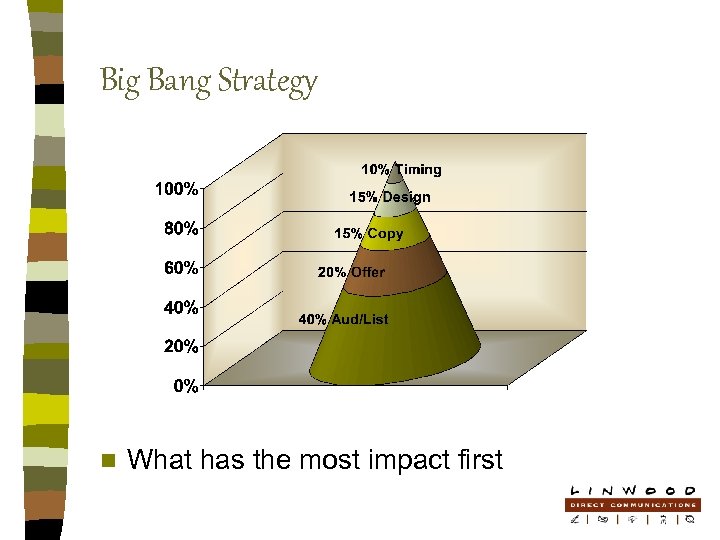
Big Bang Strategy The Audience n The Offer n The Creative/Format n n How do you weight each one’s importance § 40 – 20 (Ed Mayer) § 60 – 30 – 10 (Ray Jutkins) § 40 – 20 – 15/15 – 10 (Ron Jacobs)
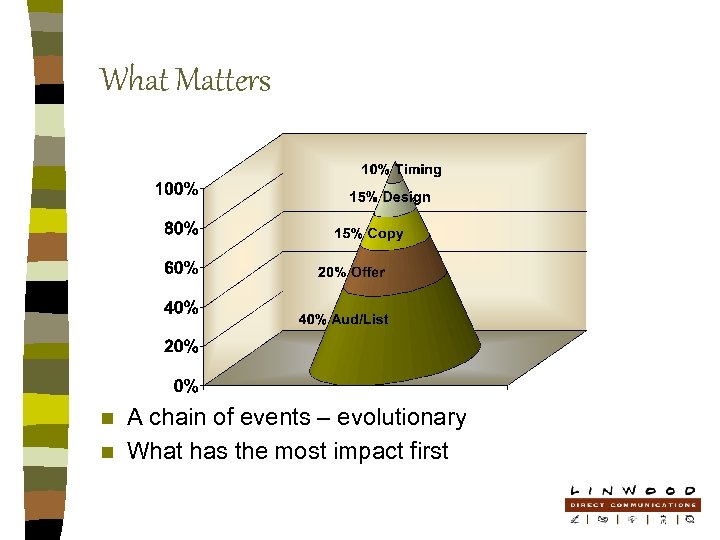
What Matters A chain of events – evolutionary n What has the most impact first n
What’s the campaign Objective n Build awareness § Company § Category § Brand Create interest n Generate leads n § How many? n Measurement criteria
The Audience n What has the most impact? § Existing customers – retention vs. acquisition § Lapsed customers § New customers n House file or cold list § Profile to find more, like your best § Requires knowing who your best customers are n Decision-makers / influencers / info-gatherers § Roles not as clear as they used to be § Companies are tougher to target – multiple hits
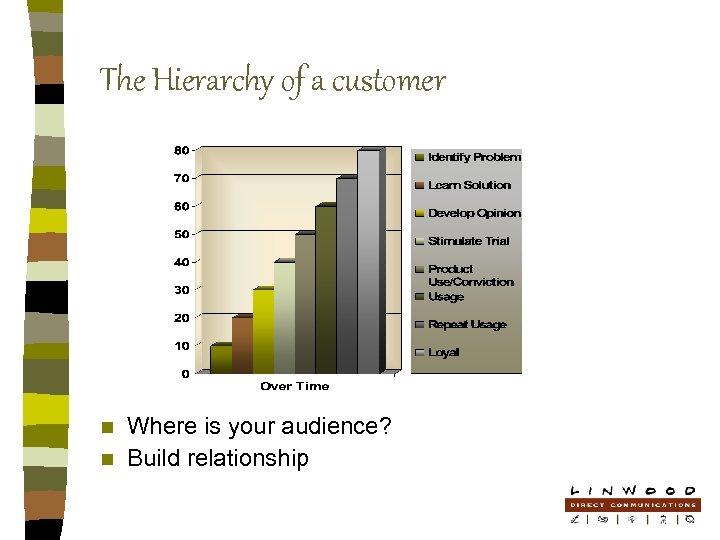
The Hierarchy of a customer Where is your audience? n Build relationship n
Touch points n A single mailing? § Most campaigns require 2 to 3 touches before they will respond to your message § 10 • 4 • 1 (mailings, telemarketing calls, sales call) n Touch in multiple ways § E-mail … phone calls … trade shows … postcards n Single step or multi-step § Lead generator and fulfillment
Audience motivations - The big five 1. Fear § 2. Avoid with insurance, financial, self-improvement and fund-raising Greed § Discounts = greed Guilt 4. Exclusivity 5. Popularity 3.
Mayer’s motivators 1. 2. 3. 4. 5. 6. 7. 8. 9. 10. 11. 12. 13. 14. To make money To save time To avoid effort To get more comfort To achieve greater cleanliness To attain fuller health To escape physical pain To gain praise To be popular To attract the opposite sex To conserve possessions To increase enjoyment To gratify curiosity 15. 16. 17. 18. 19. 20. 21. 22. 23. 24. 25. 26. To protect family To be in style To have or hold beautiful possessions To satisfy appetite To emulate others To avoid trouble To avoid criticism To be individual To protect reputation To take advantage of opportunities To have safety in buying something else To make work easier
FINDING THE BIG BENEFIT n FAB Analysis § Feature § Advantage § Benefit List features n Leverage with advantages n Position with benefits n
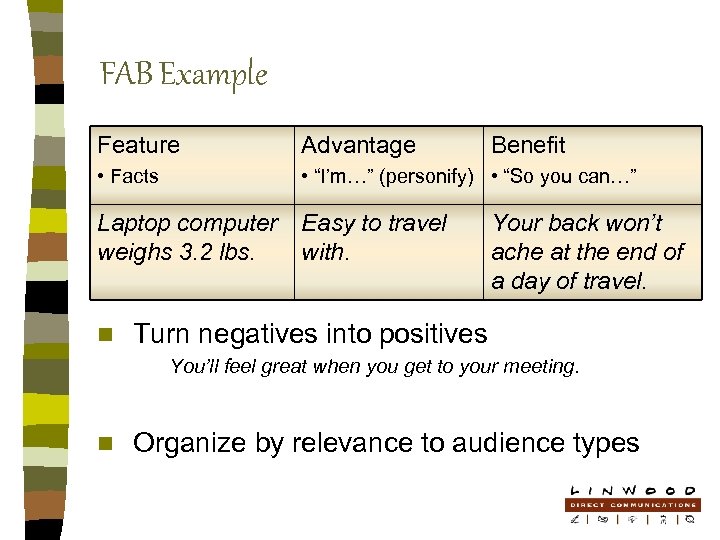
FAB Example Feature Advantage • Facts • “I’m…” (personify) • “So you can…” Laptop computer Easy to travel weighs 3. 2 lbs. with. n Benefit Your back won’t ache at the end of a day of travel. Turn negatives into positives You’ll feel great when you get to your meeting. n Organize by relevance to audience types
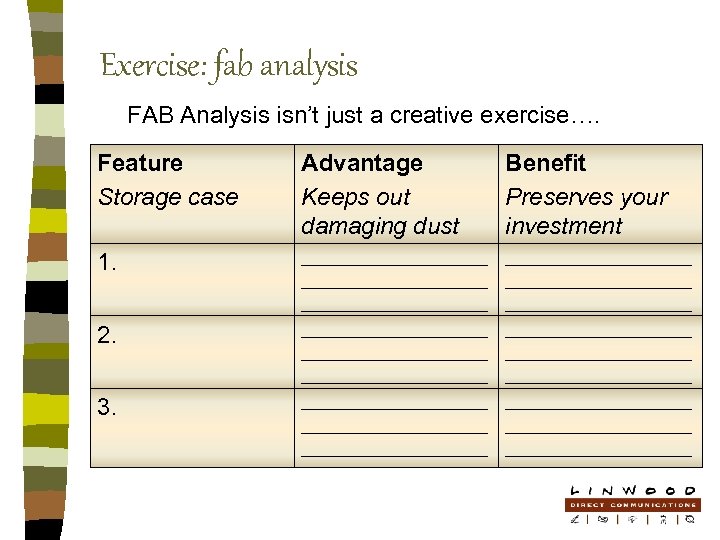
Exercise: fab analysis FAB Analysis isn’t just a creative exercise…. Feature Storage case Advantage Keeps out damaging dust Benefit Preserves your investment 1. _____________________ _____________________ 2. _____________________ _____________________ 3. _____________________ _____________________
Emotion & Logic Uncover problems n Lead with the logic, close with the emotion. n § Bus. benefits are logical (workplace benefits) § Personal benefits are emotional (recognition)
7 key offer components n What you are willing to give in return for a response 1 – Product/Service 2 – Price 3 – Unit of sale/credit/payment options 4 – Incentives 5 – Time limits 6 – Response options 7 – Guarantees
How to build an offer n Two ways 1. Relevant to product/service 2. Relevant to audience and their interests
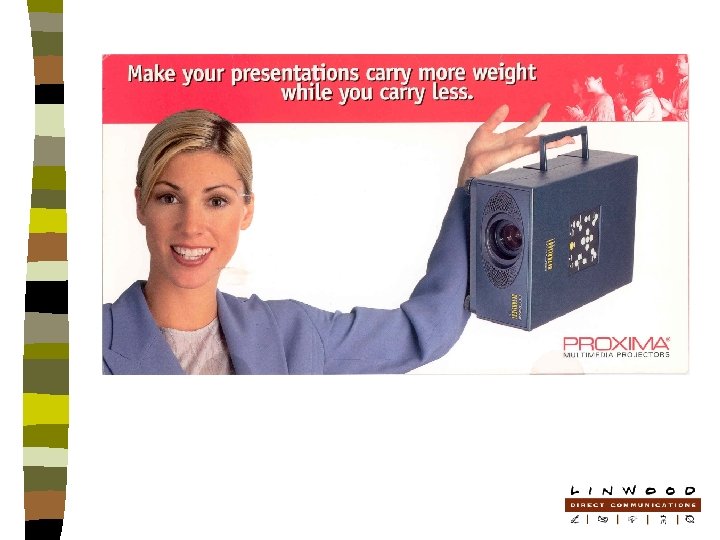
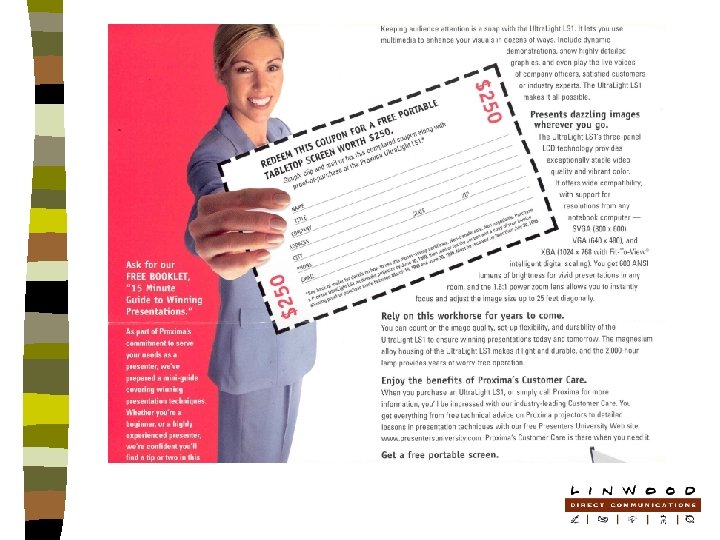
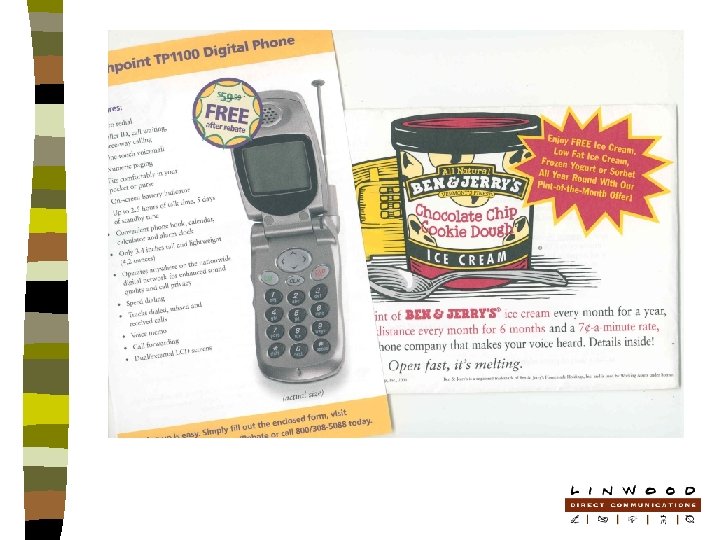
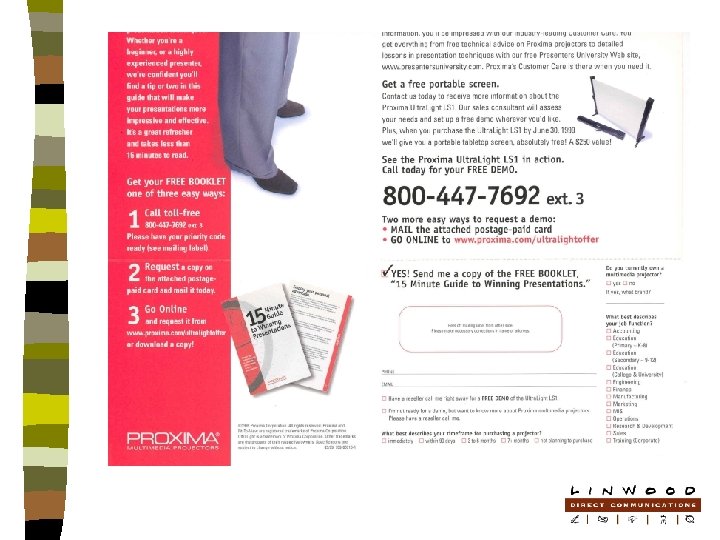
ultimate offer f. ILTERs Will this make sense to my customers/prospects? n Does the offer enhance the selling proposition? n 3 key offer attributes: n § Make it believable § Get the reader involved § Think creatively
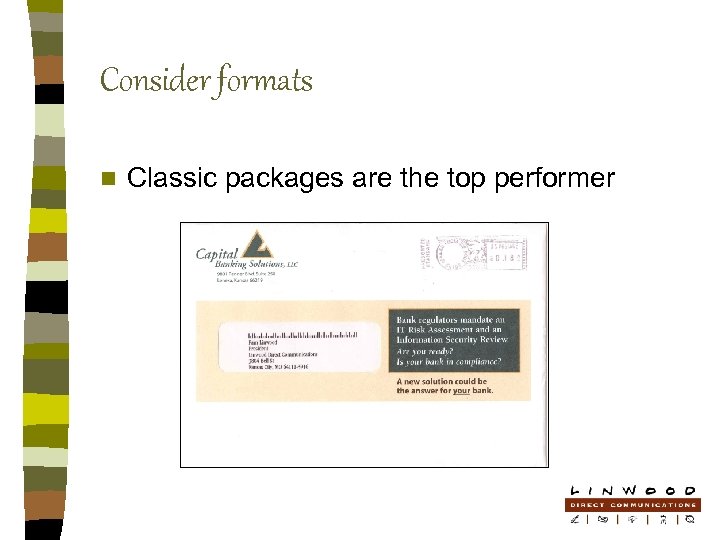
Consider formats n Classic packages are the top performer
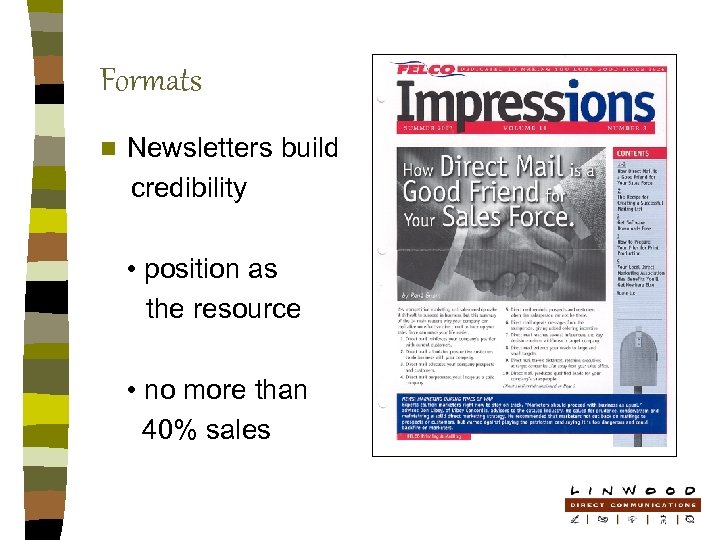
Formats n Newsletters build credibility • position as the resource • no more than 40% sales
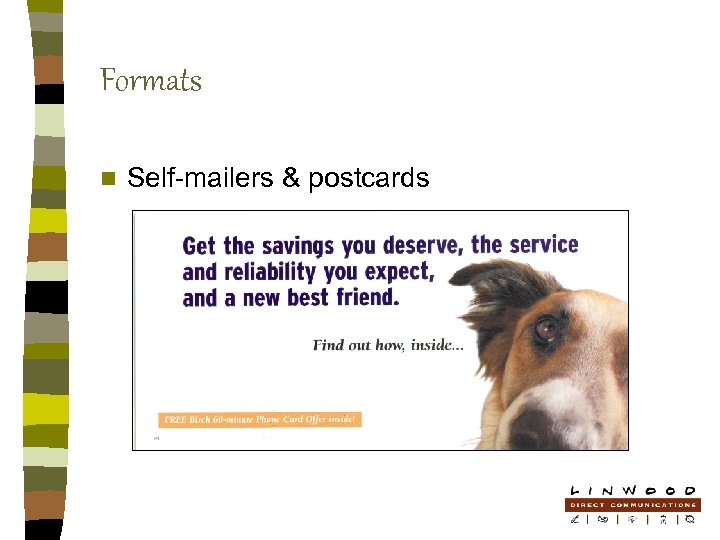
Formats n Self-mailers & postcards
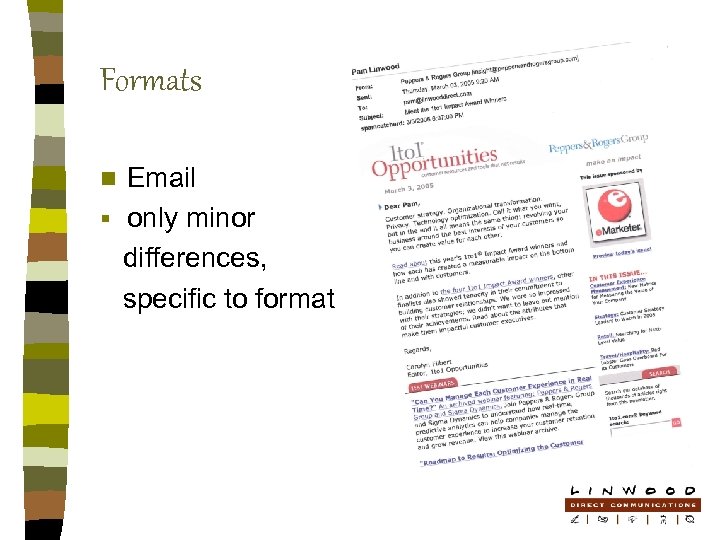
Formats Email § only minor differences, specific to format n
Timing Specific to product or company n Seasonality n When and how you contact customers, prospects is key n
What’s unique in B-to-b n This buyer wants to buy § § Always on lookout for info to advance themselves More targeted needs, not wants Will read lots of copy – wants information Stronger base of knowledge and are careful about what they buy; must be able to justify purchases
B-to-b audience n Sophisticated audience § § § High interest and understanding of your product More research required Superficial copy & over-simplification won’t work Buyers are more serious; act less on impulse Hard facts, comparisons, demonstrations, trials, test results
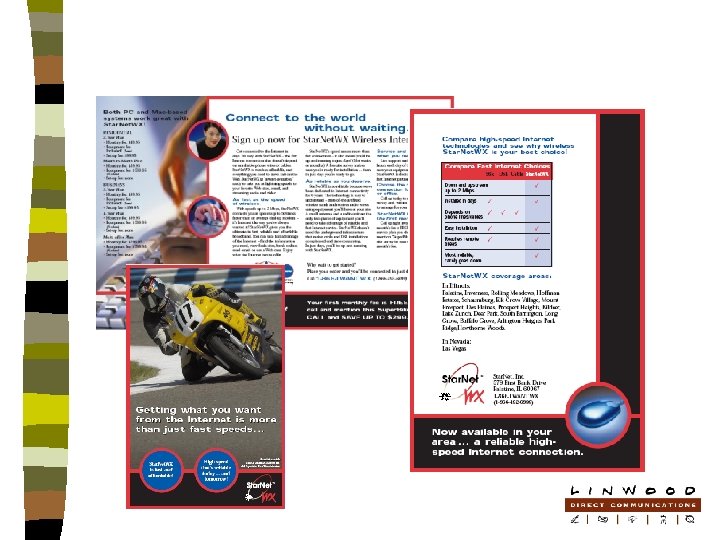
Multiples of B-to-B n Multi-steps § § n Mailing Permission emails Demonstration / trade show Sales meeting Multi-touches § Whatever it takes / what the budget can buy § Spend more on highest-propensity prospects
other multiples n Multi-audience versions § § n Multiple targets to touch, with unique positioning Versioning builds relationships; resonates Historically, look for synergies/cost-savings But the fewer the versions the more productfocused Multiple buying influences § Team effort vs. individual decision § Not an impulse buy
Suits are still people Copy does not need to be dry, hack, boring n Cloak emotion in logic – most business people take pride in logic, but respond on emotion n
Testing…with a big bang Look for ways to test n In what order? n § What has the most impact first § 40 • 20 • 15 • 10 n An evolutionary process § In direct marketing, there are no failures. Just learning experiences.
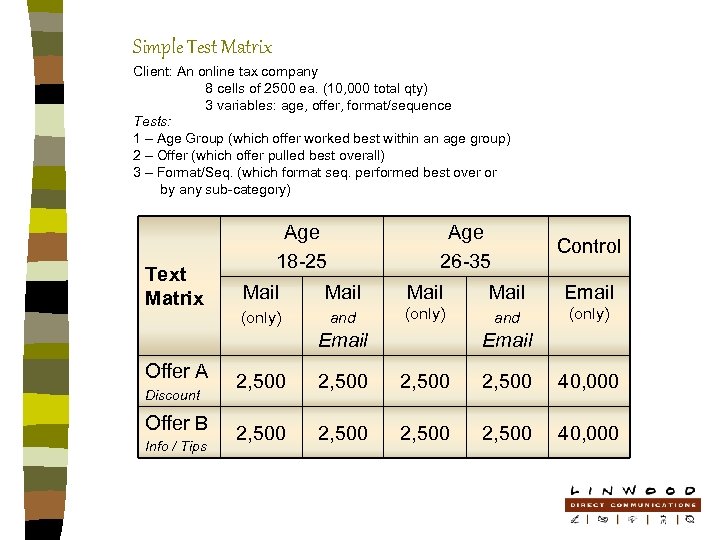
Simple Test Matrix Client: An online tax company 8 cells of 2500 ea. (10, 000 total qty) 3 variables: age, offer, format/sequence Tests: 1 – Age Group (which offer worked best within an age group) 2 – Offer (which offer pulled best overall) 3 – Format/Seq. (which format seq. performed best over or by any sub-category) Text Matrix Age 18 -25 Age 26 -35 Mail Email (only) and (only) Email Offer A Discount Offer B Info / Tips Control Email 2, 500 2, 500 40, 000
Selling your campaign n Use the Big Bang Strategy § ROI § Logical flow
Big Bang Strategy n What has the most impact first
Thank you… n Questions? Contact: Pam Linwood Direct Communications 816 -753 -2363 pam@linwooddirect. com
Скачать презентацию Big Bang The evolution of a direct
b2a057008cf3e858682b4d6428a908b3.ppt