 Скачать презентацию Beyond the MSP Project ALPHA s Strategies for Institutional
9c1651864b4a980f29933741928102e2.ppt
- Количество слайдов: 17



Beyond the MSP: Project ALPHA’s Strategies for Institutional Change CAMSP Learning Network Meeting April 4, 2011 a Algebra Preparedness for Higher Achievement
Project ALPHA Staff Dawn Esqueda and Lorena Ponciano, Math Coaches Tor Ormseth, Project Director Susanna Smith, Assistant Superintendent (PI) El Rancho USD David Pagni (Co-PI) and Harris Shultz, IHE Partners CSU Fullerton Heejeong Lim, Mark Ellis, Natalie Tran Research Team, CSU Fullerton a Algebra Preparedness for Higher Achievement
Overview • Background information • Student and teacher outcomes • Strategies for institutional change: – – – Curriculum and instruction Assessment Professional Development: Collaboration Administration Parent Partnerships a Algebra Preparedness for Higher Achievement
Project ALPHA & El Rancho USD • Cohort 1 (04 -07) & Research Cohort (08 -11) • El Rancho Unified School District: – Approximately 10, 500 students – 8 elementary, 3 middle, 2 high schools – 98% Latino, 30% EL, 68% Free/reduced lunch • Cal State Fullerton Mathematics Department • Gr. 3 -Algebra I Teachers (N=41) – 80 -hour summer intensive – 24 -hour follow-up (classroom coaching & “Math Study” meetings) a Algebra Preparedness for Higher Achievement

a Algebra Preparedness for Higher Achievement

a Algebra Preparedness for Higher Achievement

a Algebra Preparedness for Higher Achievement

a Algebra Preparedness for Higher Achievement

a Algebra Preparedness for Higher Achievement
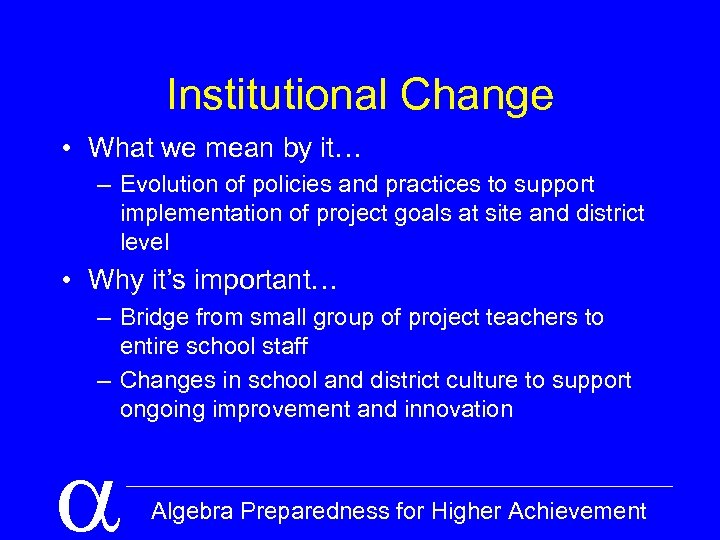
Institutional Change • What we mean by it… – Evolution of policies and practices to support implementation of project goals at site and district level • Why it’s important… – Bridge from small group of project teachers to entire school staff – Changes in school and district culture to support ongoing improvement and innovation a Algebra Preparedness for Higher Achievement
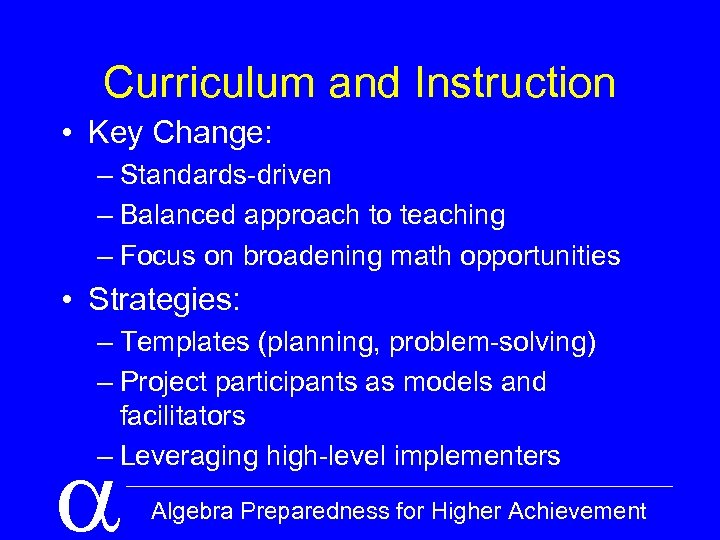
Curriculum and Instruction • Key Change: – Standards-driven – Balanced approach to teaching – Focus on broadening math opportunities • Strategies: – Templates (planning, problem-solving) – Project participants as models and facilitators – Leveraging high-level implementers a Algebra Preparedness for Higher Achievement
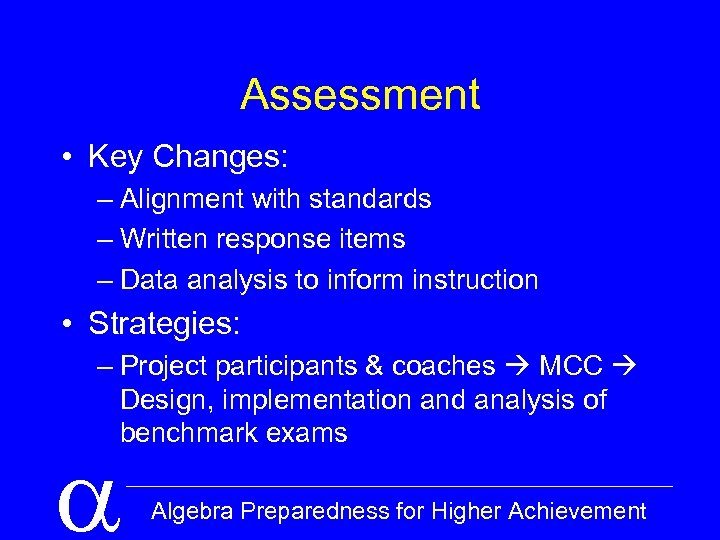
Assessment • Key Changes: – Alignment with standards – Written response items – Data analysis to inform instruction • Strategies: – Project participants & coaches MCC Design, implementation and analysis of benchmark exams a Algebra Preparedness for Higher Achievement
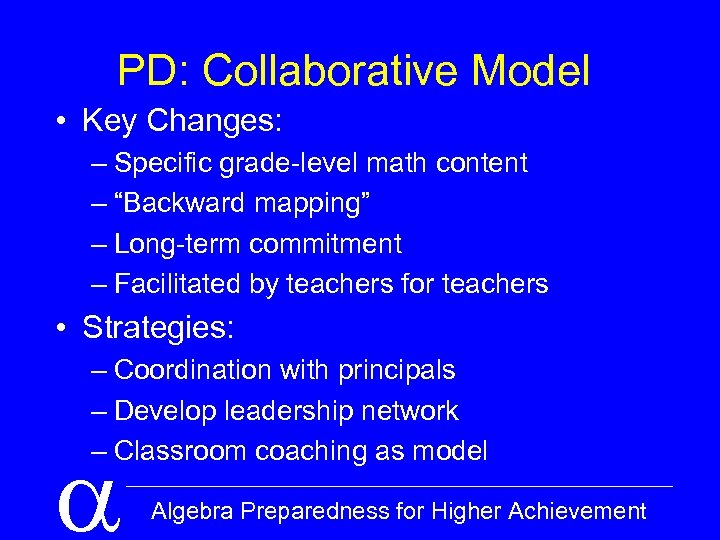
PD: Collaborative Model • Key Changes: – Specific grade-level math content – “Backward mapping” – Long-term commitment – Facilitated by teachers for teachers • Strategies: – Coordination with principals – Develop leadership network – Classroom coaching as model a Algebra Preparedness for Higher Achievement
Administration • Key Changes: – Understanding of instructional goals – Commitment to collaborative model • Strategies: – Buy-in at district level – Presentations, in-service for principals – On-going communication – Classroom observation guidelines (proposed) a Algebra Preparedness for Higher Achievement
Parent Partnership • Key Changes: – Content focus for parent involvement – Parents join teachers as facilitators of student understanding • Strategies: – Project participants develop and implement Parent Math Nights as part of follow-up hours a Algebra Preparedness for Higher Achievement
3 -Year Institutional Change Strategy • Summer Institute Leadership Strand: – Year 1: Teachers learn – Year 2: Teachers learn about sharing – Year 3: Teachers share • Organizational Strategies: – Mathematics Curriculum Council – Coordination with administrators – Communication: Website and newsletter a Algebra Preparedness for Higher Achievement

Discussion a Algebra Preparedness for Higher Achievement
Скачать презентацию Beyond the MSP Project ALPHA s Strategies for Institutional
9c1651864b4a980f29933741928102e2.ppt