 Скачать презентацию Beyond the Checkbox Quick Easy Assessments Kristen
74c543c3e7244bddd28884078a983fd4.ppt
- Количество слайдов: 24



Beyond the Checkbox: Quick & Easy Assessments! Kristen Renée Lindsay, Ph. D. Director of Advising & Student Success Terra State Community College
Participant Learning Outcomes • You will experience increased comfort and awareness of implementing simple assessments • You will gain an understanding of developing a quick assessment tool that does not look like a traditional survey • You will gain experience in creating an assessment for a specific program / service • You will be able to identify at least three different tools / resources that are available to build your assessment repertoire
Using Quick & Easy Assessments • These ideas can jumpstart your assessment • Simple ideas are great for gathering; great for personal anecdotes in reports; great for laying groundwork • Use quick assessments to figure out what to most appropriately include on a more formal survey • Combine direct & indirect measurements; use both words (qualitative) and numbers (quantitative) • Use them formative (shape / modify) rather than summative (identify improvements or report out) assessment
Importance of Assessment • Commitment to continuous improvement • Track where you have been (baseline) & forecast where you want to go (growth) • Your supervisor and the president and the Board of Trustees want more than just numbers • Because you are asked to justify your existence on a daily basis • Additional reasons assessment is important to you?
Effective Program Assessment • Systematic… an orderly and open method of acquiring assessment information over time. • Built around the mission statement or learning outcomes… an integral part of the department or program. • Ongoing and cumulative… over time, assessment efforts build a body of evidence to improve programs. • Multi-faceted. . . assessment information is collected on multiple dimensions, using multiple methods and sources. • Pragmatic… assessment is used to improve the campus environment, not simply collect stuff and file it away. • Staff-designed and implemented… not imposed from the top down. Adapted from California State University-Chico, Assessment Plan (1998) and Ball State University, Assessment Workbook (1999).
Good Assessment = Can Be More Than a Survey • Everyone – staff and students – are burnt out on surveys (Lipka, 2011) • Quality information should be collected in a variety of ways, from a variety of sources, to provide an accurate picture of program delivery, program implementation, or plain old program satisfaction that respects the time and energy of the students and staff in developing and participating in assessments (Wise & Barham, 2012) • Practitioners should consider quantitative, qualitative, and mixed-methods, incorporating both direct and indirect measures of learning, ensuring that people know their voices matter (Wise & Barham, 2012)
What to Assess? • Learning outcomes (individual level knowledge or skill) • Operational outcomes (department level metrics such as # of participants, utility usage/cost, resource expenditures, cost/student analysis, etc. ) • Program outcomes (population level outcomes such as retention, level of engagement, smoking rate, etc. ) ALL THREE ARE VALID!!!
“Small Wins” Theory • Karl Weick, an organizational theorist, introduced the concept of “small wins” to the field of organizational development in the 1980’s • The concept is intended to refocus perceptions of social problems, specifically when the daunting enormity of problems contributes to high stress levels • Can be used to translate a destined-to-be-covered-with-duston-a-bookshelf-strategic-assessment-binder into small, manageable, executable daily tasks that are user-friendly at various staffing levels • The small win is not an easy victory or a quick one-time fix, but a continuous application of small advantages • It reminds me of the “starfish story”….
Station Break
What’s on Your Mind About Assessment? Question Query Consternation Confusion Apprehension Cerebration Musing Fear Aggravation Reflection Erudition Collaboration Triumph Solution Hesitation Celebration Random Thought
Assessment Can Be Quick & Easy! • Visual observation of participants (create a rubric and check the boxes) at a majors fair • Direct collection (Fear in a Hat: collect the topics students are apprehensive about) at orientation • Ranking (what did you understand most or least) following a group advising session • Pro & con list in a time management seminar • Online assessment that includes pictures instead of words
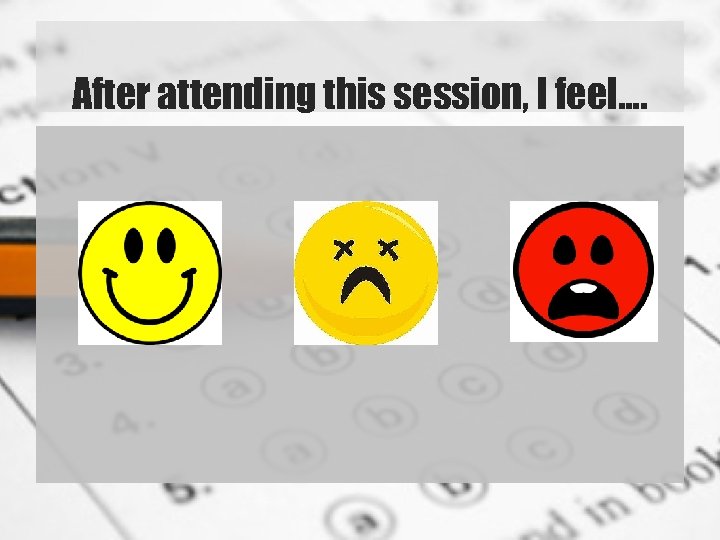
After attending this session, I feel….
More Quick & Easy Ideas! • Word journal (pick a word; explain why you selected it) as part of an FYE class • Muddiest point (what are you still cloudy about? ) during student worker training • Application card (explain how you will apply a strategy in writing) during a group advising workshop • Review tweets or Instagram or Snapchat or Facebook posts during a transfer fair • Thumbs “up / straight / down” during tutoring
Even More Quick & Easy Ideas! • Minute reflection (beginning and end) of a deciding student workshop • Monthly random satisfaction questionnaire (pick a day… three questions max… sneak in a learning outcomes question) shared with each visitor to the office • Poll (all the students in line) at a majors fair or in the dining hall or bookstore • Take a vote during a group session • Show of hands (instant assessment) in a group
Survey Example QUESTION: Do students like the weekly nondenominational worship service? • Electronic survey was actually the best option • One demographic question (built in Org. Lin; system made this possible) – Have you attended a program or not? • Limited number of questions – Which learning outcome does this weekly event best achieve? – How do you feel about the length of the program? – Do you have any topic suggestions for future programs? • Responses collected from approximately 10% of the campus population (N = 1200)
Quantitative v. Qualitative • Numbers are easy… but not as descriptive • Survey Monkey… Google Forms… so many easily accessible online formats available • Mixed methods approach is very attractive • Qualitative data is descriptive… but can be overwhelming and scary
Coding Isn’t That Difficult
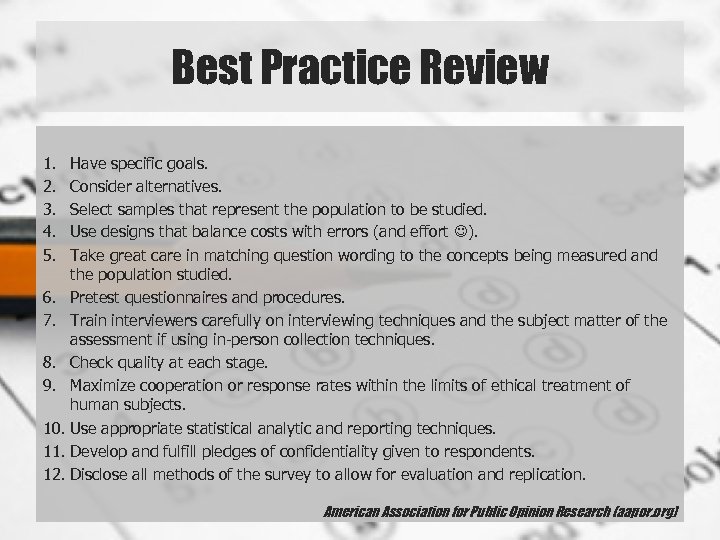
Best Practice Review 1. 2. 3. 4. 5. 6. 7. 8. 9. 10. 11. 12. Have specific goals. Consider alternatives. Select samples that represent the population to be studied. Use designs that balance costs with errors (and effort ). Take great care in matching question wording to the concepts being measured and the population studied. Pretest questionnaires and procedures. Train interviewers carefully on interviewing techniques and the subject matter of the assessment if using in-person collection techniques. Check quality at each stage. Maximize cooperation or response rates within the limits of ethical treatment of human subjects. Use appropriate statistical analytic and reporting techniques. Develop and fulfill pledges of confidentiality given to respondents. Disclose all methods of the survey to allow for evaluation and replication. American Association for Public Opinion Research (aapor. org)
Station Break
Your Turn!!! • Select a program or service! • Affirm the learning outcomes! • Identify the important questions! – What can you actually change? – Who do you want to solicit? – Why do you want to know from this population? • Brainstorm potential assessment formats / strategies!
Communicating Results Internal Audience (Board of Trustees, Supervisor, Colleagues) q Informal Report q Formal Summary q Fall Semester Newsletter q Workshop Request Advertisement q Incorporate Results into Publicity q Orientation Presentation q Welcome Week Presentation q Admission Open House Presentations External Audience (Parents, Employers, Colleagues) q Report Available on Web q Conference Presentations
Online Resources • NILOA: www. learningoutcomesassessment. org/ – Links to articles, monthly featured website, resource library • Internet Resources for Higher Education Outcomes Assessment: www. assessmentcommons. org/ • UCONN’s Assessment Website: http: //assessment. uconn. edu/what/index. html • Center for the Study of Student Life at The Ohio State University: http: //cssl. osu. edu/cssl-reports/reports-bytopic-area/student-learning/
Did I Achieve The Outcomes? • Increased comfort / awareness? (Show of Hands) • Experience creating an assessment? (Thumbs) • Developing an assessment that isn’t a survey? (Smile or Frown) • Three tools / resources? (Fingers)
Additional Featured Resources • Dodge, J. (2009). 25 quick formative assessments for a differentiated classroom. New York: Scholastic. • Angelo, T. A. , & Cross, K. P. (1993). Classroom assessment techniques: A handbook for college Teachers. • American Association for Public Opinion Research. (2017). Best practices for survey research. Found at http: //www. aapor. org/Standards-Ethics/Best. Practices. aspx
Скачать презентацию Beyond the Checkbox Quick Easy Assessments Kristen
74c543c3e7244bddd28884078a983fd4.ppt