 Скачать презентацию Beyond misunderstanding Linguistic analysis of International business communication
db1ab3f070926cadff1ca2aa269026b1.ppt
- Количество слайдов: 20



Beyond misunderstanding. Linguistic analysis of International business communication Jan D. ten Thije Universiteit van Utrecht J. D. ten. Thije@uu. nl http: //www. let. uu. nl/~Jan. ten. Thije/personal/index. html
Structure l Beyond misunderstanding – the linguistic analyses of 1. 2. 3. l discursive interculture perspectivizing cultures receptive multilingualism Conclusions
Approaches to intercultural discourse Clyne 1994, Bührig / ten Thije 2005 l l l Contrastive Approach compares native discourse across cultures Interlanguage Approach examines the discourse of non natives in a second language. Interactive Inter cultural Approach concentrates on the discourse of people of different cultural and linguistic backgrounds
Pitfalls in interactive intercultural studies Koole & ten Thije 1994 l l ‘Minimum object’: reduction of intercultural communication to misunderstandings ‘Maximum interpretation’: explanation of too many discourse phenomena from the intercultural relationship between the speakers involved.
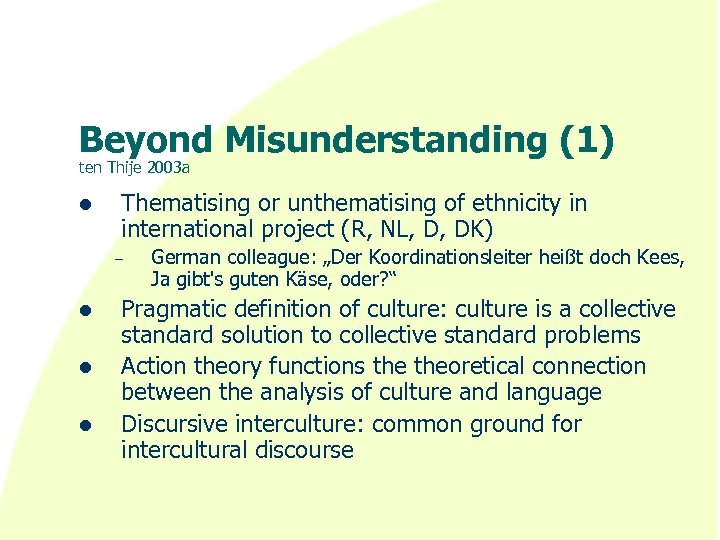
Beyond Misunderstanding (1) ten Thije 2003 a l Thematising or unthematising of ethnicity in international project (R, NL, D, DK) – l l l German colleague: „Der Koordinationsleiter heißt doch Kees, Ja gibt's guten Käse, oder? “ Pragmatic definition of culture: culture is a collective standard solution to collective standard problems Action theory functions theoretical connection between the analysis of culture and language Discursive interculture: common ground for intercultural discourse
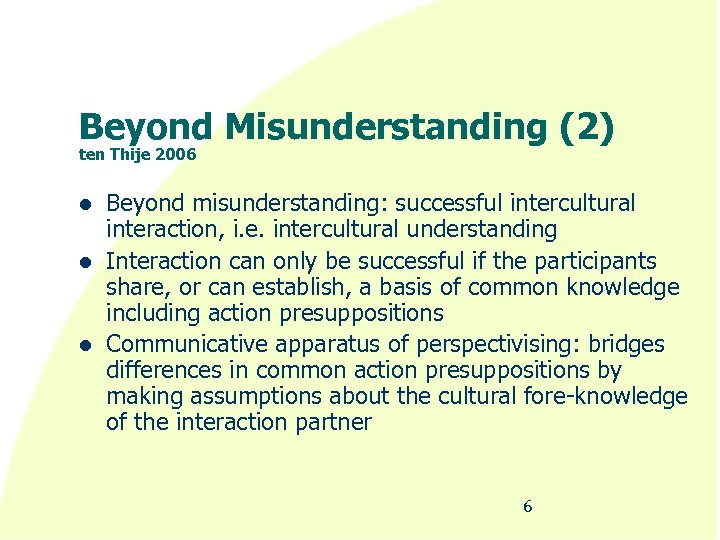
Beyond Misunderstanding (2) ten Thije 2006 l l l Beyond misunderstanding: successful intercultural interaction, i. e. intercultural understanding Interaction can only be successful if the participants share, or can establish, a basis of common knowledge including action presuppositions Communicative apparatus of perspectivising: bridges differences in common action presuppositions by making assumptions about the cultural fore knowledge of the interaction partner 6
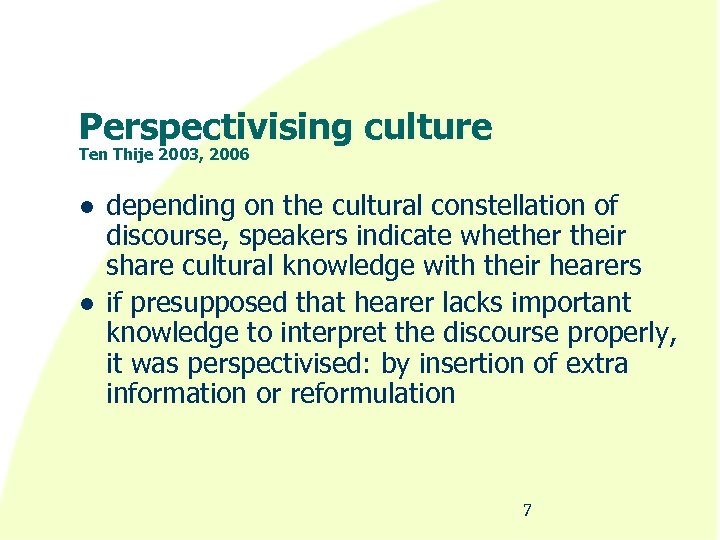
Perspectivising culture Ten Thije 2003, 2006 l l depending on the cultural constellation of discourse, speakers indicate whether their share cultural knowledge with their hearers if presupposed that hearer lacks important knowledge to interpret the discourse properly, it was perspectivised: by insertion of extra information or reformulation 7
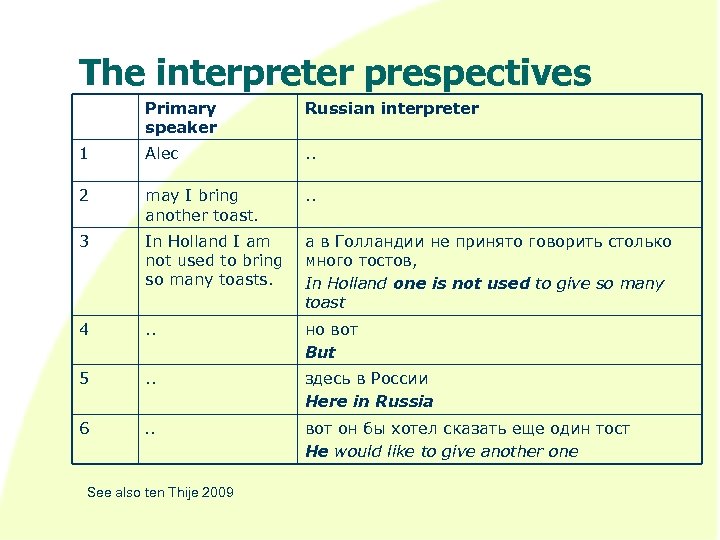
The interpreter prespectives Primary speaker Russian interpreter 1 Alec . . 2 may I bring another toast. . . 3 In Holland I am not used to bring so many toasts. а в Голландии не принято говорить столько много тостов, In Holland one is not used to give so many toast 4 . . но вот But 5 . . здесь в России Here in Russia 6 . . вот он бы хотел сказать еще один тост He would like to give another one See also ten Thije 2009
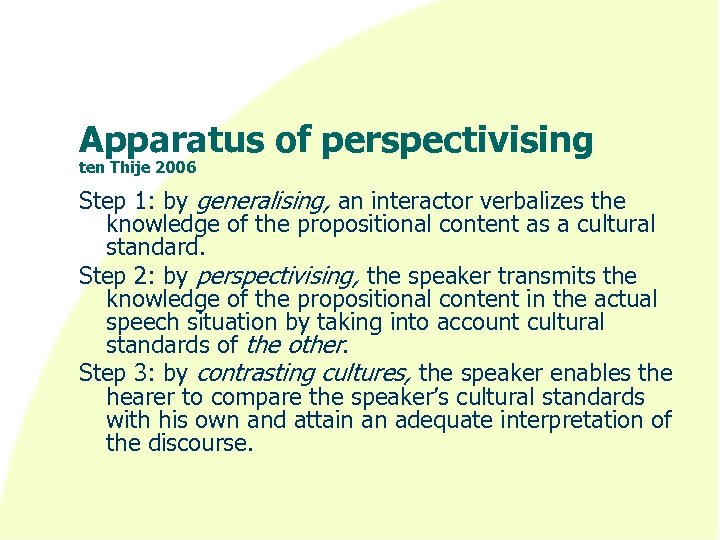
Apparatus of perspectivising ten Thije 2006 Step 1: by generalising, an interactor verbalizes the knowledge of the propositional content as a cultural standard. Step 2: by perspectivising, the speaker transmits the knowledge of the propositional content in the actual speech situation by taking into account cultural standards of the other. Step 3: by contrasting cultures, the speaker enables the hearer to compare the speaker’s cultural standards with his own and attain an adequate interpretation of the discourse.
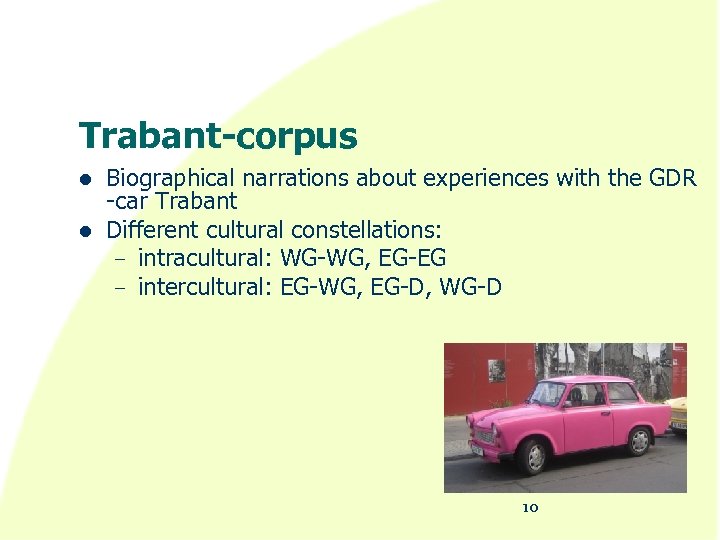
Trabant-corpus l l Biographical narrations about experiences with the GDR car Trabant Different cultural constellations: – intracultural: WG WG, EG EG – intercultural: EG WG, EG D, WG D 10
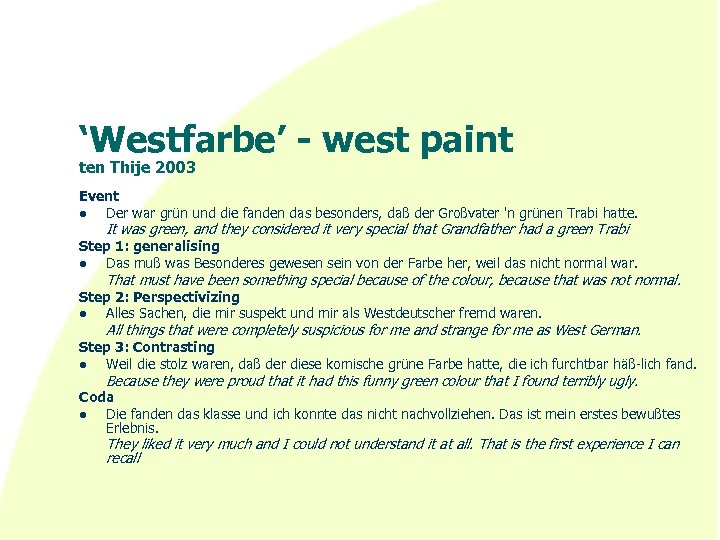
‘Westfarbe’ - west paint ten Thije 2003 Event l Der war grün und die fanden das besonders, daß der Großvater 'n grünen Trabi hatte. It was green, and they considered it very special that Grandfather had a green Trabi Step 1: generalising l Das muß was Besonderes gewesen sein von der Farbe her, weil das nicht normal war. That must have been something special because of the colour, because that was not normal. Step 2: Perspectivizing l Alles Sachen, die mir suspekt und mir als Westdeutscher fremd waren. All things that were completely suspicious for me and strange for me as West German. Step 3: Contrasting l Weil die stolz waren, daß der diese komische grüne Farbe hatte, die ich furchtbar häß lich fand. Because they were proud that it had this funny green colour that I found terribly ugly. Coda l Die fanden das klasse und ich konnte das nicht nachvollziehen. Das ist mein erstes bewußtes Erlebnis. They liked it very much and I could not understand it at all. That is the first experience I can recall
Beyond Misunderstanding (3) ten Thije & Zeevaert 2006 l l l Receptive multilingualism: speaking your own language is the ultimate mode of intercultural discourse Institutional key words as common ground: zaterduitsdag (‘Sater german day’) Receptive multilingualism is an alternative for English as lingua franca in Europe
Receptive multilingualism Ribbert & ten Thije 2006, Beerkens et al 2009 l Case study im Goethe Institute Amsterdam – – l Dutchman: "It is much easier. I can express myself more easily and more precisely with respect to important details or when I am joking. It costs less energy, less effort, less reflection and I can react instantly. " German: “When everybody is allowed to speak his first language, democracy comes into being. " Case study Dutch German border
Lingua Receptiva ten Thije, Rehbein, Verschik 2009 l l A Lingua Receptiva is a vehicle for effective communication between members of diverse language communities while using different languages simul taneously to reach mutual understanding. The research questions focus on adequate La. Ra communication strategies and on coping with potential conflict constellations in specific settings, as border regions, institutional discourse, and cross generational commu nication, including basic abilities.
Research designs to go beyond misunderstanding l l l L 1 vs. L 2 cross cultural pragmatics C 1 ICC 1/2 C 2: contrasting intercultural discourse with cultures involved ICC 1/2 – ICC 1/3: Reconstruction of interculturality by comparing two different intercultural discourse
Conclusions l l l Intercultural communication is not an automatism Distinguish between institutional and intercultural discourse Achieving intercultural purposes – – – (un)thematising ethnicity Perspectivising culture Interlingual understanding
References l l l l Bührig, K / Thije, J. D. ten (eds. ) (2006). Beyond Misunderstanding. Linguistic analyses of intercultural communication. Amsterdam: Benjamins. Bührig, K. / Thije, J. D. ten (2005) Diskurspragmatische Beschreibung (HSK 123) In: Ammon, U. , Dittmar, N. / Mattheier, K. (eds. ). Sociolinguistics Soziolinguistik. An international Handbook of the Science of Language and Society. (2. bearbeitete Auflage, Teil 2) Berlin: Mouton, 1225 1250. Beerkens, R. , Griesshaber, W. Missine, Thije, J. D. ten (to appear) Receptive Multilingualism in the Dutch German border area. A comparison between intercultural discourse in civil society organisations and governmental organizations. In: J. D. ten Thije, J. Rehbein, A. Verschik (eds. ) Receptive Multilingualism. Special issue of International Journal for Bilingualism. Clyne, M. (2003) Towards inter cultural communication in Europe without linguistic homogenization. In: De Cillia, R. (et al) (eds. ) Die Kos ten der Mehrsprachigkeit. Globalisierung und sprachliche Vielfalt; The Cost of Multilingualism. Globalisation and Linguistic Diversity. Wien: Verlag der Österreichischen Akademie der Wissenschaften, 39 49. Koole, T. / Thije, J. D. ten (1994). The Construction of Intercultural Discourse. Team Discussion of Educational Advisers. Amsterdam / Atlanta: RODOPI. Porila, A. / Thije, J. D. ten (2008) Gesprächsfibel für interkulturelle Kommunikation in Behörden. München: Meidenbauer Ribbert, A. / Thije, J. D. ten (2006) Rezeptive Mehrsprachigkeit und interkulturelle Kommunikation am Arbeitsplatz. In: Meyer, B. & Kameyama, S. (eds. ). Mehrsprachigkeit am Arbeitsplatz. Frankfurt: Lang, Sarangi, S. (1995) Culture. In: Verschueren, J. / Östman, J. O. / Blommaert, J. (Eds. ) (1995). Handbook of Pragmatics Manual. Amsterdam: Benjamins.
References l l l l Thije, J. D. ten (2002). Stufen des Verstehens bei der Interpretation von interkulturellen Diskursen. In: Kotthoff, H. (Ed. ). Kultur(en) im Gespräch. Gunter Narr Verlag. Tübingen, 61 98. Thije, J. D. ten (2003 a) The Transition from Misunderstanding to Understanding in Intercultural Communication. In L. I. Komlosi, P. Houtlosser / M. Leezenberg (Eds. ), Communication and Culture. Argumentative, Cognitive and Linguistic Perspectives. Amsterdam: Sic Sac, 197 213. Thije, J. D. ten (2003 b). Eine Pragmatik der Mehrsprachigkeit. Zur Analyse diskursiver Interkulturen. In: De Cillia, R. , Krumm, J. / Wodak, R. (Eds)‚ Die Kosten der Mehrsprachigkeit/ Globalisierung und sprachliche Vielfalt / The Cost of Multilingualism. Globalisation and Linguistic Diversity. Wien, 101 123. Thije, J. D. ten (2006) The notion of 'perspective' and 'perspectivising' in intercultural communication research. In: K. Bührig / J. D. ten Thije (Eds. ) Beyond Misunderstanding. The linguistic analysis of intercultural communication. Amsterdam: Benjamins, 97 153. Thije, J. D. ten (2009) The self retreat of the interpreter: An analysis of teasing and toasting in intercultural discourse. In K. Bührig, J. House and JD ten Thije (eds), Translatory action and intercultural communication. Manchester: St. Jerome, 114 155. Thije, J. D. ten / Zeevaert, L. (eds. ) (2007) Receptive Multilingualism and intercultural communication (Hamburg Studies in Multilingualism). Amsterdam: Benjamins. Thije, J. D. ten / J. Rehbein, A. Verschik (eds. ) (to appear) Receptive Multilingualism. Special issue of International Journal for Bilingualism

Beyond misunderstanding (4) (ten Thije 2009) l Non professional interpretation l The retreat of the interpreter Toasting and teasing in intercultural discourse Changing the participant format in order to guarantee intercultural understanding Functional equivalence and Dilated speech situation l l l
Скачать презентацию Beyond misunderstanding Linguistic analysis of International business communication
db1ab3f070926cadff1ca2aa269026b1.ppt