 Скачать презентацию Beyond LHC The Path towards Future Linear Colliders
daaa25a4ea63d5217c84bc0562d8912a.ppt
- Количество слайдов: 41



Beyond LHC The Path towards Future Linear Colliders Roger Ruber Dept. of Physics and Astronomy Div. of Nuclear and Particle Physics 22 -Jun-2010 Dept. of Physics and Astronomy Uppsala University, Sweden Beyond LHC The Path Towards Future Linear Colliders
Outline This lecture • technologies for a future linear collider • highlights of related research Sections 1. circular versus linear colliders 2. accelerating gradient 3. radio frequency power generation 4. R&D projects for a future linear collider 22 -Jun-2010 Roger Ruber - Beyond LHC: the path towards future linear colliders 2
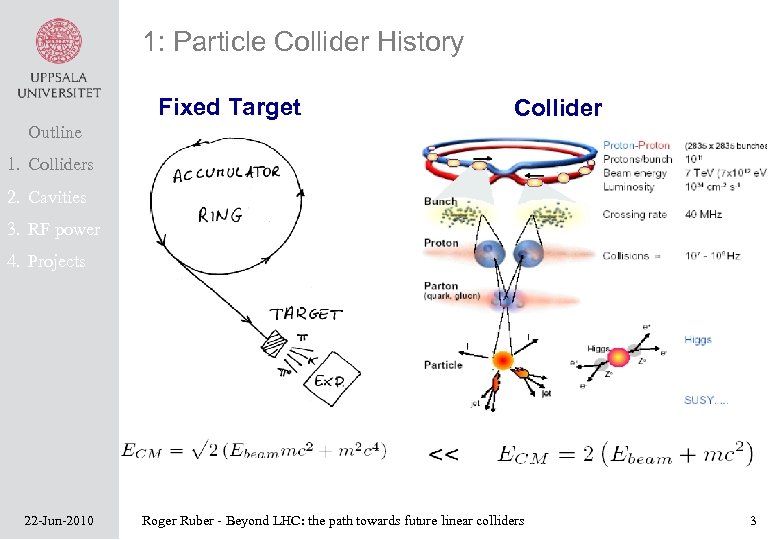
1: Particle Collider History Fixed Target Collider Outline 1. Colliders 2. Cavities 3. RF power 4. Projects 22 -Jun-2010 Roger Ruber - Beyond LHC: the path towards future linear colliders 3
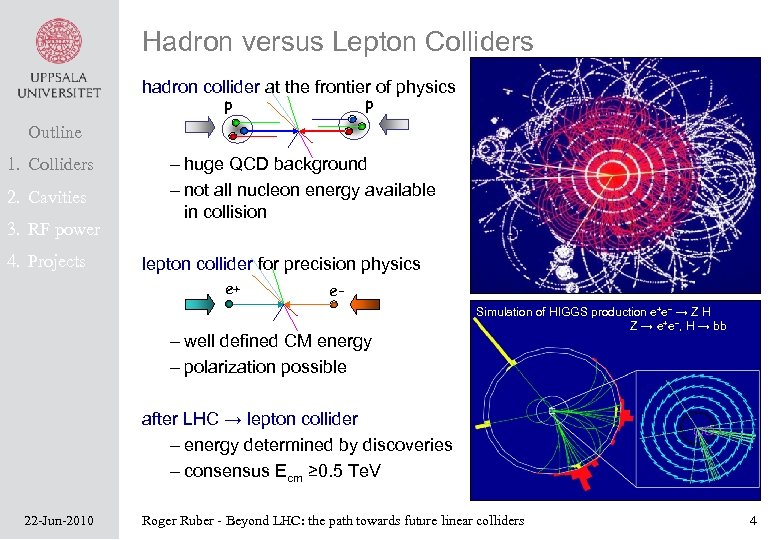
Hadron versus Lepton Colliders hadron collider at the frontier of physics p p Outline 1. Colliders 2. Cavities 3. RF power 4. Projects – huge QCD background – not all nucleon energy available in collision lepton collider for precision physics e+ e- – well defined CM energy – polarization possible Simulation of HIGGS production e+e– → Z H Z → e+e–, H → bb after LHC → lepton collider – energy determined by discoveries – consensus Ecm ≥ 0. 5 Te. V 22 -Jun-2010 Roger Ruber - Beyond LHC: the path towards future linear colliders 4
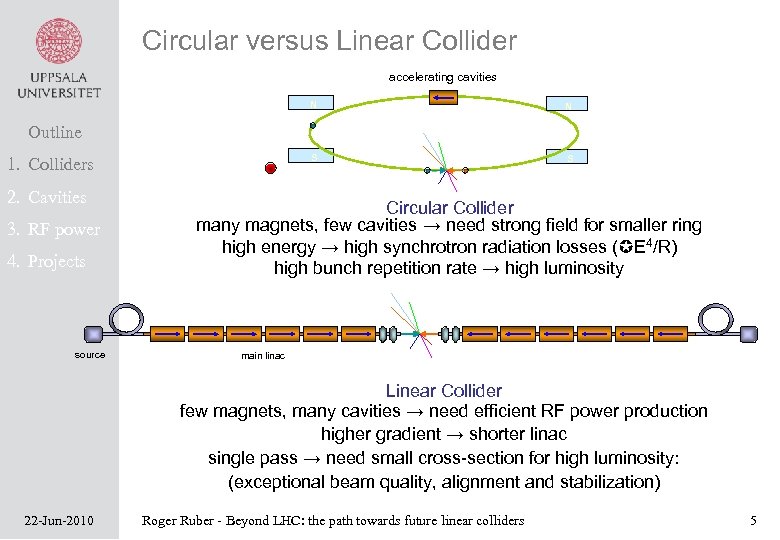
Circular versus Linear Collider accelerating cavities N N S S Outline 1. Colliders 2. Cavities 3. RF power 4. Projects source Circular Collider many magnets, few cavities → need strong field for smaller ring high energy → high synchrotron radiation losses ( E 4/R) high bunch repetition rate → high luminosity main linac Linear Collider few magnets, many cavities → need efficient RF power production higher gradient → shorter linac single pass → need small cross-section for high luminosity: (exceptional beam quality, alignment and stabilization) 22 -Jun-2010 Roger Ruber - Beyond LHC: the path towards future linear colliders 5
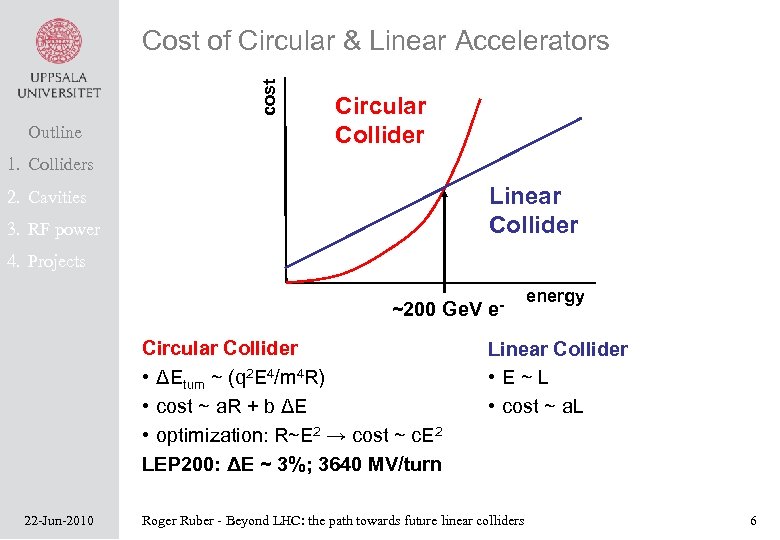
cost Cost of Circular & Linear Accelerators Outline Circular Collider 1. Colliders Linear Collider 2. Cavities 3. RF power 4. Projects ~200 Ge. V e. Circular Collider • ΔEturn ~ (q 2 E 4/m 4 R) • cost ~ a. R + b ΔE • optimization: R~E 2 → cost ~ c. E 2 LEP 200: ΔE ~ 3%; 3640 MV/turn 22 -Jun-2010 energy Linear Collider • E~L • cost ~ a. L Roger Ruber - Beyond LHC: the path towards future linear colliders 6
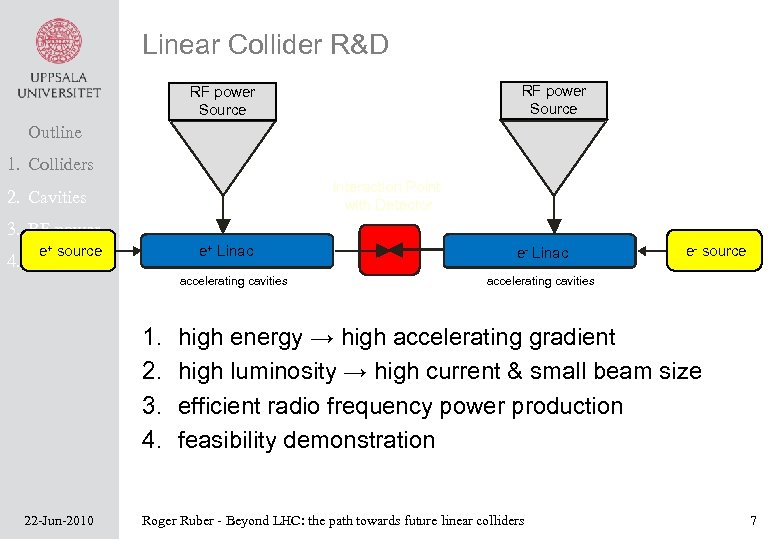
Linear Collider R&D RF power Source Outline 1. Colliders Interaction Point with Detector 2. Cavities 3. RF power e+ Linac e+ source 4. Projects accelerating cavities 1. 2. 3. 4. 22 -Jun-2010 e- Linac e- source accelerating cavities high energy → high accelerating gradient high luminosity → high current & small beam size efficient radio frequency power production feasibility demonstration Roger Ruber - Beyond LHC: the path towards future linear colliders 7
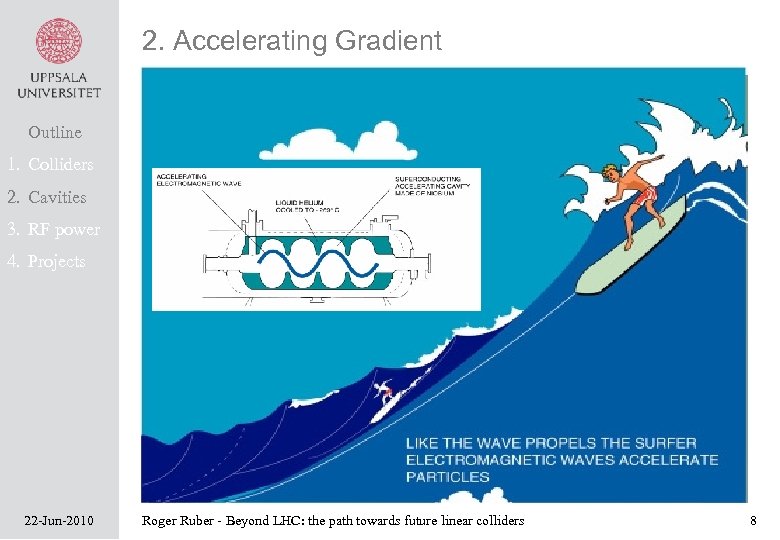
2. Accelerating Gradient Outline 1. Colliders 2. Cavities 3. RF power 4. Projects 22 -Jun-2010 Roger Ruber - Beyond LHC: the path towards future linear colliders 8
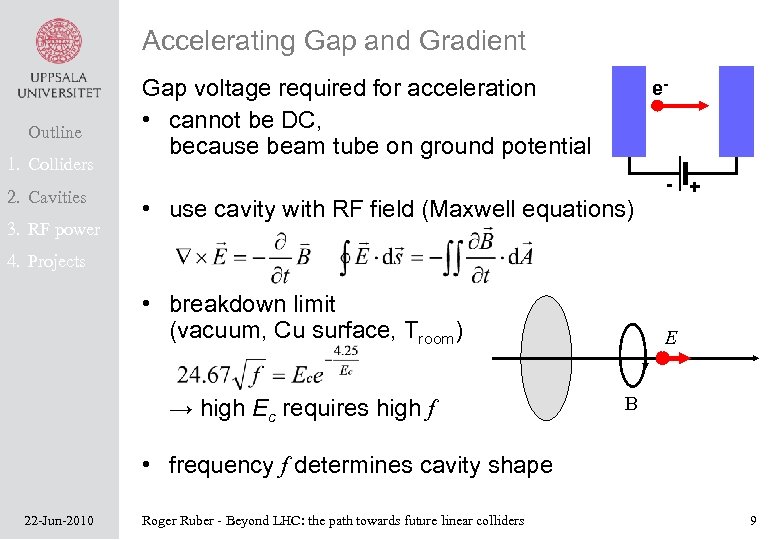
Accelerating Gap and Gradient Outline 1. Colliders 2. Cavities 3. RF power Gap voltage required for acceleration • cannot be DC, because beam tube on ground potential e- • use cavity with RF field (Maxwell equations) - + 4. Projects • breakdown limit (vacuum, Cu surface, Troom) → high Ec requires high f E B • frequency f determines cavity shape 22 -Jun-2010 Roger Ruber - Beyond LHC: the path towards future linear colliders 9
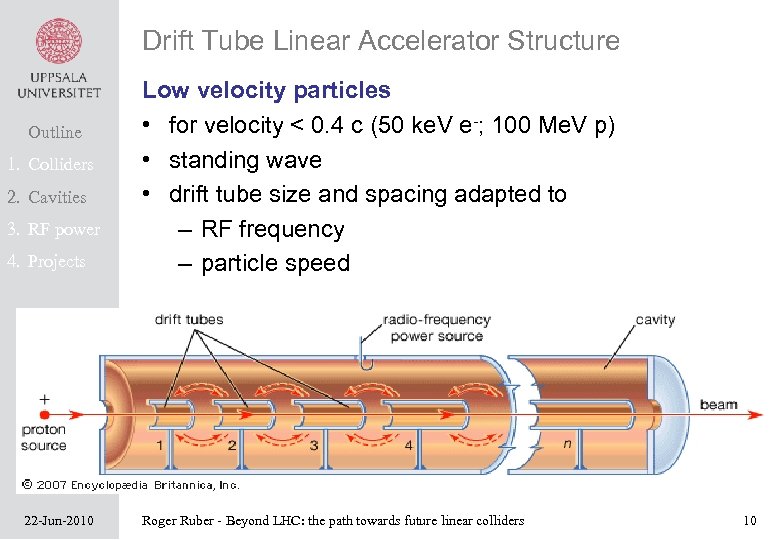
Drift Tube Linear Accelerator Structure Outline 1. Colliders 2. Cavities 3. RF power 4. Projects 22 -Jun-2010 Low velocity particles • for velocity < 0. 4 c (50 ke. V e-; 100 Me. V p) • standing wave • drift tube size and spacing adapted to – RF frequency – particle speed Roger Ruber - Beyond LHC: the path towards future linear colliders 10
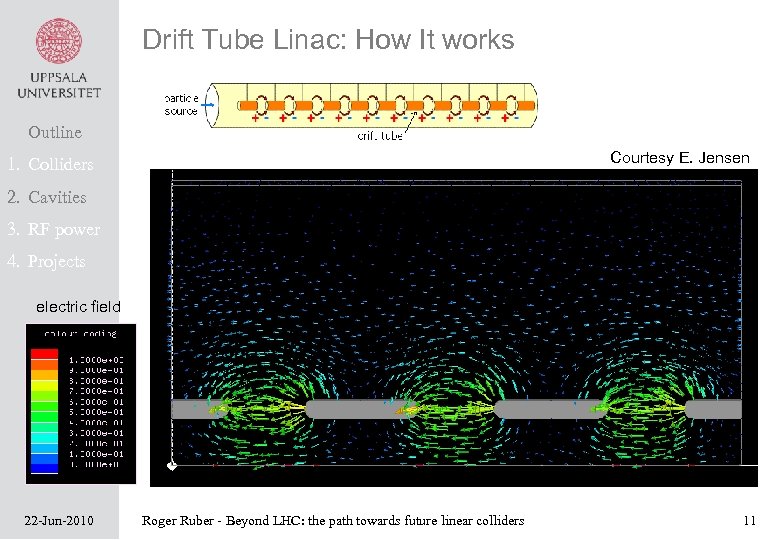
Drift Tube Linac: How It works Outline Courtesy E. Jensen 1. Colliders 2. Cavities 3. RF power 4. Projects electric field 22 -Jun-2010 Roger Ruber - Beyond LHC: the path towards future linear colliders 11
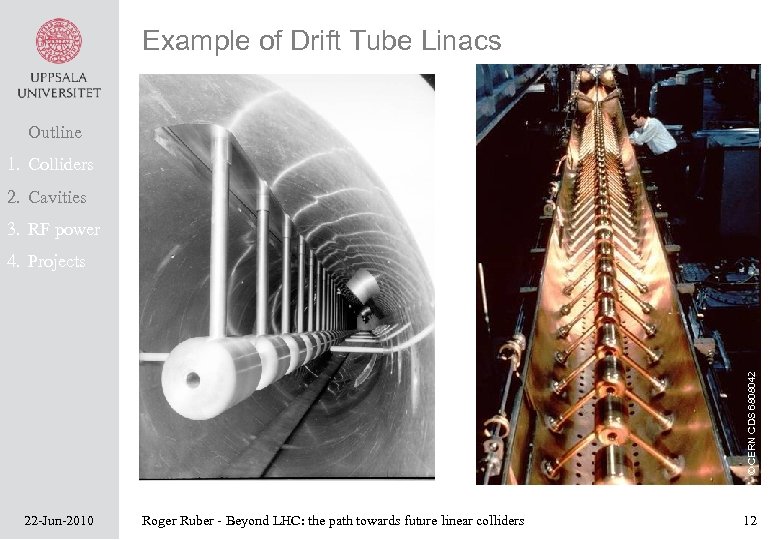
Example of Drift Tube Linacs Outline 1. Colliders 2. Cavities 3. RF power © CERN CDS 6808042 4. Projects 22 -Jun-2010 Roger Ruber - Beyond LHC: the path towards future linear colliders 12
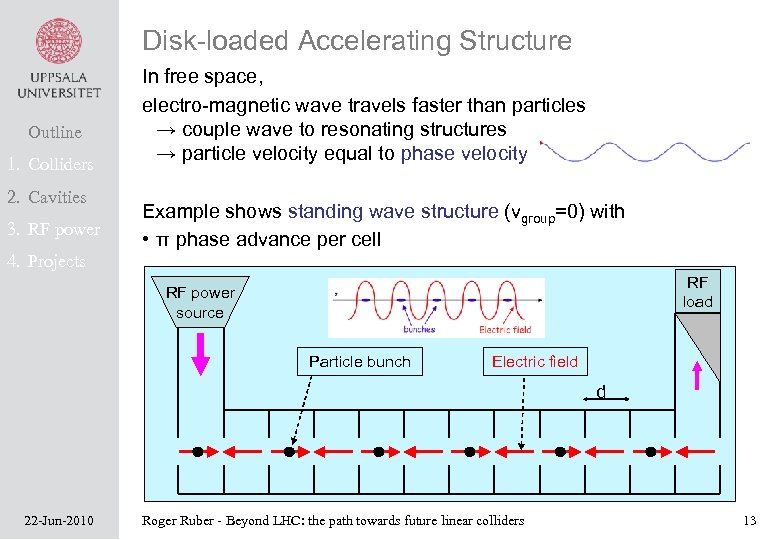
Disk-loaded Accelerating Structure Outline 1. Colliders 2. Cavities 3. RF power In free space, electro-magnetic wave travels faster than particles → couple wave to resonating structures → particle velocity equal to phase velocity Example shows standing wave structure (vgroup=0) with • π phase advance per cell 4. Projects RF load RF power source Particle bunch Electric field d 22 -Jun-2010 Roger Ruber - Beyond LHC: the path towards future linear colliders 13
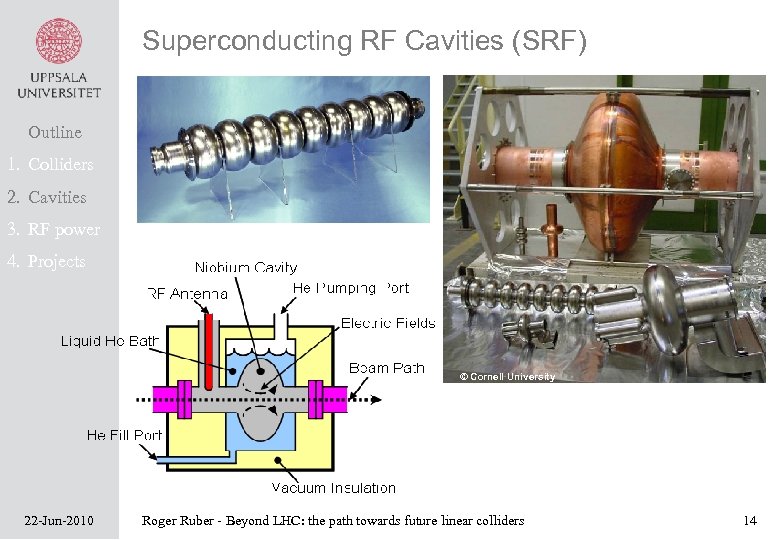
Superconducting RF Cavities (SRF) Outline 1. Colliders 2. Cavities 3. RF power 4. Projects © Cornell University 22 -Jun-2010 Roger Ruber - Beyond LHC: the path towards future linear colliders 14
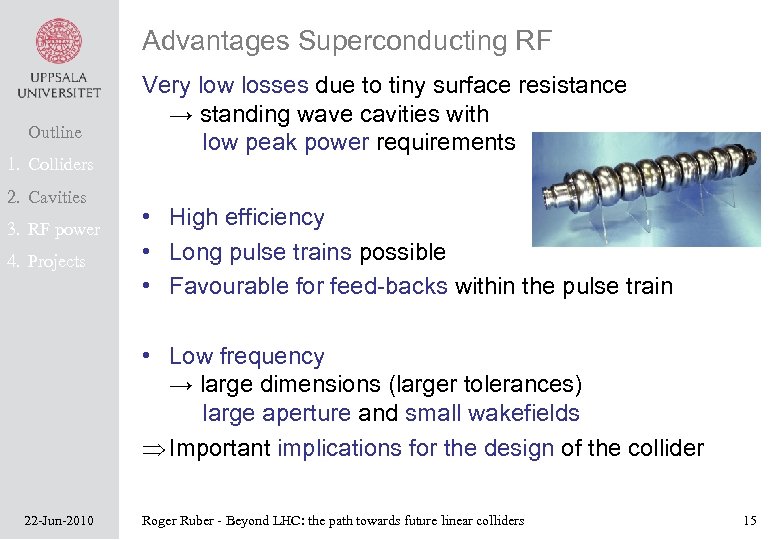
Advantages Superconducting RF Outline 1. Colliders 2. Cavities 3. RF power 4. Projects Very low losses due to tiny surface resistance → standing wave cavities with low peak power requirements • High efficiency • Long pulse trains possible • Favourable for feed-backs within the pulse train • Low frequency → large dimensions (larger tolerances) large aperture and small wakefields Þ Important implications for the design of the collider 22 -Jun-2010 Roger Ruber - Beyond LHC: the path towards future linear colliders 15
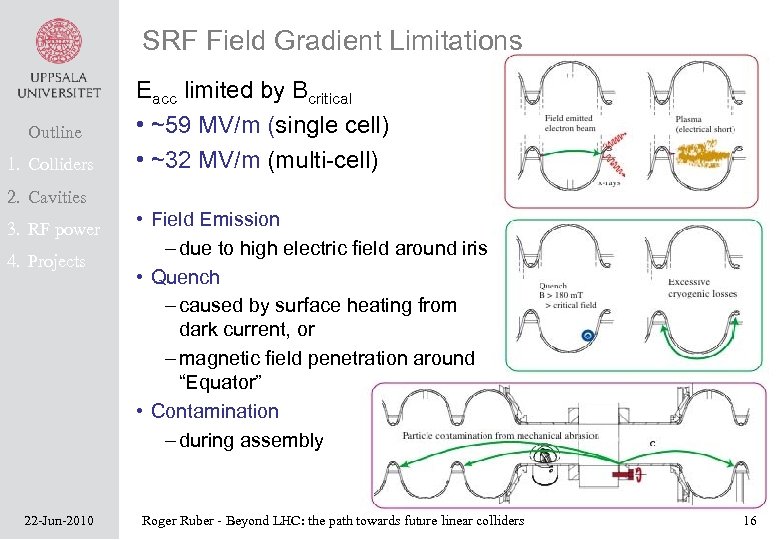
SRF Field Gradient Limitations Outline 1. Colliders Eacc limited by Bcritical • ~59 MV/m (single cell) • ~32 MV/m (multi-cell) 2. Cavities 3. RF power 4. Projects 22 -Jun-2010 • Field Emission – due to high electric field around iris • Quench – caused by surface heating from dark current, or – magnetic field penetration around “Equator” • Contamination – during assembly Roger Ruber - Beyond LHC: the path towards future linear colliders 16
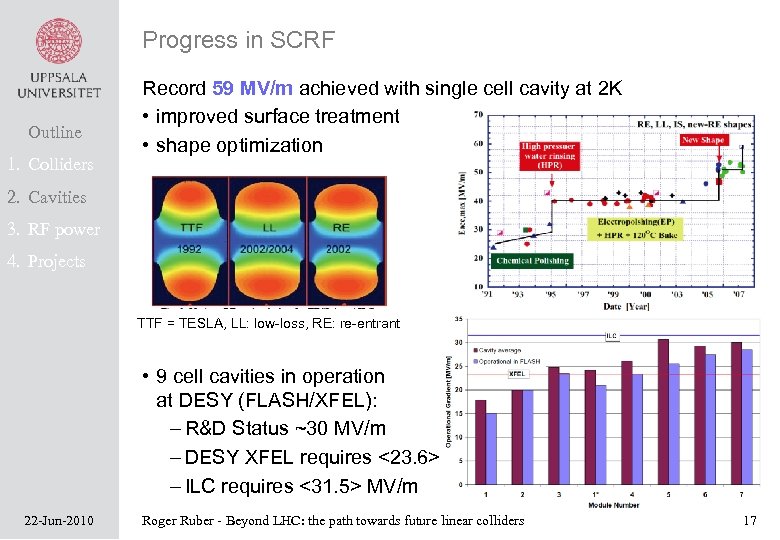
Progress in SCRF Outline 1. Colliders Record 59 MV/m achieved with single cell cavity at 2 K • improved surface treatment • shape optimization 2. Cavities 3. RF power 4. Projects TTF = TESLA, LL: low-loss, RE: re-entrant • 9 cell cavities in operation at DESY (FLASH/XFEL): – R&D Status ~30 MV/m – DESY XFEL requires <23. 6> MV/m – ILC requires <31. 5> MV/m 22 -Jun-2010 Roger Ruber - Beyond LHC: the path towards future linear colliders 17
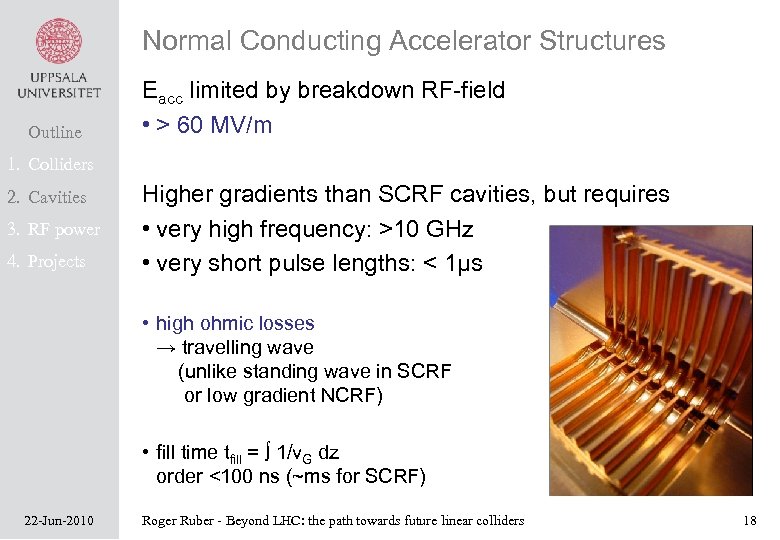
Normal Conducting Accelerator Structures Outline Eacc limited by breakdown RF-field • > 60 MV/m 1. Colliders 2. Cavities 3. RF power 4. Projects Higher gradients than SCRF cavities, but requires • very high frequency: >10 GHz • very short pulse lengths: < 1μs • high ohmic losses → travelling wave (unlike standing wave in SCRF or low gradient NCRF) • fill time tfill = 1/v. G dz order <100 ns (~ms for SCRF) 22 -Jun-2010 Roger Ruber - Beyond LHC: the path towards future linear colliders 18
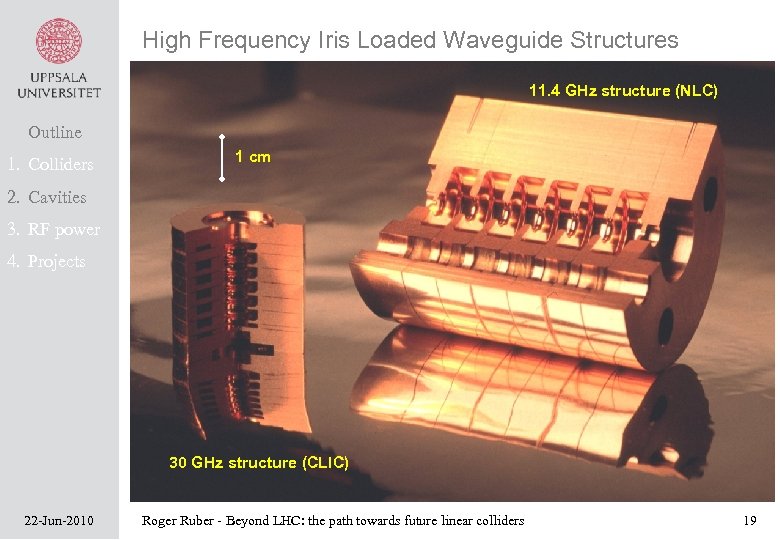
High Frequency Iris Loaded Waveguide Structures 11. 4 GHz structure (NLC) Outline 1. Colliders 1 cm 2. Cavities 3. RF power 4. Projects 30 GHz structure (CLIC) 22 -Jun-2010 Roger Ruber - Beyond LHC: the path towards future linear colliders 19
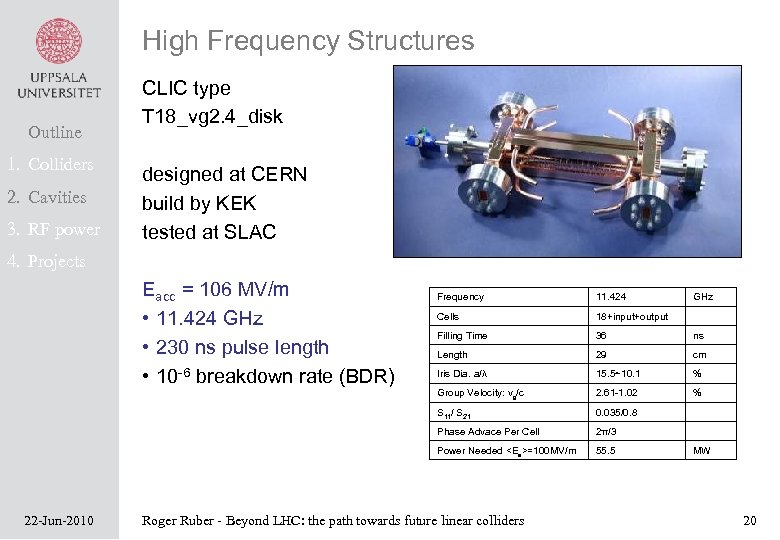
High Frequency Structures Outline 1. Colliders 2. Cavities 3. RF power CLIC type T 18_vg 2. 4_disk designed at CERN build by KEK tested at SLAC 4. Projects Eacc = 106 MV/m • 11. 424 GHz • 230 ns pulse length • 10 -6 breakdown rate (BDR) 11. 424 Cells 18+input+output Filling Time 36 ns Length 29 cm Iris Dia. a/λ 15. 5~10. 1 % Group Velocity: vg/c 2. 61 -1. 02 % S 11/ S 21 0. 035/0. 8 Phase Advace Per Cell 2π/3 Power Needed <Ea>=100 MV/m 22 -Jun-2010 Frequency 55. 5 Roger Ruber - Beyond LHC: the path towards future linear colliders GHz MW 20
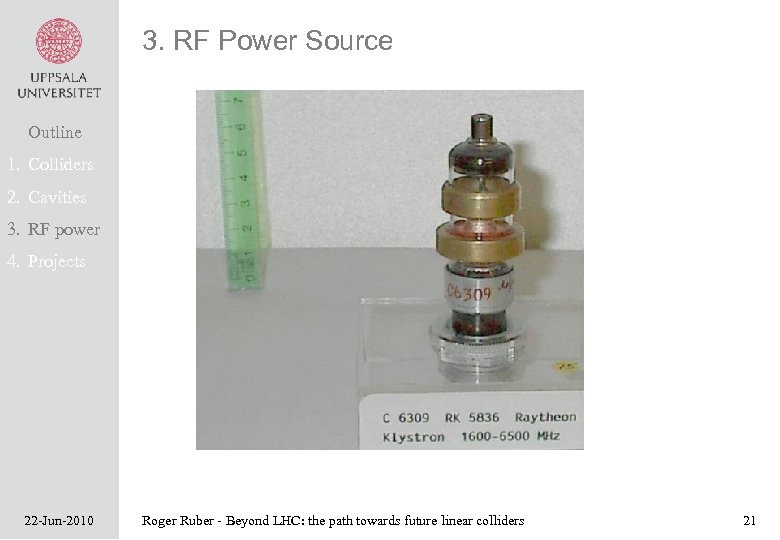
3. RF Power Source Outline 1. Colliders 2. Cavities 3. RF power 4. Projects 22 -Jun-2010 Roger Ruber - Beyond LHC: the path towards future linear colliders 21
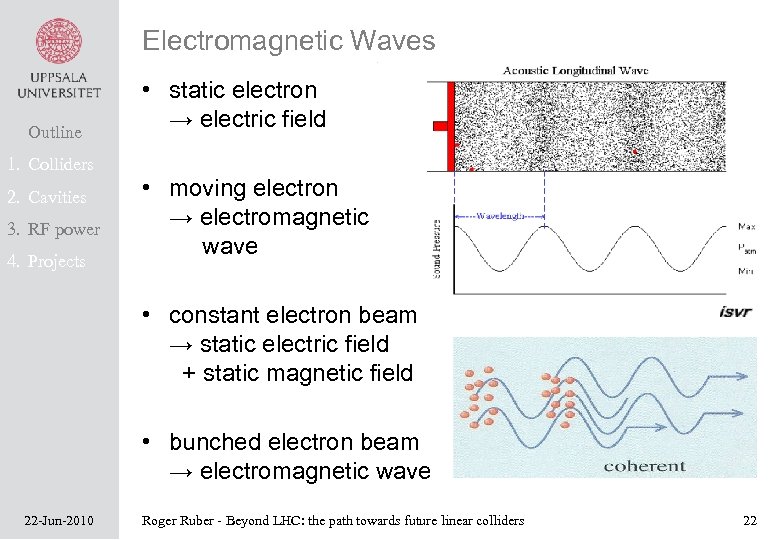
Electromagnetic Waves Outline 1. Colliders 2. Cavities 3. RF power 4. Projects • static electron → electric field • moving electron → electromagnetic wave • constant electron beam → static electric field + static magnetic field • bunched electron beam → electromagnetic wave 22 -Jun-2010 Roger Ruber - Beyond LHC: the path towards future linear colliders 22
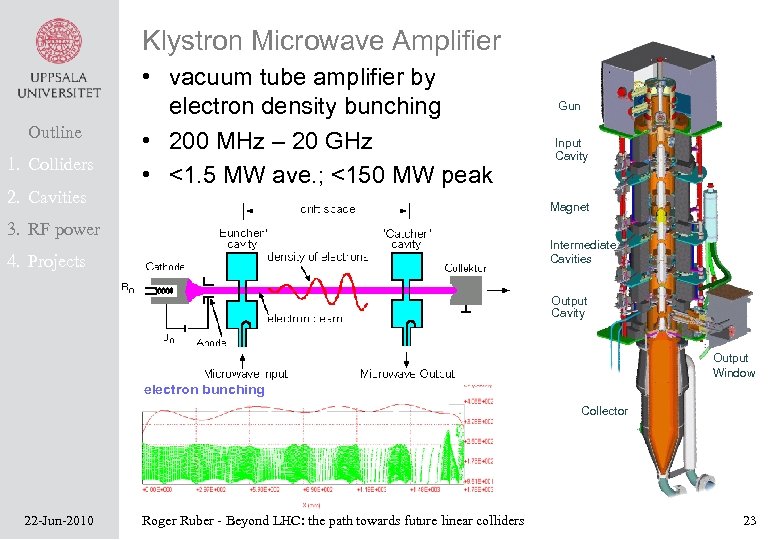
Klystron Microwave Amplifier Outline 1. Colliders 2. Cavities • vacuum tube amplifier by electron density bunching • 200 MHz – 20 GHz • <1. 5 MW ave. ; <150 MW peak Gun Input Cavity Magnet 3. RF power Intermediate Cavities 4. Projects Output Cavity Output Window electron bunching Collector 22 -Jun-2010 Roger Ruber - Beyond LHC: the path towards future linear colliders 23
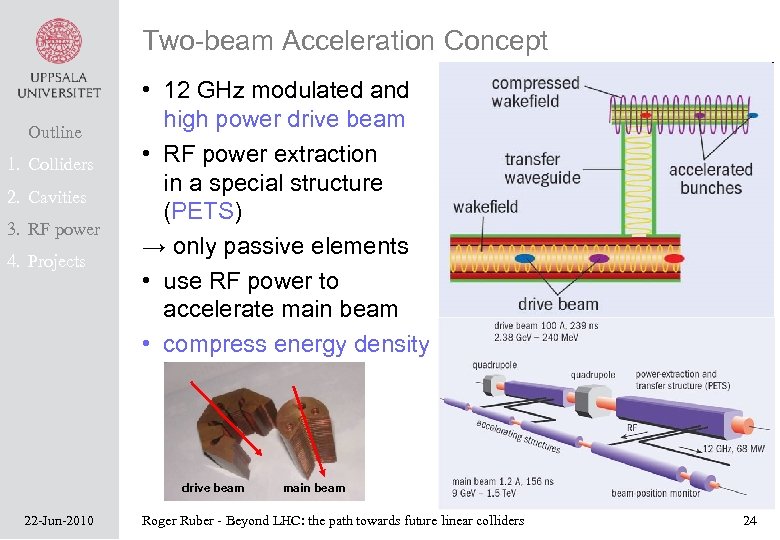
Two-beam Acceleration Concept Outline 1. Colliders 2. Cavities 3. RF power 4. Projects • 12 GHz modulated and high power drive beam • RF power extraction in a special structure (PETS) → only passive elements • use RF power to accelerate main beam • compress energy density drive beam 22 -Jun-2010 main beam Roger Ruber - Beyond LHC: the path towards future linear colliders 24
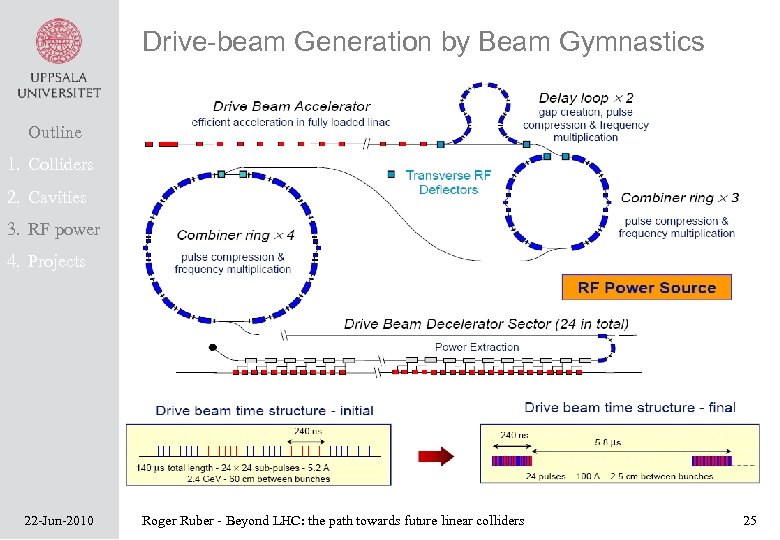
Drive-beam Generation by Beam Gymnastics Outline 1. Colliders 2. Cavities 3. RF power 4. Projects 22 -Jun-2010 Roger Ruber - Beyond LHC: the path towards future linear colliders 25
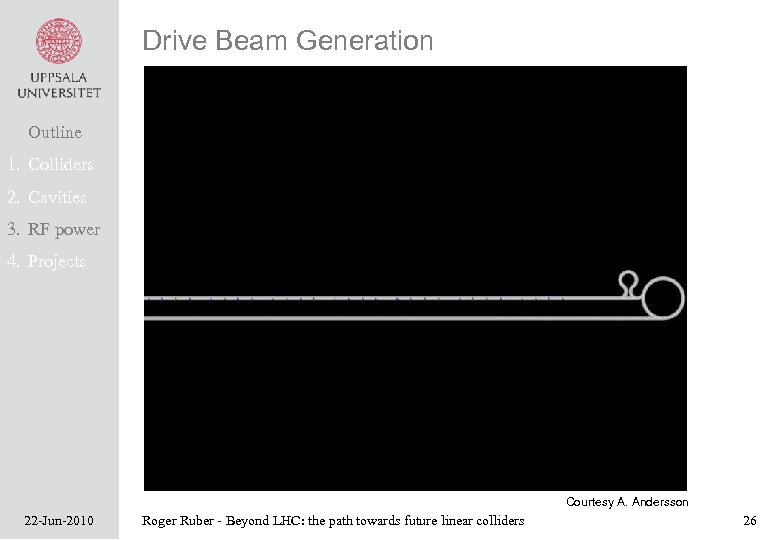
Drive Beam Generation Outline 1. Colliders 2. Cavities 3. RF power 4. Projects Courtesy A. Andersson 22 -Jun-2010 Roger Ruber - Beyond LHC: the path towards future linear colliders 26
4: Projects for a Future Linear Collider Outline 1. Colliders 2. Cavities 3. RF power 4. Projects 22 -Jun-2010 Roger Ruber - Beyond LHC: the path towards future linear colliders 27
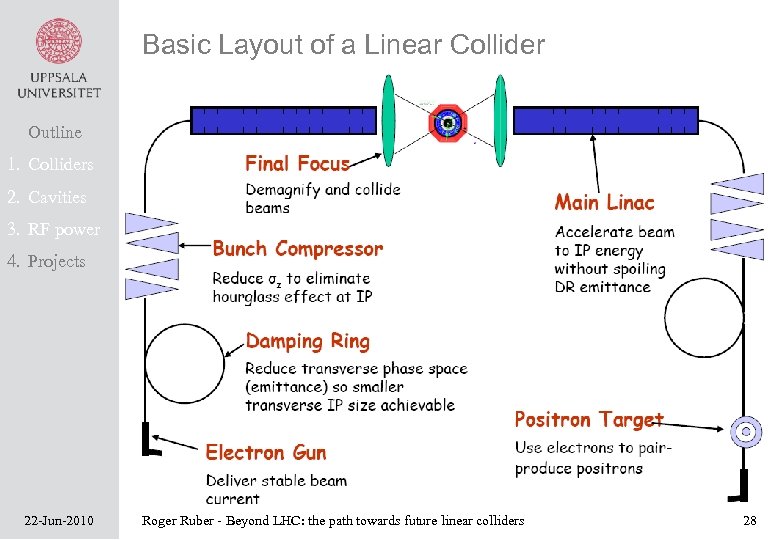
Basic Layout of a Linear Collider Outline 1. Colliders 2. Cavities 3. RF power 4. Projects 22 -Jun-2010 Roger Ruber - Beyond LHC: the path towards future linear colliders 28
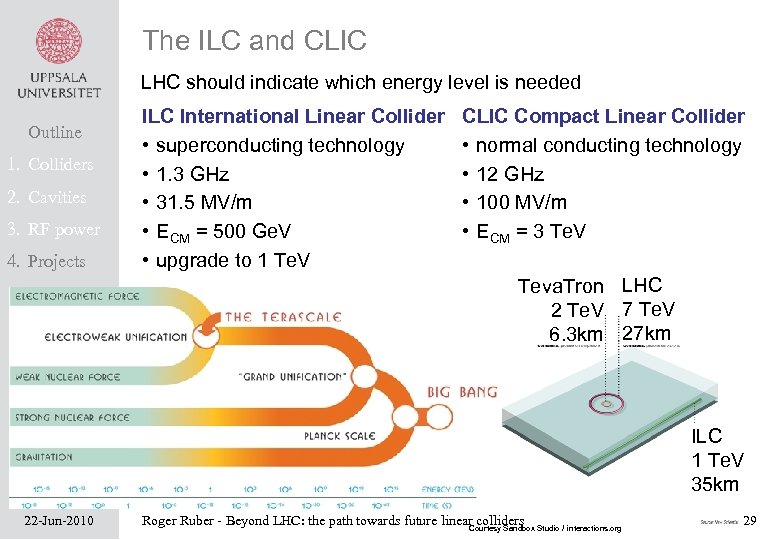
The ILC and CLIC LHC should indicate which energy level is needed Outline 1. Colliders 2. Cavities 3. RF power 4. Projects ILC International Linear Collider • superconducting technology • 1. 3 GHz • 31. 5 MV/m • ECM = 500 Ge. V • upgrade to 1 Te. V CLIC Compact Linear Collider • normal conducting technology • 12 GHz • 100 MV/m • ECM = 3 Te. V Teva. Tron LHC 2 Te. V 7 Te. V 6. 3 km 27 km ILC 1 Te. V 35 km 22 -Jun-2010 Roger Ruber - Beyond LHC: the path towards future linear colliders Studio / interactions. org Courtesy Sandbox 29
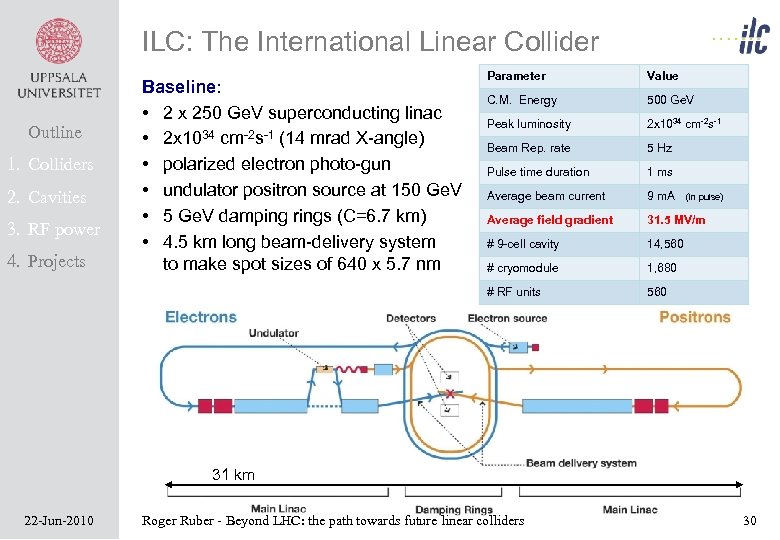
ILC: The International Linear Collider 1. Colliders 2. Cavities 3. RF power 4. Projects Value C. M. Energy 500 Ge. V Peak luminosity 2 x 1034 cm-2 s-1 Beam Rep. rate 5 Hz Pulse time duration 1 ms Average beam current 9 m. A (in pulse) Average field gradient 31. 5 MV/m # 9 -cell cavity 14, 560 # cryomodule 1, 680 # RF units Outline Baseline: • 2 x 250 Ge. V superconducting linac • 2 x 1034 cm-2 s-1 (14 mrad X-angle) • polarized electron photo-gun • undulator positron source at 150 Ge. V • 5 Ge. V damping rings (C=6. 7 km) • 4. 5 km long beam-delivery system to make spot sizes of 640 x 5. 7 nm Parameter 560 31 km 22 -Jun-2010 Roger Ruber - Beyond LHC: the path towards future linear colliders 30
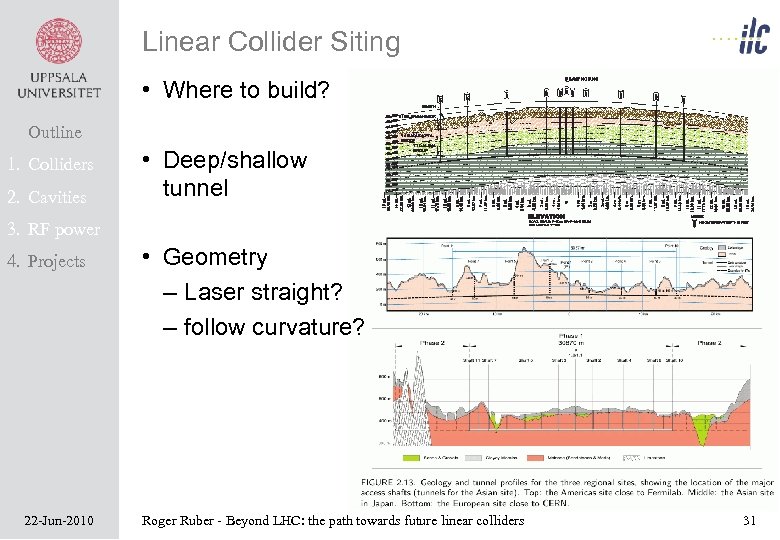
Linear Collider Siting • Where to build? Outline 1. Colliders 2. Cavities • Deep/shallow tunnel 3. RF power 4. Projects 22 -Jun-2010 • Geometry – Laser straight? – follow curvature? Roger Ruber - Beyond LHC: the path towards future linear colliders 31
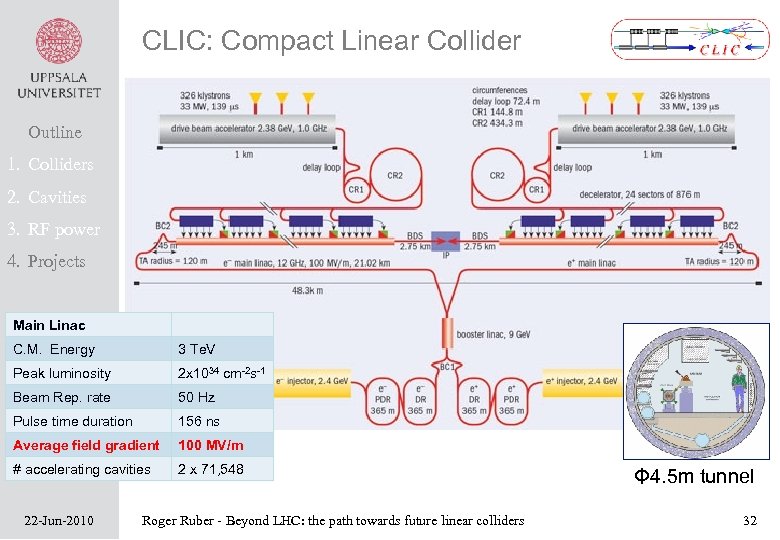
CLIC: Compact Linear Collider Outline 1. Colliders 2. Cavities 3. RF power 4. Projects Main Linac C. M. Energy 3 Te. V Peak luminosity 2 x 1034 cm-2 s-1 Beam Rep. rate 50 Hz Pulse time duration 156 ns Average field gradient 100 MV/m # accelerating cavities 2 x 71, 548 22 -Jun-2010 Roger Ruber - Beyond LHC: the path towards future linear colliders Φ 4. 5 m tunnel 32
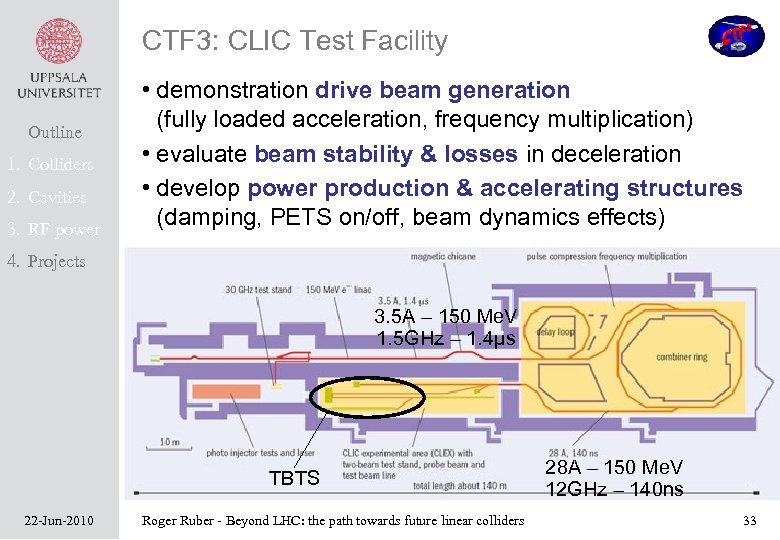
CTF 3: CLIC Test Facility Outline 1. Colliders 2. Cavities 3. RF power • demonstration drive beam generation (fully loaded acceleration, frequency multiplication) • evaluate beam stability & losses in deceleration • develop power production & accelerating structures (damping, PETS on/off, beam dynamics effects) 4. Projects 3. 5 A – 150 Me. V 1. 5 GHz – 1. 4µs TBTS 22 -Jun-2010 Roger Ruber - Beyond LHC: the path towards future linear colliders 28 A – 150 Me. V 12 GHz – 140 ns 33
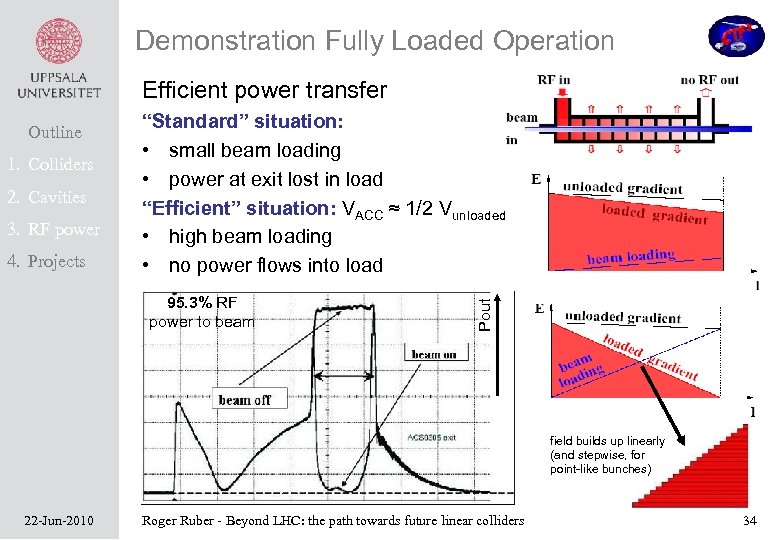
Demonstration Fully Loaded Operation Efficient power transfer 1. Colliders 2. Cavities 3. RF power 4. Projects “Standard” situation: • small beam loading • power at exit lost in load “Efficient” situation: VACC ≈ 1/2 Vunloaded • high beam loading • no power flows into load 95. 3% RF power to beam Pout Outline field builds up linearly (and stepwise, for point-like bunches) 22 -Jun-2010 Roger Ruber - Beyond LHC: the path towards future linear colliders 34
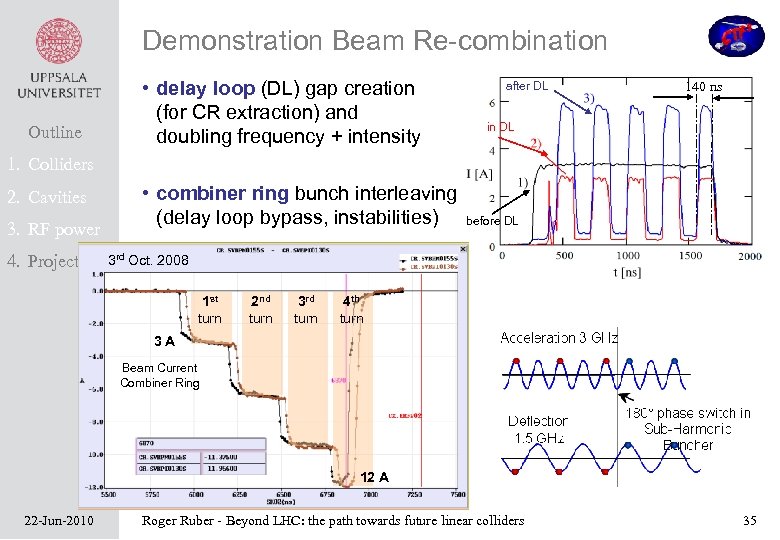
Demonstration Beam Re-combination Outline • delay loop (DL) gap creation (for CR extraction) and doubling frequency + intensity after DL 140 ns in DL 1. Colliders 2. Cavities 3. RF power 4. Projects • combiner ring bunch interleaving (delay loop bypass, instabilities) before DL 3 rd Oct. 2008 1 st turn 2 nd turn 3 rd turn 4 th turn 3 A Beam Current Combiner Ring 12 A 22 -Jun-2010 Roger Ruber - Beyond LHC: the path towards future linear colliders 35
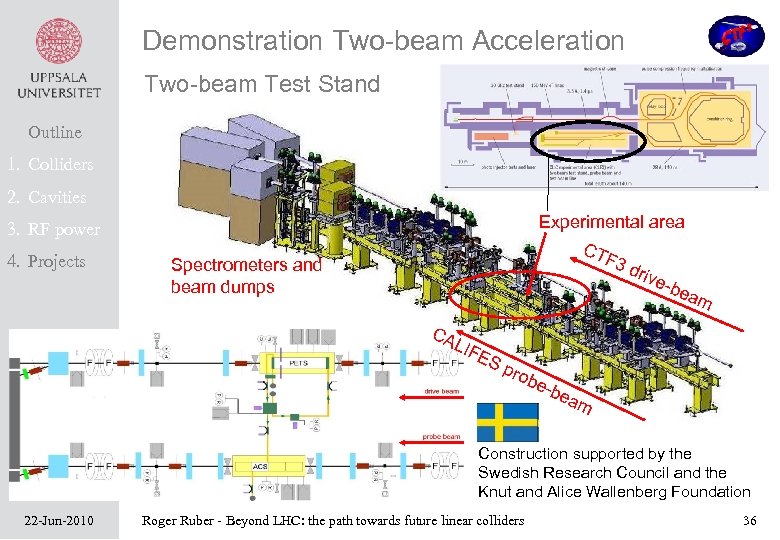
Demonstration Two-beam Acceleration Two-beam Test Stand Outline 1. Colliders 2. Cavities Experimental area CT F 3 driv e-b eam 3. RF power 4. Projects Spectrometers and beam dumps CA LIF ES pro be- bea m Construction supported by the Swedish Research Council and the Knut and Alice Wallenberg Foundation 22 -Jun-2010 Roger Ruber - Beyond LHC: the path towards future linear colliders 36
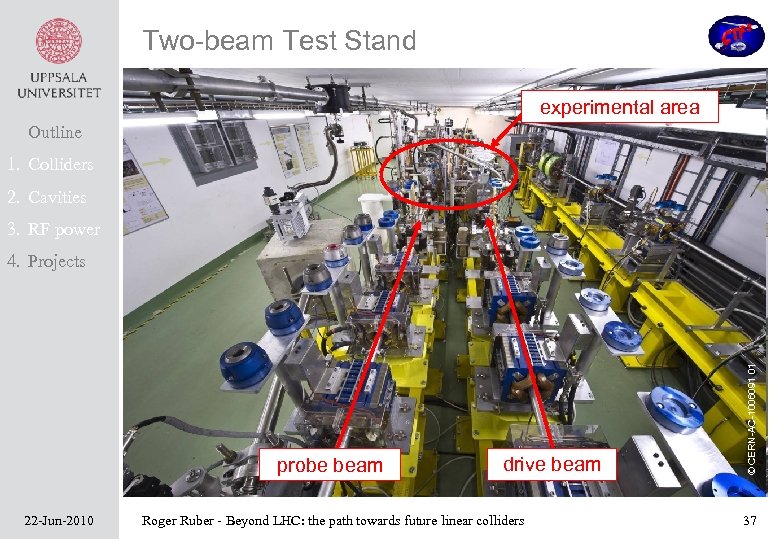
Two-beam Test Stand experimental area Outline 1. Colliders 2. Cavities 3. RF power probe beam 22 -Jun-2010 drive beam Roger Ruber - Beyond LHC: the path towards future linear colliders © CERN-AC-1006091 01 4. Projects 37
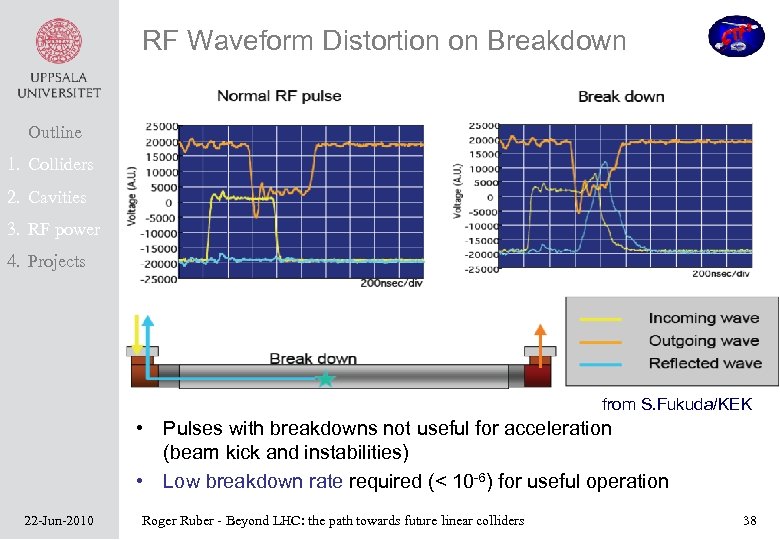
RF Waveform Distortion on Breakdown Outline 1. Colliders 2. Cavities 3. RF power 4. Projects from S. Fukuda/KEK • Pulses with breakdowns not useful for acceleration (beam kick and instabilities) • Low breakdown rate required (< 10 -6) for useful operation 22 -Jun-2010 Roger Ruber - Beyond LHC: the path towards future linear colliders 38
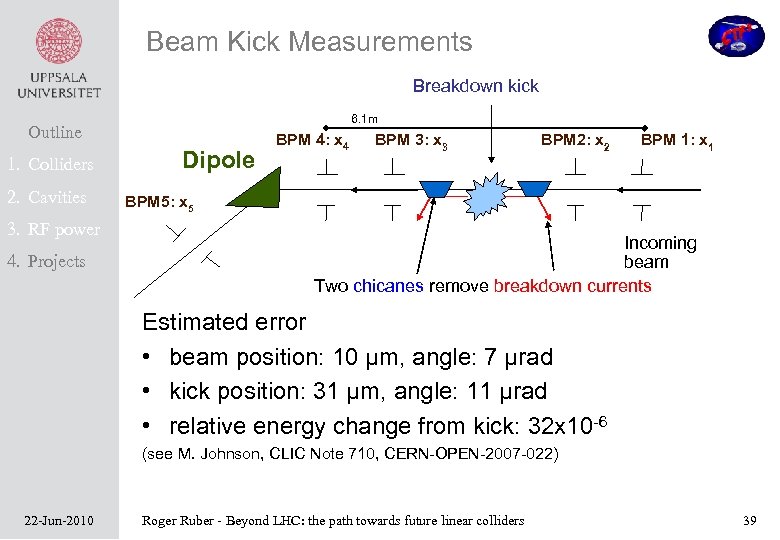
Beam Kick Measurements Breakdown kick 6. 1 m Outline 1. Colliders 2. Cavities 3. RF power 4. Projects Dipole BPM 4: x 4 BPM 3: x 3 BPM 2: x 2 BPM 1: x 1 BPM 5: x 5 Incoming beam Two chicanes remove breakdown currents Estimated error • beam position: 10 μm, angle: 7 μrad • kick position: 31 μm, angle: 11 μrad • relative energy change from kick: 32 x 10 -6 (see M. Johnson, CLIC Note 710, CERN-OPEN-2007 -022) 22 -Jun-2010 Roger Ruber - Beyond LHC: the path towards future linear colliders 39
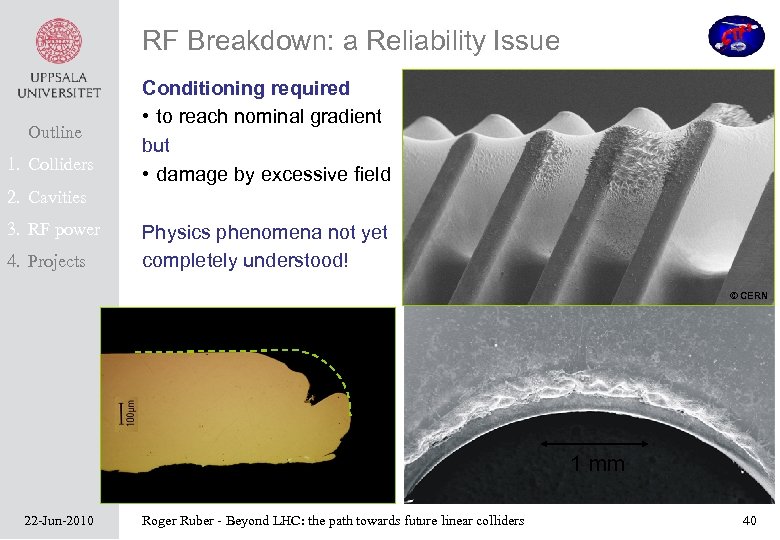
RF Breakdown: a Reliability Issue Outline 1. Colliders Conditioning required • to reach nominal gradient but • damage by excessive field 2. Cavities 3. RF power 4. Projects Physics phenomena not yet completely understood! © CERN 1 mm 22 -Jun-2010 Roger Ruber - Beyond LHC: the path towards future linear colliders 40
Acknowledgements For the contribution of material and advice, without which I would not have been able to make this presentation. My grateful thanks to • Alex Andersson, Erik Adli, Erk Jensen, Hans Braun, Daniel Schulte, Frank Tecker, Walter Wünsch, Akira Yamamoto and Volker Ziemann Some illustrations and photos courtesy • CERN, KEK and Symmetry Magazine 22 -Jun-2010 Roger Ruber - Beyond LHC: the path towards future linear colliders 41
Скачать презентацию Beyond LHC The Path towards Future Linear Colliders
daaa25a4ea63d5217c84bc0562d8912a.ppt