 Скачать презентацию Beyond Legislation Non-Legislative measures to facilitate the use
8d2d19732e37c772974141ae994bb0a5.ppt
- Количество слайдов: 18



Beyond Legislation Non-Legislative measures to facilitate the use of E-commerce in Hungary Gábor Csiszér – Prime Minister’s Office, Hungary
• Content: – Introduction – current situation of e-commerce in Hungary – Identifying and eliminating administrative burdens – Provide Information – Increasing customer’s confidence – Other non-leg. measures
Current situation in Hungary • E-Commerce in Hungary: – Directive 2000/31/EC was implemented in 2001 (Act 108. of 2001) – By then e-commerce was almost „invisible”: • The annual turnover of the sector was less than 5 billion HUF (~20. 2 million EUR) • Approx. only half million people had internet access at home (most of them had relatively expensive dial-up connection) • Most of the internet users were too young (14 -24 yrs. old) so they weren’t a real solvent demand for e-commerce
Current situation in Hungary • In the past few years there were significant changes – At the end of 2007, 38% of the Hungarian households had Internet access: • Broadband access at the first place (1. 678 million subscribers, growth rate was 40% last year) • Price of broadband access are getting still lower • Annual turnover of e-commerce sector was estimated to 47 billion HUF (190 million EUR) in 2007, 40 -50% growth every year.
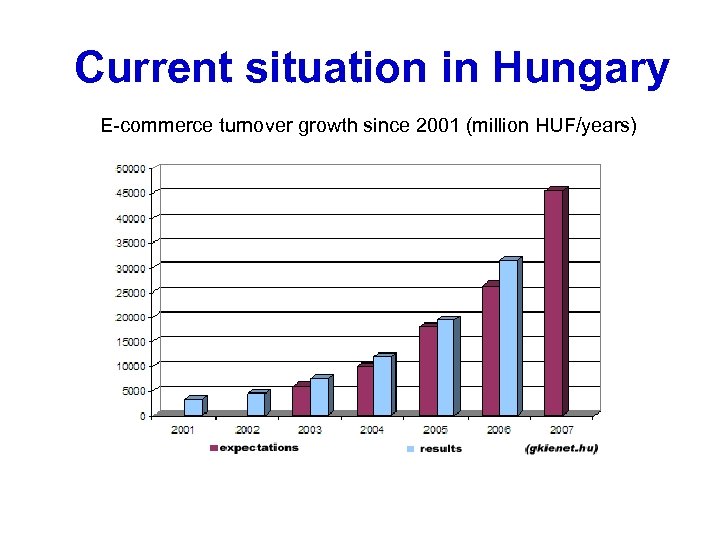
Current situation in Hungary E-commerce turnover growth since 2001 (million HUF/years)
Current situation in Hungary Conclusion • E-commerce has a great growing potential • However, it’s still only 0. 5% of the total annual turnover of retail trade • The Hungarian government decided to encourage and facilitate the wider use of ecommerce by: – – Identifying and eliminating administrative burdens Providing information Increasing customer’s confidence Supporting activity
Identifying and eliminating administrative burdens • According to the Hungarian legislation, dealers had to maintain a shop, even in case of distant selling: – The whole authorization process was focused to the shop – The shop itself had to fulfill several criteria • This obligation was disadvantageous to on-line (and other distant) dealers: – – The administrative procedure is slow and costly Maintaining a shop generates also costs Most of the cases shops are useless in distant selling Most of the EU countries do not apply such requirement • Service providers required to eliminate this obligation a long time ago
Identifying and eliminating administrative burdens • Relevant authorities first resisted, stating: – Maintaining a shop serves customer protection • Shops has a little significance in distant selling, customers choose this way of purchasing because they don’t want to go to the shop • customer’s right are already well protected, f. e. right of cancellation in 8 days in case of distant selling, • Goods can returned by post – Registered shops estabilish the basement of official controll • this way authorities can control only companies which fulfills all criteria, while the real „bad guys” can hide • There are clear requirements in other legislation Authorities has to act more proactively (f. e. test-shopping, etc) – „this is the good old way, why to change it? ” • Because it does not serves itself customer protection, it’s not the proper way of control and it imposes an unnecesary burden for enterprises
Identifying and eliminating administrative burdens • The Hungarian government realized and accepted the necessity of eliminating this obligation • It had two steps, obligation of maintaining a shop ceased in: – June 2006 for full on-line traders (where the purchased goods are immaterial, f. e. music, ringtones) – March 2008 for distant sellers (or mail order houses, including all on-line shops). • In the last 1. 5 years period these shops had to maintain only a room for customer service • These measures received positive reaction from market actors as well as civil organizations
Providing Information • Studies and our experience showed that Hungarian enterprises are showing a significant interrest to start an on-line store, but: – Enterprises are not aware of their legal obligations and possibilities • If so, how can we expect from them to act legally? – Many enterprises simply just don’t know how to start an on-line store • they don’t know how to register an own domain name • they have no idea about electronic payment methods • They have no skill in starting a website and not aware of easy applicable software solutions • Customers also has little information on their possibilities • They have concerns about shopping on-line • They have no idea about their legal possiblities • They don’t know the relevant authorities
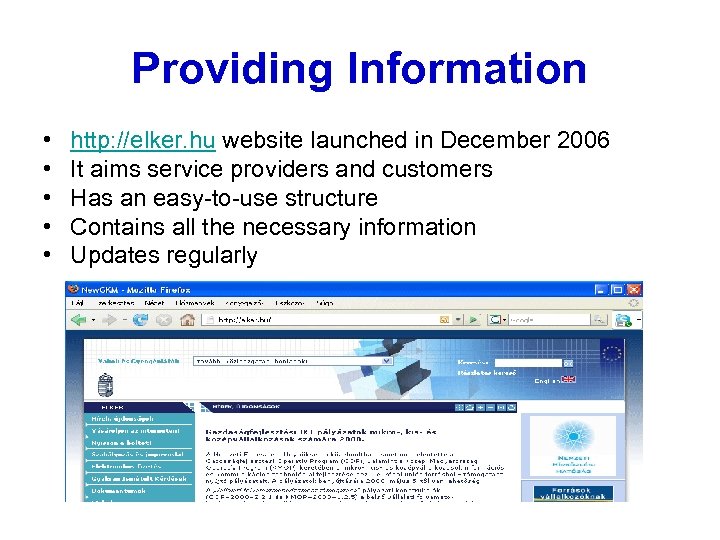
Providing Information • • • http: //elker. hu website launched in December 2006 It aims service providers and customers Has an easy-to-use structure Contains all the necessary information Updates regularly
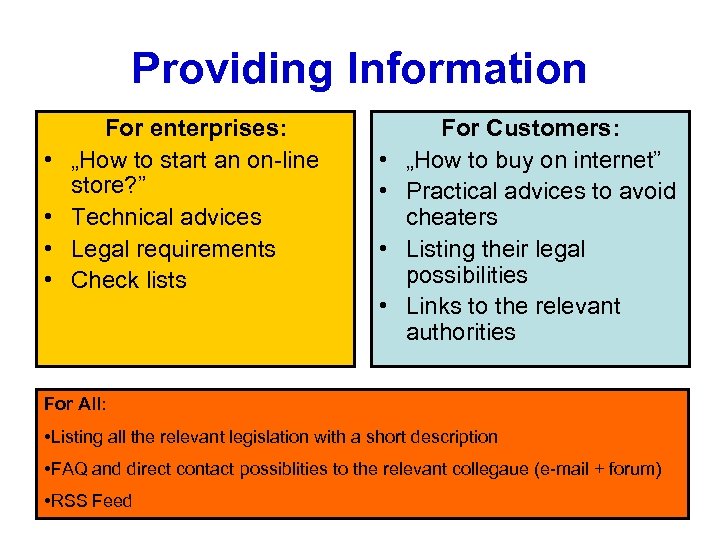
Providing Information • • For enterprises: „How to start an on-line store? ” Technical advices Legal requirements Check lists • • For Customers: „How to buy on internet” Practical advices to avoid cheaters Listing their legal possibilities Links to the relevant authorities For All: • Listing all the relevant legislation with a short description • FAQ and direct contact possiblities to the relevant collegaue (e-mail + forum) • RSS Feed
Providing Information • http: //elker. hu became succesful in no time – It was the most visited sub-website of the Ministry of Economy and Transport – Several forums, blogs, even the Hungarian Wikipedia refers to that – Prviding information in a proactive way is „remunerative” people can find easily the information, less direct request – It costs almost no money, we put out the information we already had
Increasing Customers confidence • Fight Against Spam – Hungary applies a really strict opt-in regime – Electronic advertisement related supervision procedure of Hungarian Communications Authority (HCA) – HCA provides several information on spam on it’s website: • Information regarding it’s procedure • Tests and recommendations of free spam-filters • Possibility to start the spam-procedure online
Increasing Customers confidence • Trustmark Project: – People buy more willingly in shops in which they trust – Trustmark is a trademark-like marking which shows that the on-line store in question: • Fulfils all legal criteria • Has adopted the Code of Conduct and Ethical Codex of the service providers • Has a customer-friendly policy • Is subjected to arbitrator’s procedure in order to speed up arranging debates – The „Trustmark Project” is an initiative from NGO-s • A specified organization will decide on awarding trustmarks • Hungarian government helps in the starting this project and promoting that
Other non-legislative measures • Supporting SMEs – In the framework of GOP (Economy Developing Operative Programme) – aid partly using EU sources – Co financing (up to 50%) – Supported activities: • Improving IT security infrastructure • Build up e-contracting, epayment • Starting and improving online stores • Starting B 2 B marketplaces • E-economy strategy – Identifying new challenges – Roadmap for governmental activities – The „Net. Ready” Programme: • Complex motivation information campaign to promote the use of Internet • It aims the so called „digitally illiterate” population (almost 50%) • PPP construction, biggest service providers also involved
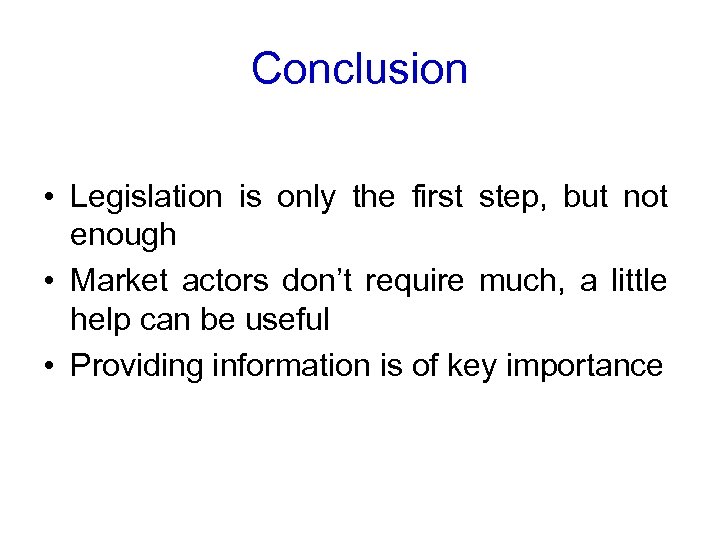
Conclusion • Legislation is only the first step, but not enough • Market actors don’t require much, a little help can be useful • Providing information is of key importance
Thank you for your attention! csiszer. gabor@gkm. gov. hu (it may change, so csiszerg@gmail. com for sure)
Скачать презентацию Beyond Legislation Non-Legislative measures to facilitate the use
8d2d19732e37c772974141ae994bb0a5.ppt