 Скачать презентацию Between evolution and revolution lines of development
b486d68003721c39272a751c27af136f.ppt
- Количество слайдов: 68



Between evolution and revolution – lines of development of EU (tele)communications law Some random thoughts on selected topics What has been will be again, what has been done will be done again; there is nothing new under the sun. (Ecclesiastes 1: 9) Robert Queck, Oslo, Friday November 13, 2015
0. 1. The underlying idea “The various regulatory models put forwards in EC telecommunications law since the 1987 Green Paper on the development of the common market for telecommunications services and equipment …[COM(87) 290, 30. 06. 1987] build upon one another, much like successive applications of paint on a surface. Underneath the current image, it is often still possible to discern the outlines of the previous ones. ” P. Larouche (2000) Continuity ! But…!! 2
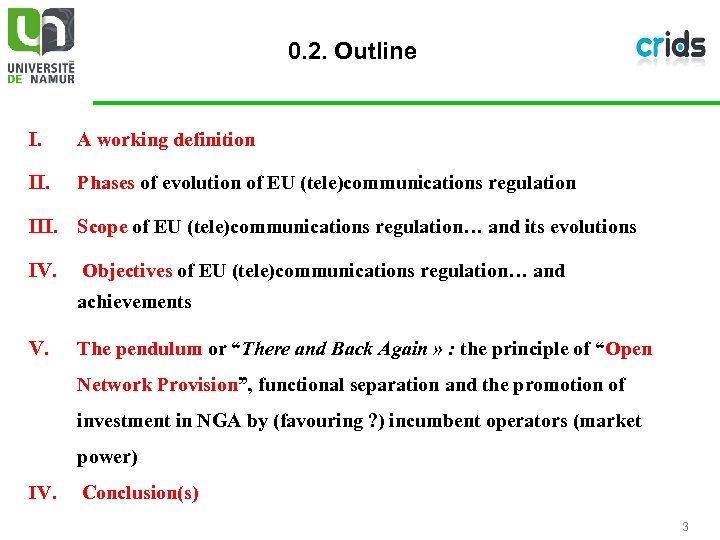
0. 2. Outline I. A working definition II. Phases of evolution of EU (tele)communications regulation III. Scope of EU (tele)communications regulation… and its evolutions IV. Objectives of EU (tele)communications regulation… and achievements V. The pendulum or “There and Back Again » : the principle of “Open Network Provision”, functional separation and the promotion of investment in NGA by (favouring ? ) incumbent operators (market power) IV. Conclusion(s) 3
I. A working definition 4
Electronic communications: « Any transmission, emission or reception of signs, signals, writing, images and sounds or intelligence of any nature by wire, optical or other electromagnetic systems » (ITU) 5
II. Phases of EU (tele)communications regulation II. 1. Summary of phases II. 2. General overview 6
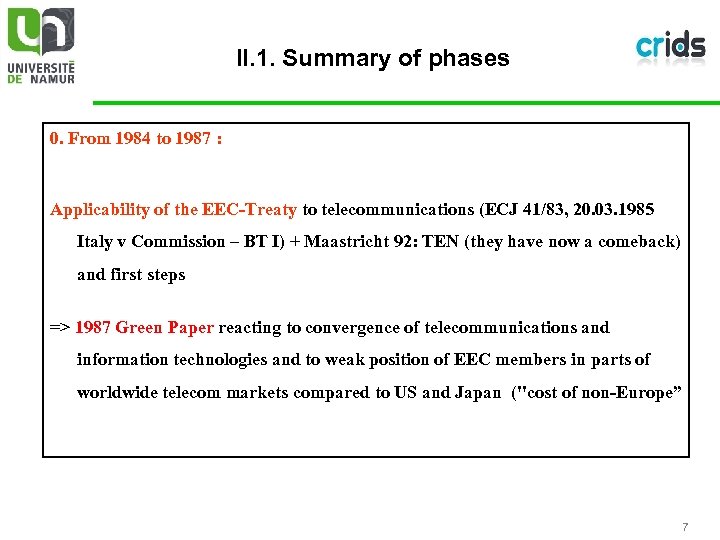
II. 1. Summary of phases 0. From 1984 to 1987 : Applicability of the EEC-Treaty to telecommunications (ECJ 41/83, 20. 03. 1985 Italy v Commission – BT I) + Maastricht 92: TEN (they have now a comeback) and first steps => 1987 Green Paper reacting to convergence of telecommunications and information technologies and to weak position of EEC members in parts of worldwide telecom markets compared to US and Japan ("cost of non-Europe” 7
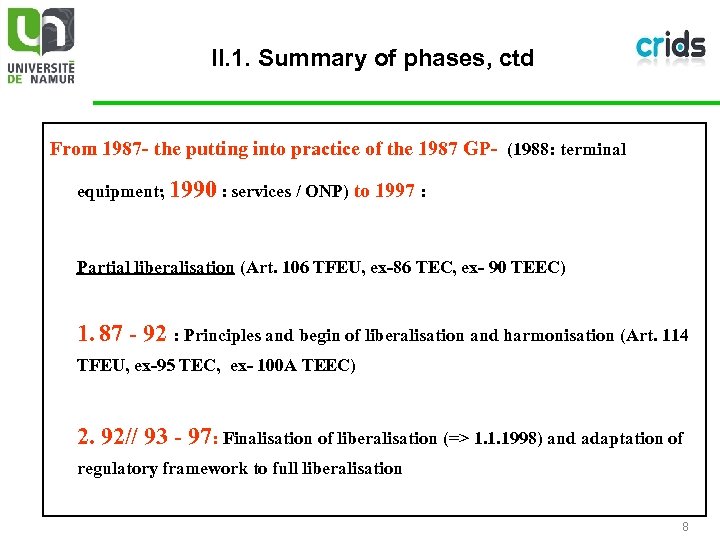
II. 1. Summary of phases, ctd From 1987 - the putting into practice of the 1987 GP- (1988: terminal equipment; 1990 : services / ONP) to 1997 : Partial liberalisation (Art. 106 TFEU, ex-86 TEC, ex- 90 TEEC) 1. 87 - 92 : Principles and begin of liberalisation and harmonisation (Art. 114 TFEU, ex-95 TEC, ex- 100 A TEEC) 2. 92// 93 - 97: Finalisation of liberalisation (=> 1. 1. 1998) and adaptation of regulatory framework to full liberalisation 8
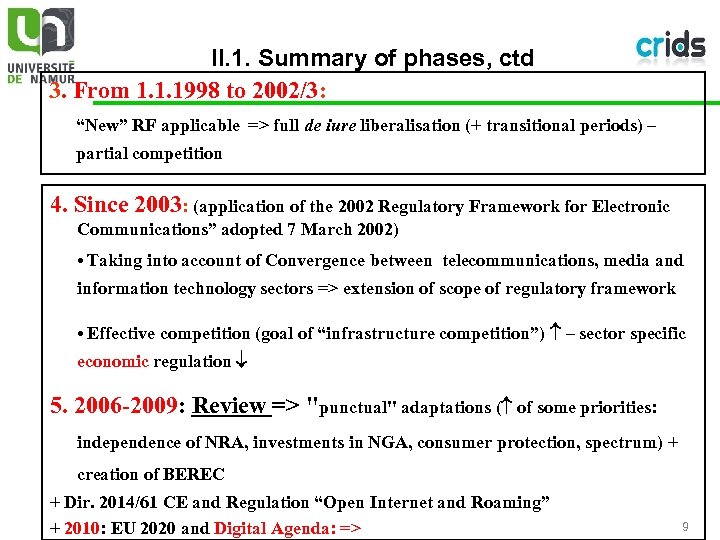
II. 1. Summary of phases, ctd 3. From 1. 1. 1998 to 2002/3: “New” RF applicable => full de iure liberalisation (+ transitional periods) – partial competition 4. Since 2003: (application of the 2002 Regulatory Framework for Electronic Communications” adopted 7 March 2002) • Taking into account of Convergence between telecommunications, media and information technology sectors => extension of scope of regulatory framework • Effective competition (goal of “infrastructure competition”) – sector specific economic regulation 5. 2006 -2009: Review => "punctual" adaptations ( of some priorities: independence of NRA, investments in NGA, consumer protection, spectrum) + creation of BEREC + Dir. 2014/61 CE and Regulation “Open Internet and Roaming” + 2010: EU 2020 and Digital Agenda: => 9
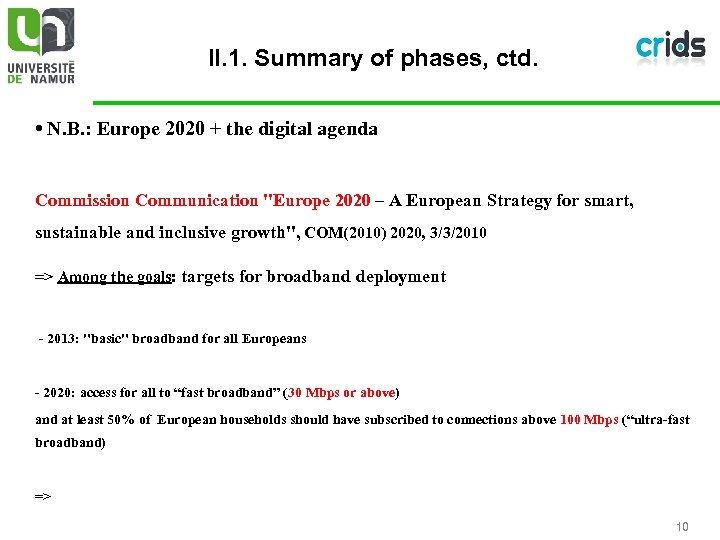
II. 1. Summary of phases, ctd. • N. B. : Europe 2020 + the digital agenda Commission Communication "Europe 2020 – A European Strategy for smart, sustainable and inclusive growth", COM(2010) 2020, 3/3/2010 => Among the goals: targets for broadband deployment - 2013: "basic" broadband for all Europeans - 2020: access for all to “fast broadband” (30 Mbps or above) and at least 50% of European households should have subscribed to connections above 100 Mbps (“ultra-fast broadband) => 10
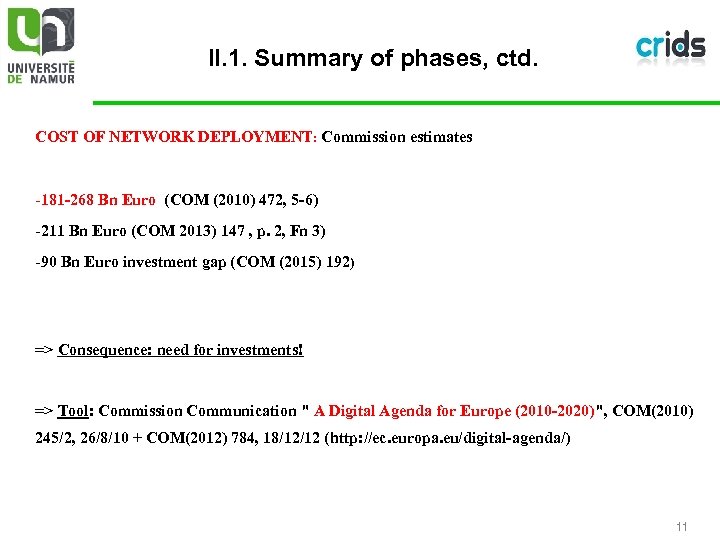
II. 1. Summary of phases, ctd. COST OF NETWORK DEPLOYMENT: Commission estimates -181 -268 Bn Euro (COM (2010) 472, 5 -6) -211 Bn Euro (COM 2013) 147 , p. 2, Fn 3) -90 Bn Euro investment gap (COM (2015) 192) => Consequence: need for investments! => Tool: Commission Communication " A Digital Agenda for Europe (2010 -2020)", COM(2010) 245/2, 26/8/10 + COM(2012) 784, 18/12/12 (http: //ec. europa. eu/digital-agenda/) 11
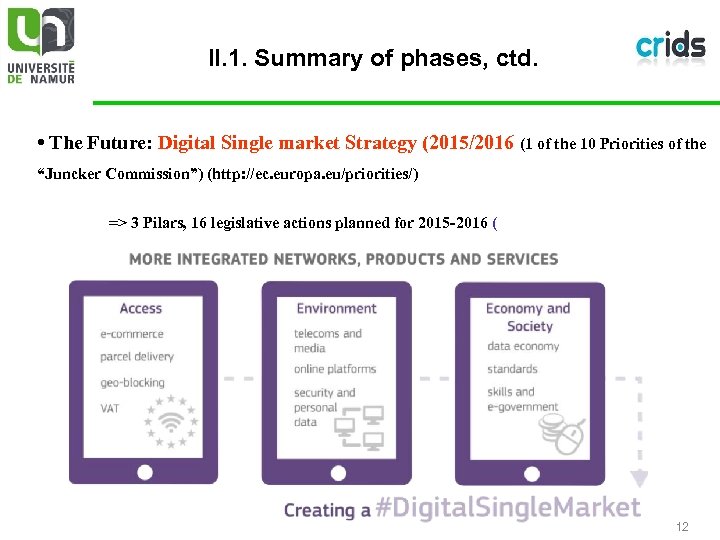
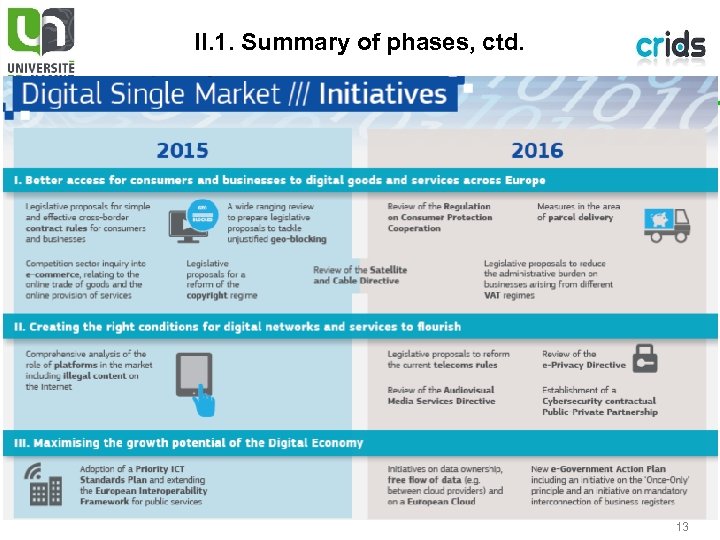
II. 1. Summary of phases, ctd. • The Future: Digital Single market Strategy (2015/2016 (1 of the 10 Priorities of the “Juncker Commission”) (http: //ec. europa. eu/priorities/) => 3 Pilars, 16 legislative actions planned for 2015 -2016 ( 12
II. 1. Summary of phases, ctd. 13
II. 1. Summary of phases, ctd. 14
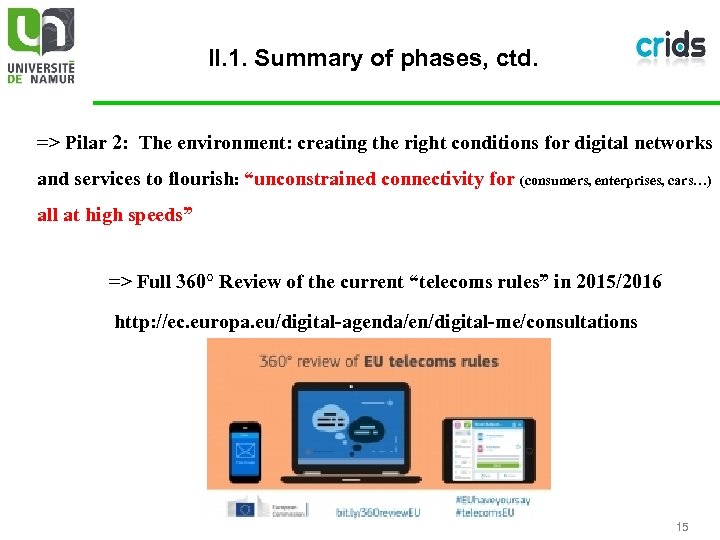
II. 1. Summary of phases, ctd. => Pilar 2: The environment: creating the right conditions for digital networks and services to flourish: “unconstrained connectivity for (consumers, enterprises, cars…) all at high speeds” => Full 360° Review of the current “telecoms rules” in 2015/2016 http: //ec. europa. eu/digital-agenda/en/digital-me/consultations 15
II. 1. Summary of phases, ctd. + Foster (establish) true single market (a single notification, …) + Harmonize spectrum management (revenues should stay with the MS, but procedures should be harmonized in order to allow transborder wireless nets: timewindows of assignments, auction practices and criteria for regulatory intervention… + Update rules in order to foster investments in networks (esp. NGA) + Review the regime of Universal Service + Create a level-playing field between OTT and providers of ECN / ECS + Improve governance in order to enhance regulatory consistency across MS (while taking into account national conditions) (ERA, re-inforced BEREC…) 16
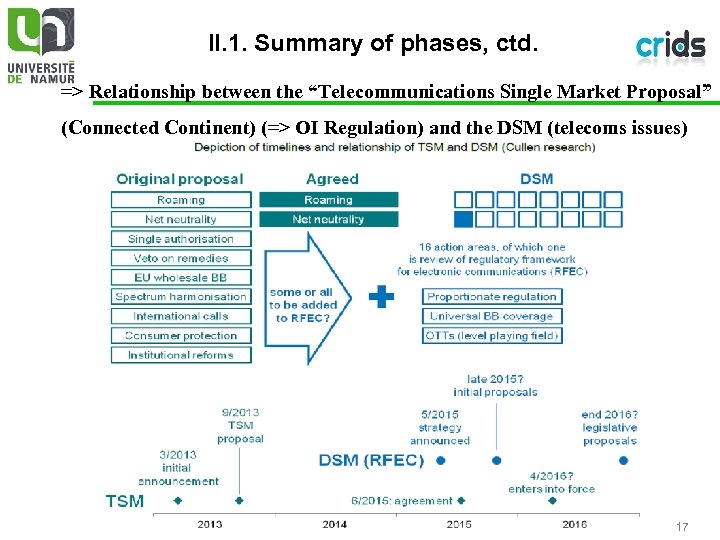
II. 1. Summary of phases, ctd. => Relationship between the “Telecommunications Single Market Proposal” (Connected Continent) (=> OI Regulation) and the DSM (telecoms issues) 17
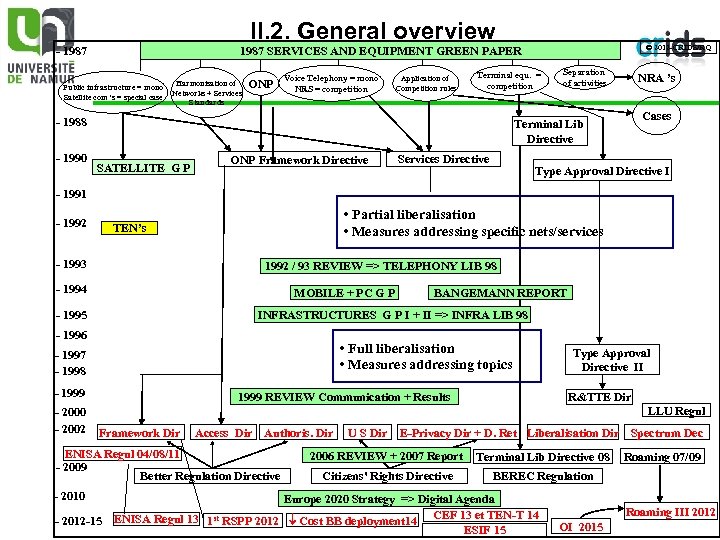
II. 2. General overview - 1987 Public infrastructure = mono Satellite com ’s = special case Harmonisation of Networks + Services Standards ONP Voice Telephony = mono NRS = competition Application of Competition rules Terminal equ. = competition - 1988 - 1990 © 2012 -CRIDS/RQ 1987 SERVICES AND EQUIPMENT GREEN PAPER Separation of activities NRA ’s Cases Terminal Lib Directive SATELLITE G P ONP Framework Directive Services Directive Type Approval Directive I - 1991 - 1992 • Partial liberalisation • Measures addressing specific nets/services TEN’s - 1993 1992 / 93 REVIEW => TELEPHONY LIB 98 - 1994 MOBILE + PC G P - 1995 INFRASTRUCTURES G P I + II => INFRA LIB 98 - 1996 • Full liberalisation • Measures addressing topics - 1997 - 1998 - 1999 - 2000 - 2002 BANGEMANN REPORT 1999 REVIEW Communication + Results Framework Dir Access Dir Authoris. Dir ENISA Regul 04/08/11 - 2009 Better Regulation Directive U S Dir Type Approval Directive II R&TTE Dir LLU Regul E-Privacy Dir + D. Ret Liberalisation Dir Spectrum Dec 2006 REVIEW + 2007 Report Terminal Lib Directive 08 Citizens' Rights Directive BEREC Regulation Roaming 07/09 - 2010 Europe 2020 Strategy => Digital Agenda - 2012 -15 ENISA Regul 13 1 st RSPP 2012 Cost BB deployment 14 CEF 13 et TEN-T 14 ESIF 15 Roaming III 2012 OI 2015
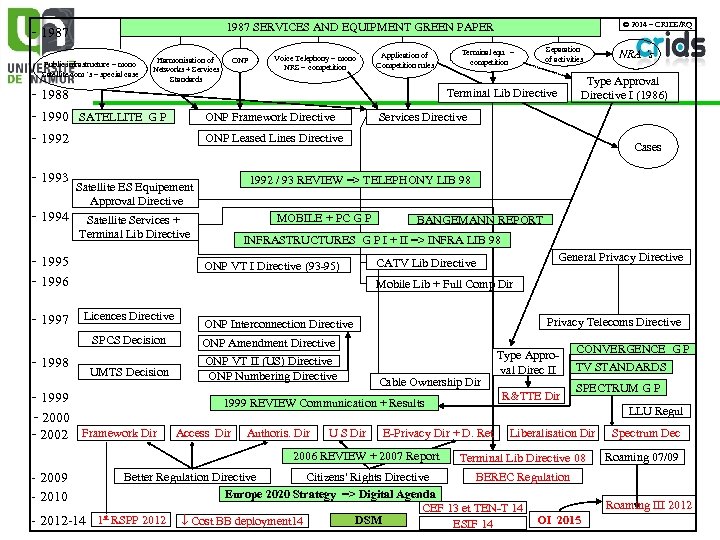
Public infrastructure = mono Satellite com ’s = special case - 1988 - 1990 - 1992 - 1993 - 1994 Harmonisation of Networks + Services Standards SATELLITE G P - 1999 - 2000 - 2002 Voice Telephony = mono NRS = competition Application of Competition rules ONP Framework Directive Separation of activities NRA ’s Type Approval Directive I (1986) Services Directive Cases 1992 / 93 REVIEW => TELEPHONY LIB 98 Satellite ES Equipement Approval Directive MOBILE + PC G P Satellite Services + Terminal Lib Directive BANGEMANN REPORT INFRASTRUCTURES G P I + II => INFRA LIB 98 ONP VT I Directive (93 -95) General Privacy Directive CATV Lib Directive Mobile Lib + Full Comp Dir Licences Directive UMTS Decision Privacy Telecoms Directive ONP Interconnection Directive ONP Amendment Directive ONP VT II (US) Directive ONP Numbering Directive Cable Ownership Dir Framework Dir Access Dir Authoris. Dir U S Dir Type Approval Direc II R&TTE Dir 1999 REVIEW Communication + Results CONVERGENCE G P TV STANDARDS SPECTRUM G P LLU Regul E-Privacy Dir + D. Ret 2006 REVIEW + 2007 Report - 2009 - 2010 Terminal equ. = competition ONP Leased Lines Directive SPCS Decision - 1998 ONP Terminal Lib Directive - 1995 - 1996 - 1997 © 2014 – CRIDS/RQ 1987 SERVICES AND EQUIPMENT GREEN PAPER - 1987 Liberalisation Dir Terminal Lib Directive 08 Better Regulation Directive Citizens' Rights Directive BEREC Regulation Europe 2020 Strategy => Digital Agenda CEF 13 et TEN-T 14 1 st RSPP 2012 Cost BB deployment 14 OI 2015 DSM - 2012 -14 ESIF 14 Spectrum Dec Roaming 07/09 Roaming III 2012
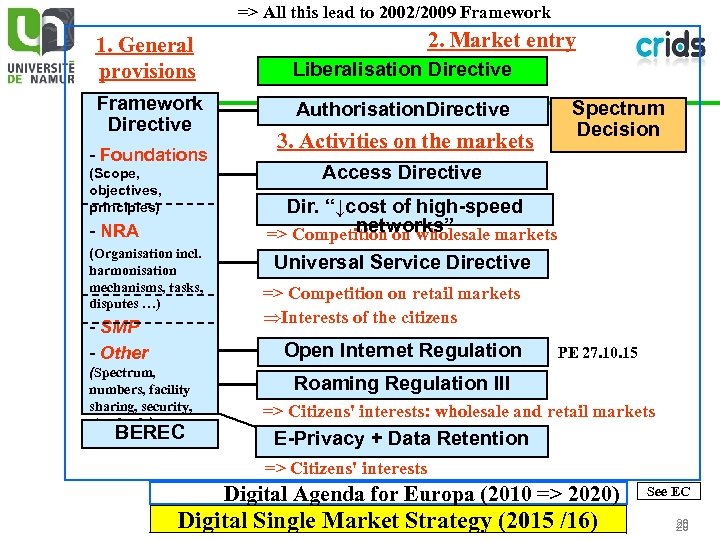
=> All this lead to 2002/2009 Framework 1. General provisions Framework Directive - Foundations (Scope, objectives, principles) 2. Market entry Liberalisation Directive Authorisation. Directive 3. Activities on the markets Spectrum Decision Access Directive Dir. “↓cost of high-speed networks” => Competition on wholesale markets - NRA (Organisation incl. harmonisation mechanisms, tasks, disputes …) - SMP - Other Universal Service Directive => Competition on retail markets ÞInterests of the citizens Open Internet Regulation (Spectrum, numbers, facility sharing, security, standards) BEREC PE 27. 10. 15 Roaming Regulation III => Citizens' interests: wholesale and retail markets E-Privacy + Data Retention => Citizens' interests Digital Agenda for Europa (2010 => 2020) Digital Single Market Strategy (2015 /16) See EC 20 20
III. Scope of EU (tele)communications regulation … and its evolutions III. 1. 1990 and 1998 Regulatory Framework III. 2. 2002 Regulatory Framework III. 3. 2002 Regulatory Framework as amended in 2009 21
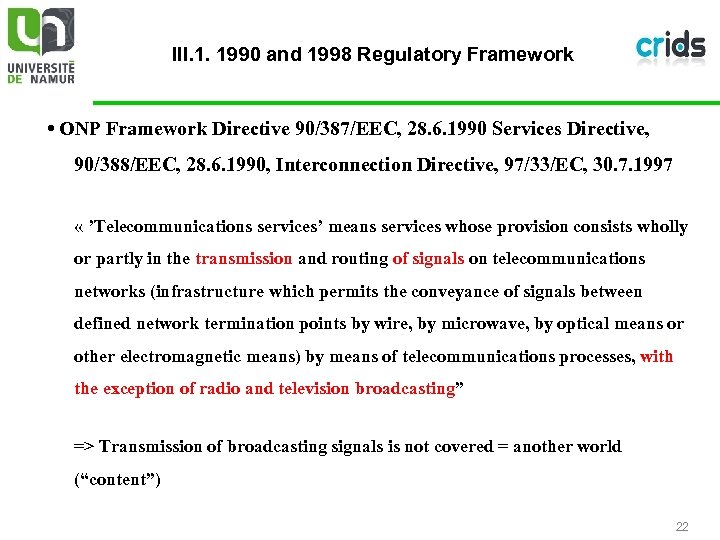
III. 1. 1990 and 1998 Regulatory Framework • ONP Framework Directive 90/387/EEC, 28. 6. 1990 Services Directive, 90/388/EEC, 28. 6. 1990, Interconnection Directive, 97/33/EC, 30. 7. 1997 « ’Telecommunications services’ means services whose provision consists wholly or partly in the transmission and routing of signals on telecommunications networks (infrastructure which permits the conveyance of signals between defined network termination points by wire, by microwave, by optical means or other electromagnetic means) by means of telecommunications processes, with the exception of radio and television broadcasting” => Transmission of broadcasting signals is not covered = another world (“content”) 22
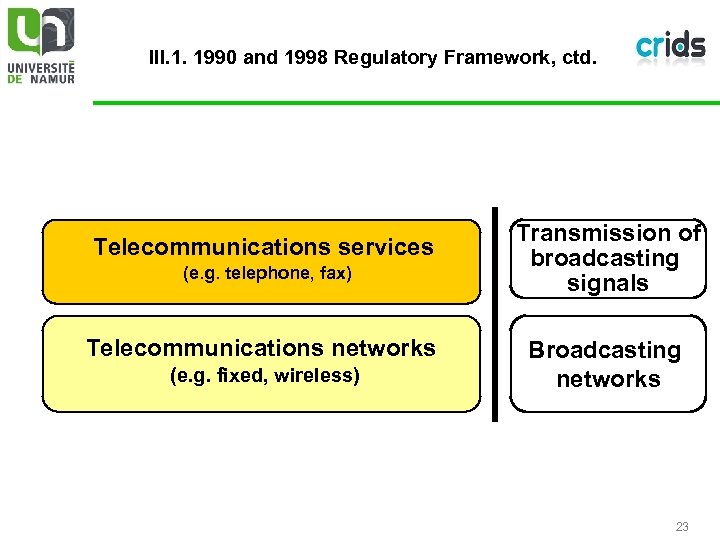
III. 1. 1990 and 1998 Regulatory Framework, ctd. Telecommunications services (e. g. telephone, fax) Telecommunications networks (e. g. fixed, wireless) Transmission of broadcasting signals Broadcasting networks 23
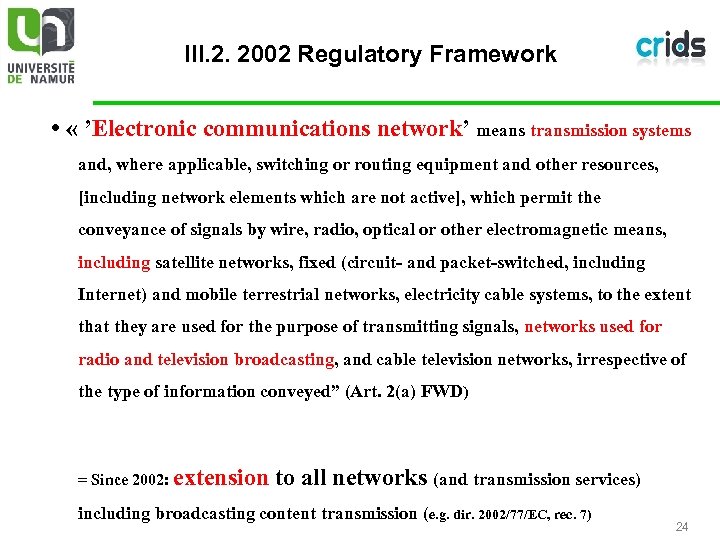
III. 2. 2002 Regulatory Framework • « ’Electronic communications network’ means transmission systems and, where applicable, switching or routing equipment and other resources, [including network elements which are not active], which permit the conveyance of signals by wire, radio, optical or other electromagnetic means, including satellite networks, fixed (circuit- and packet-switched, including Internet) and mobile terrestrial networks, electricity cable systems, to the extent that they are used for the purpose of transmitting signals, networks used for radio and television broadcasting, and cable television networks, irrespective of the type of information conveyed” (Art. 2(a) FWD) = Since 2002: extension to all networks (and transmission services) including broadcasting content transmission (e. g. dir. 2002/77/EC, rec. 7) 24
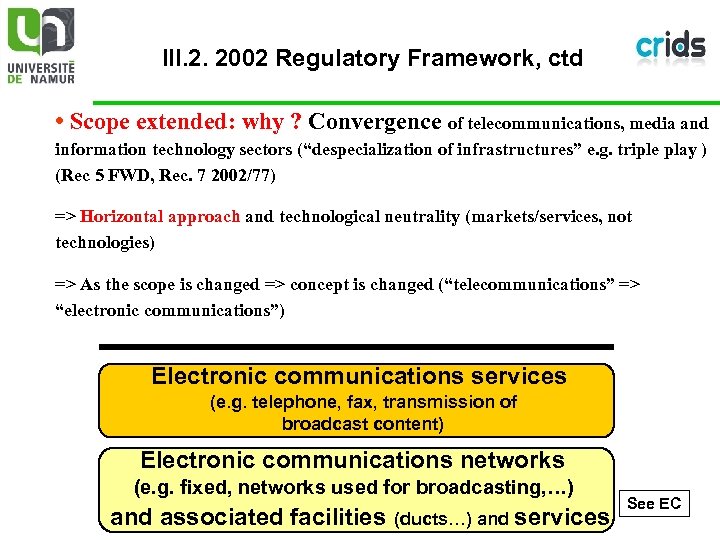
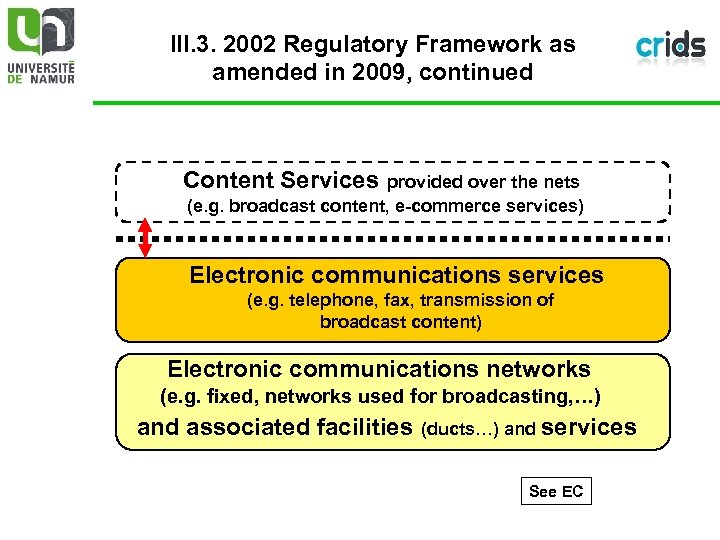
III. 2. 2002 Regulatory Framework, ctd • Scope extended: why ? Convergence of telecommunications, media and information technology sectors (“despecialization of infrastructures” e. g. triple play ) (Rec 5 FWD, Rec. 7 2002/77) => Horizontal approach and technological neutrality (markets/services, not technologies) => As the scope is changed => concept is changed (“telecommunications” => “electronic communications”) Electronic communications services (e. g. telephone, fax, transmission of broadcast content) Electronic communications networks (e. g. fixed, networks used for broadcasting, …) and associated facilities (ducts…) and services See EC
III. 2. 2002 Regulatory Framework, ctd • Regulation of transmission not content but links between both regulations have to be taken into account (rec. 5 FWD) => Regulation of transmission has an influence on regulation of content and may guarantee that a content is provided (E. g. must carry: mandatory provision of specified radio and television broadcast channels and complementary services assignment of frequencies to “pure” broadcasters): 26
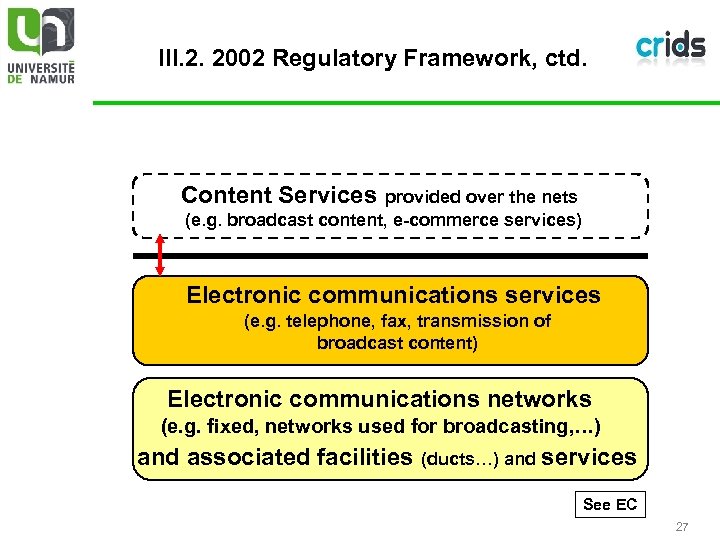
III. 2. 2002 Regulatory Framework, ctd. Content Services provided over the nets (e. g. broadcast content, e-commerce services) Electronic communications services (e. g. telephone, fax, transmission of broadcast content) Electronic communications networks (e. g. fixed, networks used for broadcasting, …) and associated facilities (ducts…) and services See EC 27
III. 3. 2002 Regulatory Framework as amended in 2009 (and ongoing) • Regulatory framework covers all transmission networks and services : principle maintained • Regulation of transmission not of content: principle maintained but links between both regulations become increasingly important and the borderline between both regulations is becoming increasingly burred: E. g. : 28
I. 3. 2002 Regulatory Framework as amended in 2009, ctd. 1. OTT (“Over-The-Top” providers (e. g. What’s. App, Skype, Spotify, You. Tube) • What are OTT’S: In principle no ECS providers They do not (re-)sell transmission, they do not intervene in transmission and are not responsible if there are transmission problems, ) – they are just providers of contents or applications 29
I. 3. 2002 Regulatory Framework as amended in 2009, ctd. “Over-the-top players provide audiovisual content [or communication applications]online without themselves being electronic communications services and network providers” (COM(2013) 231, 24. 4. 2013, p. 3) " BEREC… defines OTT service as content, a service or an application that is provided to the end-user over the open Internet. … This provision generally occurs without involvement of the IAP in the control or distribution of the service" (BEREC, Bo. R (15) 142, p. 14, 36) 30
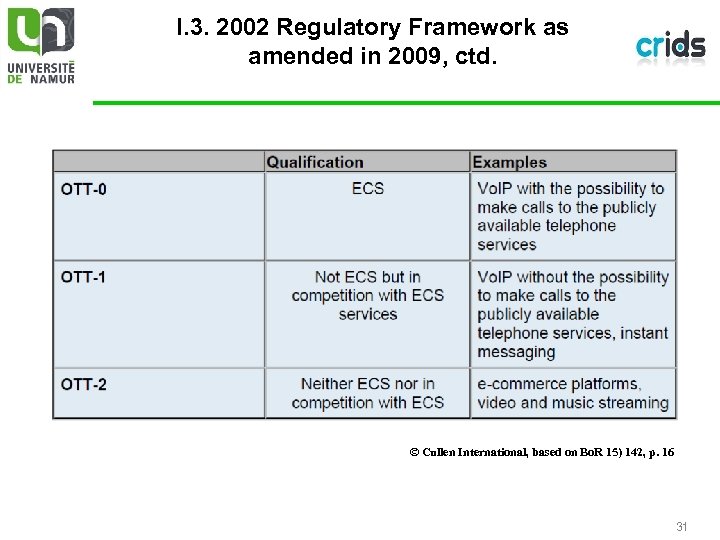
I. 3. 2002 Regulatory Framework as amended in 2009, ctd. © Cullen International, based on Bo. R 15) 142, p. 16 31
I. 3. 2002 Regulatory Framework as amended in 2009, ctd. => Electronic Communications Regulatory framework [in principle] not applicable, but OTT’s influence (the providers of) ECN and ECS: - OTT 1 (communication) compete with ECS providers and draw revenues from traditional ECS providers: e. g. Whats. APP - OTT 2 (contents): * Make profit due to the nets they use and put pressure on ECN operators by needing huge bandwith in principle without them to have direct revenues from OTT: e. g. Netflix * They may intervene in competition between ECS providers: e. g. DEEZER 32
I. 3. 2002 Regulatory Framework as amended in 2009, ctd. • Searching for an applicable regulatory framework and a balanced relationship between OTT and providers of ECN/ECS => Electronic Communications Regulatory framework in principle not applicable, but electronic communications providers ask for “level playing field” and OTT are increasingly taken into account, e. g. Commission recommendation 2014/710/EU of 9 octobre 2014 (3 rd relevant markets recommendation”), pt. 4: “National regulatory authorities should consider all relevant competitive constraints, irrespective of whether the sources of such constraints are deemed to be electronic communications networks, electronic communications services, or other types of services or applications which are comparable from the perspective of the end-user” 33
I. 3. 2002 Regulatory Framework as amended in 2009, ctd. => In the context of the DSM’s review of the Electronic Communications Regulatory framework special attention is given to the question + Some OTT (e. g. Whats. App) are Information Society Services + Some OTT (e. g. Netflix) are Audiovisual Media Services => The specific rules are applicable (Dir. 2000/31 - Dir. 2015/1535, Dir. 2010/10): * Is this not enough (layered approach)? * On the other hand, should the aim not be to have an “integrated approach” 34
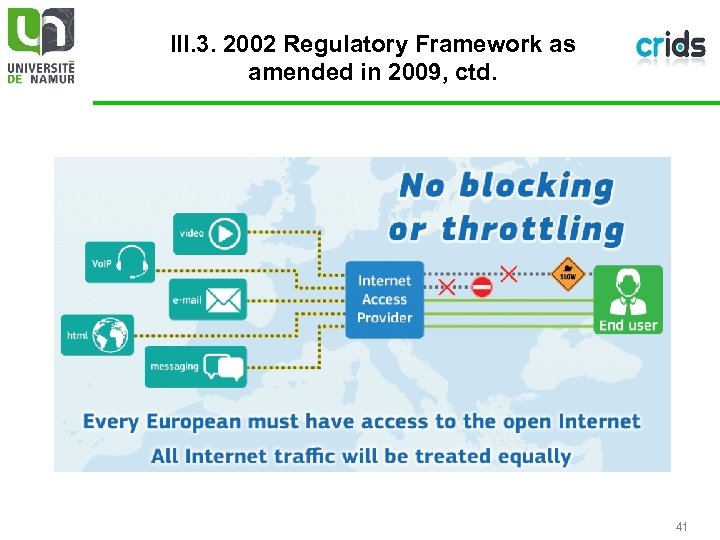
III. 3. 2002 Regulatory Framework as amended in 2009, ctd. 2. The guarantee of an Open Internet (Net Neutrality) (Reg. “Open Internet and roaming, adopted by EP on 27. 10. 15) • Principle: an open and neutral Internet without discrimination where everybody can use the applications, contents… of its choice is the best guarantee that contents are transmitted until the end-user. 35
III. 3. 2002 Regulatory Framework as amended in 2009, ctd. • Context: * Capacity of networks (and thus of the Internet = network of networks) is still limited while traffic is increasing (OTT…) => risk of congestion Þneed of traffic mangament which e. g. slows down certain applications ónon discrimination 36
III. 3. 2002 Regulatory Framework as amended in 2009, ctd. * Temptation might exist to bloc competing services /applications (e. g. Skype) … but in 2014 a Commission enquiry concluded that there were no anticompetitive practices in internet connectivity services * Some services need a specific quality (e. g. those who are “time sensitive like IP TV or telemedicine e-mail) (“specialised services”) … and thus priority against the basic , best effort internet access service => Risk that the basic IAS receives only (too) limited capacity => But those services promote innovation and brig additional revenues which the operator may invest. . 37
III. 3. 2002 Regulatory Framework as amended in 2009, ctd. • Objective and regime: + Art. 8(4)(g) FWD – the principle : “the NRA promote … the ability of end-users to access and distribute information or run applications and services of their choice” 38
III. 3. 2002 Regulatory Framework as amended in 2009, ctd. + Art. 3. 1 and 3, 1 st para, Reg. “Open Internet” : “End-users shall have the right to access and distribute information and content, use and provide applications and services, and use terminal equipment of their choice, irrespective of the end-user’s or provider’s location or the location, origin or destination of the information, content, application or service, via their internet access service. … Providers of internet access services shall treat all traffic equally, when providing internet access services, without discrimination, restriction or interference, and irrespective of the sender and receiver, the content accessed or distributed, the applications or services used or provided, or the terminal equipment used. ” 39
III. 3. 2002 Regulatory Framework as amended in 2009, ctd. => To this end the Regulation rules strictly • Trafic managment (and thus discrimination between trafic for technical reasons): only if reasonable e. g. if needed to preserve integrity of the network or to prevent impending network congestion and mitigate effects of exceptional or temporary network congestion (art. 3. 3) • Optimised services ( « special services » ): only allowed if network capacity is sufficient to provide them in addition to any internet access service => Appropriate compromise … BUT « optimised services » are no longer defined 40
III. 3. 2002 Regulatory Framework as amended in 2009, ctd. 41
III. 3. 2002 Regulatory Framework as amended in 2009, ctd. 3. Radio frequencies are submitted to the principles of technology and service neutrality (Art. 9 FWD) But exceptions to the principle are allowed notably to promote cultural and linguistic diversity and media pluralism, e. g. by the provision of radio and television broadcasting services 42
III. 3. 2002 Regulatory Framework as amended in 2009, continued Content Services provided over the nets (e. g. broadcast content, e-commerce services) Electronic communications services (e. g. telephone, fax, transmission of broadcast content) Electronic communications networks (e. g. fixed, networks used for broadcasting, …) and associated facilities (ducts…) and services See EC
IV. Objectives of EU (tele)communications regulation IV. 1. Principle IV. 2. List 44
IV. 1. Objectives - Principle "The overriding aim is to develop the conditions for the market to provide European users with a greater variety of telecommunications services , of better quality and at lower cost, affording Europe the full internal and external benefits of a strong telecommunications sector. “ The same since 1987 : … but explicitly codified only in 2002 (art. 8, Framework Directive 2002/21/EC) 45
IV. 2. Objectives - List 1. Promote competition (art. 8. 2 FWD) => Liberalisation and harmonised measures promoting competition while, since 2009 special emphasis on maintaining incentives for investments by incumbants => From “services (access-based) competition” to “infrastructure (facilities)- based competition” (art. 8. 5, c FWD, 12. 2, d ACD) => next slide + Increasing acceptance of a certain consolidation of the market + Increasing attention for the question “how many: “infrastructure competition” is one of the key issues of 2015/2016 Review 46
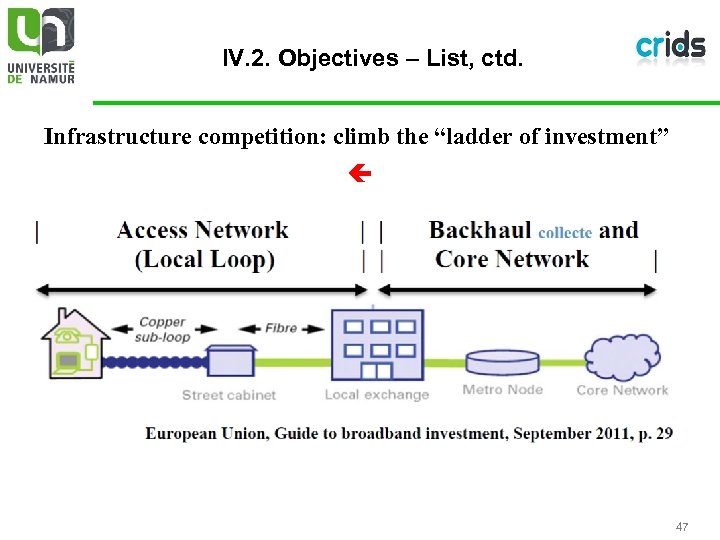
IV. 2. Objectives – List, ctd. Infrastructure competition: climb the “ladder of investment” 47
IV. 2. Objectives – List, ctd. 2. Promote the interests of the European Citizens - Guarantee offers of general economic interest like universal service - Consumer protection including data protection, privacy and network security Attention given to this objective is increasing (see 2009/136 CRD), esp. regarding consuer protection 48
IV. 2. Objectives - List, ctd. 3. Contribute to the development of the internal market The idea: Promote pan-European services and the development of a European regulatory culture and a consistent application of the rules throughout Europe => means have evolved through the years but overall result is (very) weak ( but improving e. g. through BEREC) "The Single market allows to benefit from economies of scale induced by a market of over 500 million people , increased competition, interoperability of transnational services and availability of services of same quality all over Europe as well as avoidance of regulatory costs of incompatible decisions imposed on “pan-European” operators, … “ (2010 ? ) 49
IV. 2. Objectives - List, ctd. “If the internal market for electronic communications were completed, the EU's gross domestic product (GDP) could grow by up to 110 billion euros a year” COM(2013) 634, 11. 9. 2013, p. 4 A digital Single Market “could contribute an additional EUR 415 billion (including telecoms) to the European GDP” COM(2015, 11. 9. 2013, p. 4 50
IV. 2. Objectives - List, ctd. • The result: since 1987 a real single market has not been achieved "The single EU market for telecoms is still far from reality…" European Commission, IP/10/644, 1. 06. 2010 "While successive waves of reform by the European Union have helped transform the way telecoms services are delivered in the European Union, the sector still operates largely on the basis of 28 national markets. There is no telecoms company that operates across the whole EU and both operators and customers face differing prices and rules. “ EC, IP/13/828, 11. 9. 2013, p. 1. 51
IV. 2. Objectives - List, ctd. • Current tools: the consolidation of this Single Market for electronic communications requires harmonisation of rules and their application (arts. 7(2) and 8(3)(d) FWD) = consistent application of the provisions in all Member States and coherent regulatory practices (= the development of a European regulatory culture) ≠ same solution everywhere but "that similar regulatory issues be given correspondingly similar treatment" (COM(2010) 245/2, p. 13) = goal: the same approach => EU-wide cooperation of NRA with each other and with the Commission is a prerequisite (BEREC, art. 7 veto procedure, art. 19 recoms…) • Future tools: wait and see 52
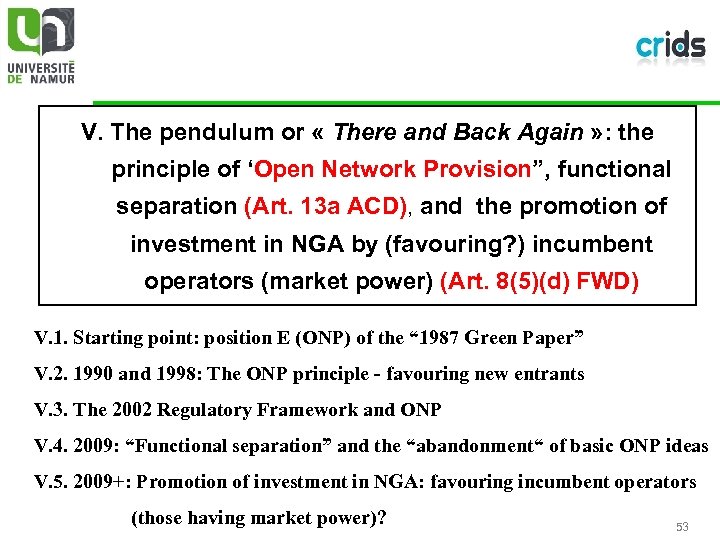
V. The pendulum or « There and Back Again » : the principle of ‘Open Network Provision”, functional separation (Art. 13 a ACD), and the promotion of investment in NGA by (favouring? ) incumbent operators (market power) (Art. 8(5)(d) FWD) V. 1. Starting point: position E (ONP) of the “ 1987 Green Paper” V. 2. 1990 and 1998: The ONP principle - favouring new entrants V. 3. The 2002 Regulatory Framework and ONP V. 4. 2009: “Functional separation” and the “abandonment“ of basic ONP ideas V. 5. 2009+: Promotion of investment in NGA: favouring incumbent operators (those having market power)? 53
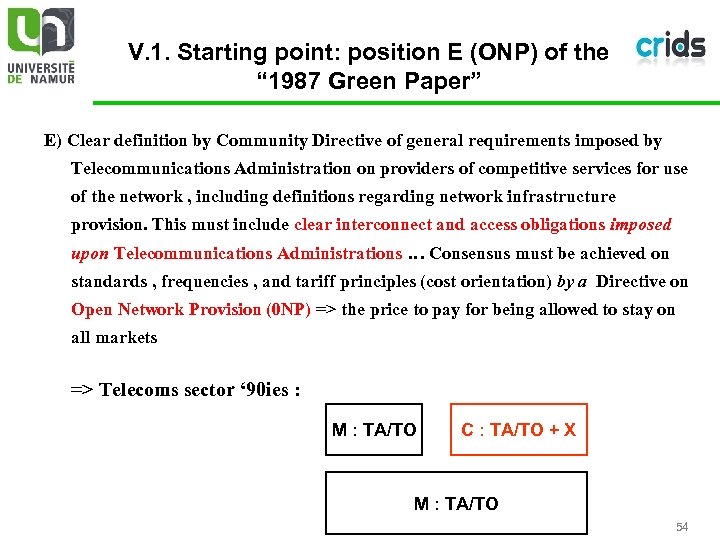
V. 1. Starting point: position E (ONP) of the “ 1987 Green Paper” E) Clear definition by Community Directive of general requirements imposed by Telecommunications Administration on providers of competitive services for use of the network , including definitions regarding network infrastructure provision. This must include clear interconnect and access obligations imposed upon Telecommunications Administrations … Consensus must be achieved on standards , frequencies , and tariff principles (cost orientation) by a Directive on Open Network Provision (0 NP) => the price to pay for being allowed to stay on all markets => Telecoms sector ‘ 90 ies : M : TA/TO C : TA/TO + X M : TA/TO 54
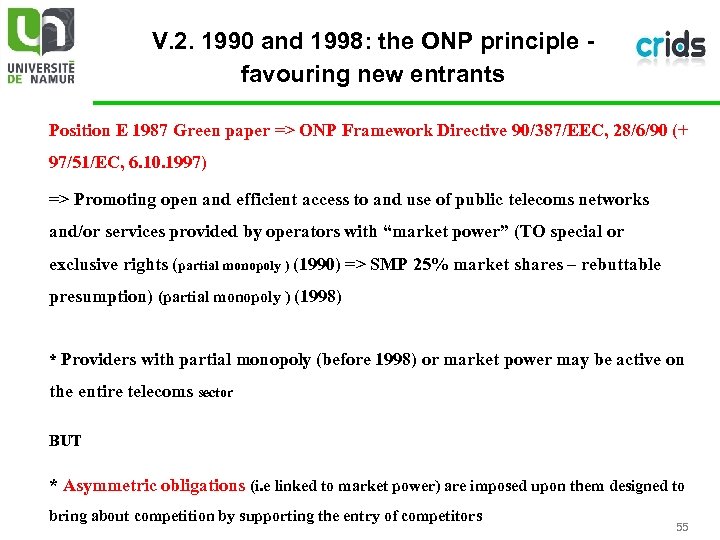
V. 2. 1990 and 1998: the ONP principle - favouring new entrants Position E 1987 Green paper => ONP Framework Directive 90/387/EEC, 28/6/90 (+ 97/51/EC, 6. 10. 1997) => Promoting open and efficient access to and use of public telecoms networks and/or services provided by operators with “market power” (TO special or exclusive rights (partial monopoly ) (1990) => SMP 25% market shares – rebuttable presumption) (partial monopoly ) (1998) * Providers with partial monopoly (before 1998) or market power may be active on the entire telecoms sector BUT * Asymmetric obligations (i. e linked to market power) are imposed upon them designed to bring about competition by supporting the entry of competitors 55
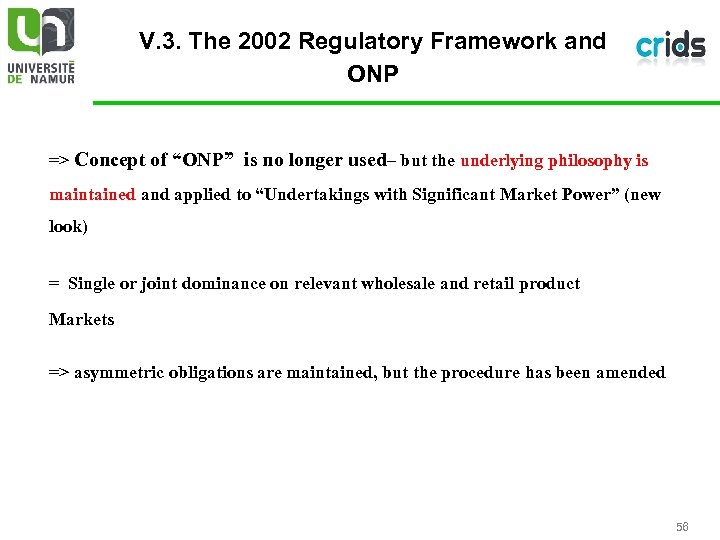
V. 3. The 2002 Regulatory Framework and ONP => Concept of “ONP” is no longer used– but the underlying philosophy is maintained and applied to “Undertakings with Significant Market Power” (new look) = Single or joint dominance on relevant wholesale and retail product Markets => asymmetric obligations are maintained, but the procedure has been amended 56
V. 3. The 2002 Regulatory Framework and ONP => But no longer asymmetric obligations only : according to art. 5 ACD access obligations and esp. interconnection may under specific also be imposed on non SMP operators AND => Idea of progressive roll-back of sector specific rules once competition becomes effective as the related obligations are very intrusive (e. g. Full Local Loop Unbundling) 57
V. 4. 2009: “Functional separation” and the “abandonment” of basic ONP ideas • In 2009 an new remedy is added to the NRAs’ toolbox: functional separation (Art. 13 a ACD): "A vertically integrated Undertaking with SMP is required to place activities related to the wholesale provision of relevant access products in an independently operating business entity“=> for this entity to offer those products in a non discriminatory way to all who ask => Two basic ONP Paradigms could be affected * SMP undertakings may in principle be active on the entire electronic communications markets … but the principle may be affected to some extend by functional separation in exceptional cases if remedies imposed have not worked out ("last resort remedy") * Sector specific economic regulation is limited in time (withdrawal once competition is achieved) (rec. 5 Dir. 2009/140) but functional separation is indeed justified by the fact that on some access markets competition will not be possible in a foreseeable future + such an intrusive measure is not easily reversible 58
V. 5. 2009+ : Promotion of investment in NGA: favouring incumbent operators (SMP) ? • 2009: Art. 8 (5) (d) FWD) exposes the principle of promotion of efficient investment in new and enhanced (access) infrastructures as a principle ruling NRA’s action => needed for reaching the EU 2020 / Digital Agenda broadband targets => Regulatory incentives for SMP operators in order to push them to invest: access obligations (= in principle a “dis-incentive are currently maintained but “nuanced”): 59
V. 5. 2009+: Promotion of investment in NGA: favouring incumbent operators (MP) ? , ctd. => Regulatory incentives: access obligations are maintained but “nuanced” (art. 8. 5, d FWD): - No regulatory holidays at least not (yet ) as a general principle fixed once for all by law, but - But access obligations imposed upon SMP operators must be designed in such a way that the related pricing obligations take into account risk of investment and do not become "dis-incentive" for investment => The tariff should be cost-oriented but costs also include a "risk premium" (see art. 13. 1 ACD and Commission recommendation 2010/572 on NGA regulation, 20. 10, para. 25 and Annex I. 6) 60
V. 5. 2009+: Promotion of investment in NGA: favouring incumbent operators (MP) ? , ctd. • 2013 EVEN no longer cost-oriented tariffs for access to NGA if the SMP operator applies strict internal and external non discrimination (equivalence of inputs – pt. 6, g Recom. 2013/466/EU) => favours the SMP operator and thus the investment + There should be no price cuts on average (€ 8 -10 per month) to what incumbent network operators can charge to competitors buying wholesale access to their copper networks => favours incumbents but also provides “incentives”to alternative operators as “services competition” becomes more expensive: rather do than buy as buying is anyway expensive (see pts. 48 ff and 41 Commission recommendation 2013/466/EU of 11 September 2013 on consistent nondiscrimination obligations and costing methodologies to promote competition and enhance the broadband investment environment, O. J. L 251/13, 21. 9. 2013 + declaration N. Kroes 12 July 2012, MEMO/12/544, 12. 7. 12) => This could be an even greater shift of the focus of attention towards the needs of incumbents as they are those who are able to invest, a little bit away from the objective of promoting new entrants but non discrimination is also burdensome… 61
V. 5. 2009+: Promotion of investment in NGA: favouring incumbent operators (MP) ? , ctd. • 2014 -15 : Ideas launched by Commissioner Oettinger + The return of the idea of regulatory holidays: operators could be allowed to deny access to their new high-speed broadband network in rural areas to competitors if they prove that without that exemption the investment would not be made + In order to provide security for investors, one could apply restrictions on the ending of user contracts for a certain period 62
V. 5. 2009+: Promotion of investment in NGA: favouring incumbent operators (MP) ? , ctd. • 2015 -16 : Digital Single Market Strategy => Pillar 3 “digital networks and services” Cfr. COM(2015) 192, p. 9 -10, SWD(2015) 100, p. 36 -39 => Some findings * “An investment gap of € 90 billion has been identified in order to meet the 100 Mbps take-up target (50% of all fixed subscriptions) for 2020 => the incentives for private operators to do more must therefore be examined afresh” 63
V. 5. 2009+: Promotion of investment in NGA: favouring incumbent operators (MP) ? , ctd. * “Proportionate regulation” for incumbants Esp. in rural areas there is a problem: only 68% of Europeans have today access to NGA and even only 25 % of rural homes … BUT “don’t let the rural tail wag the urban dog “ (R. Feasy) * “Little full ‘infrastructure competition’ has emerged in fixed-line networks: for alternative operators “investment incentives may be reduced if regulated wholesale access (=> services competition) is made disproportionately attractive, i. e. access seekers build or buy decisions rendered economically inefficient” => Wait and see. . 64
VI. Conclusion(s) 65
Readings • L. HANCHER, P. LAROUCHE, "The coming of age of EU regulation of network industries and services of general economic interest", in P. CRAIG, G. DE BÚRCA (eds. ), The Evolution of EU Law, 2 nd edition, Oxford University Press, 2011, 742 -781. • H. UNGERER, “Back to the roots: the 1987 telecom green paper 25 years after – has European telecom liberalization fulfilled its promise for Europe in the internet age? ”, Info – Special Issue: European ICT policies after 25 years: achievements, challenges and opportunities, Vol. 15, N° 2, 2013, 14 -24. • European Commission Memo, Enhancing the broadband investment environment – policy statement by Vice President Kroes, MEMO/12/554, 12 July 2012. • Communication from the Commission on the Telecommunications Single Market, COM(2013) 634, 11 September 2013. • P. LAROUCHE, “Convergence, consolidation, uncertainty: future-proofing electronic communications regulation”, CERRE Policy paper, 18 December 2013, 16 p. 66
Readings, ctd. • J. MARCUS, I. GODLOVITCH, P. NOOREN, B. VAN DEN ENDE, J. CAVE, W. NEU, How to Build a Ubiquitous EU Digital Society, Study for the European Parliament’s Committee on Industry, Research and Energy, IP/A/ITRE/ST/2012 -09, PE 518. 736, November 2013, 22 p. • C. LONG, P. BRISBY (eds. ), “EU Telecommunications Policy and Regulation”, in Global Telecommunications Law and Practice, Volume 1, London, Sweet & Maxwell, looseleaf, December 2014, p. 3003 -3037 • Communication from the Commission, A Digital Single Market Strategy for Europe, COM(2015) 192, 6. 5. 2015 AND Commission Staff Working Document, A Digital Single Market Strategy for Europe – Analysis and Evidence, SWD(2015) 100, 6. 5. 2015 67
Thank you for your attention ! robert. queck@fundp. ac. be 68
Скачать презентацию Between evolution and revolution lines of development
b486d68003721c39272a751c27af136f.ppt