 Скачать презентацию Best Practices in Report Writing Ralph E Gene
dd9998038d6350c7727c3dd5c0ad0d2c.ppt
- Количество слайдов: 31



Best Practices in Report Writing Ralph E. (Gene) Cash, Ph. D. , NCSP, ABPP President, American Academy of School Psychology Licensed Psychologist Professor, Nova Southeastern University Director, School-related Psychological Assessments and Clinical Interventions clinic Phone: 954 -262 -5703 E-mail: gcash 1@aol. com
Writers on Writing l l l “There is nothing to writing. All you do is sit down at a typewriter and bleed. ” – Earnest Hemingway “Substitute 'damn' every time you're inclined to write 'very’; your editor will delete it, and the writing will be just as it should be. ” ― Mark Twain “We write to taste life twice, in the moment and in retrospect. ” ― Anaïs Nin “Write what should not be forgotten. ” ― Isabel Allende “My task, which I am trying to achieve is, by the power of the written word, to make you hear, to make you feel--it is, before all, to make you see. ” ― Joseph Conrad
Writers on Writing l “The most important things are the hardest to say. They are things you get ashamed of, because words diminish them -- words shrink things that seemed limitless when they were in your head to no more than living size when they're brought out. But it's more than that, isn't it? The most important things lie too close to wherever your secret heart is buried, like landmarks to a treasure your enemies would love to steal away. And you may make revelations that cost you dearly only to have people look at you in a funny way, not understanding what you've said at all, or why you thought it was so important that you almost cried while you were saying it. That's the worst, I think. When the secret stays locked within not for want of a teller but for want of an understanding ear. ” ― Stephen King
Why Have Psychological Reports, Anyway? l Formulate recommendations l Foster understanding l Recommend and motivate intervention(s) l Integrate data from diverse sources l Paint a comprehensive picture l Make accurate diagnosis(es) l Provide baseline data l Facilitate resource access l Meet legal requirements
You Can’t Tell Without Assessing!
A Quality Psychological Report Is well-organized u Is solidly grounded in accurate data u Integrates and interprets assessment results rather than just reporting them u Respects individuality and diversity u Takes into account cultural and linguistic differences u Avoids jargon u Answers all referral questions u Addresses all relevant issues u Assesses for all suspected areas of disability u Is appropriate for the target audience(s) u Is completed promptly u
The Importance of Professional Ethics in Report Writing u To build and maintain public trust in school psychologists and psychology, every practitioner must be sensitive to the ethical components of his or her work, knowledgeable of broad ethical principles and rules of professional conduct, skilled in using a systematic problem-solving procedure, and committed to a proactive stance in ethical thinking and conduct.
Necessity of Comprehensive Assessment ® assesses all areas of suspected disability ® helps to meet all Federal criteria and rule-out requirements ® assures that appropriately trained and qualified personnel are involved ® serves important prevention-role efforts ® can answer the “why” question for nonresponders to evidence-based intervention ® guides individualized interventions ® recommends methods for monitoring progress ® Forest Grove vs. TA
Report Contents (not necessarily in this exact order) n n n Identifying information Reason for referral Background information Assessment procedures and instruments Observations (including Mental Status) Results and diagnostic impressions Summary (Optional) Recommendations Signature(s) Credentials Date(s) Appendix

Can we measure ability? Should we bother measuring intelligence or intellectual functioning? If so, what is it? Is the concept of Full Scale IQ useful?
Reporting Evaluative Results • Factors that may have affected results • Correct names and abbreviations of tests or procedures • • • used as well as correct grammar, spelling, etc. Scores, percentiles, and confidence intervals of tests administered (RPIs, if applicable) Descriptions of strengths as well as weaknesses Comparisons of various skills assessed Illustrative responses (Do NOT quote test items) Indications of psychopathology Indications of exceptionality Interrelationships among data sources Implications of background information, observations, and results Diagnostic impression (statutes, rules, & district policy)
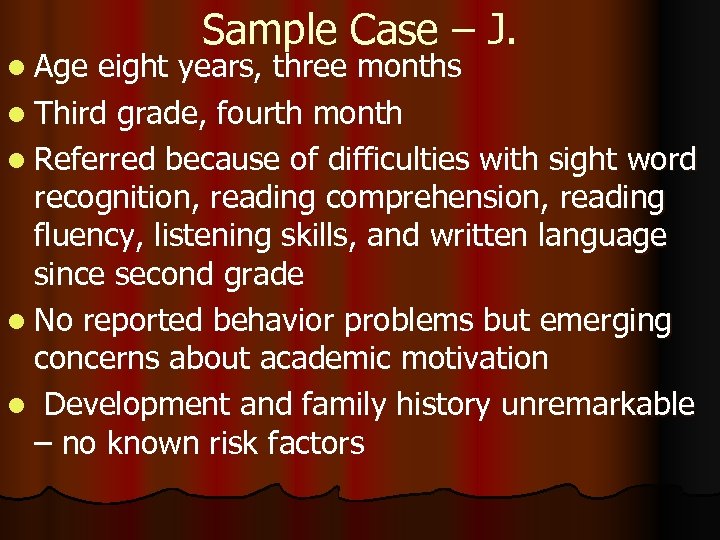
l Age Sample Case – J. eight years, three months l Third grade, fourth month l Referred because of difficulties with sight word recognition, reading comprehension, reading fluency, listening skills, and written language since second grade l No reported behavior problems but emerging concerns about academic motivation l Development and family history unremarkable – no known risk factors
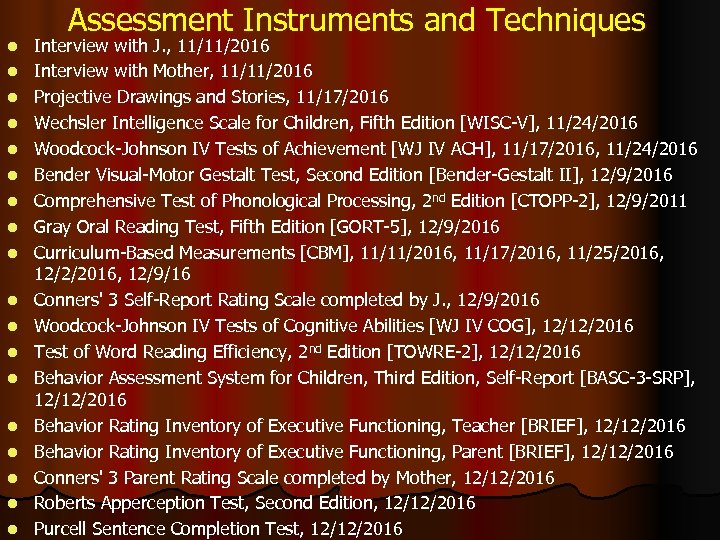
l l l l l Assessment Instruments and Techniques Interview with J. , 11/11/2016 Interview with Mother, 11/11/2016 Projective Drawings and Stories, 11/17/2016 Wechsler Intelligence Scale for Children, Fifth Edition [WISC-V], 11/24/2016 Woodcock-Johnson IV Tests of Achievement [WJ IV ACH], 11/17/2016, 11/24/2016 Bender Visual-Motor Gestalt Test, Second Edition [Bender-Gestalt II], 12/9/2016 Comprehensive Test of Phonological Processing, 2 nd Edition [CTOPP-2], 12/9/2011 Gray Oral Reading Test, Fifth Edition [GORT-5], 12/9/2016 Curriculum-Based Measurements [CBM], 11/11/2016, 11/17/2016, 11/25/2016, 12/2/2016, 12/9/16 Conners' 3 Self-Report Rating Scale completed by J. , 12/9/2016 Woodcock-Johnson IV Tests of Cognitive Abilities [WJ IV COG], 12/12/2016 Test of Word Reading Efficiency, 2 nd Edition [TOWRE-2], 12/12/2016 Behavior Assessment System for Children, Third Edition, Self-Report [BASC-3 -SRP], 12/12/2016 Behavior Rating Inventory of Executive Functioning, Teacher [BRIEF], 12/12/2016 Behavior Rating Inventory of Executive Functioning, Parent [BRIEF], 12/12/2016 Conners' 3 Parent Rating Scale completed by Mother, 12/12/2016 Roberts Apperception Test, Second Edition, 12/12/2016 Purcell Sentence Completion Test, 12/12/2016
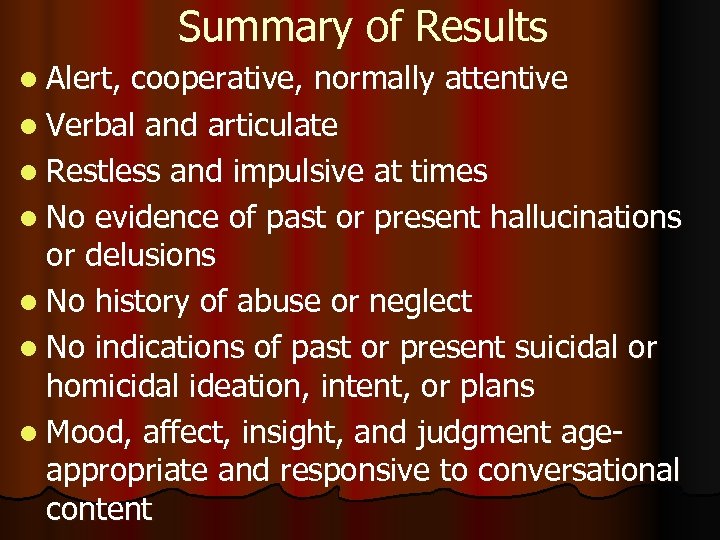
Summary of Results l Alert, cooperative, normally attentive l Verbal and articulate l Restless and impulsive at times l No evidence of past or present hallucinations or delusions l No history of abuse or neglect l No indications of past or present suicidal or homicidal ideation, intent, or plans l Mood, affect, insight, and judgment ageappropriate and responsive to conversational content
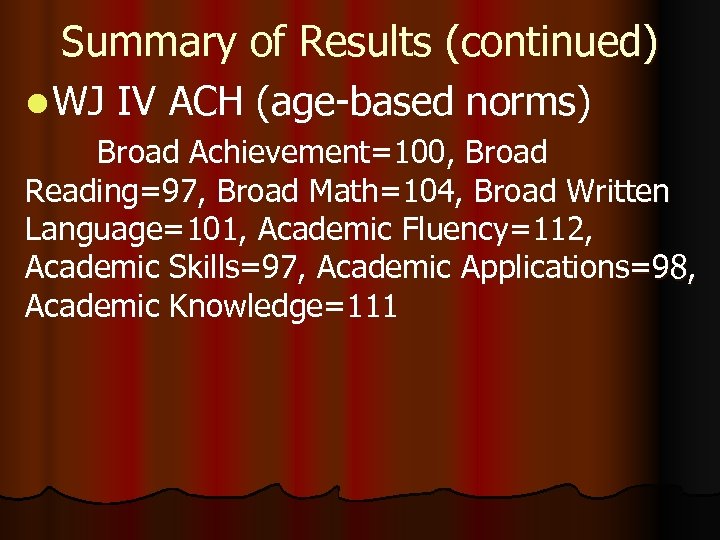
Summary of Results (continued) l WJ IV ACH (age-based norms) Broad Achievement=100, Broad Reading=97, Broad Math=104, Broad Written Language=101, Academic Fluency=112, Academic Skills=97, Academic Applications=98, Academic Knowledge=111
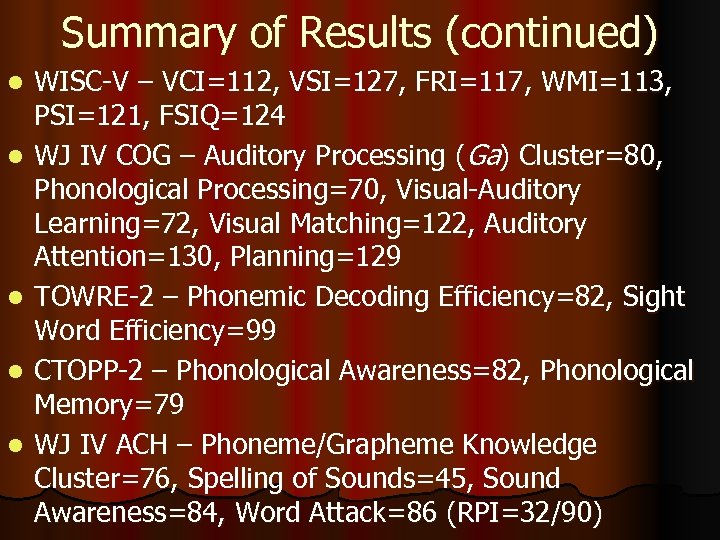
Summary of Results (continued) l l l WISC-V – VCI=112, VSI=127, FRI=117, WMI=113, PSI=121, FSIQ=124 WJ IV COG – Auditory Processing (Ga) Cluster=80, Phonological Processing=70, Visual-Auditory Learning=72, Visual Matching=122, Auditory Attention=130, Planning=129 TOWRE-2 – Phonemic Decoding Efficiency=82, Sight Word Efficiency=99 CTOPP-2 – Phonological Awareness=82, Phonological Memory=79 WJ IV ACH – Phoneme/Grapheme Knowledge Cluster=76, Spelling of Sounds=45, Sound Awareness=84, Word Attack=86 (RPI=32/90)
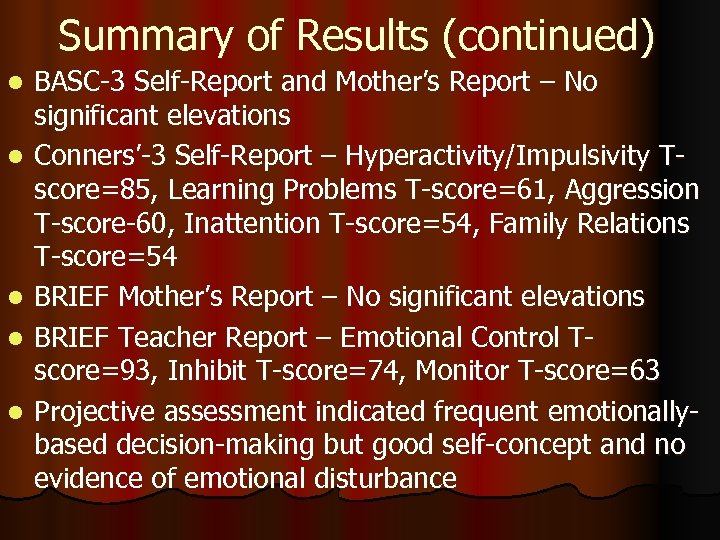
Summary of Results (continued) l l l BASC-3 Self-Report and Mother’s Report – No significant elevations Conners’-3 Self-Report – Hyperactivity/Impulsivity Tscore=85, Learning Problems T-score=61, Aggression T-score-60, Inattention T-score=54, Family Relations T-score=54 BRIEF Mother’s Report – No significant elevations BRIEF Teacher Report – Emotional Control Tscore=93, Inhibit T-score=74, Monitor T-score=63 Projective assessment indicated frequent emotionallybased decision-making but good self-concept and no evidence of emotional disturbance
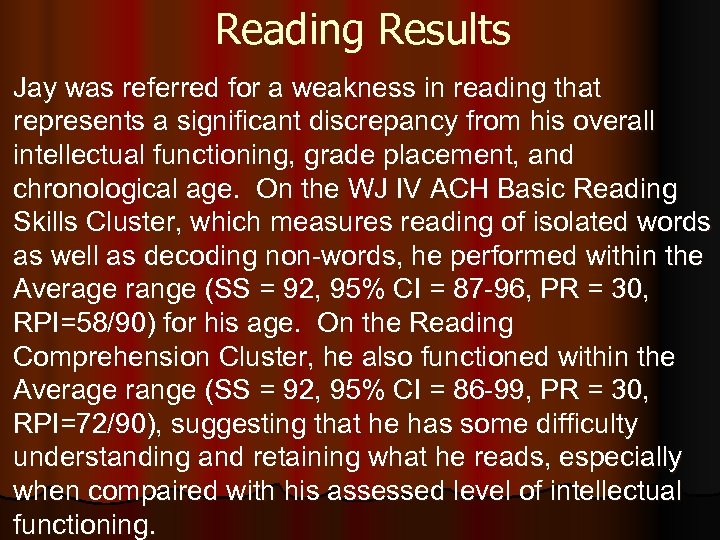
Reading Results Jay was referred for a weakness in reading that represents a significant discrepancy from his overall intellectual functioning, grade placement, and chronological age. On the WJ IV ACH Basic Reading Skills Cluster, which measures reading of isolated words as well as decoding non-words, he performed within the Average range (SS = 92, 95% CI = 87 -96, PR = 30, RPI=58/90) for his age. On the Reading Comprehension Cluster, he also functioned within the Average range (SS = 92, 95% CI = 86 -99, PR = 30, RPI=72/90), suggesting that he has some difficulty understanding and retaining what he reads, especially when compaired with his assessed level of intellectual functioning.
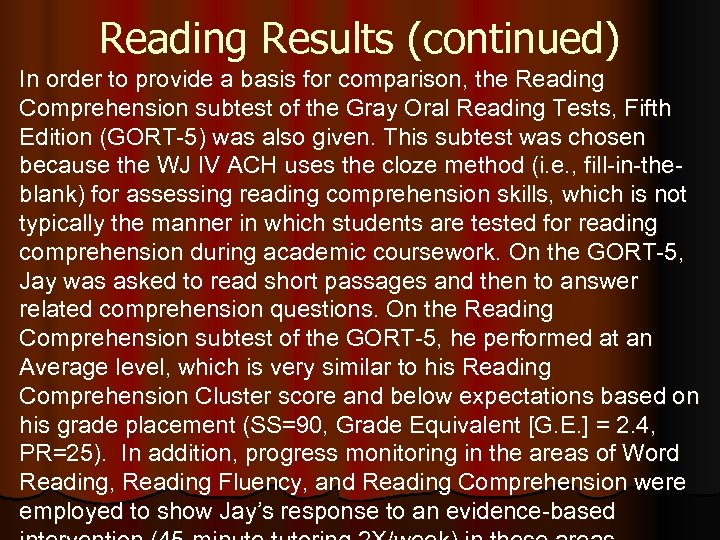
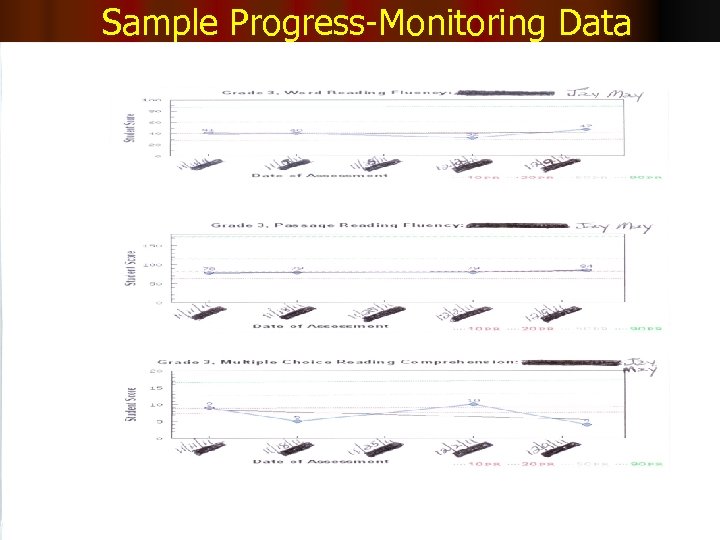
Reading Results (continued) In order to provide a basis for comparison, the Reading Comprehension subtest of the Gray Oral Reading Tests, Fifth Edition (GORT-5) was also given. This subtest was chosen because the WJ IV ACH uses the cloze method (i. e. , fill-in-theblank) for assessing reading comprehension skills, which is not typically the manner in which students are tested for reading comprehension during academic coursework. On the GORT-5, Jay was asked to read short passages and then to answer related comprehension questions. On the Reading Comprehension subtest of the GORT-5, he performed at an Average level, which is very similar to his Reading Comprehension Cluster score and below expectations based on his grade placement (SS=90, Grade Equivalent [G. E. ] = 2. 4, PR=25). In addition, progress monitoring in the areas of Word Reading, Reading Fluency, and Reading Comprehension were employed to show Jay’s response to an evidence-based
Sample Progress-Monitoring Data
Reading Results (continued) Specifically, while Jay evidenced some recall of factual information from written passages, he had difficulty decoding and defining unknown words from context and limited skills in applying inductive logic to answer comprehension questions. Moreover, his progress in each of these areas, monitored several times over a one -month period, was virtually nil, especially in reading comprehension. These findings provide further support for the presence of a learning disability within the area of reading.
DIAGNOSTIC IMPRESSION (DSM-5/ICD-10 -CM): l 315. 00/F 81. 0 Specific Learning Disorder with Impairment in Reading (sometimes referred to as dyslexia) l 315. 1/F 81. 2 Specific Learning Disorder with Impairment in Mathematics (sometimes referred to as dyscalculia) l 315. 2/F 81. 81 Specific Learning Disorder with Impairment in Written Expression
Formulating Recommendations ® The report exists for the recommendations ® Recommendations must be reasonable ® Organize recommendations categorically and hierarchically ® Involve relevant parties in formulating recommendations ® Suggest methods for evaluating the effectiveness of recommendations ® Use caution in making long-range predictions
School systems are not responsible for meeting every need of their students. But when the need directly affects learning, the school must meet the challenge. -Source: Carnegie Council Task Force on Education of Young Adolescents (1989)
Recommendations for School Psychologists • • • seek continuing training/supervision collaborate on data interpretation study personality theories stay connected to a university stay connected to an online database get involved in research be active in psychology associations join or develop a journal club be a lifelong learner practice, practice!
REFERENCES AND RESOURCES http: //ies. ed. gov/ncee/wwc/ http: //www. interventioncentral. org/ http: //www. studentprogress. org/weblibrary. asp Lichtenberger, E. O. , Mather, N. L. , Kaufman, N. L. , & Kaufman, A. S. (2004) Essentials of Assessment Report Writing. NJ: John Wiley & Sons, Inc. Mather, N. L. & Jaffe, L. E. (2011). Comprehensive Evaluations: Case Reports for Psychologists, Diagnosticians, and Special Educators. Hoboken, NJ: John Wiley & Sons, Inc. Sattler, J. (2008). Assessment of Children: Cognitive Foundations (5 th edition). San Diego, CA: Jerome Sattler, Publisher, Inc. Thomas, A. & Grimes, J. (Eds. ). (2008). Best Practices in School Psychology V. Bethesda, MD: NASP Publications.
SOCIAL-EMOTIONAL ASSESSMENT RESOURCES • • • Cal. Poly Disability Resource Center – Who Can Diagnose LD and ADHD? http: //drc. calpoly. edu/eligibility/who. Can. Diagnose. htm NASP Position Statement on Students with Emotional and Behavioral Disorders http: //www. nasponline. org/about_nasp/pospaper_sebd. aspx National Early Childhood Technical Assistance Center (NECTAC) Developmental Screening and Assessment Instruments http: //www. nectac. org/~pdfs/pubs/screening. pdf Screening for Social Emotional Concerns: Consideration in the Selection of instruments http: //www. challengingbehavior. org/do/resources/documents/roadmap_1. pdf Strength-Based Assessment of Social and Emotional Functioning http: //strongkids. uoregon. edu/SEARS/Cohn 2009. pdf What is Psychological Assessment? http: //www. psychpage. com/learning/library/assess. html

Questions? Gene Cash GCash 1@aol. com (954) 262 -5703
 Скачать презентацию Best Practices in Report Writing Ralph E Gene
dd9998038d6350c7727c3dd5c0ad0d2c.ppt