 Скачать презентацию BEST PRACTICES FOR SURFACE DISINFECTION AND NEW ROOM
3eadea9f6b9bfa5c38819e3c0be92bdf.ppt
- Количество слайдов: 82




“BEST” PRACTICES FOR SURFACE DISINFECTION AND NEW ROOM DECONTAMINATION METHODS William A. Rutala, Ph. D, MPH Director, Hospital Epidemiology, Occupational Health and Safety; Professor of Medicine and Director, Statewide Program for Infection Control and Epidemiology University of North Carolina at Chapel Hill, USA
Disclosure This educational activity is brought to you, in part, by Advanced Sterilization Products (ASP) and Ethicon. The speaker receives an honorarium from ASP and Ethicon and must present information in compliance with FDA requirements applicable to ASP. This sponsored presentation is not intended to be used as training guide. Before using any medical device, review all relevant package inserts with particular attention to the indications, contraindications, warnings and precautions, and steps for use of the devices (s). The third party trademarks used herein if any are trademarks of their respective owners.
LECTURE OBJECTIVES Ä Ä Ä Review the CDC Guideline for Disinfection and Sterilization: Focus on environmental surfaces Review “best” practices for environmental cleaning and disinfection Review the use of low-level disinfectants and the activity of disinfectants on key hospital pathogens Discuss options for evaluating environmental cleaning and disinfection Review “no touch” methods for room
“BEST” PRACTICES Ä There is little scientific evidence to inform us on cleaning/disinfecting practices and frequency Ä There is little scientific evidence that disinfecting schedules should emphasize certain “high-risk” or “hightouch” sites
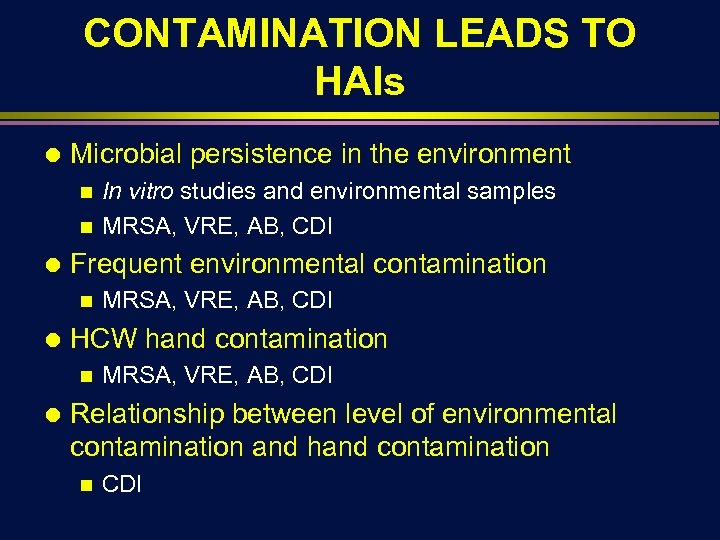
CONTAMINATION LEADS TO HAIs Ä Microbial persistence in the environment In vitro studies and environmental samples n MRSA, VRE, AB, CDI n Ä Frequent environmental contamination n Ä HCW hand contamination n Ä MRSA, VRE, AB, CDI Relationship between level of environmental contamination and hand contamination n CDI
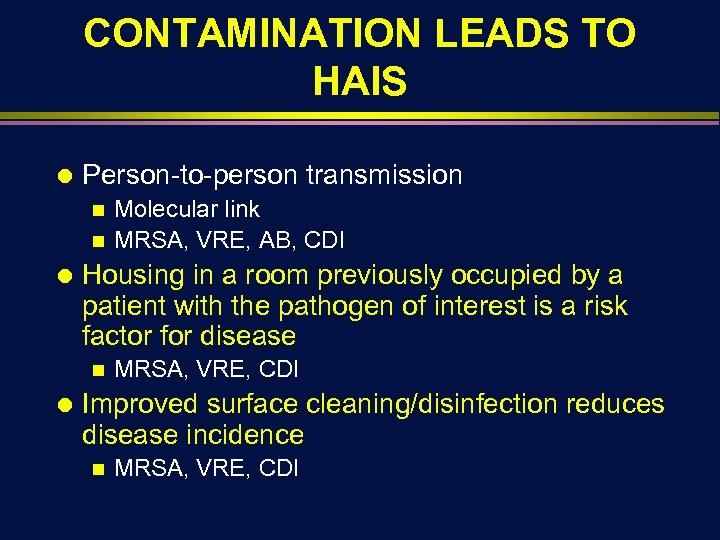
CONTAMINATION LEADS TO HAIS Ä Person-to-person transmission Molecular link n MRSA, VRE, AB, CDI n Ä Housing in a room previously occupied by a patient with the pathogen of interest is a risk factor for disease n Ä MRSA, VRE, CDI Improved surface cleaning/disinfection reduces disease incidence n MRSA, VRE, CDI
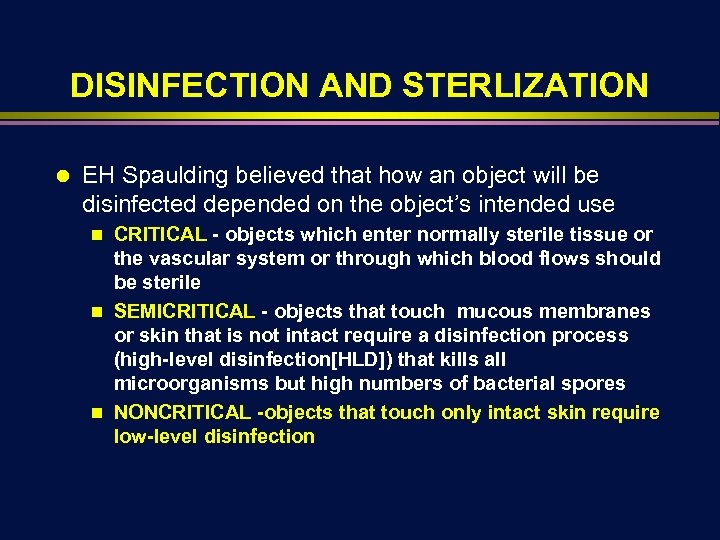
DISINFECTION AND STERLIZATION Ä EH Spaulding believed that how an object will be disinfected depended on the object’s intended use CRITICAL - objects which enter normally sterile tissue or the vascular system or through which blood flows should be sterile n SEMICRITICAL - objects that touch mucous membranes or skin that is not intact require a disinfection process (high-level disinfection[HLD]) that kills all microorganisms but high numbers of bacterial spores n NONCRITICAL -objects that touch only intact skin require low-level disinfection n
LECTURE OBJECTIVES Ä Ä Ä Review the CDC Guideline for Disinfection and Sterilization: Focus on environmental surfaces Review “best” practices for environmental cleaning and disinfection Review the use of low-level disinfectants and the activity of disinfectants on key hospital pathogens Discuss options for evaluating environmental cleaning and disinfection Review “no touch” methods for room
GUIDELINE FOR DISINFECTION AND STERILIZATION IN HEALTHCARE FACILITIES, 2008 Rutala WA, Weber DJ. , HICPAC Available on CDC web pagewww. cdc. gov
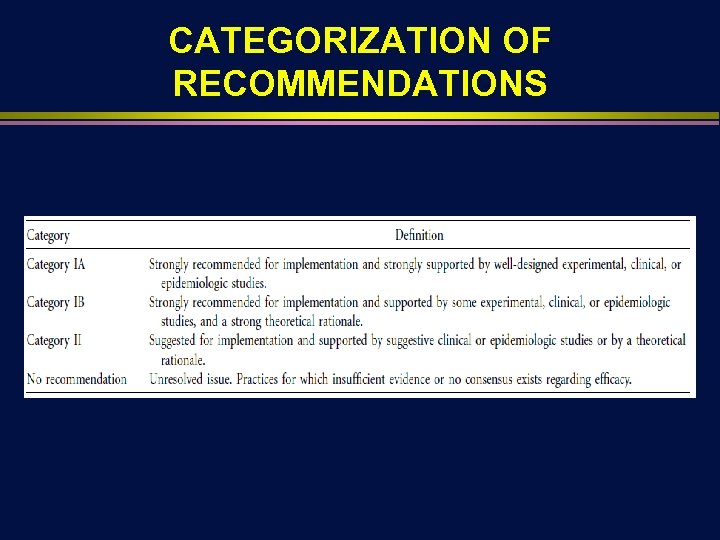
CATEGORIZATION OF RECOMMENDATIONS
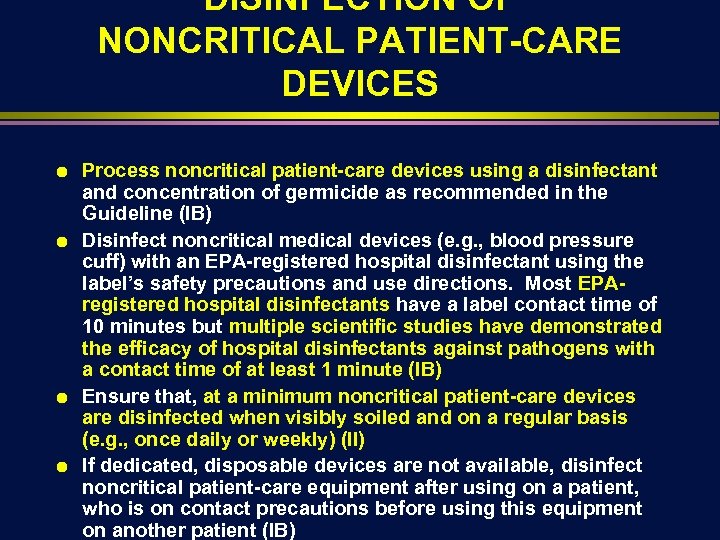
DISINFECTION OF NONCRITICAL PATIENT-CARE DEVICES Ä Ä Process noncritical patient-care devices using a disinfectant and concentration of germicide as recommended in the Guideline (IB) Disinfect noncritical medical devices (e. g. , blood pressure cuff) with an EPA-registered hospital disinfectant using the label’s safety precautions and use directions. Most EPAregistered hospital disinfectants have a label contact time of 10 minutes but multiple scientific studies have demonstrated the efficacy of hospital disinfectants against pathogens with a contact time of at least 1 minute (IB) Ensure that, at a minimum noncritical patient-care devices are disinfected when visibly soiled and on a regular basis (e. g. , once daily or weekly) (II) If dedicated, disposable devices are not available, disinfect noncritical patient-care equipment after using on a patient, who is on contact precautions before using this equipment on another patient (IB)
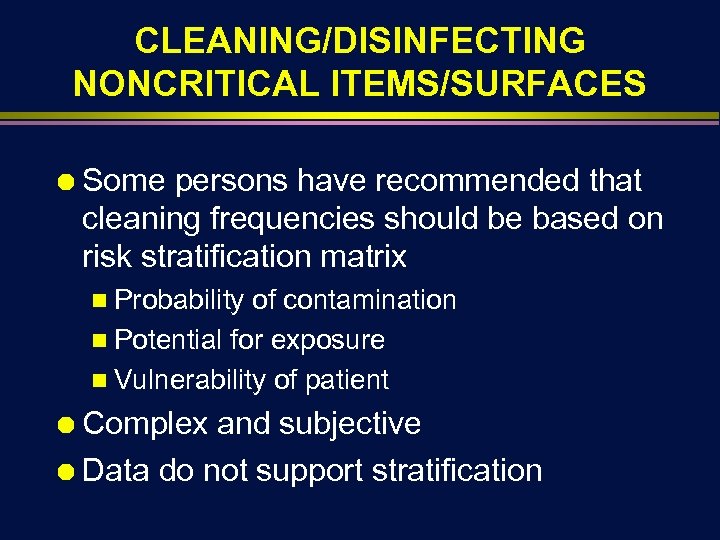
CLEANING/DISINFECTING NONCRITICAL ITEMS/SURFACES Ä Some persons have recommended that cleaning frequencies should be based on risk stratification matrix n Probability of contamination n Potential for exposure n Vulnerability of patient Ä Complex and subjective Ä Data do not support stratification
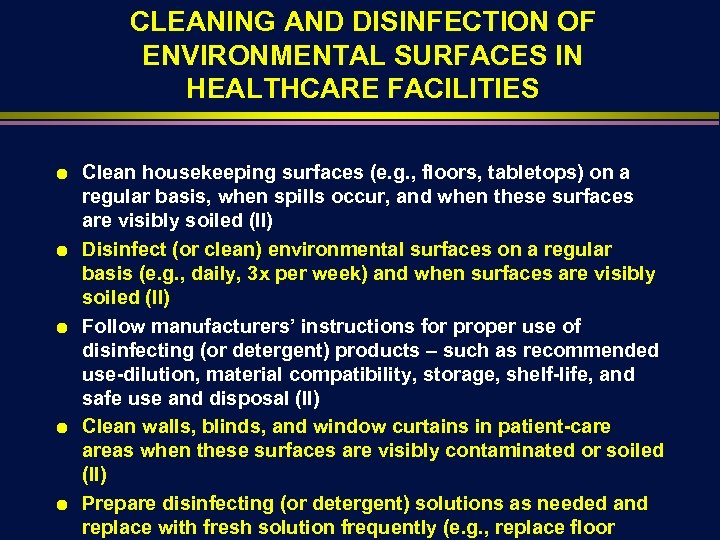
CLEANING AND DISINFECTION OF ENVIRONMENTAL SURFACES IN HEALTHCARE FACILITIES Ä Ä Ä Clean housekeeping surfaces (e. g. , floors, tabletops) on a regular basis, when spills occur, and when these surfaces are visibly soiled (II) Disinfect (or clean) environmental surfaces on a regular basis (e. g. , daily, 3 x per week) and when surfaces are visibly soiled (II) Follow manufacturers’ instructions for proper use of disinfecting (or detergent) products – such as recommended use-dilution, material compatibility, storage, shelf-life, and safe use and disposal (II) Clean walls, blinds, and window curtains in patient-care areas when these surfaces are visibly contaminated or soiled (II) Prepare disinfecting (or detergent) solutions as needed and replace with fresh solution frequently (e. g. , replace floor
REVIEW THE “BEST” PRACTICES FOR CLEANING AND DISINFECTING Cleaning and disinfecting is one-step with disinfectant-detergent. No precleaning necessary unless spill or gross contamination. In many cases “best” practices not scientifically determined.
DAILY CLEANING/DISINFECTING PRACTICES Hota et al. J Hosp Infect 2009; 71: 123 Wash hands thoroughly and put on gloves Ä Place wet floor sign at door Ä Discard disposable items and remove waste and soiled linen Ä Disinfect (damp wipe) all horizontal, vertical and contact surfaces with a cotton cloth saturated (or microfiber, disposable ) with a disinfectant-detergent solution. Ä
DAILY CLEANING/DISINFECTING PRACTICES Hota et al. J Hosp Infect 2009; 71: 123 Ä These surfaces (wipe all surfaces) include, but are not limited to: n n n n Bed rails Overbed table Infusion pumps IV poles/Hanging IV poles Nurse call box Monitor cables Telephone Countertops
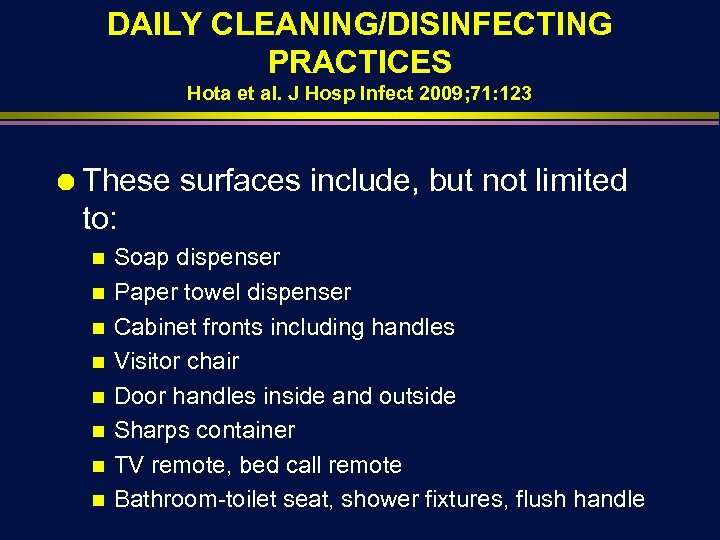
DAILY CLEANING/DISINFECTING PRACTICES Hota et al. J Hosp Infect 2009; 71: 123 Ä These surfaces include, but not limited to: n n n n Soap dispenser Paper towel dispenser Cabinet fronts including handles Visitor chair Door handles inside and outside Sharps container TV remote, bed call remote Bathroom-toilet seat, shower fixtures, flush handle
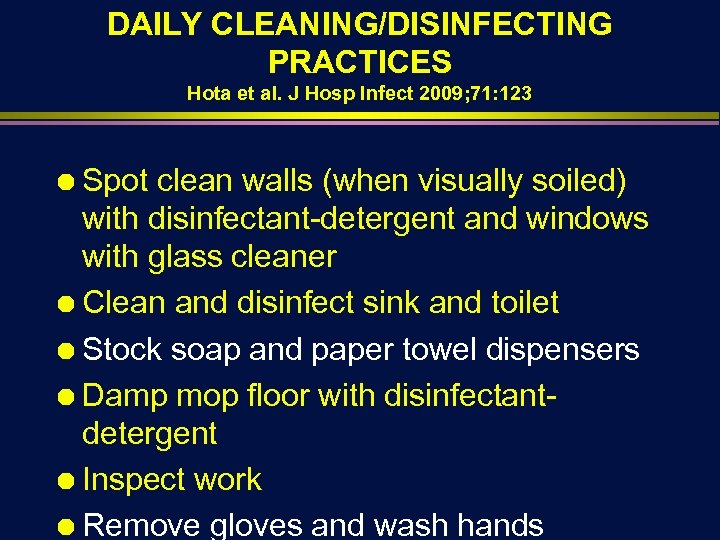
DAILY CLEANING/DISINFECTING PRACTICES Hota et al. J Hosp Infect 2009; 71: 123 Ä Spot clean walls (when visually soiled) with disinfectant-detergent and windows with glass cleaner Ä Clean and disinfect sink and toilet Ä Stock soap and paper towel dispensers Ä Damp mop floor with disinfectantdetergent Ä Inspect work Ä Remove gloves and wash hands
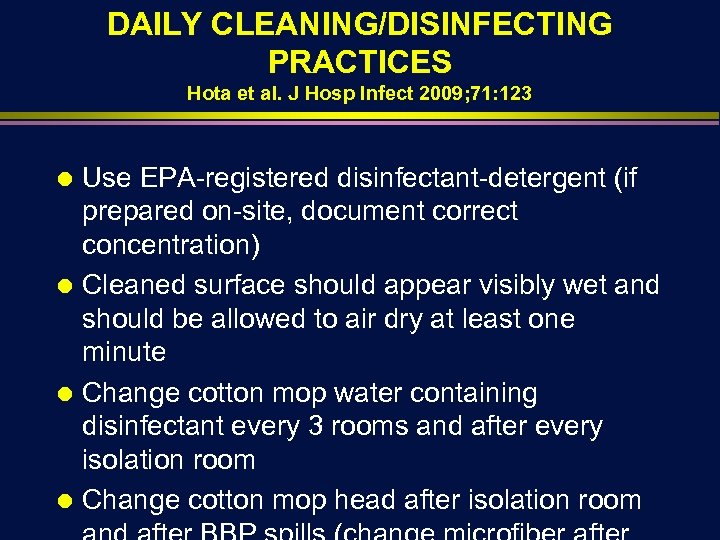
DAILY CLEANING/DISINFECTING PRACTICES Hota et al. J Hosp Infect 2009; 71: 123 Use EPA-registered disinfectant-detergent (if prepared on-site, document correct concentration) Ä Cleaned surface should appear visibly wet and should be allowed to air dry at least one minute Ä Change cotton mop water containing disinfectant every 3 rooms and after every isolation room Ä Change cotton mop head after isolation room Ä
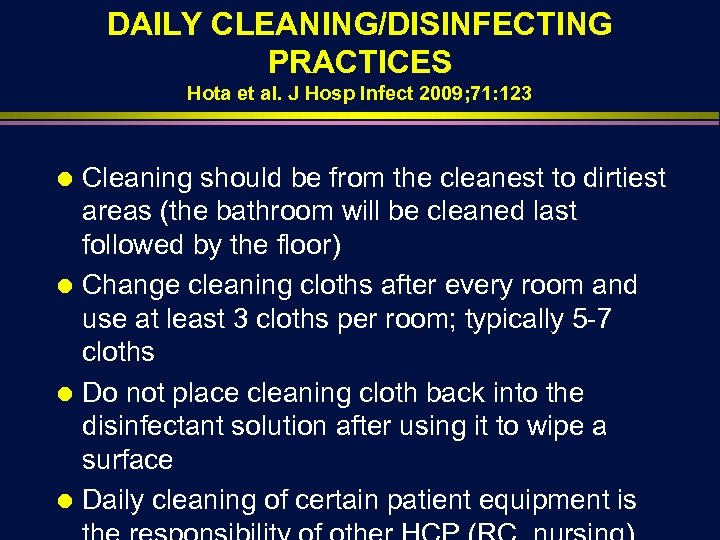
DAILY CLEANING/DISINFECTING PRACTICES Hota et al. J Hosp Infect 2009; 71: 123 Cleaning should be from the cleanest to dirtiest areas (the bathroom will be cleaned last followed by the floor) Ä Change cleaning cloths after every room and use at least 3 cloths per room; typically 5 -7 cloths Ä Do not place cleaning cloth back into the disinfectant solution after using it to wipe a surface Ä Daily cleaning of certain patient equipment is Ä
TERMINAL CLEANING/DISINFECTING PRACTICES Hota et al. J Hosp Infect 2009; 71: 123 Ä “Terminal” or discharge cleaning of nonisolation rooms consists of the same procedure above plus disinfection of bed mattresses and inaccessible items Ä Trash can cleaned weekly and when visible soiled Ä Do not wash walls, strip and wax floors, or discard wrapped disposable supplies left in drawers
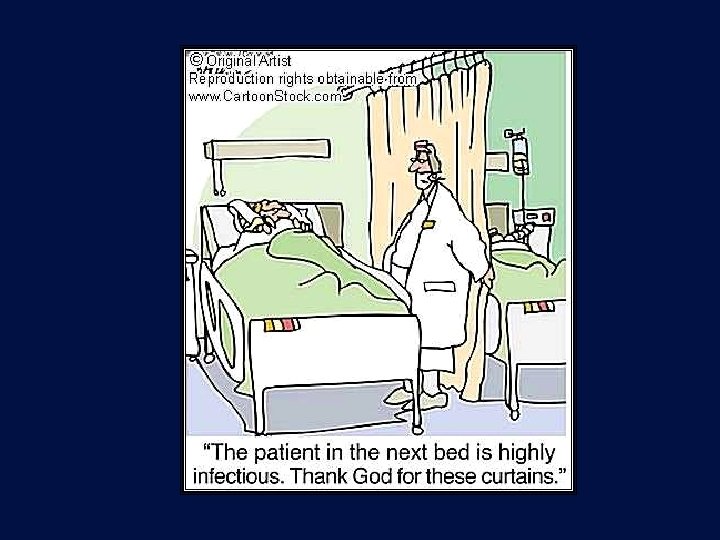
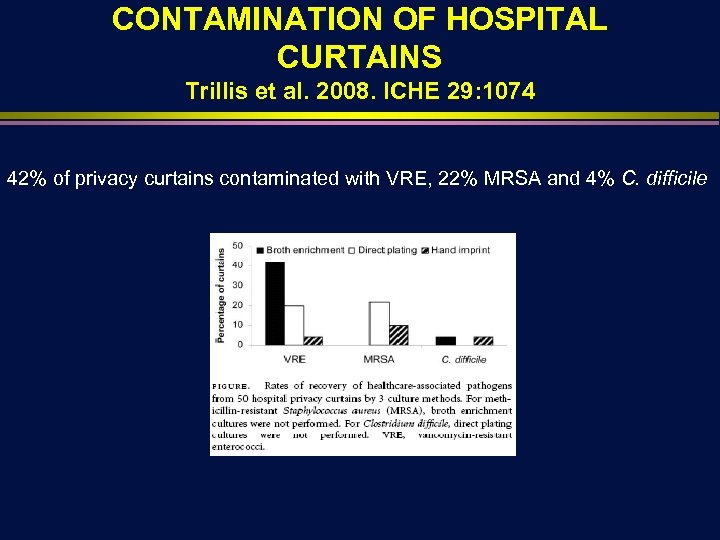
CONTAMINATION OF HOSPITAL CURTAINS Trillis et al. 2008. ICHE 29: 1074 42% of privacy curtains contaminated with VRE, 22% MRSA and 4% C. difficile
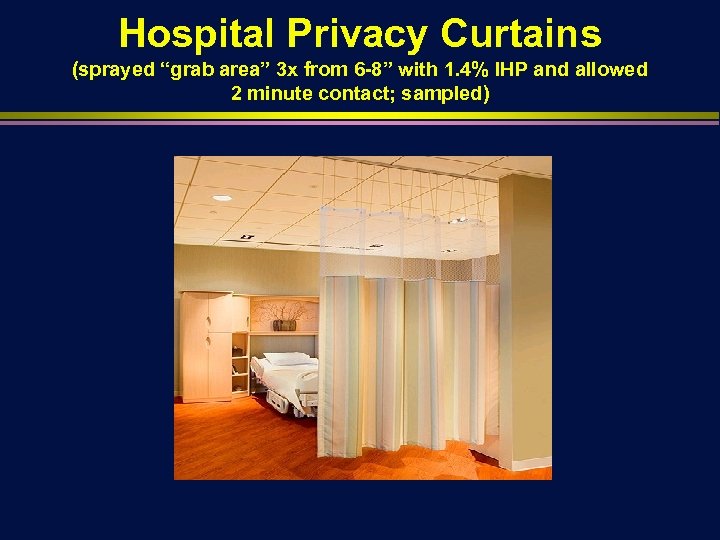
Hospital Privacy Curtains (sprayed “grab area” 3 x from 6 -8” with 1. 4% IHP and allowed 2 minute contact; sampled)
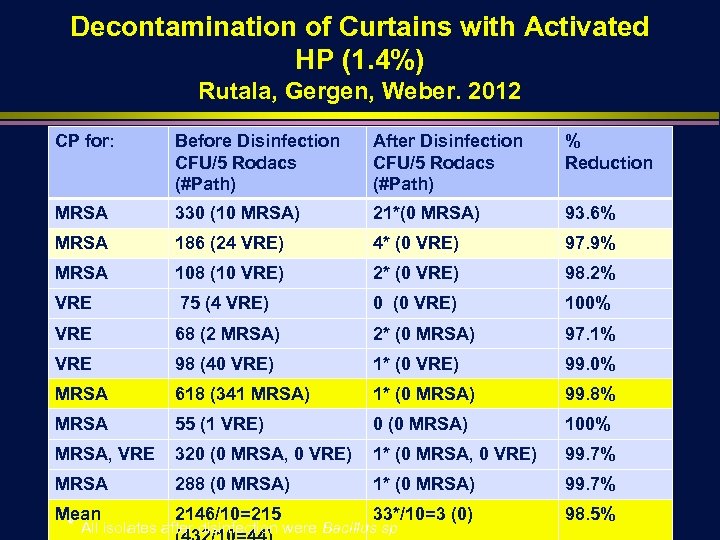
Decontamination of Curtains with Activated HP (1. 4%) Rutala, Gergen, Weber. 2012 CP for: Before Disinfection CFU/5 Rodacs (#Path) After Disinfection CFU/5 Rodacs (#Path) % Reduction MRSA 330 (10 MRSA) 21*(0 MRSA) 93. 6% MRSA 186 (24 VRE) 4* (0 VRE) 97. 9% MRSA 108 (10 VRE) 2* (0 VRE) 98. 2% VRE 75 (4 VRE) 0 (0 VRE) 100% VRE 68 (2 MRSA) 2* (0 MRSA) 97. 1% VRE 98 (40 VRE) 1* (0 VRE) 99. 0% MRSA 618 (341 MRSA) 1* (0 MRSA) 99. 8% MRSA 55 (1 VRE) 0 (0 MRSA) 100% MRSA, VRE 320 (0 MRSA, 0 VRE) 1* (0 MRSA, 0 VRE) 99. 7% MRSA 288 (0 MRSA) 1* (0 MRSA) 99. 7% Mean 2146/10=215 33*/10=3 (0) 98. 5% * All isolates after disinfection were Bacillus sp
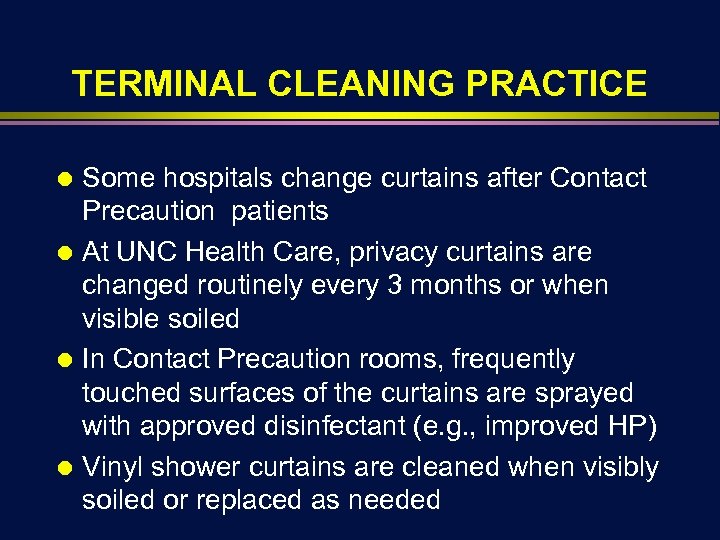
TERMINAL CLEANING PRACTICE Some hospitals change curtains after Contact Precaution patients Ä At UNC Health Care, privacy curtains are changed routinely every 3 months or when visible soiled Ä In Contact Precaution rooms, frequently touched surfaces of the curtains are sprayed with approved disinfectant (e. g. , improved HP) Ä Vinyl shower curtains are cleaned when visibly soiled or replaced as needed Ä
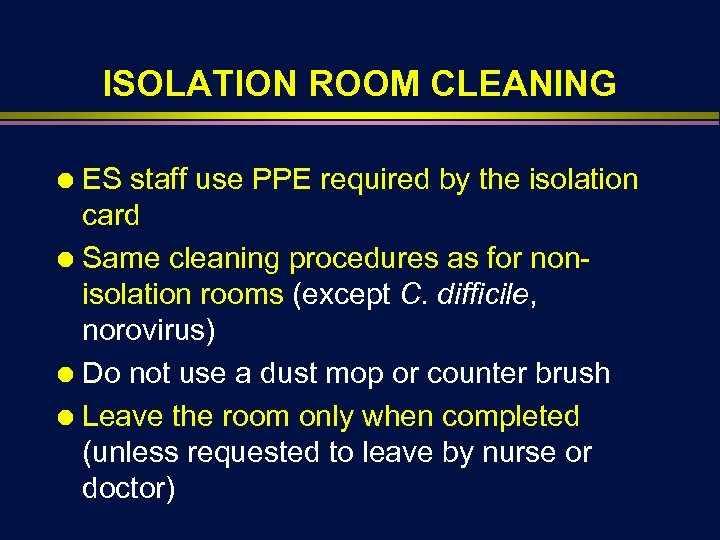
ISOLATION ROOM CLEANING Ä ES staff use PPE required by the isolation card Ä Same cleaning procedures as for nonisolation rooms (except C. difficile, norovirus) Ä Do not use a dust mop or counter brush Ä Leave the room only when completed (unless requested to leave by nurse or doctor)
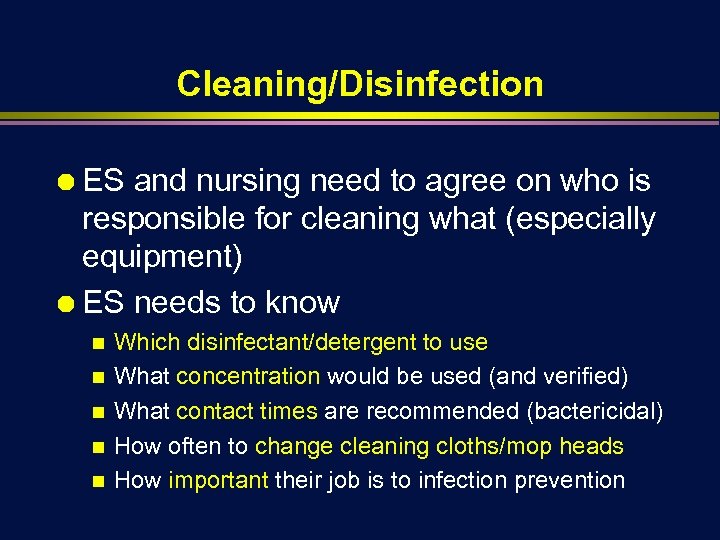
Cleaning/Disinfection Ä ES and nursing need to agree on who is responsible for cleaning what (especially equipment) Ä ES needs to know n n n Which disinfectant/detergent to use What concentration would be used (and verified) What contact times are recommended (bactericidal) How often to change cleaning cloths/mop heads How important their job is to infection prevention
LECTURE OBJECTIVES Ä Ä Ä Review the CDC Guideline for Disinfection and Sterilization: Focus on environmental surfaces Review “best” practices for environmental cleaning and disinfection Review the use of low-level disinfectants and the activity of disinfectants on key hospital pathogens Discuss options for evaluating environmental cleaning and disinfection Review “no touch” methods for room
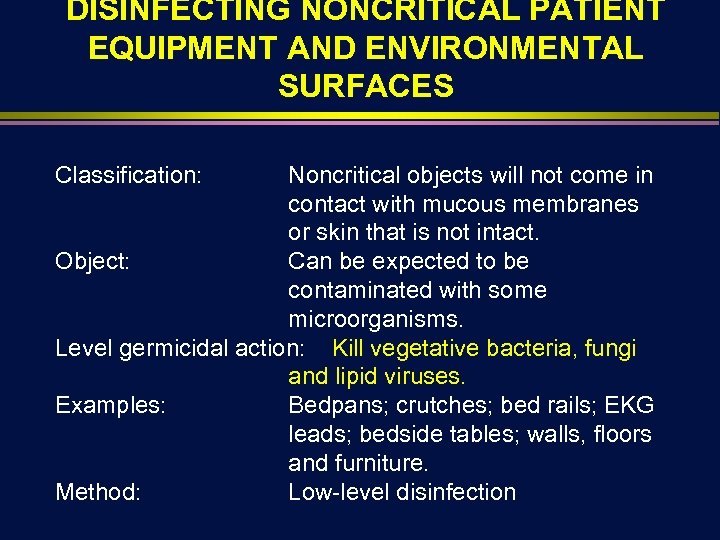
DISINFECTING NONCRITICAL PATIENT EQUIPMENT AND ENVIRONMENTAL SURFACES Classification: Noncritical objects will not come in contact with mucous membranes or skin that is not intact. Object: Can be expected to be contaminated with some microorganisms. Level germicidal action: Kill vegetative bacteria, fungi and lipid viruses. Examples: Bedpans; crutches; bed rails; EKG leads; bedside tables; walls, floors and furniture. Method: Low-level disinfection
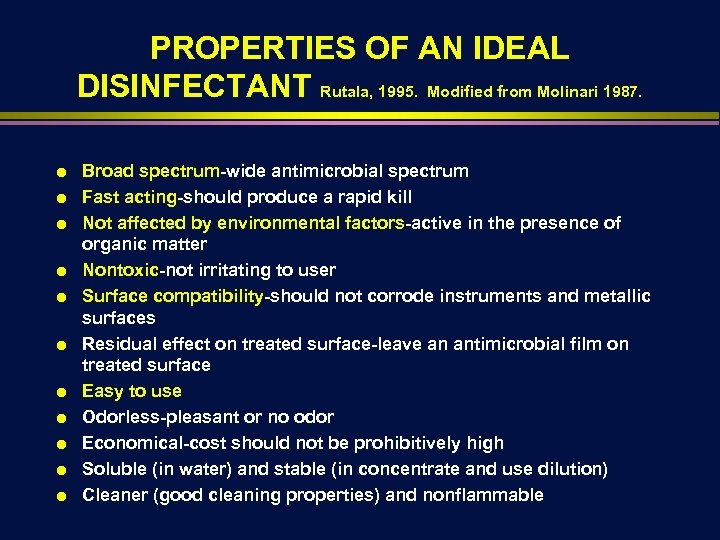
PROPERTIES OF AN IDEAL DISINFECTANT Rutala, 1995. Modified from Molinari 1987. Ä Ä Ä Broad spectrum-wide antimicrobial spectrum Fast acting-should produce a rapid kill Not affected by environmental factors-active in the presence of organic matter Nontoxic-not irritating to user Surface compatibility-should not corrode instruments and metallic surfaces Residual effect on treated surface-leave an antimicrobial film on treated surface Easy to use Odorless-pleasant or no odor Economical-cost should not be prohibitively high Soluble (in water) and stable (in concentrate and use dilution) Cleaner (good cleaning properties) and nonflammable
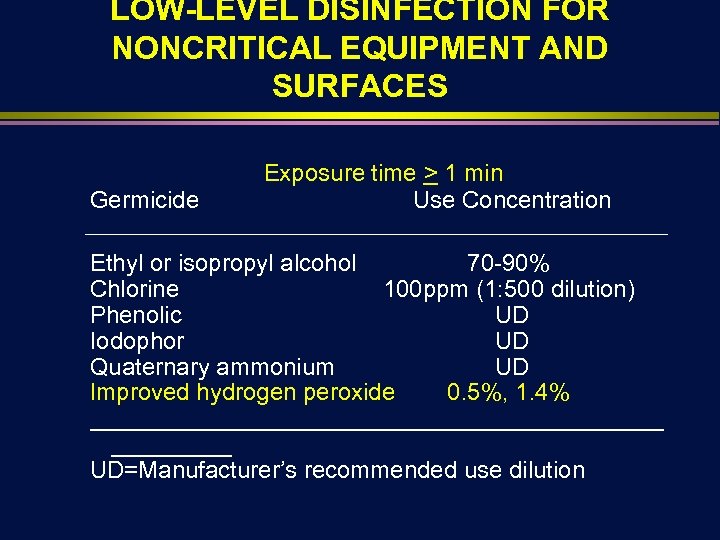
LOW-LEVEL DISINFECTION FOR NONCRITICAL EQUIPMENT AND SURFACES Germicide Exposure time > 1 min Use Concentration Ethyl or isopropyl alcohol 70 -90% Chlorine 100 ppm (1: 500 dilution) Phenolic UD Iodophor UD Quaternary ammonium UD Improved hydrogen peroxide 0. 5%, 1. 4% ______________________ UD=Manufacturer’s recommended use dilution
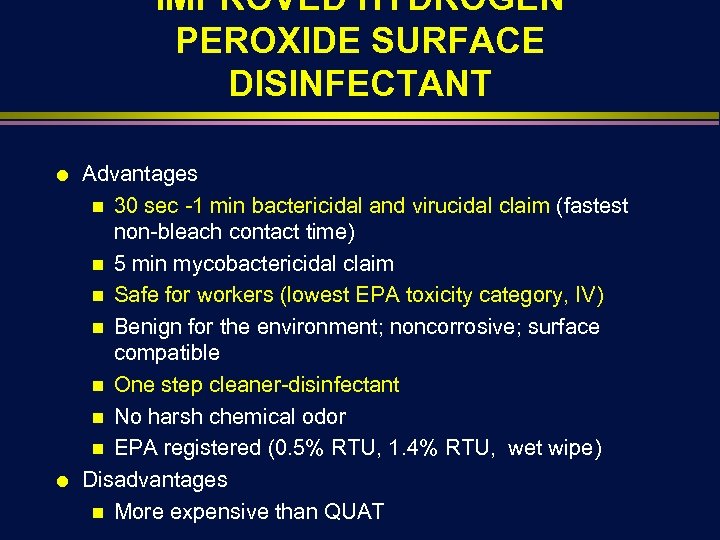
IMPROVED HYDROGEN PEROXIDE SURFACE DISINFECTANT Ä Ä Advantages n 30 sec -1 min bactericidal and virucidal claim (fastest non-bleach contact time) n 5 min mycobactericidal claim n Safe for workers (lowest EPA toxicity category, IV) n Benign for the environment; noncorrosive; surface compatible n One step cleaner-disinfectant n No harsh chemical odor n EPA registered (0. 5% RTU, 1. 4% RTU, wet wipe) Disadvantages n More expensive than QUAT
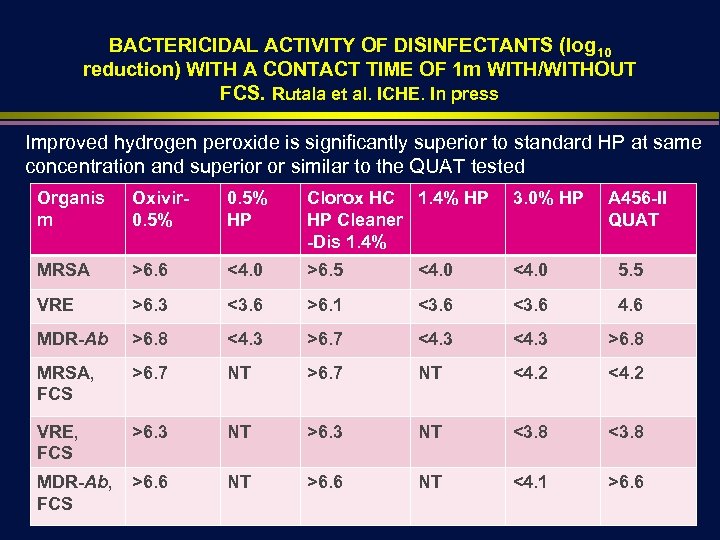
BACTERICIDAL ACTIVITY OF DISINFECTANTS (log 10 reduction) WITH A CONTACT TIME OF 1 m WITH/WITHOUT FCS. Rutala et al. ICHE. In press Improved hydrogen peroxide is significantly superior to standard HP at same concentration and superior or similar to the QUAT tested Organis m Oxivir 0. 5% HP Clorox HC 1. 4% HP HP Cleaner -Dis 1. 4% 3. 0% HP A 456 -II QUAT MRSA >6. 6 <4. 0 >6. 5 <4. 0 5. 5 VRE >6. 3 <3. 6 >6. 1 <3. 6 4. 6 MDR-Ab >6. 8 <4. 3 >6. 7 <4. 3 >6. 8 MRSA, FCS >6. 7 NT <4. 2 VRE, FCS >6. 3 NT <3. 8 MDR-Ab, FCS >6. 6 NT <4. 1 >6. 6
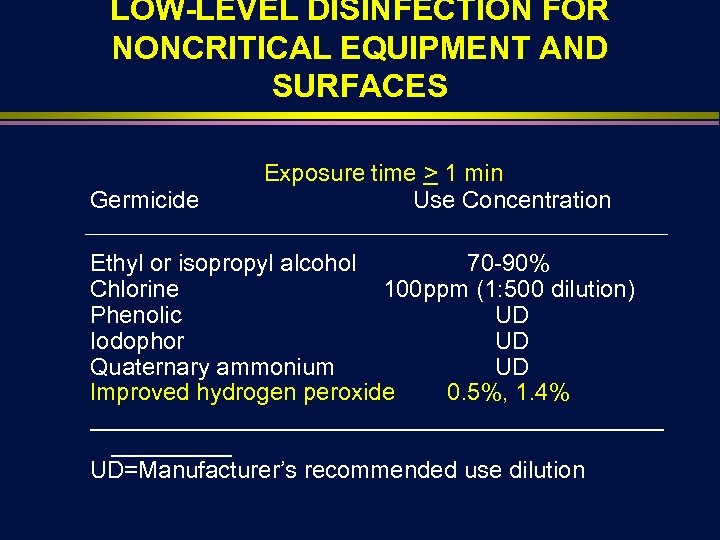
LOW-LEVEL DISINFECTION FOR NONCRITICAL EQUIPMENT AND SURFACES Germicide Exposure time > 1 min Use Concentration Ethyl or isopropyl alcohol 70 -90% Chlorine 100 ppm (1: 500 dilution) Phenolic UD Iodophor UD Quaternary ammonium UD Improved hydrogen peroxide 0. 5%, 1. 4% ______________________ UD=Manufacturer’s recommended use dilution
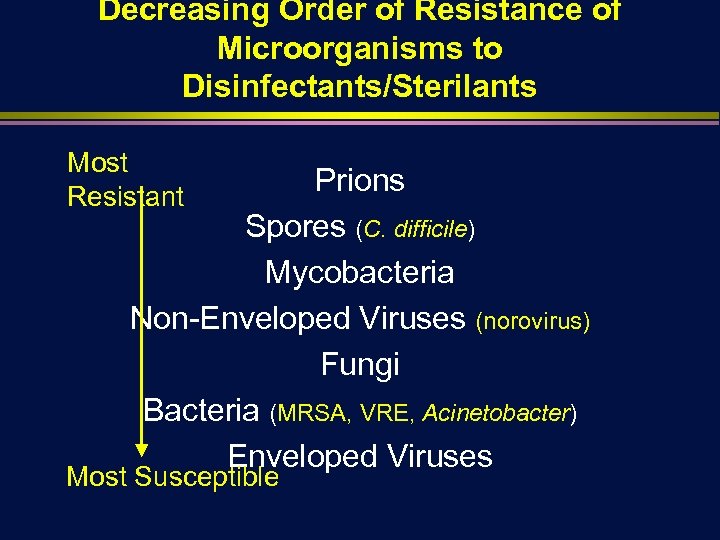
Decreasing Order of Resistance of Microorganisms to Disinfectants/Sterilants Most Resistant Prions Spores (C. difficile) Mycobacteria Non-Enveloped Viruses (norovirus) Fungi Bacteria (MRSA, VRE, Acinetobacter) Enveloped Viruses Most Susceptible
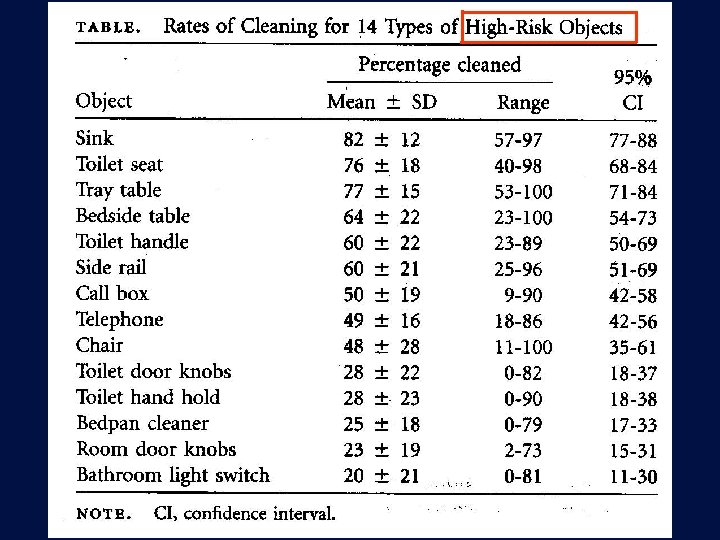
SHOULD WE CONCENTRATE ON “HIGH TOUCH” OR “HIGH RISK” OBJECTS No, not only “high risk” (all surfaces). “High touch” objects only recently defined and “high risk” objects not scientifically defined.
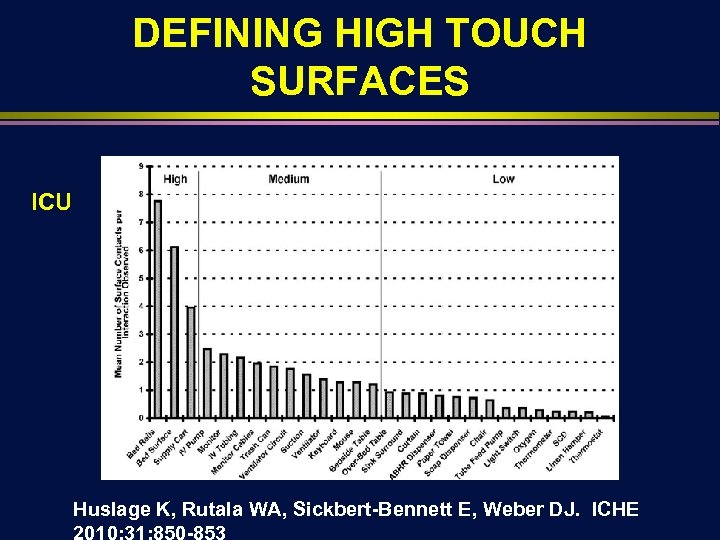
DEFINING HIGH TOUCH SURFACES ICU Huslage K, Rutala WA, Sickbert-Bennett E, Weber DJ. ICHE 2010; 31: 850 -853
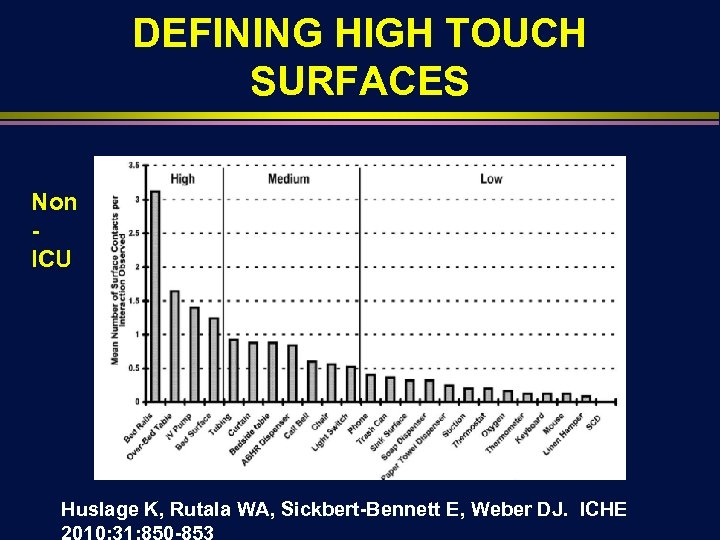
DEFINING HIGH TOUCH SURFACES Non ICU Huslage K, Rutala WA, Sickbert-Bennett E, Weber DJ. ICHE 2010; 31: 850 -853
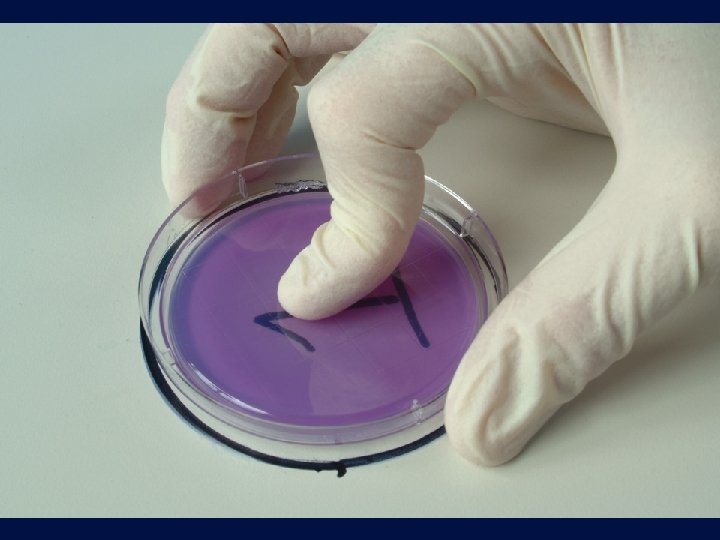
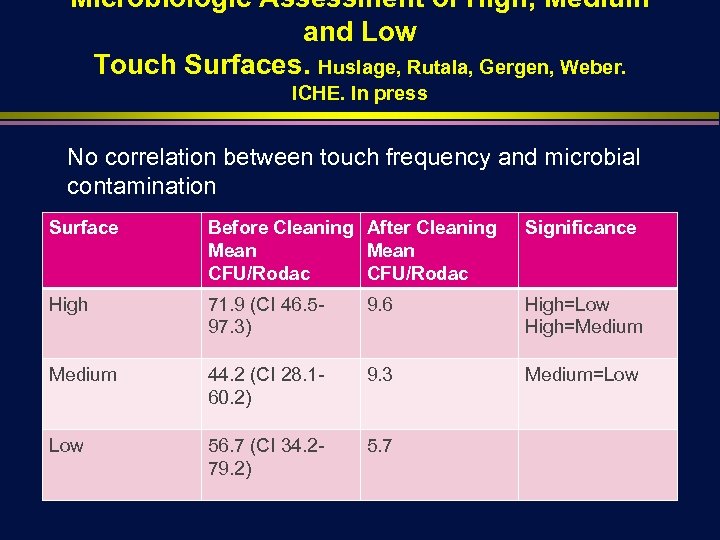
Microbiologic Assessment of High, Medium and Low Touch Surfaces. Huslage, Rutala, Gergen, Weber. ICHE. In press No correlation between touch frequency and microbial contamination Surface Before Cleaning After Cleaning Mean CFU/Rodac Significance High 71. 9 (CI 46. 597. 3) 9. 6 High=Low High=Medium 44. 2 (CI 28. 160. 2) 9. 3 Medium=Low 56. 7 (CI 34. 279. 2) 5. 7
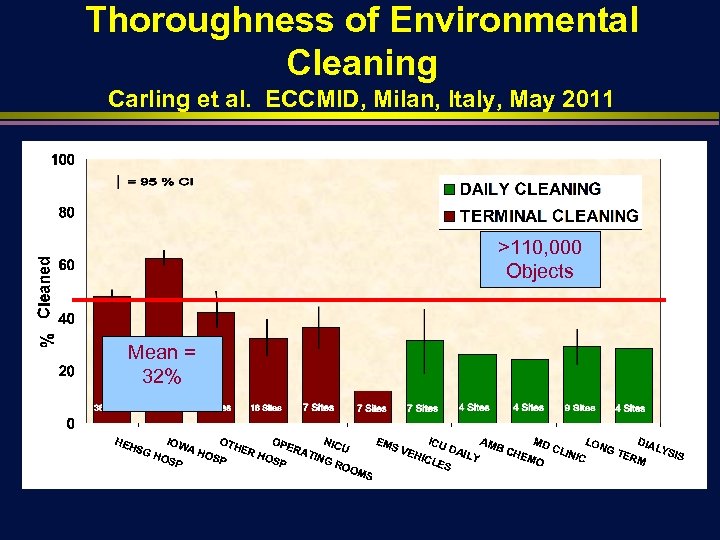
Thoroughness of Environmental Cleaning Carling et al. ECCMID, Milan, Italy, May 2011 >110, 000 Objects Mean = 32%
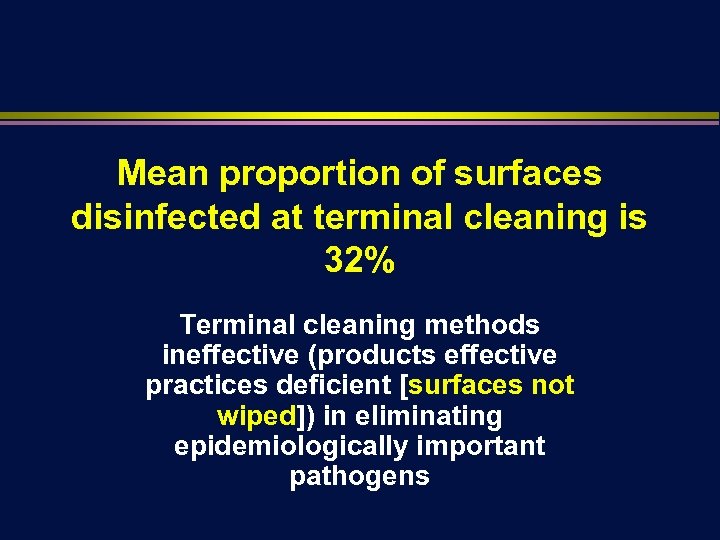
Mean proportion of surfaces disinfected at terminal cleaning is 32% Terminal cleaning methods ineffective (products effective practices deficient [surfaces not wiped]) in eliminating epidemiologically important pathogens
Effective Surface Decontamination Practice and Product
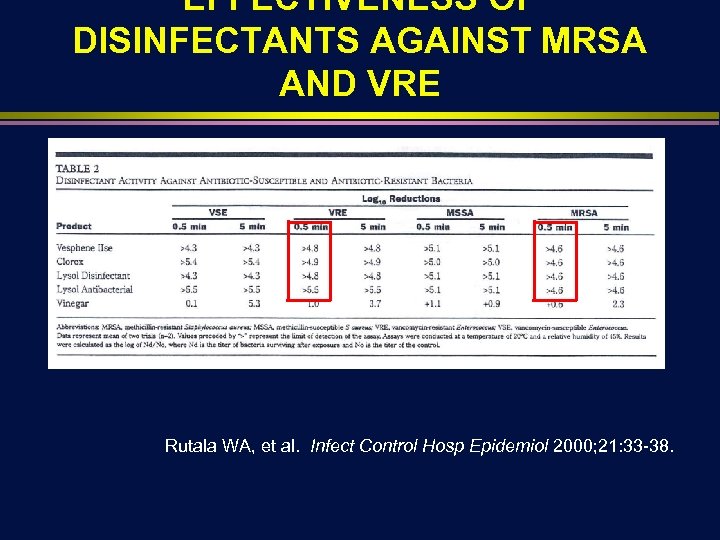
EFFECTIVENESS OF DISINFECTANTS AGAINST MRSA AND VRE Rutala WA, et al. Infect Control Hosp Epidemiol 2000; 21: 33 -38.
Not Product: Is It Practice?
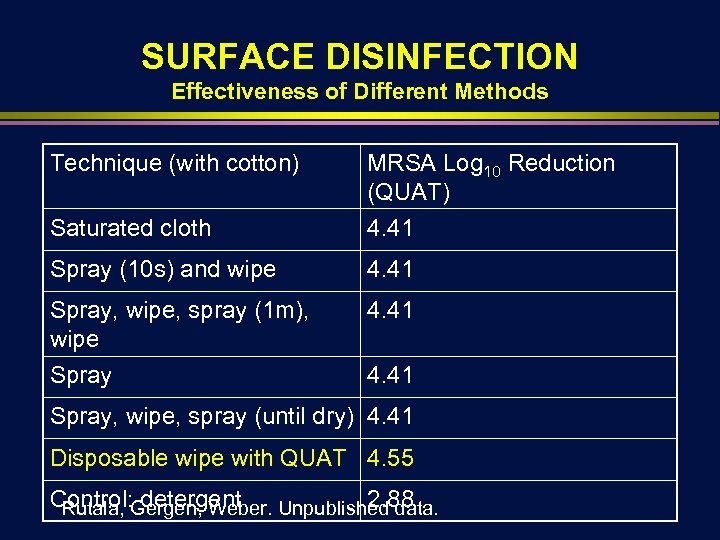
SURFACE DISINFECTION Effectiveness of Different Methods Technique (with cotton) MRSA Log 10 Reduction (QUAT) Saturated cloth 4. 41 Spray (10 s) and wipe 4. 41 Spray, wipe, spray (1 m), wipe Spray 4. 41 Spray, wipe, spray (until dry) 4. 41 Disposable wipe with QUAT 4. 55 Control: Gergen, Weber. Unpublished data. 2. 88 Rutala, detergent
Practice* NOT Product *surfaces not wiped
WIPES Wipes-cotton, disposable, microfiber Ä Wipe should have sufficient wetness to achieve the disinfectant contact time. Discontinue use of the wipe if no longer leaves the surface visible wet for > 1 minute. Ä When the wipe is visibly soiled, flip to a clean/unused side and continue until all sides of the wipe have been used (or get another wipe) Ä Dispose of the wipe/cloth wipe appropriately Ä
DISPOSABLE WIPES Ä Ä Ä Wetness-ideally, stays wet long enough to meet EPA-registered contact times (e. g. , bacteria-1 minute). Surface Coverage-premoistened wipe keeps surface area wet for 1 -2 minutes (e. g. , 12”x 12” wipes keep 55. 5 sq ft wet for 2 m; 6”x 5” equipment wipe keeps 6. 7 sq ft wet for 2 m). Wipe size based on use from small surfaces to large surfaces like mattress covers Durable substrate-will not easily tear or fall apart
LECTURE OBJECTIVES Ä Ä Ä Review the CDC Guideline for Disinfection and Sterilization: Focus on environmental surfaces Review “best” practices for environmental cleaning and disinfection Review the use of low-level disinfectants and the activity of disinfectants on key hospital pathogens Discuss options for evaluating environmental cleaning and disinfection Review “no touch” methods for room
OPTIONS FOR EVALUATING ENVIRONMENTAL CLEANING Guh, Carling. December 2010. CDC Ä Joint effort of ES and IC Ä Responsibilities of ES staff and other staff for cleaning surfaces clearly defined Ä Education of ES staff to define expectations Ä Development of measures for monitoring Ä Interventions to optimize cleaning Ä Report results to ICC and facility leadership
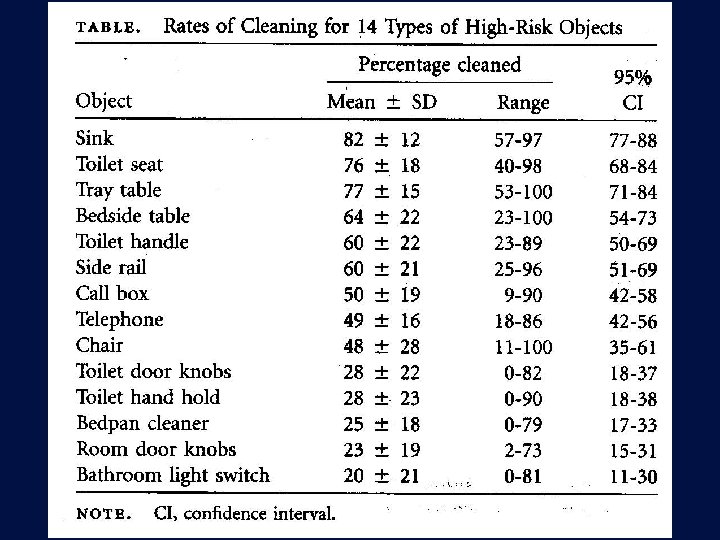
MONITORING THE EFFECTIVENESS OF CLEANING Cooper et al. AJIC 2007; 35: 338 Ä Visual assessment-not a reliable indicator of surface cleanliness Ä ATP bioluminescence-measures organic debris (each unit has own reading scale, <250 -500 RLU) Ä Microbiological methods-<2. 5 CFUs/cm 2 pass; can be costly and pathogen specific Ä Fluorescent marker
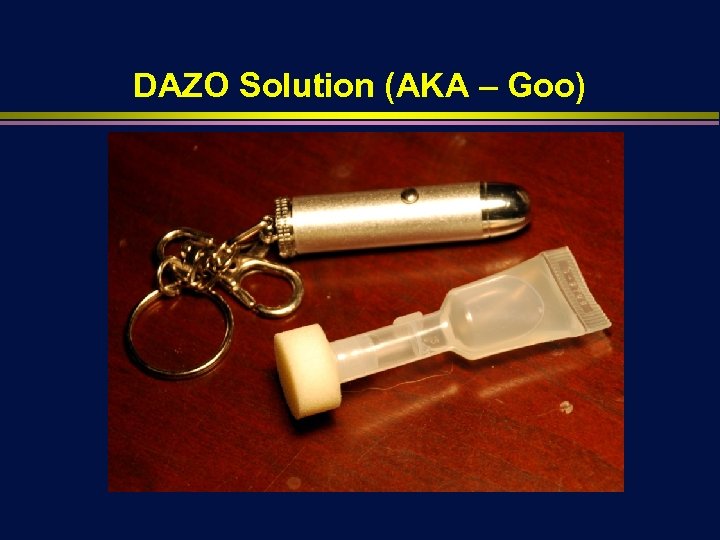
DAZO Solution (AKA – Goo)
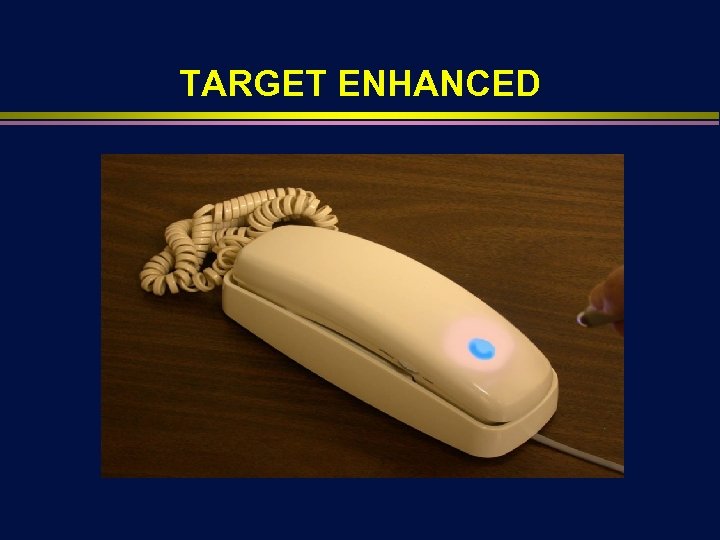
TARGET ENHANCED
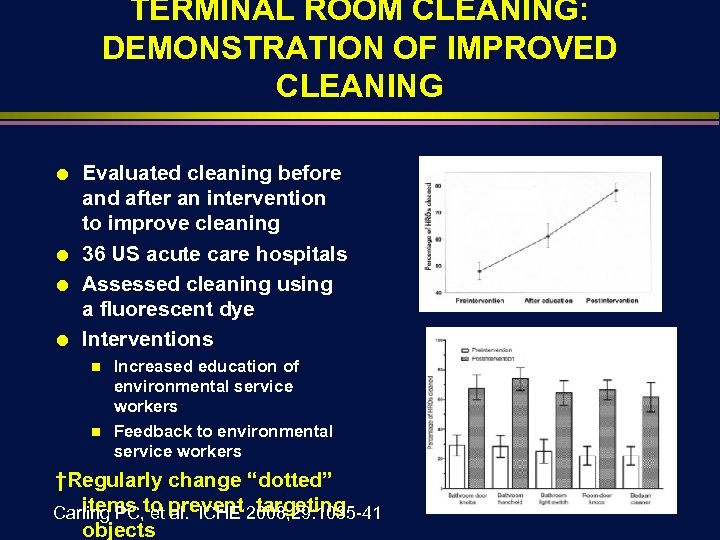
TERMINAL ROOM CLEANING: DEMONSTRATION OF IMPROVED CLEANING Ä Ä Evaluated cleaning before and after an intervention to improve cleaning 36 US acute care hospitals Assessed cleaning using a fluorescent dye Interventions Increased education of environmental service workers n Feedback to environmental service workers n †Regularly change “dotted” items et al. ICHE targeting Carling PC, to prevent 2008; 29: 1035 -41 objects
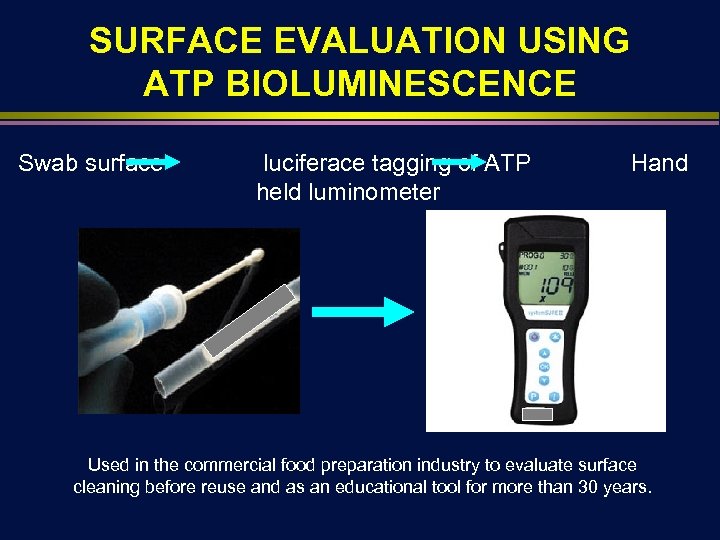
SURFACE EVALUATION USING ATP BIOLUMINESCENCE Swab surface luciferace tagging of ATP held luminometer Hand Used in the commercial food preparation industry to evaluate surface cleaning before reuse and as an educational tool for more than 30 years.
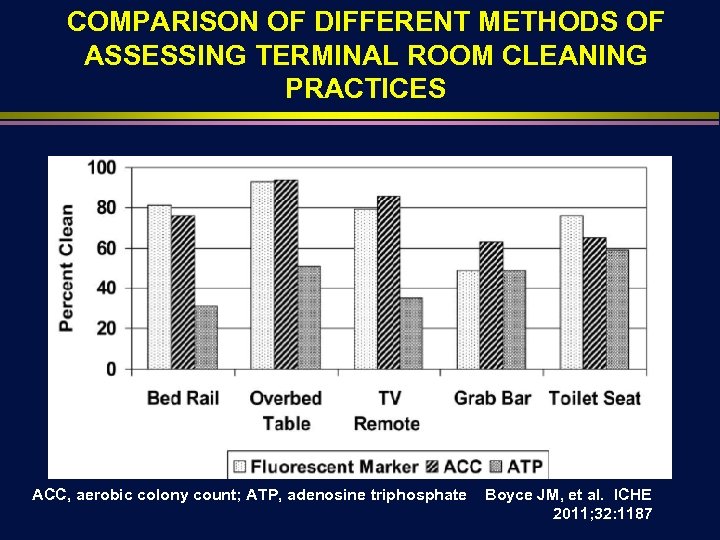
COMPARISON OF DIFFERENT METHODS OF ASSESSING TERMINAL ROOM CLEANING PRACTICES ACC, aerobic colony count; ATP, adenosine triphosphate Boyce JM, et al. ICHE 2011; 32: 1187
LECTURE OBJECTIVES Ä Ä Ä Review the CDC Guideline for Disinfection and Sterilization: Focus on environmental surfaces Review “best” practices for environmental cleaning and disinfection Review the use of low-level disinfectants and the activity of disinfectants on key hospital pathogens Discuss options for evaluating environmental cleaning and disinfection Review “no touch” methods for room
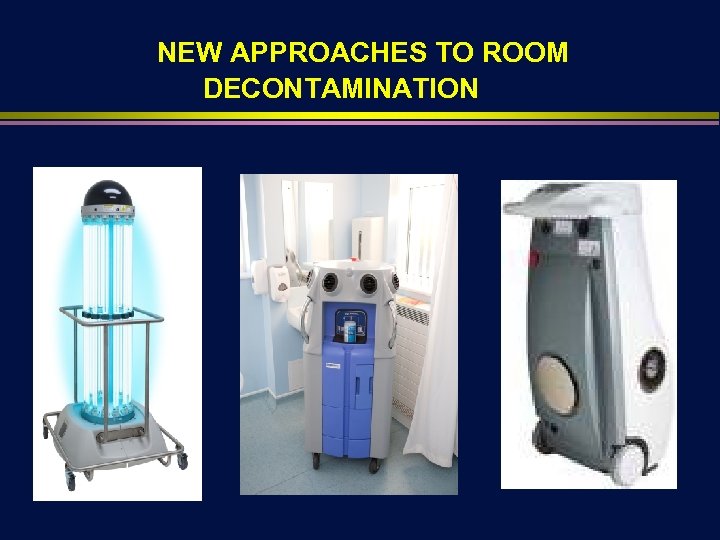
NEW APPROACHES TO ROOM DECONTAMINATION
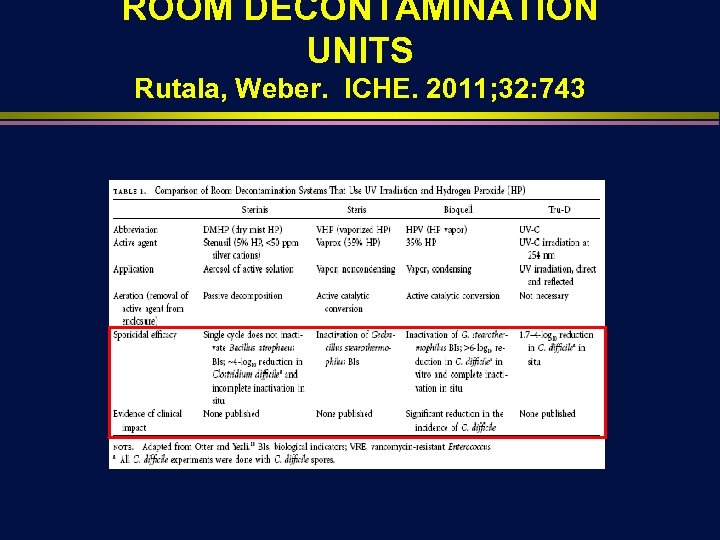
ROOM DECONTAMINATION UNITS Rutala, Weber. ICHE. 2011; 32: 743
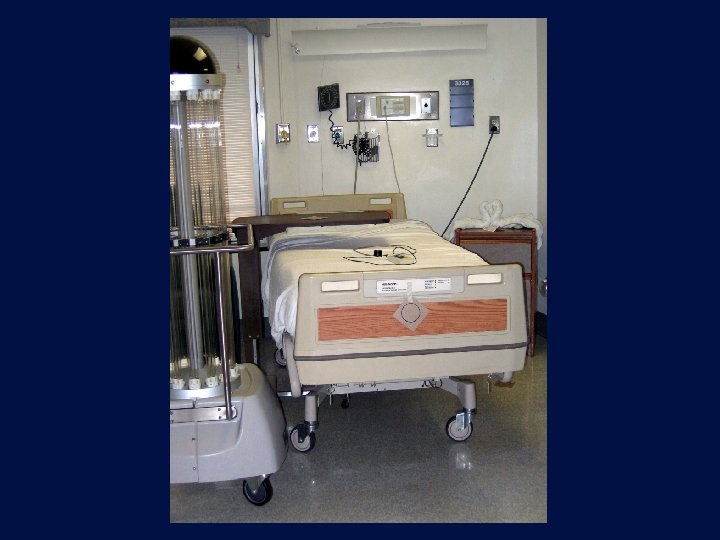
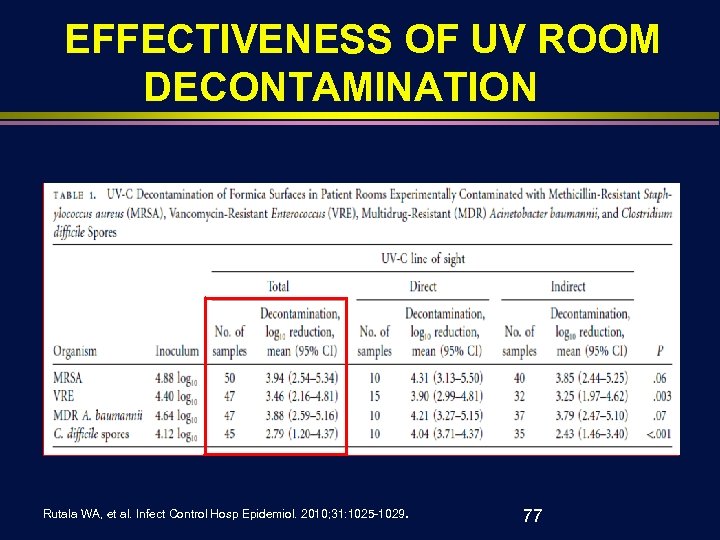
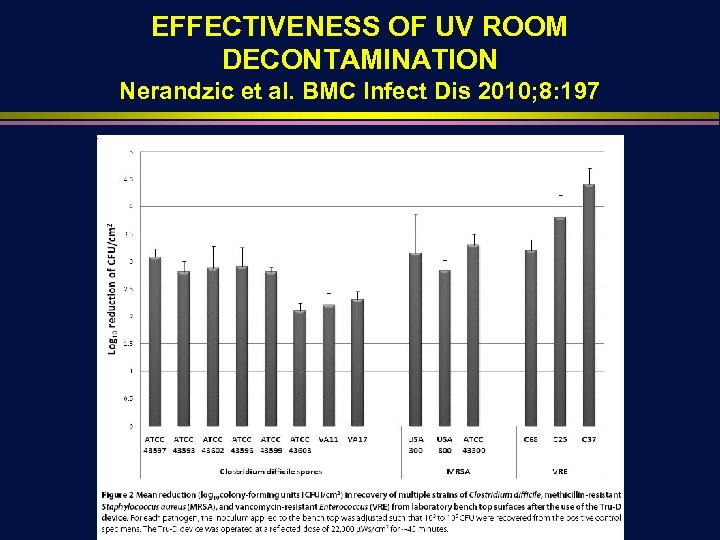
UV Room Decontamination Rutala, Gergen, Weber, ICHE. 2010: 31: 1025 -1029 • • • Fully automated, self calibrates, activated by handheld remote Room ventilation does not need to be modified Uses UV-C (254 nm range) to decontaminate surfaces Measures UV reflected from walls, ceilings, floors or other treated areas and calculates the operation total dosing/time to deliver the programmed lethal dose for pathogens. UV sensors determines and targets highly-shadowed areas to deliver measured dose of UV energy After UV dose delivered (36, 000µWs/cm 2 for spore, 12, 000µWs/cm 2 for bacteria), will power-down and audibly notify the operator
EFFECTIVENESS OF UV ROOM DECONTAMINATION Rutala WA, et al. Infect Control Hosp Epidemiol. 2010; 31: 1025 -1029. 77
EFFECTIVENESS OF UV ROOM DECONTAMINATION Nerandzic et al. BMC Infect Dis 2010; 8: 197
Hydrogen Peroxide Vapor/Aerosol Decontamination
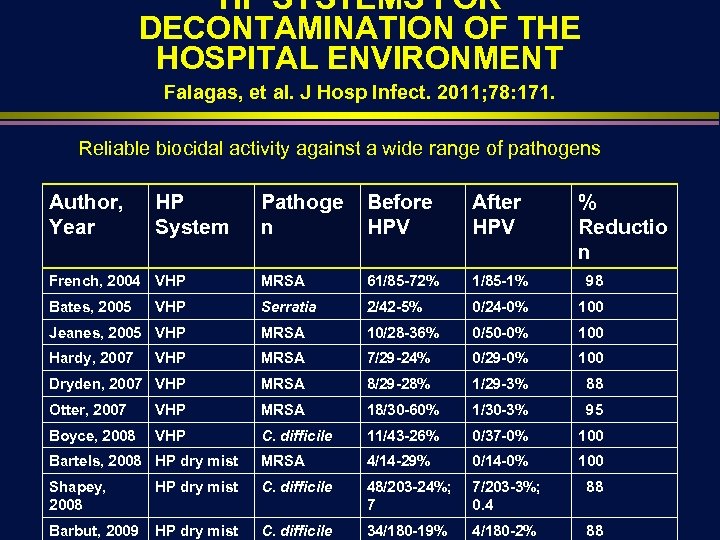
HP SYSTEMS FOR DECONTAMINATION OF THE HOSPITAL ENVIRONMENT Falagas, et al. J Hosp Infect. 2011; 78: 171. Reliable biocidal activity against a wide range of pathogens Author, Year HP System Pathoge n Before HPV After HPV French, 2004 VHP MRSA 61/85 -72% 1/85 -1% 98 Bates, 2005 Serratia 2/42 -5% 0/24 -0% 100 Jeanes, 2005 VHP MRSA 10/28 -36% 0/50 -0% 100 Hardy, 2007 VHP MRSA 7/29 -24% 0/29 -0% 100 Dryden, 2007 VHP MRSA 8/29 -28% 1/29 -3% 88 Otter, 2007 VHP MRSA 18/30 -60% 1/30 -3% 95 Boyce, 2008 VHP C. difficile 11/43 -26% 0/37 -0% 100 Bartels, 2008 HP dry mist MRSA 4/14 -29% 0/14 -0% 100 Shapey, 2008 HP dry mist C. difficile 48/203 -24%; 7 7/203 -3%; 0. 4 88 Barbut, 2009 HP dry mist C. difficile 34/180 -19% 4/180 -2% 88 VHP % Reductio n
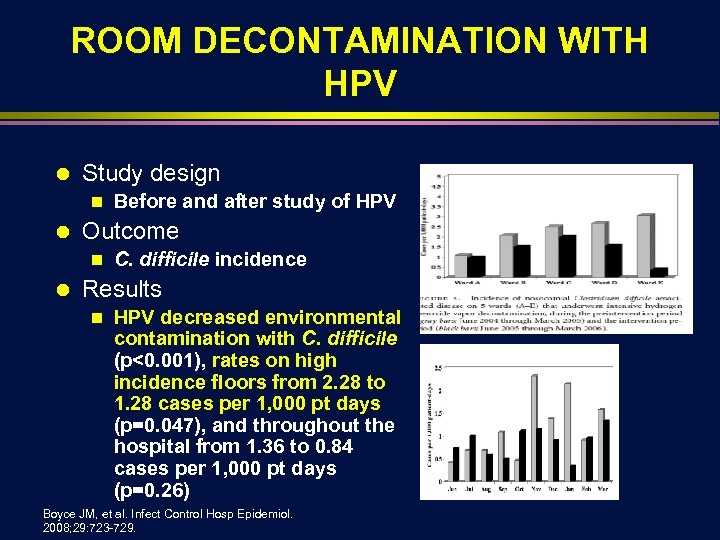
ROOM DECONTAMINATION WITH HPV Ä Study design n Ä Outcome n Ä Before and after study of HPV C. difficile incidence Results n HPV decreased environmental contamination with C. difficile (p<0. 001), rates on high incidence floors from 2. 28 to 1. 28 cases per 1, 000 pt days (p=0. 047), and throughout the hospital from 1. 36 to 0. 84 cases per 1, 000 pt days (p=0. 26) Boyce JM, et al. Infect Control Hosp Epidemiol. 2008; 29: 723 -729.
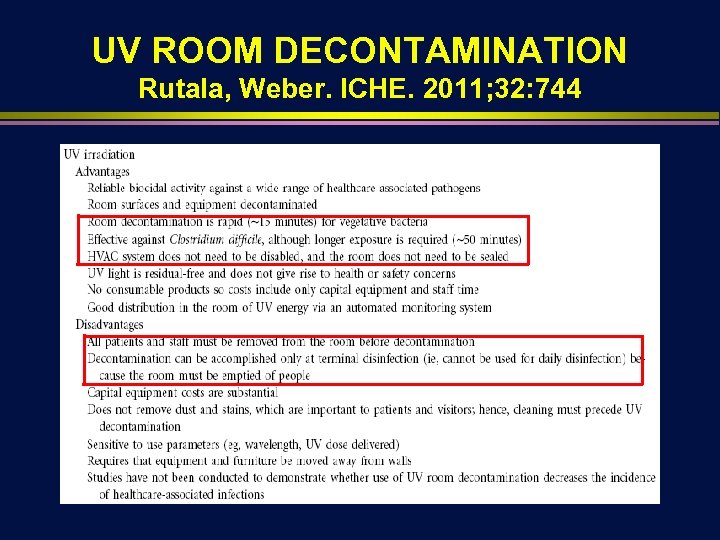
UV ROOM DECONTAMINATION Rutala, Weber. ICHE. 2011; 32: 744
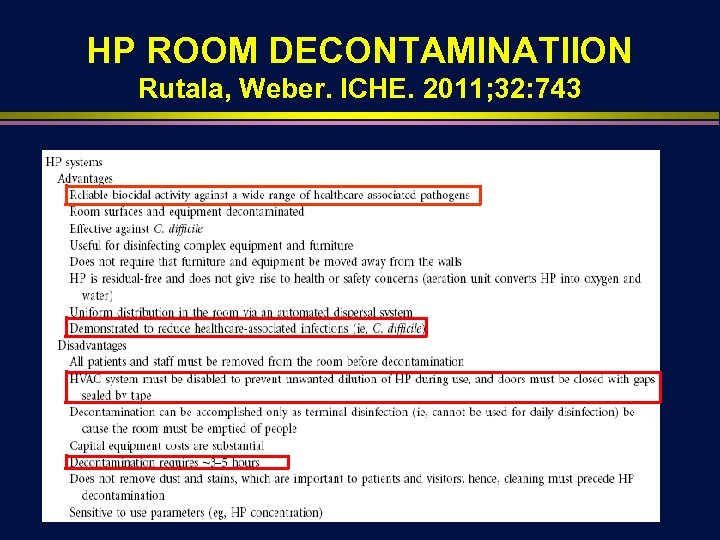
HP ROOM DECONTAMINATIION Rutala, Weber. ICHE. 2011; 32: 743
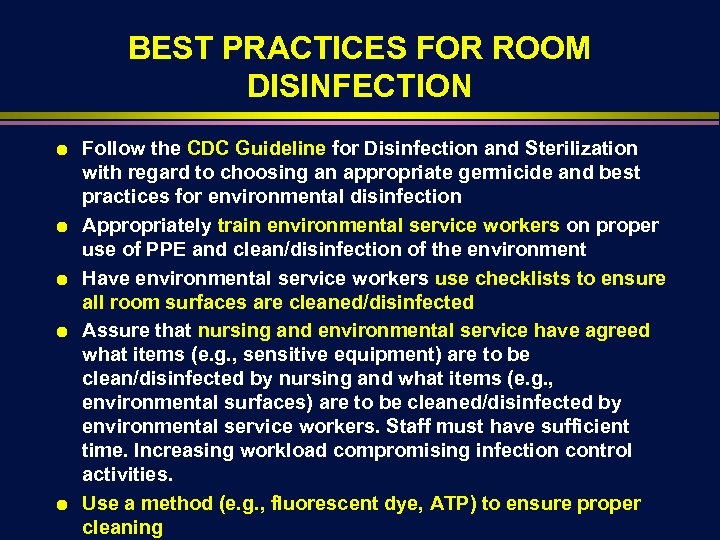
BEST PRACTICES FOR ROOM DISINFECTION Ä Ä Ä Follow the CDC Guideline for Disinfection and Sterilization with regard to choosing an appropriate germicide and best practices for environmental disinfection Appropriately train environmental service workers on proper use of PPE and clean/disinfection of the environment Have environmental service workers use checklists to ensure all room surfaces are cleaned/disinfected Assure that nursing and environmental service have agreed what items (e. g. , sensitive equipment) are to be clean/disinfected by nursing and what items (e. g. , environmental surfaces) are to be cleaned/disinfected by environmental service workers. Staff must have sufficient time. Increasing workload compromising infection control activities. Use a method (e. g. , fluorescent dye, ATP) to ensure proper cleaning
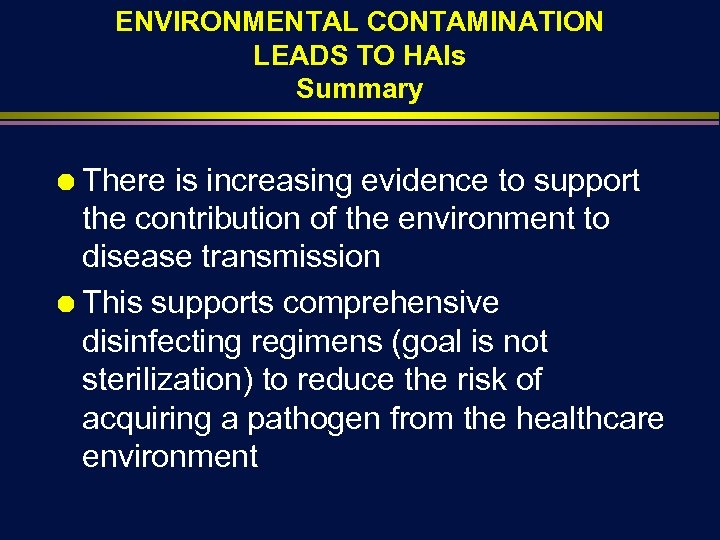
ENVIRONMENTAL CONTAMINATION LEADS TO HAIs Summary Ä There is increasing evidence to support the contribution of the environment to disease transmission Ä This supports comprehensive disinfecting regimens (goal is not sterilization) to reduce the risk of acquiring a pathogen from the healthcare environment
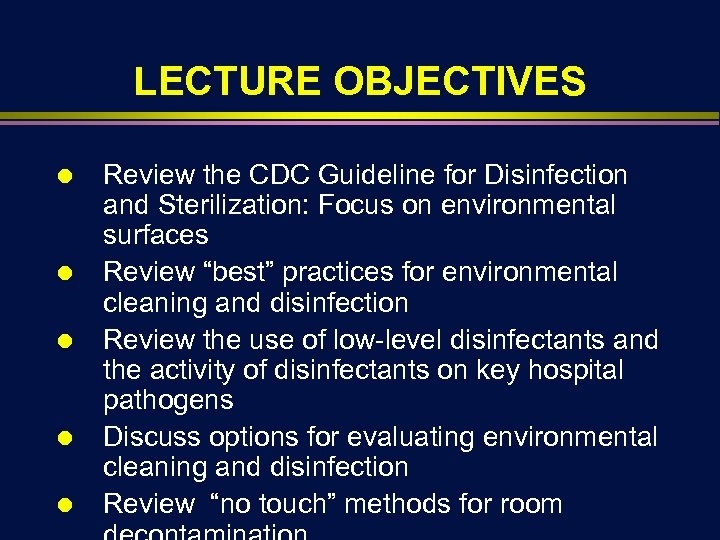
LECTURE OBJECTIVES Ä Ä Ä Review the CDC Guideline for Disinfection and Sterilization: Focus on environmental surfaces Review “best” practices for environmental cleaning and disinfection Review the use of low-level disinfectants and the activity of disinfectants on key hospital pathogens Discuss options for evaluating environmental cleaning and disinfection Review “no touch” methods for room
disinfectionandsterilizatio n. org
THANK YOU!
Microfiber Cleaning Ä Ä Ä Pad contains fibers (polyester and polyamide) that provide a cleaning surface 40 times greater than conventional string mops Proposed advantages: reduce chemical use and disposal (disinfectant solution not changed after every third room, clean microfiber per room [washing lifetime 500 -1000 x]); light (~5 lb less than string mop) and ergonomic; reduce cleaning times. Does the microfiber provide the same or better removal of microorganisms on surfaces?
Microfiber Efficacy and Use Ä > 2 log 10 reduction for microbial removal. Smith et al. JHI. 2011; 78: 182 Ä Ä Ä Currently, we use the microfiber mops for the floors with a disinfectant. We use several cotton, washcloths per room for elevated surfaces but are transitioning to microfiber cloths We use a disinfectant because cleaning implements such as microfiber can cross-contaminate the environment when a disinfectant is not incorporated or is depleted Instructions of preparation, use, and washing should be followed to maximize cloth performance
Touchscreen Cleaning Ä Ä Ä Follow the manufacturer’s recommendations Prepare the cleaning solution according to the manufacturer’s instructions (e. g. , alcohol, glutaraldehyde, mild soap, phenolic) Wet a clean, soft cloth with the selected cleaning solution Remove excess liquid from the cloth and squeeze damp Wipe exposed surfaces (do not allow liquid to enter interior)
Скачать презентацию BEST PRACTICES FOR SURFACE DISINFECTION AND NEW ROOM
3eadea9f6b9bfa5c38819e3c0be92bdf.ppt