 Скачать презентацию Beryl Cook Stanley Spencer Beryl Cook
7f1db2750c5d684dd3838e60926b781f.ppt
- Количество слайдов: 35



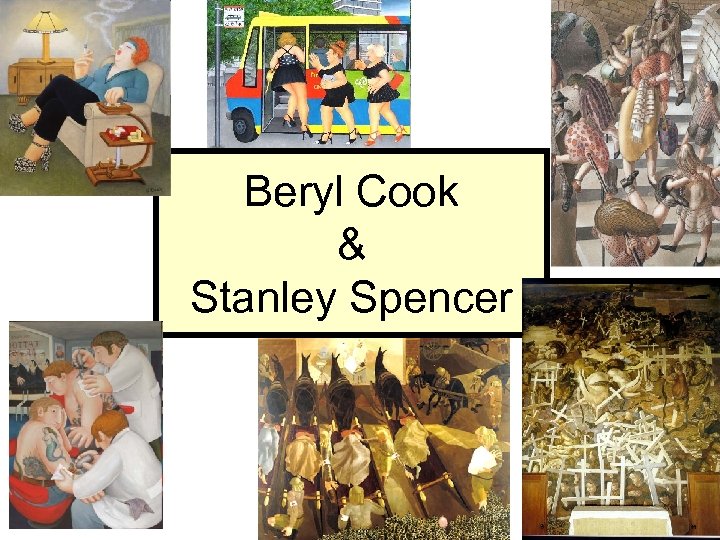
Beryl Cook & Stanley Spencer
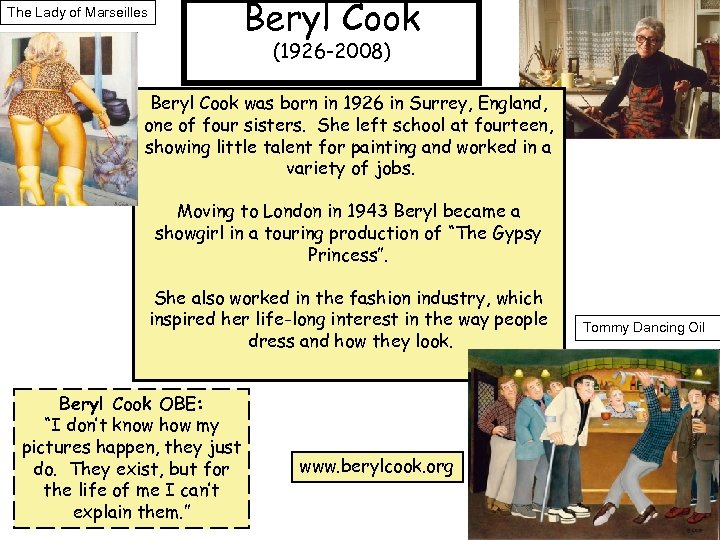
Beryl Cook The Lady of Marseilles (1926 -2008) Beryl Cook was born in 1926 in Surrey, England, one of four sisters. She left school at fourteen, showing little talent for painting and worked in a variety of jobs. Moving to London in 1943 Beryl became a showgirl in a touring production of “The Gypsy Princess”. She also worked in the fashion industry, which inspired her life-long interest in the way people dress and how they look. Beryl Cook OBE: “I don’t know how my pictures happen, they just do. They exist, but for the life of me I can’t explain them. ” www. berylcook. org Tommy Dancing Oil
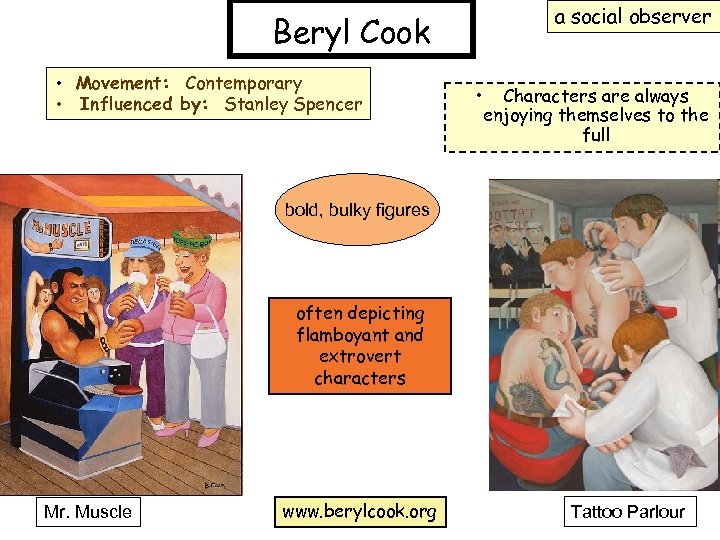
Beryl Cook • Movement: Contemporary • Influenced by: Stanley Spencer a social observer • Characters are always enjoying themselves to the full bold, bulky figures often depicting flamboyant and extrovert characters Mr. Muscle www. berylcook. org Tattoo Parlour
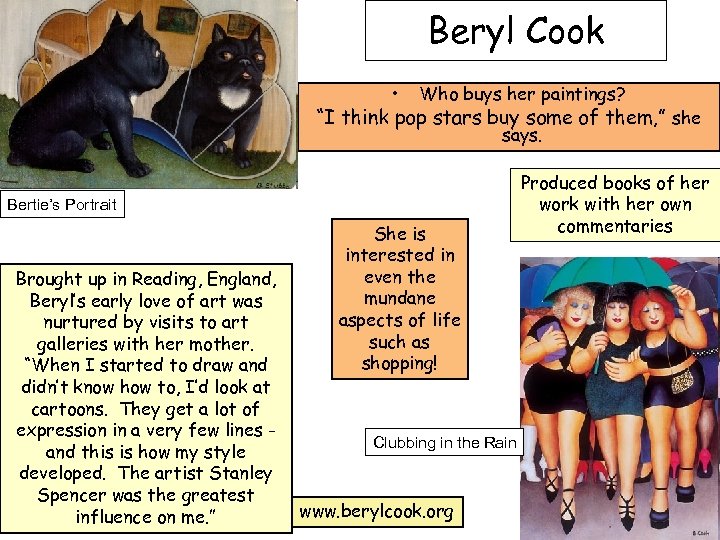
Beryl Cook • Who buys her paintings? “I think pop stars buy some of them, ” she says. Bertie’s Portrait Brought up in Reading, England, Beryl’s early love of art was nurtured by visits to art galleries with her mother. “When I started to draw and didn’t know how to, I’d look at cartoons. They get a lot of expression in a very few lines and this is how my style developed. The artist Stanley Spencer was the greatest influence on me. ” She is interested in even the mundane aspects of life such as shopping! Clubbing in the Rain www. berylcook. org Produced books of her work with her own commentaries
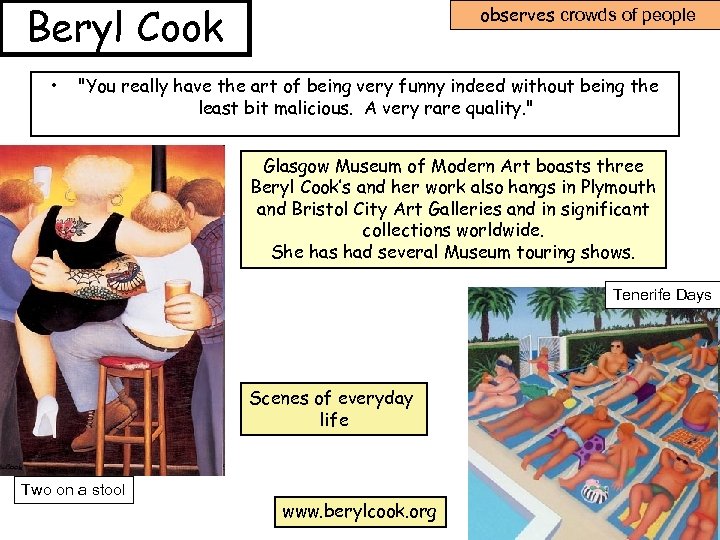
Beryl Cook • observes crowds of people "You really have the art of being very funny indeed without being the least bit malicious. A very rare quality. " Glasgow Museum of Modern Art boasts three Beryl Cook’s and her work also hangs in Plymouth and Bristol City Art Galleries and in significant collections worldwide. She has had several Museum touring shows. Tenerife Days Scenes of everyday life Two on a stool www. berylcook. org
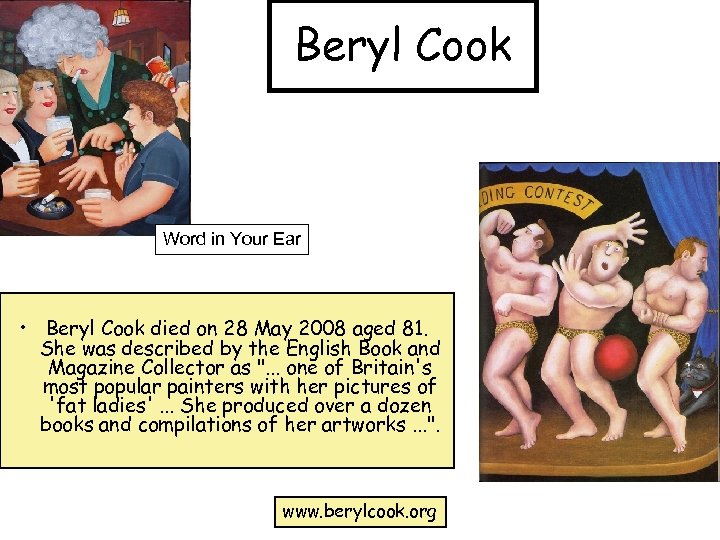
Beryl Cook Word in Your Ear • Beryl Cook died on 28 May 2008 aged 81. She was described by the English Book and Magazine Collector as ". . . one of Britain's most popular painters with her pictures of 'fat ladies'. . . She produced over a dozen books and compilations of her artworks. . . ". www. berylcook. org
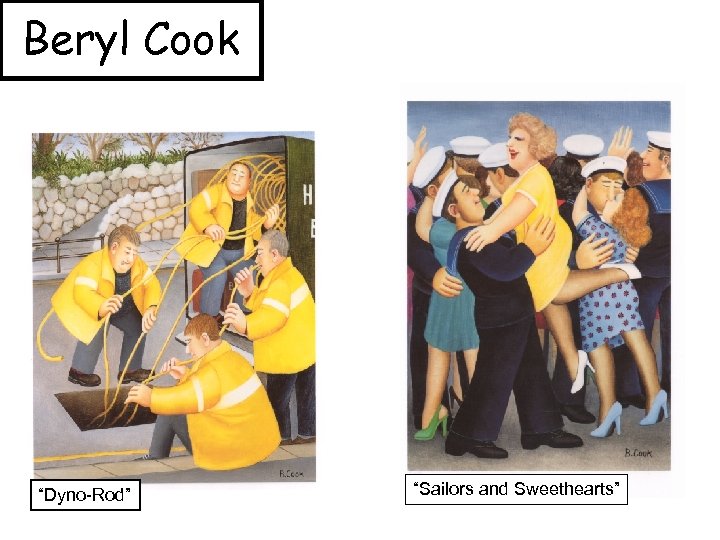
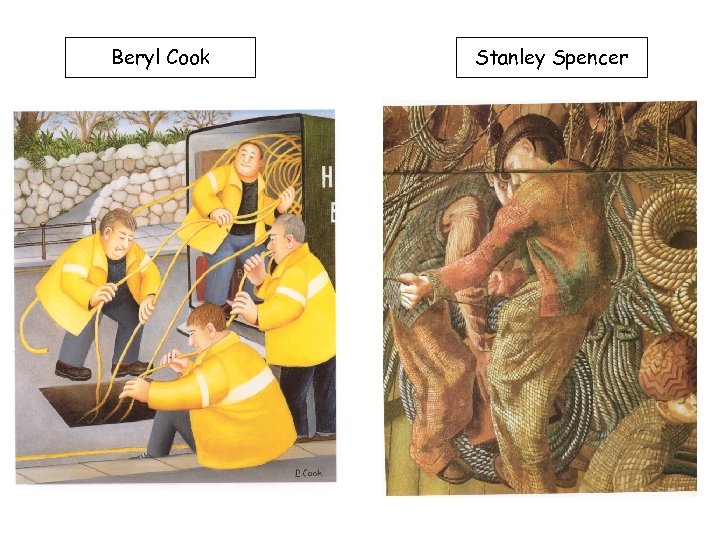
Beryl Cook “Dyno-Rod” “Sailors and Sweethearts”
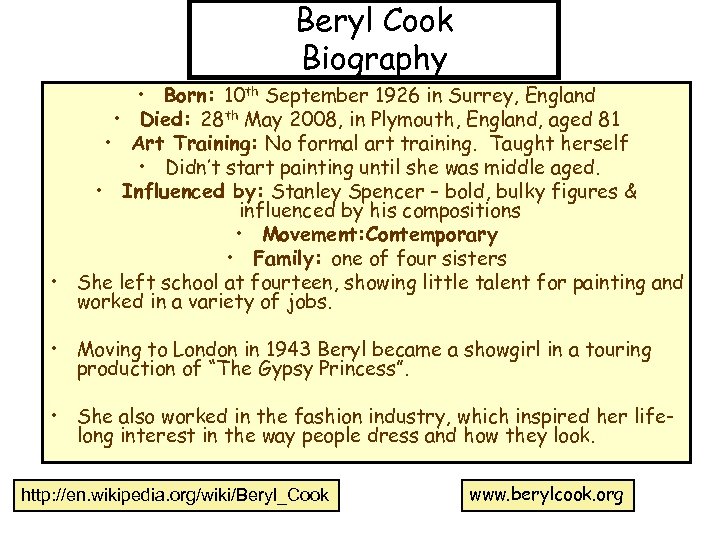
Beryl Cook Biography • Born: 10 th September 1926 in Surrey, England • Died: 28 th May 2008, in Plymouth, England, aged 81 • Art Training: No formal art training. Taught herself • Didn’t start painting until she was middle aged. • Influenced by: Stanley Spencer – bold, bulky figures & influenced by his compositions • Movement: Contemporary • Family: one of four sisters • She left school at fourteen, showing little talent for painting and worked in a variety of jobs. • Moving to London in 1943 Beryl became a showgirl in a touring production of “The Gypsy Princess”. • She also worked in the fashion industry, which inspired her lifelong interest in the way people dress and how they look. http: //en. wikipedia. org/wiki/Beryl_Cook www. berylcook. org
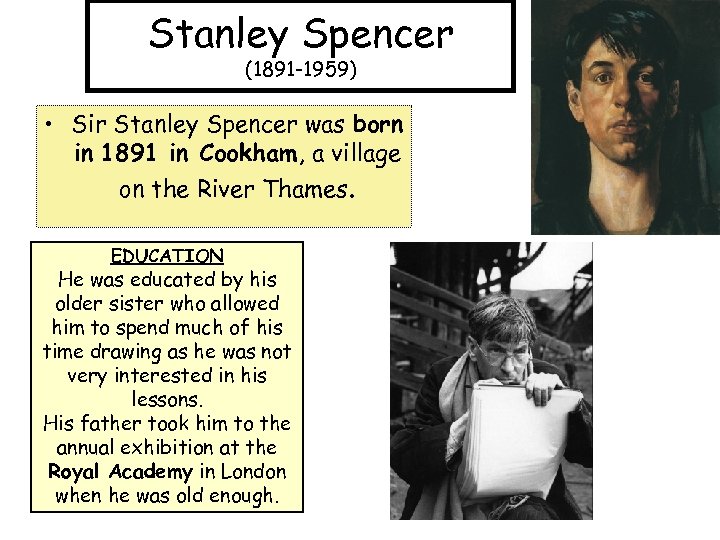
Stanley Spencer (1891 -1959) • Sir Stanley Spencer was born in 1891 in Cookham, a village on the River Thames. EDUCATION He was educated by his older sister who allowed him to spend much of his time drawing as he was not very interested in his lessons. His father took him to the annual exhibition at the Royal Academy in London when he was old enough.
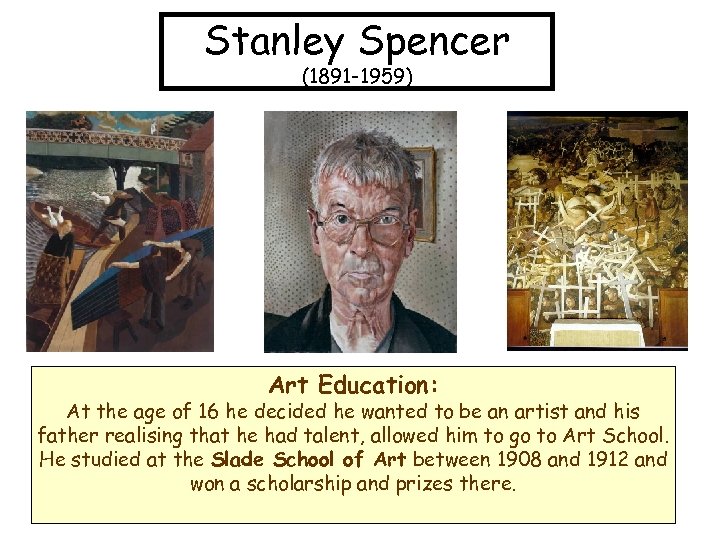
Stanley Spencer (1891 -1959) Art Education: At the age of 16 he decided he wanted to be an artist and his father realising that he had talent, allowed him to go to Art School. He studied at the Slade School of Art between 1908 and 1912 and won a scholarship and prizes there.
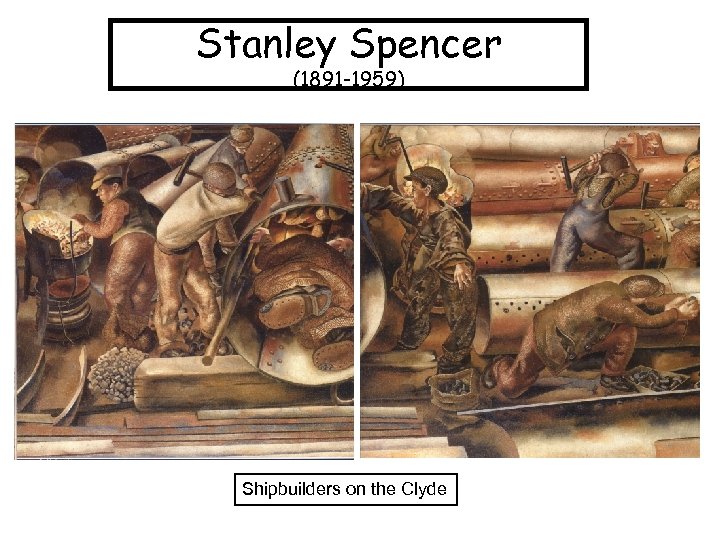
Stanley Spencer (1891 -1959) Shipbuilders on the Clyde
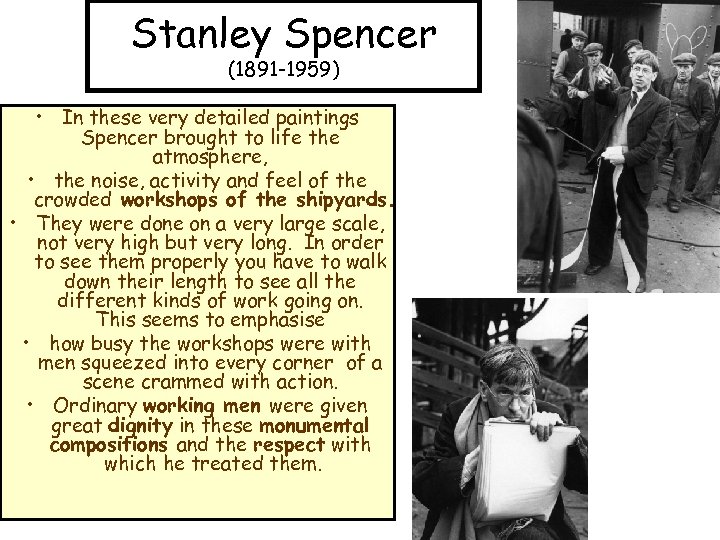
Stanley Spencer (1891 -1959) • In these very detailed paintings Spencer brought to life the atmosphere, • the noise, activity and feel of the crowded workshops of the shipyards. • They were done on a very large scale, not very high but very long. In order to see them properly you have to walk down their length to see all the different kinds of work going on. This seems to emphasise • how busy the workshops were with men squeezed into every corner of a scene crammed with action. • Ordinary working men were given great dignity in these monumental compositions and the respect with which he treated them.
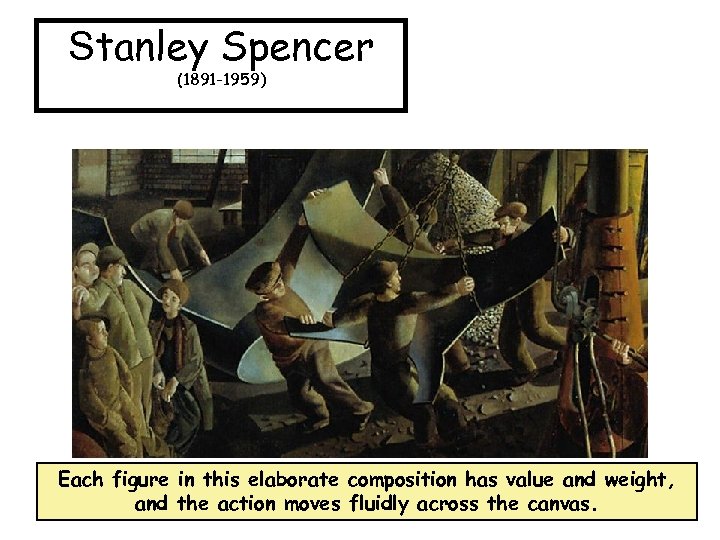
Stanley Spencer (1891 -1959) Each figure in this elaborate composition has value and weight, and the action moves fluidly across the canvas.
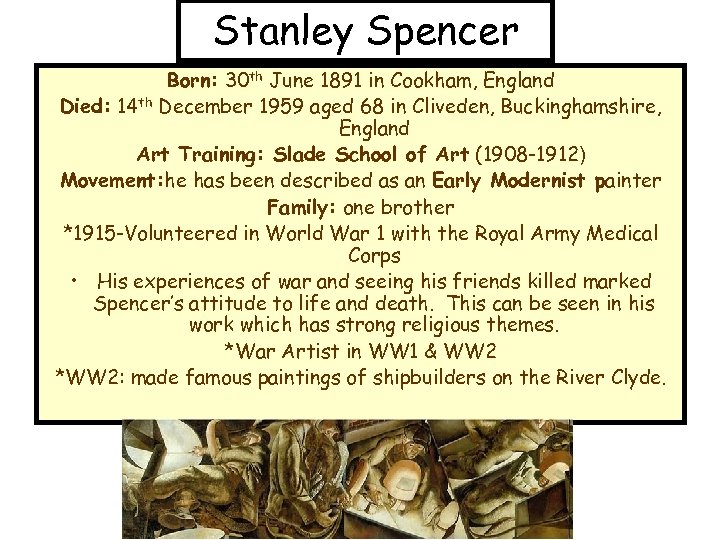
Stanley Spencer Born: 30 th June 1891 in Cookham, England Died: 14 th December 1959 aged 68 in Cliveden, Buckinghamshire, England Art Training: Slade School of Art (1908 -1912) Movement: he has been described as an Early Modernist painter Family: one brother *1915 -Volunteered in World War 1 with the Royal Army Medical Corps • His experiences of war and seeing his friends killed marked Spencer’s attitude to life and death. This can be seen in his work which has strong religious themes. *War Artist in WW 1 & WW 2 *WW 2: made famous paintings of shipbuilders on the River Clyde.
Beryl Cook Stanley Spencer
Beryl Cook Stanley Spencer
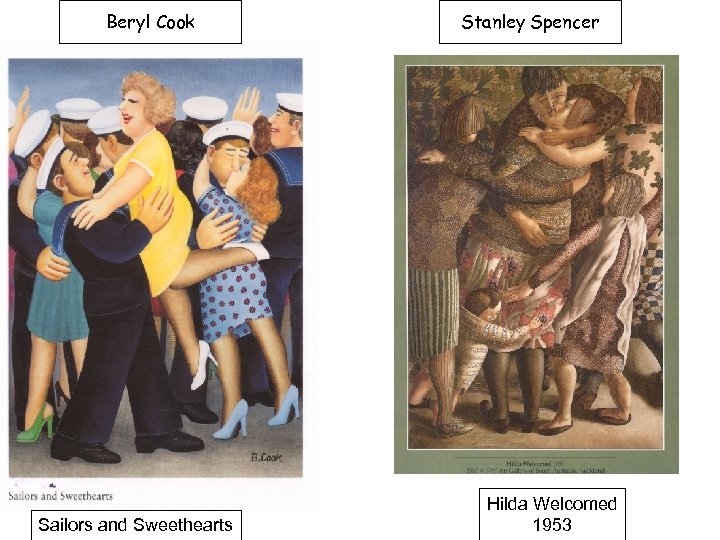
Beryl Cook Sailors and Sweethearts Stanley Spencer Hilda Welcomed 1953
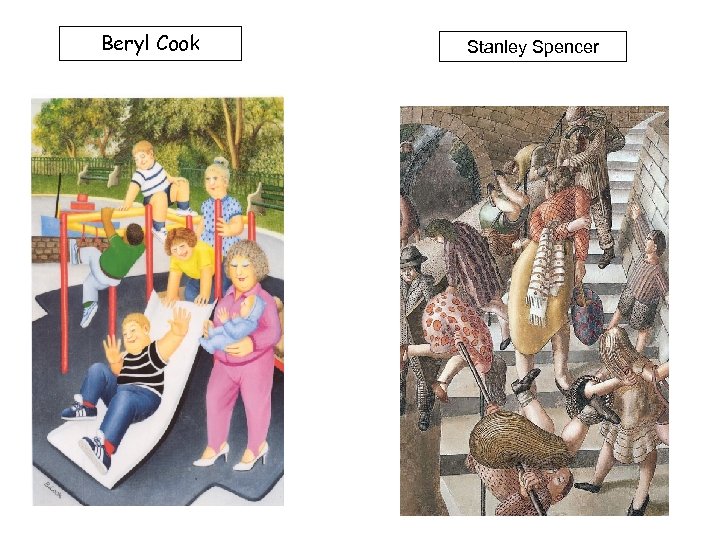
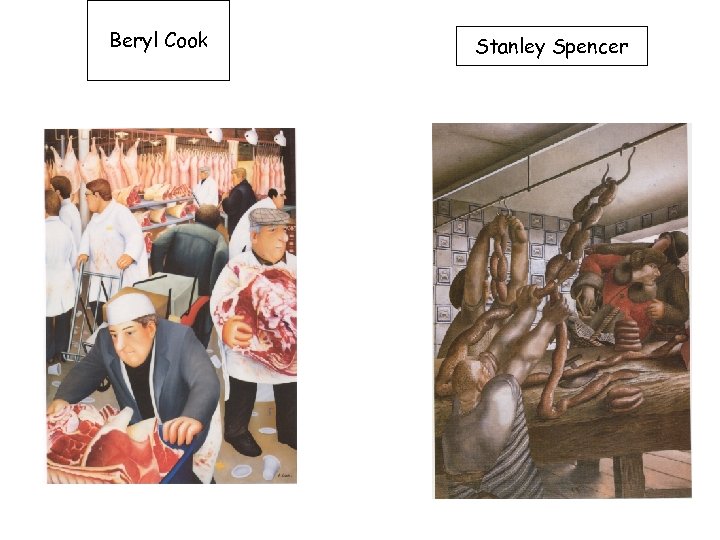
Beryl Cook Stanley Spencer
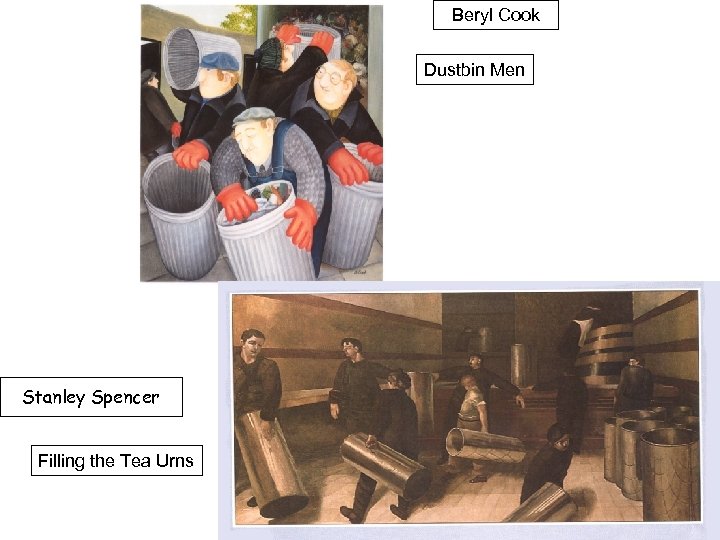
Beryl Cook Dustbin Men Stanley Spencer Filling the Tea Urns
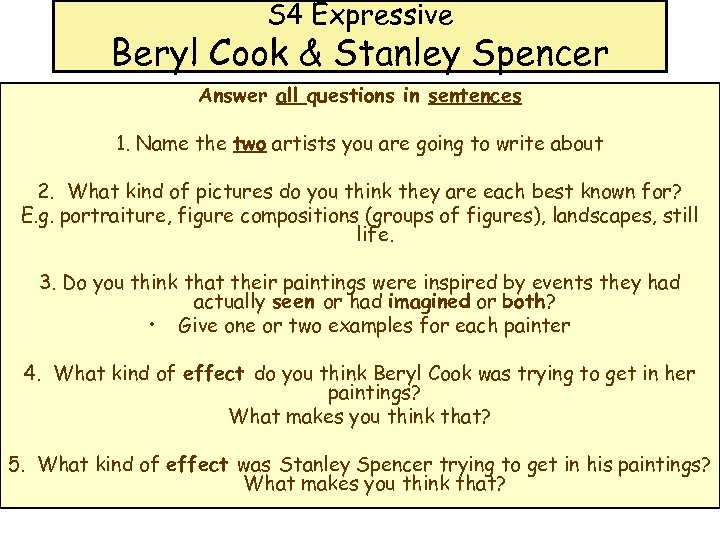
S 4 Expressive Beryl Cook & Stanley Spencer Answer all questions in sentences 1. Name the two artists you are going to write about 2. What kind of pictures do you think they are each best known for? E. g. portraiture, figure compositions (groups of figures), landscapes, still life. 3. Do you think that their paintings were inspired by events they had actually seen or had imagined or both? • Give one or two examples for each painter 4. What kind of effect do you think Beryl Cook was trying to get in her paintings? What makes you think that? 5. What kind of effect was Stanley Spencer trying to get in his paintings? What makes you think that?
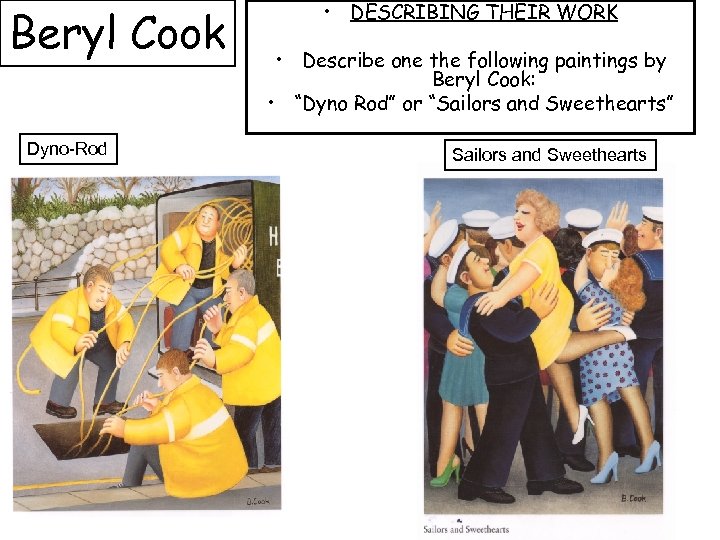
Beryl Cook Dyno-Rod • DESCRIBING THEIR WORK • Describe one the following paintings by Beryl Cook: • “Dyno Rod” or “Sailors and Sweethearts” Sailors and Sweethearts
Beryl Cook 1. Say what the subject of the painting is e. g people working, playing, in boats, at home etc. 2. Name the painting. 3. Describe what is happening in the painting and what the painting is about. 4. Describe the mood of the painting. 5. Which visual elements do you think the artist was most interested in when they were painting their picture and why? (Colour, tone, texture, shape, form, pattern, line, atmosphere) 6. Describe those parts of the painting where you think the artist has made good use of particular visual elements. Say why you think this?
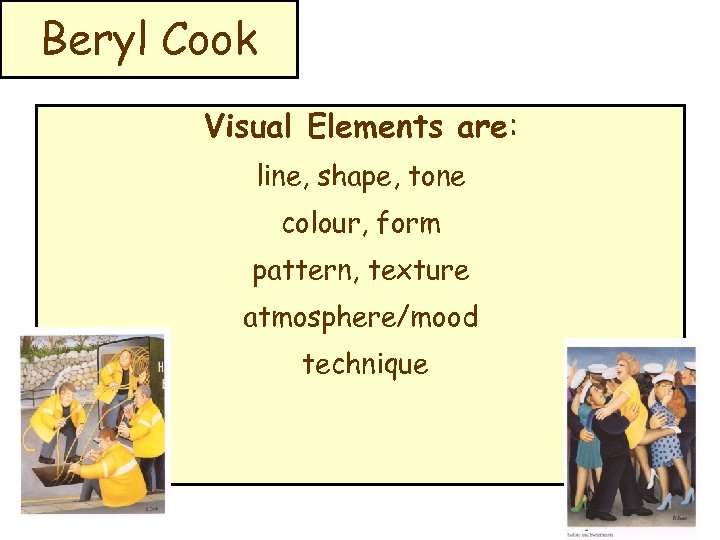
Beryl Cook Visual Elements are: line, shape, tone colour, form pattern, texture atmosphere/mood technique
Beryl Cook • Describe the painting by following the instructions below CONTENT: What is in the painting? COMPOSITION: How has the artist constructed or arranged the painting? (describe where everything is)
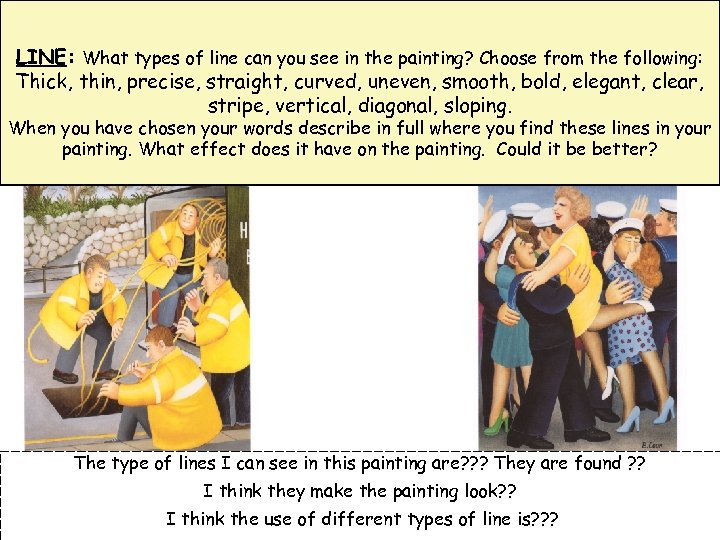
LINE: What types of line can you see in the painting? Choose from the following: Thick, thin, precise, straight, curved, uneven, smooth, bold, elegant, clear, stripe, vertical, diagonal, sloping. When you have chosen your words describe in full where you find these lines in your painting. What effect does it have on the painting. Could it be better? The type of lines I can see in this painting are? ? ? They are found ? ? I think they make the painting look? ? I think the use of different types of line is? ? ?
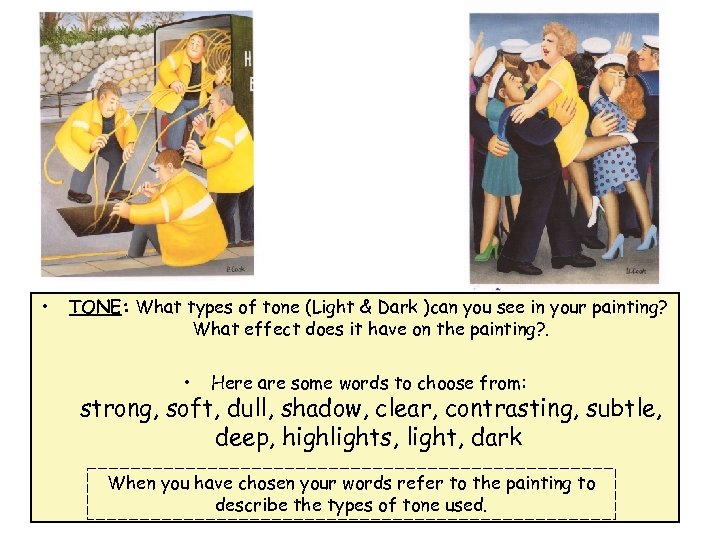
• TONE: What types of tone (Light & Dark )can you see in your painting? What effect does it have on the painting? . • Here are some words to choose from: strong, soft, dull, shadow, clear, contrasting, subtle, deep, highlights, light, dark When you have chosen your words refer to the painting to describe the types of tone used.
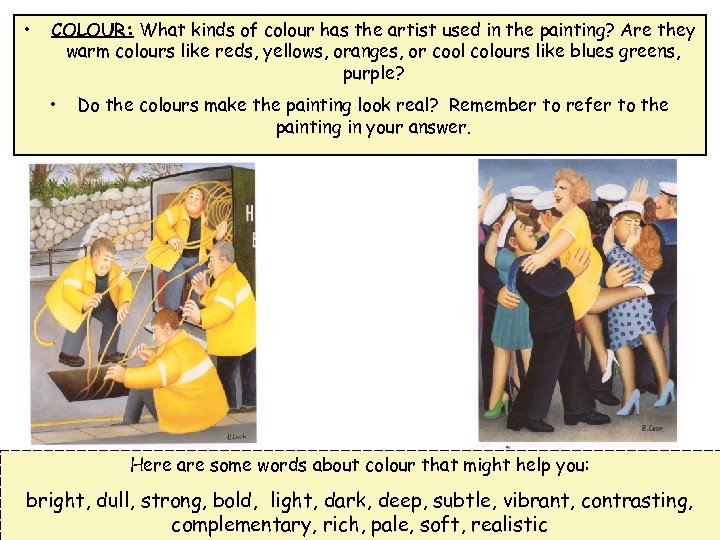
• COLOUR: What kinds of colour has the artist used in the painting? Are they warm colours like reds, yellows, oranges, or cool colours like blues greens, purple? • Do the colours make the painting look real? Remember to refer to the painting in your answer. Here are some words about colour that might help you: bright, dull, strong, bold, light, dark, deep, subtle, vibrant, contrasting, complementary, rich, pale, soft, realistic
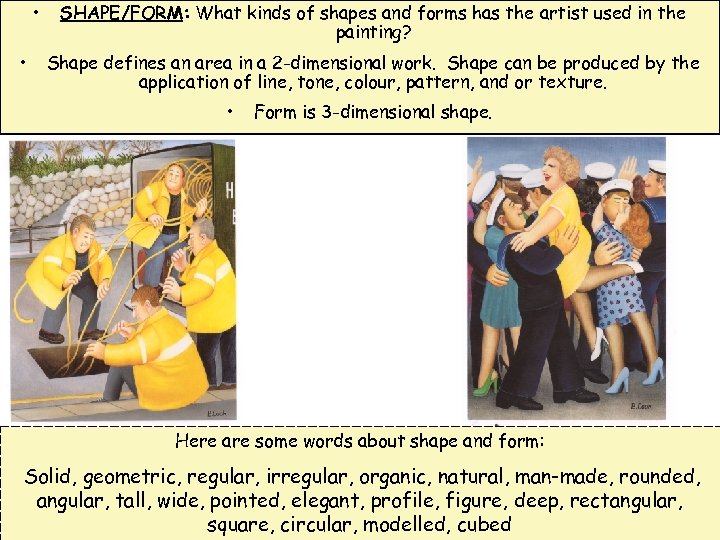
• • SHAPE/FORM: What kinds of shapes and forms has the artist used in the painting? Shape defines an area in a 2 -dimensional work. Shape can be produced by the application of line, tone, colour, pattern, and or texture. • Form is 3 -dimensional shape. Here are some words about shape and form: Solid, geometric, regular, irregular, organic, natural, man-made, rounded, angular, tall, wide, pointed, elegant, profile, figure, deep, rectangular, square, circular, modelled, cubed
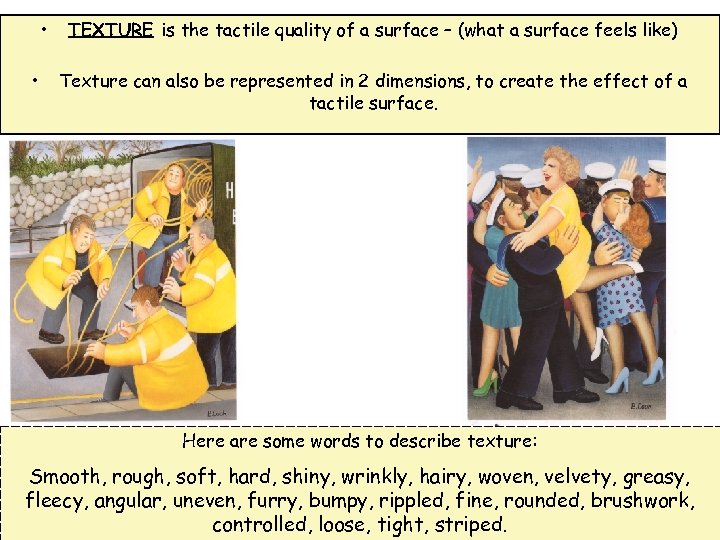
• • TEXTURE is the tactile quality of a surface – (what a surface feels like) Texture can also be represented in 2 dimensions, to create the effect of a tactile surface. Here are some words to describe texture: Smooth, rough, soft, hard, shiny, wrinkly, hairy, woven, velvety, greasy, fleecy, angular, uneven, furry, bumpy, rippled, fine, rounded, brushwork, controlled, loose, tight, striped.
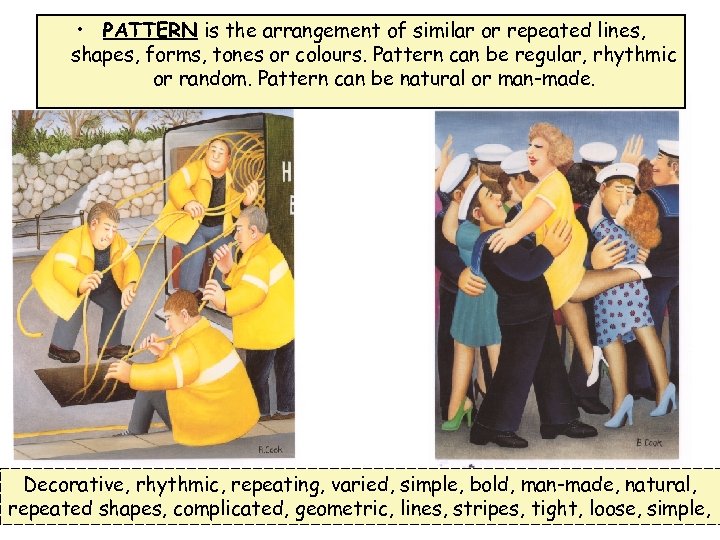
• PATTERN is the arrangement of similar or repeated lines, shapes, forms, tones or colours. Pattern can be regular, rhythmic or random. Pattern can be natural or man-made. Decorative, rhythmic, repeating, varied, simple, bold, man-made, natural, repeated shapes, complicated, geometric, lines, stripes, tight, loose, simple,
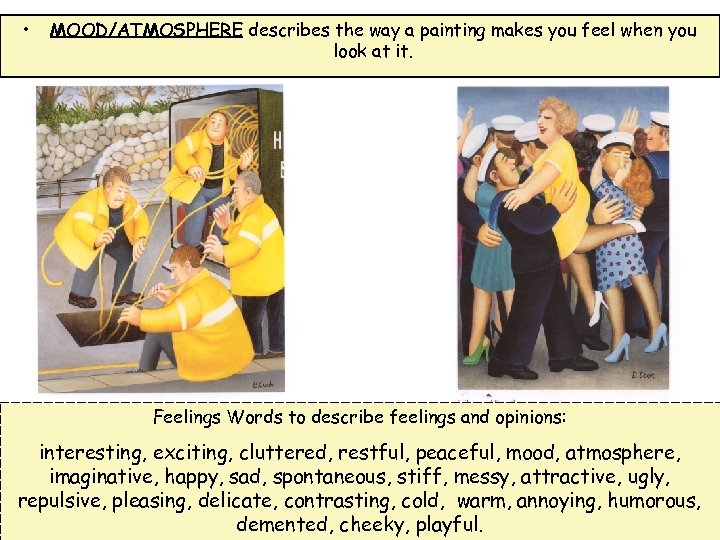
• MOOD/ATMOSPHERE describes the way a painting makes you feel when you look at it. Feelings Words to describe feelings and opinions: interesting, exciting, cluttered, restful, peaceful, mood, atmosphere, imaginative, happy, sad, spontaneous, stiff, messy, attractive, ugly, repulsive, pleasing, delicate, contrasting, cold, warm, annoying, humorous, demented, cheeky, playful.
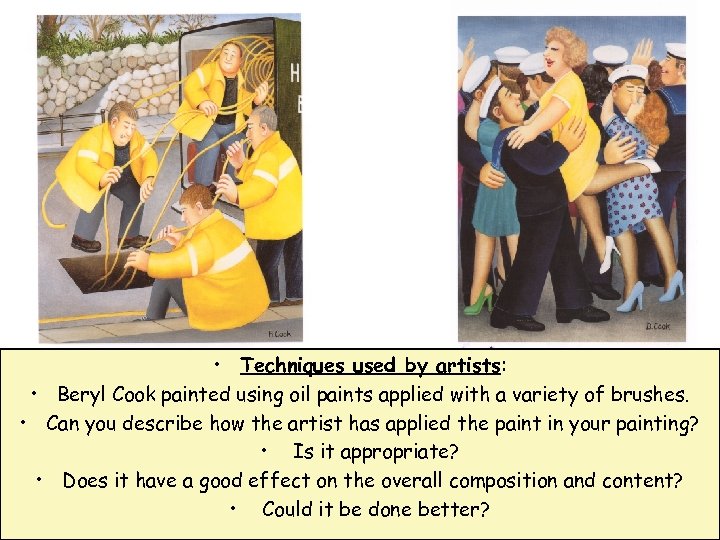
• Techniques used by artists: • Beryl Cook painted using oil paints applied with a variety of brushes. • Can you describe how the artist has applied the paint in your painting? • Is it appropriate? • Does it have a good effect on the overall composition and content? • Could it be done better?
• LOOK at your painting – ALL your answers are there. • LOOK at and USE the word banks on the visual elements. • Work to a STRUCTURE – start a new paragraph for each visual element • Give your honest opinions and back up what you say. Start with: • I think…. . • I feel…. . • My opinion is…. . Most important thing: be confident!! You know your own opinions! Say what you think is happening in the painting and just describe it all!
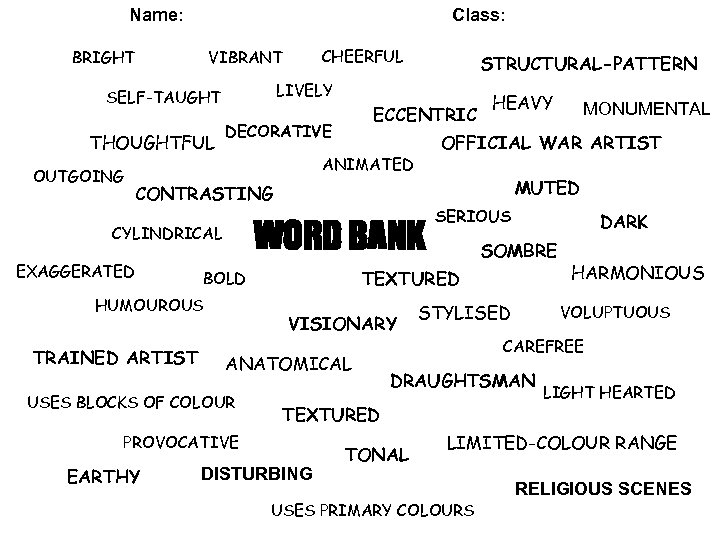
Name: Class: BRIGHT THOUGHTFUL STRUCTURAL-PATTERN LIVELY SELF-TAUGHT OUTGOING CHEERFUL VIBRANT ECCENTRIC DECORATIVE MUTED CONTRASTING EXAGGERATED WORD BANK TRAINED ARTIST VISIONARY ANATOMICAL USES BLOCKS OF COLOUR DARK SOMBRE STYLISED DISTURBING VOLUPTUOUS DRAUGHTSMAN TONAL HARMONIOUS CAREFREE TEXTURED PROVOCATIVE EARTHY SERIOUS TEXTURED BOLD HUMOUROUS MONUMENTAL OFFICIAL WAR ARTIST ANIMATED CYLINDRICAL HEAVY LIGHT HEARTED LIMITED-COLOUR RANGE USES PRIMARY COLOURS RELIGIOUS SCENES
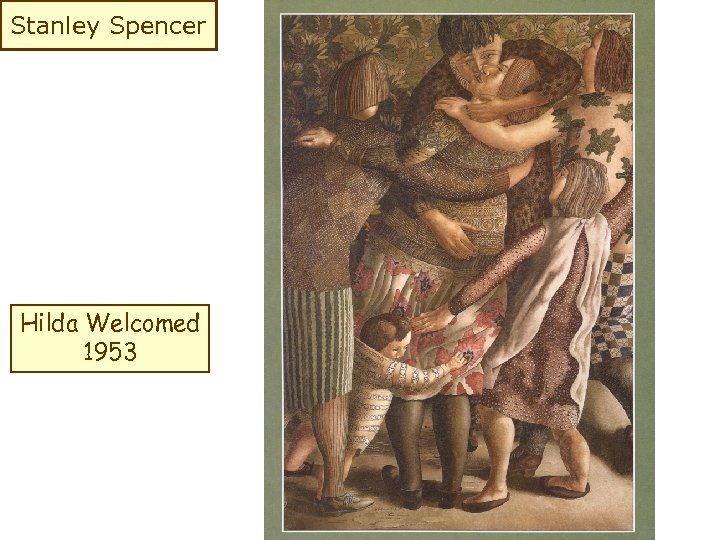
Stanley Spencer Hilda Welcomed 1953
Скачать презентацию Beryl Cook Stanley Spencer Beryl Cook
7f1db2750c5d684dd3838e60926b781f.ppt