 Скачать презентацию Berryessa Designs Mike Ju Elaine Chang
41f5adf7eb389f6ab7547d478a516833.ppt
- Количество слайдов: 69



Berryessa Designs Mike Ju & Elaine Chang
Who We Are • We are a lighting design house and manufacturer with focus on LED based reading lights. • Started in 2009, Base in San Jose, California – Primary production in San Jose • Our mission statement: – Quality Products from Quality Designs
Our Primary Market 1. 2. 3. 4. 5. Reading lights for low vision Reading lights for people over 40 (Boomers) Reading lights for university students Reading lights for hotel rooms Reading lights for 12 and under
4 Eye Disorders Affecting People Over 40 • • Cataract Glaucoma Age Related Macular Degeneration Diabetic Retinopathy Appropriate reading light can help. We are here to help.
Customer Needs • • Some need more light to read Some feel light is too bright and glary Some navigate by the shadow of the light Some eyes changes color preferences through out the day We build lights to address the needs of our customers through light source, optics, fixtures, and electronics
Key Partners in Low Vision • 4 State Government Agencies – – Department of Rehab, California Oregon Commission for the Blind Montana DPHHS Blind and Low Vision Services Washington DSB • Universities – UCLA, UC Berkeley – Casey Eye Institute, Portland Oregon • Low Vision Institutes – – Braille Institute Southern California Center for Partially Sighted Earle Baum Institute Light House San Francisco
LIGHTING BASICS
Lights • Light have two primary purposes: 1. To illuminate • Lighting inside a room or a building • Lighting for reading, writing, craft works etc 2. To indicate • • Signal lights at intersection Turn signals on an automobile Bill board lights Lighted signs
Light Fixture • Light Fixture for General Illumination – Light fixture designed to light up an area or a room – Examples: ceiling light, wall sconces, recess lighting, floor lamp, table lamps • Light Fixture for Task Lighting – Light fixture designed for a specific task – Examples: flash light, magnifier lamp, any light with a targeted lighting area
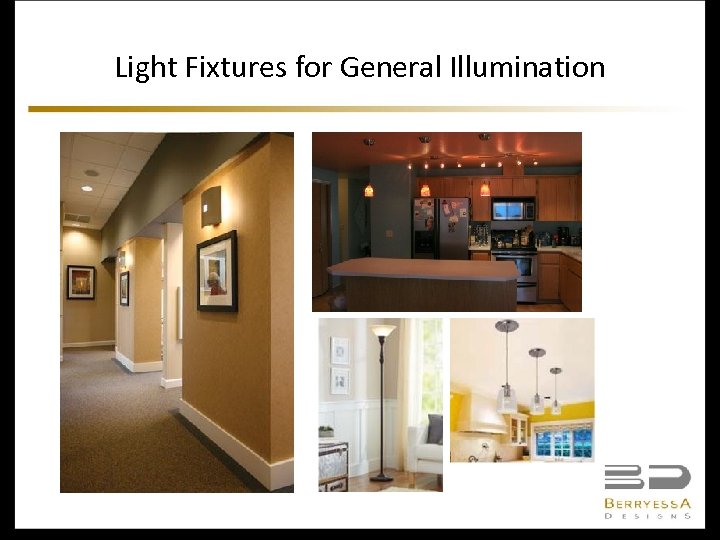
Light Fixtures for General Illumination
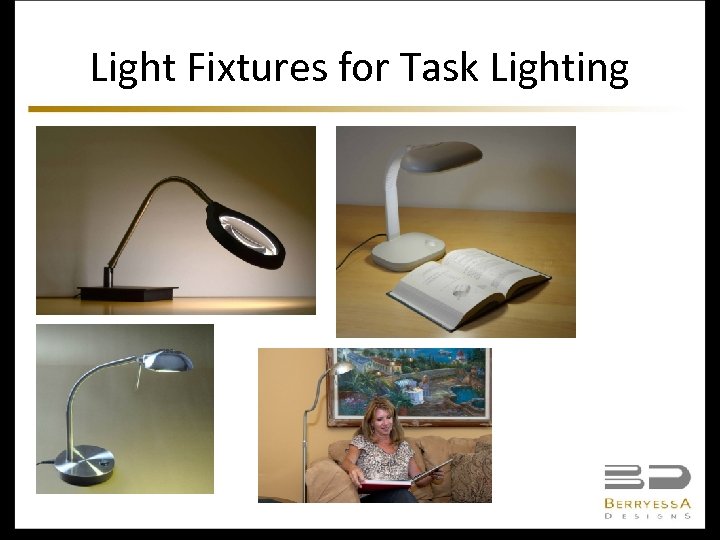
Light Fixtures for Task Lighting
A REVIEW ON LIGHTING TECHNOLOGY
Popular Lighting Technologies • • Incandescent Fluorescent Halogen LED
Light Sources Technologies and Their Inventors (1) • Incandescent – Thomas Edison, carbonized sewing thread inside a vacuum bulb – William Coolidge, ductile tungsten bulb • Fluorescent – George Inman, Richard Thayer, Eugene Lemmers, and Willard Roberts developed the first true fluorescent lamp (source edisontechcenter. org)
Light Sources Technologies and Their Inventors (2) • Halogen – First developed by Elmer Fridrich and Emmett Wiley • LED – James Biard and Gary Pittman, 1 st Patent on LED 1966 – Shuji Nakamura, 1 st bright blue Ga. N LED that we use today. (source edisontechcenter. org)
Why is LED better than Other Technologies? • Highest efficacy of the popular technologies – 80 to 120 Lumens per Watt • Lower operating voltage, safety – Typically DC voltage < 40 volts • No UV – Compact Fluorescent and Halogen Technologies emit UV
KEY WORDS IN LIGHTING
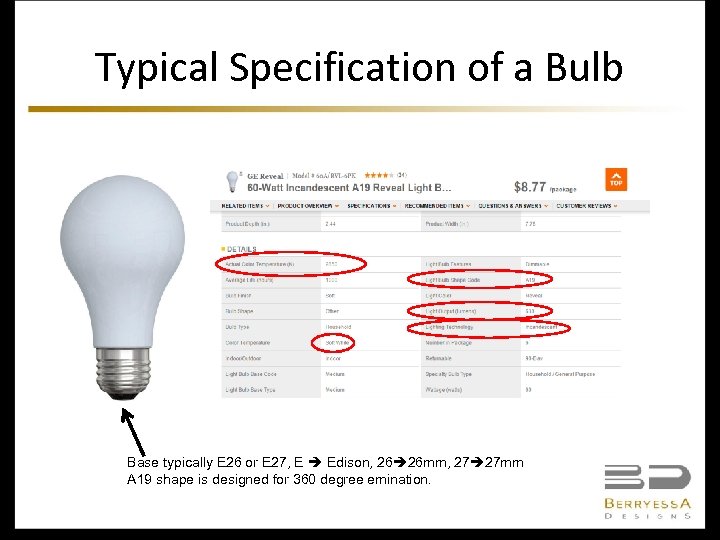
Typical Specification of a Bulb Base typically E 26 or E 27, E Edison, 26 26 mm, 27 27 mm A 19 shape is designed for 360 degree emination.
Key Words in Lighting • • Efficacy Lumens Lux Correlated Color Temperature CCT
Efficacy – Definition • In this case, we are talking about luminous efficacy. • Efficacy is an efficiency parameter to measure how well does the light source convert electrical energy into light. • It is expressed in volume of light / electrical power supplied • Metric Unit is expressed in Lumens / Watt
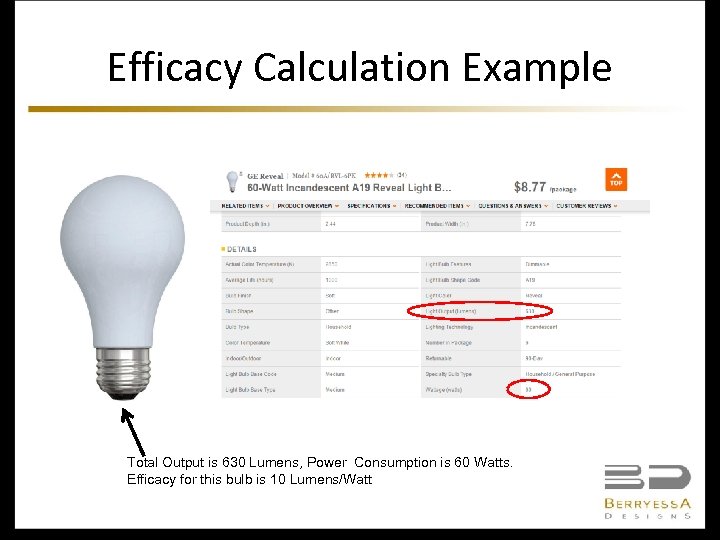
Efficacy Calculation Example Total Output is 630 Lumens, Power Consumption is 60 Watts. Efficacy for this bulb is 10 Lumens/Watt
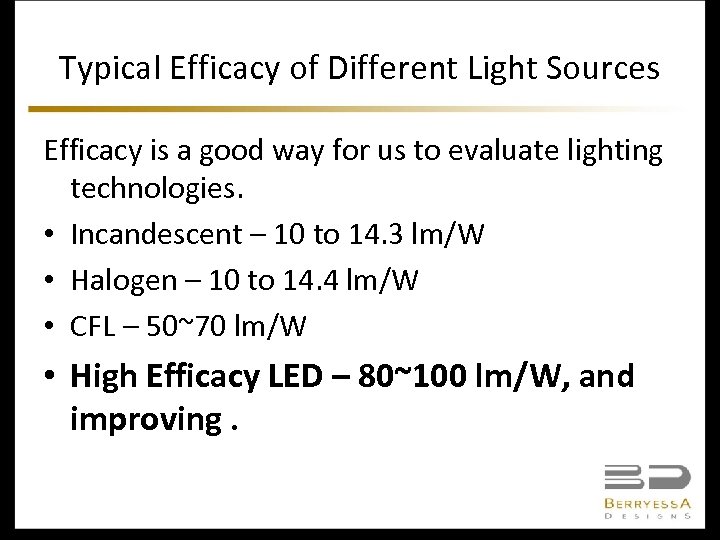
Typical Efficacy of Different Light Sources Efficacy is a good way for us to evaluate lighting technologies. • Incandescent – 10 to 14. 3 lm/W • Halogen – 10 to 14. 4 lm/W • CFL – 50~70 lm/W • High Efficacy LED – 80~100 lm/W, and improving.
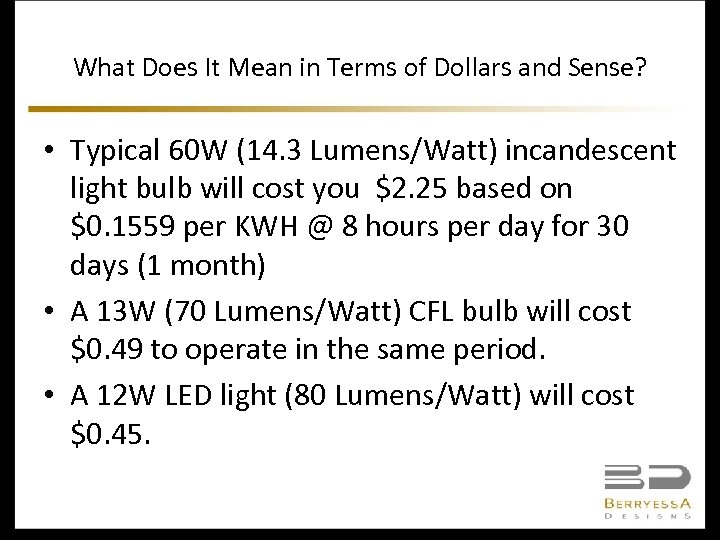
What Does It Mean in Terms of Dollars and Sense? • Typical 60 W (14. 3 Lumens/Watt) incandescent light bulb will cost you $2. 25 based on $0. 1559 per KWH @ 8 hours per day for 30 days (1 month) • A 13 W (70 Lumens/Watt) CFL bulb will cost $0. 49 to operate in the same period. • A 12 W LED light (80 Lumens/Watt) will cost $0. 45.
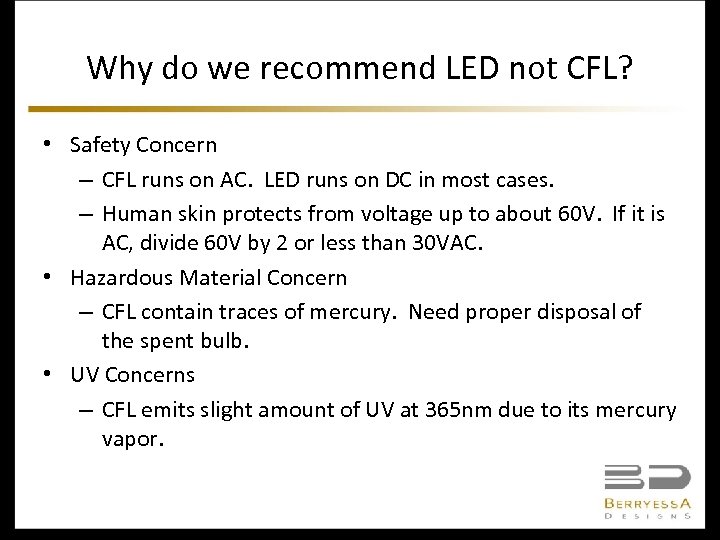
Why do we recommend LED not CFL? • Safety Concern – CFL runs on AC. LED runs on DC in most cases. – Human skin protects from voltage up to about 60 V. If it is AC, divide 60 V by 2 or less than 30 VAC. • Hazardous Material Concern – CFL contain traces of mercury. Need proper disposal of the spent bulb. • UV Concerns – CFL emits slight amount of UV at 365 nm due to its mercury vapor.
Lumens – Definition • Lumens is a measure of total amount of visible light from a light source. – A typical 60 W incandescent light bulb can produce 800 Lumens of light – A 13~15 W CFL bulb can produce 800 Lumens – Typical 10. 5 W A 19 Shaped LED bulb from Philips or Sylvania produces 800 Lumens
Lux - Definition • Lux is a measurement of brightness. It is expressed as Lumens / Surface Area. • It is expressed as Lumens/meter square • Typical brightness of environment – Moonless, overcast night sky 0. 0001 lux – Office building 350 to 500 lux – Sunrise or sunset on a clear day 400 lux – Full day light, indirect sun 10000 to 25000 lux
Lux vs, Lumens When to use Which Parameter • When buying a light for general illumination purpose, it is best to look at number of Lumens that the light can provide. • When buying a reading lamp, it is best to look at the number of Lux that the light can provide. Be sure to know what distance between the light source and the intended object that the lux is measured.
CCT - Definition • CCT stands for correlated color temperature • It is the temperature of an ideal black-body radiator, expressed in the units of degree Kelvin. • White light comes in different shades. – 3000 K soft white or warm white – 4000 K neutral white – 5000 K cool white
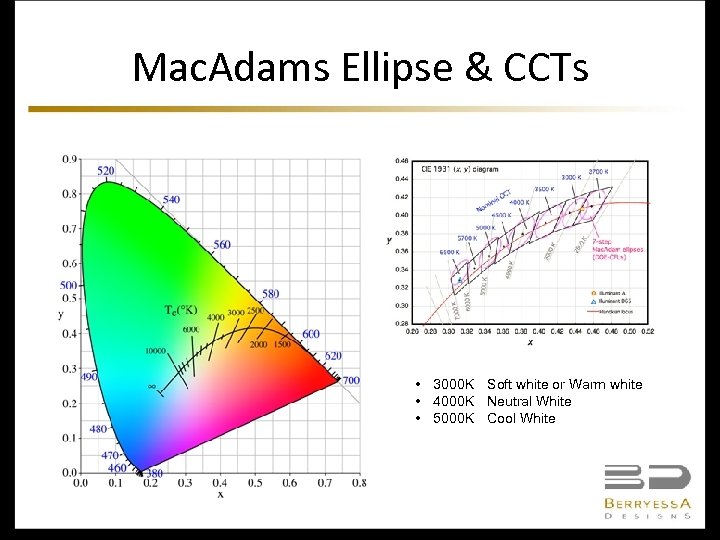
Mac. Adams Ellipse & CCTs • 3000 K Soft white or Warm white • 4000 K Neutral White • 5000 K Cool White
Which CCT is Best? • Each person has a sweet spot or preference for CCT. Factors depends on heredity, where you grew up, and most important what eye conditions do you have. • It is easier to have individual examine to see what CCT preference by reading materials with lamps with different CCTs.
Trends and General Tendencies • Cataract – lower CCT, longer wavelength penetrates matters better • Diabetes – lower CCT with reddish spectrum • Macular Degeneration – varies, depending on your heritage and where you grew up
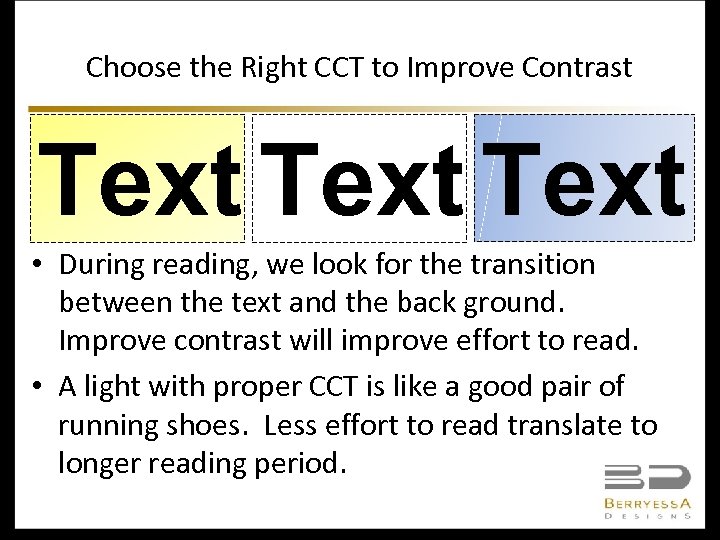
Choose the Right CCT to Improve Contrast Text • During reading, we look for the transition between the text and the back ground. Improve contrast will improve effort to read. • A light with proper CCT is like a good pair of running shoes. Less effort to read translate to longer reading period.
GENERAL ILLUMINATION
Importance of Ambient Lighting • Your eyes constantly monitor the amount of light in the surrounding and opens pupil accordingly. • It is important to maintain appropriate ambient light to minimize over-exposure of your retina. • Key take away point is never read watch TV in the dark.
Lights Sources In general, lights can be of point source, line source and plane source Examples • Point source - a light bulb • Line source: a light tube • Plane source: a light box or screen made of OLED, fluorescent tubes
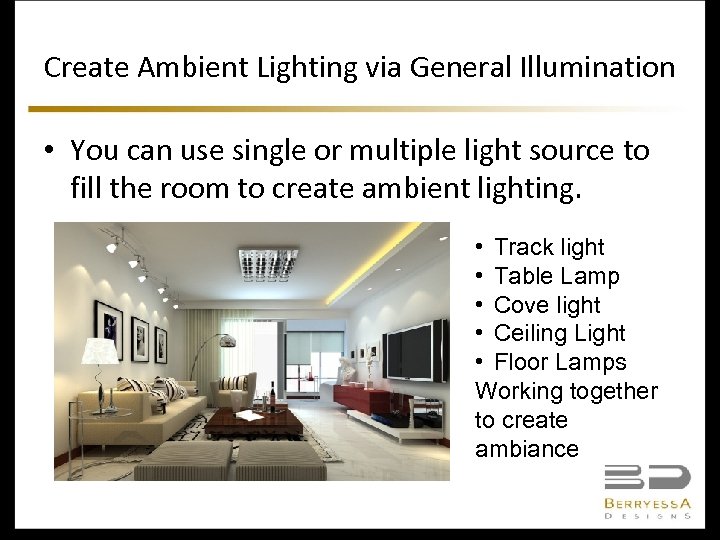
Create Ambient Lighting via General Illumination • You can use single or multiple light source to fill the room to create ambient lighting. • Track light • Table Lamp • Cove light • Ceiling Light • Floor Lamps Working together to create ambiance
TASK LIGHTING
What Makes a Good Reading Light? • CCT – Proper CCT, Everyone is Unique • Brightness – Appropriate Brightness, Dimmer Option • Adjustability – Delivery of Light • Safety – Free from Heat & Electric Shock • Quality – Longevity of Product
Why is Berryessa Designs Reading Lamp? • Good thermal management to ensure longevity of LEDs • A family of CCT to choose from • Power management with maximum DC voltage of 24 V + short circuit protection. Human skin protects from electro-shock up to 60 V. • After sales customer service
Our Products
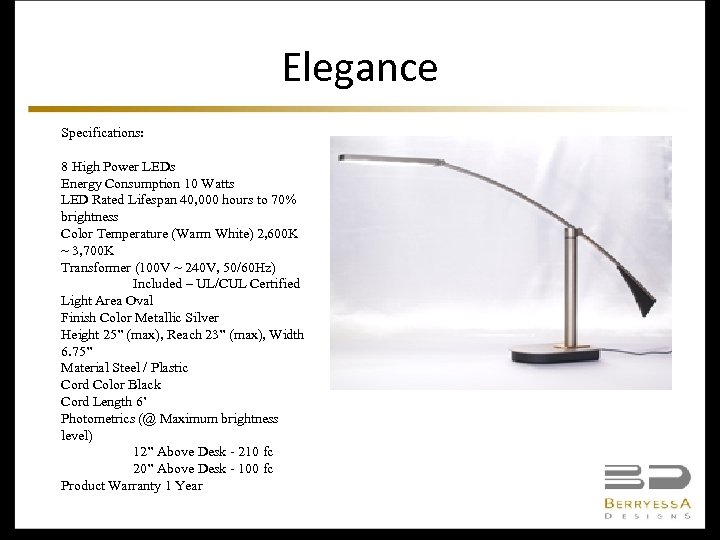
Elegance Specifications: 8 High Power LEDs Energy Consumption 10 Watts LED Rated Lifespan 40, 000 hours to 70% brightness Color Temperature (Warm White) 2, 600 K ~ 3, 700 K Transformer (100 V ~ 240 V, 50/60 Hz) Included – UL/CUL Certified Light Area Oval Finish Color Metallic Silver Height 25” (max), Reach 23” (max), Width 6. 75” Material Steel / Plastic Cord Color Black Cord Length 6’ Photometrics (@ Maximum brightness level) 12” Above Desk - 210 fc 20” Above Desk - 100 fc Product Warranty 1 Year
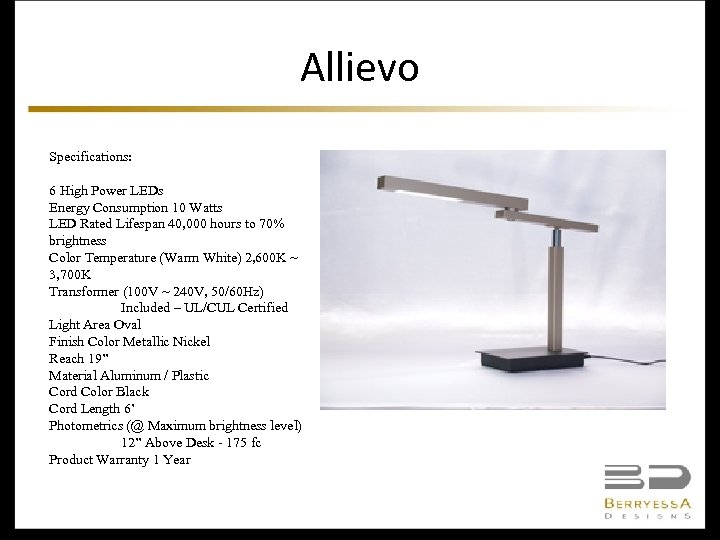
Allievo Specifications: 6 High Power LEDs Energy Consumption 10 Watts LED Rated Lifespan 40, 000 hours to 70% brightness Color Temperature (Warm White) 2, 600 K ~ 3, 700 K Transformer (100 V ~ 240 V, 50/60 Hz) Included – UL/CUL Certified Light Area Oval Finish Color Metallic Nickel Reach 19” Material Aluminum / Plastic Cord Color Black Cord Length 6’ Photometrics (@ Maximum brightness level) 12” Above Desk - 175 fc Product Warranty 1 Year
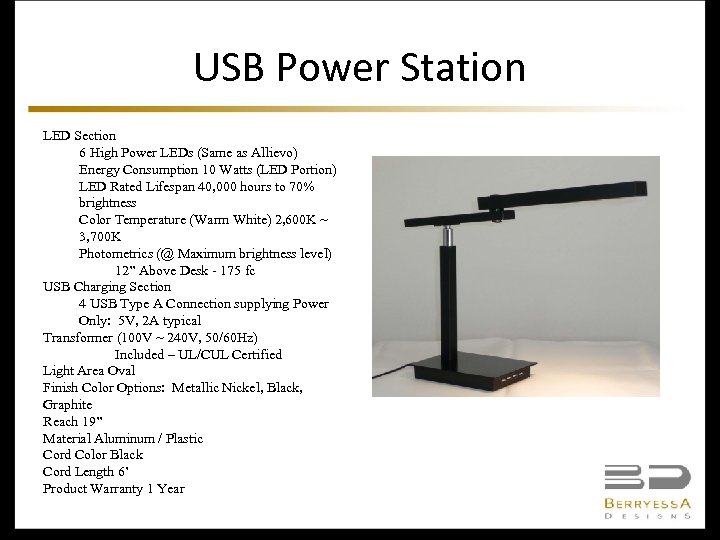
USB Power Station LED Section 6 High Power LEDs (Same as Allievo) Energy Consumption 10 Watts (LED Portion) LED Rated Lifespan 40, 000 hours to 70% brightness Color Temperature (Warm White) 2, 600 K ~ 3, 700 K Photometrics (@ Maximum brightness level) 12” Above Desk - 175 fc USB Charging Section 4 USB Type A Connection supplying Power Only: 5 V, 2 A typical Transformer (100 V ~ 240 V, 50/60 Hz) Included – UL/CUL Certified Light Area Oval Finish Color Options: Metallic Nickel, Black, Graphite Reach 19” Material Aluminum / Plastic Cord Color Black Cord Length 6’ Product Warranty 1 Year
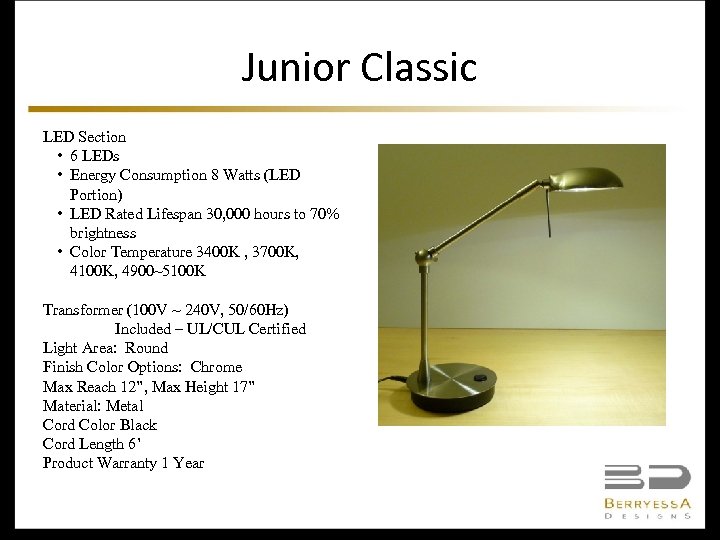
Junior Classic LED Section • 6 LEDs • Energy Consumption 8 Watts (LED Portion) • LED Rated Lifespan 30, 000 hours to 70% brightness • Color Temperature 3400 K , 3700 K, 4100 K, 4900~5100 K Transformer (100 V ~ 240 V, 50/60 Hz) Included – UL/CUL Certified Light Area: Round Finish Color Options: Chrome Max Reach 12”, Max Height 17” Material: Metal Cord Color Black Cord Length 6’ Product Warranty 1 Year
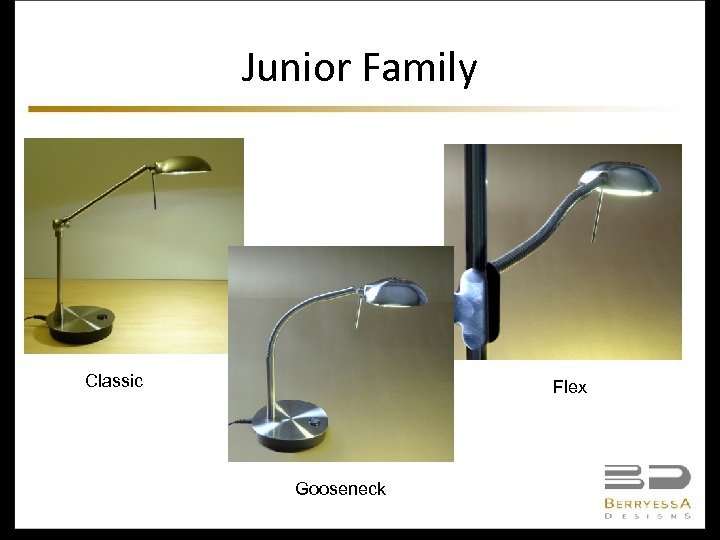
Junior Family Classic Flex Gooseneck
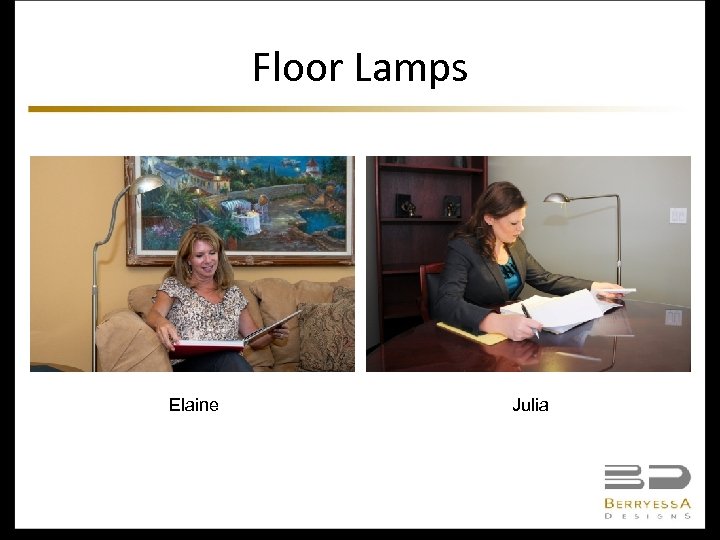
Floor Lamps Elaine Julia
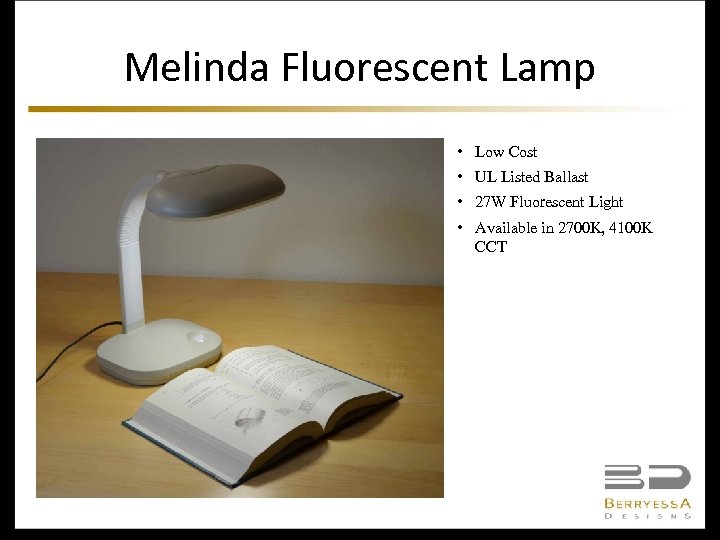
Melinda Fluorescent Lamp • Low Cost • UL Listed Ballast • 27 W Fluorescent Light • Available in 2700 K, 4100 K CCT
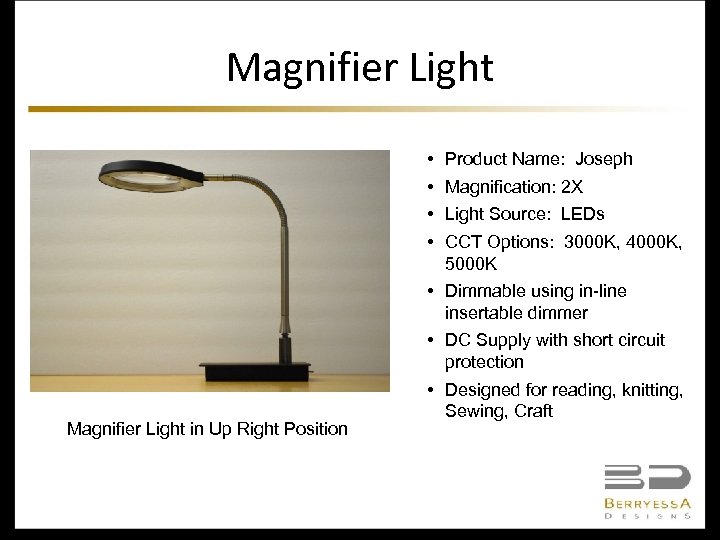
Magnifier Light • • Magnifier Light in Up Right Position Product Name: Joseph Magnification: 2 X Light Source: LEDs CCT Options: 3000 K, 4000 K, 5000 K • Dimmable using in-line insertable dimmer • DC Supply with short circuit protection • Designed for reading, knitting, Sewing, Craft
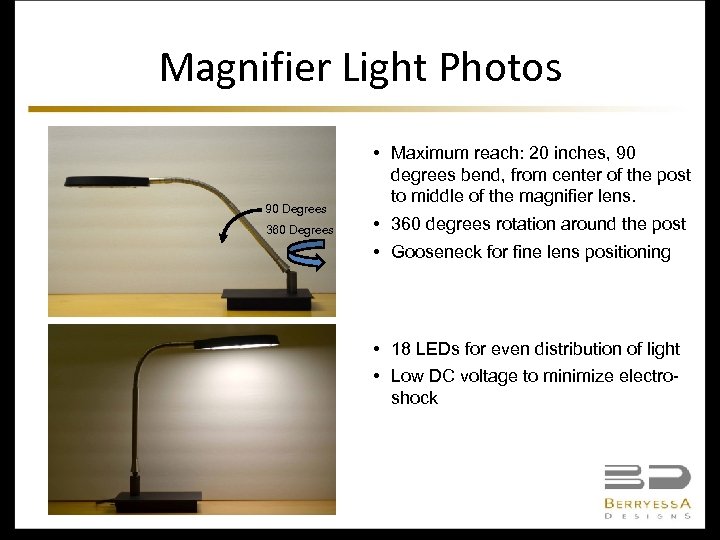
Magnifier Light Photos 90 Degrees 360 Degrees • Maximum reach: 20 inches, 90 degrees bend, from center of the post to middle of the magnifier lens. • 360 degrees rotation around the post • Gooseneck for fine lens positioning • 18 LEDs for even distribution of light • Low DC voltage to minimize electroshock
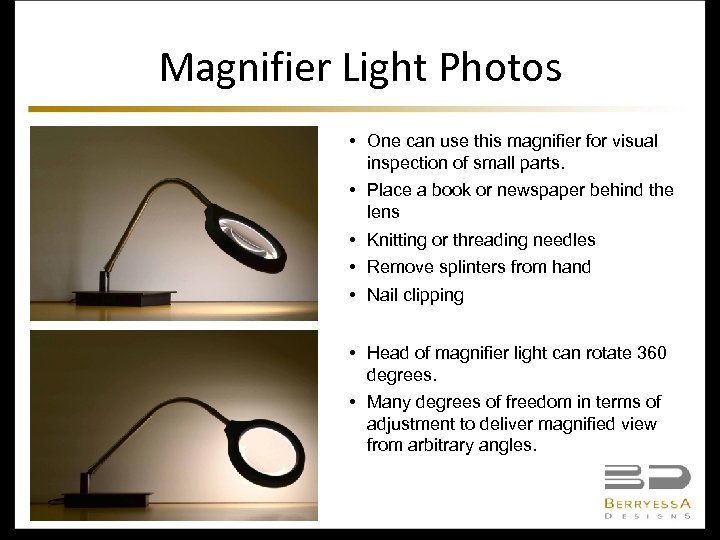
Magnifier Light Photos • One can use this magnifier for visual inspection of small parts. • Place a book or newspaper behind the lens • Knitting or threading needles • Remove splinters from hand • Nail clipping • Head of magnifier light can rotate 360 degrees. • Many degrees of freedom in terms of adjustment to deliver magnified view from arbitrary angles.
How Bright is Bright? • It depends on whether it is public space, private space. Typical office ~ 500 lux and classrooms ~ 250 Lux minimum. • Most public spaces are lit with 4000 K to 5000 K CCT. To most people, this is perfectly acceptable. To some people, this may be either too bright or too dark. CCT is a important function need to be consider along with illuminance.
What to Do When Existing General Illumination is Not Comfortable? Cater the needs of each individual through analysis of CCT and illuminance needed. 1. Identify the CCT that the individual is most comfortable with in his or her individual space. 2. Measure illuminance needed in tha space for the individual to be at ease. 3. Replace general illumination light source or additional task lighting to create environment.
How to Identify CCT, Measure Illuminance? Possible Solution: 1. Professional Light Meter to measure CCT and Illuminance with Proper Light Sources at set distance. 2. Proper light sources with known CCTs at a set distance to measure Illuminance with adjustable dimmer for brightness control. Use and record brightness reading from photosensors of tablets or smart phones.
Apps for Light Measurement • Apps for Smart Phones and Tablets can give a quick measurement of lights. – The apps can provide marker readings to provide trends and directions towards the lighting condition desired. • Google Play Store: search for light meter – Light Meter, a good app with calibration parameters for illuminance and CCT adjustments. • Apple Apps Store – Light meter apps with no calibration control, no confidence in data measured
Values of These Mobile Apps • Although mobile lighting apps are not precise in comparison to professional equipment, the readings made using apps can serve as markers in terms of light intensity and CCT. • By using different known CCT light sources for color metamerism, mobile lighting apps can show direction trend about where the client prefers in terms of CCT. • By using dimming capability of LED bulb to adjust intensity, mobile lighting apps can reveal where intensity of the light needs to be.
Simple Techniqut to Identify CCT Preference (1) • Material Needed – Reference: a 60 W LED Bulb with 3000 K CCT – Reference: a 60 W LED Bulb with 5000 K CCT • Read the label off the box. Each bulb should provide approximately 800 lumens. We can choose other lumenous flux as long as both are the same. • Choose dimmable LED bulbs for intensity control
Simple Techniqut to Identify CCT Preference (2) • Choose bulb with 3000 K CCT, illuminate the reading material at 12 inches away from the reading material. Record the illuminance as ICal. Label as 12 inch Reference for 3000 K or D 3 K-Cal • Gradually move the lamp either towards or away from the reading material until the text is legible to the client. • Record down CCT and illuminance I 3 K from the mobile lighting app. Also record the distance between the lamp and the reading material as D 3 K
Simple Techniqut to Identify CCT Preference (3) • Gradually move the light source of 5000 K CCT bulb either away or towards the reading material until the mobile lighting app reads the illuminance number as the 3000 K CCT Bulb ICal. Record the distance as D 5 KCal • Gradually move the lamp either towards or away from the reading material until the text is legible to the client.
Simple Techniqut to Identify CCT Preference (4) • Record down CCT and illuminance I 5 Kfrom the mobile lighting app. Also record the distance between the lamp and the reading material D 5 K • Compare 12 inch Reference for 3000 K distance to Equal Illuminance Distance (5000 K) to see which bulb has higher luminous flux. • Not all bulbs are created equal. We use ICal, D 3 K-Cal, and D 5 K-Cal as a way to calibrate out differences in bulb output.
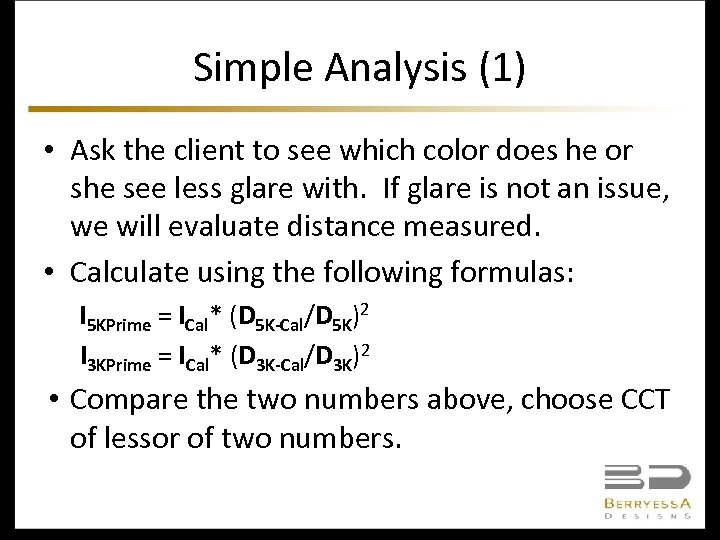
Simple Analysis (1) • Ask the client to see which color does he or she see less glare with. If glare is not an issue, we will evaluate distance measured. • Calculate using the following formulas: I 5 KPrime = ICal* (D 5 K-Cal/D 5 K)2 I 3 KPrime = ICal* (D 3 K-Cal/D 3 K)2 • Compare the two numbers above, choose CCT of lessor of two numbers.
Simple Analysis (2) • The choose CCT hints the direction of preference. • It is possible to choose a third CCT bulb such as 4000 K to rerun the exercise to further narrow down CCT preference.
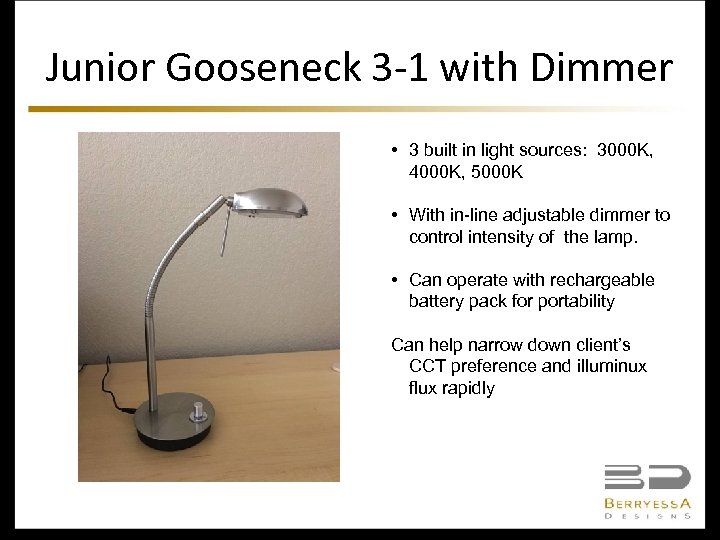
Junior Gooseneck 3 -1 with Dimmer • 3 built in light sources: 3000 K, 4000 K, 5000 K • With in-line adjustable dimmer to control intensity of the lamp. • Can operate with rechargeable battery pack for portability Can help narrow down client’s CCT preference and illuminux flux rapidly
PORTABLE TASK LAMPS
Key Considerations for Portable Lamps • Brightness and beam pattern – Public Spaces are often too dark for people with low vision. Additional lighting is needed. Brightness needs to bright enough yet not intrusive to others. Same goes with beam pattern of portable lamp, not to invade other people’s space. • Color Temperature – Most portable lights are built with very high CCT, > 5500 K to conserve power consumption • Hours of Operation – Depending types of battery. Voltage and current differs from one technology to the next. • Weight – portable often becomes luggable due to operating time constraint. Is it too heavy to carry?
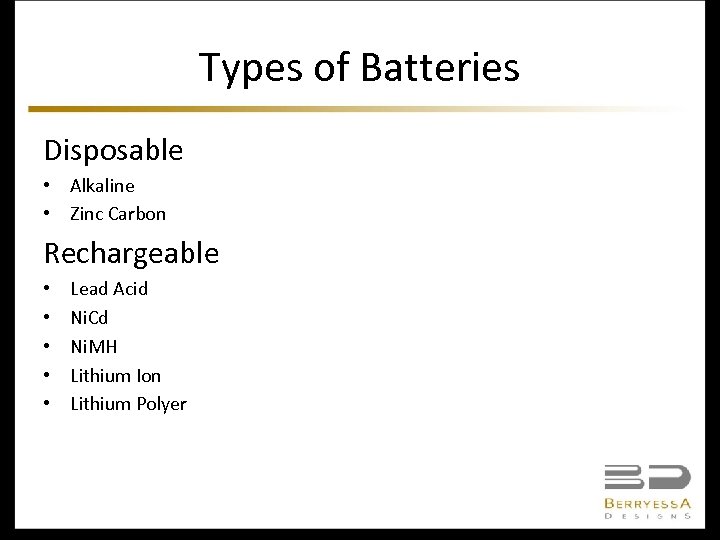
Types of Batteries Disposable • Alkaline • Zinc Carbon Rechargeable • • • Lead Acid Ni. Cd Ni. MH Lithium Ion Lithium Polyer
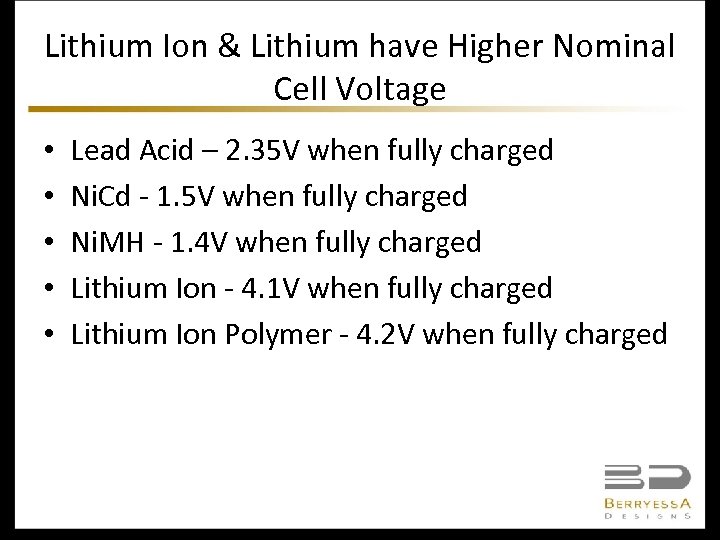
Lithium Ion & Lithium have Higher Nominal Cell Voltage • • • Lead Acid – 2. 35 V when fully charged Ni. Cd - 1. 5 V when fully charged Ni. MH - 1. 4 V when fully charged Lithium Ion - 4. 1 V when fully charged Lithium Ion Polymer - 4. 2 V when fully charged
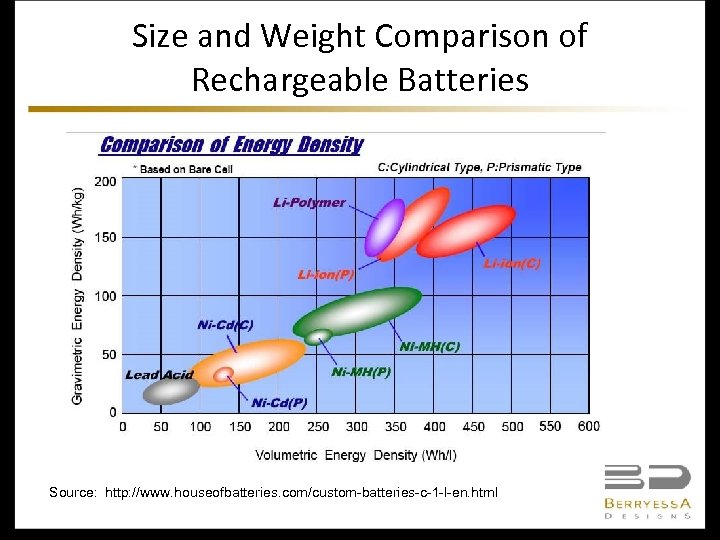
Size and Weight Comparison of Rechargeable Batteries Source: http: //www. houseofbatteries. com/custom-batteries-c-1 -l-en. html
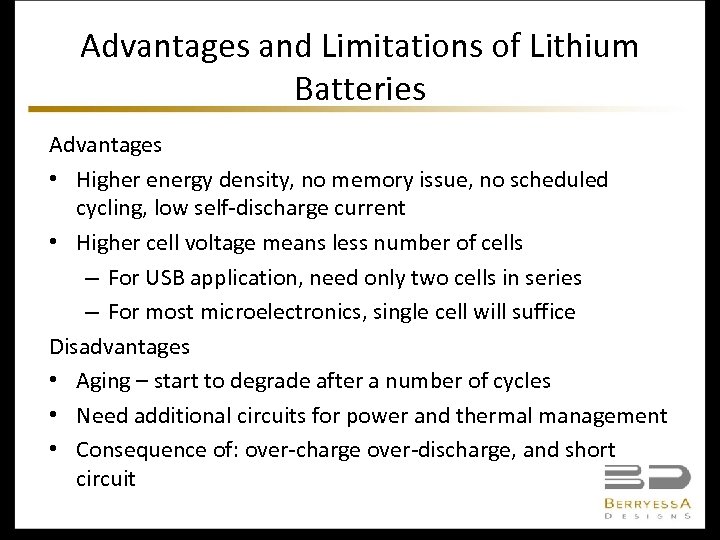
Advantages and Limitations of Lithium Batteries Advantages • Higher energy density, no memory issue, no scheduled cycling, low self-discharge current • Higher cell voltage means less number of cells – For USB application, need only two cells in series – For most microelectronics, single cell will suffice Disadvantages • Aging – start to degrade after a number of cycles • Need additional circuits for power and thermal management • Consequence of: over-charge over-discharge, and short circuit
Thank You
Скачать презентацию Berryessa Designs Mike Ju Elaine Chang
41f5adf7eb389f6ab7547d478a516833.ppt