 Скачать презентацию Bernard Sadoulet Dept of Physics LBNL UC Berkeley
a30ba6372d088e523e1ac385ef8490aa.ppt
- Количество слайдов: 33



Bernard Sadoulet Dept. of Physics /LBNL UC Berkeley UC Institute for Nuclear and Particle Astrophysics and Cosmology (INPAC) DUSEL Site Independent (S 1) study S 1 context DUSEL: a multidisciplinary enterprise Findings: Compulsory science Example in Physics: Dark Matter Example in Biology: Dark Life The frontier is at depth Recommendations Comparison with other strategies Bernard Sadoulet, UC Berkeley, Astrophysics/Cosmology Eugene Beier, U. of Pennsylvania, Particle Physics Charles Fairhurst, U. of Minnesota, geology/engineering Tullis Onstott, Princeton, geomicrobiology Hamish Robertson, U. Washington, Nuclear Physics James Tiedje, Michigan State, microbiology DUSEL Henderson 5/4/06 1 B. Sadoulet
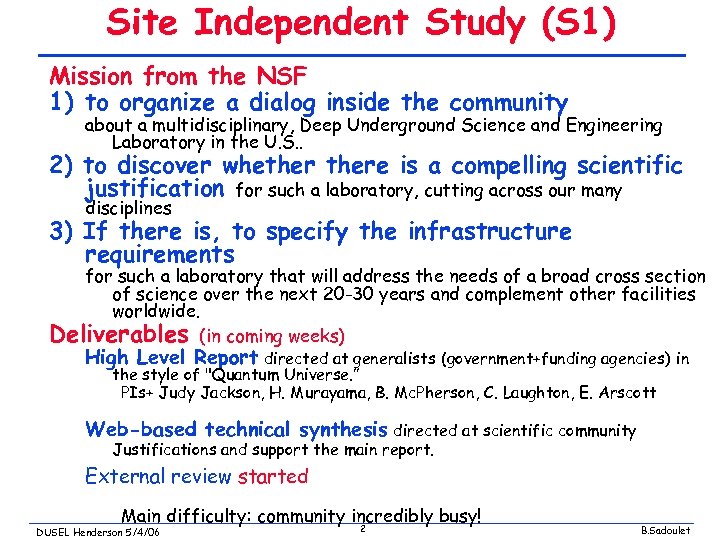
Site Independent Study (S 1) Mission from the NSF 1) to organize a dialog inside the community about a multidisciplinary, Deep Underground Science and Engineering Laboratory in the U. S. . 2) to discover whethere is a compelling scientific justification for such a laboratory, cutting across our many disciplines 3) If there is, to specify the infrastructure requirements for such a laboratory that will address the needs of a broad cross section of science over the next 20 -30 years and complement other facilities worldwide. Deliverables (in coming weeks) High Level Report directed at generalists (government+funding agencies) the style of "Quantum Universe. ” PIs+ Judy Jackson, H. Murayama, B. Mc. Pherson, C. Laughton, E. Arscott in Web-based technical synthesis directed at scientific community Justifications and support the main report. External review started Main difficulty: community incredibly busy! DUSEL Henderson 5/4/06 2 B. Sadoulet
Findings DUSEL Henderson 5/4/06 3 B. Sadoulet
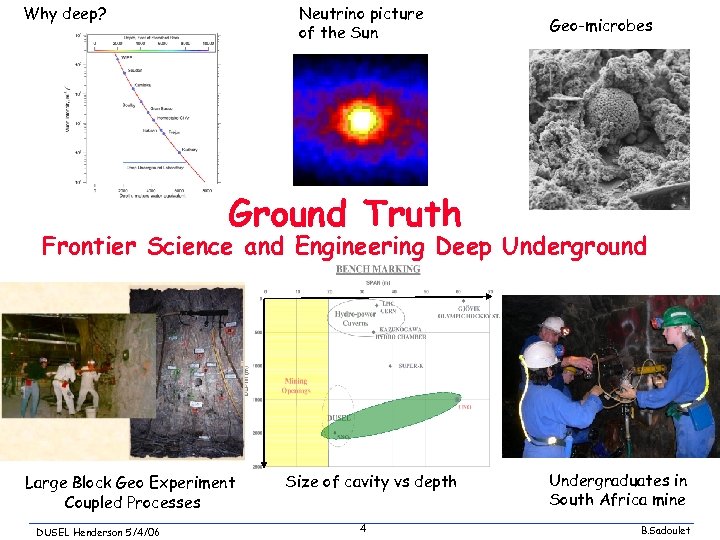
Why deep? Neutrino picture of the Sun Geo-microbes Ground Truth Frontier Science and Engineering Deep Underground Large Block Geo Experiment Coupled Processes DUSEL Henderson 5/4/06 Size of cavity vs depth 4 Undergraduates in South Africa mine B. Sadoulet
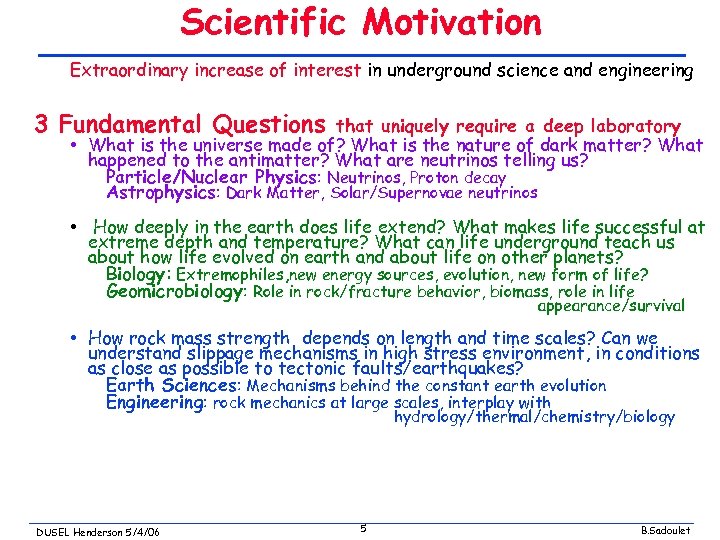
Scientific Motivation Extraordinary increase of interest in underground science and engineering 3 Fundamental Questions that uniquely require a deep laboratory • What is the universe made of? What is the nature of dark matter? What happened to the antimatter? What are neutrinos telling us? Particle/Nuclear Physics: Neutrinos, Proton decay Astrophysics: Dark Matter, Solar/Supernovae neutrinos • How deeply in the earth does life extend? What makes life successful at extreme depth and temperature? What can life underground teach us about how life evolved on earth and about life on other planets? Biology: Extremophiles, new energy sources, evolution, new form of life? Geomicrobiology: Role in rock/fracture behavior, biomass, role in life appearance/survival • How rock mass strength depends on length and time scales? Can we understand slippage mechanisms in high stress environment, in conditions as close as possible to tectonic faults/earthquakes? Earth Sciences: Mechanisms behind the constant earth evolution Engineering: rock mechanics at large scales, interplay with hydrology/thermal/chemistry/biology DUSEL Henderson 5/4/06 5 B. Sadoulet
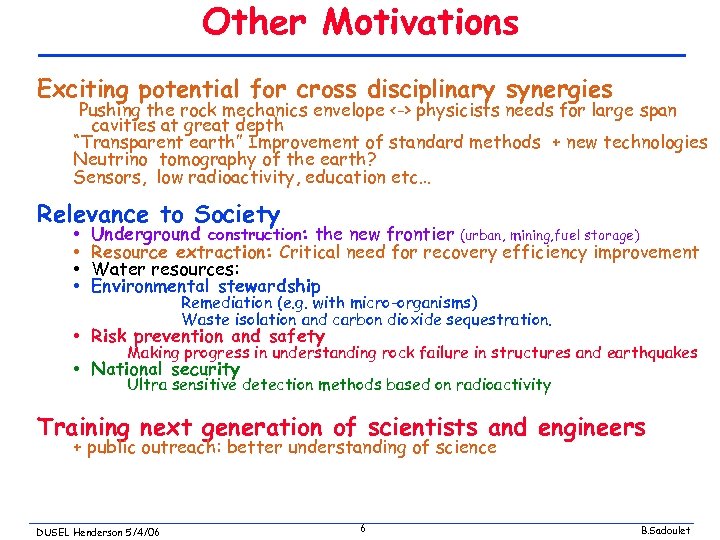
Other Motivations Exciting potential for cross disciplinary synergies Pushing the rock mechanics envelope <-> physicists needs for large span cavities at great depth “Transparent earth” Improvement of standard methods + new technologies Neutrino tomography of the earth? Sensors, low radioactivity, education etc… Relevance to Society • • Underground construction: the new frontier (urban, mining, fuel storage) Resource extraction: Critical need for recovery efficiency improvement Water resources: Environmental stewardship Remediation (e. g. with micro-organisms) Waste isolation and carbon dioxide sequestration. • Risk prevention and safety Making progress in understanding rock failure in structures and earthquakes • National security Ultra sensitive detection methods based on radioactivity Training next generation of scientists and engineers + public outreach: better understanding of science DUSEL Henderson 5/4/06 6 B. Sadoulet
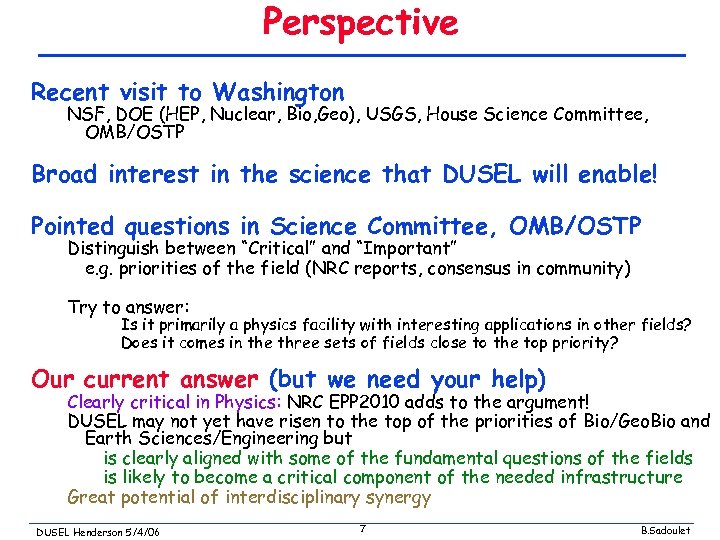
Perspective Recent visit to Washington NSF, DOE (HEP, Nuclear, Bio, Geo), USGS, House Science Committee, OMB/OSTP Broad interest in the science that DUSEL will enable! Pointed questions in Science Committee, OMB/OSTP Distinguish between “Critical” and “Important” e. g. priorities of the field (NRC reports, consensus in community) Try to answer: Is it primarily a physics facility with interesting applications in other fields? Does it comes in the three sets of fields close to the top priority? Our current answer (but we need your help) Clearly critical in Physics: NRC EPP 2010 adds to the argument! DUSEL may not yet have risen to the top of the priorities of Bio/Geo. Bio and Earth Sciences/Engineering but is clearly aligned with some of the fundamental questions of the fields is likely to become a critical component of the needed infrastructure Great potential of interdisciplinary synergy DUSEL Henderson 5/4/06 7 B. Sadoulet
A Physics Example Dark Matter DUSEL Henderson 5/4/06 8 B. Sadoulet
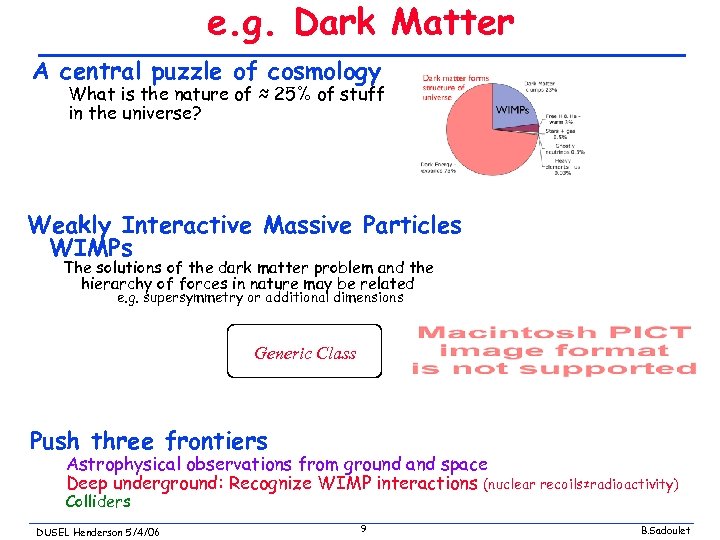
e. g. Dark Matter A central puzzle of cosmology What is the nature of ≈ 25% of stuff in the universe? Weakly Interactive Massive Particles WIMPs The solutions of the dark matter problem and the hierarchy of forces in nature may be related e. g. supersymmetry or additional dimensions Generic Class Push three frontiers Astrophysical observations from ground and space Deep underground: Recognize WIMP interactions (nuclear recoils≠radioactivity) Colliders DUSEL Henderson 5/4/06 9 B. Sadoulet
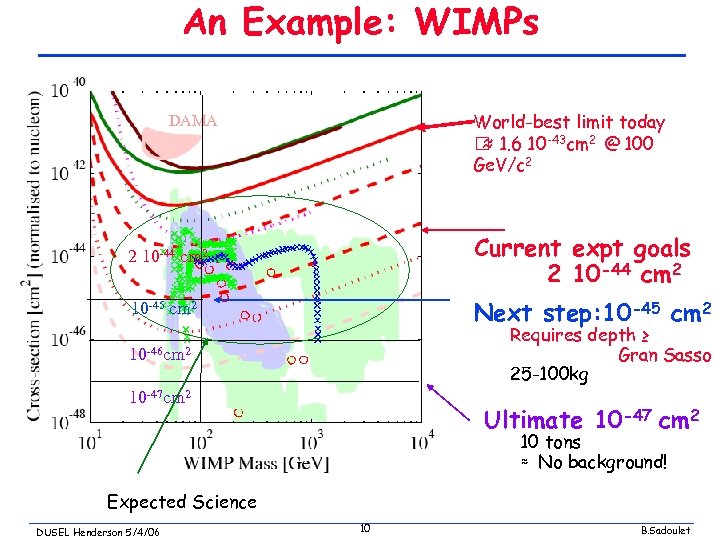
An Example: WIMPs World-best limit today 1. 6 10 -43 cm 2 @ 100 ≈ Ge. V/c 2 DAMA 2 10 -44 cm 2 Current expt goals 2 10 -44 cm 2 10 -45 cm 2 Next step: 10 -45 cm 2 Requires depth ≥ Gran Sasso 25 -100 kg 10 -46 cm 2 10 -47 cm 2 Ultimate 10 -47 cm 2 10 tons ≈ No background! Expected Science DUSEL Henderson 5/4/06 10 B. Sadoulet
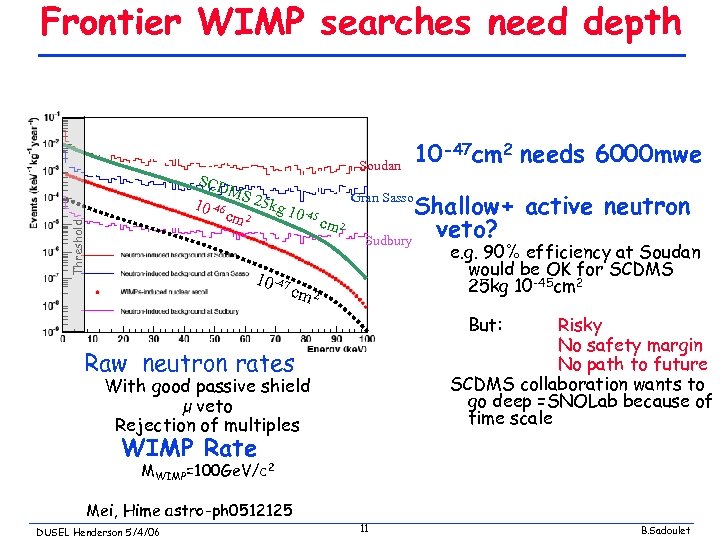
Frontier WIMP searches need depth Soudan 10 -47 cm 2 needs 6000 mwe Threshold SCD MS Gran Sasso 25 kg 10 -46 Shallow+ 10 -45 cm 2 Sudbury 10 -47 cm 2 veto? active neutron e. g. 90% efficiency at Soudan would be OK for SCDMS 25 kg 10 -45 cm 2 But: Risky No safety margin No path to future SCDMS collaboration wants to go deep =SNOLab because of time scale Raw neutron rates With good passive shield µ veto Rejection of multiples WIMP Rate MWIMP=100 Ge. V/c 2 Mei, Hime astro-ph 0512125 DUSEL Henderson 5/4/06 11 B. Sadoulet
Deep Biology Dark Life Of course, I am not a biologist… DUSEL Henderson 5/4/06 12 B. Sadoulet
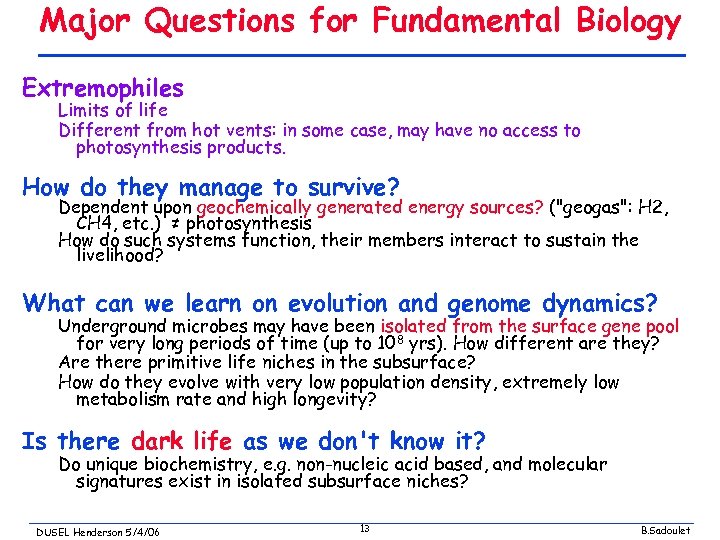
Major Questions for Fundamental Biology Extremophiles Limits of life Different from hot vents: in some case, may have no access to photosynthesis products. How do they manage to survive? Dependent upon geochemically generated energy sources? ("geogas": H 2, CH 4, etc. ) ≠ photosynthesis How do such systems function, their members interact to sustain the livelihood? What can we learn on evolution and genome dynamics? Underground microbes may have been isolated from the surface gene pool for very long periods of time (up to 108 yrs). How different are they? Are there primitive life niches in the subsurface? How do they evolve with very low population density, extremely low metabolism rate and high longevity? Is there dark life as we don't know it? Do unique biochemistry, e. g. non-nucleic acid based, and molecular signatures exist in isolated subsurface niches? DUSEL Henderson 5/4/06 13 B. Sadoulet
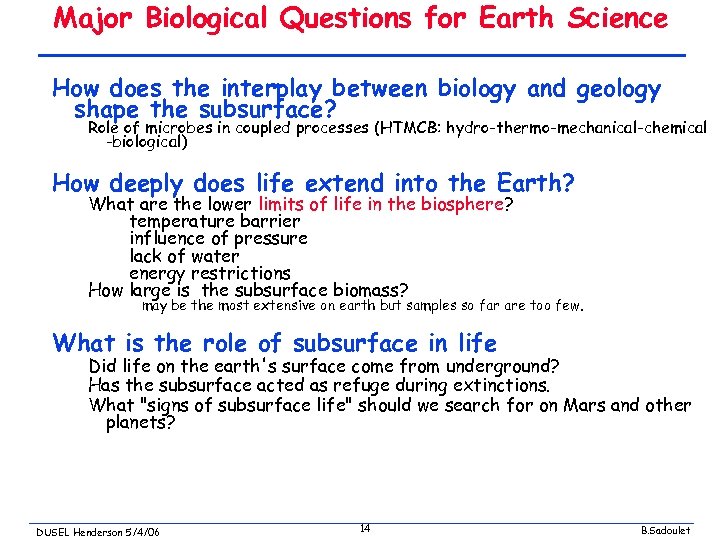
Major Biological Questions for Earth Science How does the interplay between biology and geology shape the subsurface? Role of microbes in coupled processes (HTMCB: hydro-thermo-mechanical-chemical -biological) How deeply does life extend into the Earth? What are the lower limits of life in the biosphere? temperature barrier influence of pressure lack of water energy restrictions How large is the subsurface biomass? may be the most extensive on earth but samples so far are too few. What is the role of subsurface in life Did life on the earth's surface come from underground? Has the subsurface acted as refuge during extinctions. What "signs of subsurface life" should we search for on Mars and other planets? DUSEL Henderson 5/4/06 14 B. Sadoulet
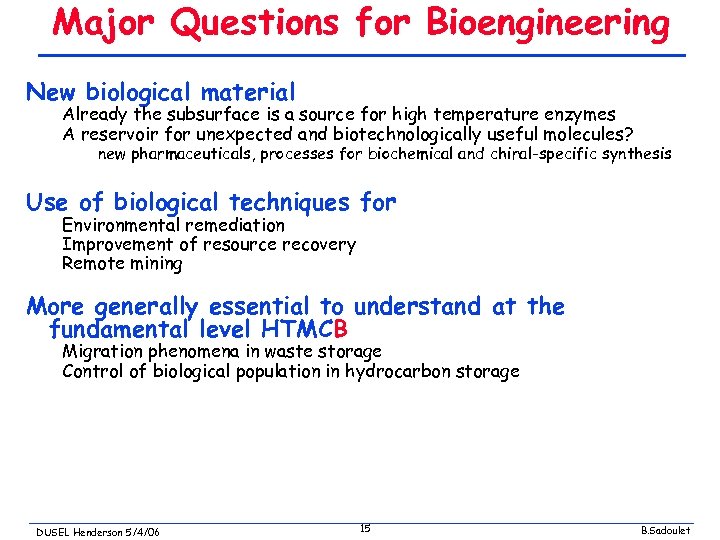
Major Questions for Bioengineering New biological material Already the subsurface is a source for high temperature enzymes A reservoir for unexpected and biotechnologically useful molecules? new pharmaceuticals, processes for biochemical and chiral-specific synthesis Use of biological techniques for Environmental remediation Improvement of resource recovery Remote mining More generally essential to understand at the fundamental level HTMCB Migration phenomena in waste storage Control of biological population in hydrocarbon storage DUSEL Henderson 5/4/06 15 B. Sadoulet
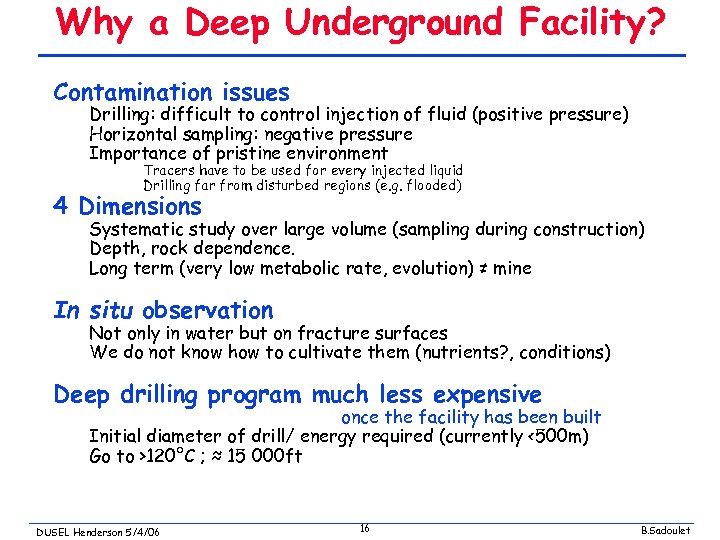
Why a Deep Underground Facility? Contamination issues Drilling: difficult to control injection of fluid (positive pressure) Horizontal sampling: negative pressure Importance of pristine environment Tracers have to be used for every injected liquid Drilling far from disturbed regions (e. g. flooded) 4 Dimensions Systematic study over large volume (sampling during construction) Depth, rock dependence. Long term (very low metabolic rate, evolution) ≠ mine In situ observation Not only in water but on fracture surfaces We do not know how to cultivate them (nutrients? , conditions) Deep drilling program much less expensive once the facility has been built Initial diameter of drill/ energy required (currently <500 m) Go to >120°C ; ≈ 15 000 ft DUSEL Henderson 5/4/06 16 B. Sadoulet
Findings (Continued) DUSEL Henderson 5/4/06 17 B. Sadoulet
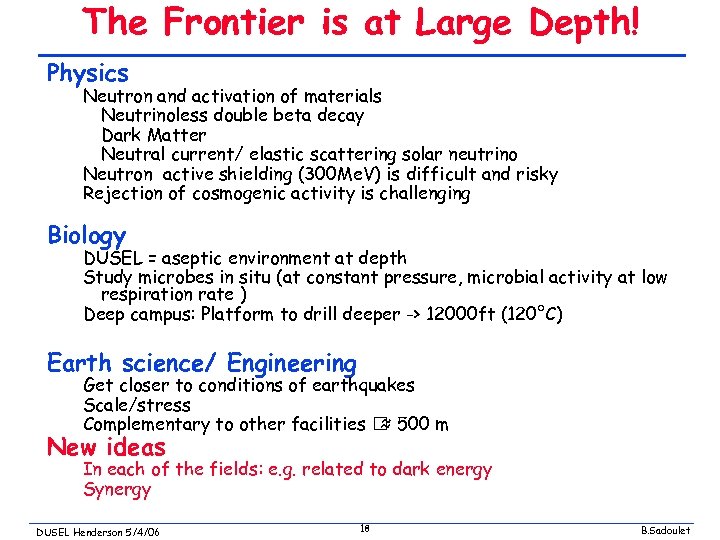
The Frontier is at Large Depth! Physics Neutron and activation of materials Neutrinoless double beta decay Dark Matter Neutral current/ elastic scattering solar neutrino Neutron active shielding (300 Me. V) is difficult and risky Rejection of cosmogenic activity is challenging Biology DUSEL = aseptic environment at depth Study microbes in situ (at constant pressure, microbial activity at low respiration rate ) Deep campus: Platform to drill deeper -> 12000 ft (120°C) Earth science/ Engineering Get closer to conditions of earthquakes Scale/stress Complementary to other facilities 500 m ≈ New ideas In each of the fields: e. g. related to dark energy Synergy DUSEL Henderson 5/4/06 18 B. Sadoulet
Motivations for a National Facility Although Science is international in nature U. S. scientists and engineers managed to play a pioneering role without a dedicated U. S. deep underground laboratory There is no substitute for a premier national facility with unique characteristics Push frontier science Strategic advantage for U. S. scientists and engineers in the : • Rapid exploration of new ideas, and unexpected phenomena • Full exploitation of existing national assets, such as accelerators. • Maximization of the program's impact on our society U. S. one of the only G 8 nations without national facility DUSEL Henderson 5/4/06 19 B. Sadoulet
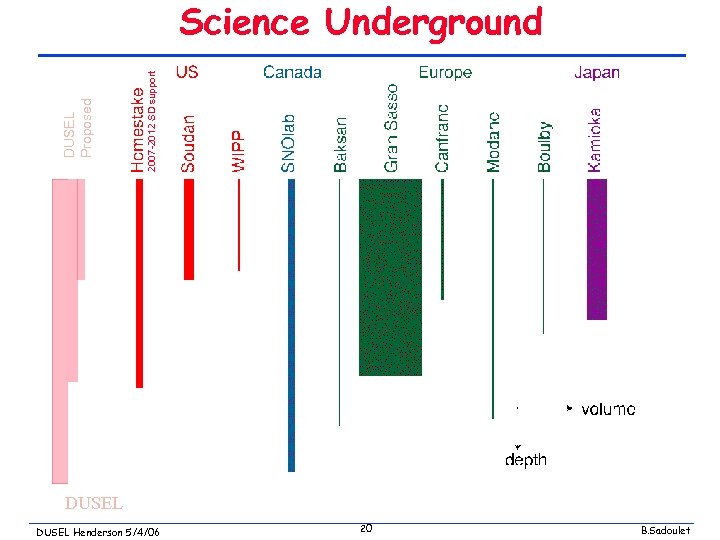
2007 -2012 SD support DUSEL Proposed Science Underground DUSEL Henderson 5/4/06 20 B. Sadoulet
Need for New Underground Facilities Chronic Oversubscription Worldwide Historically True! Only exception: currently Gran Sasso as ICARUS won’t be expanded above 600 tons Increase in the community Importance/interest of the science: neutrinos, cosmology Shift from accelerator based experiments Fast progress at boundaries between fields DUSEL Henderson 5/4/06 21 B. Sadoulet
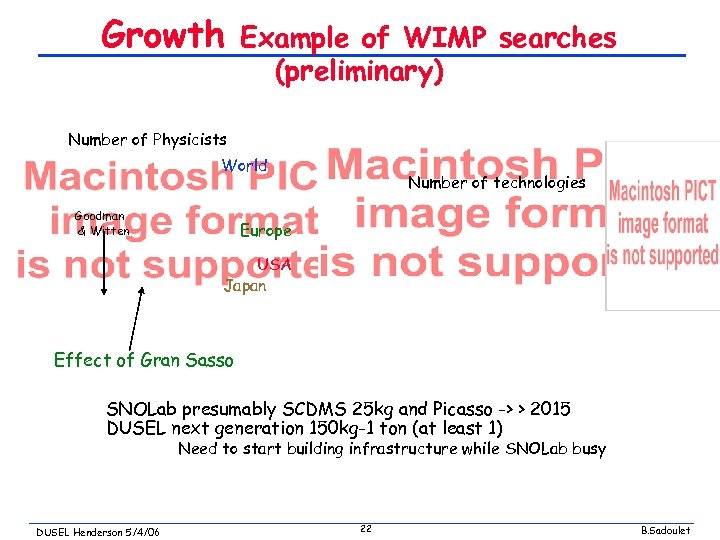
Growth Example of WIMP searches (preliminary) Number of Physicists World Goodman & Witten Number of technologies Europe USA Japan Effect of Gran Sasso SNOLab presumably SCDMS 25 kg and Picasso -> > 2015 DUSEL next generation 150 kg-1 ton (at least 1) Need to start building infrastructure while SNOLab busy DUSEL Henderson 5/4/06 22 B. Sadoulet
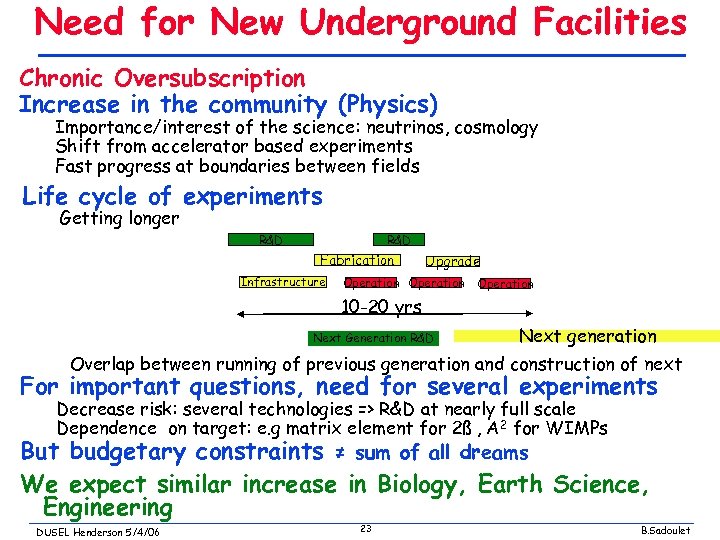
Need for New Underground Facilities Chronic Oversubscription Increase in the community (Physics) Importance/interest of the science: neutrinos, cosmology Shift from accelerator based experiments Fast progress at boundaries between fields Life cycle of experiments Getting longer R&D Fabrication Infrastructure Upgrade Operation 10 -20 yrs Next Generation R&D Next generation Overlap between running of previous generation and construction of next For important questions, need for several experiments Decrease risk: several technologies => R&D at nearly full scale Dependence on target: e. g matrix element for 2ß , A 2 for WIMPs But budgetary constraints ≠ sum of all dreams We expect similar increase in Biology, Earth Science, Engineering DUSEL Henderson 5/4/06 23 B. Sadoulet
Recommendations DUSEL Henderson 5/4/06 24 B. Sadoulet
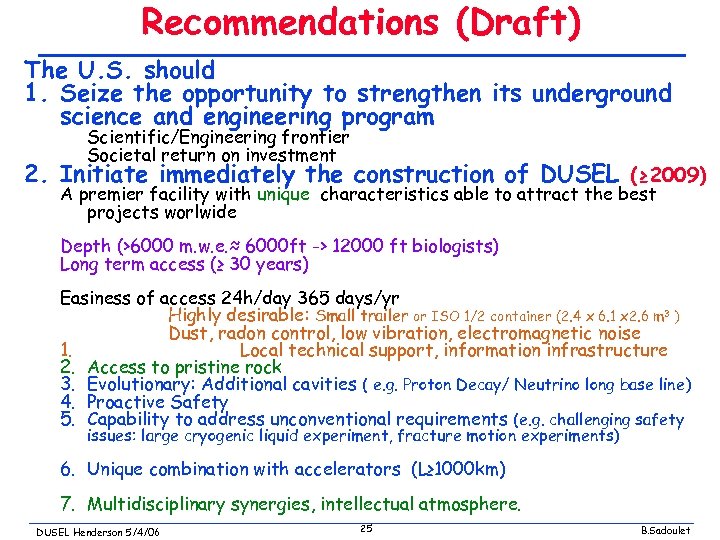
Recommendations (Draft) The U. S. should 1. Seize the opportunity to strengthen its underground science and engineering program Scientific/Engineering frontier Societal return on investment 2. Initiate immediately the construction of DUSEL (≥ 2009) A premier facility with unique characteristics able to attract the best projects worlwide Depth (>6000 m. w. e. ≈ 6000 ft -> 12000 ft biologists) Long term access (≥ 30 years) Easiness of access 24 h/day 365 days/yr Highly desirable: Small trailer or ISO 1/2 container (2. 4 x 6. 1 x 2. 6 m 3 ) Dust, radon control, low vibration, electromagnetic noise 1. Local technical support, information infrastructure 2. Access to pristine rock 3. Evolutionary: Additional cavities ( e. g. Proton Decay/ Neutrino long base line) 4. Proactive Safety 5. Capability to address unconventional requirements (e. g. challenging safety issues: large cryogenic liquid experiment, fracture motion experiments) 6. Unique combination with accelerators (L≥ 1000 km) 7. Multidisciplinary synergies, intellectual atmosphere. DUSEL Henderson 5/4/06 25 B. Sadoulet
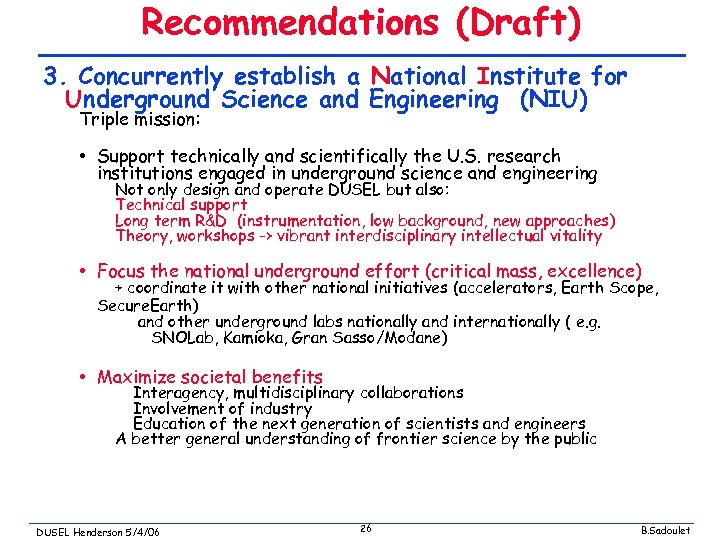
Recommendations (Draft) 3. Concurrently establish a National Institute for Underground Science and Engineering (NIU) Triple mission: • Support technically and scientifically the U. S. research institutions engaged in underground science and engineering Not only design and operate DUSEL but also: Technical support Long term R&D (instrumentation, low background, new approaches) Theory, workshops -> vibrant interdisciplinary intellectual vitality • Focus the national underground effort (critical mass, excellence) + coordinate it with other national initiatives (accelerators, Earth Scope, Secure. Earth) and other underground labs nationally and internationally ( e. g. SNOLab, Kamioka, Gran Sasso/Modane) • Maximize societal benefits Interagency, multidisciplinary collaborations Involvement of industry Education of the next generation of scientists and engineers A better general understanding of frontier science by the public DUSEL Henderson 5/4/06 26 B. Sadoulet
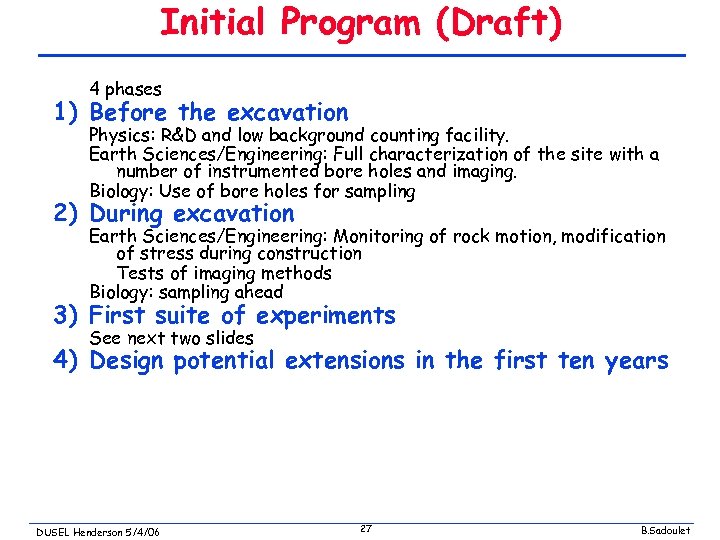
Initial Program (Draft) 4 phases 1) Before the excavation Physics: R&D and low background counting facility. Earth Sciences/Engineering: Full characterization of the site with a number of instrumented bore holes and imaging. Biology: Use of bore holes for sampling 2) During excavation Earth Sciences/Engineering: Monitoring of rock motion, modification of stress during construction Tests of imaging methods Biology: sampling ahead 3) First suite of experiments See next two slides 4) Design potential extensions in the first ten years DUSEL Henderson 5/4/06 27 B. Sadoulet
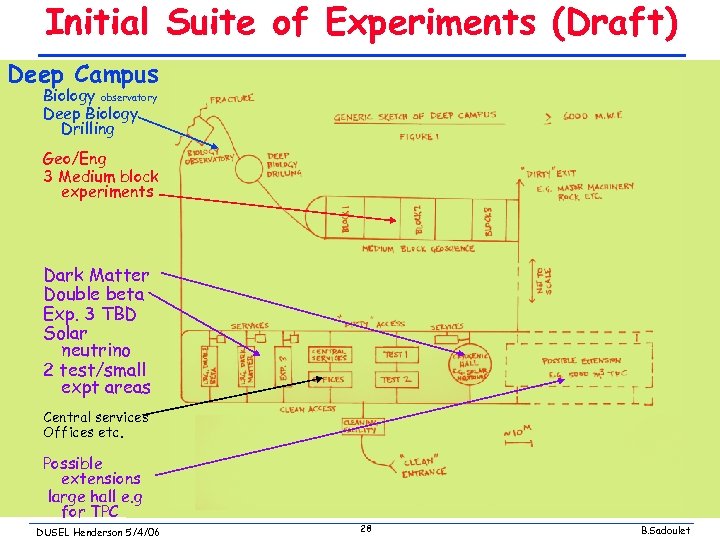
Initial Suite of Experiments (Draft) Deep Campus Biology observatory Deep Biology Drilling Geo/Eng 3 Medium block experiments Dark Matter Double beta Exp. 3 TBD Solar neutrino 2 test/small expt areas Central services Offices etc. Possible extensions large hall e. g for TPC DUSEL Henderson 5/4/06 28 B. Sadoulet
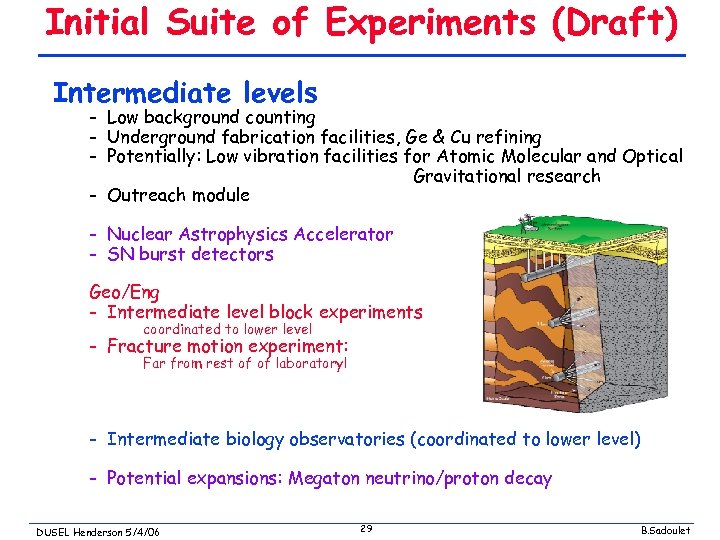
Initial Suite of Experiments (Draft) Intermediate levels - Low background counting - Underground fabrication facilities, Ge & Cu refining - Potentially: Low vibration facilities for Atomic Molecular and Optical Gravitational research - Outreach module - Nuclear Astrophysics Accelerator - SN burst detectors Geo/Eng - Intermediate level block experiments coordinated to lower level - Fracture motion experiment: Far from rest of of laboratory! - Intermediate biology observatories (coordinated to lower level) - Potential expansions: Megaton neutrino/proton decay DUSEL Henderson 5/4/06 29 B. Sadoulet
The Right Strategy? DUSEL Henderson 5/4/06 30 B. Sadoulet
Can we afford DUSEL? MREFC line Covers Facility + NSF contribution to first suite of experiments (NSF-DOE working group) =Line item Strategy is to involve Geo/Bio/Eng to secure place in MRE queue Initially bring new resources to all communities Long term costs Cost of operation will be eventually borne in part by the fields • National Institute: a question of priority to underground research • Facility operation and safety: potentially important discriminant was context Water pumping, hoist operation, maintenance of horizontal • Easiness of access /vertical access Installation (e. g. 100 -200 man-yrs of SNO, small experiments) debate Emergency interventions, maintenance Impact on future projects: Although multidisciplinary, MRE would be seen as Physics possibly impacting other NSF initiatives But: different scale from ILC enabling possible extensions e. g. Proton Decay/Long Baseline neutrino detector DUSEL Henderson 5/4/06 31 B. Sadoulet
Comparison with Other Strategies Expansion of SNOLab Limits of cooperation of INCO Not everything needs to be deep Not suitable for multidisciplinary enterprise Strong reduction of benefits to U. S. A shallow site + SNOLab + subsequent deepening e. g. Soudan (existing v beam) + SNOLab Pioneer tunnel (already dug) + SNOLab 2000 m. w. e. indeed suitable for a number of experiments (automatic in most facility) But attempting to perform frontier experiments at lower depth with shielding because of lack of space is risky (when given the choice teams choose depth) only a temporary stop-gap Lack of space may inhibit rapid exploration of new ideas A subsequent extension is not well adapted to MREFC structure Sequential approach delays a frontier facility DUSEL Henderson 5/4/06 32 B. Sadoulet
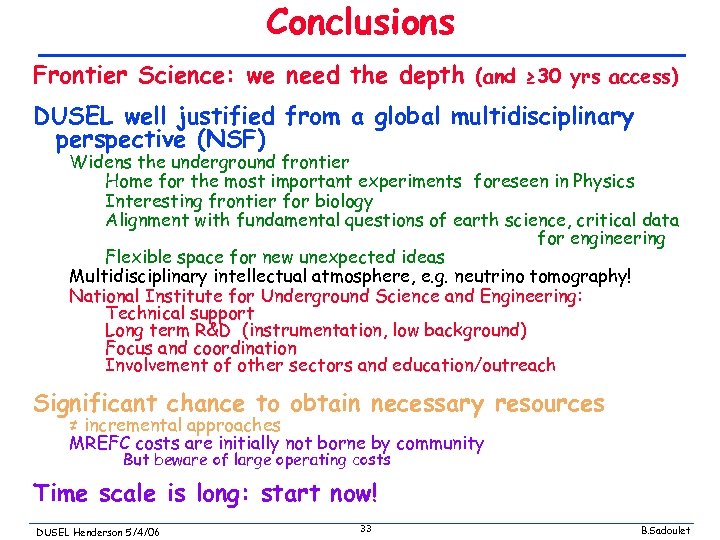
Conclusions Frontier Science: we need the depth (and ≥ 30 yrs access) DUSEL well justified from a global multidisciplinary perspective (NSF) Widens the underground frontier Home for the most important experiments foreseen in Physics Interesting frontier for biology Alignment with fundamental questions of earth science, critical data for engineering Flexible space for new unexpected ideas Multidisciplinary intellectual atmosphere, e. g. neutrino tomography! National Institute for Underground Science and Engineering: Technical support Long term R&D (instrumentation, low background) Focus and coordination Involvement of other sectors and education/outreach Significant chance to obtain necessary resources ≠ incremental approaches MREFC costs are initially not borne by community But beware of large operating costs Time scale is long: start now! DUSEL Henderson 5/4/06 33 B. Sadoulet
Скачать презентацию Bernard Sadoulet Dept of Physics LBNL UC Berkeley
a30ba6372d088e523e1ac385ef8490aa.ppt