 Скачать презентацию Benchmarking of Transactions with DEA 20 presminutes enta
2620bdfd06455d66d7b75096bb388d79.ppt
- Количество слайдов: 14



Benchmarking of Transactions with DEA: 20 presminutes enta tion Analyses on Process Level at the Example of a Banking Process Andreas Burger a. burger@frankfurt-school. de Jürgen Moormann j. moormann@frankfurt-school. de ©Frankfurt–School. de
Agenda 1. 1 2. 2 3. 3 4. 4 5. 5 6. 6 7. 7 Introduction Research positioning / contribution Definitions Methodology Case study Results Conclusion ©Frankfurt–School. de 7 th Int. Conf. on DEA, Conference Presentation, Philadelphia, PA, 11. 07. 2009 2
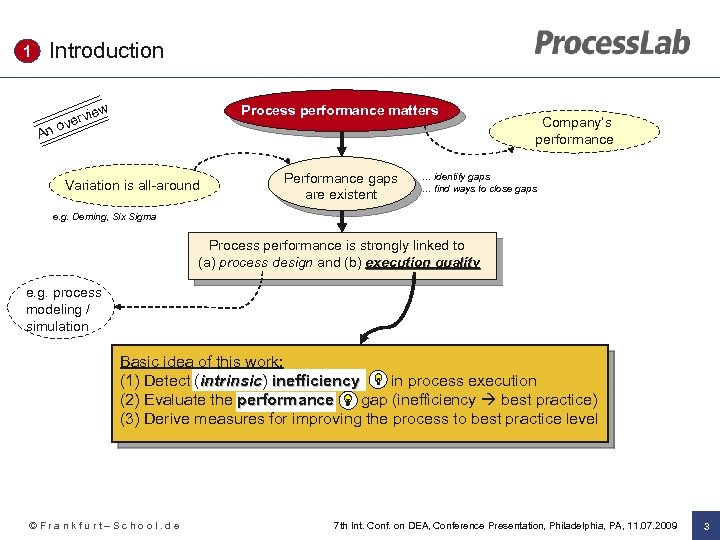
1 Introduction w An Process performance matters rvie ove Variation is all-around Performance gaps are existent Company’s performance … identify gaps … find ways to close gaps e. g. Deming, Six Sigma Process performance is strongly linked to (a) process design and (b) execution quality e. g. process modeling / simulation Basic idea of this work: (1) Detect (intrinsic) inefficiency in process execution intrinsic (2) Evaluate the performance gap (inefficiency best practice) (3) Derive measures for improving the process to best practice level ©Frankfurt–School. de 7 th Int. Conf. on DEA, Conference Presentation, Philadelphia, PA, 11. 07. 2009 3
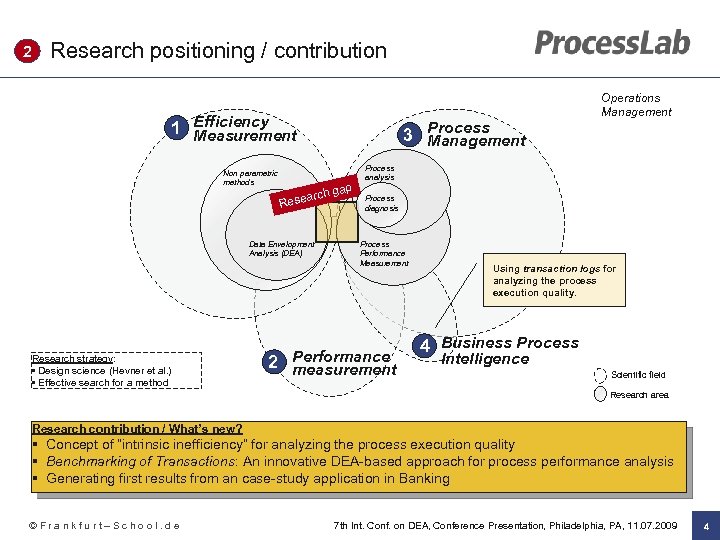
2 Research positioning / contribution 1 Efficiency Measurement Non parametric methods 3 Process Management Data Envelopment Analysis (DEA) Research strategy: • Design science (Hevner et al. ) • Effective search for a method ap arch g Rese Operations Management Process analysis Process diagnosis Process Performance Measurement 2 Performance measurement Using transaction logs for analyzing the process execution quality. 4 Business Process Intelligence Scientific field Research area Research contribution / What’s new? § Concept of “intrinsic inefficiency” for analyzing the process execution quality § Benchmarking of Transactions: An innovative DEA-based approach for process performance analysis § Generating first results from an case-study application in Banking ©Frankfurt–School. de 7 th Int. Conf. on DEA, Conference Presentation, Philadelphia, PA, 11. 07. 2009 4
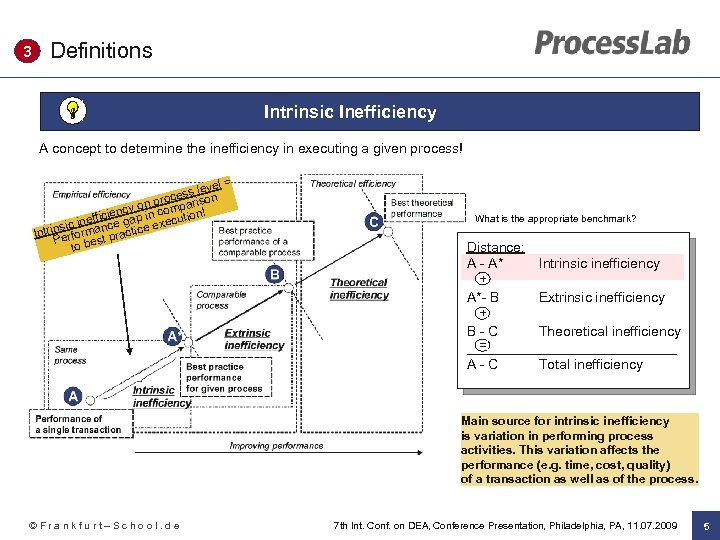
3 Definitions Intrinsic Inefficiency A concept to determine the inefficiency in executing a given process! vel ss le roce arison p y on mp cienc ap in co cution! effi e g exe sic in nc Intrin erforma t practice P s to be = What is the appropriate benchmark? Distance: A - A* Intrinsic inefficiency + A*- B Extrinsic inefficiency + B-C Theoretical inefficiency = ______________ A-C Total inefficiency Main source for intrinsic inefficiency is variation in performing process activities. This variation affects the performance (e. g. time, cost, quality) of a transaction as well as of the process. ©Frankfurt–School. de 7 th Int. Conf. on DEA, Conference Presentation, Philadelphia, PA, 11. 07. 2009 5
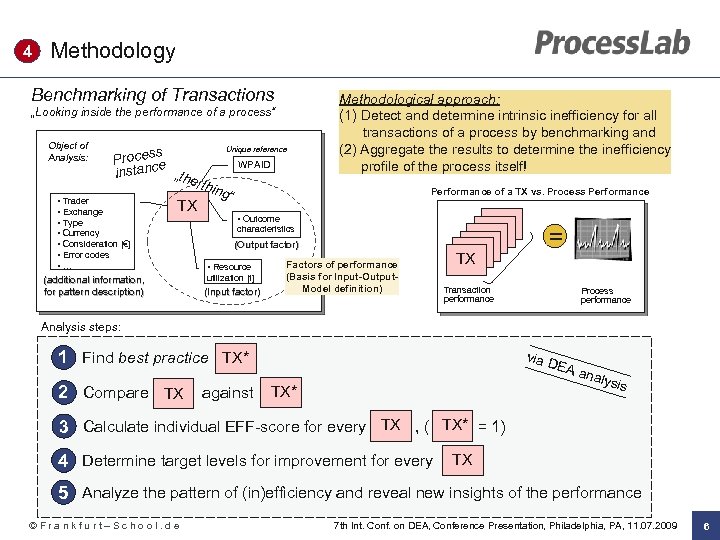
4 Methodology Benchmarking of Transactions „Looking inside the performance of a process“ Object of Analysis: Unique reference rocess P WPAID e instanc „the thin g“ • Trader • Exchange • Type • Currency • Consideration [€] • Error codes • … TX (additional information, for pattern description) Methodological approach: (1) Detect and determine intrinsic inefficiency for all transactions of a process by benchmarking and (2) Aggregate the results to determine the inefficiency profile of the process itself! Performance of a TX vs. Process Performance • Outcome characteristics (Output factor) • Resource utilization [t] (Input factor) Factors of performance (Basis for Input-Output. Model definition) TX = Transaction performance Process performance Analysis steps: 1 Find best practice TX* via D EA a 2 Compare TX against TX* naly sis 3 Calculate individual EFF-score for every TX , ( TX* = 1) 4 Determine target levels for improvement for every TX 5 Analyze the pattern of (in)efficiency and reveal new insights of the performance ©Frankfurt–School. de 7 th Int. Conf. on DEA, Conference Presentation, Philadelphia, PA, 11. 07. 2009 6
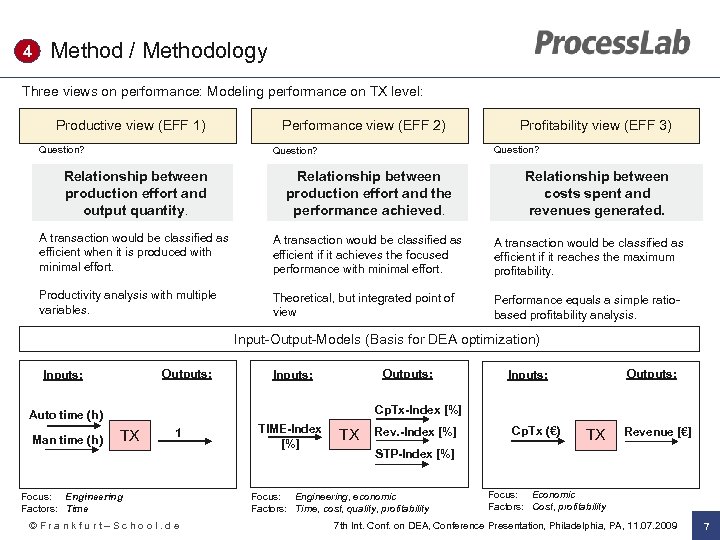
4 Method / Methodology Three views on performance: Modeling performance on TX level: Productive view (EFF 1) Question? Performance view (EFF 2) Profitability view (EFF 3) Question? Relationship between production effort and output quantity. Relationship between production effort and the performance achieved. Relationship between costs spent and revenues generated. A transaction would be classified as efficient when it is produced with minimal effort. A transaction would be classified as efficient if it achieves the focused performance with minimal effort. A transaction would be classified as efficient if it reaches the maximum profitability. Productivity analysis with multiple variables. Theoretical, but integrated point of view Performance equals a simple ratiobased profitability analysis. Input-Output-Models (Basis for DEA optimization) Outputs: Inputs: Cp. Tx-Index [%] Auto time (h) Man time (h) Outputs: Inputs: TX 1 Focus: Engineering Factors: Time ©Frankfurt–School. de TIME-Index [%] TX Rev. -Index [%] Cp. Tx (€) TX Revenue [€] STP-Index [%] Focus: Engineering, economic Factors: Time, cost, quality, profitability Focus: Economic Factors: Cost, profitability 7 th Int. Conf. on DEA, Conference Presentation, Philadelphia, PA, 11. 07. 2009 7
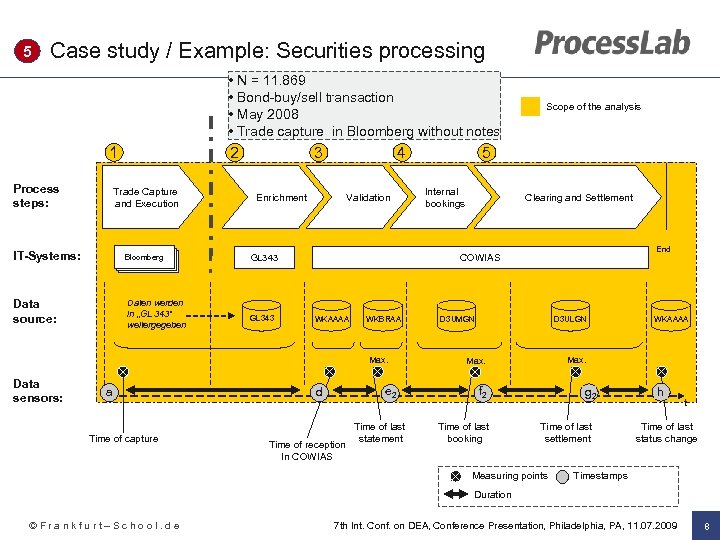
5 Case study / Example: Securities processing • N = 11. 869 • Bond-buy/sell transaction • May 2008 • Trade capture in Bloomberg without notes 1 Process steps: 2 Trade Capture and Execution IT-Systems: Bloomberg Data source: Daten werden in „GL 343“ weitergegeben 3 4 Enrichment Validation WKAAAA WKBRAA Max. Data sensors: a Time of capture 5 Internal bookings Clearing and Settlement End COWIAS GL 343 Scope of the analysis e 2 d Time of reception In COWIAS Time of last statement D 3 ULGN D 3 UMGN Max. f 2 Time of last booking WKAAAA g 2 Time of last settlement Measuring points h t Time of last status change Timestamps Duration ©Frankfurt–School. de 7 th Int. Conf. on DEA, Conference Presentation, Philadelphia, PA, 11. 07. 2009 8
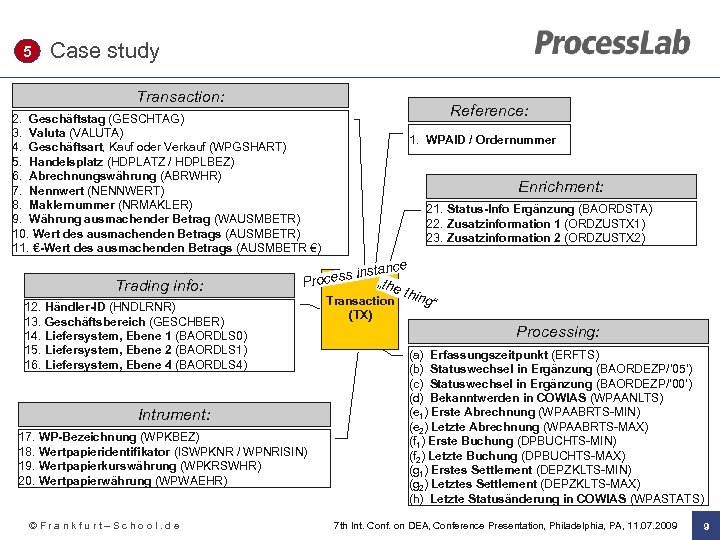
5 Case study Transaction: Reference: 2. Geschäftstag (GESCHTAG) 3. Valuta (VALUTA) 4. Geschäftsart, Kauf oder Verkauf (WPGSHART) 5. Handelsplatz (HDPLATZ / HDPLBEZ) 6. Abrechnungswährung (ABRWHR) 7. Nennwert (NENNWERT) 8. Maklernummer (NRMAKLER) 9. Währung ausmachender Betrag (WAUSMBETR) 10. Wert des ausmachenden Betrags (AUSMBETR) 11. €-Wert des ausmachenden Betrags (AUSMBETR €) Trading info: 12. Händler-ID (HNDLRNR) 13. Geschäftsbereich (GESCHBER) 14. Liefersystem, Ebene 1 (BAORDLS 0) 15. Liefersystem, Ebene 2 (BAORDLS 1) 16. Liefersystem, Ebene 4 (BAORDLS 4) Enrichment: 21. Status-Info Ergänzung (BAORDSTA) 22. Zusatzinformation 1 (ORDZUSTX 1) 23. Zusatzinformation 2 (ORDZUSTX 2) stance cess in „th Pro e th Intrument: 17. WP-Bezeichnung (WPKBEZ) 18. Wertpapieridentifikator (ISWPKNR / WPNRISIN) 19. Wertpapierkurswährung (WPKRSWHR) 20. Wertpapierwährung (WPWAEHR) ©Frankfurt–School. de 1. WPAID / Ordernummer Transaction (TX) ing“ Processing: (a) Erfassungszeitpunkt (ERFTS) (b) Statuswechsel in Ergänzung (BAORDEZP/’ 05’) (c) Statuswechsel in Ergänzung (BAORDEZP/’ 00‘) (d) Bekanntwerden in COWIAS (WPAANLTS) (e 1) Erste Abrechnung (WPAABRTS-MIN) (e 2) Letzte Abrechnung (WPAABRTS-MAX) (f 1) Erste Buchung (DPBUCHTS-MIN) (f 2) Letzte Buchung (DPBUCHTS-MAX) (g 1) Erstes Settlement (DEPZKLTS-MIN) (g 2) Letztes Settlement (DEPZKLTS-MAX) (h) Letzte Statusänderung in COWIAS (WPASTATS) 7 th Int. Conf. on DEA, Conference Presentation, Philadelphia, PA, 11. 07. 2009 9
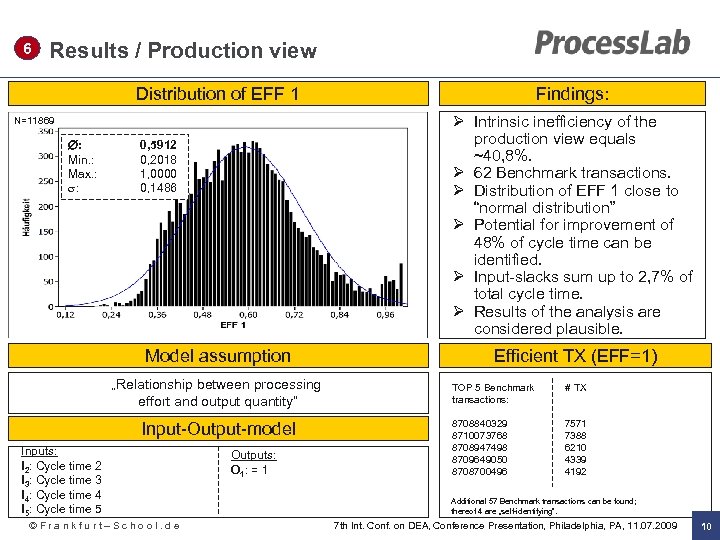
6 Results / Production view Distribution of EFF 1 Ø Intrinsic inefficiency of the production view equals ~40, 8%. Ø 62 Benchmark transactions. Ø Distribution of EFF 1 close to “normal distribution” Ø Potential for improvement of 48% of cycle time can be identified. Ø Input-slacks sum up to 2, 7% of total cycle time. Ø Results of the analysis are considered plausible. N=11869 : Min. : Max. : : 0, 5912 0, 2018 1, 0000 0, 1486 Model assumption „Relationship between processing effort and output quantity“ Input-Output-model Inputs: I 2: Cycle time 2 I 3: Cycle time 3 I 4: Cycle time 4 I 5: Cycle time 5 ©Frankfurt–School. de Findings: Outputs: O 1: = 1 Efficient TX (EFF=1) TOP 5 Benchmark transactions: # TX 8708840329 8710073768 8708947498 8709649050 8708700496 7571 7388 6210 4339 4192 Additional 57 Benchmark transactions can be found; thereof 4 are „self-identifying“. 7 th Int. Conf. on DEA, Conference Presentation, Philadelphia, PA, 11. 07. 2009 10
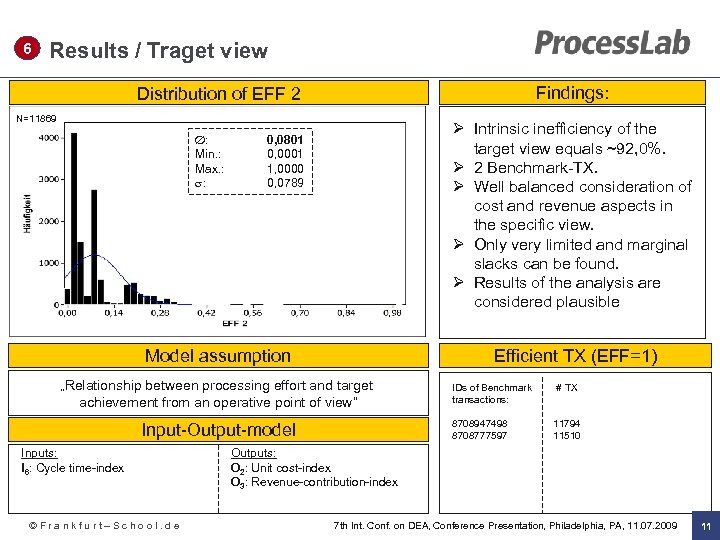
6 Results / Traget view Findings: Distribution of EFF 2 N=11869 : Min. : Max. : : Ø Intrinsic inefficiency of the target view equals ~92, 0%. Ø 2 Benchmark-TX. Ø Well balanced consideration of cost and revenue aspects in the specific view. Ø Only very limited and marginal slacks can be found. Ø Results of the analysis are considered plausible 0, 0801 0, 0001 1, 0000 0, 0789 Model assumption Efficient TX (EFF=1) „Relationship between processing effort and target achievement from an operative point of view“ 8708947498 8708777597 Input-Output-model Inputs: I 6: Cycle time-index ©Frankfurt–School. de IDs of Benchmark transactions: # TX 11794 11510 Outputs: O 2: Unit cost-index O 3: Revenue-contribution-index 7 th Int. Conf. on DEA, Conference Presentation, Philadelphia, PA, 11. 07. 2009 11
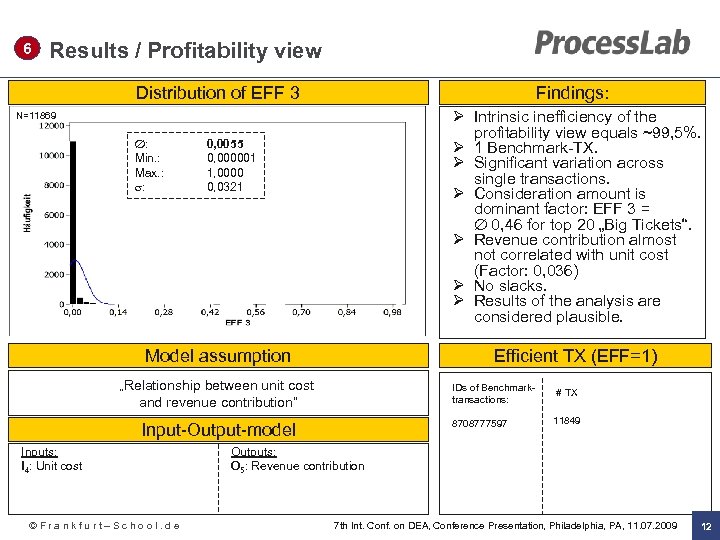
6 Results / Profitability view Distribution of EFF 3 Findings: Ø Intrinsic inefficiency of the profitability view equals ~99, 5%. Ø 1 Benchmark-TX. Ø Significant variation across single transactions. Ø Consideration amount is dominant factor: EFF 3 = 0, 46 for top 20 „Big Tickets“. Ø Revenue contribution almost not correlated with unit cost (Factor: 0, 036) Ø No slacks. Ø Results of the analysis are considered plausible. N=11869 : Min. : Max. : : 0, 0055 0, 000001 1, 0000 0, 0321 Model assumption Efficient TX (EFF=1) „Relationship between unit cost and revenue contribution“ IDs of Benchmarktransactions: 8708777597 Input-Output-model Inputs: I 4: Unit cost ©Frankfurt–School. de # TX 11849 Outputs: O 5: Revenue contribution 7 th Int. Conf. on DEA, Conference Presentation, Philadelphia, PA, 11. 07. 2009 12
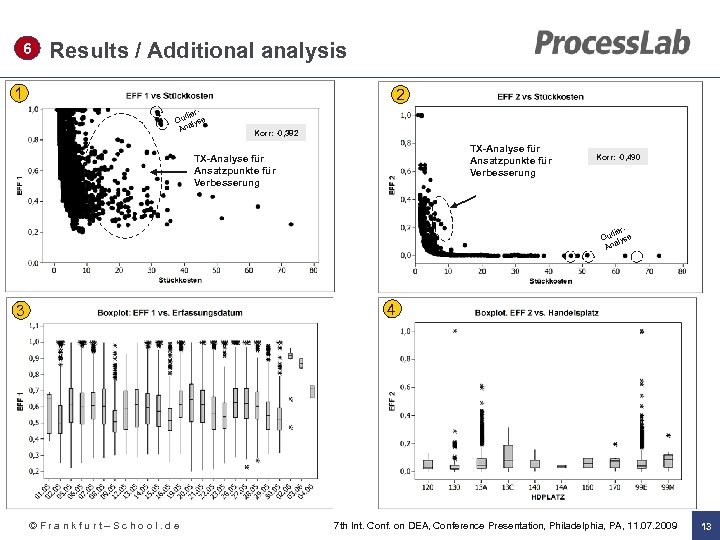
6 Results / Additional analysis 1 2 rtlie Ou lyse Ana Korr: -0, 382 TX-Analyse für Ansatzpunkte für Verbesserung Korr: -0, 490 rtlie Ou lyse Ana 4 3 ©Frankfurt–School. de 7 th Int. Conf. on DEA, Conference Presentation, Philadelphia, PA, 11. 07. 2009 13
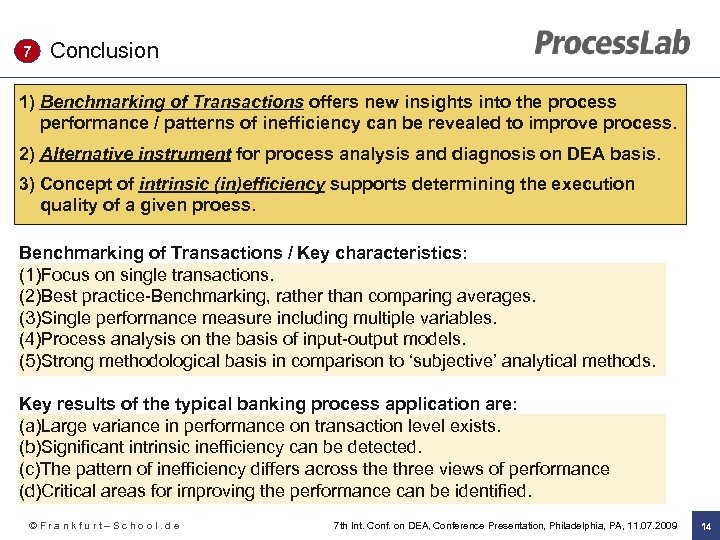
7 Conclusion 1) Benchmarking of Transactions offers new insights into the process performance / patterns of inefficiency can be revealed to improve process. 2) Alternative instrument for process analysis and diagnosis on DEA basis. 3) Concept of intrinsic (in)efficiency supports determining the execution quality of a given proess. Benchmarking of Transactions / Key characteristics: (1)Focus on single transactions. (2)Best practice-Benchmarking, rather than comparing averages. (3)Single performance measure including multiple variables. (4)Process analysis on the basis of input-output models. (5)Strong methodological basis in comparison to ‘subjective’ analytical methods. Key results of the typical banking process application are: (a)Large variance in performance on transaction level exists. (b)Significant intrinsic inefficiency can be detected. (c)The pattern of inefficiency differs across the three views of performance (d)Critical areas for improving the performance can be identified. ©Frankfurt–School. de 7 th Int. Conf. on DEA, Conference Presentation, Philadelphia, PA, 11. 07. 2009 14
Скачать презентацию Benchmarking of Transactions with DEA 20 presminutes enta
2620bdfd06455d66d7b75096bb388d79.ppt