 Скачать презентацию Ben Gurion University The VENμS mission Earth Observation
109fc8743206f93e6e2533ad0d6ef571.ppt
- Количество слайдов: 19



Ben Gurion University The VENμS mission: Earth Observation with High Spatial and Temporal Resolution Capabilities G. Dedieu 1, O. Hagolle 2, A. Karnieli 3, S. Cherchali 2 P. Ferrier 2 and Y. Yaniv 4 1 CESBIO, Toulouse Cedex 9, France Toulouse France 3 The Remote Sensing Laboratory, Ben Gurion Univ. of the Negev, Israel 4 MBT Space Division, Israel Aircraft Industries ISRAEL 2 CNES Mission scientists (PI's) : Gérard Dedieu & Arnon Kanieli
VEN S q VEN S is an Earth observation scientific mission jointly developed by CNES, the French space agency, and ISA, the Israeli Space Agency q Objectives : t To provide data for research on land surface functioning : land cover & land use, water and carbon exchanges, snow • • Data assimilation Automatic land cover mapping Validation of medium resolution satellite products Demonstration of the use of RS data for the implementation of Environmental regulations (e. g. Grenelle laws in France) t To investigate and demonstrate the benefit for Earth sciences and applications of high repetitivity, high resolution remotely sensed measurements acquired by a super spectral imaging radiometer t To develop and experiment a dedicated ground segment able to deliver state of the art quality products
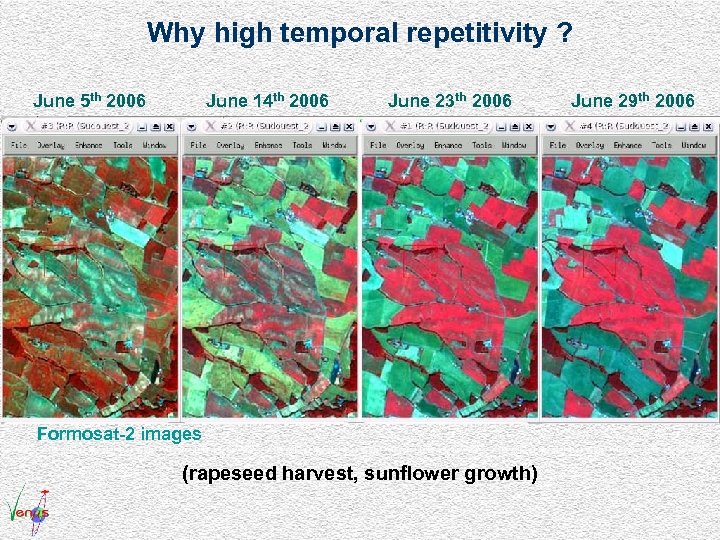
Why high temporal repetitivity ? June 5 th 2006 June 14 th 2006 June 23 th 2006 Formosat-2 images (rapeseed harvest, sunflower growth) June 29 th 2006
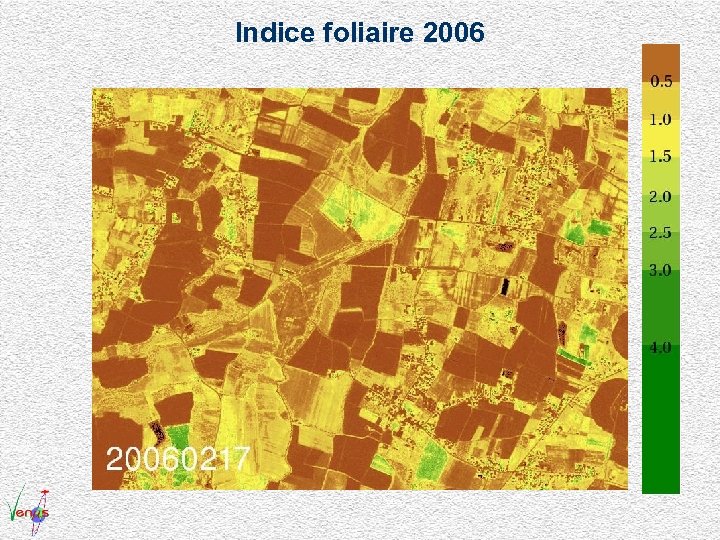
Indice foliaire 2006
VEN S Uniqueness - Summary q Temporal resolution 2 days revisit time for monitoring rapid changes : objective of a cloud free (composite) image every 7 or 10 days q Spectral resolution Super spectral sensor – 12 spectral bands VIS-NIR for land applications q Spatial resolution Pixel size of 5. 3 m for Level 1, 10 m for level 2 and 3. Registration requirement: 3 m rmse q Tilting capability 30 deg across and along track q View angle Constant view angle can be achieved every 2 days, at constant local solar time q Stereo pairs with a small angle difference at 620 nm Cloud screening based on altitude, DEM generation
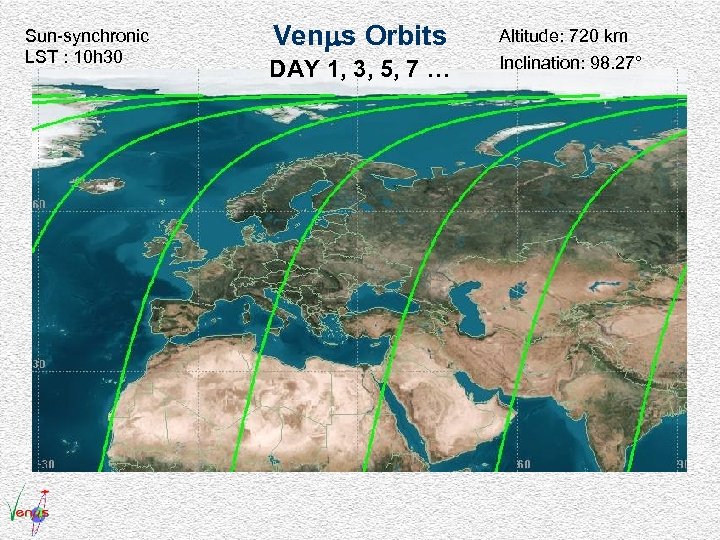
Sun-synchronic LST : 10 h 30 Ven s Orbits Altitude: 720 km DAY 1, 3, 5, 7 … Inclination: 98. 27°
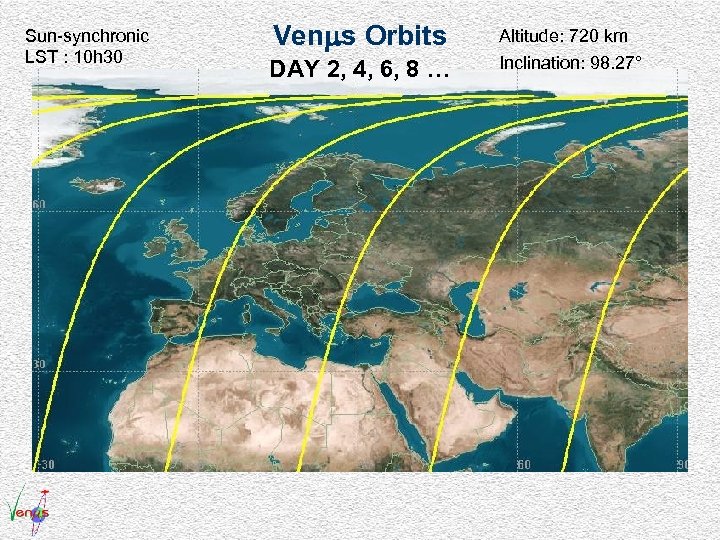
Sun-synchronic LST : 10 h 30 Ven s Orbits Altitude: 720 km DAY 2, 4, 6, 8 … Inclination: 98. 27°
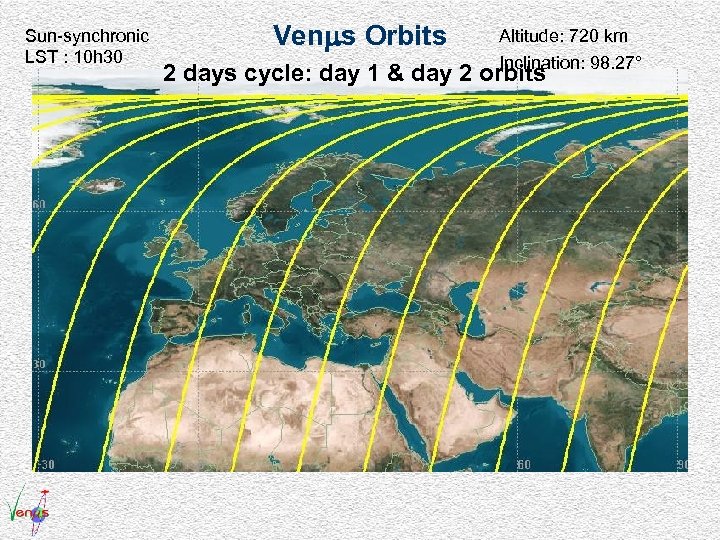
Sun-synchronic LST : 10 h 30 Ven s Orbits Altitude: 720 km Inclination: 98. 27° 2 days cycle: day 1 & day 2 orbits
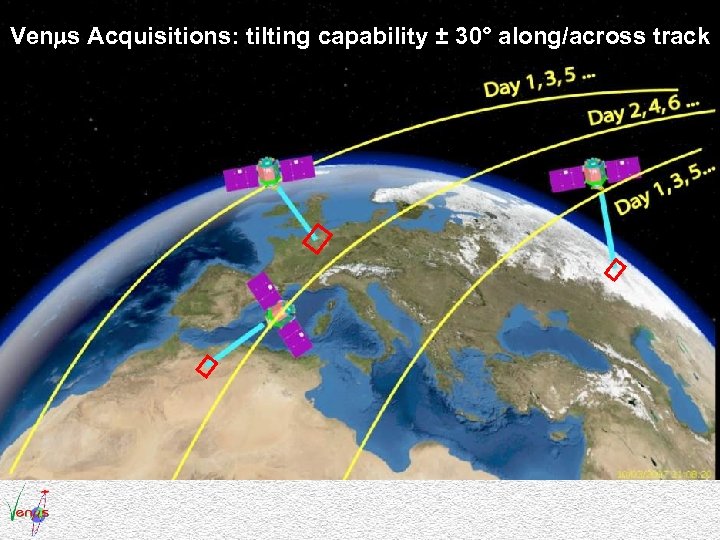
Ven s Acquisitions: tilting capability ± 30° along/across track
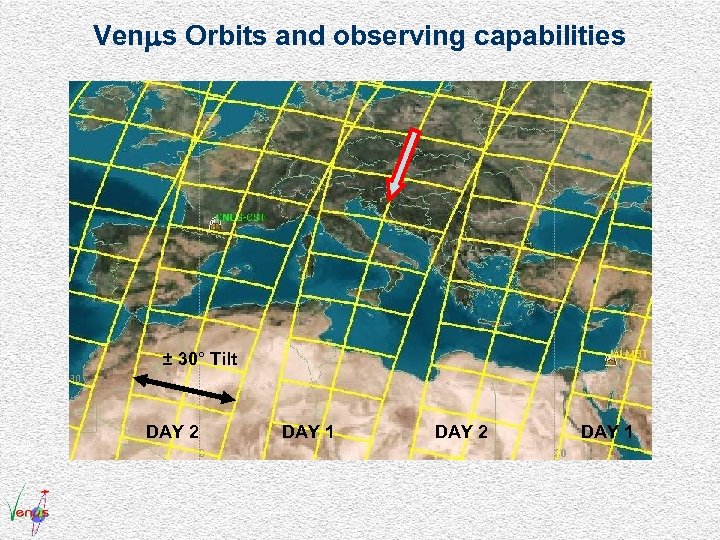
Ven s Orbits and observing capabilities ± 30° Tilt DAY 2 DAY 1
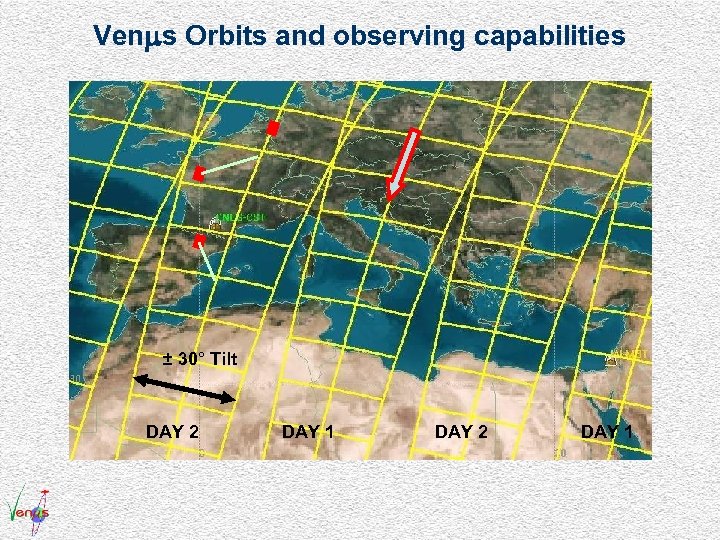
Ven s Orbits and observing capabilities ± 30° Tilt DAY 2 DAY 1
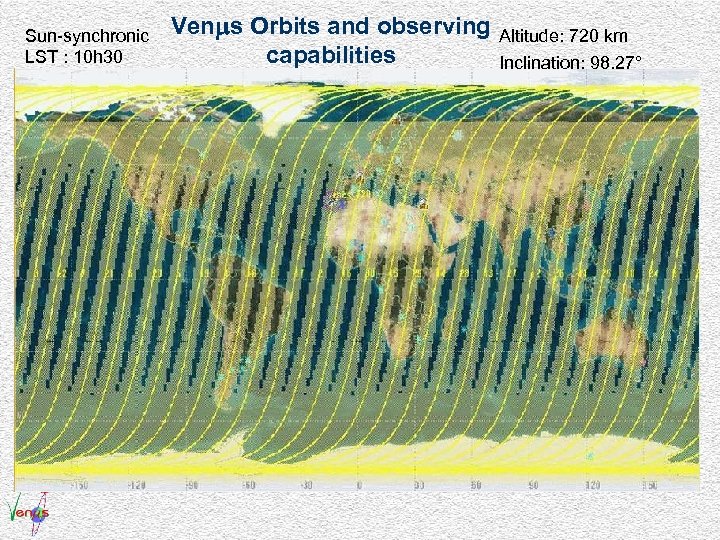
Sun-synchronic LST : 10 h 30 Ven s Orbits and observing capabilities Altitude: 720 km Inclination: 98. 27°
VEN S Imaging capabilities q Swath: 27. 56 km q Nominal requirements t 50 sites of 27 x 54 km + calibration and image quality sites t 140 images of 27 x 27 km within 2 days (>20000/year) t 30 images on the most demanding orbit q Data strips longer than 54 km are feasible q Angular sampling could be achieved for a few sites (± 30° roll and pitch) q Moon viewing for calibration
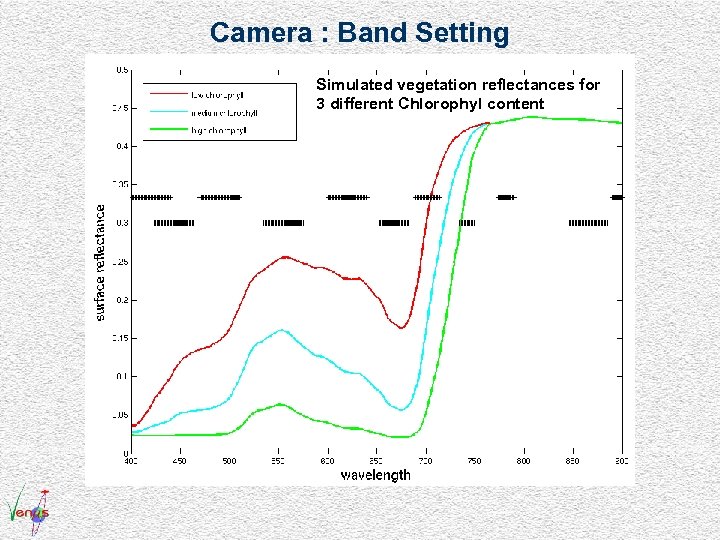
Camera : Band Setting Simulated vegetation reflectances for 3 different Chlorophyl content
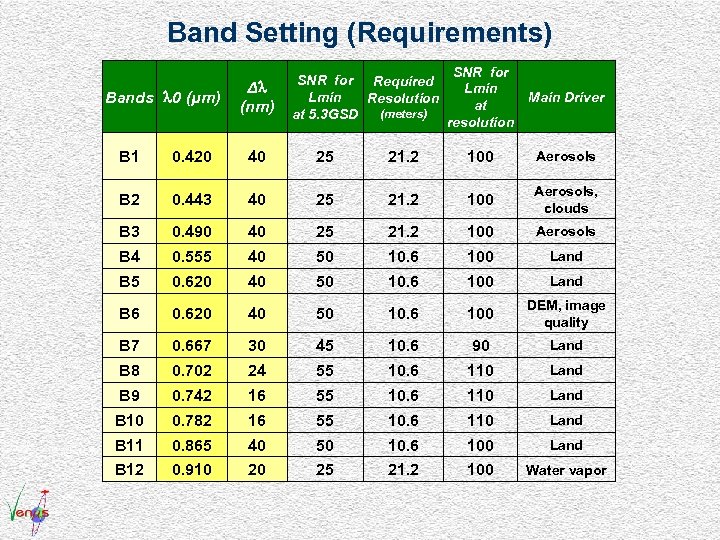
Band Setting (Requirements) Bands l 0 (μm) Δl (nm) SNR for Required Lmin Resolution (meters) at 5. 3 GSD SNR for Lmin Main Driver at resolution B 1 0. 420 40 25 21. 2 100 Aerosols B 2 0. 443 40 25 21. 2 100 Aerosols, clouds B 3 0. 490 40 25 21. 2 100 Aerosols B 4 0. 555 40 50 10. 6 100 Land B 5 0. 620 40 50 10. 6 100 Land B 6 0. 620 40 50 10. 6 100 DEM, image quality B 7 0. 667 30 45 10. 6 90 Land B 8 0. 702 24 55 10. 6 110 Land B 9 0. 742 16 55 10. 6 110 Land B 10 0. 782 16 55 10. 6 110 Land B 11 0. 865 40 50 10. 6 100 Land B 12 0. 910 20 25 21. 2 100 Water vapor
Image quality q Needs t Spatial and temporal image composites that can be used over a whole area to monitor seasonal and interannual evolutions ð Need to provide consistent and homogeneous measurements through time and space, with physical meaning (reflectances) q Requirements t Geometrical registration (within bands 0. 25 pix, multitemporal 3 m) t Radiometric calibration (3 -5%), knowledge of the spectral responses, and spectral stability t Minimisation of perturbing effects : directional and atmospheric. Maximum shift of the time of overpass throughout the mission duration: lower than ± 5 minutes – Constant view zenith angle ± 2 degrees
Ground segment : Products Level 1: single acquisition Geometrically corrected (maps) of top of the atmosphere reflectances. One map projection per site. Level 2: single acquisition, geophysical variables Surface reflectances, atmospheric water vapor content and aerosol optical depth Level 3 : time composite, geophysical variables Surface reflectances, atmospheric water vapor content and aerosol optical depth All the acquired images will be freely available by ftp less than 1 month after acquisitions
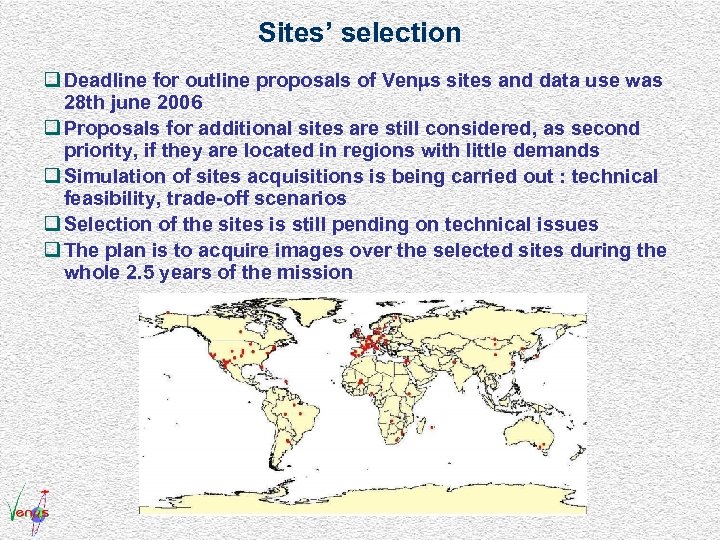
Sites’ selection q Deadline for outline proposals of Ven s sites and data use was 28 th june 2006 q Proposals for additional sites are still considered, as second priority, if they are located in regions with little demands q Simulation of sites acquisitions is being carried out : technical feasibility, trade-off scenarios q Selection of the sites is still pending on technical issues q The plan is to acquire images over the selected sites during the whole 2. 5 years of the mission
Objective of the workshop q Present the current status of the mission q Present levels 2 and 3 algorithms and existing/forthcoming data-sets q Illustrate the benefit of the mission by some examples q Answer your questions q Networking of scientists interested by the Venµs mission and more generally by high resolution/high repetitivity data t Listen to your needs and requests t Discussion on possible additional products or innovative uses q Coordination of efforts in the frame of calls for proposals (Tosca, PNTS, Interreg, FP 7, …) and Sentinel -2 preparation
Скачать презентацию Ben Gurion University The VENμS mission Earth Observation
109fc8743206f93e6e2533ad0d6ef571.ppt