 Скачать презентацию Ben Graham and the Growth Investor Presented to
85be2a99ca7357e1bb063aa5f3a48a65.ppt
- Количество слайдов: 115



Ben Graham and the Growth Investor Presented to Bryant College April 10, 2008 HEWITT HEISERMAN JR. www. Earnings. Power. com Hewitt. Heiserman@Earnings. Power. com The Earnings Power Chart and Earnings Power Staircase are property of Hewitt Heiserman Jr. All rights reserved. Copyright 2008

Preface Why We Have to Be at the Top of Our Game 2
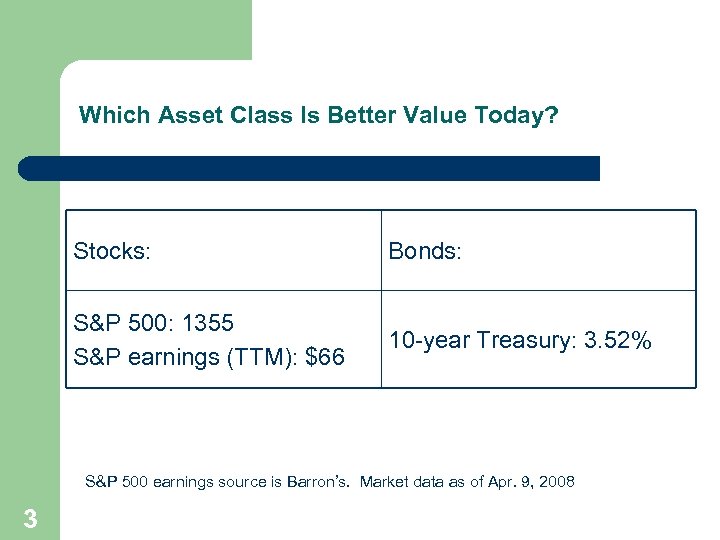
Which Asset Class Is Better Value Today? Stocks: Bonds: S&P 500: 1355 S&P earnings (TTM): $66 10 -year Treasury: 3. 52% S&P 500 earnings source is Barron’s. Market data as of Apr. 9, 2008 3
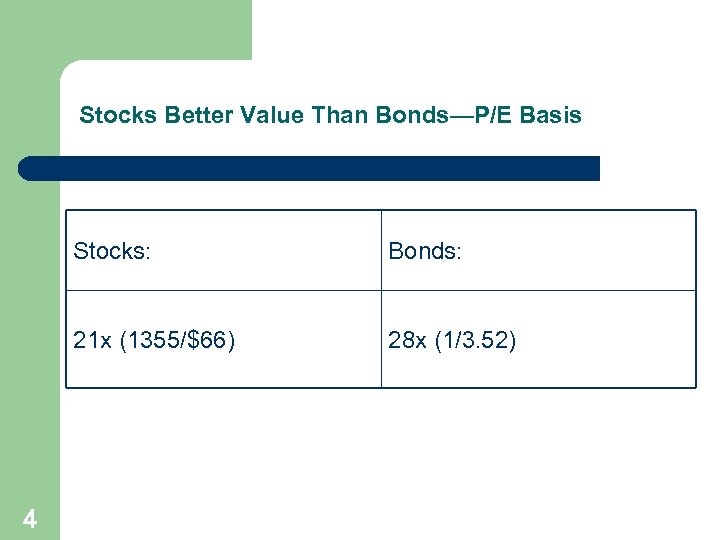
Stocks Better Value Than Bonds—P/E Basis Stocks: 21 x (1355/$66) 4 Bonds: 28 x (1/3. 52)
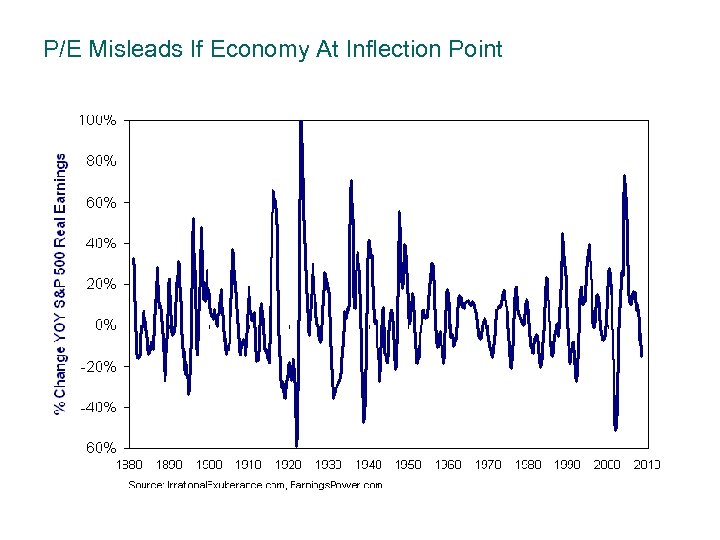
P/E Misleads If Economy At Inflection Point
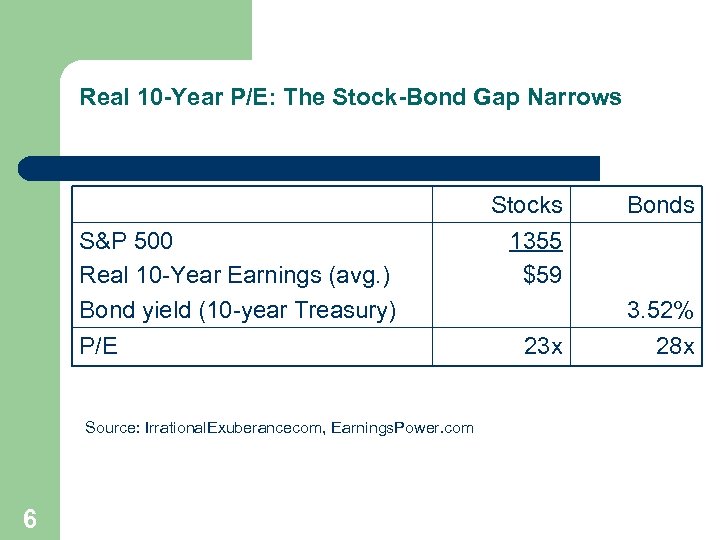
Real 10 -Year P/E: The Stock-Bond Gap Narrows S&P 500 Real 10 -Year Earnings (avg. ) Bond yield (10 -year Treasury) P/E Source: Irrational. Exuberancecom, Earnings. Power. com 6 Stocks 1355 $59 Bonds 3. 52% 23 x 28 x
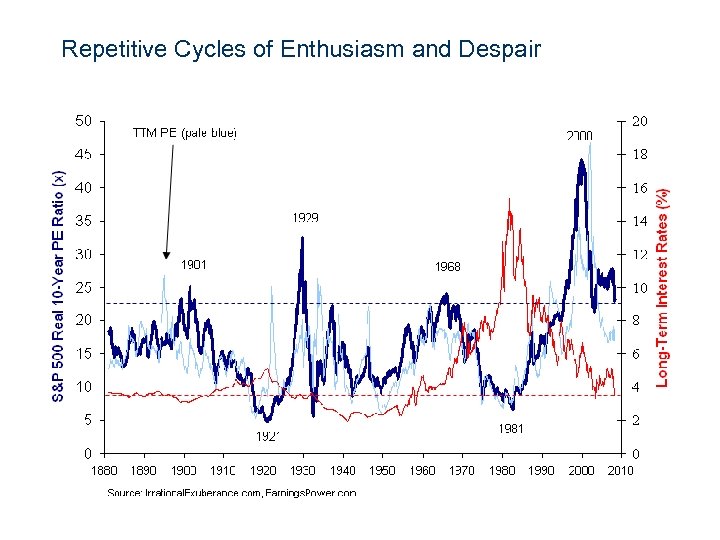
Repetitive Cycles of Enthusiasm and Despair
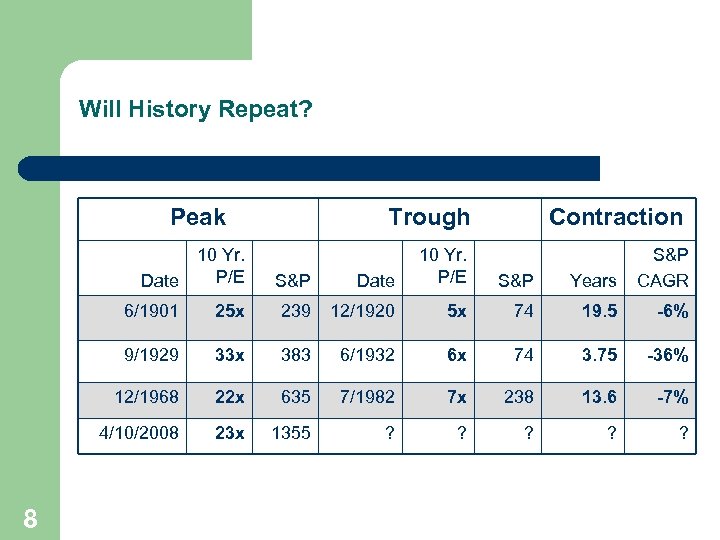
Will History Repeat? Peak Trough Date S&P 6/1901 25 x 9/1929 Date 10 Yr. P/E S&P Years S&P CAGR 239 12/1920 5 x 74 19. 5 -6% 33 x 383 6/1932 6 x 74 3. 75 -36% 12/1968 22 x 635 7/1982 7 x 238 13. 6 -7% 4/10/2008 8 10 Yr. P/E Contraction 23 x 1355 ? ? ?
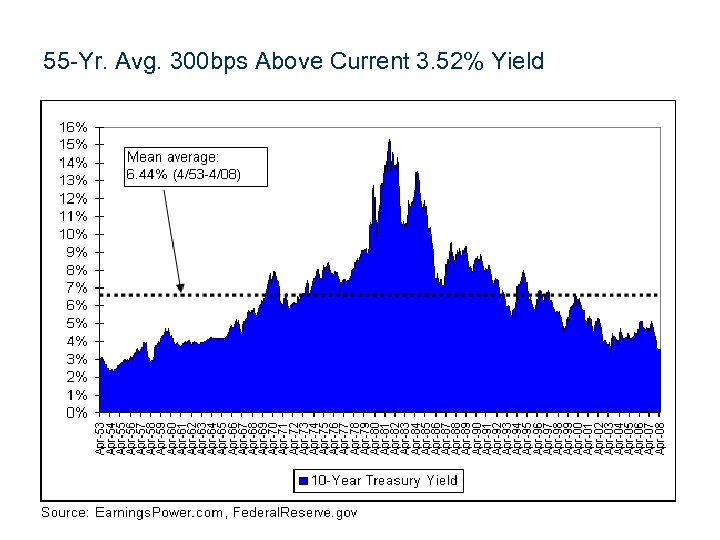
55 -Yr. Avg. 300 bps Above Current 3. 52% Yield
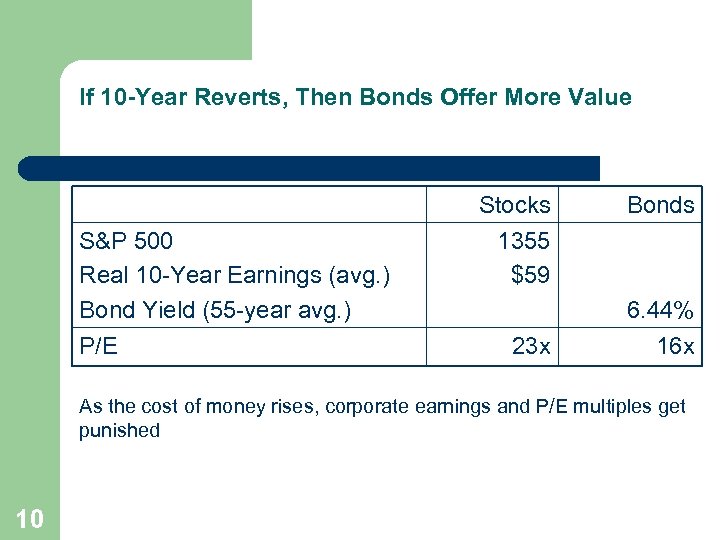
If 10 -Year Reverts, Then Bonds Offer More Value S&P 500 Real 10 -Year Earnings (avg. ) Bond Yield (55 -year avg. ) P/E Stocks 1355 $59 Bonds 6. 44% 23 x 16 x As the cost of money rises, corporate earnings and P/E multiples get punished 10
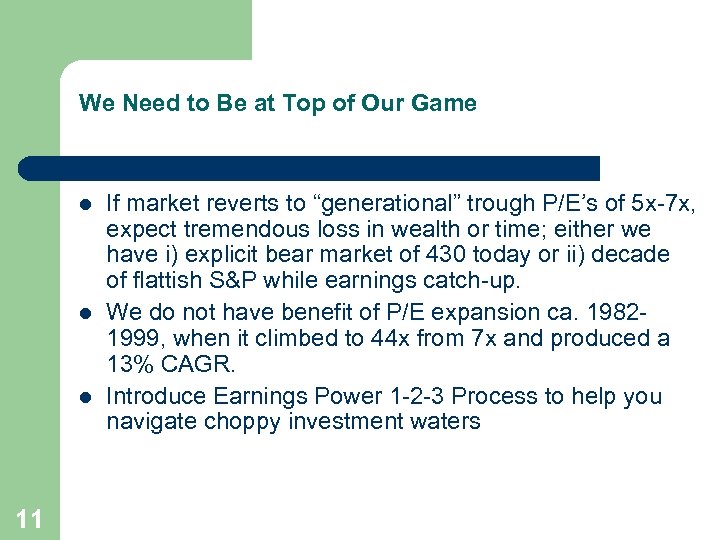
We Need to Be at Top of Our Game l l l 11 If market reverts to “generational” trough P/E’s of 5 x-7 x, expect tremendous loss in wealth or time; either we have i) explicit bear market of 430 today or ii) decade of flattish S&P while earnings catch-up. We do not have benefit of P/E expansion ca. 19821999, when it climbed to 44 x from 7 x and produced a 13% CAGR. Introduce Earnings Power 1 -2 -3 Process to help you navigate choppy investment waters
Resources: Prof. Robert Shiller’s website: http: //www. irrationalexuberance. com/ To view the Real 10 -Year PE Data, click here: “One can access an Excel file with the data set (used and described in the book) on stock prices, earnings, dividends and interest rates since 1871, updated. ”
Section I The Growth Trap 13
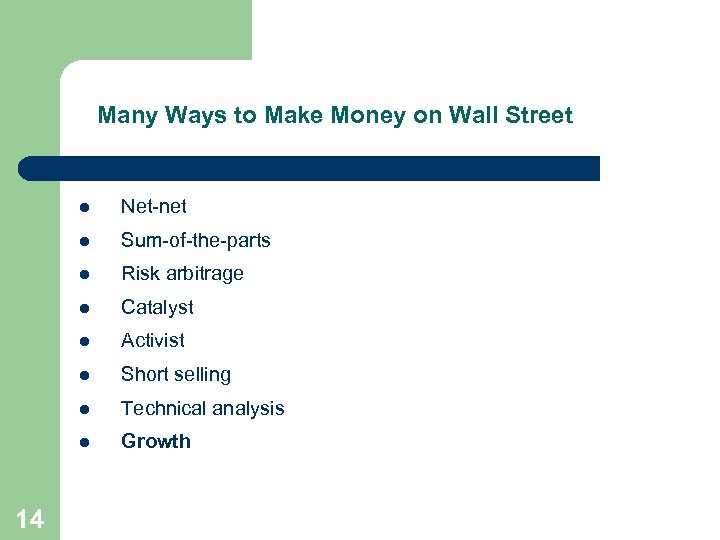
Many Ways to Make Money on Wall Street l l Sum-of-the-parts l Risk arbitrage l Catalyst l Activist l Short selling l Technical analysis l 14 Net-net Growth
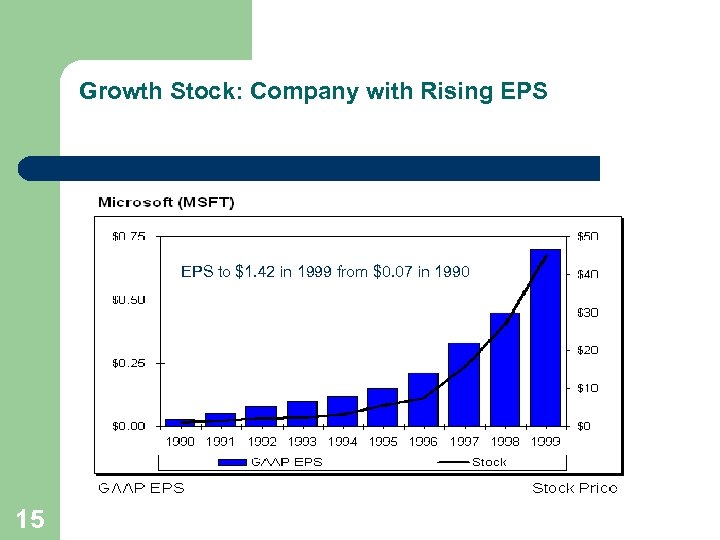
Growth Stock: Company with Rising EPS to $1. 42 in 1999 from $0. 07 in 1990 15
Benefits of Growth Investing l l Save money on commissions, bid-ask slippage costs l Trade less, which improves investing results l No “exquisite timing” required; you can build a position over many years l 16 Defer capital gains taxes, so your principal compounds faster Asymmetrical risk-reward. Worst-case, investment goes to zero. Best-case, multiply your capital several-fold. $10, 000 in Microsoft in 1990 grew to almost $1 million over next ten years.
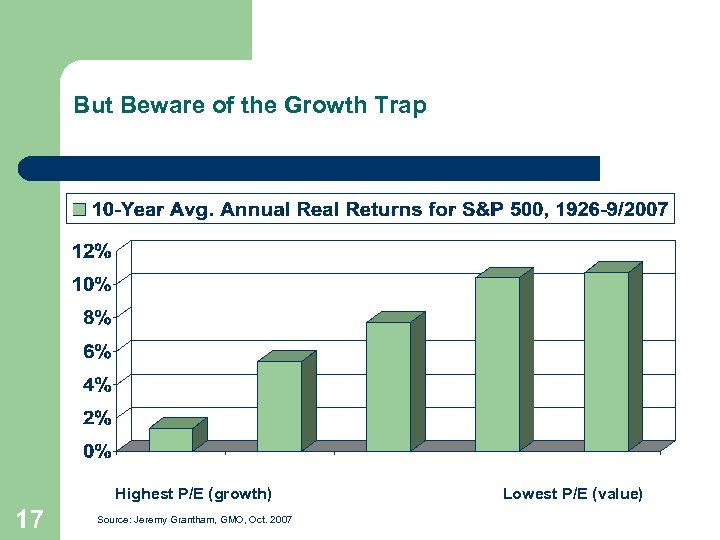
But Beware of the Growth Trap Highest P/E (growth) 17 Source: Jeremy Grantham, GMO, Oct. 2007 Lowest P/E (value)
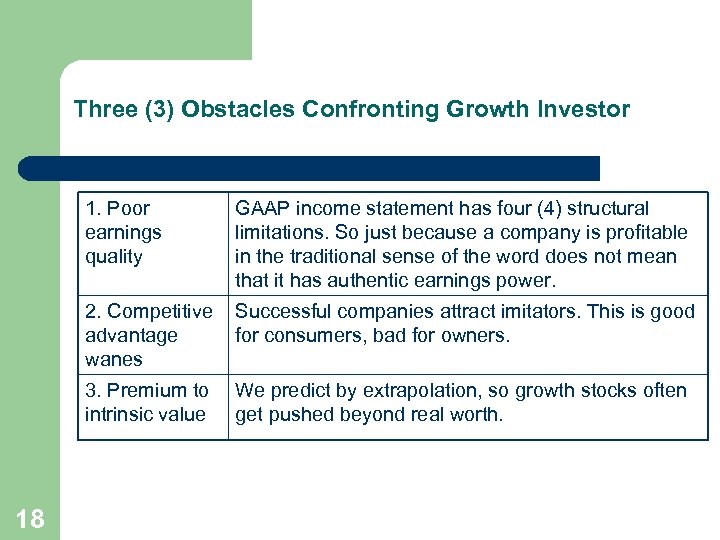
Three (3) Obstacles Confronting Growth Investor 1. Poor earnings quality 2. Competitive advantage wanes Successful companies attract imitators. This is good for consumers, bad for owners. 3. Premium to intrinsic value 18 GAAP income statement has four (4) structural limitations. So just because a company is profitable in the traditional sense of the word does not mean that it has authentic earnings power. We predict by extrapolation, so growth stocks often get pushed beyond real worth.
Section II Obstacle #1: Poor Earnings Quality 19
The GAAP Income Statement l l Robert’s Rules of Order for corporate America l When you open an annual report, 10 -K or 10 -Q and look at financials statements, that’s GAAP l 20 To create comparability, all companies follow generally accepted accounting principals (GAAP) Many investors take GAAP at face value; they think EPS is “hard” number, like…
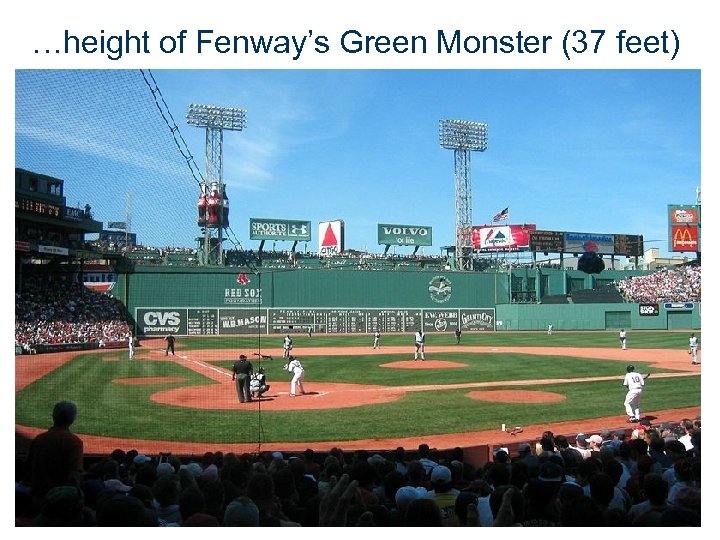
…height of Fenway’s Green Monster (37 feet)
But EPS is a “Soft” Number l l 22 GAAP income statement has four (4) structural limitations A dollar of earnings for one company’s may not be comparable to a dollar of EPS from another company, or for same company from one year to next
GAAP P&L’s Four (4) Structural Limitations 1. 2. 3. 4. 23 Investment in fixed capital is ignored, so when capital spending is greater than depreciation the company may be profitable on GAAP basis but short cash. Omits investment in working capital, so when receivables and inventory grow faster than payables and accrued expenses the company may be profitable on GAAP basis but short cash. Intangibles like R&D, advertising, employee education are expensed even though the benefits will last more than one accounting period. Stockholders’ equity is free even though owners have an opportunity cost.
GAAP P&L’s Four (4) Structural Limitations 1. 2. 3. 4. 24 Investment in fixed capital is ignored, so when capital spending is greater than depreciation the company may be profitable on GAAP basis but short cash. Omits investment in working capital, so when receivables and inventory grow faster than payables and accrued expenses the company may be profitable on GAAP basis but short cash. Intangibles like R&D, advertising, employee education are expensed even though the benefits will last more than one accounting period. Stockholders’ equity is free even though owners have an opportunity cost.
Notes on Capital Spending l l 25 Fixed capital is buildings, trucks, telephone networks, etc. When a company buys fixed capital, it spends the cash today but for accounting purposes depreciates outlay over asset’s expected useful life. Depreciation enables companies to match current sales with current expenses, and future sales with future expenses If capex is greater than depreciation, a company makes investment in fixed capital. Investment in fixed capital is a use of cash. This cash outlay has to come from somewhere; e. g. checking account, liquidate other assets, borrowings, or stock sales. Will investment produce higher future sales, cost savings? Beware of capital-intensive companies. The 20% with highest capital spending growth lagged market by 1. 5% a year during 1973 -1996, while lowest 20% beat market by 1% a year. (Paul Sturm, Smart Money, June 2005)
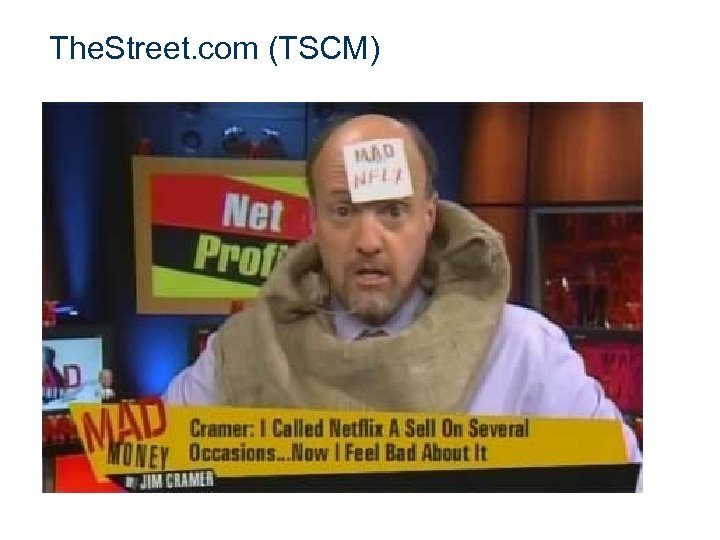
The. Street. com (TSCM)
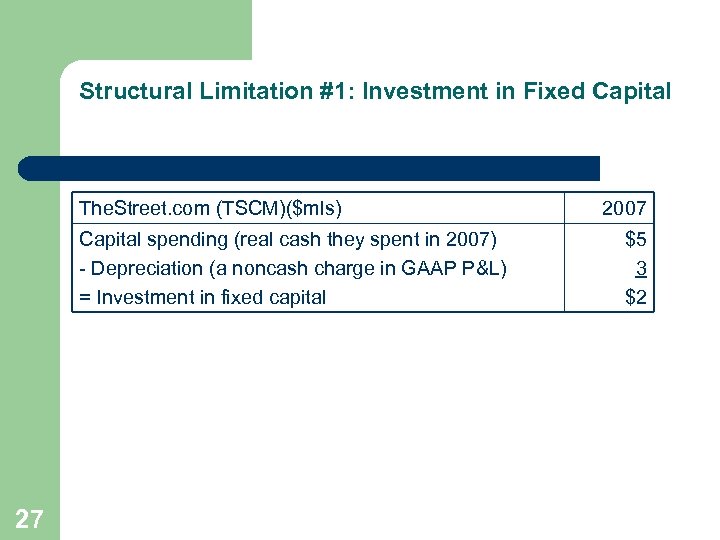
Structural Limitation #1: Investment in Fixed Capital The. Street. com (TSCM)($mls) Capital spending (real cash they spent in 2007) - Depreciation (a noncash charge in GAAP P&L) = Investment in fixed capital 27 2007 $5 3 $2
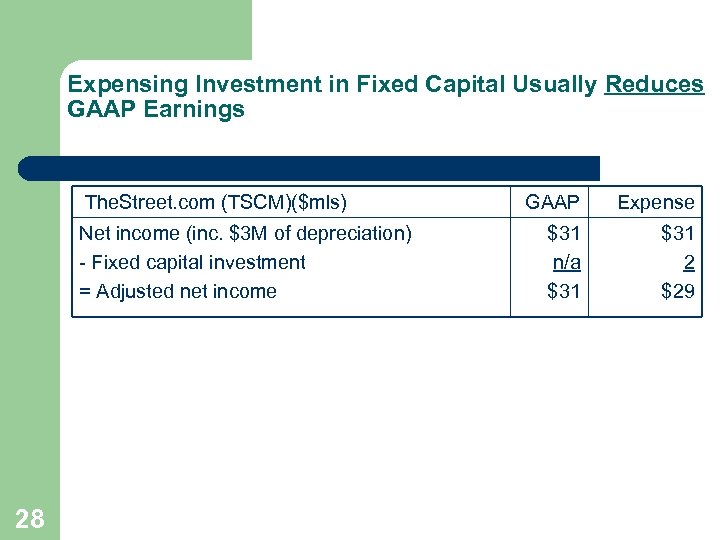
Expensing Investment in Fixed Capital Usually Reduces GAAP Earnings The. Street. com (TSCM)($mls) Net income (inc. $3 M of depreciation) - Fixed capital investment = Adjusted net income 28 GAAP Expense $31 n/a $31 2 $29
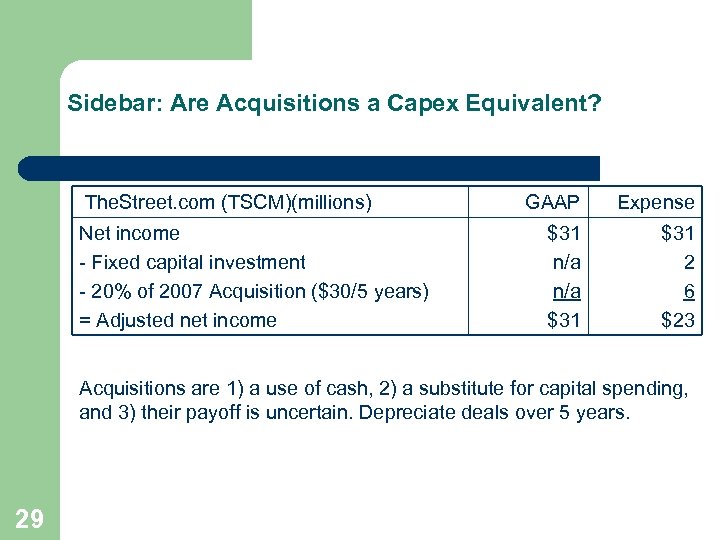
Sidebar: Are Acquisitions a Capex Equivalent? The. Street. com (TSCM)(millions) Net income - Fixed capital investment - 20% of 2007 Acquisition ($30/5 years) = Adjusted net income GAAP Expense $31 n/a $31 2 6 $23 Acquisitions are 1) a use of cash, 2) a substitute for capital spending, and 3) their payoff is uncertain. Depreciate deals over 5 years. 29
GAAP P&L’s Four (4) Structural Limitations 1. 2. 3. 4. 30 Investment in fixed capital is ignored, so when capital spending is greater than depreciation the company may be profitable on GAAP basis but short cash. Omits investment in working capital, so when receivables and inventory grow faster than payables and accrued expenses the company may be profitable on GAAP basis but short cash. Intangibles like R&D, advertising, employee education are expensed even though the benefits will last more than one accounting period. Stockholders’ equity is free even though owners have an opportunity cost.
Notes on Working Capital l l 31 Working capital assets include receivables, inventory, other current assets (but not cash, marketable securities); working capital liabilities are payables, accrued expenses. Working capital is WCA - WCL While it is good to have more assets than liabilities, when working capital increases from one year to next, this is an investment in working capital Investment in working capital is use of cash that does not appear in GAAP income statement. Still, like fixed capital investment, it has to be financed somehow A profitable company can suffer liquidity squeeze if it can’t collect receivables and/or sell inventory in timely manner
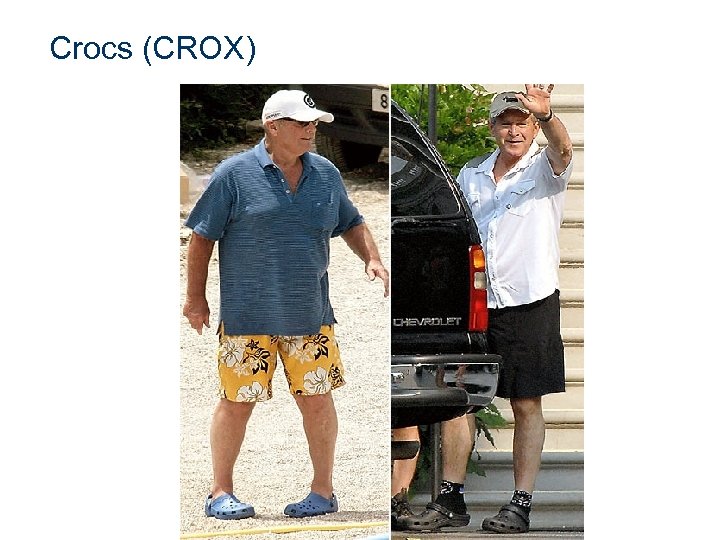
Crocs (CROX)
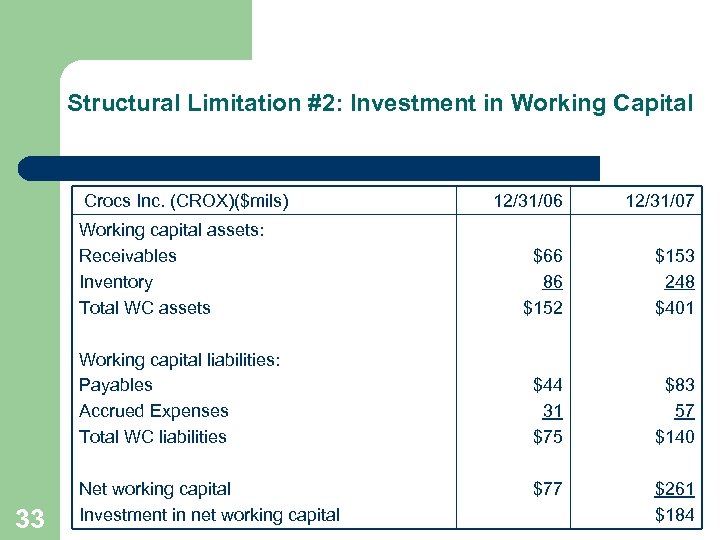
Structural Limitation #2: Investment in Working Capital Crocs Inc. (CROX)($mils) Working capital assets: Receivables Inventory Total WC assets Working capital liabilities: Payables Accrued Expenses Total WC liabilities 33 Net working capital Investment in net working capital 12/31/06 12/31/07 $66 86 $152 $153 248 $401 $44 31 $75 $83 57 $140 $77 $261 $184
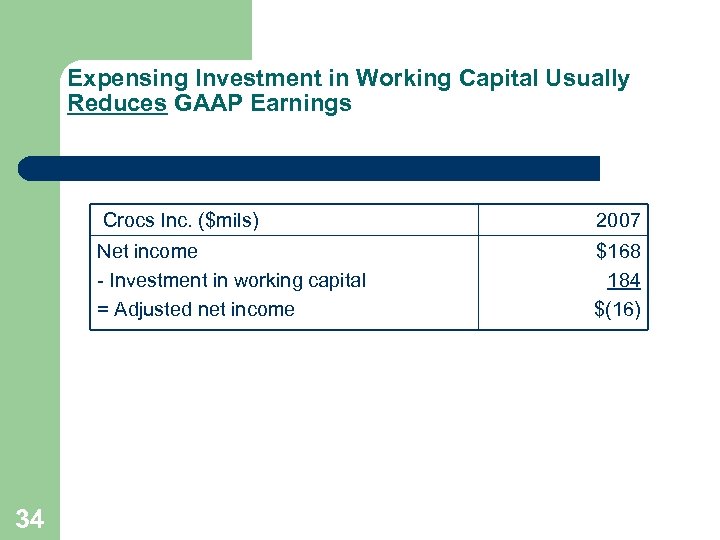
Expensing Investment in Working Capital Usually Reduces GAAP Earnings Crocs Inc. ($mils) Net income - Investment in working capital = Adjusted net income 34 2007 $168 184 $(16)
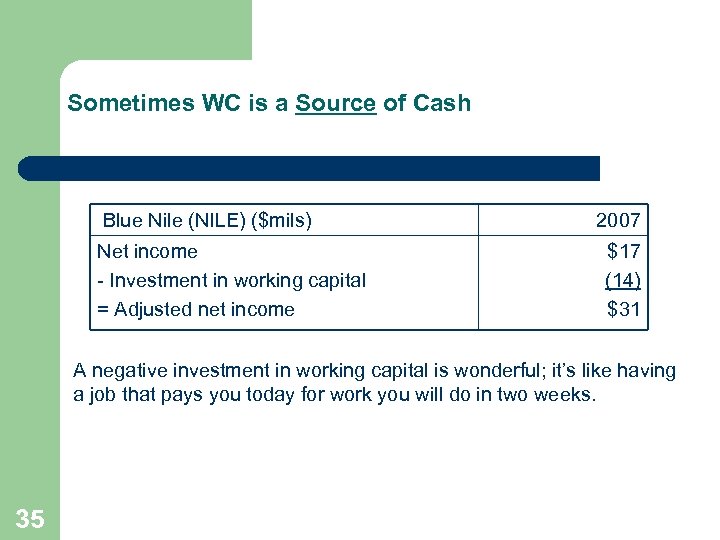
Sometimes WC is a Source of Cash Blue Nile (NILE) ($mils) Net income - Investment in working capital = Adjusted net income 2007 $17 (14) $31 A negative investment in working capital is wonderful; it’s like having a job that pays you today for work you will do in two weeks. 35
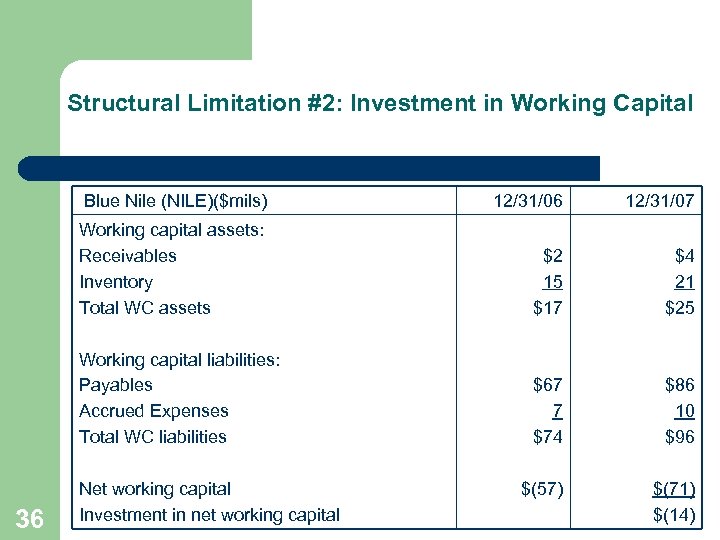
Structural Limitation #2: Investment in Working Capital Blue Nile (NILE)($mils) 12/31/07 Working capital assets: Receivables Inventory Total WC assets $2 15 $17 $4 21 $25 Working capital liabilities: Payables Accrued Expenses Total WC liabilities 36 12/31/06 $67 7 $74 $86 10 $96 $(57) $(71) $(14) Net working capital Investment in net working capital
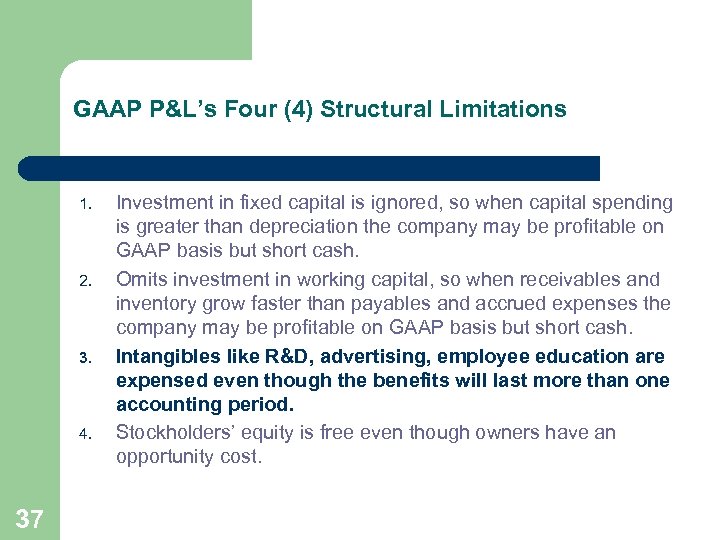
GAAP P&L’s Four (4) Structural Limitations 1. 2. 3. 4. 37 Investment in fixed capital is ignored, so when capital spending is greater than depreciation the company may be profitable on GAAP basis but short cash. Omits investment in working capital, so when receivables and inventory grow faster than payables and accrued expenses the company may be profitable on GAAP basis but short cash. Intangibles like R&D, advertising, employee education are expensed even though the benefits will last more than one accounting period. Stockholders’ equity is free even though owners have an opportunity cost.
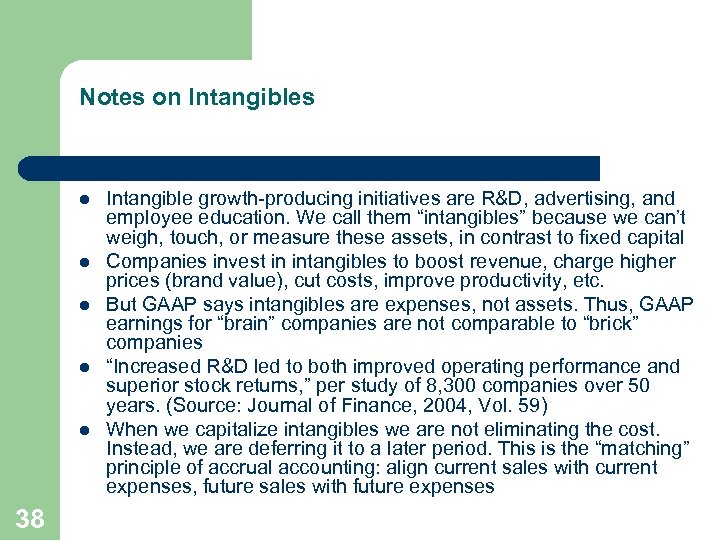
Notes on Intangibles l l l 38 Intangible growth-producing initiatives are R&D, advertising, and employee education. We call them “intangibles” because we can’t weigh, touch, or measure these assets, in contrast to fixed capital Companies invest in intangibles to boost revenue, charge higher prices (brand value), cut costs, improve productivity, etc. But GAAP says intangibles are expenses, not assets. Thus, GAAP earnings for “brain” companies are not comparable to “brick” companies “Increased R&D led to both improved operating performance and superior stock returns, ” per study of 8, 300 companies over 50 years. (Source: Journal of Finance, 2004, Vol. 59) When we capitalize intangibles we are not eliminating the cost. Instead, we are deferring it to a later period. This is the “matching” principle of accrual accounting: align current sales with current expenses, future sales with future expenses
Google (GOOG)
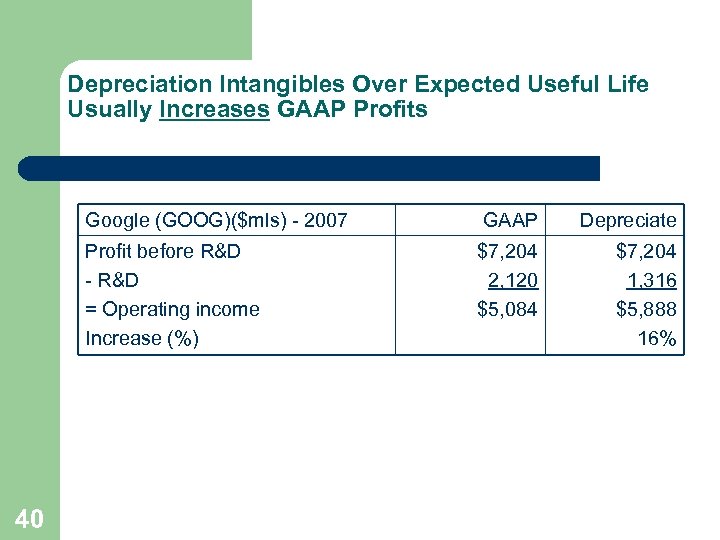
Depreciation Intangibles Over Expected Useful Life Usually Increases GAAP Profits Google (GOOG)($mls) - 2007 Depreciate Profit before R&D - R&D = Operating income Increase (%) 40 GAAP $7, 204 2, 120 $5, 084 $7, 204 1, 316 $5, 888 16%
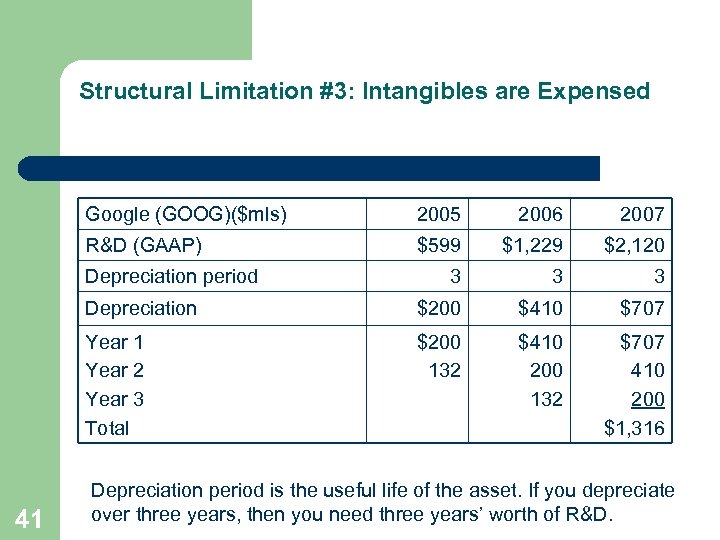
Structural Limitation #3: Intangibles are Expensed Google (GOOG)($mls) 2005 2006 2007 R&D (GAAP) $599 $1, 229 $2, 120 3 3 3 Depreciation $200 $410 $707 Year 1 Year 2 Year 3 Total $200 132 $410 200 132 $707 410 200 $1, 316 Depreciation period 41 Depreciation period is the useful life of the asset. If you depreciate over three years, then you need three years’ worth of R&D.
GAAP P&L’s Four (4) Structural Limitations 1. 2. 3. 42 Investment in fixed capital is ignored, so when capital spending is greater than depreciation the company may be profitable on GAAP basis but short cash. Omits investment in working capital, so when receivables and inventory grow faster than payables and accrued expenses the company may be profitable on GAAP basis but short cash. Intangibles like R&D, advertising, employee education are expensed even though the benefits will last more than one accounting period. Stockholders’ equity is free even though owners have an opportunity cost.
Notes on Stockholders’ Equity l l 43 All companies financed by combination of debt and equity Debt comes from banks, bondholders; equity from owners via retained earnings (GAAP profits minus dividends) Debt an expense but equity is free. Why? Noncash cost; also, different owners have different required rates of return. But GAAP-profitable company may destroy value if you expense owner opportunity costs.
Playboy (PLA)
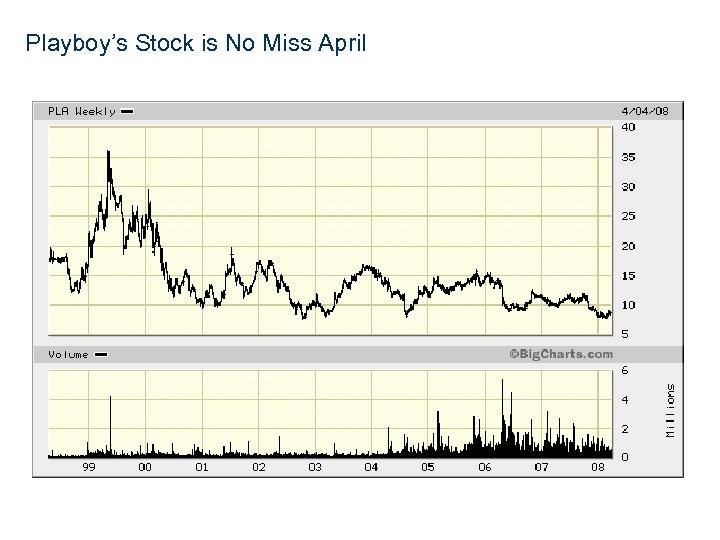
Playboy’s Stock is No Miss April
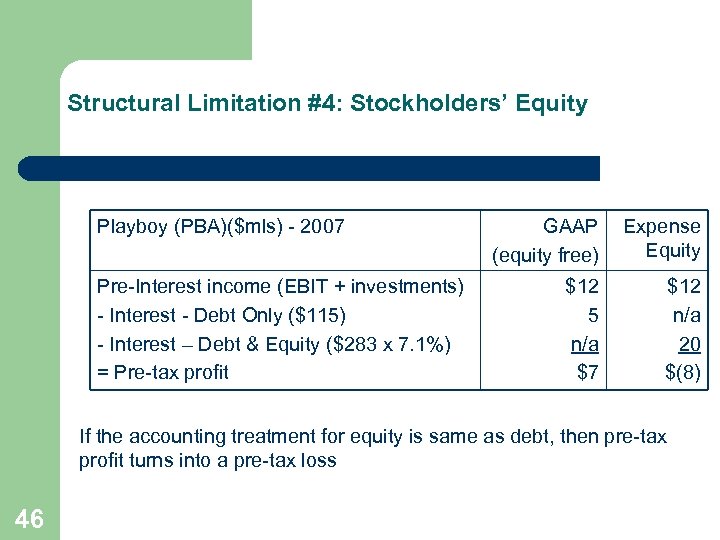
Structural Limitation #4: Stockholders’ Equity Playboy (PBA)($mls) - 2007 Pre-Interest income (EBIT + investments) - Interest - Debt Only ($115) - Interest – Debt & Equity ($283 x 7. 1%) = Pre-tax profit GAAP (equity free) Expense Equity $12 5 n/a $7 $12 n/a 20 $(8) If the accounting treatment for equity is same as debt, then pre-tax profit turns into a pre-tax loss 46
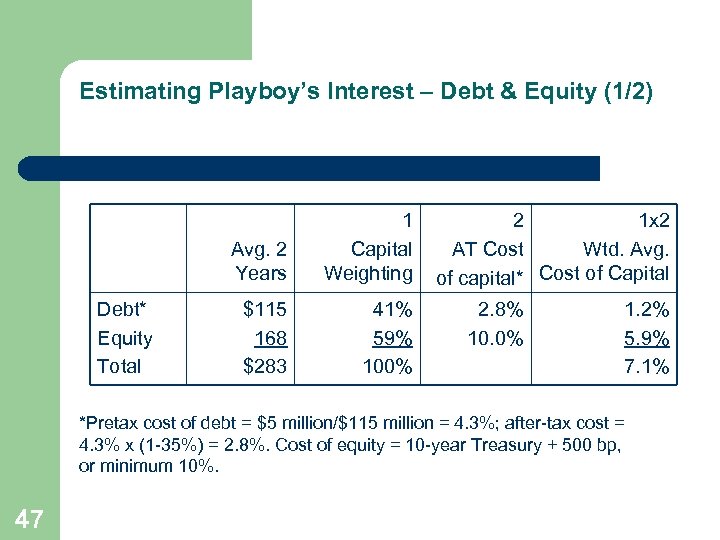
Estimating Playboy’s Interest – Debt & Equity (1/2) Avg. 2 Years Debt* Equity Total 1 Capital Weighting $115 168 $283 41% 59% 100% 2 1 x 2 AT Cost Wtd. Avg. of capital* Cost of Capital 2. 8% 10. 0% 1. 2% 5. 9% 7. 1% *Pretax cost of debt = $5 million/$115 million = 4. 3%; after-tax cost = 4. 3% x (1 -35%) = 2. 8%. Cost of equity = 10 -year Treasury + 500 bp, or minimum 10%. 47
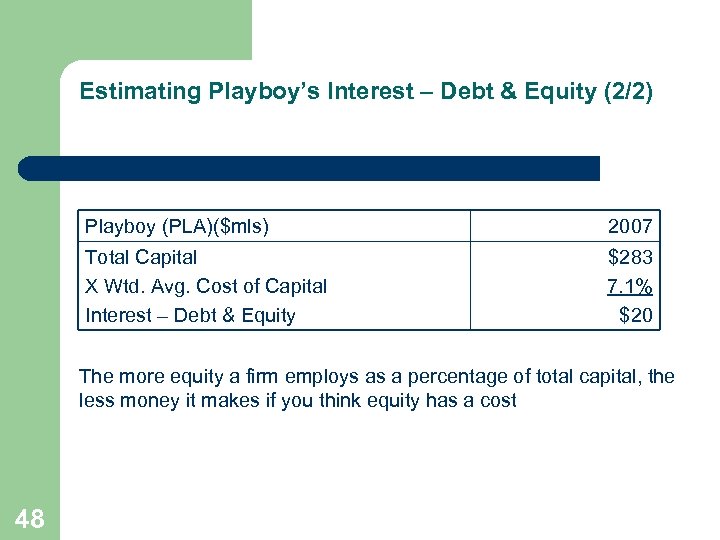
Estimating Playboy’s Interest – Debt & Equity (2/2) Playboy (PLA)($mls) 2007 Total Capital X Wtd. Avg. Cost of Capital Interest – Debt & Equity $283 7. 1% $20 The more equity a firm employs as a percentage of total capital, the less money it makes if you think equity has a cost 48
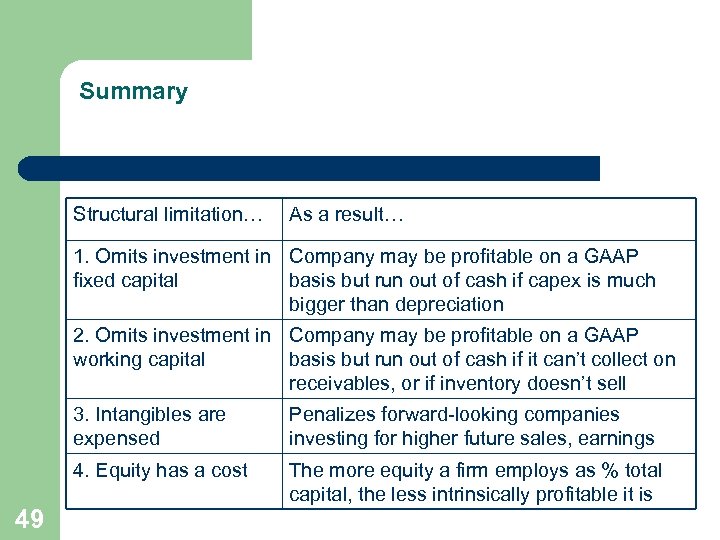
Summary Structural limitation… As a result… 1. Omits investment in Company may be profitable on a GAAP fixed capital basis but run out of cash if capex is much bigger than depreciation 2. Omits investment in Company may be profitable on a GAAP working capital basis but run out of cash if it can’t collect on receivables, or if inventory doesn’t sell 3. Intangibles are expensed 4. Equity has a cost 49 Penalizes forward-looking companies investing for higher future sales, earnings The more equity a firm employs as % total capital, the less intrinsically profitable it is
How Do We Fix These Structural Limitations? l l l 50 Do we re-build income statement to 1) expense investment in FC, 2) expense investment in WC, 3) depreciate intangibles, and 4) expenses stockholders’ equity? We could, but then we create other problems; e. g. , we penalize companies that are investing in FC, WC. Also, who is arbiter of cost of equity? (Elvis still alive, some think. ) No single income statement is cure-all. Instead, let’s add the strengths of two alternate P&L’s that have been devised in recent years to our analysis…free cash flow and Economic Value Added
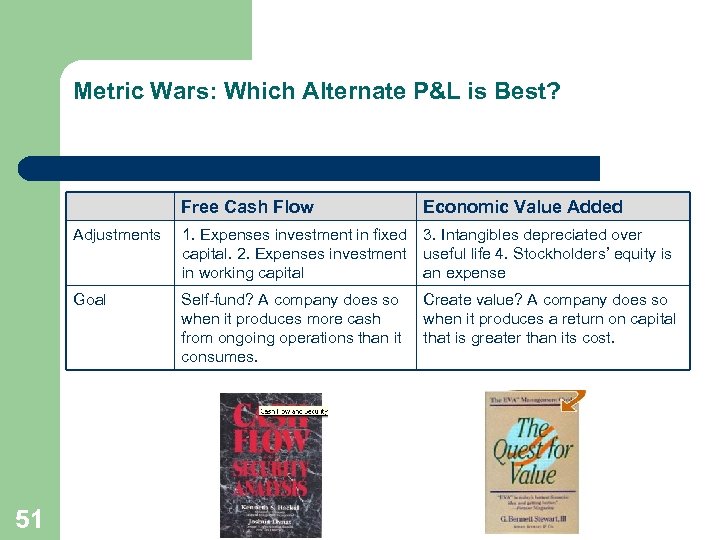
Metric Wars: Which Alternate P&L is Best? Free Cash Flow Adjustments 1. Expenses investment in fixed capital. 2. Expenses investment in working capital 3. Intangibles depreciated over useful life 4. Stockholders’ equity is an expense Goal 51 Economic Value Added Self-fund? A company does so when it produces more cash from ongoing operations than it consumes. Create value? A company does so when it produces a return on capital that is greater than its cost.
Not this Ben Graham 52
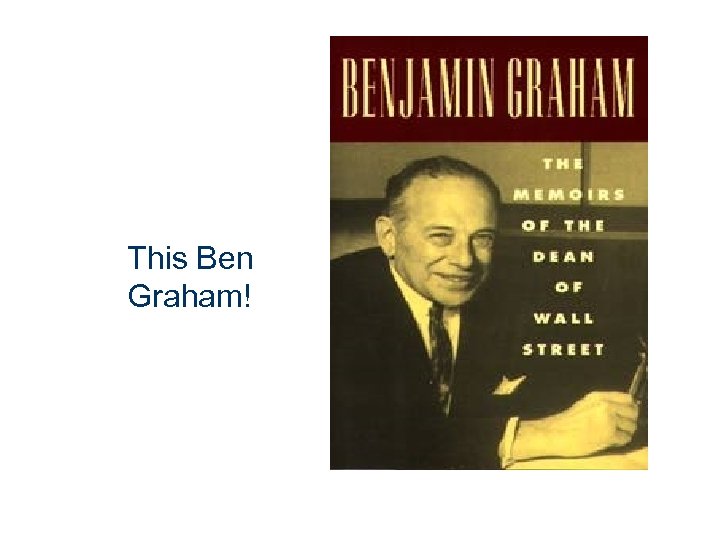
This Ben Graham! 53
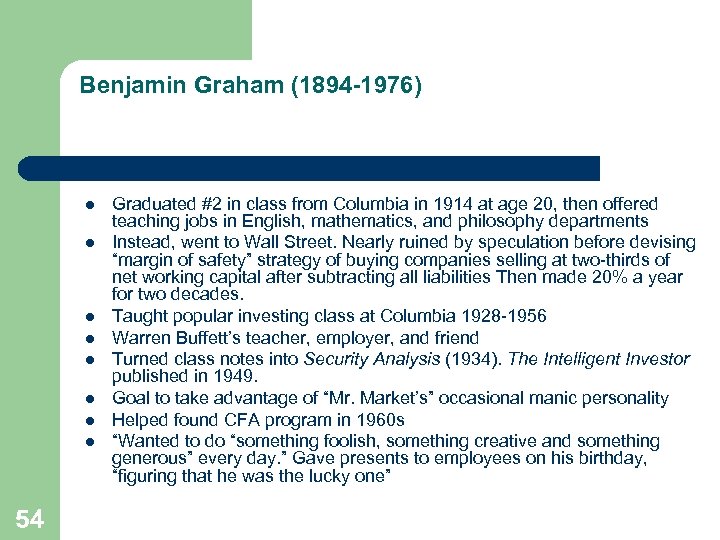
Benjamin Graham (1894 -1976) l l l l 54 Graduated #2 in class from Columbia in 1914 at age 20, then offered teaching jobs in English, mathematics, and philosophy departments Instead, went to Wall Street. Nearly ruined by speculation before devising “margin of safety” strategy of buying companies selling at two-thirds of net working capital after subtracting all liabilities Then made 20% a year for two decades. Taught popular investing class at Columbia 1928 -1956 Warren Buffett’s teacher, employer, and friend Turned class notes into Security Analysis (1934). The Intelligent Investor published in 1949. Goal to take advantage of “Mr. Market’s” occasional manic personality Helped found CFA program in 1960 s “Wanted to do “something foolish, something creative and something generous” every day. ” Gave presents to employees on his birthday, “figuring that he was the lucky one”
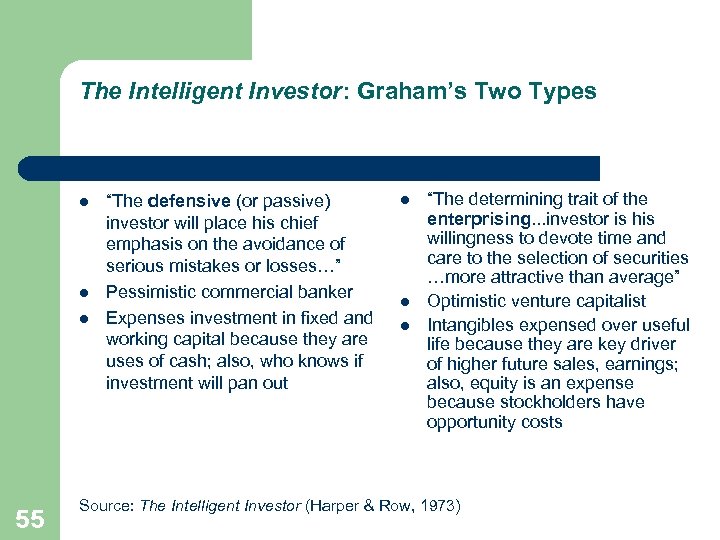
The Intelligent Investor: Graham’s Two Types l l l 55 “The defensive (or passive) investor will place his chief emphasis on the avoidance of serious mistakes or losses…” Pessimistic commercial banker Expenses investment in fixed and working capital because they are uses of cash; also, who knows if investment will pan out l l l “The determining trait of the enterprising. . . investor is his willingness to devote time and care to the selection of securities …more attractive than average” Optimistic venture capitalist Intangibles expensed over useful life because they are key driver of higher future sales, earnings; also, equity is an expense because stockholders have opportunity costs Source: The Intelligent Investor (Harper & Row, 1973)
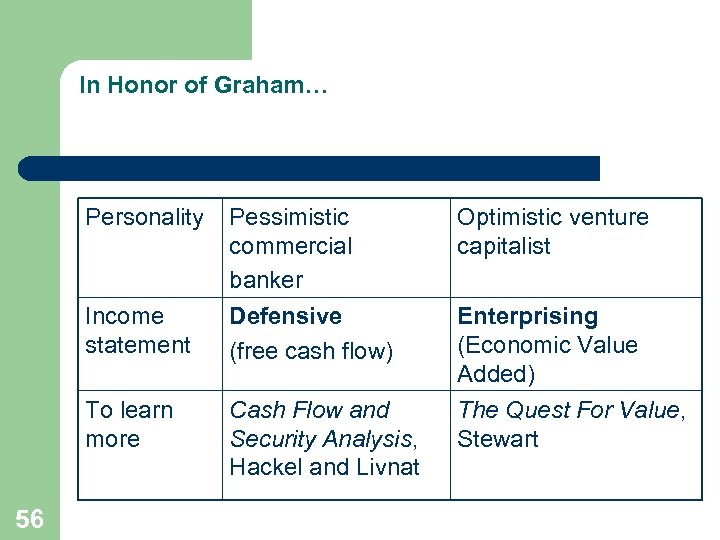
In Honor of Graham… Personality Income statement To learn more 56 Pessimistic commercial banker Defensive (free cash flow) Optimistic venture capitalist Cash Flow and Security Analysis, Hackel and Livnat The Quest For Value, Stewart Enterprising (Economic Value Added)
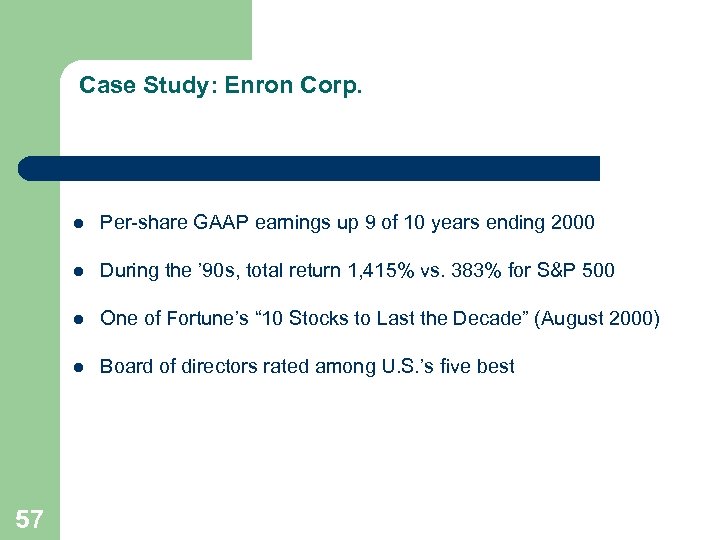
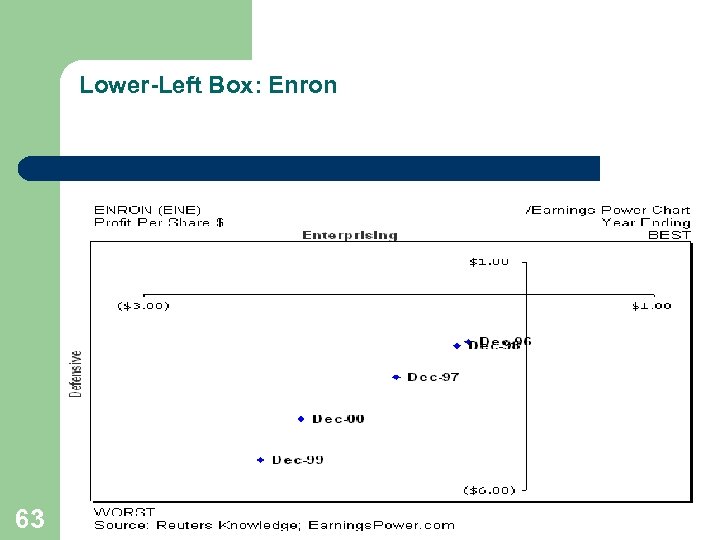
Case Study: Enron Corp. l l During the ’ 90 s, total return 1, 415% vs. 383% for S&P 500 l One of Fortune’s “ 10 Stocks to Last the Decade” (August 2000) l 57 Per-share GAAP earnings up 9 of 10 years ending 2000 Board of directors rated among U. S. ’s five best
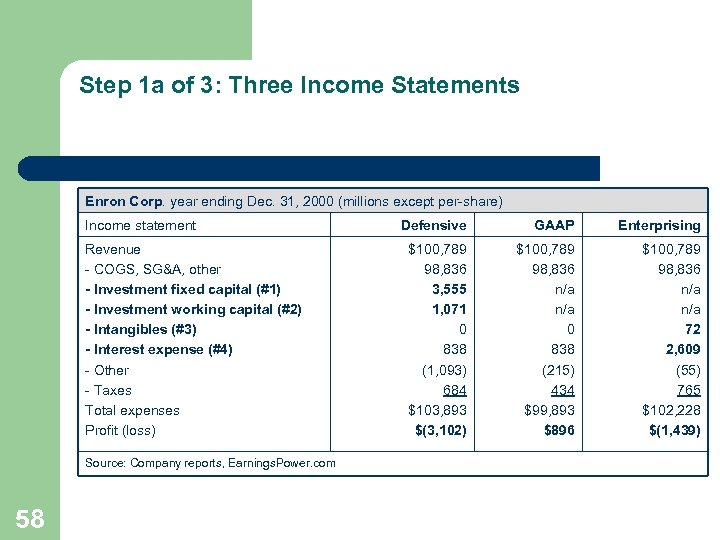
Step 1 a of 3: Three Income Statements Enron Corp. year ending Dec. 31, 2000 (millions except per-share) Income statement Revenue - COGS, SG&A, other - Investment fixed capital (#1) - Investment working capital (#2) - Intangibles (#3) - Interest expense (#4) - Other - Taxes Total expenses Profit (loss) Source: Company reports, Earnings. Power. com 58 Defensive GAAP Enterprising $100, 789 98, 836 3, 555 1, 071 0 838 (1, 093) 684 $103, 893 $(3, 102) $100, 789 98, 836 n/a 0 838 (215) 434 $99, 893 $896 $100, 789 98, 836 n/a 72 2, 609 (55) 765 $102, 228 $(1, 439)
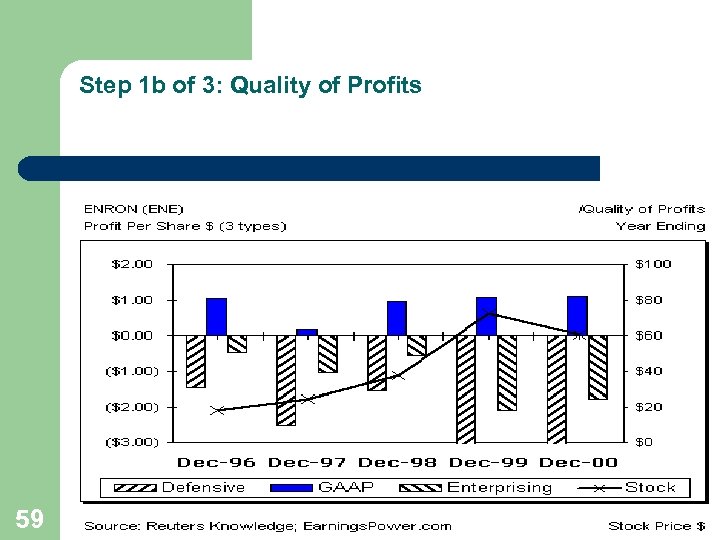
Step 1 b of 3: Quality of Profits 59
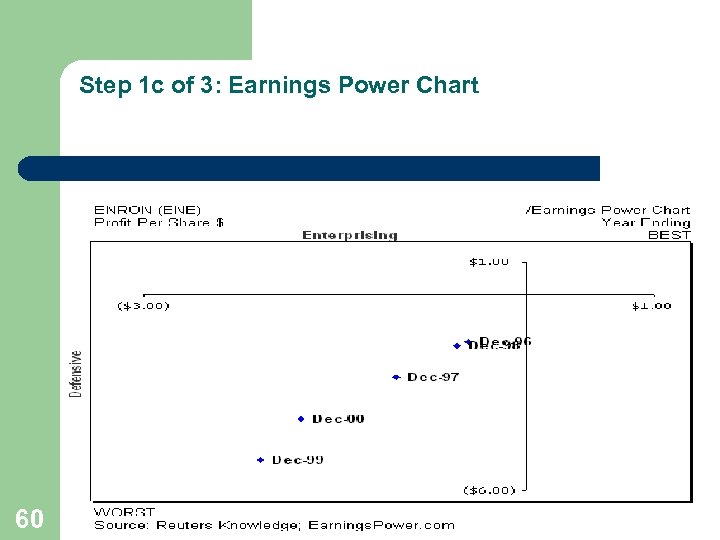
Step 1 c of 3: Earnings Power Chart 60
Enron: A Second Look l l l 61 2000 was a record year for revenue, net income; total return +89% vs. -9% for S&P 500 But then management declared bankruptcy in December 2001 after admitting 1997 -2001 earnings were overstated; biggest U. S. corporate failure to date Stock falls to pennies from high of $85 21, 000 employees lose their jobs, pensions Despite GAAP profits, Enron does not possess authentic earnings power according to the Earnings Power Chart
Section III “Just Four Types of Companies” 62
Lower-Left Box: Enron 63
Upper-Left Box: Health. South (HLSH) (down 83% from $30 peak in mid-1998) 64
Lower-Right Box: Krispy Kreme Donuts (KKD) (down 88% from $50 peak in mid-2003) 65
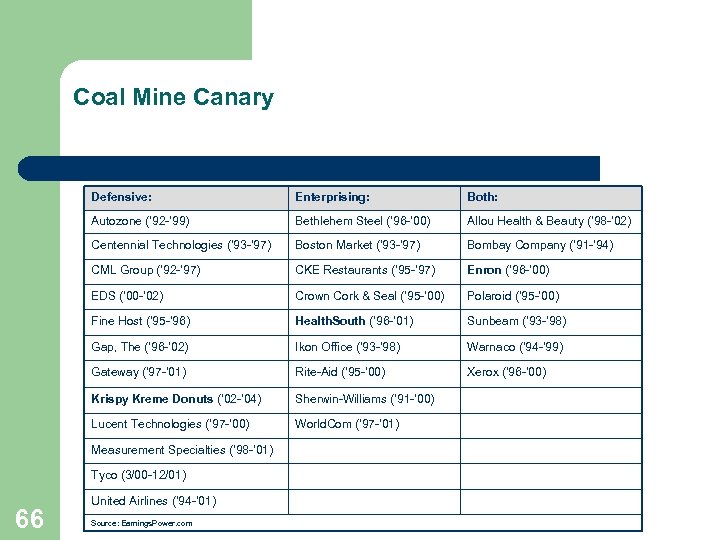
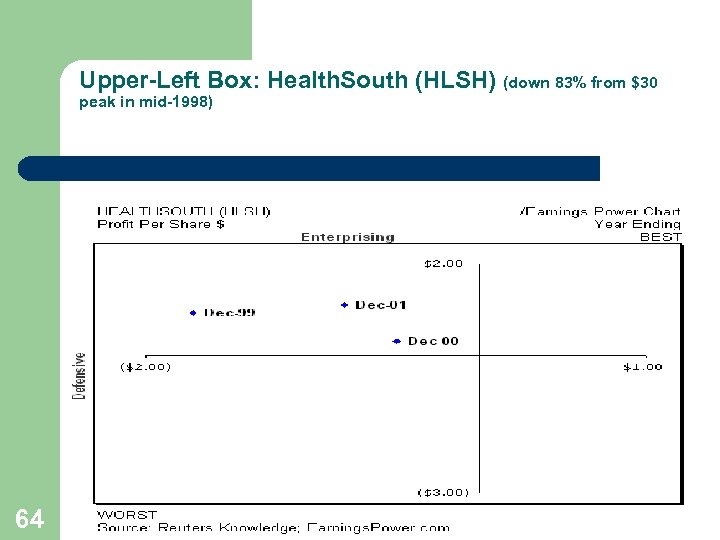
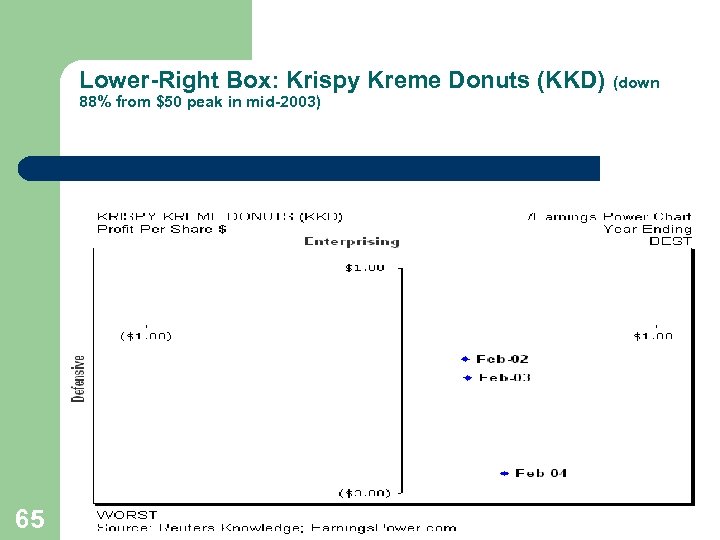
Coal Mine Canary Defensive: Enterprising: Both: Autozone (’ 92 -’ 99) Bethlehem Steel (’ 96 -’ 00) Allou Health & Beauty (’ 98 -’ 02) Centennial Technologies (’ 93 -’ 97) Boston Market (’ 93 -’ 97) Bombay Company (’ 91 -’ 94) CML Group (’ 92 -’ 97) CKE Restaurants (’ 95 -’ 97) Enron (’ 96 -’ 00) EDS (’ 00 -’ 02) Crown Cork & Seal (’ 95 -’ 00) Polaroid (’ 95 -’ 00) Fine Host (’ 95 -’ 96) Health. South (’ 96 -’ 01) Sunbeam (’ 93 -’ 98) Gap, The (’ 96 -’ 02) Ikon Office (’ 93 -’ 98) Warnaco (’ 94 -’ 99) Gateway (’ 97 -’ 01) Rite-Aid (’ 95 -’ 00) Xerox (’ 96 -’ 00) Krispy Kreme Donuts (’ 02 -’ 04) Sherwin-Williams (’ 91 -’ 00) Lucent Technologies (’ 97 -’ 00) World. Com (’ 97 -’ 01) Measurement Specialties (’ 98 -’ 01) Tyco (3/00 -12/01) 66 United Airlines (’ 94 -’ 01) Source: Earnings. Power. com
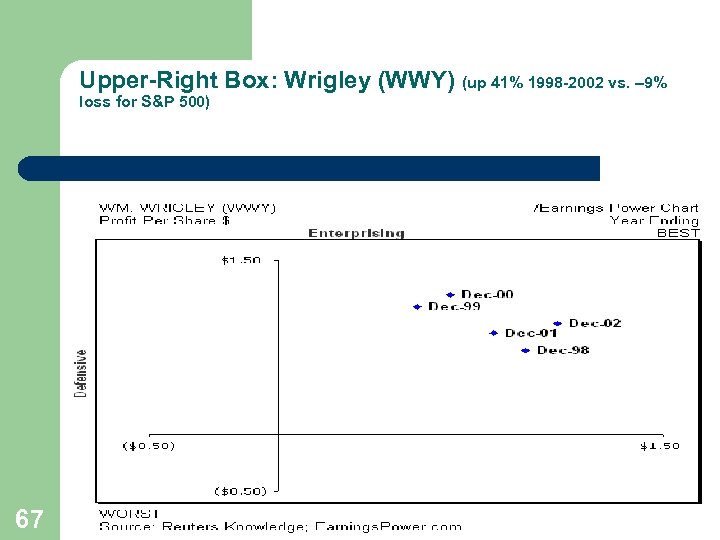
Upper-Right Box: Wrigley (WWY) (up 41% 1998 -2002 vs. – 9% loss for S&P 500) 67
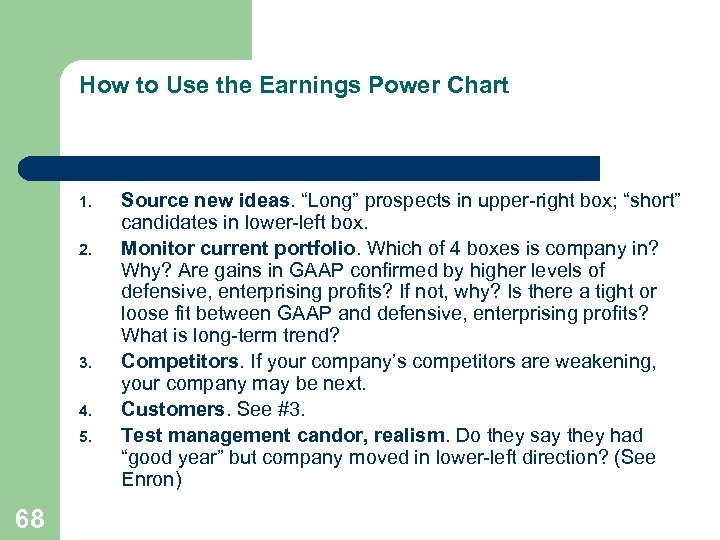
How to Use the Earnings Power Chart 1. 2. 3. 4. 5. 68 Source new ideas. “Long” prospects in upper-right box; “short” candidates in lower-left box. Monitor current portfolio. Which of 4 boxes is company in? Why? Are gains in GAAP confirmed by higher levels of defensive, enterprising profits? If not, why? Is there a tight or loose fit between GAAP and defensive, enterprising profits? What is long-term trend? Competitors. If your company’s competitors are weakening, your company may be next. Customers. See #3. Test management candor, realism. Do they say they had “good year” but company moved in lower-left direction? (See Enron)
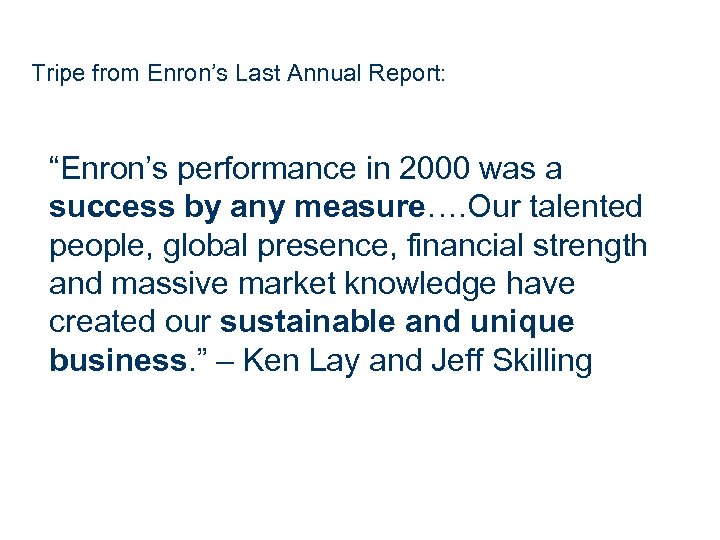
Tripe from Enron’s Last Annual Report: “Enron’s performance in 2000 was a success by any measure…. Our talented people, global presence, financial strength and massive market knowledge have created our sustainable and unique business. ” – Ken Lay and Jeff Skilling 69
Key Points: l l l 70 The Earnings Power Chart fixes the four (4) structural limitations of the GAAP income statement Regardless of size, industry, or capital structure, all companies are situated in one of Earnings Power Chart’s four (4) boxes Which box are the companies you own in? Why? The Earnings Power Chart is like looking both ways before you cross the street; it provides a margin of safety. There are companies in the lower-right, lower left, and upper-left boxes that will be great stocks. But life is short and our capital is limited. So unless you have a compelling reason, stick with upper-right box. These “twice-blessed” companies have the authentic earnings power that Wall Street prizes.
Source for an Earnings Power Chart Spreadsheet: http: //www. filespace. org/Sand 101/IETC 1. 2. zip n. b. , I did not make this spreadsheet so user beware. Also, do not ask me questions about this SS as I use my own proprietary version. 71
Section IV Hallmark of Profitable Growth: The Earnings Power Staircase 72
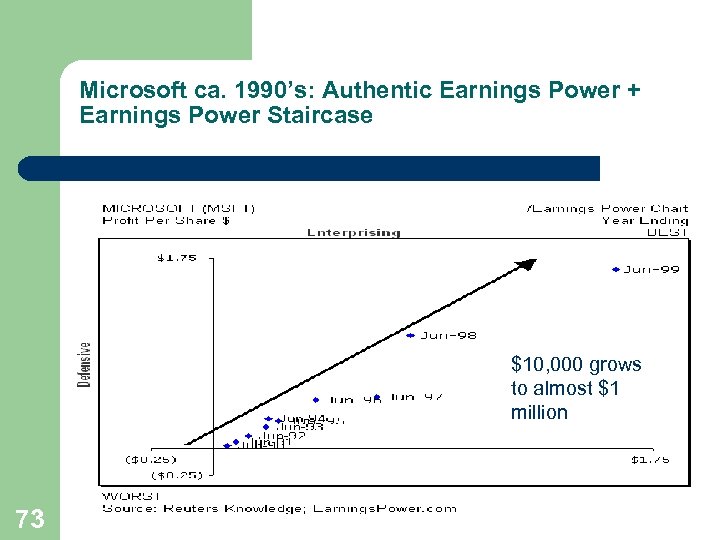
Microsoft ca. 1990’s: Authentic Earnings Power + Earnings Power Staircase $10, 000 grows to almost $1 million 73
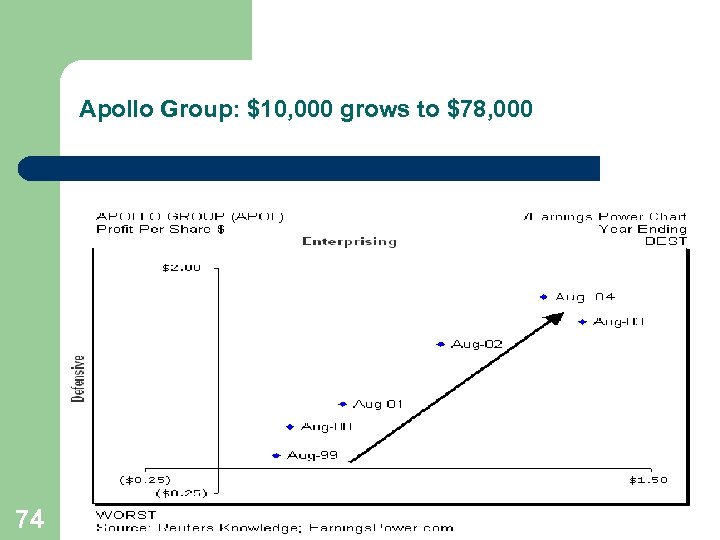
Apollo Group: $10, 000 grows to $78, 000 74
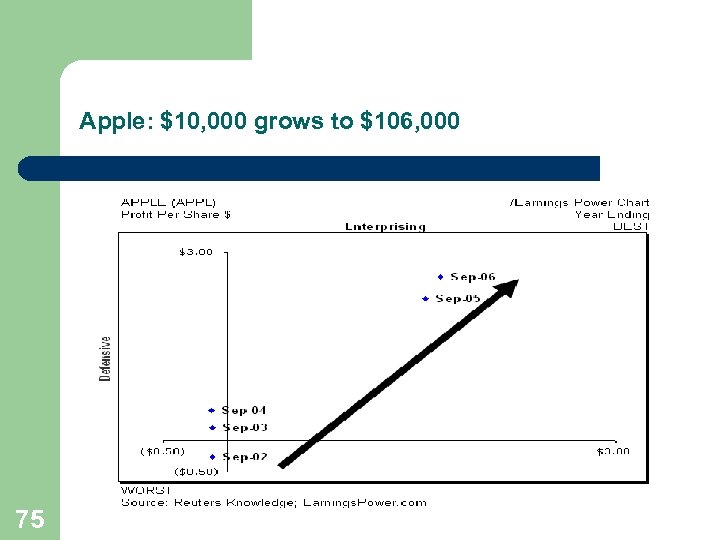
Apple: $10, 000 grows to $106, 000 75
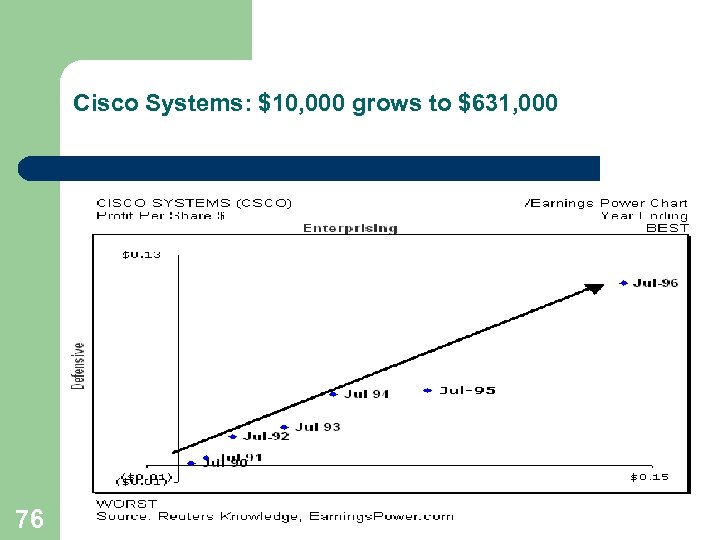
Cisco Systems: $10, 000 grows to $631, 000 76
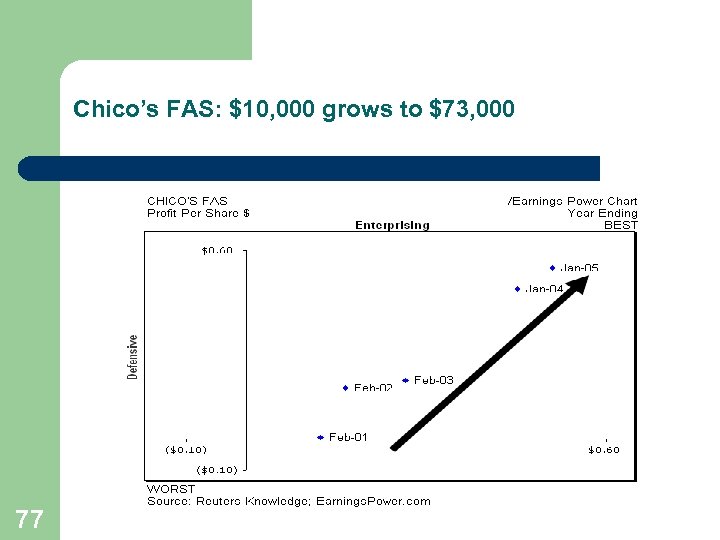
Chico’s FAS: $10, 000 grows to $73, 000 77
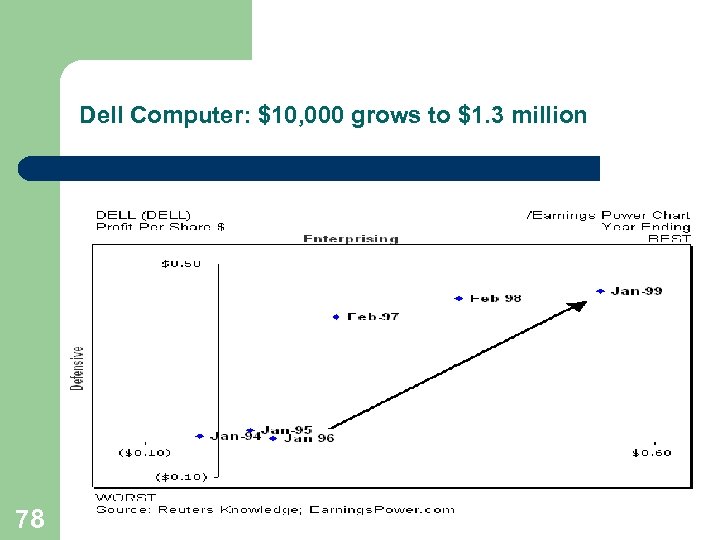
Dell Computer: $10, 000 grows to $1. 3 million 78
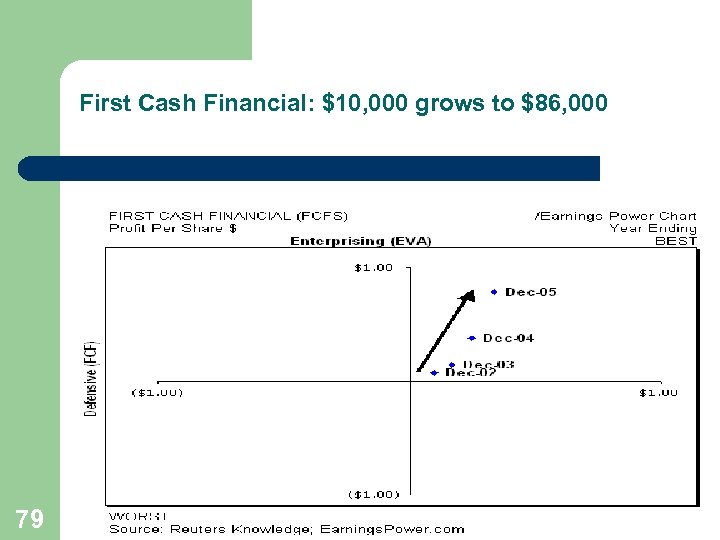
First Cash Financial: $10, 000 grows to $86, 000 79
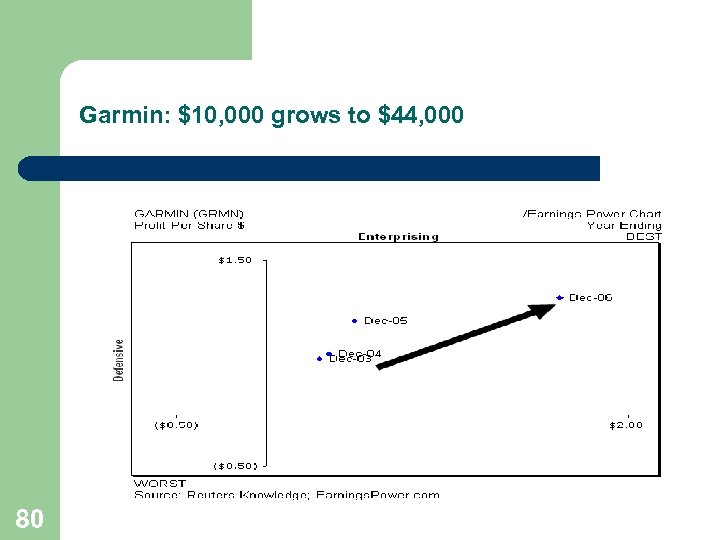
Garmin: $10, 000 grows to $44, 000 80
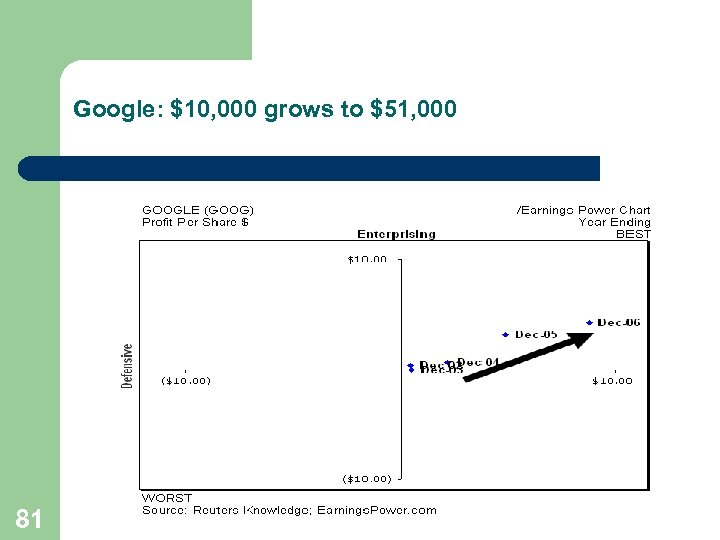
Google: $10, 000 grows to $51, 000 81
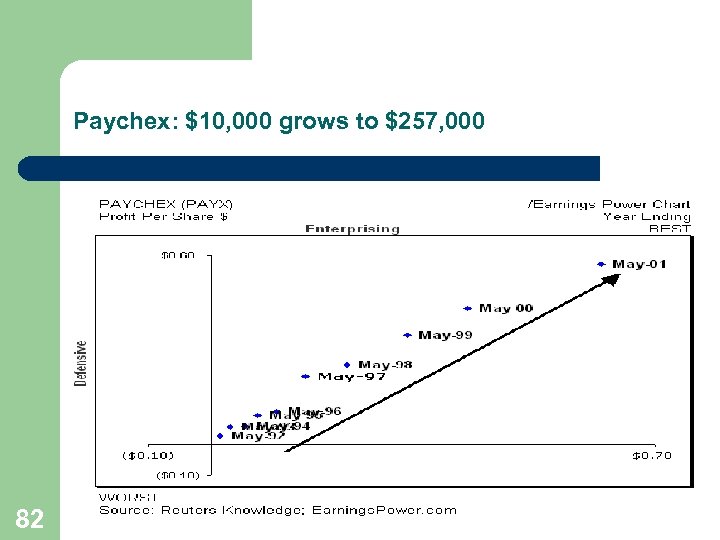
Paychex: $10, 000 grows to $257, 000 82
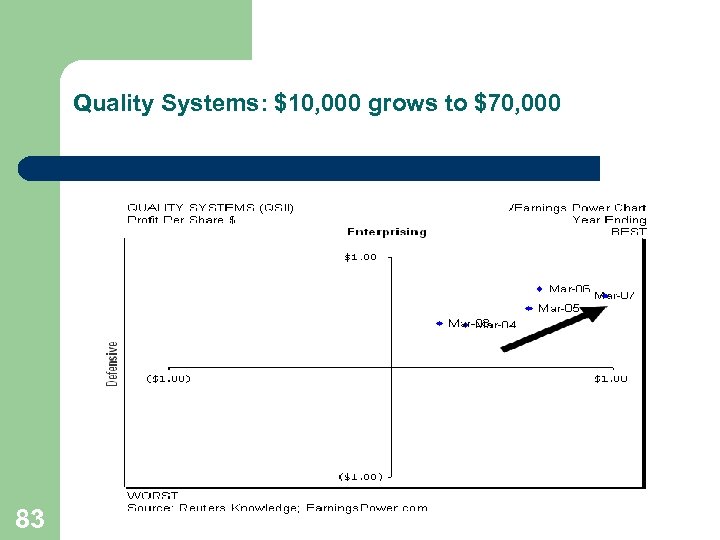
Quality Systems: $10, 000 grows to $70, 000 83
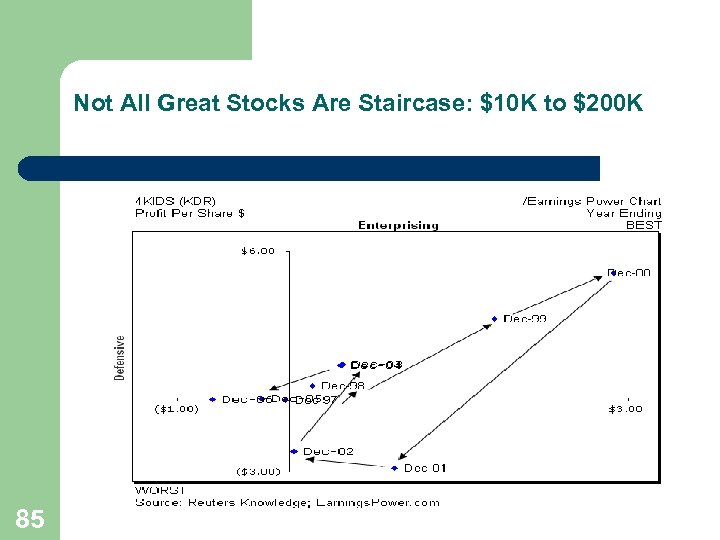
Not All Great Stocks Are Staircase: $10 K to $200 K 85
Section V Best Stock: 1997 -2006 86

The winner is: Hansen Natural
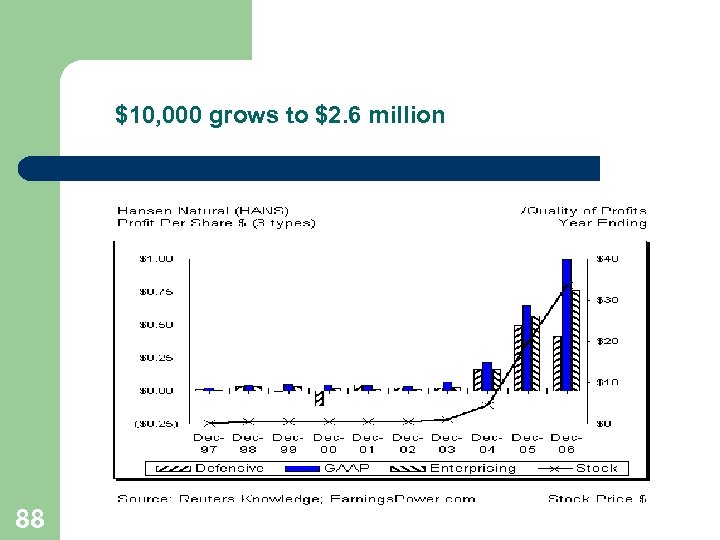
$10, 000 grows to $2. 6 million 88
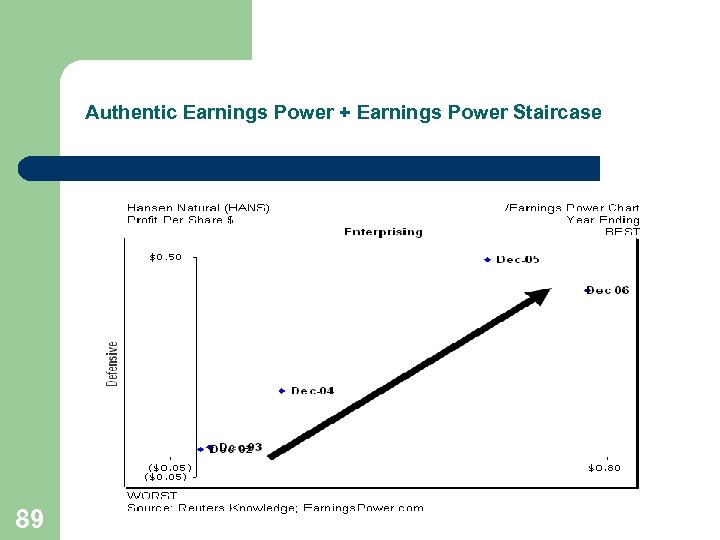
Authentic Earnings Power + Earnings Power Staircase 89
Section VI Putting It Altogether: The Earnings Power 1 -2 -3 Process 90
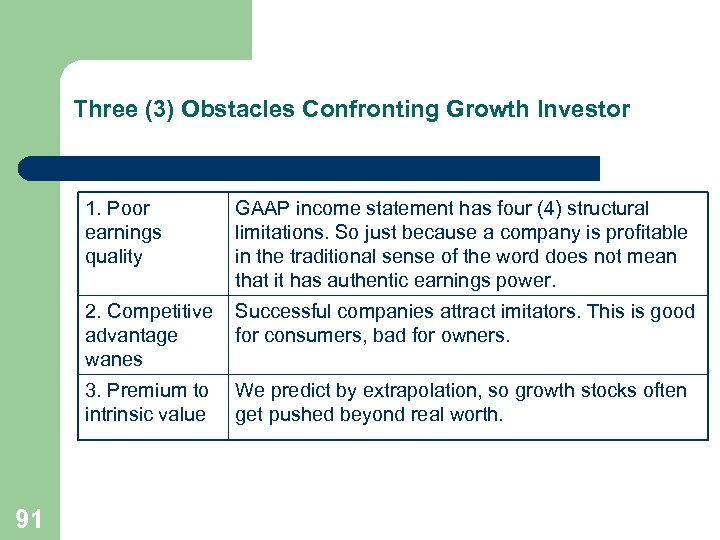
Three (3) Obstacles Confronting Growth Investor 1. Poor earnings quality 2. Competitive advantage wanes Successful companies attract imitators. This is good for consumers, bad for owners. 3. Premium to intrinsic value 91 GAAP income statement has four (4) structural limitations. So just because a company is profitable in the traditional sense of the word does not mean that it has authentic earnings power. We predict by extrapolation, so growth stocks often get pushed beyond real worth.
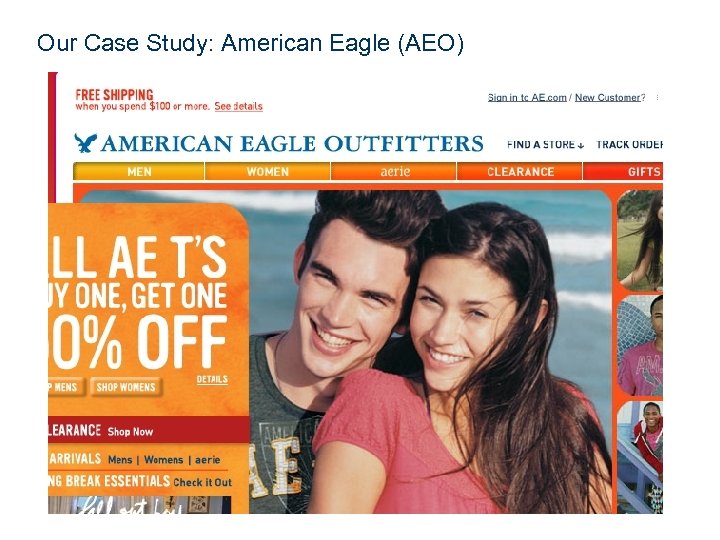
Our Case Study: American Eagle (AEO)
Highlights l l l l 93 Mall-based retailer with 926 stores in U. S. , Canada Three concepts: American Eagle, aerie, and Martin + Osa HQ’d in Pittsburgh Founded 1977 Ranked #2 “coolest brand” among 12 -19 year olds “We compete on trend but not ahead of trend. ” Schottenstein family with AEO since 1980; owns $750 million of stock. One of 10 best stocks for decade ending 2006
Three (3) Obstacles Confronting Growth Investor 1. Poor earnings quality 2. Competitive advantage wanes Successful companies attract imitators. This is good for consumers, bad for owners. 3. Premium to intrinsic value 94 GAAP income statement has four (4) structural limitations. So just because a company is profitable in the traditional sense of the word does not mean that it has authentic earnings power. We predict by extrapolation, so growth stocks often get pushed beyond real worth.
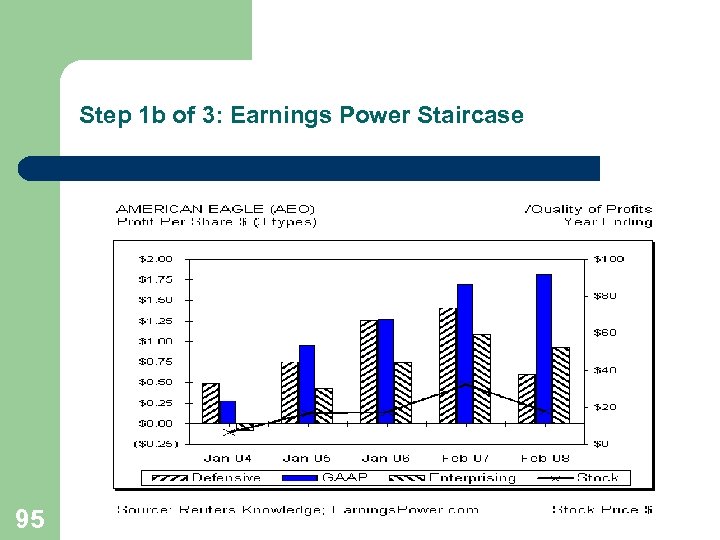
Step 1 b of 3: Earnings Power Staircase 95
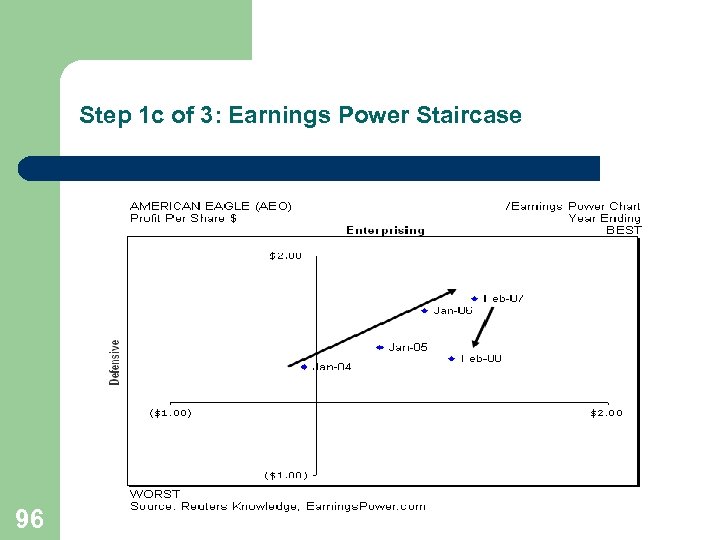
Step 1 c of 3: Earnings Power Staircase 96
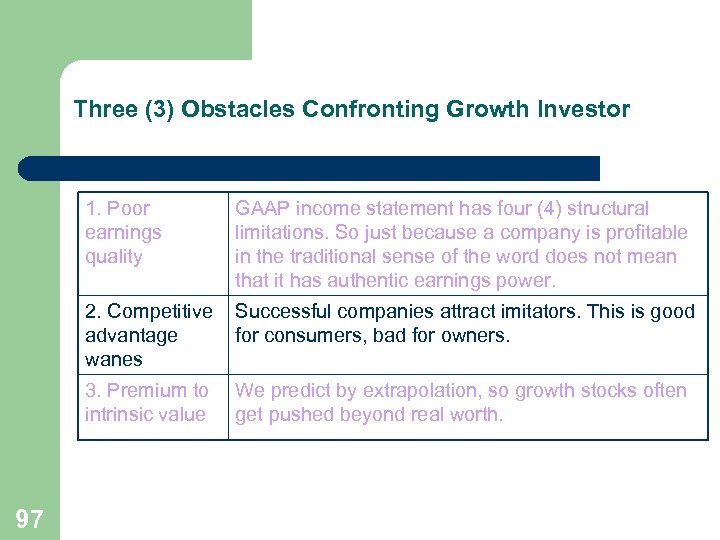
Three (3) Obstacles Confronting Growth Investor 1. Poor earnings quality 2. Competitive advantage wanes Successful companies attract imitators. This is good for consumers, bad for owners. 3. Premium to intrinsic value 97 GAAP income statement has four (4) structural limitations. So just because a company is profitable in the traditional sense of the word does not mean that it has authentic earnings power. We predict by extrapolation, so growth stocks often get pushed beyond real worth.
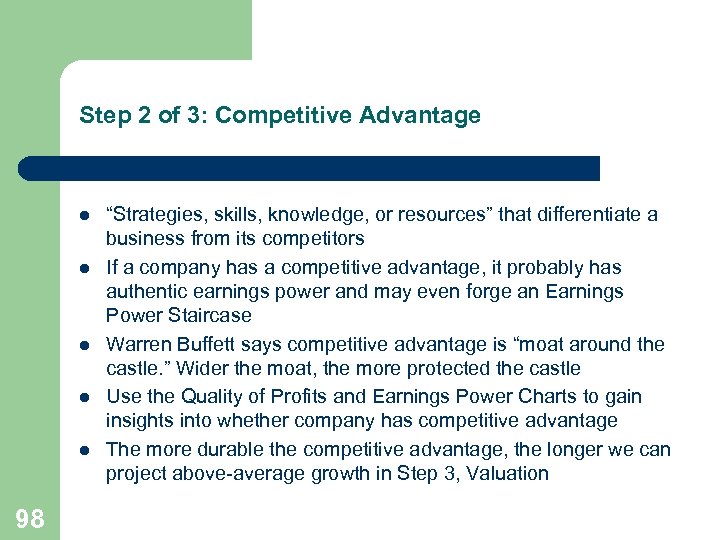
Step 2 of 3: Competitive Advantage l l l 98 “Strategies, skills, knowledge, or resources” that differentiate a business from its competitors If a company has a competitive advantage, it probably has authentic earnings power and may even forge an Earnings Power Staircase Warren Buffett says competitive advantage is “moat around the castle. ” Wider the moat, the more protected the castle Use the Quality of Profits and Earnings Power Charts to gain insights into whether company has competitive advantage The more durable the competitive advantage, the longer we can project above-average growth in Step 3, Valuation
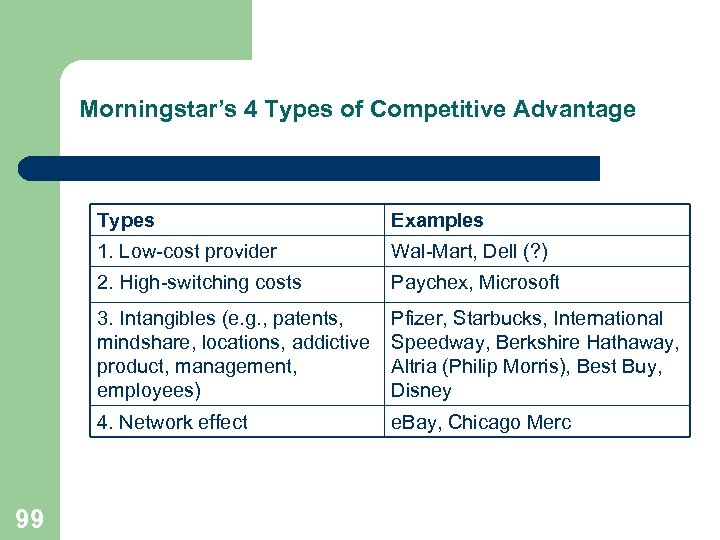
Morningstar’s 4 Types of Competitive Advantage Types 1. Low-cost provider Wal-Mart, Dell (? ) 2. High-switching costs Paychex, Microsoft 3. Intangibles (e. g. , patents, mindshare, locations, addictive product, management, employees) Pfizer, Starbucks, International Speedway, Berkshire Hathaway, Altria (Philip Morris), Best Buy, Disney 4. Network effect 99 Examples e. Bay, Chicago Merc
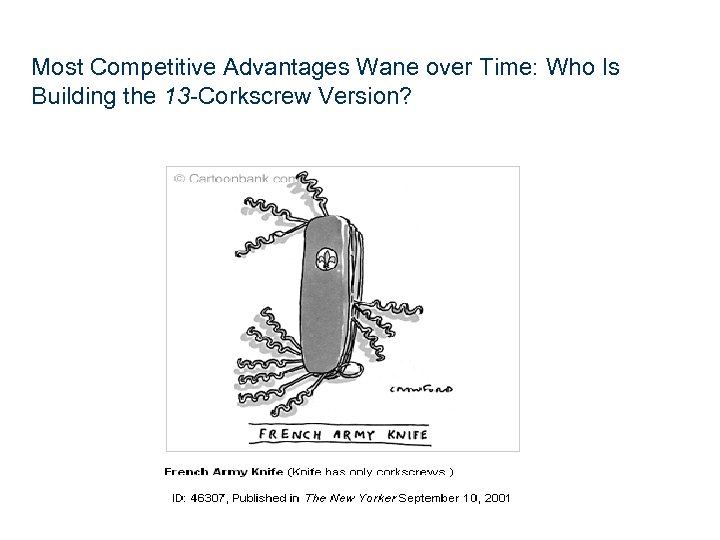
Most Competitive Advantages Wane over Time: Who Is Building the 13 -Corkscrew Version?
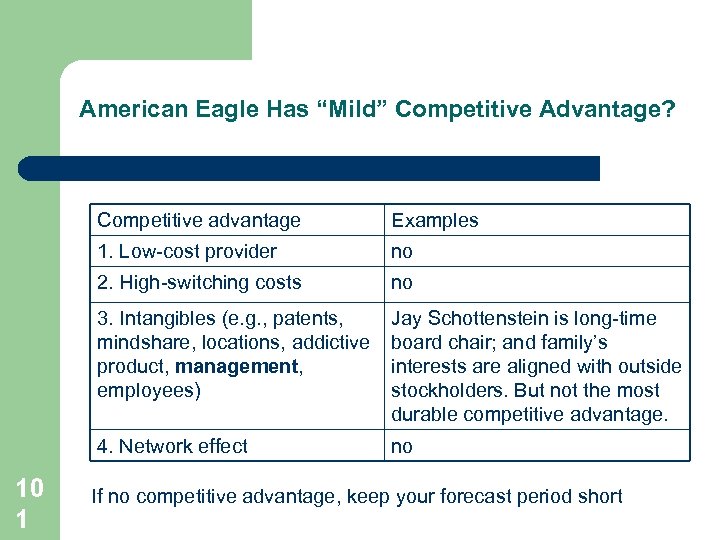
American Eagle Has “Mild” Competitive Advantage? Competitive advantage 1. Low-cost provider no 2. High-switching costs no 3. Intangibles (e. g. , patents, mindshare, locations, addictive product, management, employees) Jay Schottenstein is long-time board chair; and family’s interests are aligned with outside stockholders. But not the most durable competitive advantage. 4. Network effect 10 1 Examples no If no competitive advantage, keep your forecast period short
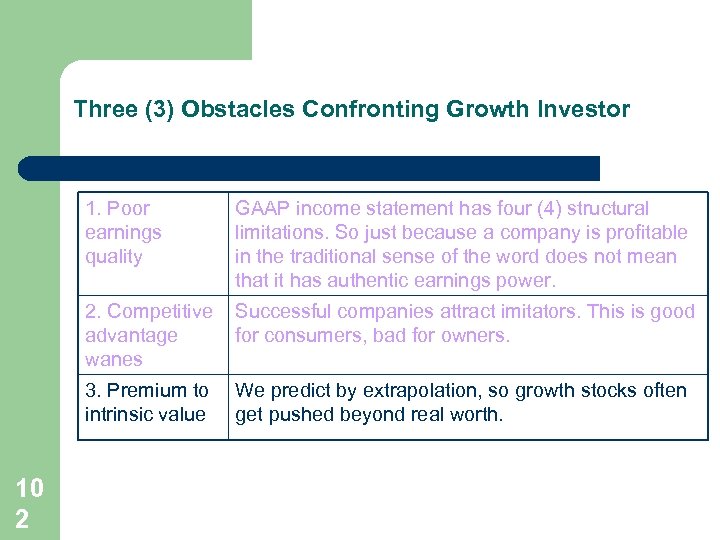
Three (3) Obstacles Confronting Growth Investor 1. Poor earnings quality 2. Competitive advantage wanes Successful companies attract imitators. This is good for consumers, bad for owners. 3. Premium to intrinsic value 10 2 GAAP income statement has four (4) structural limitations. So just because a company is profitable in the traditional sense of the word does not mean that it has authentic earnings power. We predict by extrapolation, so growth stocks often get pushed beyond real worth.
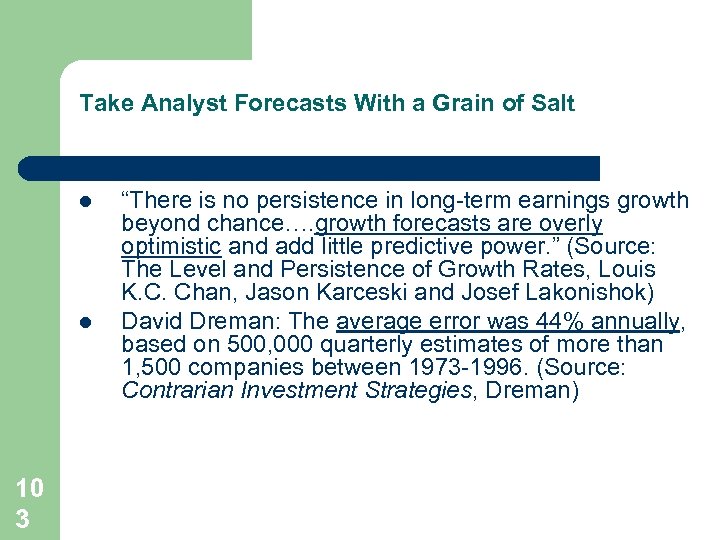
Take Analyst Forecasts With a Grain of Salt l l 10 3 “There is no persistence in long-term earnings growth beyond chance…. growth forecasts are overly optimistic and add little predictive power. ” (Source: The Level and Persistence of Growth Rates, Louis K. C. Chan, Jason Karceski and Josef Lakonishok) David Dreman: The average error was 44% annually, based on 500, 000 quarterly estimates of more than 1, 500 companies between 1973 -1996. (Source: Contrarian Investment Strategies, Dreman)
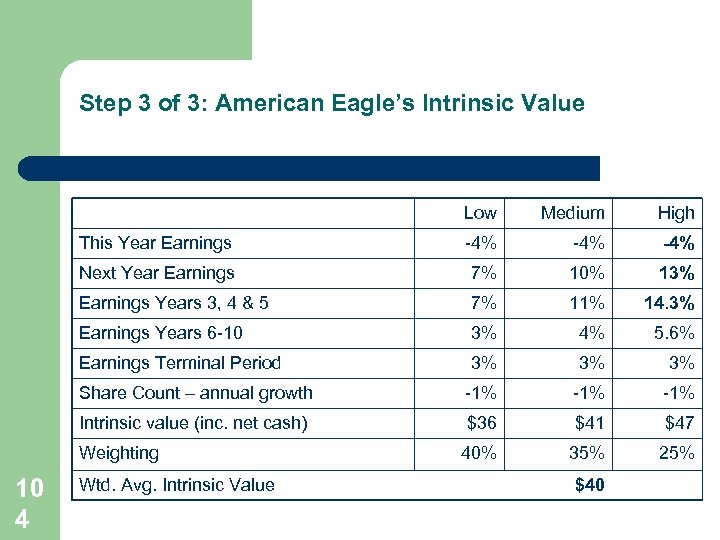
Step 3 of 3: American Eagle’s Intrinsic Value Low Medium High This Year Earnings -4% -4% Next Year Earnings 7% 10% 13% Earnings Years 3, 4 & 5 7% 11% 14. 3% Earnings Years 6 -10 3% 4% 5. 6% Earnings Terminal Period 3% 3% 3% Share Count – annual growth -1% -1% Intrinsic value (inc. net cash) $36 $41 $47 40% 35% 25% Weighting 10 4 Wtd. Avg. Intrinsic Value $40
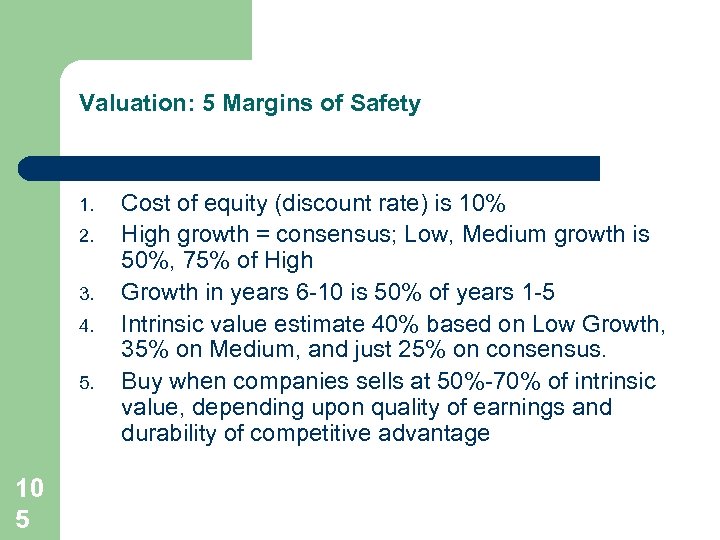
Valuation: 5 Margins of Safety 1. 2. 3. 4. 5. 10 5 Cost of equity (discount rate) is 10% High growth = consensus; Low, Medium growth is 50%, 75% of High Growth in years 6 -10 is 50% of years 1 -5 Intrinsic value estimate 40% based on Low Growth, 35% on Medium, and just 25% on consensus. Buy when companies sells at 50%-70% of intrinsic value, depending upon quality of earnings and durability of competitive advantage
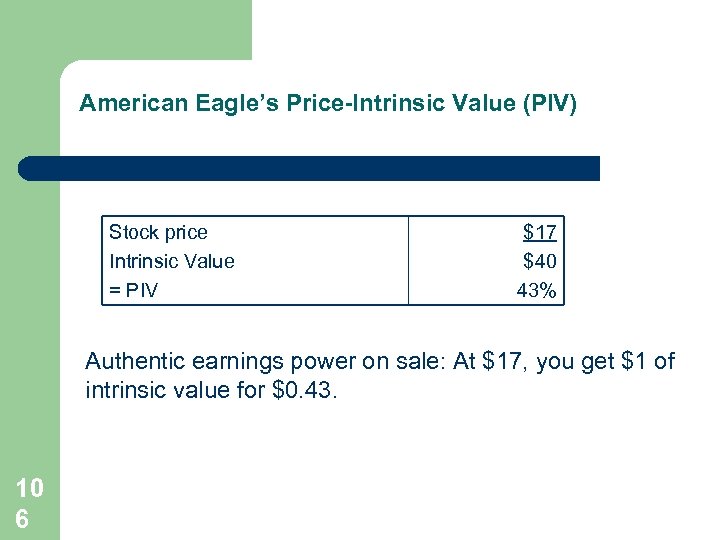
American Eagle’s Price-Intrinsic Value (PIV) Stock price Intrinsic Value = PIV $17 $40 43% Authentic earnings power on sale: At $17, you get $1 of intrinsic value for $0. 43. 10 6
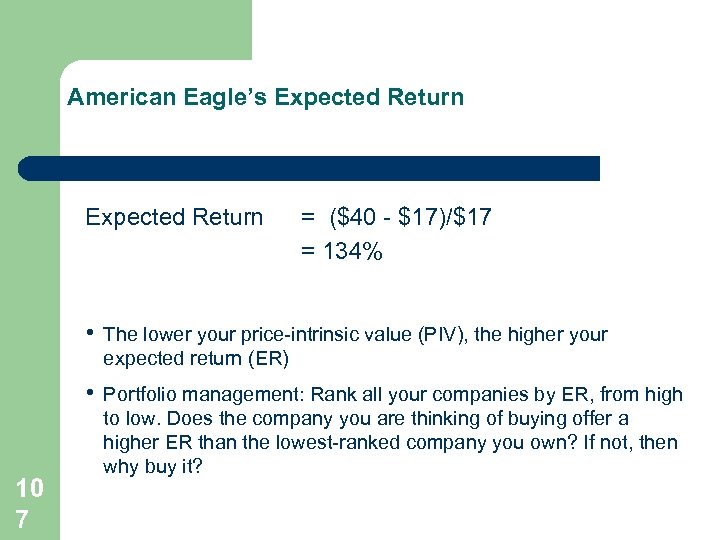
American Eagle’s Expected Return = ($40 - $17)/$17 = 134% • • 10 7 The lower your price-intrinsic value (PIV), the higher your expected return (ER) Portfolio management: Rank all your companies by ER, from high to low. Does the company you are thinking of buying offer a higher ER than the lowest-ranked company you own? If not, then why buy it?
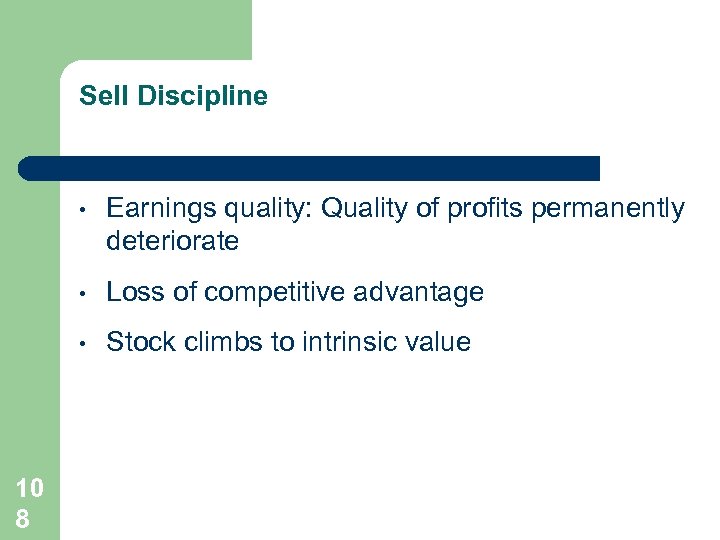
Sell Discipline • • Loss of competitive advantage • 10 8 Earnings quality: Quality of profits permanently deteriorate Stock climbs to intrinsic value
Summary Why “Ben Graham and the Growth Investor? ” 10 9
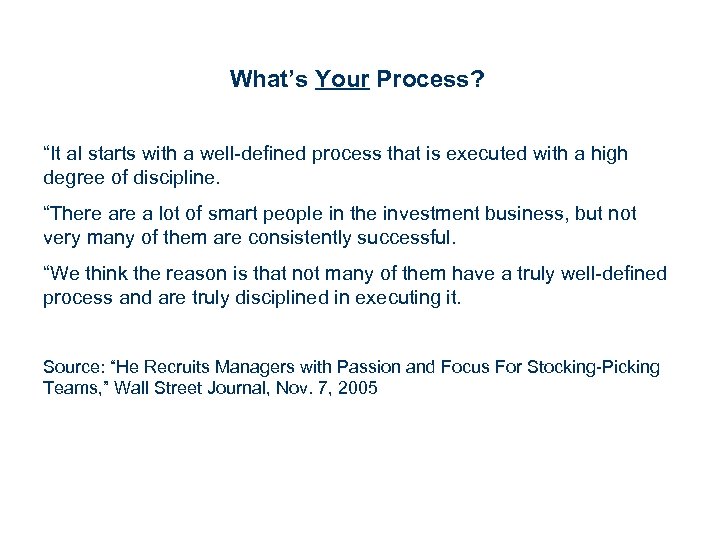
What’s Your Process? “It al starts with a well-defined process that is executed with a high degree of discipline. “There a lot of smart people in the investment business, but not very many of them are consistently successful. “We think the reason is that not many of them have a truly well-defined process and are truly disciplined in executing it. Source: “He Recruits Managers with Passion and Focus For Stocking-Picking Teams, ” Wall Street Journal, Nov. 7, 2005
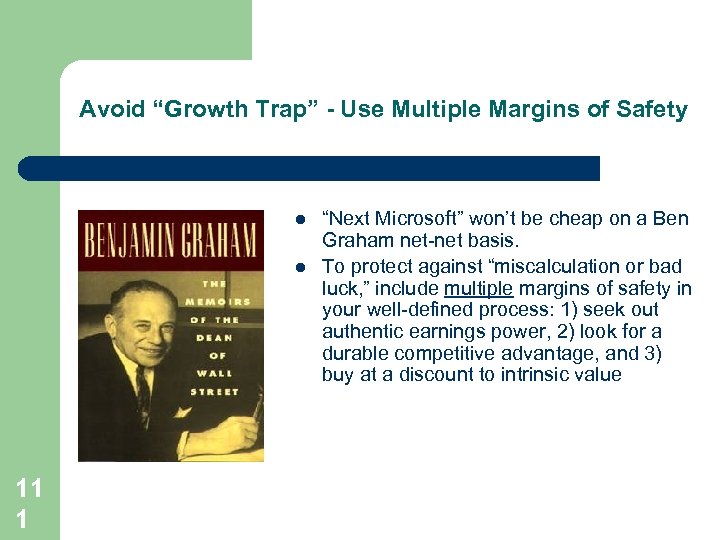
Avoid “Growth Trap” - Use Multiple Margins of Safety l l 11 1 “Next Microsoft” won’t be cheap on a Ben Graham net-net basis. To protect against “miscalculation or bad luck, ” include multiple margins of safety in your well-defined process: 1) seek out authentic earnings power, 2) look for a durable competitive advantage, and 3) buy at a discount to intrinsic value
Bonus Material for Bryant College: - Useful Writing Tips
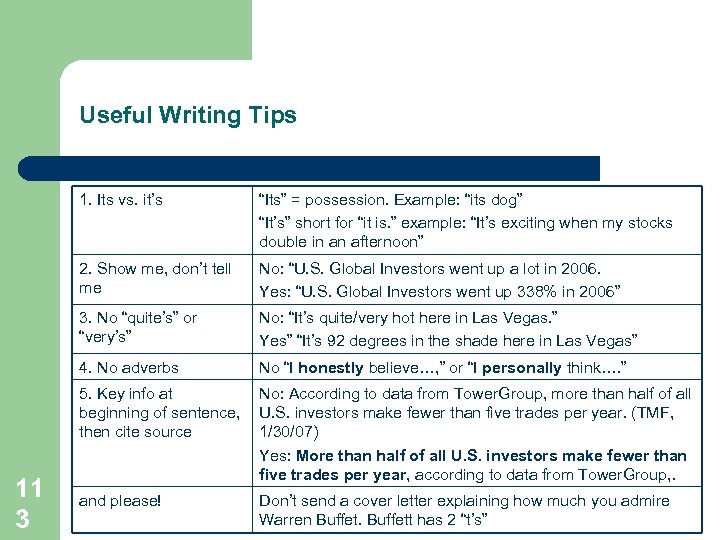
Useful Writing Tips 1. Its vs. it’s 2. Show me, don’t tell me No: “U. S. Global Investors went up a lot in 2006. Yes: “U. S. Global Investors went up 338% in 2006” 3. No “quite’s” or “very’s” No: “It’s quite/very hot here in Las Vegas. ” Yes” “It’s 92 degrees in the shade here in Las Vegas” 4. No adverbs No “I honestly believe…, ” or “I personally think…. ” 5. Key info at beginning of sentence, then cite source 11 3 “Its” = possession. Example: “its dog” “It’s” short for “it is. ” example: “It’s exciting when my stocks double in an afternoon” No: According to data from Tower. Group, more than half of all U. S. investors make fewer than five trades per year. (TMF, 1/30/07) Yes: More than half of all U. S. investors make fewer than five trades per year, according to data from Tower. Group, . and please! Don’t send a cover letter explaining how much you admire Warren Buffett has 2 “t’s”
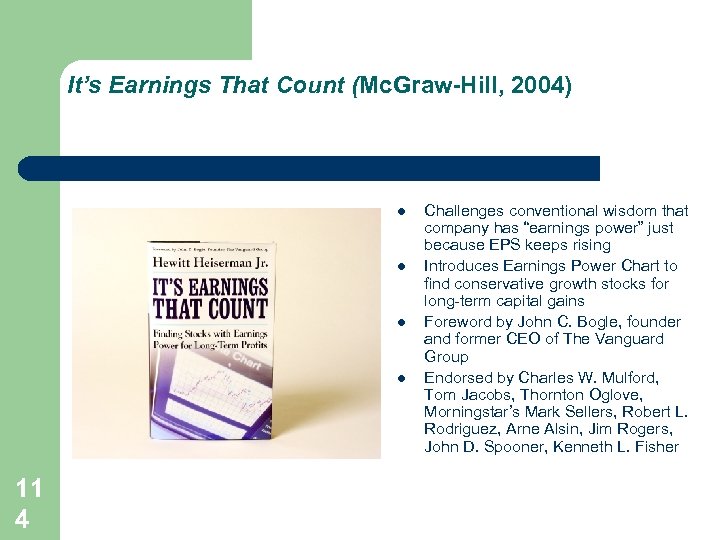
It’s Earnings That Count (Mc. Graw-Hill, 2004) l l 11 4 Challenges conventional wisdom that company has “earnings power” just because EPS keeps rising Introduces Earnings Power Chart to find conservative growth stocks for long-term capital gains Foreword by John C. Bogle, founder and former CEO of The Vanguard Group Endorsed by Charles W. Mulford, Tom Jacobs, Thornton Oglove, Morningstar’s Mark Sellers, Robert L. Rodriguez, Arne Alsin, Jim Rogers, John D. Spooner, Kenneth L. Fisher
Biography 11 5 Hewitt Heiserman Jr. conceived the Earnings Power Chart and the Earnings Power Staircase, which are featured in his book "It's Earnings That Count" (Mc. Graw-Hill, 2004). He also writes a column on earnings power for Real. Money. com. Heiserman graduated from Kenyon College with Distinction in History, and also received the Faculty Award for Distinguished Achievement. Heiserman is a member of the Boston Security Analyst Society and the CFA Institute. Heiserman's work on earnings quality has appeared in The. Street. com, Business. Week, CBS Market. Watch, Business 2. 0, Better Investing, The Motley Fool, Complete Growth Investor, Barron's, and the Haverford Trust Company Adviser. Heiserman has spoken to the New York Society of Security Analysis, the Boston Security Analysts Society, Fidelity Management an Research, the Babson Investment Management Association, the American Association of Individual Investors, and Complete Growth Investors on "Ben Graham and the Growth Investor. " Heiserman is a finance instructor for Gerson. Lehrman Group. He is a trustee for a land conservation group. To learn more, visit www. Earnings. Power. com
Questions? Hewitt. Heiserman@Earnings. Power. com www. Earnings. Power. com 11 6
Скачать презентацию Ben Graham and the Growth Investor Presented to
85be2a99ca7357e1bb063aa5f3a48a65.ppt