 Скачать презентацию Bellringer August 15 2017 List the 8 parts
6fb495ccbba583601df1f9681816feee.ppt
- Количество слайдов: 21



Bellringer: August 15, 2017 List the 8 parts of speech on your own paper. We will add notes to this paper later! Here’s the first one for you… 1. Noun
Answers 1. 2. 3. 4. 5. 6. 7. 8. noun pronoun adjective verb adverb conjunction interjection preposition

PARTS OF SPEECH FLIP-FOLIO (quick reference guide) Cut each piece out along the solid black lines. 2. Stack as shown on example page, with the smallest piece in front, and with all the pieces even at the top. 3. I will come around and staple at the top for you. 4. You may use this to take additional notes by folding the pages up and writing on the page above. 1.
8 Parts of Speech Mrs. Wilson 7 th Grade Language Arts
Common Noun People, places, things, or ideas. Examples: People: boy, girl, baker, musician, teacher Places: library, school, mall, bathroom Things: pencil, cell phone, carpet, ring Ideas: love, hate, beauty Now, write 3 examples of nouns on your own.
Proper Noun Proper nouns are specific nouns. Proper nouns will always be capitalized. Examples: People: Bennett, Mrs. Chase, Drew Brees, etc. Places: Ridgeland High School, Northpark Mall, New York City, Mississippi, etc. Things: Declaration of Independence, Volkswagen Beetle, Apple i. Phone, etc. Write three examples of your own!
Concrete & Abstract Nouns Concrete nouns are things that you can experience through your five senses: sight, smell, hearing, taste, and touch. An abstract noun is a quality, a concept, or an idea.
Singular, Plural, & Collective Singular noun- names one person, place, thing, or idea, Plural noun- names more than one person, place, thing, or idea. Collective noun- a noun that denotes a group Write down an example of each!
Collective Nouns army audience board cabinet class committee company corporation family
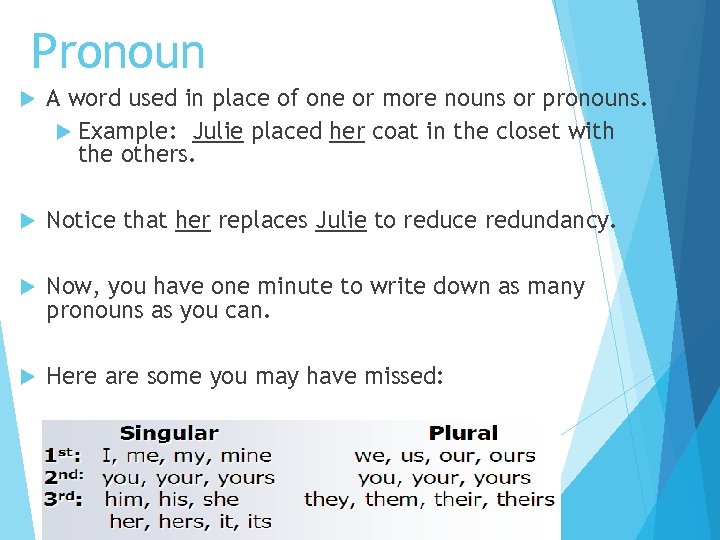
Pronoun A word used in place of one or more nouns or pronouns. Example: Julie placed her coat in the closet with the others. Notice that her replaces Julie to reduce redundancy. Now, you have one minute to write down as many pronouns as you can. Here are some you may have missed:
Adjective is a word that modifies or describes a noun or pronoun. Adjectives answer these questions: Which one? What kind? How many? How much? Examples: Which questions do these adjectives answer? • My aunt lives in the pink house on the left. • Wow! His furry back really creeps me out! List three examples of adjectives of your own.
Sensory Details n What are sensory details? n Sensory details use your senses to describe. Most sensory details are adjectives! What are your senses? Smell (nose) rosy, dank, arid Hear (ears) bang, clank Taste (mouth) bitter, sour n Sight (eyes) bright, dark Touch (hands and feet) fluffy, rough List two examples of each sense on your own!
Verb is a word that expresses action or state of being. (It’s what you do!) Examples: Find the verbs! I bowled a great game tonight. She was nervous in her interview. Make a list of three verbs!
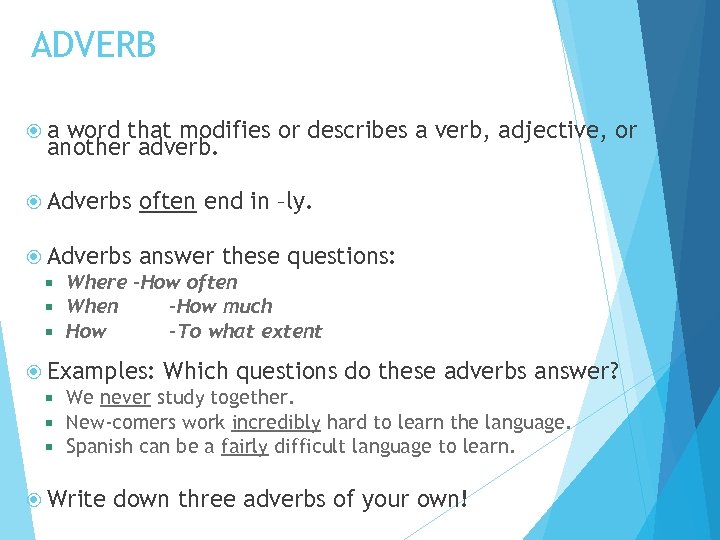
ADVERB a word that modifies or describes a verb, adjective, or another adverb. Adverbs often end in –ly. Adverbs answer these questions: Where -How often When -How much How -To what extent Examples: Which questions do these adverbs answer? We never study together. New-comers work incredibly hard to learn the language. Spanish can be a fairly difficult language to learn. Write down three adverbs of your own!
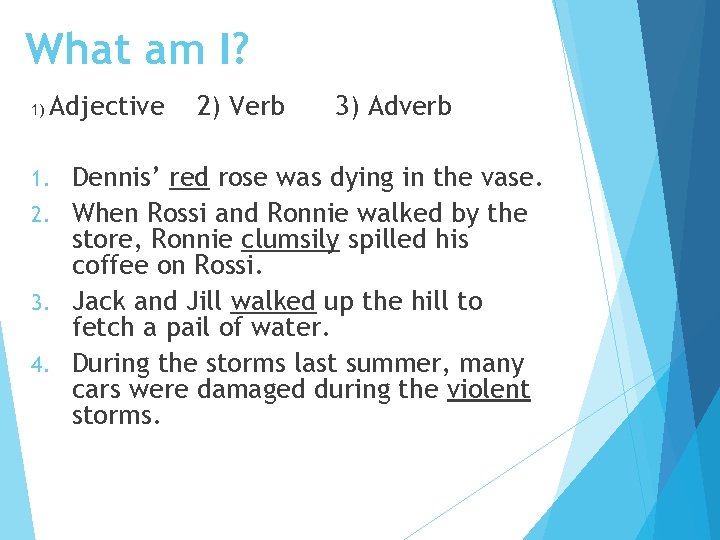
What am I? 1) Adjective 2) Verb 3) Adverb Dennis’ red rose was dying in the vase. 2. When Rossi and Ronnie walked by the store, Ronnie clumsily spilled his coffee on Rossi. 3. Jack and Jill walked up the hill to fetch a pail of water. 4. During the storms last summer, many cars were damaged during the violent storms. 1.
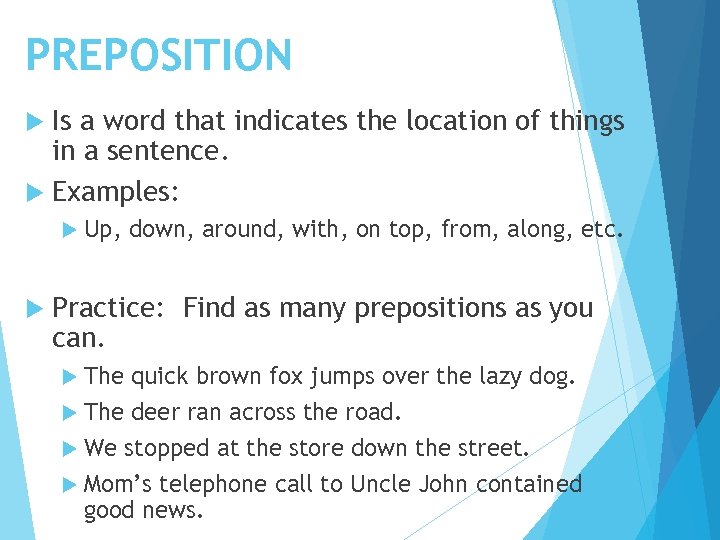
PREPOSITION Is a word that indicates the location of things in a sentence. Examples: Up, down, around, with, on top, from, along, etc. Practice: Find as many prepositions as you can. The quick brown fox jumps over the lazy dog. The deer ran across the road. We stopped at the store down the street. Mom’s telephone call to Uncle John contained good news.
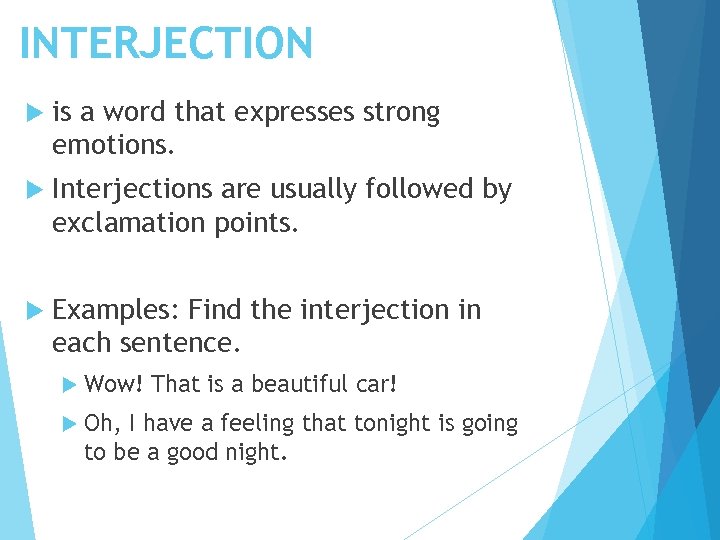
INTERJECTION is a word that expresses strong emotions. Interjections are usually followed by exclamation points. Examples: Find the interjection in each sentence. Wow! Oh, That is a beautiful car! I have a feeling that tonight is going to be a good night.
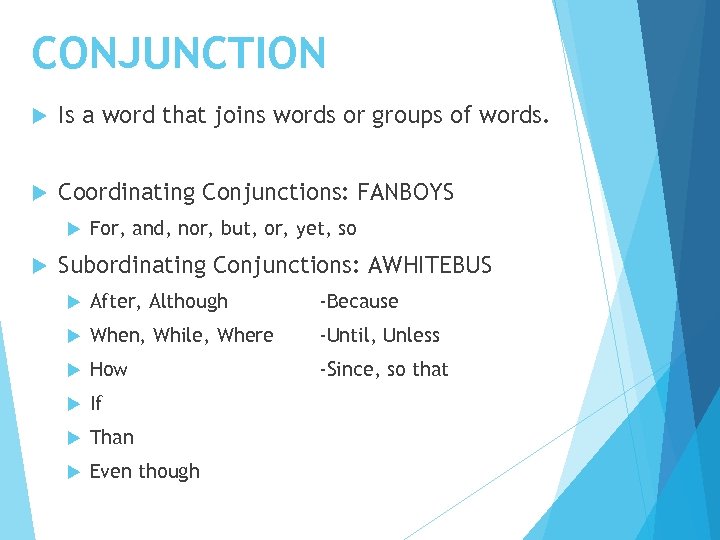
CONJUNCTION Is a word that joins words or groups of words. Coordinating Conjunctions: FANBOYS For, and, nor, but, or, yet, so Subordinating Conjunctions: AWHITEBUS After, Although -Because When, While, Where -Until, Unless How -Since, so that If Than Even though
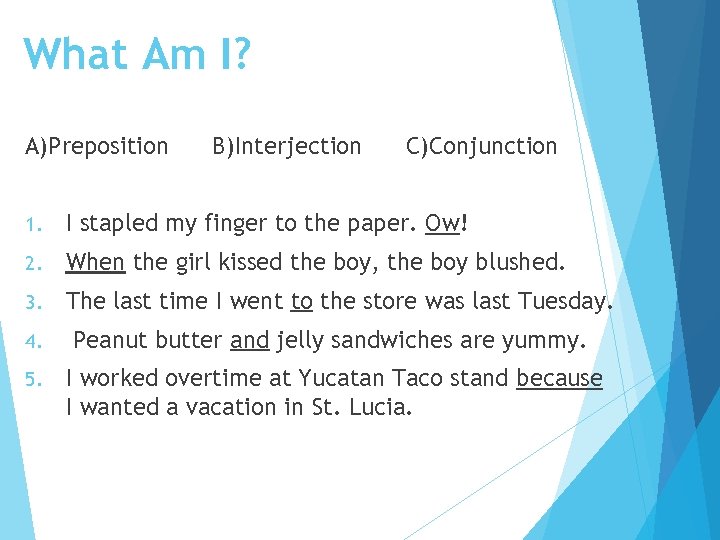
What Am I? A)Preposition B)Interjection C)Conjunction 1. I stapled my finger to the paper. Ow! 2. When the girl kissed the boy, the boy blushed. 3. The last time I went to the store was last Tuesday. 4. Peanut butter and jelly sandwiches are yummy. 5. I worked overtime at Yucatan Taco stand because I wanted a vacation in St. Lucia.
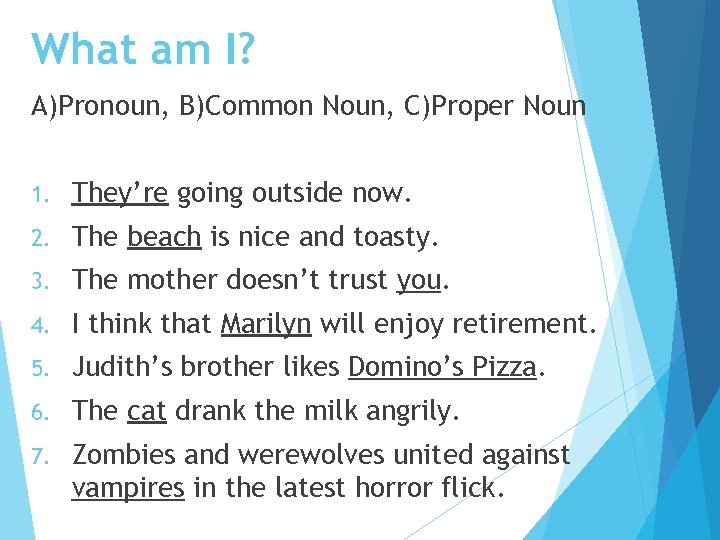
What am I? A)Pronoun, B)Common Noun, C)Proper Noun 1. They’re going outside now. 2. The beach is nice and toasty. 3. The mother doesn’t trust you. 4. I think that Marilyn will enjoy retirement. 5. Judith’s brother likes Domino’s Pizza. 6. The cat drank the milk angrily. 7. Zombies and werewolves united against vampires in the latest horror flick.
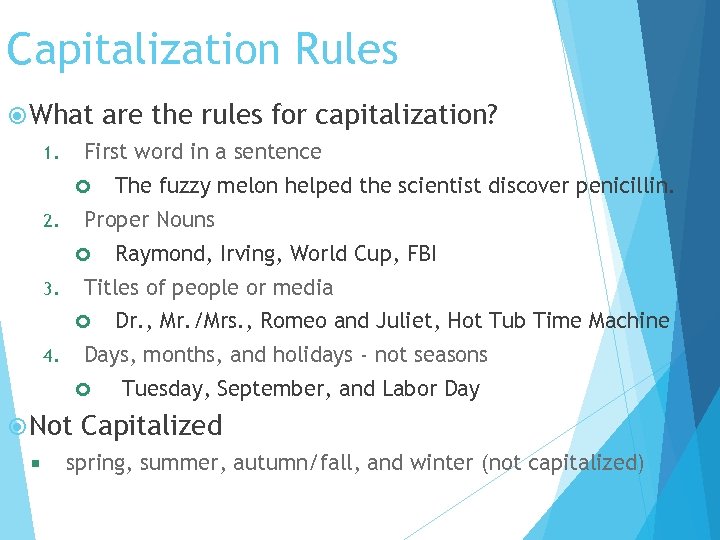
Capitalization Rules What First word in a sentence 1. The fuzzy melon helped the scientist discover penicillin. Proper Nouns 2. Raymond, Irving, World Cup, FBI Titles of people or media 3. Dr. , Mr. /Mrs. , Romeo and Juliet, Hot Tub Time Machine Days, months, and holidays - not seasons 4. Not are the rules for capitalization? Tuesday, September, and Labor Day Capitalized spring, summer, autumn/fall, and winter (not capitalized)
Скачать презентацию Bellringer August 15 2017 List the 8 parts
6fb495ccbba583601df1f9681816feee.ppt