 Скачать презентацию BELL RINGER We are going to use
ce04b7898bf43e63387d5b6903d95fcd.ppt
- Количество слайдов: 40



BELL RINGER • We are going to use your homework scenarios for the Bill of Rights for a quiz. Get a piece of paper out or index card and number it 1 -10. • Make sure I have your homework!

3 BRANCHES

Government: How it works for you
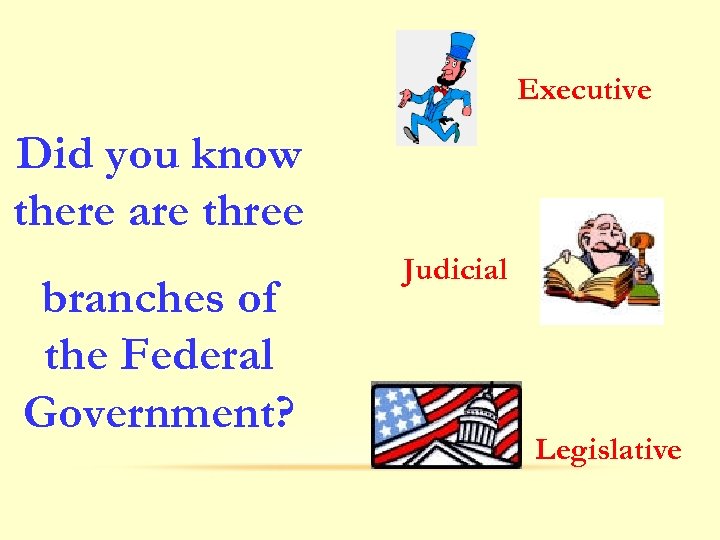
Executive Did you know there are three branches of the Federal Government? Judicial Legislative

Executive Branch The President of The United States is the head of the Executive Branch
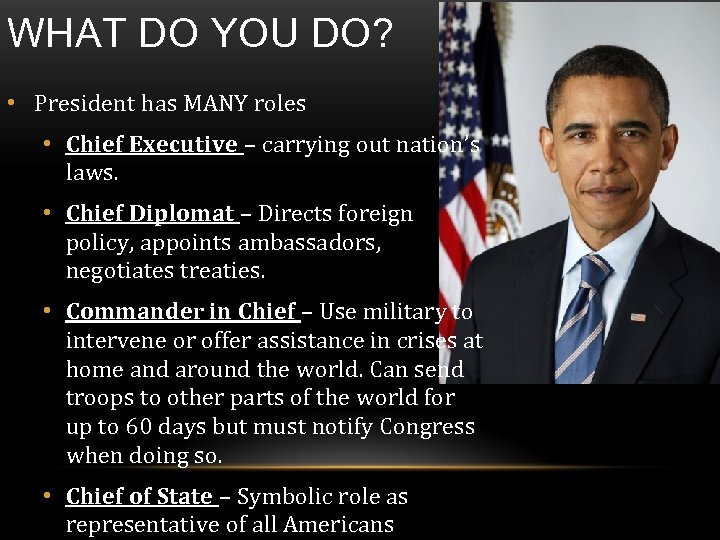
WHAT DO YOU DO? • President has MANY roles • Chief Executive – carrying out nation’s laws. • Chief Diplomat – Directs foreign policy, appoints ambassadors, negotiates treaties. • Commander in Chief – Use military to intervene or offer assistance in crises at home and around the world. Can send troops to other parts of the world for up to 60 days but must notify Congress when doing so. • Chief of State – Symbolic role as representative of all Americans
The Executive Branch also includes the Vice President and other officials, such as members of the cabinet. • The Secretary of State • The Secretary of Agriculture • The Secretary of the Interior • The Secretary of Commerce • The Secretary of Education • The Secretary of Health and Human Services • The Secretary of Homeland Security • The Secretary of Labor • The Secretary of the Treasury • The Secretary of Energy • The Secretary of Defense • The Attorney General • The Secretary of Housing and Urban Development • The Secretary of Transportation • The Secretary of Veterans' Affairs
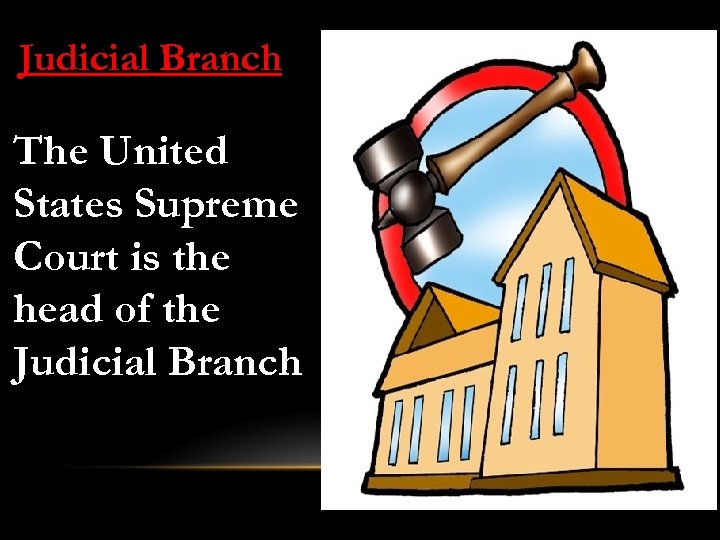
Judicial Branch The United States Supreme Court is the head of the Judicial Branch
The judicial branch oversees the court system of the United States. • Explains the meaning of the Constitution and laws passed by Congress • Rules on whether something is unconstitutional or constitutional
• On the Supreme Court there are nine justices, or judges; eight associate and one chief justice. • Judges are nominated by the President and approved by the Senate. • Have no term limits. • Supreme Court is the highest court in the land. • Its decisions are final, and no other court can overrule their decisions.
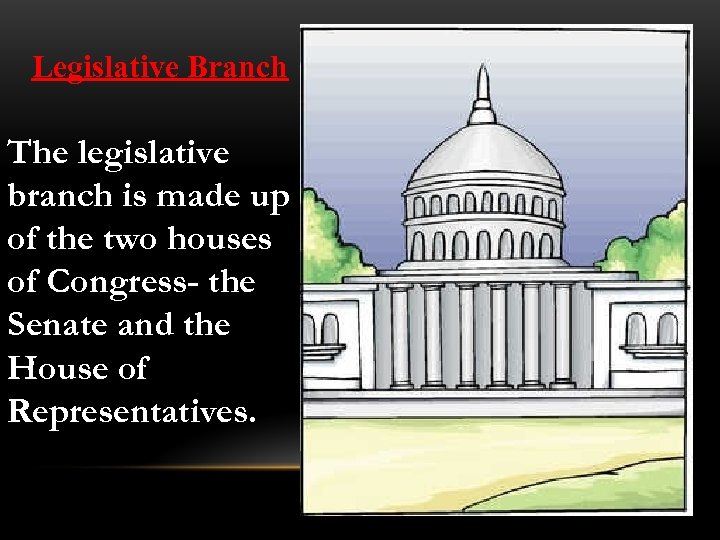
Legislative Branch The legislative branch is made up of the two houses of Congress- the Senate and the House of Representatives.
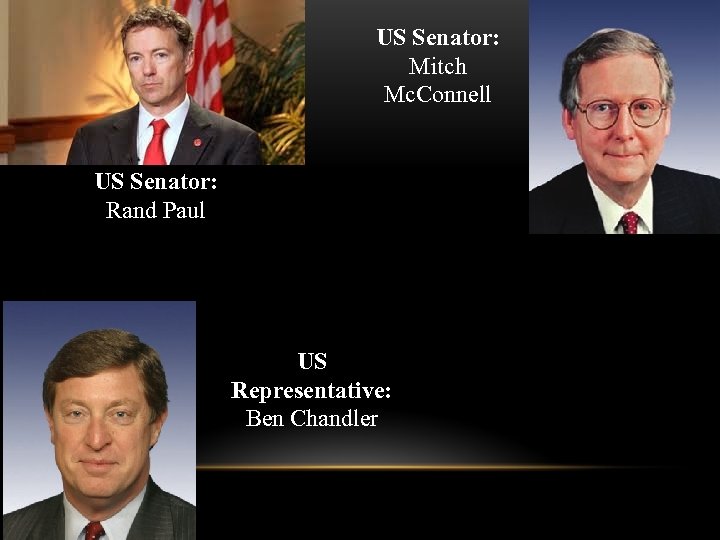
US Senator: Mitch Mc. Connell US Senator: Rand Paul US Representative: Ben Chandler
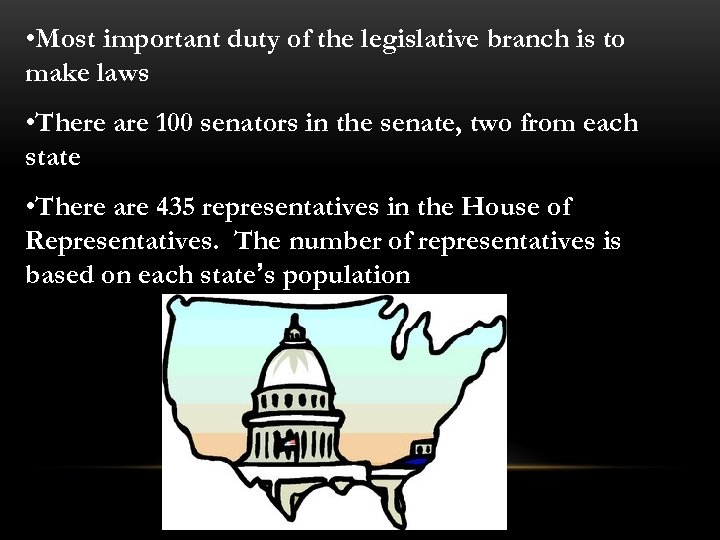
• Most important duty of the legislative branch is to make laws • There are 100 senators in the senate, two from each state • There are 435 representatives in the House of Representatives. The number of representatives is based on each state’s population
OTHER DUTIES • Government cannot spend money unless congress appropriates funds. • All tax and spending bills must originate in the House of Representatives. • House of Representatives can impeach any federal official. • Only Senate can ratify treaties, confirm presidential appointments of federal officials, such as department heads, ambassadors, and federal judges. • Must represent their constituents. Promote and protect your state’s interests as well as those of the nation.
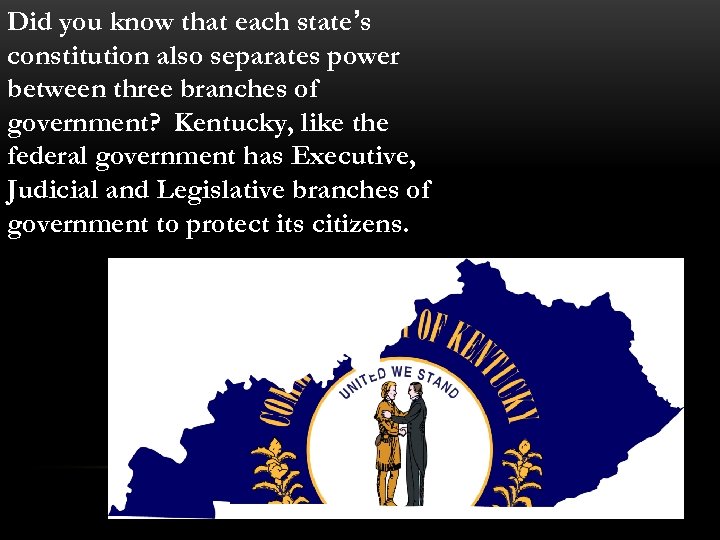
Did you know that each state’s constitution also separates power between three branches of government? Kentucky, like the federal government has Executive, Judicial and Legislative branches of government to protect its citizens.

The Governor is the head of the state executive branch. The executive branch also includes the Lieutenant Governor, Attorney General, Secretary of State, State Treasurer, State Auditor and the State Land Commissioner.
The state judicial branch is made up of five court systems: • The Kentucky Supreme Court • Kentucky Court of Appeals • Circuit Courts • District Courts • City Courts
At the top level is the Supreme Court where there are seven justices, or judges: six associate justices and one chief justice. Unlike the federal judicial branch the state Supreme Court Justices are elected by the people
The state legislative branch, like the federal legislative branch is made up of two houses- the Senate and the House of Representatives. The state legislative branch also creates laws; there are 38 senators and 100 representatives. They meet every odd year in January at the State Capitol in Frankfort for their regular session.

State Senator RJ Palmer State Representative Richard Henderson
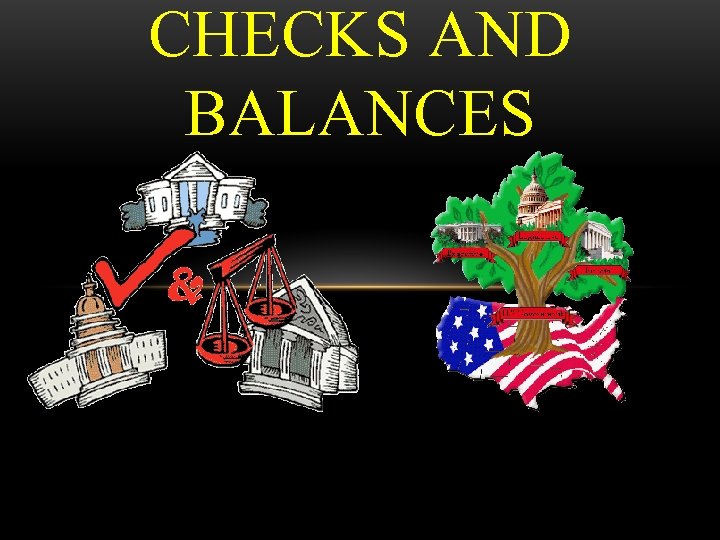
CHECKS AND BALANCES Mr. Blais Foundations of America

DIVIDING THE FEDERAL GOVERNMENT • The Founding Fathers believed that the only way to keep the Federal Government from gaining too much power was to divide it into three parts: • The Legislature – Makes Laws • The Executive – Enforces Laws • The Judicial – Interprets Laws
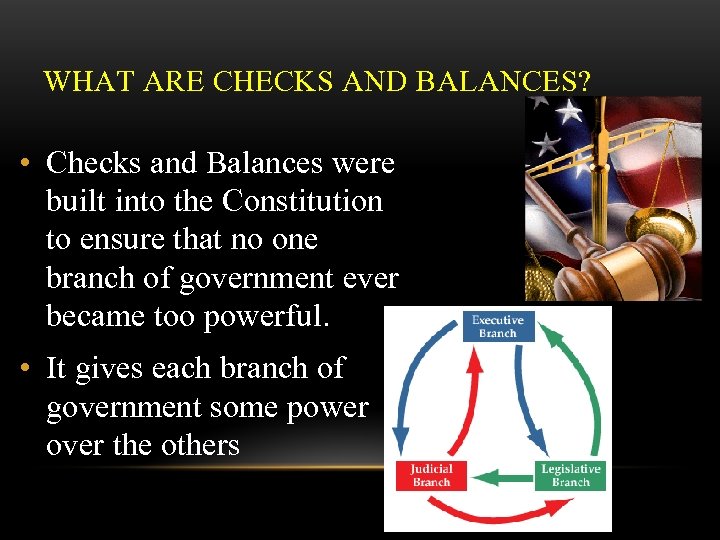
WHAT ARE CHECKS AND BALANCES? • Checks and Balances were built into the Constitution to ensure that no one branch of government ever became too powerful. • It gives each branch of government some power over the others
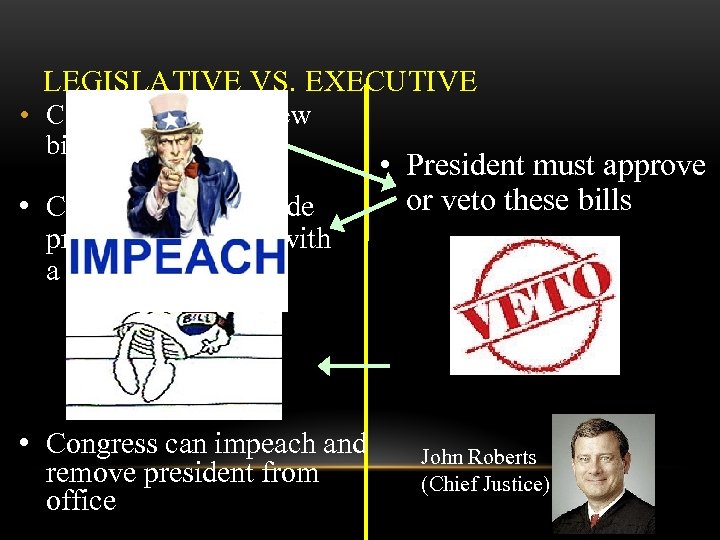
LEGISLATIVE VS. EXECUTIVE • Congress can pass new bills • Congress can override presidential vetoes with a 2/3 majority vote • President must approve or veto these bills • The Senate must approve • President can make treaties and appoint all appointments and Supreme Court Justices treaties • Congress can impeach and John Roberts remove president from (Chief Justice) office
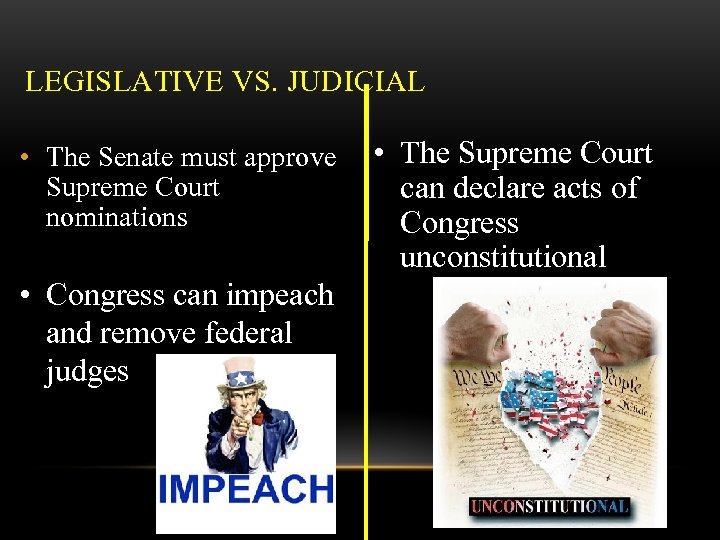
LEGISLATIVE VS. JUDICIAL • The Senate must approve Supreme Court nominations • Congress can impeach and remove federal judges • The Supreme Court can declare acts of Congress unconstitutional
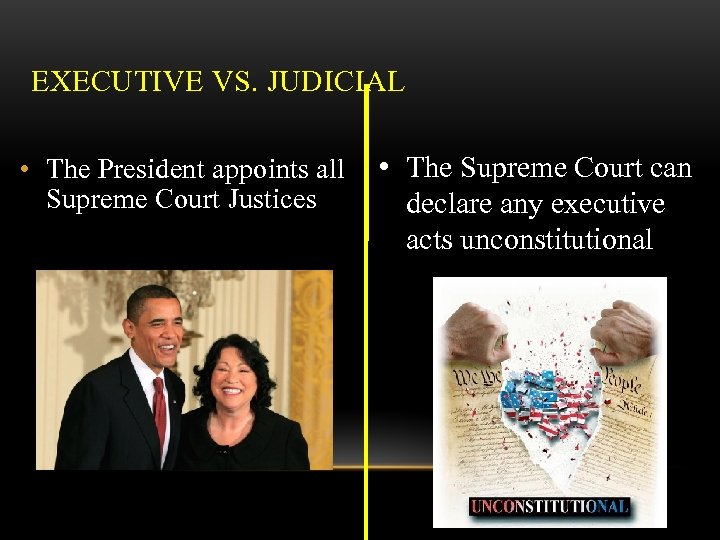
EXECUTIVE VS. JUDICIAL • The President appoints all Supreme Court Justices • Newest Supreme Court Justice: Sonia Sotomayor • The Supreme Court can declare any executive acts unconstitutional
DUTY V. RESPONSIBILITY
CITIZENSHIP • Do we have rights? • How do we know what our rights are as citizens? • The Constitution of the United States of America establishes and protects the citizen's fundamental rights and liberties. • Few rights, if any, are considered absolute or unrestricted.
CITIZENSHIP • What duties are expected of all citizens? • Legal obligations of citizens • Obey laws • Pay taxes • Serve in the armed forces if called • Serve on a jury or as a witness in court
CITIZENSHIP • Citizens who choose not to fulfill these civic duties face legal consequences. • Remember: If you don’t fulfill your responsibilities, then you probably don’t have the right to complain. Being a responsible citizen entitles you to a voice in the government!
CITIZENSHIP • • Responsibilities of citizens Register and vote Hold elective office Influence government by communicating with government officials Serve in voluntary, appointed positions Participate in political campaigns Keep informed regarding current issues Respect others' rights to an equal voice in government
BILL BECOMES A LAW
Do you know how a bill becomes a law? We know that the legislative branch makes them, but do we know how? http: //www. youtube. com/watch? v=Vx. T 7 Qjlv. Dq. M
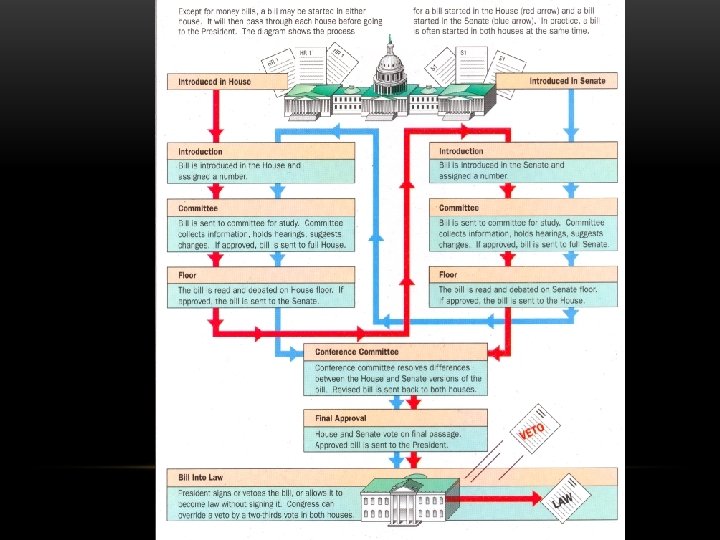
First, a concerned citizen contacts his/her senator or representative about an idea that they would like to see become a law. After the researching is done the legislator has the bill drafted by their staff. After a bill is drafted, it can be introduced by any member of the house or senate, and more than one legislator can sponsor a bill. The bill is filed with the bill clerk, who assigns the bill a number.
The bill is then introduced and read in the house or the senate for the first and usually a second time ( a bill must be read three times before final passage). After reading, the bill is assigned to the appropriate committee. The committee schedules the bill to be read at a public meeting where legislators and anyone interested can speak for or against the bill. The committee can also add amendments to a bill. The committee then votes on the bill. The committee votes do pass, do pass as amended, do not pass, or without recommendation.
If a bill is amended, the bill is engrossed to include the amendment. When a bill comes out of committee it is placed on the calendar for a third reading. At the third reading, the reading clerk reads the title of the bill for the third and final time. Vote: Most bills are adopted by a simple majority. Appropriation bills require a 3/4 vote. Initiated acts may be amended or repealed by a 2/3 vote of both houses.
If the bill fails, it dies on the floor. If the bill passes, it is sent to the opposite chamber and repeats the process that it followed in the previous chamber. If the house amends a senate bill, it is then referred to the senate and then referred to a committee.
Conference Committee: If the 2 houses cannot agree on a bill, the differences are reconciled by a conference committee with representatives from each House. Compromises subject to approval by both houses. When bills are passed by both houses, the enrolled bill is certified by the presiding officer of each house and sent to the Governor.
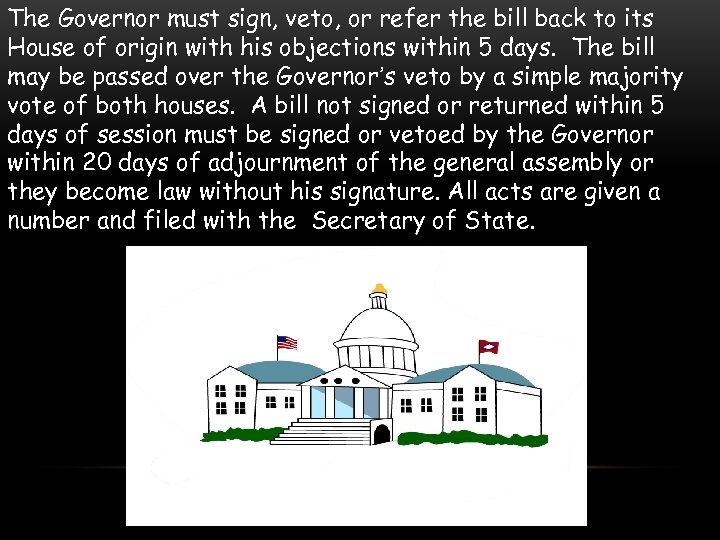
The Governor must sign, veto, or refer the bill back to its House of origin with his objections within 5 days. The bill may be passed over the Governor’s veto by a simple majority vote of both houses. A bill not signed or returned within 5 days of session must be signed or vetoed by the Governor within 20 days of adjournment of the general assembly or they become law without his signature. All acts are given a number and filed with the Secretary of State.
 Скачать презентацию BELL RINGER We are going to use
ce04b7898bf43e63387d5b6903d95fcd.ppt