 Скачать презентацию Bell Ringer n n n Take the new
1e2fa7fd02f65f5f954f23d2a367d707.ppt
- Количество слайдов: 63



Bell Ringer!!! n n n Take the new vocabulary packet off of the pick up shelf. You will have the first mod to complete as much as possible. Notice the due date at the top of the packet……? ? ?
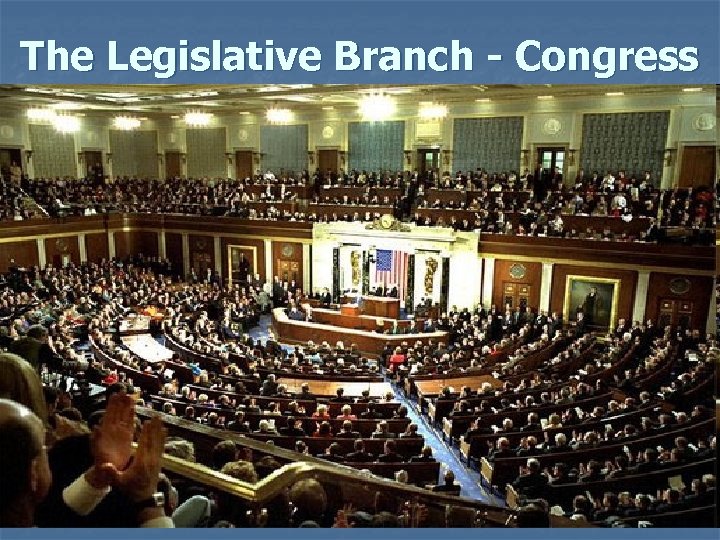
The Legislative Branch - Congress
Qualifications of Congress Formal Qualifications: Written into the Constitution, must be met to hold office House 1. 2. 3. • Must be 25 years old Be a citizen for at least 7 years Be a resident of the state you wish to represent Members of the House of Reps are closer to the American people Senate 1. 2. 3. • Must be 30 years old Be a citizen for at least 9 years Must be a resident of the state that you wish to represent Members of the Senate are more removed from the American people
Makeup of Congress n n Nearly all members of Congress are college graduates Nearly half are lawyers Typically much more active in their communities than others Typically represent the Democrats or Republicans
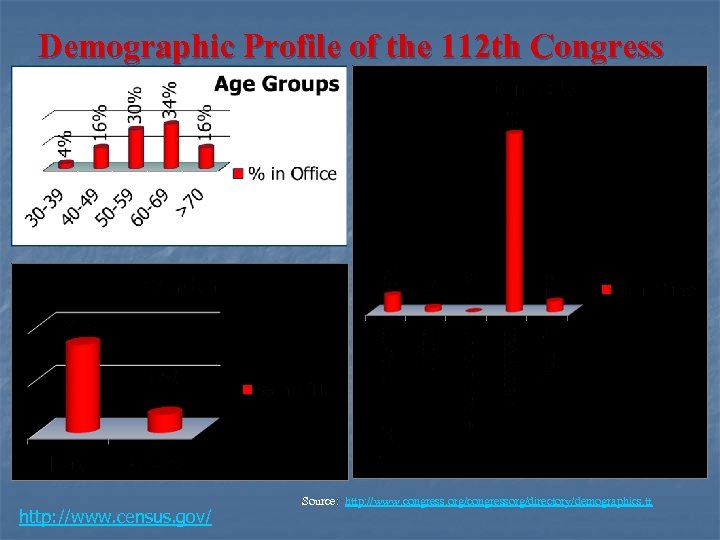
Demographic Profile of the 112 th Congress http: //www. census. gov/ Source: http: //www. congress. org/congressorg/directory/demographics. tt
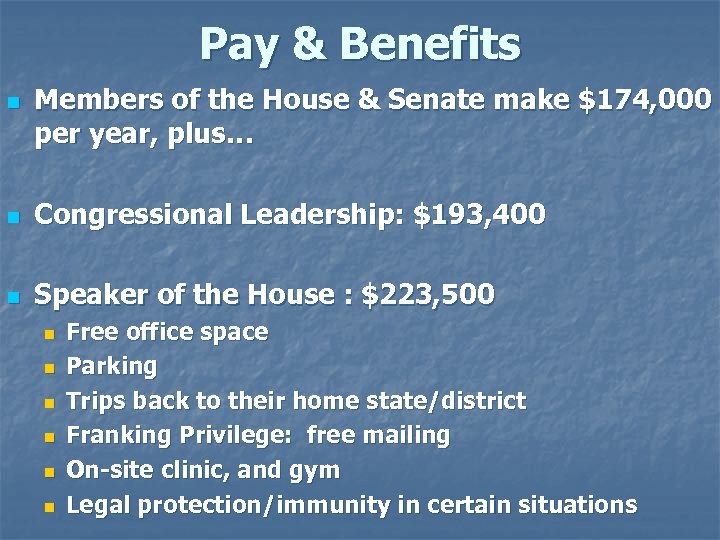
Pay & Benefits n Members of the House & Senate make $174, 000 per year, plus… n Congressional Leadership: $193, 400 n Speaker of the House : $223, 500 n n n Free office space Parking Trips back to their home state/district Franking Privilege: free mailing On-site clinic, and gym Legal protection/immunity in certain situations
Behind the Scenes n Members of Congress get staff at offices in both Washington D. C. and in their home state/district n Staff does research on bills/issues n Handle requests from voters & media n Interns also used to do certain jobs n Committee Staff: Each committee has staff members to draft/outline bills and gather info
Why Bicameral? n Bicameral Legislature: n Congress consists of 2 distinct groups n n n The House of Representatives (based on population The Senate (equally represented) reasons for a bicameral system: 1. 2. To make both large and small states happy To act as a Check on each others power n To make sure that laws passed are truly in the best interest of the people
Terms vs. Sessions n Each Term of Congress lasts for 2 years, and begins at noon on the 3 rd day of January n n n The 113 th Congress assembled Jan. 2013 & term will end Jan. 2015 20 th Amendment changed term start from March to January Sessions: When Congress meets to conduct business (1 year) n n n Used to last only a few months, now commonly go yearround At the end of each session, Congress will Adjourn (end) for the year Congress takes several smaller breaks called Recesses (off time) throughout the year
House of Representatives: Has 435 members n This number is fixed and does not change unless CONGRESS votes to change it Census: population count done every 10 years n n Apportionment: Deciding how many representatives each state gets Reapportionment: Changing/redistributing the number of representatives from each state n Reapportionment happens every 10 years after a Census is taken
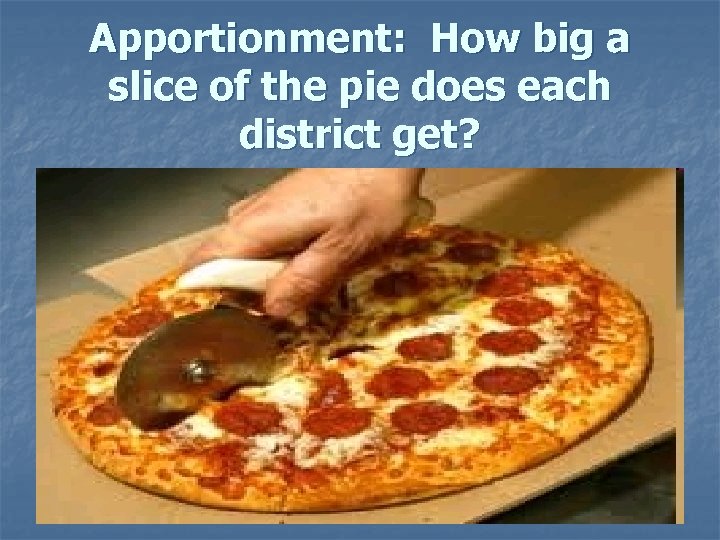
Apportionment: How big a slice of the pie does each district get?
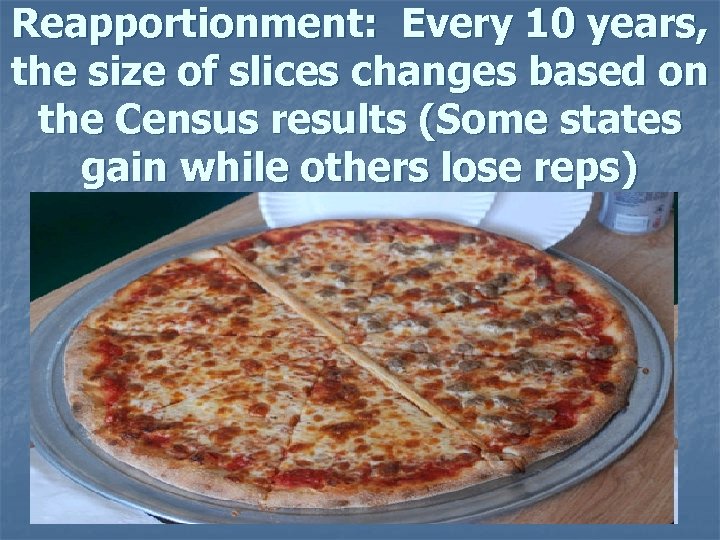
Reapportionment: Every 10 years, the size of slices changes based on the Census results (Some states gain while others lose reps)
Each state is broken down into smaller sections called Districts (for House of Reps) n n Each district gets ONE representative in Congress Constituents: The people represented by a member of Congress
n Drawing political districts to gain an advantage for one political party or to minimize the power of a group is referred to as: n GERRYMANDERING n Districts supposed to be “compact territory” n Supposed to be nearly equal in people
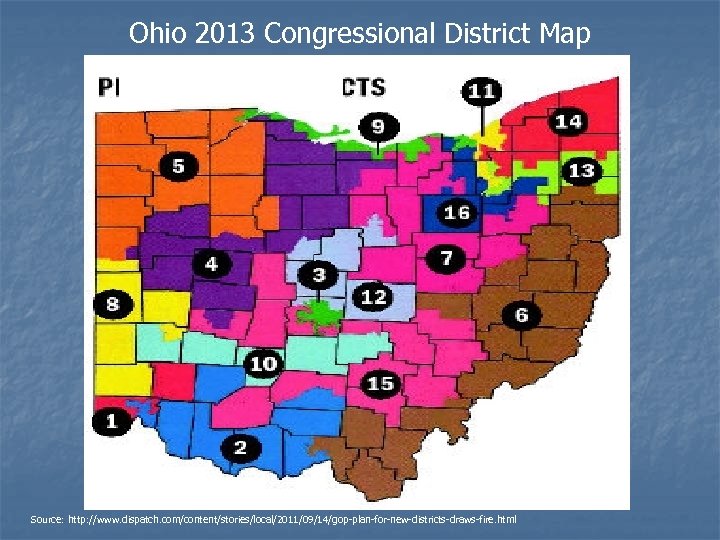
Ohio 2013 Congressional District Map Source: http: //www. dispatch. com/content/stories/local/2011/09/14/gop-plan-for-new-districts-draws-fire. html
The Senate n n In the Senate, each state receives 2 members, regardless of population Each Senator represents the entire state & serves for 6 years
Party Politics Democrats Republicans
Majority vs. Minority The organization of Congress depends heavily on political parties n n Majority Party: The party that has more members in either the House or Senate Minority Party: The party with fewer members in the House or Senate Currently Republicans hold majority in House & Democrats in the Senate This status can change every Two years (elections)
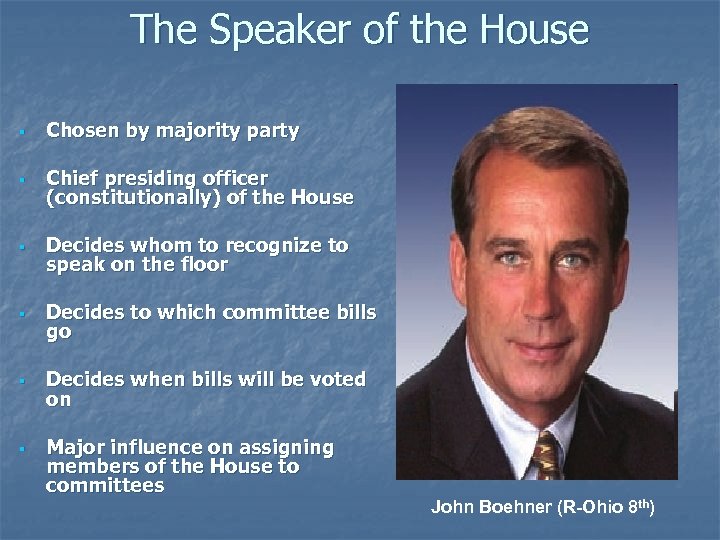
The Speaker of the House Chosen by majority party Chief presiding officer (constitutionally) of the House Decides whom to recognize to speak on the floor Decides to which committee bills go Decides when bills will be voted on Major influence on assigning members of the House to committees John Boehner (R-Ohio 8 th)
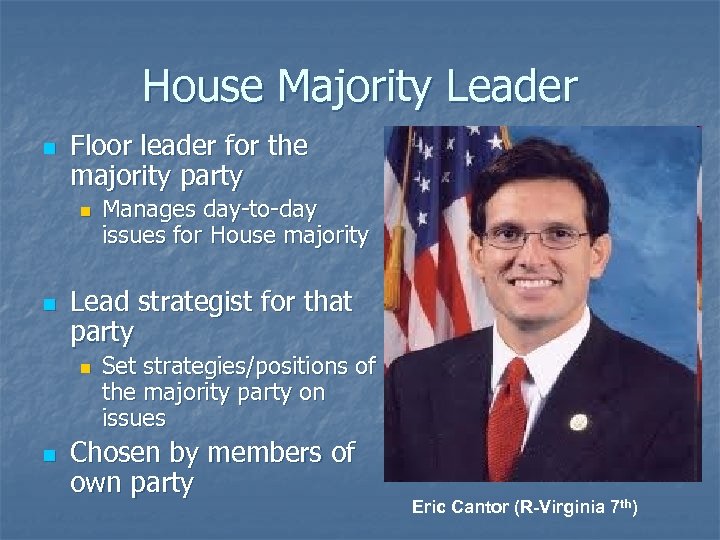
House Majority Leader n Floor leader for the majority party n n Lead strategist for that party n n Manages day-to-day issues for House majority Set strategies/positions of the majority party on issues Chosen by members of own party Eric Cantor (R-Virginia 7 th)
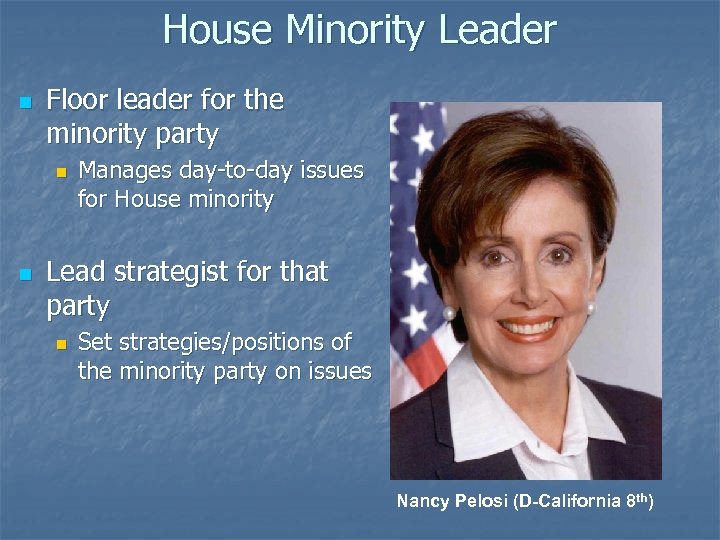
House Minority Leader n Floor leader for the minority party n n Manages day-to-day issues for House minority Lead strategist for that party n Set strategies/positions of the minority party on issues Nancy Pelosi (D-California 8 th)
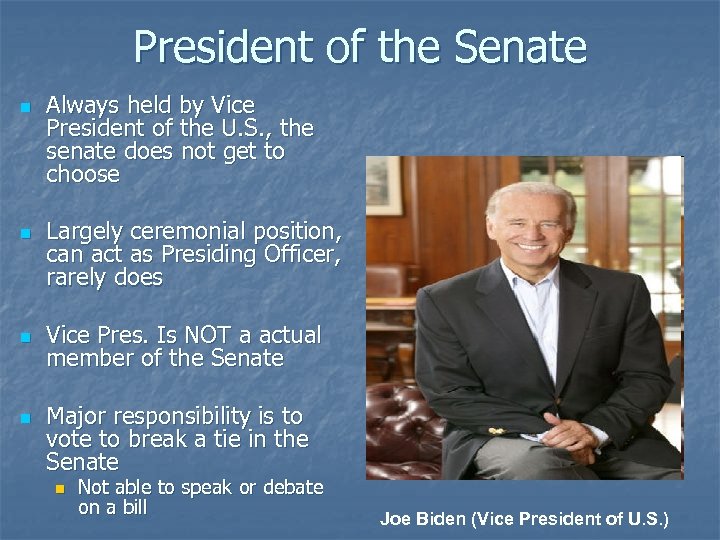
President of the Senate n n Always held by Vice President of the U. S. , the senate does not get to choose Largely ceremonial position, can act as Presiding Officer, rarely does Vice Pres. Is NOT a actual member of the Senate Major responsibility is to vote to break a tie in the Senate n Not able to speak or debate on a bill Joe Biden (Vice President of U. S. )
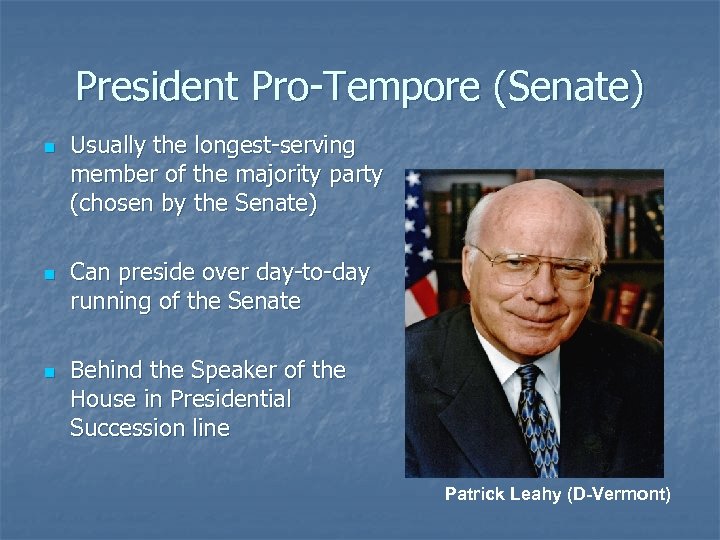
President Pro-Tempore (Senate) n n n Usually the longest-serving member of the majority party (chosen by the Senate) Can preside over day-to-day running of the Senate Behind the Speaker of the House in Presidential Succession line Patrick Leahy (D-Vermont)
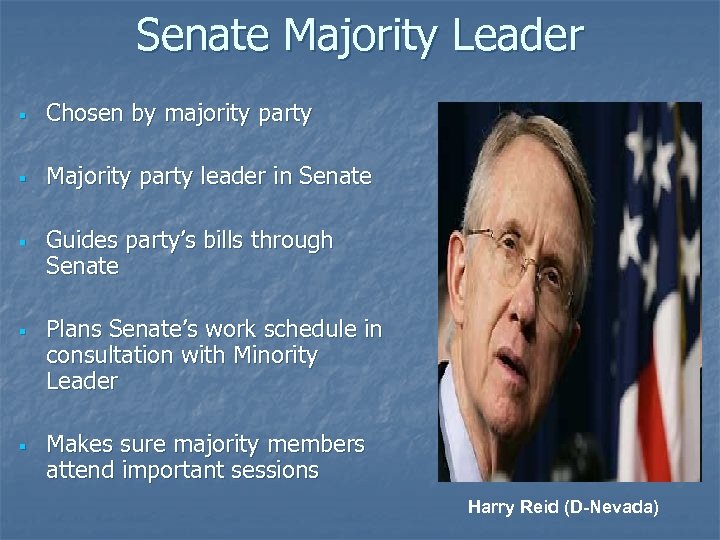
Senate Majority Leader Chosen by majority party Majority party leader in Senate Guides party’s bills through Senate Plans Senate’s work schedule in consultation with Minority Leader Makes sure majority members attend important sessions Harry Reid (D-Nevada)
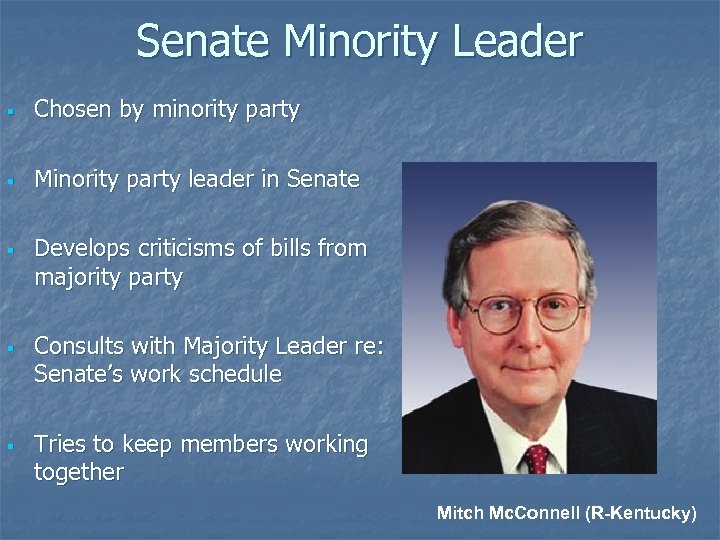
Senate Minority Leader Chosen by minority party Minority party leader in Senate Develops criticisms of bills from majority party Consults with Majority Leader re: Senate’s work schedule Tries to keep members working together Mitch Mc. Connell (R-Kentucky)
3 Major Jobs of Congress 1. 2. Lawmaking: Members of the House and Senate are free to introduce bills (proposed laws) Casework: Members of Congress get many requests from constituents. n n Staff members handle many requests for help and information on issues Casework/helping Constituents can help re-election and support
Helping the District n n Public works – Congress appropriates billions of dollars for local projects. (post offices, military bases, dams, mass transit) Grants and Contracts – Try to make sure their state/district get their fair share of federal grants and contracts. n n Pork Barrel projects Using influence – try to influence Federal agencies that are dividing up grants.
6. 1 How Congress is Organized n n GOAL: to explain how committees in Congress are organized and what role they play in the lawmaking process Why Committees? n In the course of one congressional session the senate and house of reps will consider thousands of bills (proposed laws). Dealing with this amount would be impossible without committees.
6. 1 How Congress is Organized What Work is Being Accomplished? n 1. Bills get filtered to the correct committee 2. The committee gets it to the correct sub -committee (if there is one) to be looked over. ◦ ◦ Both parties are represented in the committee they can debate the bill and make recommended amendments (changes)
6. 1 How Congress is Organized Standing Committees = Permanent ◦ House of Reps (not all listed) ◦ Senate (not all listed) ◦ Armed Services, Budget, Education and Labor, Foreign Affairs, Homeland Security, Natural Resources, Science and Technology, Small Business, Transportation and Infrastructure Agriculture, Nutrition and Forestry, Banking, Housing and Urban Affairs, Energy and Natural Resources, Environment and Public Works Concurrent Agriculture, Commerce, Veterans Affairs
6. 1 How Congress is Organized n Select Committees: Temporary Deals with Special Issues n Meet for a limited time until they complete the assigned task n EX: Global Warming, Aging, Ethics, n
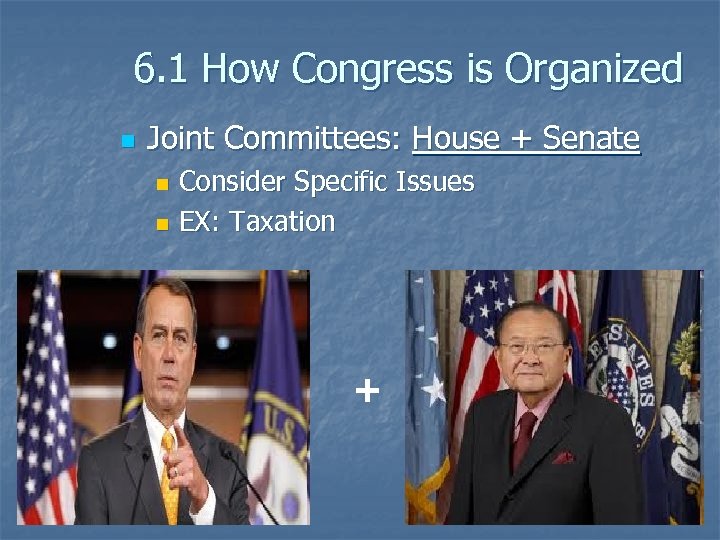
6. 1 How Congress is Organized n Joint Committees: House + Senate Consider Specific Issues n EX: Taxation n +
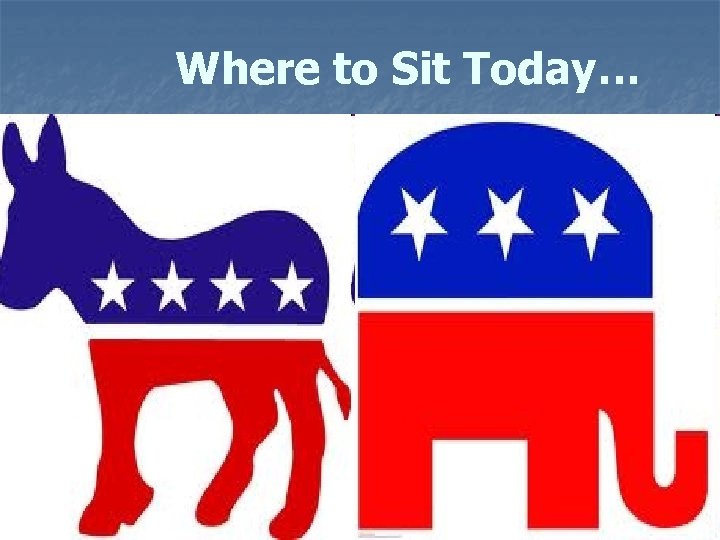
Where to Sit Today…
6. 1 How Congress is Organized Committee Assignments ◦ When senators and representatives first come to Congress they try to get assigned to important committees that affect people who elected them Ex) Rep from rural farm-town might want to serve on the agriculture committee b/c influence policy
6. 1 How Congress is Organized n Chairperson: the longest serving committee member from the majority party Chairpersons decide when and if a committee will meet, what bills will be addressed, and who will serve on subcommittees n This is part of the seniority system n n Some like it b/c of experience other say talented members get overlooked
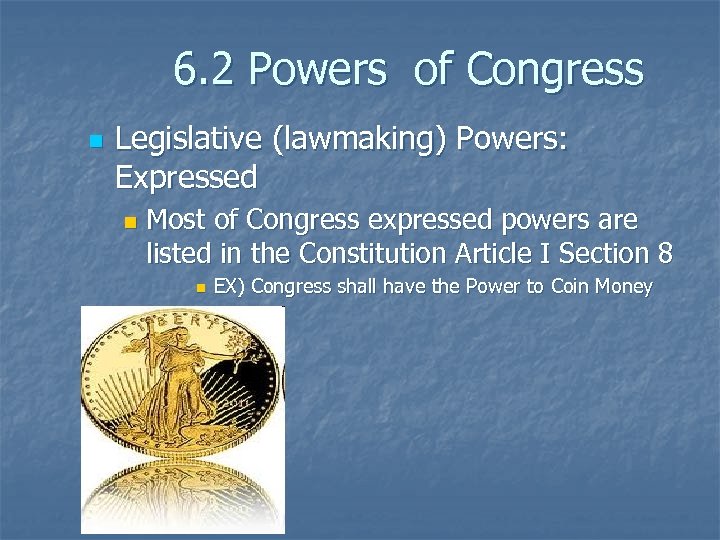
6. 2 Powers of Congress n Legislative (lawmaking) Powers: Expressed n Most of Congress expressed powers are listed in the Constitution Article I Section 8 n EX) Congress shall have the Power to Coin Money
6. 2 Powers of Congress n Legislative (lawmaking) Powers: Implied The grey area in-between. Not specifically written n Article I Section 8 Clause 18: Congress shall have the Power to do whatever is “necessary and proper” to carry out the expressed powers. n
6. 2 Powers of Congress n Legislative Powers: Elastic Clause 18 gets this title b/c Congress STRETCHES like a rubber band its Powers to meet new needs as they arise to our nation. n EX) Air Force not in the Constitution b/c airplanes didn’t exist but Congress supports it under the Expressed Power to support armies n
6. 2 Powers of Congress n Money Powers n Expressed Taxes to provide for the defense and general welfare of the US n Borrow $$$ n Establish Bankruptcy Laws n Coin, Print, and Regulate Money n Punish Counterfeiters n n Implied Taxes to support welfare programs n Borrowing $ implies power to create Fed Reserve n
6. 2 Powers of Congress n Commerce Powers n Expressed n n Regulate Foreign and Interstate (between states) Implied n Power to prohibit discrimination in restaurants, hotels and other public accommodations
6. 2 Powers of Congress n Military and Foreign Policy n Expressed Declare War n Raise, Support and Regulate and army and navy n Provide, Regulate and Call into service militia (National Guard) n n Implied n Draft
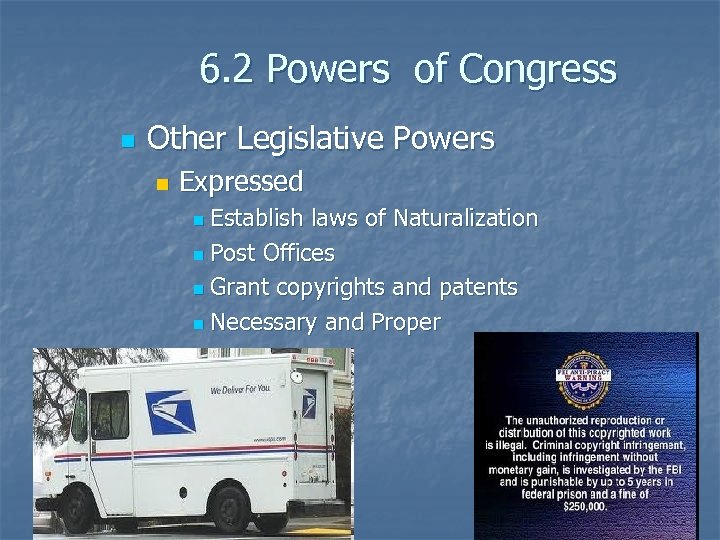
6. 2 Powers of Congress n Other Legislative Powers n Expressed Establish laws of Naturalization n Post Offices n Grant copyrights and patents n Necessary and Proper n
6. 2 Powers of Congress n Non-Legislative (non-lawmaking) Powers: Checks and Balances n Make sure the Executive and Judicial Branch are doing the jobs outline to them by the Constitution and are not wielding too much power.
6. 2 Powers of Congress n Non-Legislative Powers: Appointment n Senate has the power to reject or approve the President’s nominees for various offices n Supreme Court Justices, Federal Judges, Ambassadors
6. 2 Powers of Congress n Non-Legislative Powers: Impeachment n n Constitution allows Congress to remove any federal official who has committed serious wrongdoing The HOUSE of REPS has the sole authority to impeach: accuse officials of misconduct If a majority votes to impeach the Senate has the power to hold a trial and act as jury to decide n 2/3 vote needed n Nobody has been removed from office n This is mostly used for Federal Judgesscandals…. . n
6. 2 Powers of Congress n Power Limitations Constitution says what Congress CANNOT do as well n Bill of Rights n n Not pass a bill that limits free speech Tax interstate commerce n Tax exports n Not pass laws that would interfere with individuals legal rights n
6. 2 Powers of Congress n Power Limitations: Writ of Habeas Corpus Congress CANNOT suspend this n WHC: court order that requires police to bring a prisoner to court to explain WHY they are holding a person n
6. 2 Powers of Congress n Power Limitations: Bill of Attainder Congress is BANNED from passing n Bo. A: laws that punish a person without a jury trial n
6. 2 Powers of Congress n Power Limitations: Ex Post Facto Laws Congress may NOT pass n EPFL: laws that make an act a crime after the act has been committed n
6. 4 How a Bill Becomes a Law http: //www. youtube. com/watch? v=He. YBZFEzf 8
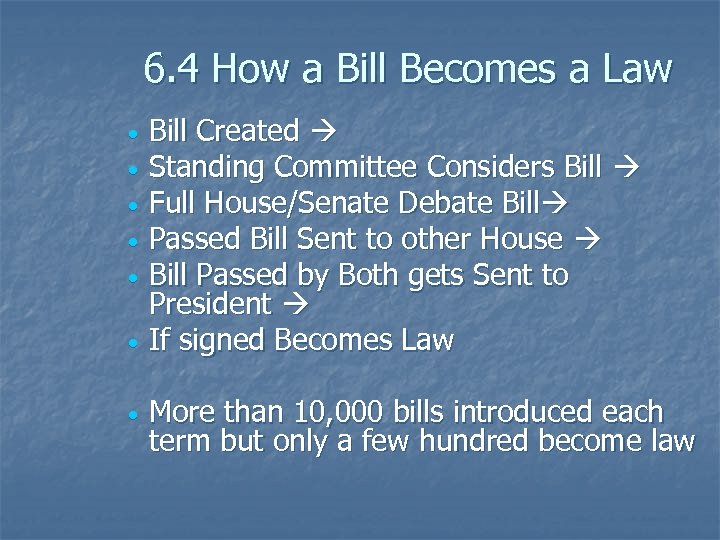
6. 4 How a Bill Becomes a Law Bill Created Standing Committee Considers Bill Full House/Senate Debate Bill Passed Bill Sent to other House Bill Passed by Both gets Sent to President If signed Becomes Law More than 10, 000 bills introduced each term but only a few hundred become law
6. 4 How a Bill Becomes a Law n Types of Bills n Private Bills n n Concern individual people or places Public Bills (most that are passed) Apply to the entire nation n Involve general matters like taxation n
6. 4 How a Bill Becomes a Law n Resolutions Formal statements expressing lawmakers’ opinions n Most do NOT have the force of law n n Joint Resolution Passed by both House/Senate do become law if signed by President n Constitutional Amendments or an authorization to use military force (Ex. Iraq) n
6. 4 How a Bill Becomes a Law n Where Does a Bill Come From? Private Citizens n White House n Special Interest Groups n n n NRA, PETA, Amnesty International Member of House or Senate MUST introduce a bill before Congress will even consider it (sponsor) n Every Bill is given a title and number n n S. 103 H. R. 39
6. 4 How a Bill Becomes a Law n Committee Action After a bill is introduced it goes to a standing committee that is related to the subject of the bill n Committees will n Pass the bill n Mark up a bill n Ignore the bill and let it die n Kill the bill outright with a majority vote n Replace the original Bill with a new Bill n
6. 4 How a Bill Becomes a Law n Debating a Bills approved in committees are ready for consideration by the full House or Senate n When the bill reaches the “floor” members debate the “pros” and “cons” and discuss amendments (changes) n House only allows amendments relevant to the bill n Senate accepts riders- completely unrelated amendments to be tacked on n
6. 4 How a Bill Becomes a Law n Rules of Debate n In the House the Rules Committee sets terms for debate n n Time limits Senate can speak for as long as they wish Filibuster: talk a bill to death so a sponsor will withdraw n Senate can end filibuster if 3/5 members vote for cloture (no one may speak for more than 1 hour) n
6. 4 How a Bill Becomes a Law n Voting on a Bill After a bill is debated it gets voted on n House: n Voice Vote say “Aye” then “No” n Standing Vote- rise for yes then for no n Recorded Vote- electronically n n Senate: Standing Vote n Voice Vote “Yea” or “No” (used to confirm voice vote) n Roll-Call Vote – each Senator asked “yea” or “nay” n n These votes are recorded
6. 4 How a Bill Becomes a Law n Voting on a Bill n n n A simple majority is needed to pass If passed in the House goes to the Senate If passed in the Senate goes to the House If either house rejects once its sent the bill dies Bill has to be passed by both houses in IDENTICAL form before is goes to the President n When 2 versions of the same bill are passed a Conference Committee is established to create ONE version of the bill
6. 4 How a Bill Becomes a Law n Voting on a Bill n n After an identical bill is approved by both houses it goes to the President may: Pass – Sign into law n Veto- refuse to sign n n Congress can overturn a veto if both houses 2/3 vote to do so. 1789 -2008 only overturned 108 vetoes Do nothing for 10 days n n If Congress is in session it automatically becomes a law If Congress is not in session (adjourned) the bill dies…. sad face. This is called a pocket veto.
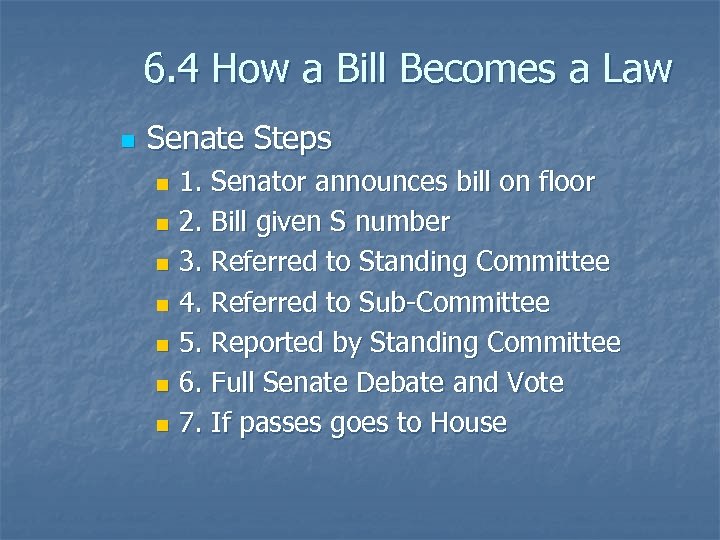
6. 4 How a Bill Becomes a Law n Senate Steps 1. Senator announces bill on floor n 2. Bill given S number n 3. Referred to Standing Committee n 4. Referred to Sub-Committee n 5. Reported by Standing Committee n 6. Full Senate Debate and Vote n 7. If passes goes to House n
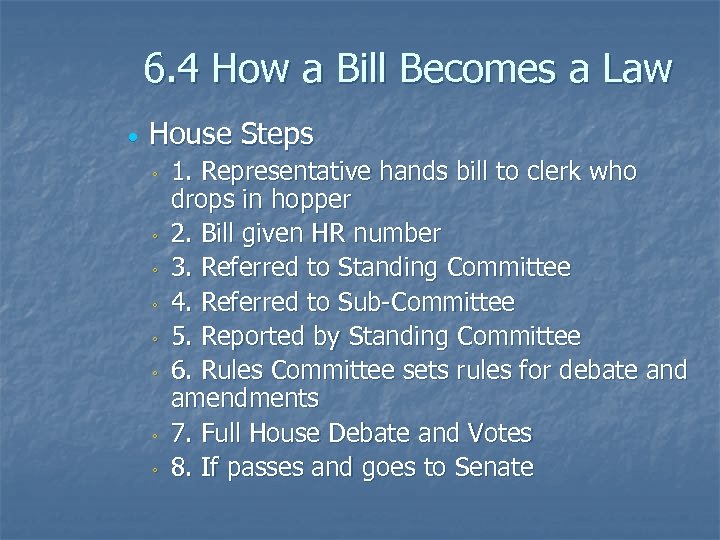
6. 4 How a Bill Becomes a Law House Steps ◦ ◦ ◦ ◦ 1. Representative hands bill to clerk who drops in hopper 2. Bill given HR number 3. Referred to Standing Committee 4. Referred to Sub-Committee 5. Reported by Standing Committee 6. Rules Committee sets rules for debate and amendments 7. Full House Debate and Votes 8. If passes and goes to Senate
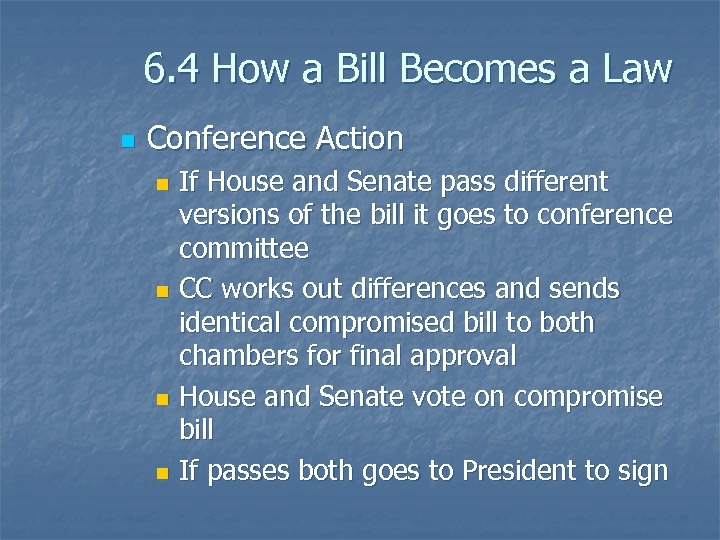
6. 4 How a Bill Becomes a Law n Conference Action If House and Senate pass different versions of the bill it goes to conference committee n CC works out differences and sends identical compromised bill to both chambers for final approval n House and Senate vote on compromise bill n If passes both goes to President to sign n
Скачать презентацию Bell Ringer n n n Take the new
1e2fa7fd02f65f5f954f23d2a367d707.ppt