 Скачать презентацию Bell Ringer In terms of energy what
719f19b1dffcfb5af45d9393090f78b8.ppt
- Количество слайдов: 62



Bell Ringer • In terms of energy, what happens to the energy of an object in free-fall?
Bell Ringer • Identify one station from yesterday’s lab. – How did you change the object’s center of mass? – What did this do to the object?
Center of Mass
Center of Gravity (CG) • The point at the center of an object’s weight distribution – The force of gravity can be considered to act on an object at this one point • Located in the geometric center of a symmetrical object • Located in the heavier end of an asymmetrical object • May be located where there is no actual material – i. e. A donut
Center of Gravity (CG) • An object which rotates/revolves about its CG moves smoothly • An object which rotates/revolves about a point other than its CG tends to wobble
Center of Mass (CM) • The average position of all of the particles making up an object • Usually located very close to the center of gravity – Not the case with very tall objects – Gravity pulls harder on the bottom of the object making the bottom “heavier”
Stability • An object will topple if its CG is tipped beyond its support base • An object is most stable when its CG lie below their support points – Extra work is required to lift the CG to the point of toppling
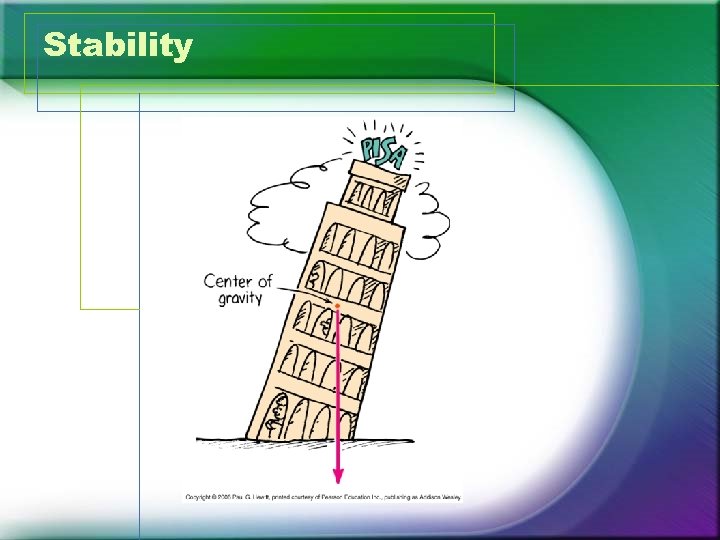
Stability
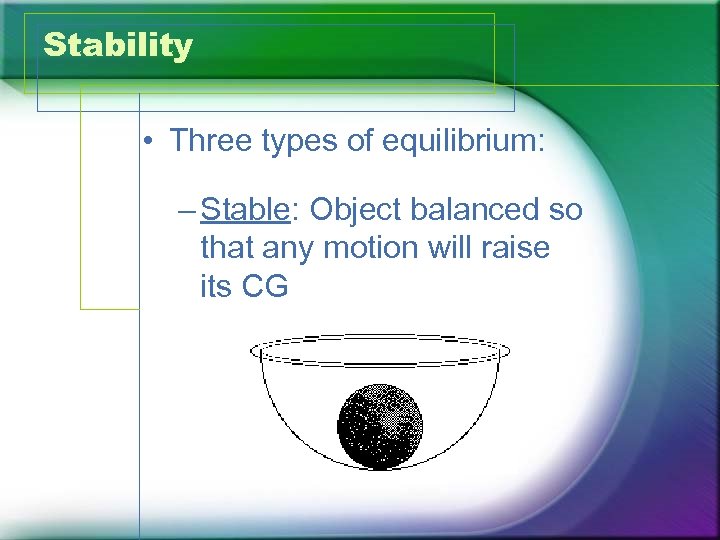
Stability • Three types of equilibrium: – Stable: Object balanced so that any motion will raise its CG
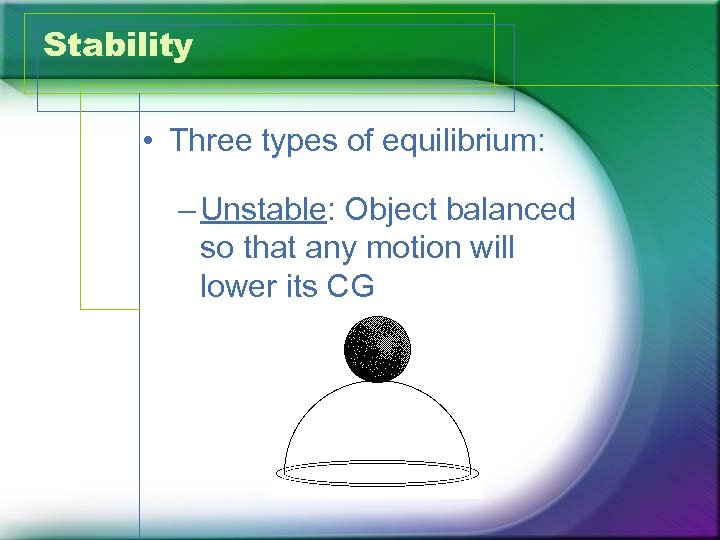
Stability • Three types of equilibrium: – Unstable: Object balanced so that any motion will lower its CG
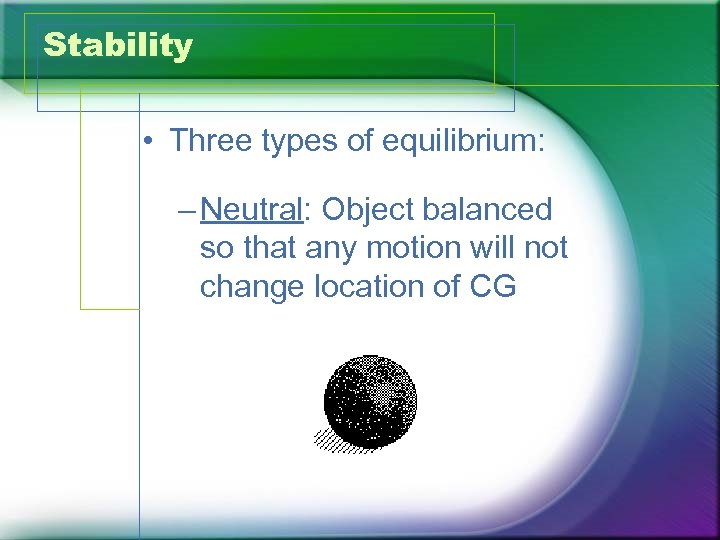
Stability • Three types of equilibrium: – Neutral: Object balanced so that any motion will not change location of CG
CG of People • Men tend to have slightly higher centers of gravity than women
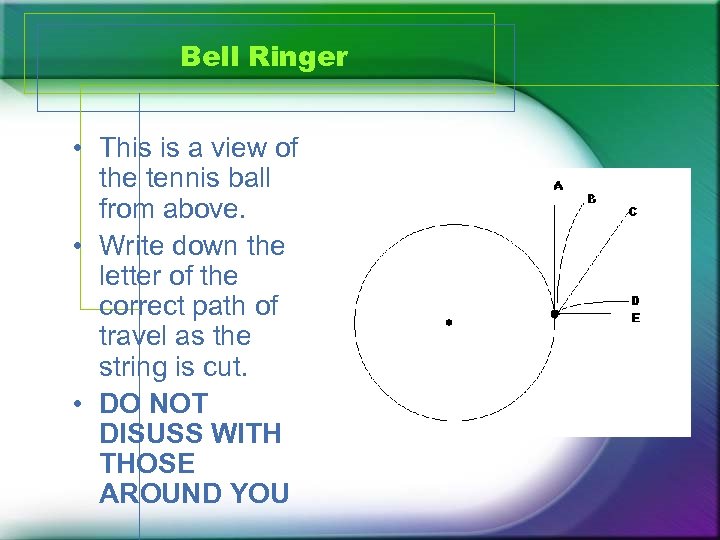
Bell Ringer • This is a view of the tennis ball from above. • Write down the letter of the correct path of travel as the string is cut. • DO NOT DISUSS WITH THOSE AROUND YOU
Bell Ringer • Why, when carrying a large object, do you tend to learn back?
Rotational Mechanics
Rotational Motion • Axis: The straight line around which circular motion takes place • Rotation: When an object turns about an internal axis – The Earth rotates on its axis • Revolution: When an object turns about an external axis – The Earth revolves around the Sun
Rotational Motion • Period (T): The time it takes for an object to complete one full circle – Units: seconds
Two Types of Velocity – Tangential Velocity (v): The speed of an object moving along a circular path • Units: m/s • Direction of motion: –Always changing –Always tangent to the circle
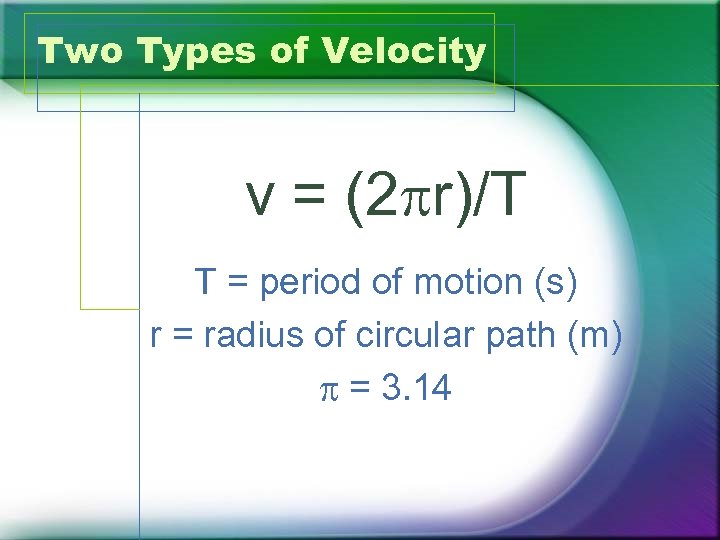
Two Types of Velocity v = (2 pr)/T T = period of motion (s) r = radius of circular path (m) p = 3. 14
Two Types of Velocity v = (2 pr)/T T = period of motion (s) r = radius of circular path (m) p = 3. 14
Two Types of Velocity – Rotational Velocity (w): The number of rotations or revolutions per unit time • Units: – radians per second – revolutions per minute (rpm) • i. e. ) All parts of a turntable have the same rotational velocity
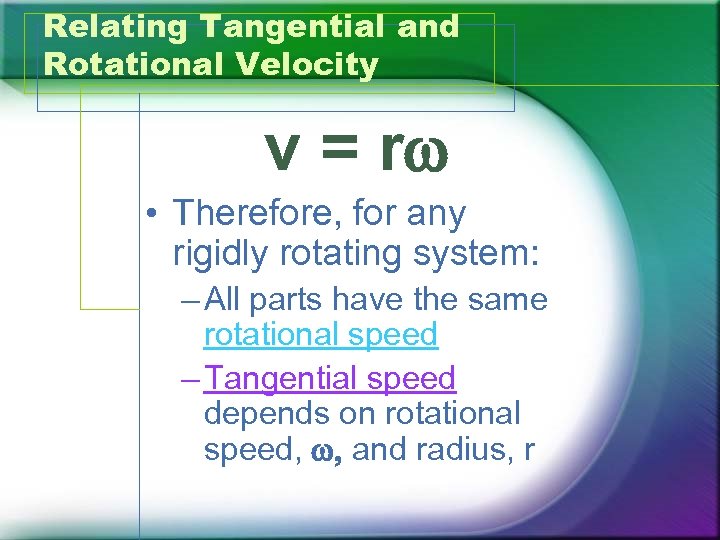
Relating Tangential and Rotational Velocity v = rw • Therefore, for any rigidly rotating system: – All parts have the same rotational speed – Tangential speed depends on rotational speed, w, and radius, r
Bell Ringer • If a car does doughnuts with a radius of 6 m and completes one full circle every 3 s, what is the car’s tangential velocity? • What is the car’s rotational velocity?
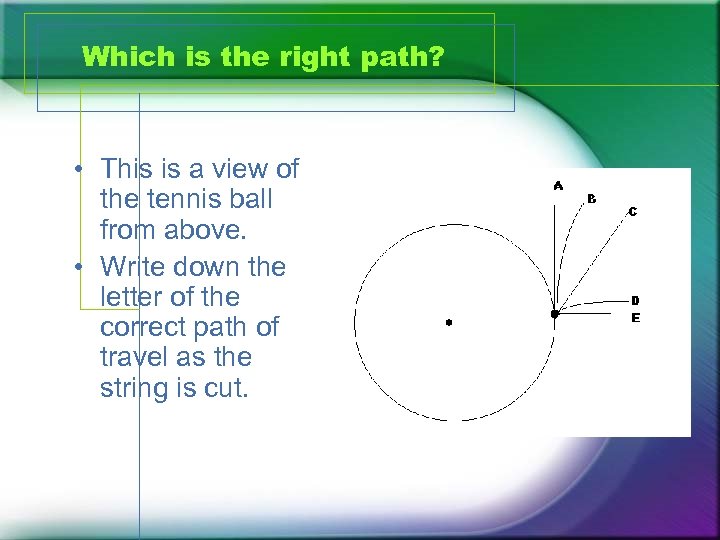
Which is the right path? • This is a view of the tennis ball from above. • Write down the letter of the correct path of travel as the string is cut.

Why does a CD case slide across the dashboard on a turn?
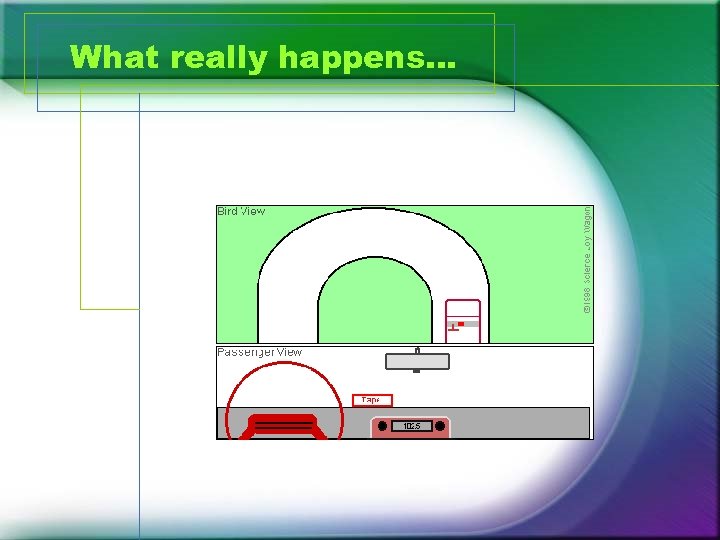
What really happens…
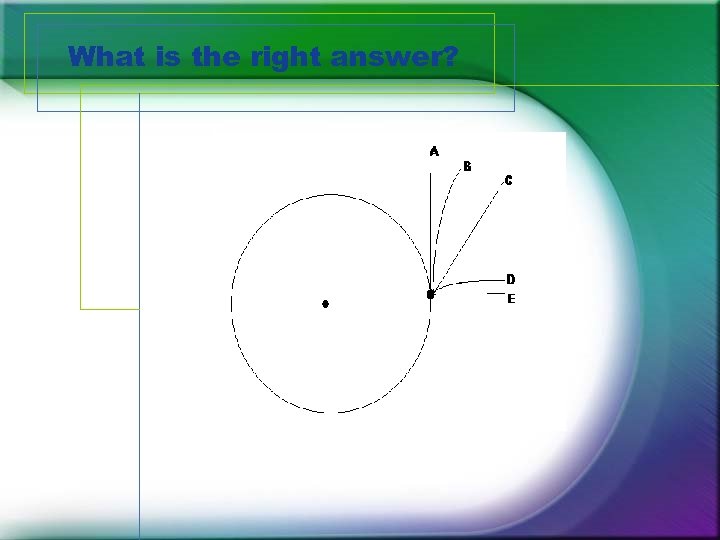
What is the right answer?
What is a piece of equipment that use centripetal force for a mechanical advantage?
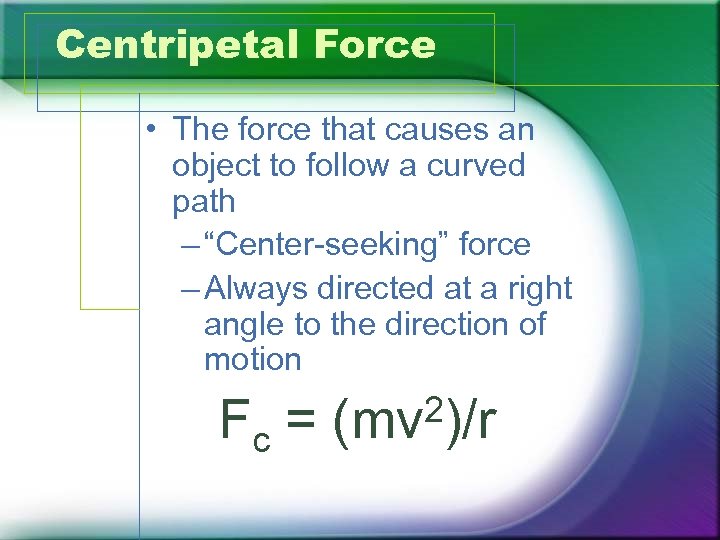
Centripetal Force • The force that causes an object to follow a curved path – “Center-seeking” force – Always directed at a right angle to the direction of motion Fc = 2)/r (mv
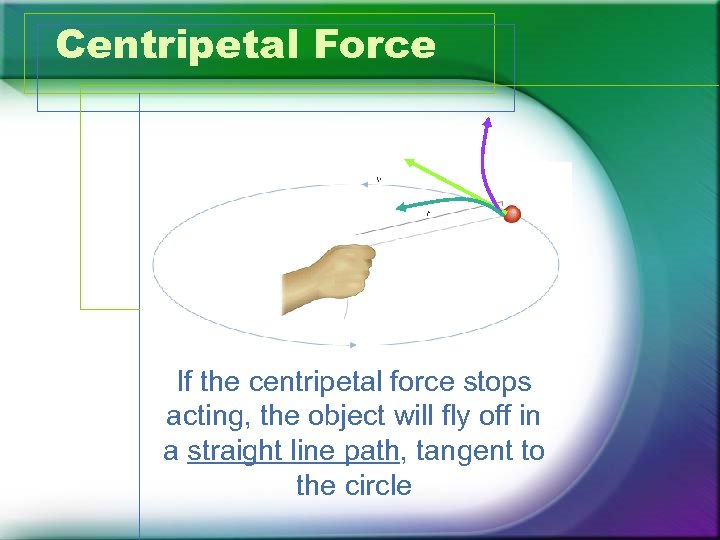
Centripetal Force If the centripetal force stops acting, the object will fly off in a straight line path, tangent to the circle
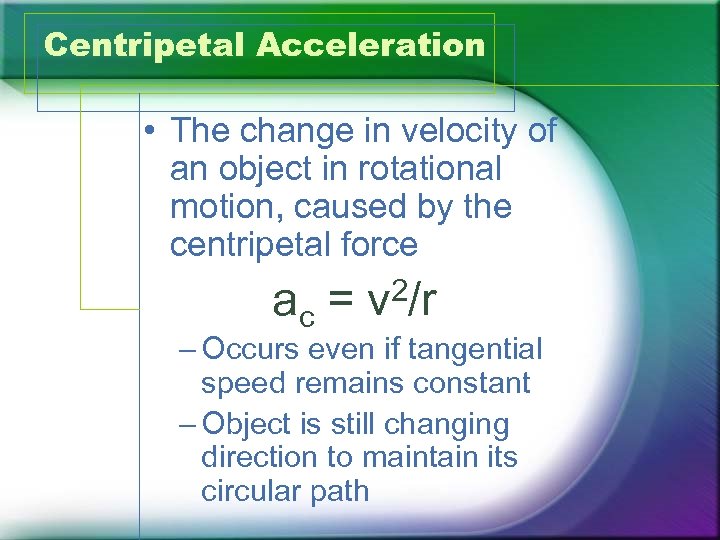
Centripetal Acceleration • The change in velocity of an object in rotational motion, caused by the centripetal force ac = v 2/r – Occurs even if tangential speed remains constant – Object is still changing direction to maintain its circular path
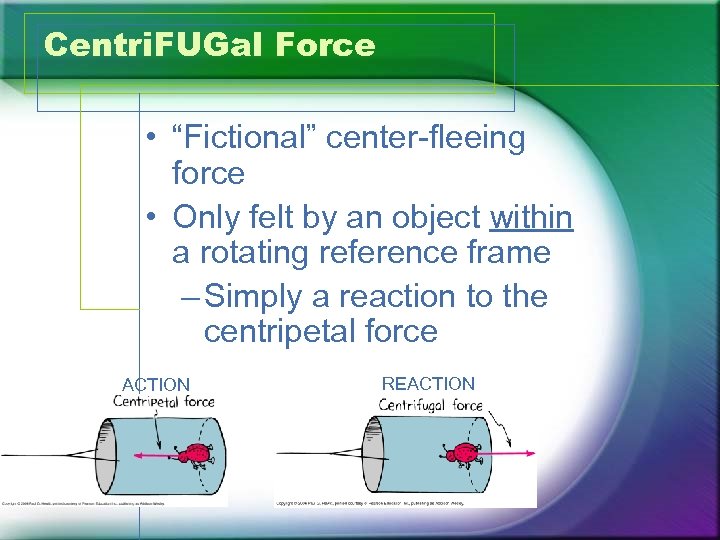
Centri. FUGal Force • “Fictional” center-fleeing force • Only felt by an object within a rotating reference frame – Simply a reaction to the centripetal force ACTION REACTION
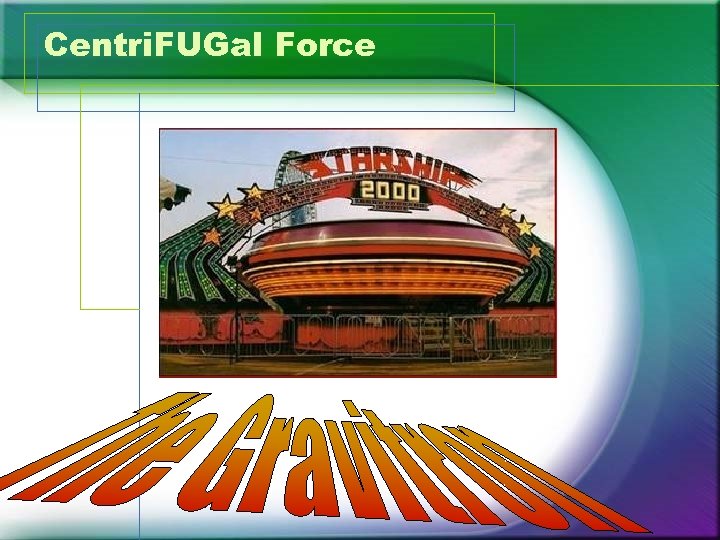
Centri. FUGal Force
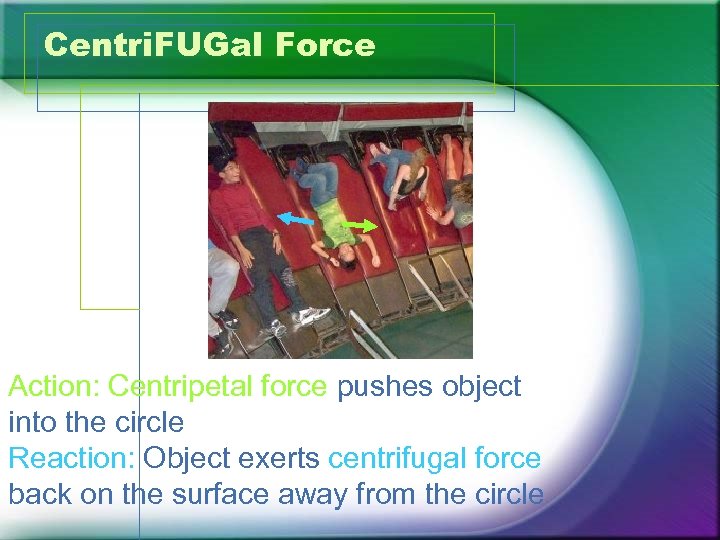
Centri. FUGal Force Action: Centripetal force pushes object into the circle Reaction: Object exerts centrifugal force back on the surface away from the circle
Simulated Gravity • Comes from the centrifugal force acting on rotating object • Simulated gravity will feel stronger when: – The capsule spins faster – The object sits farther from the axis of rotation of the capsule • If sitting on the axis of rotation, the object will feel no “gravity”
Bell Ringer A friend pushes you out of his car as you go around a turn. In what direction will you travel?
Bell Ringer • What provides the centripetal force for a tetherball? • What is the only way to measure the centrifugal force?
Bell Ringer • In order for there to be a “simulated gravity” effect, what must happen? • (in other words what must something equal to)
• Examining G Forces
Torque • Recall: Forces tend to make objects accelerate • Torque makes an object rotate • Torques occur when a force is applied with leverage – Note: A perpendicular push or pull gives more rotation with less effort
Torque • When the applied force is perpendicular: – Force is represented by F – Lever arm (l): the distance from the axis to the point of contact
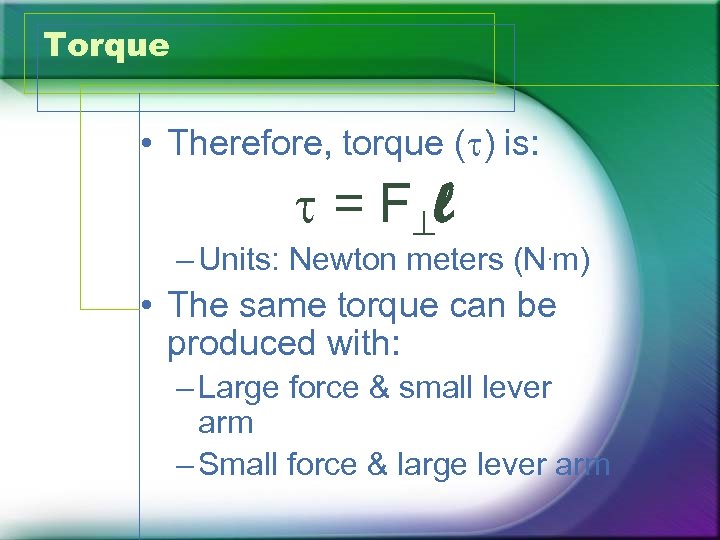
Torque • Therefore, torque (t) is: t = F l – Units: Newton meters (N. m) • The same torque can be produced with: – Large force & small lever arm – Small force & large lever arm
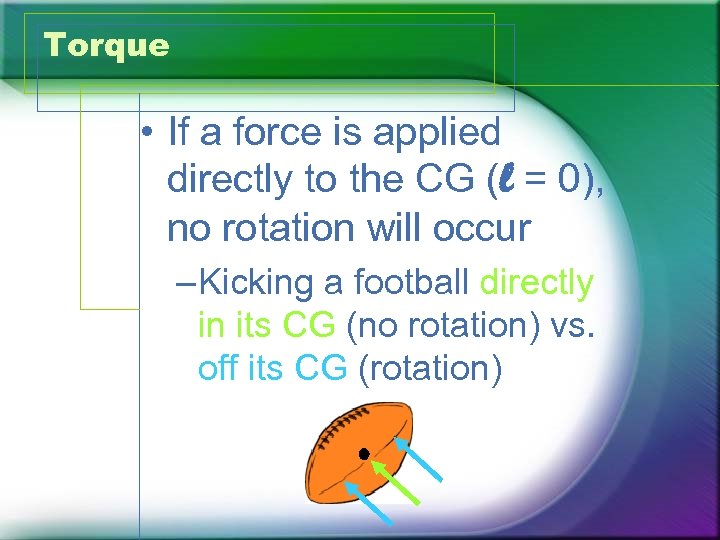
Torque • If a force is applied directly to the CG (l = 0), no rotation will occur – Kicking a football directly in its CG (no rotation) vs. off its CG (rotation)
Balanced Torques • In order for an object to remain balanced the torques on either end must balance each other • Therefore: tccw = tcw – ccw = counter-clockwise – cw = clockwise
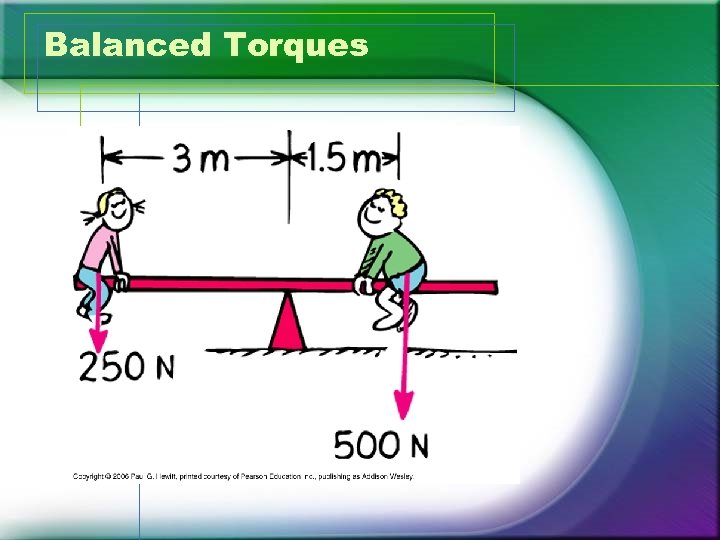
Balanced Torques
Bell Ringer • What are three things that you can do to increase the amount of torque on a stubborn rusted bolt?
Rotational Inertia • Recall: Newton’s Law of Inertia • There is a similar Law of Rotational Inertia: An object rotating about an axis tends to keep rotating about that axis unless acted upon by a net torque.
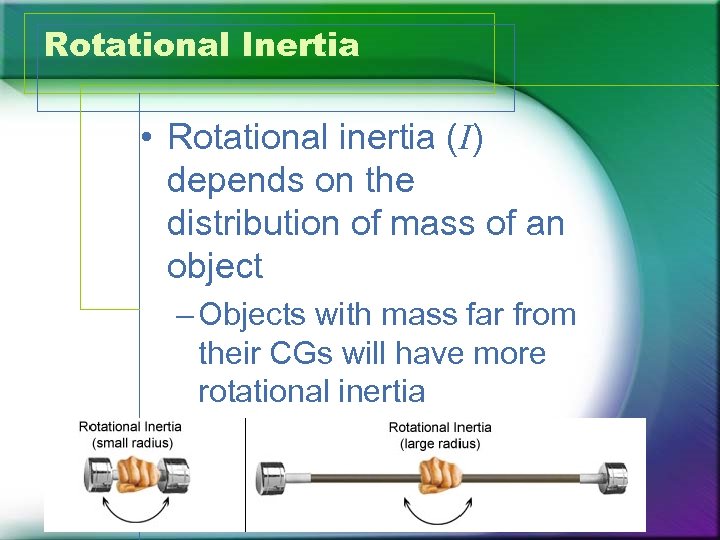
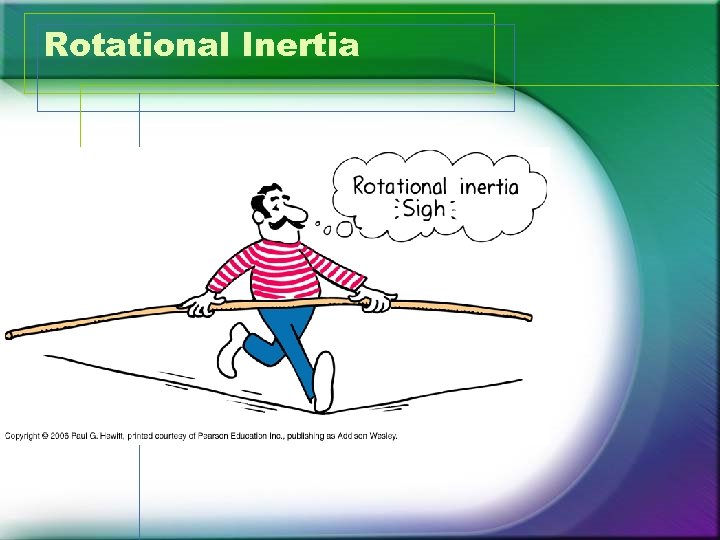
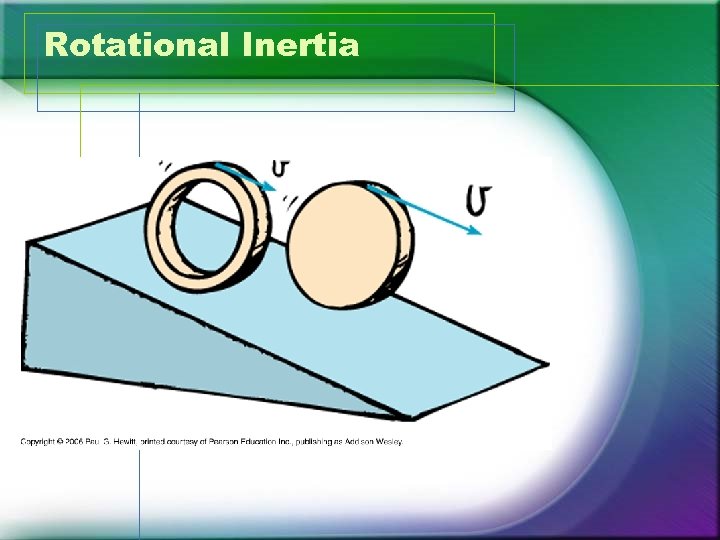
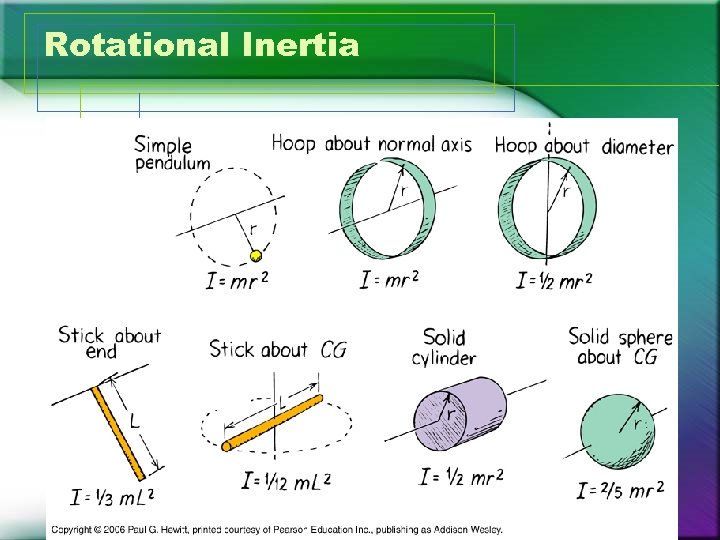
Rotational Inertia • Rotational inertia (I) depends on the distribution of mass of an object – Objects with mass far from their CGs will have more rotational inertia
Rotational Inertia
Rotational Inertia • Which has less rotational inertia: – A short pendulum or a long pendulum of the same mass? • Short pendulum – A hoop or a solid disk of the same mass? • Solid disk
Rotational Inertia
Bell Ringer • What are three things that you can do to increase the amount of torque on a stubborn rusted bolt?
Rotational Inertia
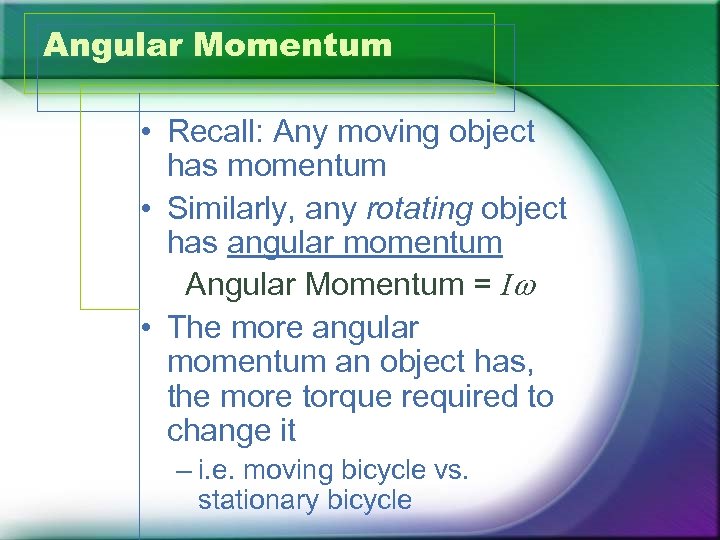
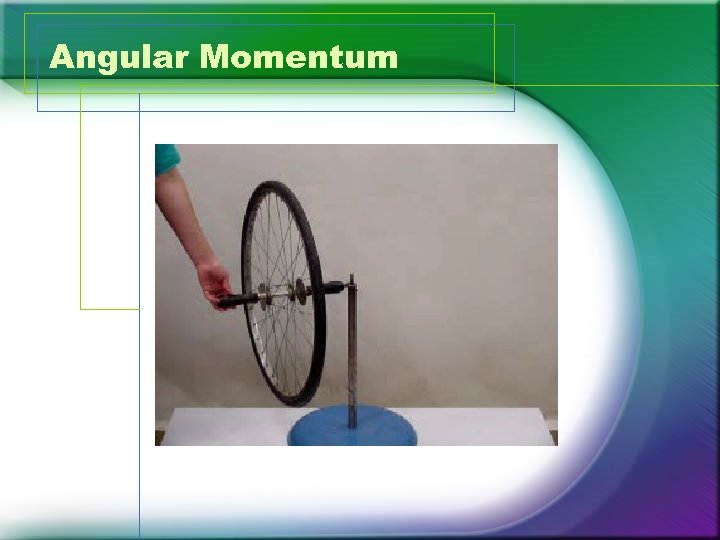
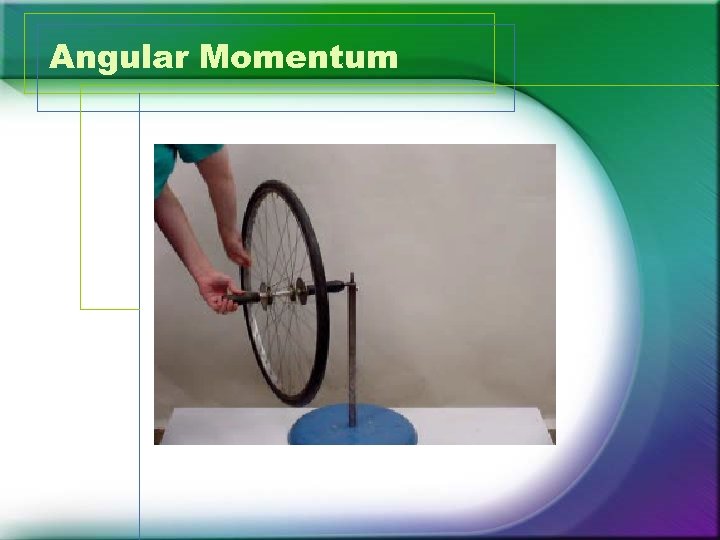
Angular Momentum • Recall: Any moving object has momentum • Similarly, any rotating object has angular momentum Angular Momentum = Iw • The more angular momentum an object has, the more torque required to change it – i. e. moving bicycle vs. stationary bicycle
Angular Momentum
Angular Momentum
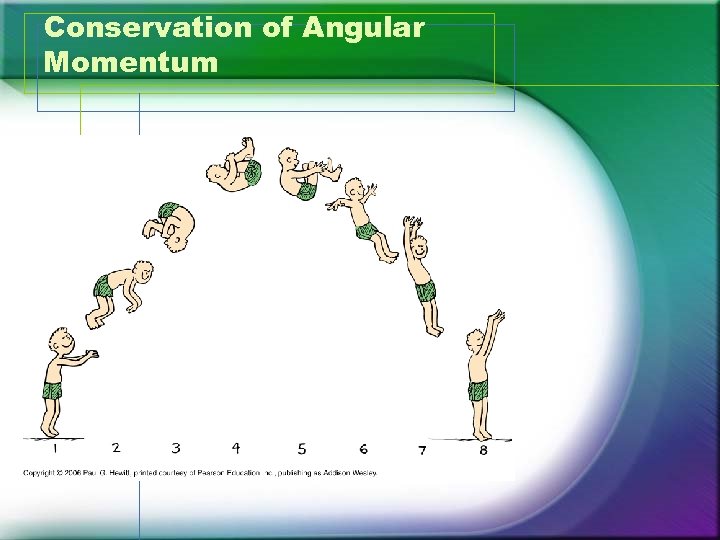
Conservation of Angular Momentum • Law of Conservation of Angular Momentum: Without a balanced, external torque, the angular momentum of a system will remain constant • In an isolated system: – If I increases, w will decrease – If I decreases, w will increase
Conservation of Angular Momentum
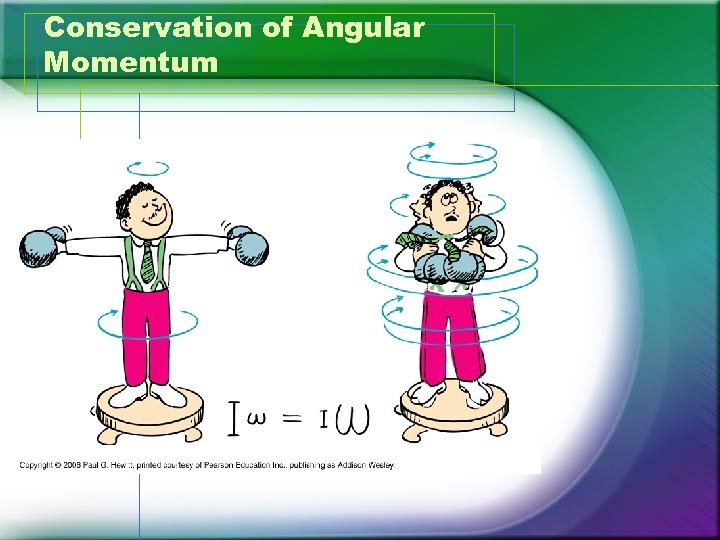
Conservation of Angular Momentum
Скачать презентацию Bell Ringer In terms of energy what
719f19b1dffcfb5af45d9393090f78b8.ppt