 Скачать презентацию Belgrade 2 October 2008 Indicators for a Knowledge-Based
1050999073ffe7e2578bedd91231eb4f.ppt
- Количество слайдов: 123




Belgrade, 2 October 2008 Indicators for a Knowledge-Based Economy The OECD perspective Martin Schaaper OECD Directorate for Science, Technology and Industry Economic Analysis and Statistics Division
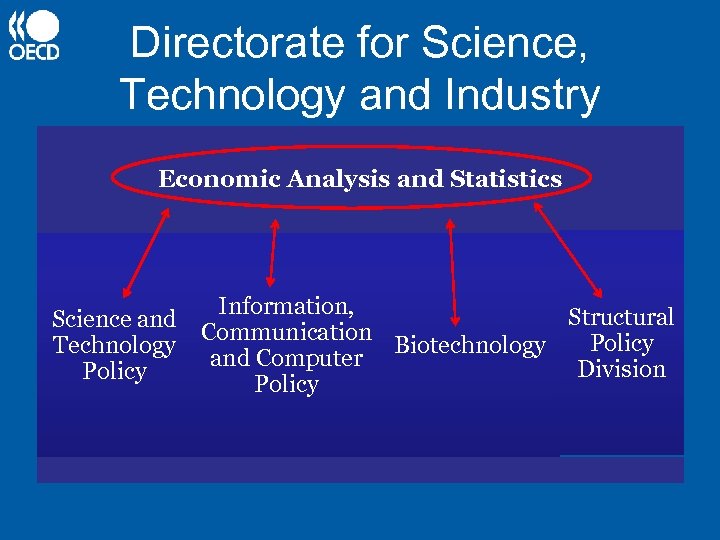
Directorate for Science, Technology and Industry Economic Analysis and Statistics Information, Structural Science and Communication Policy Technology Biotechnology and Computer Division Policy
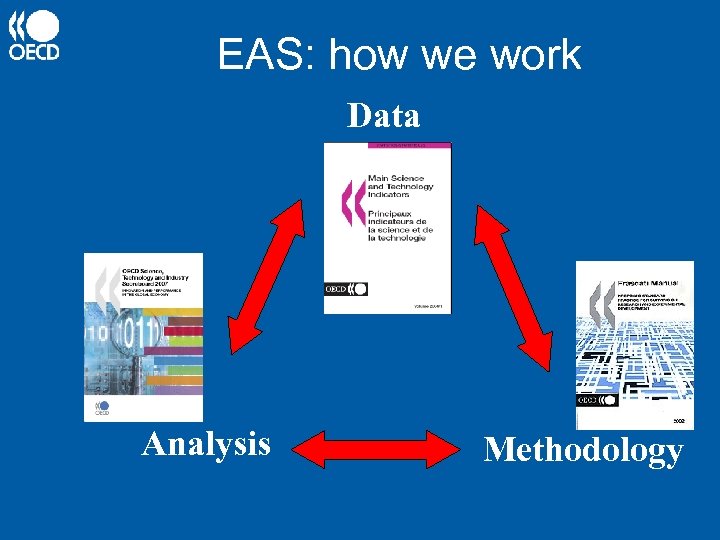
EAS: how we work Data Analysis Methodology
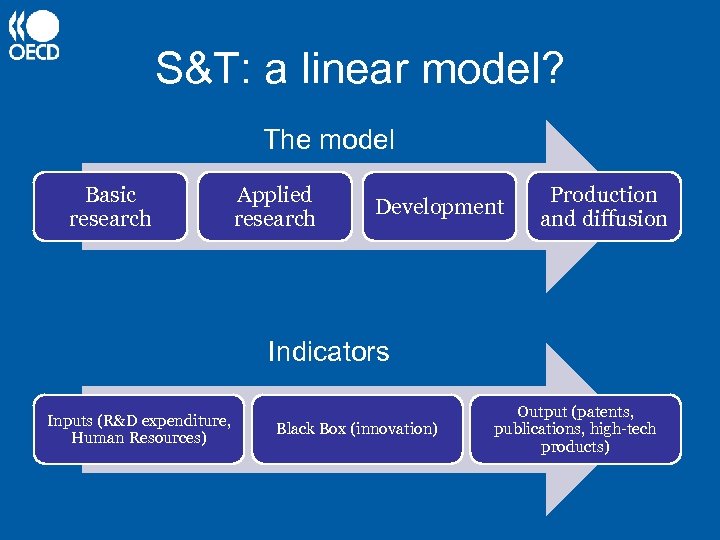
S&T: a linear model? The model Basic research Applied research Development Production and diffusion Indicators Inputs (R&D expenditure, Human Resources) Black Box (innovation) Output (patents, publications, high-tech products)
A systems approach Innovation is dynamic and complex: • Many actors, many linkages • Feedback and feed-forward loops innovation is non-linear
Evidence-based policy making
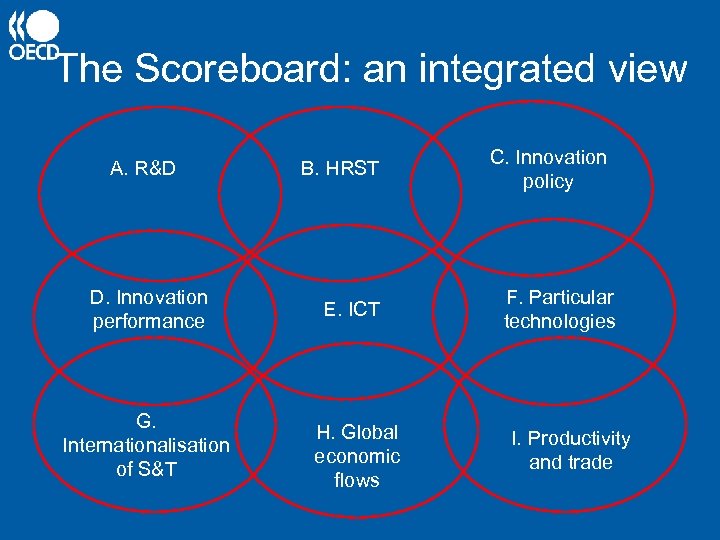
The Scoreboard: an integrated view A. R&D D. Innovation performance G. Internationalisation of S&T B. HRST E. ICT H. Global economic flows C. Innovation policy F. Particular technologies I. Productivity and trade
A. Research and Development • First edition published in 1963! • Sixth edition published in 2002 • Data also collected since 1963
th 5 Highlights of the Frascati Manual revision • • Improved methodological guidelines Update various classifications R&D in service sectors Human resources for R&D Survey methods business enterprise sector GBAORD Globalisation and links to SNA (capitalisation of R&D!) • Annexes on health, ICT and biotechnology
Definition of R&D • Research and experimental development (R&D) comprise creative work undertaken on a systematic basis in order to increase the stock of knowledge, including knowledge of man, culture and society, and the use of this stock of knowledge to devise new applications.
Exclusions from R&D • • Education and training Other science and technology activities Other industrial activities Administration and other supporting activities
Intramural R&D expenditure • By sector of performance (BES, HE, GOV, PNP) • By source of funds (same plus abroad) • By type of activity (BR, AR, ED) • By type of cost (current and capital) • By field of science (nat sc, eng & techn, med sc, agri sc, soc sc, hum) • By socio-economic objective (~ NABS)
Business Expenditure on R&D • BERD by industry (NACE/ISIC) – Main activity – Product field – ISIC 73 • BERD by size-class
Government Budget Appropriations or Outlays for R&D (GBAORD) 1. 2. 3. 4. 5. 6. 7. 8. 9. 10. 11. 12. 13. 14. Exploration and exploitation of the earth Environment Exploration and exploitation of space Transport, telecommunication and other infrastructures Energy Industrial production and technology Health Agriculture Education Culture, recreation religion and mass media Political and social systems, structures and processes General advancement of knowledge: GUF General advancement of knowledge: non-GUF Defence
R&D Personnel • • In headcounts and full-time equivalents By sector of employment By occupation (researchers, technicians, oss) By qualification (ISCED) By field of science By industry By sex By age-group
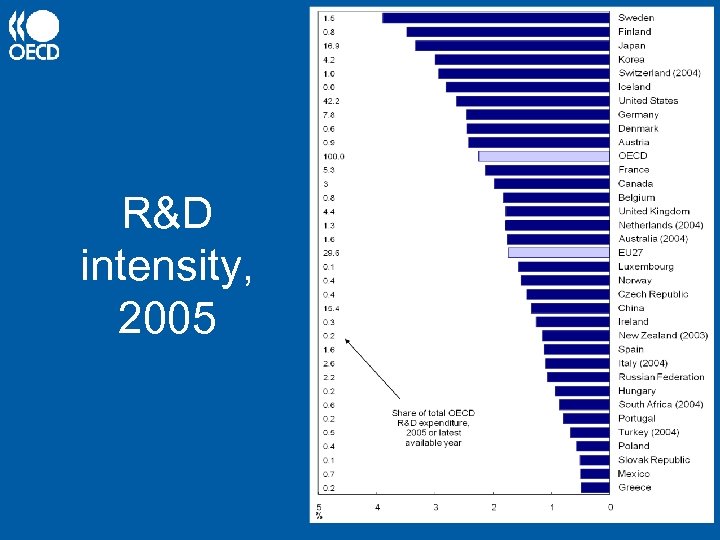
R&D intensity, 2005
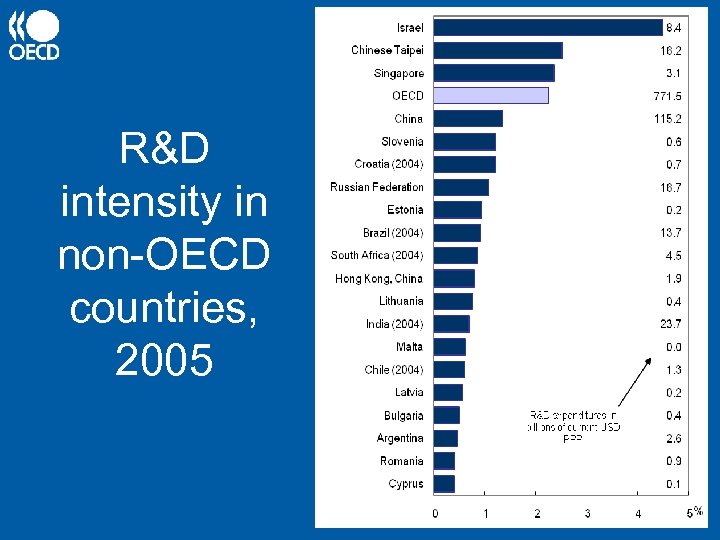
R&D intensity in non-OECD countries, 2005
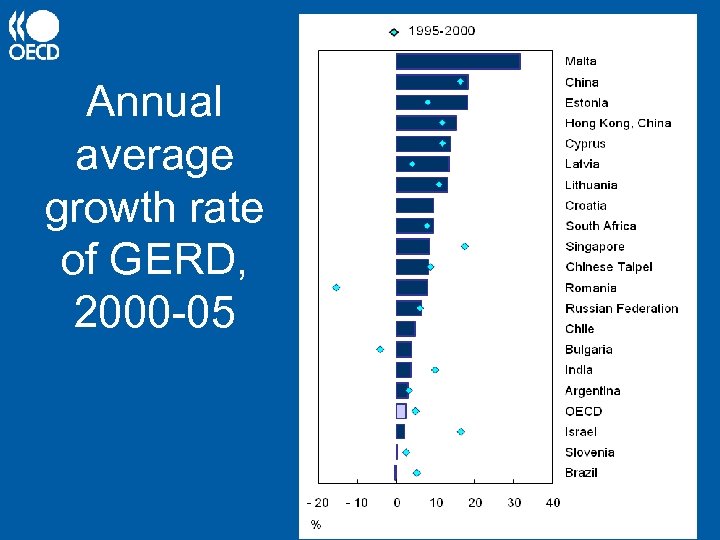
Annual average growth rate of GERD, 2000 -05
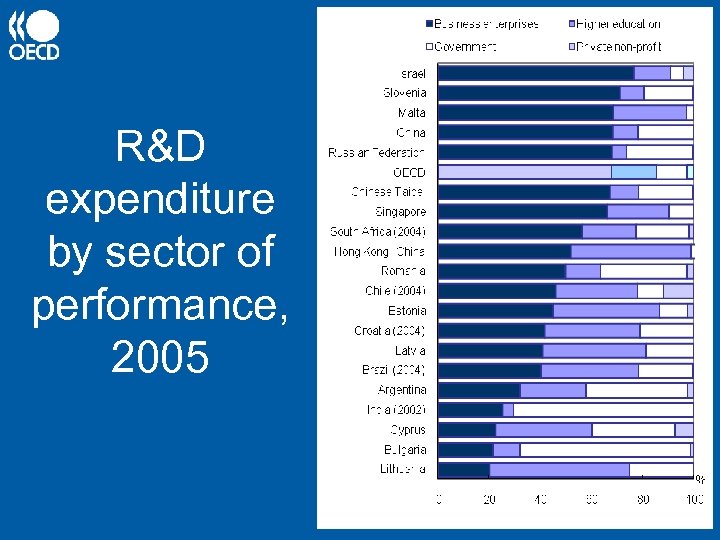
R&D expenditure by sector of performance, 2005
B. Human Resources for Science and Technology (HRST) • The Measurement of Human Resources Devoted to Science and Technology – Canberra Manual (1995) • The CM is part of the Frascati family • Careers of Doctorate Holders (CDH)
Dimensions of HRST • Skills • Qualifications • Mobility
Definition of HRST (Canberra Manual) HRST are people who fulfil one or other of the following conditions: a) successfully completed education at the third level in an S&T field of study; b) not formally qualified as above, but employed in a S&T occupation where the above qualifications are normally required.
Definition of HRST (cont. ) Education • ISCED Level 5 - First stage of tertiary education (not leading directly to an advanced research qualification) • ISCED 5 A: theoretically based/research preparatory or giving access to professions with high skills requirements • ISCED 5 B: practical/technical/occupationally specific • ISCED Level 6 - Second stage of tertiary education (leading to an advanced research qualification)
Definition of HRST (cont. ) Occupation • A subset of ISCO Major Group 1: Legislators, senior officials and managers Usually ignored! • ISCO Major Group 2: Professionals • ISCO Major Group 3: Technicians And Associate Professionals
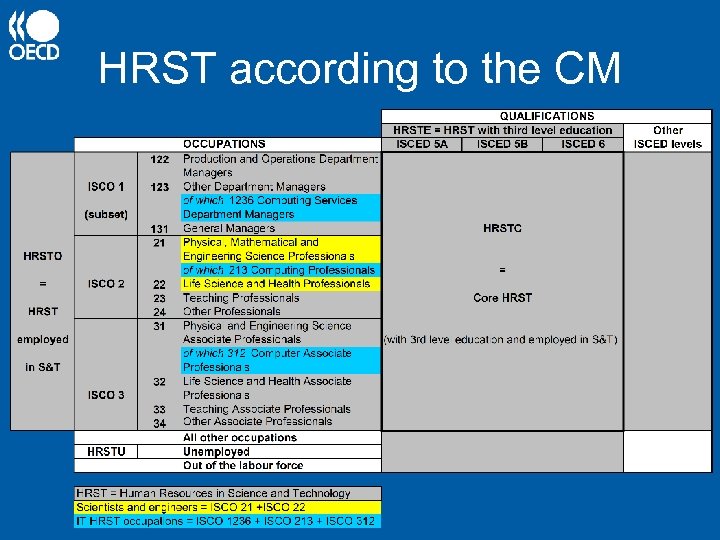
HRST according to the CM
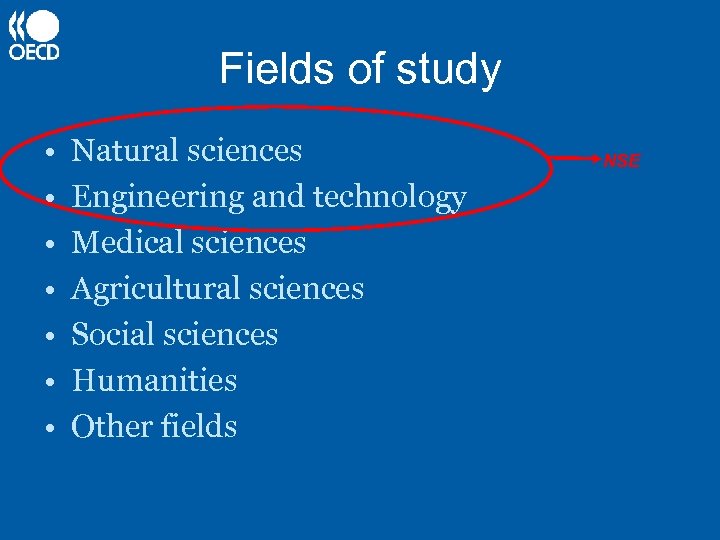
Fields of study • • Natural sciences Engineering and technology Medical sciences Agricultural sciences Social sciences Humanities Other fields NSE
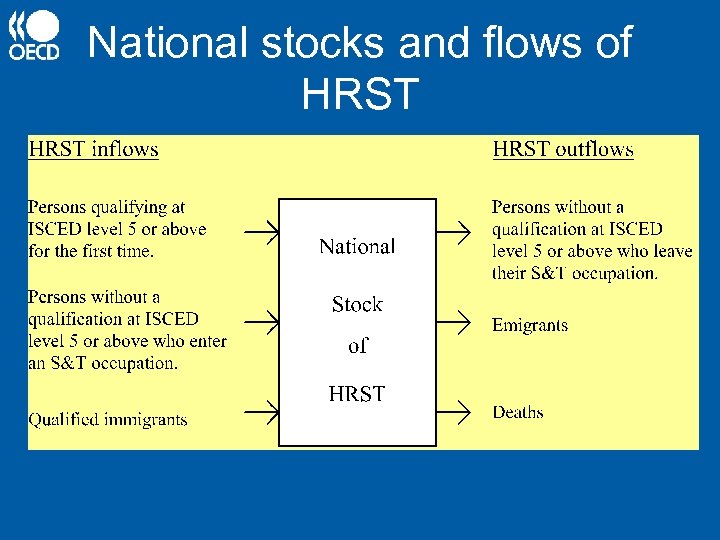
National stocks and flows of HRST
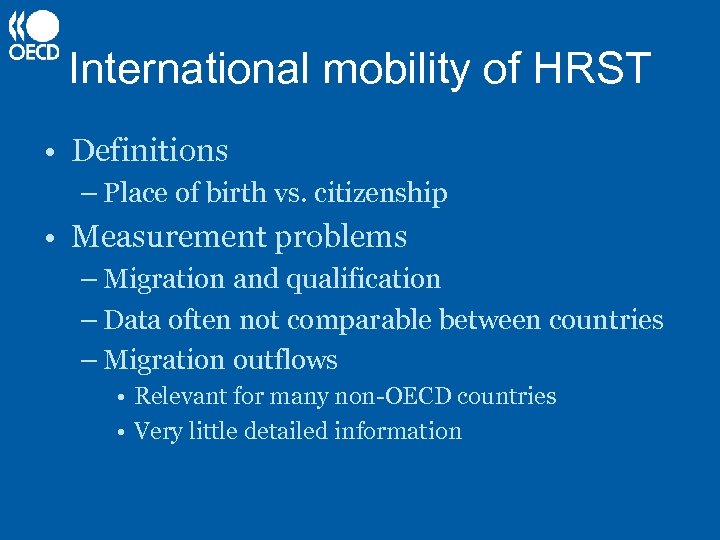
International mobility of HRST • Definitions – Place of birth vs. citizenship • Measurement problems – Migration and qualification – Data often not comparable between countries – Migration outflows • Relevant for many non-OECD countries • Very little detailed information
Sources for HRST • • • Education databases Labour force surveys Population registers Censuses National administrative systems for regulating and monitoring immigration • Administrative systems relating to temporary residence or work permits for non-nationals • Specific surveys
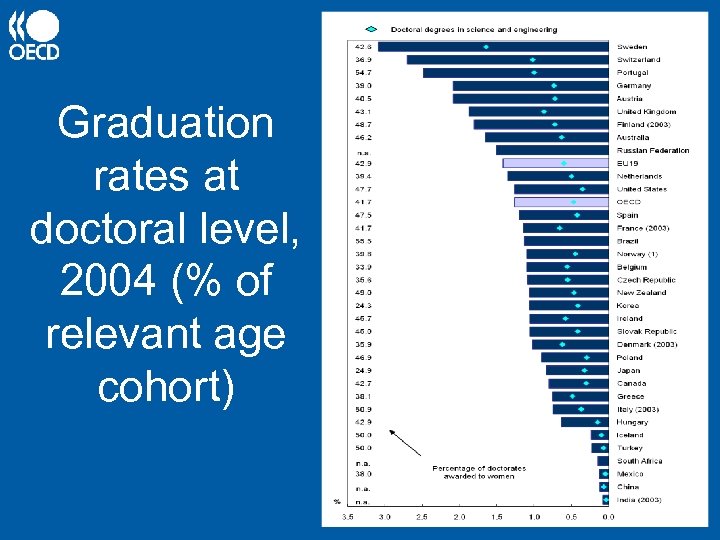
Graduation rates at doctoral level, 2004 (% of relevant age cohort)
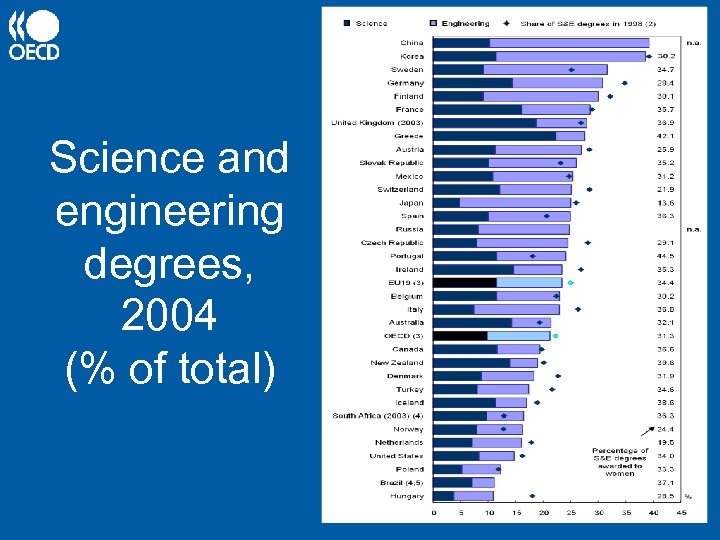
Science and engineering degrees, 2004 (% of total)
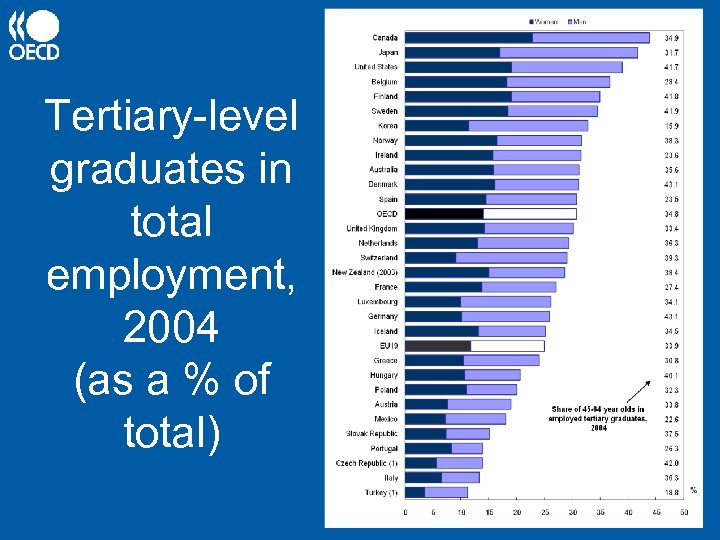
Tertiary-level graduates in total employment, 2004 (as a % of total)
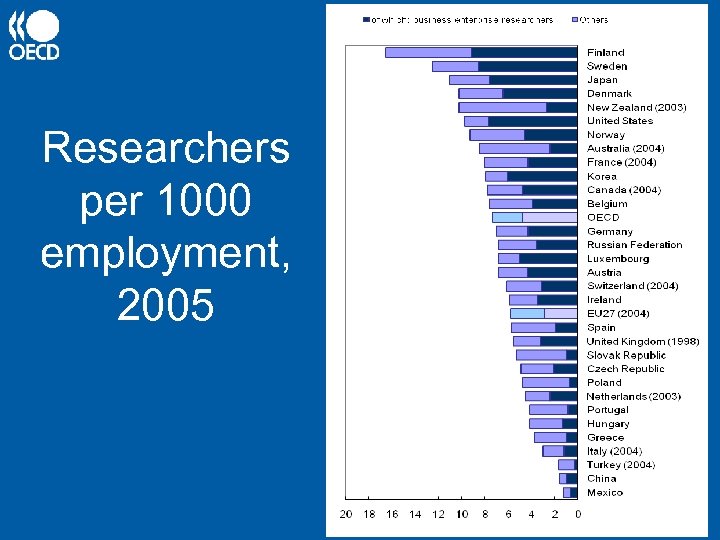
Researchers per 1000 employment, 2005
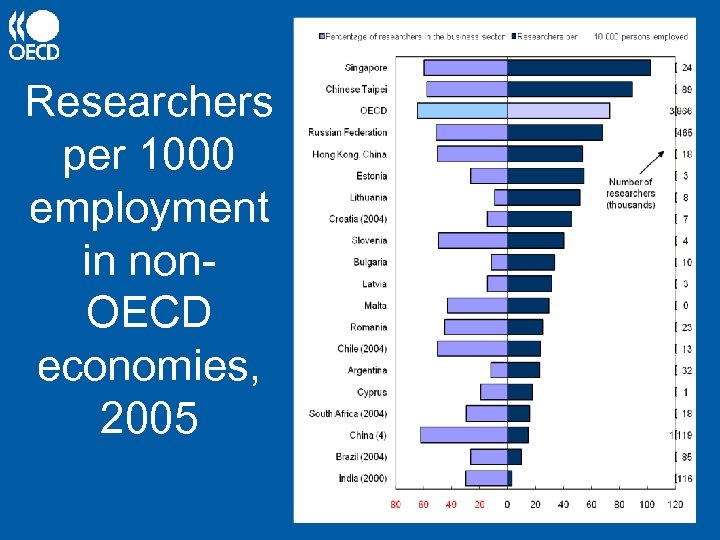
Researchers per 1000 employment in non. OECD economies, 2005
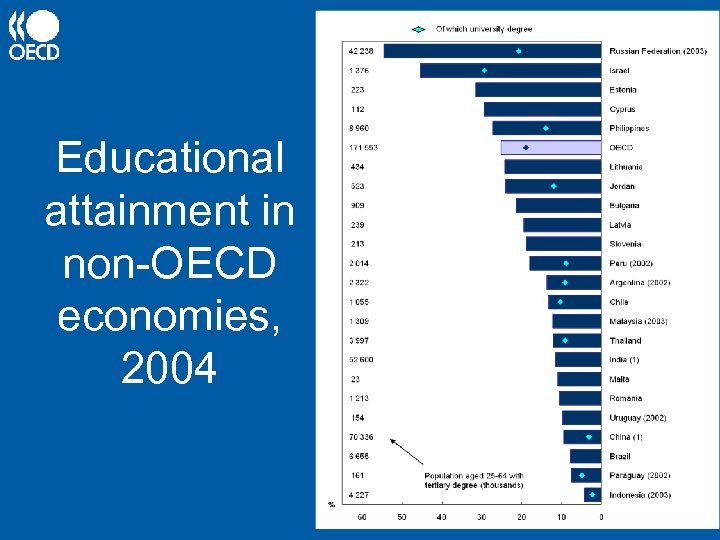
Educational attainment in non-OECD economies, 2004
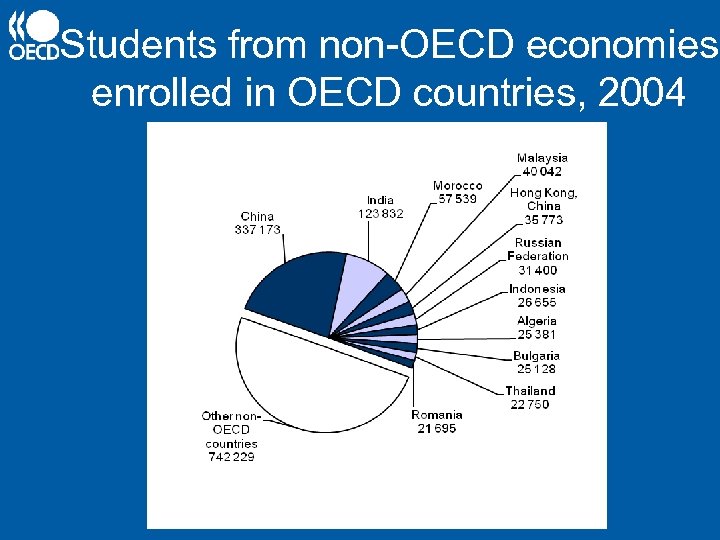
Students from non-OECD economies enrolled in OECD countries, 2004
Careers of Doctorate Holders (CDH) • A joint OECD/Eurostat/UNESCO project launched by the OECD Secretariat in 2004 • An expert group of 40 countries among which the United States, Japan, China, India, Argentina, Uganda and many European countries • A three-component package developed by the expert group: output tabulations, methodological guidelines and a model survey questionnaire
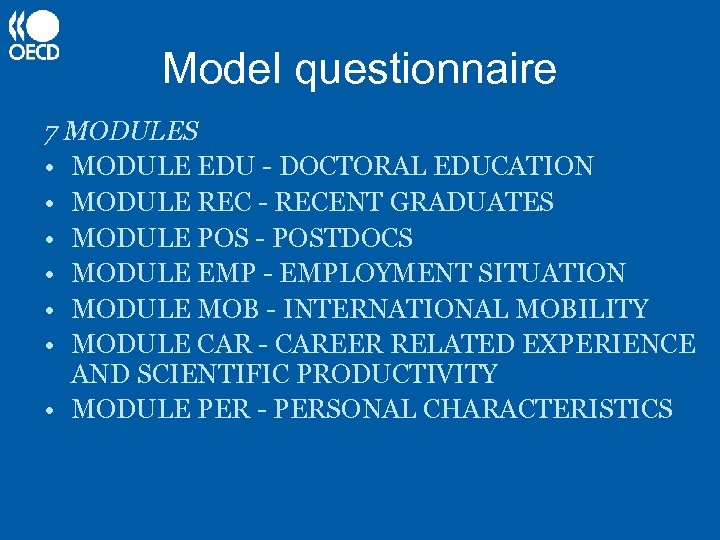
Model questionnaire 7 MODULES • MODULE EDU - DOCTORAL EDUCATION • MODULE REC - RECENT GRADUATES • MODULE POS - POSTDOCS • MODULE EMP - EMPLOYMENT SITUATION • MODULE MOB - INTERNATIONAL MOBILITY • MODULE CAR - CAREER RELATED EXPERIENCE AND SCIENTIFIC PRODUCTIVITY • MODULE PER - PERSONAL CHARACTERISTICS
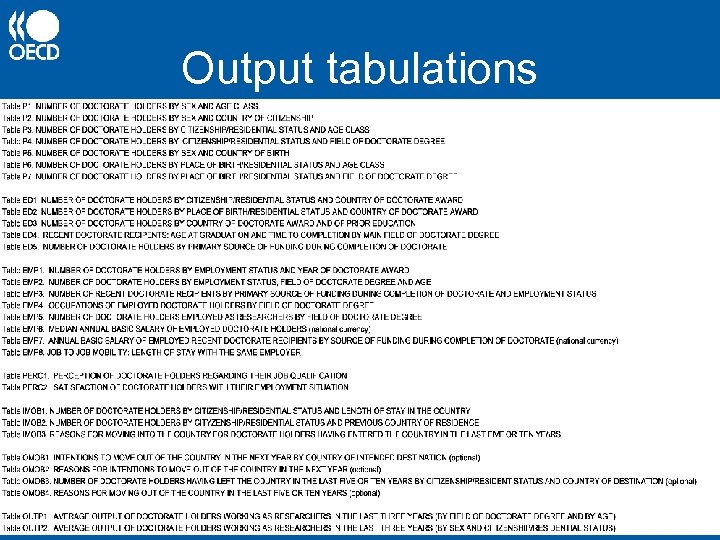
Output tabulations
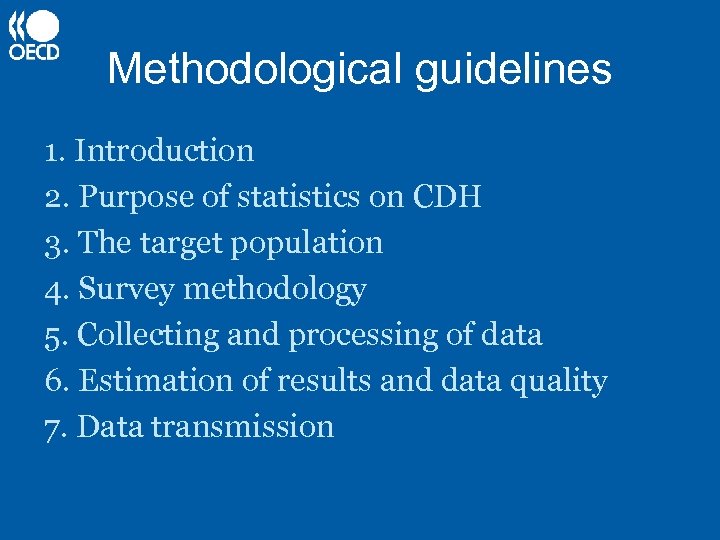
Methodological guidelines 1. Introduction 2. Purpose of statistics on CDH 3. The target population 4. Survey methodology 5. Collecting and processing of data 6. Estimation of results and data quality 7. Data transmission
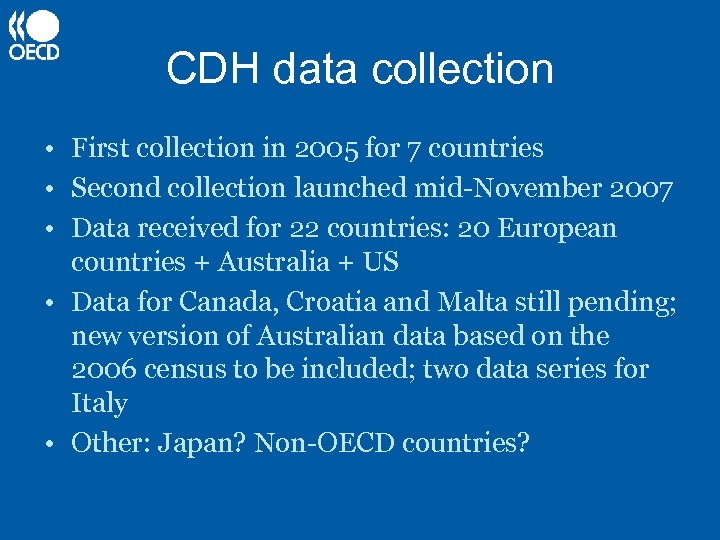
CDH data collection • First collection in 2005 for 7 countries • Second collection launched mid-November 2007 • Data received for 22 countries: 20 European countries + Australia + US • Data for Canada, Croatia and Malta still pending; new version of Australian data based on the 2006 census to be included; two data series for Italy • Other: Japan? Non-OECD countries?
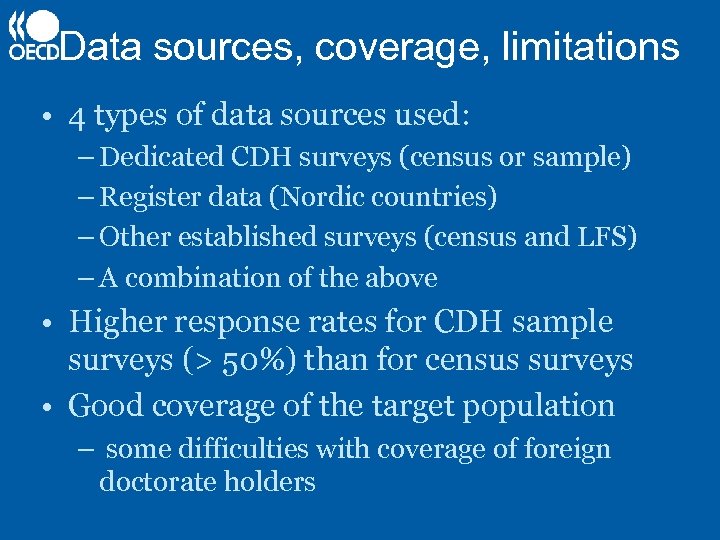
Data sources, coverage, limitations • 4 types of data sources used: – Dedicated CDH surveys (census or sample) – Register data (Nordic countries) – Other established surveys (census and LFS) – A combination of the above • Higher response rates for CDH sample surveys (> 50%) than for census surveys • Good coverage of the target population – some difficulties with coverage of foreign doctorate holders
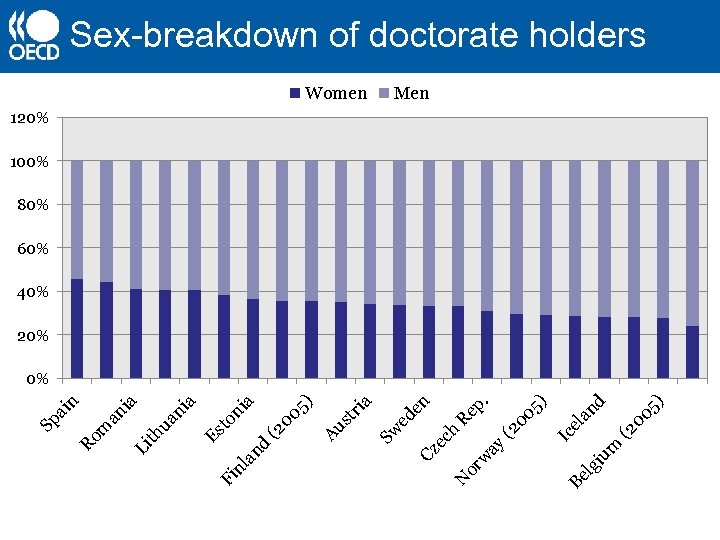
m gi u ay w or Be l N 5) nd la 00 (2 Ic e 5) p. Re 00 (2 h ec ia en ed ia 5) st r 00 Au (2 Sw nd to n Es a ni Women Cz la Fi n ua Li th an ia m Ro n ai Sp Sex-breakdown of doctorate holders Men 120% 100% 80% 60% 40% 20% 0%
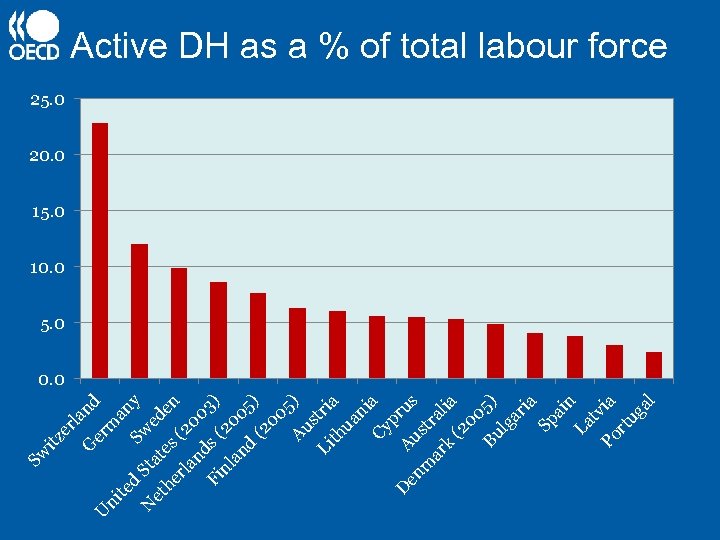
er nd la m ni an te d y St Sw N et ate ede he s n rla (2 nd 00 Fi s ( 3) nl 2 an 00 5 d (2 ) 00 5 Au ) s Li tria th ua ni Cy a p D Au rus en m str ar al i k (2 a 00 Bu 5) lg ar ia Sp ai n La t Po via rt ug al U G er itz Sw Active DH as a % of total labour force 25. 0 20. 0 15. 0 10. 0 5. 0 0. 0
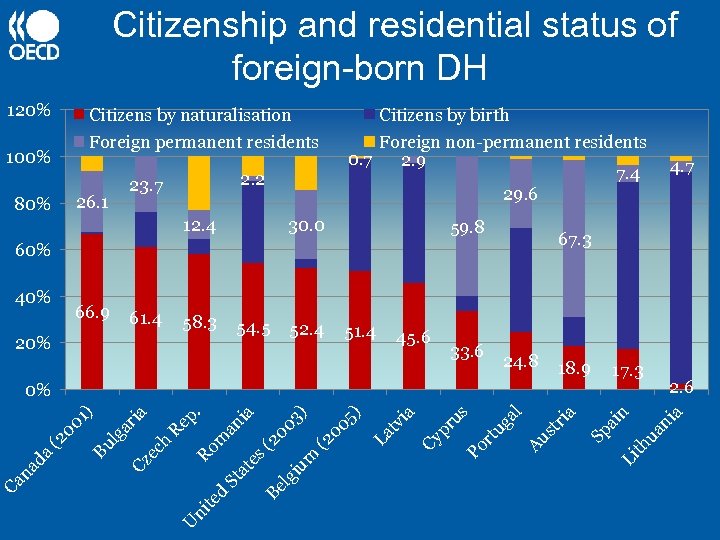
Citizenship and residential status of foreign-born DH Citizens by naturalisation Citizens by birth 30. 0 59. 8 67. 3 60% 40% 66. 9 61. 4 58. 3 20% 54. 5 52. 4 51. 4 45. 6 33. 6 24. 8 18. 9 17. 3 n ai Sp Au st r ia l ga Po rt u us Cy pr a tv i La 5) 00 (2 m gi u Be l es (2 00 3) an ia d St at Ro h ec Cz m p. ia ar lg Bu Re U ni te Ca na da (2 00 1) 0% 2. 6 a 12. 4 4. 7 ni 2. 2 23. 7 26. 1 80% Foreign non-permanent residents 0. 7 2. 9 7. 4 29. 6 ua Foreign permanent residents 100% Li th 120%
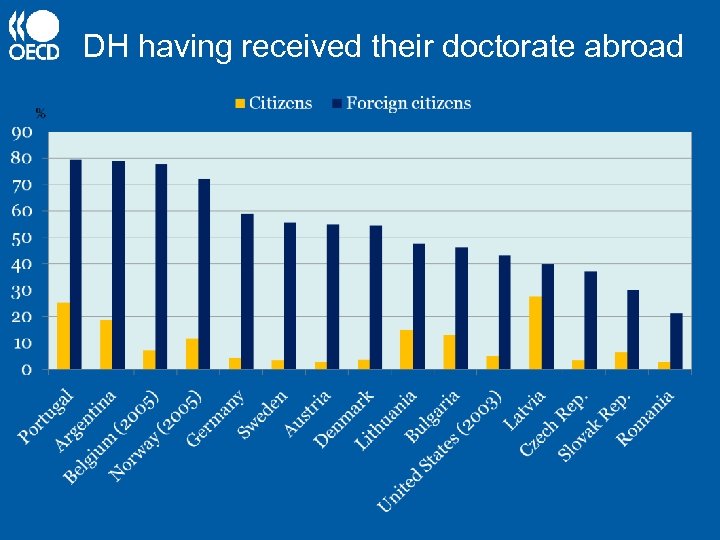
DH having received their doctorate abroad
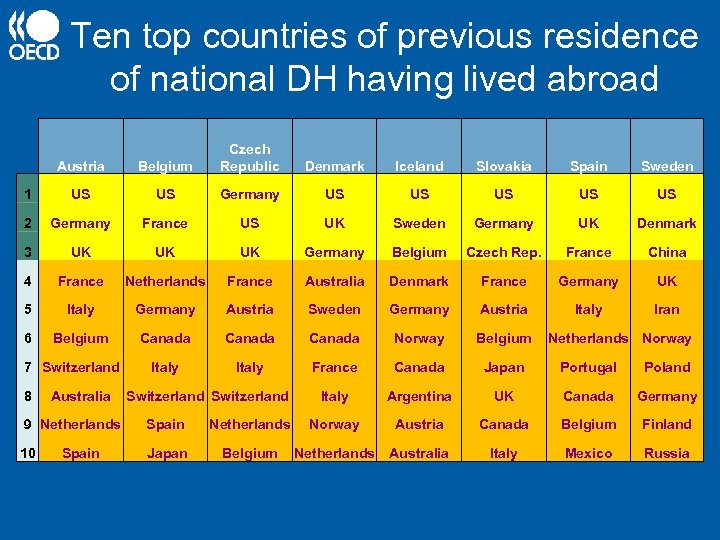
Ten top countries of previous residence of national DH having lived abroad Austria Belgium Czech Republic 1 US US Germany US US US 2 Germany France US UK Sweden Germany UK Denmark 3 UK UK UK Germany Belgium Czech Rep. France China 4 France Netherlands France Australia Denmark France Germany UK 5 Italy Germany Austria Sweden Germany Austria Italy Iran 6 Belgium Canada Norway Belgium Italy France Canada Japan Portugal Poland Italy Argentina UK Canada Germany 7 Switzerland 8 Australia Switzerland Denmark Iceland Slovakia Spain Sweden Netherlands Norway 9 Netherlands Spain Netherlands Norway Austria Canada Belgium Finland 10 Japan Belgium Netherlands Australia Italy Mexico Russia Spain
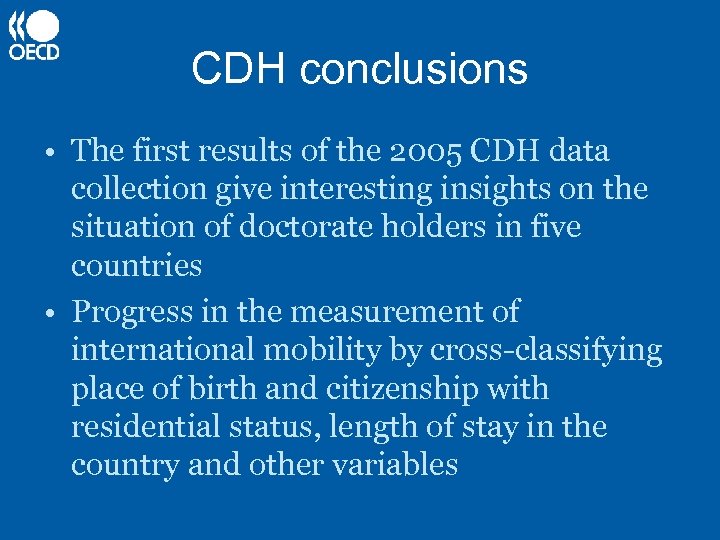
CDH conclusions • The first results of the 2005 CDH data collection give interesting insights on the situation of doctorate holders in five countries • Progress in the measurement of international mobility by cross-classifying place of birth and citizenship with residential status, length of stay in the country and other variables
CDH conclusions (cont. ) • Important value added by introducing the collection of more qualitative information on the perception and plans of doctoral graduates regarding their employment and international mobility • Such qualitative indicators are extremely useful to help understanding the complex patterns of international mobility that cannot only be gauged through quantitative data because of the heterogeneity of migration systems across countries
International conference on the Careers and Mobility of Doctorate Holders • 1 st December in Brussels • Joint OECD/UIS/Eurostat event with support of EC DG Research • The conference will serve as a forum to diffuse and discuss the results with interested stakeholders, academics and policy makers
International conference on the Careers and Mobility of Doctorate Holders • Programme is under discussion, list of topics: – Doctoral and research training – Human resources in research – The labour market of doctorate holders – The international mobility of doctorate holders
C. Innovation policy • • • Public-private cross-funding of R&D Government R&D budgets Tax treatment of R&D Patenting by universities and government Collaboration with public research organisations by innovating firms • Science linkages in technology • Entrepreneurship
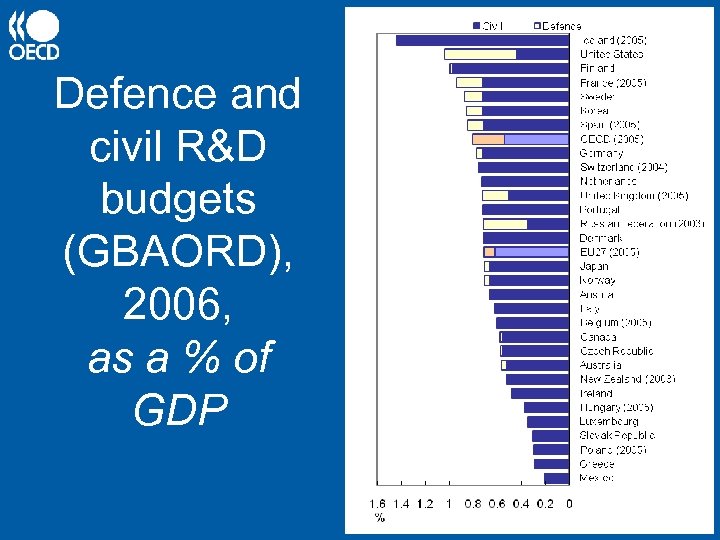
Defence and civil R&D budgets (GBAORD), 2006, as a % of GDP
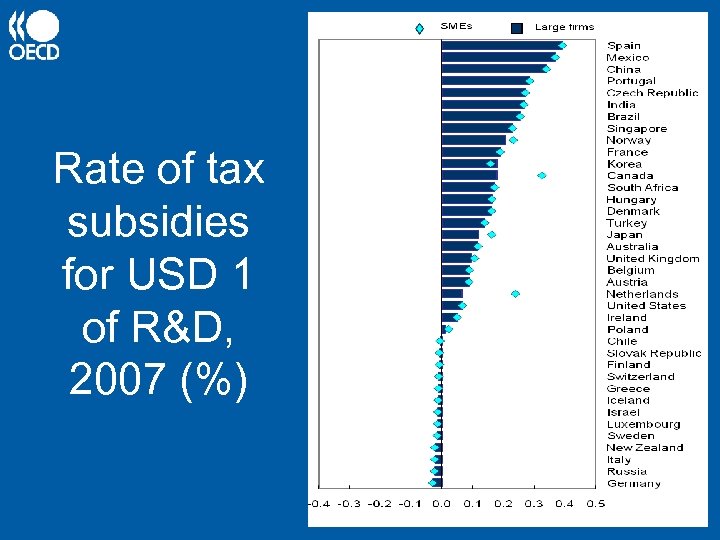
Rate of tax subsidies for USD 1 of R&D, 2007 (%)
D. Innovation performance • Patents • Bibliometrics • Innovation
Patents • Indicators of invention • Administrative data containing much information • Data widely available, e. g. in PATSTAT (EPO) • Drawbacks – Not all inventions are patented – Value distribution skewed
Patent Statistics Task Force • • OECD Eurostat European Patent Office (EPO) Japan Patent Office (JPO) US National Science Foundation (NSF) US Patent and Trademark Office (USPTO) World Intellectual Property Organization (WIPO)
The Patent Manual 2008 • Part of the Frascati family • Major revision of the 1994 Manual • Provides background information to understand the patent process • Proposes standards for compiling indicators
Contents of the Patent Manual 1. 2. 3. 4. 5. 6. 7. 8. Introduction Patents as statistical indicators of S&T Patent systems and procedures Counting patents for conducting international comparison Technical and economic classifications of patents The use and analysis of citations Indicators of internationalisation Indicators of patent value
Recent work • Regional patents • Standardising patent holders’ names • Trademarks
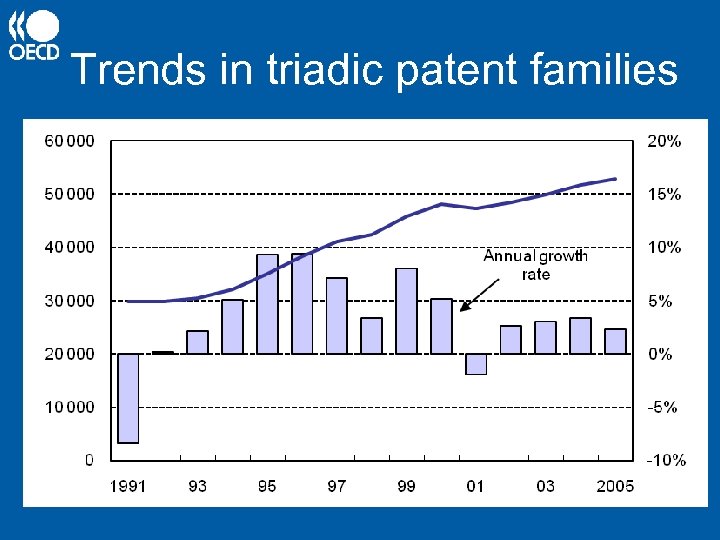
Trends in triadic patent families
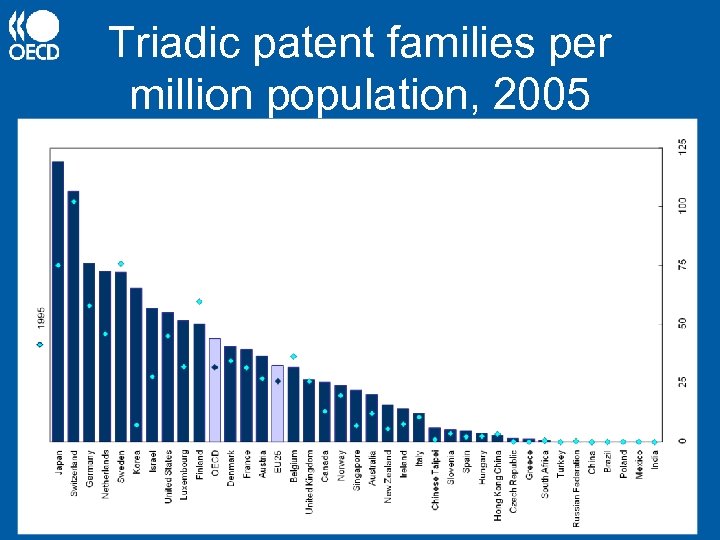
Triadic patent families per million population, 2005

Any questions? Or is it already time for the coffee break?
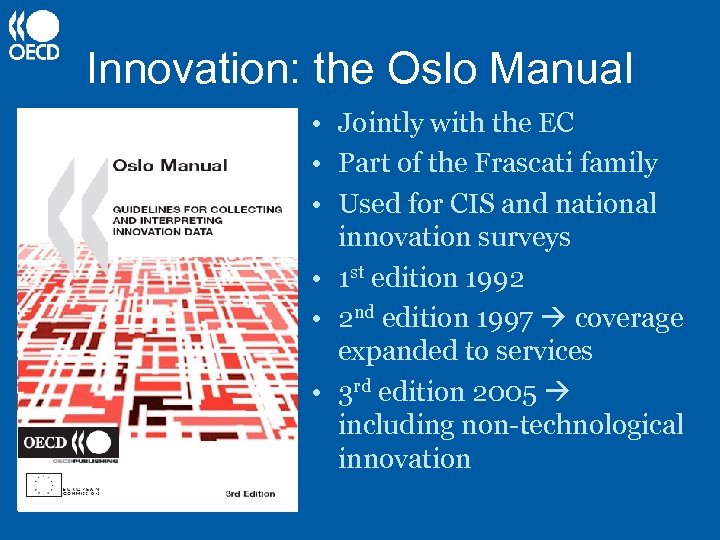
Innovation: the Oslo Manual • Jointly with the EC • Part of the Frascati family • Used for CIS and national innovation surveys • 1 st edition 1992 • 2 nd edition 1997 coverage expanded to services • 3 rd edition 2005 including non-technological innovation
Innovation definition An innovation is the implementation of a new or significantly improved product (good or service), or process, a new marketing method, or a new organisational method in business practices, workplace organisation or external relations
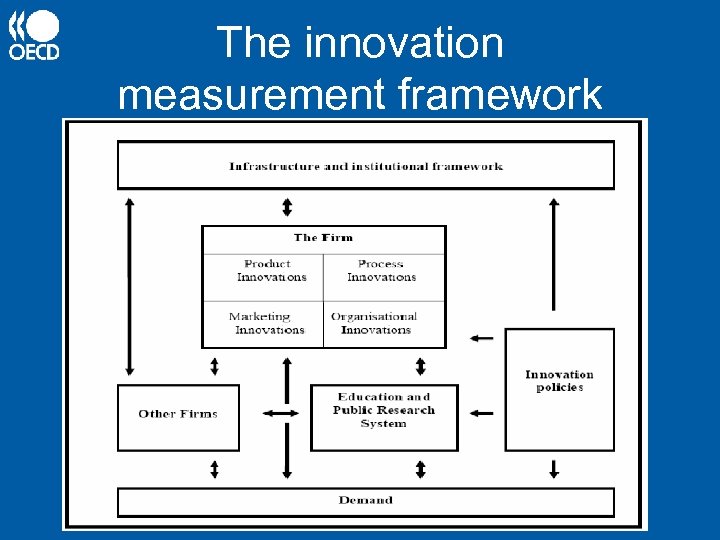
The innovation measurement framework
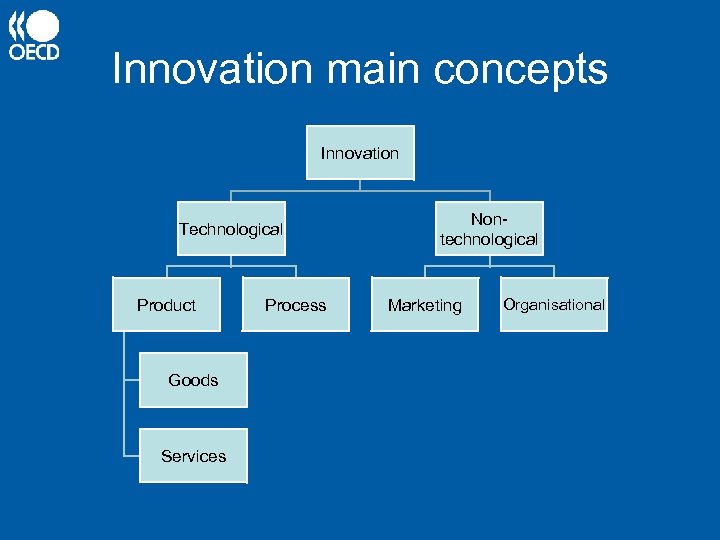
Innovation main concepts Innovation Technological Product Goods Services Process Nontechnological Marketing Organisational
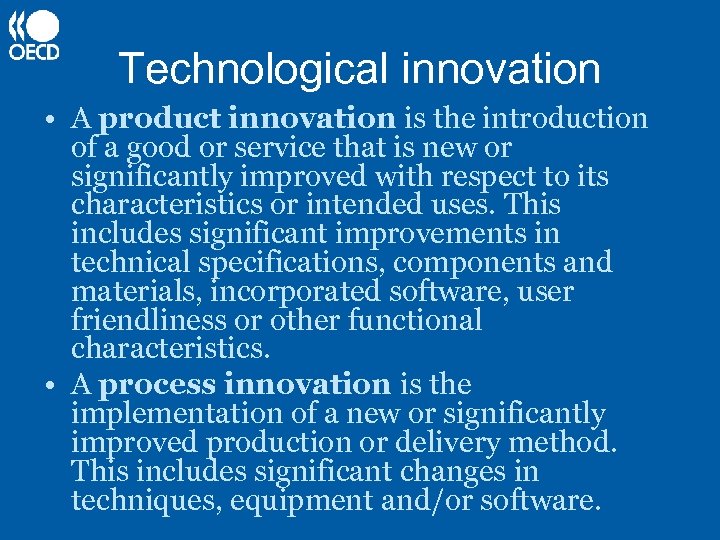
Technological innovation • A product innovation is the introduction of a good or service that is new or significantly improved with respect to its characteristics or intended uses. This includes significant improvements in technical specifications, components and materials, incorporated software, user friendliness or other functional characteristics. • A process innovation is the implementation of a new or significantly improved production or delivery method. This includes significant changes in techniques, equipment and/or software.
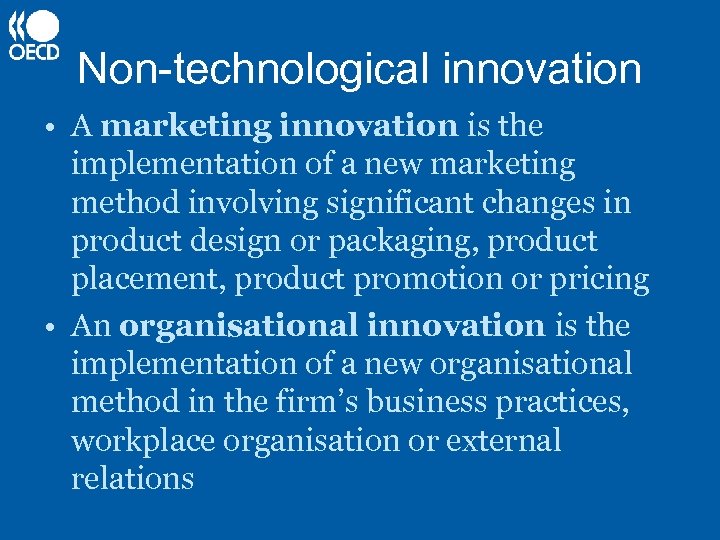
Non-technological innovation • A marketing innovation is the implementation of a new marketing method involving significant changes in product design or packaging, product placement, product promotion or pricing • An organisational innovation is the implementation of a new organisational method in the firm’s business practices, workplace organisation or external relations
More definitions (1) Innovation activities are all scientific, technological, organisational, financial and commercial steps which actually, or are intended to, lead to the implementation of innovations. Some innovation activities are themselves innovative, others are not novel activities but are necessary for the implementation of innovations. Innovation activities also include R&D that is not directly related to the development of a specific innovation.
More definitions (2) • An innovative firm is one that has implemented an innovation during the period under review. • A product‑process innovative firm is one that has implemented a new or significantly improved product or process during the period under review.
More definitions (3) • Type of innovation: successful, unsuccessful, ongoing • Degree of novelty: technologically new / significantly improved/disruptive • Approach: “subject” vs. “object” • Degree of novelty: technologically new / significantly improved • Focus: business enterprise sector
Innovation activities for product and process innovations • • Intramural (in-house) R&D Acquisition of R&D (extramural R&D) Acquisition of other external knowledge Acquisition of machinery, equipment and other capital goods • Other preparations for product and process innovations • Market preparations for product innovations • Training
Innovation data • • • Objectives of innovation Factors assisting/hampering innovation Expenditure on innovation Impacts and outcomes Linkages
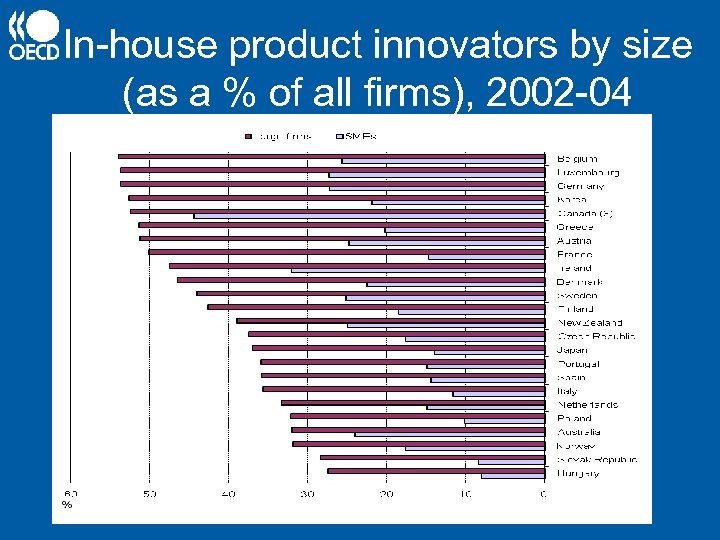
In-house product innovators by size (as a % of all firms), 2002 -04
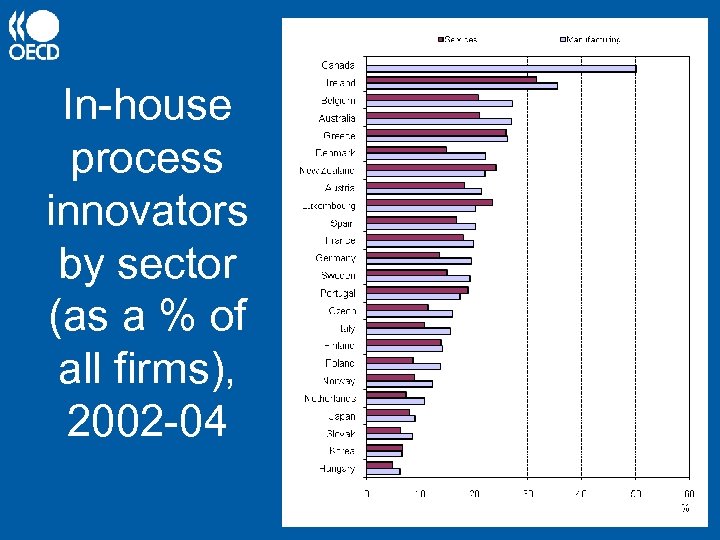
In-house process innovators by sector (as a % of all firms), 2002 -04
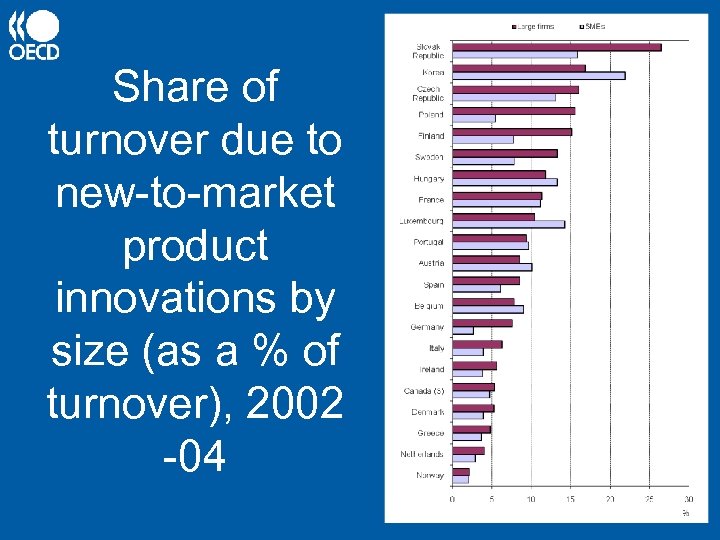
Share of turnover due to new-to-market product innovations by size (as a % of turnover), 2002 -04
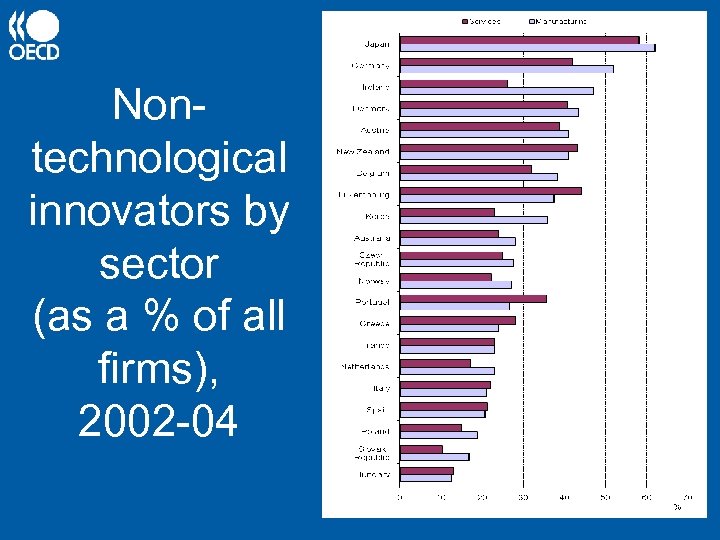
Nontechnological innovators by sector (as a % of all firms), 2002 -04
E. ICT • OECD Guide to Measuring the Information Society – OECD definition of the ICT sector – OECD classification of ICT products – Model survey of ICT use in households and by individuals – Model survey of ICT use by businesses – OECD definitions of Internet and e-commerce transactions – Impacts – Annex for developing countries
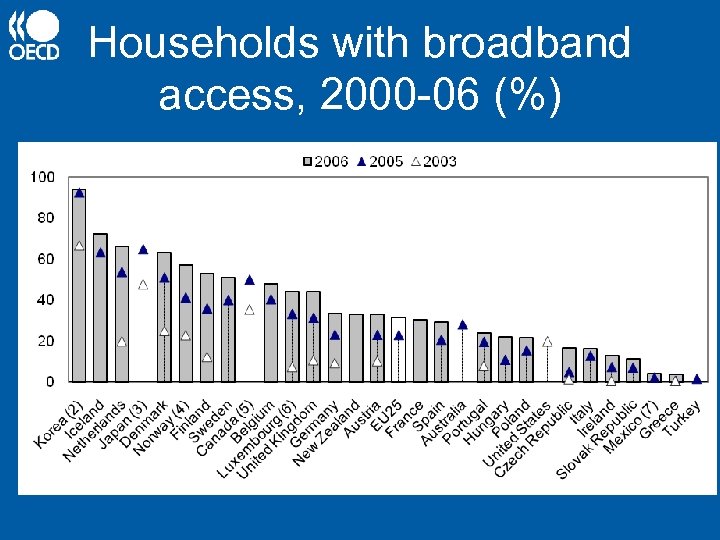
Households with broadband access, 2000 -06 (%)
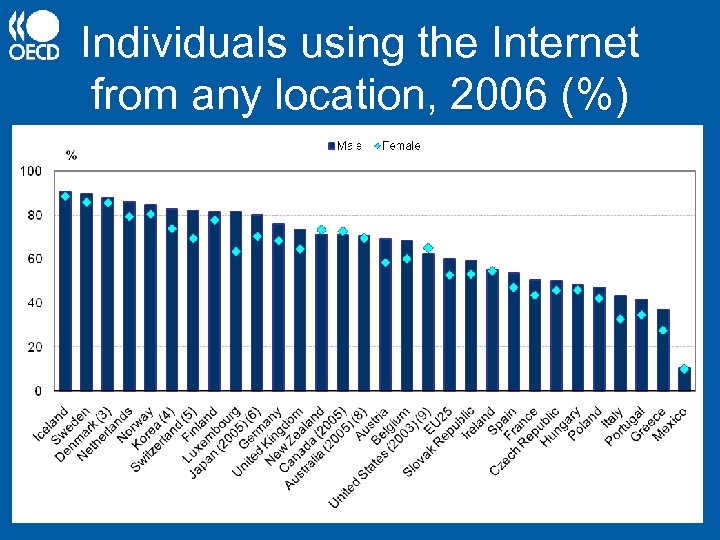
Individuals using the Internet from any location, 2006 (%)
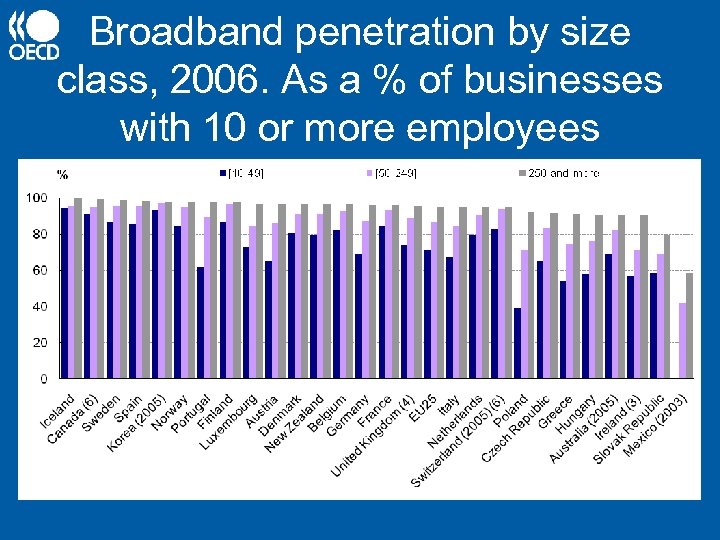
Broadband penetration by size class, 2006. As a % of businesses with 10 or more employees
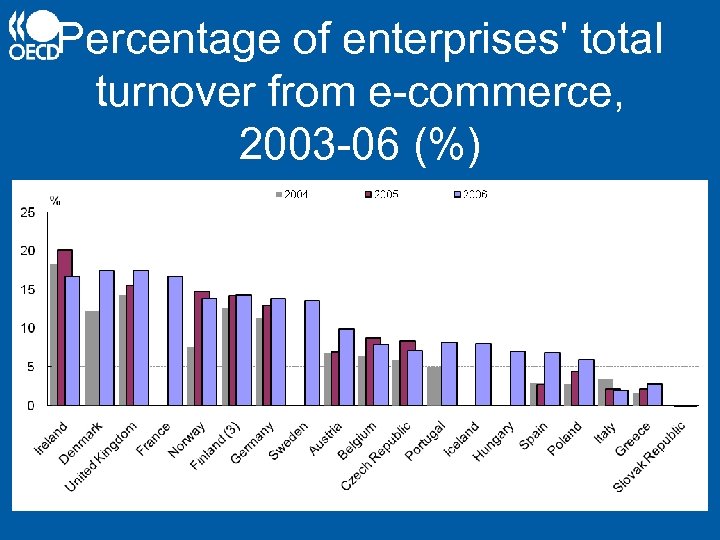
Percentage of enterprises' total turnover from e-commerce, 2003 -06 (%)
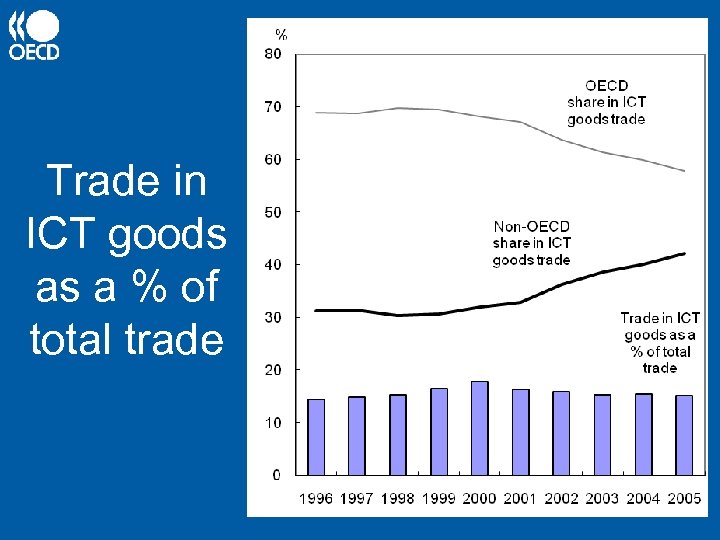
Trade in ICT goods as a % of total trade
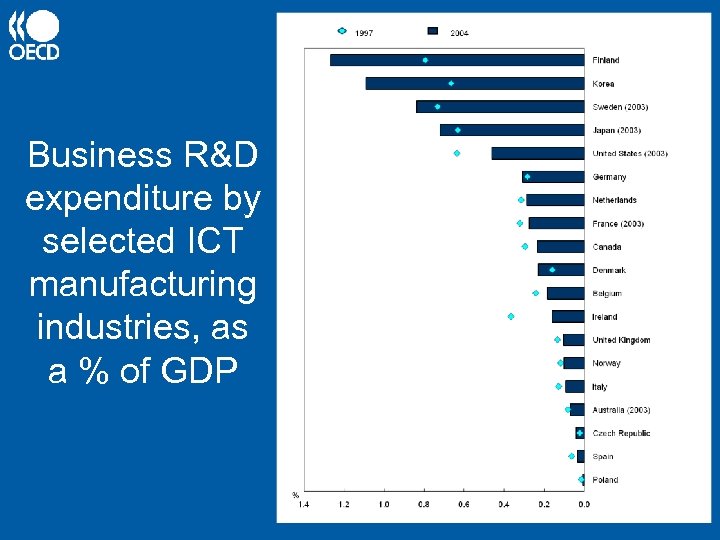
Business R&D expenditure by selected ICT manufacturing industries, as a % of GDP
F. Particular technologies • Biotechnology • Nanotechnology • Environmental science
Biotechnology • A series of ad-hoc meetings of a NESTI spin-off group • A framework for biotechnology statistics (2005) – Definitions – Model survey of biotechnology use and development – Classifications • OECD biotechnology statistics - 2006
The single definition of biotechnology The application of science and technology to living organisms, as well as parts, products and models thereof, to alter living or nonliving materials for the production of knowledge, goods and services.
The list-based definition of biotechnology technoques • DNA/RNA: Genomics, pharmacogenomics, gene probes, genetic engineering, • • • DNA/RNA sequencing/ synthesis/amplification, gene expression profiling, and use of antisense technology. Proteins and other molecules: Sequencing/synthesis/engineering of proteins and peptides (including large molecule hormones); improved delivery methods for large molecule drugs; proteomics, protein isolation and purification, signaling, identification of cell receptors. Cell and tissue culture and engineering: Cell/tissue culture, tissue engineering (including tissue scaffolds and biomedical engineering), cellular fusion, vaccine/immune stimulants, embryo manipulation. Process biotechnology techniques: Fermentation using bioreactors, bioprocessing, bioleaching, biopulping, biobleaching, biodesulphurisation, bioremediation, biofiltration and phytoremediation. Gene and RNA vectors: Gene therapy, viral vectors. Bioinformatics: Construction of databases on genomes, protein sequences; modelling complex biological processes, including systems biology. Nanobiotechnology: Applies the tools and processes of nano/microfabrication to build devices for studying biosystems and applications in drug delivery, diagnostics, etc.
Other relevant definitions • • Biotechnology product Biotechnology process Biotechnology active firm (enterprise) Dedicated biotechnology firm Innovative biotechnology firm Biotechnology R&D Biotechnology sales/revenue Biotechnology expenses
Biotechnology statistics & indicators • Biotechnology products and processes • Biotechnology R&D • Biotechnology firms by type (dedicated, innovative) • Biotechnology sales/revenue • Biotechnology expenses • Biotechnology employment • Biotechnology patents
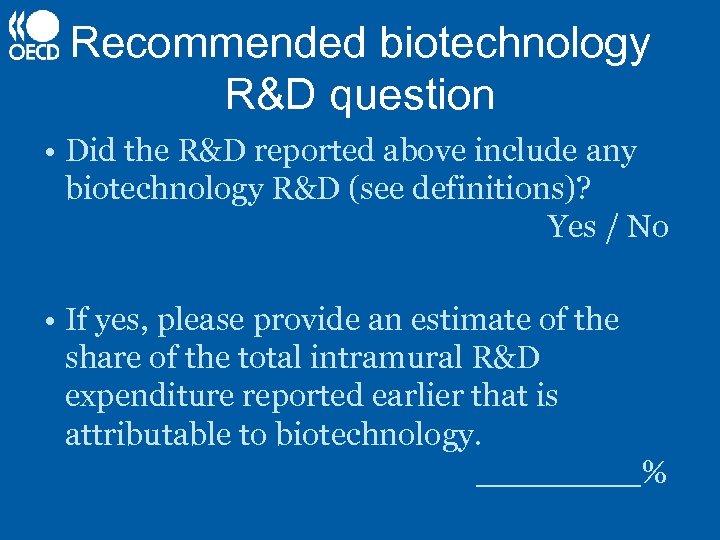
Recommended biotechnology R&D question • Did the R&D reported above include any biotechnology R&D (see definitions)? Yes / No • If yes, please provide an estimate of the share of the total intramural R&D expenditure reported earlier that is attributable to biotechnology. ____%
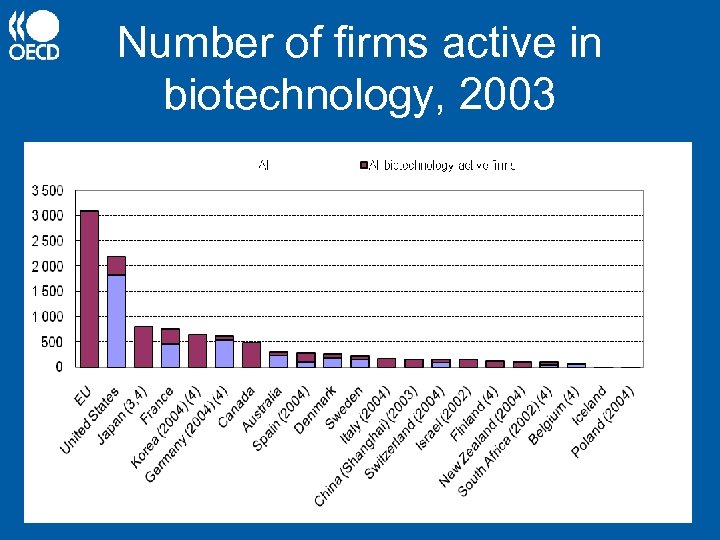
Number of firms active in biotechnology, 2003
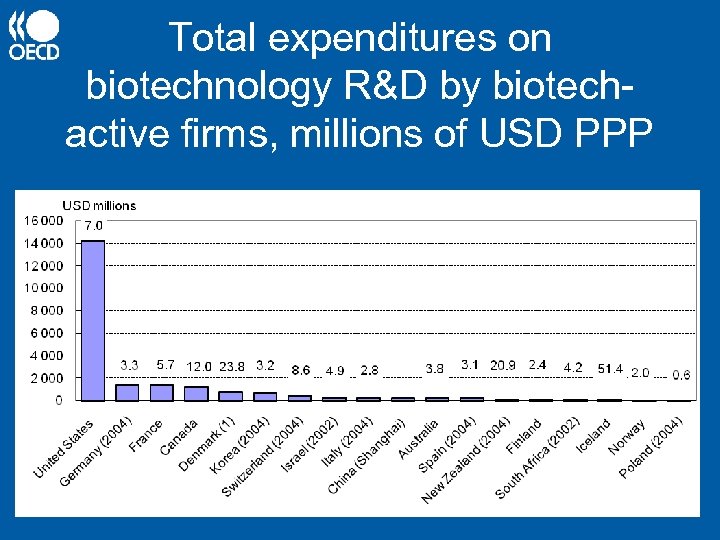
Total expenditures on biotechnology R&D by biotechactive firms, millions of USD PPP
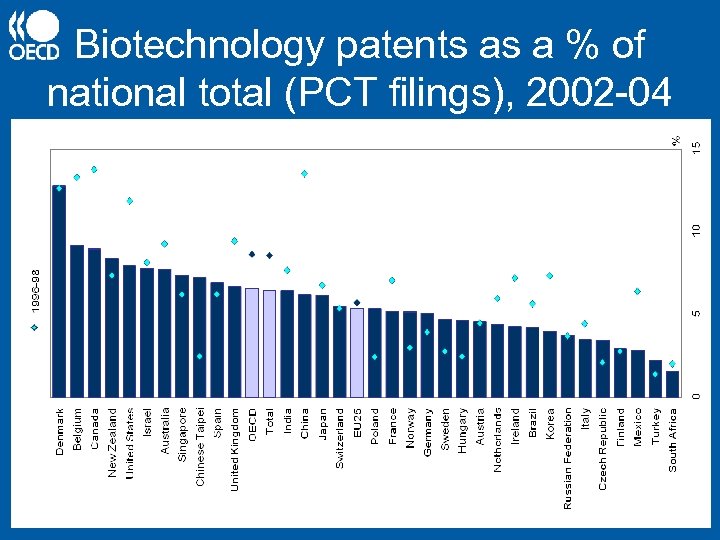
Biotechnology patents as a % of national total (PCT filings), 2002 -04
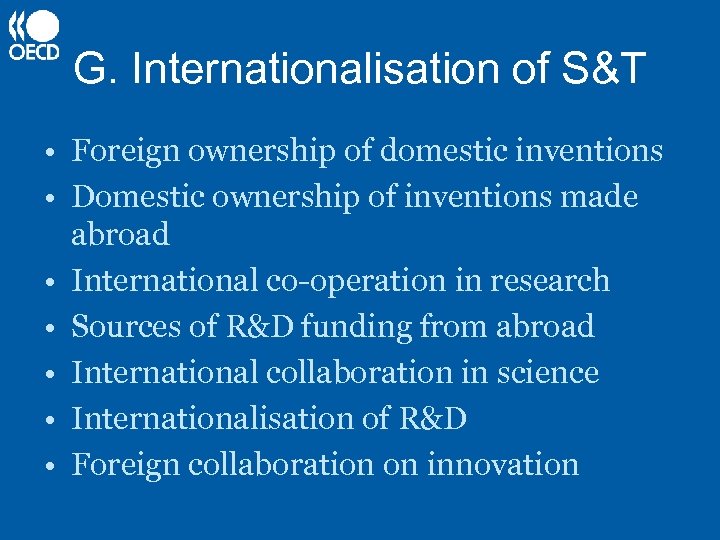
G. Internationalisation of S&T • Foreign ownership of domestic inventions • Domestic ownership of inventions made abroad • International co-operation in research • Sources of R&D funding from abroad • International collaboration in science • Internationalisation of R&D • Foreign collaboration on innovation
Data sources • • • Patents R&D data Publications (SCI) FATS and AFA CIS
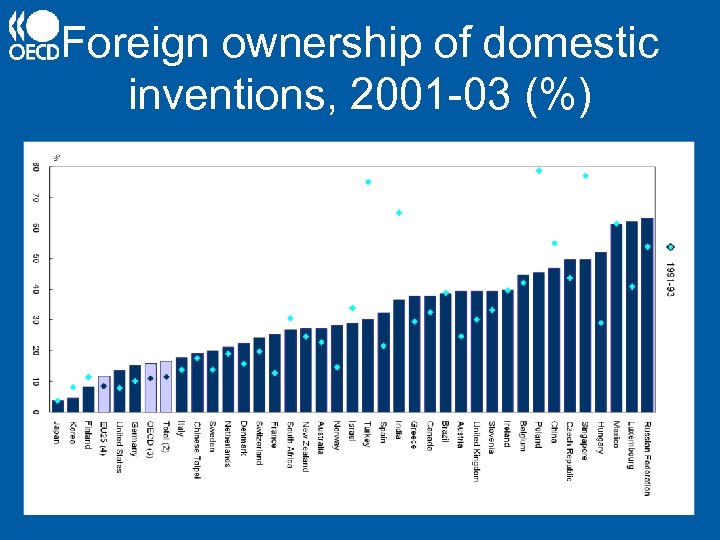
Foreign ownership of domestic inventions, 2001 -03 (%)
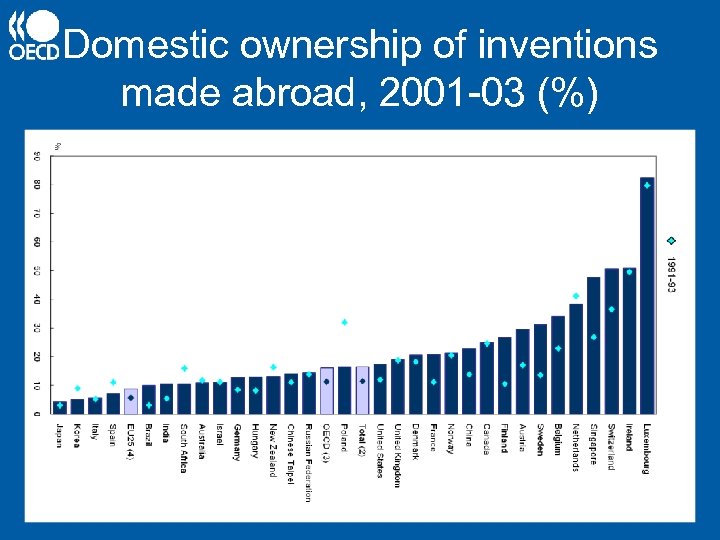
Domestic ownership of inventions made abroad, 2001 -03 (%)
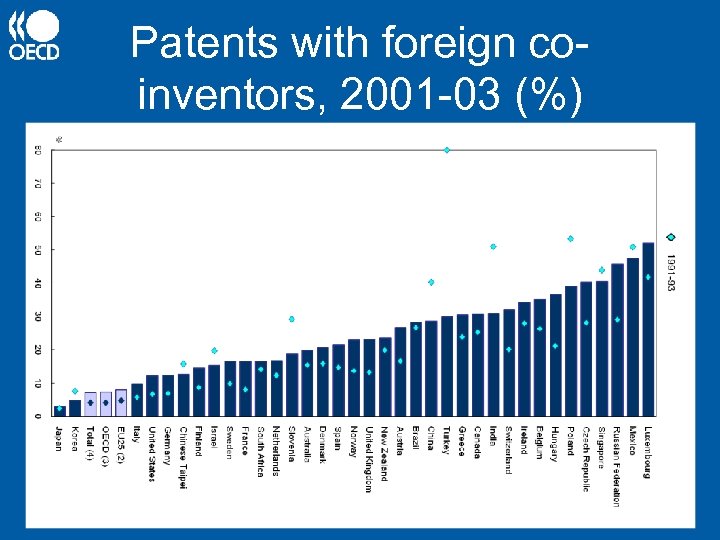
Patents with foreign coinventors, 2001 -03 (%)
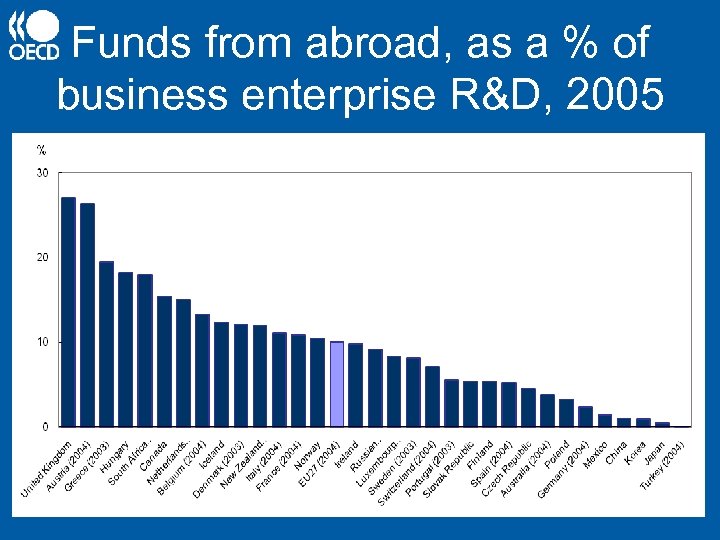
Funds from abroad, as a % of business enterprise R&D, 2005
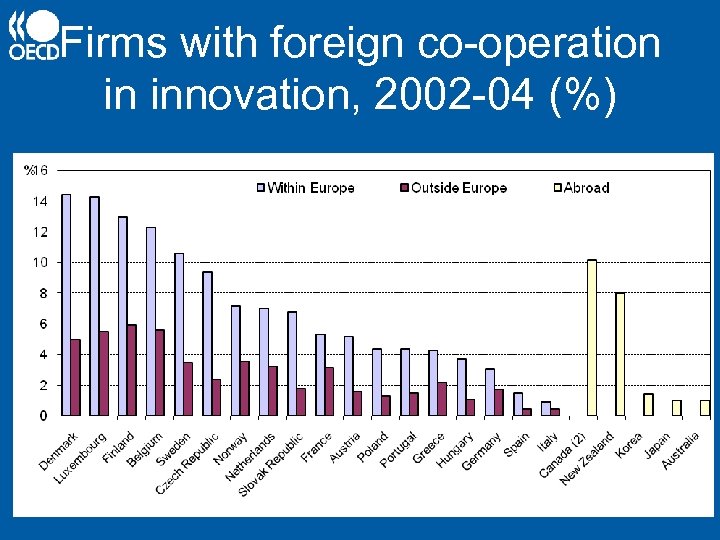
Firms with foreign co-operation in innovation, 2002 -04 (%)
H. Global economic flows • • International trade FDI Foreign affiliates statistics Technology balance of payments
Methodology • Measuring Globalisation – OECD Handbook on Economic Globalisation Indicators (2005) • Technology Balance of Payments Manual (1990) – Part of the Frascati family – Now included in the Handbook on Economic Globalisation Indicators (Ch. 4. 4)
TBP categories • Technology transfers: – – Patents Unpatented inventions Licences (linked to know-how) Know-how • Transfers of designs (sales, licences, franchises), trademarks and patterns • Provision of technical services, comprising: – Technical and engineering studies (project design and implementation) – Technical assistance • Provision of industrial R&D (performed abroad or financed from abroad)
TBP data • Technology receipts and payments for the whole of the economy and also broken down by industrial sector (ISIC Revision 3) and by country and geographical area • Technology receipts and payments of foreigncontrolled affiliates, broken down by manufacturing sector • Technology receipts and payments for the whole economy, broken down by sector according to the main categories of transaction • Receipts and payments of foreign-controlled affiliates in services separately (sectoral breakdown)
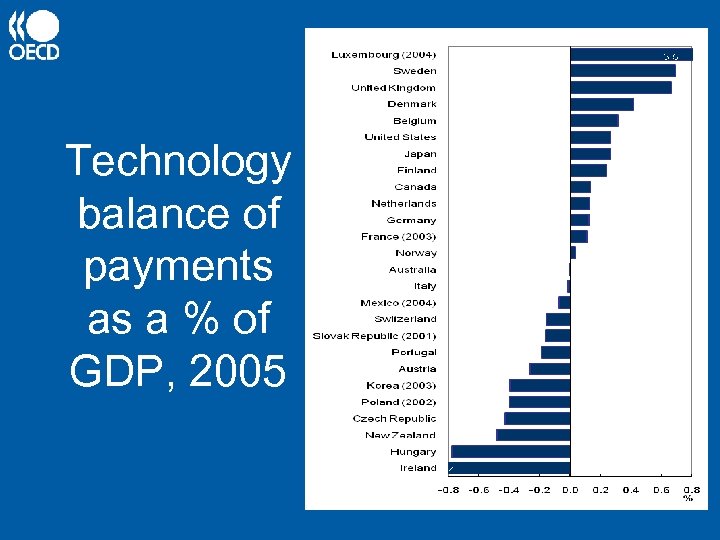
Technology balance of payments as a % of GDP, 2005
I. Productivity and trade • Income and productivity – OECD Manual on Measuring Productivity (2001) • Technology- and knowledge-intensive industries – Measuring Globalisation – OECD Handbook on Economic Globalisation Indicators (2005) – Revision of the High-Technology Sector and Product Classification (OECD, STI Working Paper 1997/2 – T. Hatzichronologou)
Technology classification (1) Originally based on (STI WP 1997/2): 1. R&D expenditures divided by value added 2. R&D expenditures divided by production 3. R&D expenditures plus technology embodied in intermediate and investment goods divided by production
Technology classification (2) For data availability reasons currently based on (Handbook on Economic Globalisation Indicators ): 1. R&D expenditures divided by value added 1991 -1999 2. R&D expenditures divided by production 1991 -1999
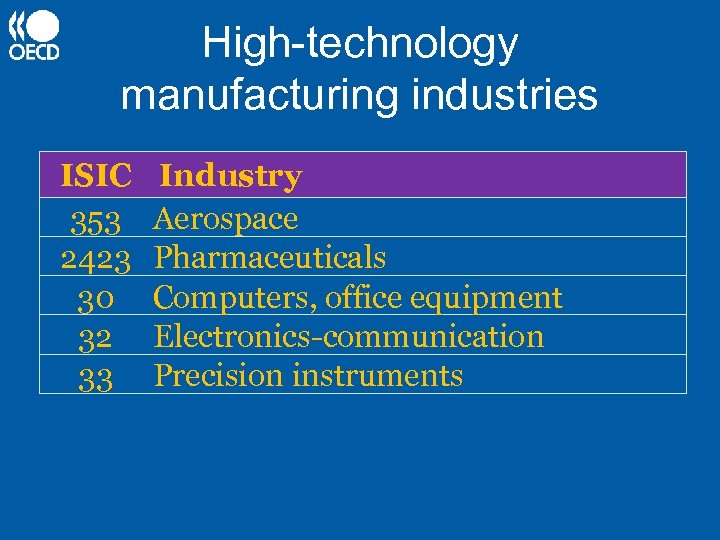
High-technology manufacturing industries ISIC 353 2423 30 32 33 Industry Aerospace Pharmaceuticals Computers, office equipment Electronics-communication Precision instruments
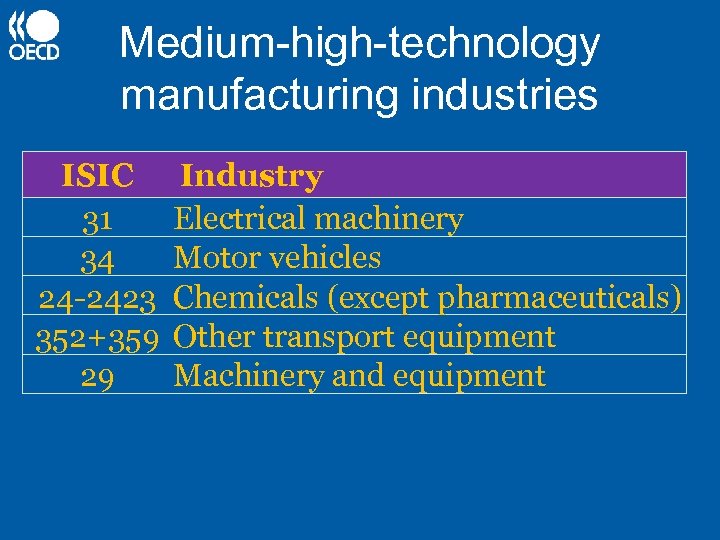
Medium-high-technology manufacturing industries ISIC 31 34 24 -2423 352+359 29 Industry Electrical machinery Motor vehicles Chemicals (except pharmaceuticals) Other transport equipment Machinery and equipment
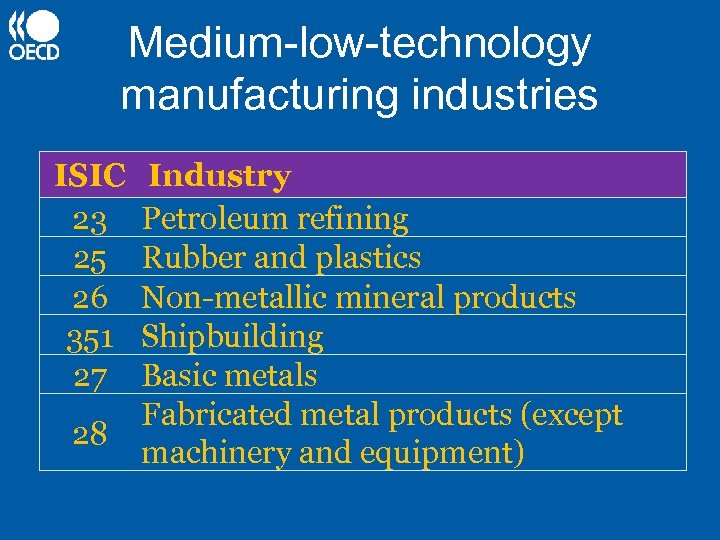
Medium-low-technology manufacturing industries ISIC 23 25 26 351 27 28 Industry Petroleum refining Rubber and plastics Non-metallic mineral products Shipbuilding Basic metals Fabricated metal products (except machinery and equipment)
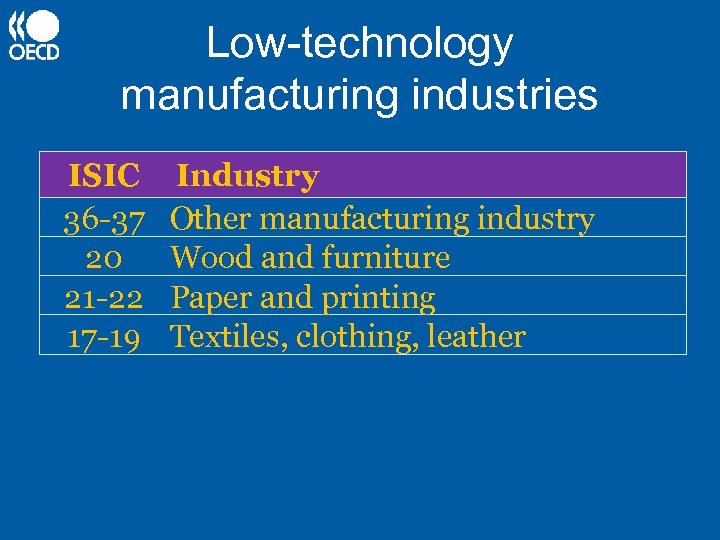
Low-technology manufacturing industries ISIC 36 -37 20 21 -22 17 -19 Industry Other manufacturing industry Wood and furniture Paper and printing Textiles, clothing, leather
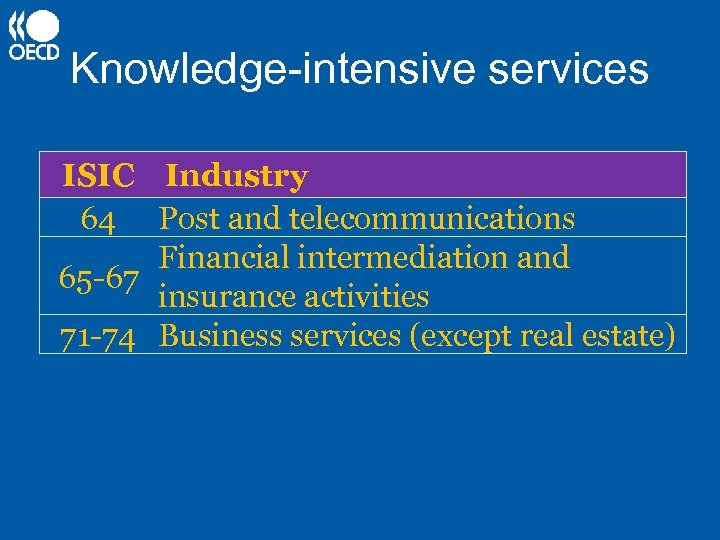
Knowledge-intensive services ISIC Industry 64 Post and telecommunications Financial intermediation and 65 -67 insurance activities 71 -74 Business services (except real estate)
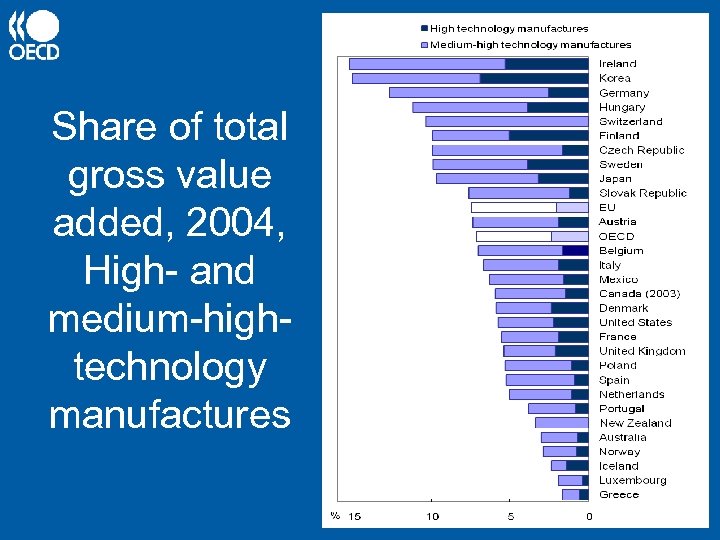
Share of total gross value added, 2004, High- and medium-hightechnology manufactures
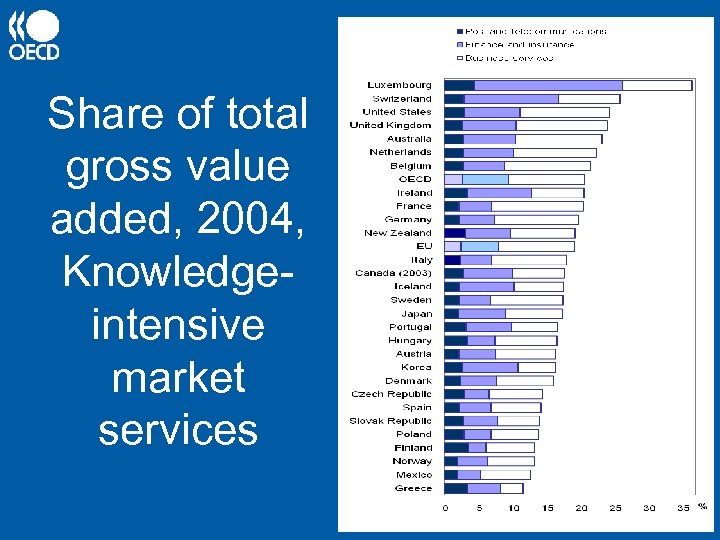
Share of total gross value added, 2004, Knowledgeintensive market services
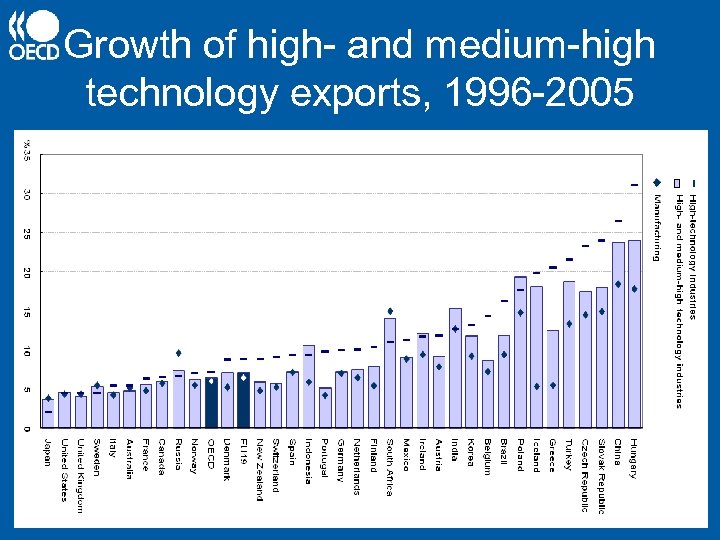
Growth of high- and medium-high technology exports, 1996 -2005
Links • www. oecd. org/sti/statistical-analysis • www. oecd. org/sti/scoreboard or www. sourceoecd. org/scoreboard • www. oecd. org/sti/cdh • www. oecd. org/sti/ipr-statistics • www. oecd. org/sti/measuring-infoeconomy • www. oecd. org/sti/measuring-globalisation
Manuals (1) Frascati Manual: http: //213. 253. 134. 43/oecd/pdfs/browseit/9202081 E. PDF Oslo Manual: http: //213. 253. 134. 43/oecd/pdfs/browseit/9205111 E. PDF Canberra Manual: http: //www. oecd. org/dataoecd/34/0/2096025. pdf Patent Manual: (forthcoming) http: //www. oecd. org/document/10/0, 3343, en_264 9_34451_1901066_1_1, 00. html
Manuals (2) OECD Guide to Measuring the Information Society: www. oecd. org/sti/measuring-infoeconomy/guide Biotechnology framework: http: //www. oecd. org/dataoecd/5/48/34935605. pdf Technology Balance of Payments Manual: http: //www. oecd. org/dataoecd/35/13/2347115. pdf Handbook on Economic Globalisation Indicators: (for sale) http: //www. oecd. org/document/44/0, 3343, en_264 9_34443_34957420_1_1, 00. html

THANK YOU! martin. schaaper@oecd. org
Скачать презентацию Belgrade 2 October 2008 Indicators for a Knowledge-Based
1050999073ffe7e2578bedd91231eb4f.ppt