 Скачать презентацию BEING AND CONSCIOUSNESS PLAN 1 The conception
Being and consciousness.pptx
- Количество слайдов: 30



BEING AND CONSCIOUSNESS
PLAN 1. The conception of the world and being in philosophy. 2. The general concept of Matter. Attributes of Matter: Motion, Space and Time. 3. Consciousness: Essence and origin. Consciousness, language and communication.
![LITERATURE Basic: Alexander Spirkin. Dialectical Materialism / Alexander Spirkin : [transl. by Robert Daglish].](https://present5.com/presentation/63961661_154443474/image-3.jpg "LITERATURE Basic: Alexander Spirkin. Dialectical Materialism / Alexander Spirkin : [transl. by Robert Daglish].")
LITERATURE Basic: Alexander Spirkin. Dialectical Materialism / Alexander Spirkin : [transl. by Robert Daglish]. — M. : Progress Publishers, 1983. − 342 p. John Heil. From an Ontological Point of View / John Heil. — New York : Oxford University Press, 2003. — 267 p. Jan Westerhoff. Ontological Categories: Their nature and Significance / Jan Westerhoff. — New York : Oxford University Press, 2005. − 261 p. Supplementary: Essays in Ontology / [Edwin B. Allaire and others]. − Iowa City : University of Iowa, 1963. − 215 p. Handbook of Metaphysics and Ontology / Hans Burkhardt, Barry Smith. − Philadelphia : Philosophia Verlag, 1991. − 1005 p. Primary sources: Aristotle. Metaphysics / Aristotle : [transl. by W. D. Ross]. – Nashotah, Wisconsin : The Classical Library, 2001. — P. 55− 71. Gebhard Geiger. Evolutionary Instability: Logical and Material Aspects of a Unified Theory of Biosocial Evolution / Gebhard Geiger. — New York : Springer-Verlag, 1990. — 167 p. Martin Heidegger. Being and Time / Martin Heidegger : [transl. by John Macquarrie and Edward Robinson]. — New York : Harper and Row, 1962. — P. 161− 165.
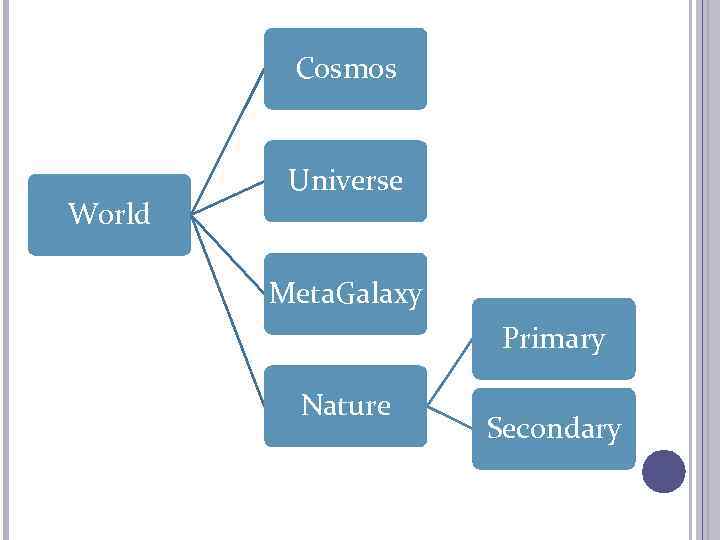
Cosmos World Universe Meta. Galaxy Primary Nature Secondary
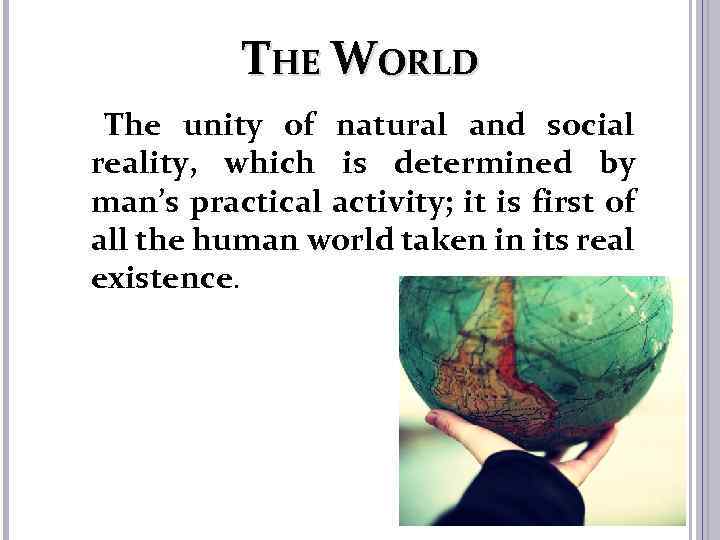
THE WORLD The unity of natural and social reality, which is determined by man’s practical activity; it is first of all the human world taken in its real existence.
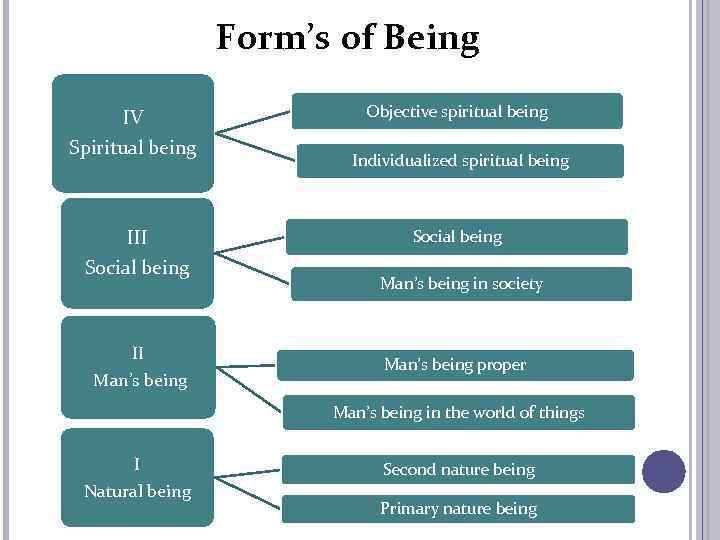
Form’s of Being IV Spiritual being III Social being II Man’s being Objective spiritual being Individualized spiritual being Social being Man’s being in society Man’s being proper Man’s being in the world of things I Natural being Second nature being Primary nature being
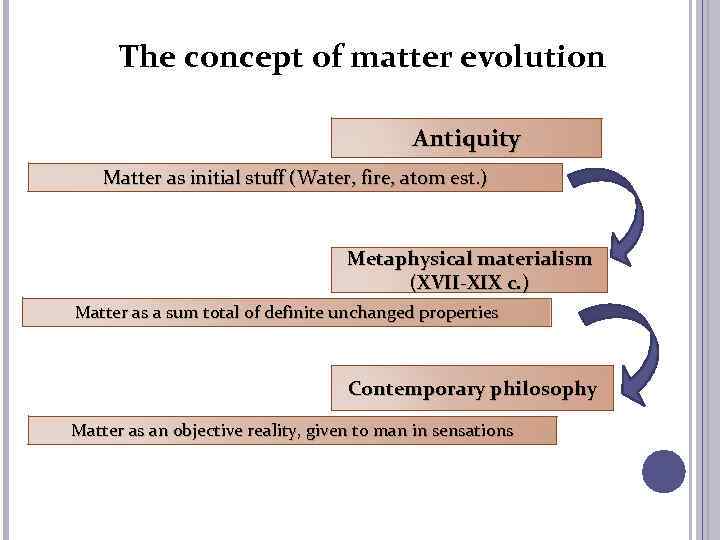
The concept of matter evolution Antiquity Matter as initial stuff (Water, fire, atom est. ) Metaphysical materialism (XVII-XIX c. ) Matter as a sum total of definite unchanged properties Contemporary philosophy Matter as an objective reality, given to man in sensations
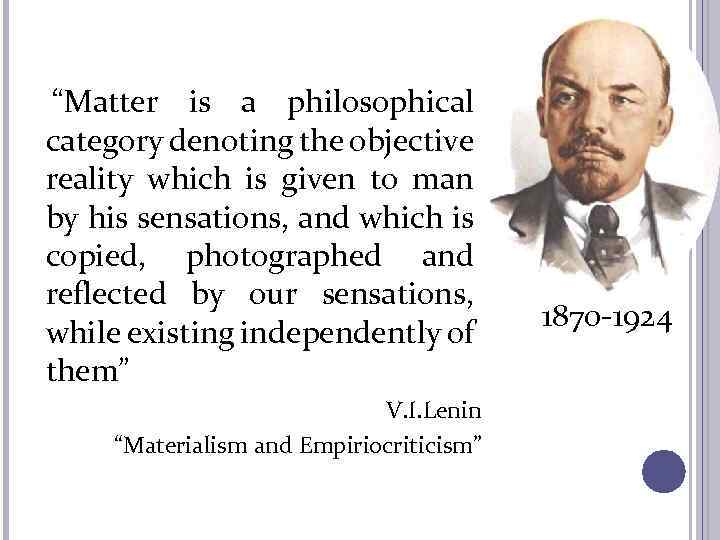
“Matter is a philosophical category denoting the objective reality which is given to man by his sensations, and which is copied, photographed and reflected by our sensations, while existing independently of them” V. I. Lenin “Materialism and Empiriocriticism” 1870 -1924
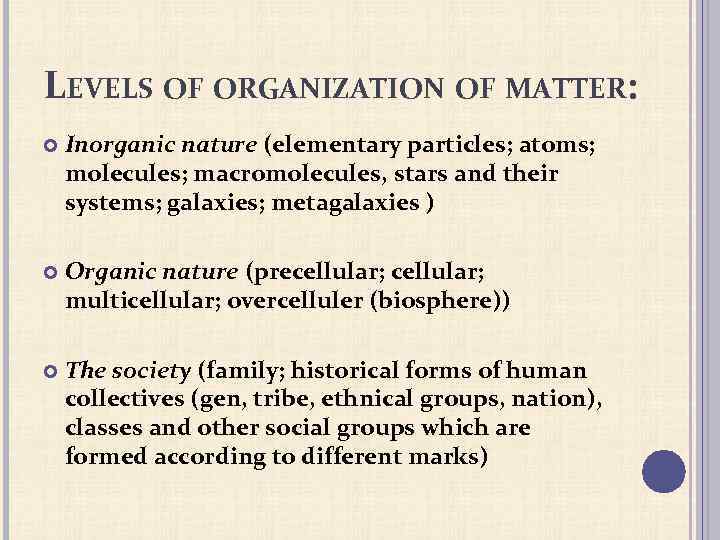
LEVELS OF ORGANIZATION OF MATTER: Inorganic nature (elementary particles; atoms; molecules; macromolecules, stars and their systems; galaxies; metagalaxies ) Organic nature (precellular; multicellular; overcelluler (biosphere)) The society (family; historical forms of human collectives (gen, tribe, ethnical groups, nation), classes and other social groups which are formed according to different marks)
MOTION AS A MODE OF EXISTENCE OF MATTER motion is inseparable from matter, as it is the mode of its existence. motion is objective, uncreatable and indestructible, absolute, unavoidable, and universal; motion is not a pure continuum but the unity of continuum and discreteness, of change and stability, of disturbance and rest.
Mechanical Physical Chemical Biological Social FORMS OF MOTION All forms of motion of matter and their connection with types of matter and their development are embodied in the following principles: 1. The specific type of motion corresponds with each level of organization of matter. 2. Among the forms of motion there is the genetic connection. It means that superior forms of motion appear on the bases of the inferior ones. 3. Superior forms of motion are qualitative specific and can not be reduced to inferior ones.
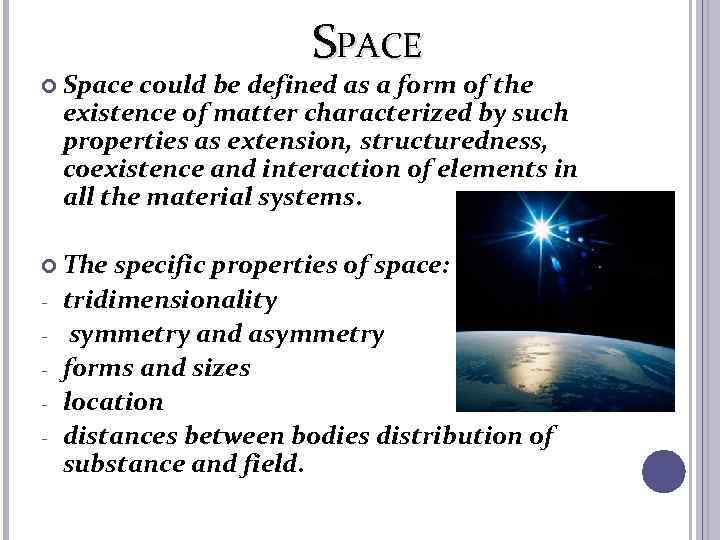
Space SPACE could be defined as a form of the existence of matter characterized by such properties as extension, structuredness, coexistence and interaction of elements in all the material systems. The - specific properties of space: tridimensionality symmetry and asymmetry forms and sizes location distances between bodies distribution of substance and field.
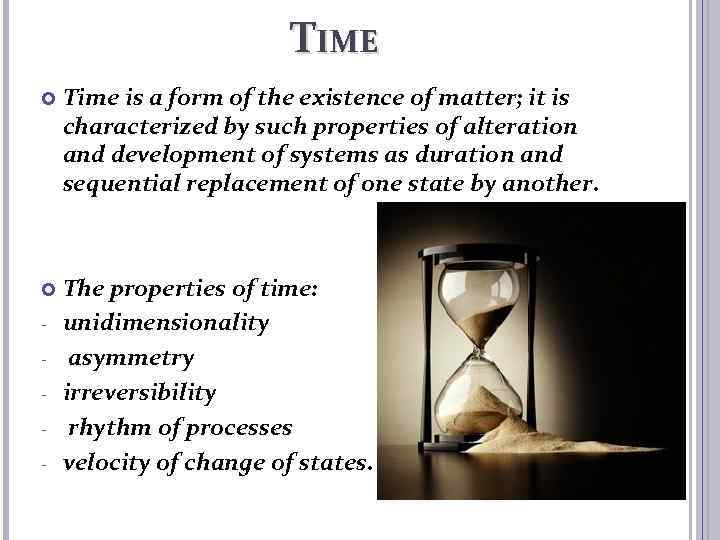
TIME Time is a form of the existence of matter; it is characterized by such properties of alteration and development of systems as duration and sequential replacement of one state by another. The properties of time: unidimensionality asymmetry irreversibility rhythm of processes velocity of change of states. -
SPACE AND TIME ARE ABSOLUTE. Space and time are conditioned by matter, as a form is conditioned by its content, and every level of the motion of matter possesses its space-time structure
SOCIAL SPACE AND TIME Social space is a space of human existence, which includes social, cultural, spiritual and practical dimensions. Social time is the duration of existence of the mankind, its history; It indicates the extent of variability of social life, material and spiritual processes that occur in society.
CONSCIOUSNESS: ORIGIN AND ESSENCE
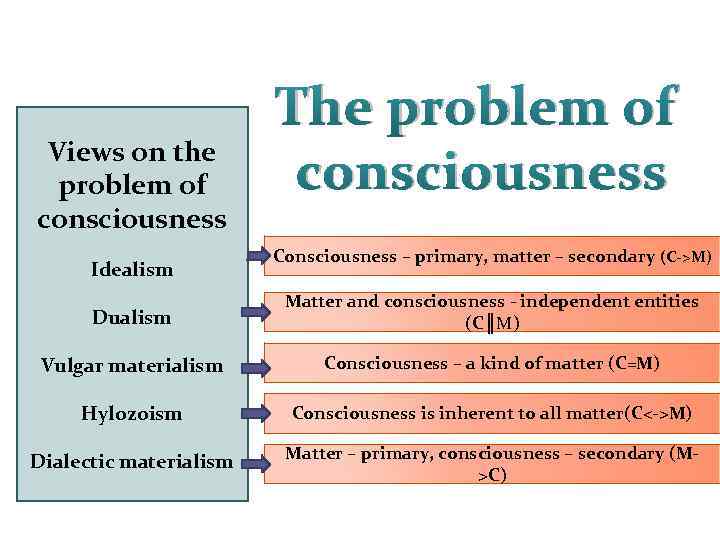
Views on the problem of consciousness Idealism The problem of consciousness Consciousness – primary, matter – secondary (C->M) Dualism Matter and consciousness - independent entities (C║M) Vulgar materialism Consciousness – a kind of matter (C=M) Hylozoism Consciousness is inherent to all matter(C<->M) Dialectic materialism Matter – primary, consciousness – secondary (M>C)
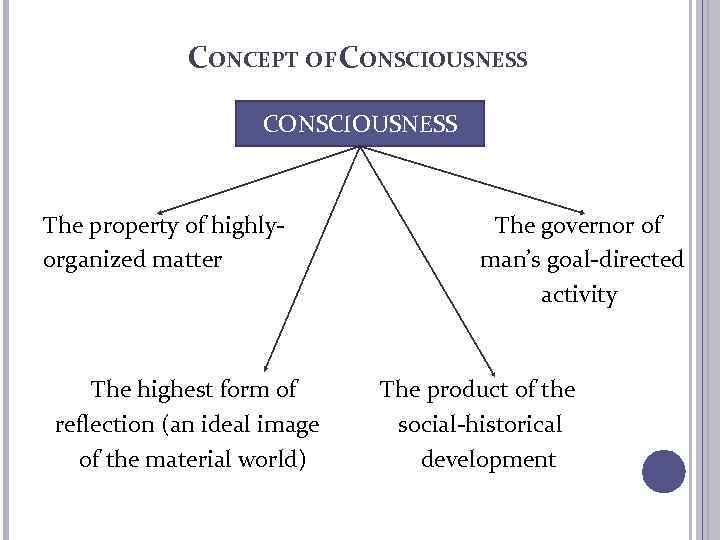
CONCEPT OF CONSCIOUSNESS The property of highly- The governor of organized matter man’s goal-directed activity The highest form of The product of the reflection (an ideal image social-historical of the material world) development
Consciousness is the highest function of the brain characteristic only of man and connected with speech, a function whose essence is a generalized and purposeful reflection of reality, anticipatory mental construction of actions and foreseeing their results, and rational regulation and selfcontrol of behavior.
The Essence of Consciousness The phenomenon of consciousness is directly connected with such property of matter as reflection. But consciousness appears to be a social form of reflection. It defines man’s ability of an ideal reflecting of the reality and also the mode and forms of such a reflection. The consciousness of modern man is a product of world history, the sum total of the practical and cognitive activity of countless generations throughout the centuries. Consciousness has both a natural prehistory, the formation of its biological prerequisites in the course of the evolution of animal psyche and social history. It took twenty million years to create the conditions for the emergence of Homo sapiens. Psyche had developed in living organisms with the possession of the property of reflection inherent in all matter.
REFLECTION is the universal capacity of matter to reproduce some features and relations of the object that is reflected.
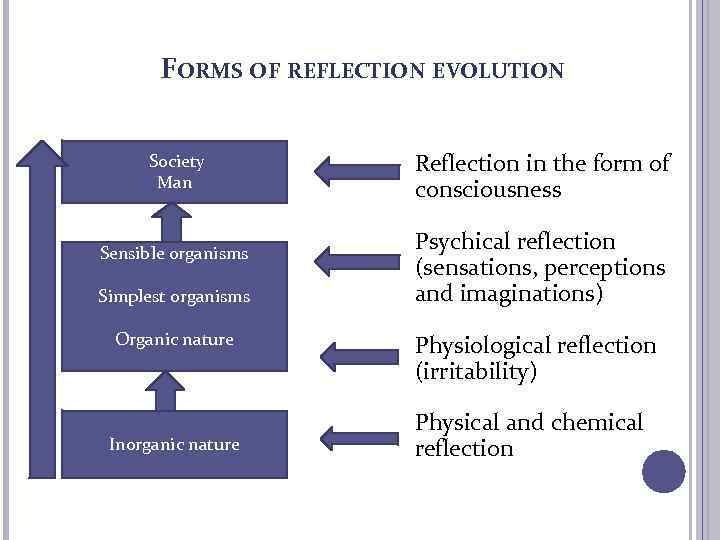
FORMS OF REFLECTION EVOLUTION Society Man Sensible organisms Simplest organisms Organic nature Inorganic nature Reflection in the form of consciousness Psychical reflection (sensations, perceptions and imaginations) Physiological reflection (irritability) Physical and chemical reflection
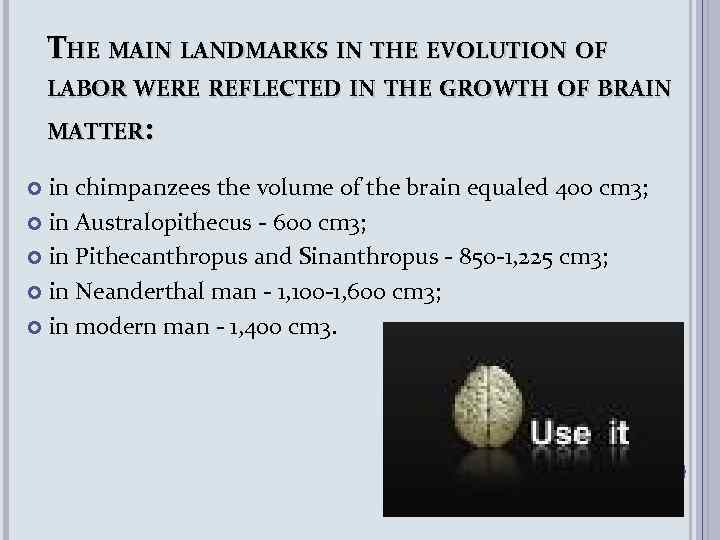
THE MAIN LANDMARKS IN THE EVOLUTION OF LABOR WERE REFLECTED IN THE GROWTH OF BRAIN MATTER: in chimpanzees the volume of the brain equaled 400 cm 3; in Australopithecus - 600 cm 3; in Pithecanthropus and Sinanthropus - 850 -1, 225 cm 3; in Neanderthal man - 1, 100 -1, 600 cm 3; in modern man - 1, 400 cm 3.
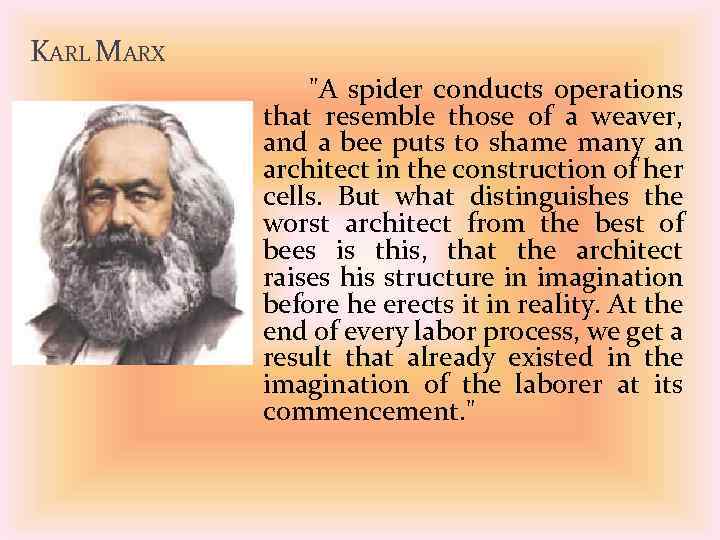
KARL MARX "A spider conducts operations that resemble those of a weaver, and a bee puts to shame many an architect in the construction of her cells. But what distinguishes the worst architect from the best of bees is this, that the architect raises his structure in imagination before he erects it in reality. At the end of every labor process, we get a result that already existed in the imagination of the laborer at its commencement. "
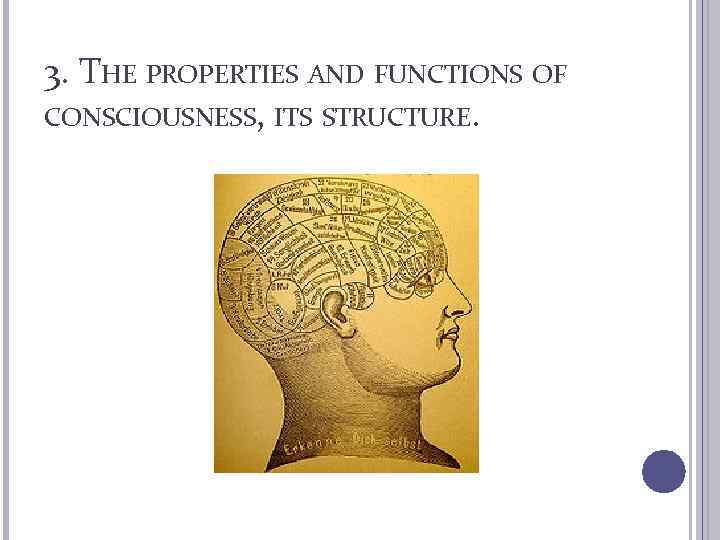
3. THE PROPERTIES AND FUNCTIONS OF CONSCIOUSNESS, ITS STRUCTURE.
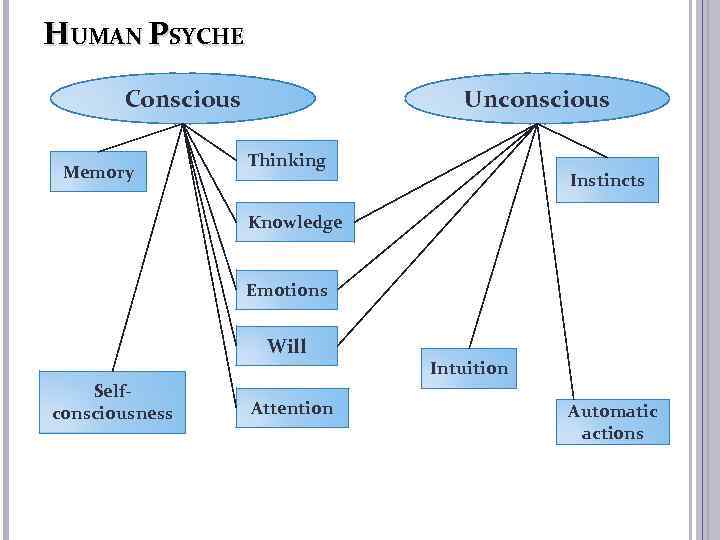
HUMAN PSYCHE Conscious Memory Unconscious Thinking Instincts Knowledge Emotions Will Selfconsciousness Attention Intuition Automatic actions
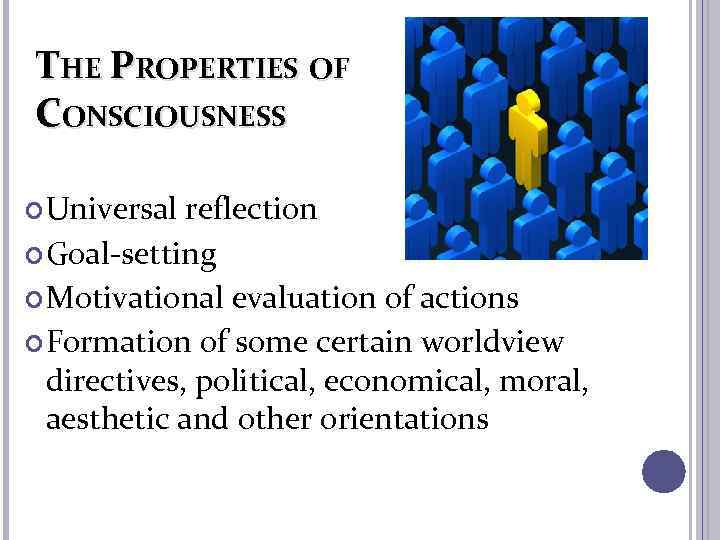
THE PROPERTIES OF CONSCIOUSNESS Universal reflection Goal-setting Motivational evaluation of actions Formation of some certain worldview directives, political, economical, moral, aesthetic and other orientations
FUNCTIONS OF CONSCIOUSNESS Informative Cognitive Creative Estimative Goal-setting Sense-formative Organizing-Volitional Control-Regulative Self-educational
THE STRUCTURE OF CONSCIOUSNESS Sensuous-emotional component Emotional-volitional component Abstract-logical component
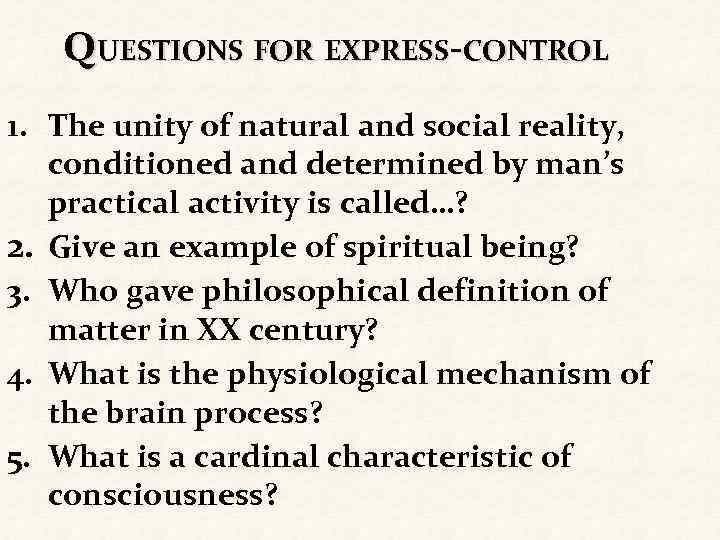
QUESTIONS FOR EXPRESS-CONTROL 1. The unity of natural and social reality, conditioned and determined by man’s practical activity is called…? 2. Give an example of spiritual being? 3. Who gave philosophical definition of matter in XX century? 4. What is the physiological mechanism of the brain process? 5. What is a cardinal characteristic of consciousness?
Скачать презентацию BEING AND CONSCIOUSNESS PLAN 1 The conception
Being and consciousness.pptx