 Скачать презентацию Behavioral Finance Economics 437 Behavioral Finance Law Of
215bce0109cab868fc005fb872ec0514.ppt
- Количество слайдов: 12



Behavioral Finance Economics 437 Behavioral Finance Law Of One Price Feb 2 2016
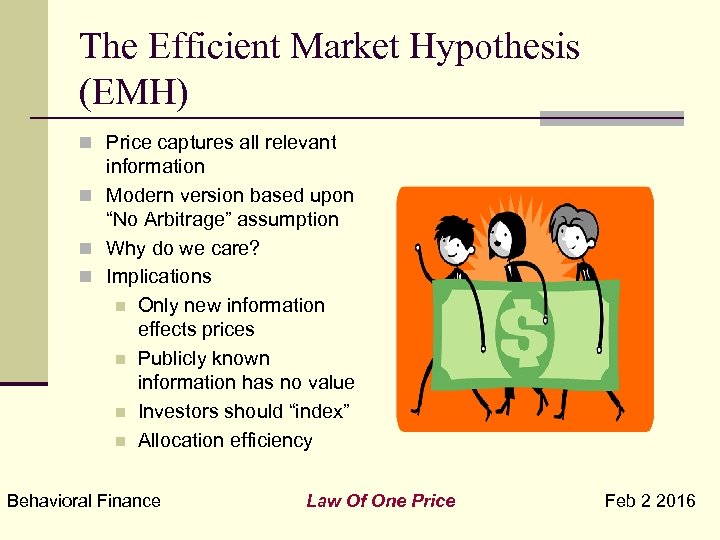
The Efficient Market Hypothesis (EMH) n Price captures all relevant information n Modern version based upon “No Arbitrage” assumption n Why do we care? n Implications n Only new information effects prices n Publicly known information has no value n Investors should “index” n Allocation efficiency Behavioral Finance Law Of One Price Feb 2 2016
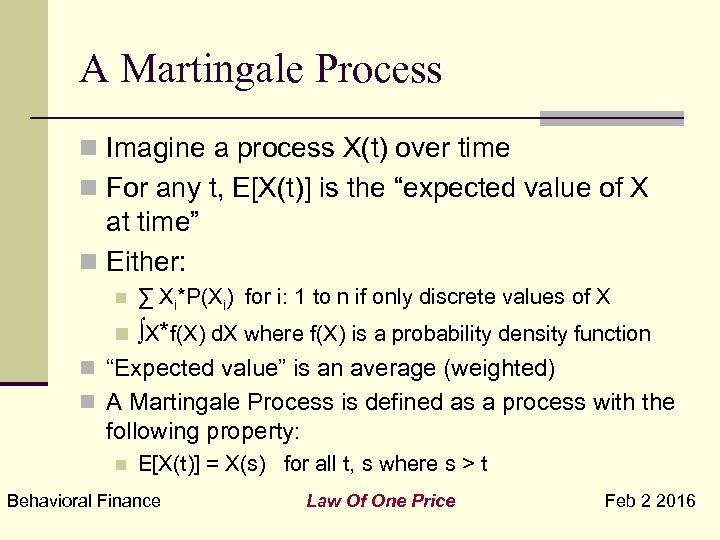
A Martingale Process n Imagine a process X(t) over time n For any t, E[X(t)] is the “expected value of X at time” n Either: n ∑ Xi*P(Xi) for i: 1 to n if only discrete values of X n ∫X*f(X) d. X where f(X) is a probability density function n “Expected value” is an average (weighted) n A Martingale Process is defined as a process with the following property: n E[X(t)] = X(s) for all t, s where s > t Behavioral Finance Law Of One Price Feb 2 2016
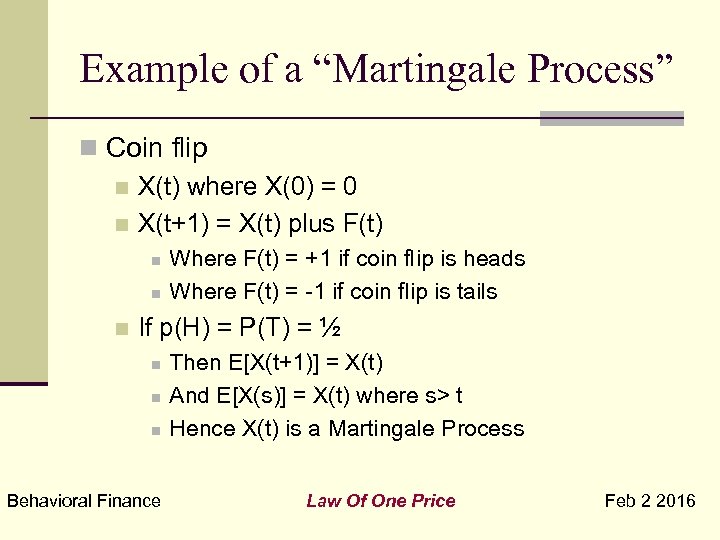
Example of a “Martingale Process” n Coin flip n X(t) where X(0) = 0 n X(t+1) = X(t) plus F(t) n n n Where F(t) = +1 if coin flip is heads Where F(t) = -1 if coin flip is tails If p(H) = P(T) = ½ n n n Behavioral Finance Then E[X(t+1)] = X(t) And E[X(s)] = X(t) where s> t Hence X(t) is a Martingale Process Law Of One Price Feb 2 2016
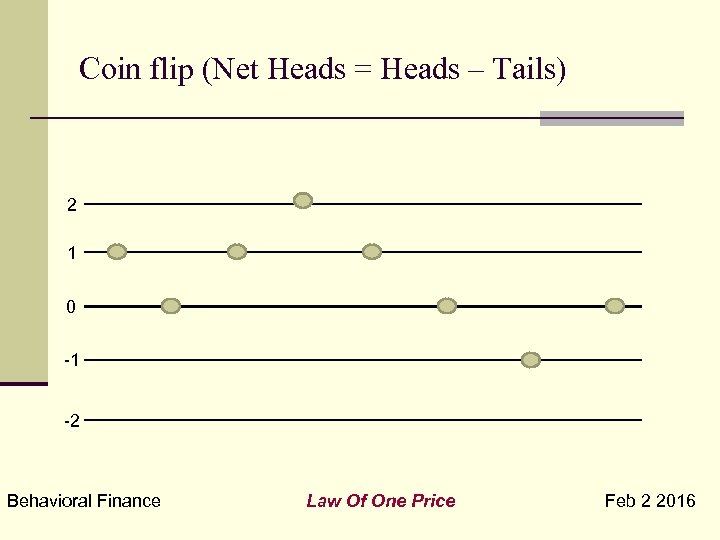
Coin flip (Net Heads = Heads – Tails) 2 1 0 -1 -2 Behavioral Finance Law Of One Price Feb 2 2016
![Can stock returns be a “Martingale Process? ” (Accounting for Trend) n E[P(s)] =](https://present5.com/presentation/215bce0109cab868fc005fb872ec0514/image-6.jpg "Can stock returns be a “Martingale Process? ” (Accounting for Trend) n E[P(s)] =")
Can stock returns be a “Martingale Process? ” (Accounting for Trend) n E[P(s)] = P(t) for all s > t ? n But shouldn’t stocks earn a return? n Suppose the mean return of a stock is r n Create a new variable, Q and assume s > t n Let Q (s) = P(s)*(1+r)-n where n = s – t n Then Q(t) = P(t) n E[Q(s)] = Q(t) for all s > t n Means that, after subtracting out a mean return of r, P(t) is a Martingale Process Behavioral Finance Law Of One Price Feb 2 2016
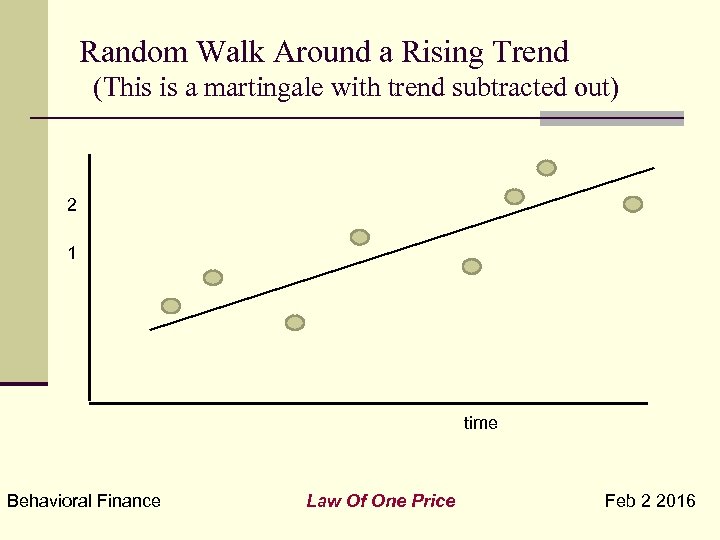
Random Walk Around a Rising Trend (This is a martingale with trend subtracted out) 2 1 time Behavioral Finance Law Of One Price Feb 2 2016
Modern Finance Assumes n Stock Prices (Adjusted) Follow a Martingale Process n This is the definition of EMH in the modern finance literature n Also known as “random walk” (not quite correctly, as Fama points out in his 1970 article) Behavioral Finance Law Of One Price Feb 2 2016
Black on “Noise” n Black strong believer in noise and noise traders in particular n They lose money according to him (though they make money for a short while) n Prices are “efficient” if they are within a factor of 2 of “correct” value n Actual prices should have higher volatility than values because of noise Behavioral Finance Law Of One Price Feb 2 2016
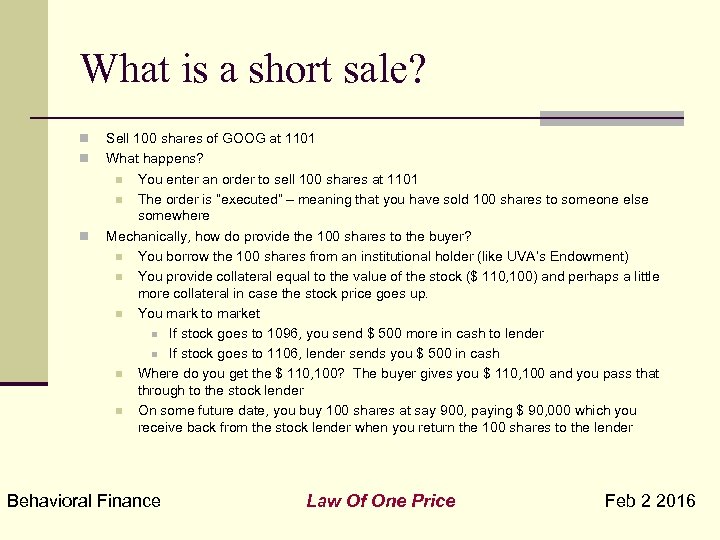
What is a short sale? n n n Sell 100 shares of GOOG at 1101 What happens? n You enter an order to sell 100 shares at 1101 n The order is “executed” – meaning that you have sold 100 shares to someone else somewhere Mechanically, how do provide the 100 shares to the buyer? n You borrow the 100 shares from an institutional holder (like UVA’s Endowment) n You provide collateral equal to the value of the stock ($ 110, 100) and perhaps a little more collateral in case the stock price goes up. n You mark to market n If stock goes to 1096, you send $ 500 more in cash to lender n If stock goes to 1106, lender sends you $ 500 in cash n Where do you get the $ 110, 100? The buyer gives you $ 110, 100 and you pass that through to the stock lender n On some future date, you buy 100 shares at say 900, paying $ 90, 000 which you receive back from the stock lender when you return the 100 shares to the lender Behavioral Finance Law Of One Price Feb 2 2016
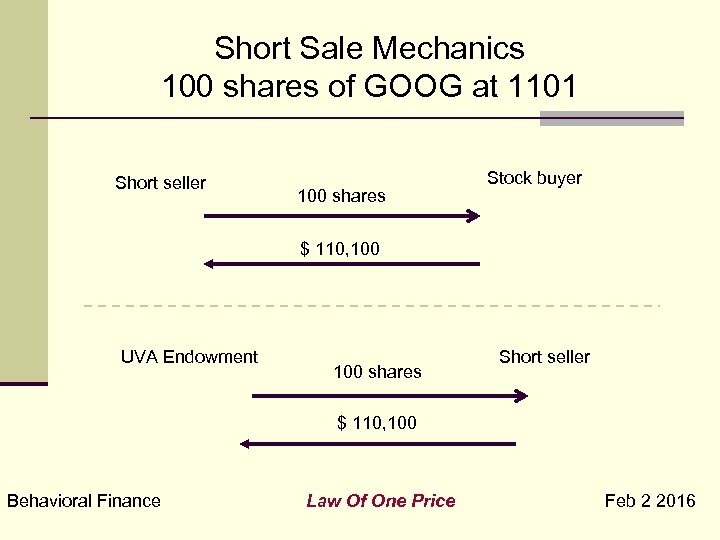
Short Sale Mechanics 100 shares of GOOG at 1101 Short seller 100 shares Stock buyer $ 110, 100 UVA Endowment 100 shares Short seller $ 110, 100 Behavioral Finance Law Of One Price Feb 2 2016
The End Behavioral Finance Law Of One Price Feb 2 2016
Скачать презентацию Behavioral Finance Economics 437 Behavioral Finance Law Of
215bce0109cab868fc005fb872ec0514.ppt