 Скачать презентацию Becoming a Professional Dr Diane Finley Diversity 2000
b7797759d9b52097c3ce29ac4cd2d213.ppt
- Количество слайдов: 18



Becoming a Professional Dr. Diane Finley Diversity 2000 and Beyond Washington DC April 2004
What Does Professional Mean? • Of, relating to, engaged in, or suitable for a profession: lawyers, doctors, and other professional people. • Conforming to the standards of a profession: professional behavior
Professional refers to • How you present yourself • Dress, hair, comportment • How you present your accomplishments • Vita, transcripts, portfolio
Professional Dress • Dress is important because it is a silent introduction to you. First impressions are primarily nonverbal and dress and hair is a large component of that impression. • Professional dress conventions are governed by the industry being discussed. • Professional dress projects an image of confidence and success.
Dress, Hair, Comportment • Why is this important? • What does this include?
Do’s and Don’ts of Dress and Hair • Don’t wear clothes that are soiled, not pressed, or in bad condition and shoes that are scuffed and unpolished. • Don’t wear clothes with messages such as Tshirts and ties. • Don’t wear heavy makeup or too much cologne. Be cautious about body piercing beyond one pair of earrings and tattoos that show. • Don’t wear ungroomed or extreme hair styles and colors.
More Don’ts • Don’t wear clothing too casual for a business environment, such as T-shirt and jeans, halter top and Capri pants, skorts, sweat pants, bare midriffs, etc. • Don’t wear pants and skirts that are too tight or too short. • Be cautious about bare skin (arms and legs), low -cut blouses, stretch pants, sexy heels and open sandals and shoes, no hose
Do’s of Professional Dress • Dark color suits (for women, a knee-length skirt is safest) in solids or small patterns; colorcoordinated shirts, blouses, shoes, scarves, . • Men wear socks that match the hem of their trousers. Women wear natural color hose. • Shoes, purses and briefcases are well-polished. Everything should be in perfect condition. • Jewelry should enhance, not overwhelm.
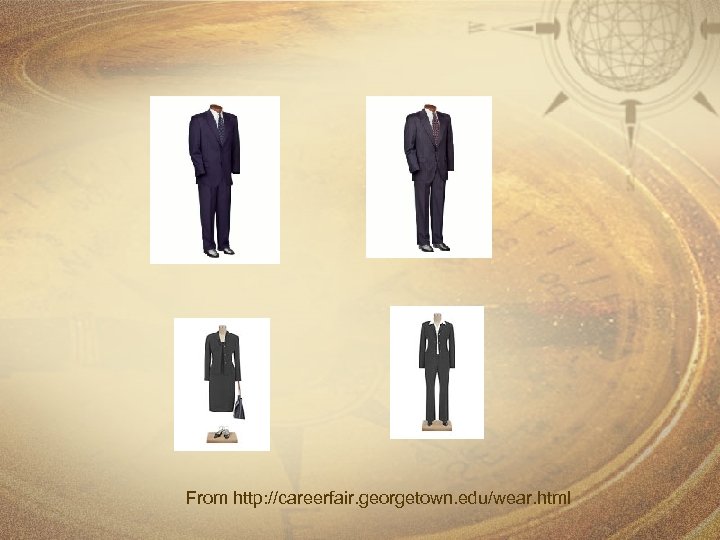
From http: //careerfair. georgetown. edu/wear. html
Websites about Dressing for Success • http: //webs. wichita. edu/depttools/user_home/ ? view=cooped&page=dress • http: //www 1. appstate. edu/~clarkhm/ethics_03 1/student_pres/workforce/dress. htm • http: //webs. wichita. edu/depttools/user_home/ ? view=cooped&page=dosdonts • http: //www. blackcollegian. com/career/dress 2001 -2 nd. shtml • http: //www. careerservices. swt. edu/Student_A lumnus/Job. Search. Manual/How_To_Dress_Fo r_Interviews. htm
Vita, transcripts, portfolio • Why do I use a vita instead of a resume? • What about a portfolio?
What is a Resume? • Resume comes from the French word for summary. • It is a summary of your educational history, your work experience and your skills. • Resumes are usually one page. • They are used in the business environment
What is a Vita? • Vita comes from the Latin word for life. • In academic environments, the curriculum vita takes the place of a resume. • The C. V. or vita is a written record of your educational life. • The vita is always longer than one page.
What goes in a vita? • • • Educational history Professional positions (teaching/research) Memberships in professional organizations Professional activities Grants Conference Presentations Publications Papers submitted but not published/presented Technology Skills Academic References
Cover Letters • When you send a vita or a resume, you always include a cover letter. • The cover letter should be addressed to a specific person. • The cover letter should be targeted toward the job or opportunity. It is NEVER generic. • Cover letters should be one page.
Do’s and Don’ts • Always be sure there are no typographical errors and that your writing is clear and concise. Every word should count. • Make sure the font is readable and spacing is visually pleasing. • Use good paper to print it on and use a laser printer. • Make sure the staple is neat and in the upper left corner. • Have someone proofread your vita. • Don’t be creative – the vita should follow conventions. • Don’t pad the vita by using wide margins, high school accomplishments or irrelevant items. • Don’t list irrelevant personal information. • Keep in mind that this is a living document and you will add categories are you go along.
Transcripts and Portfolios • You will get your transcript from your college. Get an unofficial copy to submit with your applications. Check it out for any errors or omissions. • Portfolios are more detailed presentations of your experiences. They include sample papers, syllabi and evaluations.
Advice • Begin to build your vita – participate in psychology organizations at school, volunteer in psychology related organizations. • Seek out opportunities – conferences, research, speakers. • Keep a journal, listing what you have done, where and who supervised and what you learned that was relevant to psychology • Learn to network – the contacts will serve you well. • Practice writing a vita – do it on a computer since you will revise it yearly. • Enjoy the journey!
Скачать презентацию Becoming a Professional Dr Diane Finley Diversity 2000
b7797759d9b52097c3ce29ac4cd2d213.ppt