 Скачать презентацию Beauty of Chinese Calligraphy 中国书法的演变 中国书法的种类
84f517c7549971d8e2d67e2958047425.ppt
- Количество слайдов: 76



Beauty of Chinese Calligraphy ——中国书法的演变
– 中国书法的种类: 篆书、隶书、行书、草书、楷书 汉字的演变: 甲骨文—金文—小篆—隶书—草书—楷书—行书
Oracle script 甲骨文 Bronze script 金文 Large seal script 大篆 Small seal script 小篆 Clerical script 隶书 Cursive script 草书 Semi-cursive script 行书 Regular script 楷书
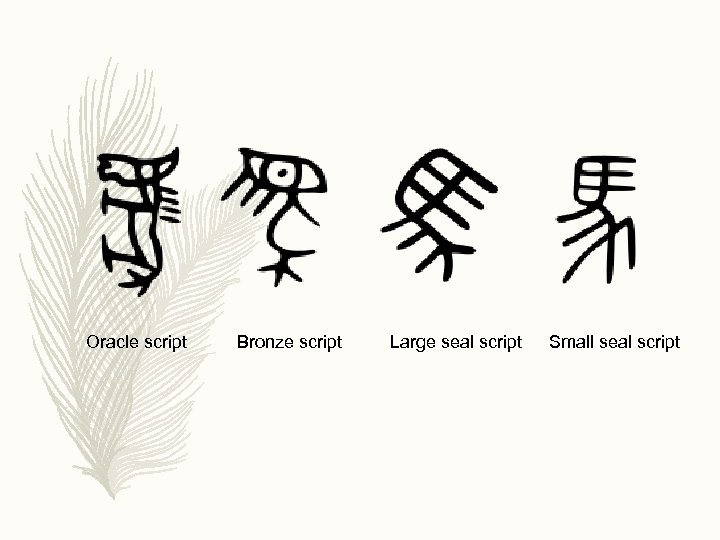
Oracle script Bronze script Large seal script Small seal script
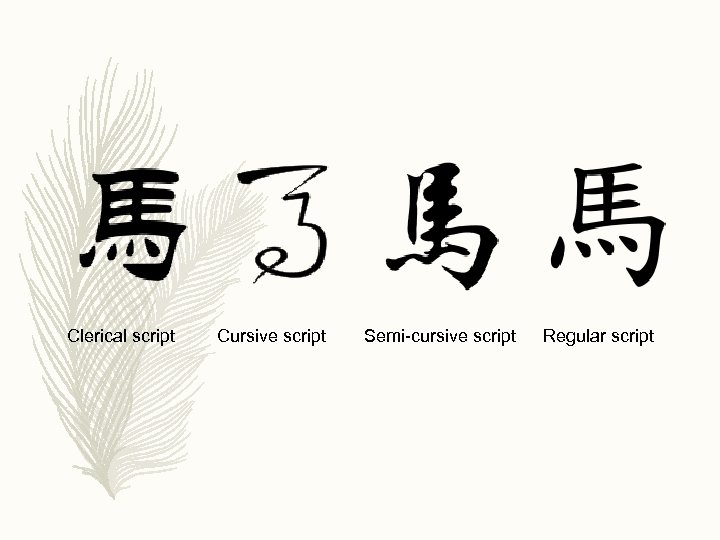
Clerical script Cursive script Semi-cursive script Regular script
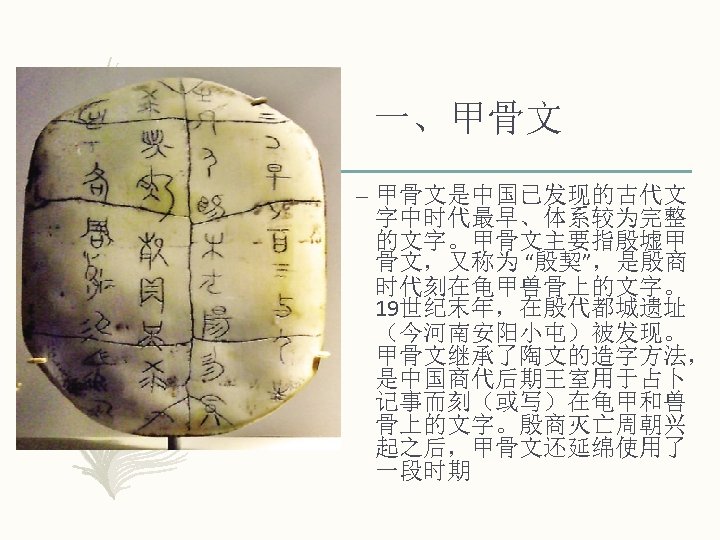
一、甲骨文 – 甲骨文是中国已发现的古代文 字中时代最早、体系较为完整 的文字。甲骨文主要指殷墟甲 骨文,又称为 “殷契”,是殷商 时代刻在龟甲兽骨上的文字。 19世纪末年,在殷代都城遗址 (今河南安阳小屯)被发现。 甲骨文继承了陶文的造字方法, 是中国商代后期王室用于占卜 记事而刻(或写)在龟甲和兽 骨上的文字。殷商灭亡周朝兴 起之后,甲骨文还延绵使用了 一段时期
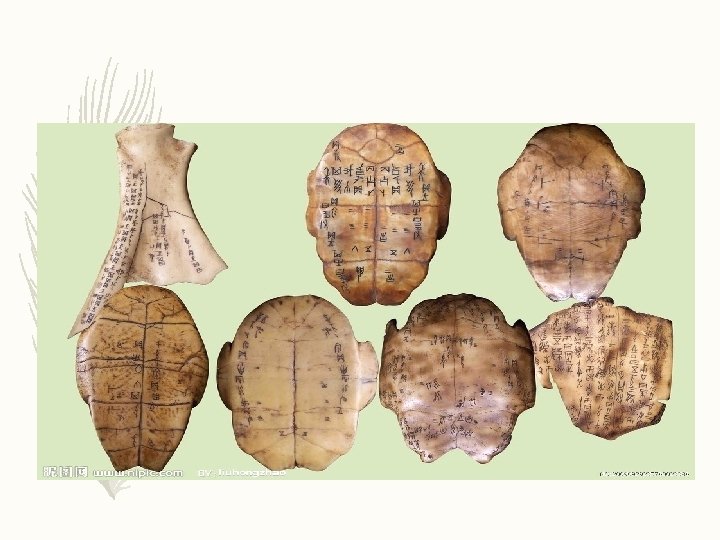
– Chinese characters can be retraced to 4000 BC. The principles of contemporary Chinese characters were already visible in Jiaguwen, carved on ox scapulas and tortoise plastrons and around 14 th - 11 th century BC. During the divination ceremony, after the cracks were made, characters were written with a brush on the shell or bone to be later carved.
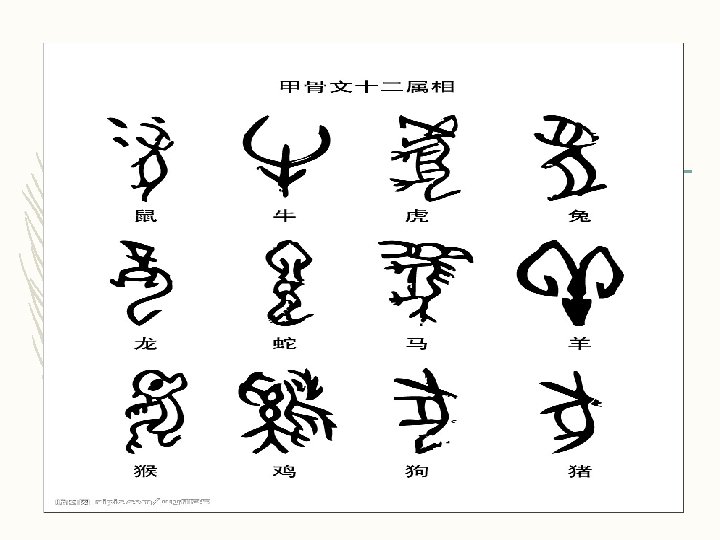
Oracle bone script (Chinese: 甲骨文) was the form of Chinese characters used on oracle bones—animal bones or turtle plastrons used in pyromantic divination —in the late 2 nd millennium BCE, and is the earliest known form of Chinese writing. The vast majority record the pyromantic divinations of the royal house of the late Shang dynasty at the capital of Yin (modern Anyang, Henan Province); dating of the Anyang examples of oracle bone script varies from c. 14 th– 11 th centuries BCE to c. 1200– 1050 BCE. Very few oracle bone writings date to the beginning of the subsequent Zhou dynasty, because pyromancy fell from favor and divining with milfoil became more common. The late Shang oracle bone writings, along with a few contemporary characters in a different style cast in bronzes, constitute the earliest significant corpus of Chinese writing, which is essential for the study of Chinese etymology, as Shang writing is directly ancestral to the modern Chinese script. It is also the oldest known member and ancestor of the Chinese family of scripts, preceding the bronzeware script.
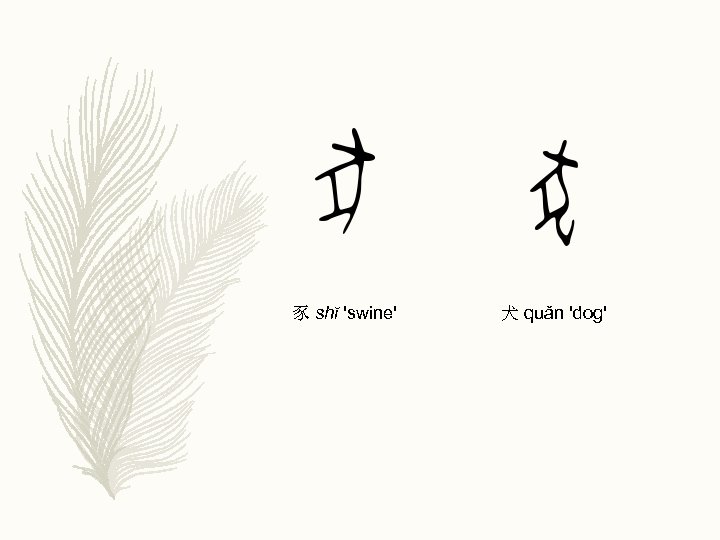
豕 shĭ 'swine' 犬 quǎn 'dog'
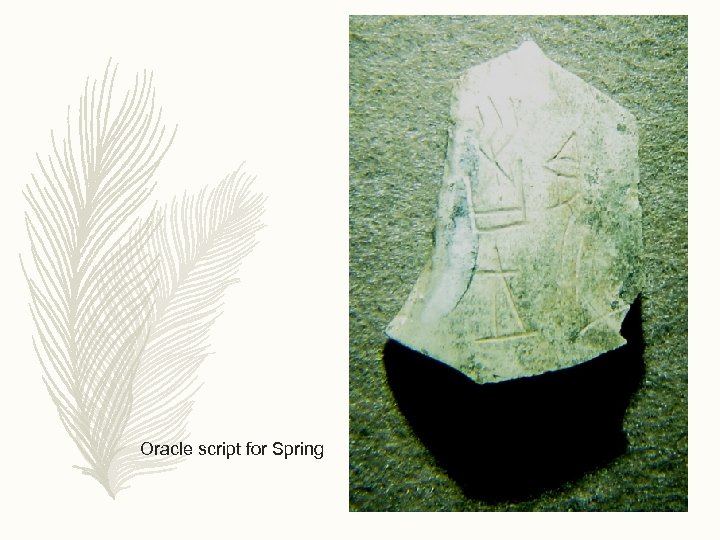
Oracle script for Spring
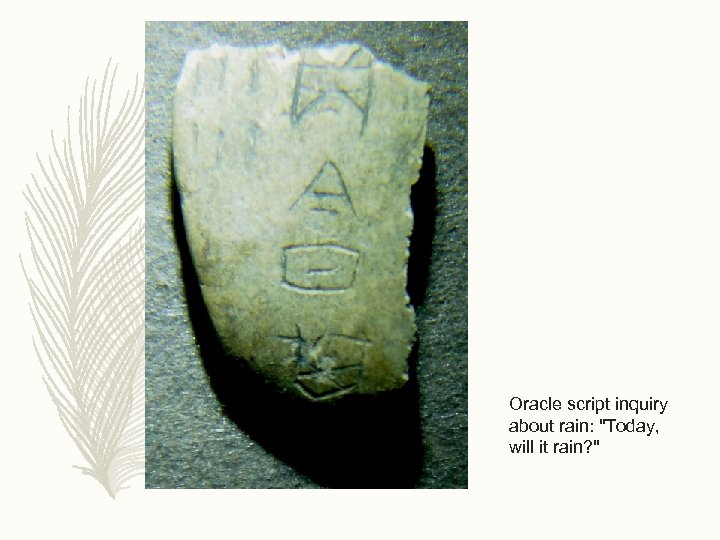
Oracle script inquiry about rain: "Today, will it rain? "
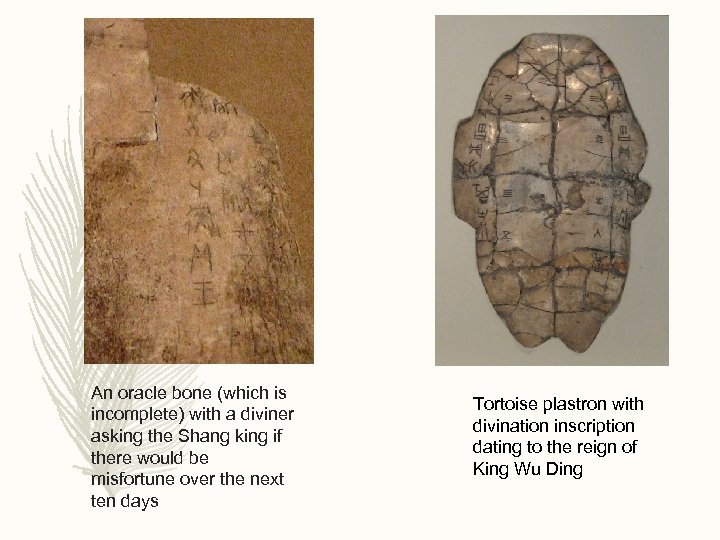
An oracle bone (which is incomplete) with a diviner asking the Shang king if there would be misfortune over the next ten days Tortoise plastron with divination inscription dating to the reign of King Wu Ding
二、金文 – 金文是指铸刻在殷周青铜器上的铭文,也叫钟鼎文。商周是青铜器的 时代,青铜器的礼器以鼎为代表,乐器以钟为代表,“钟鼎”是青铜器的 代名词。所谓青铜,就是铜和锡的合金。中国在夏代就已进入青铜时 代,铜的冶炼和铜器的制造技术十分发达。因为周以前把铜也叫金, 所以铜器上的铭文就叫作“金文” ;金文应用的年代,上自商代的早期, 下至秦灭六国,约 1200多年。
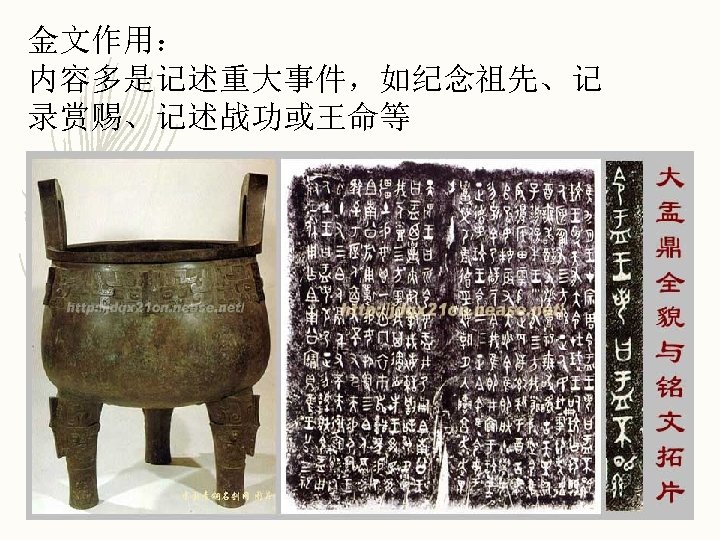
金文作用: 内容多是记述重大事件,如纪念祖先、记 录赏赐、记述战功或王命等
– With the development of Bronzeware script and Large Seal Script, "cursive" signs appeared. Moreover, each archaic kingdom had its own set of characters. – In about 220 BC, the emperor Qin imposed several reforms, among them is the character unification, which created a set of 3300 standardized small seal characters. Despite that the main writing implement of the time was already the brush, main examples of this style are on steles.
Chinese bronze inscriptions, also commonly referred to as Bronze script or Bronzeware script are writing in a variety of Chinese scripts on Chinese ritual bronzes such as zhōng bells and dǐng tripodal cauldrons from the Shang dynasty to the Zhou dynasty and even later. Early bronze inscriptions were almost always cast (that is, the writing was done with a stylus in the wet clay of the piece-mold from which the bronze was then cast), while later inscriptions were often engraved after the bronze was cast. The bronze inscriptions are one of the earliest scripts in the Chinese family of scripts, preceded by the oracle bone script.
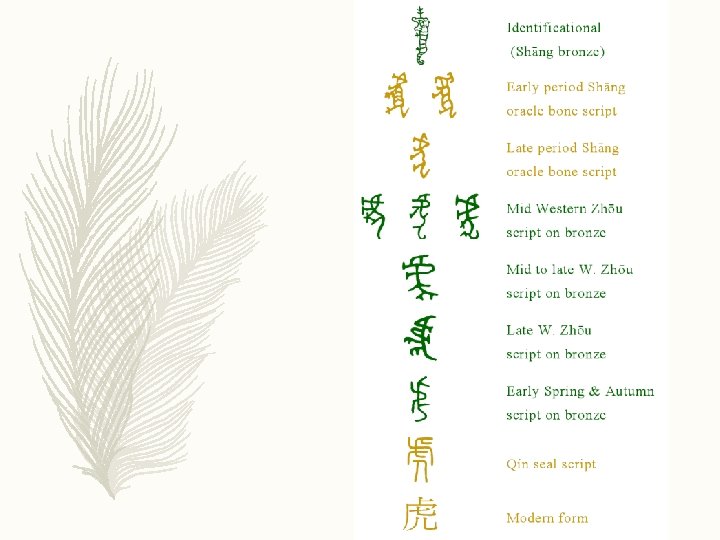
For the early Western Zhou to early Warring States period, the bulk of writing which has been unearthed has been in the form of bronze inscriptions. As a result, it is common to refer to the variety of scripts of this period as “bronze script”, even though there is no single such script. The term usually includes bronze inscriptions of the preceding Shang dynasty as well. However, there are great differences between the highly pictorial Shang emblem (aka "identificational") characters on bronzes (see "ox" clan insignia at left), typical Shang bronze graphs, writing on bronzes from the middle of the Zhou dynasty, and that on late Zhou to Qin, Han and subsequent period bronzes. Furthermore, starting in the Spring and Autumn period, the writing in each region gradually evolved in different directions, such that the script styles in the Warring States of Chu, Qin and the eastern regions, for instance, were strikingly divergent. In addition, artistic scripts also emerged in the late Spring and Autumn to early Warring States, such as Bird Script (鳥書 niǎoshū), also called Bird Seal Script (niǎozhuàn 鳥篆 ), and. Worm Script (chóngshū 蟲書).
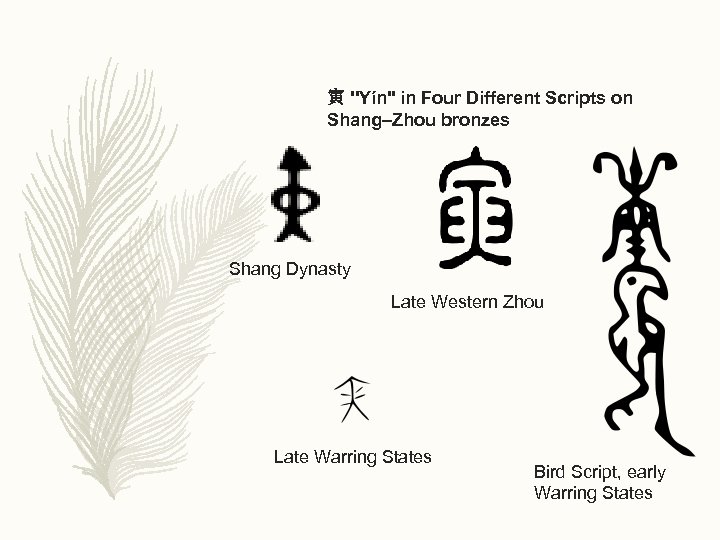
寅 ''Yín'' in Four Different Scripts on Shang–Zhou bronzes Shang Dynasty Late Western Zhou Late Warring States Bird Script, early Warring States
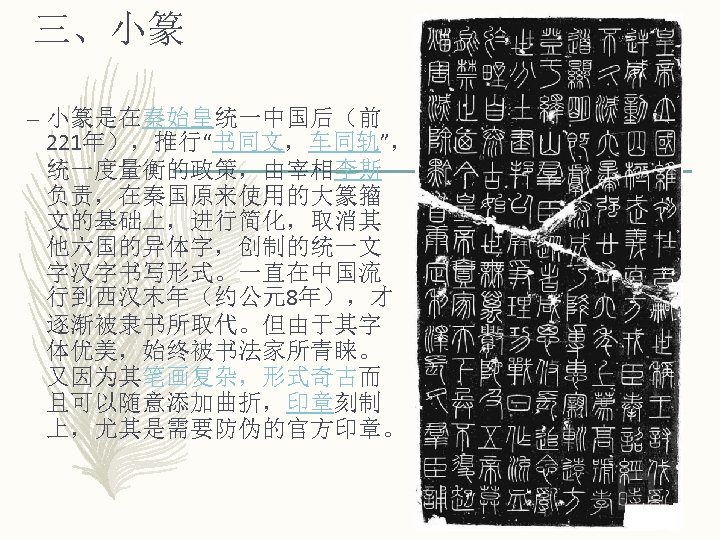
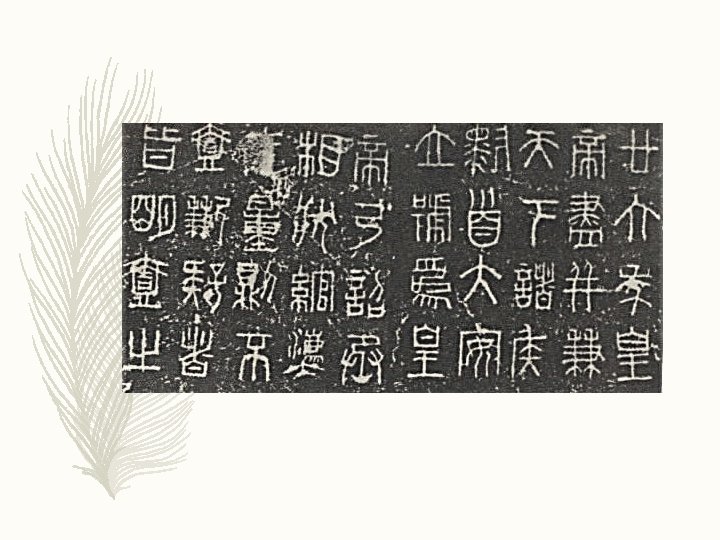
三、小篆 – 小篆是在秦始皇统一中国后(前 221年),推行“书同文,车同轨”, 统一度量衡的政策,由宰相李斯 负责,在秦国原来使用的大篆籀 文的基础上,进行简化,取消其 他六国的异体字,创制的统一文 字汉字书写形式。一直在中国流 行到西汉末年(约公元8年),才 逐渐被隶书所取代。但由于其字 体优美,始终被书法家所青睐。 又因为其笔画复杂,形式奇古而 且可以随意添加曲折,印章刻制 上,尤其是需要防伪的官方印章。
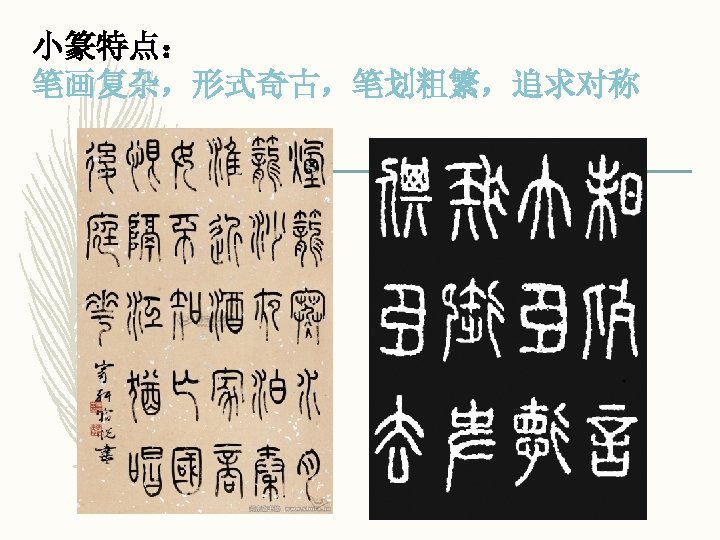
小篆特点: 笔画复杂,形式奇古,笔划粗繁,追求对称
Small Seal Script (Chinese: 小篆 , xiǎozhuàn), formerly romanized as Hsiaochuan and also known as Seal Script, Lesser Seal Script and Qin Script (秦篆, Qínzhuàn), is an archaic form of Chinese calligraphy. It was standardized and promulgated as a national standard by Li Si, prime minister under Shi Huangdi, the First Emperor of Qin. Before the Qin conquest of the last six of the Warring States of Zhou China, local styles of characters evolved independently of one another for centuries, producing what are called the "Scripts of the Six States" (六國文字) or "Great Seal Script". Under one unified government however, the diversity was deemed undesirable as it hindered timely communication, trade, taxation, and transportation and as independent scripts might represent dissenting political ideas.
Hence coaches, roads, currency, laws, weights, measures, and writing were to be unified systematically. Characters which were different from those found in Qin were discarded and Li Si‘s small seal characters became the standard for all regions within the empire. This policy came in about 220 BC, the year after Qin’s unification of the Chinese states, and was introduced by Li Si and two ministers. The small cursive form clerical script came after the small script. Li Si's compilation is known only through Chinese commentaries through the centuries. It is stated to contain 3, 300 characters. Several hundred characters from fragmented commentaries have been collected during the Qing period, and recent archeological excavations in Anhui, China, have uncovered several hundred more on bamboo strips to show the order of the characters; unfortunately, the script found is not the small seal script as the discovery dates from Han times.
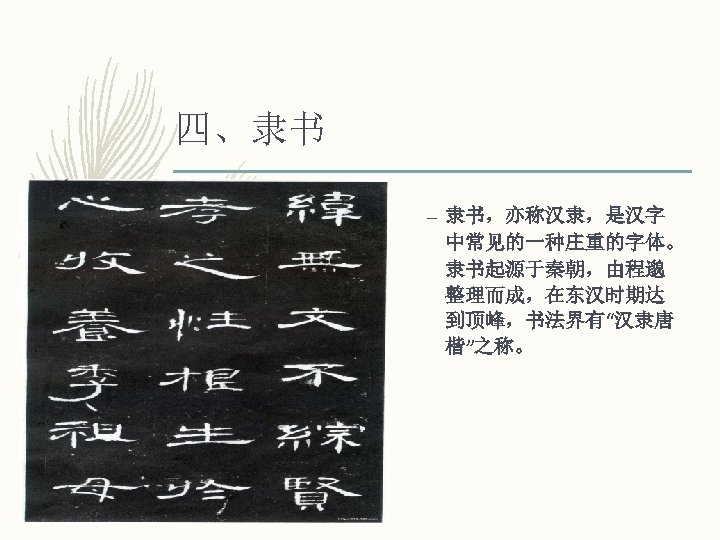
四、隶书 – 隶书,亦称汉隶,是汉字 中常见的一种庄重的字体。 隶书起源于秦朝,由程邈 整理而成,在东汉时期达 到顶峰,书法界有“汉隶唐 楷”之称。
The clerical script (traditional Chinese: 隸書; simplified Chinese: 隶书; pinyin: lìshū; Japanese: 隷書体 , Reishotai), also formerly chancery script, is an archaic style of Chinese calligraphy which evolved in the Warring States period to the Qin dynasty, was dominant in the Han dynasty, and remained in use through the Wei-Jin periods. Due to its high legibility to modern readers, it is still used for artistic flavor in a variety of functional applications such as headlines, signboards, and advertisements. This legibility stems from the highly rectilinear structure, a feature shared with modern regular script (kaishu). In structure and rectilinearity, it is generally similar to the modern script; however, in contrast with the tall to square modern script, it tends to be square to wide, and often has a pronounced, wavelike flaring of isolated major strokes, especially a dominant rightward or downward diagonal stroke. Some structures are also archaic.
During Warring States, proto-clerical script emerged in casual, informal usage. During the Qin dynasty it appears to have also been used in some scribal capacity, but never in formal usage. Maturing into clerical script in the early Han, it soon became the dominant script for general purposes, while seal script remained in use for the most formal purposes such as some stelae, signet seals (name chops), and especially the titles of written works and stelae; some cursive was also in use at the time. Out of clerical script, a new form then emerged in the middle of the Eastern Han dynasty, which Qiu terms "neo-clerical" script; it was from this neo-clerical and from cursive that by late in the Eastern Han semicursive would then evolve, out of which then emerged the modern standard script. Thus, the evolution from clerical script to standard script was not a direct step as commonly supposed.
– Lishu, the clerical script is more regularized, and in some ways similar to modern text, were also authorised under Qin Shi Huang. – Cursive styles descended from Clerical script, the regular script in Han Dynasty, but either semi-cursive (行书)or cursive script (草书) were used for personal notes only, and were never used as standard.
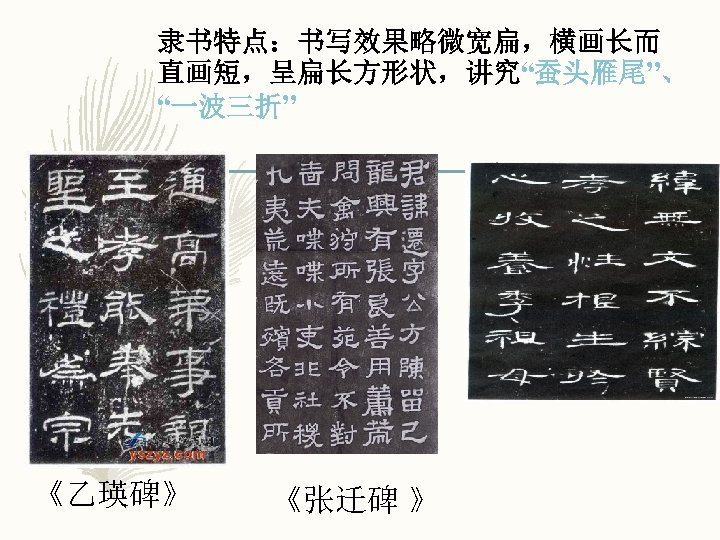
隶书特点:书写效果略微宽扁,横画长而 直画短,呈扁长方形状,讲究“蚕头雁尾”、 “一波三折” 《乙瑛碑》 《张迁碑 》
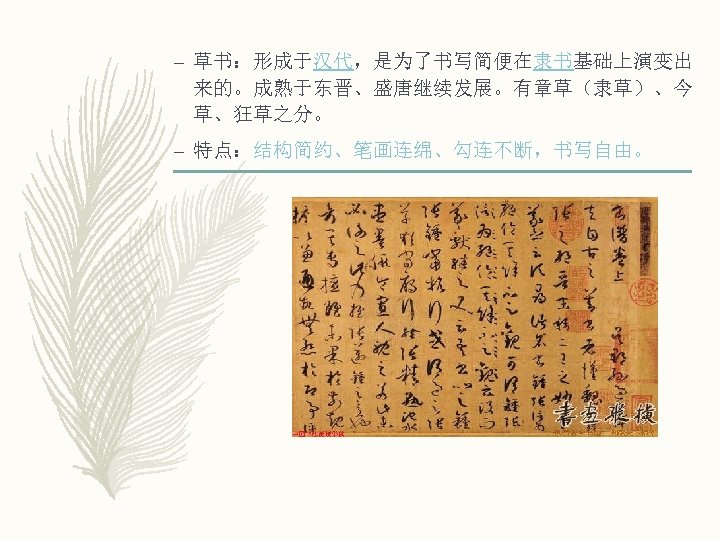
– 草书:形成于汉代,是为了书写简便在隶书基础上演变出 来的。成熟于东晋、盛唐继续发展。有章草(隶草)、今 草、狂草之分。 – 特点:结构简约、笔画连绵、勾连不断,书写自由。
Cursive script (simplified Chinese: 草书; traditional Chinese: 草書; pinyin: cǎoshū), often mistranslated asgrass script (see Names below), is a style of Chinese calligraphy. Cursive script is faster to write than other styles, but difficult to read for those unfamiliar with it. It functions primarily as a kind of shorthand script or calligraphic style. People who can read standard or printed forms of Chinese may not be able to comprehend this script. The character 書 (shū) means script in this context, and the character 草 (cǎo) means quick, rough or sloppy. Thus, the name of this script is literally "rough script" or "sloppy script". The same character 草 (cǎo) appears in this sense in the noun "rough draft" (草稿, cǎogǎo), and the verb "to draft [a document or plan]" (草擬, cǎonǐ). The other indirectly related meaning of the character 草 (cǎo) is grass, which has led to the mistranslation "grass script".
Beside zhāngcǎo and the “modern cursive”, there is the “wild cursive” (Chinese: 狂草; pinyin: kuáng cǎo, ) which is even more cursive and difficult to read. When it was developed by Zhang Xuand Huaisu in the Tang dynasty, they were called Dian Zhang Zui Su (crazy Zhang and drunk Su, 顛張醉素). Cursive, in this style, is no longer significant in legibility but rather in artistry. Cursive scripts can be divided into the unconnected style (Chinese (S) and Japanese 独草, Chinese (T) 獨草, pinyin dúcǎo, ) where each character is separate, and the connected style (Chinese (S) 连绵, Chinese (T) 連綿, Japanese 連綿体, pinyin liánmián) where each character is connected to the succeeding one.
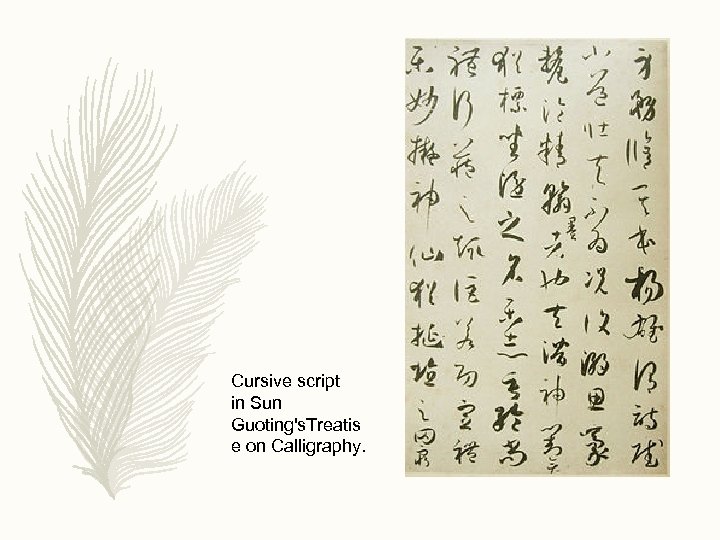
Cursive script in Sun Guoting's. Treatis e on Calligraphy.
– Chinese calligraphyis the art of line in a highly concentrated and purified form. Awareness in calligraphy began during the Wei-Jin. It was in this period that the rigid, orderly, and imposing official style, the clerical script, gave way to the running, cursive, and regular scripts. What used to be a little known and unimportant occupation of the middle and lower classes now became a skilled and absorbing pastime of the great families and distinguished scholars.
– From the merchant who hoists up his newly written shop sign with ceremony and incense to the poet who indulges in the brilliant sword dance of the brush, calligraphy is revered above all other arts. Not only is handwriting considered a clue to a person’s temperament, moral worth, and learning, but the uniquely ideographic Chinese script has charged each individual characters with a richness of content and association.
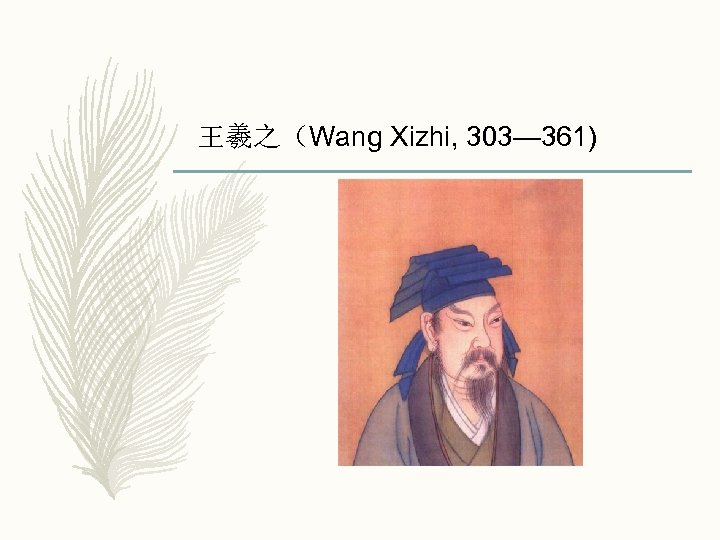
王羲之(Wang Xizhi, 303— 361) ,
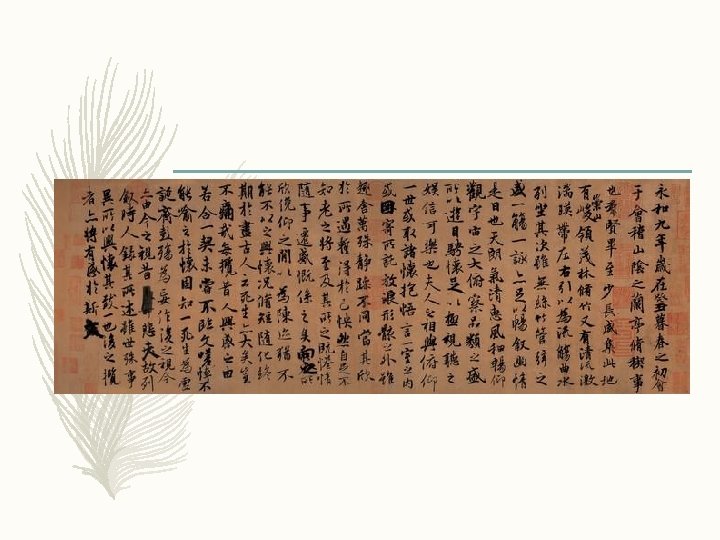
Lanting Xu, or Preface to the Orchid Pavilion, is the masterpiece of Wang Xizhi. It ranked the greatest calligraphic masterpiece of semi-cursive script in history . The gem of Chinese calligraphy, like a “frolicking dragon, ” vigorous, yet refined and elegant with dynamic significance and extraordinary grace. The text recorded the beauty of mountains and water surrounding the Orchid Pavilion as well as the pleasure of gathering.
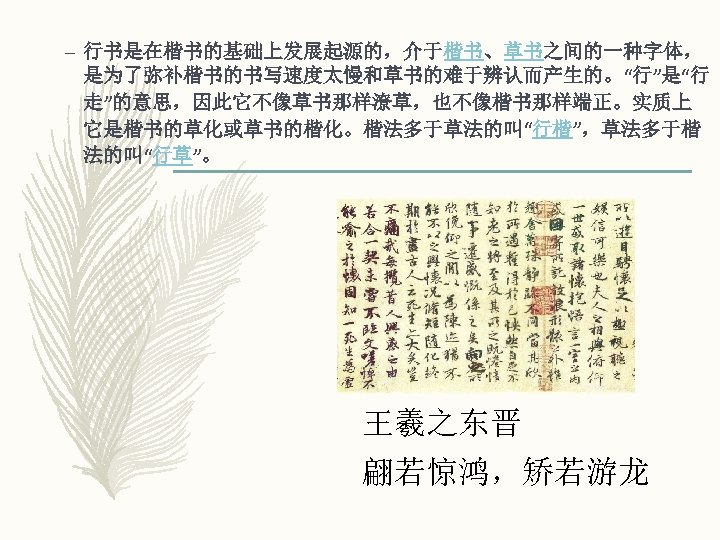
– 行书是在楷书的基础上发展起源的,介于楷书、草书之间的一种字体, 是为了弥补楷书的书写速度太慢和草书的难于辨认而产生的。“行”是“行 走”的意思,因此它不像草书那样潦草,也不像楷书那样端正。实质上 它是楷书的草化或草书的楷化。楷法多于草法的叫“行楷”,草法多于楷 法的叫“行草”。 王羲之东晋 翩若惊鸿,矫若游龙
– On March 3 in lunar calendar, 353, Wang Xizhi together with other 41 people held the rite of Xi, a ritual to eliminate and avoid the evil, in Shaoxing. They created prose and poems respectively and collected them together as Lantingji, or The Collection of the Orchid Pavilion. Wang Xizhi created a preface to this collection. The text recorded the beauty of mountains and water surrounding the Orchid Pavilion as well as the pleasure of gathering.
莫春者,春服既成,冠者五六人,童子 六七人,浴乎沂,风乎舞雩,咏而归。 (《先进》) Joseph Addison: True happiness is of a retired nature, and an enemy to pomp and noise; it arises, in the first place, from the enjoyment of one’s self, and in the next from the friendship and conversation of a few selected companions. The Spectator, March 17, 1711
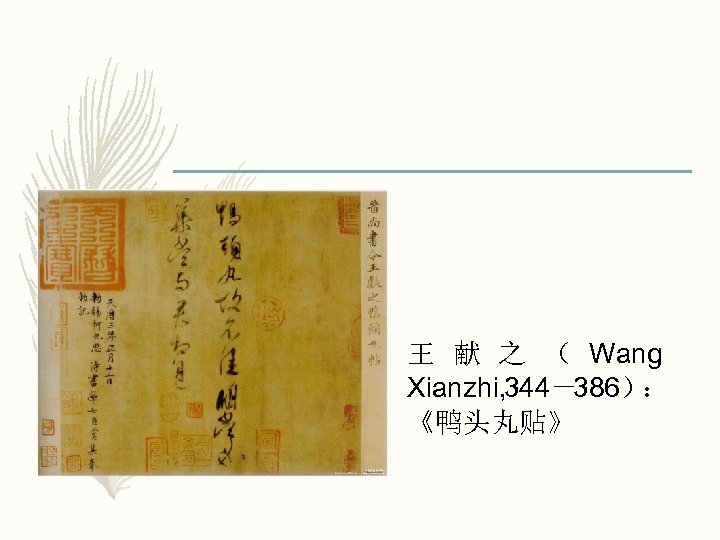
王 献 之 ( Wang Xianzhi, 344-386): 《鸭头丸贴》
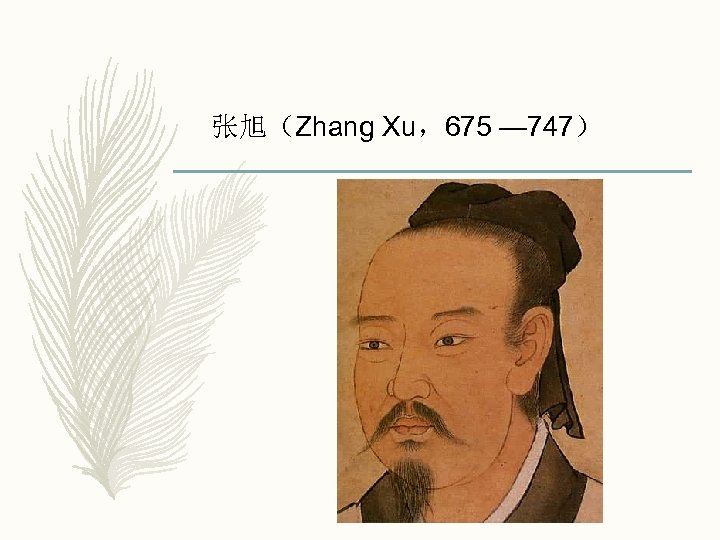
张旭(Zhang Xu,675 — 747)
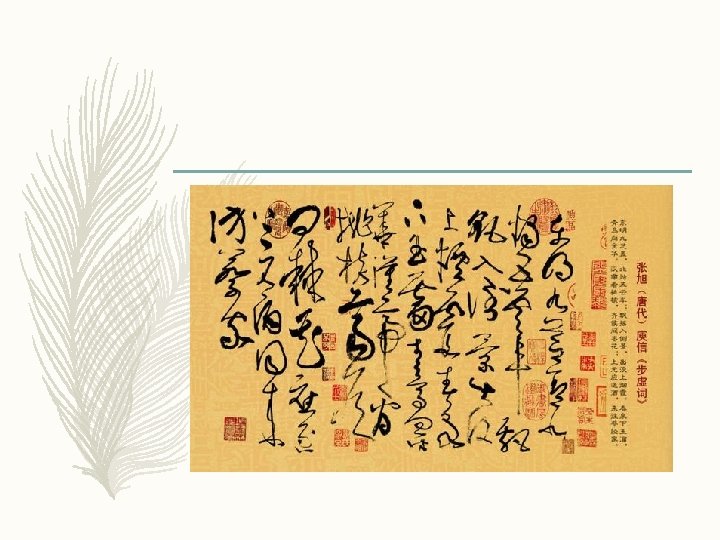
– One day, on the streets of Chang’an, Zhang saw a crowd of people gathering to enjoy a performance by Lady Gongsun, a sword dance, in which her supple body and flying robe mixing with the movements of the sword up and down, and becoming perfectly integrated into the surroundings. Rapid progress was he made from then on.
Watching Lady Gongsun’s Disciple Perform a Sword Dance Du Fu (712 -770) – Preface – On October 19 th in the second year of the Dali era (766779), in the house of the Kueifu official, Yuanchi, I watched a young lady, Li of Lingying, perform a sword dance with robust and impressive footing. I asked who her teacher was and she replied, “I am a disciple of Lady Gongsun. ” –
– I remember in the third year of the Kaiyuan era (713 -741), when I was still a child, watching Lady Gongsun perform a sword dance in Yancheng, moving like a floating boat in deep water hit by the swift patter of rain, unequaled among her peers. Of all the top performers of the Pear Garden dance troupe, and those I knew of outside the troupe, performing in the early years of the Emperor, sacred of literary talent and military might, Lady Gongsun was alone.
– She had a jeweled appearance and wore embroidered clothes, but now I have gray hair and even her disciple’s face is no longer young. Since I now recognize her roots, I know there is no second to her sublime routine. To console my ardent sighs a bit, I wrote a poem then, called “Ode to Swords. ”
– There once was a man from Wu named Zhang Xu, skilled in cursive calligraphy, who beheld Lady Gongsun perform her Western River Sword Dance several times in Ye County. Henceforth, he made great strides in cursive calligraphy, arousing in it a pool of heroic feeling. That, apparently, is the influence of Lady Gongsun.
杜甫:观公孙大娘舞剑器行 – In the past, there was a beauty, – a lady of the Gongsun clan, – who would do a sword dance, – moving in all directions. – So many people, like the colors – of countless mountains, watched – in amazement, for heaven and earth – itself moved up and down.
– Shimmering, like shots of the – archer Yi, nine suns were dropping, – brave and swift, like the team of flying – dragons belonging to the Emperors of Heaven. – The drums were coming in thunder claps – as the audience held its furious force – Until the end—when the sword became – a river and sea congealed in pure light.
– Red lips, jeweled sleeves— – both of them have disappeared, – but later a disciple came – to spread her lovely talent. – A Linying beauty – in White Emperor City – performs this same song, – a magic dance—and the spirits disperse. – I ask about her – and learn her story, – thus feeling matters in time that – have increased my wounds and regrets.
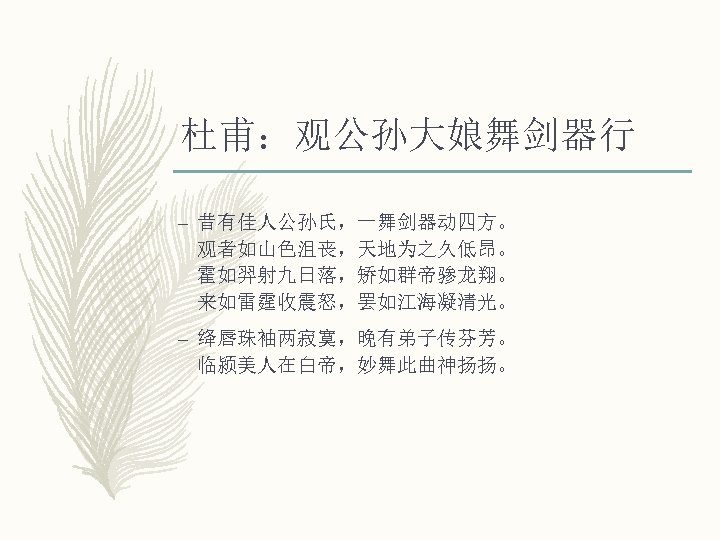
杜甫:观公孙大娘舞剑器行 – 昔有佳人公孙氏,一舞剑器动四方。 观者如山色沮丧,天地为之久低昂。 霍如羿射九日落,矫如群帝骖龙翔。 来如雷霆收震怒,罢如江海凝清光。 – 绛唇珠袖两寂寞,晚有弟子传芬芳。 临颍美人在白帝,妙舞此曲神扬扬。
– Lines that express happiness are continuous and flowing, with no pauses or break, and no sharp turnings. Lines that express unpleasant feelings usually have stops in them, suggesting difficulty or impediment. When there are too many stops, it is a sign of grief and anxiety. What calligraphy expressed was the free, flowing romantic, and lofty style of the Wei and Jin, and a clear and open atmosphere that differed from Han Dynasty.
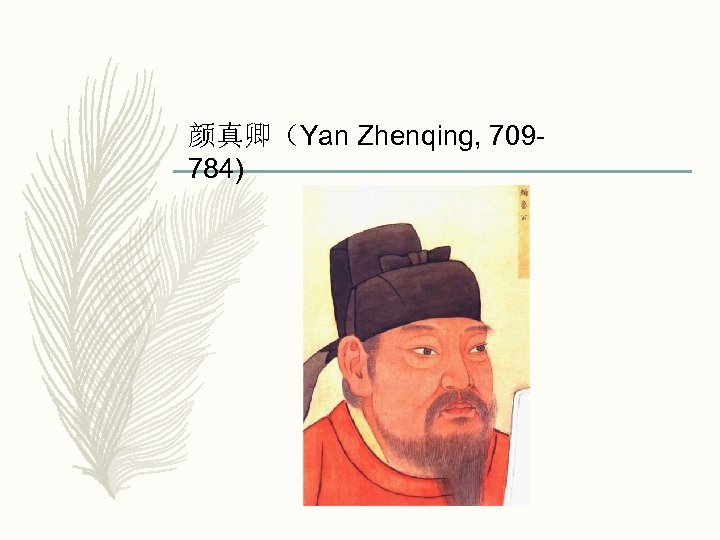
颜真卿(Yan Zhenqing, 709784)
– 拜师以后,张旭却没有透露半点书法秘诀。他只是给颜 真卿介绍了一些名家字帖,简单地指点一下字贴的特点, 让颜真卿临摹。有时候,他带着颜真卿去爬山,去游水, 去赶集、看戏,回家后又让颜真卿练字,或看他挥毫疾 书。
– Yan Zhengqing regarded the regular script as the most standard form of handwriting, for it was “steady, clear, and easy to use. ” It was the kind of script people used when making copies, and in time it became the model for the printed script of the Song Dynasty. It was a form of handwriting that everybody could learn and use, which is of course very different from the crazy cursive script of the prime Tang.
– Traditionally one praised handwriting of Wang Xizhi and Wang Xianzhi, which lean slight to one side with the left shoulder tilted, are graceful and varied in appearance, and free and flexible in style. Compare with it, Yan display a quite different spirit. His characters are basically symmetrical, like the frontal view of an object, executed in simple and vigorous strokes, square in shape, solemn, oderly, and impressive.
– The modern Chinese historian Fan Wenlan, in A Concise History of China, says: – The people of the Song learnt from Yan Zhengqing in the same way as the people of the early Tang regarded Wang Xizhi and Wang Xianzhi as their master. The line “calligraphy values the hard and thin”(书贵瘦硬方通神) in one of Du Fu’s poems was an old criterion when Yan’s calligraphy was not yet know to the world. Su Shi’s remark, “Du Fu says that calligraphy stressed the hard and thin, but I will not abide by this statement for it is unfair. ” Reflects the new criterion after Yan’ calligraphy became popular.
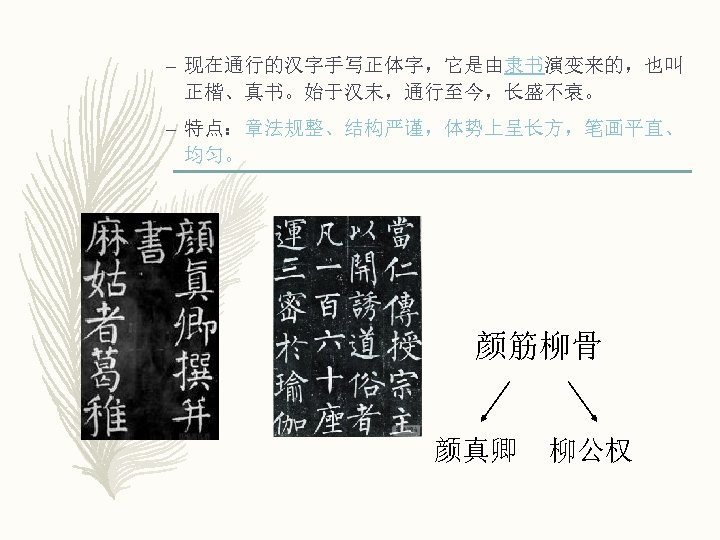
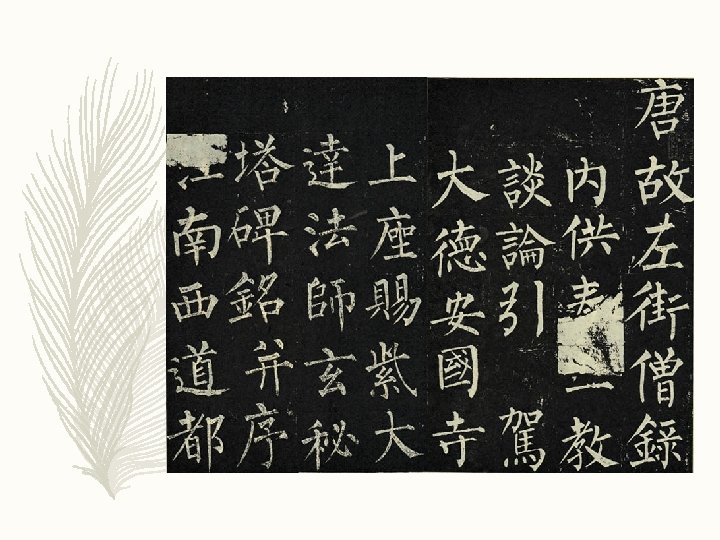
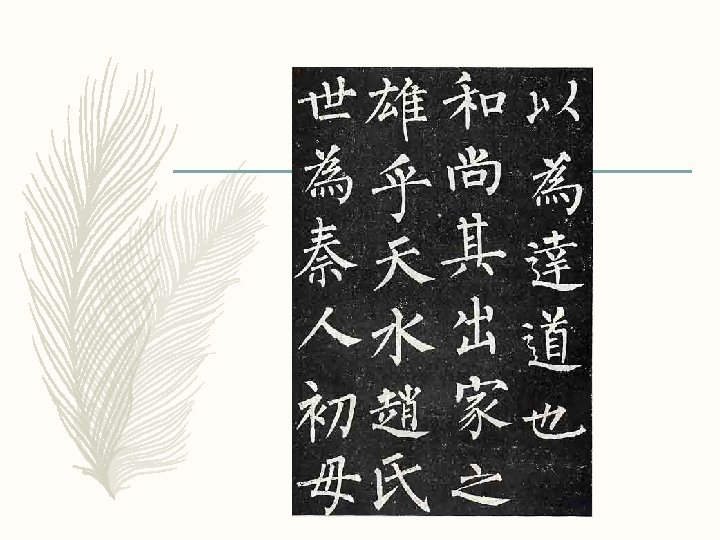
– 现在通行的汉字手写正体字,它是由隶书演变来的,也叫 正楷、真书。始于汉末,通行至今,长盛不衰。 – 特点:章法规整、结构严谨,体势上呈长方,笔画平直、 均匀。 颜筋柳骨 颜真卿 柳公权
– For individual stroke, Yan adopted the rule of “thin horizontal and thick vertical strokes”; strokes’ widths were varied to show the curvature and flow, and the dots and oblique strokes were finished with sharp edges. And for the allocation of the blank, characters are compact vertically, leaving relatively more space in between lines. Hence, Yan style had abandoned the sumptuous trend of early Tang: it is rather upright, muscular, fitting, rich and controlled; than sloped, feminine, pretty, slim and capricious.
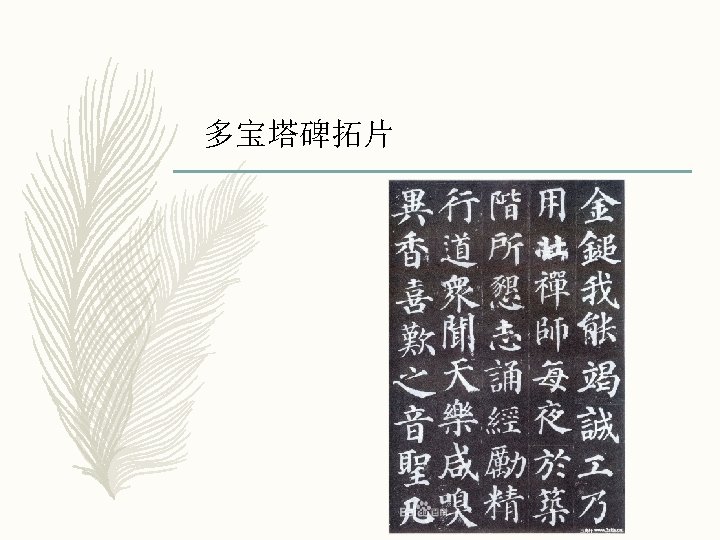
多宝塔碑拓片
– Traditionally one praised handwriting of Wang Xizhi and Wang Xianzhi, which lean slight to one side with the left shoulder tilted, are graceful and varied in appearance, and free and flexible in style. Compare with it, Yan display a quite different spirit. His characters are basically symmetrical, like the frontal view of an object, executed in simple and vigorous strokes, square in shape, solemn, oderly, and impressive.
– Fan Wenlan, A Concise History of China: – People of the Song learnt from Yan in the same way as people of the early Tang regarded Wangs as their master. The line “calligraphy values the hard and thin”(书贵瘦硬 方通神) of Du Fu was an old criterion when Yan’s calligraphy was not yet know to the world. Su Shi’s remark, “Du Fu says that calligraphy stressed the hard and thin, but I will not abide by this statement for it is unfair. ” Reflects the new criterion after Yan’ calligraphy became popular.
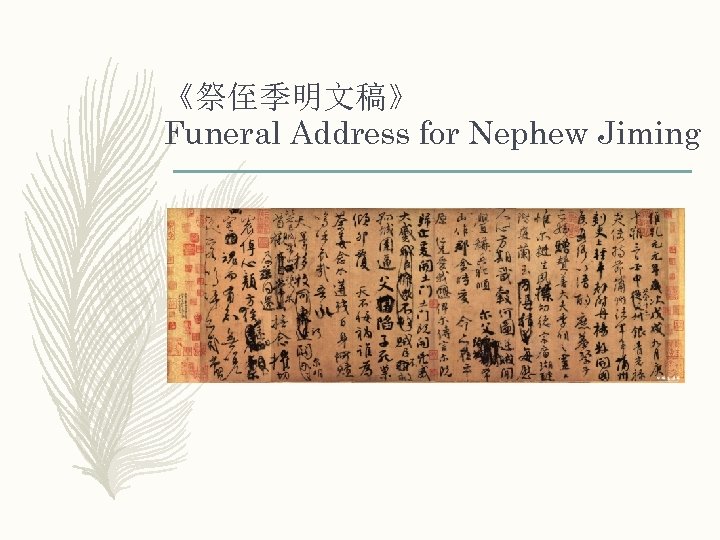
《祭侄季明文稿》 Funeral Address for Nephew Jiming
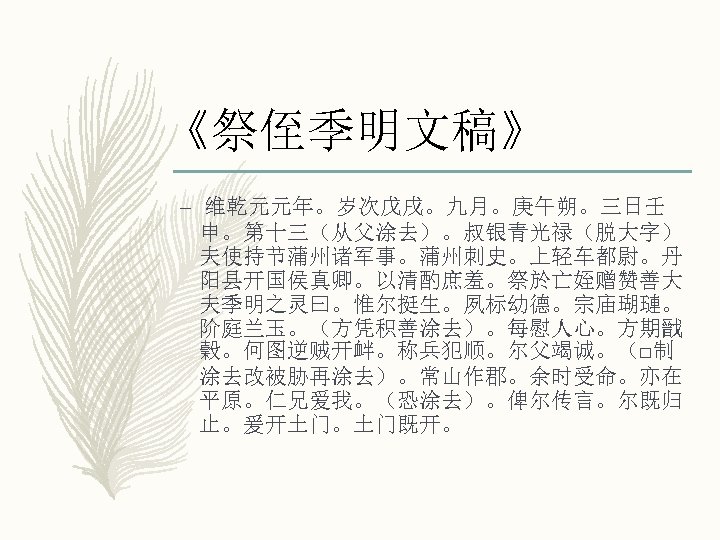
《祭侄季明文稿》 – 维乾元元年。岁次戊戌。九月。庚午朔。三日壬 申。第十三(从父涂去)。叔银青光禄(脱大字) 夫使持节蒲州诸军事。蒲州刺史。上轻车都尉。丹 阳县开国侯真卿。以清酌庶羞。祭於亡姪赠赞善大 夫季明之灵曰。惟尔挺生。夙标幼德。宗庙瑚璉。 阶庭兰玉。(方凭积善涂去)。每慰人心。方期戩 穀。何图逆贼开衅。称兵犯顺。尔父竭诚。(□制 涂去改被胁再涂去)。常山作郡。余时受命。亦在 平原。仁兄爱我。(恐涂去)。俾尔传言。尔既归 止。爰开土门。土门既开。
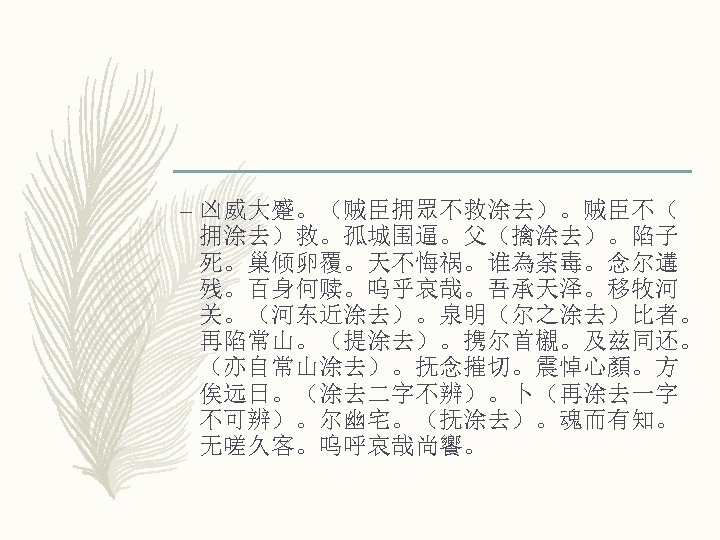
– 凶威大蹙。(贼臣拥眾不救涂去)。贼臣不( 拥涂去)救。孤城围逼。父(擒涂去)。陷子 死。巢倾卵覆。天不悔祸。谁為荼毒。念尔遘 残。百身何赎。呜乎哀哉。吾承天泽。移牧河 关。(河东近涂去)。泉明(尔之涂去)比者。 再陷常山。(提涂去)。携尔首櫬。及兹同还。 (亦自常山涂去)。抚念摧切。震悼心顏。方 俟远日。(涂去二字不辨)。卜(再涂去一字 不可辨)。尔幽宅。(抚涂去)。魂而有知。 无嗟久客。呜呼哀哉尚饗。
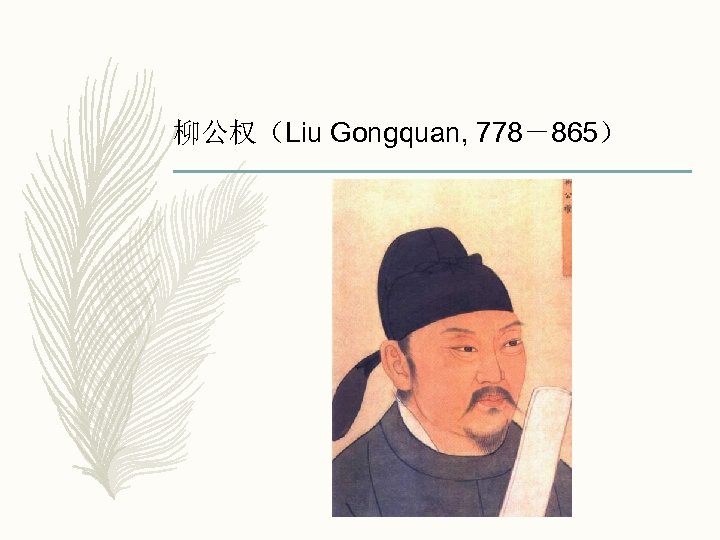
柳公权(Liu Gongquan, 778-865)
– Liu Gongquan (simplified Chinese: 柳公权; traditional Chinese: 柳公權; pinyin: Liǔ Gōngquán) (778– 865), courtesy name Chengxuan (诚悬), was a Chinese calligrapher who stood with Yan Zhenqing as the two great masters of late Tang calligraphy. – A minister like Yan of the Tang dynasty, Liu was a native of today's Tongchuan, Shaanxi, a devout Buddhist and follower of Yan's style of writing. Like him an expert of the regular script, Liu's works were imitated for centuries after and he is often referred in unison with his famed predecessor as "Yan-Liu".
印刷体:宋体、仿宋、黑体 – 宋体: 是在中国宋朝发明的一种汉字印刷字体。笔画有粗细变化,而 且一般是横细竖粗, – 仿宋体: 仿照宋版书上所刻的字体,笔画粗细均匀 黑体: 又称方体或等线体,字形端庄,笔画横 平竖直,笔迹全部一样粗细。
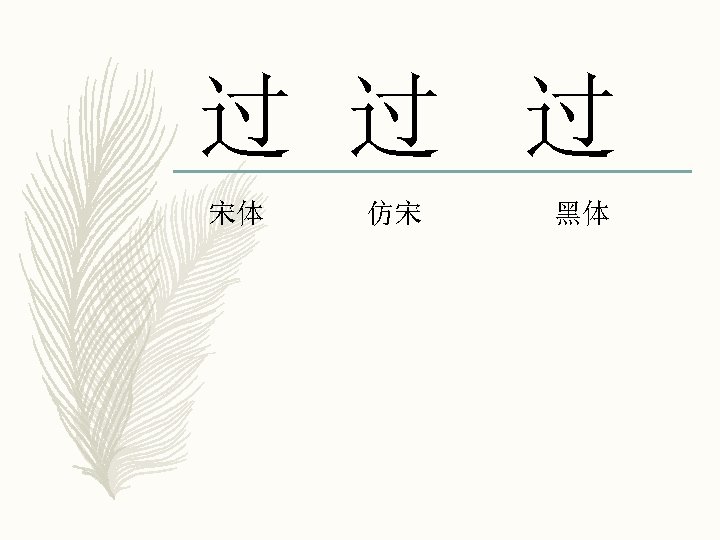
过 过 过 宋体 仿宋 黑体
Imitation Song is a style of Chinese typefaces modeled after a type style in Lin‘anin the Southern Song Dynasty. They are technically a type of regular script typeface. Characteristics of imitation Song typefaces include: The basic structure of regular script. Relatively straight strokes, with horizontal strokes slanting up slightly. Low stroke width variation between horizontal and vertical strokes, with strokes usually being relatively thin. Overall geometrical regularity.
Скачать презентацию Beauty of Chinese Calligraphy 中国书法的演变 中国书法的种类
84f517c7549971d8e2d67e2958047425.ppt