 Скачать презентацию Beating Joe Camel The American Society of Anesthesiologists
c7cccf8010ffabd6321a782da4de7f27.ppt
- Количество слайдов: 34



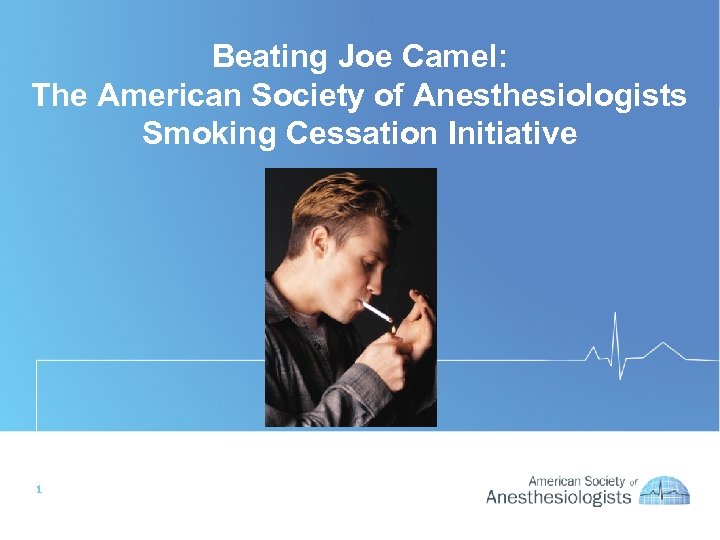
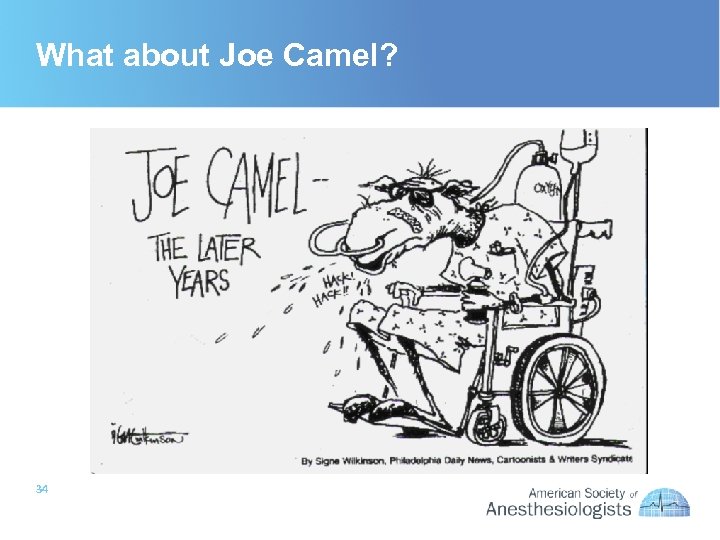
Beating Joe Camel: The American Society of Anesthesiologists Smoking Cessation Initiative 1
Beating Joe Camel… • Why bother? • Barriers • The ASA Smoking Cessation Initiative • How to help in three minutes or less • How to get paid for helping (under some circumstances)
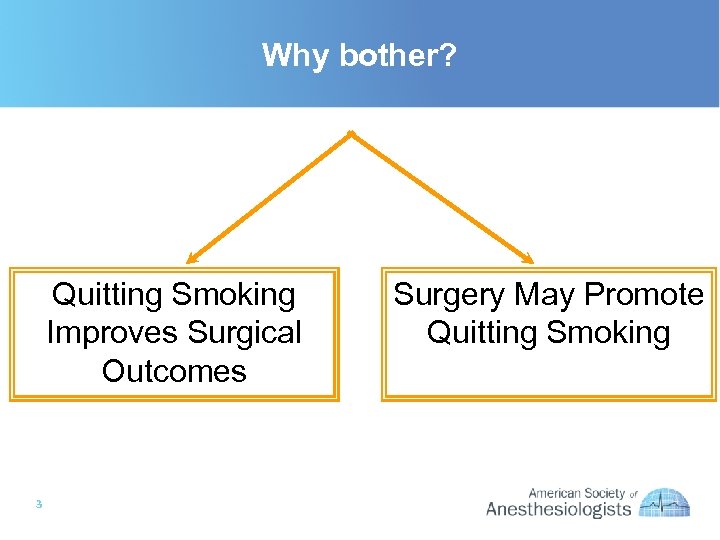
Why bother? Quitting Smoking Improves Surgical Outcomes 3 Surgery May Promote Quitting Smoking
Tobacco Cessation Improves Surgical Outcomes • Cardiovascular complications • Respiratory complications • Wound related complications 4
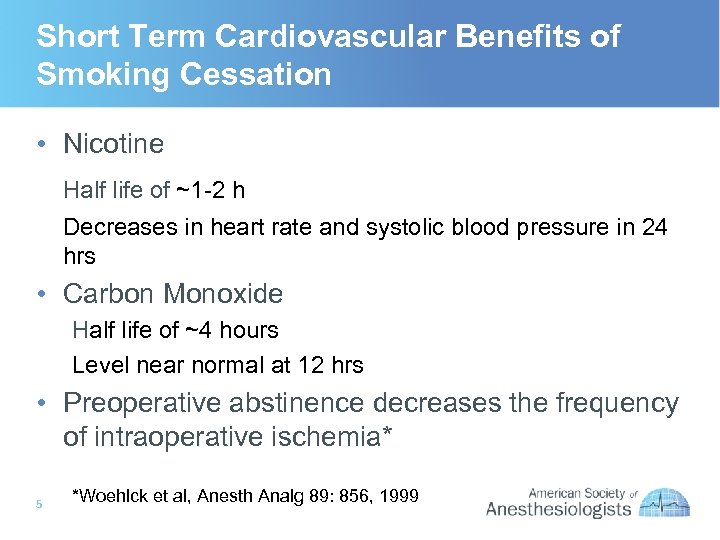
Short Term Cardiovascular Benefits of Smoking Cessation • Nicotine Half life of ~1 -2 h Decreases in heart rate and systolic blood pressure in 24 hrs • Carbon Monoxide Half life of ~4 hours Level near normal at 12 hrs • Preoperative abstinence decreases the frequency of intraoperative ischemia* 5 *Woehlck et al, Anesth Analg 89: 856, 1999
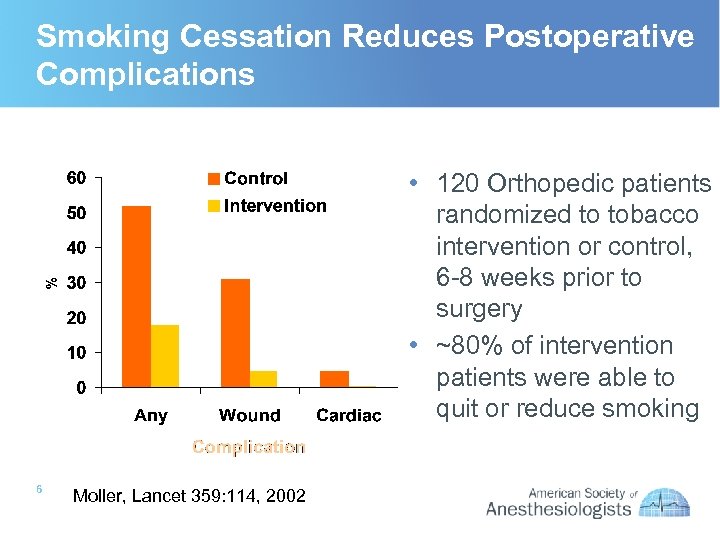
Smoking Cessation Reduces Postoperative Complications • 120 Orthopedic patients randomized to tobacco intervention or control, 6 -8 weeks prior to surgery • ~80% of intervention patients were able to quit or reduce smoking 6 Moller, Lancet 359: 114, 2002
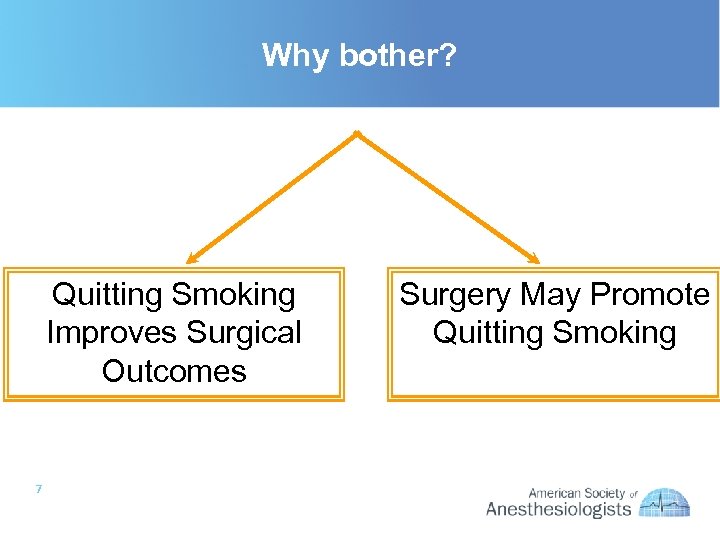
Why bother? Quitting Smoking Improves Surgical Outcomes 7 Surgery May Promote Quitting Smoking
Surgery Promotes Tobacco Cessation • Opportunity to intervene – Contact with healthcare system – Forced abstinence • Major medical interventions improve quit rates – Occurs even in the absence of tobacco interventions – May also improve the effectiveness of tobacco interventions 8
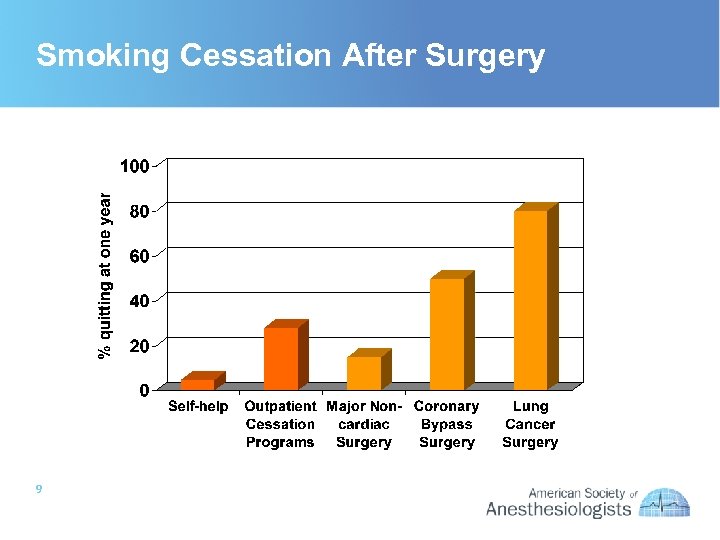
Smoking Cessation After Surgery 9
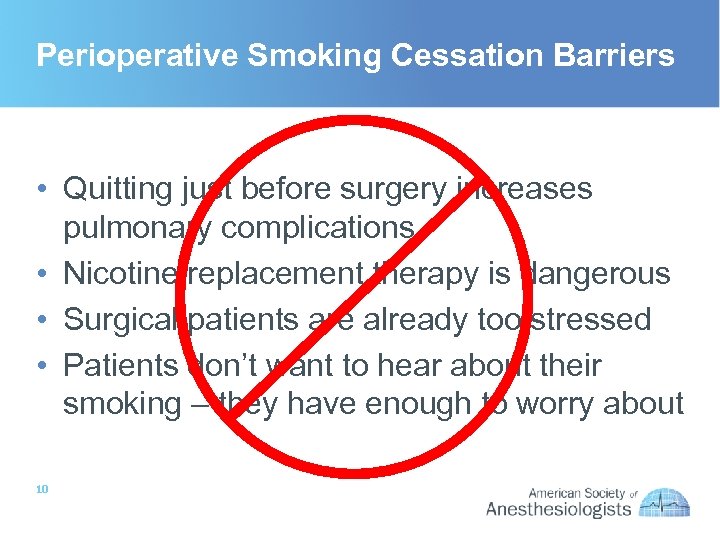
Perioperative Smoking Cessation Barriers • Quitting just before surgery increases pulmonary complications • Nicotine replacement therapy is dangerous • Surgical patients are already too stressed • Patients don’t want to hear about their smoking – they have enough to worry about 10
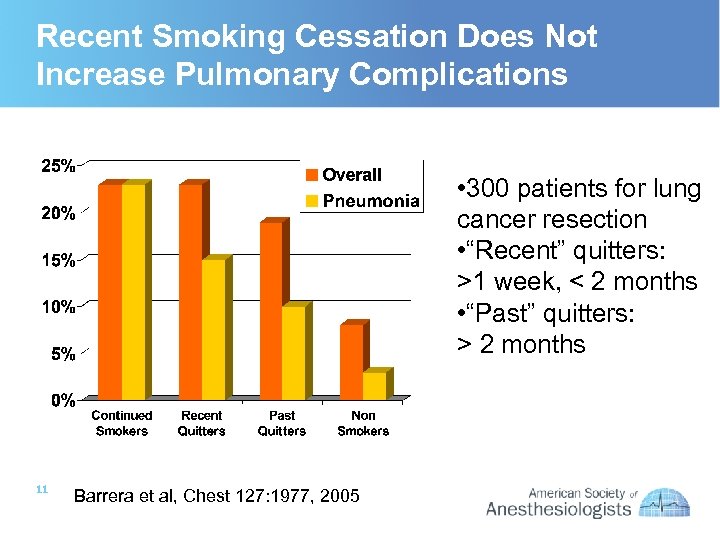
Recent Smoking Cessation Does Not Increase Pulmonary Complications • 300 patients for lung cancer resection • “Recent” quitters: >1 week, < 2 months • “Past” quitters: > 2 months 11 Barrera et al, Chest 127: 1977, 2005
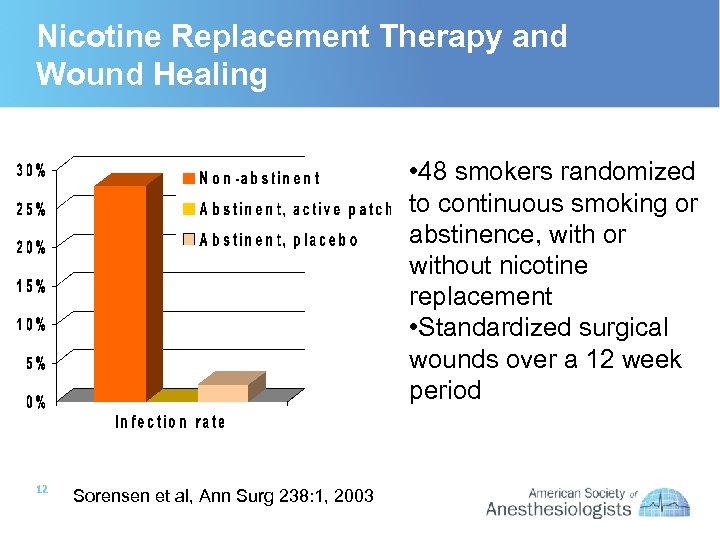
Nicotine Replacement Therapy and Wound Healing • 48 smokers randomized to continuous smoking or abstinence, with or without nicotine replacement • Standardized surgical wounds over a 12 week period 12 Sorensen et al, Ann Surg 238: 1, 2003
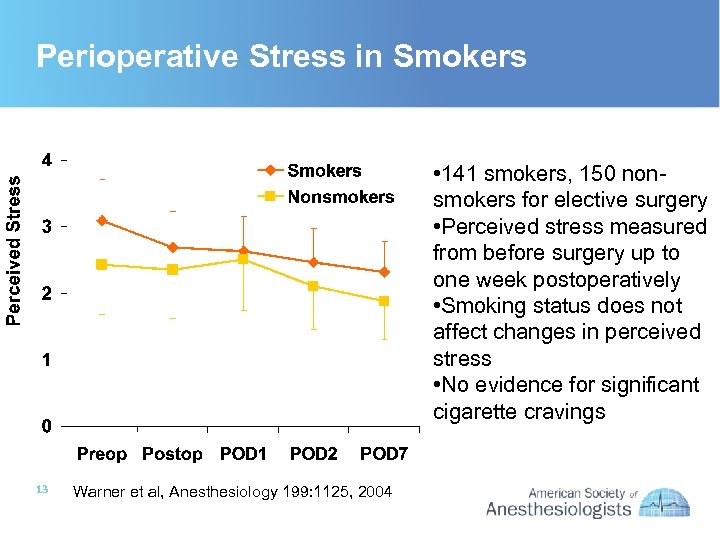
Perioperative Stress in Smokers • 141 smokers, 150 nonsmokers for elective surgery • Perceived stress measured from before surgery up to one week postoperatively • Smoking status does not affect changes in perceived stress • No evidence for significant cigarette cravings 13 Warner et al, Anesthesiology 199: 1125, 2004
What do smokers expect? • Essentially all smokers are aware of general health hazards – Most are not aware of how it might affect their surgery – and want to know! • They want information and options • Almost all will not be offended if you discuss their smoking… • But they do not want a sermon 14 Warner et al, Am J Prev Med 35: S 486, 2008
The Real Barriers to Intervention “I don’t know how” “I don’t have time” “It’s not my job” 15
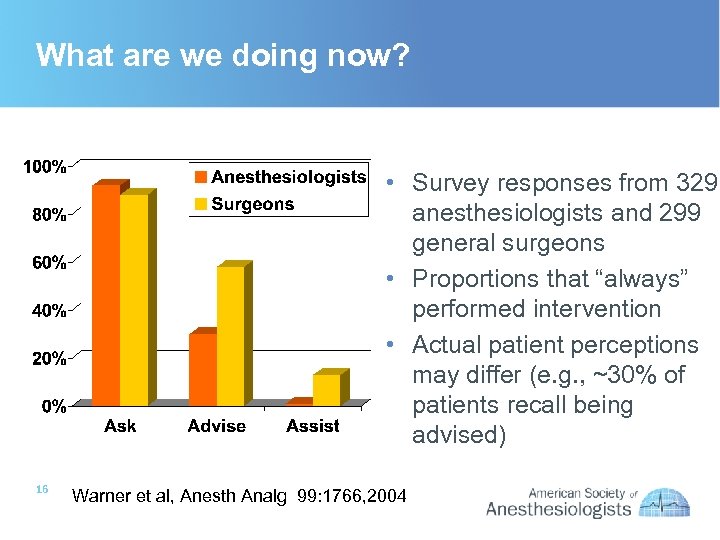
What are we doing now? • Survey responses from 329 anesthesiologists and 299 general surgeons • Proportions that “always” performed intervention • Actual patient perceptions may differ (e. g. , ~30% of patients recall being advised) 16 Warner et al, Anesth Analg 99: 1766, 2004
ASA Smoking Cessation Initiative: Rationale • Smoking cessation improves perioperative outcomes • Sustained abstinence produced by this teachable moment produces an average 6 -8 years of life gained • Demonstrate to the public that anesthesiologists are perioperative physicians who care about patient health • Recent CMS changes make it possible to bill for tobacco interventions lasting three or more minutes 17
ASA Smoking Cessation Initiative Vision and Goals • Vision – Every smoker cared for by an anesthesiologist will receive assistance in quitting as an integral part of care • Goal – Increase the involvement of ASA members in smoking cessation efforts, thus increasing abstinence rates for their patients who smoke 18
ASA Smoking Cessation Initiative Strategies • Encourage all anesthesiologists to consistently apply the ASK, ADVISE, and REFER technique • Develop anesthesiologists who can serve as leaders for local efforts to provide tobacco intervention services in perioperative practice • Educate the public regarding the importance of perioperative smoking cessation • Create partnerships with other healthcare professionals to promote a comprehensive perioperative strategy for patients who smoke 19
What should we do for smokers who need surgery? • ASK Assess tobacco use at every visit • ADVISE Strongly urge all tobacco users to quit • REFER To a tobacco quitline or other resources 20
What are Quitlines? • • Free via telephone to all Americans Staffed by trained specialists Up to 4 -6 personalized sessions Some offer free nicotine replacement therapy • Up to 30% success rates for patients who complete sessions Most providers and patients know nothing about quitlines…. 21
ASK every patient about tobacco use • Ask even if you already know the answer – Reinforces the message that as a physician you think their tobacco use is significant 22
ADVISE all smokers to quit • Why quit for surgery? – Talking Points – Quit for as long as possible before and after surgery • Day of surgery especially important – “fast” from both food and cigarettes – Benefits of quitting to wound healing, heart and lungs – Great opportunity to quit for good • Many people don’t have cravings • Need to be smoke free in the hospital anyway 23
REFER smokers to quitlines or other resources • What are quitlines? – Talking Points – – – Quitlines are free Talk with a specialist, not a recording Free stop smoking medications may be available Can call anytime, even after surgery Can help you stay off cigarettes even if you have already quit • Can also use proactive fax referral • 1 -800 -QUIT-NOW 24
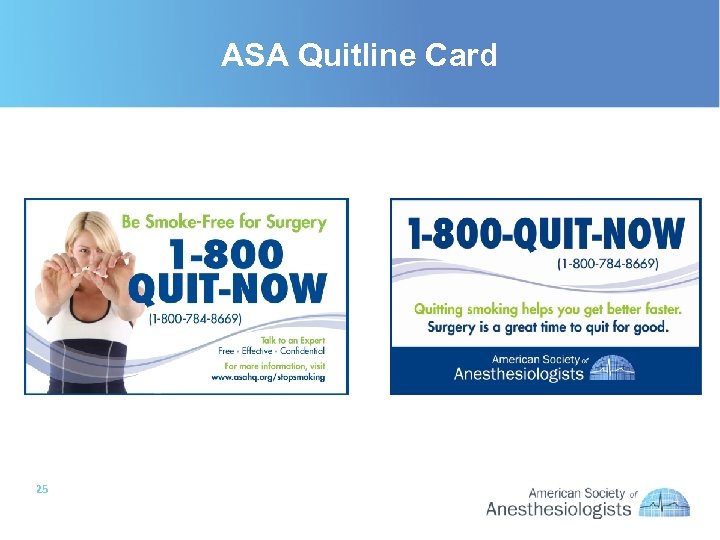
ASA Quitline Card 25
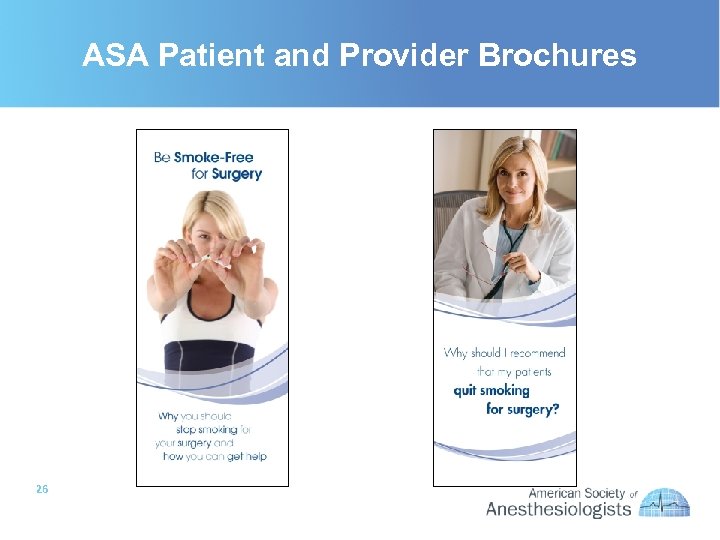
ASA Patient and Provider Brochures 26
Other Patient Resources • Tobacco treatment specialists – Available in many practice settings – Often hospital-based • Web sites – www. smokefree. gov – www. asahq. org/stopsmoking • Insurers – E. g. , Blue Cross/Shield, Blue. Print for Health stop smoking program 27
Tobacco Intervention CMS Reimbursement • Who is covered? – Patients who use tobacco and have a disease or adverse health effect found by the US Surgeon General to be linked to tobacco use – Patients who take certain therapeutic agents whose metabolism or dosage is affected by tobacco use as based on FDA-approved information • CPT® Codes – 99406 Smoking and tobacco-use cessation counseling visit; intermediate, greater than 3 minutes up to 10 minutes – 99407 Smoking and tobacco-use cessation counseling visit; intensive, greater than 10 minutes 28
Tobacco Intervention CMS Reimbursement • Cessation counseling attempt occurs when a qualified physician or other Medicare recognized practitioner determines that a beneficiary meets the eligibility requirements and initiates treatment • Two attempts, up to 4 sessions, allowed every 12 months • No credentialing requirements 29
ASA Smoking Cessation Initiative Task Force Pilot Program • Identified 14 practices nationally, both private practices and academic • Implemented Ask-Advise-Refer strategy from Oct. – Dec. 2007 • Practices surveyed after this period to determine feasibility and gather feedback 30
Pilot Project Highlights (n=94 responses) • ~50% expressed increased self-efficacy • ~75% agree that they would incorporate AAR in their practice • High acceptance of materials • ~80% agree that the ASA should encourage 31
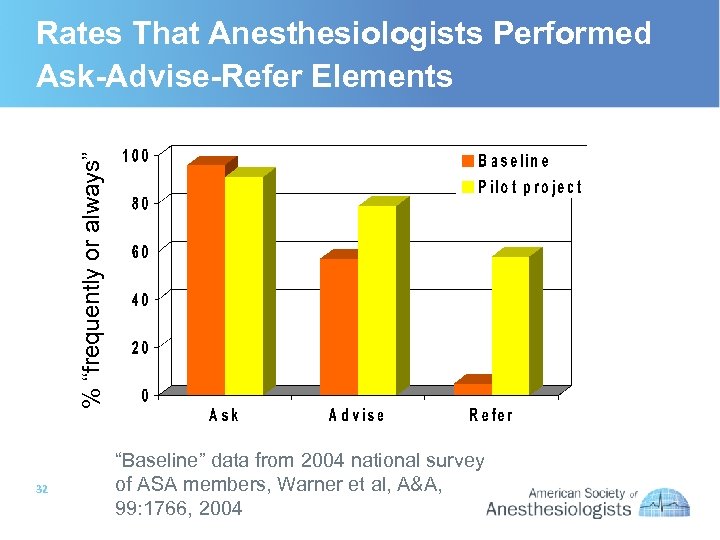
% “frequently or always” Rates That Anesthesiologists Performed Ask-Advise-Refer Elements 32 “Baseline” data from 2004 national survey of ASA members, Warner et al, A&A, 99: 1766, 2004
Bottom Line… • You can make a difference in the lives of your patients who smoke • You can help without being an expert in tobacco control – and get paid for doing it • The ASA is working to provide you with the tools needed to do this effectively 33
What about Joe Camel? 34
Скачать презентацию Beating Joe Camel The American Society of Anesthesiologists
c7cccf8010ffabd6321a782da4de7f27.ppt