 Скачать презентацию Beam Loss and Collimation at the LHC R
a0faa587def7481773c92104eacfe6ca.ppt
- Количество слайдов: 55



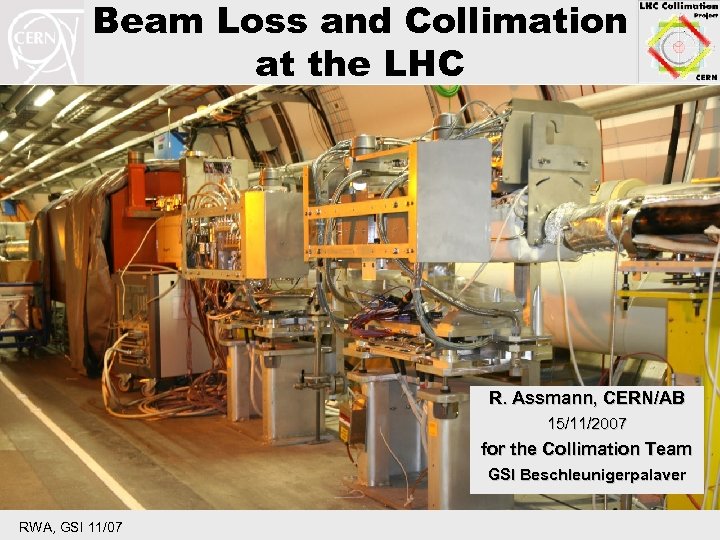
Beam Loss and Collimation at the LHC R. Assmann, CERN/AB 15/11/2007 for the Collimation Team GSI Beschleunigerpalaver RWA, GSI 11/07
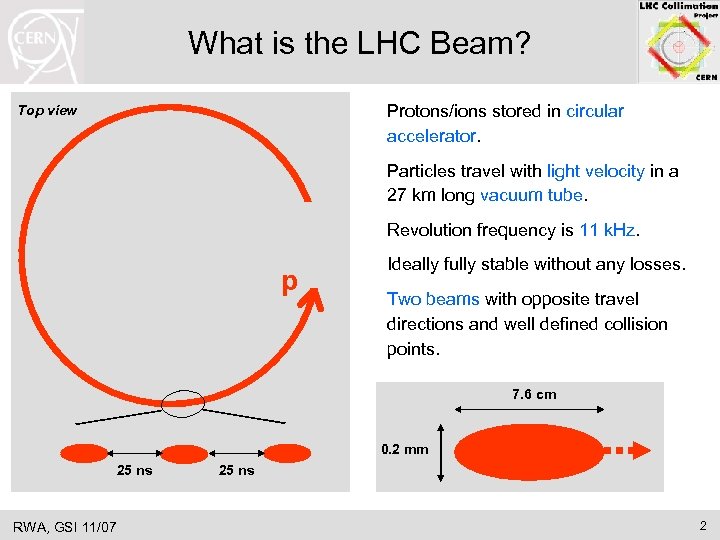
What is the LHC Beam? Protons/ions stored in circular accelerator. Top view Particles travel with light velocity in a 27 km long vacuum tube. Revolution frequency is 11 k. Hz. p Ideally fully stable without any losses. Two beams with opposite travel directions and well defined collision points. 7. 6 cm 0. 2 mm 25 ns RWA, GSI 11/07 25 ns 2
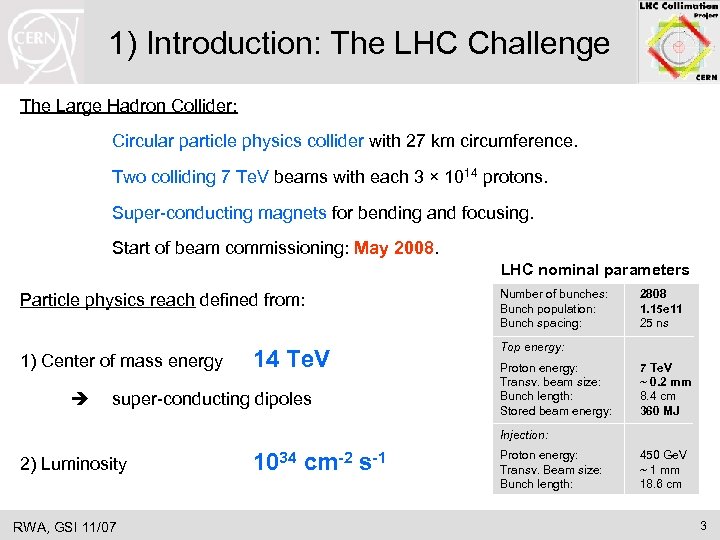
1) Introduction: The LHC Challenge The Large Hadron Collider: Circular particle physics collider with 27 km circumference. Two colliding 7 Te. V beams with each 3 × 10¹⁴ protons. Super-conducting magnets for bending and focusing. Start of beam commissioning: May 2008. LHC nominal parameters Particle physics reach defined from: 1) Center of mass energy 14 Te. V super-conducting dipoles Number of bunches: Bunch population: Bunch spacing: 2808 1. 15 e 11 25 ns Top energy: Proton energy: Transv. beam size: Bunch length: Stored beam energy: 7 Te. V ~ 0. 2 mm 8. 4 cm 360 MJ Injection: 2) Luminosity RWA, GSI 11/07 1034 cm-2 s-1 Proton energy: Transv. Beam size: Bunch length: 450 Ge. V ~ 1 mm 18. 6 cm 3
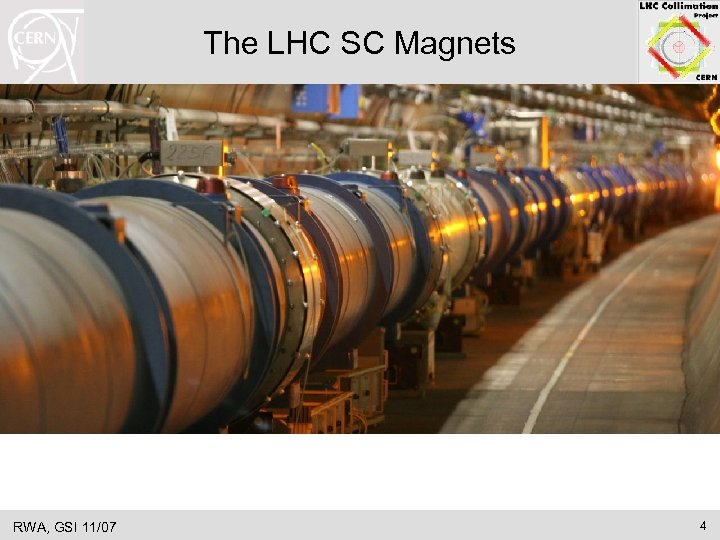
The LHC SC Magnets RWA, GSI 11/07 4
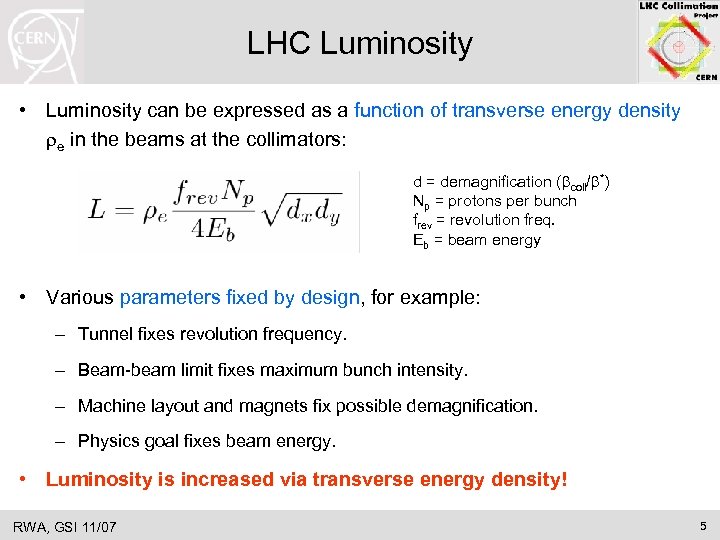
LHC Luminosity • Luminosity can be expressed as a function of transverse energy density re in the beams at the collimators: d = demagnification (bcoll/b*) Np = protons per bunch frev = revolution freq. Eb = beam energy • Various parameters fixed by design, for example: – Tunnel fixes revolution frequency. – Beam-beam limit fixes maximum bunch intensity. – Machine layout and magnets fix possible demagnification. – Physics goal fixes beam energy. • Luminosity is increased via transverse energy density! RWA, GSI 11/07 5
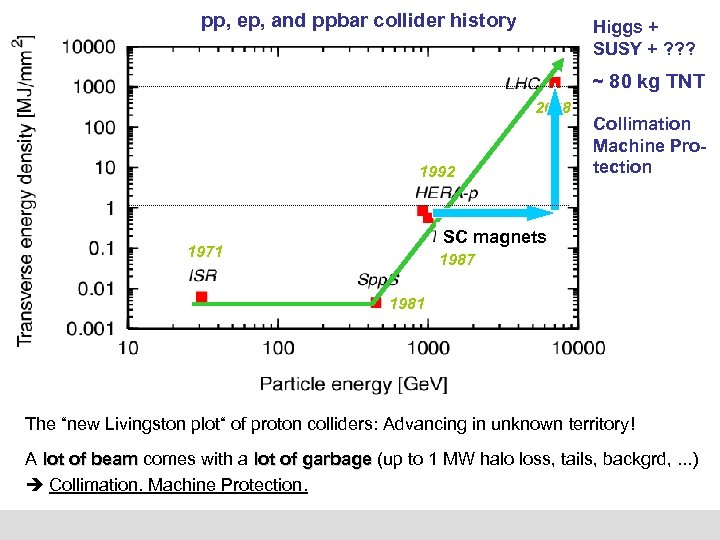
pp, ep, and ppbar collider history Higgs + SUSY + ? ? ? ~ 80 kg TNT 2008 1992 Collimation Machine Protection SC magnets 1971 1987 1981 The “new Livingston plot“ of proton colliders: Advancing in unknown territory! A lot of beam comes with a lot of garbage (up to 1 MW halo loss, tails, backgrd, . . . ) Collimation. Machine Protection.
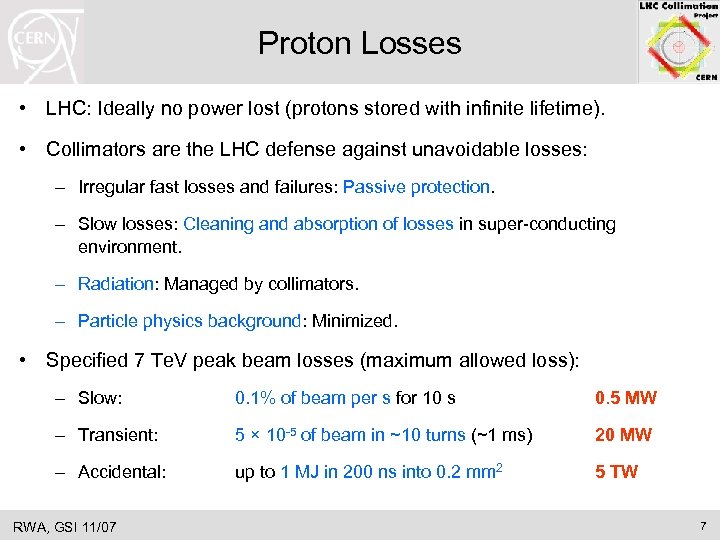
Proton Losses • LHC: Ideally no power lost (protons stored with infinite lifetime). • Collimators are the LHC defense against unavoidable losses: – Irregular fast losses and failures: Passive protection. – Slow losses: Cleaning and absorption of losses in super-conducting environment. – Radiation: Managed by collimators. – Particle physics background: Minimized. • Specified 7 Te. V peak beam losses (maximum allowed loss): – Slow: 0. 1% of beam per s for 10 s 0. 5 MW – Transient: 5 × 10 -5 of beam in ~10 turns (~1 ms) 20 MW – Accidental: up to 1 MJ in 200 ns into 0. 2 mm 2 5 TW RWA, GSI 11/07 7
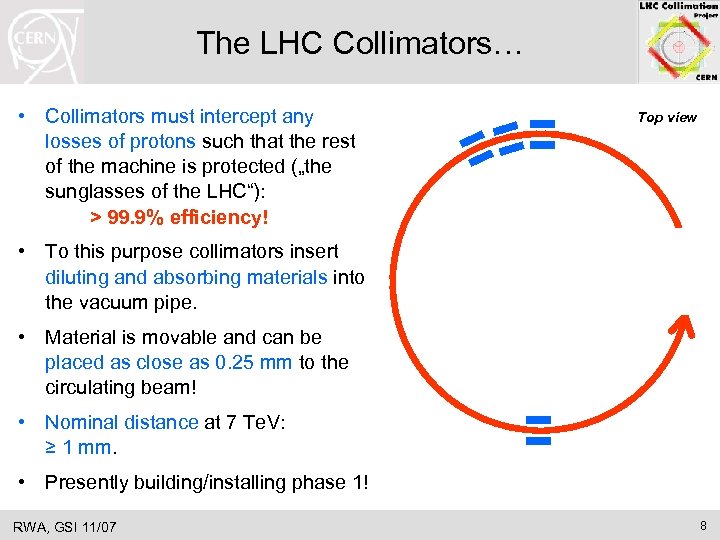
The LHC Collimators… • Collimators must intercept any losses of protons such that the rest of the machine is protected („the sunglasses of the LHC“): > 99. 9% efficiency! Top view • To this purpose collimators insert diluting and absorbing materials into the vacuum pipe. • Material is movable and can be placed as close as 0. 25 mm to the circulating beam! • Nominal distance at 7 Te. V: ≥ 1 mm. • Presently building/installing phase 1! RWA, GSI 11/07 8
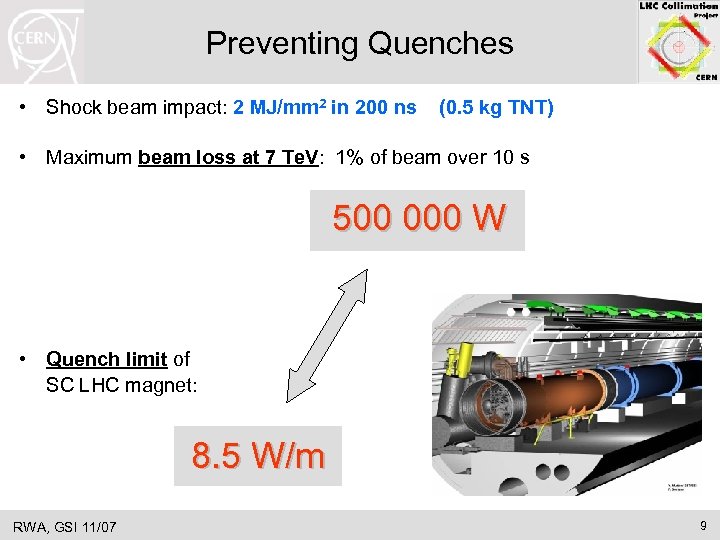
Preventing Quenches • Shock beam impact: 2 MJ/mm 2 in 200 ns (0. 5 kg TNT) • Maximum beam loss at 7 Te. V: 1% of beam over 10 s 500 000 W • Quench limit of SC LHC magnet: 8. 5 W/m RWA, GSI 11/07 9
Machine Protection • There a number of LHC failure scenarios which lead to beam loss. • No discussion of machine protection details here. However, comments on collimator role in machine protection. R. Schmidt is Project Leader for MP. • Slow failures: – First losses after >10 -50 turns appear at collimators as closest aperture restrictions. – Beam loss monitors detect abnormally high losses and dump the beam within 1 -2 turns. • Fast failures (dump and injection kicker related): – Sensitive equipment must be passively protected by collimators. • In all cases, the exposed collimators must survive the beam impact: up to 2 MJ in 200 ns (0. 5 kg TNT) RWA, GSI 11/07 10
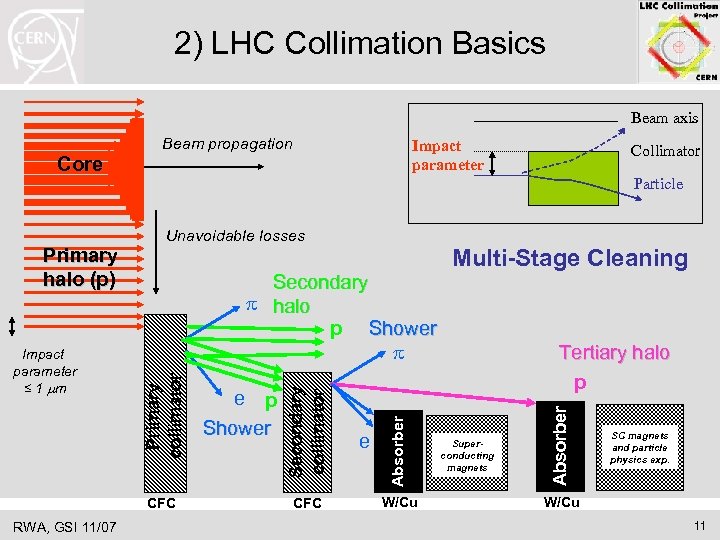
2) LHC Collimation Basics Beam axis Beam propagation Impact parameter Core CFC RWA, GSI 11/07 e p Shower CFC e Absorber Secondary p halo p Shower p W/Cu Multi-Stage Cleaning Tertiary halo p Superconducting magnets Absorber Unavoidable losses Secondary collimator Impact parameter ≤ 1 mm Particle Primary collimator Primary halo (p) Collimator SC magnets and particle physics exp. W/Cu 11
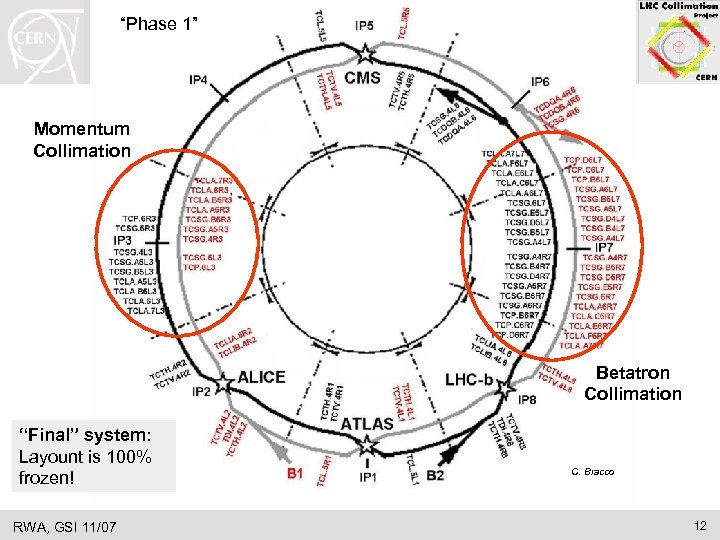
“Phase 1” System Design Momentum Collimation Betatron Collimation “Final” system: Layount is 100% frozen! RWA, GSI 11/07 C. Bracco 12
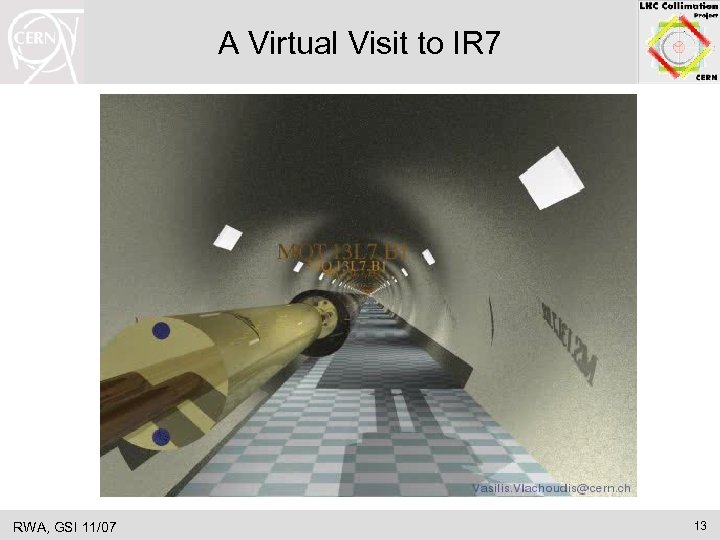
A Virtual Visit to IR 7 RWA, GSI 11/07 13
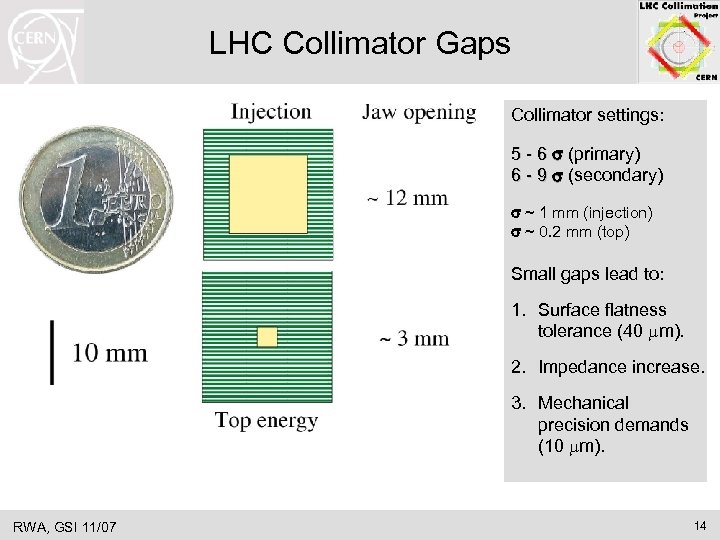
LHC Collimator Gaps Collimator settings: 5 - 6 s (primary) 6 - 9 s (secondary) s ~ 1 mm (injection) s ~ 0. 2 mm (top) Small gaps lead to: 1. Surface flatness tolerance (40 mm). 2. Impedance increase. 3. Mechanical precision demands (10 mm). RWA, GSI 11/07 14
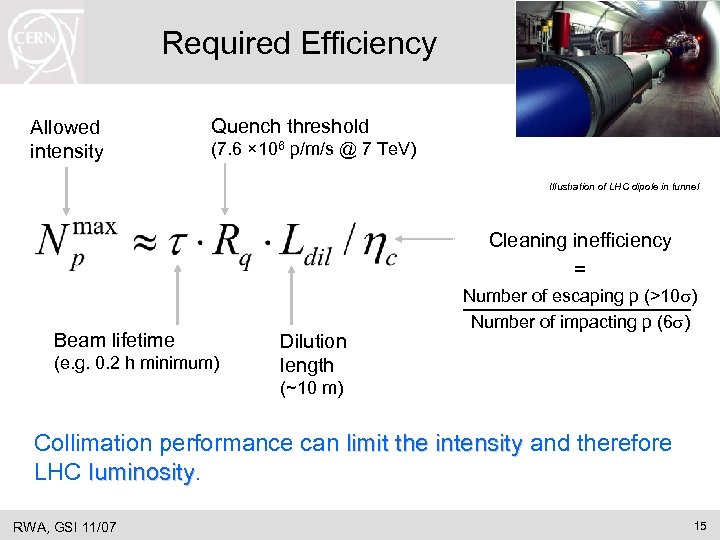
Required Efficiency Allowed intensity Quench threshold (7. 6 × 10⁶ p/m/s @ 7 Te. V) Illustration of LHC dipole in tunnel Cleaning inefficiency = Beam lifetime (e. g. 0. 2 h minimum) Dilution length Number of escaping p (>10 s) Number of impacting p (6 s) (~10 m) Collimation performance can limit the intensity and therefore LHC luminosity RWA, GSI 11/07 15
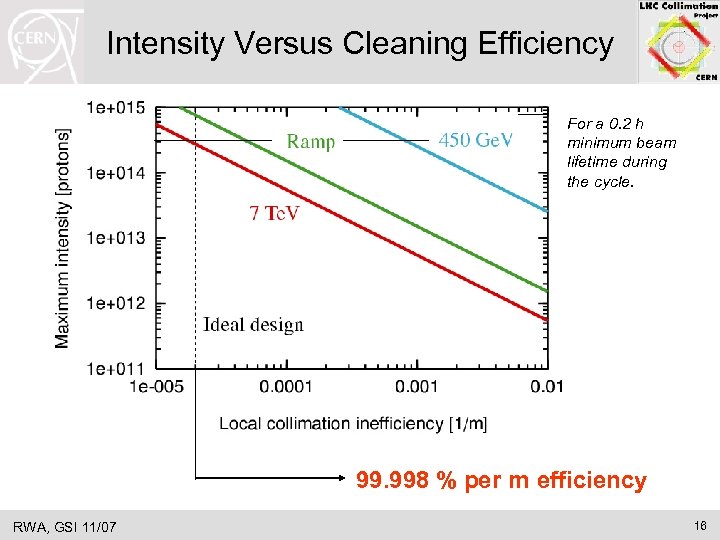
Intensity Versus Cleaning Efficiency For a 0. 2 h minimum beam lifetime during the cycle. 99. 998 % per m efficiency RWA, GSI 11/07 16
The LHC Phase 1 Collimation • Low Z materials closest to the beam: – Survival of materials with direct beam impact – Improved cleaning efficiency – High transparency: 95% of energy leaves jaw • Distributing losses over ~250 m long dedicated cleaning insertions: – Average load ≤ 2. 5 k. W per m for a 500 k. W loss. – No risk of quenches in normal-conducting magnets. – Hot spots protected by passive absorbers outside of vacuum. • Capturing residual energy flux by high Z absorbers: – Preventing losses into super-conducting region after collimator insertions. – Protecting expensive magnets against damage. • No shielding of collimators: – As a result radiation spread more equally in tunnel. – Lower peak doses. – Fast and remote handling possible for low weight collimators. RWA, GSI 11/07 17
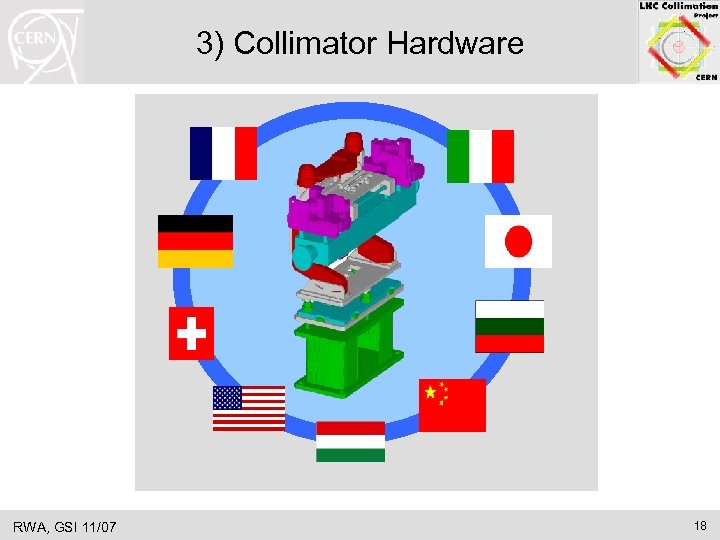
3) Collimator Hardware RWA, GSI 11/07 18
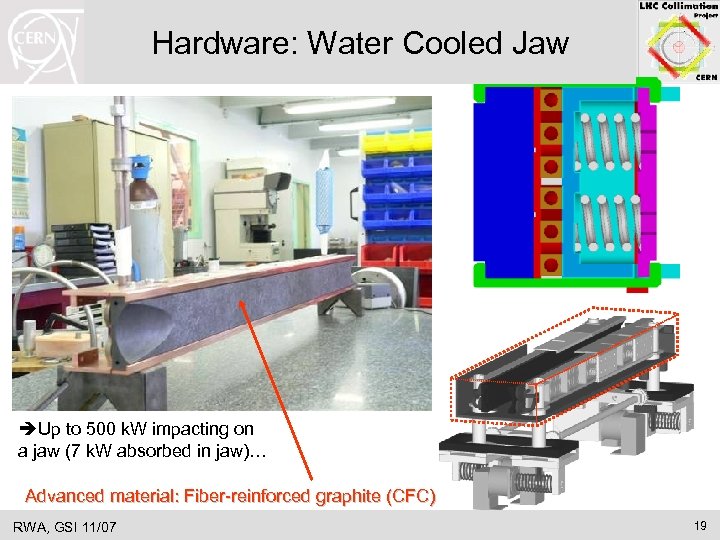
Hardware: Water Cooled Jaw Up to 500 k. W impacting on a jaw (7 k. W absorbed in jaw)… Advanced material: Fiber-reinforced graphite (CFC) RWA, GSI 11/07 19
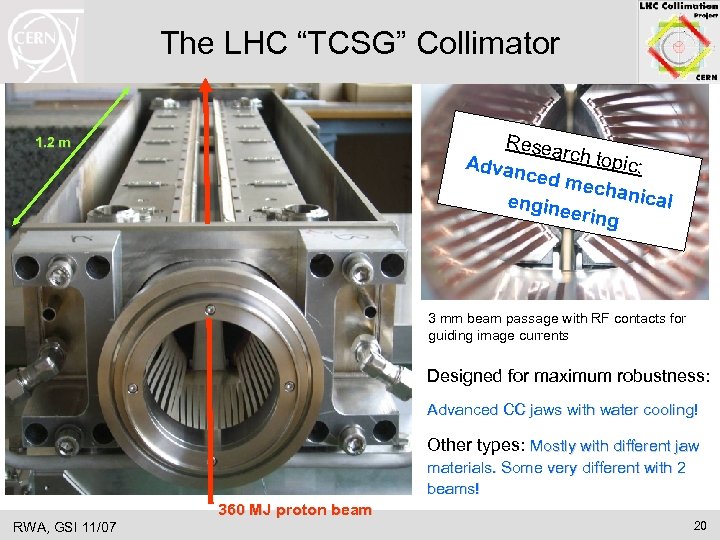
The LHC “TCSG” Collimator Resea rch top Advan ic: ced m echan ical engin eering 1. 2 m 3 mm beam passage with RF contacts for guiding image currents Designed for maximum robustness: Advanced CC jaws with water cooling! Other types: Mostly with different jaw materials. Some very different with 2 beams! 360 MJ proton beam RWA, GSI 11/07 20
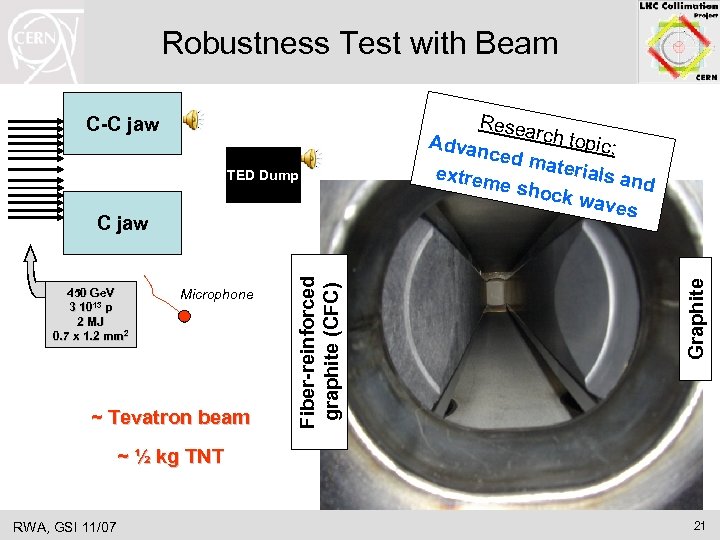
Robustness Test with Beam TED Dump 450 Ge. V 3 1013 p 2 MJ 0. 7 x 1. 2 mm 2 Microphone ~ Tevatron beam Fiber-reinforced graphite (CFC) C jaw Resea rch top Advan ic: ced m ateria extrem ls and e shoc k wav es Graphite C-C jaw ~ ½ kg TNT RWA, GSI 11/07 21
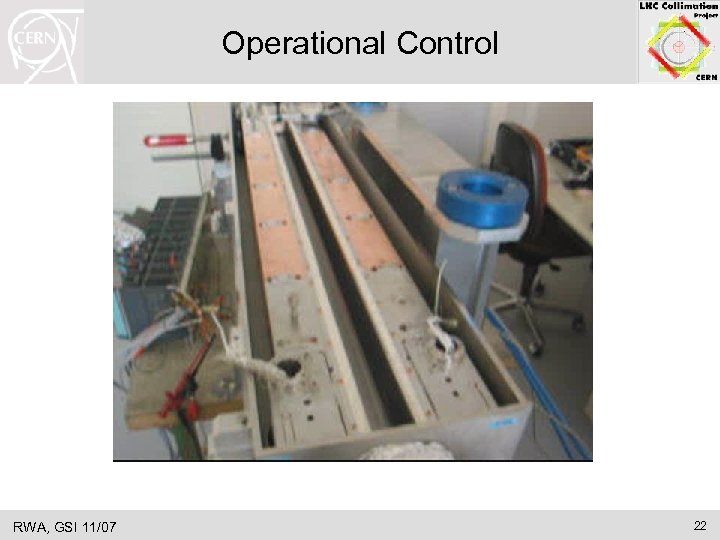
Operational Control RWA, GSI 11/07 22
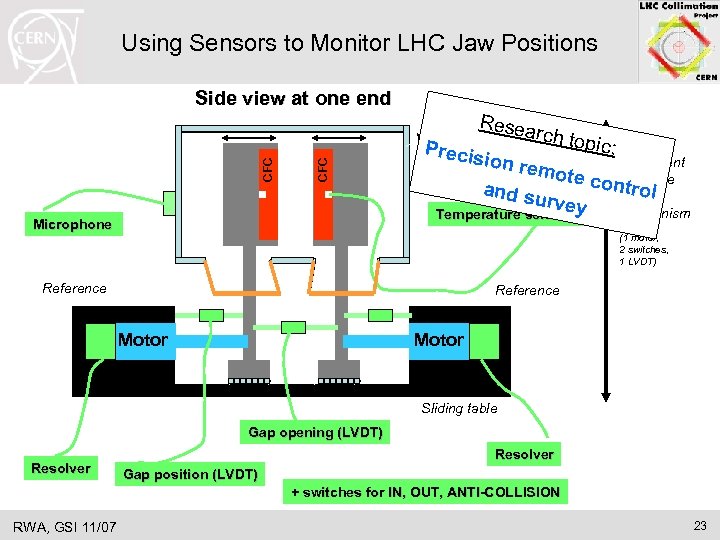
Using Sensors to Monitor LHC Jaw Positions Side view at one end Resea CFC Vacuum tank Microphone rch top ic: Precis ion re Movement mote for spare contro and su l surface rvey mechanism Temperature sensors (1 motor, 2 switches, 1 LVDT) Reference Motor Sliding table Gap opening (LVDT) Resolver Gap position (LVDT) + switches for IN, OUT, ANTI-COLLISION RWA, GSI 11/07 23
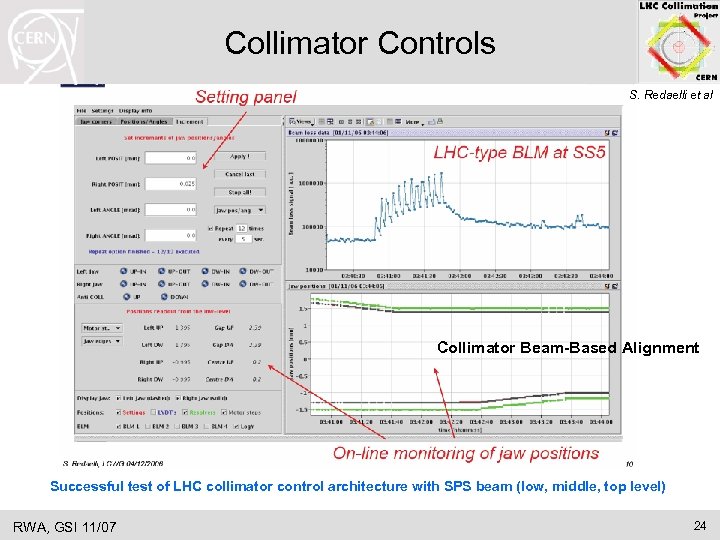
Collimator Controls S. Redaelli et al Collimator Beam-Based Alignment Successful test of LHC collimator control architecture with SPS beam (low, middle, top level) RWA, GSI 11/07 24
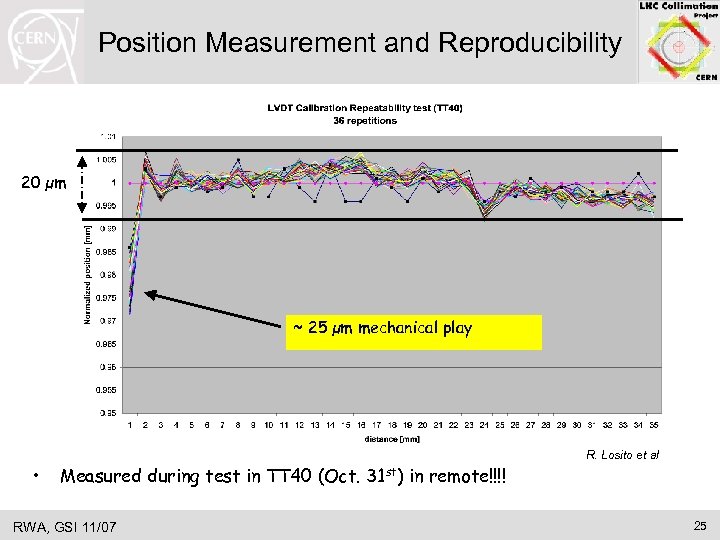
Position Measurement and Reproducibility 20 µm ~ 25 µm mechanical play • R. Losito et al Measured during test in TT 40 (Oct. 31 st) in remote!!!! RWA, GSI 11/07 25
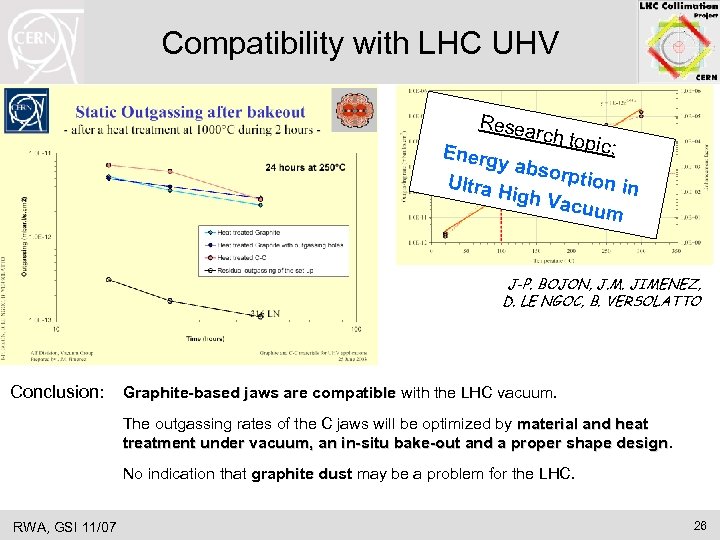
Compatibility with LHC UHV Resea Energ rch top ic: y abso rption Ultra H in igh Va cuum J-P. BOJON, J. M. JIMENEZ, D. LE NGOC, B. VERSOLATTO Conclusion: Graphite-based jaws are compatible with the LHC vacuum. The outgassing rates of the C jaws will be optimized by material and heat treatment under vacuum, an in-situ bake-out and a proper shape design No indication that graphite dust may be a problem for the LHC. RWA, GSI 11/07 26
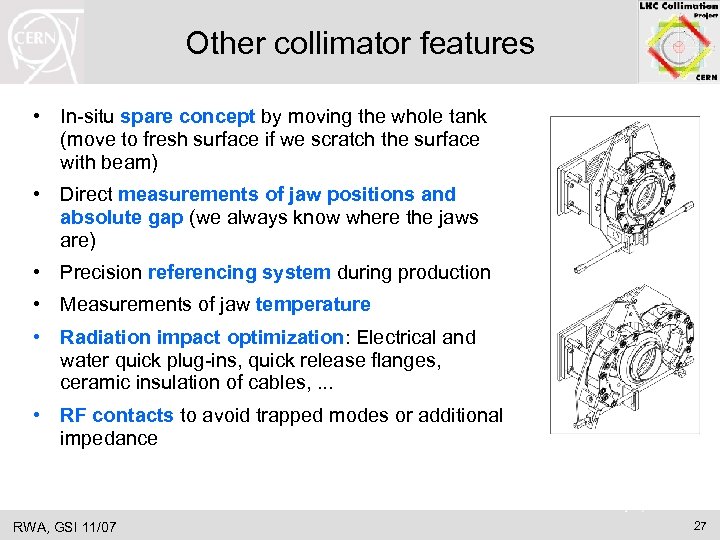
Other collimator features • In-situ spare concept by moving the whole tank (move to fresh surface if we scratch the surface with beam) • Direct measurements of jaw positions and absolute gap (we always know where the jaws are) • Precision referencing system during production • Measurements of jaw temperature • Radiation impact optimization: Electrical and water quick plug-ins, quick release flanges, ceramic insulation of cables, . . . • RF contacts to avoid trapped modes or additional impedance C. Rathjen, AT/VAC RWA, GSI 11/07 27
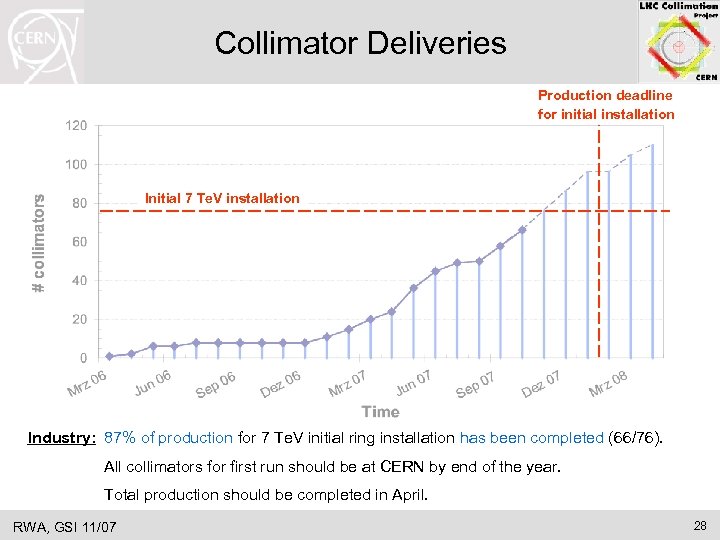
Collimator Deliveries Production deadline for initial installation Initial 7 Te. V installation Industry: 87% of production for 7 Te. V initial ring installation has been completed (66/76). All collimators for first run should be at CERN by end of the year. Total production should be completed in April. RWA, GSI 11/07 28
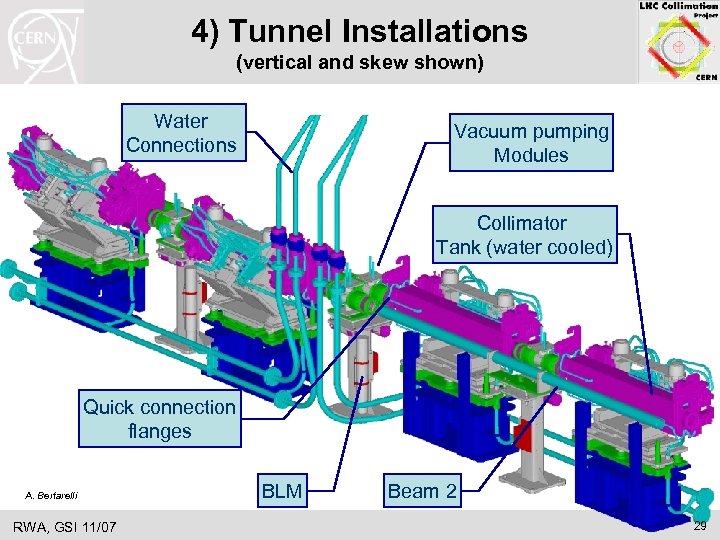
4) Tunnel Installations (vertical and skew shown) Water Connections Vacuum pumping Modules Collimator Tank (water cooled) Quick connection flanges A. Bertarelli RWA, GSI 11/07 BLM Beam 2 29
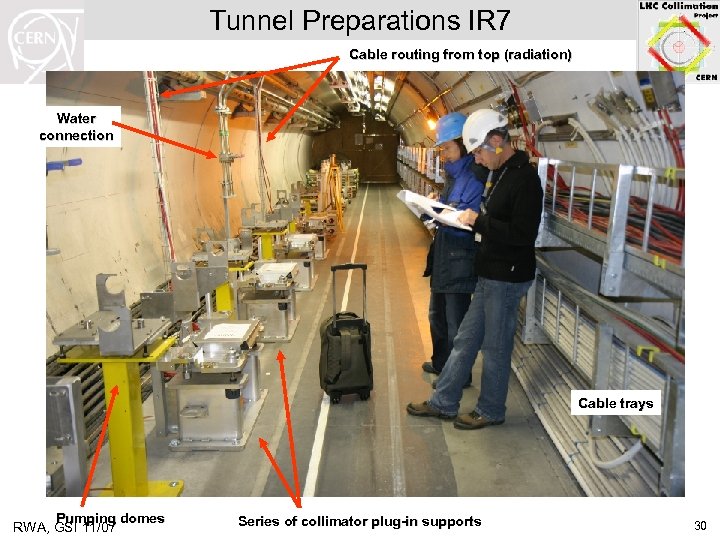
Tunnel Preparations IR 7 Cable routing from top (radiation) Water connection Cable trays Pumping domes RWA, GSI 11/07 Series of collimator plug-in supports 30
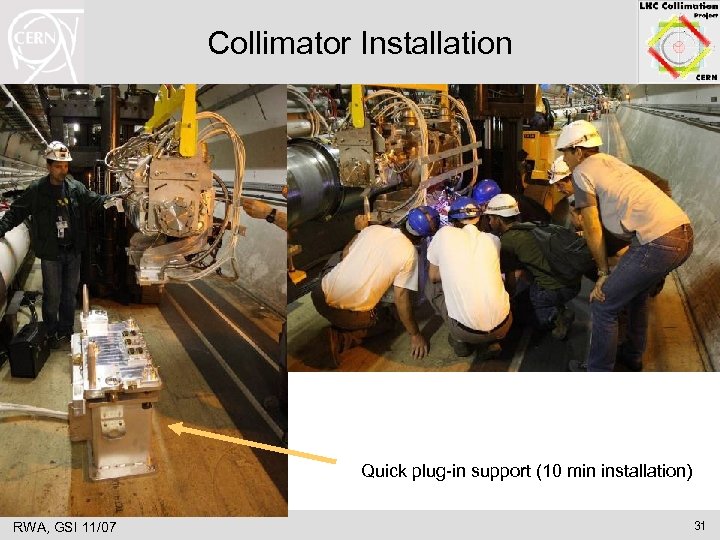
Collimator Installation Quick plug-in support (10 min installation) RWA, GSI 11/07 31
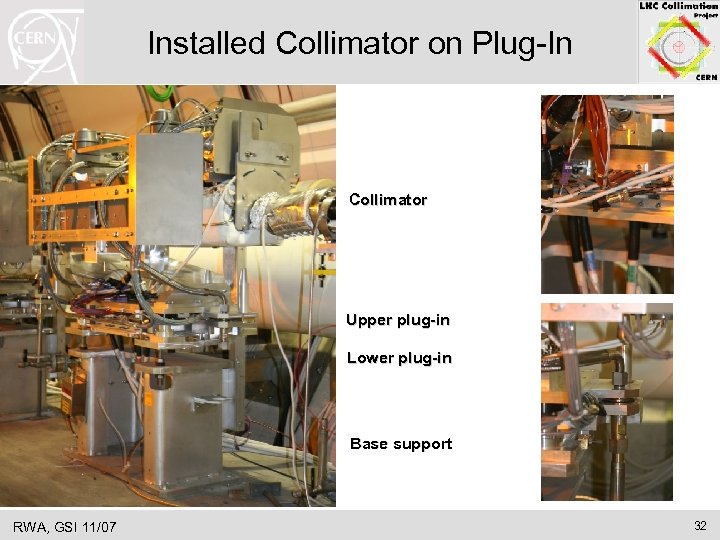
Installed Collimator on Plug-In Collimator Upper plug-in Lower plug-in Base support RWA, GSI 11/07 32
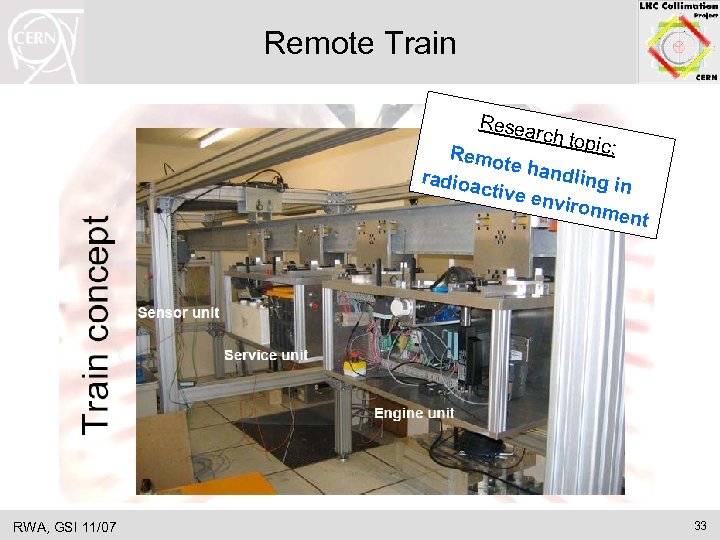
Remote Train Resea rch top ic: Remo te han dling radioa in ctive e nviron ment RWA, GSI 11/07 33
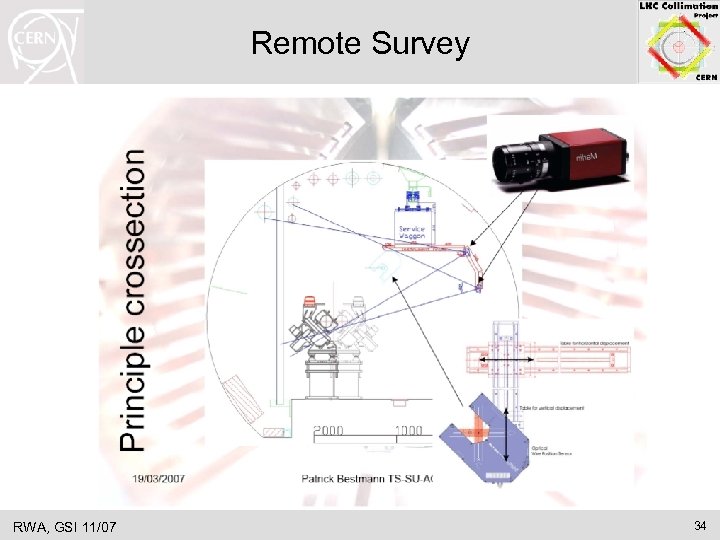
Remote Survey RWA, GSI 11/07 34
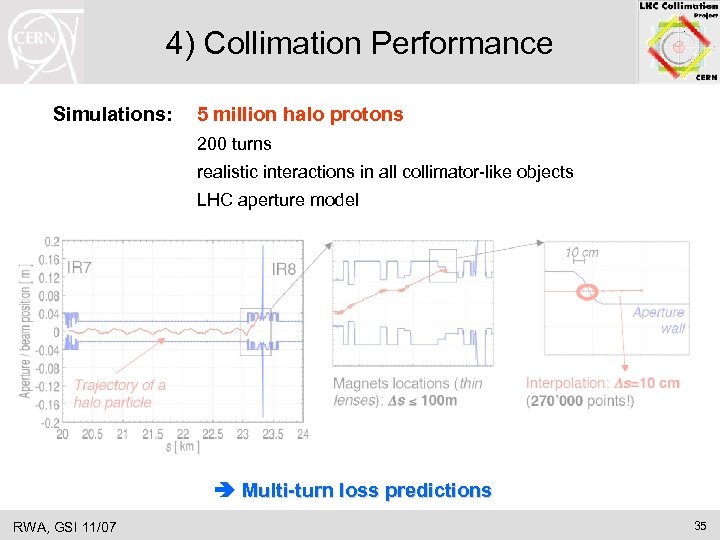
4) Collimation Performance Simulations: 5 million halo protons 200 turns realistic interactions in all collimator-like objects LHC aperture model Multi-turn loss predictions RWA, GSI 11/07 35
![Efficiency in Capturing Losses Local inefficiency [1/m] Resea Efficiency 99. 998 % per m](https://present5.com/presentation/a0faa587def7481773c92104eacfe6ca/image-36.jpg "Efficiency in Capturing Losses Local inefficiency [1/m] Resea Efficiency 99. 998 % per m")
Efficiency in Capturing Losses Local inefficiency [1/m] Resea Efficiency 99. 998 % per m TCDQ rch top 7 Te. V Beam 1, ic: Halo a Betatron cleaning nd co performance Ideal llimati on mode l. Quench limit ing (nominal I, t=0. 2 h) Beam 2, 7 Te. V Efficiency 99. 998 % per m TCDQ Betatron cleaning Ideal performance Quench limit (nominal I, t=0. 2 h) 99. 998 % needed Local inefficiency: #p lost in 1 m over total #p lost = leakage rate RWA, GSI 11/07 99. 995 % predicted 36
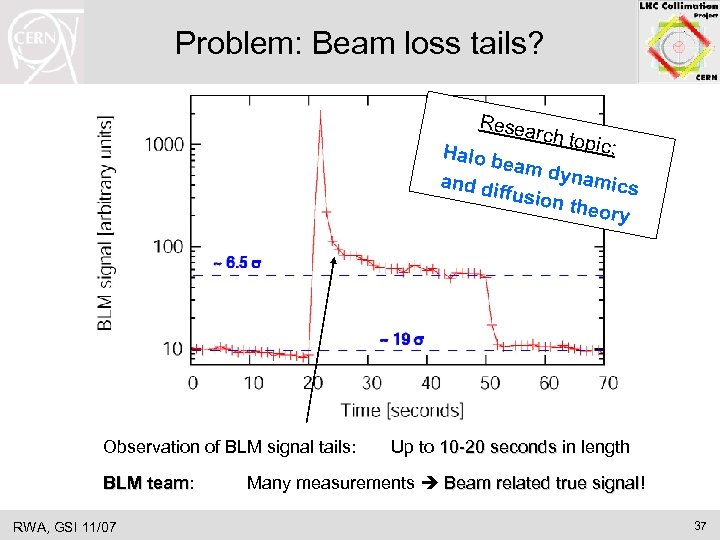
Problem: Beam loss tails? Resea rch top ic: Halo b eam d ynami and d cs iffusio n theo ry Observation of BLM signal tails: BLM team: team RWA, GSI 11/07 Up to 10 -20 seconds in length Many measurements Beam related true signal! signal 37
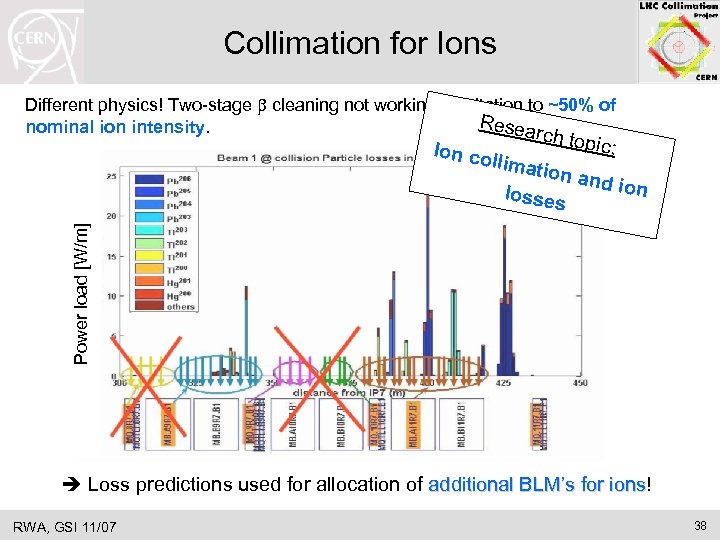
Collimation for Ions Different physics! Two-stage b cleaning not working! Limitation to ~50% of Resea nominal ion intensity. rc Ion co llimati h topic : G. Bellodi et al Power load [W/m] on an d ion losses Loss predictions used for allocation of additional BLM’s for ions! ions RWA, GSI 11/07 38
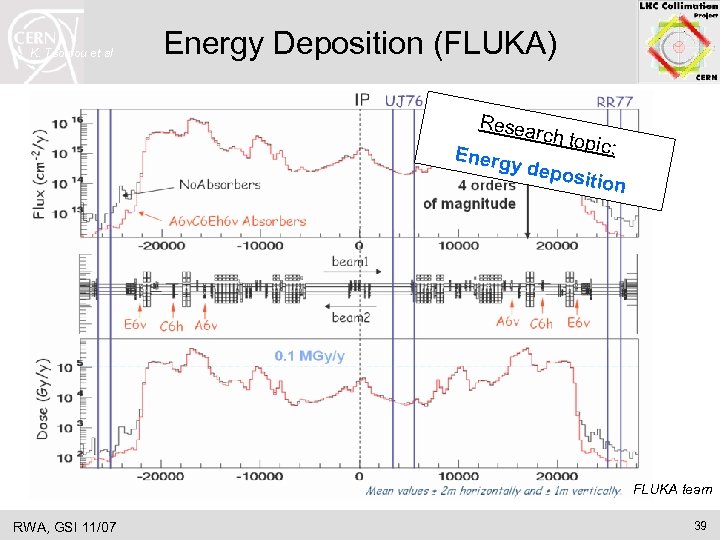
K. Tsoulou et al Energy Deposition (FLUKA) Resea rch top ic: Energ y depo sition FLUKA team RWA, GSI 11/07 39
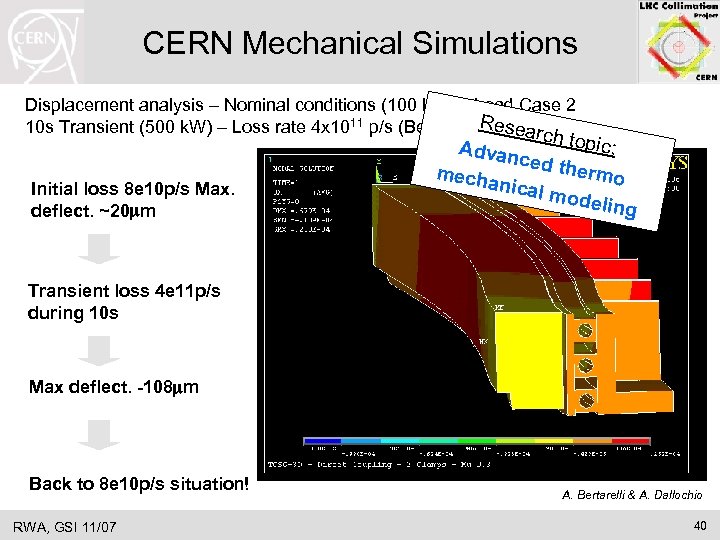
CERN Mechanical Simulations Displacement analysis – Nominal conditions (100 k. W) – Load Case 2 Resea 10 s Transient (500 k. W) – Loss rate 4 x 10¹¹ p/s (Beam Lifetime 12 min) rc Initial loss 8 e 10 p/s Max. deflect. ~20 mm h topic Advan : ced th ermo mecha nical m odelin g Transient loss 4 e 11 p/s during 10 s Max deflect. -108 mm Back to 8 e 10 p/s situation! RWA, GSI 11/07 A. Bertarelli & A. Dallochio 40
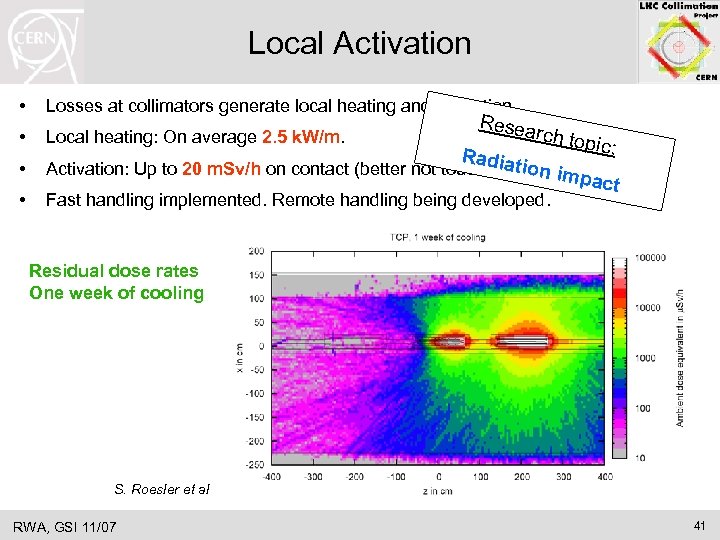
Local Activation • Losses at collimators generate local heating and activation. • Local heating: On average 2. 5 k. W/m. • Activation: Up to 20 m. Sv/h on contact (better not touch it). tion im pact Fast handling implemented. Remote handling being developed. • Resea Radia rch top ic: Residual dose rates One week of cooling S. Roesler et al RWA, GSI 11/07 41
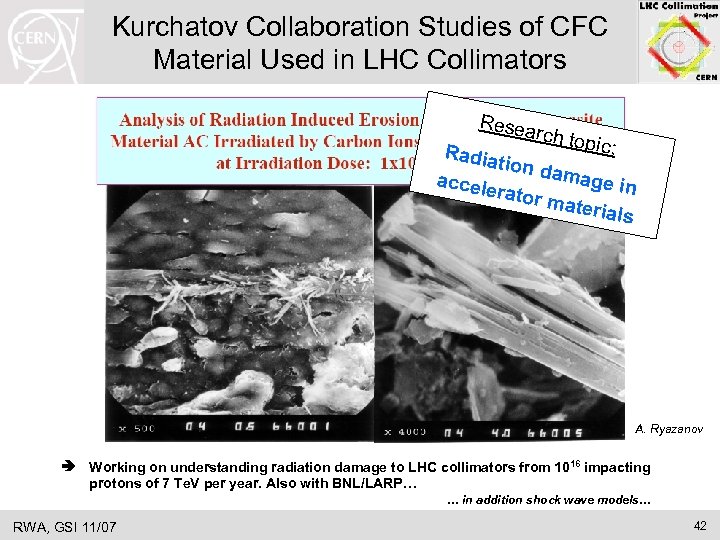
Kurchatov Collaboration Studies of CFC Material Used in LHC Collimators Resea rch top ic: Radia tion d amage accele in rator m ateria ls A. Ryazanov Working on understanding radiation damage to LHC collimators from 1016 impacting protons of 7 Te. V per year. Also with BNL/LARP… … in addition shock wave models… RWA, GSI 11/07 42
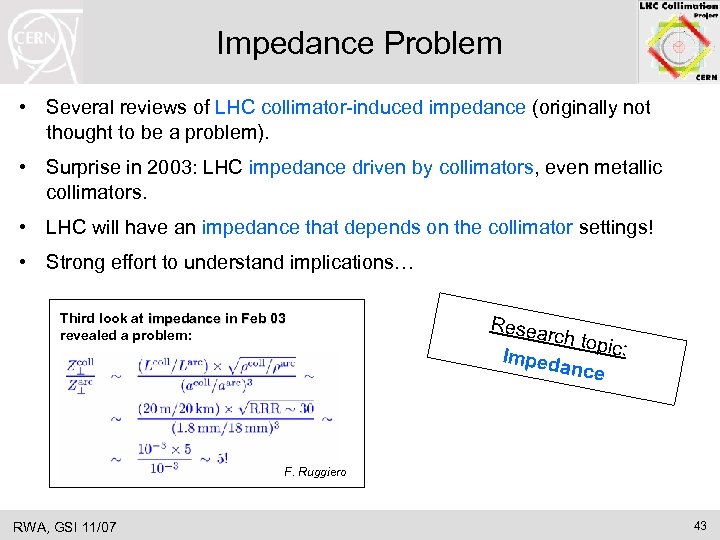
Impedance Problem • Several reviews of LHC collimator-induced impedance (originally not thought to be a problem). • Surprise in 2003: LHC impedance driven by collimators, even metallic collimators. • LHC will have an impedance that depends on the collimator settings! • Strong effort to understand implications… Third look at impedance in Feb 03 revealed a problem: Resea rch top ic: Imped ance F. Ruggiero RWA, GSI 11/07 43
![Transverse Impedance [MΩ/m] First Impedance Estimates 2003 Typical collimator half gap 104 103 102](https://present5.com/presentation/a0faa587def7481773c92104eacfe6ca/image-44.jpg "Transverse Impedance [MΩ/m] First Impedance Estimates 2003 Typical collimator half gap 104 103 102")
Transverse Impedance [MΩ/m] First Impedance Estimates 2003 Typical collimator half gap 104 103 102 LHC impedance without collimators 10 1 10 -1 0 2 4 6 Half Gap [mm] RWA, GSI 11/07 8 10 F. Ruggiero, L. Vos 44
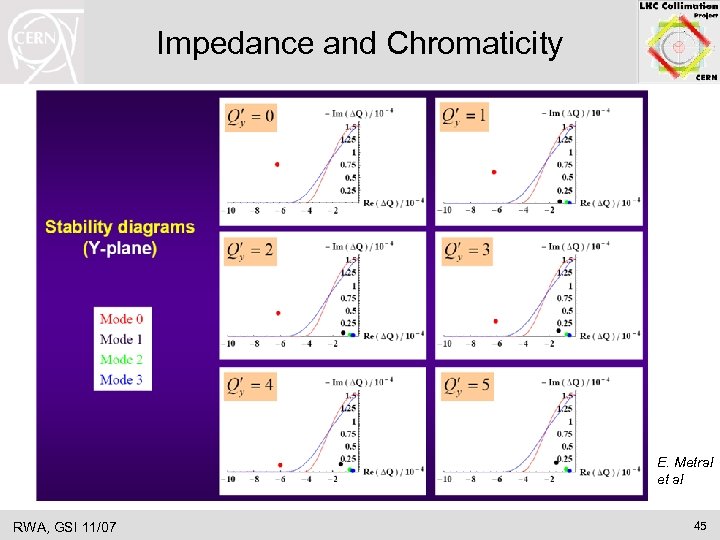
Impedance and Chromaticity E. Metral et al RWA, GSI 11/07 45
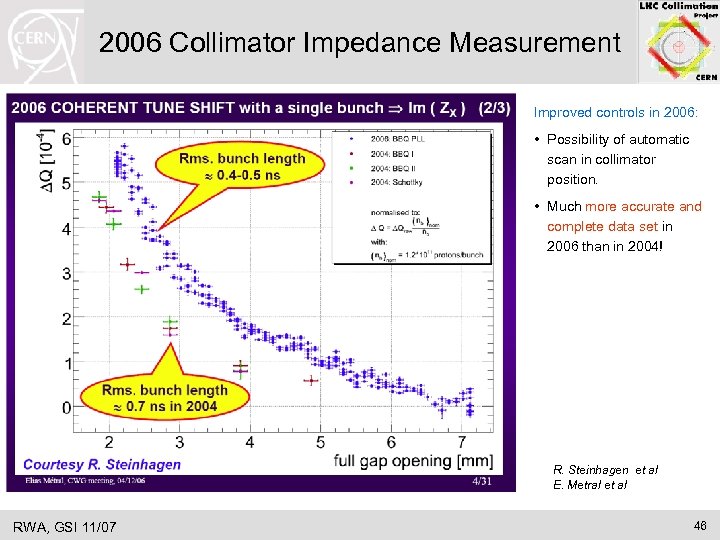
2006 Collimator Impedance Measurement Improved controls in 2006: • Possibility of automatic scan in collimator position. • Much more accurate and complete data set in 2006 than in 2004! R. Steinhagen et al E. Metral et al RWA, GSI 11/07 46
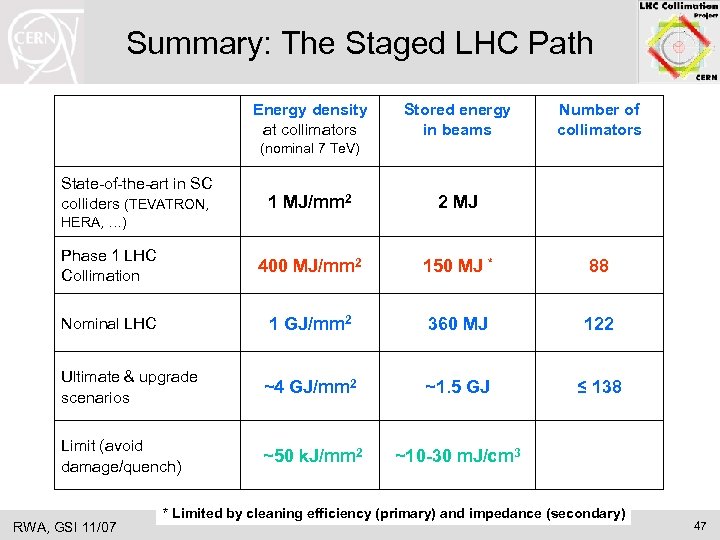
Summary: The Staged LHC Path Energy density at collimators Stored energy in beams Number of collimators (nominal 7 Te. V) State-of-the-art in SC colliders (TEVATRON, 1 MJ/mm 2 2 MJ Phase 1 LHC Collimation 400 MJ/mm 2 150 MJ * 88 Nominal LHC 1 GJ/mm 2 360 MJ 122 Ultimate & upgrade scenarios ~4 GJ/mm 2 ~1. 5 GJ ≤ 138 Limit (avoid damage/quench) ~50 k. J/mm 2 ~10 -30 m. J/cm 3 HERA, …) RWA, GSI 11/07 * Limited by cleaning efficiency (primary) and impedance (secondary) 47
5) Beyond Phase 1 • The LHC phase 1 system is the best system we could get within the available 4 -5 years. • Phase 1 is quite advanced and powerful already and should allow to go a factor 100 beyond HERA and TEVATRON. • Phase 2 R&D for advanced secondary collimators starts early to address expected collimation limitations of phase 1. • Phase 2 collimation project was approved and funded (CERN white paper). Starts Jan 2008. Should aim at complementary design compared to SLAC. • Collaborations within Europe through FP 7 and with US through LARP are crucial components in our plans and address several possible problems. • We also revisit other collimation solutions, like cryogenic collimators, crystals, magnetic collimators, non-linear schemes. RWA, GSI 11/07 48
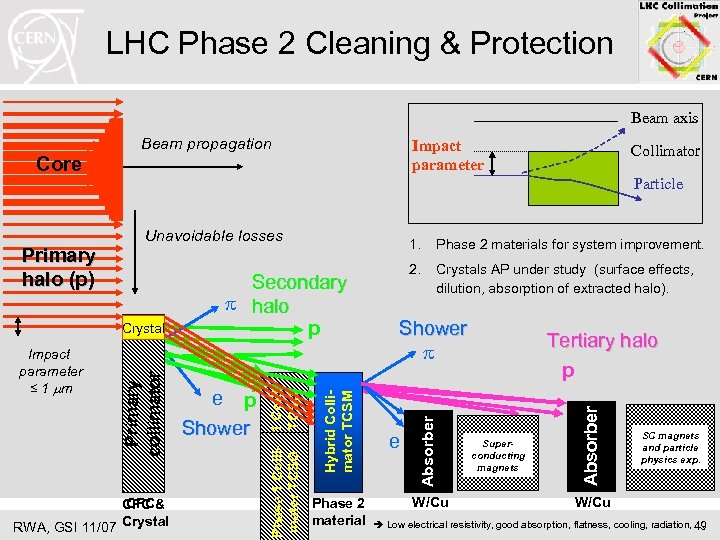
LHC Phase 2 Cleaning & Protection Beam axis Beam propagation Impact parameter Core Particle Unavoidable losses CFC & RWA, GSI 11/07 Crystal CFC Phase 2 material 2. Crystals AP under study (surface effects, dilution, absorption of extracted halo). Shower p e W/Cu Tertiary halo p Superconducting magnets Absorber p Shower Phase 2 materials for system improvement. Absorber e Hybrid Collimator TCSM Primary collimator Crystal Impact parameter ≤ 1 mm 1. Secondary p halo p Phase 1 Colli- 1 Collimator TCSG Primary halo (p) Collimator SC magnets and particle physics exp. W/Cu Low electrical resistivity, good absorption, flatness, cooling, radiation, 49 …
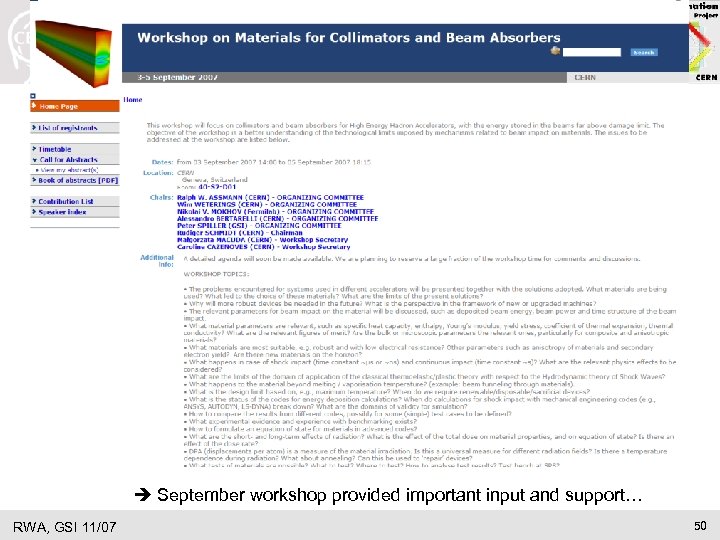
September workshop provided important input and support… RWA, GSI 11/07 50
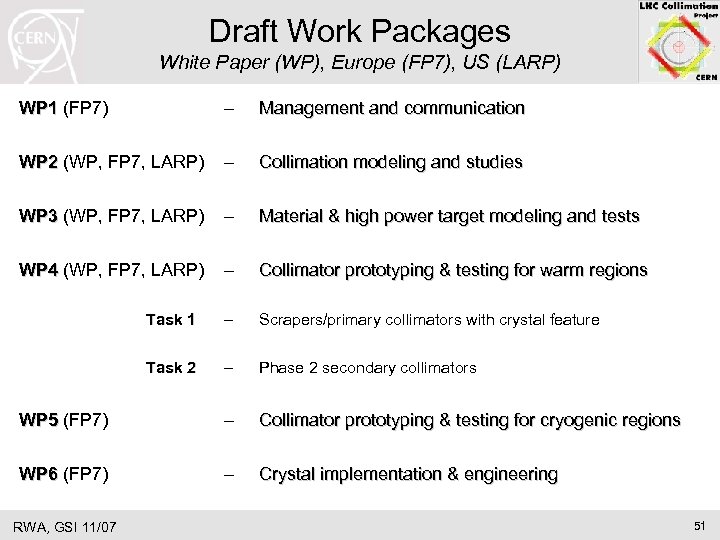
Draft Work Packages White Paper (WP), Europe (FP 7), US (LARP) WP 1 (FP 7) – Management and communication WP 2 (WP, FP 7, LARP) – Collimation modeling and studies WP 3 (WP, FP 7, LARP) – Material & high power target modeling and tests WP 4 (WP, FP 7, LARP) – Collimator prototyping & testing for warm regions Task 1 – Scrapers/primary collimators with crystal feature Task 2 – Phase 2 secondary collimators WP 5 (FP 7) – Collimator prototyping & testing for cryogenic regions WP 6 (FP 7) – Crystal implementation & engineering RWA, GSI 11/07 51
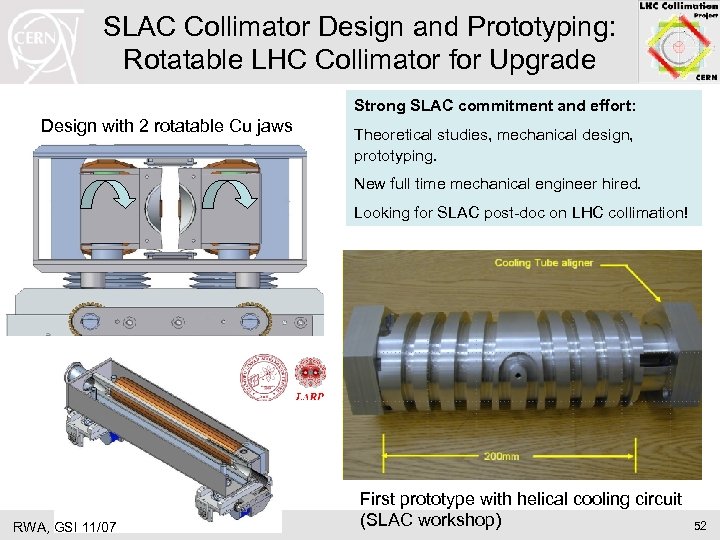
SLAC Collimator Design and Prototyping: Rotatable LHC Collimator for Upgrade Strong SLAC commitment and effort: Design with 2 rotatable Cu jaws Theoretical studies, mechanical design, prototyping. New full time mechanical engineer hired. Looking for SLAC post-doc on LHC collimation! RWA, GSI 11/07 First prototype with helical cooling circuit (SLAC workshop) 52
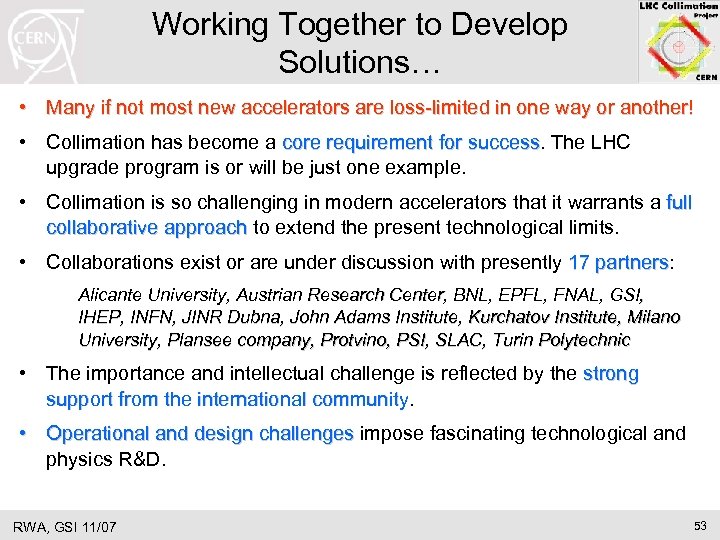
Working Together to Develop Solutions… • Many if not most new accelerators are loss-limited in one way or another! • Collimation has become a core requirement for success. The LHC success upgrade program is or will be just one example. • Collimation is so challenging in modern accelerators that it warrants a full collaborative approach to extend the present technological limits. • Collaborations exist or are under discussion with presently 17 partners: partners Alicante University, Austrian Research Center, BNL, EPFL, FNAL, GSI, IHEP, INFN, JINR Dubna, John Adams Institute, Kurchatov Institute, Milano University, Plansee company, Protvino, PSI, SLAC, Turin Polytechnic • The importance and intellectual challenge is reflected by the strong support from the international community • Operational and design challenges impose fascinating technological and physics R&D. RWA, GSI 11/07 53
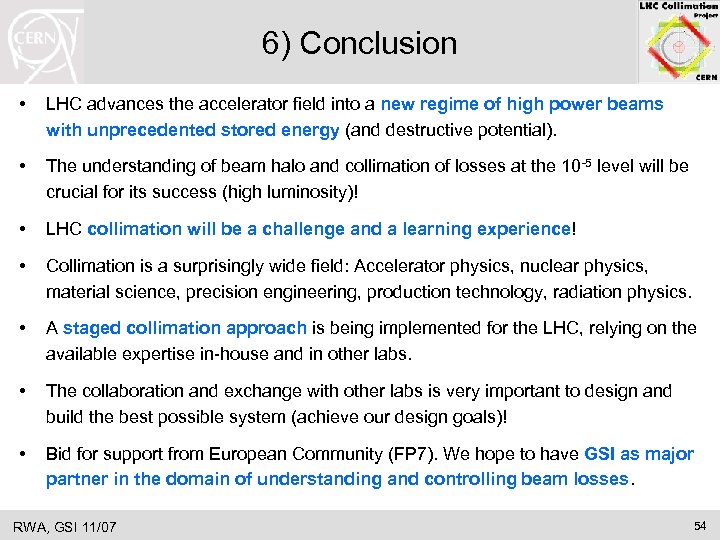
6) Conclusion • LHC advances the accelerator field into a new regime of high power beams with unprecedented stored energy (and destructive potential). • The understanding of beam halo and collimation of losses at the 10 -5 level will be crucial for its success (high luminosity)! • LHC collimation will be a challenge and a learning experience! • Collimation is a surprisingly wide field: Accelerator physics, nuclear physics, material science, precision engineering, production technology, radiation physics. • A staged collimation approach is being implemented for the LHC, relying on the available expertise in-house and in other labs. • The collaboration and exchange with other labs is very important to design and build the best possible system (achieve our design goals)! • Bid for support from European Community (FP 7). We hope to have GSI as major partner in the domain of understanding and controlling beam losses. RWA, GSI 11/07 54
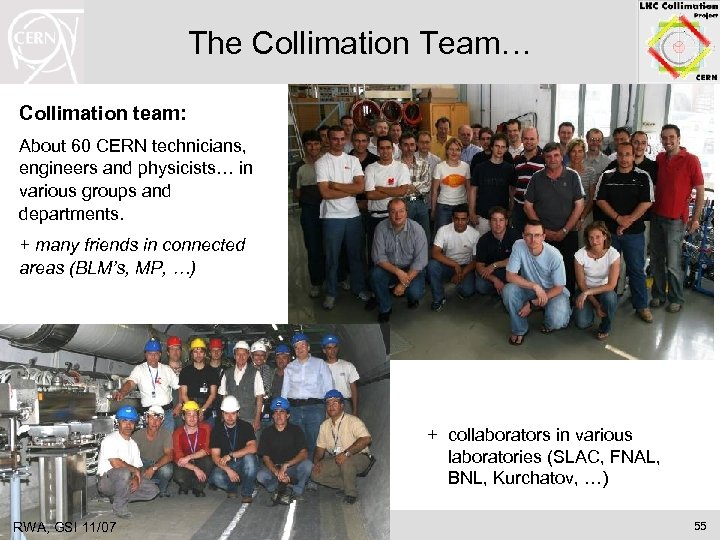
The Collimation Team… Collimation team: About 60 CERN technicians, engineers and physicists… in various groups and departments. + many friends in connected areas (BLM’s, MP, …) + collaborators in various laboratories (SLAC, FNAL, BNL, Kurchatov, …) RWA, GSI 11/07 55
Скачать презентацию Beam Loss and Collimation at the LHC R
a0faa587def7481773c92104eacfe6ca.ppt