 Скачать презентацию Beam Instrumentation for the HIE-ISOLDE linac Francesca Zocca
0ff6d2fe56cdc9b69385522de471f0ab.ppt
- Количество слайдов: 18



Beam Instrumentation for the HIE-ISOLDE linac Francesca Zocca Instituto de Estructura de la Materia – CSIC , Madrid CERN - BE/BI/PM on behalf of BE-BI group and HIE-ISOLDE collaboration ISOLDE Workshop and Users Meeting - 5 -7 December 2011 - CERN
Outline § Beam instrumentation overview for the HIEISOLDE super-conducting linac § Inter-tank diagnostic boxes for beam intensity, position and transverse profile measurements: design status § Silicon detector monitor for cavity phase-up and longitudinal profile measurements: test results of the first prototype § Conclusions & outlook
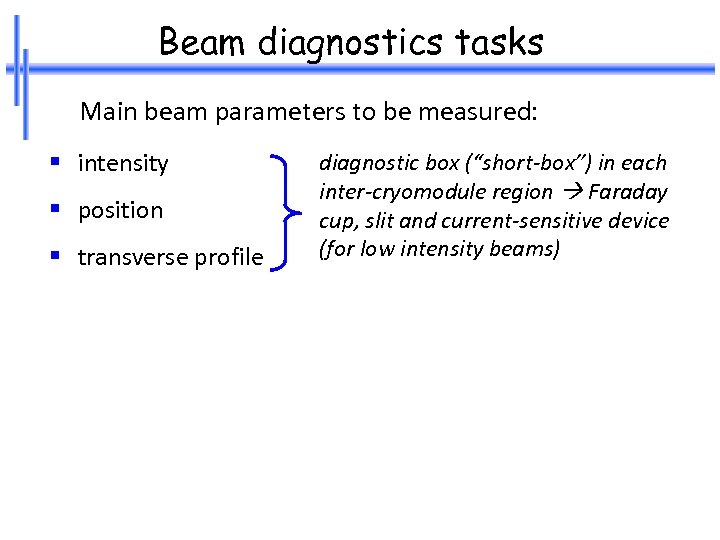
Beam diagnostics tasks Main beam parameters to be measured: § intensity § position § transverse profile diagnostic box (“short-box”) in each inter-cryomodule region Faraday cup, slit and current-sensitive device (for low intensity beams)
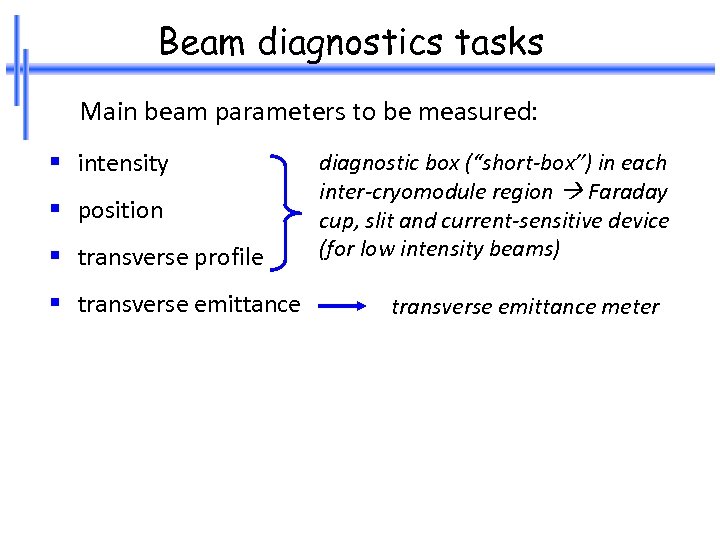
Beam diagnostics tasks Main beam parameters to be measured: § intensity § position § transverse profile § transverse emittance diagnostic box (“short-box”) in each inter-cryomodule region Faraday cup, slit and current-sensitive device (for low intensity beams) transverse emittance meter
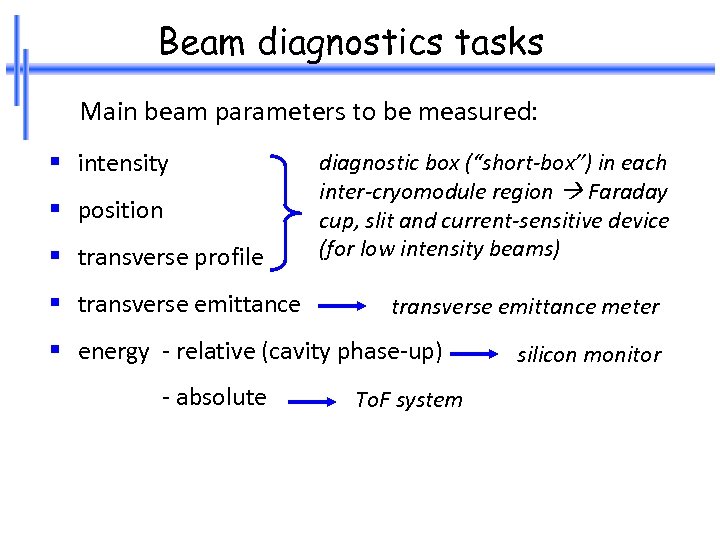
Beam diagnostics tasks Main beam parameters to be measured: § intensity § position § transverse profile § transverse emittance diagnostic box (“short-box”) in each inter-cryomodule region Faraday cup, slit and current-sensitive device (for low intensity beams) transverse emittance meter § energy - relative (cavity phase-up) - absolute To. F system silicon monitor
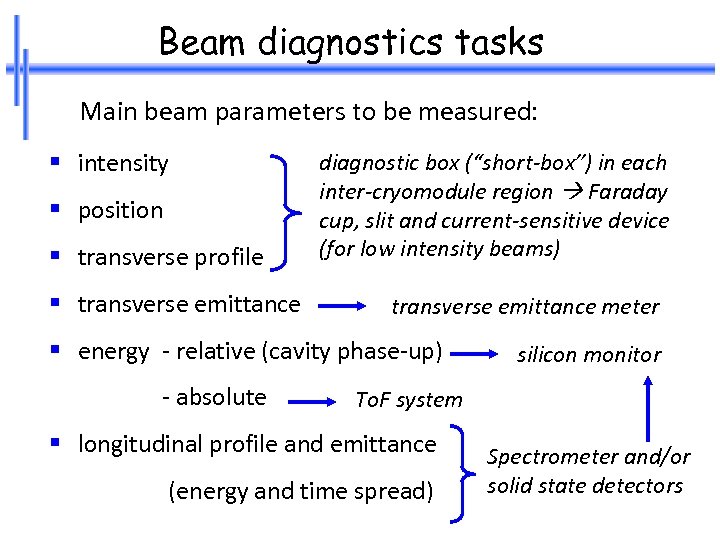
Beam diagnostics tasks Main beam parameters to be measured: § intensity § position § transverse profile § transverse emittance diagnostic box (“short-box”) in each inter-cryomodule region Faraday cup, slit and current-sensitive device (for low intensity beams) transverse emittance meter § energy - relative (cavity phase-up) - absolute silicon monitor To. F system § longitudinal profile and emittance (energy and time spread) Spectrometer and/or solid state detectors
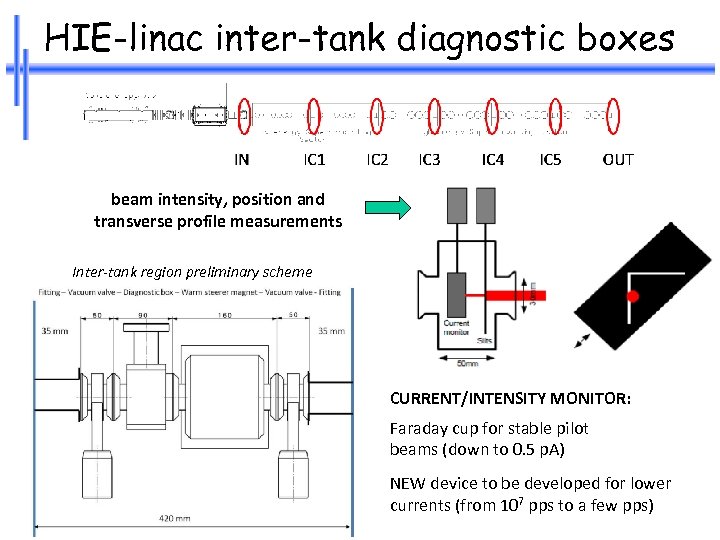
HIE-linac inter-tank diagnostic boxes beam intensity, position and transverse profile measurements Inter-tank region preliminary scheme CURRENT/INTENSITY MONITOR: Faraday cup for stable pilot beams (down to 0. 5 p. A) NEW device to be developed for lower currents (from 107 pps to a few pps)
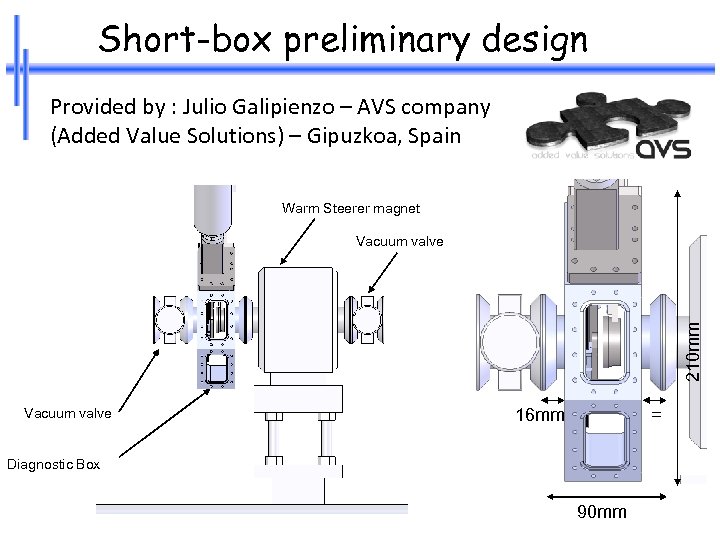
Short-box preliminary design Provided by : Julio Galipienzo – AVS company (Added Value Solutions) – Gipuzkoa, Spain Warm Steerer magnet 210 mm Vacuum valve 16 mm = Diagnostic Box 90 mm
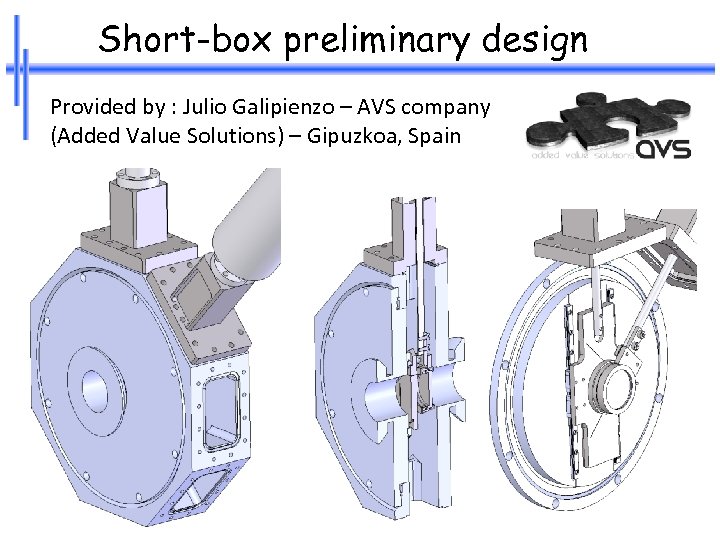
Short-box preliminary design Provided by : Julio Galipienzo – AVS company (Added Value Solutions) – Gipuzkoa, Spain
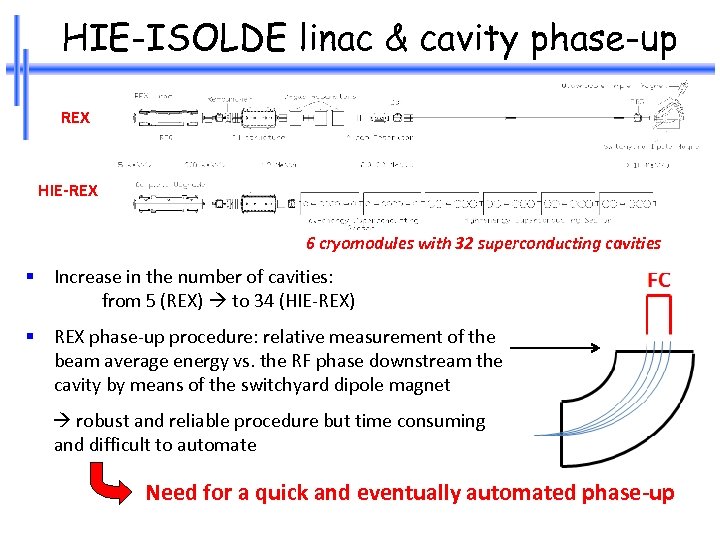
HIE-ISOLDE linac & cavity phase-up REX HIE-REX 6 cryomodules with 32 superconducting cavities § Increase in the number of cavities: from 5 (REX) to 34 (HIE-REX) § REX phase-up procedure: relative measurement of the beam average energy vs. the RF phase downstream the cavity by means of the switchyard dipole magnet robust and reliable procedure but time consuming and difficult to automate Need for a quick and eventually automated phase-up
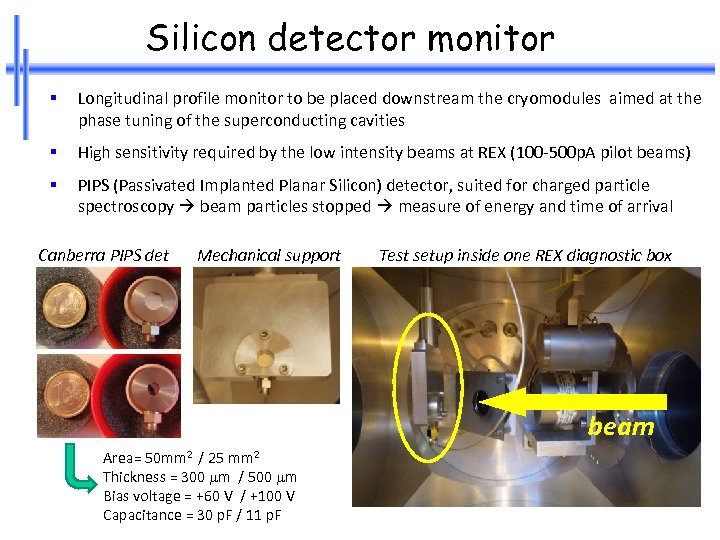
Silicon detector monitor § Longitudinal profile monitor to be placed downstream the cryomodules aimed at the phase tuning of the superconducting cavities § High sensitivity required by the low intensity beams at REX (100 -500 p. A pilot beams) § PIPS (Passivated Implanted Planar Silicon) detector, suited for charged particle spectroscopy beam particles stopped measure of energy and time of arrival Canberra PIPS det Mechanical support Test setup inside one REX diagnostic box beam Area= 50 mm 2 / 25 mm 2 Thickness = 300 mm / 500 mm Bias voltage = +60 V / +100 V Capacitance = 30 p. F / 11 p. F
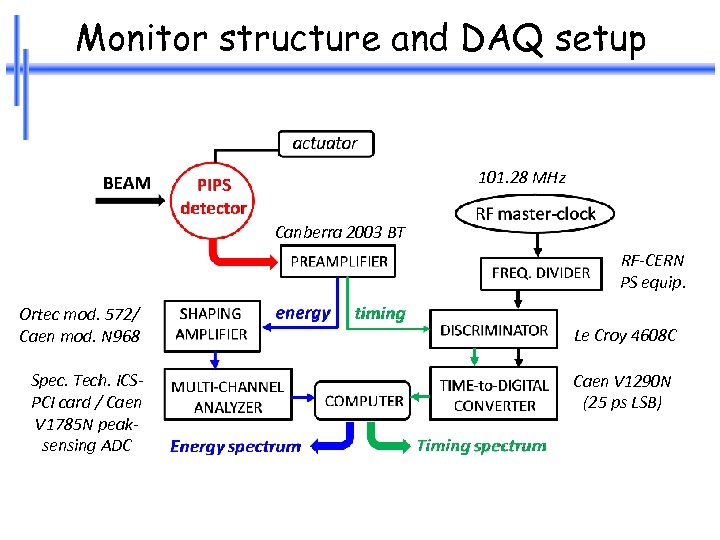
Monitor structure and DAQ setup 101. 28 MHz Canberra 2003 BT RF-CERN PS equip. Ortec mod. 572/ Caen mod. N 968 Spec. Tech. ICSPCI card / Caen V 1785 N peaksensing ADC Le Croy 4608 C Caen V 1290 N (25 ps LSB)
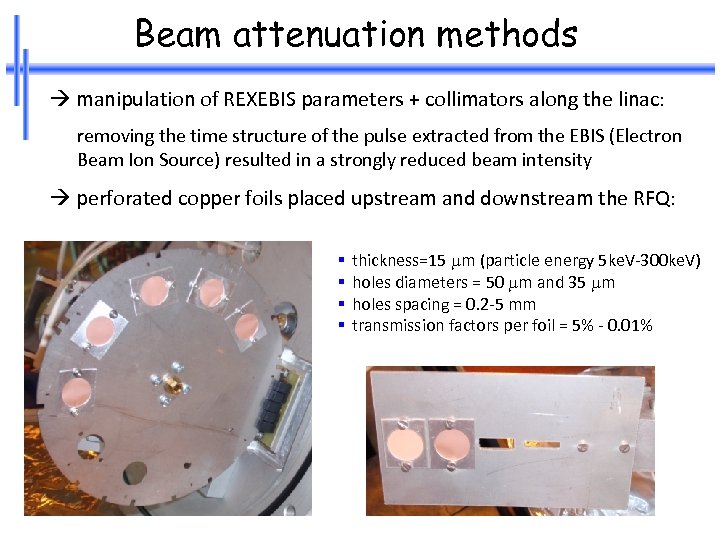
Beam attenuation methods manipulation of REXEBIS parameters + collimators along the linac: removing the time structure of the pulse extracted from the EBIS (Electron Beam Ion Source) resulted in a strongly reduced beam intensity perforated copper foils placed upstream and downstream the RFQ: § § thickness=15 mm (particle energy 5 ke. V-300 ke. V) holes diameters = 50 mm and 35 mm holes spacing = 0. 2 -5 mm transmission factors per foil = 5% - 0. 01%
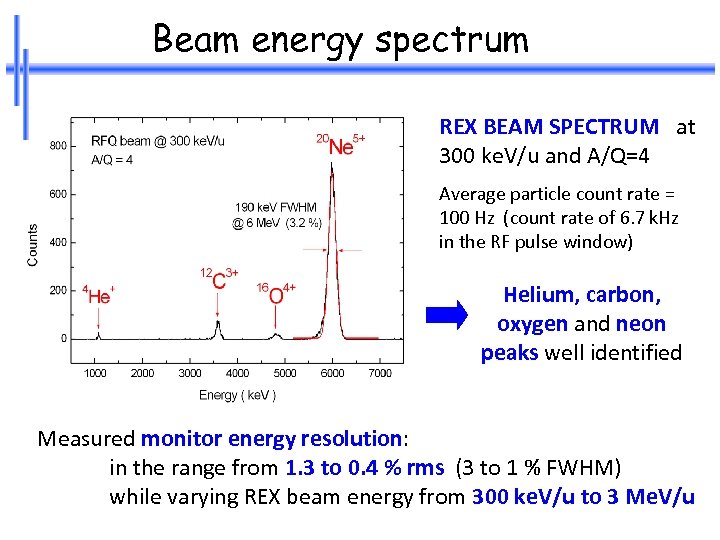
Beam energy spectrum REX BEAM SPECTRUM at 300 ke. V/u and A/Q=4 Average particle count rate = 100 Hz (count rate of 6. 7 k. Hz in the RF pulse window) Helium, carbon, oxygen and neon peaks well identified Measured monitor energy resolution: in the range from 1. 3 to 0. 4 % rms (3 to 1 % FWHM) while varying REX beam energy from 300 ke. V/u to 3 Me. V/u
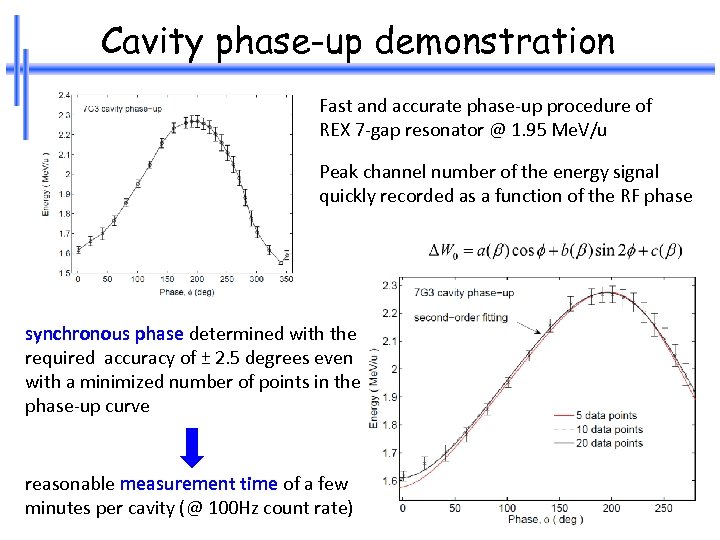
Cavity phase-up demonstration Fast and accurate phase-up procedure of REX 7 -gap resonator @ 1. 95 Me. V/u Peak channel number of the energy signal quickly recorded as a function of the RF phase synchronous phase determined with the required accuracy of ± 2. 5 degrees even with a minimized number of points in the phase-up curve reasonable measurement time of a few minutes per cavity (@ 100 Hz count rate)
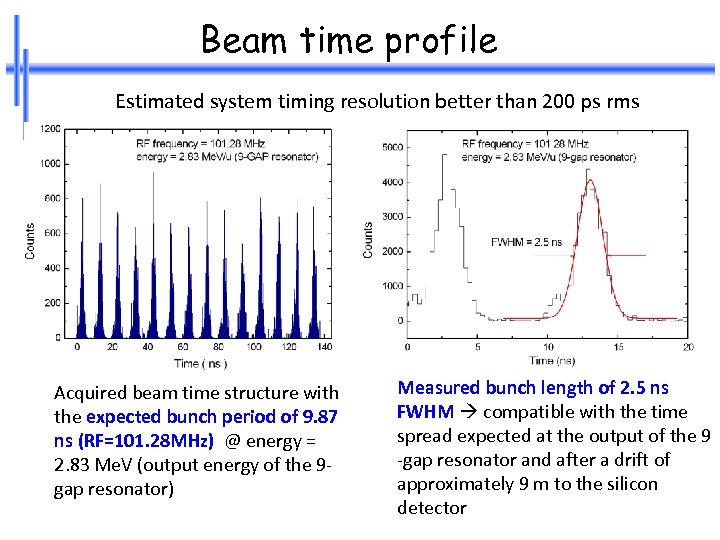
Beam time profile Estimated system timing resolution better than 200 ps rms Acquired beam time structure with the expected bunch period of 9. 87 ns (RF=101. 28 MHz) @ energy = 2. 83 Me. V (output energy of the 9 gap resonator) Measured bunch length of 2. 5 ns FWHM compatible with the time spread expected at the output of the 9 -gap resonator and after a drift of approximately 9 m to the silicon detector
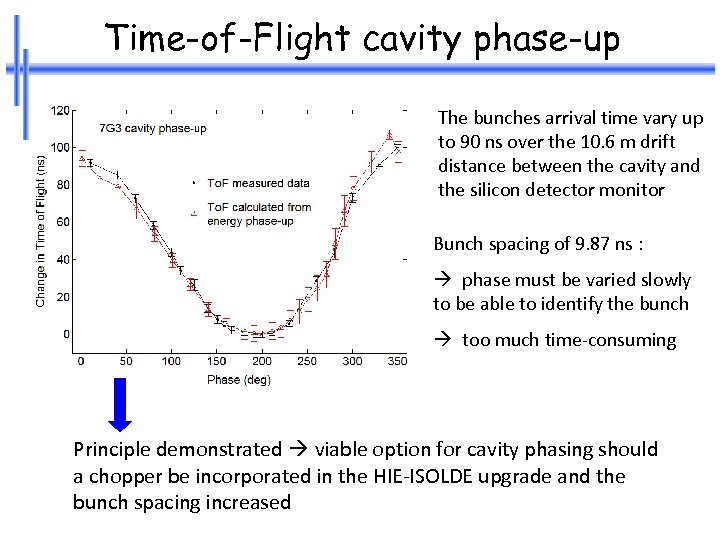
Time-of-Flight cavity phase-up The bunches arrival time vary up to 90 ns over the 10. 6 m drift distance between the cavity and the silicon detector monitor Bunch spacing of 9. 87 ns : phase must be varied slowly to be able to identify the bunch too much time-consuming Principle demonstrated viable option for cavity phasing should a chopper be incorporated in the HIE-ISOLDE upgrade and the bunch spacing increased
Conclusions & outlook § Almost complete design of the inter-tank short boxes aimed at intensity, position and transverse profile measurements § Successful test of a prototype Si-detector monitor for longitudinal profile measurements aimed at cavity phase-up Future developments: § Inter-tank short boxes: electronic read-out chain, test of a first prototype either at CERN or on other beam lines outside CERN § R&D of a detection system to measure the faint currents of radioactive beams, to be integrated in the short-boxes § Si detector: automated system control, optimization of the intensity attenuation factors to achieve the fastest possible phase-up § Emittance-meter design (slit + profiler based on short-box design)
Скачать презентацию Beam Instrumentation for the HIE-ISOLDE linac Francesca Zocca
0ff6d2fe56cdc9b69385522de471f0ab.ppt