 Скачать презентацию BE FOUND BE ENGAGED BE SUCCESSFUL Cure
78e97f00f46cb9643a788697c3b6e942.ppt
- Количество слайдов: 80



BE FOUND BE ENGAGED BE SUCCESSFUL
Cure the Chaos: How to Coordinate Your Company’s Social Media Efforts September 29, 2010 Marc Engelsman Vice President, Client Programs & Services Digital Brand Expressions Michelle Brusyo Group Manager, Marketing & Communication Digital Brand Expressions
What We Bring to the Table • DBE helps companies be found on the Web faster and better positioned than their competitors • Solutions typically include integrating: – SEO – Paid Search – Social Media • …into the rest of the marketing mix
What We’re Talking About Today • An action plan for pulling together social media initiatives across the organization • A checklist of items companies should include in their social media policies
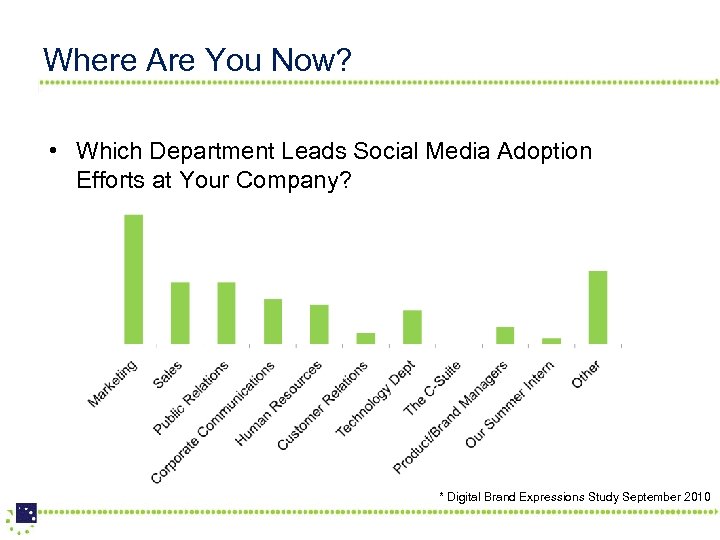
Where Are You Now? • Which Department Leads Social Media Adoption Efforts at Your Company? * Digital Brand Expressions Study September 2010
Integrating Social Into the Marketing Mix • Today we’ll refer to the framework DBE has developed to guide entire organizations into the social media channel • Use it to start or reset your social media communications • The process forces you and your colleagues to ask and answer the tough questions before communicating with stakeholders on behalf of your brand
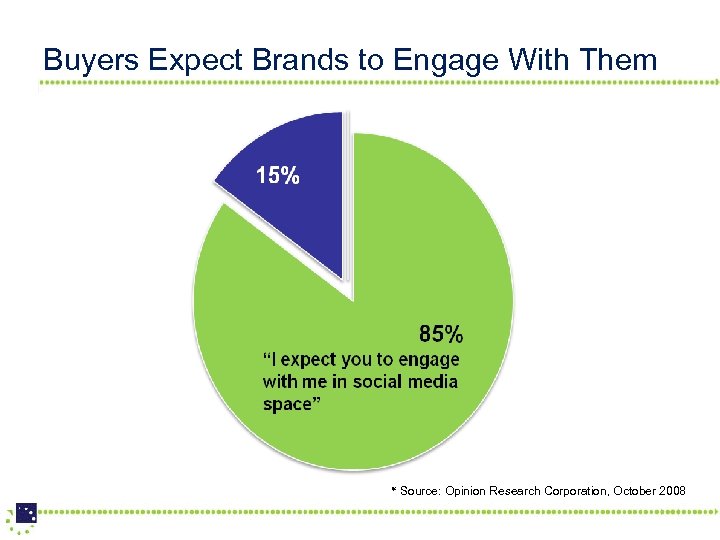
Buyers Expect Brands to Engage With Them * Source: Opinion Research Corporation, October 2008
Accept Reality • It’s 1998 all over again. – Remember how 1995’s “what is a website for? ” – …Became “what are the risks of a website? ” and “what are the benefits of a website? And “what can we do with a website? ” and “what are our competitors doing with their websites? ” • Social Media is here to stay and is evolving rapidly • But don’t jump in without a parachute
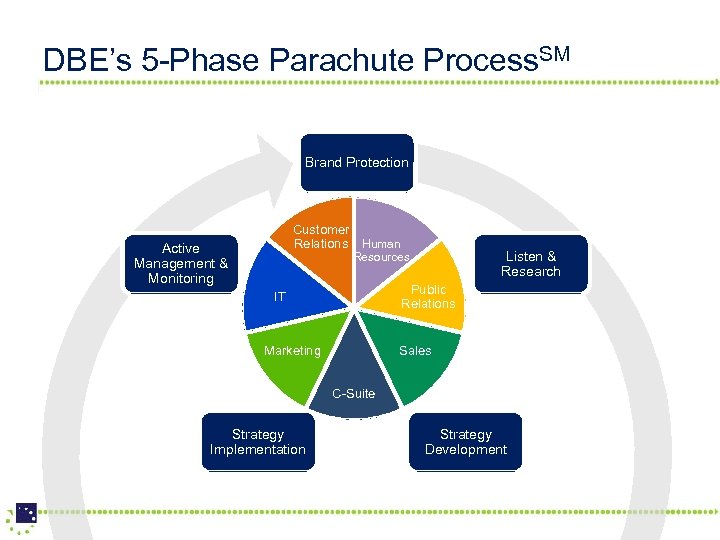
DBE’s 5 -Phase Parachute Process. SM Brand Protection Customer Relations Human Active Management & Monitoring Listen & Research Resources Public Relations IT Marketing Sales C-Suite Strategy Implementation Strategy Development
DBE’s 5 -Phase Parachute Process • A well-planned, strategic approach to social media adoption will ensure: – Brand protection – Sustainability – Measurability – Ongoing ROI
Before You Begin: What’s Your Mission? • What objectives do you want to achieve? – – – Increased sales Better quality job applicants Improved customer relationships Streamlined media relations Higher awareness with industry analysts – Some of the above – All of the above and more
Realistic Expectations For Social Media • Sales shouldn’t be the short-term goal – Repeatedly, people say they DON’T want to be marketed TO – Use this channel to influence rather than drive sales • Consumers and B 2 B decision-makers do want: – Knowledgeable resources – Responsive partners – Companies that listen
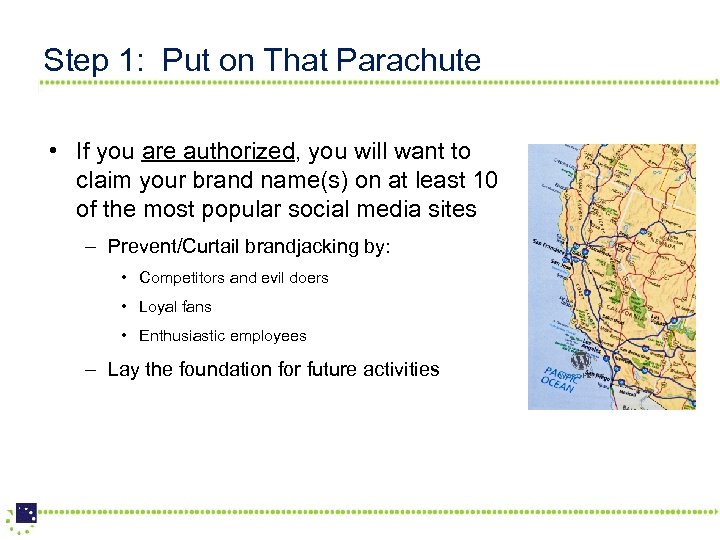
Step 1: Put on That Parachute • If you are authorized, you will want to claim your brand name(s) on at least 10 of the most popular social media sites – Prevent/Curtail brandjacking by: • Competitors and evil doers • Loyal fans • Enthusiastic employees – Lay the foundation for future activities
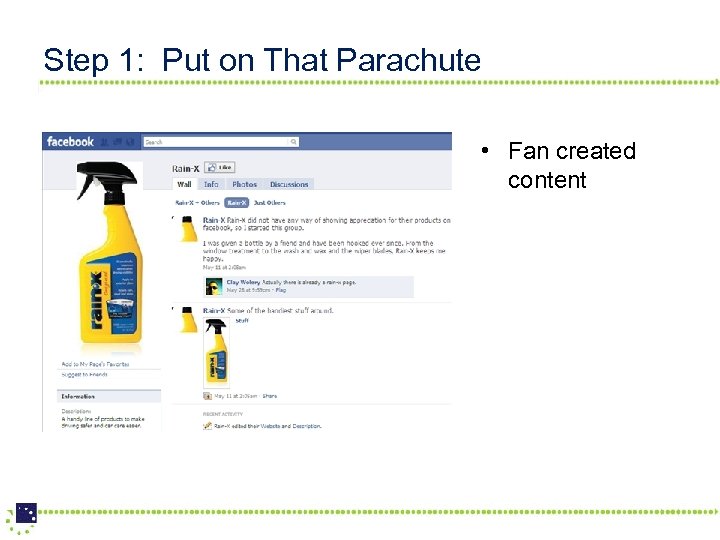
Step 1: Put on That Parachute • Fan created content
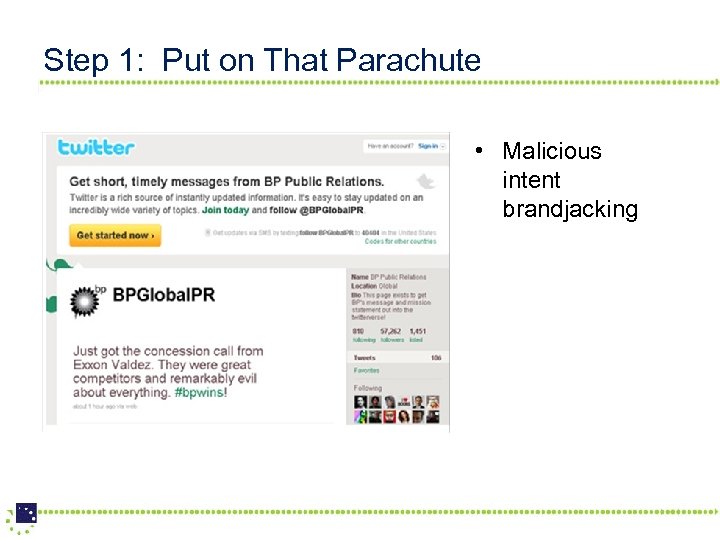
Step 1: Put on That Parachute • Fan created content • Malicious intent brandjacking
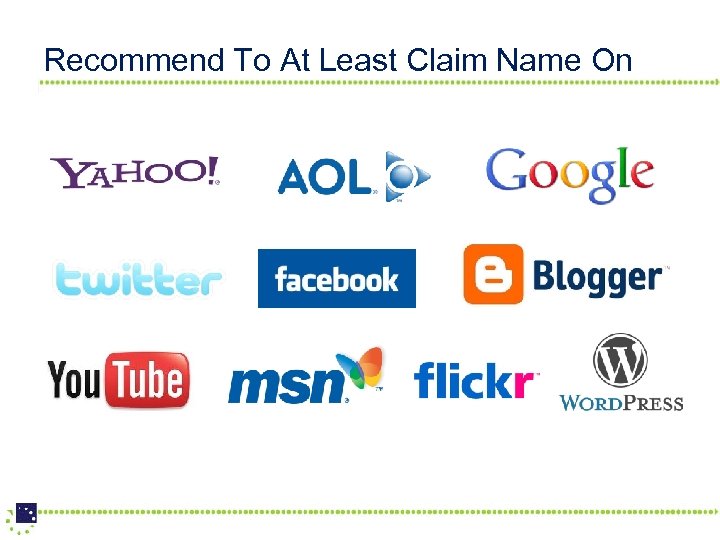
Recommend To At Least Claim Name On
TIP… • Remember there are industry specific sites you will want to name claim on as well. E. g. , : – – Real Estate--Active. Rain Physicians—SERMO Lawyers—Law. Link. com Hospitality/Travel—Its. Hospitality. com
Step 1: Put on That Parachute • Establish protocols for claiming names: – Who is authorized to claim branded names and accounts? – What is the procedure for obtaining corporate approval? – Who maintains records of accounts and names claimed? – What names will be claimed up front? • Variations on name – Character limitations – “Official”
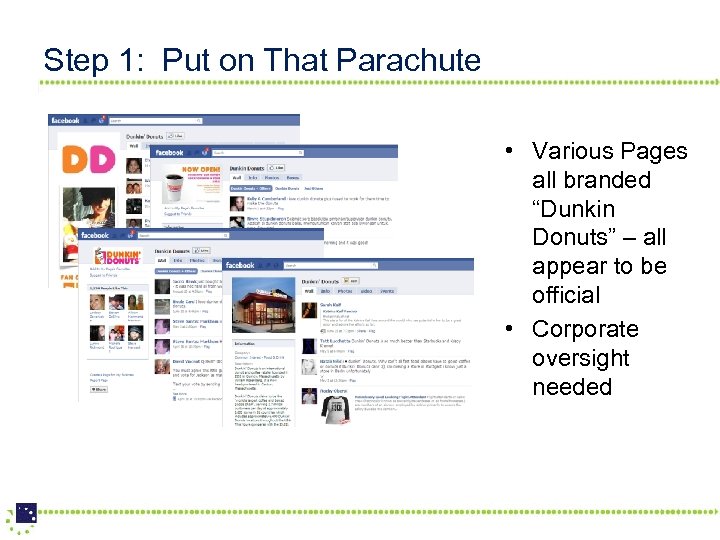
Step 1: Put on That Parachute • Various Pages all branded “Dunkin Donuts” – all appear to be official • Corporate oversight needed
Step 1: Put on That Parachute • Establish protocols for claiming names: – Keep registration information consistent, document it all • Decisions about avatars/compiled personas • Birthdates and other sensitive info (ID fraud) – How will the information be safeguarded? – Who will create passwords – How will you ensure compliance
Step 1: Put on That Parachute • How often do you need to post “something” to keep the account live? – E. g. , Twitter needs to see something posted at least every 6 months to keep the account active • Change your password every 6 months or so • Document decisions • Keep current with policy changes at each outpost
TIP… • Before you start, check protocols for name claiming across multiples sites, come up with best common denominators. E. g. : – Twitter usernames have a 15 character limit – Facebook requires 25 fans before brands can get a vanity URL • Keep protocols consistent but unique to avoid someone “guessing” and hacking your accounts
TIP… • Be aware of Facebook’s Community Page feature – Pulls in content from Wikipedia and posts from the Facebook community – Community Pages are not brand controlled, but should be monitored – Highlights the need for well-branded company-created Pages and Groups • Always ensure that the profile name you choose for your brand pages is the company or brand name • Indicate that it is an official brand profile
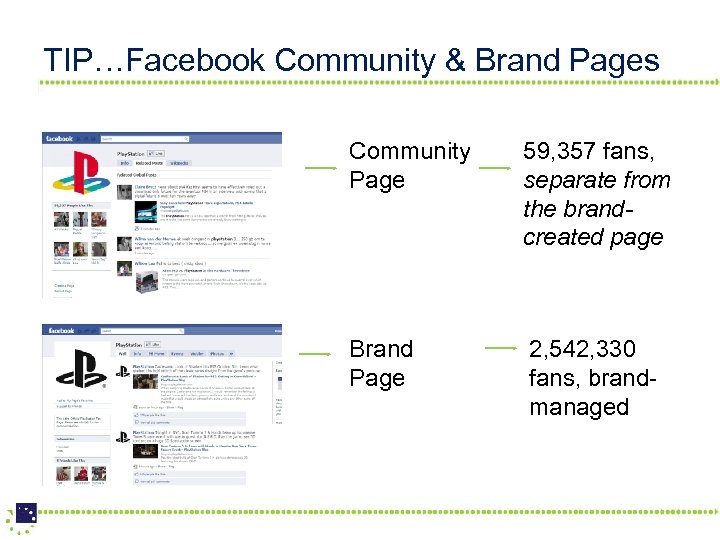
TIP…Facebook Community & Brand Pages Community Page 59, 357 fans, separate from the brandcreated page Brand Page 2, 542, 330 fans, brandmanaged
Step 2: Take in the View • Take the time to understand what the social landscape looks like for your brand • Go to the sites themselves, search for info on your company and competitors – On Twitter search for variations of your competitors names.
Step 2: Take in the View – Check hash tags directory to see what’s being tweeted in your industry. http: //hashtags. org/tags – On Linked. In, search your company and brand names in “companies” search box – On You. Tube, check for channels and keyword posts – Etc.
Step 2: Take in the View • And Don’t Forget the Search Engines – Enter your brand name and see what besides your website shows up – Check out your competition the same way – Enter topics you think your customers would be discussing—see what conversations or sites appear in the natural search listings
Step 2: Utilize Monitoring Tools • Monitor the social media landscape (qualitative and quantitative) – Free tools include: • Social. Mention. com • Google Alerts • Addictomatic – Paid tools include: • Scout. Labs • Listen. Logic • Radian 6
Step 2: Take in the View • Avoid the temptation to talk—just listen • What are your stakeholders doing? – Are your customers already there? • Are they talking about your brand? • Are they talking about competitors? • What do they think of your industry and your role in it? – Who do media/analysts turn to for info?
Step 2: Take in the View – What are your competitors doing? – Do prospective customers behave differently from current customers? – What are your employees doing now? • By department • As individuals – Personal use – Professional use
Step 2: Take in the View • DOCUMENT Your Findings • What did you learn? – Are your competitors • Absent, present, or active? – Are your customers: • Lamenting your absence or complaining you’re not paying attention? – Are potential employees • Being turned off by current employee profiles?
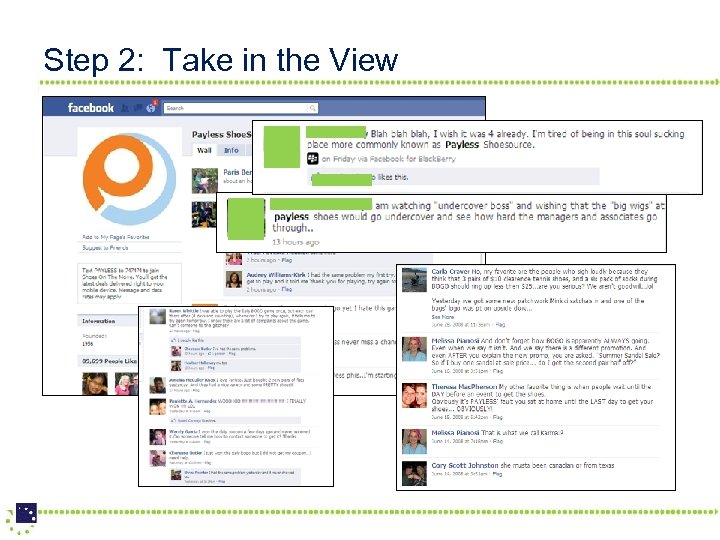
Step 2: Take in the View

Step 2: Take in the View • Info change your plans? – Can you move forward from zero or a position of strength? Or… – Do you have remediation work to do first?
Step 3: Overarching Plan • What resources do you have available and when – People – Content • Text • Video – Tools – Training required
Step 3: Overarching Plan • How will you fund it? • Measure success? – What are you measuring? • Hard Goals • Soft Goals – Which tools will help you? – How often will you be analyzing & reporting? • How will problems be addressed? • Which departments or outside resources do you need? (IT to unblock social sites? Customer service to handle requests, etc. )
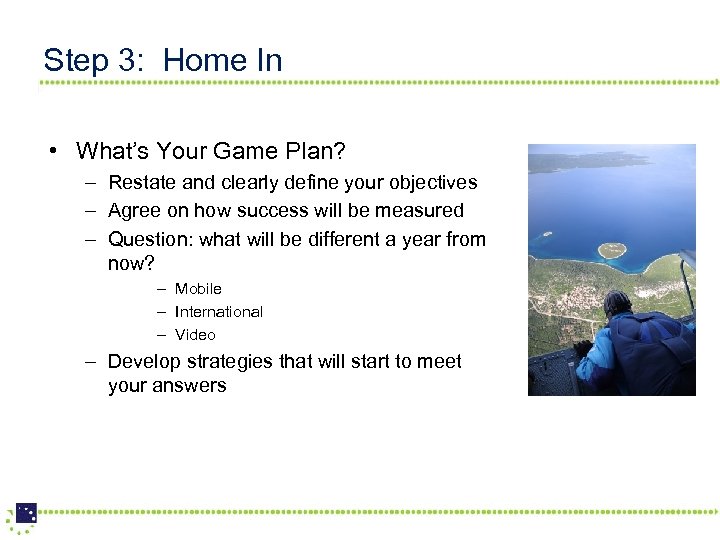
Step 3: Home In • What’s Your Game Plan? – Restate and clearly define your objectives – Agree on how success will be measured – Question: what will be different a year from now? – Mobile – International – Video – Develop strategies that will start to meet your answers
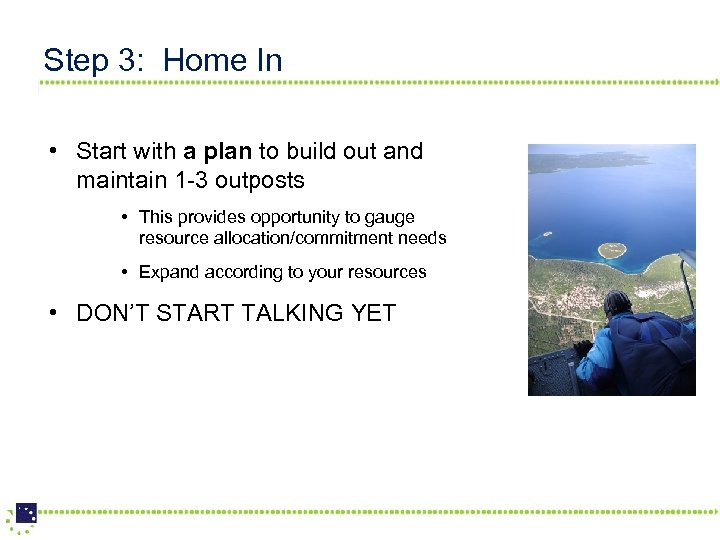
Step 3: Home In • Start with a plan to build out and maintain 1 -3 outposts • This provides opportunity to gauge resource allocation/commitment needs • Expand according to your resources • DON’T START TALKING YET
Step 3: Home In • Consider what you want to do in each of the environments to begin to achieve your goals • DON’T UNDERESTIMATE the resources that will be required to keep the conversation going – Free ≠ no cost – Stale posts worse than none at all
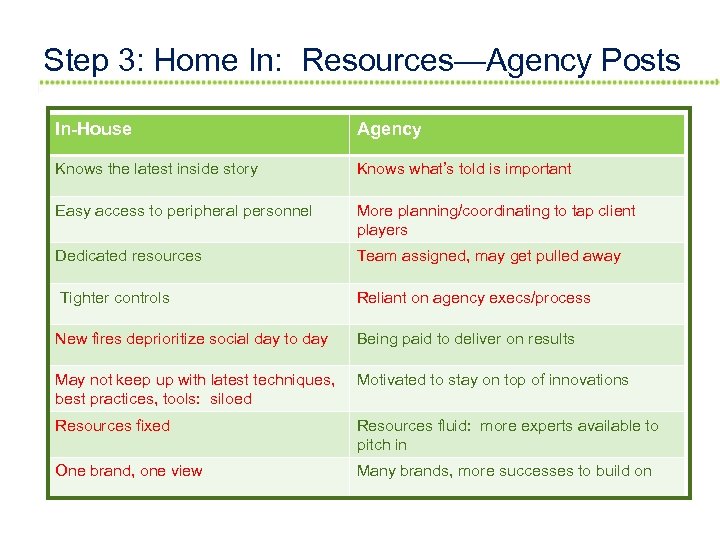
Step 3: Home In: Resources—Agency Posts In-House Agency Knows the latest inside story Knows what’s told is important Easy access to peripheral personnel More planning/coordinating to tap client players Dedicated resources Team assigned, may get pulled away Tighter controls Reliant on agency execs/process New fires deprioritize social day to day Being paid to deliver on results May not keep up with latest techniques, best practices, tools: siloed Motivated to stay on top of innovations Resources fixed Resources fluid: more experts available to pitch in One brand, one view Many brands, more successes to build on
Step 3: Home In • Things to think through: – What are your company’s policies about content created by employees? – Who owns the content? – How will employees represent their posts? • Professional • Personal – What is your company’s Internet policy? • Can the social media policy be added to it? • Are they in conflict? – Are employees allowed to talk as individuals during work hours?
Step 3: Home In • More To Think Through – Are social media sites blocked by your IT department? • How will this impact your ability to monitor & respond? – Who will be responsible for monitoring and responding to conversations about your brand?
Step 3: Home In • More To Think Through – How often will you check the sites? – Will you converse as a team with one persona or as individuals representing the brand? – What will be the tone if one persona but many players? – How will multiple players be represented?
Step 3: Home In • Involve the legal team on policy development – What employee activities can you regulate and which are off-limits? • Develop policies based on industry: – Assess the regulations and requirements in your industry • Financial services – SEC, FINRA, NYSE • Public companies – SEC • Healthcare – HIPAA, FDA
Step 3: Home In • Educate your employees – Those who will be actively communicating – Everyone else so they are aware of the changes • Map out contingency plans for communicators: – What happens when team communicator(s) are: • On vacation • Let go • Quit
Step 3: Home In • Get approval – you need buy-in from all departments/personnel affected • Key to consider: – – – – – Executive Team Marketing HR Customer Relations Corporate Relations Brand Managers Legal IT Individuals within the organization
Risks • Possible risks include: – Overzealous employees – Overly aggressive competitors – Vocal, unhappy customers – Negative press for missteps • Industry-specific regulations need to be considered, too – Pharmaceuticals/Healthcare – Finance – Professional Services
Rewards • More open, real-time information for your organization – About your industry – From your customers – Requests from the media – Spotlights by analysts • Better employee communications • Improved product development/refinement • Increased sales through positive associations and user-generated messaging
Step 4: Step off the plane • Your plan’s approved! • The commitment to continuous communication is made – The commitment to LISTEN – The commitment to RESPOND – The commitment to be PROACTIVE • Your team is ready to go
Step 4: Step off the plane • Gotta’ Have: If/Then Scenarios – What happens with negative posts? • The pros and cons of vetting posts before they go live – What if we don’t like what’s being posted, when do we jump in? – What if one of our competitors is posting nasty information? – What if there is a PR disaster, how should we respond in our posts?
TIP…Program Management Tools • Managing the social media outposts – Hootsuite • Works well for most companies – Tweet. Deck or Seesmic • Depends on the type of mobile device used – Socialware Compass • For regulated industries that need to moderate employee output
Step 4: Step off the plane • Set up the 1 -3 outposts you chose in the previous stage, configuring them according to your formal plan • Examples: – Facebook: • Pages or Groups – Does a community page already exist? • Vanity URL • Dual- or single-stream wall (see examples) • What kind of photos? Who can post/tag? Permissions/Releases.
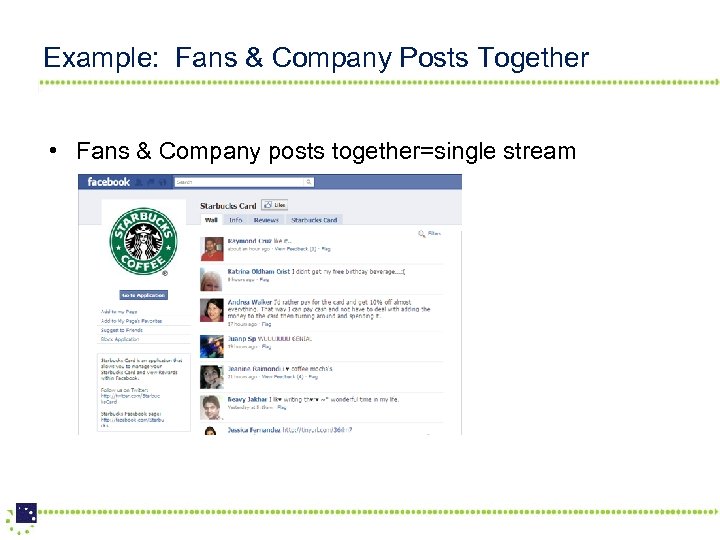
Example: Fans & Company Posts Together • Fans & Company posts together=single stream
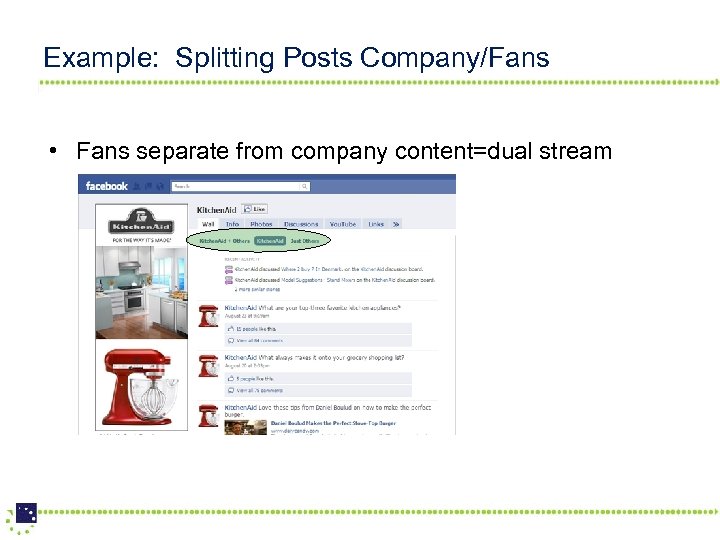
Example: Splitting Posts Company/Fans • Fans separate from company content=dual stream
Step 4: Step off the plane • Twitter: – Background design—logo, design elements – Editorial calendar or serendipitous topic commentary? • You. Tube channel: – Regularly scheduled posts or topical commentary? – A destination or a pit stop?
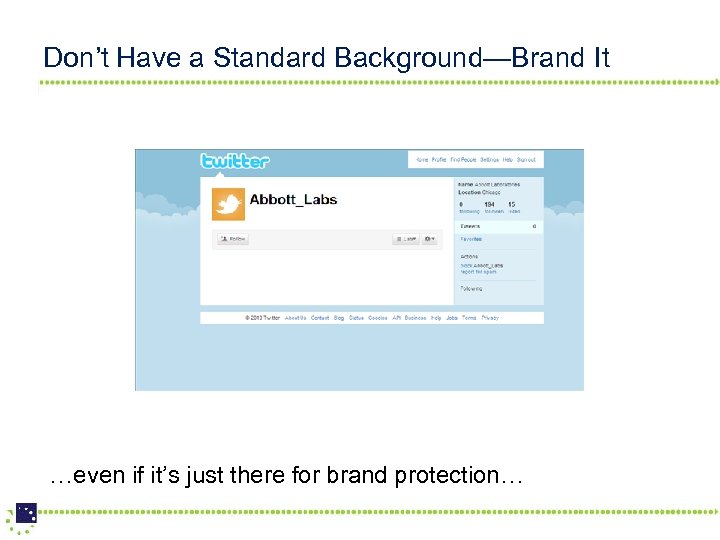
Don’t Have a Standard Background—Brand It …even if it’s just there for brand protection…
Step 4: Step off the plane • Soft launch them among “friends” • Get inputs as you would with web usability
Step 5: Pull the cord • Start talking, quietly at first – Gauge reactions – Fine tune • Continue to listen, respond promptly • Learn by doing
Step 5: Pull the cord • Don’t hide mistakes, learn • Remember, it’s all transparent • Succeed because you know what success looks like
Post 5: Measurement • How’s it going? – Are you sure? • If you can tag it, you can measure it! • The “trend” is your friend • Just because you can, doesn’t mean you should • Make measurement actionable – if this, then that
Post 5: Measurement • Some things to keep in mind for measuring success: – Don’t forget to benchmark all applicable data so you can show progress – Referred traffic to website • Coupons, downloads, sign-ups, click-thrus, phone call activity, etc. • Sales leads and sales if set up to capture • Bit. ly clicks
Post 5: Measurement • Volume: #of Fans, Followers, Diggs, comments measures exposure • Buzz levels: Use Addictomatic or other tools to see what they’re saying • Sentiment analysis: Use Social. Mention. com, Listen. Logic, Facetime
TIP…Additional Measurement Tools • Measuring program results – Google Analytics – Built-in analytics • Many networks, including You. Tube, Facebook, and Flickr, provide their own Insights data – Bit. ly or Ow. ly click-thrus Plus the tools on monitoring tools slide
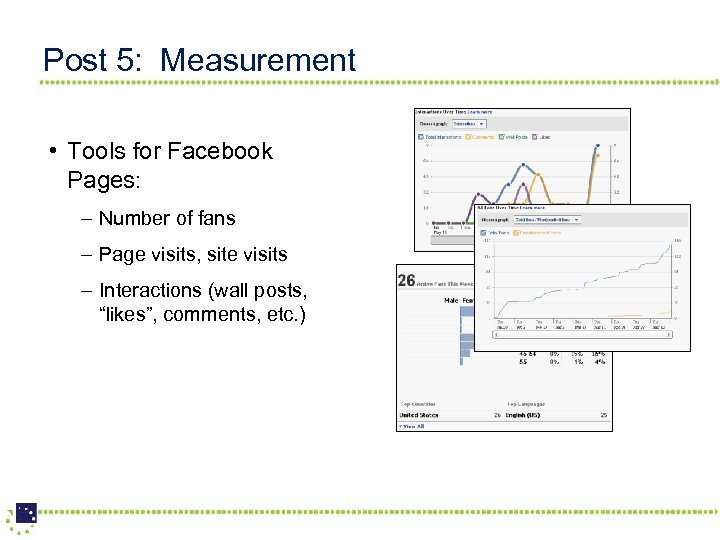
Post 5: Measurement • Tools for Facebook Pages: – Number of fans – Page visits, site visits – Interactions (wall posts, “likes”, comments, etc. )
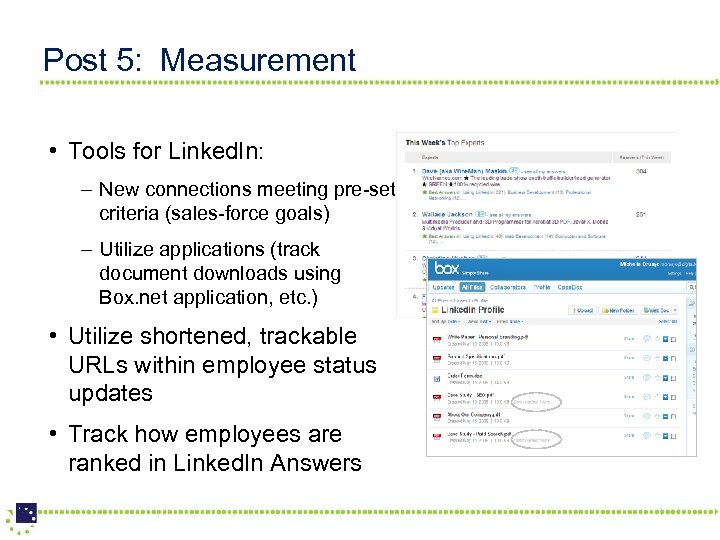
Post 5: Measurement • Tools for Linked. In: – New connections meeting pre-set criteria (sales-force goals) – Utilize applications (track document downloads using Box. net application, etc. ) • Utilize shortened, trackable URLs within employee status updates • Track how employees are ranked in Linked. In Answers
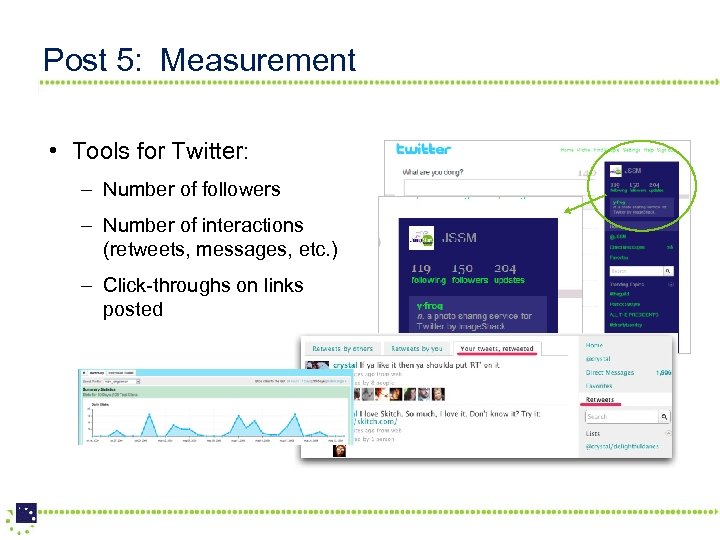
Post 5: Measurement • Tools for Twitter: – Number of followers – Number of interactions (retweets, messages, etc. ) – Click-throughs on links posted
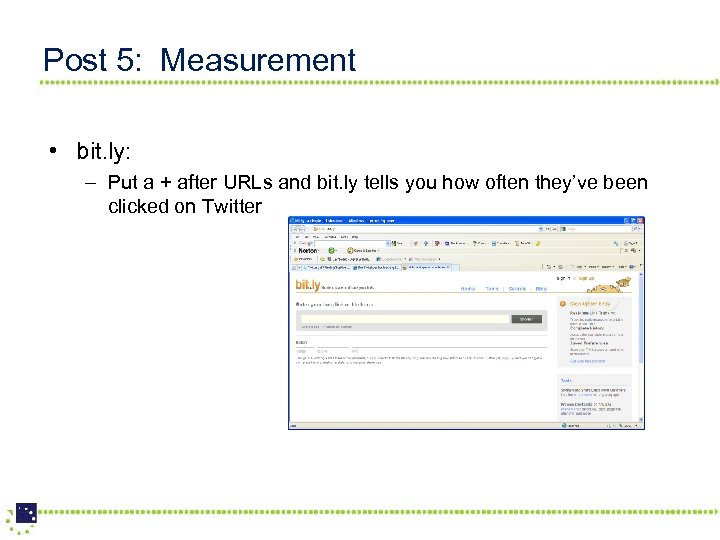
Post 5: Measurement • bit. ly: – Put a + after URLs and bit. ly tells you how often they’ve been clicked on Twitter
Step 5: Expand the Conversation • What’s working? Do more of it • What’s not working? Figure out why – Ask questions – Share answers – Keep the dialogue open • Expand channels only when you are sure it will derive a benefit
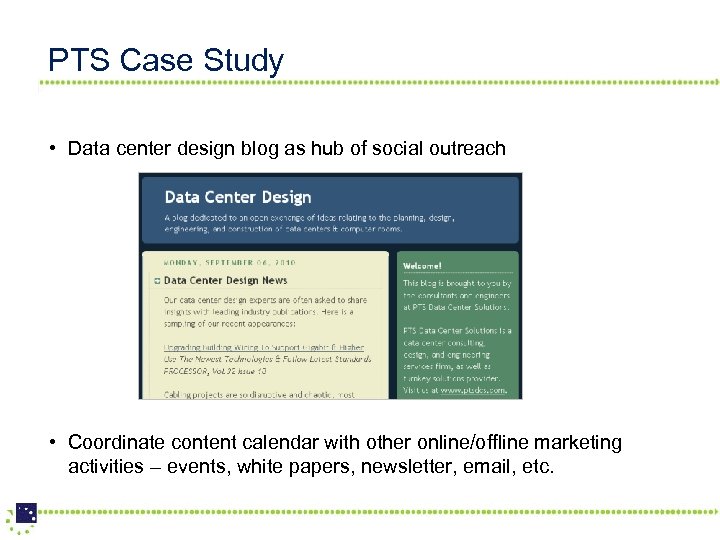
PTS Case Study • Data center design blog as hub of social outreach • Coordinate content calendar with other online/offline marketing activities – events, white papers, newsletter, email, etc.
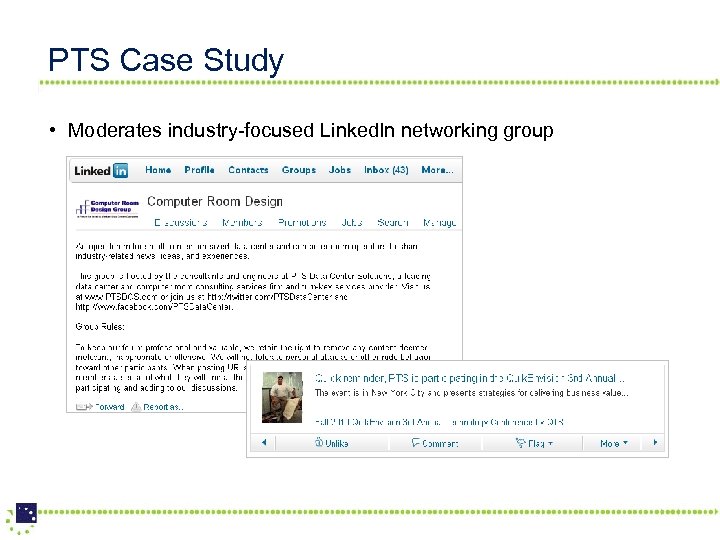
PTS Case Study • Moderates industry-focused Linked. In networking group
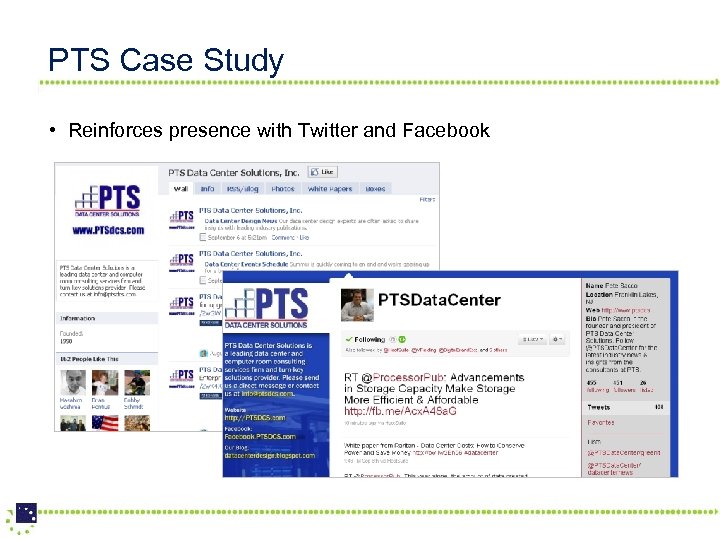
PTS Case Study • Reinforces presence with Twitter and Facebook
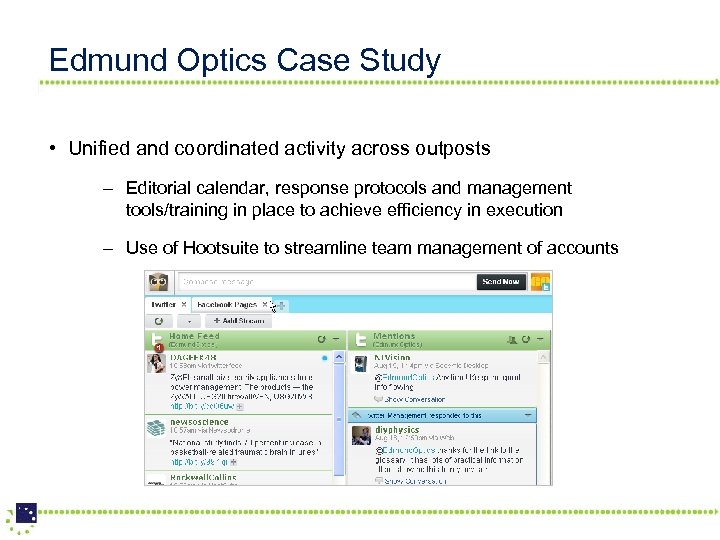
Edmund Optics Case Study • Unified and coordinated activity across outposts – Editorial calendar, response protocols and management tools/training in place to achieve efficiency in execution – Use of Hootsuite to streamline team management of accounts
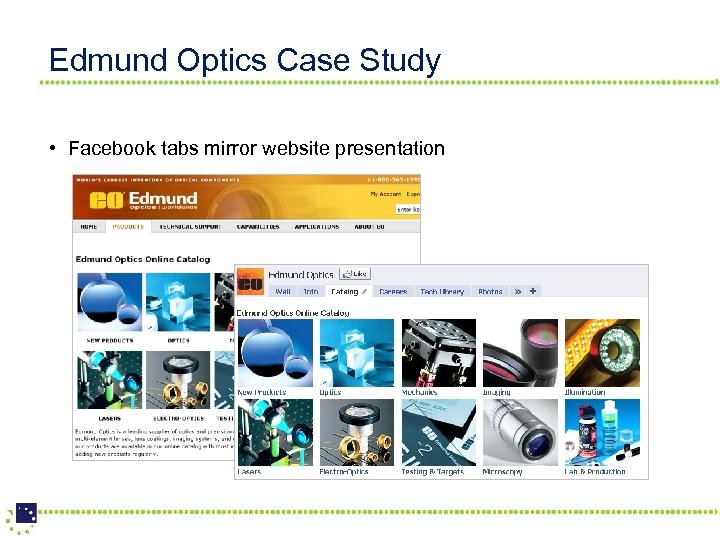
Edmund Optics Case Study • Facebook tabs mirror website presentation
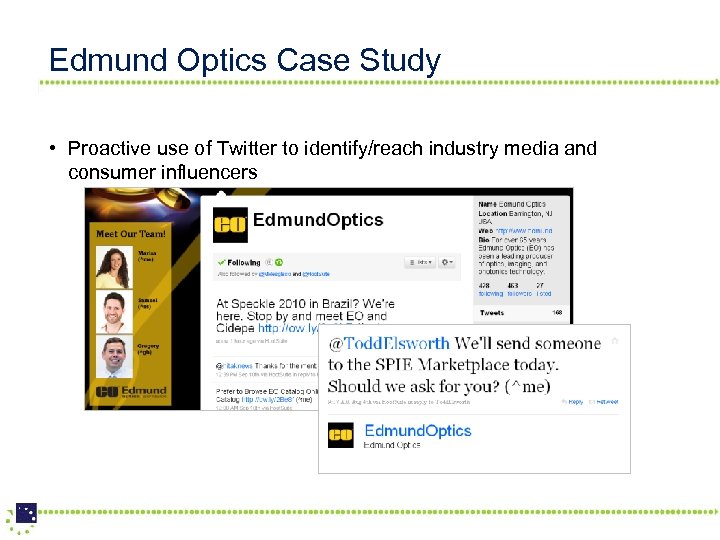
Edmund Optics Case Study • Proactive use of Twitter to identify/reach industry media and consumer influencers
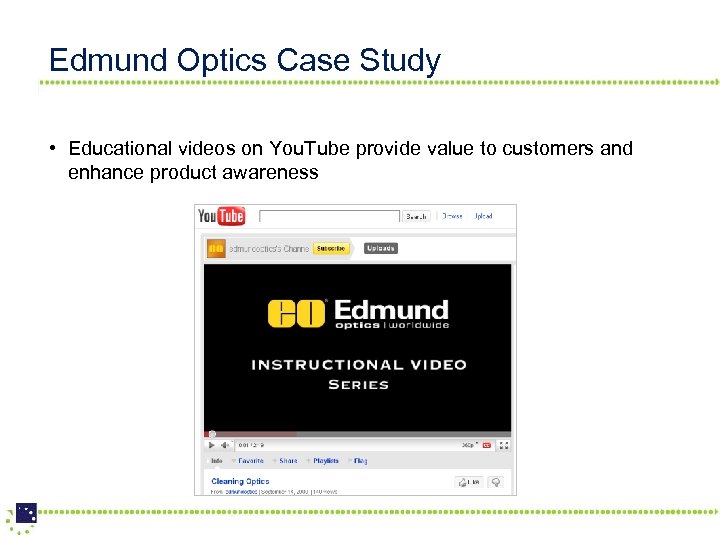
Edmund Optics Case Study • Educational videos on You. Tube provide value to customers and enhance product awareness
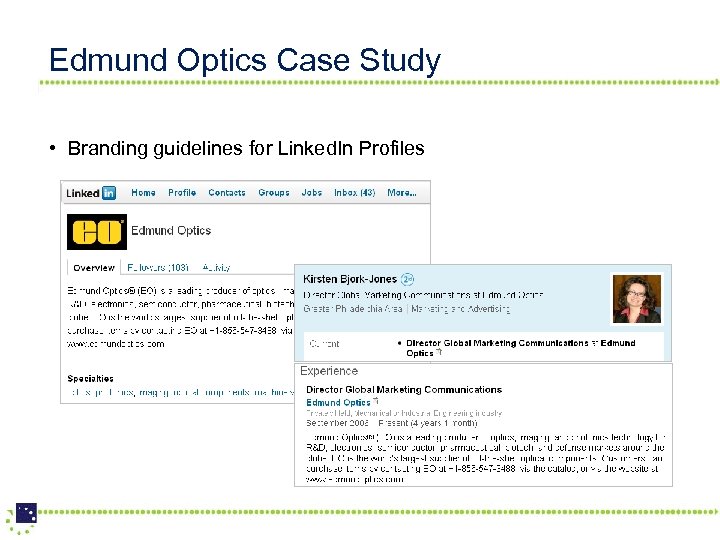
Edmund Optics Case Study • Branding guidelines for Linked. In Profiles
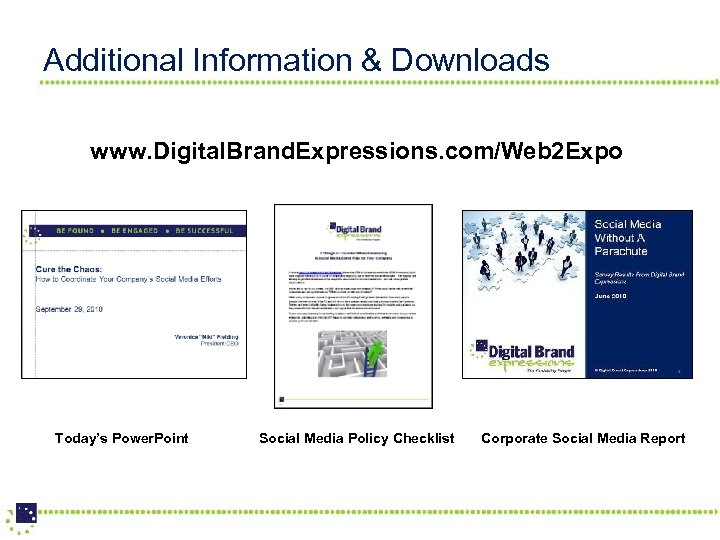
Additional Information & Downloads www. Digital. Brand. Expressions. com/Web 2 Expo Today’s Power. Point Social Media Policy Checklist Corporate Social Media Report
Questions? Veronica Fielding Twitter: @VFielding Linked. In: www. linkedin. com/in/veronicafielding Or Call Toll Free: 866/651 -6767
Appendix/Additional Info
Active & Recognized Marketers

Diverse Experience
Скачать презентацию BE FOUND BE ENGAGED BE SUCCESSFUL Cure
78e97f00f46cb9643a788697c3b6e942.ppt