 Скачать презентацию BCP Planning Fundamentals for Organizational Leadership Emergency Preparedness
e5f77791ee7e12ebbc72a354a90b64b3.ppt
- Количество слайдов: 36



BCP Planning Fundamentals for Organizational Leadership Emergency Preparedness Project Training May 30, 2014 Presented by: Annie Grunewald
5 Stages of Grief (Over having to do disaster planning) 1. DENIAL o o o Nothing is going to happen to our organization. We weren’t hit by Sandy. Anyway I think we have a plan somewhere (in fact I think that’s the plan right there – under the door!) Besides, we already do fire drills AND I have a go bag with a whistle.
5 Stages of Grief (Over having to do disaster planning) 2. ANGER o o o Seriously? ? Agency x expects me to have a plan and that haven’t given me any funding to do anything. They don’t even give me enough funding to pay my staff a decent wage – we are all overworked. THERE ARE HUNDREDS OF RESOURCES – NOTHING FITS MY AGNECY. HOW ARE WE SUPPOSED TO WRITE AN EMRGENCY PLAN!!!!!!!”
5 Stages of Grief (Over having to do disaster planning) 3. BARGAINING o o OK fine. I’m not going to like it but I’ll do something. Just give me a template… we’ll get IT and Facilities together and we’ll write ourselves a plan in a couple of weeks!
5 Stages of Grief (Over having to do disaster planning) 4. DEPRESSION o o o This is really hard. It is more complicated than I thought. Every time we think of something – 5 other things occur to us. And we had that carbon monoxide scare and no one knew what to do. We might as well not even try
5 Stages of Grief (Over having to do disaster planning) 5. ACCEPTANCE o o o It's going to be okay. I can't fight it, so I may as well accept it. We need to try and fulfill our mission no matter what the circumstances are. Yes. Its complicated but we can do this a little at a time –and embrace it instead of fight it. I think it will help strengthen our agency over all.
Finding Funding How do you make disasters sexy?
Disaster Philanthropy 1. Disaster Grantmaking: A Practical Guide for Foundations and Corporations n n 2. The Report of a Joint Working Group of the European Foundation Centre and the Council on Foundations 2001, 2007 http: //www. cof. org/sites/default/files/documents/files/disasterguide. pdf Creating Order from Chaos: Roles For Philanthropy in Disaster Planning and Response. n n Du. Pont 2012 http: //www. dupontfund. org/wp-content/uploads/2012/05/du. Pont. Disaster-Relief-Guide. pdf
Disaster Philanthropy 3. Best Practices in Disaster Grantmaking – Lessons from the Gulf Coast n n 4. NYRAG/Philanthropy NY http: //aspcapro. org/sites/pro/files/aspca-best-practices-disastergrants. pdf In Practice: Philanthropic Grantmaking for Disasters. Dr. William M. Paton March 2012 n Conrad N. Hilton Foundation n http: //www. mcf. org/system/asset_manager_pdfs/0000/1925/In_Practice _Philanthropic_Grantmaking_for_Disaster_2011. pdf
Disaster Philanthropy o o North Star Foundation - From the Edge of Disaster: New York Sandy Activism Report http: //northstarfund. org/news/2014/03/fromthe-edge-of-disaster-report. php
Arc of Disaster Philanthropy o o o Ad hoc donations to response Targeted response Recognizing importance of recovery focus Concepts of Resiliency/Risk reduction Center for Disaster Philanthropy
Guidance: from Philanthropic Community to Philanthropic Community o From “A practical Guide” 3. Think about when to make a disaster grant. n Don’t wait for a disaster to occur. Consider supporting disaster prevention, early warning systems, preparedness and planning activities in a disaster-prone region before a disaster happens. 5. Looking at the disaster management picture. n Think about making disaster grants aimed at disaster prevention or preparedness so that communities regularly hit by floods, earthquakes and other disasters can develop disaster plans, raise public awareness about disaster preparedness, and train local disaster response teams for the next emergency.
Guidance: from Philanthropic Community to Philanthropic Community o from Hilton Foundation report Recovery and prevention n Attempt to build disaster response on local capacities. n Address recovery, return of sustainable livelihoods and transitions from humanitarian relief to recovery and development activities. n Invest in disaster risk reduction to prevent or reduce the extent of future disasters
Center for Disaster Philanthropy Basic Tips for Disaster Giving o Take the long view n o All funders are disaster philanthropists n o o Even if your organization does not work in a particular geographic area or fund immediate relief efforts, you can look for ways to tie disaster funding into your existing mission. If you focus on education, health, children or vulnerable populations, disasters present prime opportunities. Look to past disasters for guidance n o With the increase in extreme weather events, the government cannot fully fund recovery. What’s more, private funders have opportunities to develop innovation solutions to help prevent or mitigate future disasters that the government cannot. There are often lessons learned that could be used to create better policy and procedure. Consider funding disaster risk-reduction research or projects that could inform more effective disaster preparation and response policy. Ask the experts Recognize that there are places private philanthropy can help that government agencies might not Support the sharing of best practices Connect with other funders
Truths about Emergency Planning o o Comprehensive Emergency Planning is complicated and like an onion Every Social Service Organization is a disaster response and recovery organization The process and participation is more important than the plan itself There are many ways to structure your plan
Keys to success o o o o Leadership (including Board) involvement/by-in Assign strong leadership – and ensure managed like a project Accept, empower and promote - Strive to imbed in the culture Think of Disaster Planning Team a standing committee not ad hoc Think of it as an ongoing project/capacity building Integrate into existing organizational systems Take the long view…. and one step at a time. Steal (Borrow) when possible - work with your community of organizations
XYZ Settlement House Emergency Management Plan 1. 2. 3. 4. 5. 6. o Basic Plan Information Leadership Structure and Decision Making Emergency Response Continuity of Operations/Services Disaster-Specific Community Support Emergency Communications Appendices
1. 3 Planning and Preparedness Planning Team o Lead by member of Leadership Team n n n n n Programs – Could include more than one representative Support Functions Finance Human Resources Facilities IT Communications Development Legal Ensure all members know purpose & expectations of involvement
1. 3 Planning and Preparedness o Meeting Frequency and Structure n n n Meet quarterly Establish/revise priorities Assign subgroups as necessary Report on progress from last meeting Make assignments/deadlines to include approval process
1. 3 Planning and Preparedness o Plan Updates n n n Can distribute new protocols/information as developed and approved during the year Update full plan once a year OK to have sections that say “in progress”
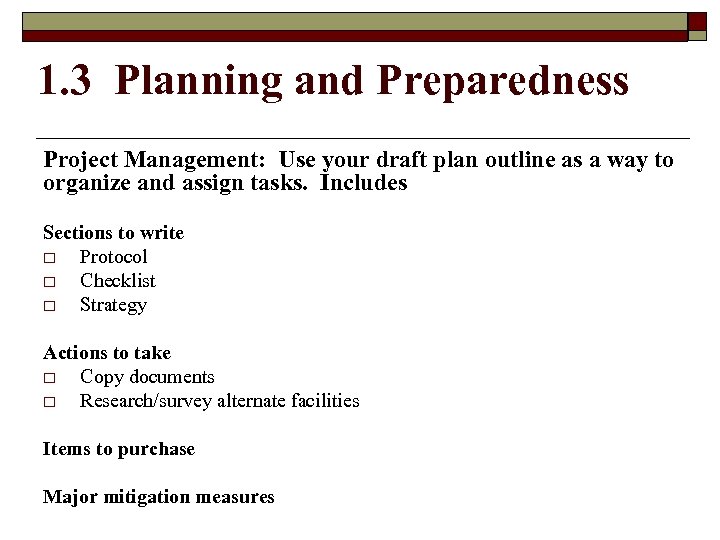
1. 3 Planning and Preparedness Project Management: Use your draft plan outline as a way to organize and assign tasks. Includes Sections to write o Protocol o Checklist o Strategy Actions to take o Copy documents o Research/survey alternate facilities Items to purchase Major mitigation measures
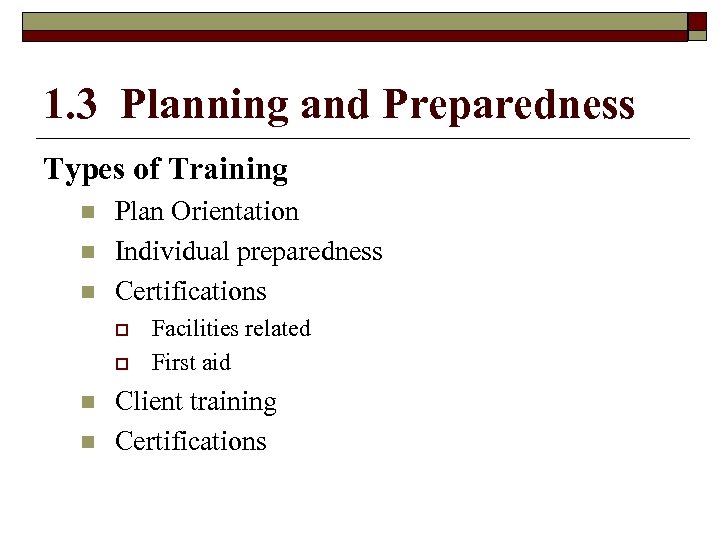
1. 3 Planning and Preparedness Types of Training n n n Plan Orientation Individual preparedness Certifications o o n n Facilities related First aid Client training Certifications
1. 3 Planning and Preparedness Types of Training n n n Plan Orientation Individual preparedness Certifications o o n n Facilities related First aid Client training Certifications
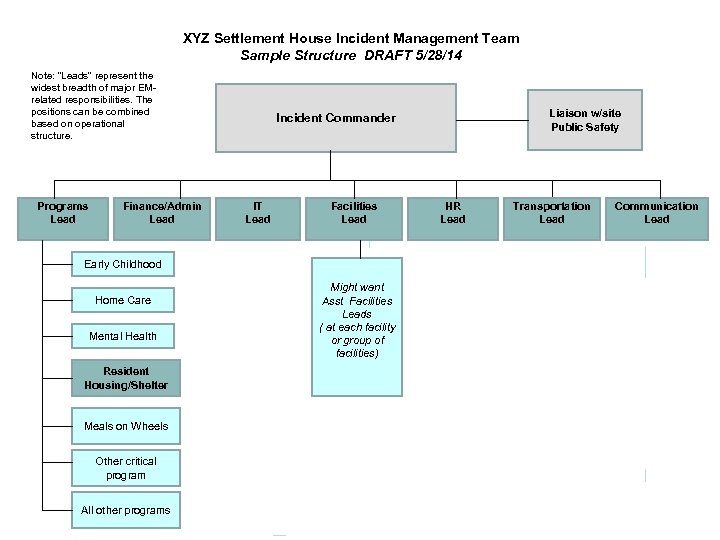
XYZ Settlement House Incident Management Team Sample Structure DRAFT 5/28/14 Note: “Leads” represent the widest breadth of major EMrelated responsibilities. The positions can be combined based on operational structure. Programs Lead Finance/Admin Lead IT Lead Facilities Lead Early Childhood Home Care Mental Health Resident Housing/Shelter Meals on Wheels Other critical program All other programs Liaison w/site Public Safety Incident Commander Might want Asst Facilities Leads ( at each facility or group of facilities) HR Lead Transportation Lead Communication Lead
2. Leadership Structure and Decision Making o o o Close to your own structure as possible Use emergency titles ICS Concept – expandable and contractible Two-three deep for all leadership positions Clearly articulate when a back-up assumes a role & make sure back-ups are empowered to make decisions
Activation Events with no warning o After emergency needs of staff/clients are met and IC determines there is a need to coordinate and manage continued emergency-related efforts, IC will notify and convene IMT: n In person, at HQ n In person off site at Assembly area (if an evacuation has been called at HQ) n By phone (if team members are dispersed or if after regular business hours)
Activation Events with warning o Any staff member aware of a potential incident that could disrupt operations can contact any IMT member who in turn will contact IC o If IC determines there is a need to activate team, IC will do so by any of the methods listed above
Client and Service Delivery Considerations o Changes in Services Based on Client Demand Need n n Demand for regular services Demand for New Services
Client and Service delivery considerations o Changes in Service Delivery based on Regulatory, Governmental or Contractual Issues n n n Industry Standards and Regulations Mayoral Emergency Declarations Public Health Emergency Declarations Contractual/Grant Obligations Advocacy and Communication
Client and Service delivery considerations o o Preparedness/Communication/Prioritization Client Assessment Form
4. 4 Alternate Facilities Major Components o Overlaps with Evacuation (policies and procedures temp facilities) o Assessment /inventory o Identification of alt sites n MOUs
4. 6 Human Resources o Planning Challenges n Alternate Sources of Staff o o Use staff from non- essential programs/services. Remove non-essential tasks from staff duties. Hire temporary workers Use Volunteers n n Current Organization Volunteers Spontaneous Volunteers
4. 6 Human Resources o Planning Challenges n Flexible work strategies o o o Telecommuting Changes in mode of contact/interaction with clients Changes in staff work location n n o o Another agency and/or donated space Another facility of the agency Alternate staff reporting strategies Telehealth Technologies
4. 6 Human Resources o Policies and Regulatory Issues n n Compensation: Disaster related absenteeism: Staff may not report to work because of: o o n n n Damage to/loss of home Fear of contamination Transportation disruption Injury to self or family Worker’s compensation Liability issues Volunteers Disaster and Public Health Declarations Credentialing
4. 6 Human Resources o Training/Preparation for Staff and Volunteers o Stress Management Support
THANK YOU! BCP Planning Fundamentals for Organizational Leadership Emergency Preparedness Project Training May 30, 2014 annie@clgconsulting. org
Скачать презентацию BCP Planning Fundamentals for Organizational Leadership Emergency Preparedness
e5f77791ee7e12ebbc72a354a90b64b3.ppt