 Скачать презентацию Battery-Powered Driver for Fundamental-Mode Orthogonal Fluxgates Prepared by
9027403bb2746653f8959b7538458024.ppt
- Количество слайдов: 14



Battery-Powered Driver for Fundamental-Mode Orthogonal Fluxgates Prepared by: Anton Plotkin Supervisor: Professor Shmuel Ben-Yakov Department of Electrical and Computer Engineering Ben-Gurion University of the Negev, P. O. Box 653, Beer-Sheva 84105, Israel 28. 06
The Aim Provide the maximum battery life of the driver for fundamental-mode orthogonal fluxgates.
Contents 1. Orthogonal fluxgate. 2. Fundamental-mode operation. 3. Current source. 4. Current source with transformer. 5. Full-bridge driver. 6. Comparison. 7. Conclusions.
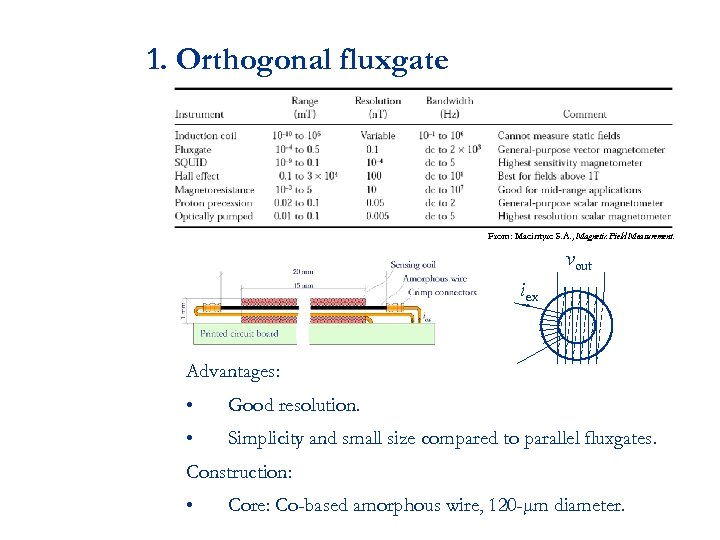
1. Orthogonal fluxgate From: Macintyre S. A. , Magnetic Field Measurement. vout iex Advantages: • Good resolution. • Simplicity and small size compared to parallel fluxgates. Construction: • Core: Co-based amorphous wire, 120 -mm diameter.
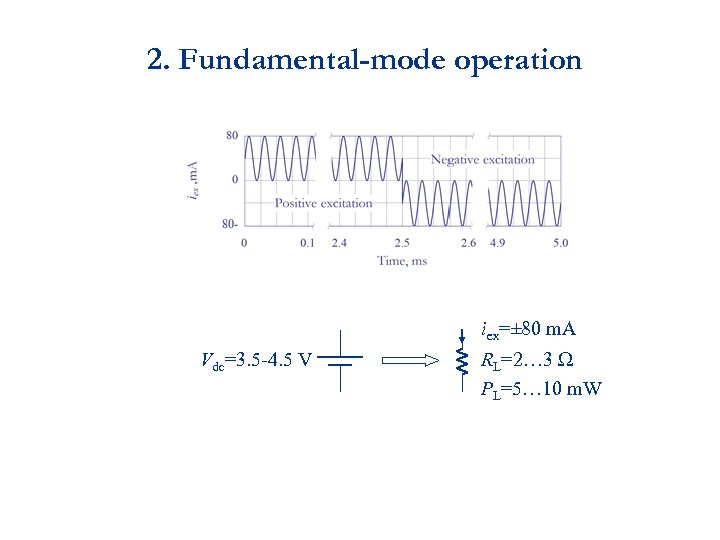
2. Fundamental-mode operation iex=± 80 m. A Vdc=3. 5 -4. 5 V RL=2… 3 W PL=5… 10 m. W
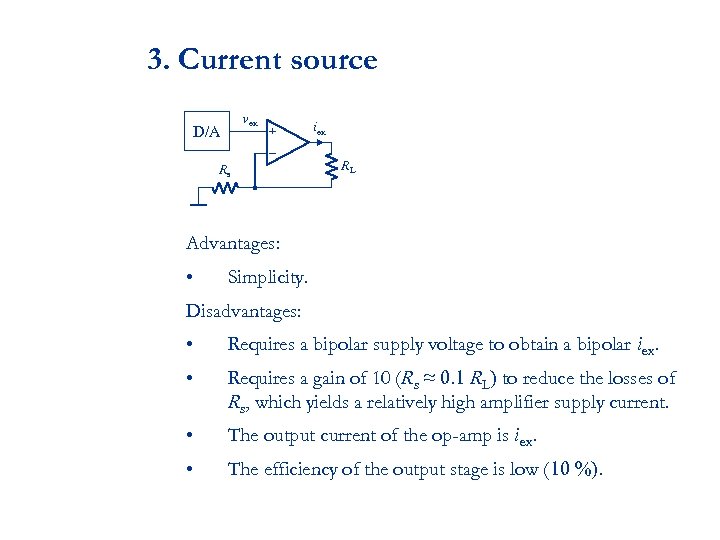
3. Current source vex D/A Rs iex RL Advantages: • Simplicity. Disadvantages: • Requires a bipolar supply voltage to obtain a bipolar iex. • Requires a gain of 10 (Rs ≈ 0. 1 RL) to reduce the losses of Rs, which yields a relatively high amplifier supply current. • The output current of the op-amp is iex. • The efficiency of the output stage is low (10 %).
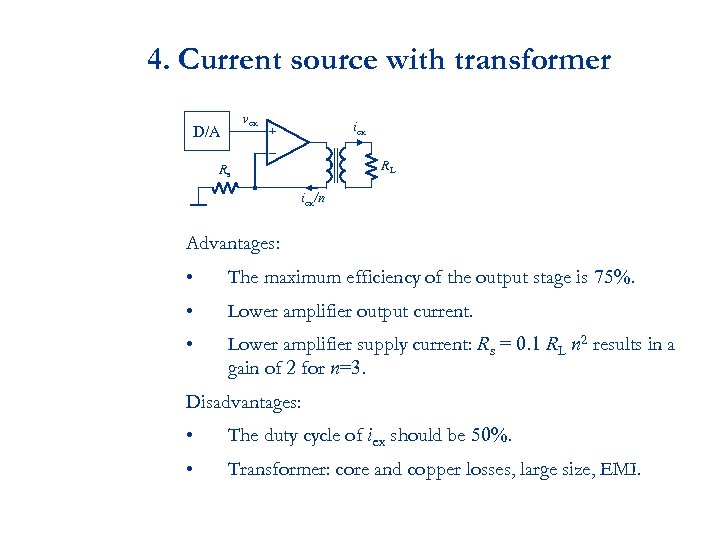
4. Current source with transformer vex D/A iex RL Rs iex/n Advantages: • The maximum efficiency of the output stage is 75%. • Lower amplifier output current. • Lower amplifier supply current: Rs = 0. 1 RL n 2 results in a gain of 2 for n=3. Disadvantages: • The duty cycle of iex should be 50%. • Transformer: core and copper losses, large size, EMI.
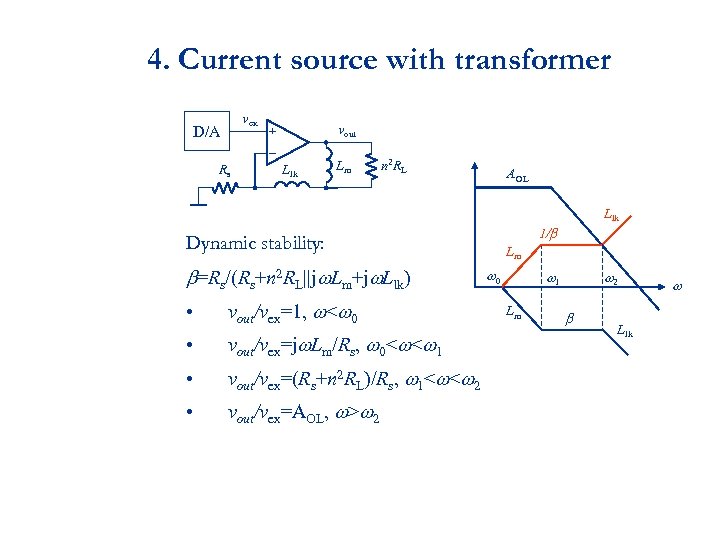
4. Current source with transformer vex D/A Rs vout Llk Lm n 2 RL AOL 1/b Dynamic stability: b=Rs/(Rs+n 2 RL||jw. Lm+jw. Llk) • vout/vex=1, w<w 0 • vout/vex=jw. Lm/Rs, w 0<w<w 1 • vout/vex=(Rs+n 2 RL)/Rs, w 1<w<w 2 • vout/vex=AOL, w>w 2 Llk Lm w 0 w 1 Lm w 2 b Llk w
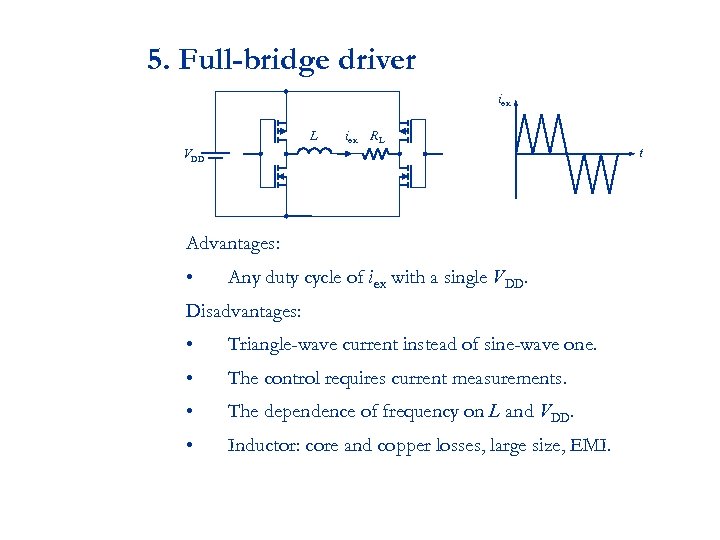
5. Full-bridge driver iex L iex RL VDD Advantages: • Any duty cycle of iex with a single VDD. Disadvantages: • Triangle-wave current instead of sine-wave one. • The control requires current measurements. • The dependence of frequency on L and VDD. • Inductor: core and copper losses, large size, EMI. t
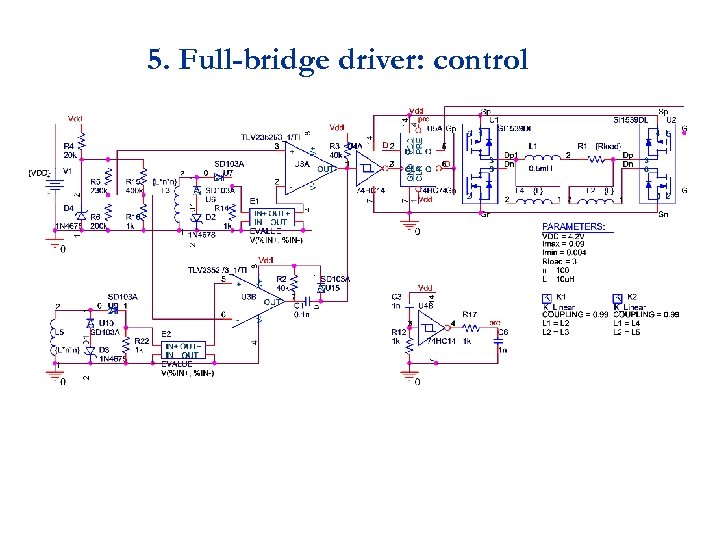
5. Full-bridge driver: control
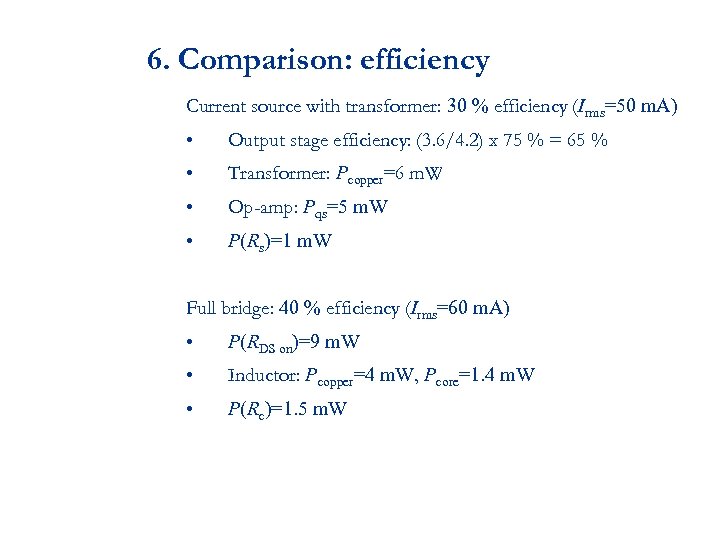
6. Comparison: efficiency Current source with transformer: 30 % efficiency (Irms=50 m. A) • Output stage efficiency: (3. 6/4. 2) x 75 % = 65 % • Transformer: Pcopper=6 m. W • Op-amp: Pqs=5 m. W • P(Rs)=1 m. W Full bridge: 40 % efficiency (Irms=60 m. A) • P(RDS on)=9 m. W • Inductor: Pcopper=4 m. W, Pcore=1. 4 m. W • P(Rc)=1. 5 m. W
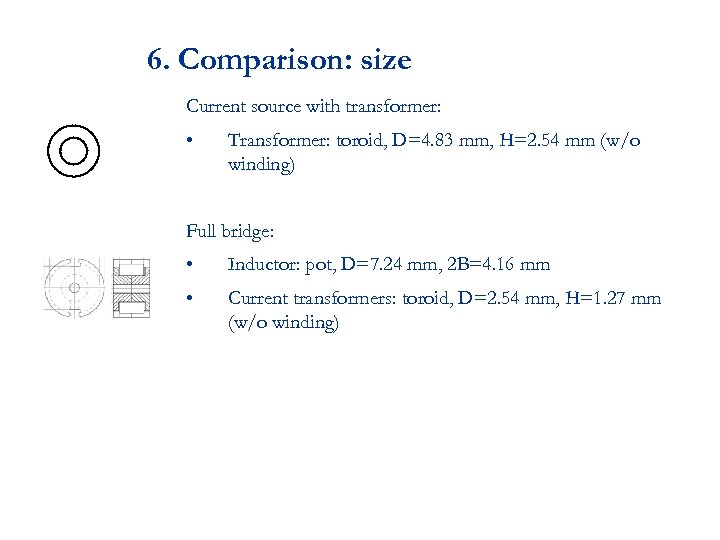
6. Comparison: size Current source with transformer: • Transformer: toroid, D=4. 83 mm, H=2. 54 mm (w/o winding) Full bridge: • Inductor: pot, D=7. 24 mm, 2 B=4. 16 mm • Current transformers: toroid, D=2. 54 mm, H=1. 27 mm (w/o winding)
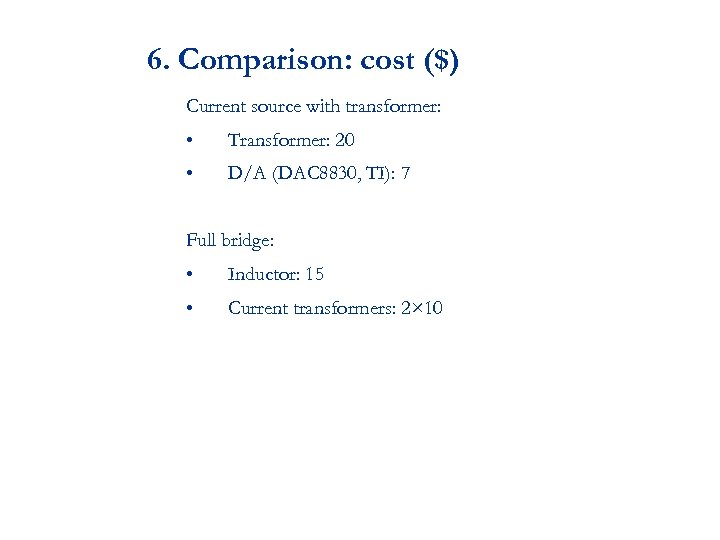
6. Comparison: cost ($) Current source with transformer: • Transformer: 20 • D/A (DAC 8830, TI): 7 Full bridge: • Inductor: 15 • Current transformers: 2× 10
7. Conclusions • The maximum efficiency of the driver is 40 % (the minimum losses are 16 m. W). • The main factors limiting the efficiency of the current source are the supply of the op-amp and the transformer copper losses. • The main factors limiting the efficiency of the full bridge are the switching losses (either RDSon or gate driving) and the inductor copper losses. • Both the transformers and inductor should be carefully shielded to reduce the EMI.
Скачать презентацию Battery-Powered Driver for Fundamental-Mode Orthogonal Fluxgates Prepared by
9027403bb2746653f8959b7538458024.ppt