 Скачать презентацию Basics of the grammar of English Words
b73716b58b49d41ea04fcf83e78e171a.ppt
- Количество слайдов: 31



Basics of the grammar of English • Words, phrases, clauses • Words • Open classes; nouns and verbs • Distribution patterns • Nouns, pronouns, verbs, tenses • Inflection • Noun phrases • Simple clauses, categories • Questions • Roles • Prepositional phrases • Clausal subjects / complements • Verb phrases • Modifiers • Compound clauses • Relative clauses CSI 4106, Winter 2005 Basic facts about the English grammar, page 1
Words, phrases, clauses The building blocks of expressions in natural languages are words, phrases, clauses. There is a semantic motivation for some of these fundamental constructions: noun phrases correspond to entities that have properties (expressed by adjective phrases, relative clauses, and so on); verb phrases correspond to situations with roles (noun phrases, prepositional phrases) and qualities (adverbial phrases). CSI 4106, Winter 2005 Basic facts about the English grammar, page 2
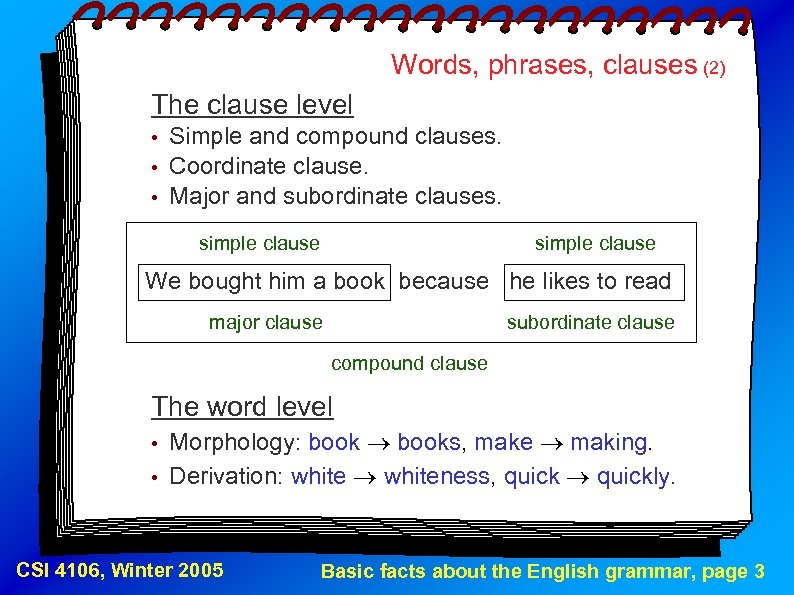
Words, phrases, clauses (2) The clause level • • • Simple and compound clauses. Coordinate clause. Major and subordinate clauses. simple clause We bought him a book because he likes to read major clause subordinate clause compound clause The word level • • Morphology: books, make making. Derivation: whiteness, quickly. CSI 4106, Winter 2005 Basic facts about the English grammar, page 3
Words Criteria for distinguishing words are quite arbitrary, though the simplest test (groups of letters between non-letters) works okay. Words are not the lowest level of description. Morphemes, e. g. , pre+book+ing, un+glue+d. antidisestablishmentarianism There are four open classes of words (noun, verb, adjective, adverb) and closed classes (including articles, conjunctions, prepositions, numerals, pronouns). CSI 4106, Winter 2005 Basic facts about the English grammar, page 4
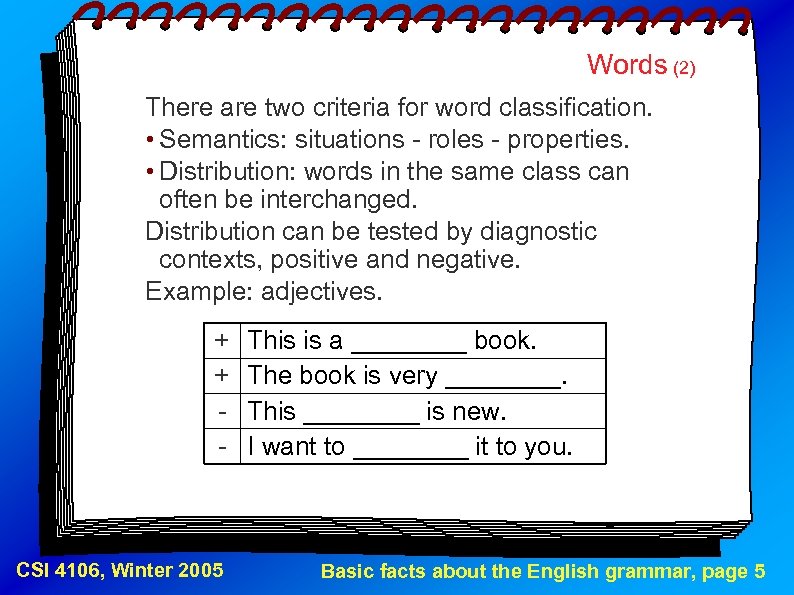
Words (2) There are two criteria for word classification. • Semantics: situations - roles - properties. • Distribution: words in the same class can often be interchanged. Distribution can be tested by diagnostic contexts, positive and negative. Example: adjectives. + + - CSI 4106, Winter 2005 This is a ____ book. The book is very ____. This ____ is new. I want to ____ it to you. Basic facts about the English grammar, page 5
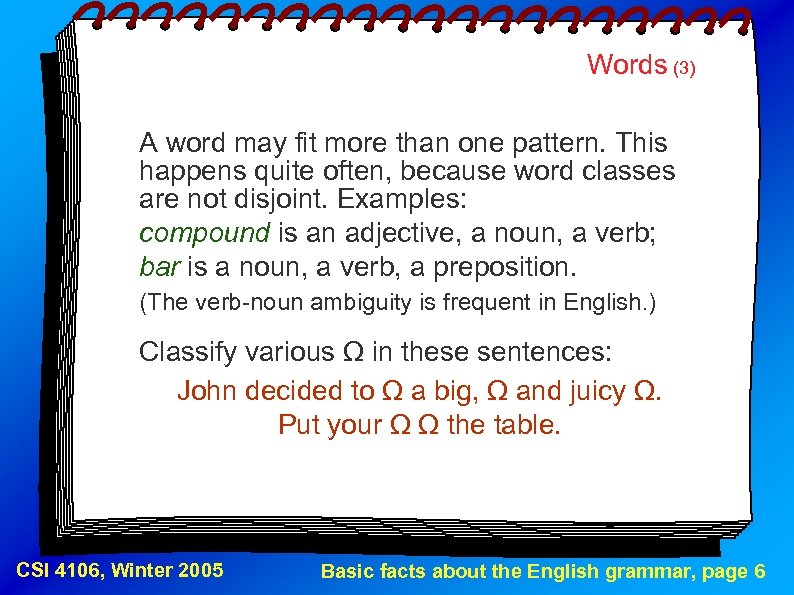
Words (3) A word may fit more than one pattern. This happens quite often, because word classes are not disjoint. Examples: compound is an adjective, a noun, a verb; bar is a noun, a verb, a preposition. (The verb-noun ambiguity is frequent in English. ) Classify various Ω in these sentences: John decided to Ω a big, Ω and juicy Ω. Put your Ω Ω the table. CSI 4106, Winter 2005 Basic facts about the English grammar, page 6
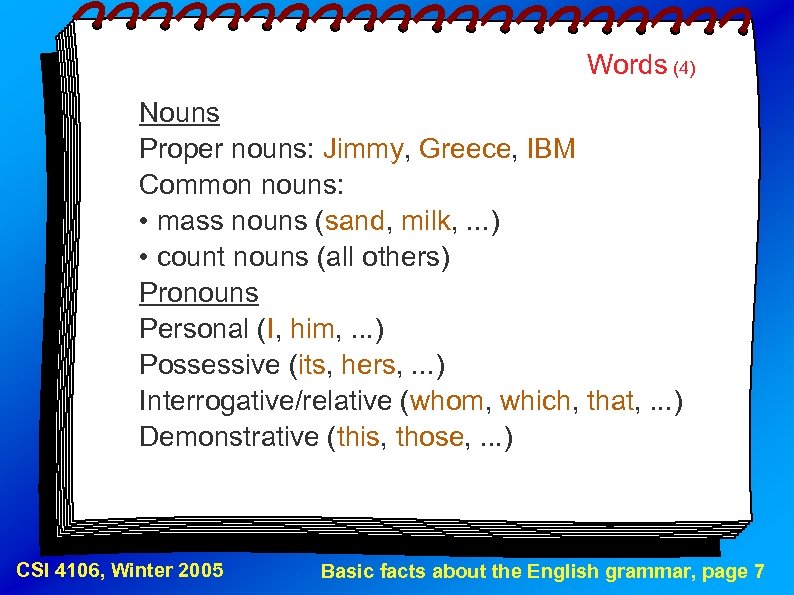
Words (4) Nouns Proper nouns: Jimmy, Greece, IBM Common nouns: • mass nouns (sand, milk, . . . ) • count nouns (all others) Pronouns Personal (I, him, . . . ) Possessive (its, hers, . . . ) Interrogative/relative (whom, which, that, . . . ) Demonstrative (this, those, . . . ) CSI 4106, Winter 2005 Basic facts about the English grammar, page 7
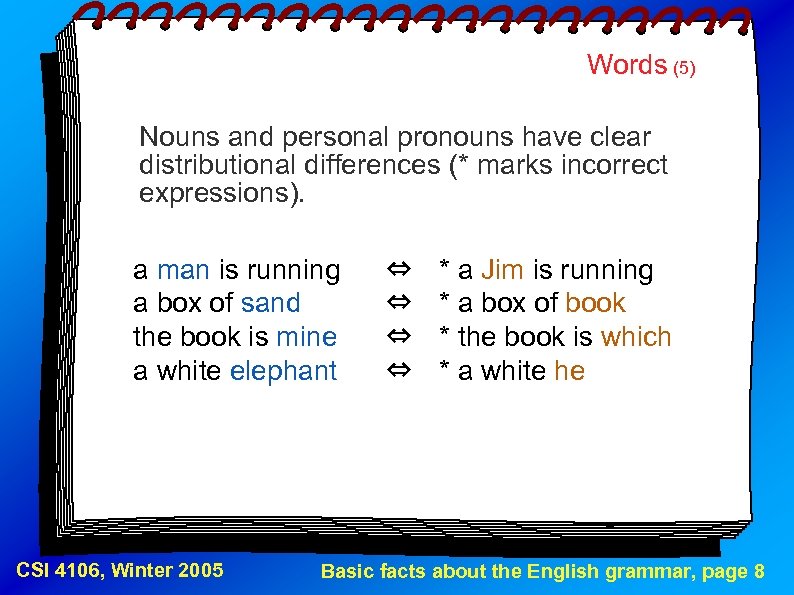
Words (5) Nouns and personal pronouns have clear distributional differences (* marks incorrect expressions). a man is running a box of sand the book is mine a white elephant CSI 4106, Winter 2005 ⇔ ⇔ * a Jim is running * a box of book * the book is which * a white he Basic facts about the English grammar, page 8
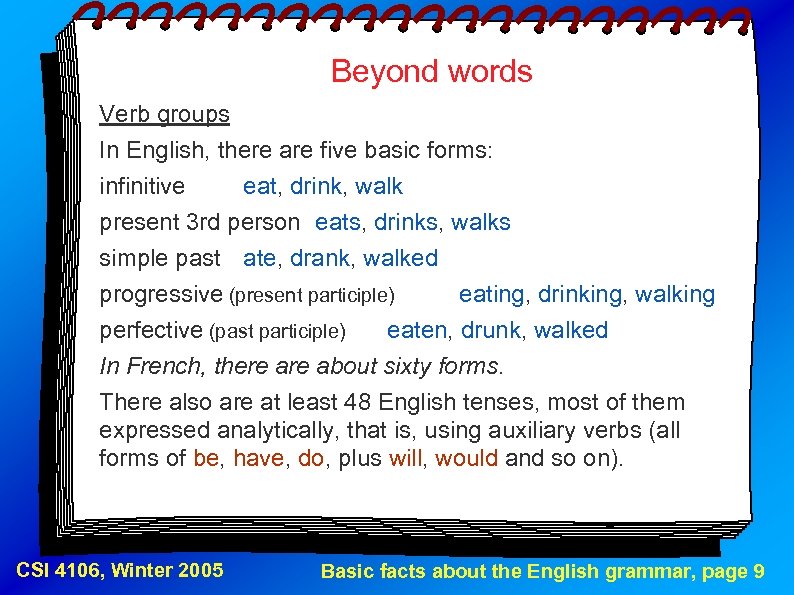
Beyond words Verb groups In English, there are five basic forms: infinitive eat, drink, walk present 3 rd person eats, drinks, walks simple past ate, drank, walked progressive (present participle) eating, drinking, walking perfective (past participle) eaten, drunk, walked In French, there about sixty forms. There also are at least 48 English tenses, most of them expressed analytically, that is, using auxiliary verbs (all forms of be, have, do, plus will, would and so on). CSI 4106, Winter 2005 Basic facts about the English grammar, page 9
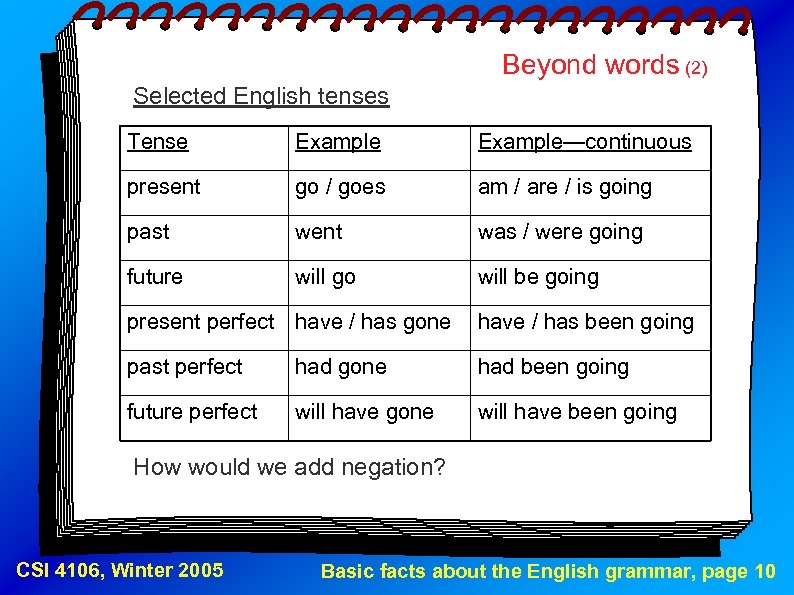
Beyond words (2) Selected English tenses Tense Example—continuous present go / goes am / are / is going past went was / were going future will go will be going present perfect have / has gone have / has been going past perfect had gone had been going future perfect will have gone will have been going How would we add negation? CSI 4106, Winter 2005 Basic facts about the English grammar, page 10
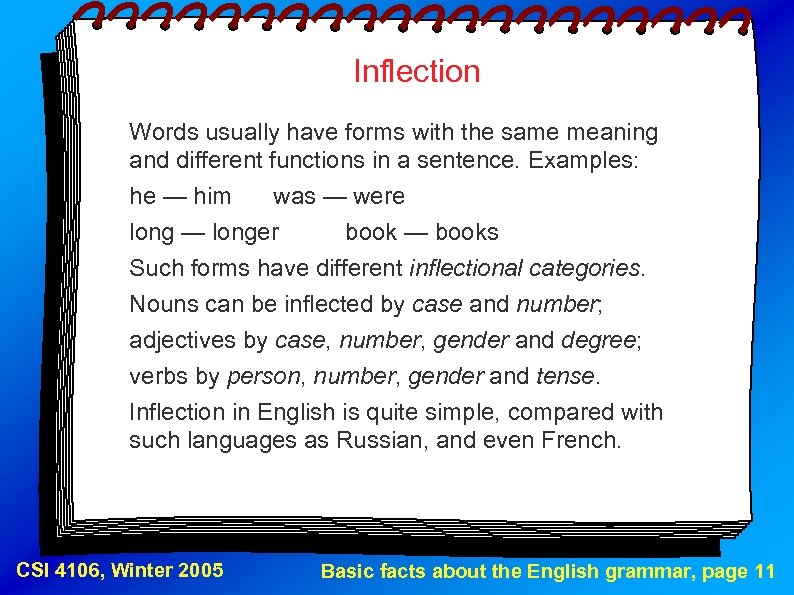
Inflection Words usually have forms with the same meaning and different functions in a sentence. Examples: he — him was — were long — longer book — books Such forms have different inflectional categories. Nouns can be inflected by case and number; adjectives by case, number, gender and degree; verbs by person, number, gender and tense. Inflection in English is quite simple, compared with such languages as Russian, and even French. CSI 4106, Winter 2005 Basic facts about the English grammar, page 11
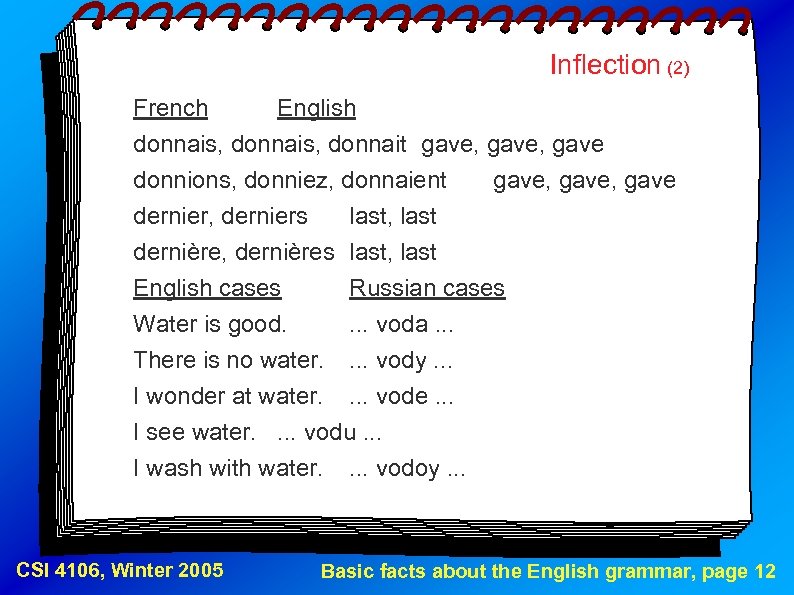
Inflection (2) French English donnais, donnait gave, gave donnions, donniez, donnaient gave, gave dernier, derniers last, last dernière, dernières last, last English cases Russian cases Water is good. . voda. . . There is no water. . vody. . . I wonder at water. . vode. . . I see water. . vodu. . . I wash with water. . vodoy. . . CSI 4106, Winter 2005 Basic facts about the English grammar, page 12
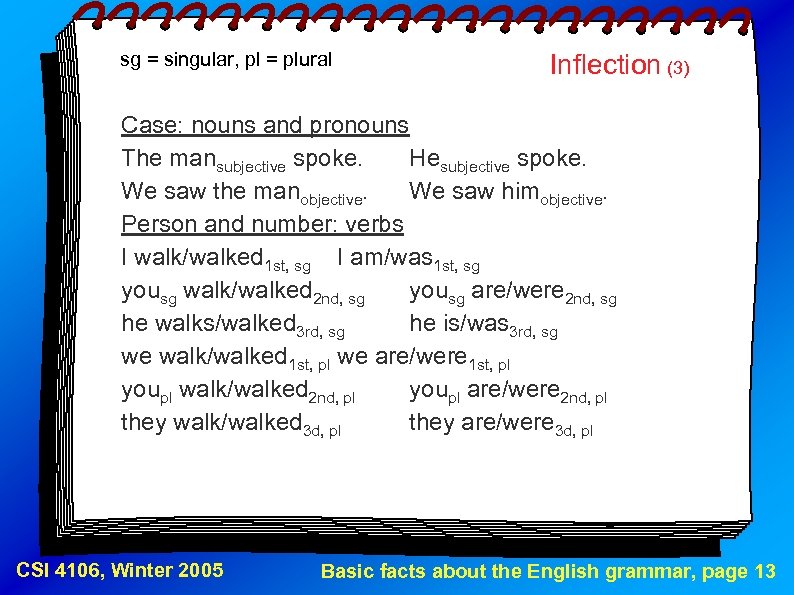
sg = singular, pl = plural Inflection (3) Case: nouns and pronouns The mansubjective spoke. Hesubjective spoke. We saw the manobjective. We saw himobjective. Person and number: verbs I walk/walked 1 st, sg I am/was 1 st, sg yousg walk/walked 2 nd, sg yousg are/were 2 nd, sg he walks/walked 3 rd, sg he is/was 3 rd, sg we walk/walked 1 st, pl we are/were 1 st, pl youpl walk/walked 2 nd, pl youpl are/were 2 nd, pl they walk/walked 3 d, pl they are/were 3 d, pl CSI 4106, Winter 2005 Basic facts about the English grammar, page 13
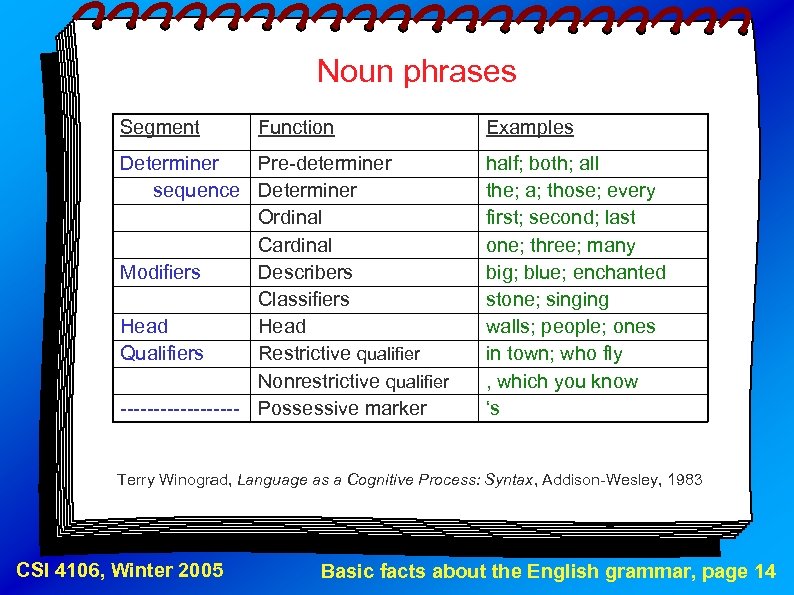
Noun phrases Segment Function Determiner Pre-determiner sequence Determiner Ordinal Cardinal Modifiers Describers Classifiers Head Qualifiers Restrictive qualifier Nonrestrictive qualifier --------- Possessive marker Examples half; both; all the; a; those; every first; second; last one; three; many big; blue; enchanted stone; singing walls; people; ones in town; who fly , which you know ‘s Terry Winograd, Language as a Cognitive Process: Syntax, Addison-Wesley, 1983 CSI 4106, Winter 2005 Basic facts about the English grammar, page 14
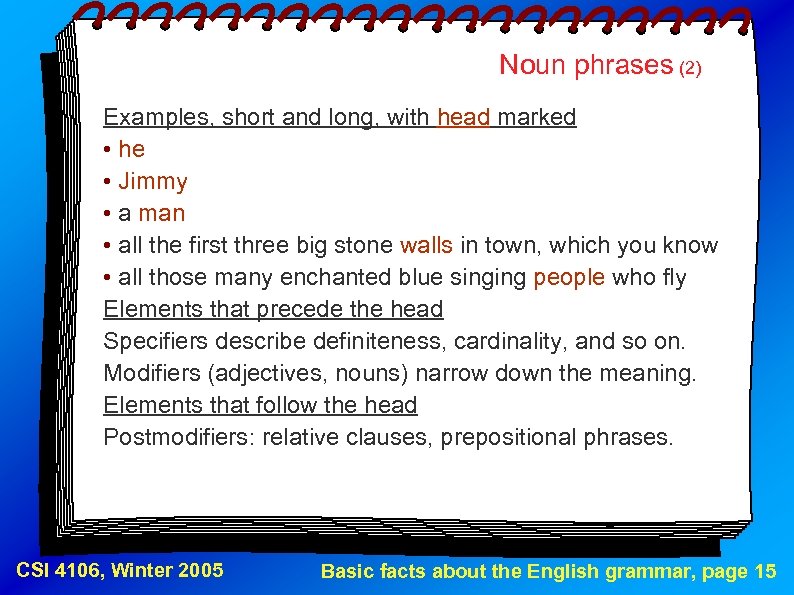
Noun phrases (2) Examples, short and long, with head marked • he • Jimmy • a man • all the first three big stone walls in town, which you know • all those many enchanted blue singing people who fly Elements that precede the head Specifiers describe definiteness, cardinality, and so on. Modifiers (adjectives, nouns) narrow down the meaning. Elements that follow the head Postmodifiers: relative clauses, prepositional phrases. CSI 4106, Winter 2005 Basic facts about the English grammar, page 15
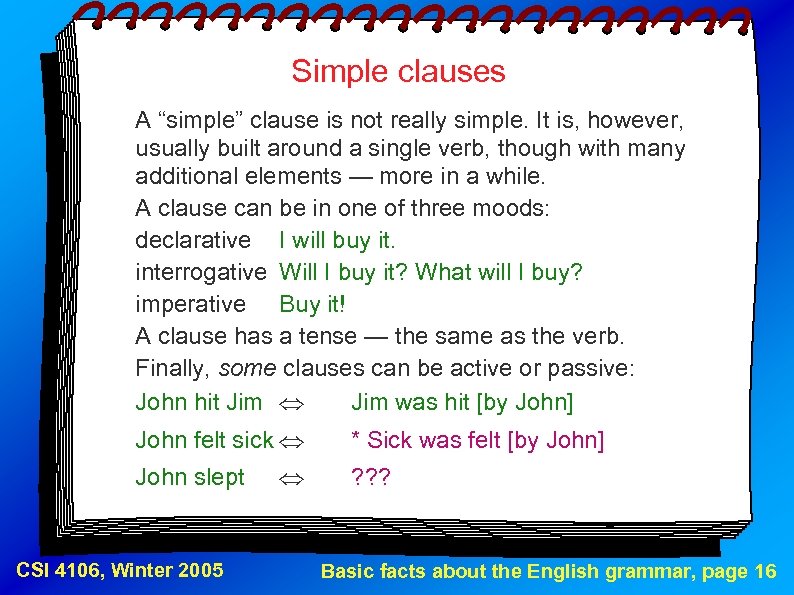
Simple clauses A “simple” clause is not really simple. It is, however, usually built around a single verb, though with many additional elements — more in a while. A clause can be in one of three moods: declarative I will buy it. interrogative Will I buy it? What will I buy? imperative Buy it! A clause has a tense — the same as the verb. Finally, some clauses can be active or passive: John hit Jim was hit [by John] John felt sick John slept CSI 4106, Winter 2005 * Sick was felt [by John] ? ? ? Basic facts about the English grammar, page 16
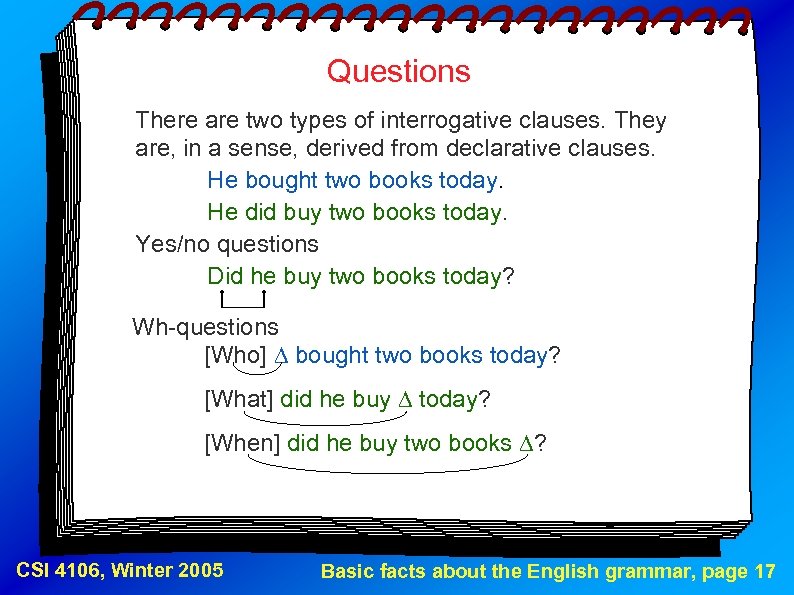
Questions There are two types of interrogative clauses. They are, in a sense, derived from declarative clauses. He bought two books today. He did buy two books today. Yes/no questions Did he buy two books today? Wh-questions [Who] bought two books today? [What] did he buy today? [When] did he buy two books ? CSI 4106, Winter 2005 Basic facts about the English grammar, page 17
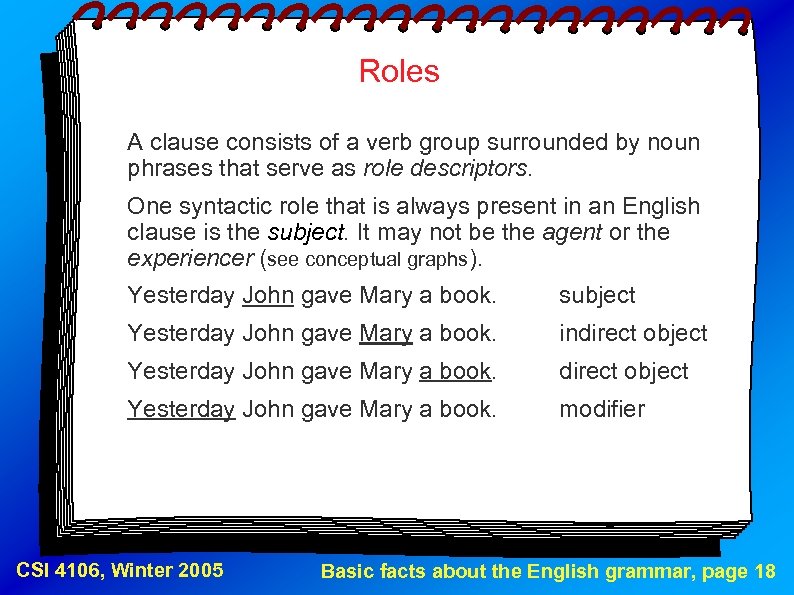
Roles A clause consists of a verb group surrounded by noun phrases that serve as role descriptors. One syntactic role that is always present in an English clause is the subject. It may not be the agent or the experiencer (see conceptual graphs). Yesterday John gave Mary a book. subject Yesterday John gave Mary a book. indirect object Yesterday John gave Mary a book. modifier CSI 4106, Winter 2005 Basic facts about the English grammar, page 18
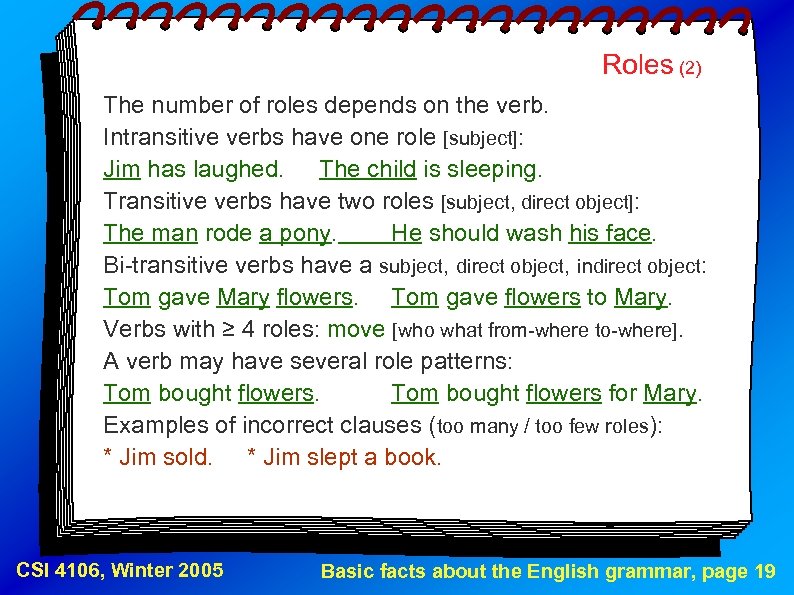
Roles (2) The number of roles depends on the verb. Intransitive verbs have one role [subject]: Jim has laughed. The child is sleeping. Transitive verbs have two roles [subject, direct object]: The man rode a pony. He should wash his face. Bi-transitive verbs have a subject, direct object, indirect object: Tom gave Mary flowers. Tom gave flowers to Mary. Verbs with ≥ 4 roles: move [who what from-where to-where]. A verb may have several role patterns: Tom bought flowers for Mary. Examples of incorrect clauses (too many / too few roles): * Jim sold. * Jim slept a book. CSI 4106, Winter 2005 Basic facts about the English grammar, page 19
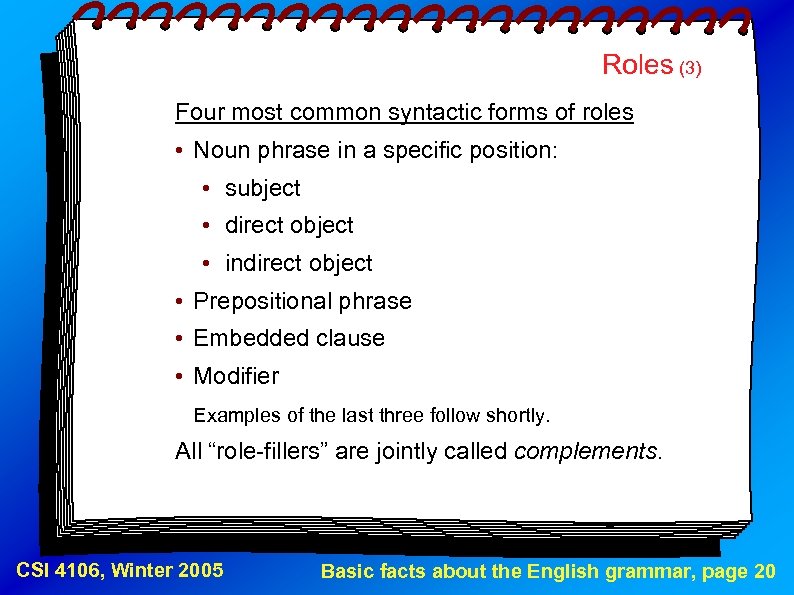
Roles (3) Four most common syntactic forms of roles • Noun phrase in a specific position: • subject • direct object • indirect object • Prepositional phrase • Embedded clause • Modifier Examples of the last three follow shortly. All “role-fillers” are jointly called complements. CSI 4106, Winter 2005 Basic facts about the English grammar, page 20
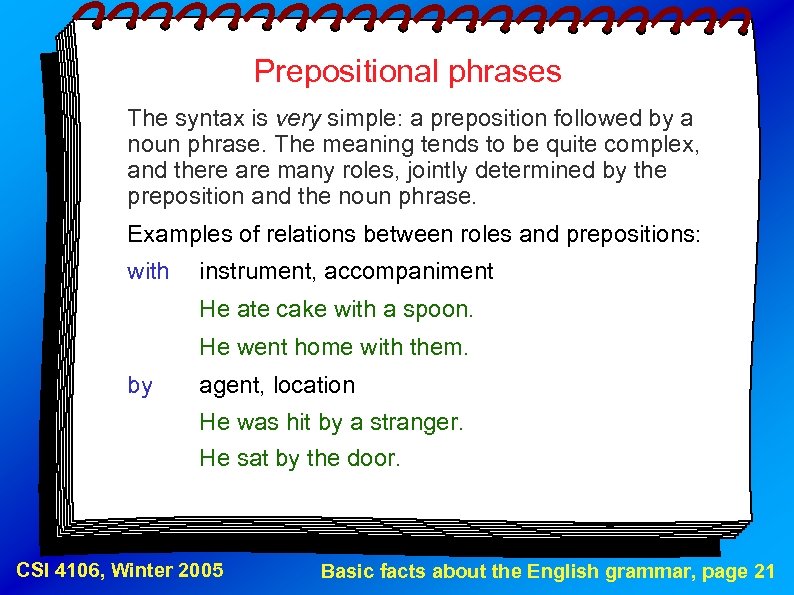
Prepositional phrases The syntax is very simple: a preposition followed by a noun phrase. The meaning tends to be quite complex, and there are many roles, jointly determined by the preposition and the noun phrase. Examples of relations between roles and prepositions: with instrument, accompaniment He ate cake with a spoon. He went home with them. by agent, location He was hit by a stranger. He sat by the door. CSI 4106, Winter 2005 Basic facts about the English grammar, page 21
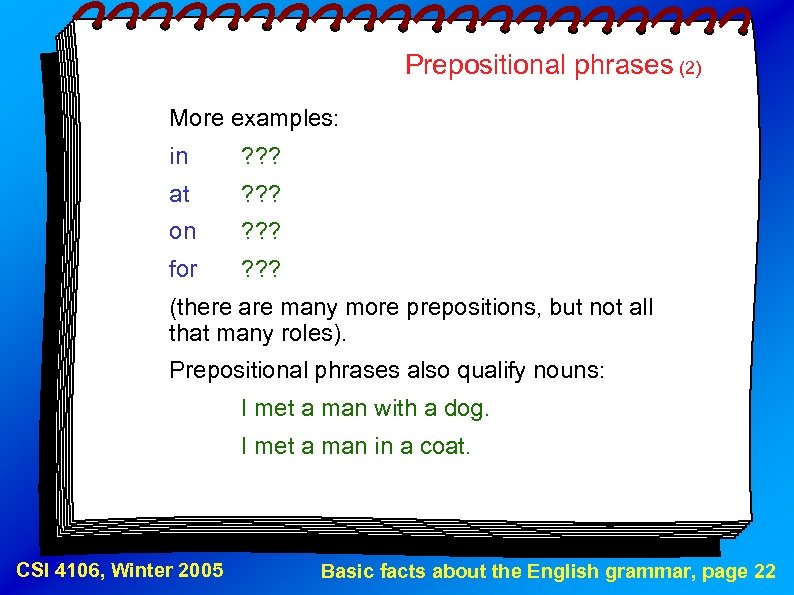
Prepositional phrases (2) More examples: in ? ? ? at ? ? ? on ? ? ? for ? ? ? (there are many more prepositions, but not all that many roles). Prepositional phrases also qualify nouns: I met a man with a dog. I met a man in a coat. CSI 4106, Winter 2005 Basic facts about the English grammar, page 22
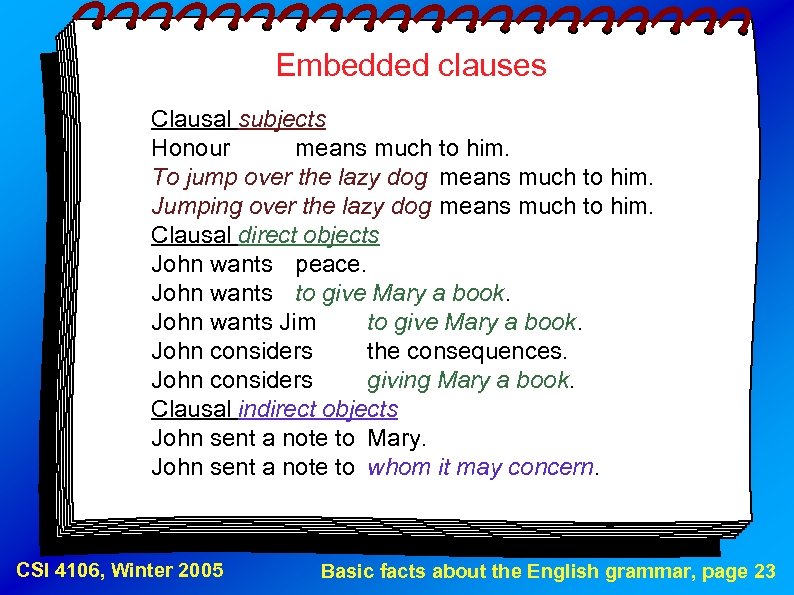
Embedded clauses Clausal subjects Honour means much to him. To jump over the lazy dog means much to him. Jumping over the lazy dog means much to him. Clausal direct objects John wants peace. John wants to give Mary a book. John wants Jim to give Mary a book. John considers the consequences. John considers giving Mary a book. Clausal indirect objects John sent a note to Mary. John sent a note to whom it may concern. CSI 4106, Winter 2005 Basic facts about the English grammar, page 23
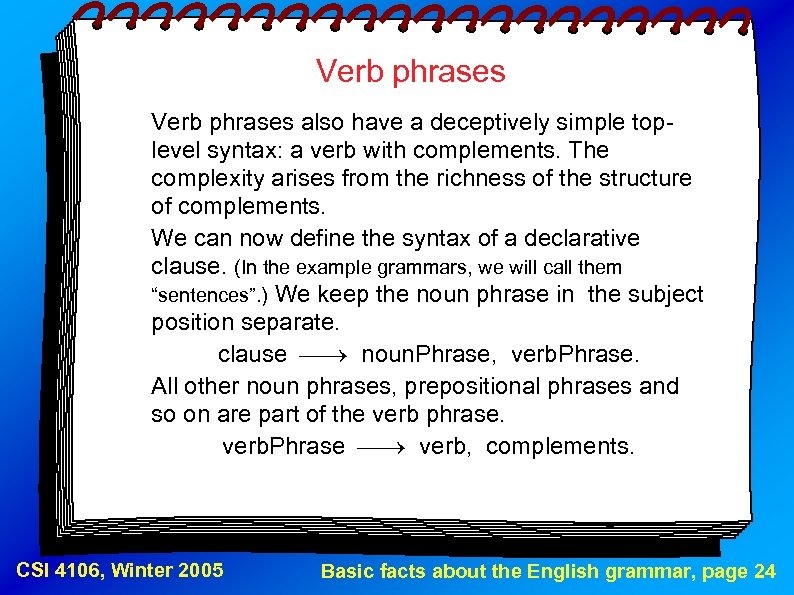
Verb phrases also have a deceptively simple toplevel syntax: a verb with complements. The complexity arises from the richness of the structure of complements. We can now define the syntax of a declarative clause. (In the example grammars, we will call them “sentences”. ) We keep the noun phrase in the subject position separate. clause noun. Phrase, verb. Phrase. All other noun phrases, prepositional phrases and so on are part of the verb phrase. verb. Phrase verb, complements. CSI 4106, Winter 2005 Basic facts about the English grammar, page 24
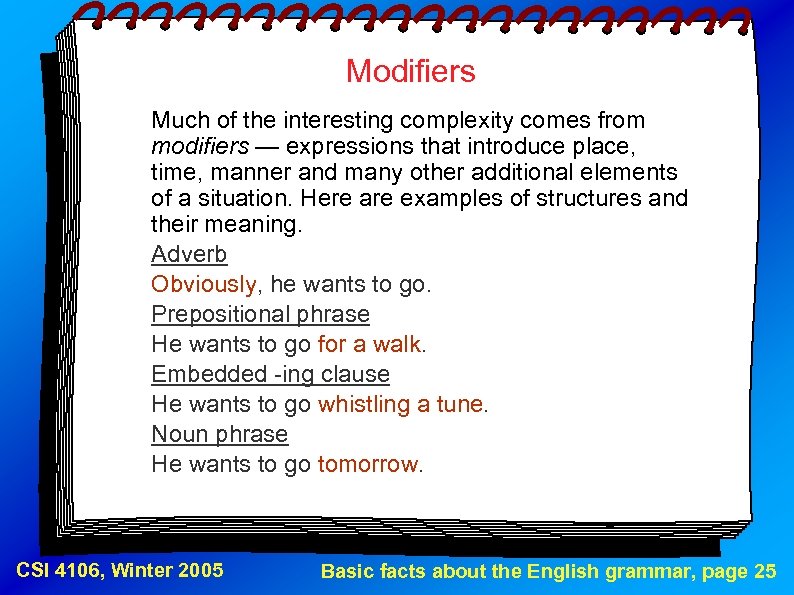
Modifiers Much of the interesting complexity comes from modifiers — expressions that introduce place, time, manner and many other additional elements of a situation. Here are examples of structures and their meaning. Adverb Obviously, he wants to go. Prepositional phrase He wants to go for a walk. Embedded -ing clause He wants to go whistling a tune. Noun phrase He wants to go tomorrow. CSI 4106, Winter 2005 Basic facts about the English grammar, page 25
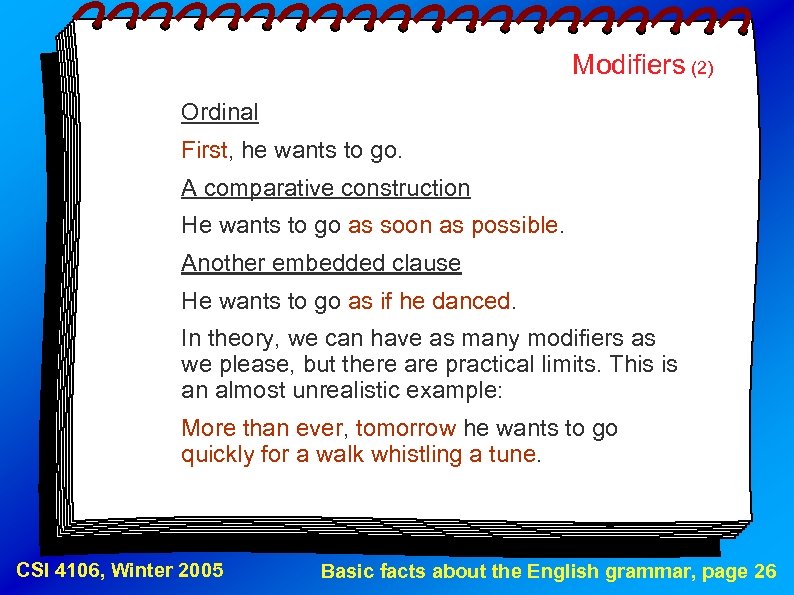
Modifiers (2) Ordinal First, he wants to go. A comparative construction He wants to go as soon as possible. Another embedded clause He wants to go as if he danced. In theory, we can have as many modifiers as we please, but there are practical limits. This is an almost unrealistic example: More than ever, tomorrow he wants to go quickly for a walk whistling a tune. CSI 4106, Winter 2005 Basic facts about the English grammar, page 26
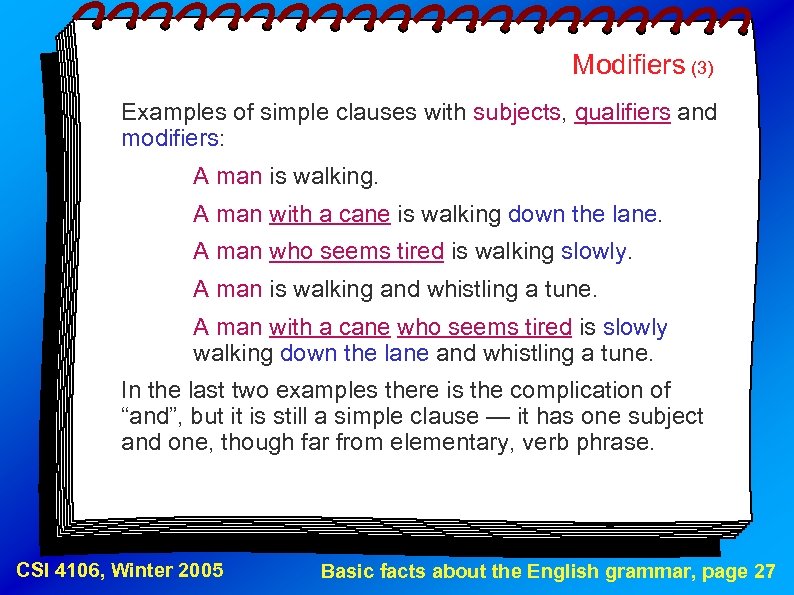
Modifiers (3) Examples of simple clauses with subjects, qualifiers and modifiers: A man is walking. A man with a cane is walking down the lane. A man who seems tired is walking slowly. A man is walking and whistling a tune. A man with a cane who seems tired is slowly walking down the lane and whistling a tune. In the last two examples there is the complication of “and”, but it is still a simple clause — it has one subject and one, though far from elementary, verb phrase. CSI 4106, Winter 2005 Basic facts about the English grammar, page 27
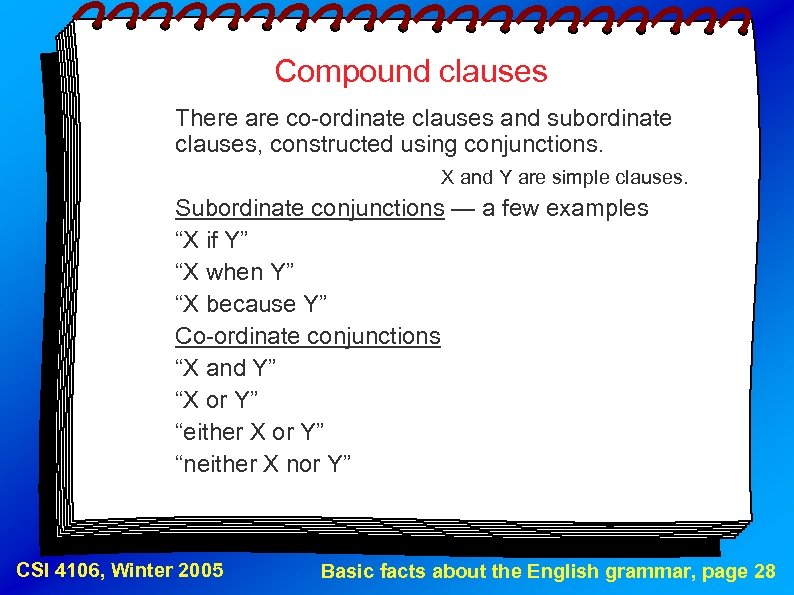
Compound clauses There are co-ordinate clauses and subordinate clauses, constructed using conjunctions. X and Y are simple clauses. Subordinate conjunctions — a few examples “X if Y” “X when Y” “X because Y” Co-ordinate conjunctions “X and Y” “X or Y” “either X or Y” “neither X nor Y” CSI 4106, Winter 2005 Basic facts about the English grammar, page 28
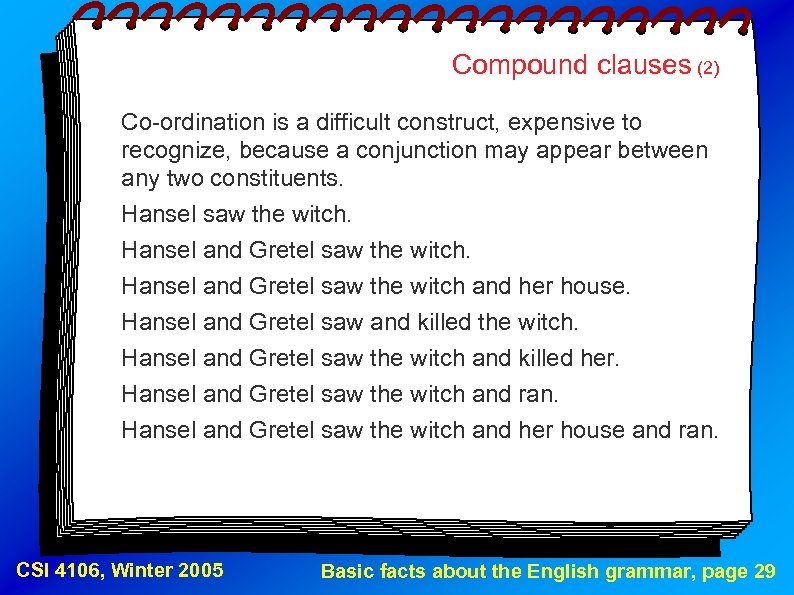
Compound clauses (2) Co-ordination is a difficult construct, expensive to recognize, because a conjunction may appear between any two constituents. Hansel saw the witch. Hansel and Gretel saw the witch and her house. Hansel and Gretel saw and killed the witch. Hansel and Gretel saw the witch and killed her. Hansel and Gretel saw the witch and ran. Hansel and Gretel saw the witch and her house and ran. CSI 4106, Winter 2005 Basic facts about the English grammar, page 29
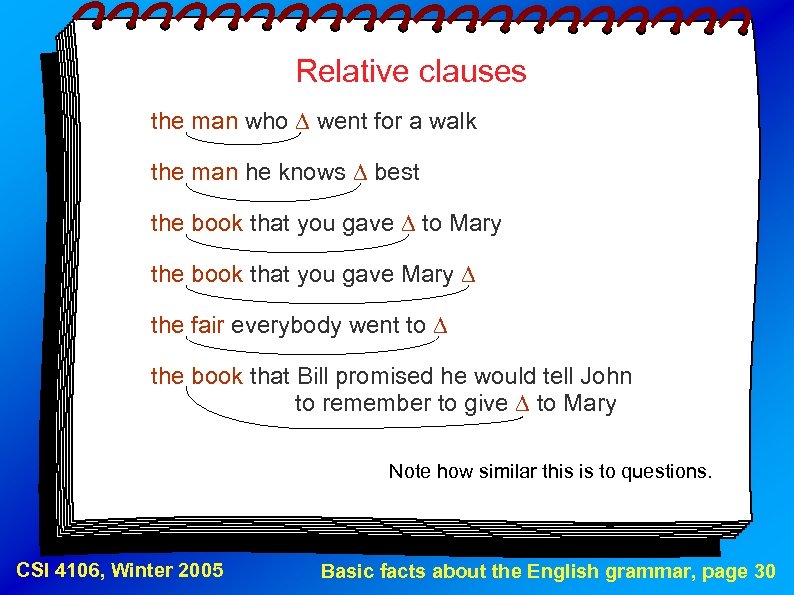
Relative clauses the man who ∆ went for a walk the man he knows ∆ best the book that you gave ∆ to Mary the book that you gave Mary ∆ the fair everybody went to ∆ the book that Bill promised he would tell John to remember to give ∆ to Mary Note how similar this is to questions. CSI 4106, Winter 2005 Basic facts about the English grammar, page 30
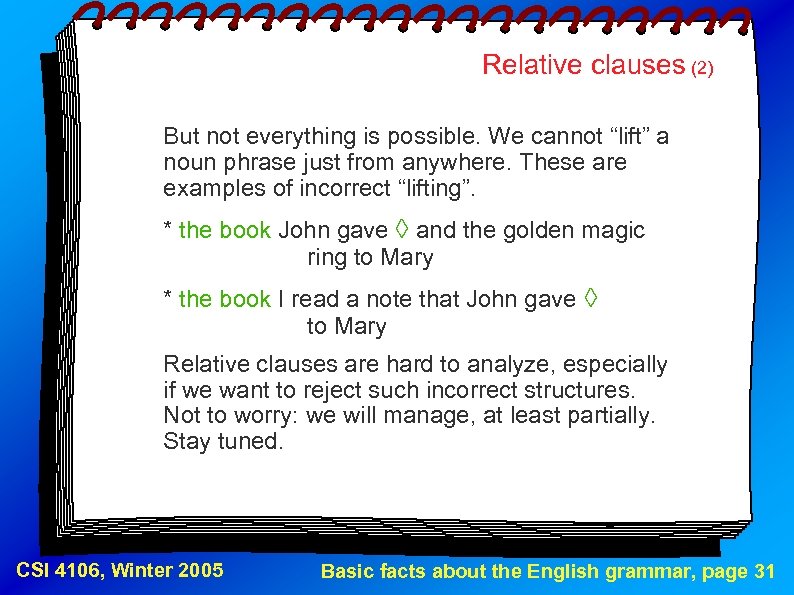
Relative clauses (2) But not everything is possible. We cannot “lift” a noun phrase just from anywhere. These are examples of incorrect “lifting”. * the book John gave ◊ and the golden magic ring to Mary * the book I read a note that John gave ◊ to Mary Relative clauses are hard to analyze, especially if we want to reject such incorrect structures. Not to worry: we will manage, at least partially. Stay tuned. CSI 4106, Winter 2005 Basic facts about the English grammar, page 31
Скачать презентацию Basics of the grammar of English Words
b73716b58b49d41ea04fcf83e78e171a.ppt