 Скачать презентацию Basics of Rietveld Refinement Scott A Speakman 13
dcaaff71b0ebe75d49034b46aca2ece2.ppt
- Количество слайдов: 25



Basics of Rietveld Refinement Scott A Speakman 13 -4009 A x 3 -6887 speakman@mit. edu
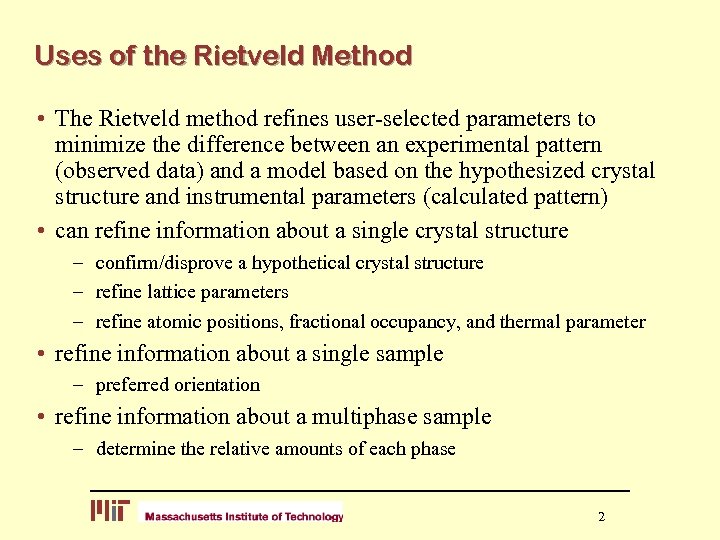
Uses of the Rietveld Method • The Rietveld method refines user-selected parameters to minimize the difference between an experimental pattern (observed data) and a model based on the hypothesized crystal structure and instrumental parameters (calculated pattern) • can refine information about a single crystal structure – confirm/disprove a hypothetical crystal structure – refine lattice parameters – refine atomic positions, fractional occupancy, and thermal parameter • refine information about a single sample – preferred orientation • refine information about a multiphase sample – determine the relative amounts of each phase 2
Requirements of Rietveld Method • High quality experimental diffraction pattern • a structure model that makes physical and chemical sense • suitable peak and background functions 3
Obtaining High Quality Data • issues to consider – aligned and calibrated instrument – beam overflow problems – thin specimen error – good counting statistics – appropriate step size – sample transparency – surface roughness – preferred orientation – particle size • go to XRD Basics pg 102 4
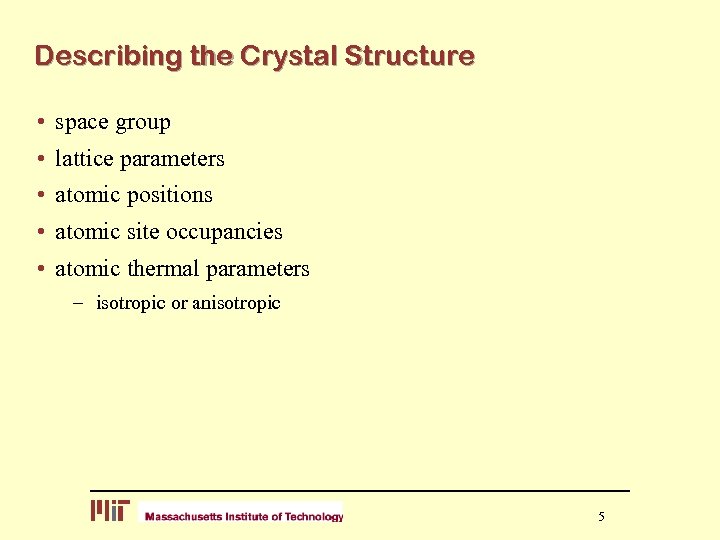
Describing the Crystal Structure • space group • lattice parameters • atomic positions • atomic site occupancies • atomic thermal parameters – isotropic or anisotropic 5
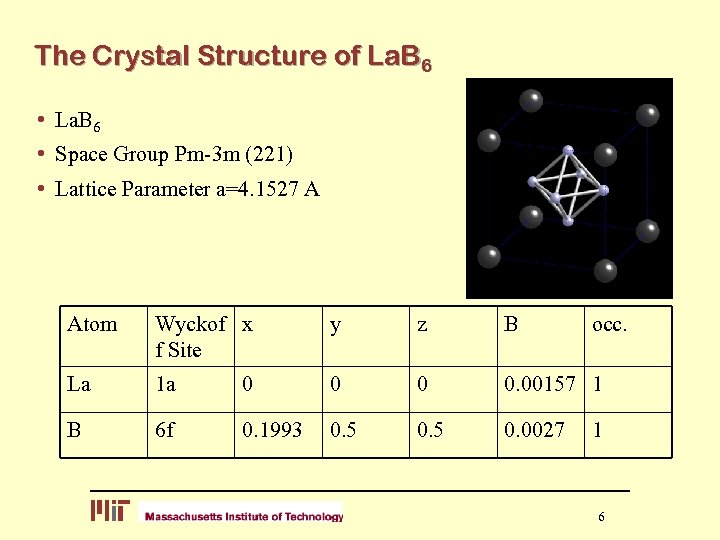
The Crystal Structure of La. B 6 • Space Group Pm-3 m (221) • Lattice Parameter a=4. 1527 A Atom Wyckof x f Site y z B occ. La 1 a 0 0. 00157 1 B 6 f 0. 1993 0. 5 0. 0027 1 6
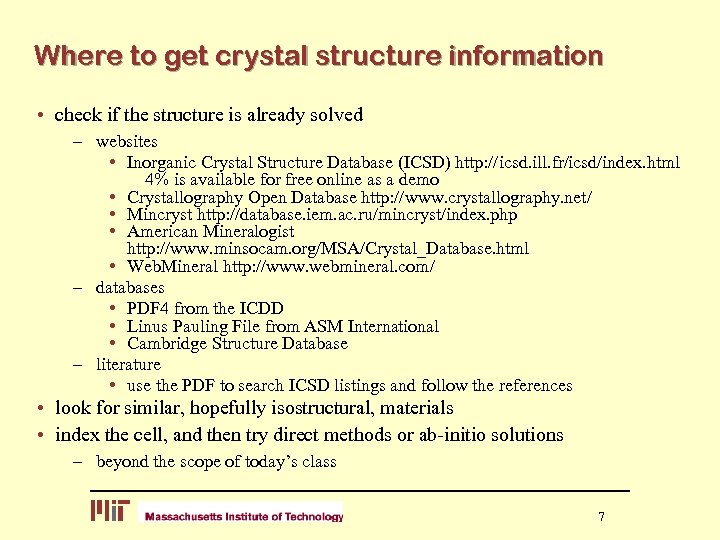
Where to get crystal structure information • check if the structure is already solved – websites • Inorganic Crystal Structure Database (ICSD) http: //icsd. ill. fr/icsd/index. html 4% is available for free online as a demo • Crystallography Open Database http: //www. crystallography. net/ • Mincryst http: //database. iem. ac. ru/mincryst/index. php • American Mineralogist http: //www. minsocam. org/MSA/Crystal_Database. html • Web. Mineral http: //www. webmineral. com/ – databases • PDF 4 from the ICDD • Linus Pauling File from ASM International • Cambridge Structure Database – literature • use the PDF to search ICSD listings and follow the references • look for similar, hopefully isostructural, materials • index the cell, and then try direct methods or ab-initio solutions – beyond the scope of today’s class 7
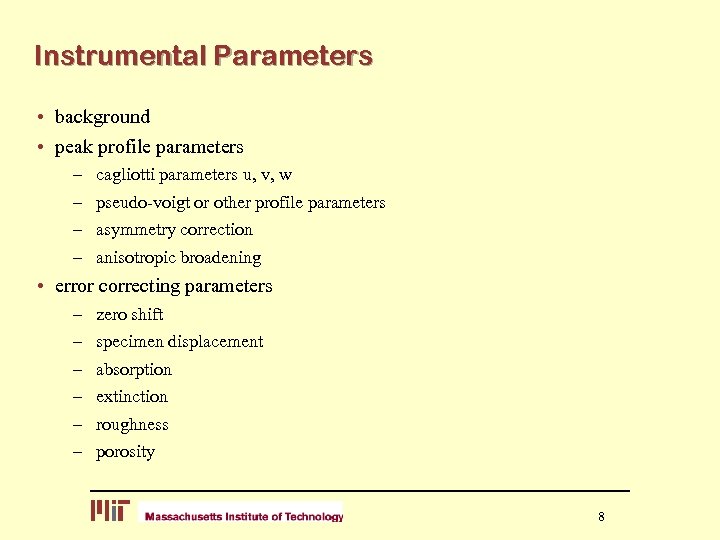
Instrumental Parameters • background • peak profile parameters – – cagliotti parameters u, v, w pseudo-voigt or other profile parameters asymmetry correction anisotropic broadening • error correcting parameters – – – zero shift specimen displacement absorption extinction roughness porosity 8
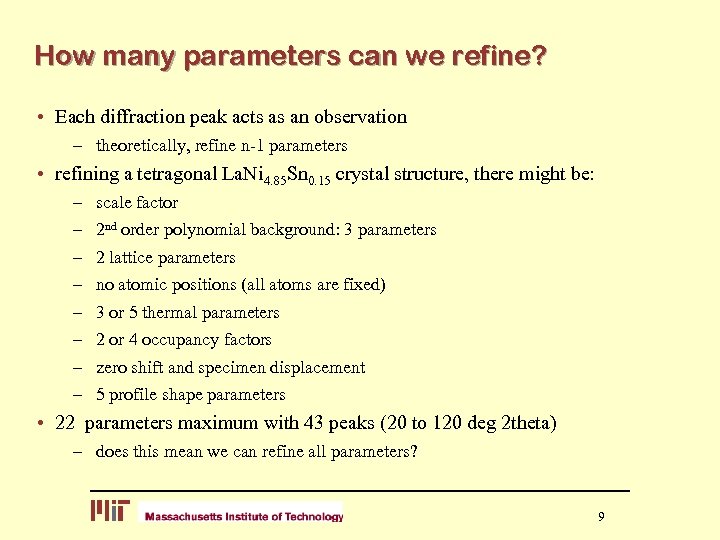
How many parameters can we refine? • Each diffraction peak acts as an observation – theoretically, refine n-1 parameters • refining a tetragonal La. Ni 4. 85 Sn 0. 15 crystal structure, there might be: – – – – scale factor 2 nd order polynomial background: 3 parameters 2 lattice parameters no atomic positions (all atoms are fixed) 3 or 5 thermal parameters 2 or 4 occupancy factors zero shift and specimen displacement 5 profile shape parameters • 22 parameters maximum with 43 peaks (20 to 120 deg 2 theta) – does this mean we can refine all parameters? 9
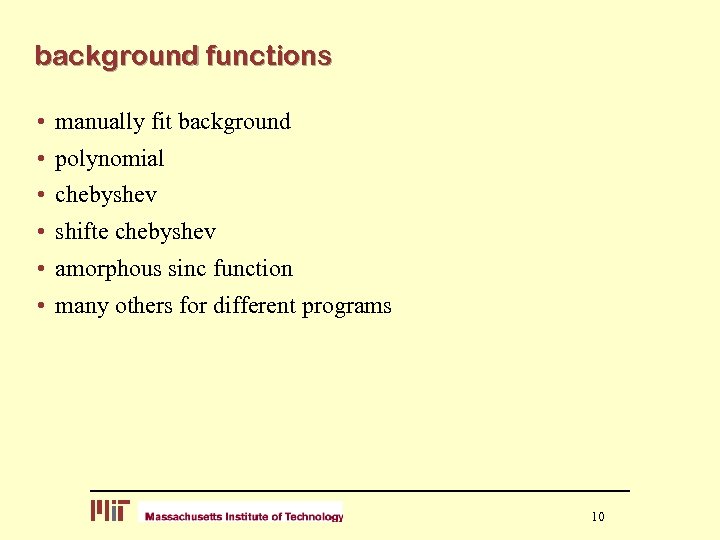
background functions • manually fit background • polynomial • chebyshev • shifte chebyshev • amorphous sinc function • many others for different programs 10
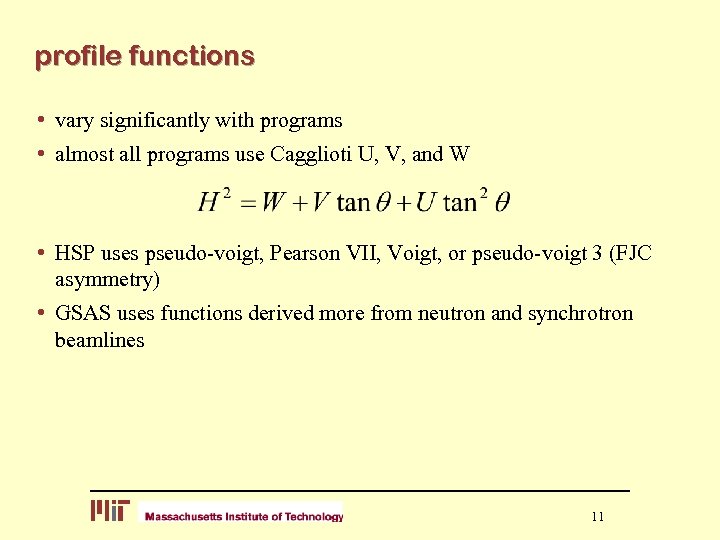
profile functions • vary significantly with programs • almost all programs use Cagglioti U, V, and W • HSP uses pseudo-voigt, Pearson VII, Voigt, or pseudo-voigt 3 (FJC asymmetry) • GSAS uses functions derived more from neutron and synchrotron beamlines 11
• go to parameters_calc_pattern. pdf 12
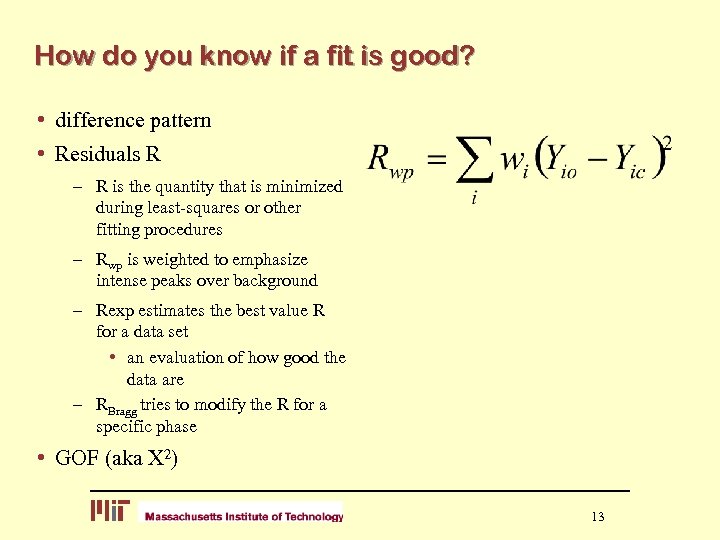
How do you know if a fit is good? • difference pattern • Residuals R – R is the quantity that is minimized during least-squares or other fitting procedures – Rwp is weighted to emphasize intense peaks over background – Rexp estimates the best value R for a data set • an evaluation of how good the data are – RBragg tries to modify the R for a specific phase • GOF (aka X 2) 13
Refinement Strategy • Rietveld methods fit a multivarialbe structure-background-profile model to experimental data – lots of potential for false minima, diverging solutions, etc • need to refine the most important variables first, then add more until an adequate solution is realized – a correct solution may not result … 14
Ray Young’s Refinement Strategy • • • scale factor zero shift or specimen displacement (not both) linear background lattice parameters more background peak width, w atom positions preferred orientation isotropic temperature factor B u, v, and other profile parameters anisotropic temperature factors 15
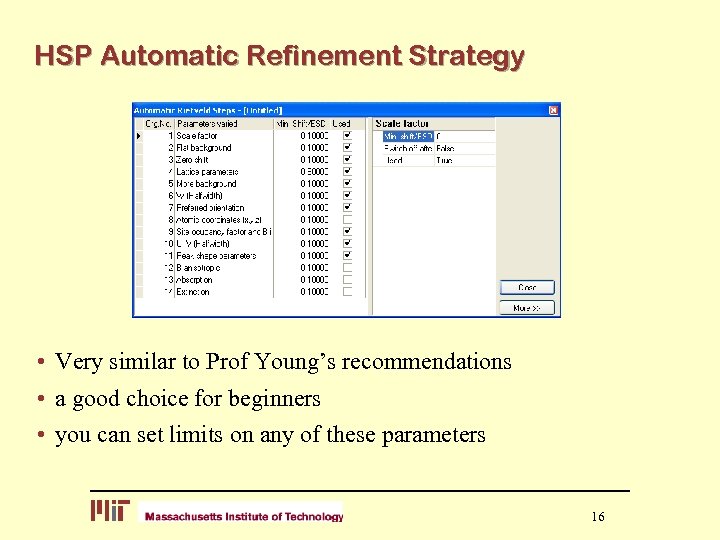
HSP Automatic Refinement Strategy • Very similar to Prof Young’s recommendations • a good choice for beginners • you can set limits on any of these parameters 16
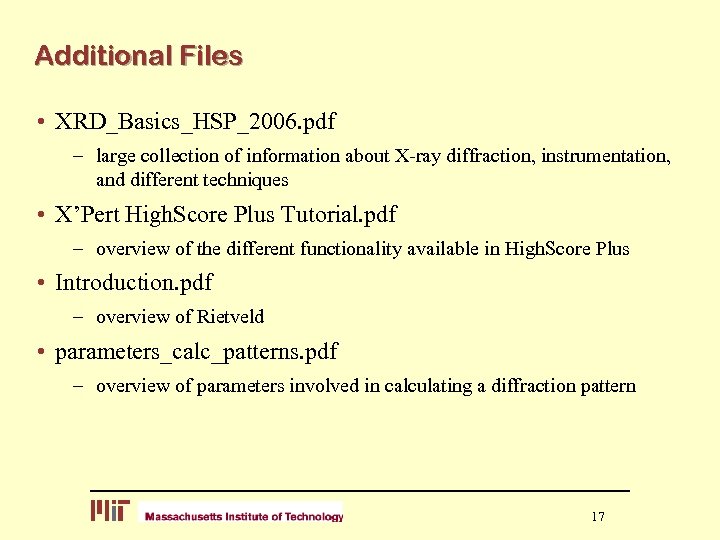
Additional Files • XRD_Basics_HSP_2006. pdf – large collection of information about X-ray diffraction, instrumentation, and different techniques • X’Pert High. Score Plus Tutorial. pdf – overview of the different functionality available in High. Score Plus • Introduction. pdf – overview of Rietveld • parameters_calc_patterns. pdf – overview of parameters involved in calculating a diffraction pattern 17
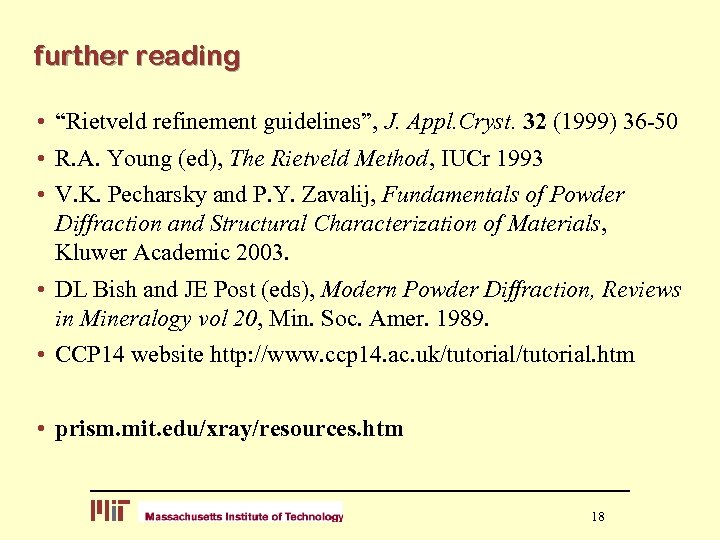
further reading • “Rietveld refinement guidelines”, J. Appl. Cryst. 32 (1999) 36 -50 • R. A. Young (ed), The Rietveld Method, IUCr 1993 • V. K. Pecharsky and P. Y. Zavalij, Fundamentals of Powder Diffraction and Structural Characterization of Materials, Kluwer Academic 2003. • DL Bish and JE Post (eds), Modern Powder Diffraction, Reviews in Mineralogy vol 20, Min. Soc. Amer. 1989. • CCP 14 website http: //www. ccp 14. ac. uk/tutorial. htm • prism. mit. edu/xray/resources. htm 18
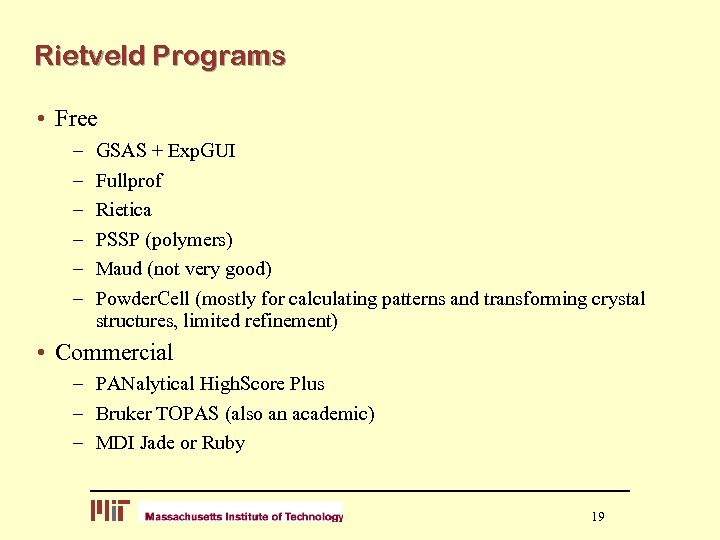
Rietveld Programs • Free – – – GSAS + Exp. GUI Fullprof Rietica PSSP (polymers) Maud (not very good) Powder. Cell (mostly for calculating patterns and transforming crystal structures, limited refinement) • Commercial – PANalytical High. Score Plus – Bruker TOPAS (also an academic) – MDI Jade or Ruby 19
Examples • Silicon • La. B 6 • intermetallic La. Ni 4. 85 Sn 0. 15 20
Silicon • Open the datafile in HSP • Add the structure model – insert the structure manually – import (insert) a struture file • usually use the CIF format– the ubiquitous standard for crystal structures • HSP can also import ICSD *. cry files and structures from other refinement programs • GSAS can import CIF or Powder. Cell files • try the automatic refinement • manually improve the fit 21
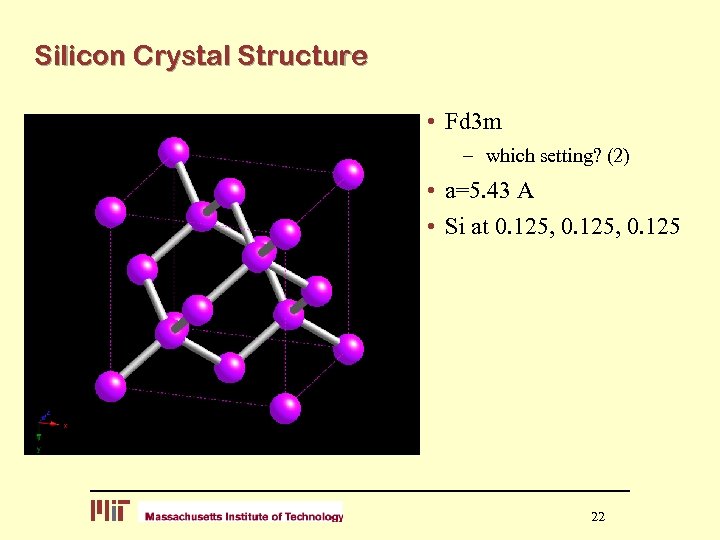
Silicon Crystal Structure • Fd 3 m – which setting? (2) • a=5. 43 A • Si at 0. 125, 0. 125 22
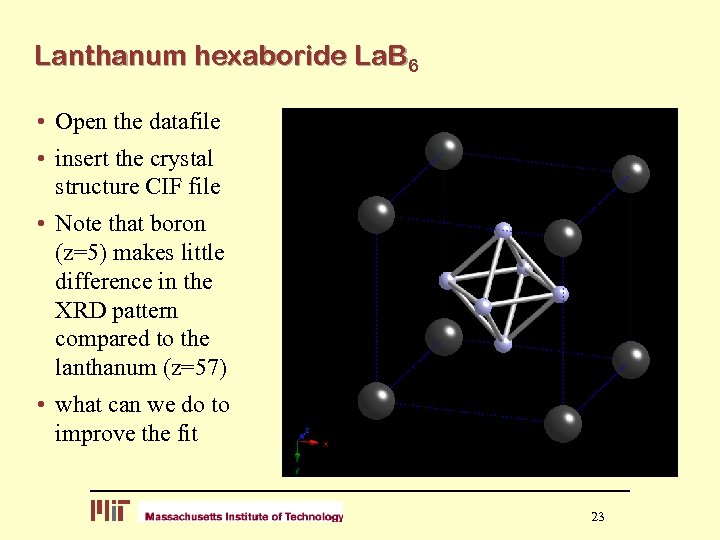
Lanthanum hexaboride La. B 6 • Open the datafile • insert the crystal structure CIF file • Note that boron (z=5) makes little difference in the XRD pattern compared to the lanthanum (z=57) • what can we do to improve the fit 23
La. Ni 4. 85 Sn 0. 15 • The data was taken from Chapter 6 of Fundamentals of Powder Diffraction and Structural Characterization of Materials, by Pecharsky and Zavalij • The structure is a bit more complex that our earlier example, which allows us to explore more features of High. Score Plus • The data (Ch 6_1. raw) is in GSAS format, which can be read into High. Score Plus • I have also included a CIF file from the ICSD (#104685) with all the main features of the structure described 24
Issue to Consider • How can I work without knowledge of the structure? – Use Le. Bail or Pawley method to determine lattice parameters – Try indexing and solving the structure using the High. Score Plus tools – You will find that there are 16 possible space groups for this material, but picking the most common (and simplest) choice, P 6/mmm, is the right way to go • Where do I put the atoms? – You can use a Fourier map to find out wherein the structure the electron densities are greatest. Put the heaviest atoms (La) at these sites, then work your way through the chemistry • What variables do I refine and in what sequence? – Take a look at the “automatic” option in HSP - this is not a bad strategy to use. We will go through these in detail… 25
Скачать презентацию Basics of Rietveld Refinement Scott A Speakman 13
dcaaff71b0ebe75d49034b46aca2ece2.ppt