 Скачать презентацию Basics of Management Sc D Prof Vladimir Momot
Basics of Management (2).pptx
- Количество слайдов: 116



Basics of Management Sc. D, Prof. Vladimir Momot (Alfred Nobel University)
Concept of Management Topic One
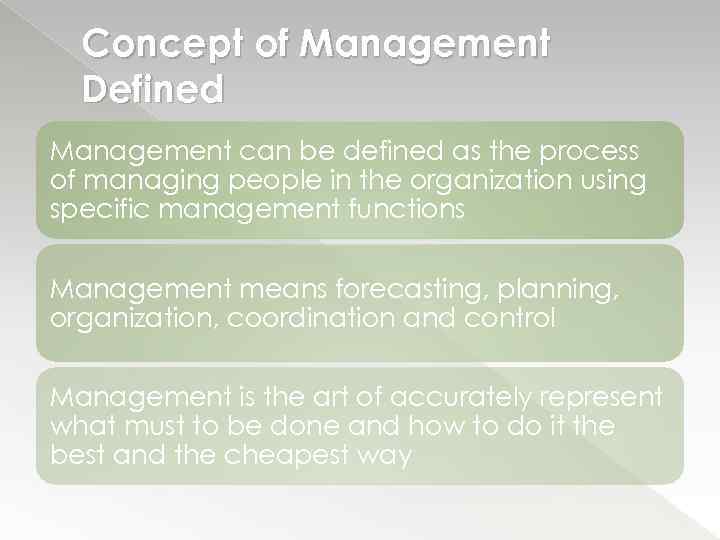
Concept of Management Defined Management can be defined as the process of managing people in the organization using specific management functions Management means forecasting, planning, organization, coordination and control Management is the art of accurately represent what must to be done and how to do it the best and the cheapest way
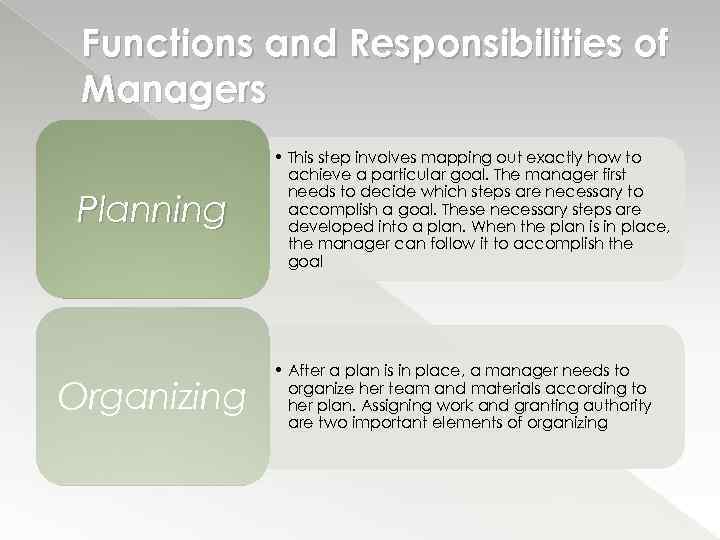
Functions and Responsibilities of Managers Planning Organizing • This step involves mapping out exactly how to achieve a particular goal. The manager first needs to decide which steps are necessary to accomplish a goal. These necessary steps are developed into a plan. When the plan is in place, the manager can follow it to accomplish the goal • After a plan is in place, a manager needs to organize her team and materials according to her plan. Assigning work and granting authority are two important elements of organizing
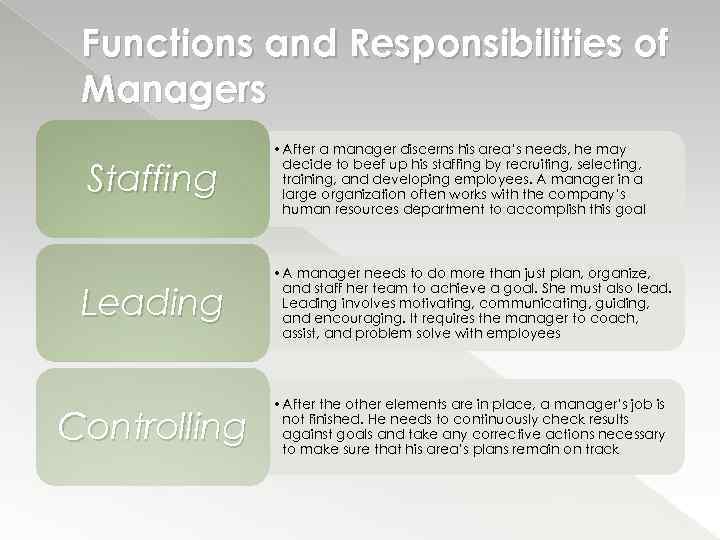
Functions and Responsibilities of Managers Staffing • After a manager discerns his area’s needs, he may decide to beef up his staffing by recruiting, selecting, training, and developing employees. A manager in a large organization often works with the company’s human resources department to accomplish this goal Leading • A manager needs to do more than just plan, organize, and staff her team to achieve a goal. She must also lead. Leading involves motivating, communicating, guiding, and encouraging. It requires the manager to coach, assist, and problem solve with employees Controlling • After the other elements are in place, a manager’s job is not finished. He needs to continuously check results against goals and take any corrective actions necessary to make sure that his area’s plans remain on track
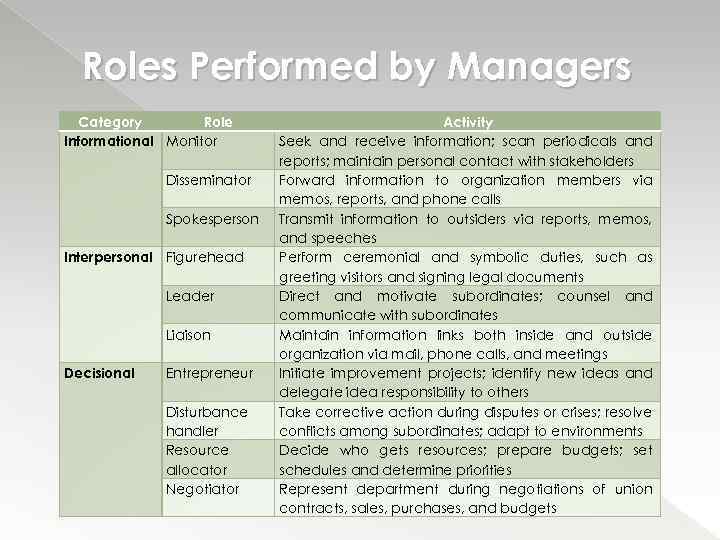
Roles Performed by Managers Category Role Informational Monitor Disseminator Spokesperson Interpersonal Figurehead Leader Liaison Decisional Entrepreneur Disturbance handler Resource allocator Negotiator Activity Seek and receive information; scan periodicals and reports; maintain personal contact with stakeholders Forward information to organization members via memos, reports, and phone calls Transmit information to outsiders via reports, memos, and speeches Perform ceremonial and symbolic duties, such as greeting visitors and signing legal documents Direct and motivate subordinates; counsel and communicate with subordinates Maintain information links both inside and outside organization via mail, phone calls, and meetings Initiate improvement projects; identify new ideas and delegate idea responsibility to others Take corrective action during disputes or crises; resolve conflicts among subordinates; adapt to environments Decide who gets resources; prepare budgets; set schedules and determine priorities Represent department during negotiations of union contracts, sales, purchases, and budgets
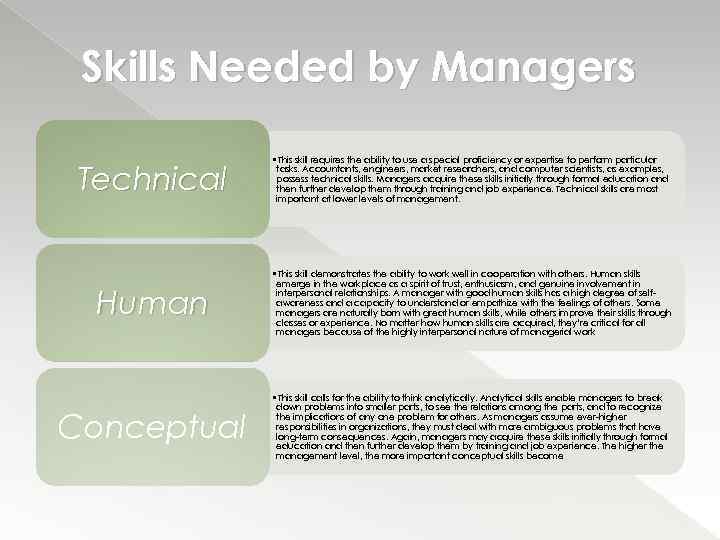
Skills Needed by Managers Technical • This skill requires the ability to use a special proficiency or expertise to perform particular tasks. Accountants, engineers, market researchers, and computer scientists, as examples, possess technical skills. Managers acquire these skills initially through formal education and then further develop them through training and job experience. Technical skills are most important at lower levels of management. • This skill demonstrates the ability to work well in cooperation with others. Human skills Human emerge in the workplace as a spirit of trust, enthusiasm, and genuine involvement in interpersonal relationships. A manager with good human skills has a high degree of selfawareness and a capacity to understand or empathize with the feelings of others. Some managers are naturally born with great human skills, while others improve their skills through classes or experience. No matter how human skills are acquired, they’re critical for all managers because of the highly interpersonal nature of managerial work • This skill calls for the ability to think analytically. Analytical skills enable managers to break Conceptual down problems into smaller parts, to see the relations among the parts, and to recognize the implications of any one problem for others. As managers assume ever-higher responsibilities in organizations, they must deal with more ambiguous problems that have long-term consequences. Again, managers may acquire these skills initially through formal education and then further develop them by training and job experience. The higher the management level, the more important conceptual skills become
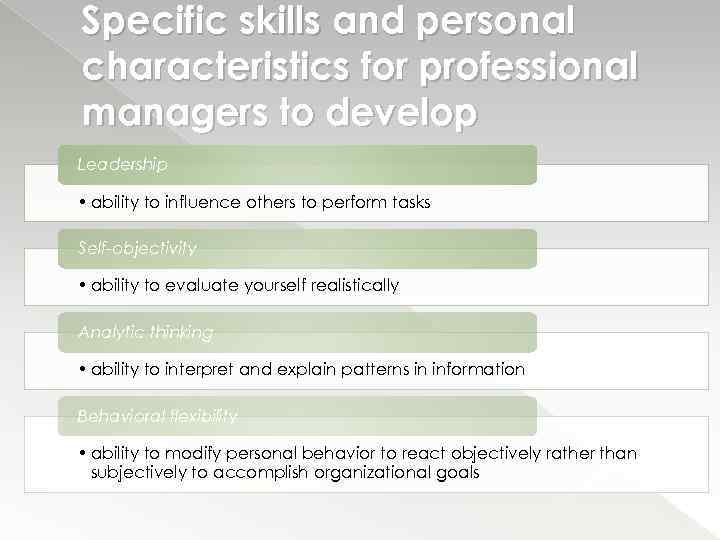
Specific skills and personal characteristics for professional managers to develop Leadership • ability to influence others to perform tasks Self objectivity • ability to evaluate yourself realistically Analytic thinking • ability to interpret and explain patterns in information Behavioral flexibility • ability to modify personal behavior to react objectively rather than subjectively to accomplish organizational goals
Specific skills and personal characteristics for professional managers to develop Oral communication • ability to express ideas clearly in words Written communication • ability to express ideas clearly in writing Personal impact • ability to create a good impression and instill confidence Resistance to stress • ability to perform under stressful conditions Tolerance for uncertainty • ability to perform in ambiguous situations
Differences between a manager and an entrepreneur The main reason for an entrepreneur to start a business enterprise is because he comprehends the venture for his individual satisfaction and has personal stake in it where as a manager provides his services in an enterprise established by someone An entrepreneur and a manager differ in their standing, an entrepreneur is the owner of the organization and he bears all the risk and uncertainties involved in running an organization where as a manager is an employee and does not accept any risk
Differences between a manager and an entrepreneur An entrepreneur and a manager differ in their objectives. Entrepreneur’s objective is to innovate and create and he acts as a change agent where as a manager’s objective is to supervise and create routines. He implements the entrepreneur’s plans and ideas An entrepreneur is faced with more income uncertainties as his income is contingent on the performance of the firm where as a manager’s compensation is less dependent on the performance of the organization.
Differences between a manager and an entrepreneur An entrepreneur is not induced to involve in fraudulent behavior where as a manger does. A manager may cheat by not working hard because his income is not tied up to the performance of the organization. Entrepreneur is required to have certain qualifications and qualities like high accomplishment motive, innovative thinking, forethought, risk-bearing ability etc. Conversely it’s mandatory for a manager to be educated in the fields of management theories and practices. An entrepreneur deals with faults and failures as a part of learning experience where as a manager make every effort to avoid mistakes and he postpones failure.
Differences between a manager and an entrepreneur Behavioral Differences • The typical entrepreneur wants to "be in control" of his life (which is often the reason why he started the business), of his business and especially of his employees • The professional manager, on the other hand, enters a company which needs to delegate authority, since it has reached the stage in its development where the entrepreneur can no longer "do it all himself" Management Style • The entrepreneurial management style is very demanding, leaving very little room for error, and none at all for actual failures, since in most cases the business is a "one man show", even if there are other employees. • The professional manager, however, must be tolerant of failure (and see it as a basis for learning) and develop an administrative team, since a basic assumption is that responsibility in the organization must pass from the "allknowing" entrepreneur to people who still have to learn about the business
Differences between a manager and an entrepreneur The Moving Force • Entrepreneurial management is characterized by concepts such as "entrepreneurship", "creativity", "innovation", and so on, indicators of the desire to create "something from nothing". • Professional management is characterized by concepts such as "order", "organization", "procedures", and so on, indicating the desire to organize and maintain what exists Growth • Entrepreneurial management is noted for its ability to react quickly and effectively to new business opportunities. This ability is the foundation for rapid growth of the company in its entrepreneurial stage. • Professional management is noted for medium and long term strategic planning, which leads to controlled growth of the company during the process of establishment
Differences between a manager and an entrepreneur Organizational Structure • The entrepreneurial organization is characterized by its informal, flexible structure, which allows it to adapt to changes required by its rapid growth. • Professional management, on the other hand, requires a formal and fairly rigid organizational structure, which leaves no room for rapid reactions to business opportunities, but protects the organization from sudden collapse. Decision-Making • The entrepreneur usually makes decisions, even those of critical importance for his business, on the basis of his own personal intuition and "gut feelings". • The professional manager makes decisions after collecting detailed information and reaching operative conclusions, while relying on experts both from within and outside the organization
Differences between a manager and an entrepreneur Definition of Aims • The entrepreneur describes his organization in terms of "vision", "dream" and "mission" and manages to give his employees the feeling that they are working for a higher aim than just marketing a product and/or service. • The professional manager describes the company aims in terms of market segments, yield per worker and profitability. Attitude to Money • Although the accepted myth is that entrepreneurs are driven by the desire for power and money, both theoretical and empirical studies have shown that typical entrepreneurs are in fact driven by the desire for success rather than power. This means that, in the eyes of most entrepreneurs, while money is a welcome by-product of their efforts, it is not the reason for their efforts. • The professional business manager, on the other hand, looks at the business he manages through "financial eyes" and defines its aims (usually in the short term only) purely in financial terms
Differences between a manager and an entrepreneur Attitude to Risk • The myths describe entrepreneurs as "wild risk-takers", although many studies have shown that in fact the typical entrepreneur is very good at assessing risks. • On the other hand, the professional manager, who sees his task as strengthening and maintaining the company, is naturally afraid of risks and tries to maintain the status quo. Company Culture • The typical entrepreneur does not usually try to define a "culture" for the organization he sets up, since in most cases he himself is the organization. The literature defines this situation as "the entrepreneurial organizational culture", characterized by large doses of charisma and "manipulativeness". • The professional manager does try to establish a well-defined company culture, based on company values on one hand commercial aims on the other
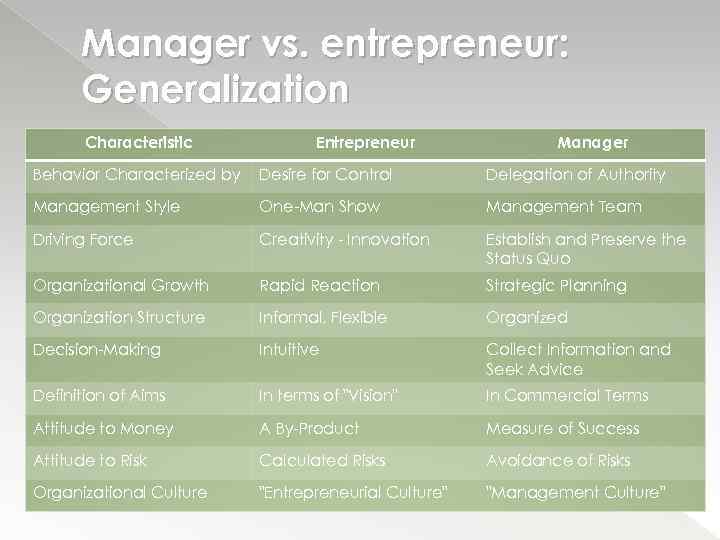
Manager vs. entrepreneur: Generalization Characteristic Entrepreneur Manager Behavior Characterized by Desire for Control Delegation of Authority Management Style One-Man Show Management Team Driving Force Creativity - Innovation Establish and Preserve the Status Quo Organizational Growth Rapid Reaction Strategic Planning Organization Structure Informal, Flexible Organized Decision-Making Intuitive Collect Information and Seek Advice Definition of Aims In terms of "Vision" In Commercial Terms Attitude to Money A By-Product Measure of Success Attitude to Risk Calculated Risks Avoidance of Risks Organizational Culture "Entrepreneurial Culture" "Management Culture"
Manager, entrepreneur and technichian Work • The entrepreneur's work is strategic in nature, and involves focusing on the future and developing a vision of where s/he can take their business. This vision is specific in terms of what the company will do to serve the wants and needs of the owner. • The manager's work is both strategic and tactical. The manager's focus is on the present and achieving results through others. The manager is the pragmatist, planner, and organizer who turns the vision into action. • The technician is directed by the manager, and follows the guiding structure of the company's systems to get the work done. The technician's focus is on the present and performing the hands-on work of the business.
Manager, entrepreneur and technichian Time • The entrepreneur organizes time so that each day is spent in doing strategic work - ensuring that the company is on course to meet the vision. This time is critical to the entrepreneur's future. • The manager knows that time must be utilized so that the company's personnel and other resources use every precious moment to produce. Managers take the company's strategic vision and plot moment-by-moment tactical action to accomplish that vision. Time for the manager has both long and short term considerations. • The technician's time is in the present moment, and concerns what can be done today. The technician strives to make as much as possible happen now. The technician knows that the more produced within the day the more money made.
Manager, entrepreneur and technichian Money • The entrepreneur pays particular attention to the balance sheets, knowing that the real value of the business is reflected in the equity. The higher the equity value, the greater the price that can be commanded for the business in the market place. The equity value ultimately serves the entrepreneur's exit strategy - the plan to sell the business and move on. • The manager's focus is on controlling costs and increasing profits. The manager conceives a tactical plan for growth through proper employment of people and assets. This requires up-to-date financial information that allows the manager to make adjustments when necessary. The manager is called to tactical action in order to meet strategic goals. • The technician looks at money as earnings for work performed. Technicians are always trying to figure out how to do it better and faster in order to make more money. The technician's efforts are the source of better competitive strategies that allow for a strong, profitable position in the marketplace.
Principles of Management Division of work • Division of work and specialization produces more and better work with the same effort. Authority and responsibility • Authority is the right to give orders and the power to exact obedience. A manager has official authority because of her position, as well as personal authority based on individual personality, intelligence, and experience. Authority creates responsibility. Discipline • Obedience and respect within an organization are absolutely essential. Good discipline requires managers to apply sanctions whenever violations become apparent.
Principles of Management Unity of command • An employee should receive orders from only one superior. Unity of direction • Organizational activities must have one central authority and one plan of action. Subordination of individual interest to general interest • The interests of one employee or group of employees are subordinate to the interests and goals of the organization. Remuneration of personnel • Salaries — the price of services rendered by employees — should be fair and provide satisfaction both to the employee and employer.
Principles of Management Centralization • The objective of centralization is the best utilization of personnel. The degree of centralization varies according to the dynamics of each organization. Scalar chain • A chain of authority exists from the highest organizational authority to the lowest ranks. Order • Organizational order for materials and personnel is essential. The right materials and the right employees are necessary for each organizational function and activity.
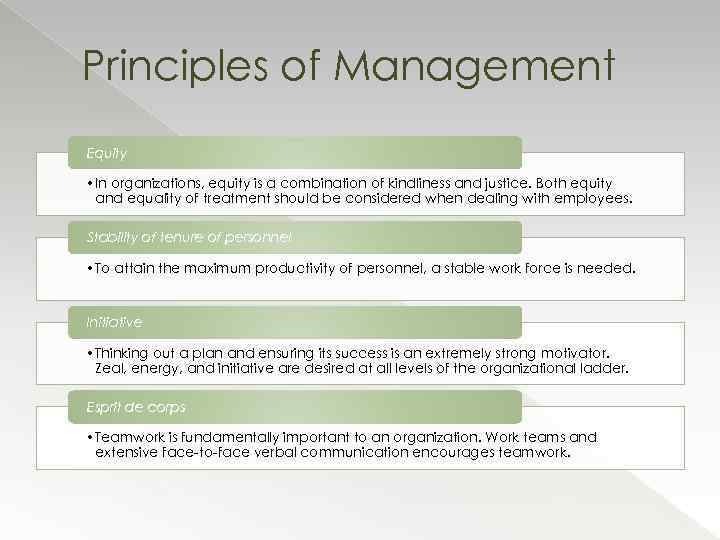
Principles of Management Equity • In organizations, equity is a combination of kindliness and justice. Both equity and equality of treatment should be considered when dealing with employees. Stability of tenure of personnel • To attain the maximum productivity of personnel, a stable work force is needed. Initiative • Thinking out a plan and ensuring its success is an extremely strong motivator. Zeal, energy, and initiative are desired at all levels of the organizational ladder. Esprit de corps • Teamwork is fundamentally important to an organization. Work teams and extensive face-to-face verbal communication encourages teamwork.
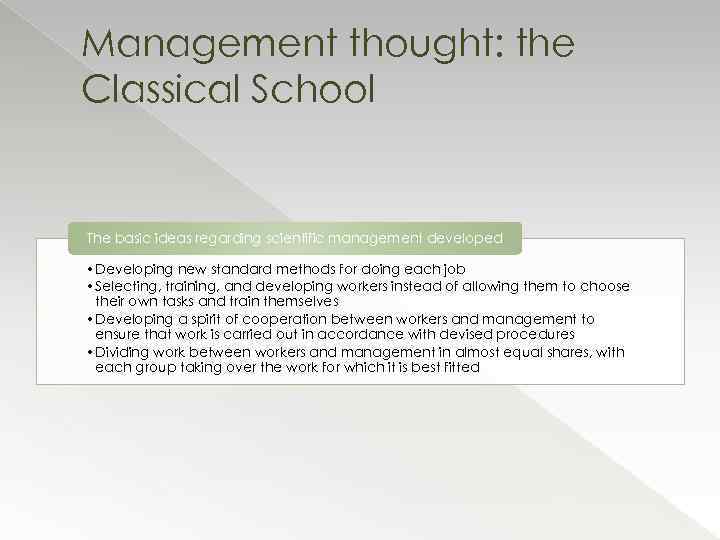
Management thought: the Classical School The basic ideas regarding scientific management developed • Developing new standard methods for doing each job • Selecting, training, and developing workers instead of allowing them to choose their own tasks and train themselves • Developing a spirit of cooperation between workers and management to ensure that work is carried out in accordance with devised procedures • Dividing work between workers and management in almost equal shares, with each group taking over the work for which it is best fitted
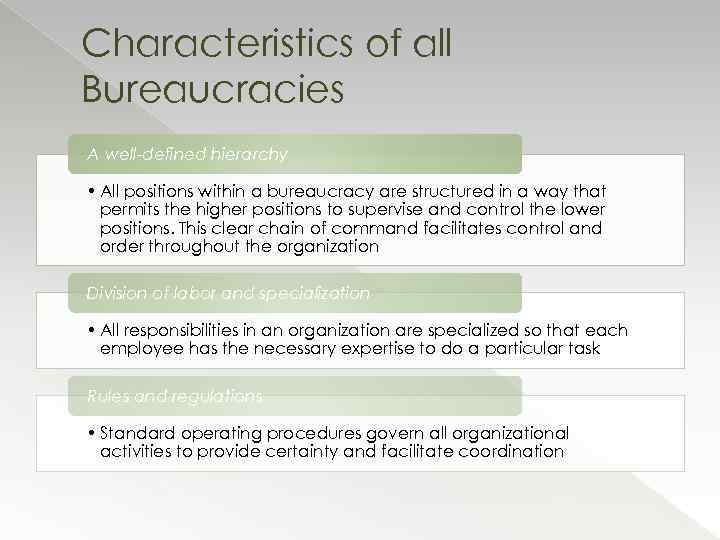
Characteristics of all Bureaucracies A well defined hierarchy • All positions within a bureaucracy are structured in a way that permits the higher positions to supervise and control the lower positions. This clear chain of command facilitates control and order throughout the organization Division of labor and specialization • All responsibilities in an organization are specialized so that each employee has the necessary expertise to do a particular task Rules and regulations • Standard operating procedures govern all organizational activities to provide certainty and facilitate coordination
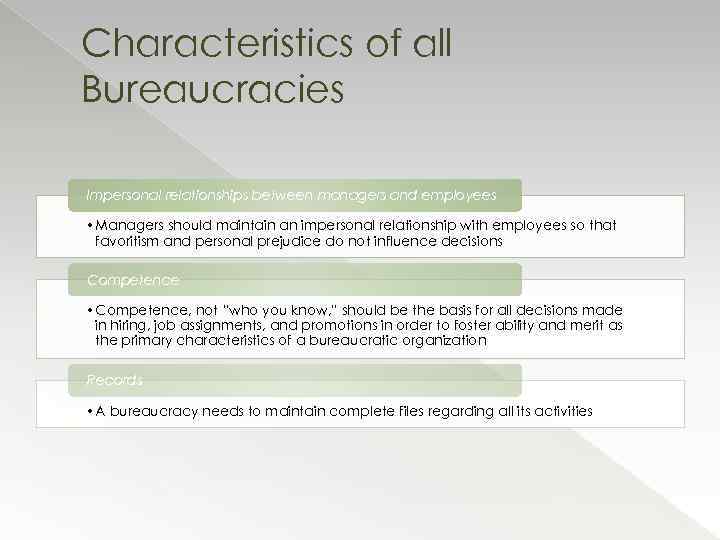
Characteristics of all Bureaucracies Impersonal relationships between managers and employees • Managers should maintain an impersonal relationship with employees so that favoritism and personal prejudice do not influence decisions Competence • Competence, not “who you know, ” should be the basis for all decisions made in hiring, job assignments, and promotions in order to foster ability and merit as the primary characteristics of a bureaucratic organization Records • A bureaucracy needs to maintain complete files regarding all its activities
Management thought: The Human Relations (Behavior) School Theory of human needs had three assumptions: • Human needs are never completely satisfied • Human behavior is purposeful and is motivated by the need for satisfaction • Needs can be classified according to a hierarchical structure of importance, from the lowest to highest
Management thought: The Human Relations (Behavior) School The needs hierarchy has five specific areas: • Physiological needs. Maslow grouped all physical needs necessary for maintaining basic human well-being, such as food and drink, into this category. After the need is satisfied, however, it is no longer is a motivator. • Safety needs. These needs include the need for basic security, stability, protection, and freedom from fear. A normal state exists for an individual to have all these needs generally satisfied. Otherwise, they become primary motivators. • Belonging and love needs. After the physical and safety needs are satisfied and are no longer motivators, the need for belonging and love emerges as a primary motivator. The individual strives to establish meaningful relationships with significant others. • Esteem needs. An individual must develop self-confidence and wants to achieve status, reputation, fame, and glory. • Self actualization needs. Assuming that all the previous needs in the hierarchy are satisfied, an individual feels a need to find himself.
Management thought: Systems theory An organization as a system is composed of four elements: • Inputs — material or human resources • Transformation processes — technological and managerial processes • Outputs — products or services • Feedback — reactions from the environment
Management thought: Quantity School of Management Managers use several science applications. • Mathematical forecasting helps make projections that are useful in the planning process. • Inventory modeling helps control inventories by mathematically establishing how and when to order a product. • Queuing theory helps allocate service personnel or workstations to minimize customer waiting and service cost. • Operations management is a narrow branch of the quantitative approach to management. It focuses on managing the process of transforming materials, labor, and capital into useful goods and/or services. • Management information systems (MIS) is the most recent subfield of the quantitative school. A management information system organizes past, present, and projected data from both internal and external sources and processes it into usable information, which it then makes available to managers at all organizational levels
Management thought: Quality School of Management The quality school of management considers the following in its theory: • Organization makeup. Organizations are made up of complex systems of customers and suppliers. Every individual, executive, manager, and worker functions as both a supplier and a customer. • Quality of goods and services. Meeting the customers’ requirements is a priority goal and presumed to be a key to organizational survival and growth. • Continuous improvement in goods and services. Recognizing the need to pinpoint internal and external requirements and continuously strive to improve. It is an idea that says, “the company is good, but it can always become better. ” • Employees working in teams. These groups are primary vehicles for planning and problem solving. • Developing openness and trust. Confidence among members of the organization at all levels is an important condition for success.
Management thought: Contingency Management The contingency school of management can be summarized as an “it all depends” approach • Contingency management recognizes that there is no one best way to manage. In the contingency perspective, managers are faced with the task of determining which managerial approach is likely to be most effective in a given situation. • Contingency thinking avoids the classical “one best way” arguments and recognizes the need to understand situational differences and respond appropriately to them. It does not apply certain management principles to any situation. Contingency theory is a recognition of the extreme importance of individual manager performance in any given situation.
Management in the Future Modern management approaches recognize that people are complex and variable: • The commitment to meet customer needs 100 percent of the time guides organizations toward quality management and continuous improvement of operations. • Today’s global economy is a dramatic influence on organizations, and opportunities abound to learn new ways of managing from practices in other countries. • Organizations must reinvest in their most important asset, their people. If organizations cannot make the commitment to lifelong employment, they must commit to using attrition to reduce head count. They will not receive cooperation unless they make it clear that their people will not be working themselves out of a job. • Managers must excel in their leadership responsibilities to perform numerous different roles.

Planning Topic Two
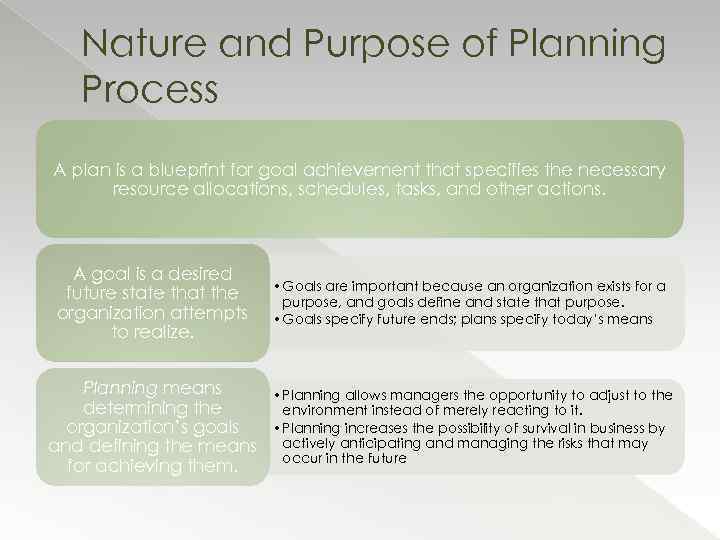
Nature and Purpose of Planning Process A plan is a blueprint for goal achievement that specifies the necessary resource allocations, schedules, tasks, and other actions. A goal is a desired future state that the organization attempts to realize. • Goals are important because an organization exists for a purpose, and goals define and state that purpose. • Goals specify future ends; plans specify today’s means Planning means • Planning allows managers the opportunity to adjust to the determining the environment instead of merely reacting to it. • Planning increases the possibility of survival in business by organization’s goals and defining the means actively anticipating and managing the risks that may occur in the future for achieving them.
Principles of Planning process should reflect the following principles: • Comprehensive – all significant options and impacts are considered. • Efficient – the process should not waste time or money. • Inclusive – people affected by the plan have opportunities to be involved. • Informative – results are understood by stakeholders (people affected by a decision). • Integrated – individual, short-term decisions should support strategic, longterm goals. • Logical – each step leads to the next. • Transparent – everybody involved understands how the process operates
Planning Framework Typically includes the following components: • Principles – A basic rule or concept used for decision-making. • Vision – A general description of the desired result of the planning process. • Problem – An undesirable condition to be mitigated (solved, reduced or compensated). • Goals – A general desirable condition to be achieved, usually too general to be quantified, such as wealth, health, equity and freedom. • Objectives – Specific, potentially quantifiable ways to achieve goals, such as increased income and economic activity, reduced crashes, and improved accessibility for non-drivers. • Targets or standards – Quantitative levels of objectives to be achieved, such as a particular increase in income or reduction in crash rates. Standards are sometimes required by law or regulation, such as minimum parking requirements in zoning codes.
Planning Framework Typically includes the following components: • Performance indicators – Practical ways to measure progress toward objectives, such as specific definitions of income, crash rates, and accessibility. • Plans – A scheme or set of actions. This may be a strategic (general and broad) or an action (specific and narrow) plan. • Options – Possible ways to achieve an objective or solutions to a problem. • Policies or strategies – A course of action implemented by a jurisdiction or organization. • Programs – A specific set of objectives, responsibilities and tasks within an organization. • Tasks or actions – A specific thing to be accomplished. • Scope – The range (area, people, time, activities, etc. ) to be included in a process. • Evaluation criteria – The impacts (costs and benefits) considered in an analysis. • Evaluation methodology – The process of valuing and comparing options, such as cost effectiveness, benefit/cost, or lifecycle cost analysis.
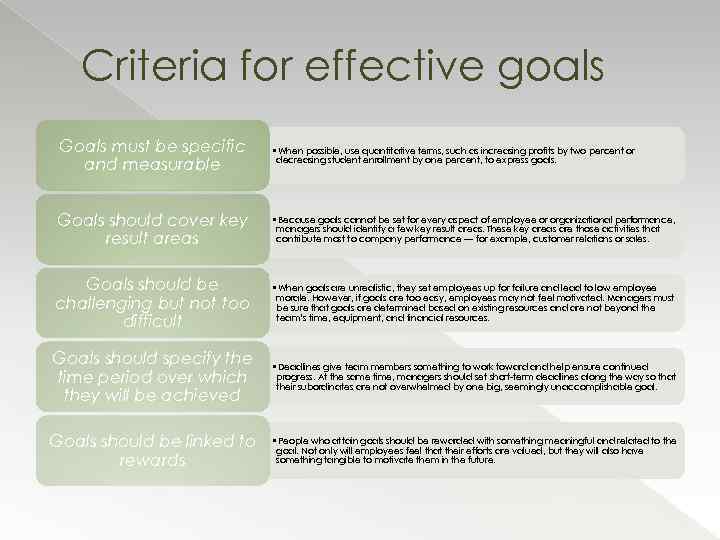
Criteria for effective goals Goals must be specific and measurable Goals should cover key result areas Goals should be challenging but not too difficult Goals should specify the time period over which they will be achieved Goals should be linked to rewards • When possible, use quantitative terms, such as increasing profits by two percent or decreasing student enrollment by one percent, to express goals. • Because goals cannot be set for every aspect of employee or organizational performance, managers should identify a few key result areas. These key areas are those activities that contribute most to company performance — for example, customer relations or sales. • When goals are unrealistic, they set employees up for failure and lead to low employee morale. However, if goals are too easy, employees may not feel motivated. Managers must be sure that goals are determined based on existing resources and are not beyond the team’s time, equipment, and financial resources. • Deadlines give team members something to work toward and help ensure continued progress. At the same time, managers should set short-term deadlines along the way so that their subordinates are not overwhelmed by one big, seemingly unaccomplishable goal. • People who attain goals should be rewarded with something meaningful and related to the goal. Not only will employees feel that their efforts are valued, but they will also have something tangible to motivate them in the future.
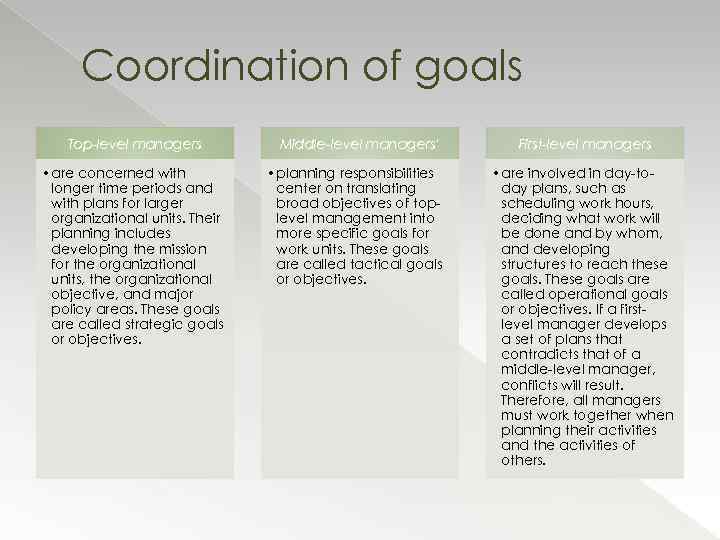
Coordination of goals Top level managers • are concerned with longer time periods and with plans for larger organizational units. Their planning includes developing the mission for the organizational units, the organizational objective, and major policy areas. These goals are called strategic goals or objectives. Middle level managers’ • planning responsibilities center on translating broad objectives of toplevel management into more specific goals for work units. These goals are called tactical goals or objectives. First level managers • are involved in day-today plans, such as scheduling work hours, deciding what work will be done and by whom, and developing structures to reach these goals. These goals are called operational goals or objectives. If a firstlevel manager develops a set of plans that contradicts that of a middle-level manager, conflicts will result. Therefore, all managers must work together when planning their activities and the activities of others.
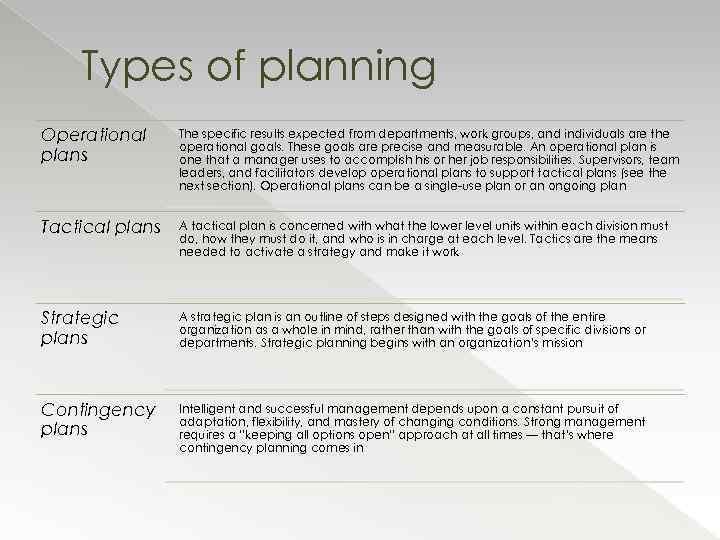
Types of planning Operational plans The specific results expected from departments, work groups, and individuals are the operational goals. These goals are precise and measurable. An operational plan is one that a manager uses to accomplish his or her job responsibilities. Supervisors, team leaders, and facilitators develop operational plans to support tactical plans (see the next section). Operational plans can be a single-use plan or an ongoing plan Tactical plans A tactical plan is concerned with what the lower level units within each division must do, how they must do it, and who is in charge at each level. Tactics are the means needed to activate a strategy and make it work Strategic plans A strategic plan is an outline of steps designed with the goals of the entire organization as a whole in mind, rather than with the goals of specific divisions or departments. Strategic planning begins with an organization’s mission Contingency plans Intelligent and successful management depends upon a constant pursuit of adaptation, flexibility, and mastery of changing conditions. Strong management requires a “keeping all options open” approach at all times — that’s where contingency planning comes in
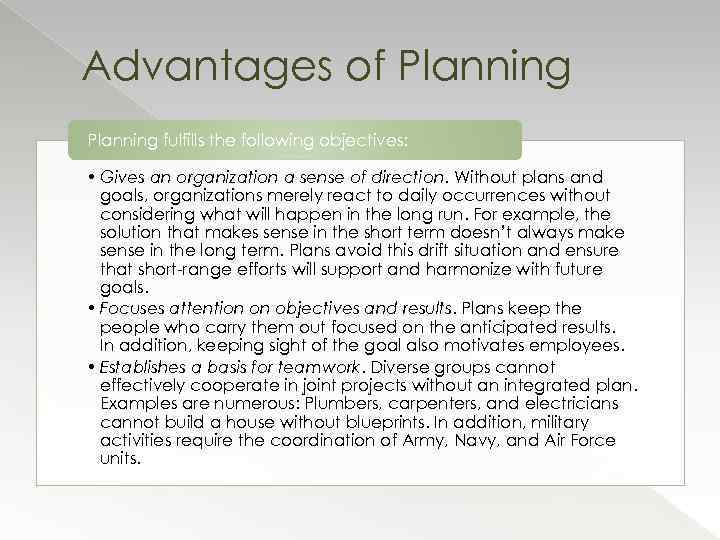
Advantages of Planning fulfills the following objectives: • Gives an organization a sense of direction. Without plans and goals, organizations merely react to daily occurrences without considering what will happen in the long run. For example, the solution that makes sense in the short term doesn’t always make sense in the long term. Plans avoid this drift situation and ensure that short-range efforts will support and harmonize with future goals. • Focuses attention on objectives and results. Plans keep the people who carry them out focused on the anticipated results. In addition, keeping sight of the goal also motivates employees. • Establishes a basis for teamwork. Diverse groups cannot effectively cooperate in joint projects without an integrated plan. Examples are numerous: Plumbers, carpenters, and electricians cannot build a house without blueprints. In addition, military activities require the coordination of Army, Navy, and Air Force units.
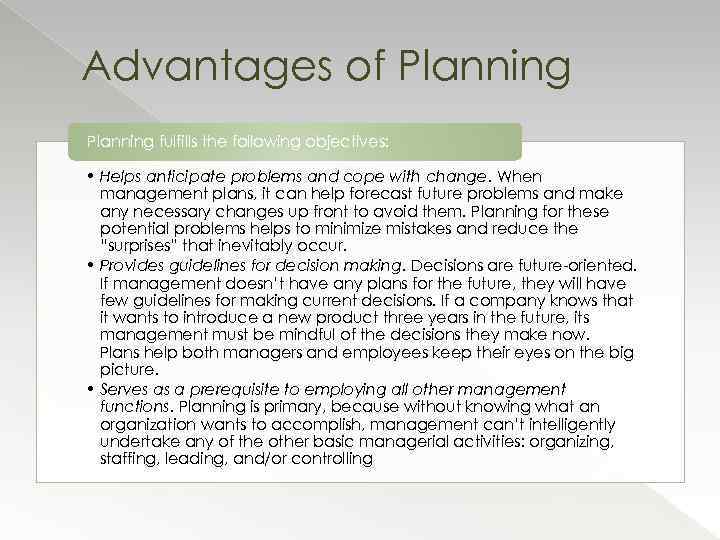
Advantages of Planning fulfills the following objectives: • Helps anticipate problems and cope with change. When management plans, it can help forecast future problems and make any necessary changes up front to avoid them. Planning for these potential problems helps to minimize mistakes and reduce the “surprises” that inevitably occur. • Provides guidelines for decision making. Decisions are future-oriented. If management doesn’t have any plans for the future, they will have few guidelines for making current decisions. If a company knows that it wants to introduce a new product three years in the future, its management must be mindful of the decisions they make now. Plans help both managers and employees keep their eyes on the big picture. • Serves as a prerequisite to employing all other management functions. Planning is primary, because without knowing what an organization wants to accomplish, management can’t intelligently undertake any of the other basic managerial activities: organizing, staffing, leading, and/or controlling
Limitations of Planning The common barriers that inhibit successful planning are as follows: • Inability to plan or inadequate planning. Managers are not born with the ability to plan. Some managers are not successful planners because they lack the background, education, and/or ability. Others may have never been taught how to plan. When these two types of managers take the time to plan, they may not know how to conduct planning as a process. • Lack of commitment to the planning process. The development of of a plan is hard work; it is much easier for a manager to claim that he or she doesn't have the time to work through the required planning process than to actually devote the time to developing a plan. (The latter, of course, would save them more time in the long run!) Another possible reason for lack of commitment can be fear of failure. As a result, managers may choose to do little or nothing to help in the planning process. • Inferior information. Facts that are out-of-date, of poor quality, or of insufficient quantity can be major barriers to planning. No matter how well managers plan, if they are basing their planning on inferior information, their plans will probably fail.
Limitations of Planning The common barriers that inhibit successful planning are as follows: • Focusing on the present at the expense of the future. Failure to consider the long-term effects of a plan because of emphasis on short-term problems may lead to trouble in preparing for the future. Managers should try to keep the big picture — their long-term goals — in mind when developing their plans. • Too much reliance on the organization's planning department. Many companies have a planning department or a planning and development team. These departments conduct studies, do research, build models, and project probable results, but they do not implement plans. Planning department results are aids in planning and should be used only as such. Formulating the plan is still the manager's responsibility. • Concentrating on controllable variables. Managers can find themselves concentrating on the things and events that they can control, such as new product development, but then fail to consider outside factors, such as a poor economy. One reason may be that managers demonstrate a decided preference for the known and an aversion to the unknown.
Creating organizational Structure Topic Three
Going from Planning to Organizing After a manager has a plan in place, he can structure his teams and resources. This important step can profoundly affect an organization's success Not only does a business's organizational structure help determine how well its employees make decisions, but it also reflects how well they respond to problems Once managers have their plans in place, they need to organize the necessary resources to accomplish their goals
The Organizing Defined Organizing • the second of the universal management functions, is the process of establishing the orderly use of resources by assigning and coordinating tasks. The organizing process transforms plans into reality through the purposeful deployment of people and resources within a decision-making framework known as the organizational structure
The organizational structure is defined as: • The set of formal tasks assigned to individuals and departments • The formal reporting relationships, including lines of authority, decision responsibility, number of hierarchical levels, and span of managerial control • The design of systems to ensure effective coordination of employees across departments
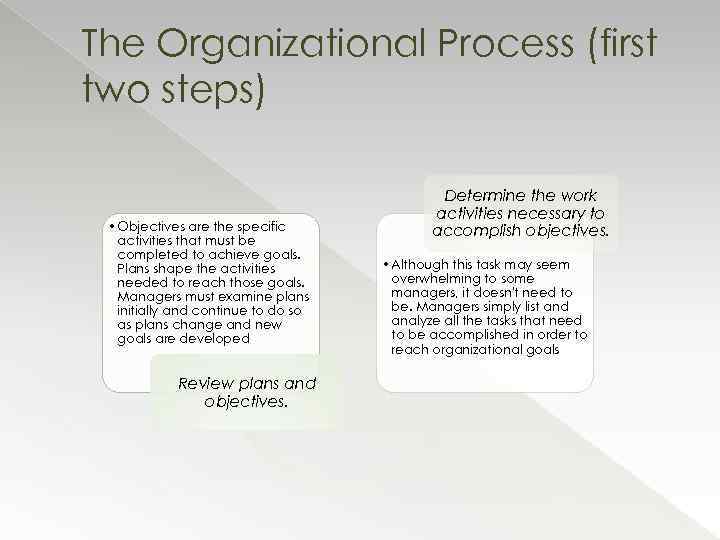
The Organizational Process (first two steps) • Objectives are the specific activities that must be completed to achieve goals. Plans shape the activities needed to reach those goals. Managers must examine plans initially and continue to do so as plans change and new goals are developed Review plans and objectives. Determine the work activities necessary to accomplish objectives. • Although this task may seem overwhelming to some managers, it doesn't need to be. Managers simply list and analyze all the tasks that need to be accomplished in order to reach organizational goals
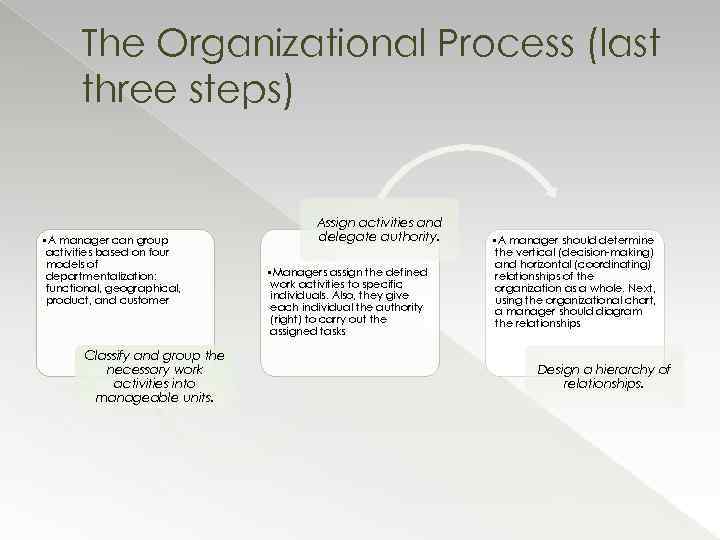
The Organizational Process (last three steps) • A manager can group activities based on four models of departmentalization: functional, geographical, product, and customer Classify and group the necessary work activities into manageable units. Assign activities and delegate authority. • Managers assign the defined work activities to specific individuals. Also, they give each individual the authority (right) to carry out the assigned tasks • A manager should determine the vertical (decision-making) and horizontal (coordinating) relationships of the organization as a whole. Next, using the organizational chart, a manager should diagram the relationships Design a hierarchy of relationships.
Concepts of Organizing These concepts are based on the principles developed by Henri Fayol • The chain of command is an unbroken line of authority that links all persons in an organization and defines who reports to whom. This chain has two underlying principles: unity of command scalar principle • Authority is the formal and legitimate right of a manager to make decisions, issue orders, and allocate resources to achieve organizationally desired outcomes. A manager's authority is defined in his or her job description • A concept related to authority is delegation. Delegation is the downward transfer of authority from a manager to a subordinate • Span of control (span of management) refers to the number of workers who report to one manager
The chain of command This chain has two underlying principles Unity of command: This principle states that an employee should have one and only one supervisor to whom he or she is directly responsible. No employee should report to two or more people. Otherwise, the employee may receive conflicting demands or priorities from several supervisors at once, placing this employee in a no-win situation Scalar principle: The scalar principle refers to a clearly defined line of authority that includes all employees in the organization. The classical school of management suggests that there should be a clear and unbroken chain of command linking every person in the organization with successively higher levels of authority up to and including the top manage
Organizational authority has three important underlying principles Authority is based on the organizational position, and anyone in the same position has the same authority. A uthorityis accepted by subordinates. Subordinates comply because they believe that managers have a legitimate right to issue orders. Authority flows down the vertical hierarchy. Positions at the top of the hierarchy are vested with more formal authority than are positions at the bottom
Organizational authority Authority comes in three types: Line authority gives a manager the right to direct the work of his or her employees and make many decisions without consulting others Staff authority supports line authority by advising, servicing, and assisting, but this type of authority is typically limited Functional authority is authority delegated to an individual or department over specific activities undertaken by personnel in other departments. Staff managers may have functional authority, meaning that they can issue orders down the chain of command within the very narrow limits of their authority
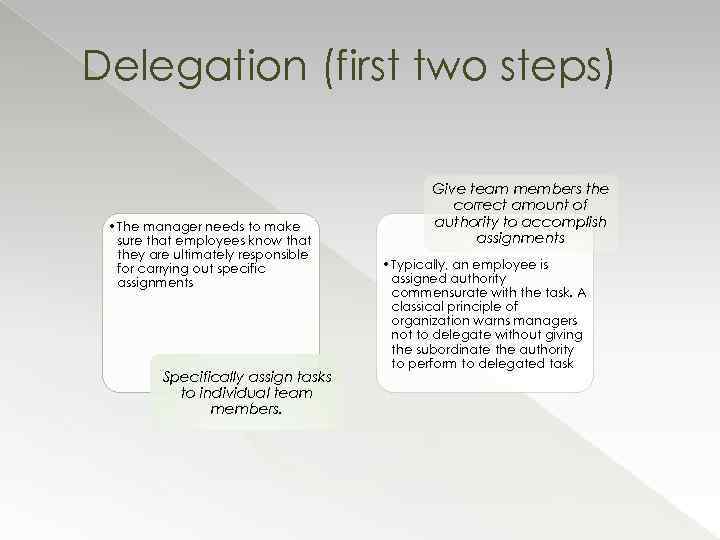
Delegation (first two steps) • The manager needs to make sure that employees know that they are ultimately responsible for carrying out specific assignments Specifically assign tasks to individual team members. Give team members the correct amount of authority to accomplish assignments • Typically, an employee is assigned authority commensurate with the task. A classical principle of organization warns managers not to delegate without giving the subordinate the authority to perform to delegated task
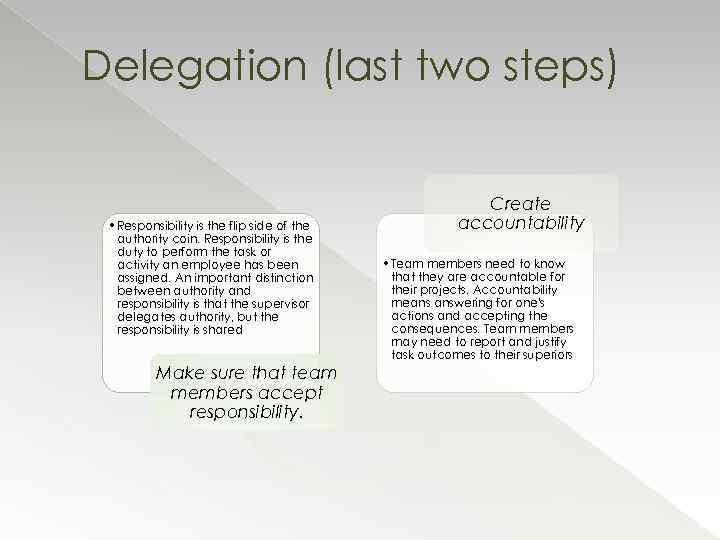
Delegation (last two steps) • Responsibility is the flip side of the authority coin. Responsibility is the duty to perform the task or activity an employee has been assigned. An important distinction between authority and responsibility is that the supervisor delegates authority, but the responsibility is shared Make sure that team members accept responsibility. Create accountability • Team members need to know that they are accountable for their projects. Accountability means answering for one's actions and accepting the consequences. Team members may need to report and justify task outcomes to their superiors
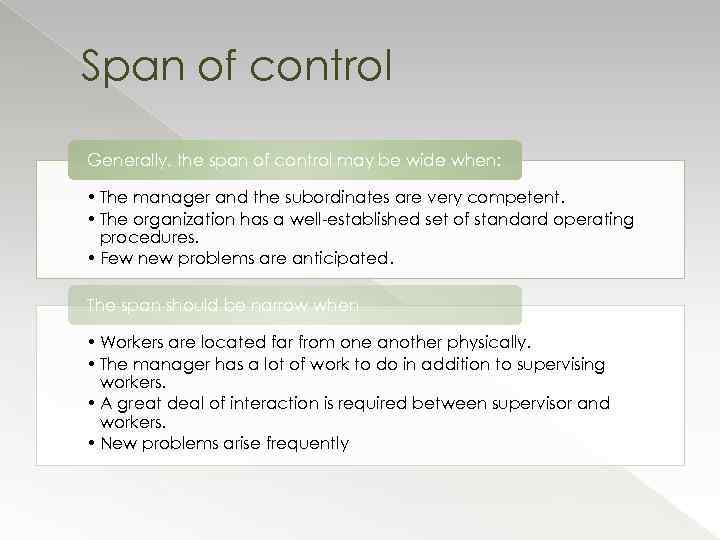
Span of control Generally, the span of control may be wide when: • The manager and the subordinates are very competent. • The organization has a well-established set of standard operating procedures. • Few new problems are anticipated. The span should be narrow when • Workers are located far from one another physically. • The manager has a lot of work to do in addition to supervising workers. • A great deal of interaction is required between supervisor and workers. • New problems arise frequently
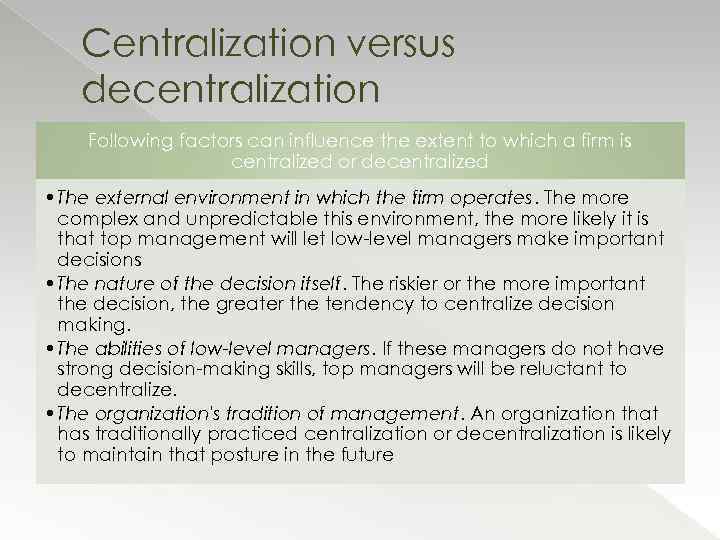
Centralization versus decentralization Following factors can influence the extent to which a firm is centralized or decentralized • The external environment in which the firm operates. The more complex and unpredictable this environment, the more likely it is that top management will let low-level managers make important decisions • The nature of the decision itself. The riskier or the more important the decision, the greater the tendency to centralize decision making. • The abilities of low level managers. If these managers do not have strong decision-making skills, top managers will be reluctant to decentralize. • The organization's tradition of management. An organization that has traditionally practiced centralization or decentralization is likely to maintain that posture in the future
Organizational Design Organizational design is the creation or change of an organization's structure Two basic forms of organizational structure are mechanistic and organic
The mechanistic structure, sometimes used synonymously with bureaucratic structure, is a management system based on a formal framework of authority that is carefully outlined and precisely followed An organization that uses a mechanistic structure is likely to have the following characteristics: • Clearly specified tasks • Precise definitions of the rights and obligations of members • Clearly defined line and staff positions with formal relationships between the two • Tendency toward formal communication throughout the organizational structure
The organic structure An organic structure is a management system founded on cooperation and knowledge-based authority. It is much less formal than a mechanistic organization, and much more flexible Organic structures are characterized by • Roles that are not highly defined • Tasks that are continually redefined • Little reliance on formal authority • Decentralized control • Fast decision making • Informal patterns of both delegation and communication
Factors Affecting Organizational Design Organizational size • The larger an organization becomes, the more complicated its structure. In reality, if the organization is very small, it may not even have a formal structure. Instead of following an organizational chart or specified job functions, individuals simply perform tasks based on their likes, dislikes, ability, and/or need. Small organizations are very often organic systems. The type of structure that develops will be one that provides the organization with the ability to operate effectively. That's one reason larger organizations are often mechanistic—mechanistic systems are usually designed to maximize specialization and improve efficiency
Factors Affecting Organizational Design Organization life cycle • Organizations tend to progress through stages known as a life cycle. Most organizations go through the following four stages: birth, youth, midlife, and maturity. Each stage has characteristics that have implications for the structure of the firm • Birth • Youth • Midlife • Maturity
Factors Affecting Organizational Design Strategy • How an organization is going to position itself in the market in terms of its product is considered its strategy. Strategies require a structure that helps the organization reach its objectives, the structure must fit the strategy. Companies that want to be the first on the market with the newest and best product probably are organic, because organic structures permit organizations to respond quickly to changes. Companies that elect to produce the same products more efficiently and effectively will probably be mechanistic
Factors Affecting Organizational Design Environment • The environment is the world in which the organization operates, and includes conditions that influence the organization such as economic, social-cultural, legalpolitical, technological, and natural environment conditions. Environments are often described as either stable or dynamic. In general, organizations that operate in stable external environments find mechanistic structures to be advantageous. This system provides a level of efficiency that enhances the long-term performances of organizations that enjoy relatively stable operating environments. In contrast, organizations that operate in volatile and frequently changing environments are more likely to find that an organic structure provides the greatest benefits. This structure allows the organization to respond to environment change more proactively
Factors Affecting Organizational Design Technology • Advances in technology are the most frequent cause of change in organizations since they generally result in greater efficiency and lower costs for the firm
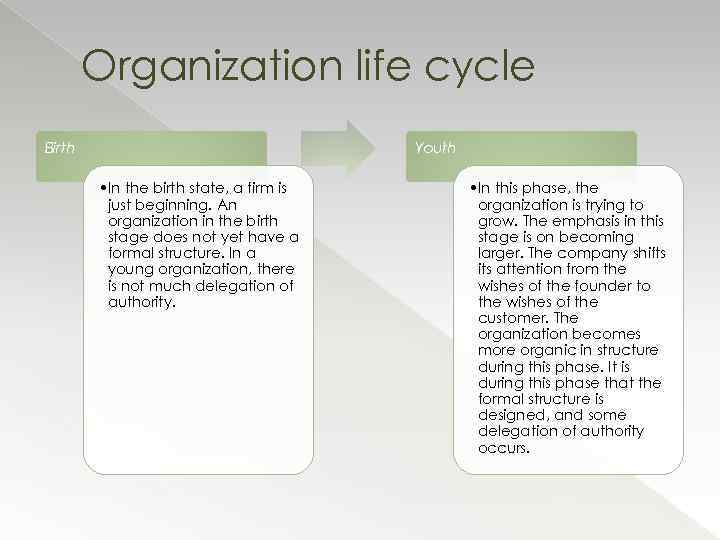
Organization life cycle Birth Youth • In the birth state, a firm is just beginning. An organization in the birth stage does not yet have a formal structure. In a young organization, there is not much delegation of authority. • In this phase, the organization is trying to grow. The emphasis in this stage is on becoming larger. The company shifts its attention from the wishes of the founder to the wishes of the customer. The organization becomes more organic in structure during this phase. It is during this phase that the formal structure is designed, and some delegation of authority occurs.
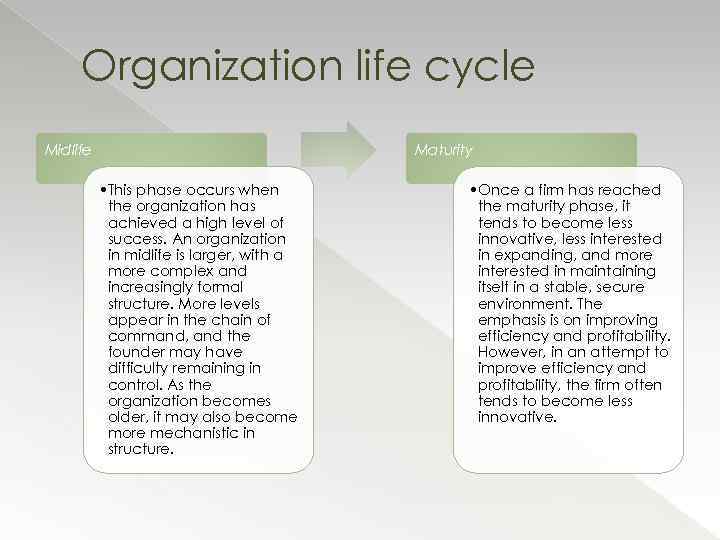
Organization life cycle Midlife Maturity • This phase occurs when the organization has achieved a high level of success. An organization in midlife is larger, with a more complex and increasingly formal structure. More levels appear in the chain of command, and the founder may have difficulty remaining in control. As the organization becomes older, it may also become more mechanistic in structure. • Once a firm has reached the maturity phase, it tends to become less innovative, less interested in expanding, and more interested in maintaining itself in a stable, secure environment. The emphasis is on improving efficiency and profitability. However, in an attempt to improve efficiency and profitability, the firm often tends to become less innovative.
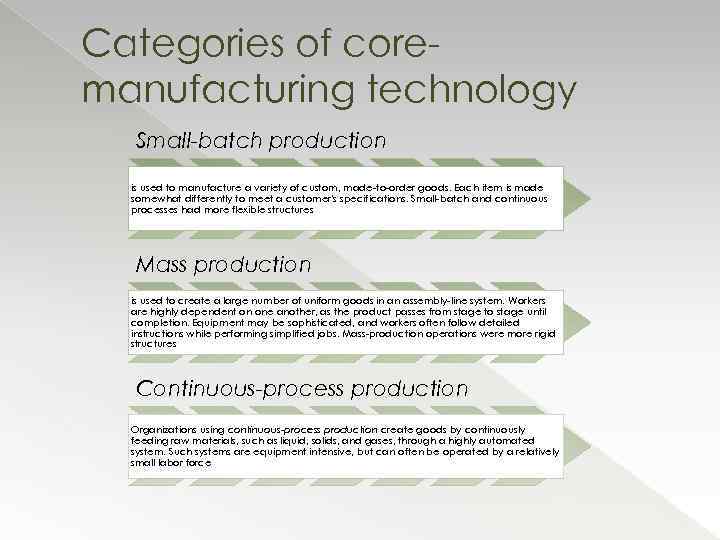
Categories of coremanufacturing technology Small batch production is used to manufacture a variety of custom, made-to-order goods. Each item is made somewhat differently to meet a customer's specifications. Small-batch and continuous processes had more flexible structures Mass production is used to create a large number of uniform goods in an assembly-line system. Workers are highly dependent on one another, as the product passes from stage to stage until completion. Equipment may be sophisticated, and workers often follow detailed instructions while performing simplified jobs. Mass-production operations were more rigid structures Continuous process production Organizations using continuous process production create goods by continuously feeding raw materials, such as liquid, solids, and gases, through a highly automated system. Such systems are equipment intensive, but can often be operated by a relatively small labor force
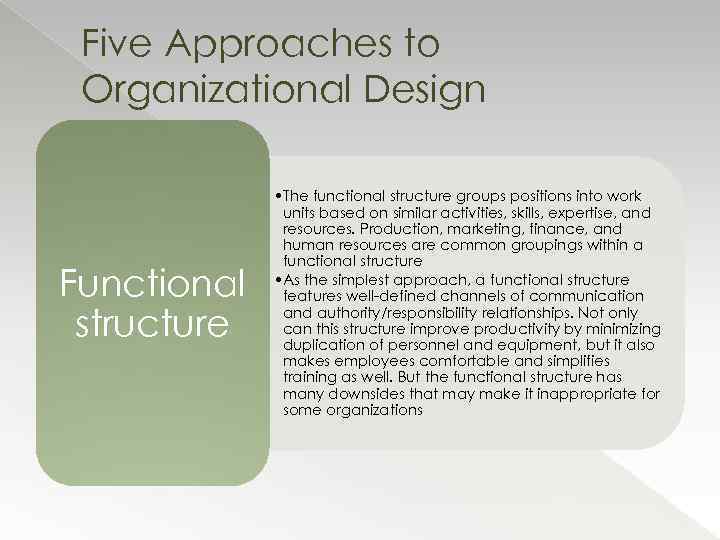
Five Approaches to Organizational Design Functional structure • The functional structure groups positions into work units based on similar activities, skills, expertise, and resources. Production, marketing, finance, and human resources are common groupings within a functional structure • As the simplest approach, a functional structure features well-defined channels of communication and authority/responsibility relationships. Not only can this structure improve productivity by minimizing duplication of personnel and equipment, but it also makes employees comfortable and simplifies training as well. But the functional structure has many downsides that may make it inappropriate for some organizations
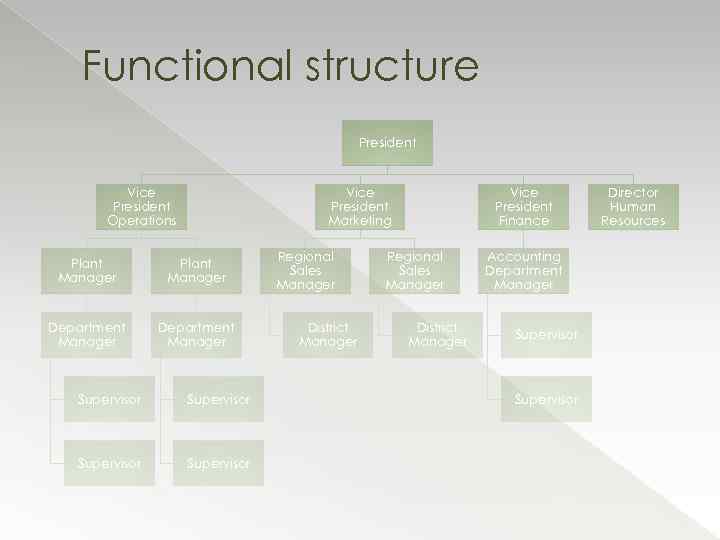
Functional structure President Vice President Operations Vice President Marketing Plant Manager Department Manager Supervisor Regional Sales Manager District Manager Vice President Finance Regional Sales Manager District Manager Accounting Department Manager Supervisor Director Human Resources
Five Approaches to Organizational Design Divisional structure • Because managers in large companies may have difficulty keeping track of all their company's products and activities, specialized departments may develop. These departments are divided according to their organizational outputs. Examples include departments created to distinguish among production, customer service, and geographical categories. These departments allow managers to better focus their resources and results. Divisional structure also makes performance easier to monitor. As a result, this structure is flexible and responsive to change • However, divisional structure does have its drawbacks. Because managers are so specialized, they may waste time duplicating each other's activities and resources. In addition, competition among divisions may develop due to limited resources
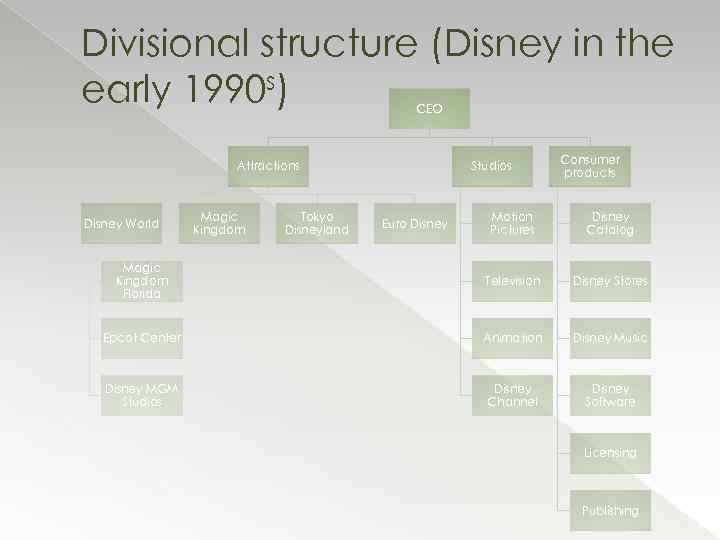
Divisional structure (Disney in the early 1990 s) CEO Attractions Tokyo Disneyland Consumer products Motion Pictures Disney Catalog Magic Kingdom Florida Television Disney Stores Epcot Center Animation Disney Music Disney MGM Studios Disney Channel Disney Software Disney World Magic Kingdom Studios Euro Disney Licensing Publishing
Five Approaches to Organizational Design Matrix structure • The matrix structure combines functional specialization with the focus of divisional structure. This structure uses permanent cross-functional teams to integrate functional expertise with a divisional focus • Employees in a matrix structure belong to at least two formal groups at the same time—a functional group and a product, program, or project team. They also report to two bosses—one within the functional group and the other within the team • This structure not only increases employee motivation, but it also allows technical and general management training across functional areas as well
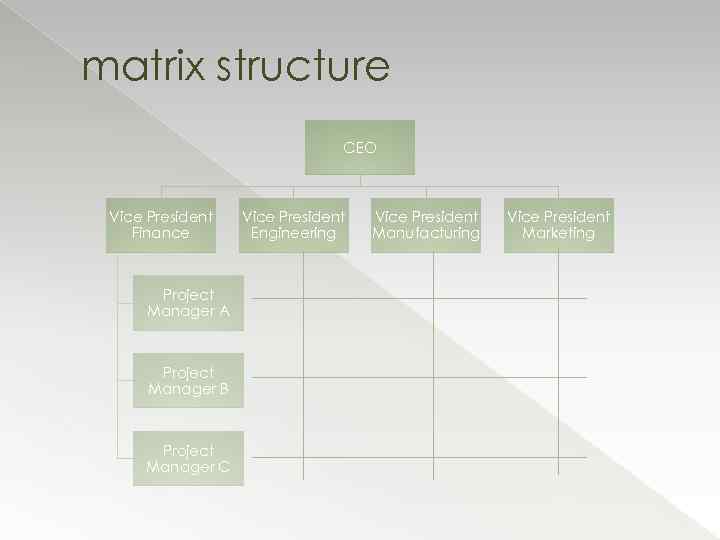
matrix structure CEO Vice President Finance Project Manager A Project Manager B Project Manager C Vice President Engineering Vice President Manufacturing Vice President Marketing
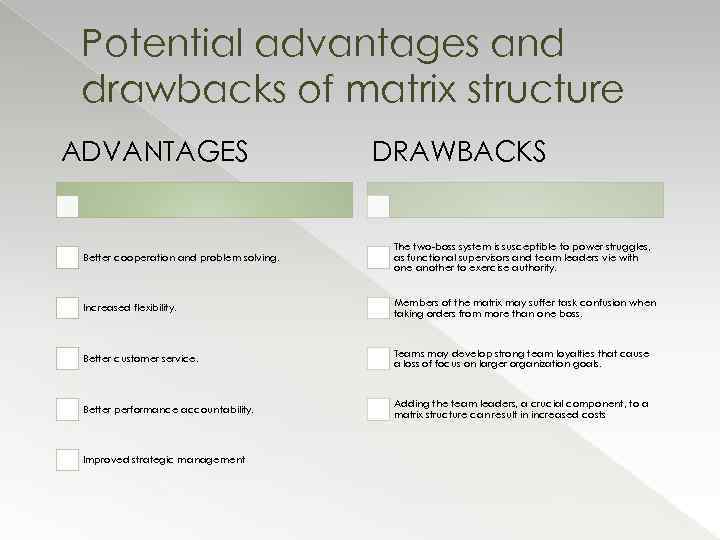
Potential advantages and drawbacks of matrix structure ADVANTAGES DRAWBACKS Better cooperation and problem solving. The two-boss system is susceptible to power struggles, as functional supervisors and team leaders vie with one another to exercise authority. Increased flexibility. Members of the matrix may suffer task confusion when taking orders from more than one boss. Better customer service. Teams may develop strong team loyalties that cause a loss of focus on larger organization goals. Better performance accountability. Adding the team leaders, a crucial component, to a matrix structure can result in increased costs Improved strategic management
Five Approaches to Organizational Design Team structure • Team structure organizes separate functions into a group based on one overall objective • These cross-functional teams are composed of members from different departments who work together as needed to solve problems and explore opportunities • The intent is to break down functional barriers among departments and create a more effective relationship for solving ongoing problems
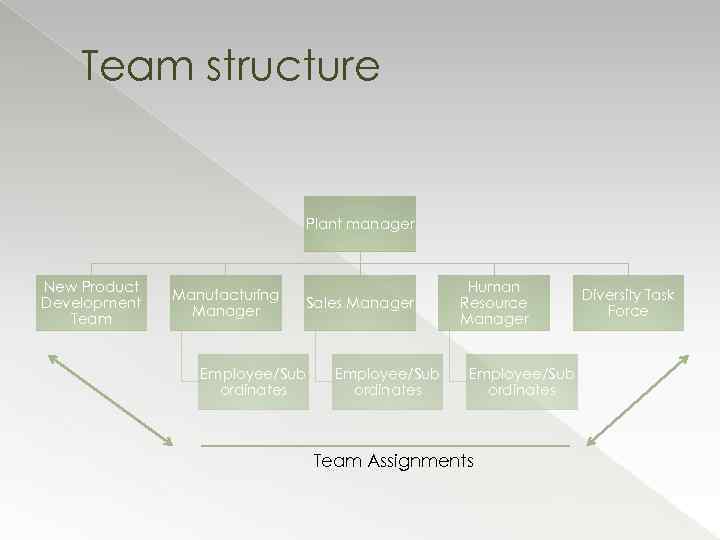
Team structure Plant manager New Product Development Team Manufacturing Manager Sales Manager Employee/Sub ordinates Human Resource Manager Employee/Sub ordinates Team Assignments Diversity Task Force
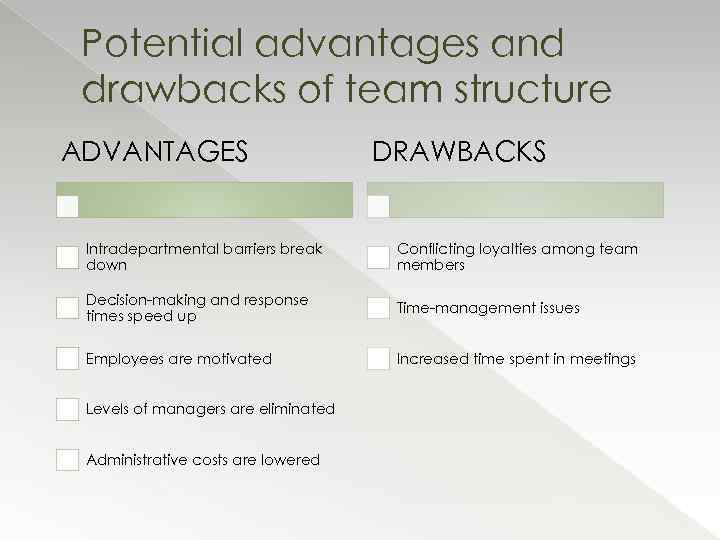
Potential advantages and drawbacks of team structure ADVANTAGES DRAWBACKS Intradepartmental barriers break down Conflicting loyalties among team members Decision-making and response times speed up Time-management issues Employees are motivated Increased time spent in meetings Levels of managers are eliminated Administrative costs are lowered
Five Approaches to Organizational Design Network structure • The network structure relies on other organizations to perform critical functions on a contractual basis. In other words, managers can contract out specific work to specialists • This approach provides flexibility and reduces overhead because the size of staff and operations can be reduced • On the other hand, the network structure may result in unpredictability of supply and lack of control because managers are relying on contractual workers to perform important work
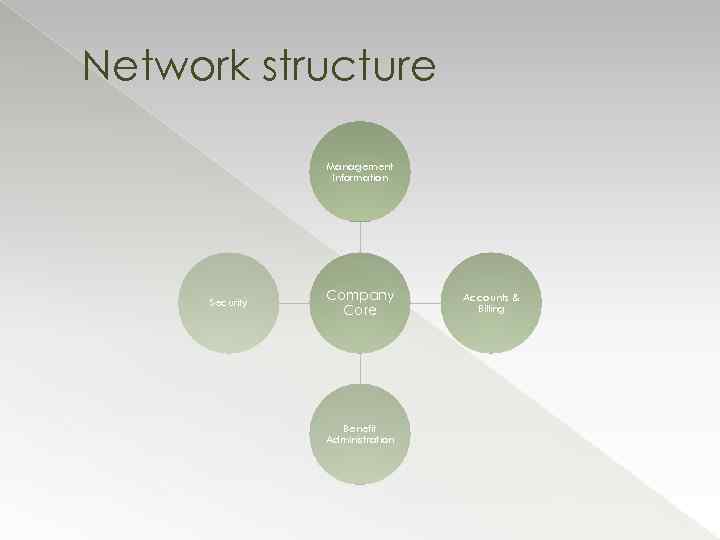
Network structure Management Information Security Company Core Benefit Administration Accounts & Billing

Motivation Topic Four
Defining Motivation is defined as the force that causes an individual to behave in a specific way. Simply put, a highly motivated person works hard at a job; an unmotivated person does not Motivation is really an internal process. It's the result of the interaction of a person's needs, his or her ability to make choices about how to meet those needs, and the environment created by management that allows these needs to be met and the choices to be made
Motivation Theories: Individual Needs In management circles, probably the most popular explanations of motivation are based on the needs of the individual The basic needs model, referred to as content theory of motivation, highlights the specific factors that motivate an individual. Although these factors are found within an individual, things outside the individual can affect him or her as well In short, all people have needs that they want satisfied. Some are primary needs that deal with the physical aspects of behavior and are considered unlearned. These needs are biological in nature and relatively stable. Their influences on behavior are usually obvious and hence easy to identify Secondary needs, on the other hand, are psychological, which means that they are learned primarily through experience. These needs vary significantly by culture and by individual. Identifying and interpreting these needs is more difficult because they are demonstrated in a variety of ways
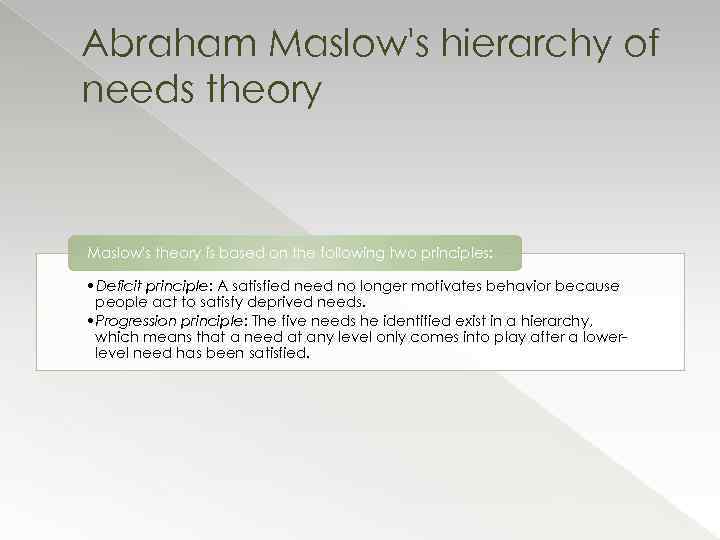
Abraham Maslow's hierarchy of needs theory Maslow's theory is based on the following two principles: • Deficit principle: A satisfied need no longer motivates behavior because people act to satisfy deprived needs. • Progression principle: The five needs he identified exist in a hierarchy, which means that a need at any level only comes into play after a lowerlevel need has been satisfied.
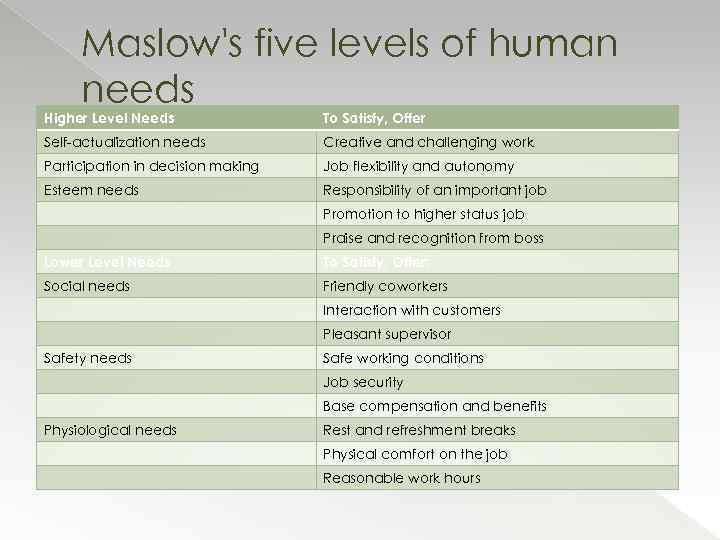
Maslow's five levels of human needs Higher Level Needs To Satisfy, Offer Self-actualization needs Creative and challenging work Participation in decision making Job flexibility and autonomy Esteem needs Responsibility of an important job Promotion to higher status job Praise and recognition from boss Lower Level Needs To Satisfy, Offer: Social needs Friendly coworkers Interaction with customers Pleasant supervisor Safety needs Safe working conditions Job security Base compensation and benefits Physiological needs Rest and refreshment breaks Physical comfort on the job Reasonable work hours
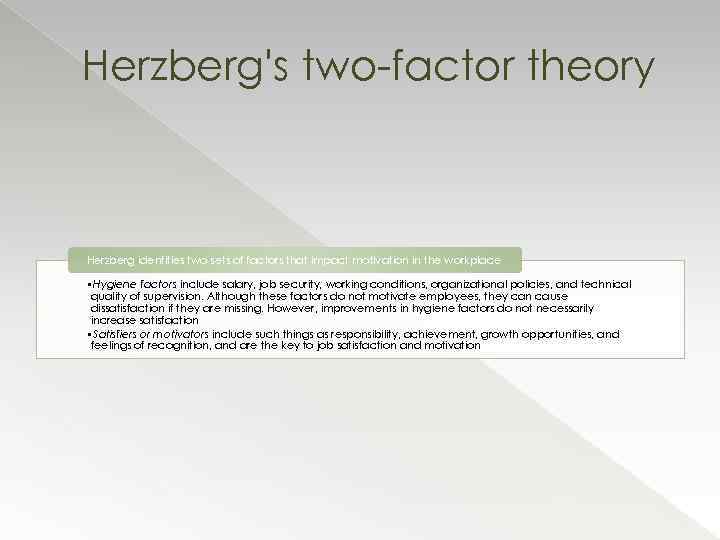
Herzberg's two-factor theory Herzberg identifies two sets of factors that impact motivation in the workplace • Hygiene factors include salary, job security, working conditions, organizational policies, and technical quality of supervision. Although these factors do not motivate employees, they can cause dissatisfaction if they are missing. However, improvements in hygiene factors do not necessarily increase satisfaction • Satisfiers or motivators include such things as responsibility, achievement, growth opportunities, and feelings of recognition, and are the key to job satisfaction and motivation
Alderfer's ERG theory Alderfer collapses Maslow's five levels of needs into three categories • Existence needs are desires for physiological and material well-being. (In terms of Maslow's model, existence needs include physiological and safety needs) • Relatedness needs are desires for satisfying interpersonal relationships. (In terms of Maslow's model, relatedness correspondence to social needs) • Growth needs are desires for continued psychological growth and development. (In terms of Maslow's model, growth needs include esteem and self-realization needs)
Mc. Clelland's acquired needs theory Mc. Clelland identifies three specific needs • Need for achievement is the drive to excel • Need for power is the desire to cause others to behave in a way that they would not have behaved otherwise • Need for affiliation is the desire for friendly, close interpersonal relationships and conflict avoidance
Mc. Clelland's theory: types of behavior defined High achievers exhibit the following behaviors • Seek personal responsibility for finding solutions to problems • Want rapid feedback on their performances so that they can tell easily whether they are improving or not • Set moderately challenging goals and perform best when they perceive their probability of success as 50 -50 Individuals with a high need of power demonstrate the following behaviors • Enjoy being in charge • Want to influence others • Prefer to be placed into competitive and status-oriented situations • Tend to be more concerned with prestige and gaining influence over others than with effective performance People needing affiliation display the following behaviors • Take a special interest in work that provides companionship and social approval • Strive for friendship • Prefer cooperative situations rather than competitive ones • Desire relationships involving a high degree of mutual understanding
Motivation Theories: Behavior Process theories explain how workers select behavioral actions to meet their needs and determine their choices Behavior theories each offer advice and insight on how people actually make choices to work hard or not work hard based on their individual preferences, the available rewards, and the possible work outcomes
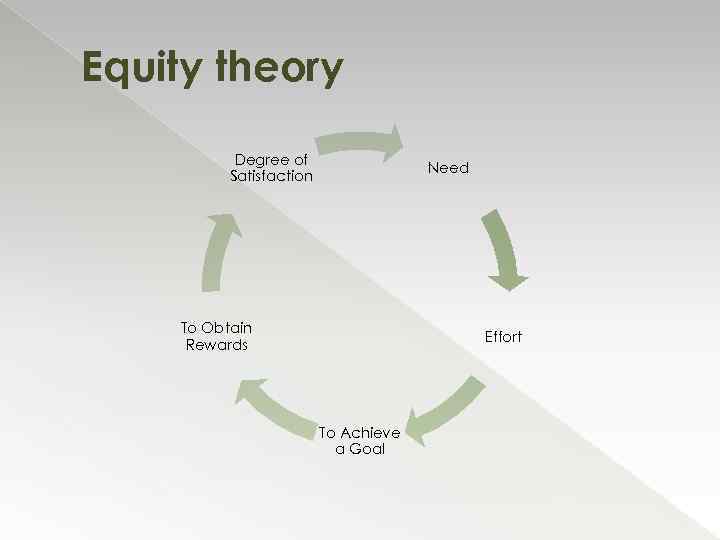
Equity theory Degree of Satisfaction Need To Obtain Rewards Effort To Achieve a Goal
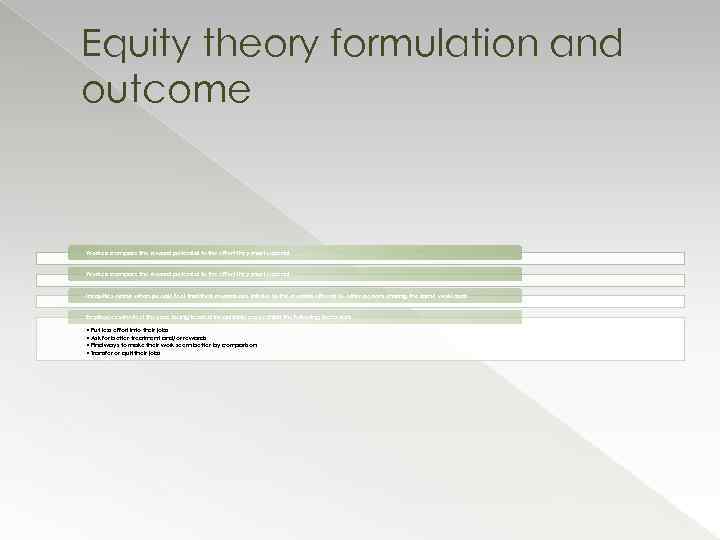
Equity theory formulation and outcome Workers compare the reward potential to the effort they must expend Inequities occur when people feel that their rewards are inferior to the rewards offered to other persons sharing the same workloads Employees who feel they are being treated inequitably may exhibit the following behaviors: • Put less effort into their jobs • Ask for better treatment and/or rewards • Find ways to make their work seem better by comparison • Transfer or quit their jobs
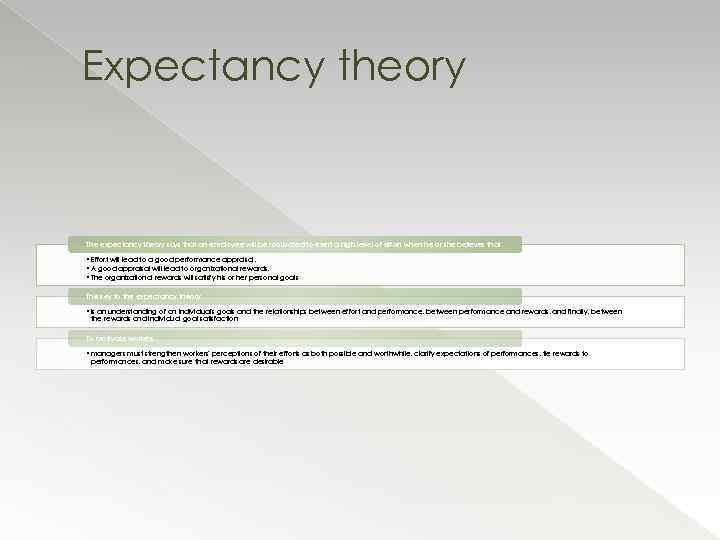
Expectancy theory The expectancy theory says that an employee will be motivated to exert a high level of effort when he or she believes that • Effort will lead to a good performance appraisal. • A good appraisal will lead to organizational rewards. • The organizational rewards will satisfy his or her personal goals The key to the expectancy theory • is an understanding of an individual's goals and the relationships between effort and performance, between performance and rewards, and finally, between the rewards and individual goal satisfaction To motivate workers • managers must strengthen workers' perceptions of their efforts as both possible and worthwhile, clarify expectations of performances, tie rewards to performances, and make sure that rewards are desirable
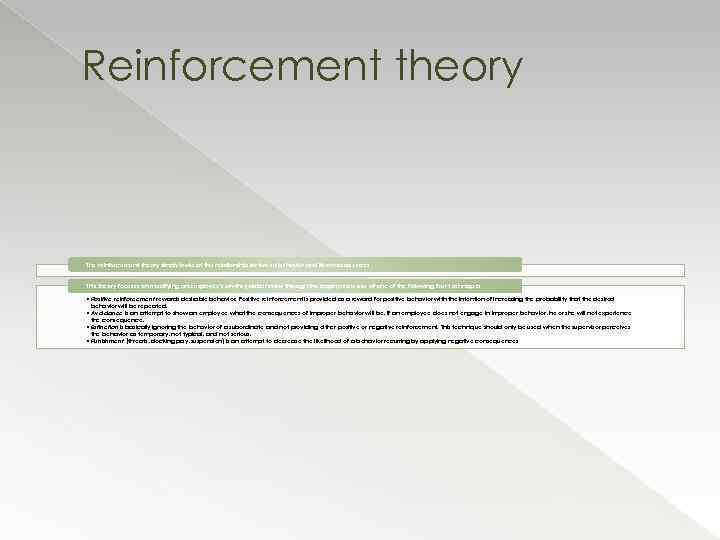
Reinforcement theory The reinforcement theory simply looks at the relationship between behavior and its consequences This theory focuses on modifying an employee's on-the-job behavior through the appropriate use of one of the following four techniques • Positive reinforcement rewards desirable behavior. Positive reinforcement is provided as a reward for positive behavior with the intention of increasing the probability that the desired behavior will be repeated. • Avoidance is an attempt to show an employee what the consequences of improper behavior will be. If an employee does not engage in improper behavior, he or she will not experience the consequence. • Extinction is basically ignoring the behavior of a subordinate and not providing either positive or negative reinforcement. This technique should only be used when the supervisor perceives the behavior as temporary, not typical, and not serious. • Punishment (threats, docking pay, suspension) is an attempt to decrease the likelihood of a behavior recurring by applying negative consequences
implications for management The reinforcement theory has the following implications for management: • Learning what is acceptable to the organization influences motivated behavior. • Managers who are trying to motivate their employees should be sure to tell individuals what they are doing wrong and be careful not to reward all individuals at the same time. • Managers must tell individuals what they can do to receive positive reinforcement. • Managers must be sure to administer the reinforcement as closely as possible to the occurrence of the behavior. • Managers must recognize that failure to reward can also modify behavior. Employees who believe that they deserve a reward and do not receive it will often become disenchanted with both their manager and company
Goal-setting theory The goal-setting theory proposed that intentions to work toward a goal are a major source of work motivation • Goals, in essence, tell employees what needs to be done and how much effort should be expanded • The more difficult the goal, the higher the level of performance expected Managers can set the goals for their employees, or employees and managers can develop goals together • One advantage of employees participating in goal setting is that they may be more likely to work toward a goal they helped develop Employees do better when they get feedback on their progress. In addition to feedback, 3 other factors influence the goalsperformance relationship • The employee must be committed to the goal. • The employee must believe that he is capable of performing the task. • Tasks involved in achieving the goal should be simple, familiar, and independent
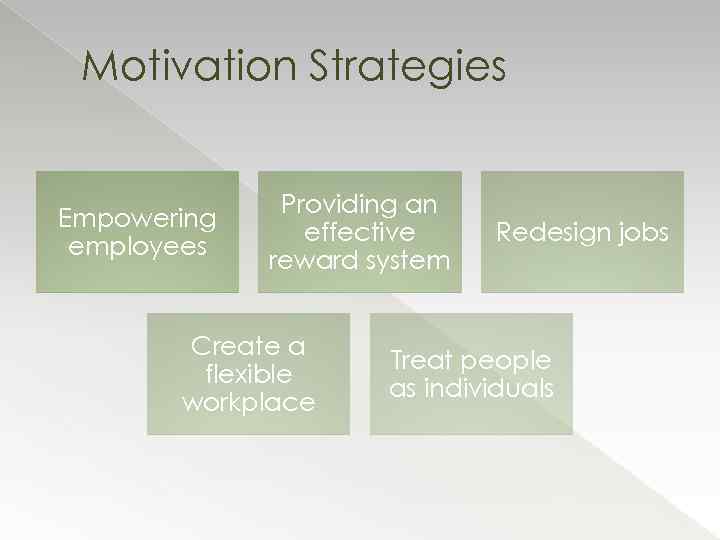
Motivation Strategies Empowering employees Providing an effective reward system Create a flexible workplace Redesign jobs Treat people as individuals
Empowering employees Empowerment occurs when individuals in an organization are given autonomy, authority, trust, and encouragement to accomplish a task • Empowerment is designed to unshackle the worker and to make a job the worker's responsibility In an attempt to empower and to change some of the old bureaucratic ideas, managers are promoting corporate intrapreneurships • Intrapreneurship encourages employees to pursue new ideas and gives them the authority to promote those ideas • Intrapreneurship is not for the timid, because old structures and processes are turned upside down
Providing an effective reward system A reward is a work outcome of positive value to the individual. People receive rewards in one of the following two ways • Extrinsic rewards are externally administered. They are valued outcomes given to someone by another person, typically a supervisor or higher level manager. In all cases, the motivational stimulus of extrinsic rewards originates outside the individual. • Intrinsic rewards are self-administered. Think of the “natural high” a person may experience after completing a job. That person feels good because she has a feeling of competency, personal development, and self-control over her work. In contrast to extrinsic rewards, the motivational stimulus of intrinsic rewards is internal and doesn't depend on the actions of other people.
Elements of effective reward system An effective reward system has four elements: • Rewards need to satisfy the basic needs of all employees. • Rewards need to be included in the system and be comparable to ones offered by a competitive organization in the same area. • Rewards need to be available to people in the same positions and be distributed fairly and equitably. • The overall reward system needs to be multifaceted. Because all people are different, managers must provide a range of rewards—pay, time off, recognition, or promotion. In addition, managers should provide several different ways to earn these rewards
Redesigning jobs When redesigning jobs, managers look at both job scope and job depth • Job enlargement. Often referred to as horizontal job loading, job enlargement increases the variety of tasks a job includes. Although it doesn't increase the quality or the challenge of those tasks, job enlargement may reduce some of the monotony, and as an employee's boredom decreases, his or her work quality generally increases. • Job rotation. This practice assigns people to different jobs or tasks to different people on a temporary basis. The idea is to add variety and to expose people to the dependence that one job has on other jobs. Job rotation can encourage higher levels of contributions and renew interest and enthusiasm. The organization benefits from a cross-trained workforce. • Job enrichment. Also called vertical job loading, this application includes not only an increased variety of tasks, but also provides an employee with more responsibility and authority. If the skills required to do the job are skills that match the jobholder's abilities, job enrichment may improve morale and performance
Controlling Topic Five
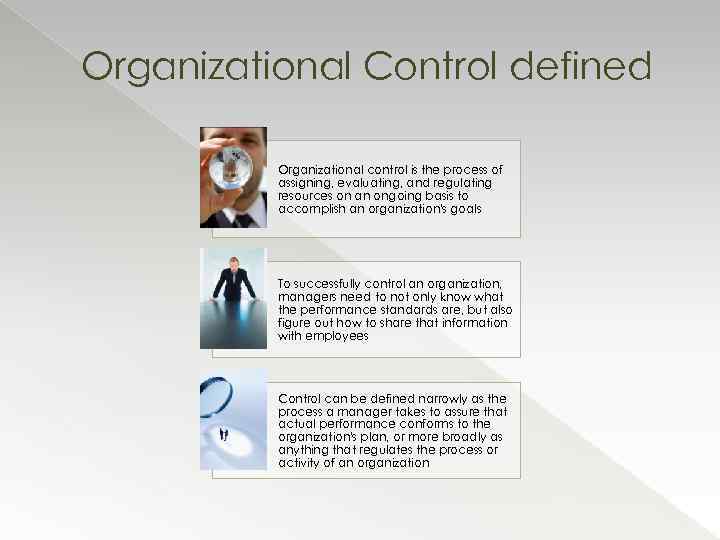
Organizational Control defined Organizational control is the process of assigning, evaluating, and regulating resources on an ongoing basis to accomplish an organization's goals To successfully control an organization, managers need to not only know what the performance standards are, but also figure out how to share that information with employees Control can be defined narrowly as the process a manager takes to assure that actual performance conforms to the organization's plan, or more broadly as anything that regulates the process or activity of an organization
Organizational Control Objectives The six major purposes of controls are as follows • Controls make plans effective. Managers need to measure progress, offer feedback, and direct their teams if they want to succeed. • Controls make sure that organizational activities are consistent. Policies and procedures help ensure that efforts are integrated. • Controls make organizations effective. Organizations need controls in place if they want to achieve and accomplish their objectives. • Controls make organizations efficient. Efficiency probably depends more on controls than any other management function. • Controls provide feedback on project status. Not only do they measure progress, but controls also provide feedback to participants as well. Feedback influences behavior and is an essential ingredient in the control process • Controls aid in decision making. The ultimate purpose of controls is to help managers make better decisions. Controls make managers aware of problems and give them information that is necessary for decision making.
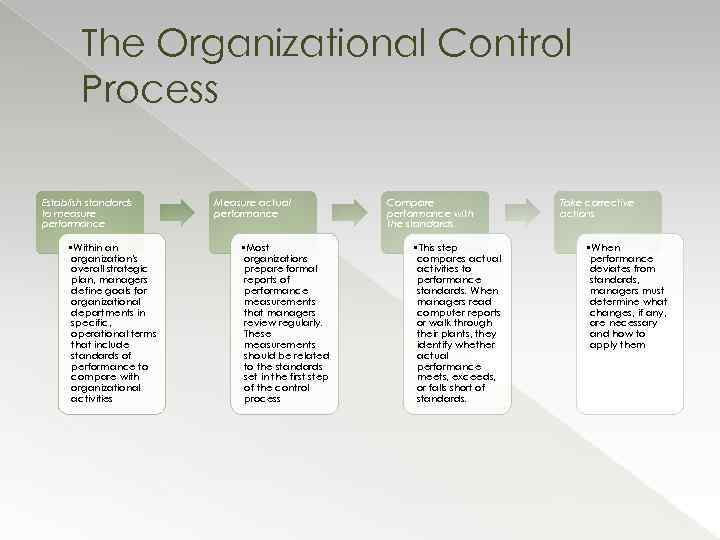
The Organizational Control Process Establish standards to measure performance • Within an organization's overall strategic plan, managers define goals for organizational departments in specific, operational terms that include standards of performance to compare with organizational activities Measure actual performance • Most organizations prepare formal reports of performance measurements that managers review regularly. These measurements should be related to the standards set in the first step of the control process Compare performance with the standards • This step compares actual activities to performance standards. When managers read computer reports or walk through their plants, they identify whether actual performance meets, exceeds, or falls short of standards. Take corrective actions • When performance deviates from standards, managers must determine what changes, if any, are necessary and how to apply them
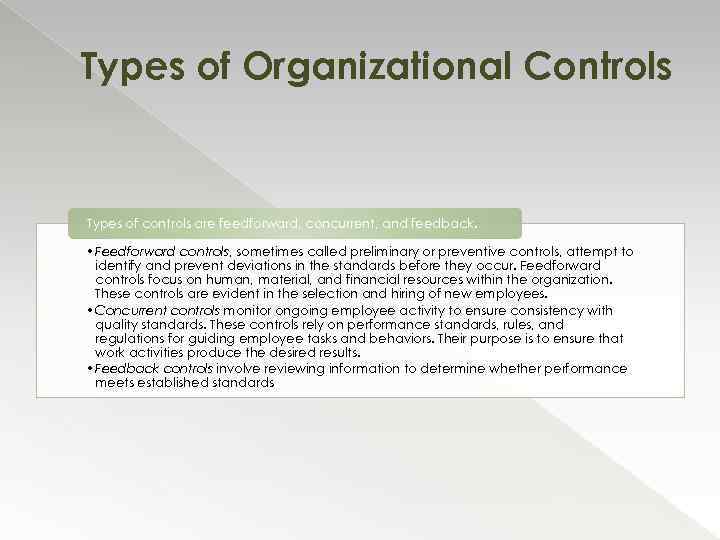
Types of Organizational Controls Types of controls are feedforward, concurrent, and feedback. • Feedforward controls, sometimes called preliminary or preventive controls, attempt to identify and prevent deviations in the standards before they occur. Feedforward controls focus on human, material, and financial resources within the organization. These controls are evident in the selection and hiring of new employees. • Concurrent controls monitor ongoing employee activity to ensure consistency with quality standards. These controls rely on performance standards, rules, and regulations for guiding employee tasks and behaviors. Their purpose is to ensure that work activities produce the desired results. • Feedback controls involve reviewing information to determine whether performance meets established standards
Effective control systems share several common characteristics • A focus on critical points. The critical points include all the areas of an organization's operations that directly affect the success of its key operations. • Integration into established processes. Controls must function harmoniously within these processes and should not bottleneck operations. • Acceptance by employees. Employee involvement in the design of controls can increase acceptance. • Availability of information when needed. Deadlines, time needed to complete the project, costs associated with the project, and priority needs are apparent in these criteria • Economic feasibility. In short, comparison of the costs to the benefits ensures that the benefits of controls outweigh the costs. • Accuracy. Effective control systems provide factual information that's useful, reliable, valid, and consistent. • Comprehensibility. Controls must be simple and easy to understand.

Financial controls Financial ratio analysis examines the relationship between specific figures on the financial statements : • Liquidity ratios measure an organization's ability to generate cash. • Profitability ratios measure an organization's ability to generate profits. • Debt ratios measure an organization's ability to pay its debts. • Activity ratios measure an organization's efficiency in operations and use of assets
Budget controls Budget development methods are as follows • Top down budgeting. Managers prepare the budget and send it to subordinates. • Bottom up budgeting. Figures come from the lower levels and are adjusted and coordinated as they move up the hierarchy. • Zero based budgeting. Managers develop each new budget by justifying the projected allocation against its contribution to departmental or organizational goals. • Flexible budgeting. Any budget exercise can incorporate flexible budgets, which set “meet or beat” standards that can be compared to expenditures.
Marketing controls Controls used to evaluate an organization’s marketing functions • Market research gathers data to assess customer needs—information critical to an organization’s success. Ongoing market research reflects how well an organization is meeting customers’ expectations and helps anticipate customer needs. It also helps identify competitors. • Test marketing is small-scale product marketing to assess customer acceptance. Using surveys and focus groups, test marketing goes beyond identifying general requirements and looks at what (or who) actually influences buying decisions. • Marketing statistics measure performance by compiling data and analyzing results. In most cases, competency with a computer spreadsheet program is all a manager needs. Managers look at marketing ratios, which measure profitability, activity, and market shares, as well as sales quotas, which measure progress toward sales goals and assist with inventory controls
Human resource controls help managers regulate the quality of newly hired personnel, as well as monitor current employees’ developments and daily performances On a daily basis, managers can go a long way in helping to control workers’ behaviors in organizations. Managers can also institute policies and procedures to help guide workers’ actions. Finally, they can consider past experiences when developing future strategies, objectives, policies, and procedures. Common control types include performance appraisals, disciplinary programs, observations, and training and development assessments. Because the quality of a firm’s personnel, to a large degree, determines the firm’s overall effectiveness, controlling this area is very crucial.
Computers and information controls Limitations of the use of information technology • Performance limitations. Although management information systems have the potential to increase overall performance, replacing long-time organizational employees with information systems technology may result in the loss of expert knowledge that these individuals hold. Additionally, computerized information systems are expensive and difficult to develop. After the system has been purchased, coordinating it—possibly with existing equipment—may be more difficult than expected • Behavioral limitations. Information technology allows managers to access more information than ever before. But too much information can overwhelm employees, cause stress, and even slow decision making. Thus, managing the quality and amount of information available to avoid information overload is important. • Health risks. Potentially serious health-related issues associated with the use of computers and other information technology have been raised in recent years. An example is carpal tunnel syndrome, a painful disorder in the hands and wrists caused by repetitive movements (such as those made on a keyboard).
Скачать презентацию Basics of Management Sc D Prof Vladimir Momot
Basics of Management (2).pptx