 Скачать презентацию Basics of Geography World Cultures- Mr Evans
5982d0dbbefb0672a35e98959feafe36.ppt
- Количество слайдов: 15



Basics of Geography World Cultures- Mr. Evans
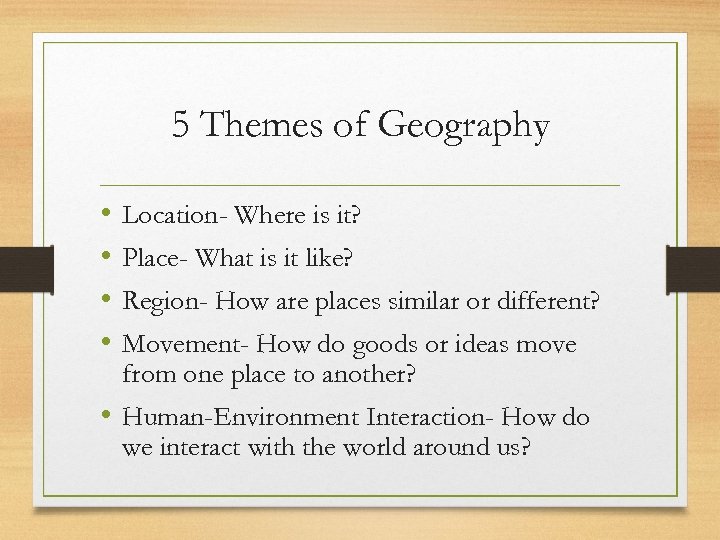
5 Themes of Geography • • Location- Where is it? Place- What is it like? Region- How are places similar or different? Movement- How do goods or ideas move from one place to another? • Human-Environment Interaction- How do we interact with the world around us?
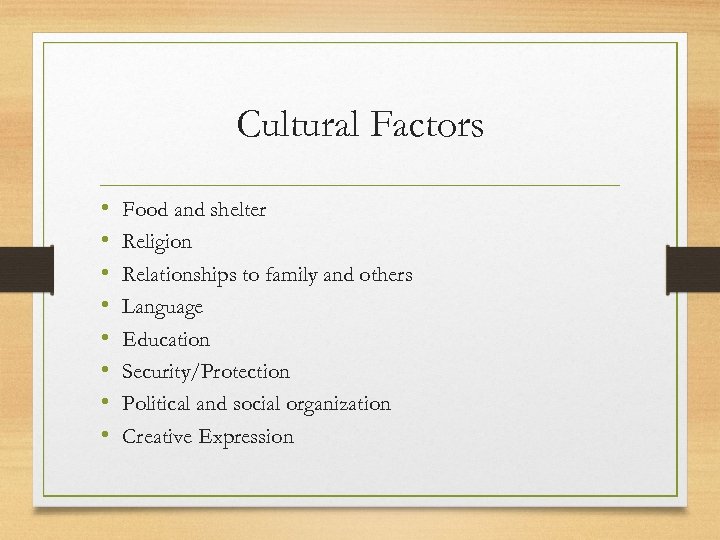
Cultural Factors • • Food and shelter Religion Relationships to family and others Language Education Security/Protection Political and social organization Creative Expression
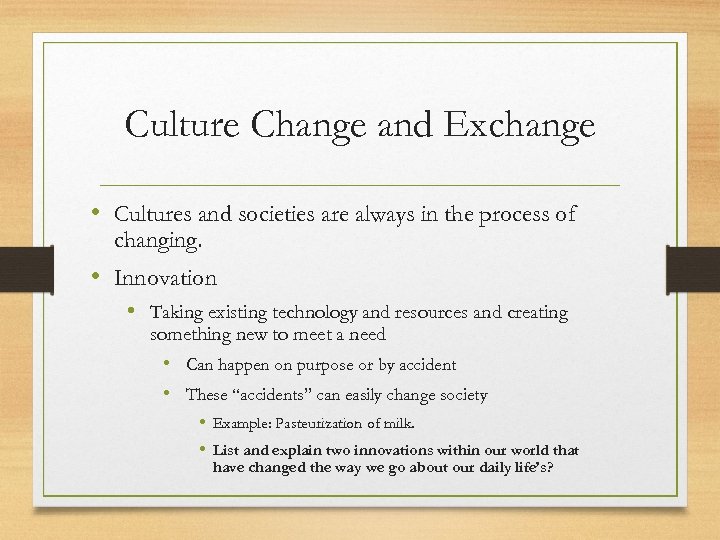
Culture Change and Exchange • Cultures and societies are always in the process of changing. • Innovation • Taking existing technology and resources and creating something new to meet a need • Can happen on purpose or by accident • These “accidents” can easily change society • Example: Pasteurization of milk. • List and explain two innovations within our world that have changed the way we go about our daily life’s?
Diffusion • Good ideas are hard to keep a secret. • The spread of ideas, inventions, or patterns of behavior is called DIFFUSION. • Age of technology this process can happen very quickly • Mass media such as Internet, Social Media cover a broad range. List and explain an example of diffusion within the United States? To stimulate your brain think entertainment, food, clothing, etc.
Religion • This aspect of culture has a great deal of influence and importance in many people’s lives • Religion consists of a belief in a supernatural power or powers that are regarded as creators and maintains the universe. • Often establishes values or beliefs
Religions Continued… • There are three major types of religions • Monotheistic- with a belief in one god • Polytheistic- with a belief in many gods • Animistic- (traditional) often a belief in divine forces in nature For Monday, give an examples of a faith that fits the three major types of religions? • Religion spreads through diffusion and also converts • People who give up their former beliefs for new ones
Three Major Religions • All are monotheistic and share similar beliefs and some of the major prophets and teachers • Judaism- The oldest of the Southwest Asian religions • Followers are known as “Jews” • Live in Israel, U. S. , Canada, South America and many European cities • Basic laws and teachings come from the Torah
Christianity • Evolved 2, 000 years from the teachings of Judaism • Based on the teachings of Jesus Christ • New Testament of the Bible • Largest of the religions with over 2 billion followers • Christians live on every continent
Islam • Based on the teachings of the Prophet Mohammad • Began teaching around 613 A. D. • Followers are known as Muslims • Their god is known as Allah • The Muslim holy book is known as the Quran
Nations of the World • State- Four general characteristics • • Territory Government People Sovereign • They have control over their internal and external affairs
Types of Government • • Democracy Monarchy Dictatorship Communism • Nearly all political power and means of production are held by the government in the name of all the people.
Types of Economies • Command- Production of goods and services is determined by a central government • Market- Production of goods and services is determined by the demand of consumers • Mixed- A combination of command market economies
General Terms • Gross National Product (GNP)- total value of all goods and services produced by a country over a year • Gross Domestic Product (GDP)- total value of all goods and services produced within a country in a given period of time
General Terms Continued… • Developing Nations (3 rd World)- nations that have a low GDP and limited development • No infrastructure and struggle to meet the basic needs of their population • Developed Nations (1 st World)- countries with a high per capita income and a varied economy
Скачать презентацию Basics of Geography World Cultures- Mr Evans
5982d0dbbefb0672a35e98959feafe36.ppt