 Скачать презентацию BASIC UNDERSTANDING OF THE CONCEPT FOR ENTREPRENEURSHIP AND
a29fb7eb4fc4268690d5820acc41ae7b.ppt
- Количество слайдов: 26




BASIC UNDERSTANDING OF THE CONCEPT FOR ENTREPRENEURSHIP AND ENTREPRENEURSHIP EDUCATION Henk Verbeke Tartu, March 2012
1 – How it all went so nicely 2 – The roaring sixties 3 – Teaching Process Management
There was bureaucracy Borrowed from the Juran website, years ago
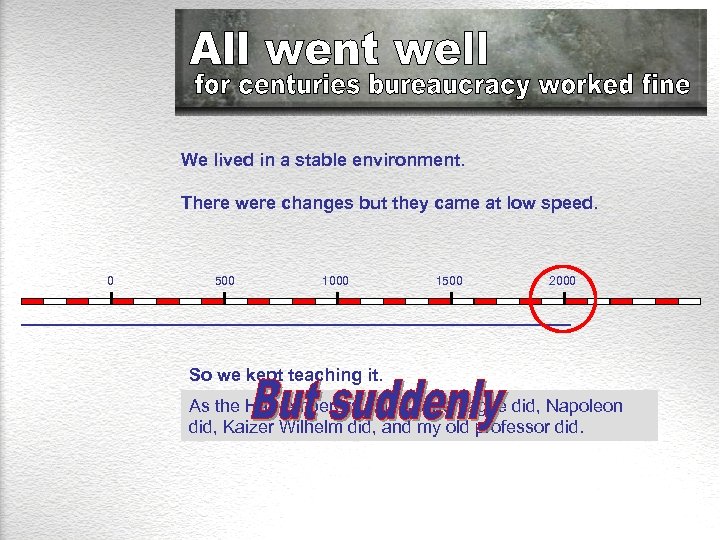
We lived in a stable environment. There were changes but they came at low speed. 0 500 1000 1500 2000 So we kept teaching it. As the Han-emperors did, Charlemagne did, Napoleon did, Kaizer Wilhelm did, and my old professor did.
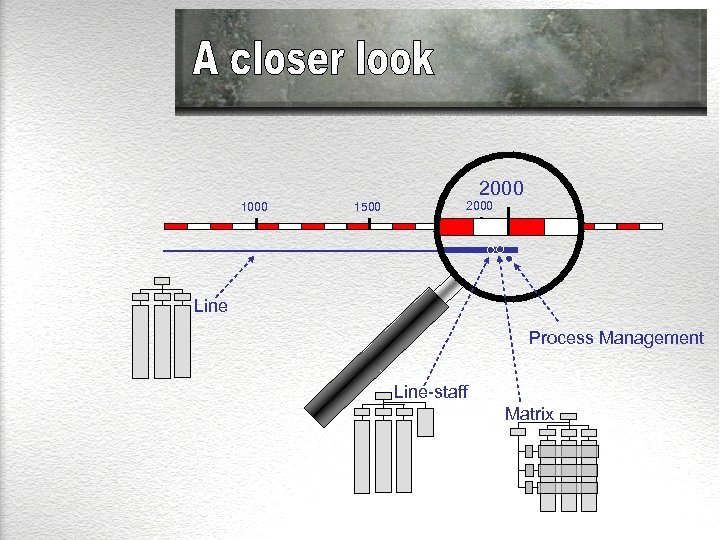
2000 1500 2000 Line Process Management Line-staff Matrix
Ah, we sure rocked the boat, didn’t we!
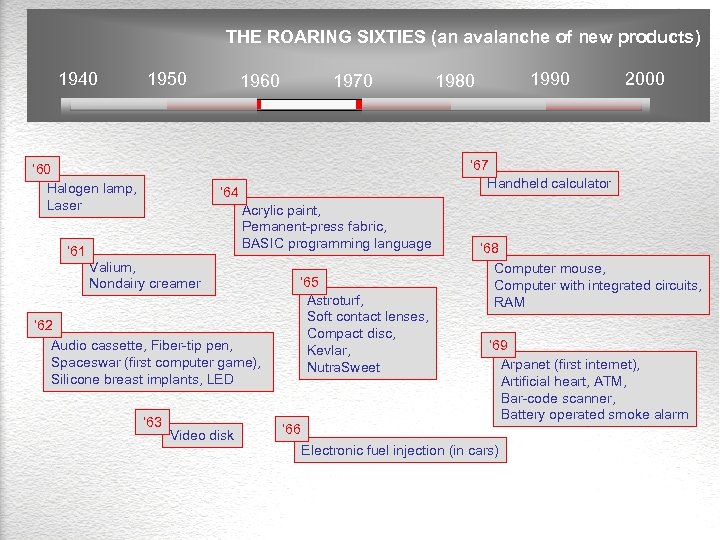
THE ROARING SIXTIES (an avalanche of new products) 1940 1950 ‘ 60 Halogen lamp, Laser 1960 1970 Acrylic paint, Pemanent-press fabric, BASIC programming language Valium, Nondairy creamer ‘ 62 Audio cassette, Fiber-tip pen, Spaceswar (first computer game), Silicone breast implants, LED ‘ 63 Video disk 2000 ‘ 67 Handheld calculator ‘ 64 ‘ 61 1990 1980 ‘ 65 Astroturf, Soft contact lenses, Compact disc, Kevlar, Nutra. Sweet ‘ 66 ‘ 68 Computer mouse, Computer with integrated circuits, RAM ‘ 69 Arpanet (first internet), Artificial heart, ATM, Bar-code scanner, Battery operated smoke alarm Electronic fuel injection (in cars)
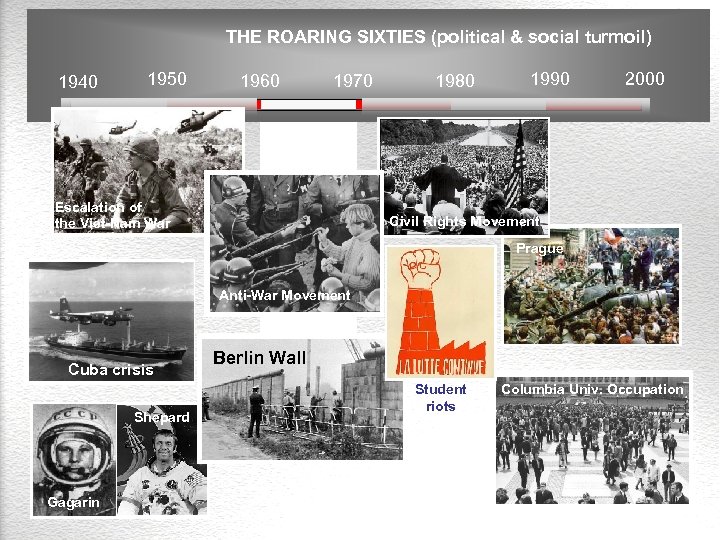
THE ROARING SIXTIES (political & social turmoil) 1940 1950 1960 1970 Escalation of the Viet-Nam War 1980 1990 2000 Civil Rights Movement Prague Anti-War Movement Cuba crisis Shepard Gagarin Berlin Wall Student riots Columbia Univ. Occupation
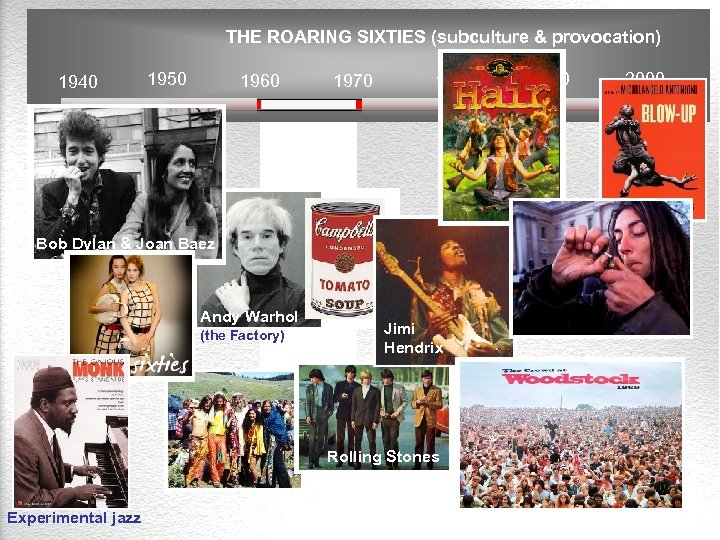
THE ROARING SIXTIES (subculture & provocation) 1940 1950 1960 1970 1980 Bob Dylan & Joan Baez Andy Warhol (the Factory) Jimi Hendrix Rolling Stones Experimental jazz 1990 2000
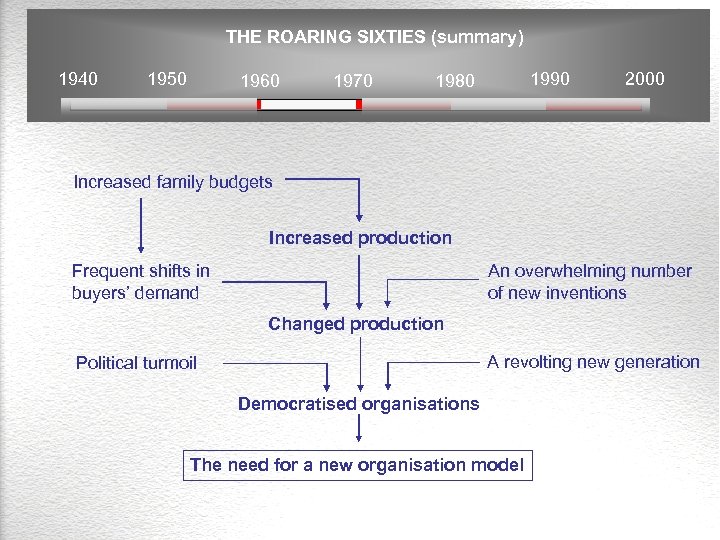
THE ROARING SIXTIES (summary) 1940 1950 1960 1970 1990 1980 2000 Increased family budgets Increased production Frequent shifts in buyers’ demand An overwhelming number of new inventions Changed production A revolting new generation Political turmoil Democratised organisations The need for a new organisation model
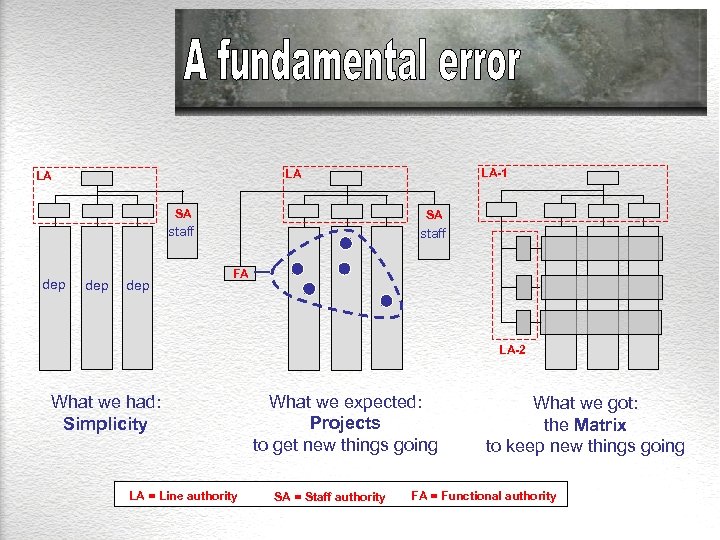
LA-1 LA LA SA staff dep dep SA staff FA LA-2 What we had: Simplicity LA = Line authority What we expected: Projects to get new things going SA = Staff authority What we got: the Matrix to keep new things going FA = Functional authority
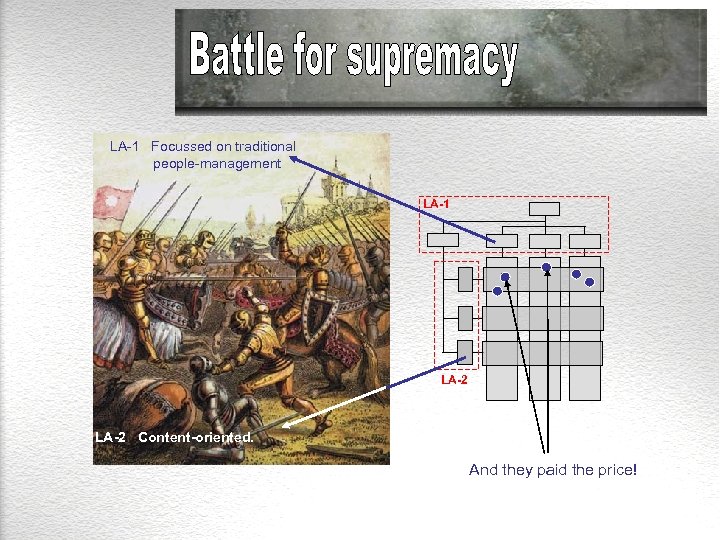
LA-1 Focussed on traditional people-management LA-1 LA-2 Content-oriented. And they paid the price!
When the task environment becomes dynamic rather than stable (…) standardised response rules are inadequate (…). It (the organisation) must determine when and how to act, and its cues must be taken from the task environment. Thompson, J. D (1967) Organizations in action, page 72. Mc. Graw-Hill
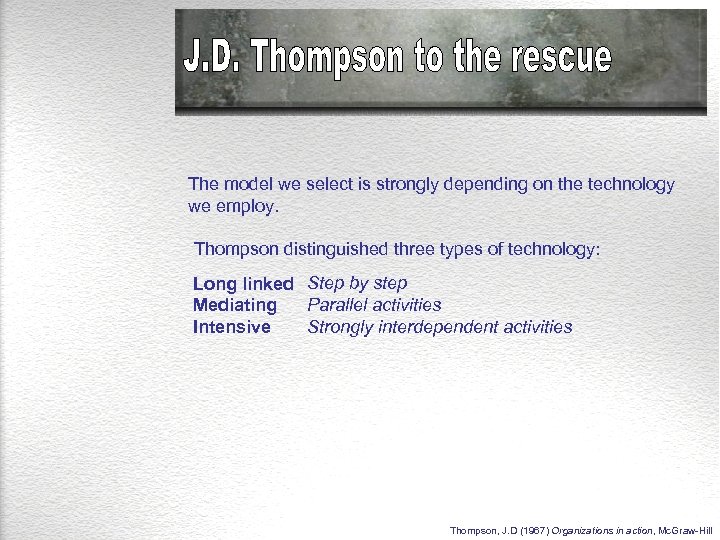
The model we select is strongly depending on the technology we employ. Thompson distinguished three types of technology: Long linked Step by step Parallel activities Mediating Strongly interdependent activities Intensive Thompson, J. D (1967) Organizations in action, Mc. Graw-Hill
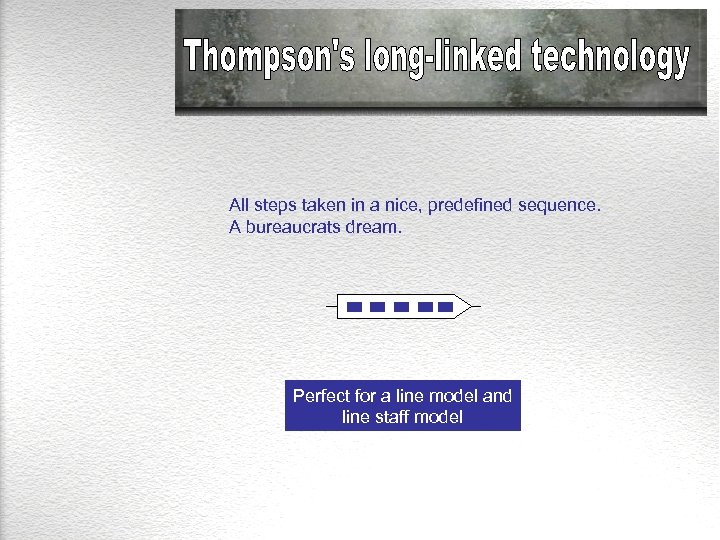
All steps taken in a nice, predefined sequence. A bureaucrats dream. Perfect for a line model and line staff model
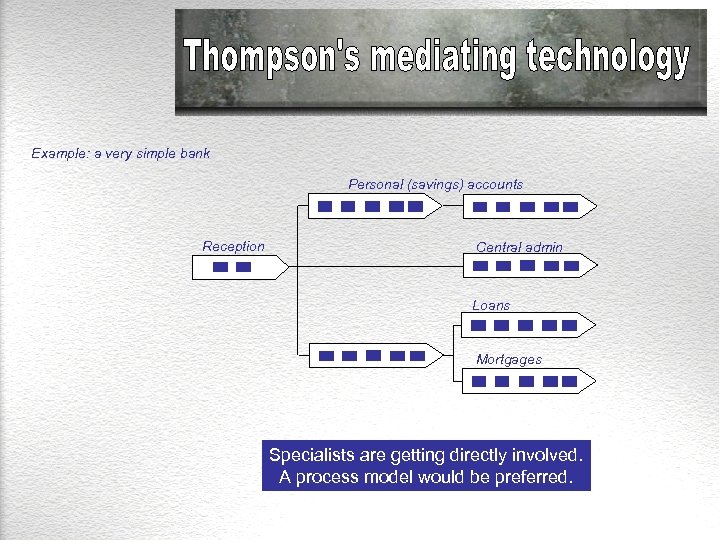
Example: a very simple bank Personal (savings) accounts Reception Central admin Loans Mortgages Specialists are getting directly involved. A process model would be preferred.
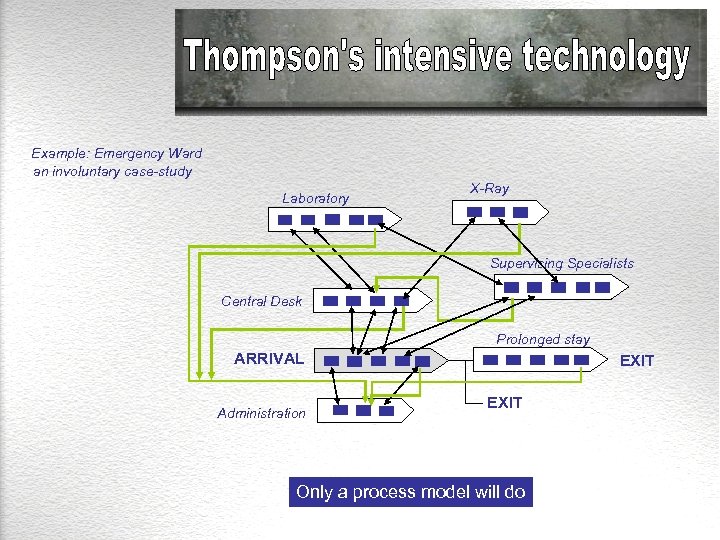
Example: Emergency Ward an involuntary case-study Laboratory X-Ray Supervising Specialists Central Desk Prolonged stay ARRIVAL Administration EXIT Only a process model will do EXIT
Consultants keep each other busy in lengthy discussions about Process Management. Especially Linked. In-groups on process management offer a wide range of that entrepreneurs adopt ISO certification requiresdiscussions between consultants. Process Management, but nobody told them how. We see entrepreneurs ‘describe’ processes only for those activities that are Girls have hijacked Process Management. The IT-Boys &important to the certificates in question. Unknowingly they create hybrid organisations. Many SME’s are tempted to buy expensive software to get ‘up-to-date’. An extreme waste of money requiring the help of expensive experts We see governmental institutions struggle to modernise, to get things going again. thus adopting the Matrix-model (!) A very disappointing experience. As if they never heard about it’s lack of results, combined with extreme costs due to constant meetings. Meetings that are necessary to keep everyone informed and conflicts within limits.
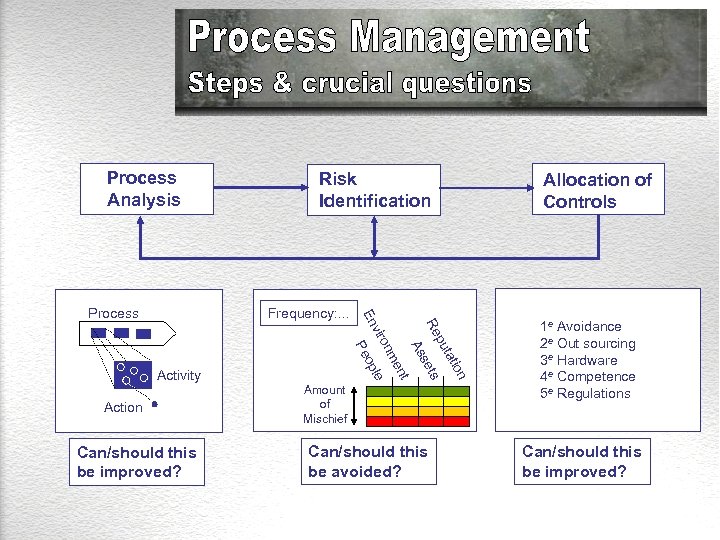
Process Analysis What are we doing? At what sequence? Who are doing it? Activity What triggers? Action What deliverables? Can/should this be improved? What can go wrong? Frequency: . . . ion tat pu Re sets As nt me on le vir op En Pe Process Risk Identification What are the causes? What are the consequences? Amount of What likelihood? Mischief Can/should this be avoided? Allocation of Controls What control works best? 1 Avoidance Additional controls 2 e Out sourcing required? e e 3 Hardware 4 e Competence Cotse and benefits 5 Regulations of controls? Can/should this be improved?
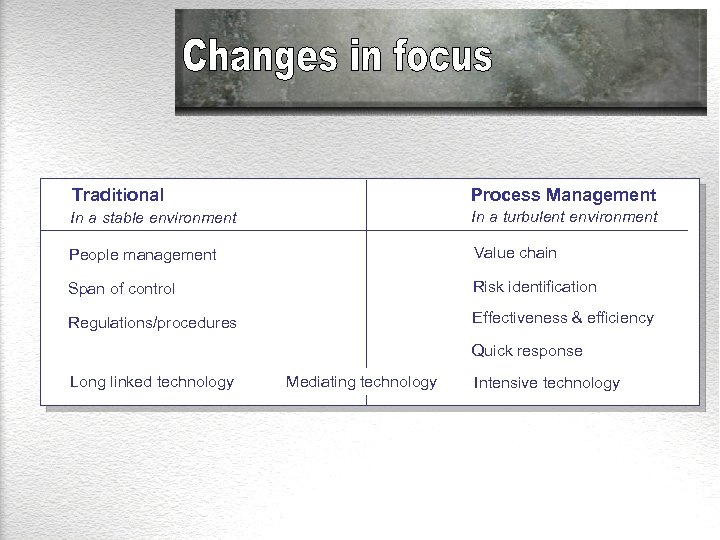
Traditional Process Management In a stable environment In a turbulent environment People management Value chain Span of control Risk identification Regulations/procedures Effectiveness & efficiency Quick response Long linked technology Mediating technology Intensive technology
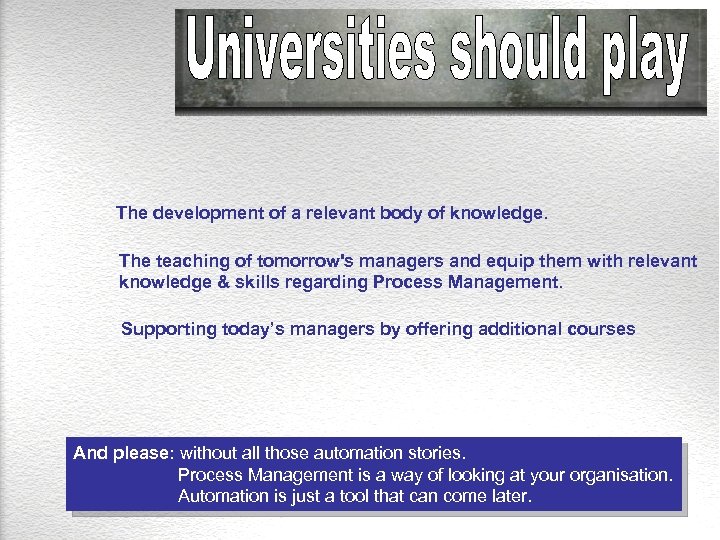
The development of a relevant body of knowledge. The teaching of tomorrow's managers and equip them with relevant knowledge & skills regarding Process Management. Supporting today’s managers by offering additional courses And please: without all those automation stories. Process Management is a way of looking at your organisation. Automation is just a tool that can come later.
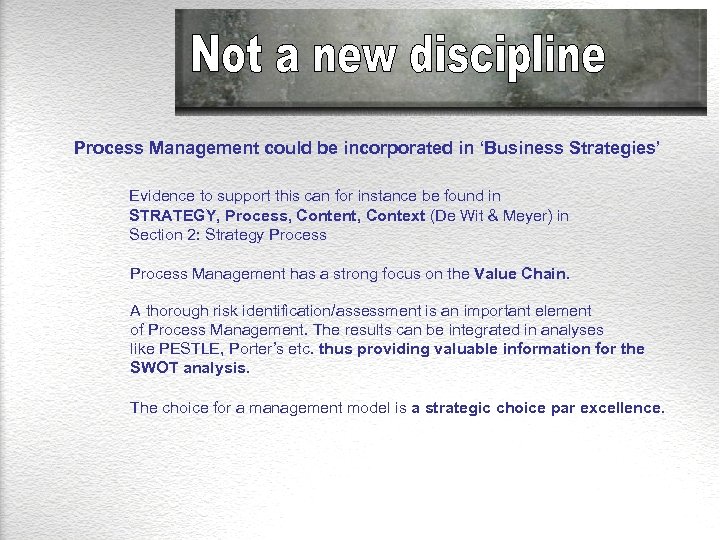
Process Management could be incorporated in ‘Business Strategies’ Evidence to support this can for instance be found in STRATEGY, Process, Content, Context (De Wit & Meyer) in Section 2: Strategy Process Management has a strong focus on the Value Chain. A thorough risk identification/assessment is an important element of Process Management. The results can be integrated in analyses like PESTLE, Porter’s etc. thus providing valuable information for the SWOT analysis. The choice for a management model is a strategic choice par excellence.
This also goes for Process Management
Henk Verbeke hverbeke@home. nl
Скачать презентацию BASIC UNDERSTANDING OF THE CONCEPT FOR ENTREPRENEURSHIP AND
a29fb7eb4fc4268690d5820acc41ae7b.ppt