 Скачать презентацию Basic periods in computer history v Pre-mechanical v
ce601bfaec45a12acace1f9b511c421b.ppt
- Количество слайдов: 26



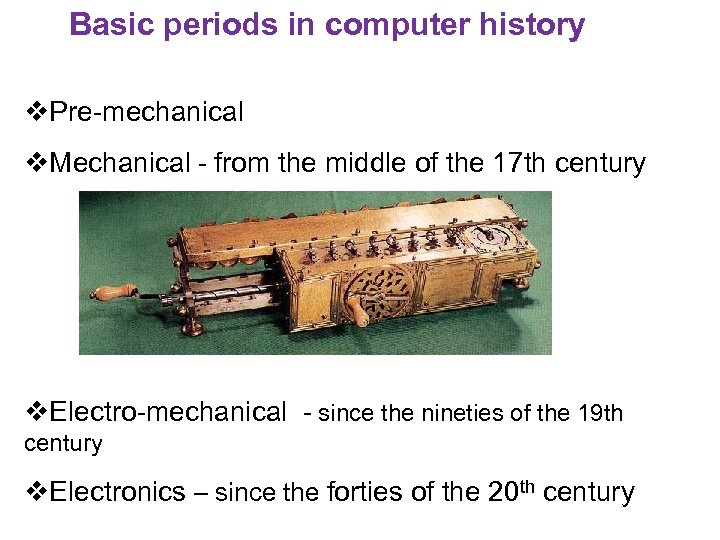
Basic periods in computer history v. Pre-mechanical v. Mechanical - from the middle of the 17 th century v. Electro-mechanical - since the nineties of the 19 th century v. Electronics – since the forties of the 20 th century
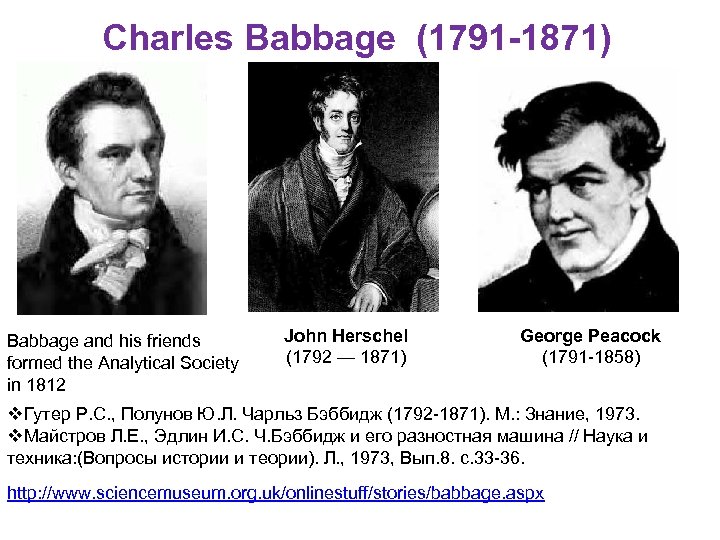
Charles Babbage (1791 -1871) Babbage and his friends formed the Analytical Society in 1812 John Herschel (1792 — 1871) George Peacock (1791 -1858) v. Гутер Р. С. , Полунов Ю. Л. Чарльз Бэббидж (1792 -1871). М. : Знание, 1973. v. Майстров Л. Е. , Эдлин И. С. Ч. Бэббидж и его разностная машина // Наука и техника: (Вопросы истории и теории). Л. , 1973, Вып. 8. с. 33 -36. http: //www. sciencemuseum. org. uk/onlinestuff/stories/babbage. aspx
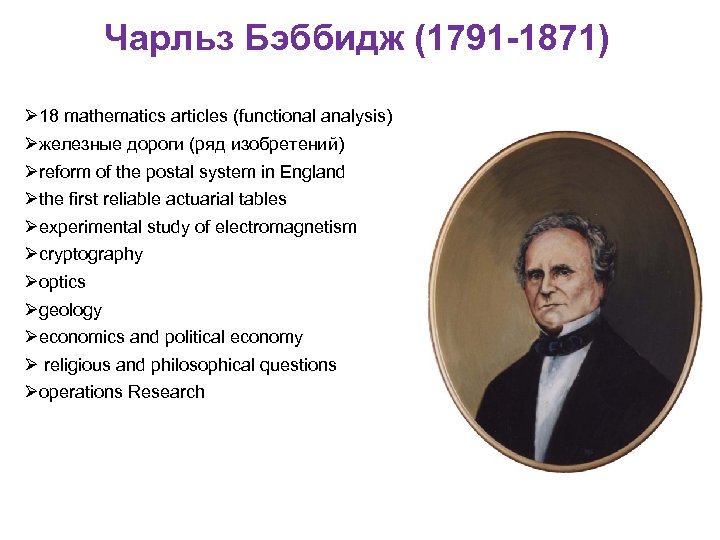
Чарльз Бэббидж (1791 -1871) Ø 18 mathematics articles (functional analysis) Øжелезные дороги (ряд изобретений) Øreform of the postal system in England Øthe first reliable actuarial tables Øexperimental study of electromagnetism Øcryptography Øoptics Øgeology Øeconomics and political economy Ø religious and philosophical questions Øoperations Research
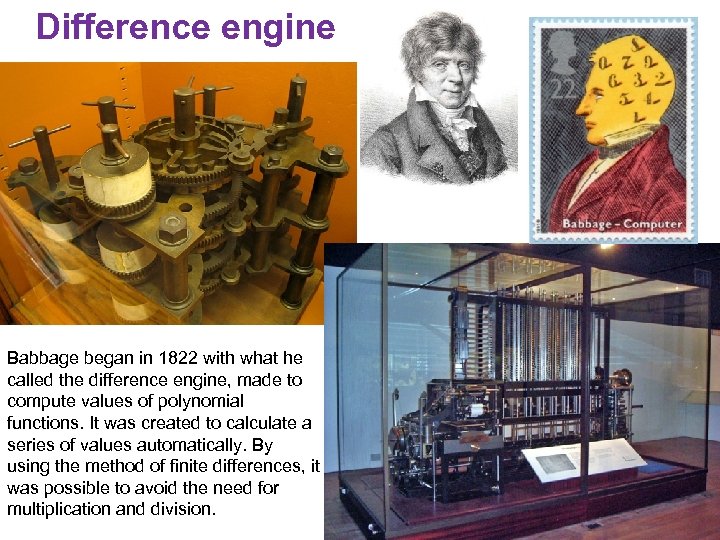
Difference engine Babbage began in 1822 with what he called the difference engine, made to compute values of polynomial functions. It was created to calculate a series of values automatically. By using the method of finite differences, it was possible to avoid the need for multiplication and division.
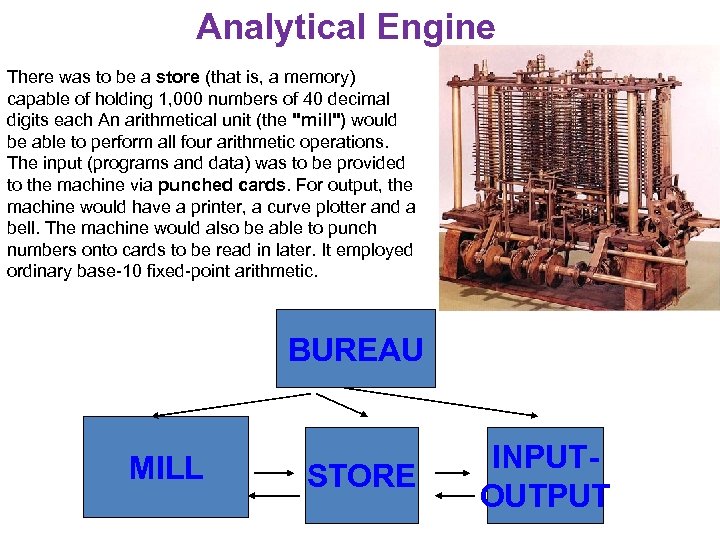
Analytical Engine There was to be a store (that is, a memory) capable of holding 1, 000 numbers of 40 decimal digits each An arithmetical unit (the "mill") would be able to perform all four arithmetic operations. The input (programs and data) was to be provided to the machine via punched cards. For output, the machine would have a printer, a curve plotter and a bell. The machine would also be able to punch numbers onto cards to be read in later. It employed ordinary base-10 fixed-point arithmetic. BUREAU MILL STORE INPUTOUTPUT
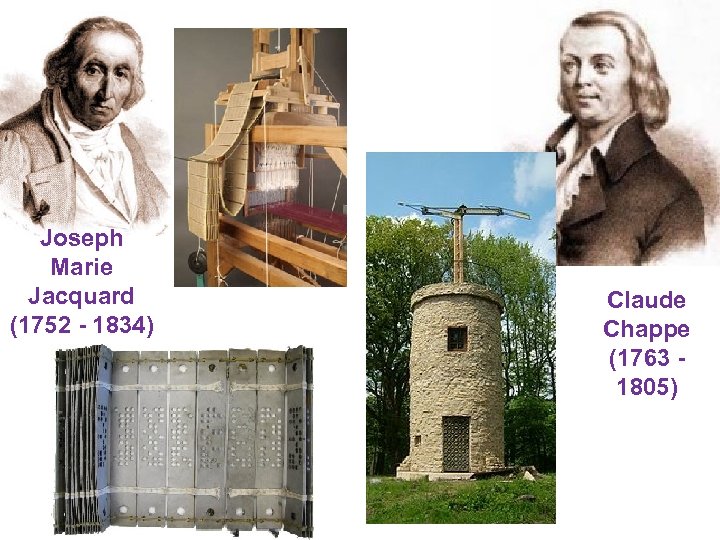
Joseph Marie Jacquard (1752 - 1834) Claude Chappe (1763 1805)
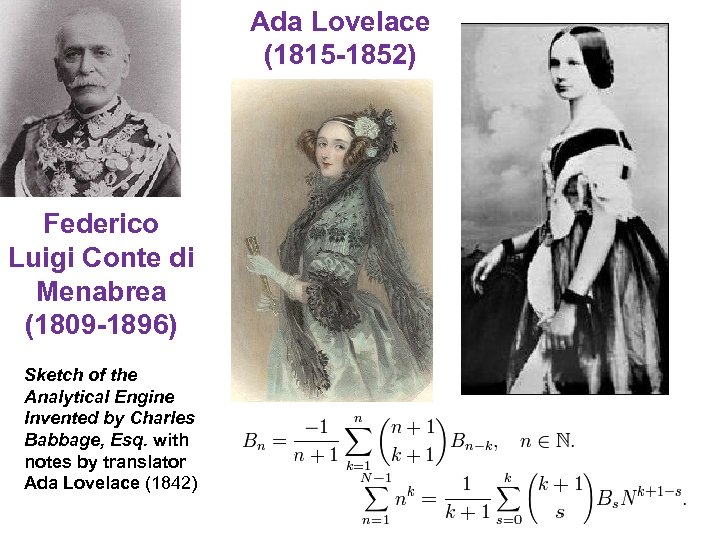
Ada Lovelace (1815 -1852) Federico Luigi Conte di Menabrea (1809 -1896) Sketch of the Analytical Engine Invented by Charles Babbage, Esq. with notes by translator Ada Lovelace (1842)
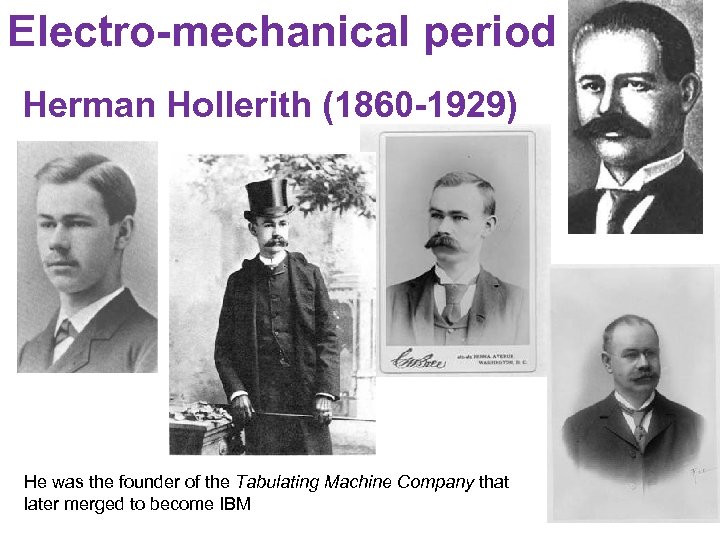
Electro-mechanical period Herman Hollerith (1860 -1929) He was the founder of the Tabulating Machine Company that later merged to become IBM
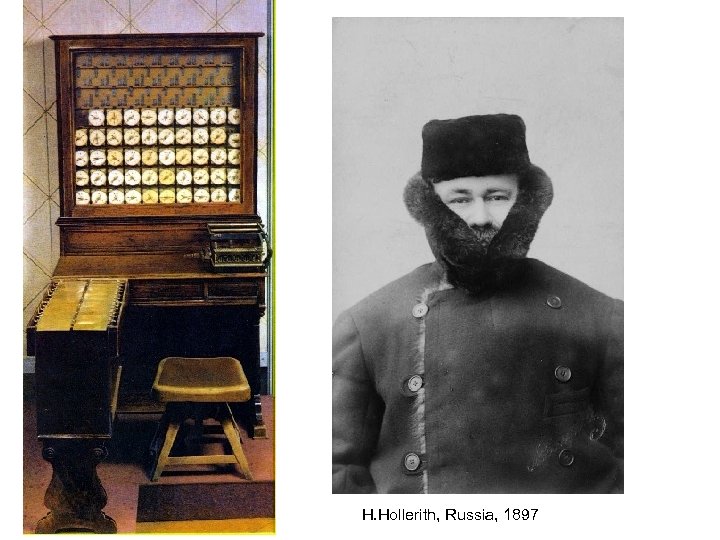
H. Hollerith, Russia, 1897
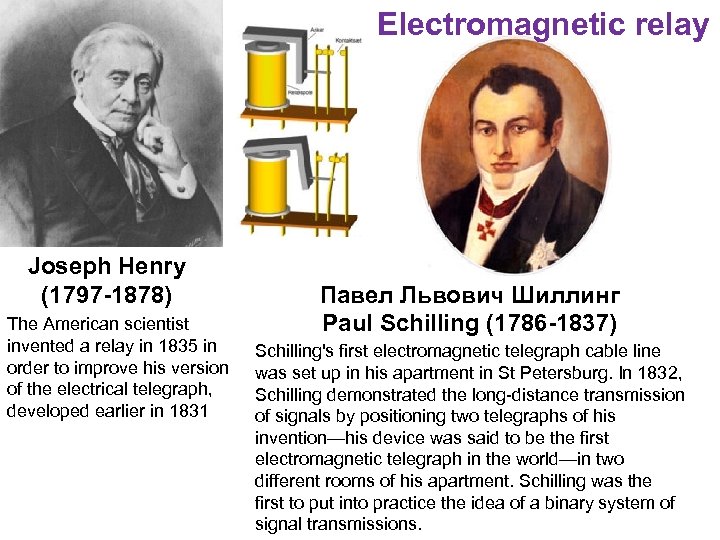
Electromagnetic relay Joseph Henry (1797 -1878) The American scientist invented a relay in 1835 in order to improve his version of the electrical telegraph, developed earlier in 1831 Павел Львович Шиллинг Paul Schilling (1786 -1837) Schilling's first electromagnetic telegraph cable line was set up in his apartment in St Petersburg. In 1832, Schilling demonstrated the long-distance transmission of signals by positioning two telegraphs of his invention—his device was said to be the first electromagnetic telegraph in the world—in two different rooms of his apartment. Schilling was the first to put into practice the idea of a binary system of signal transmissions.
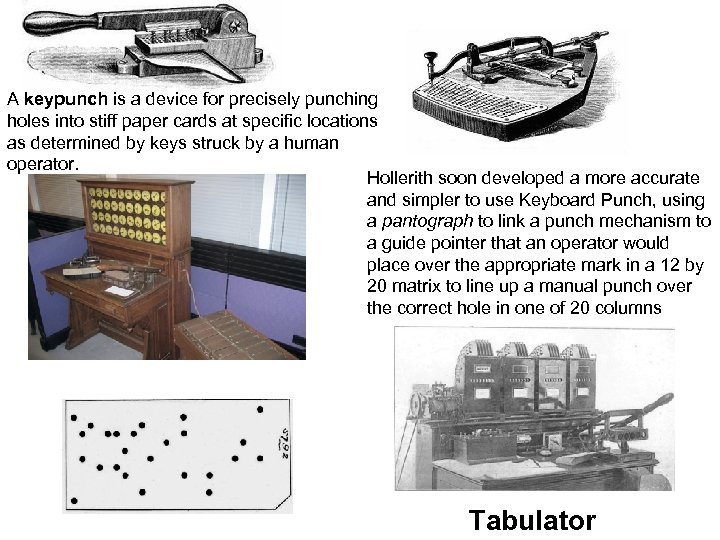
A keypunch is a device for precisely punching holes into stiff paper cards at specific locations as determined by keys struck by a human operator. Hollerith soon developed a more accurate and simpler to use Keyboard Punch, using a pantograph to link a punch mechanism to a guide pointer that an operator would place over the appropriate mark in a 12 by 20 matrix to line up a manual punch over the correct hole in one of 20 columns Tabulator
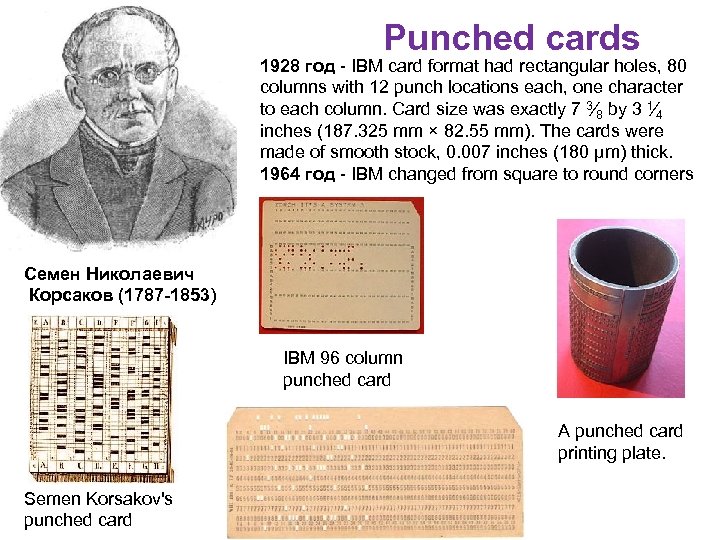
Punched cards 1928 год - IBM card format had rectangular holes, 80 columns with 12 punch locations each, one character to each column. Card size was exactly 7 3⁄8 by 3 1⁄4 inches (187. 325 mm × 82. 55 mm). The cards were made of smooth stock, 0. 007 inches (180 µm) thick. 1964 год - IBM changed from square to round corners Семен Николаевич Корсаков (1787 -1853) IBM 96 column punched card A punched card printing plate. Semen Korsakov's punched card
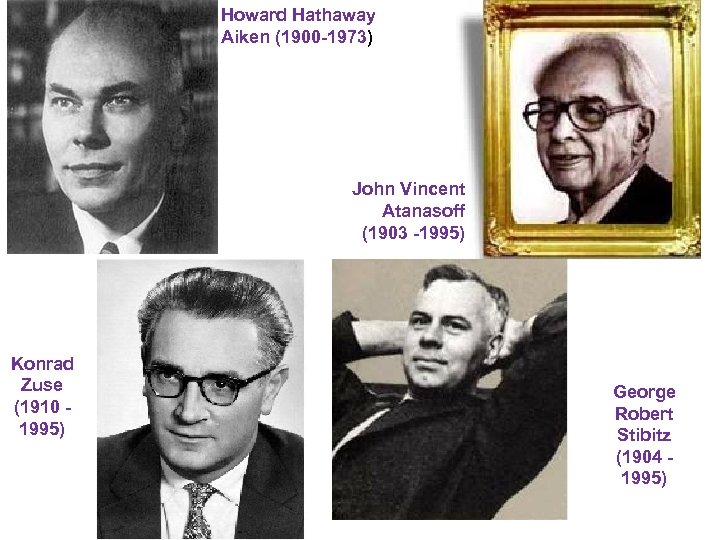
Howard Hathaway Aiken (1900 -1973) John Vincent Atanasoff (1903 -1995) Konrad Zuse (1910 1995) George Robert Stibitz (1904 1995)
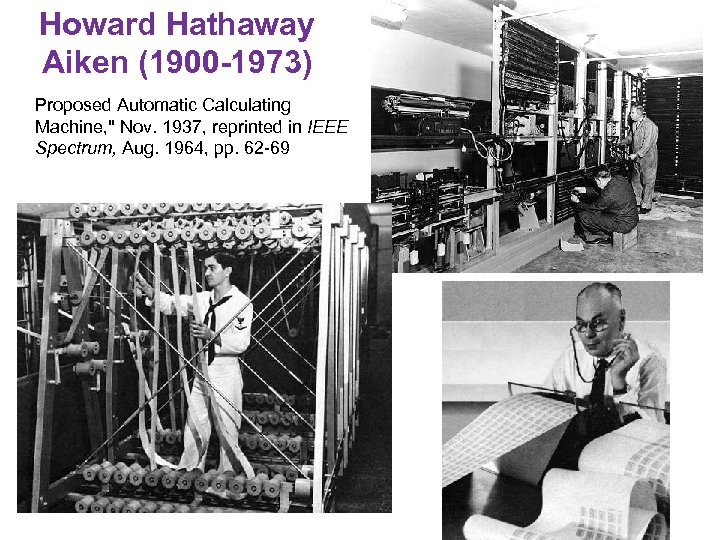
Howard Hathaway Aiken (1900 -1973) Proposed Automatic Calculating Machine, " Nov. 1937, reprinted in IEEE Spectrum, Aug. 1964, pp. 62 -69
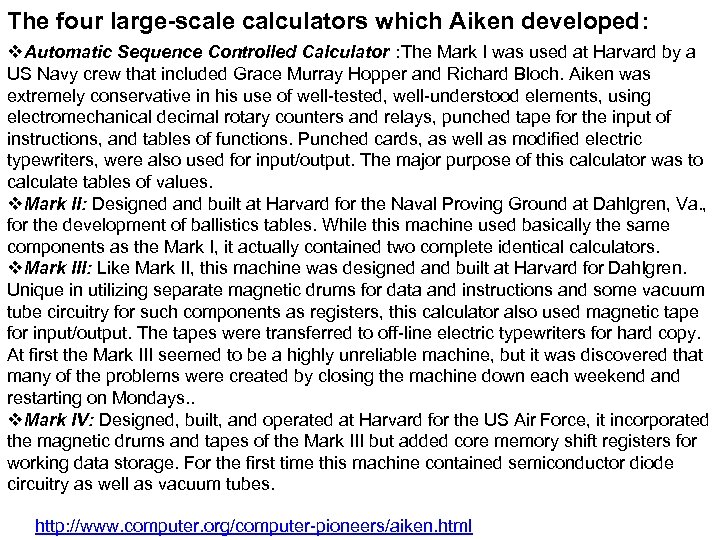
The four large-scale calculators which Aiken developed: v. Automatic Sequence Controlled Calculator : The Mark I was used at Harvard by a US Navy crew that included Grace Murray Hopper and Richard Bloch. Aiken was extremely conservative in his use of well-tested, well-understood elements, using electromechanical decimal rotary counters and relays, punched tape for the input of instructions, and tables of functions. Punched cards, as well as modified electric typewriters, were also used for input/output. The major purpose of this calculator was to calculate tables of values. v. Mark II: Designed and built at Harvard for the Naval Proving Ground at Dahlgren, Va. , for the development of ballistics tables. While this machine used basically the same components as the Mark I, it actually contained two complete identical calculators. v. Mark III: Like Mark II, this machine was designed and built at Harvard for Dahlgren. Unique in utilizing separate magnetic drums for data and instructions and some vacuum tube circuitry for such components as registers, this calculator also used magnetic tape for input/output. The tapes were transferred to off-line electric typewriters for hard copy. At first the Mark III seemed to be a highly unreliable machine, but it was discovered that many of the problems were created by closing the machine down each weekend and restarting on Mondays. . v. Mark IV: Designed, built, and operated at Harvard for the US Air Force, it incorporated the magnetic drums and tapes of the Mark III but added core memory shift registers for working data storage. For the first time this machine contained semiconductor diode circuitry as well as vacuum tubes. http: //www. computer. org/computer-pioneers/aiken. html
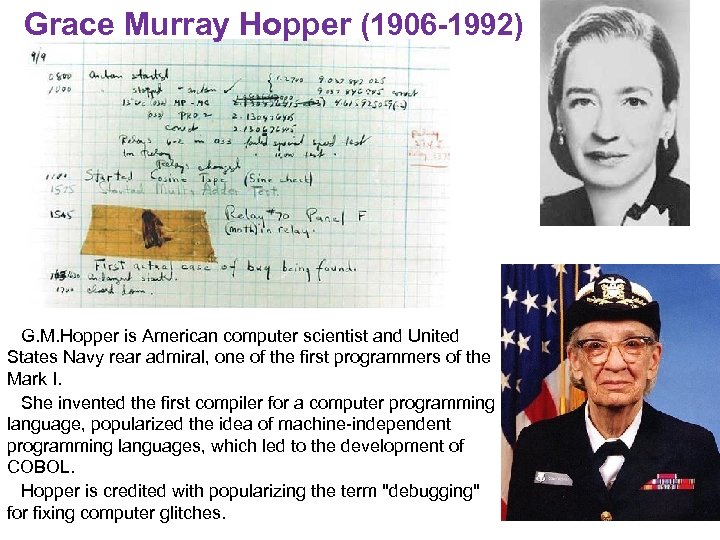
Grace Murray Hopper (1906 -1992) G. M. Hopper is American computer scientist and United States Navy rear admiral, one of the first programmers of the Mark I. She invented the first compiler for a computer programming language, popularized the idea of machine-independent programming languages, which led to the development of COBOL. Hopper is credited with popularizing the term "debugging" for fixing computer glitches.
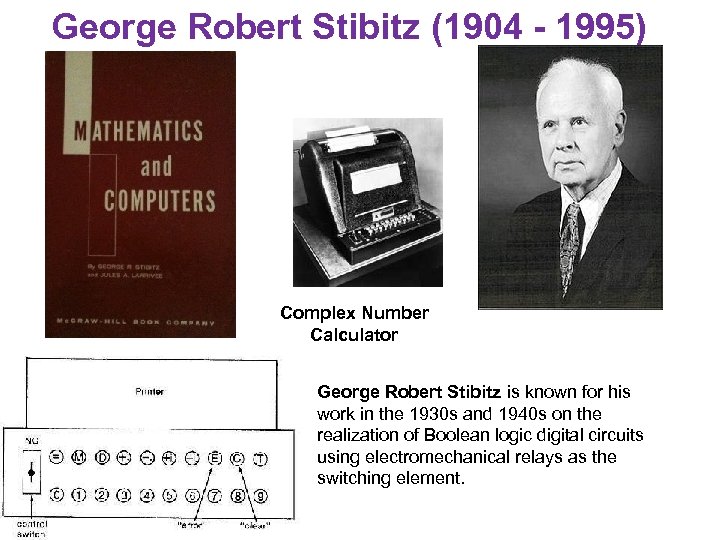
George Robert Stibitz (1904 - 1995) Complex Number Calculator George Robert Stibitz is known for his work in the 1930 s and 1940 s on the realization of Boolean logic digital circuits using electromechanical relays as the switching element.
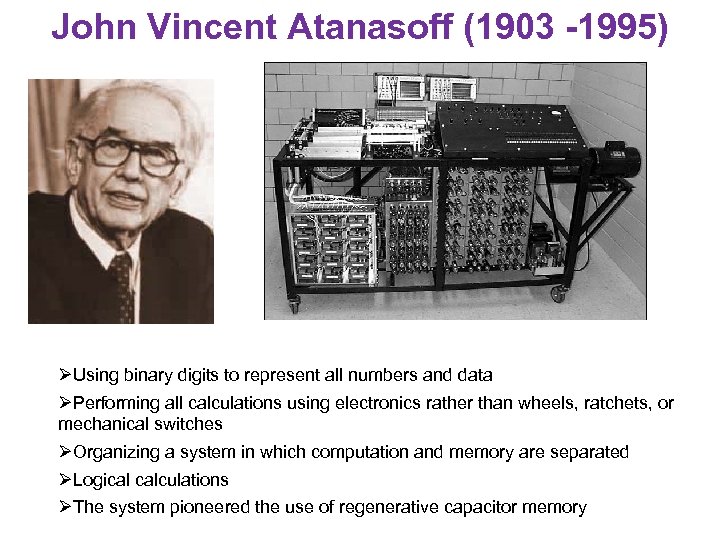
John Vincent Atanasoff (1903 -1995) ØUsing binary digits to represent all numbers and data ØPerforming all calculations using electronics rather than wheels, ratchets, or mechanical switches ØOrganizing a system in which computation and memory are separated ØLogical calculations ØThe system pioneered the use of regenerative capacitor memory
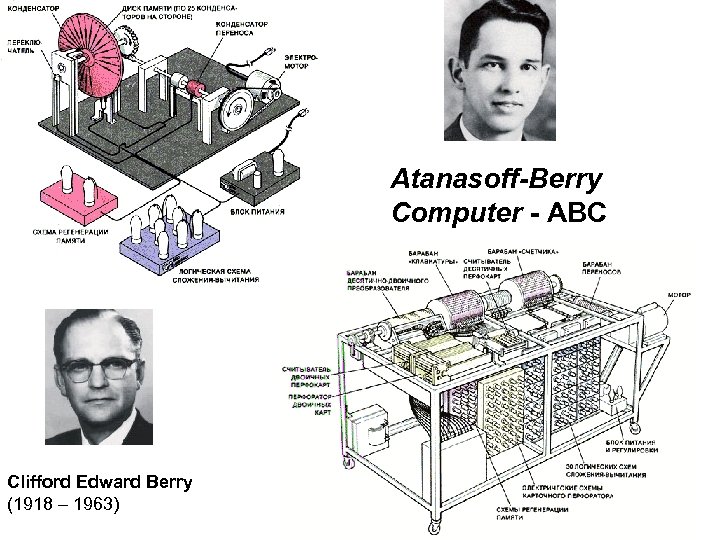
Atanasoff-Berry Computer - ABC Clifford Edward Berry (1918 – 1963)
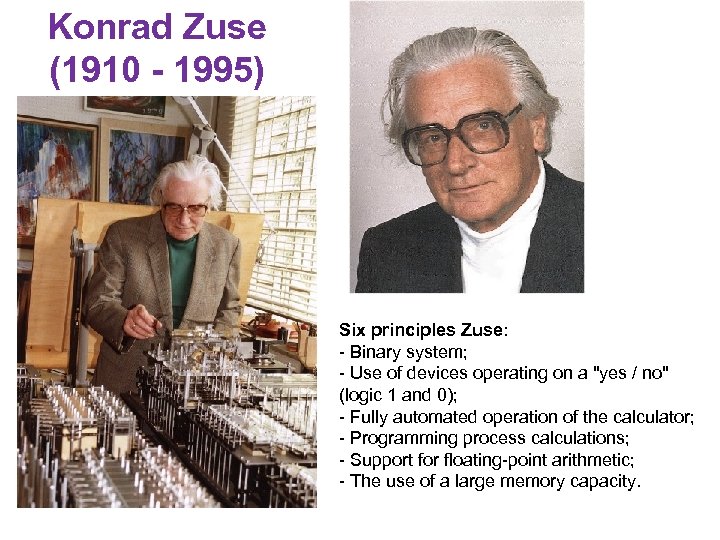
Konrad Zuse (1910 - 1995) Six principles Zuse: - Binary system; - Use of devices operating on a "yes / no" (logic 1 and 0); - Fully automated operation of the calculator; - Programming process calculations; - Support for floating-point arithmetic; - The use of a large memory capacity.
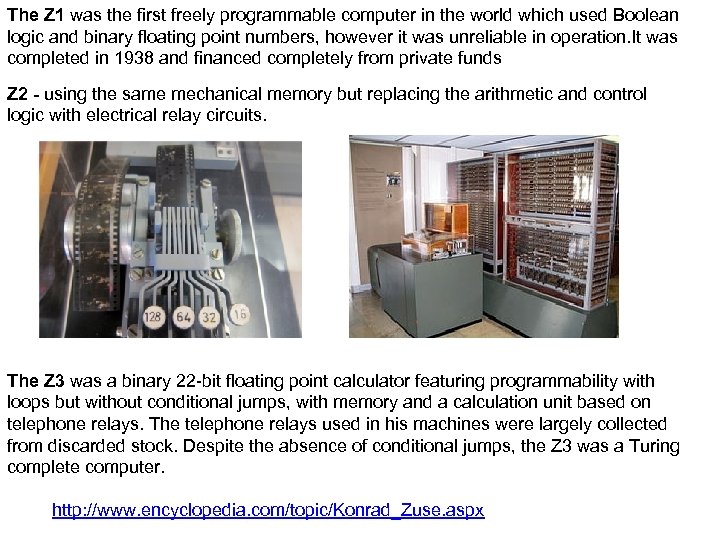
The Z 1 was the first freely programmable computer in the world which used Boolean logic and binary floating point numbers, however it was unreliable in operation. It was completed in 1938 and financed completely from private funds Z 2 - using the same mechanical memory but replacing the arithmetic and control logic with electrical relay circuits. The Z 3 was a binary 22 -bit floating point calculator featuring programmability with loops but without conditional jumps, with memory and a calculation unit based on telephone relays. The telephone relays used in his machines were largely collected from discarded stock. Despite the absence of conditional jumps, the Z 3 was a Turing complete computer. http: //www. encyclopedia. com/topic/Konrad_Zuse. aspx
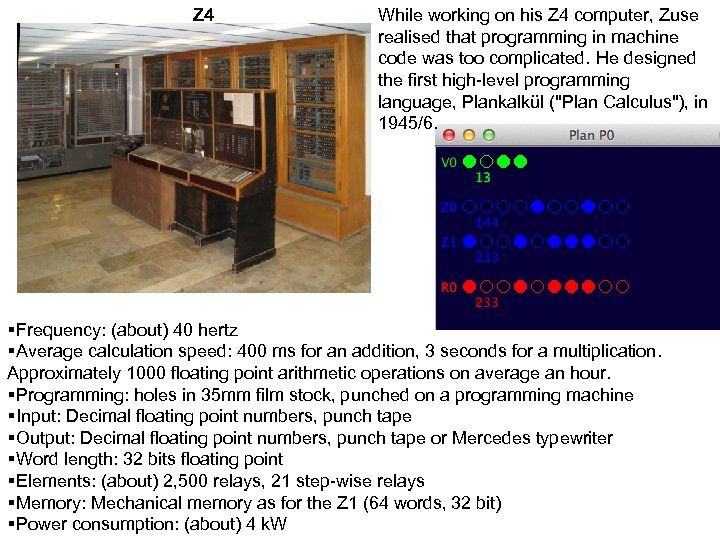
Z 4 While working on his Z 4 computer, Zuse realised that programming in machine code was too complicated. He designed the first high-level programming language, Plankalkül ("Plan Calculus"), in 1945/6. §Frequency: (about) 40 hertz §Average calculation speed: 400 ms for an addition, 3 seconds for a multiplication. Approximately 1000 floating point arithmetic operations on average an hour. §Programming: holes in 35 mm film stock, punched on a programming machine §Input: Decimal floating point numbers, punch tape §Output: Decimal floating point numbers, punch tape or Mercedes typewriter §Word length: 32 bits floating point §Elements: (about) 2, 500 relays, 21 step-wise relays §Memory: Mechanical memory as for the Z 1 (64 words, 32 bit) §Power consumption: (about) 4 k. W

“Видение города Stadt”


http: //www. rtd-net. de/Zuse. html
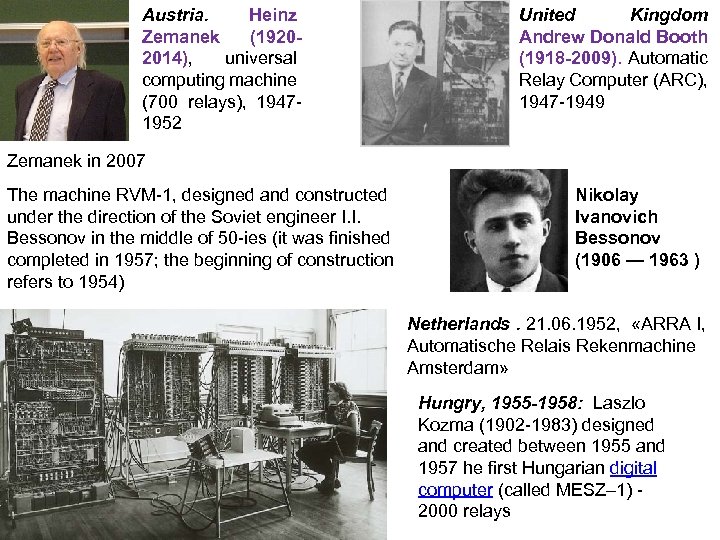
Austria. Heinz Zemanek (19202014), universal computing machine (700 relays), 19471952 United Kingdom Andrew Donald Booth (1918 -2009). Automatic Relay Computer (ARC), 1947 -1949 Zemanek in 2007 The machine RVM-1, designed and constructed under the direction of the Soviet engineer I. I. Bessonov in the middle of 50 -ies (it was finished completed in 1957; the beginning of construction refers to 1954) Nikolay Ivanovich Bessonov (1906 — 1963 ) Netherlands. 21. 06. 1952, «ARRA I, Automatische Relais Rekenmachine Amsterdam» Hungry, 1955 -1958: Laszlo Kozma (1902 -1983) designed and created between 1955 and 1957 he first Hungarian digital computer (called MESZ– 1) - 2000 relays
Скачать презентацию Basic periods in computer history v Pre-mechanical v
ce601bfaec45a12acace1f9b511c421b.ppt