 Скачать презентацию Basic Energy Sciences Update July 9 2009 Basic
6bf42cf3ca466703bec3aa31d68f31f7.ppt
- Количество слайдов: 34



Basic Energy Sciences Update July 9, 2009 Basic Energy Sciences Advisory Committee Meeting Dr. Harriet Kung Director, Office of Basic Energy Sciences Office of Science U. S. Department of Energy
Outline § Personnel and Budget Updates § Program Highlights § New BESAC Charge 2
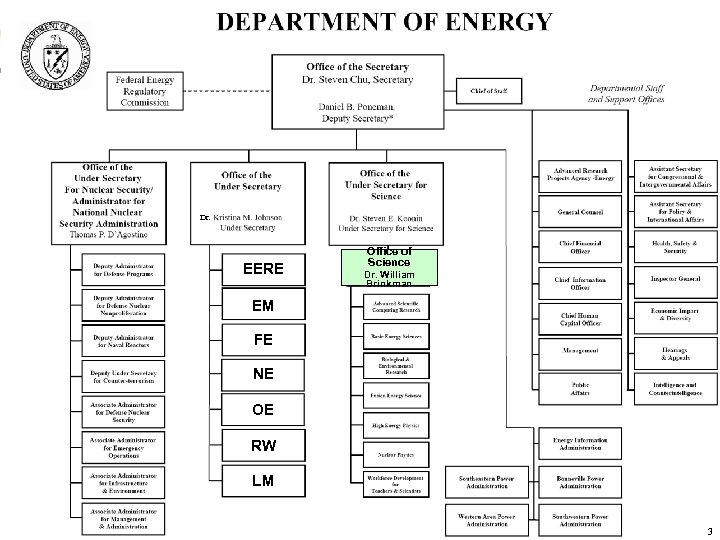
Dr. EERE Office of Science Dr. William Brinkman EM FE NE OE RW LM 3
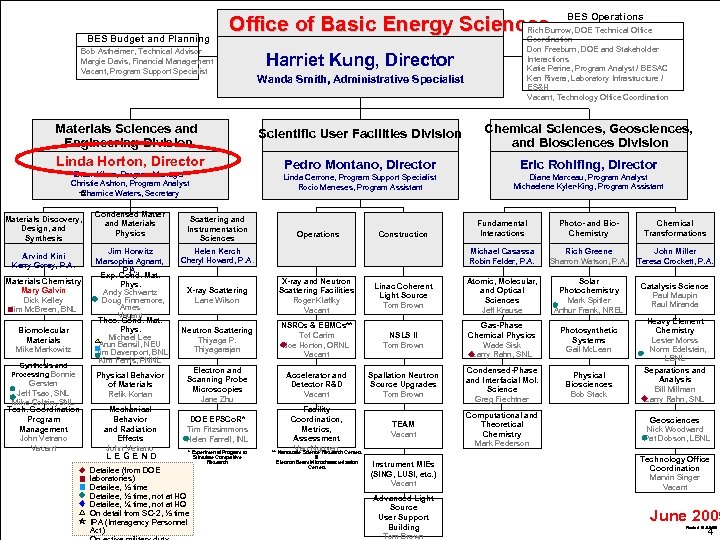
BES Budget and Planning Office of Basic Energy Sciences Bob Astheimer, Technical Advisor Margie Davis, Financial Management Vacant, Program Support Specialist Materials Sciences and Engineering Division Linda Horton, Director Ehsan Khan, Program Manager Christie Ashton, Program Analyst Charnice Waters, Secretary Materials Discovery, Design, and Synthesis Arvind Kini Kerry Gorey, P. A. Materials Chemistry Mary Galvin Dick Kelley Jim Mc. Breen, BNL Biomolecular Materials Mike Markowitz Synthesis and Processing Bonnie Gersten Jeff Tsao, SNL Mike Coltrin, SNL Tech. Coordination Program Management John Vetrano Vacant Condensed Matter and Materials Physics Jim Horwitz Marsophia Agnant, P. A. Exp. Cond. Mat. Phys. Andy Schwartz Doug Finnemore, Ames Vacant Theo. Cond. Mat. Phys. Michael Lee Arun Bansil, NEU Jim Davenport, BNL Kim Ferris, PNNL Scattering and Instrumentation Sciences Harriet Kung, Director Wanda Smith, Administrative Specialist BES Operations Rich Burrow, DOE Technical Office Coordination Don Freeburn, DOE and Stakeholder Interactions Katie Perine, Program Analyst / BESAC Ken Rivera, Laboratory Infrastructure / ES&H Vacant, Technology Office Coordination Scientific User Facilities Division Chemical Sciences, Geosciences, and Biosciences Division Pedro Montano, Director Eric Rohlfing, Director Linda Cerrone, Program Support Specialist Rocio Meneses, Program Assistant Diane Marceau, Program Analyst Michaelene Kyler-King, Program Assistant Construction Helen Kerch Cheryl Howard, P. A. Fundamental Interactions Photo- and Bio. Chemistry Chemical Transformations Michael Casassa Robin Felder, P. A. Operations Rich Greene Sharron Watson, P. A. John Miller Teresa Crockett, P. A. Catalysis Science Paul Maupin Raul Miranda X-ray Scattering Lane Wilson X-ray and Neutron Scattering Facilities Roger Klaffky Vacant Linac Coherent Light Source Tom Brown Atomic, Molecular, and Optical Sciences Jeff Krause Solar Photochemistry Mark Spitler Arthur Frank, NREL Neutron Scattering Thiyaga P. Thiyagarajan NSRCs & EBMCs** Tof Carim Joe Horton, ORNL Vacant NSLS II Tom Brown Gas-Phase Chemical Physics Wade Sisk Larry Rahn, SNL Photosynthetic Systems Gail Mc. Lean Physical Behavior of Materials Refik Kortan Electron and Scanning Probe Microscopies Jane Zhu Accelerator and Detector R&D Vacant Spallation Neutron Source Upgrades Tom Brown Condensed-Phase and Interfacial Mol. Science Greg Fiechtner Physical Biosciences Bob Stack Mechanical Behavior and Radiation Effects John Vetrano DOE EPSCo. R* Tim Fitzsimmons Helen Farrell, INL Facility Coordination, Metrics, Assessment Van Nguyen ** Nanoscale Science Research Centers TEAM Vacant Computational and Theoretical Chemistry Mark Pederson L E G E N D * Experimental Program to Stimulate Competitive Research Detailee (from DOE laboratories) Detailee, ½ time, not at HQ Detailee, ¼ time, not at HQ On detail from SC-2, ½ time IPA (Interagency Personnel Act) & Electron Beam Microcharacterization Centers Heavy Element Chemistry Lester Morss Norm Edelstein, LBNL Separations and Analysis Bill Millman Larry Rahn, SNL Geosciences Nick Woodward Pat Dobson, LBNL Instrument MIEs (SING, LUSI, etc. ) Vacant Technology Office Coordination Marvin Singer Vacant Advanced Light Source User Support Building Tom Brown June 2009 4 Posted 10 JUN 09
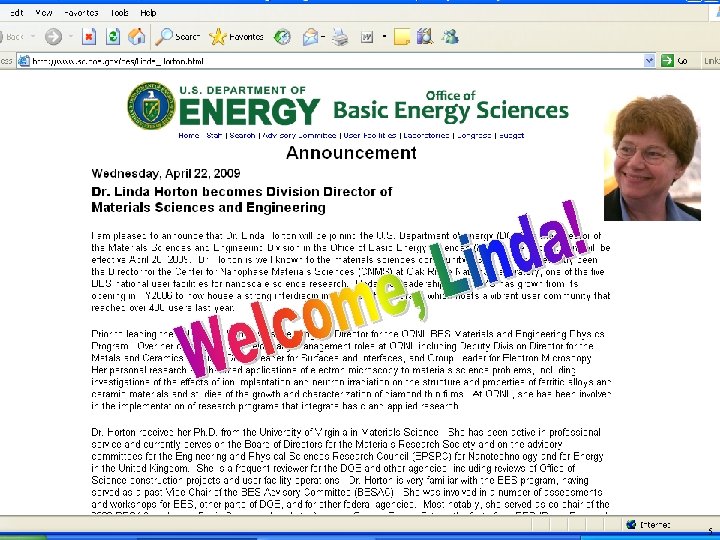
Linda Announcement 5
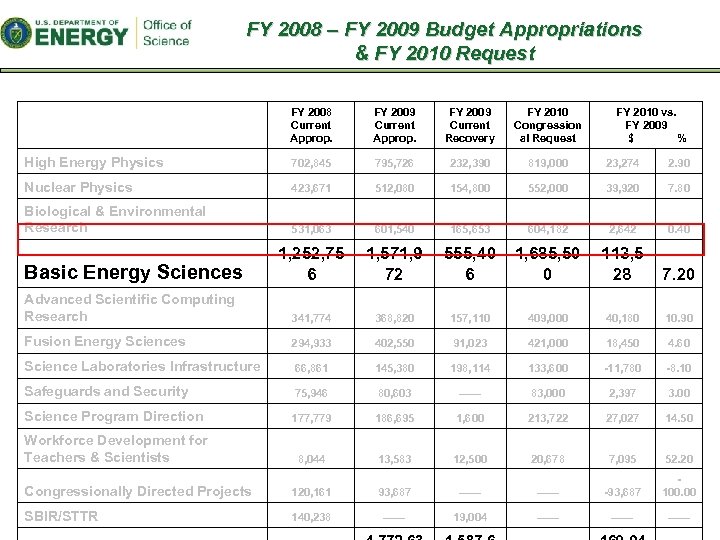
FY 2008 – FY 2009 Budget Appropriations & FY 2010 Request FY 2008 Current Approp. FY 2009 Current Recovery FY 2010 Congression al Request High Energy Physics 702, 845 795, 726 232, 390 819, 000 23, 274 2. 90 Nuclear Physics 423, 671 512, 080 154, 800 552, 000 39, 920 7. 80 Biological & Environmental Research 531, 063 601, 540 165, 653 604, 182 2, 642 0. 40 Basic Energy Sciences 1, 252, 75 6 1, 571, 9 72 555, 40 6 1, 685, 50 0 113, 5 28 7. 20 Advanced Scientific Computing Research 341, 774 368, 820 157, 110 409, 000 40, 180 10. 90 Fusion Energy Sciences 294, 933 402, 550 91, 023 421, 000 18, 450 4. 60 Science Laboratories Infrastructure 66, 861 145, 380 198, 114 133, 600 -11, 780 -8. 10 Safeguards and Security 75, 946 80, 603 —— 83, 000 2, 397 3. 00 Science Program Direction 177, 779 186, 695 1, 600 213, 722 27, 027 14. 50 8, 044 13, 583 12, 500 20, 678 7, 095 52. 20 Workforce Development for Teachers & Scientists FY 2010 vs. FY 2009 $ % Congressionally Directed Projects 120, 161 93, 687 —— —— -93, 687 100. 00 SBIR/STTR 140, 238 —— 19, 004 —— —— ——
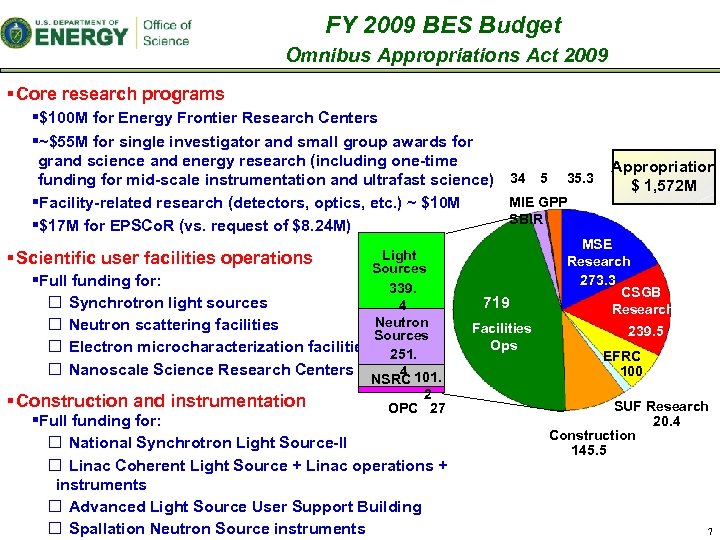
FY 2009 BES Budget Omnibus Appropriations Act 2009 § Core research programs §$100 M for Energy Frontier Research Centers §~$55 M for single investigator and small group awards for grand science and energy research (including one-time funding for mid-scale instrumentation and ultrafast science) 34 5 35. 3 MIE GPP §Facility-related research (detectors, optics, etc. ) ~ $10 M SBIR §$17 M for EPSCo. R (vs. request of $8. 24 M) § Scientific user facilities operations MSE Research Light Sources §Full funding for: 339. Synchrotron light sources 4 CSGB Neutron Research Neutron scattering facilities Sources Electron microcharacterization facilities 251. Nanoscale Science Research Centers 4 101. NSRC § Construction and instrumentation 2 OPC 27 §Full funding for: National Synchrotron Light Source-II Linac Coherent Light Source + Linac operations + instruments Advanced Light Source User Support Building Spallation Neutron Source instruments Faciliti es 719 Ops Facilities Ops Appropriation $ 1, 572 M MSE Research 273. 3 CSGB Research 239. 5 EFRC 100 SUF Research 20. 4 Construction 145. 5 7
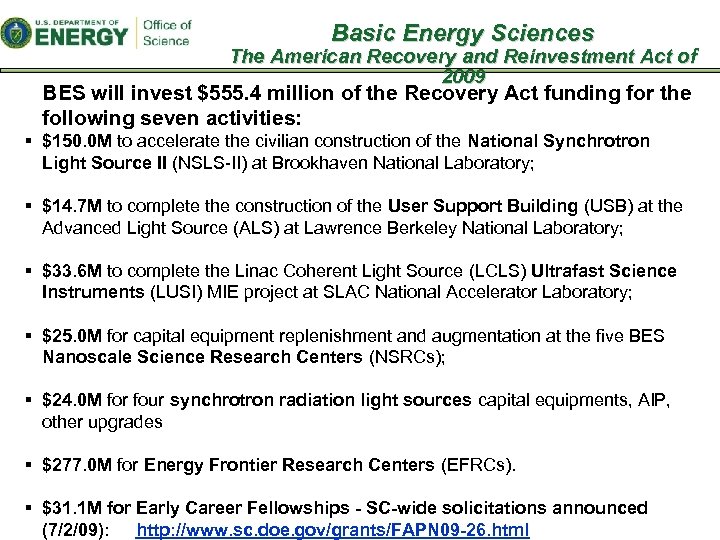
Basic Energy Sciences The American Recovery and Reinvestment Act of 2009 BES will invest $555. 4 million of the Recovery Act funding for the following seven activities: § $150. 0 M to accelerate the civilian construction of the National Synchrotron Light Source II (NSLS-II) at Brookhaven National Laboratory; § $14. 7 M to complete the construction of the User Support Building (USB) at the Advanced Light Source (ALS) at Lawrence Berkeley National Laboratory; § $33. 6 M to complete the Linac Coherent Light Source (LCLS) Ultrafast Science Instruments (LUSI) MIE project at SLAC National Accelerator Laboratory; § $25. 0 M for capital equipment replenishment and augmentation at the five BES Nanoscale Science Research Centers (NSRCs); § $24. 0 M for four synchrotron radiation light sources capital equipments, AIP, other upgrades § $277. 0 M for Energy Frontier Research Centers (EFRCs). § $31. 1 M for Early Career Fellowships - SC-wide solicitations announced (7/2/09): http: //www. sc. doe. gov/grants/FAPN 09 -26. html
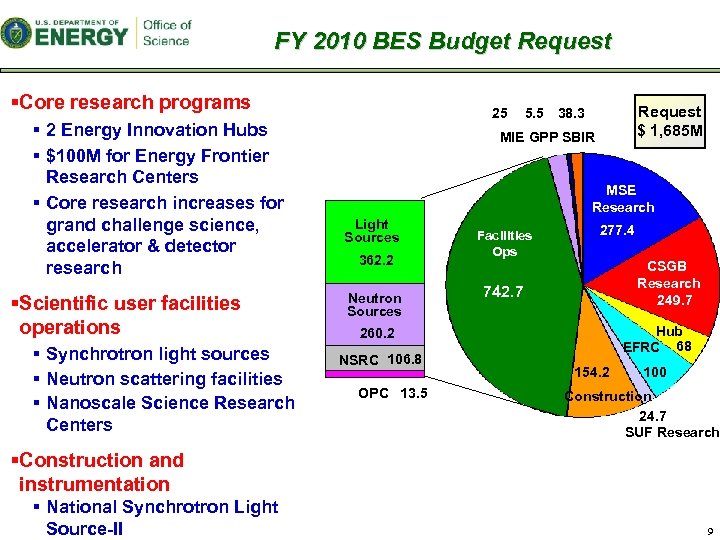
FY 2010 BES Budget Request §Core research programs § 2 Energy Innovation Hubs § $100 M for Energy Frontier Research Centers § Core research increases for grand challenge science, accelerator & detector research §Scientific user facilities operations § Synchrotron light sources § Neutron scattering facilities § Nanoscale Science Research Centers 25 Request $ 1, 685 M 5. 5 38. 3 MIE GPP SBIR MSE Research Light Sources 362. 2 CSGB Research Neutron Facilities Ops 277. 4 CSGB Research 249. 7 742. 7 Sources Hub EFRC 68 260. 2 NSRC 106. 8 OPC 13. 5 154. 2 100 Construction 24. 7 SUF Research §Construction and instrumentation § National Synchrotron Light Source-II 9
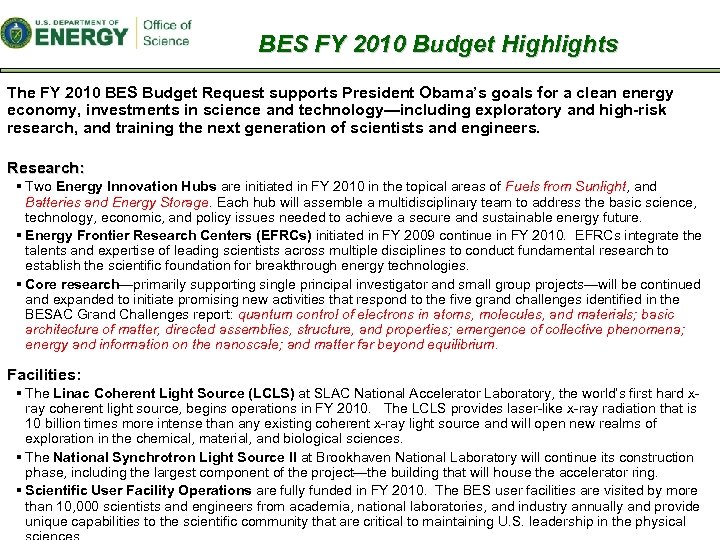
BES FY 2010 Budget Highlights The FY 2010 BES Budget Request supports President Obama’s goals for a clean energy economy, investments in science and technology—including exploratory and high-risk research, and training the next generation of scientists and engineers. Research: § Two Energy Innovation Hubs are initiated in FY 2010 in the topical areas of Fuels from Sunlight, and Batteries and Energy Storage. Each hub will assemble a multidisciplinary team to address the basic science, technology, economic, and policy issues needed to achieve a secure and sustainable energy future. § Energy Frontier Research Centers (EFRCs) initiated in FY 2009 continue in FY 2010. EFRCs integrate the talents and expertise of leading scientists across multiple disciplines to conduct fundamental research to establish the scientific foundation for breakthrough energy technologies. § Core research—primarily supporting single principal investigator and small group projects—will be continued and expanded to initiate promising new activities that respond to the five grand challenges identified in the BESAC Grand Challenges report: quantum control of electrons in atoms, molecules, and materials; basic architecture of matter, directed assemblies, structure, and properties; emergence of collective phenomena; energy and information on the nanoscale; and matter far beyond equilibrium. Facilities: § The Linac Coherent Light Source (LCLS) at SLAC National Accelerator Laboratory, the world’s first hard xray coherent light source, begins operations in FY 2010. The LCLS provides laser-like x-ray radiation that is 10 billion times more intense than any existing coherent x-ray light source and will open new realms of exploration in the chemical, material, and biological sciences. § The National Synchrotron Light Source II at Brookhaven National Laboratory will continue its construction phase, including the largest component of the project—the building that will house the accelerator ring. § Scientific User Facility Operations are fully funded in FY 2010. The BES user facilities are visited by more than 10, 000 scientists and engineers from academia, national laboratories, and industry annually and provide unique capabilities to the scientific community that are critical to maintaining U. S. leadership in the physical
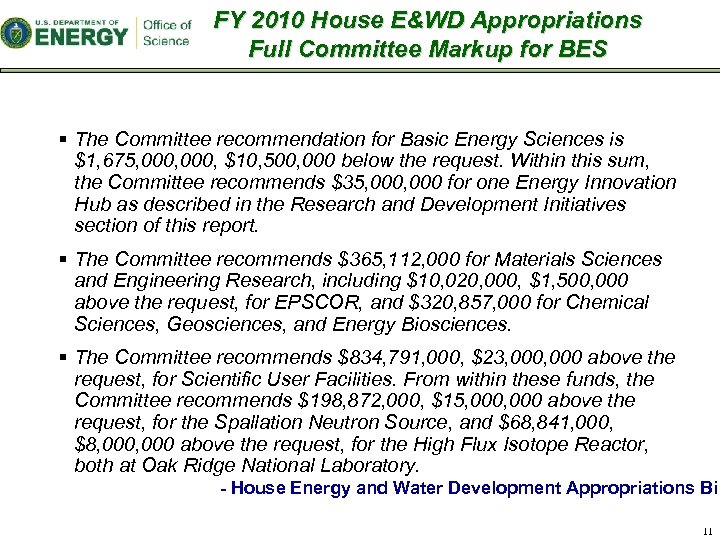
FY 2010 House E&WD Appropriations Full Committee Markup for BES § The Committee recommendation for Basic Energy Sciences is $1, 675, 000, $10, 500, 000 below the request. Within this sum, the Committee recommends $35, 000 for one Energy Innovation Hub as described in the Research and Development Initiatives section of this report. § The Committee recommends $365, 112, 000 for Materials Sciences and Engineering Research, including $10, 020, 000, $1, 500, 000 above the request, for EPSCOR, and $320, 857, 000 for Chemical Sciences, Geosciences, and Energy Biosciences. § The Committee recommends $834, 791, 000, $23, 000 above the request, for Scientific User Facilities. From within these funds, the Committee recommends $198, 872, 000, $15, 000 above the request, for the Spallation Neutron Source, and $68, 841, 000, $8, 000 above the request, for the High Flux Isotope Reactor, both at Oak Ridge National Laboratory. - House Energy and Water Development Appropriations Bil 11
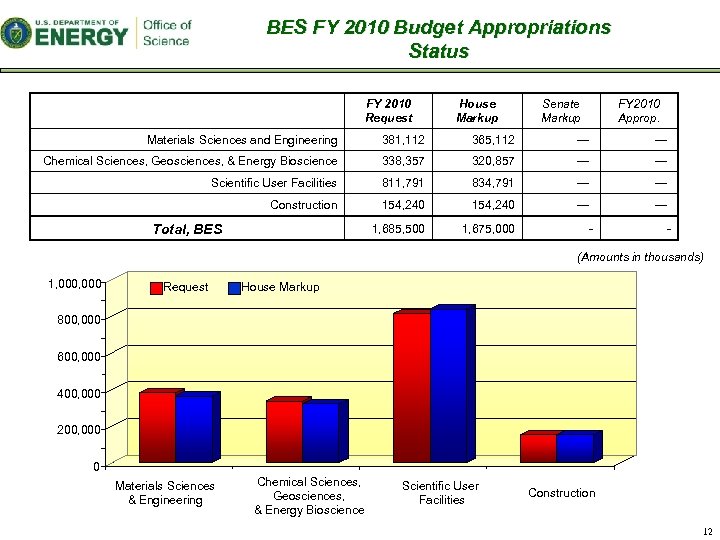
BES FY 2010 Budget Appropriations Status FY 2010 Request House Markup Senate Markup FY 2010 Approp. Materials Sciences and Engineering 381, 112 365, 112 --- Chemical Sciences, Geosciences, & Energy Bioscience 338, 357 320, 857 --- Scientific User Facilities 811, 791 834, 791 --- Construction 154, 240 --- 1, 685, 500 1, 675, 000 Total, BES - - (Amounts in thousands) 1, 000 Request House Markup 800, 000 600, 000 400, 000 200, 000 0 Materials Sciences & Engineering Chemical Sciences, Geosciences, & Energy Bioscience Scientific User Facilities Construction 12
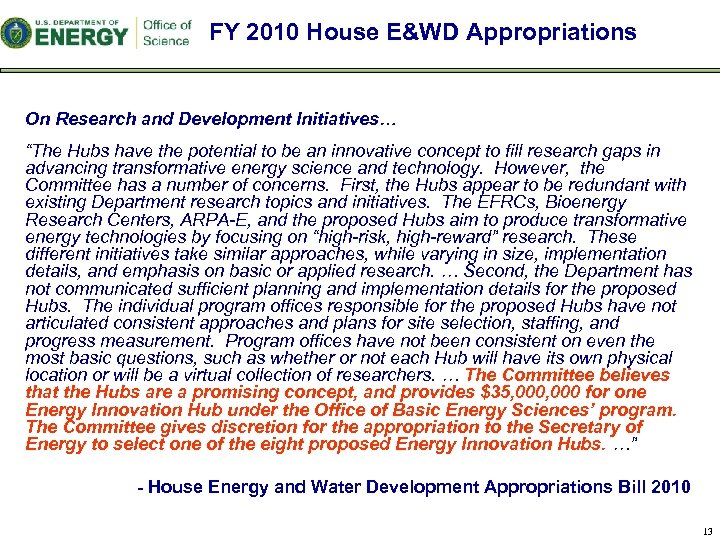
FY 2010 House E&WD Appropriations On Research and Development Initiatives… “The Hubs have the potential to be an innovative concept to fill research gaps in advancing transformative energy science and technology. However, the Committee has a number of concerns. First, the Hubs appear to be redundant with existing Department research topics and initiatives. The EFRCs, Bioenergy Research Centers, ARPA-E, and the proposed Hubs aim to produce transformative energy technologies by focusing on “high-risk, high-reward” research. These different initiatives take similar approaches, while varying in size, implementation details, and emphasis on basic or applied research. … Second, the Department has not communicated sufficient planning and implementation details for the proposed Hubs. The individual program offices responsible for the proposed Hubs have not articulated consistent approaches and plans for site selection, staffing, and progress measurement. Program offices have not been consistent on even the most basic questions, such as whether or not each Hub will have its own physical location or will be a virtual collection of researchers. … The Committee believes that the Hubs are a promising concept, and provides $35, 000 for one Energy Innovation Hub under the Office of Basic Energy Sciences’ program. The Committee gives discretion for the appropriation to the Secretary of Energy to select one of the eight proposed Energy Innovation Hubs. …” - House Energy and Water Development Appropriations Bill 2010 13
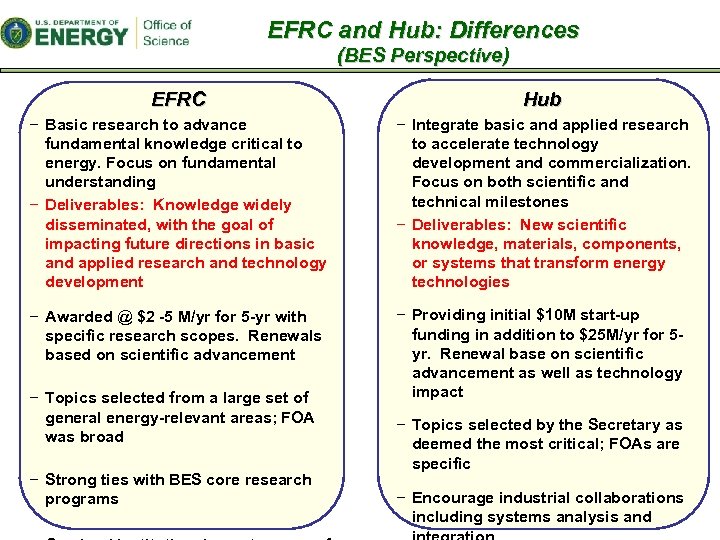
EFRC and Hub: Differences (BES Perspective) EFRC Hub − Basic research to advance fundamental knowledge critical to energy. Focus on fundamental understanding − Deliverables: Knowledge widely disseminated, with the goal of impacting future directions in basic and applied research and technology development − Integrate basic and applied research to accelerate technology development and commercialization. Focus on both scientific and technical milestones − Deliverables: New scientific knowledge, materials, components, or systems that transform energy technologies − Awarded @ $2 -5 M/yr for 5 -yr with specific research scopes. Renewals based on scientific advancement − Providing initial $10 M start-up funding in addition to $25 M/yr for 5 yr. Renewal base on scientific advancement as well as technology impact − Topics selected from a large set of general energy-relevant areas; FOA was broad − Strong ties with BES core research programs − Topics selected by the Secretary as deemed the most critical; FOAs are specific − Encourage industrial collaborations including systems analysis and
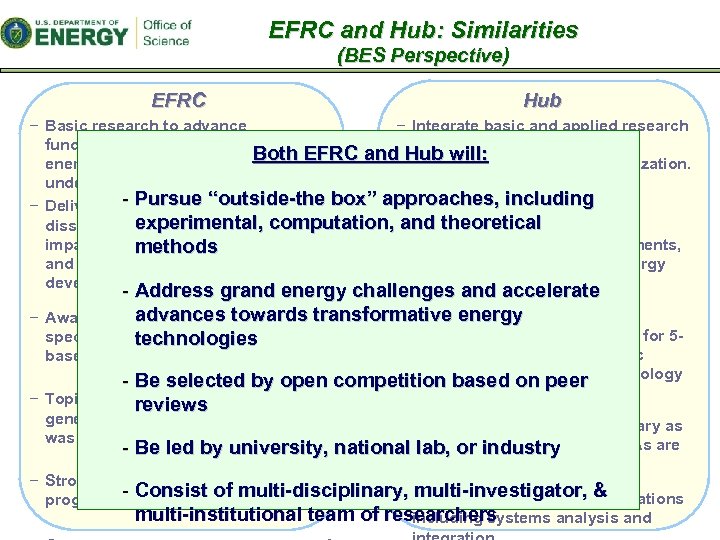
EFRC and Hub: Similarities (BES Perspective) Hub EFRC − Basic research to advance − Integrate basic and applied research to accelerate technology fundamental knowledge critical to Both EFRC and Hub will: development and commercialization. energy. Focus on fundamental Focus on both scientific and understanding - Pursue “outside-the box” approaches, including technical milestones − Deliverables: Knowledge widely experimental, computation, and theoretical − Deliverables: New scientific disseminated, with the goal of knowledge, materials, components, impacting future directions in basic methods or systems that transform energy and applied research and technology technologies development - Address grand energy challenges and accelerate advances towards transformative energy − Providing initial $10 M start-up − Awarded @ $2 -5 M/yr for 5 -yr with funding in addition to $25 M/yr for 5 specific research scopes. Renewals technologies yr. Renewal base on scientific advancement as well as technology - Be selected by open competition based on peer impact. − Topics selected from a large set of reviews general energy-relevant areas; FOA − Topics selected by the Secretary as was broad deemed the most critical; FOAs are based on scientific advancement. - Be led by university, national lab, or industry specific − Strong ties with BES core research - Consist of multi-disciplinary, multi-investigator, & − Encourage industrial collaborations programs multi-institutional team of researchers including systems analysis and
BES Program Highlights X-ray Light Sources Update i. LCLS ii. NSLS-II 16
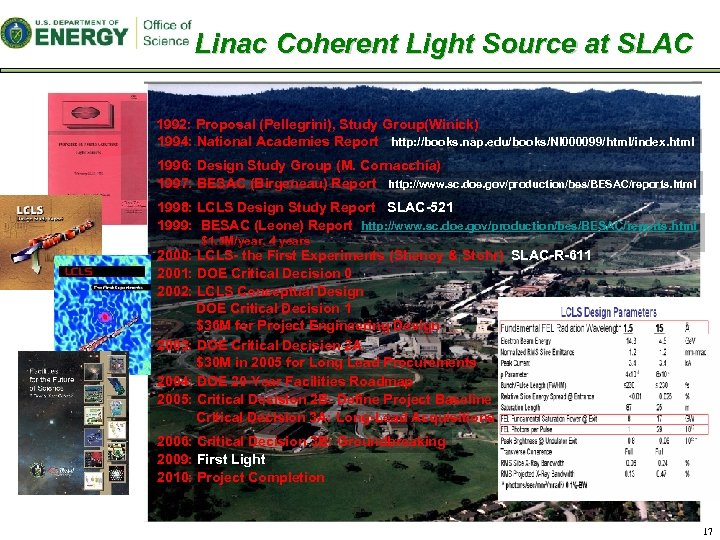
Linac Coherent Light Source at SLAC 1992: Proposal (Pellegrini), Study Group(Winick) 1994: National Academies Report http: //books. nap. edu/books/NI 000099/html/index. html 1996: Design Study Group (M. Cornacchia) 1997: BESAC (Birgeneau) Report http: //www. sc. doe. gov/production/bes/BESAC/reports. html 1998: LCLS Design Study Report SLAC-521 1999: BESAC (Leone) Report http: //www. sc. doe. gov/production/bes/BESAC/reports. html $1. 5 M/year, 4 years 2000: LCLS- the First Experiments (Shenoy & Stohr) SLAC-R-611 2001: DOE Critical Decision 0 2002: LCLS Conceptual Design DOE Critical Decision 1 $36 M for Project Engineering Design 2003: DOE Critical Decision 2 A $30 M in 2005 for Long Lead Procurements 2004: DOE 20 -Year Facilities Roadmap 2005: Critical Decision 2 B: Define Project Baseline Critical Decision 3 A: Long-Lead Acquisitions 2006: Critical Decision 3 B: Groundbreaking 2009: First Light 2010: Project Completion 17
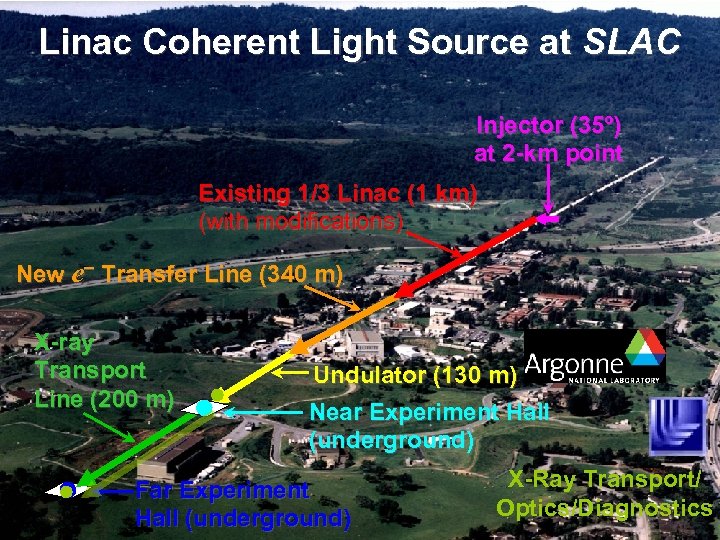
Linac Coherent Light Source at SLAC Injector (35º) at 2 -km point Existing 1/3 Linac (1 km) (with modifications) New e- Transfer Line (340 m) X-ray Transport Line (200 m) Undulator (130 m) Near Experiment Hall (underground) Far Experiment Hall (underground) X-Ray Transport/ Optics/Diagnostics
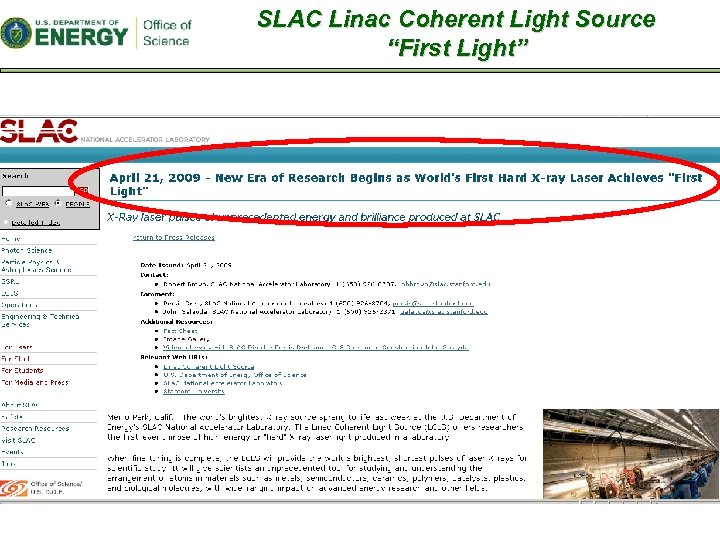
SLAC Linac Coherent Light Source “First Light”
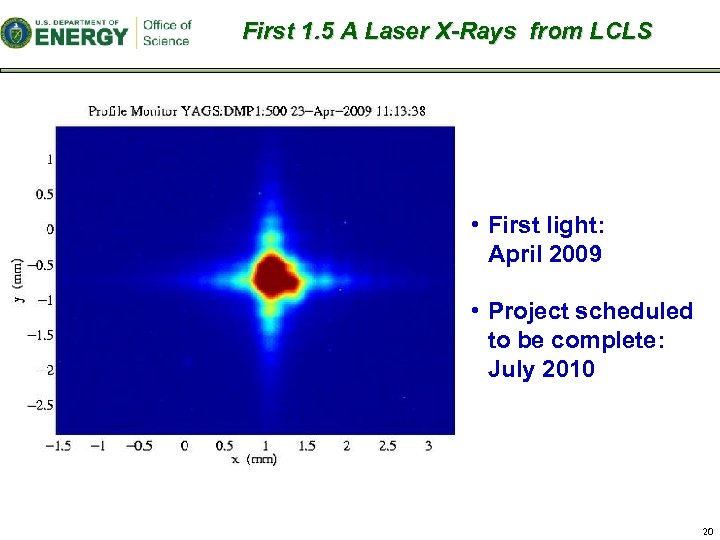
First 1. 5 A Laser X-Rays from LCLS • First light: April 2009 • Project scheduled to be complete: July 2010 20
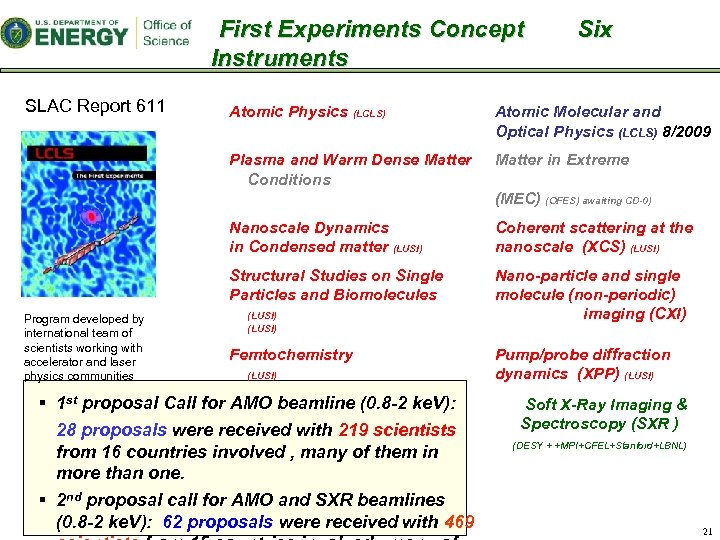
First Experiments Concept Instruments SLAC Report 611 Six Atomic Physics (LCLS) Atomic Molecular and Optical Physics (LCLS) 8/2009 Plasma and Warm Dense Matter Conditions Matter in Extreme (MEC) (OFES) awaiting CD-0) Nanoscale Dynamics in Condensed matter (LUSI) Structural Studies on Single Particles and Biomolecules Program developed by international team of scientists working with accelerator and laser physics communities Coherent scattering at the nanoscale (XCS) (LUSI) Nano-particle and single molecule (non-periodic) imaging (CXI) (LUSI) Femtochemistry (LUSI) § 1 st proposal Call for AMO beamline (0. 8 -2 ke. V): 28 proposals were received with 219 scientists from 16 countries involved , many of them in more than one. § 2 nd proposal call for AMO and SXR beamlines (0. 8 -2 ke. V): 62 proposals were received with 469 Pump/probe diffraction dynamics (XPP) (LUSI) Soft X-Ray Imaging & Spectroscopy (SXR ) (DESY + +MPI+CFEL+Stanford+LBNL) 21
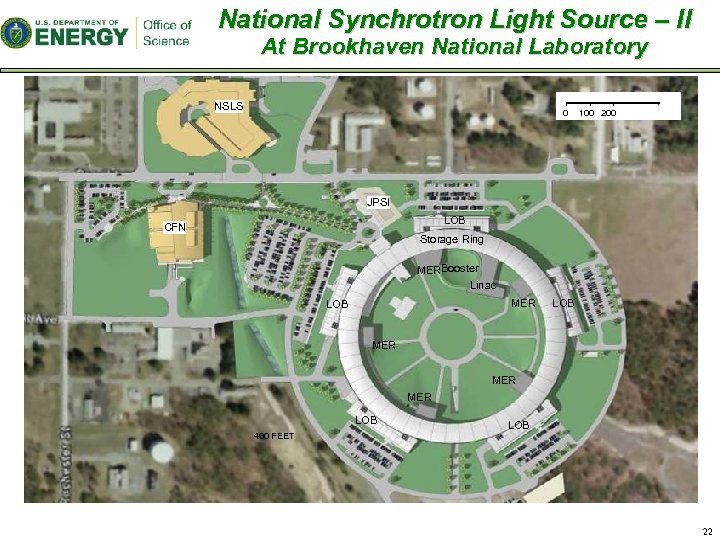
National Synchrotron Light Source – II At Brookhaven National Laboratory NSLS 0 100 200 JPSI LOB CFN Storage Ring MERBooster Linac MER LOB MER MER LOB 400 FEET LOB 22
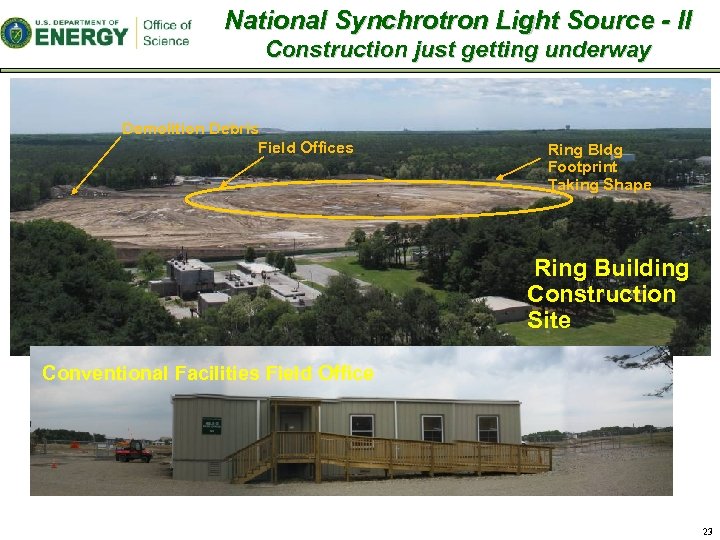
National Synchrotron Light Source - II Construction just getting underway Demolition Debris Field Offices Ring Bldg Footprint Taking Shape Ring Building Construction Site Conventional Facilities Field Office 23
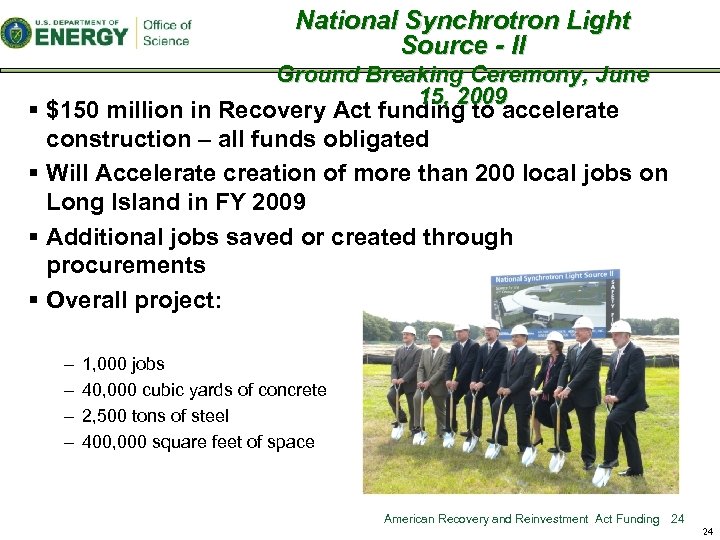
National Synchrotron Light Source - II Ground Breaking Ceremony, June 15, 2009 § $150 million in Recovery Act funding to accelerate construction – all funds obligated § Will Accelerate creation of more than 200 local jobs on Long Island in FY 2009 § Additional jobs saved or created through procurements § Overall project: – – 1, 000 jobs 40, 000 cubic yards of concrete 2, 500 tons of steel 400, 000 square feet of space American Recovery and Reinvestment Act Funding 24 24
BES Program Highlight Energy Frontier Research Center Update 25
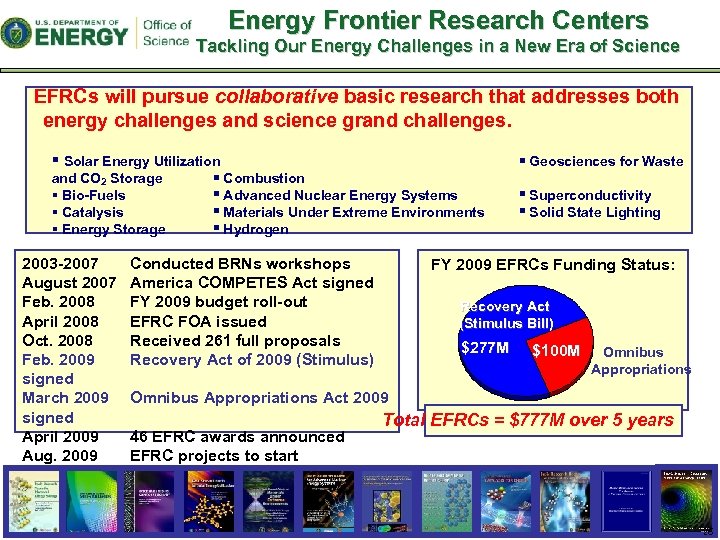
Energy Frontier Research Centers Tackling Our Energy Challenges in a New Era of Science EFRCs will pursue collaborative basic research that addresses both energy challenges and science grand challenges. § Solar Energy Utilization Geosciences for Waste and CO 2 Storage § Bio-Fuels § Catalysis § Energy Storage Superconductivity Solid State Lighting 2003 -2007 August 2007 Feb. 2008 April 2008 Oct. 2008 Feb. 2009 signed March 2009 signed April 2009 Aug. 2009 Combustion Advanced Nuclear Energy Systems Materials Under Extreme Environments Hydrogen Conducted BRNs workshops America COMPETES Act signed FY 2009 budget roll-out EFRC FOA issued Received 261 full proposals Recovery Act of 2009 (Stimulus) FY 2009 EFRCs Funding Status: Recovery Act (Stimulus Bill) $277 M $100 M Omnibus Appropriations Act 2009 46 EFRC awards announced EFRC projects to start Total EFRCs = $777 M over 5 years 26
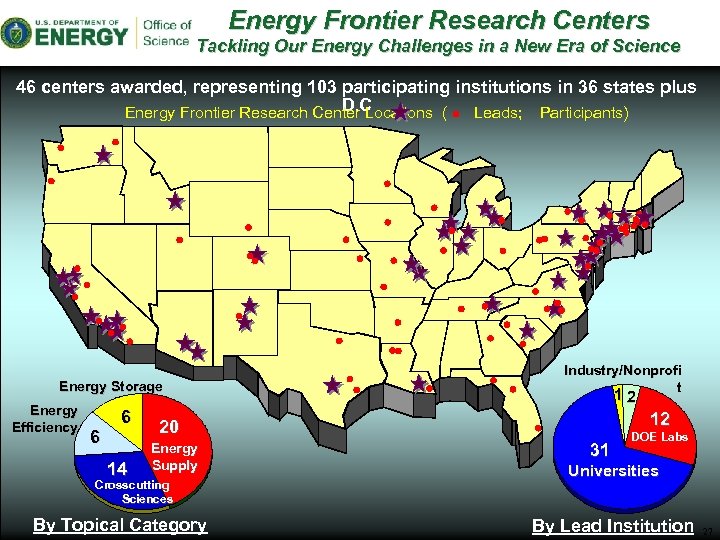
Energy Frontier Research Centers Tackling Our Energy Challenges in a New Era of Science 46 centers awarded, representing 103 participating institutions in 36 states plus D. C Energy Frontier Research Center Locations ( Leads; Participants) Energy Storage Energy Efficiency 6 6 14 Industry/Nonprofi t 12 12 20 Energy Supply Crosscutting Sciences By Topical Category 31 DOE Labs Universities By Lead Institution 27
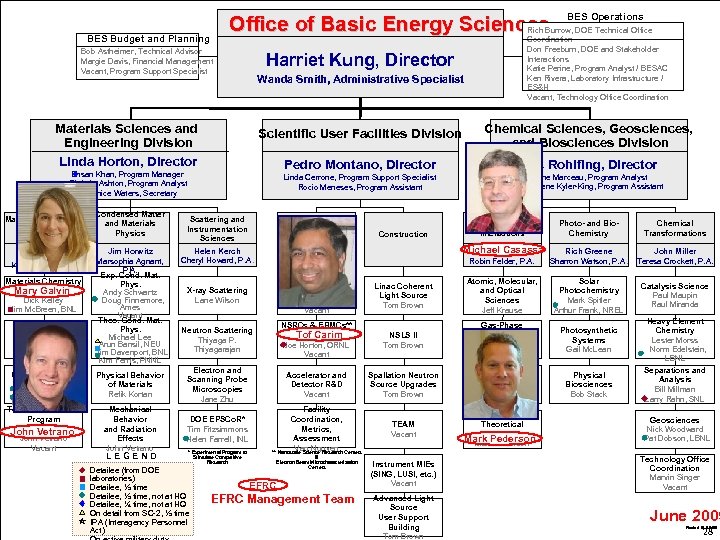
Office of Basic Energy Sciences BES Budget and Planning Bob Astheimer, Technical Advisor Margie Davis, Financial Management Vacant, Program Support Specialist Harriet Kung, Director Wanda Smith, Administrative Specialist Materials Sciences and Engineering Division Linda Horton, Director Arvind Kini Kerry Gorey, P. A. Materials Chemistry Mary Galvin Dick Kelley Jim Mc. Breen, BNL Biomolecular Materials Mike Markowitz Synthesis and Processing Bonnie Gersten Jeff Tsao, SNL Mike Coltrin, SNL Tech. Coordination Program Management John Vetrano Vacant Condensed Matter and Materials Physics Jim Horwitz Marsophia Agnant, P. A. Exp. Cond. Mat. Phys. Andy Schwartz Doug Finnemore, Ames Vacant Theo. Cond. Mat. Phys. Michael Lee Arun Bansil, NEU Jim Davenport, BNL Kim Ferris, PNNL Scientific User Facilities Division Chemical Sciences, Geosciences, and Biosciences Division Pedro Montano, Director Eric Rohlfing, Director Linda Cerrone, Program Support Specialist Rocio Meneses, Program Assistant Diane Marceau, Program Analyst Michaelene Kyler-King, Program Assistant Ehsan Khan, Program Manager Christie Ashton, Program Analyst Charnice Waters, Secretary Materials Discovery, Design, and Synthesis BES Operations Rich Burrow, DOE Technical Office Coordination Don Freeburn, DOE and Stakeholder Interactions Katie Perine, Program Analyst / BESAC Ken Rivera, Laboratory Infrastructure / ES&H Vacant, Technology Office Coordination Scattering and Instrumentation Sciences Helen Kerch Cheryl Howard, P. A. Photo- and Bio. Chemistry Chemical Transformations Robin Felder, P. A. Construction Fundamental Interactions Michael Casassa Operations Rich Greene Sharron Watson, P. A. John Miller Teresa Crockett, P. A. Catalysis Science Paul Maupin Raul Miranda X-ray Scattering Lane Wilson X-ray and Neutron Scattering Facilities Roger Klaffky Vacant Linac Coherent Light Source Tom Brown Atomic, Molecular, and Optical Sciences Jeff Krause Solar Photochemistry Mark Spitler Arthur Frank, NREL Neutron Scattering Thiyaga P. Thiyagarajan NSRCs & EBMCs** Tof Carim Joe Horton, ORNL Vacant NSLS II Tom Brown Gas-Phase Chemical Physics Wade Sisk Larry Rahn, SNL Photosynthetic Systems Gail Mc. Lean Physical Behavior of Materials Refik Kortan Electron and Scanning Probe Microscopies Jane Zhu Accelerator and Detector R&D Vacant Spallation Neutron Source Upgrades Tom Brown Condensed-Phase and Interfacial Mol. Science Greg Fiechtner Physical Biosciences Bob Stack Mechanical Behavior and Radiation Effects John Vetrano DOE EPSCo. R* Tim Fitzsimmons Helen Farrell, INL Facility Coordination, Metrics, Assessment Van Nguyen ** Nanoscale Science Research Centers TEAM Vacant Computational and Theoretical Chemistry Mark Pederson L E G E N D * Experimental Program to Stimulate Competitive Research Detailee (from DOE laboratories) Detailee, ½ time, not at HQ Detailee, ¼ time, not at HQ On detail from SC-2, ½ time IPA (Interagency Personnel Act) & Electron Beam Microcharacterization Centers EFRC Management Team Heavy Element Chemistry Lester Morss Norm Edelstein, LBNL Separations and Analysis Bill Millman Larry Rahn, SNL Geosciences Nick Woodward Pat Dobson, LBNL Instrument MIEs (SING, LUSI, etc. ) Vacant Technology Office Coordination Marvin Singer Vacant Advanced Light Source User Support Building Tom Brown June 2009 28 Posted 10 JUN 09
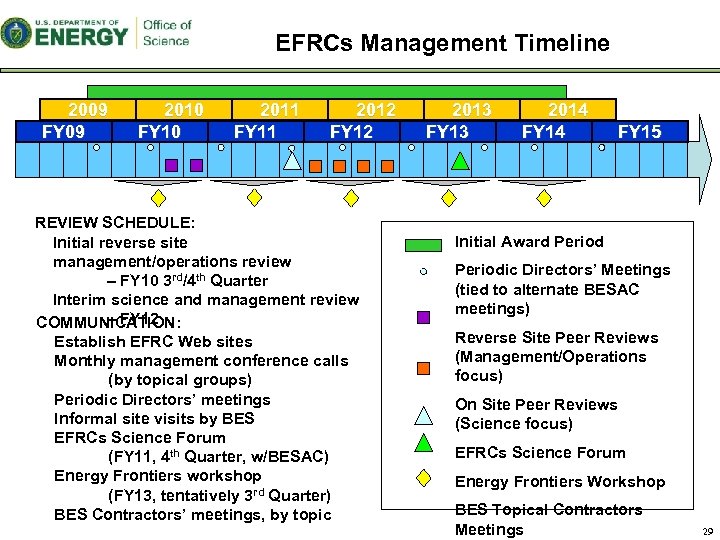
EFRCs Management Timeline 2009 FY 09 2010 FY 10 2011 FY 11 2012 FY 12 REVIEW SCHEDULE: Initial reverse site management/operations review – FY 10 3 rd/4 th Quarter Interim science and management review – FY 12 COMMUNICATION: Establish EFRC Web sites Monthly management conference calls (by topical groups) Periodic Directors’ meetings Informal site visits by BES EFRCs Science Forum (FY 11, 4 th Quarter, w/BESAC) Energy Frontiers workshop (FY 13, tentatively 3 rd Quarter) BES Contractors’ meetings, by topic 2013 FY 13 2014 FY 15 Initial Award Periodic Directors’ Meetings (tied to alternate BESAC meetings) Reverse Site Peer Reviews (Management/Operations focus) On Site Peer Reviews (Science focus) EFRCs Science Forum Energy Frontiers Workshop BES Topical Contractors Meetings 29
New BESAC Charge 30
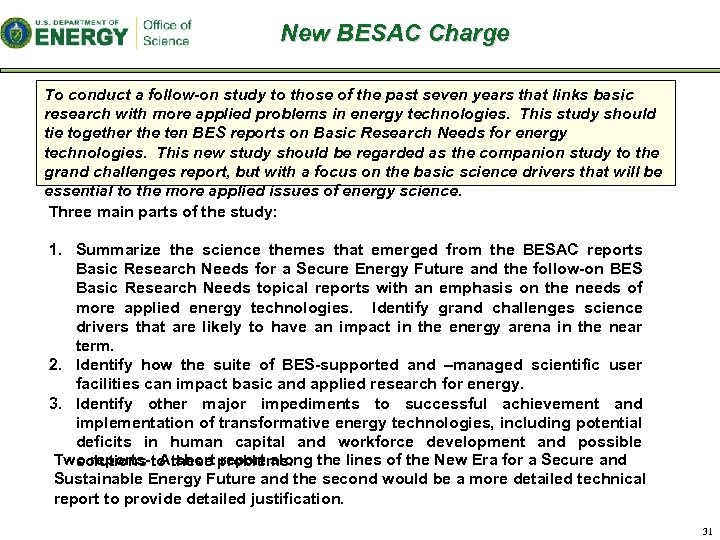
New BESAC Charge To conduct a follow-on study to those of the past seven years that links basic research with more applied problems in energy technologies. This study should tie together the ten BES reports on Basic Research Needs for energy technologies. This new study should be regarded as the companion study to the grand challenges report, but with a focus on the basic science drivers that will be essential to the more applied issues of energy science. Three main parts of the study: 1. Summarize the science themes that emerged from the BESAC reports Basic Research Needs for a Secure Energy Future and the follow-on BES Basic Research Needs topical reports with an emphasis on the needs of more applied energy technologies. Identify grand challenges science drivers that are likely to have an impact in the energy arena in the near term. 2. Identify how the suite of BES-supported and –managed scientific user facilities can impact basic and applied research for energy. 3. Identify other major impediments to successful achievement and implementation of transformative energy technologies, including potential deficits in human capital and workforce development and possible Two reports- A short report along the lines of the New Era for a Secure and solutions to these problems. Sustainable Energy Future and the second would be a more detailed technical report to provide detailed justification. 31
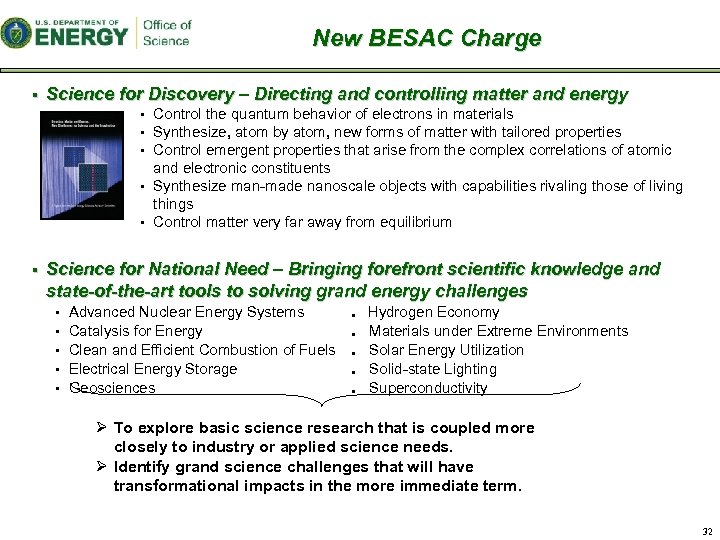
New BESAC Charge § Science for Discovery – Directing and controlling matter and energy Discovery § § § Control the quantum behavior of electrons in materials Synthesize, atom by atom, new forms of matter with tailored properties Control emergent properties that arise from the complex correlations of atomic and electronic constituents Synthesize man-made nanoscale objects with capabilities rivaling those of living things Control matter very far away from equilibrium Science for National Need – Bringing forefront scientific knowledge and state-of-the-art tools to solving grand energy challenges § § § Advanced Nuclear Energy Systems Catalysis for Energy Clean and Efficient Combustion of Fuels Electrical Energy Storage Geosciences Hydrogen Economy Materials under Extreme Environments Solar Energy Utilization Solid-state Lighting Superconductivity Ø To explore basic science research that is coupled more closely to industry or applied science needs. Ø Identify grand science challenges that will have transformational impacts in the more immediate term. 32
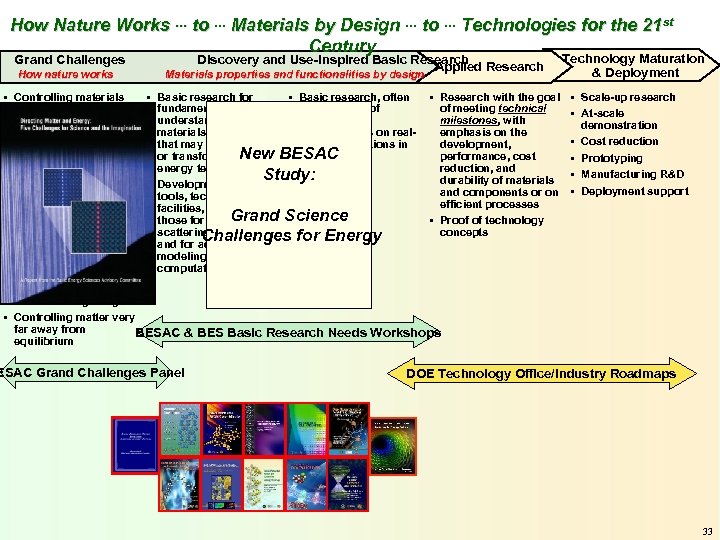
How Nature Works … to … Materials by Design … to … Technologies for the 21 st Century Grand Challenges Discovery and Use-Inspired Basic Research Applied Research How nature works Materials properties and functionalities by design Technology Maturation & Deployment § Controlling materials § Basic research for § Basic research, often § Research with the goal processes at the level fundamental new with the goal of of meeting technical of quantum behavior of understanding on addressing milestones, with electrons materials or systems showstoppers on realemphasis on the that may revolutionize world applications in development, § Atom- and energy. New the energy or transform today’s BESAC performance, cost efficient syntheses of energy technologies reduction, and new forms of matter Study: durability of materials with tailored properties § Development of new and components or on tools, techniques, and § Emergent properties efficient processes facilities, including from complex those for the Grand Science § Proof of technology correlations of atomic scattering sciences concepts and electronic Challenges for Energy and for advanced constituents modeling and § Man-made nanoscale computation objects with capabilities rivaling those of living things § Controlling matter very far away from BESAC & BES Basic Research Needs Workshops equilibrium ESAC Grand Challenges Panel § Scale-up research § At-scale demonstration § Cost reduction § Prototyping § Manufacturing R&D § Deployment support DOE Technology Office/Industry Roadmaps 33
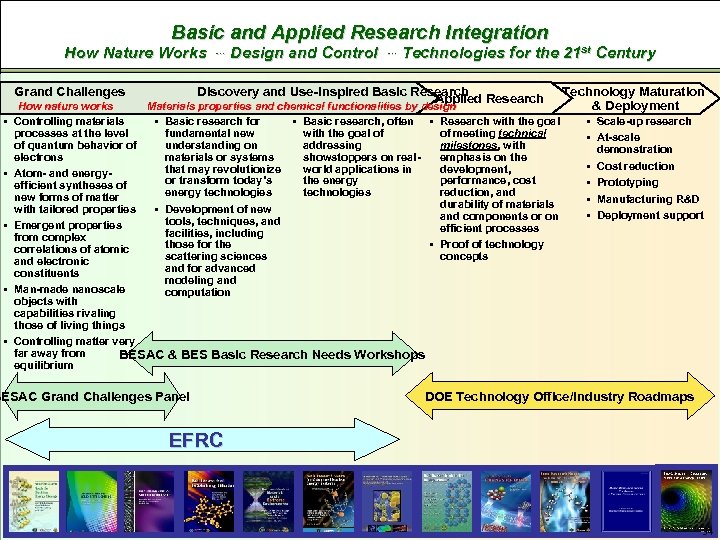
Basic and Applied Research Integration How Nature Works … Design and Control … Technologies for the 21 st Century Grand Challenges Discovery and Use-Inspired Basic Research Applied Research How nature works Materials properties and chemical functionalities by design Technology Maturation & Deployment § Controlling materials § Basic research for § Basic research, often § Research with the goal processes at the level fundamental new with the goal of of meeting technical of quantum behavior of understanding on addressing milestones, with electrons materials or systems showstoppers on realemphasis on the that may revolutionize world applications in development, § Atom- and energyor transform today’s the energy performance, cost efficient syntheses of energy technologies reduction, and new forms of matter durability of materials § Development of new with tailored properties and components or on tools, techniques, and § Emergent properties efficient processes facilities, including from complex those for the § Proof of technology correlations of atomic scattering sciences concepts and electronic and for advanced constituents modeling and § Man-made nanoscale computation objects with capabilities rivaling those of living things § Controlling matter very far away from BESAC & BES Basic Research Needs Workshops equilibrium BESAC Grand Challenges Panel § Scale-up research § At-scale demonstration § Cost reduction § Prototyping § Manufacturing R&D § Deployment support DOE Technology Office/Industry Roadmaps EFRC 34
Скачать презентацию Basic Energy Sciences Update July 9 2009 Basic
6bf42cf3ca466703bec3aa31d68f31f7.ppt