 Скачать презентацию Basic Electrical Safety Faculty of Science Health
cc56e4d3d45b8c19b559f7fcc0be2bb2.ppt
- Количество слайдов: 53



Basic Electrical Safety Faculty of Science & Health Safe-Lab Module Alan Hughes January 2017 Ver. 1. 0
Why this Module! Encouraging Electrical Safety In an Educational & Active Research Environment Specifically q Avoid Injury, Death – You & Others q Avoid Equipment Damage & Loss of Research q Awareness of your moral & legal responsibility to yourself, colleagues & to all others By increasing your q awareness of potential dangers & how to avoid creating them q awareness of your skills & Limitations q providing sources of advice & information January 2016 Ver. 1. 1 2
Overview of Module! Encouraging Electrical Safety in an Educational and Research Environment q Information sources q Overview of Electrical Basics q Electrical Equipment q Specific laboratory examples January 2016 Ver. 1. 1 3
Where to get more information n n Your Supervisor, Manager, Head of Department Safety Statements Department Safety Committees & Safety Officer DCU safety - WEB n Edinburgh University H&S - WEB University London H&S – WEB n These PP slides on Faculty Safety web site n Safety in Schools n Department of education document January 2016 Ver. 1. 1 4

TODAY January 2016 Ver. 1. 1 5
![Content n [ I ] Basic Electrical Theory n n [ Ladybird version, no](https://present5.com/presentation/cc56e4d3d45b8c19b559f7fcc0be2bb2/image-6.jpg "Content n [ I ] Basic Electrical Theory n n [ Ladybird version, no")
Content n [ I ] Basic Electrical Theory n n [ Ladybird version, no maths ] Voltage & Current Electricity in the body & effects on the body Electricity & associated hazards [ II ] Electrical Equipment n n n Electrocution General Electrical Guidelines & Precautions Safety features: fuses, ELCBs, cables, connections, equipment design [ III ] Specific Hazards & Personal Safety n A few Do’s , Don’ts & Watch-out-for’s January 2016 Ver. 1. 1 6

- January 2016 Ver. 1. 1 7
![[I] Electricity Basic Electrical Theory January 2016 Ver. 1. 1 8](https://present5.com/presentation/cc56e4d3d45b8c19b559f7fcc0be2bb2/image-8.jpg "[I] Electricity Basic Electrical Theory January 2016 Ver. 1. 1 8")
[I] Electricity Basic Electrical Theory January 2016 Ver. 1. 1 8
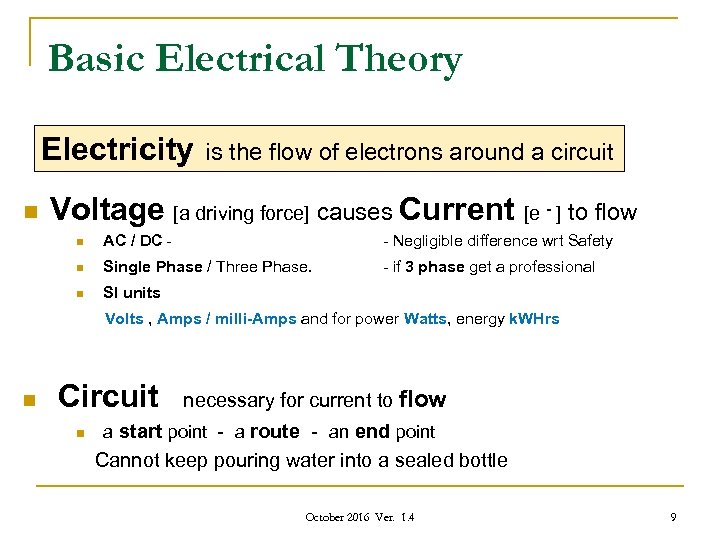
Basic Electrical Theory Electricity n is the flow of electrons around a circuit Voltage [a driving force] causes Current [e - ] to flow n AC / DC - - Negligible difference wrt Safety n Single Phase / Three Phase. - if 3 phase get a professional n SI units Volts , Amps / milli-Amps and for power Watts, energy k. WHrs n Circuit n necessary for current to flow a start point - a route - an end point Cannot keep pouring water into a sealed bottle October 2016 Ver. 1. 4 9
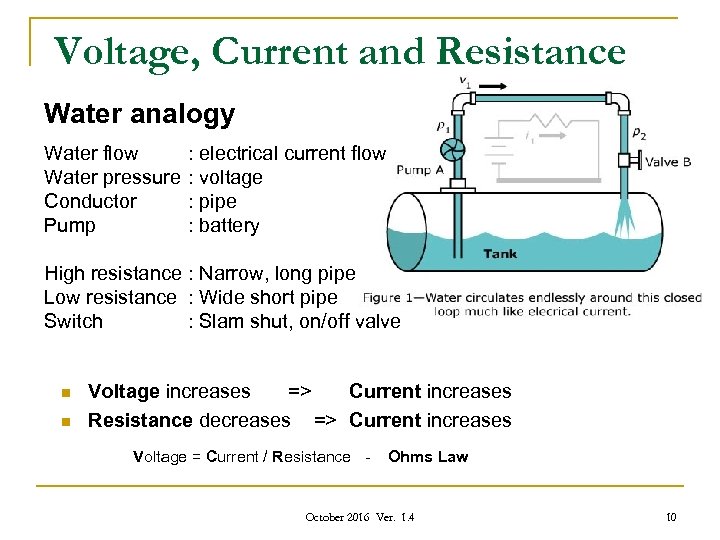
Voltage, Current and Resistance Water analogy Water flow Water pressure Conductor Pump : electrical current flow : voltage : pipe : battery High resistance : Narrow, long pipe Low resistance : Wide short pipe Switch : Slam shut, on/off valve n n Voltage increases => Current increases Resistance decreases => Current increases Voltage = Current / Resistance - Ohms Law October 2016 Ver. 1. 4 10
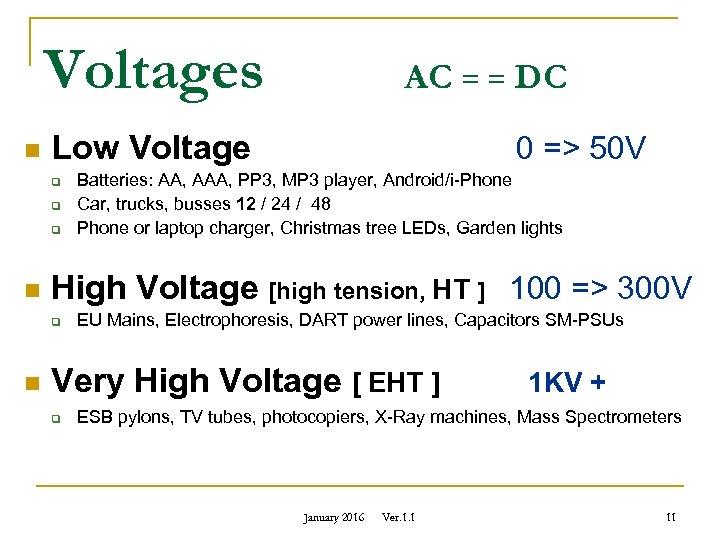
Voltages n Low Voltage q q q n 0 => 50 V Batteries: AA, AAA, PP 3, MP 3 player, Android/i-Phone Car, trucks, busses 12 / 24 / 48 Phone or laptop charger, Christmas tree LEDs, Garden lights High Voltage [high tension, HT ] 100 => 300 V q n AC = = DC EU Mains, Electrophoresis, DART power lines, Capacitors SM-PSUs Very High Voltage [ EHT ] q 1 KV + ESB pylons, TV tubes, photocopiers, X-Ray machines, Mass Spectrometers January 2016 Ver. 1. 1 11
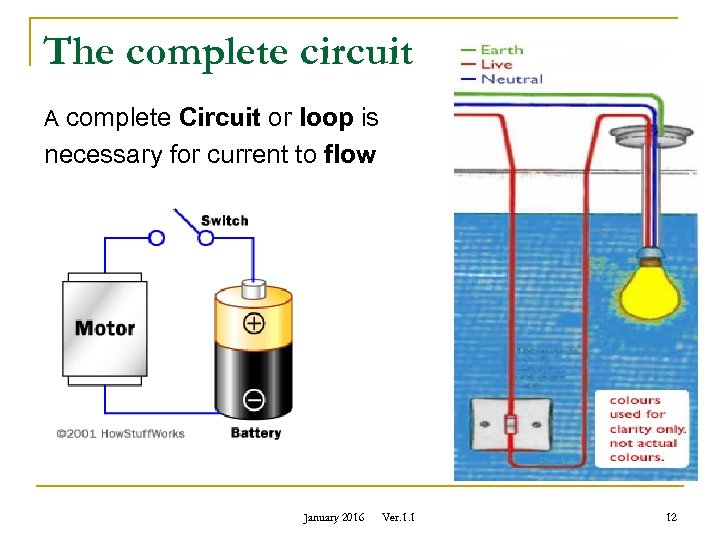
The complete circuit A complete Circuit or loop is necessary for current to flow January 2016 Ver. 1. 1 12
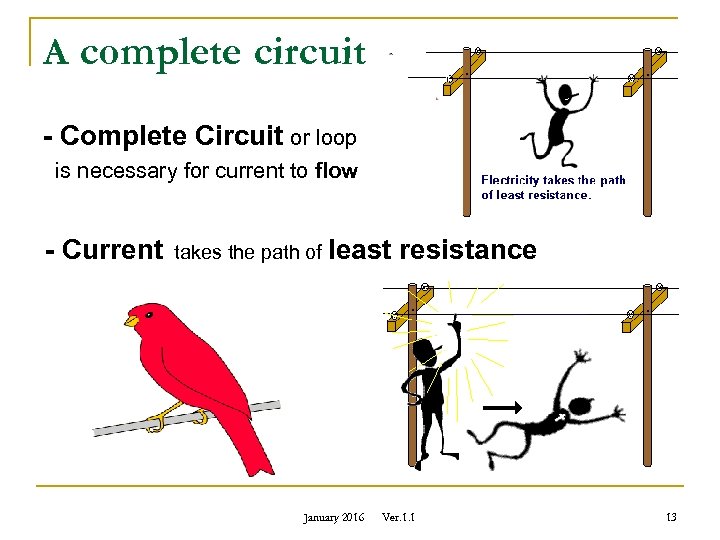
A complete circuit. - Complete Circuit or loop is necessary for current to flow - Current takes the path of least January 2016 resistance Ver. 1. 1 13
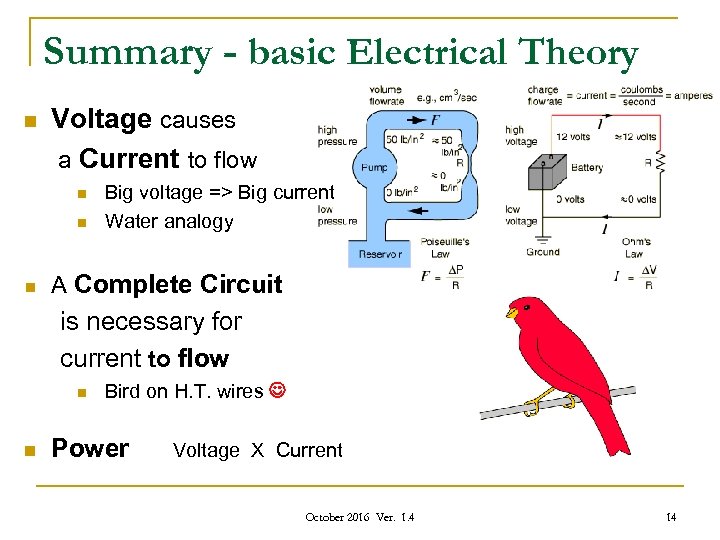
Summary - basic Electrical Theory n Voltage causes a Current to flow n n n Big voltage => Big current Water analogy A Complete Circuit is necessary for current to flow n n Bird on H. T. wires Power Voltage X Current October 2016 Ver. 1. 4 14
Electricity & Human Body January 2016 Ver. 1. 1 15
‘Normal’ Electricity the body in n Muscles q q q Muscles control all body movements, activated using small electrical currents Including & very importantly, those that keep us alive: our Breathing and our Heart beat The brain controls voluntary muscles using small current pulses along nerves Some local autonomous circuits for involuntary muscles e. g. Heart January 2016 Ver. 1. 1 16

‘External’ Electricity the body in n External Current through the body overrides all biological control and causes: q Loss of muscle control, respiratory, paralysis including ‘Inability to let go’ q Spasms & Involuntary movement q Fibrillation of the Heart [no heart pumping] q Burns - external & internal January 2016 Ver. 1. 1 17
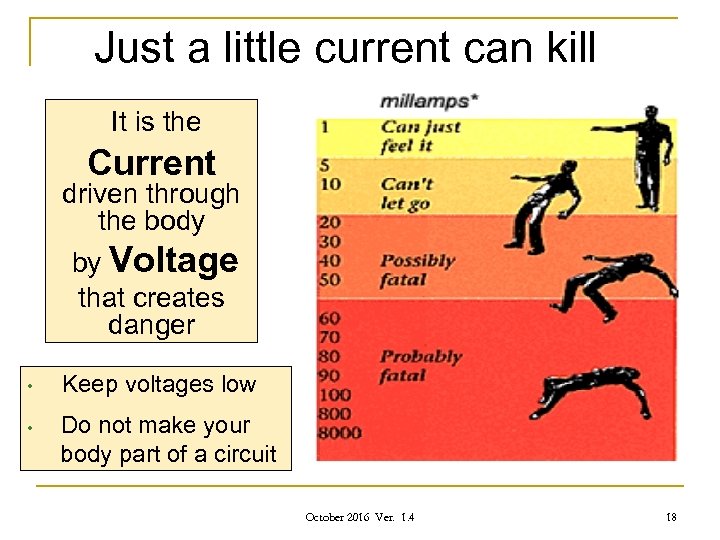
Just a little current can kill It is the Current driven through the body by Voltage that creates danger • • Keep voltages low Do not make your body part of a circuit October 2016 Ver. 1. 4 18
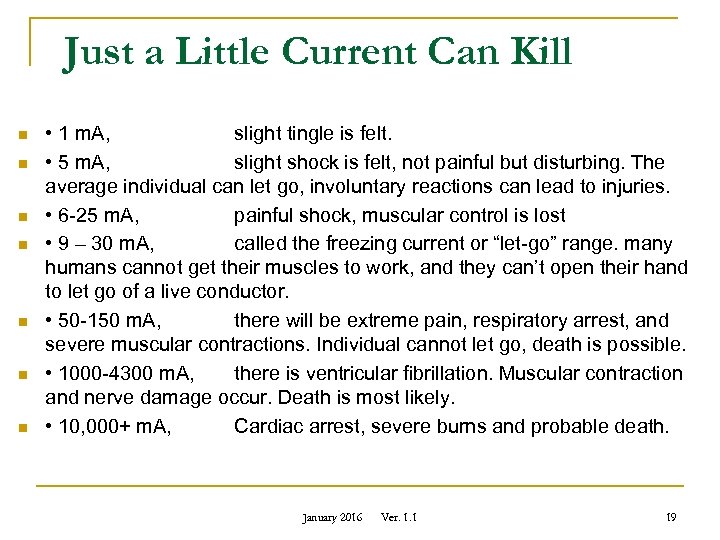
Just a Little Current Can Kill n n n n • 1 m. A, slight tingle is felt. • 5 m. A, slight shock is felt, not painful but disturbing. The average individual can let go, involuntary reactions can lead to injuries. • 6 -25 m. A, painful shock, muscular control is lost • 9 – 30 m. A, called the freezing current or “let-go” range. many humans cannot get their muscles to work, and they can’t open their hand to let go of a live conductor. • 50 -150 m. A, there will be extreme pain, respiratory arrest, and severe muscular contractions. Individual cannot let go, death is possible. • 1000 -4300 m. A, there is ventricular fibrillation. Muscular contraction and nerve damage occur. Death is most likely. • 10, 000+ m. A, Cardiac arrest, severe burns and probable death. January 2016 Ver. 1. 1 19
Electricity & Associated Hazards January 2016 Ver. 1. 1 20
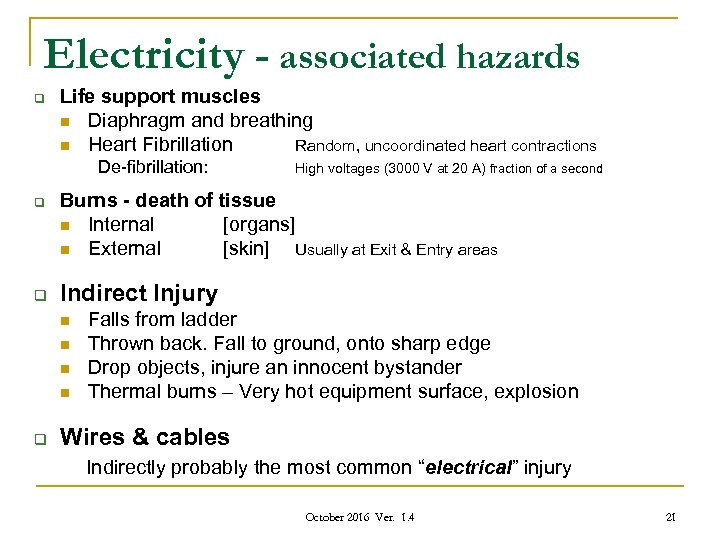
Electricity - associated hazards q Life support muscles n Diaphragm and breathing n Heart Fibrillation Random, uncoordinated heart contractions De-fibrillation: q q Burns - death of tissue n Internal [organs] n External [skin] Usually at Exit & Entry areas Indirect Injury n n q High voltages (3000 V at 20 A) fraction of a second Falls from ladder Thrown back. Fall to ground, onto sharp edge Drop objects, injure an innocent bystander Thermal burns – Very hot equipment surface, explosion Wires & cables Indirectly probably the most common “electrical” injury October 2016 Ver. 1. 4 21
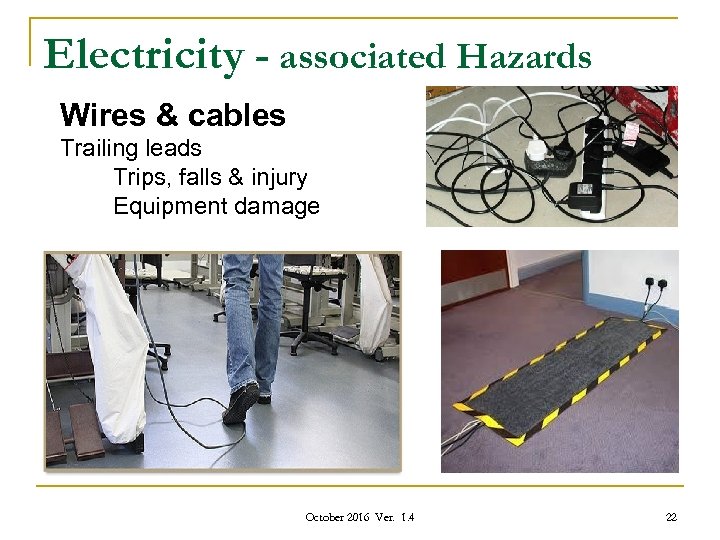
Electricity - associated Hazards Wires & cables Trailing leads Trips, falls & injury Equipment damage Re-route, tidy up, cover October 2016 Ver. 1. 4 22
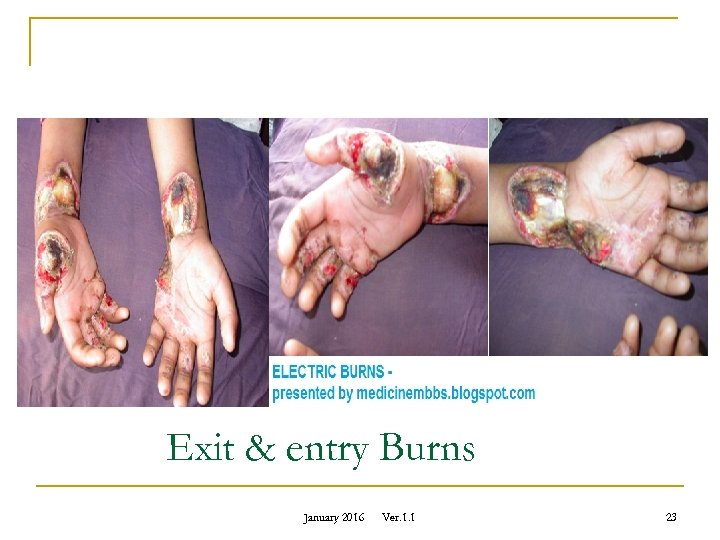
Exit & entry Burns January 2016 Ver. 1. 1 23
![END [I] Electrical Theory Section January 2016 Ver. 1. 1 24](https://present5.com/presentation/cc56e4d3d45b8c19b559f7fcc0be2bb2/image-24.jpg "END [I] Electrical Theory Section January 2016 Ver. 1. 1 24")
END [I] Electrical Theory Section January 2016 Ver. 1. 1 24

- January 2016 Ver. 1. 1 25
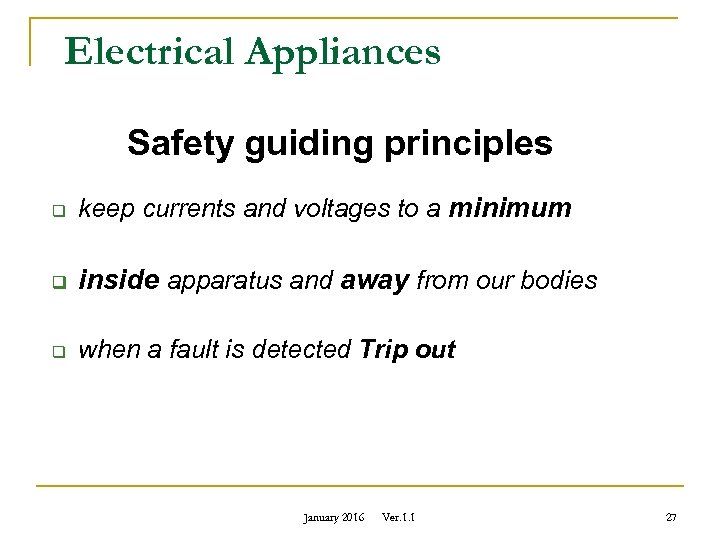
Electrical Appliances Safety guiding principles q keep currents and voltages to a minimum q inside apparatus and away from our bodies q when a fault is detected Trip out January 2016 Ver. 1. 1 27
![Electrical Appliances Minimise voltages [ and thus minimise current ] § Inherently safe -](https://present5.com/presentation/cc56e4d3d45b8c19b559f7fcc0be2bb2/image-27.jpg "Electrical Appliances Minimise voltages [ and thus minimise current ] § Inherently safe -")
Electrical Appliances Minimise voltages [ and thus minimise current ] § Inherently safe - Low voltage / low current Keep Voltages away from our bodies § § § Enclosures Insulation Connections safe & secure Trip out when fault detected § Safety features – Fuses, ELCBs, Switches January 2016 Ver. 1. 1 28
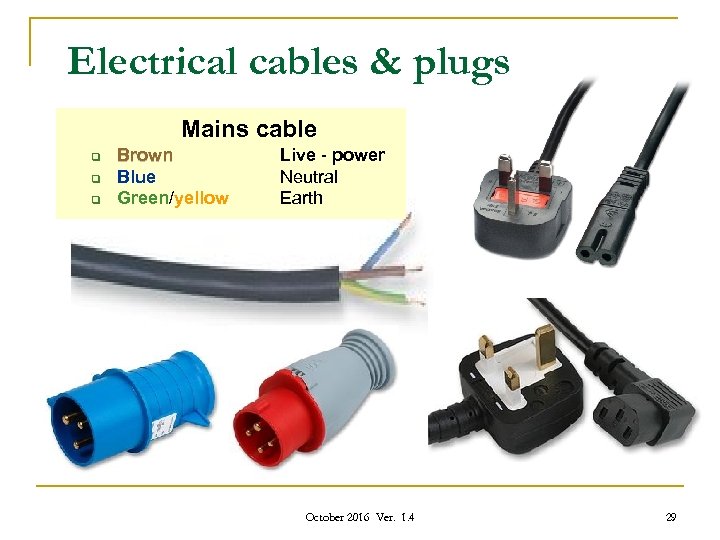
Electrical cables & plugs Mains cable q q q Brown Blue Green/yellow Live - power Neutral Earth October 2016 Ver. 1. 4 29
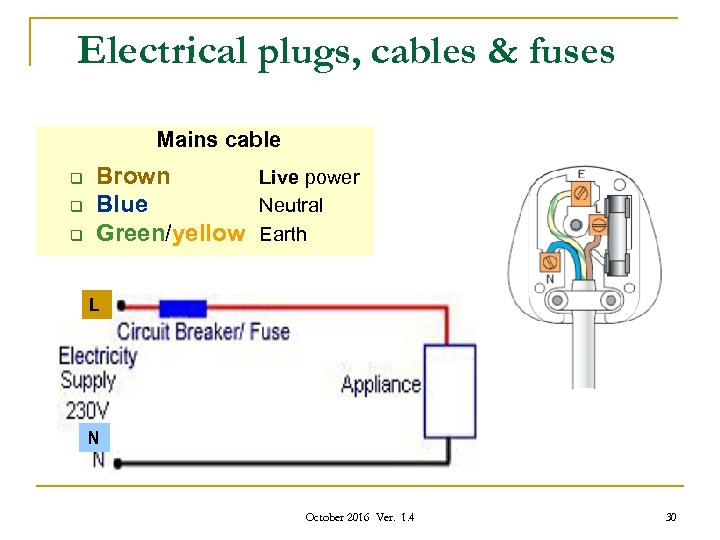
Electrical plugs, cables & fuses Mains cable q q q Brown Live power Blue Neutral Green/yellow Earth L N October 2016 Ver. 1. 4 30
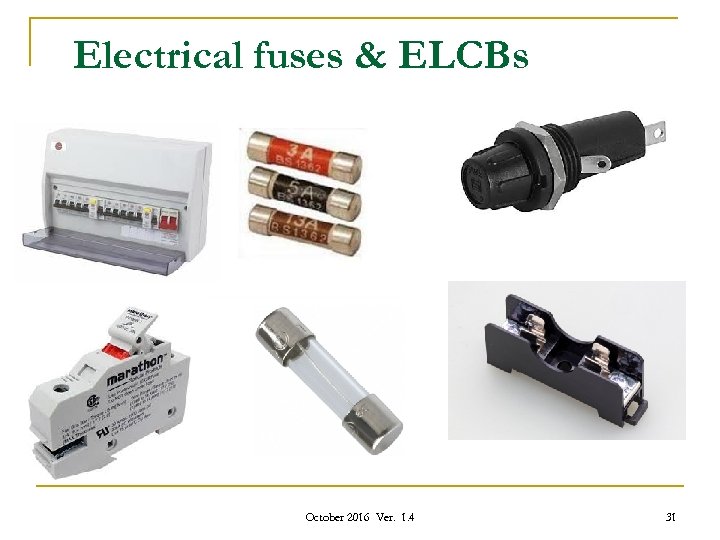
Electrical fuses & ELCBs October 2016 Ver. 1. 4 31
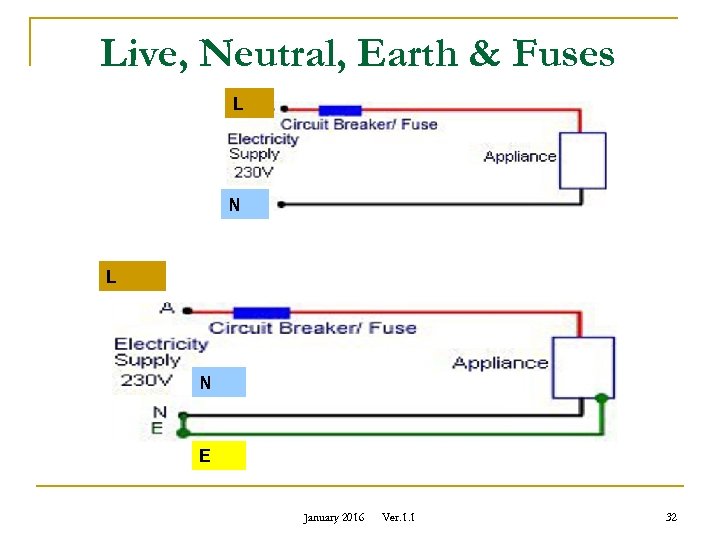
Live, Neutral, Earth & Fuses L N E January 2016 Ver. 1. 1 32
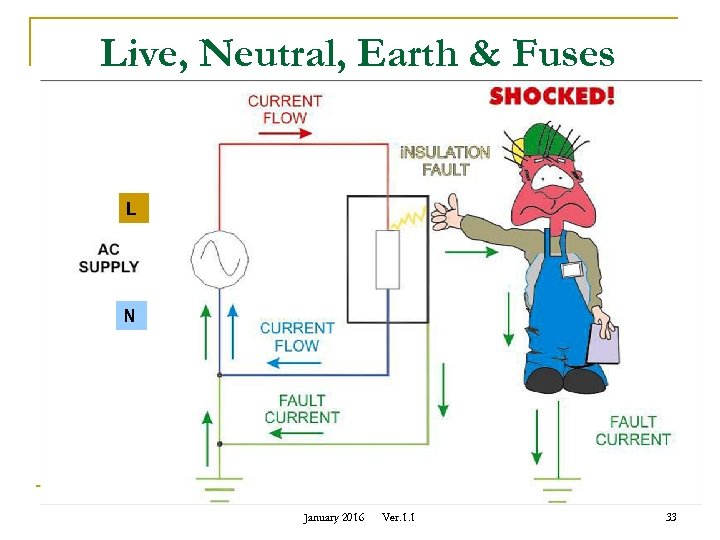
Live, Neutral, Earth & Fuses L N January 2016 Ver. 1. 1 33
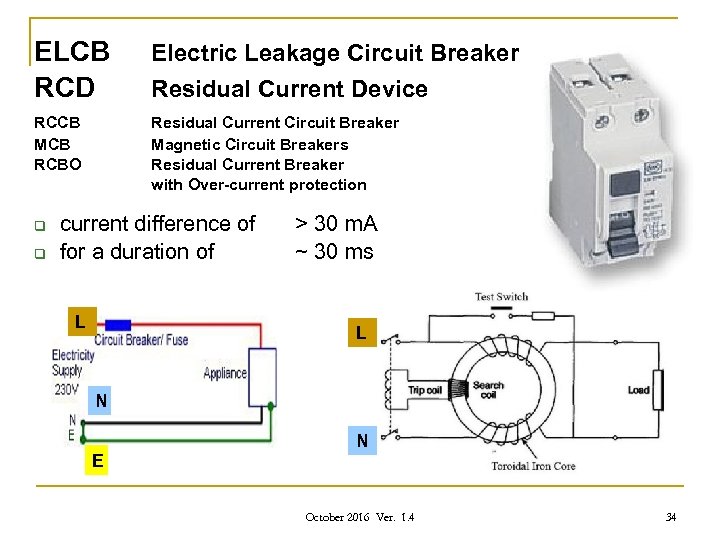
ELCB RCD Electric Leakage Circuit Breaker Residual Current Device RCCB MCB RCBO Residual Current Circuit Breaker Magnetic Circuit Breakers Residual Current Breaker with Over-current protection q q current difference of for a duration of L > 30 m. A ~ 30 ms L N E N October 2016 Ver. 1. 4 34
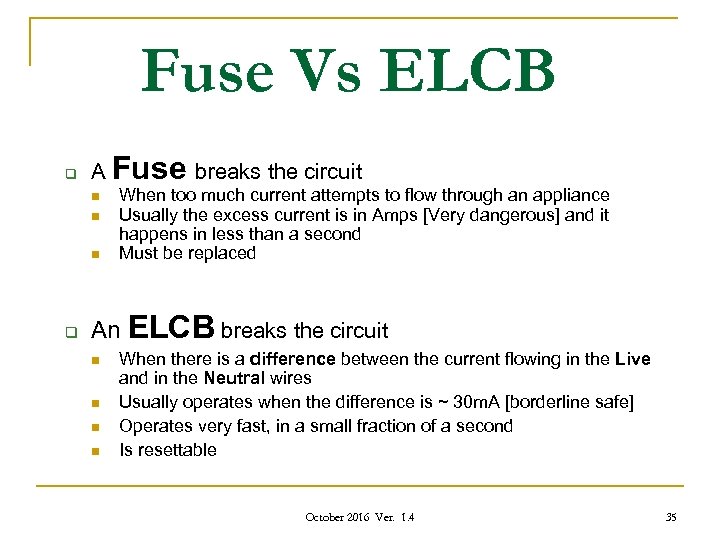
Fuse Vs ELCB q A Fuse breaks the circuit n n n q When too much current attempts to flow through an appliance Usually the excess current is in Amps [Very dangerous] and it happens in less than a second Must be replaced An n n ELCB breaks the circuit When there is a difference between the current flowing in the Live and in the Neutral wires Usually operates when the difference is ~ 30 m. A [borderline safe] Operates very fast, in a small fraction of a second Is resettable October 2016 Ver. 1. 4 35
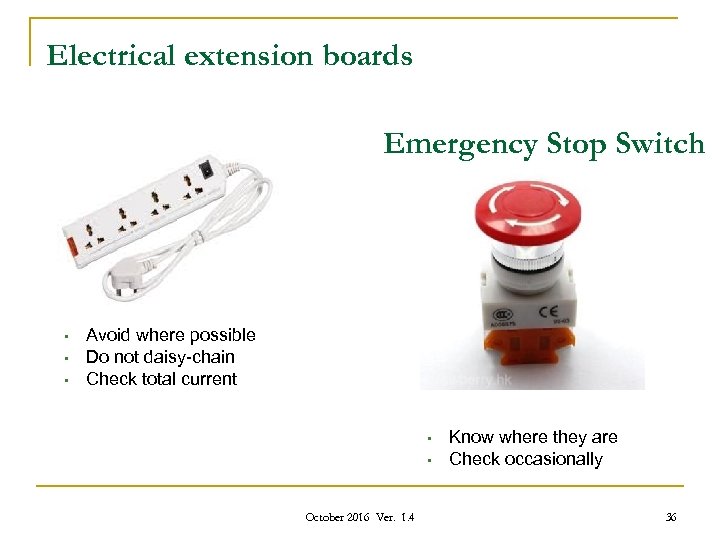
Electrical extension boards Emergency Stop Switch • • • Avoid where possible Do not daisy-chain Check total current • • October 2016 Ver. 1. 4 Know where they are Check occasionally 36
Electrical summary Live and Neutral wires carry current to equipment q The Earth wire is there to protect you. n n q The Earth wire can act like a back-up Neutral wire, Many appliances have metal cases e. g. kettles, toasters, dishwashers, washing machines etc. The Fuse is very thin piece of wire. n n n The wire has a quite low melting point. As current flows through the wire it heats up. If too large a current flows it melts, thus breaking the circuit Use appropriate fuse size/rating ELCBs, RCDs Important Safety Devices q n Leakage-to-earth sensors with trip out October 2016 Ver. 1. 4 37
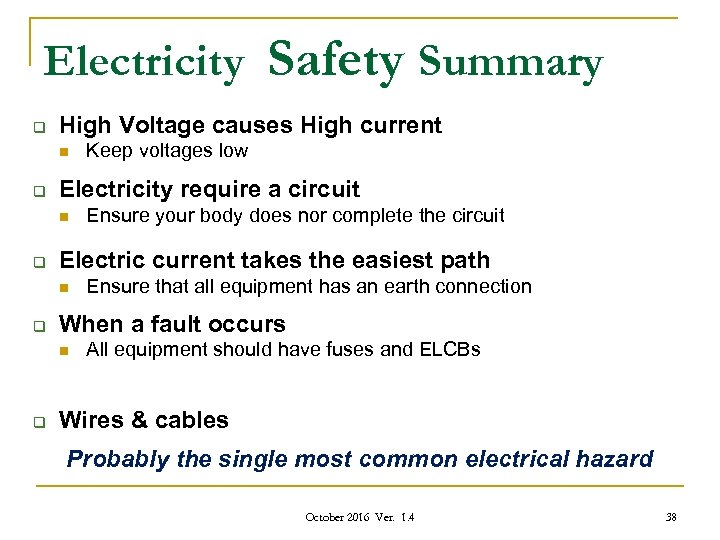
Electricity Safety Summary q High Voltage causes High current n q Electricity require a circuit n q Ensure that all equipment has an earth connection When a fault occurs n q Ensure your body does nor complete the circuit Electric current takes the easiest path n q Keep voltages low All equipment should have fuses and ELCBs Wires & cables Probably the single most common electrical hazard October 2016 Ver. 1. 4 38
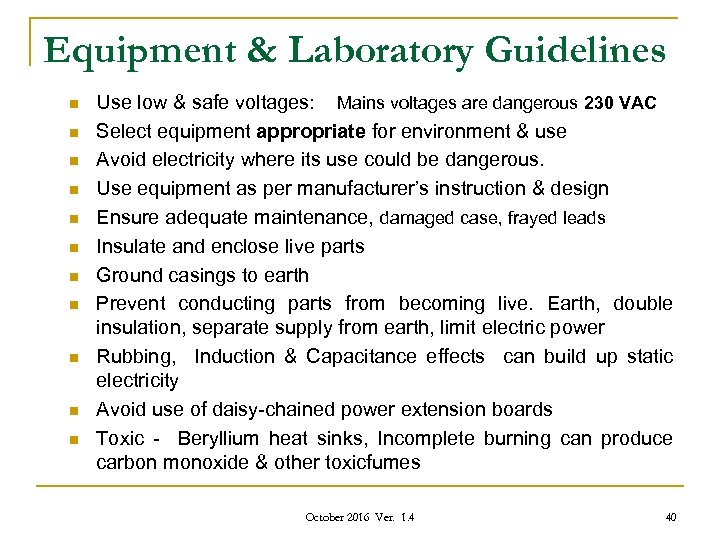
Equipment & Laboratory Guidelines n n n Use low & safe voltages: Mains voltages are dangerous 230 VAC Select equipment appropriate for environment & use Avoid electricity where its use could be dangerous. Use equipment as per manufacturer’s instruction & design Ensure adequate maintenance, damaged case, frayed leads Insulate and enclose live parts Ground casings to earth Prevent conducting parts from becoming live. Earth, double insulation, separate supply from earth, limit electric power Rubbing, Induction & Capacitance effects can build up static electricity Avoid use of daisy-chained power extension boards Toxic - Beryllium heat sinks, Incomplete burning can produce carbon monoxide & other toxicfumes October 2016 Ver. 1. 4 40
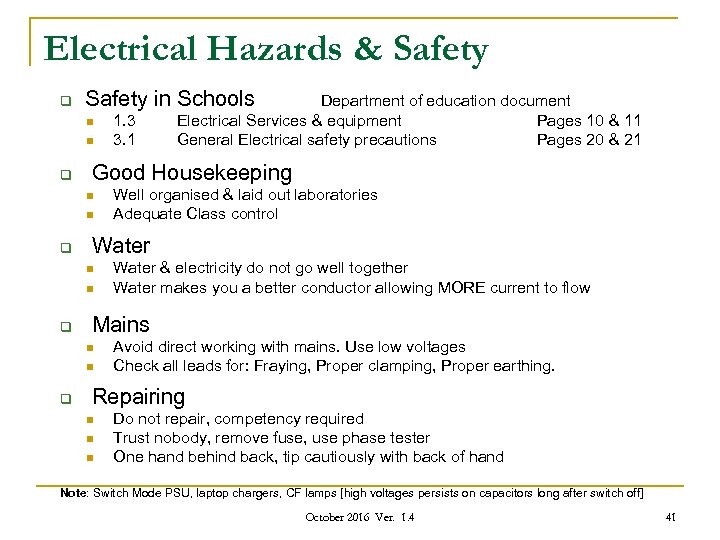
Electrical Hazards & Safety q Safety in Schools n n q Good Housekeeping n n q n Water & electricity do not go well together Water makes you a better conductor allowing MORE current to flow Mains n n q Well organised & laid out laboratories Adequate Class control Water n q 1. 3 3. 1 Department of education document Electrical Services & equipment Pages 10 & 11 General Electrical safety precautions Pages 20 & 21 Avoid direct working with mains. Use low voltages Check all leads for: Fraying, Proper clamping, Proper earthing. Repairing n n n Do not repair, competency required Trust nobody, remove fuse, use phase tester One hand behind back, tip cautiously with back of hand Note: Switch Mode PSU, laptop chargers, CF lamps [high voltages persists on capacitors long after switch off] October 2016 Ver. 1. 4 41
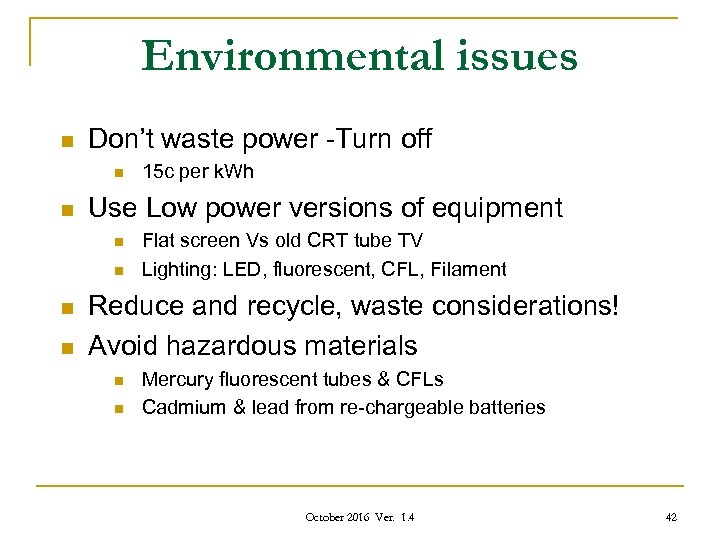
Environmental issues n Don’t waste power -Turn off n n Use Low power versions of equipment n n 15 c per k. Wh Flat screen Vs old CRT tube TV Lighting: LED, fluorescent, CFL, Filament Reduce and recycle, waste considerations! Avoid hazardous materials n n Mercury fluorescent tubes & CFLs Cadmium & lead from re-chargeable batteries October 2016 Ver. 1. 4 42
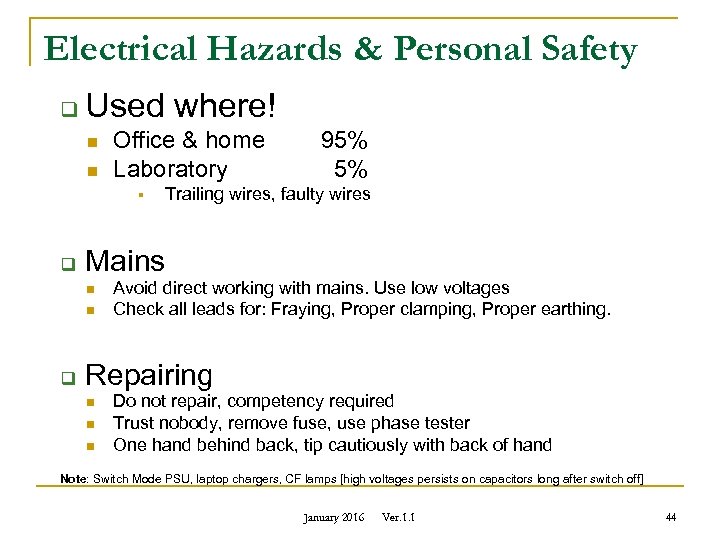
Electrical Hazards & Personal Safety q Used where! n n Office & home Laboratory § q Trailing wires, faulty wires Mains n n q 95% 5% Avoid direct working with mains. Use low voltages Check all leads for: Fraying, Proper clamping, Proper earthing. Repairing n n n Do not repair, competency required Trust nobody, remove fuse, use phase tester One hand behind back, tip cautiously with back of hand Note: Switch Mode PSU, laptop chargers, CF lamps [high voltages persists on capacitors long after switch off] January 2016 Ver. 1. 1 44
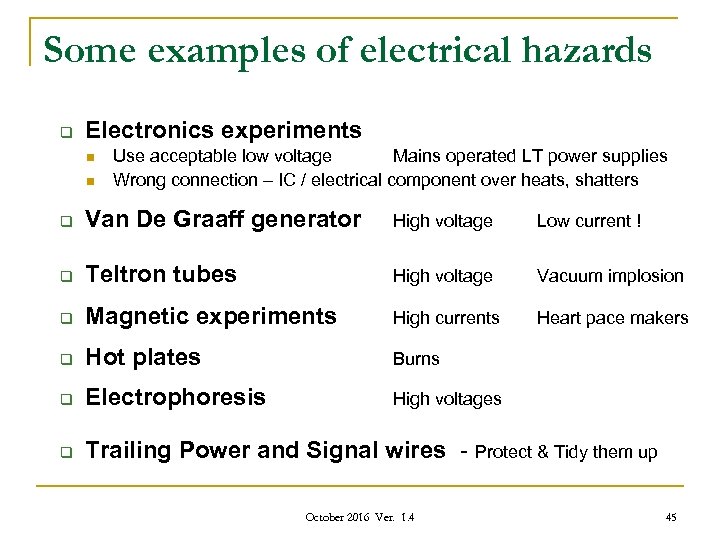
Some examples of electrical hazards q Electronics experiments n n Use acceptable low voltage Mains operated LT power supplies Wrong connection – IC / electrical component over heats, shatters q Van De Graaff generator High voltage Low current ! q Teltron tubes High voltage Vacuum implosion q Magnetic experiments High currents Heart pace makers q Hot plates Burns q Electrophoresis High voltages q Trailing Power and Signal wires - Protect & Tidy them up October 2016 Ver. 1. 4 45
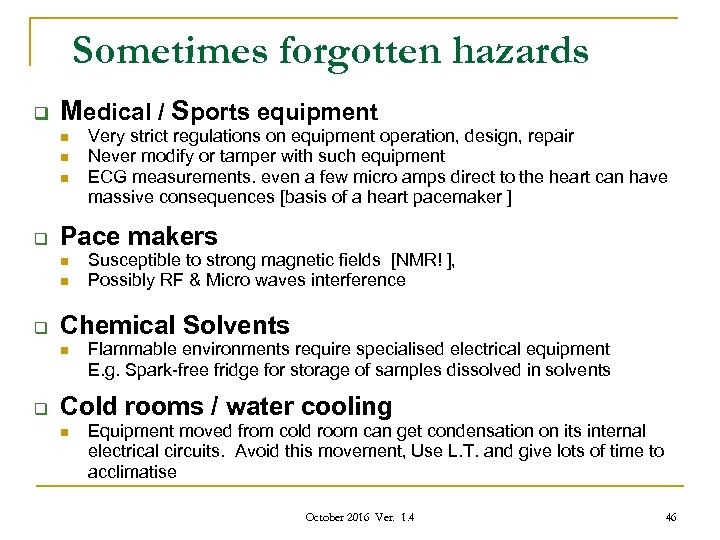
Sometimes forgotten hazards q Medical / Sports equipment n n n q Pace makers n n q Susceptible to strong magnetic fields [NMR! ], Possibly RF & Micro waves interference Chemical Solvents n q Very strict regulations on equipment operation, design, repair Never modify or tamper with such equipment ECG measurements. even a few micro amps direct to the heart can have massive consequences [basis of a heart pacemaker ] Flammable environments require specialised electrical equipment E. g. Spark-free fridge for storage of samples dissolved in solvents Cold rooms / water cooling n Equipment moved from cold room can get condensation on its internal electrical circuits. Avoid this movement, Use L. T. and give lots of time to acclimatise October 2016 Ver. 1. 4 46
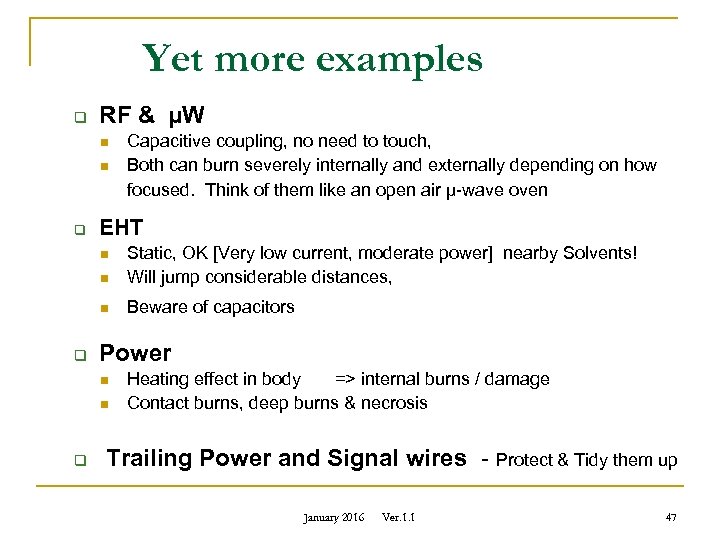
Yet more examples q RF & µW n n q Capacitive coupling, no need to touch, Both can burn severely internally and externally depending on how focused. Think of them like an open air μ-wave oven EHT n Static, OK [Very low current, moderate power] nearby Solvents! Will jump considerable distances, n Beware of capacitors n q Power n n q Heating effect in body => internal burns / damage Contact burns, deep burns & necrosis Trailing Power and Signal wires - Protect & Tidy them up January 2016 Ver. 1. 1 47
Specific Hazards & Personal Safety q Other Laboratory Situations ? q Other Office Situations ? q Other Home Situations ? January 2016 Ver. 1. 1 48
Electrocution n Prevention & Training : Where are red mushroom switches ? Response: Immediately cut power, red buttons / switch / plug n If in any doubt - Do not touch victim. n One hand behind back, stand on insulation, tip with back of hand Use insulating rod / stick to move wires from victim. n n n Call for assistance Talk & reassure victim If unconscious then use first aid, CPR January 2016 Ver. 1. 1 50
![END [ II ] Theory Section Electrical Appliances January 2016 Ver. 1. 1 51](https://present5.com/presentation/cc56e4d3d45b8c19b559f7fcc0be2bb2/image-47.jpg "END [ II ] Theory Section Electrical Appliances January 2016 Ver. 1. 1 51")
END [ II ] Theory Section Electrical Appliances January 2016 Ver. 1. 1 51

- January 2016 Ver. 1. 1 52

- January 2016 Ver. 1. 1 53
SUMMARY January 2016 Ver. 1. 1 54
Summary n Awareness of the need for electrical safety n Potential Source of electrical dangers n Your responsibility to take care of Yourself and Others n Note Safety References for future use n If unsure never be afraid to ask January 2016 Ver. 1. 1 55
Where to get more information n Your Supervisor, Manager, Head of Department n Department Safety Statements Department Safety Committees & Safety Officer DCU safety - WEB n n n Edinburgh University H&S - WEB University London H&S – WEB n http: //sce. e-smartonline. net/elec_safety-smart/index. html n January 2016 Ver. 1. 1 56
END Thanks for your attention January 2016 Ver. 1. 1 57
Скачать презентацию Basic Electrical Safety Faculty of Science Health
cc56e4d3d45b8c19b559f7fcc0be2bb2.ppt