

Basic concepts of state, law and public-legal phenomena

Basic concepts of state, law and public-legal phenomena Lecturer: Karmenbaev S. A.
Questions: 1. The origin and nature of the state. 2. Form of government. 3. Functions of the state and the legal form of their implementation. 4. State of law and its signs. 5. The concept the signs and the essence of law. 6. Sources of law and their views. System of law. 7. Rules of low.
State - a political organization of society, providing its unity and integrity, by carrying out public administration mechanism of society, the sovereign public authority, which gives law obligatory value making guaranty rights, freedoms, rule of law and the right order.
Theory of the origin of the state: 1. theological theory 2. patriarchal theory 3. contractual theory 4. theory of violence 5. organic theory 6. theory of geographical determinism 7. Psychological 8. irrigation theory 9. Historical -materialist theory
The main causes of origin of the state: • first and second major social division of labor; • emergence of trade and exchange; • the emergence of private property; • division of society into classes; • emergence of contradictions between classes.
Signs of the state: • Availability of public (political) power, has a special administrative apparatus of compulsion; • territorial organization of the population; • State sovereignty; • comprehensive, obligatory nature of acts issued by the State; • taxation and tax collection.
Mechanism of the state: 1) state enterprises; 2) public institutions; 3) government bodies.
State enterprises whose activities are connected with the production of goods, performance of works, rendering of services, satisfaction of needs of the population. Public institutions - is an organization engaged in the social and cultural spheres: medicine, science, education and culture. Government bodies - are organizations or officials with designated authority and acting in a strictly defined framework.
Form of state - a way of organizing government, interconnected with the main - the essential features of the state as a special political, territorial and structural organization of society.
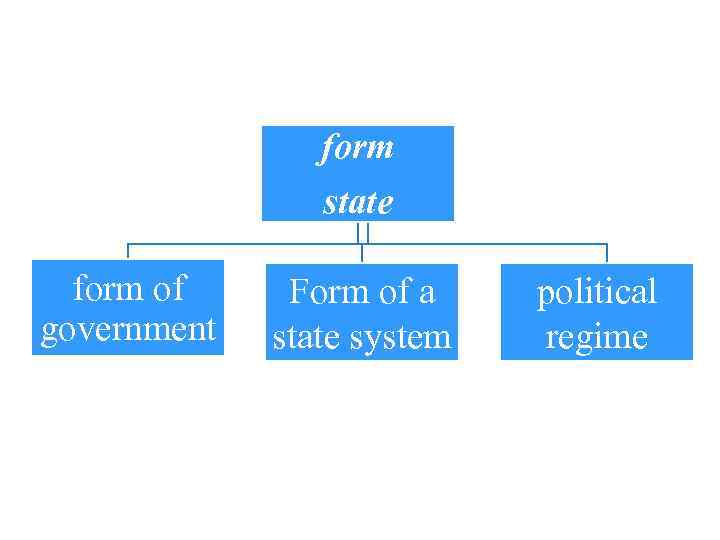
form state form of Form of a political government state system regime
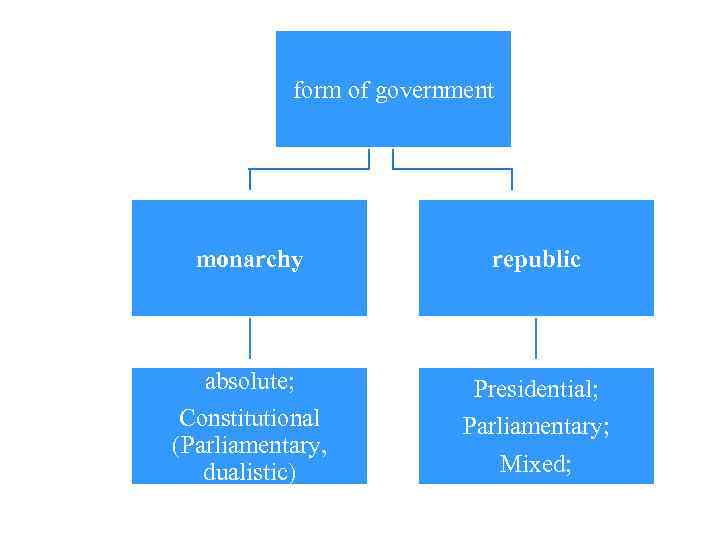
form of government monarchy republic absolute; Presidential; Constitutional Parliamentary; (Parliamentary, dualistic) Mixed;
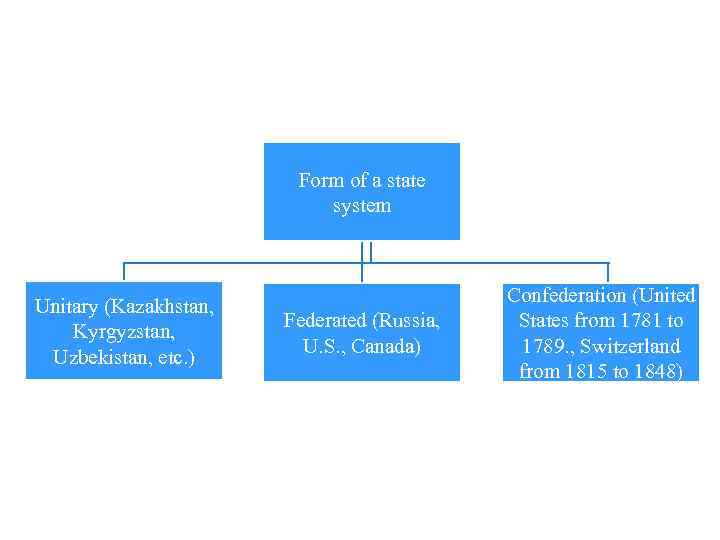
Form of a state system Confederation (United Unitary (Kazakhstan, Federated (Russia, States from 1781 to Kyrgyzstan, U. S. , Canada) 1789. , Switzerland Uzbekistan, etc. ) from 1815 to 1848)
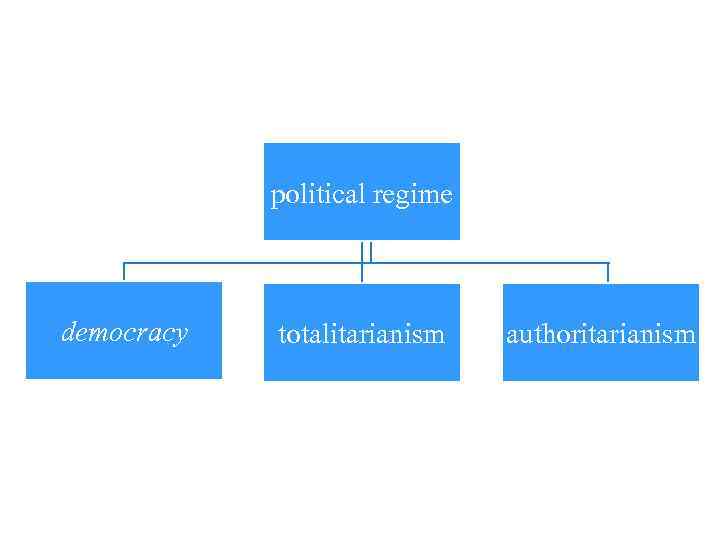
political regime democracy totalitarianism authoritarianism
Functions of the state 1) spheres of social life (political, economic, social, ideological, environmental, legal, etc. ). 2) territorial basis (internal and external). 3) runtime (permanent and temporary).
Legal state - a state in which the organization and activities of the government in its relations with individuals and their associations based on the right and his correspondence. The idea of state seeks to limit the power (force) of the state law, and on the establishment of the rule of law and not of men, on human security in its interactions with the state
Signs of legal state: 1) the rule of law in public and political life; 2) the principle of separation of powers; 3) the inviolability of human rights and freedoms, and their warranty and the reality of implementation; 4) the mutual responsibility of the state and the individual.
Right - a system of mandatory, statutory regulations or rules of conduct that establishes and implements state.
Signs right: 1) normative , it consists of rules of conduct that clearly define the rights and responsibilities of individuals and organizations ; 2) universal validity , the rule of law are binding on all members of society and all who are on the territory of the State , in case of violation of state law may apply coercion ; 3 ) always exist in writing and certainly couched in strictly the established norm of an act - law , decree , judgment;
Functions of right Regulatory function aimed at regulating, ordering of social relations, the establishment of rules of human behavior. Protective function aimed at protecting the most important for society relations.
Sources of right: Legal practice is a custom that has been recognized and approved by the state and, therefore, its protection. Legal precedent - u nder legal precedent decision meant judicial or administrative authorities of the case, which is taken as the obligatory rule for solving similar cases subsequently.
Legal doctrine - this theoretical position , scientific theories legal nature , which set out the key principles , legal categories, concepts , beliefs of scientists - lawyers. Normative content of the contracts represent an agreement between subjects , designed to regulate their relationship by securing mutual rights and responsibilities that actors undertake voluntarily implement. Religious norms are based on religious beliefs and play an important role in societies where one or the other is the official religion , nation-wide.
Legal act, in most states, is the main source of law and form. It is an act that secures the rule of law. Signs: • normative legal act comes from the state; • there is a special procedure the adoption of this act; • used writing and the act itself is made in a special form; • hierarchical subordination, based on different legal effect of individual acts; • content of the act constitute rules of conduct.
Normative legal acts are divided into two large groups: - laws (laws are made by representative bodies); - regulations (regulations - all other competent authorities and officials).
Law - a normative legal act adopted by representative (legislative) authorities in a particular order, the most important for regulating the life of society and social relations has supreme legal force. Subdivided into constitutional laws and current.
The system of law is a structural organization of law, which is due to the objective conditions of its existence and provides internal unity and consistency of the law. The system of law includes several key components: - The branch of law, - subsectors, - legal institutions, - rule of law.
Branch of law - this body of law governing qualitatively homogeneous group of public relations. Several close in character form of regulation of legal institutions subsector rights (consisting of the civil law , there is copyright, patent , etc. ) Law Institute - is part of the field of law , which is a set of legal rules governing a certain kind of uniform public relations ( employment contract , remuneration , working time , rest time . In labor law , etc ). The primary element of the system of law is the rule of law - a specific rule of conduct
The rule of law - obligatory formally certain rules of conduct established by the state as a legitimate criterion or prohibited conduct, and provided public funds.
Elements of the rule of law: Hypothesis - is an indication of the conditions and circumstances under which a given norm. Disposition itself contains a rule of conduct, rights and duties of subjects. Sanction is an indication of adverse effects that may occur in the event of non-compliance requirements dispositions.

Thanks For your attention!
 Скачать презентацию Basic concepts of state, law and public-legal phenomena
1 Д__Р-С А__ЫЛШЫНША.ppt
- Количество слайдов: 29