 Скачать презентацию Basic Business Statistics 10 th Edition Chapter 9
7faf3fe5170a63490bda37e499b6a221.ppt
- Количество слайдов: 59



Basic Business Statistics 10 th Edition Chapter 9 Fundamentals of Hypothesis Testing: One-Sample Tests Basic Business Statistics, 10 e © 2006 Prentice-Hall, Inc. Chap 9 -1
Learning Objectives In this chapter, you learn: § The basic principles of hypothesis testing § How to use hypothesis testing to test a mean or proportion § The assumptions of each hypothesis-testing procedure, how to evaluate them, and the consequences if they are seriously violated § How to avoid the pitfalls involved in hypothesis testing § The ethical issues involved in hypothesis testing Basic Business Statistics, 10 e © 2006 Prentice-Hall, Inc. 2
What is a Hypothesis? § A hypothesis is a claim (assumption) about a population parameter: § population mean Example: The mean monthly cell phone bill of this city is μ = $42 § population proportion Example: The proportion of adults in this city with cell phones is π = 0. 68 Basic Business Statistics, 10 e © 2006 Prentice-Hall, Inc. 3
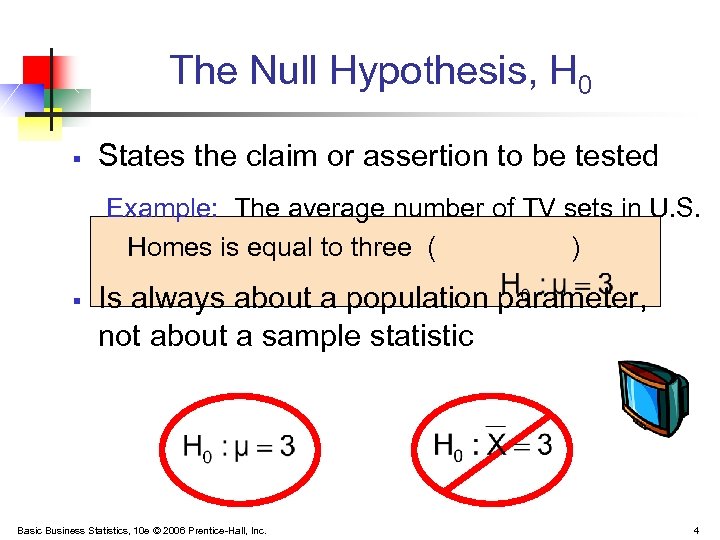
The Null Hypothesis, H 0 § States the claim or assertion to be tested Example: The average number of TV sets in U. S. Homes is equal to three ( ) § Is always about a population parameter, not about a sample statistic Basic Business Statistics, 10 e © 2006 Prentice-Hall, Inc. 4
The Null Hypothesis, H 0 (continued) § § Begin with the assumption that the null hypothesis is true § Similar to the notion of innocent until proven guilty Refers to the status quo Always contains “=” , “≤” or “ ” sign May or may not be rejected Basic Business Statistics, 10 e © 2006 Prentice-Hall, Inc. 5
The Alternative Hypothesis, H 1 § Is the opposite of the null hypothesis § § § e. g. , The average number of TV sets in U. S. homes is not equal to 3 ( H 1: μ ≠ 3 ) Challenges the status quo Never contains the “=” , “≤” or “ ” sign May or may not be proven Is generally the hypothesis that the researcher is trying to prove Basic Business Statistics, 10 e © 2006 Prentice-Hall, Inc. 6
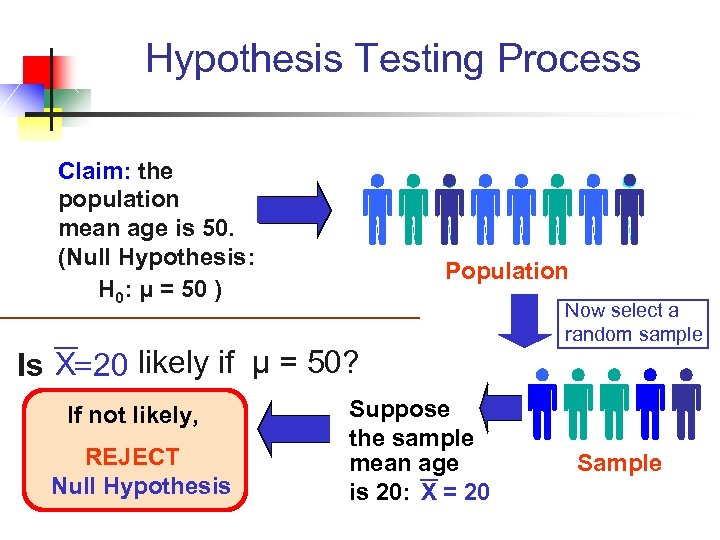
Hypothesis Testing Process Claim: the population mean age is 50. (Null Hypothesis: H 0: μ = 50 ) Population Is X= 20 likely if μ = 50? If not likely, REJECT Null Hypothesis Suppose the sample mean age is 20: X = 20 Now select a random sample Sample
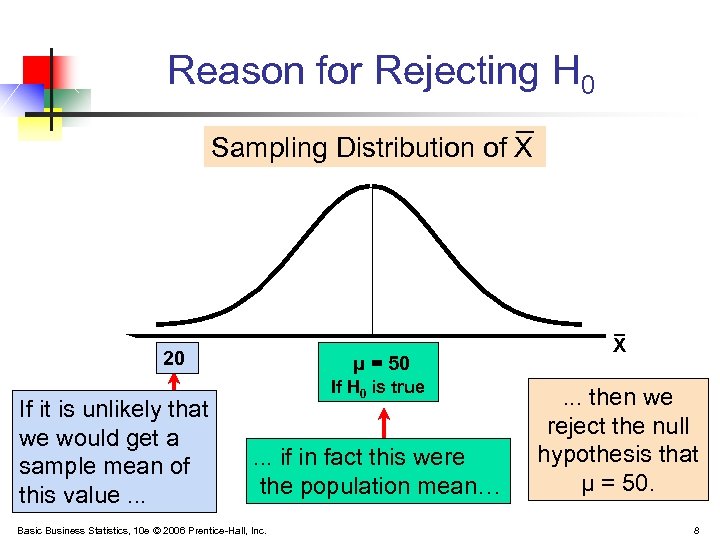
Reason for Rejecting H 0 Sampling Distribution of X 20 If it is unlikely that we would get a sample mean of this value. . . μ = 50 If H 0 is true . . . if in fact this were the population mean… Basic Business Statistics, 10 e © 2006 Prentice-Hall, Inc. X . . . then we reject the null hypothesis that μ = 50. 8
Level of Significance, § Defines the unlikely values of the sample statistic if the null hypothesis is true § § Defines rejection region of the sampling distribution Is designated by , (level of significance) § Typical values are 0. 01, 0. 05, or 0. 10 § Is selected by the researcher at the beginning § Provides the critical value(s) of the test Basic Business Statistics, 10 e © 2006 Prentice-Hall, Inc. 9
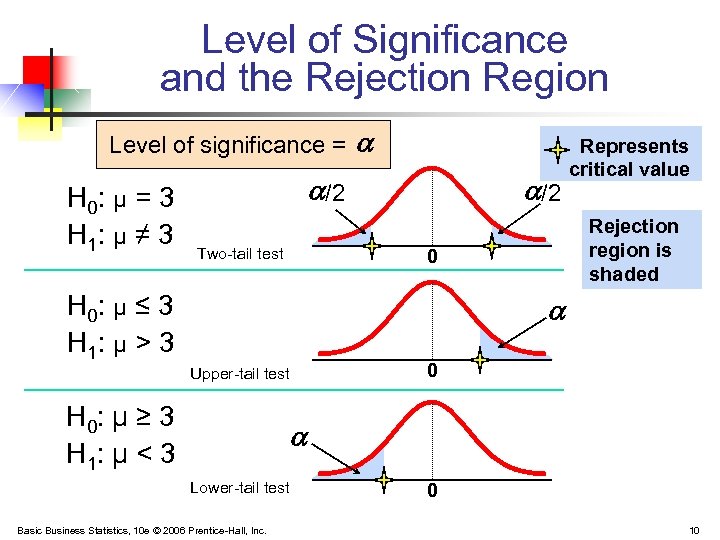
Level of Significance and the Rejection Region Level of significance = H 0: μ = 3 H 1: μ ≠ 3 /2 Two-tail test /2 Represents critical value Rejection region is shaded 0 H 0: μ ≤ 3 H 1: μ > 3 Upper-tail test H 0: μ ≥ 3 H 1: μ < 3 0 Lower-tail test Basic Business Statistics, 10 e © 2006 Prentice-Hall, Inc. 0 10
Errors in Making Decisions § Type I Error § Reject a true null hypothesis § Considered a serious type of error The probability of Type I Error is § Called level of significance of the test § Set by the researcher in advance Basic Business Statistics, 10 e © 2006 Prentice-Hall, Inc. 11
Errors in Making Decisions (continued) § Type II Error § Fail to reject a false null hypothesis The probability of Type II Error is β Basic Business Statistics, 10 e © 2006 Prentice-Hall, Inc. 12
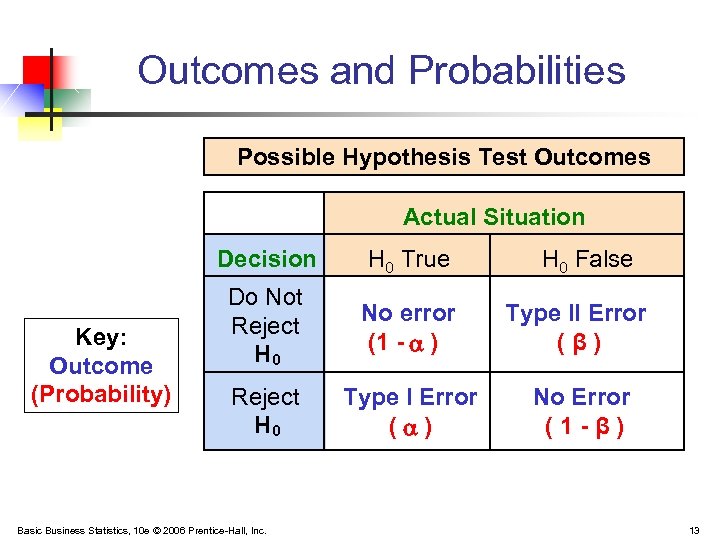
Outcomes and Probabilities Possible Hypothesis Test Outcomes Actual Situation Decision Key: Outcome (Probability) H 0 True Do Not Reject H 0 No error (1 - ) Type II Error (β) Reject H 0 Type I Error ( ) No Error (1 -β) Basic Business Statistics, 10 e © 2006 Prentice-Hall, Inc. H 0 False 13
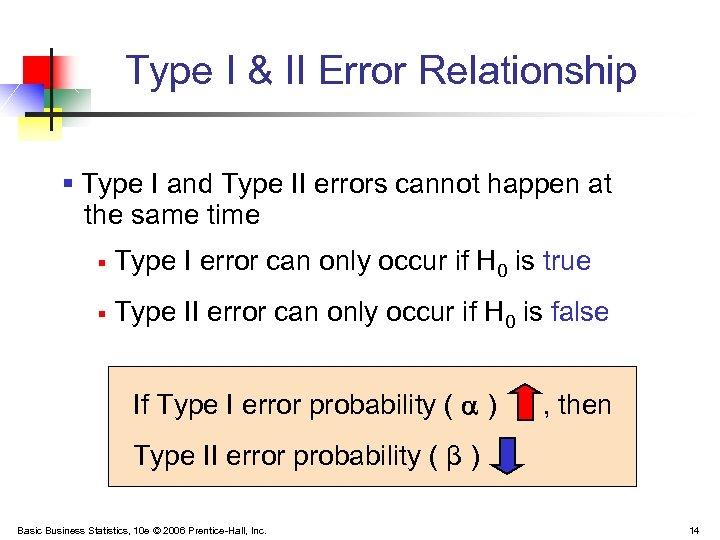
Type I & II Error Relationship § Type I and Type II errors cannot happen at the same time § Type I error can only occur if H 0 is true § Type II error can only occur if H 0 is false If Type I error probability ( ) , then Type II error probability ( β ) Basic Business Statistics, 10 e © 2006 Prentice-Hall, Inc. 14
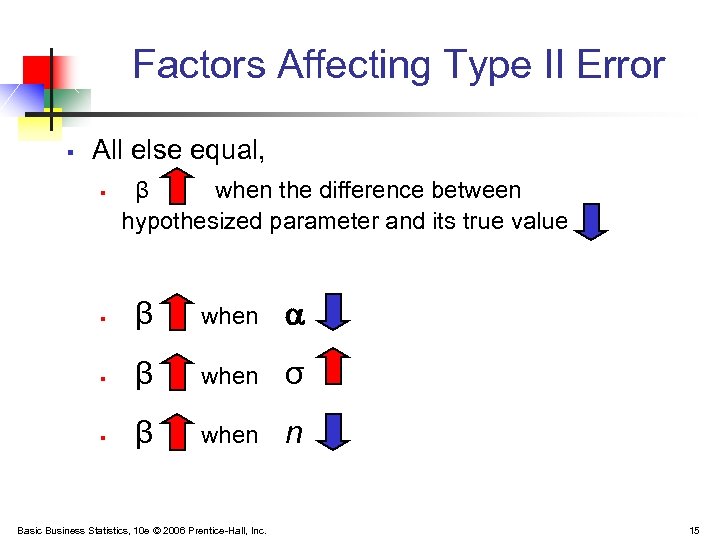
Factors Affecting Type II Error § All else equal, § β when the difference between hypothesized parameter and its true value § β when σ § β when n Basic Business Statistics, 10 e © 2006 Prentice-Hall, Inc. 15
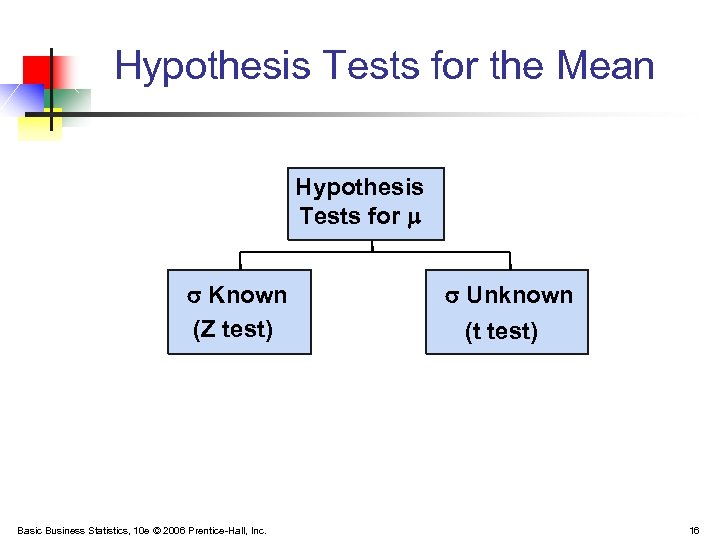
Hypothesis Tests for the Mean Hypothesis Tests for Known (Z test) Basic Business Statistics, 10 e © 2006 Prentice-Hall, Inc. Unknown (t test) 16
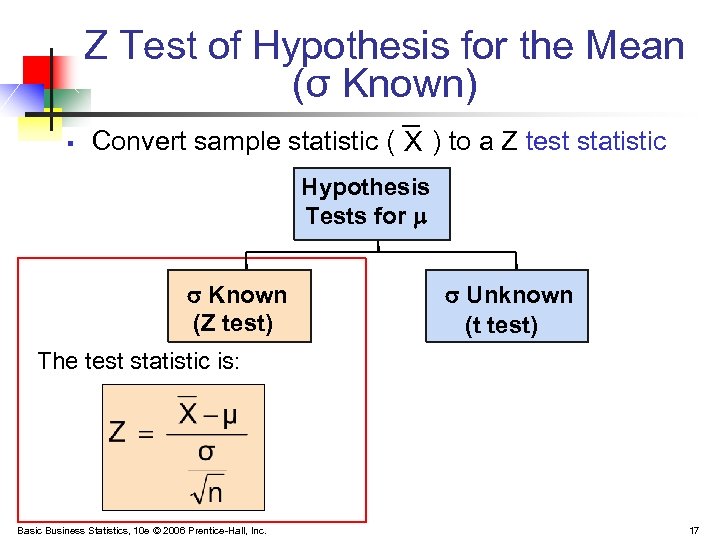
Z Test of Hypothesis for the Mean (σ Known) § Convert sample statistic ( X ) to a Z test statistic Hypothesis Tests for Known σ Known (Z test) Unknown σ Unknown (t test) The test statistic is: Basic Business Statistics, 10 e © 2006 Prentice-Hall, Inc. 17
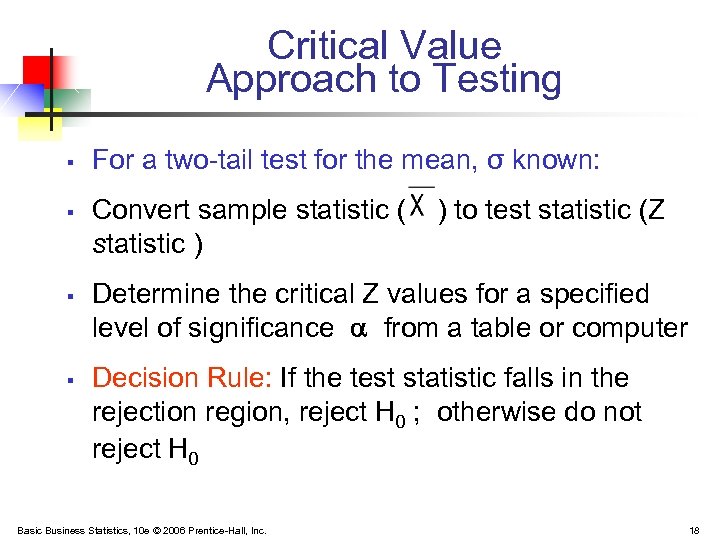
Critical Value Approach to Testing § § For a two-tail test for the mean, σ known: Convert sample statistic ( statistic ) ) to test statistic (Z Determine the critical Z values for a specified level of significance from a table or computer Decision Rule: If the test statistic falls in the rejection region, reject H 0 ; otherwise do not reject H 0 Basic Business Statistics, 10 e © 2006 Prentice-Hall, Inc. 18
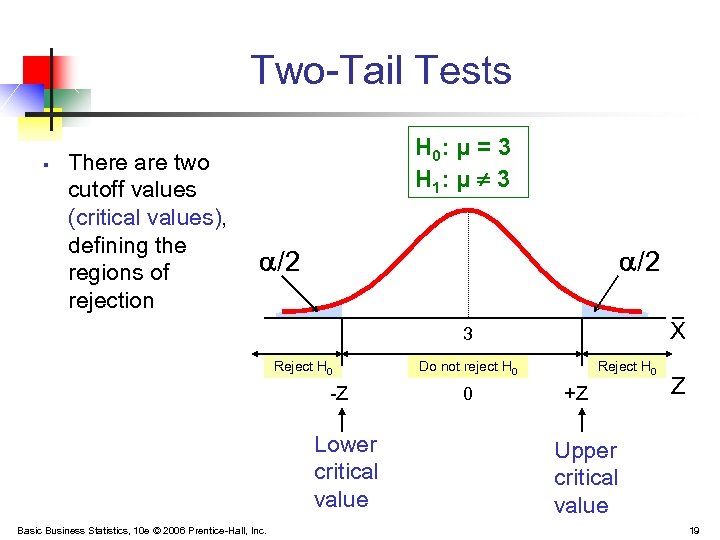
Two-Tail Tests § There are two cutoff values (critical values), defining the regions of rejection H 0: μ = 3 H 1: μ ¹ 3 /2 X 3 Reject H 0 -Z Lower critical value Basic Business Statistics, 10 e © 2006 Prentice-Hall, Inc. Do not reject H 0 0 Reject H 0 +Z Z Upper critical value 19
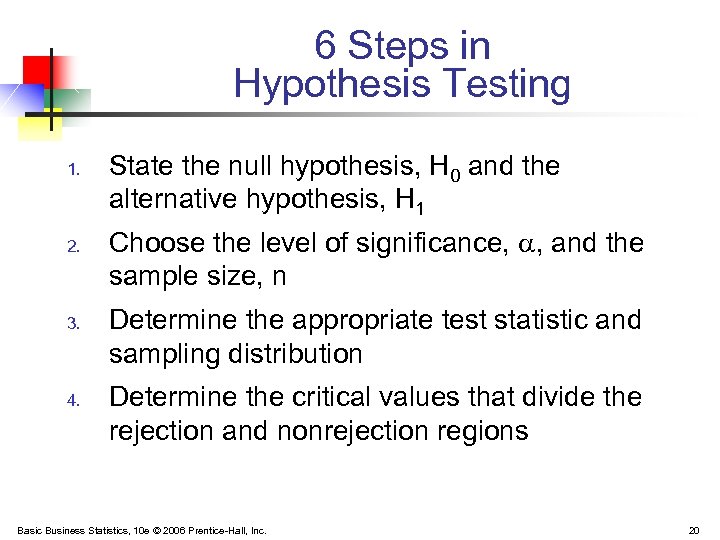
6 Steps in Hypothesis Testing 1. 2. 3. 4. State the null hypothesis, H 0 and the alternative hypothesis, H 1 Choose the level of significance, , and the sample size, n Determine the appropriate test statistic and sampling distribution Determine the critical values that divide the rejection and nonrejection regions Basic Business Statistics, 10 e © 2006 Prentice-Hall, Inc. 20
6 Steps in Hypothesis Testing 5. 6. (continued) Collect data and compute the value of the test statistic Make the statistical decision and state the managerial conclusion. If the test statistic falls into the nonrejection region, do not reject the null hypothesis H 0. If the test statistic falls into the rejection region, reject the null hypothesis. Express the managerial conclusion in the context of the problem Basic Business Statistics, 10 e © 2006 Prentice-Hall, Inc. 21
Hypothesis Testing Example Test the claim that the true mean # of TV sets in US homes is equal to 3. (Assume σ = 0. 8) 1. State the appropriate null and alternative hypotheses § H 0: μ = 3 H 1: μ ≠ 3 (This is a two-tail test) 2. Specify the desired level of significance and the sample size § Suppose that = 0. 05 and n = 100 are chosen for this test Basic Business Statistics, 10 e © 2006 Prentice-Hall, Inc. 22
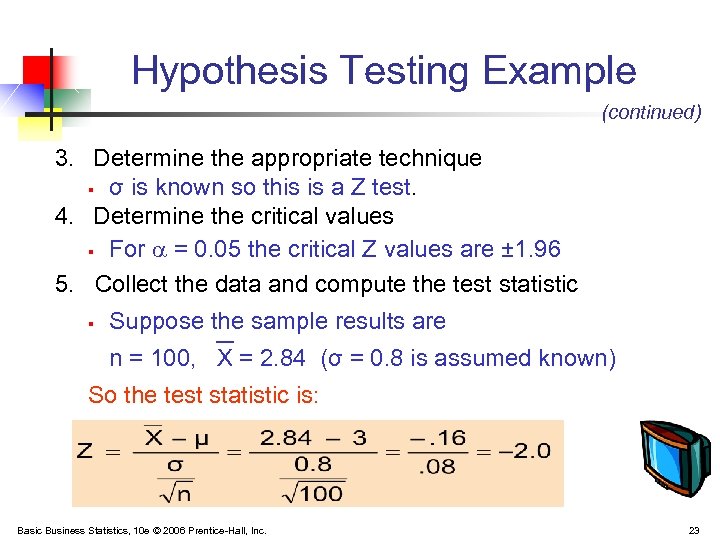
Hypothesis Testing Example (continued) 3. Determine the appropriate technique § σ is known so this is a Z test. 4. Determine the critical values § For = 0. 05 the critical Z values are ± 1. 96 5. Collect the data and compute the test statistic § Suppose the sample results are n = 100, X = 2. 84 (σ = 0. 8 is assumed known) So the test statistic is: Basic Business Statistics, 10 e © 2006 Prentice-Hall, Inc. 23
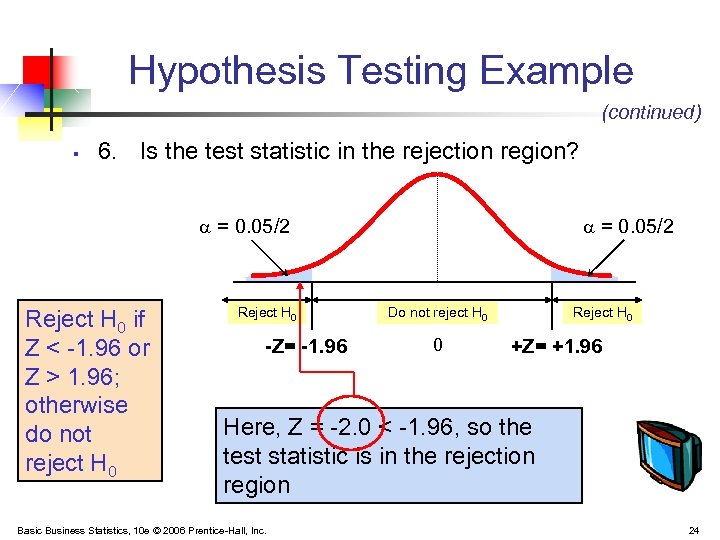
Hypothesis Testing Example (continued) § 6. Is the test statistic in the rejection region? = 0. 05/2 Reject H 0 if Z < -1. 96 or Z > 1. 96; otherwise do not reject H 0 Reject H 0 -Z= -1. 96 = 0. 05/2 Do not reject H 0 0 Reject H 0 +Z= +1. 96 Here, Z = -2. 0 < -1. 96, so the test statistic is in the rejection region Basic Business Statistics, 10 e © 2006 Prentice-Hall, Inc. 24
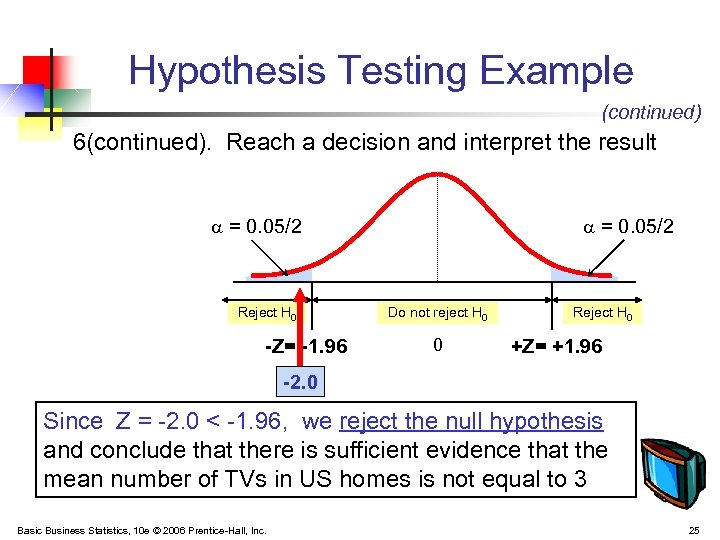
Hypothesis Testing Example (continued) 6(continued). Reach a decision and interpret the result = 0. 05/2 Reject H 0 -Z= -1. 96 = 0. 05/2 Do not reject H 0 0 Reject H 0 +Z= +1. 96 -2. 0 Since Z = -2. 0 < -1. 96, we reject the null hypothesis and conclude that there is sufficient evidence that the mean number of TVs in US homes is not equal to 3 Basic Business Statistics, 10 e © 2006 Prentice-Hall, Inc. 25
p-Value Approach to Testing § p-value: Probability of obtaining a test statistic more extreme ( ≤ or ) than the observed sample value given H 0 is true § § Also called observed level of significance Smallest value of for which H 0 can be rejected Basic Business Statistics, 10 e © 2006 Prentice-Hall, Inc. 26
p-Value Approach to Testing (continued) § Convert Sample Statistic (e. g. , X ) to Test Statistic (e. g. , Z statistic ) § Obtain the p-value from a table or computer § Compare the p-value with § If p-value < , reject H 0 § If p-value , do not reject H 0 Basic Business Statistics, 10 e © 2006 Prentice-Hall, Inc. 27
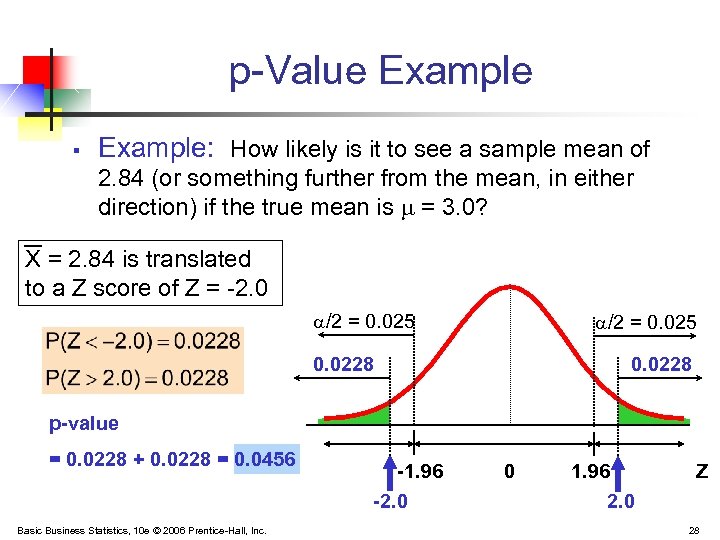
p-Value Example § Example: How likely is it to see a sample mean of 2. 84 (or something further from the mean, in either direction) if the true mean is = 3. 0? X = 2. 84 is translated to a Z score of Z = -2. 0 /2 = 0. 025 0. 0228 p-value = 0. 0228 + 0. 0228 = 0. 0456 Basic Business Statistics, 10 e © 2006 Prentice-Hall, Inc. -1. 96 -2. 0 0 1. 96 2. 0 Z 28
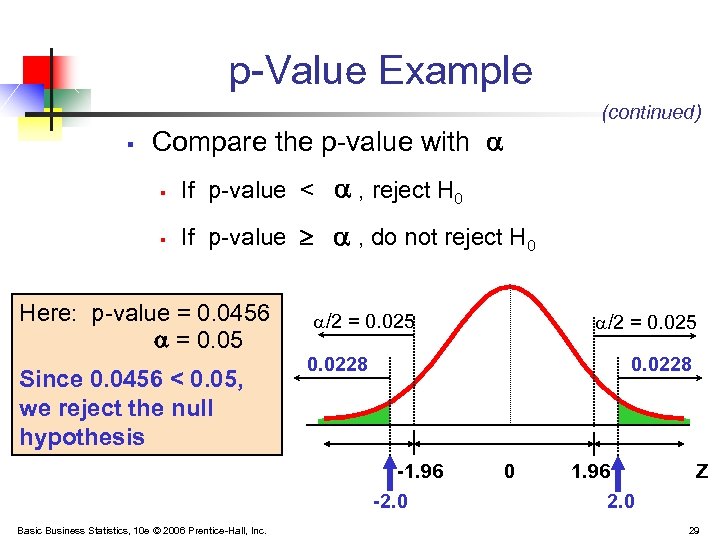
p-Value Example § (continued) Compare the p-value with § If p-value < , reject H 0 § If p-value , do not reject H 0 Here: p-value = 0. 0456 = 0. 05 Since 0. 0456 < 0. 05, we reject the null hypothesis /2 = 0. 025 0. 0228 -1. 96 -2. 0 Basic Business Statistics, 10 e © 2006 Prentice-Hall, Inc. /2 = 0. 025 0 1. 96 2. 0 Z 29
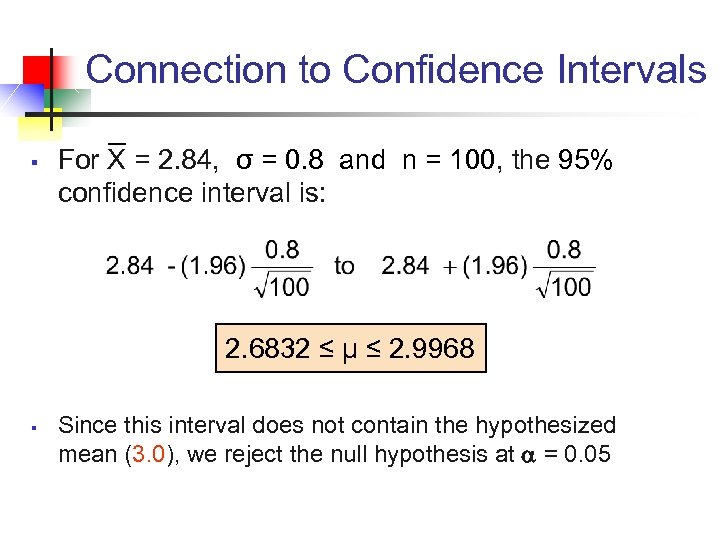
Connection to Confidence Intervals § For X = 2. 84, σ = 0. 8 and n = 100, the 95% confidence interval is: 2. 6832 ≤ μ ≤ 2. 9968 § Since this interval does not contain the hypothesized mean (3. 0), we reject the null hypothesis at = 0. 05
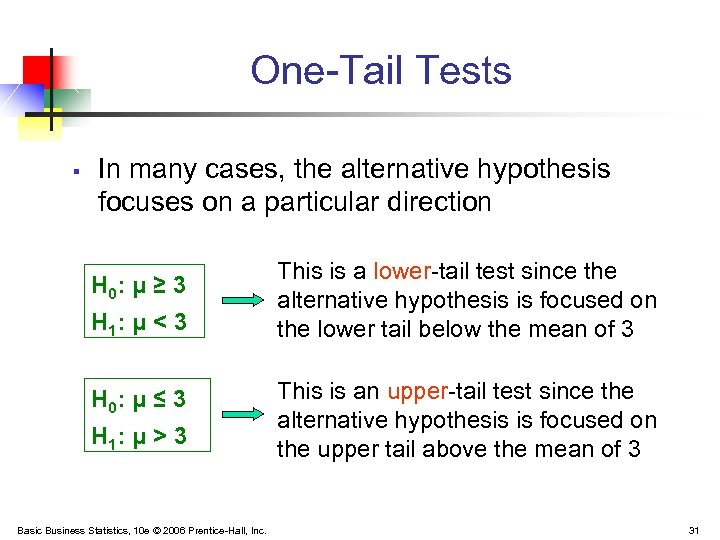
One-Tail Tests § In many cases, the alternative hypothesis focuses on a particular direction H 0: μ ≥ 3 H 1: μ < 3 H 0: μ ≤ 3 H 1: μ > 3 Basic Business Statistics, 10 e © 2006 Prentice-Hall, Inc. This is a lower-tail test since the alternative hypothesis is focused on the lower tail below the mean of 3 This is an upper-tail test since the alternative hypothesis is focused on the upper tail above the mean of 3 31
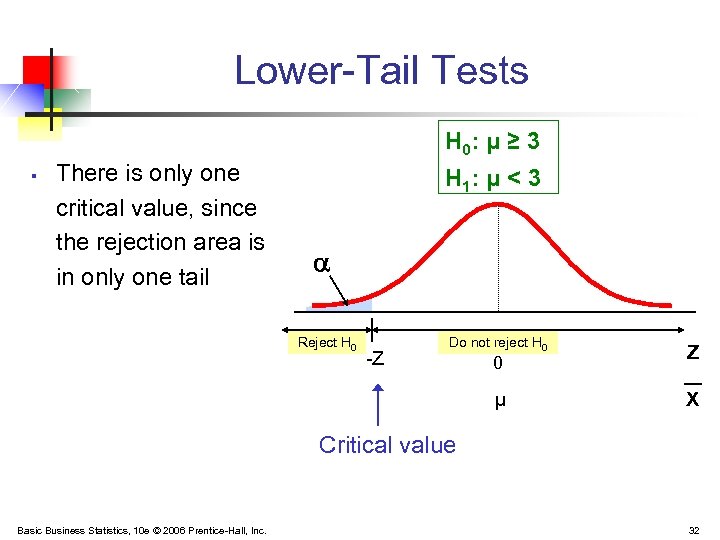
Lower-Tail Tests H 0: μ ≥ 3 § There is only one critical value, since the rejection area is in only one tail H 1: μ < 3 Reject H 0 -Z Do not reject H 0 0 μ Z X Critical value Basic Business Statistics, 10 e © 2006 Prentice-Hall, Inc. 32
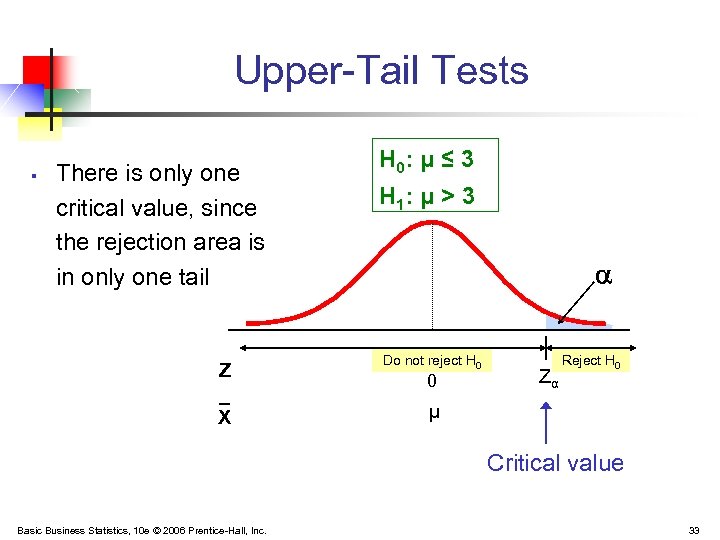
Upper-Tail Tests § There is only one critical value, since the rejection area is in only one tail Z _ X H 0: μ ≤ 3 H 1: μ > 3 Do not reject H 0 0 Zα Reject H 0 μ Critical value Basic Business Statistics, 10 e © 2006 Prentice-Hall, Inc. 33
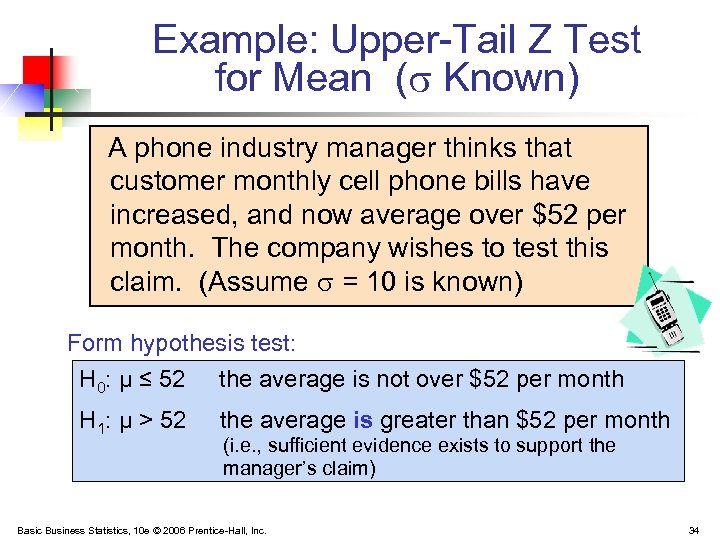
Example: Upper-Tail Z Test for Mean ( Known) A phone industry manager thinks that customer monthly cell phone bills have increased, and now average over $52 per month. The company wishes to test this claim. (Assume = 10 is known) Form hypothesis test: H 0: μ ≤ 52 the average is not over $52 per month H 1: μ > 52 the average is greater than $52 per month (i. e. , sufficient evidence exists to support the manager’s claim) Basic Business Statistics, 10 e © 2006 Prentice-Hall, Inc. 34
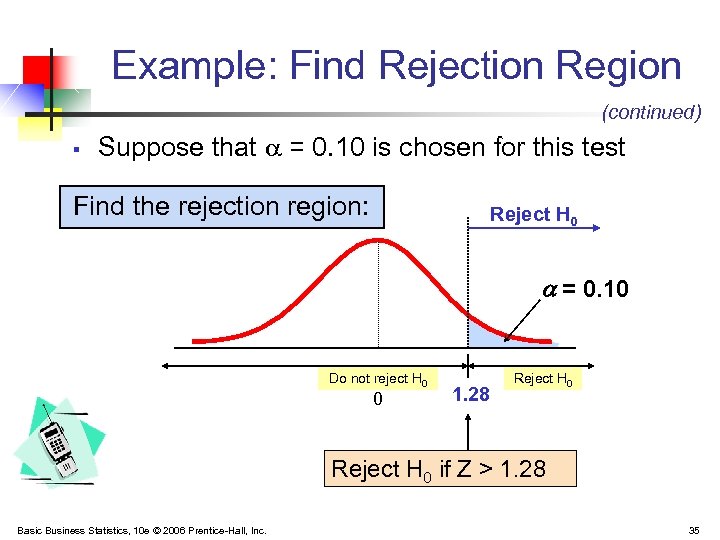
Example: Find Rejection Region (continued) § Suppose that = 0. 10 is chosen for this test Find the rejection region: Reject H 0 = 0. 10 Do not reject H 0 0 1. 28 Reject H 0 if Z > 1. 28 Basic Business Statistics, 10 e © 2006 Prentice-Hall, Inc. 35
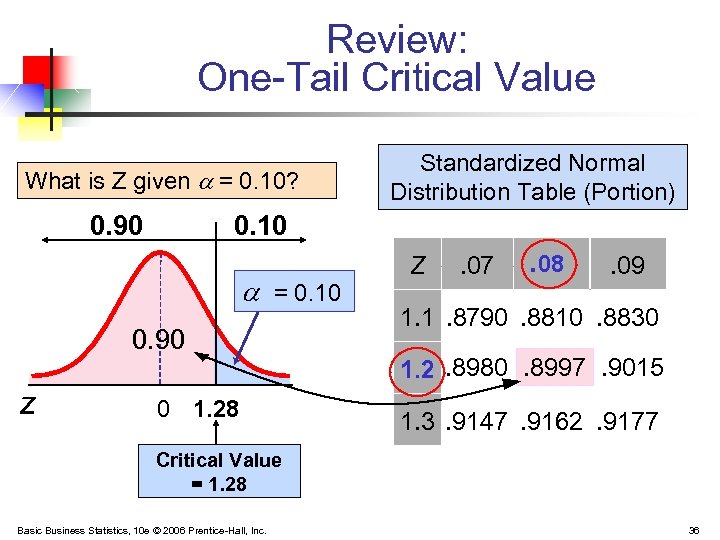
Review: One-Tail Critical Value What is Z given a = 0. 10? 0. 90 0. 10 a = 0. 10 0. 90 z Standardized Normal Distribution Table (Portion) 0 1. 28 Z . 07 . 08 . 09 1. 1. 8790. 8810. 8830 1. 2. 8980. 8997. 9015 1. 3. 9147. 9162. 9177 Critical Value = 1. 28 Basic Business Statistics, 10 e © 2006 Prentice-Hall, Inc. 36
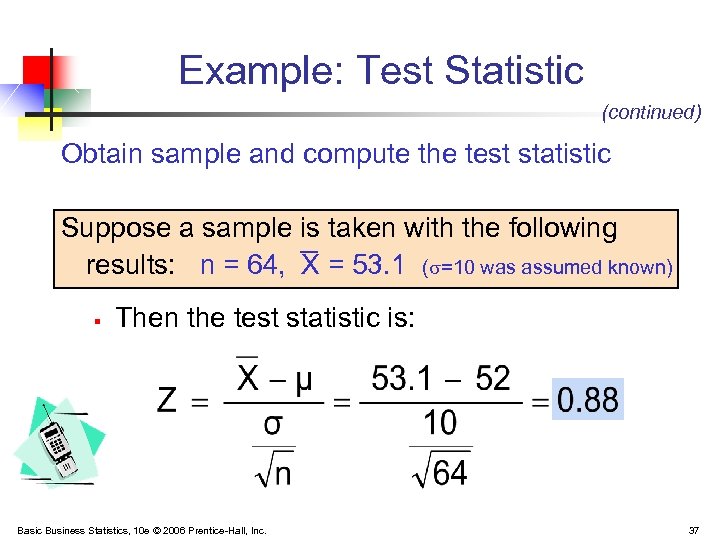
Example: Test Statistic (continued) Obtain sample and compute the test statistic Suppose a sample is taken with the following results: n = 64, X = 53. 1 ( =10 was assumed known) § Then the test statistic is: Basic Business Statistics, 10 e © 2006 Prentice-Hall, Inc. 37
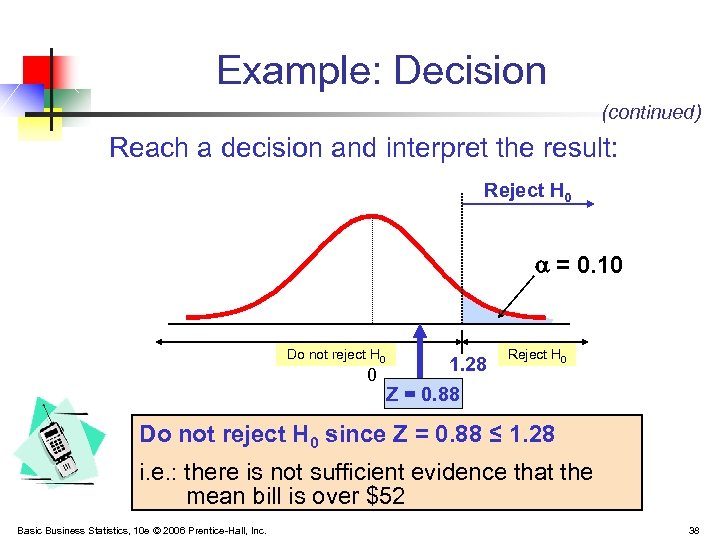
Example: Decision (continued) Reach a decision and interpret the result: Reject H 0 = 0. 10 Do not reject H 0 1. 28 0 Z = 0. 88 Reject H 0 Do not reject H 0 since Z = 0. 88 ≤ 1. 28 i. e. : there is not sufficient evidence that the mean bill is over $52 Basic Business Statistics, 10 e © 2006 Prentice-Hall, Inc. 38
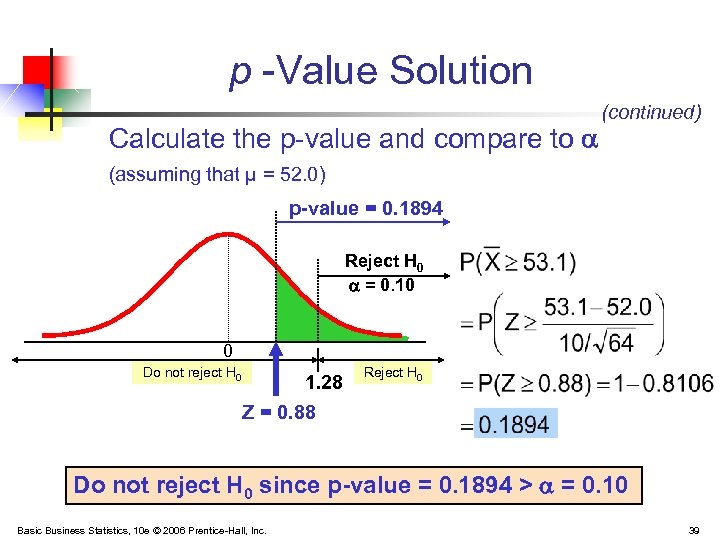
p -Value Solution Calculate the p-value and compare to (continued) (assuming that μ = 52. 0) p-value = 0. 1894 Reject H 0 = 0. 10 0 Do not reject H 0 1. 28 Z = 0. 88 Reject H 0 Do not reject H 0 since p-value = 0. 1894 > = 0. 10 Basic Business Statistics, 10 e © 2006 Prentice-Hall, Inc. 39
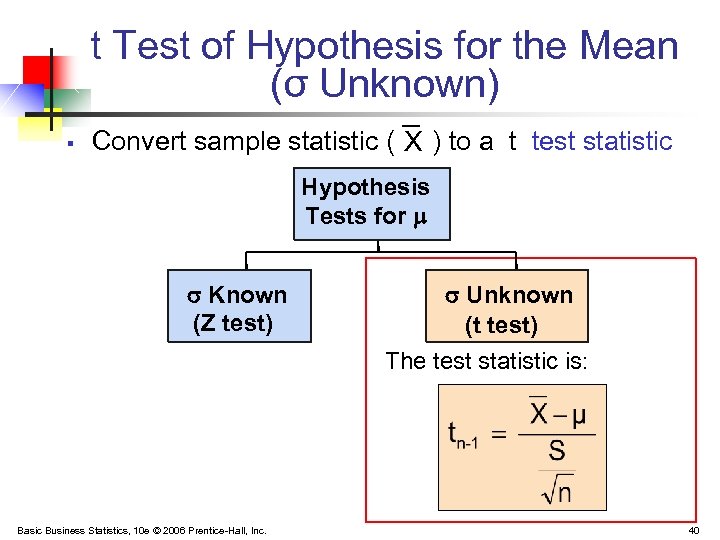
t Test of Hypothesis for the Mean (σ Unknown) § Convert sample statistic ( X ) to a t test statistic Hypothesis Tests for Known σ Known (Z test) Basic Business Statistics, 10 e © 2006 Prentice-Hall, Inc. Unknown σ Unknown (t test) The test statistic is: 40
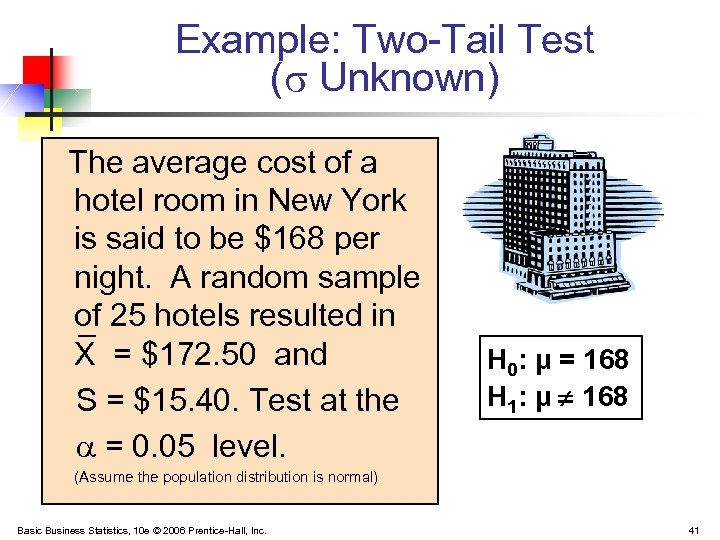
Example: Two-Tail Test ( Unknown) The average cost of a hotel room in New York is said to be $168 per night. A random sample of 25 hotels resulted in X = $172. 50 and S = $15. 40. Test at the = 0. 05 level. H 0: μ = 168 H 1: μ ¹ 168 (Assume the population distribution is normal) Basic Business Statistics, 10 e © 2006 Prentice-Hall, Inc. 41
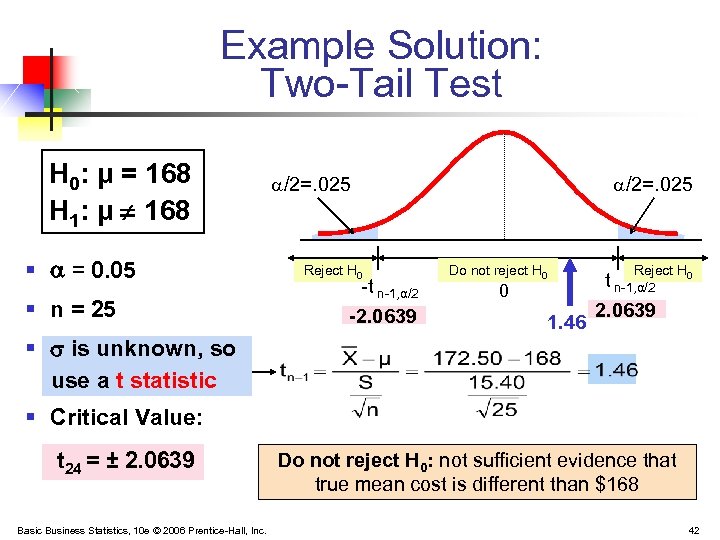
Example Solution: Two-Tail Test H 0: μ = 168 H 1: μ ¹ 168 § = 0. 05 § n = 25 § is unknown, so use a t statistic /2=. 025 Reject H 0 -t n-1, α/2 -2. 0639 /2=. 025 Do not reject H 0 0 1. 46 Reject H 0 t n-1, α/2 2. 0639 § Critical Value: t 24 = ± 2. 0639 Basic Business Statistics, 10 e © 2006 Prentice-Hall, Inc. Do not reject H 0: not sufficient evidence that true mean cost is different than $168 42
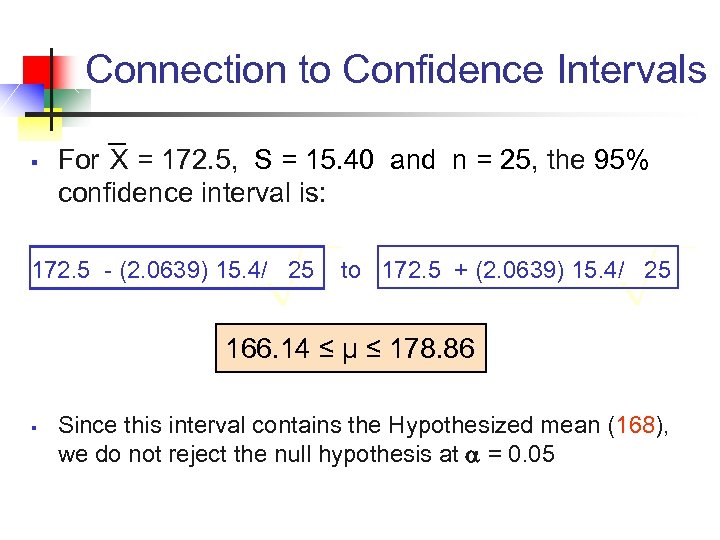
Connection to Confidence Intervals § For X = 172. 5, S = 15. 40 and n = 25, the 95% confidence interval is: 172. 5 - (2. 0639) 15. 4/ 25 to 172. 5 + (2. 0639) 15. 4/ 25 166. 14 ≤ μ ≤ 178. 86 § Since this interval contains the Hypothesized mean (168), we do not reject the null hypothesis at = 0. 05
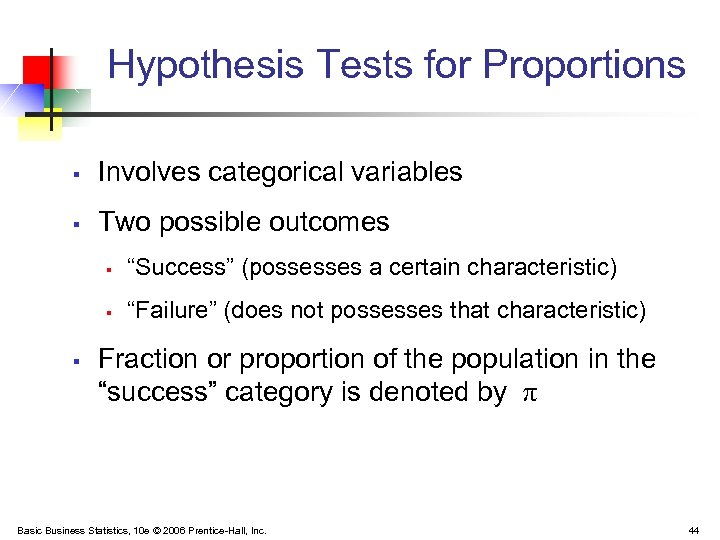
Hypothesis Tests for Proportions § Involves categorical variables § Two possible outcomes § § § “Success” (possesses a certain characteristic) “Failure” (does not possesses that characteristic) Fraction or proportion of the population in the “success” category is denoted by π Basic Business Statistics, 10 e © 2006 Prentice-Hall, Inc. 44
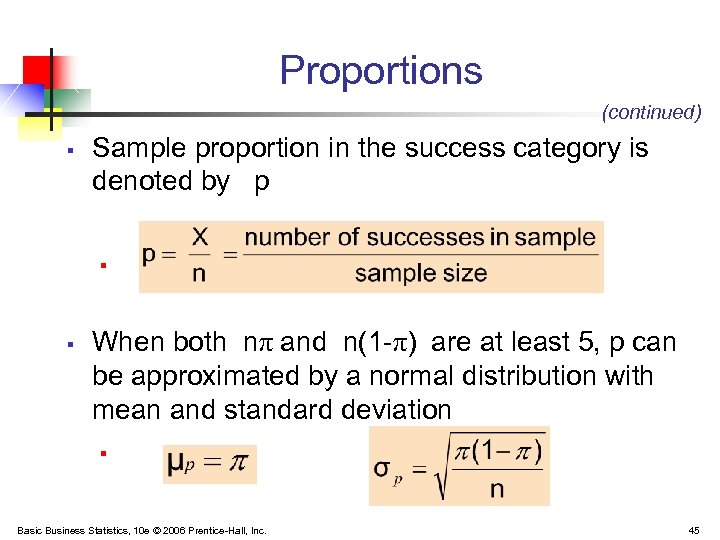
Proportions (continued) § Sample proportion in the success category is denoted by p § § When both nπ and n(1 -π) are at least 5, p can be approximated by a normal distribution with mean and standard deviation § Basic Business Statistics, 10 e © 2006 Prentice-Hall, Inc. 45
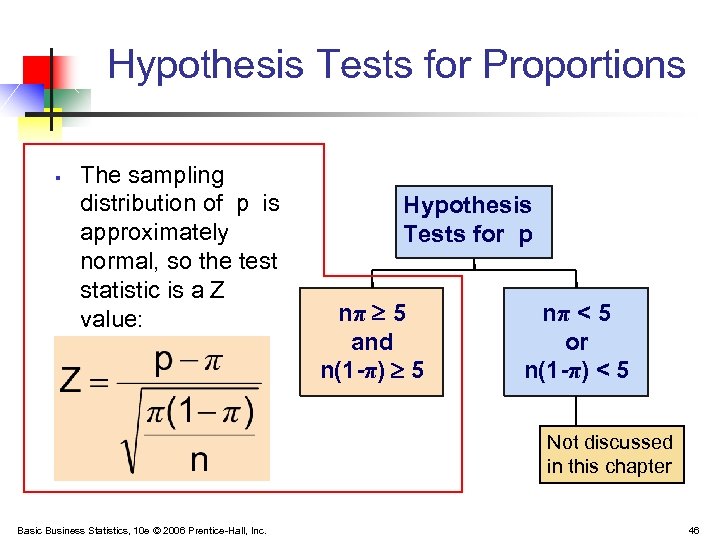
Hypothesis Tests for Proportions § The sampling distribution of p is approximately normal, so the test statistic is a Z value: Hypothesis Tests for p nπ 5 and n(1 -π) 5 nπ < 5 or n(1 -π) < 5 Not discussed in this chapter Basic Business Statistics, 10 e © 2006 Prentice-Hall, Inc. 46
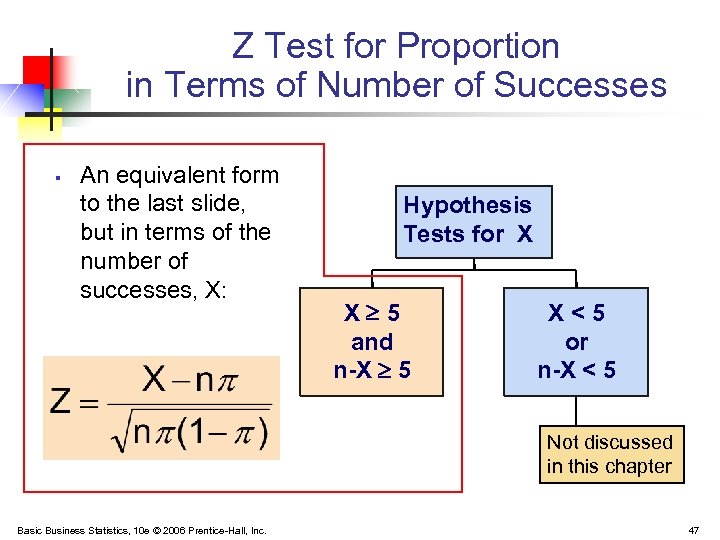
Z Test for Proportion in Terms of Number of Successes § An equivalent form to the last slide, but in terms of the number of successes, X: Hypothesis Tests for X X 5 and n-X 5 X<5 or n-X < 5 Not discussed in this chapter Basic Business Statistics, 10 e © 2006 Prentice-Hall, Inc. 47
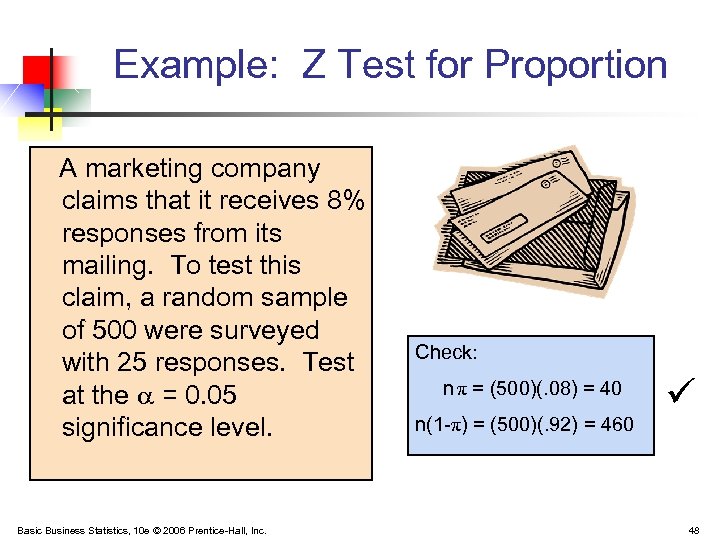
Example: Z Test for Proportion A marketing company claims that it receives 8% responses from its mailing. To test this claim, a random sample of 500 were surveyed with 25 responses. Test at the = 0. 05 significance level. Basic Business Statistics, 10 e © 2006 Prentice-Hall, Inc. Check: n π = (500)(. 08) = 40 n(1 -π) = (500)(. 92) = 460 48
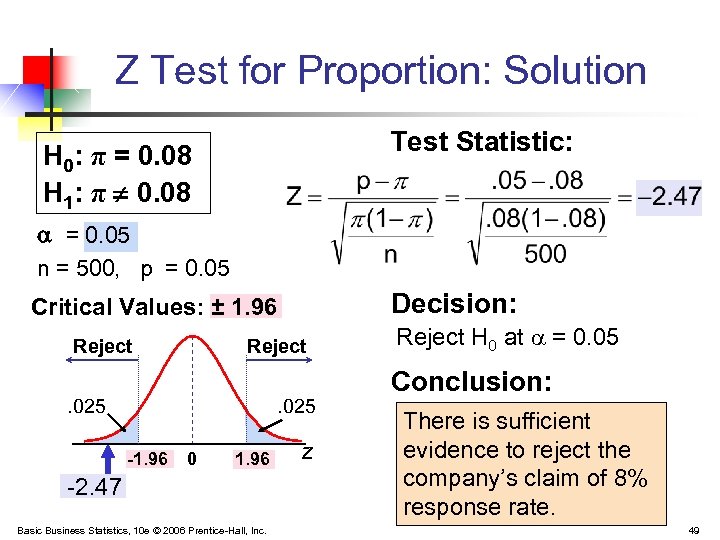
Z Test for Proportion: Solution Test Statistic: H 0: π = 0. 08 H 1: π ¹ 0. 08 = 0. 05 n = 500, p = 0. 05 Decision: Critical Values: ± 1. 96 Reject . 025 -1. 96 0 1. 96 -2. 47 Basic Business Statistics, 10 e © 2006 Prentice-Hall, Inc. z Reject H 0 at = 0. 05 Conclusion: There is sufficient evidence to reject the company’s claim of 8% response rate. 49
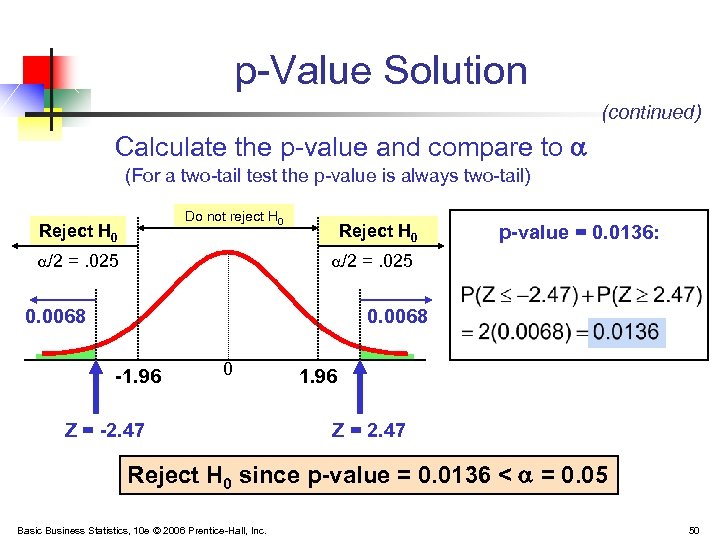
p-Value Solution (continued) Calculate the p-value and compare to (For a two-tail test the p-value is always two-tail) Do not reject H 0 Reject H 0 /2 =. 025 Reject H 0 p-value = 0. 0136: /2 =. 025 0. 0068 -1. 96 0 Z = -2. 47 1. 96 Z = 2. 47 Reject H 0 since p-value = 0. 0136 < = 0. 05 Basic Business Statistics, 10 e © 2006 Prentice-Hall, Inc. 50
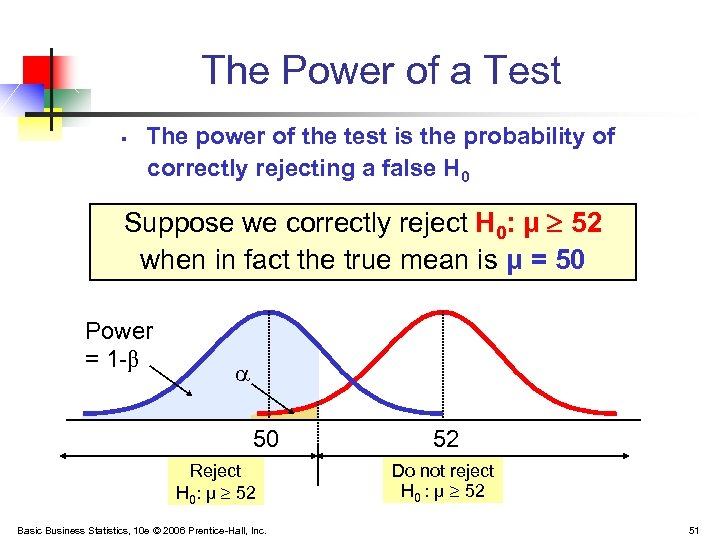
The Power of a Test § The power of the test is the probability of correctly rejecting a false H 0 Suppose we correctly reject H 0: μ 52 when in fact the true mean is μ = 50 Power = 1 -β 50 Reject H 0: μ 52 Basic Business Statistics, 10 e © 2006 Prentice-Hall, Inc. 52 Do not reject H 0 : μ 52 51
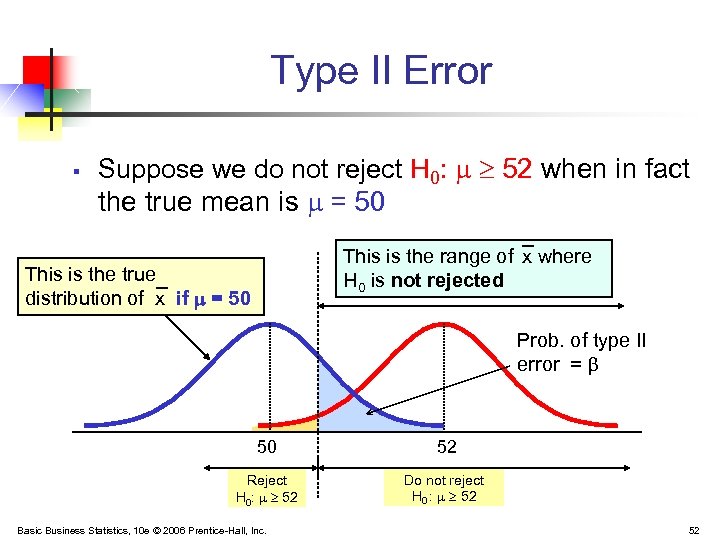
Type II Error § Suppose we do not reject H 0: 52 when in fact the true mean is = 50 This is the range of x where H 0 is not rejected This is the true distribution of x if = 50 Prob. of type II error = β 50 52 Reject H 0: 52 Do not reject H 0 : 52 Basic Business Statistics, 10 e © 2006 Prentice-Hall, Inc. 52
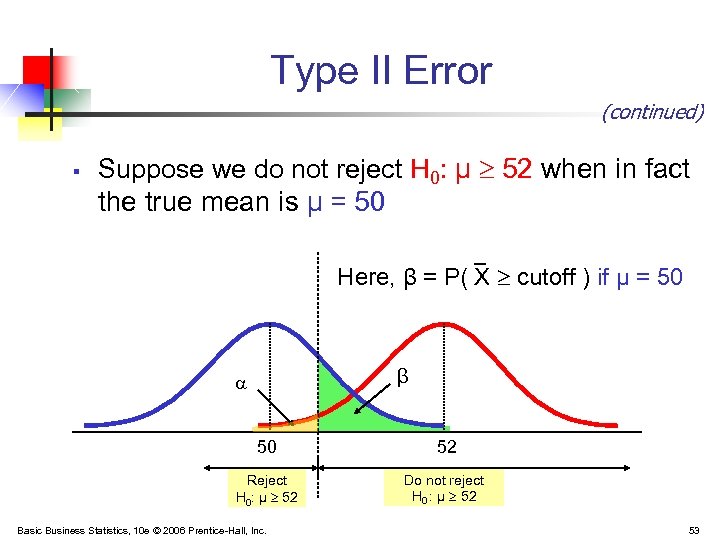
Type II Error (continued) § Suppose we do not reject H 0: μ 52 when in fact the true mean is μ = 50 Here, β = P( X cutoff ) if μ = 50 β 50 52 Reject H 0: μ 52 Do not reject H 0 : μ 52 Basic Business Statistics, 10 e © 2006 Prentice-Hall, Inc. 53
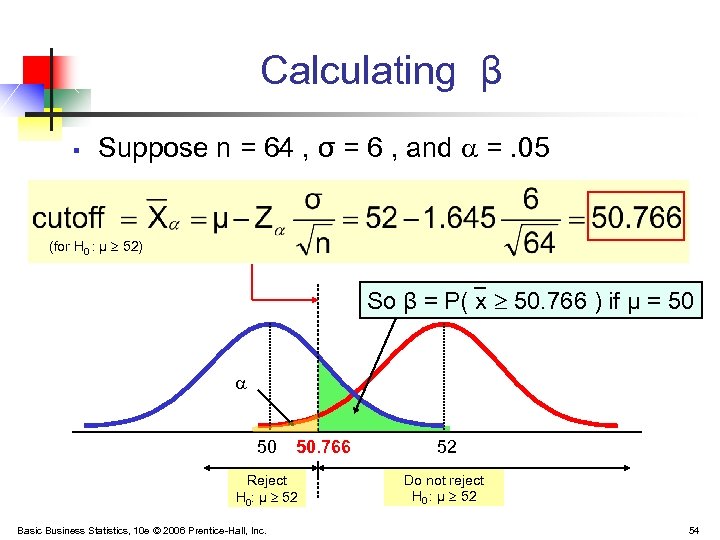
Calculating β § Suppose n = 64 , σ = 6 , and =. 05 (for H 0 : μ 52) So β = P( x 50. 766 ) if μ = 50 50. 766 Reject H 0: μ 52 Basic Business Statistics, 10 e © 2006 Prentice-Hall, Inc. 52 Do not reject H 0 : μ 52 54
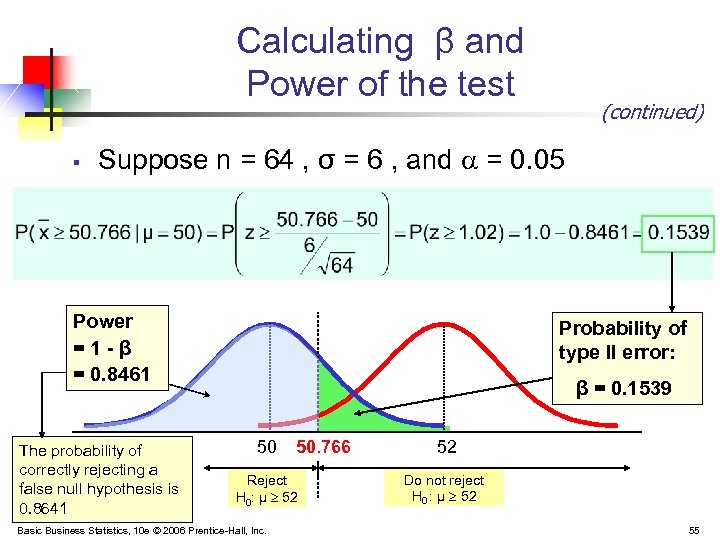
Calculating β and Power of the test § (continued) Suppose n = 64 , σ = 6 , and = 0. 05 Power =1 -β = 0. 8461 The probability of correctly rejecting a false null hypothesis is 0. 8641 Probability of type II error: β = 0. 1539 50 50. 766 Reject H 0: μ 52 Basic Business Statistics, 10 e © 2006 Prentice-Hall, Inc. 52 Do not reject H 0 : μ 52 55
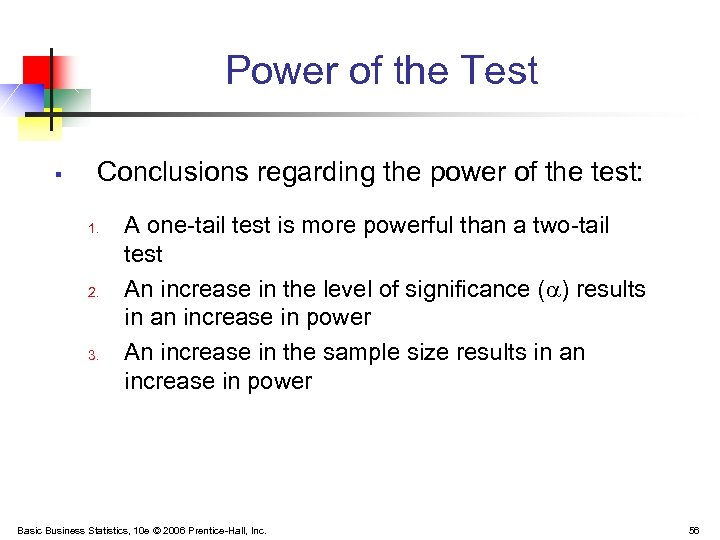
Power of the Test § Conclusions regarding the power of the test: 1. 2. 3. A one-tail test is more powerful than a two-tail test An increase in the level of significance ( ) results in an increase in power An increase in the sample size results in an increase in power Basic Business Statistics, 10 e © 2006 Prentice-Hall, Inc. 56
Potential Pitfalls and Ethical Considerations § § § Use randomly collected data to reduce selection biases Do not use human subjects without informed consent Choose the level of significance, α, and the type of test (one-tail or two-tail) before data collection Do not employ “data snooping” to choose between onetail and two-tail test, or to determine the level of significance Do not practice “data cleansing” to hide observations that do not support a stated hypothesis Report all pertinent findings Basic Business Statistics, 10 e © 2006 Prentice-Hall, Inc. 57
Chapter Summary § Addressed hypothesis testing methodology § Performed Z Test for the mean (σ known) § § Discussed critical value and p–value approaches to hypothesis testing Performed one-tail and two-tail tests Basic Business Statistics, 10 e © 2006 Prentice-Hall, Inc. 58
Chapter Summary (continued) § § Performed t test for the mean (σ unknown) Performed Z test for the proportion Calculated the probability of a Type II error and the power of the test Discussed pitfalls and ethical issues Basic Business Statistics, 10 e © 2006 Prentice-Hall, Inc. 59
Скачать презентацию Basic Business Statistics 10 th Edition Chapter 9
7faf3fe5170a63490bda37e499b6a221.ppt