 Скачать презентацию Baseload measures quantify address manage Presenter Todd Hoener
3030b56c4ee2d4bbac2b1a1f93bbf03d.ppt
- Количество слайдов: 82



Baseload measures quantify, address, manage Presenter Todd Hoener, LEED accredited professional End-use energy specialist Renewable energy program administrator Certified home energy rater & Light commercial energy auditor Golden Valley Electric Association Fairbanks, Alaska 907 451 5607 w tmhoener@gmail. com 3/15/2018 2010 Energy Out. West Reno, Nevada
E 101: k. Wh = kilowatt-hour • • • 3/15/2018 Basic electric power unit = watt One kilowatt (k. W)= 1, 000 watts Meter records consumption period in kilowatts used = kilowatt-hours (k. Wh) (k. W) X (time, in hours) = k. Wh People use & purchase k. Whs (k. Wh X $/k. Wh = $$$ owed electric utility) 2010 Energy Out. West Reno, Nevada
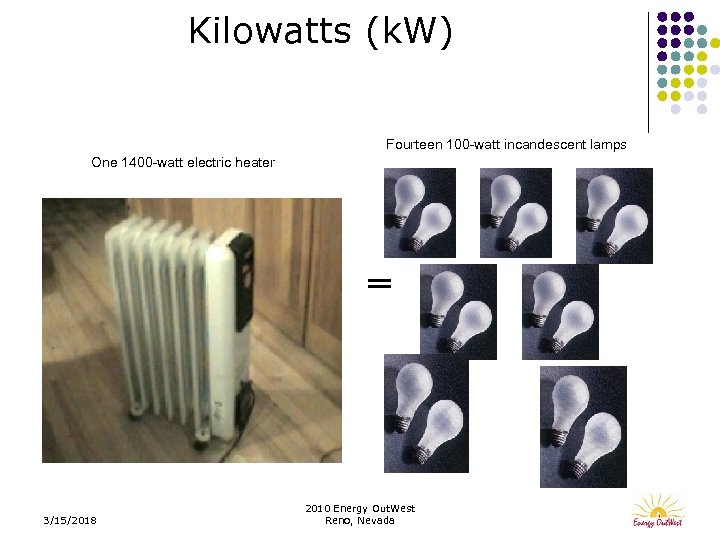
Kilowatts (k. W) Fourteen 100 -watt incandescent lamps One 1400 -watt electric heater = 3/15/2018 2010 Energy Out. West Reno, Nevada
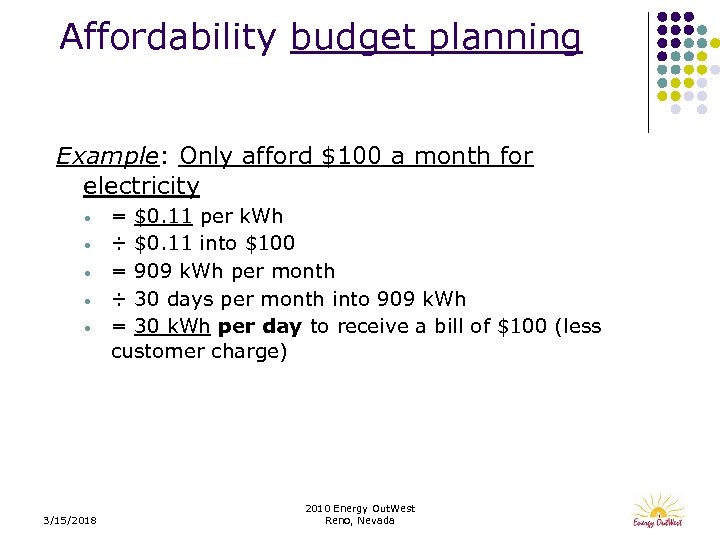
Kilowatt-hour (k. Wh) costs Example – An appliance name plate states “ 1, 400 watts” (e. g. electric space heater): • 1, 400 watts ÷ 1, 000 watts (1 k. W) = 1. 4 k. W • (1. 4 k. W) X 2 hours per morning = 2. 8 k. W-hours • 2. 8 k. Wh X $0. 11 (price of electricity per k. Wh) • = $0. 308 (i. e. , to heat space for 2 hours) • X 30 mornings per month = $9. 24 per month • X 6 months per heating season = $55. 44 3/15/2018 2010 Energy Out. West Reno, Nevada
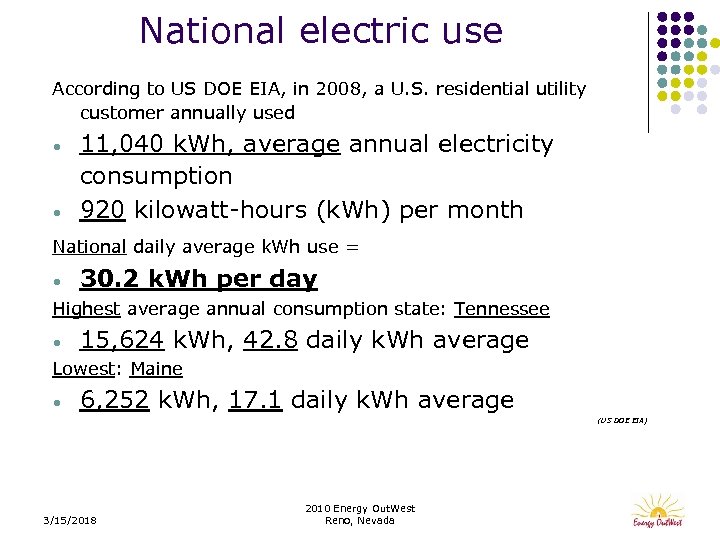
National electric use According to US DOE EIA, in 2008, a U. S. residential utility customer annually used • • 11, 040 k. Wh, average annual electricity consumption 920 kilowatt-hours (k. Wh) per month National daily average k. Wh use = • 30. 2 k. Wh per day Highest average annual consumption state: Tennessee • 15, 624 k. Wh, 42. 8 daily k. Wh average Lowest: Maine • 6, 252 k. Wh, 17. 1 daily k. Wh average (US DOE EIA) 3/15/2018 2010 Energy Out. West Reno, Nevada
What is “Baseload”? Baseload end use electricity • Measured in kilowatt-hours (k. Wh) • Generally, it represents all energy used to operate house, minus seasonal heating & cooling (peak use) 3/15/2018 2010 Energy Out. West Reno, Nevada
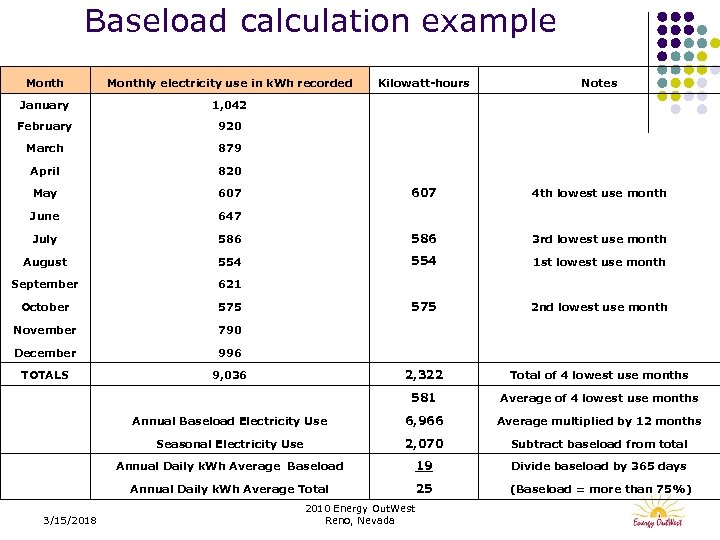
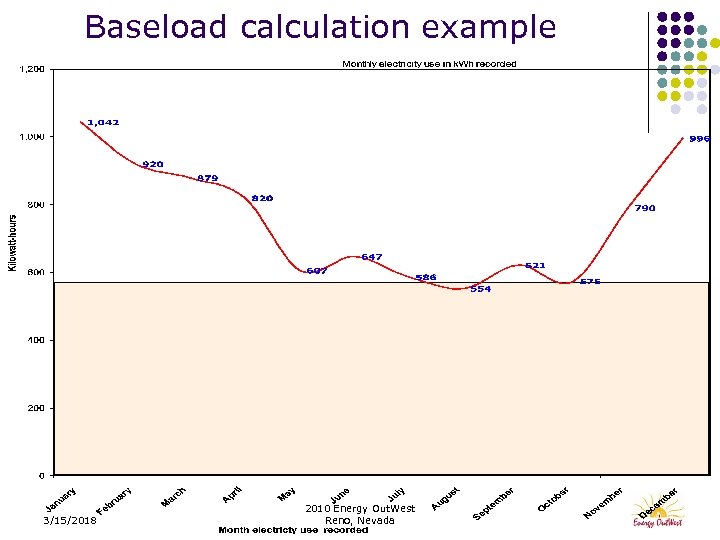
Determining baseload use Separate total annual residential electricity consumption into baseload & seasonal: • Review last 12 monthly electric use (k. Wh). • Add 3 or 4 lowest monthly electric use (k. Wh) (obtained from billing statements). • Average monthly electricity usage from these lowest use months (k. Wh). • Multiply calculated monthly baseload average (k. Wh) by 12 = estimate annual baseload electric use (k. Wh). 3/15/2018 2010 Energy Out. West Reno, Nevada
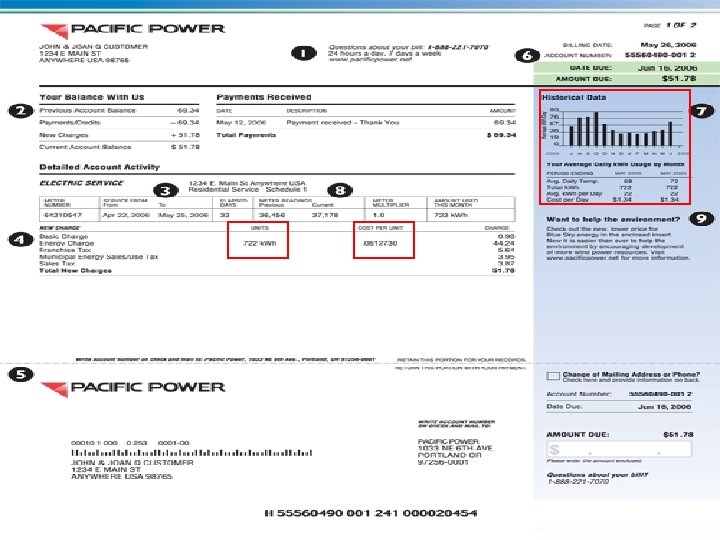
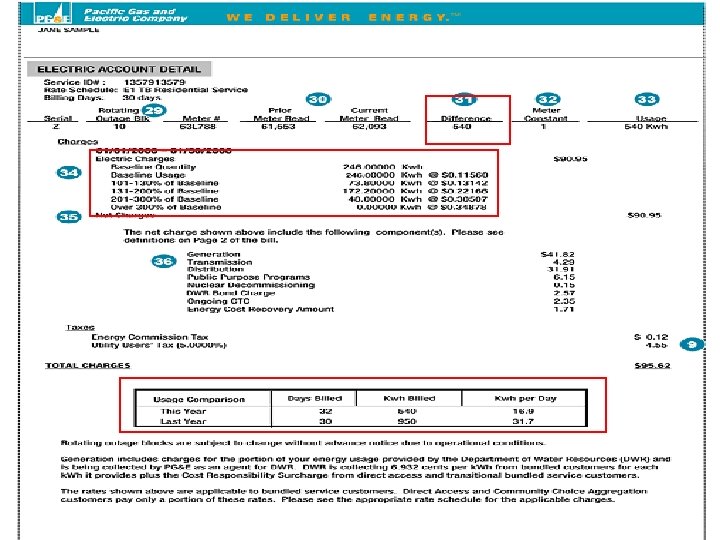
Usage statement, or “the bill” l Examine monthly statements l Utility-to-utility, statements differ l Rates may differ, but k. Whs are fairly logical l Usage statements offer information, trends l Statements are personal & confidential; request permission to obtain 3/15/2018 20080605 EOW Utility Bill Analysis 2010 Energy Out. West Todd Hoener, energy end-use specialist Reno, Nevada 8
3/15/2018 2010 Energy Out. West Reno, Nevada
3/15/2018 2010 Energy Out. West Reno, Nevada
Baseload calculation example Monthly electricity use in k. Wh recorded Kilowatt-hours Notes January 1, 042 February 920 March 879 April 820 May 607 4 th lowest use month June 647 July 586 3 rd lowest use month August 554 1 st lowest use month September 621 October 575 2 nd lowest use month November 790 December 996 TOTALS 9, 036 2, 322 Total of 4 lowest use months 581 Average of 4 lowest use months Annual Baseload Electricity Use 6, 966 Average multiplied by 12 months Seasonal Electricity Use 2, 070 Subtract baseload from total Annual Daily k. Wh Average Baseload 19 Divide baseload by 365 days Annual Daily k. Wh Average Total 25 (Baseload = more than 75%) 3/15/2018 2010 Energy Out. West Reno, Nevada
Baseload calculation example 3/15/2018 2010 Energy Out. West Reno, Nevada
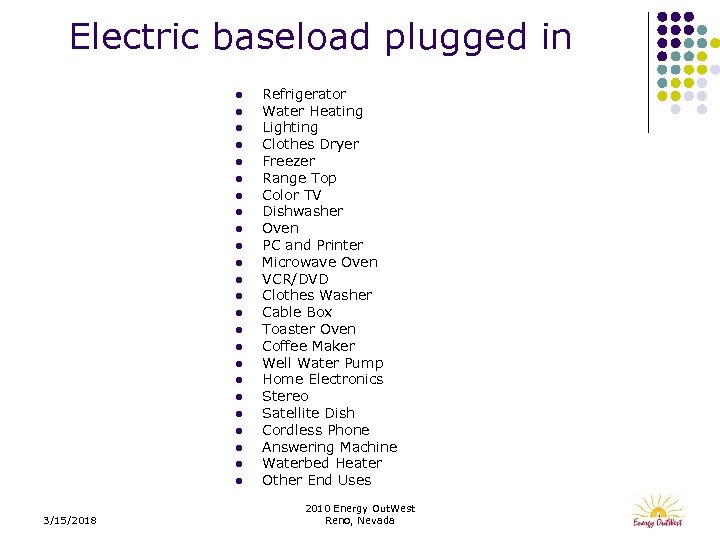
Electric baseload plugged in l l l l l l 3/15/2018 Refrigerator Water Heating Lighting Clothes Dryer Freezer Range Top Color TV Dishwasher Oven PC and Printer Microwave Oven VCR/DVD Clothes Washer Cable Box Toaster Oven Coffee Maker Well Water Pump Home Electronics Stereo Satellite Dish Cordless Phone Answering Machine Waterbed Heater Other End Uses 2010 Energy Out. West Reno, Nevada
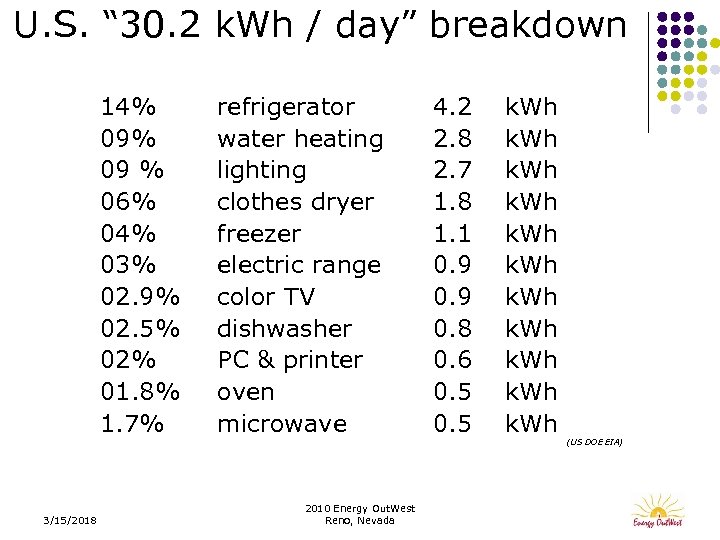
U. S. “ 30. 2 k. Wh / day” breakdown 14% 09 % 06% 04% 03% 02. 9% 02. 5% 02% 01. 8% 1. 7% refrigerator water heating lighting clothes dryer freezer electric range color TV dishwasher PC & printer oven microwave 4. 2 2. 8 2. 7 1. 8 1. 1 0. 9 0. 8 0. 6 0. 5 k. Wh k. Wh (US DOE EIA) 3/15/2018 2010 Energy Out. West Reno, Nevada
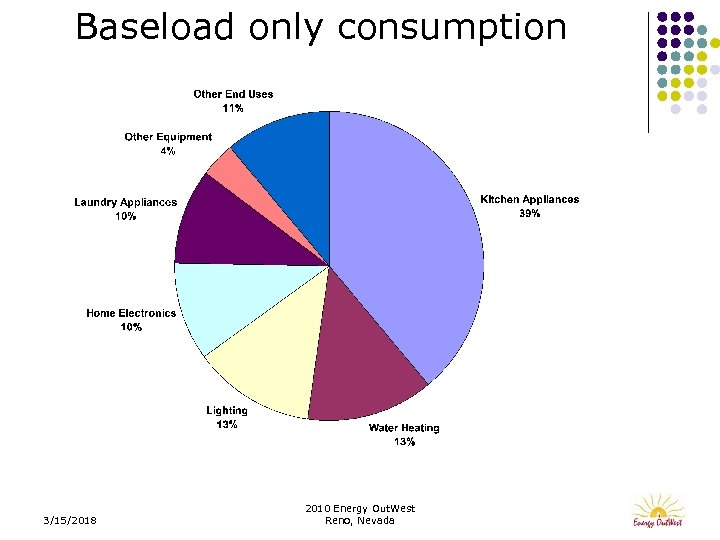
Baseload only consumption 3/15/2018 2010 Energy Out. West Reno, Nevada
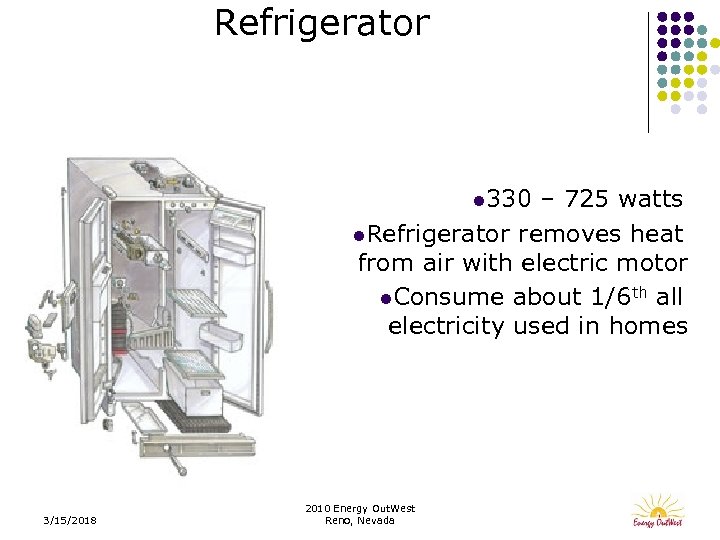
Refrigerator l 330 – 725 watts l. Refrigerator removes heat from air with electric motor l. Consume about 1/6 th all electricity used in homes 3/15/2018 2010 Energy Out. West Reno, Nevada
Refrigerator: best practices • • • Fridge temp, 36 - 40 F; freezer, 0 - 5 F Cool off hot foods Thaw frozen foods in fridge; cool as they defrost Not frost-free – defrost freezer before frost exceeds ¼” thick – frost makes freezer work harder Clean coils & air intake every 6 months Good gaskets – replace, if necessary Placement – heat must escape freely Keep from other heated objects Keep at least ¾ full, but not stuffed (air flow) 3/15/2018 2010 Energy Out. West Reno, Nevada
Refrigerator upgrade • • • Side-by-side models use more energy (at least 20% – up to 45%) Size matters – as a rule, larger models use more energy to operate & more resources to build – select smallest size that fits need Manual defrost use less electricity Before 1993, replace (old models can use up to 50% more energy than new Energy Star) Models sold after 2001 use 40% less than before Energy Star 3/15/2018 2010 Energy Out. West Reno, Nevada
Refrigerator upgrade Two methods to estimate savings from replacing old refrigerator with a new efficient one: l Metering electricity usage l Using the database of estimated annual usage 3/15/2018 2010 Energy Out. West Reno, Nevada
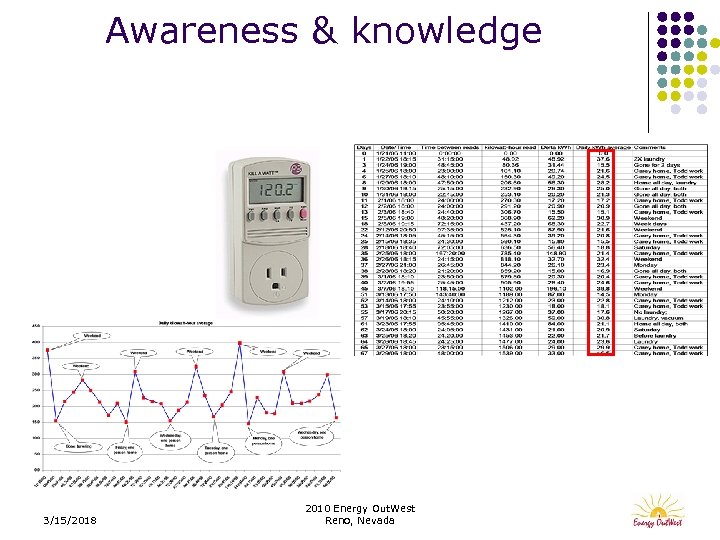
Refrigerator usage: metering Metering electricity usage l Metering 2 hours is adequate l Start metering as soon as on site Some single device monitoring meters: l Watts up? & Watts up? Pro l Kill-A-Watt l Brand Power Meter l Others (“google”) 3/15/2018 2010 Energy Out. West Reno, Nevada
Refrigerator defrost issue If older refrigerator being tested has a defrost heater, need to ensure it will not interfere with test. l Locate defrost timer, which controls the defrost heating cycle l l Under cover plate or behind kick plate in front Behind light panel or behind panel in roof of food compartment Behind on back of fridge Could be inaccessible “Incorporating Refrigerator Replacement into the Weatherization Assistance Program: Information Tool Kit , ” US Do. E, 19 November 2001 3/15/2018 2010 Energy Out. West Reno, Nevada
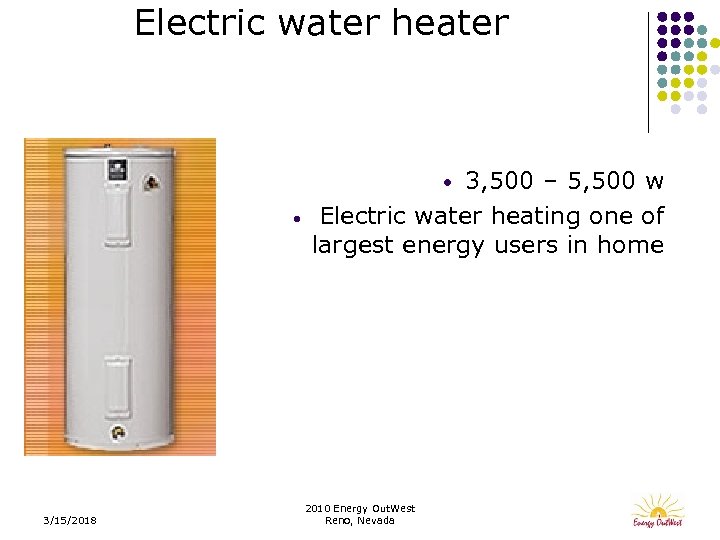
Electric water heater 3, 500 – 5, 500 w Electric water heating one of largest energy users in home • • 3/15/2018 2010 Energy Out. West Reno, Nevada
Best practices • • • Install insulation blanket (check specs, warnings) Insulate at least first 5 feet of pipes Water temperature: 125 F to 130 F Check for leaks Install low flow shower & faucet devices Install controls (e. g. , timer) & heat traps Sediment: drain a quart every 3 months Replace with more efficient heater http: //www. aceee. org/consumerguide 3/15/2018 2010 Energy Out. West Reno, Nevada
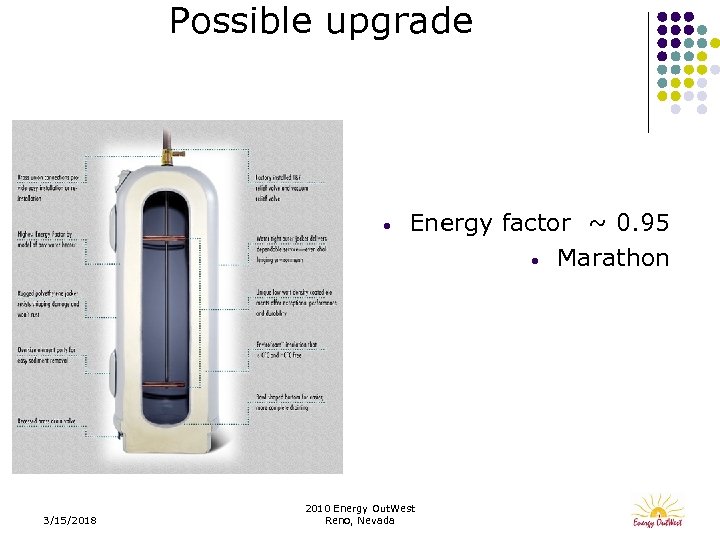
Possible upgrade • 3/15/2018 Energy factor ~ 0. 95 • Marathon 2010 Energy Out. West Reno, Nevada
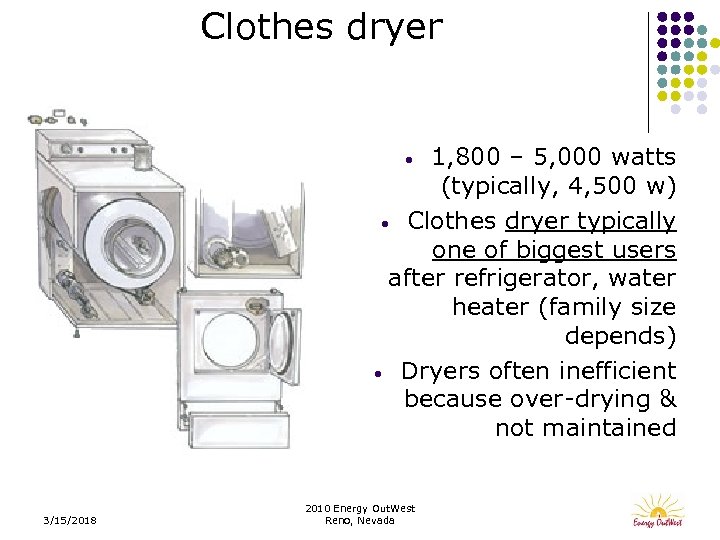
Clothes dryer 1, 800 – 5, 000 watts (typically, 4, 500 w) • Clothes dryer typically one of biggest users after refrigerator, water heater (family size depends) • Dryers often inefficient because over-drying & not maintained • 3/15/2018 2010 Energy Out. West Reno, Nevada
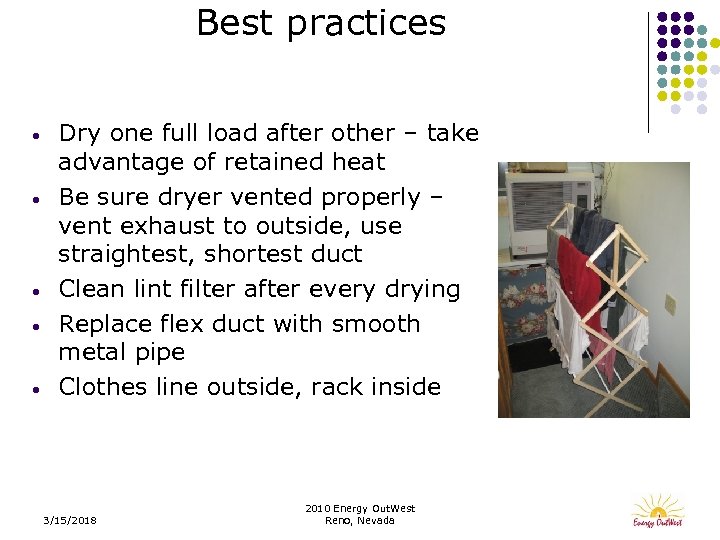
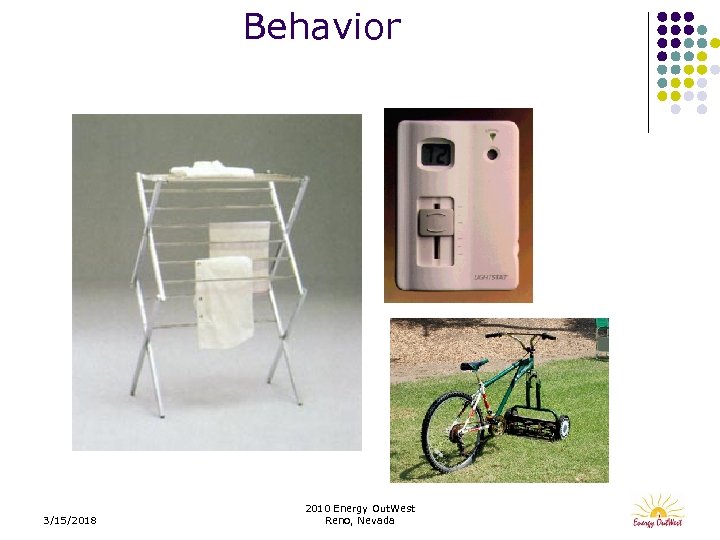
Best practices • • • Dry one full load after other – take advantage of retained heat Be sure dryer vented properly – vent exhaust to outside, use straightest, shortest duct Clean lint filter after every drying Replace flex duct with smooth metal pipe Clothes line outside, rack inside 3/15/2018 2010 Energy Out. West Reno, Nevada
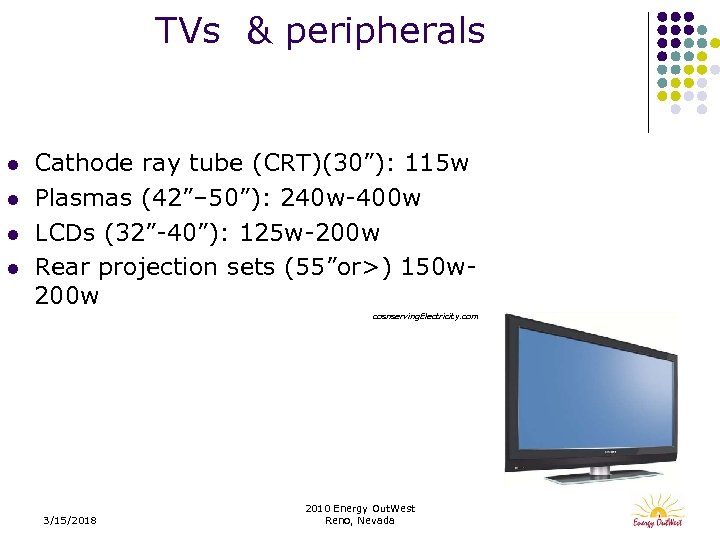
TVs & peripherals l l Cathode ray tube (CRT)(30”): 115 w Plasmas (42”– 50”): 240 w-400 w LCDs (32”-40”): 125 w-200 w Rear projection sets (55”or>) 150 w 200 w cosnserving. Electricity. com 3/15/2018 2010 Energy Out. West Reno, Nevada
TV power-saving tips l l l l l Turn TV & other connected devices off when not used Power down other connected devices, like game consoles and DVD players Turn off “Quick Start” option or something similar Turn down LCD's backlight Turn on power saver mode Reduce light output with settings; control room lighting Buy smaller screen Watch TV together Watch less TV Purchase ENERGY STAR 4. 0 compliant 3/15/2018 2010 Energy Out. West Reno, Nevada

Choice architecture affects baseload 3/15/2018 2010 Energy Out. West Reno, Nevada
Behavior strategies Behavioral economics, also “choice architecture” & “libertarian paternalism” – nudging humans to make better choices l Some experts estimate 20% of nations energy use can be controlled by behavior strategies l Best practices to leverage behavior combine strategies, all focusing on l what motivates individuals, l what is convenient & l what overcomes barriers 3/15/2018 2010 Energy Out. West Reno, Nevada
Behavior affects baseload l Baseload electricity end use is a function of people. l Reducing baseload use is not only people implementing energy efficiency technologies. l Reducing baseload also includes education, motivation, and reassessing each persons accountability. l It involves each person committing to take deliberate action upon any new and applicable awareness. 3/15/2018 2010 Energy Out. West Reno, Nevada
Behavior motivating menu Understanding what makes people act l Commitment & goal-setting l Social pressure, competition nature, perception others were participating l Structuring “opt out” choice as opposed to “opt in” l Customized information, direct appeals l Public campaigns engaging people l Regular feedback, charting progress l Rebates l Convenience 3/15/2018 2010 Energy Out. West Reno, Nevada
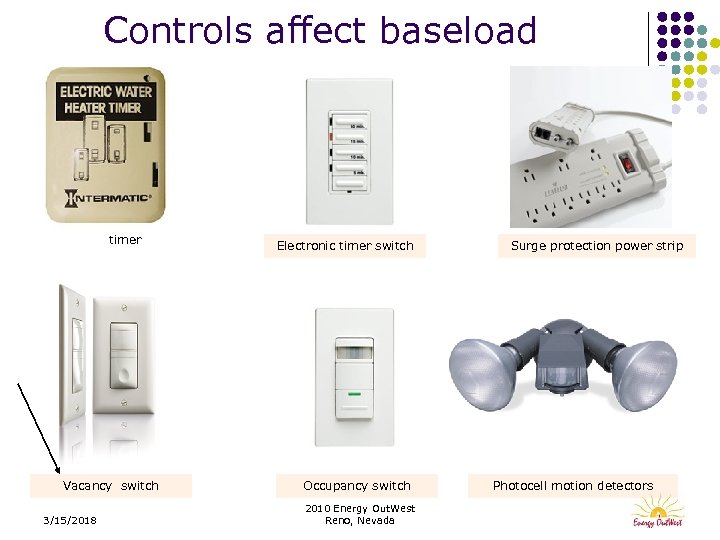
Controls affect baseload Electric water heater timer Vacancy switch 3/15/2018 Electronic timer switch Occupancy switch 2010 Energy Out. West Reno, Nevada Surge protection power strip Photocell motion detectors
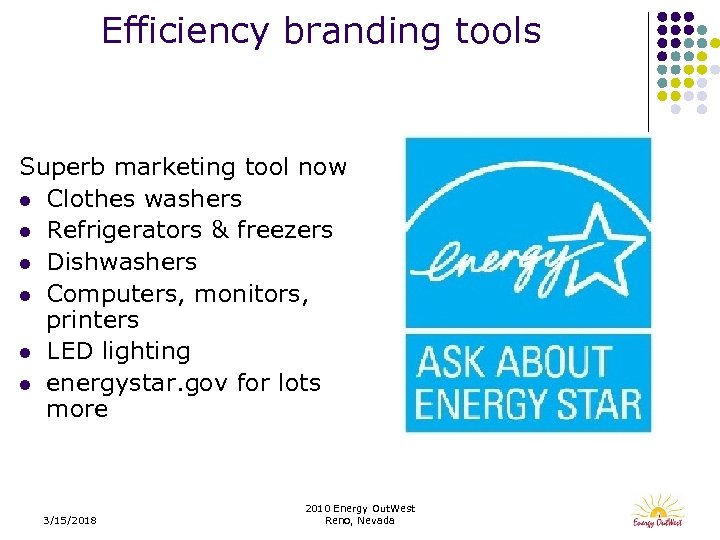
Efficiency branding tools Superb marketing tool now l Clothes washers l Refrigerators & freezers l Dishwashers l Computers, monitors, printers l LED lighting l energystar. gov for lots more 3/15/2018 2010 Energy Out. West Reno, Nevada
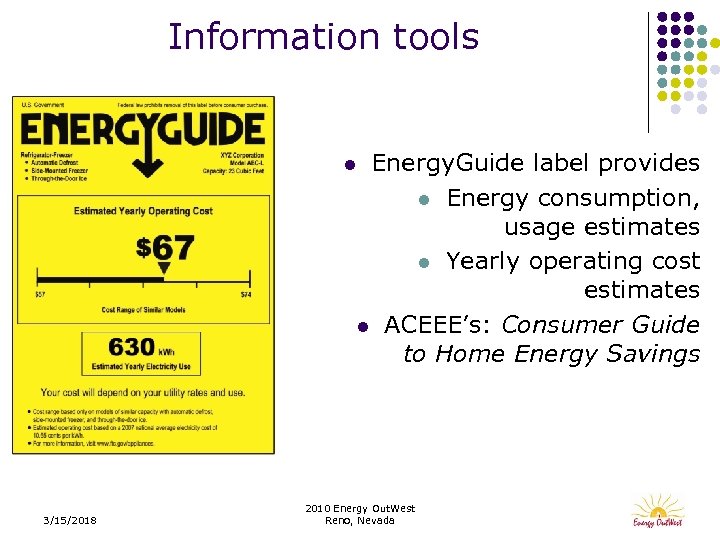
Information tools Energy. Guide label provides l Energy consumption, usage estimates l Yearly operating cost estimates l ACEEE’s: Consumer Guide to Home Energy Savings l 3/15/2018 2010 Energy Out. West Reno, Nevada
Determining electricity end use l l l Nameplates & measuring Monitoring, data logging, load profiling Whole house, individual devices The house meter as a tool Watching & record keeping 3/15/2018 2010 Energy Out. West Reno, Nevada
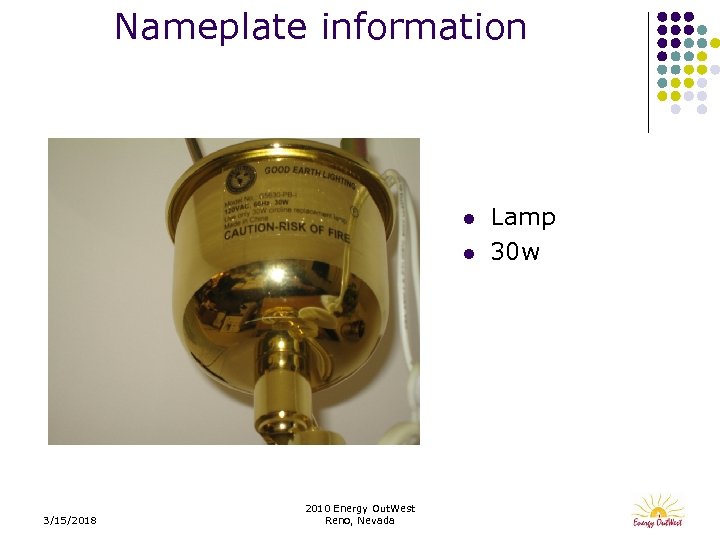
Nameplate information l l 3/15/2018 2010 Energy Out. West Reno, Nevada Lamp 30 w
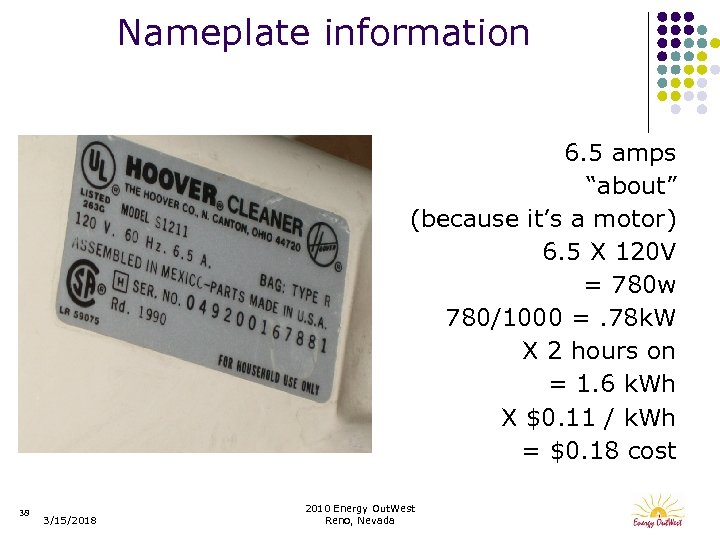
Nameplate information 6. 5 amps “about” (because it’s a motor) 6. 5 X 120 V = 780 w 780/1000 =. 78 k. W X 2 hours on = 1. 6 k. Wh X $0. 11 / k. Wh = $0. 18 cost 38 3/15/2018 2010 Energy Out. West Reno, Nevada
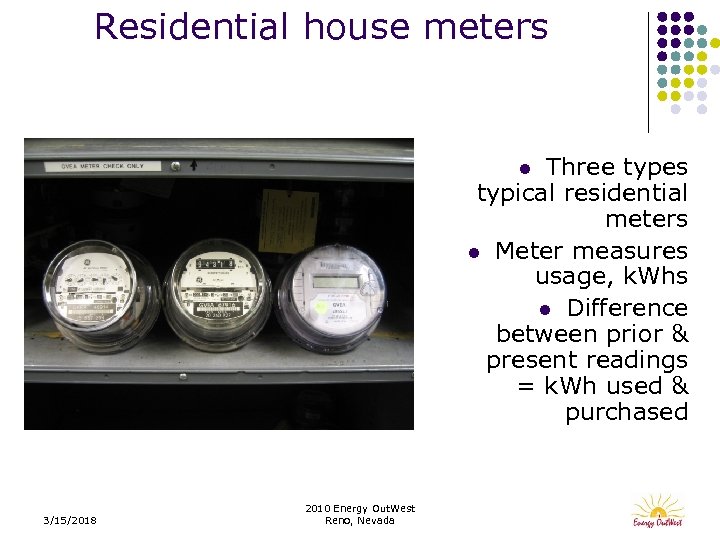
Residential house meters Three types typical residential meters l Meter measures usage, k. Whs l Difference between prior & present readings = k. Wh used & purchased l 3/15/2018 2010 Energy Out. West Reno, Nevada
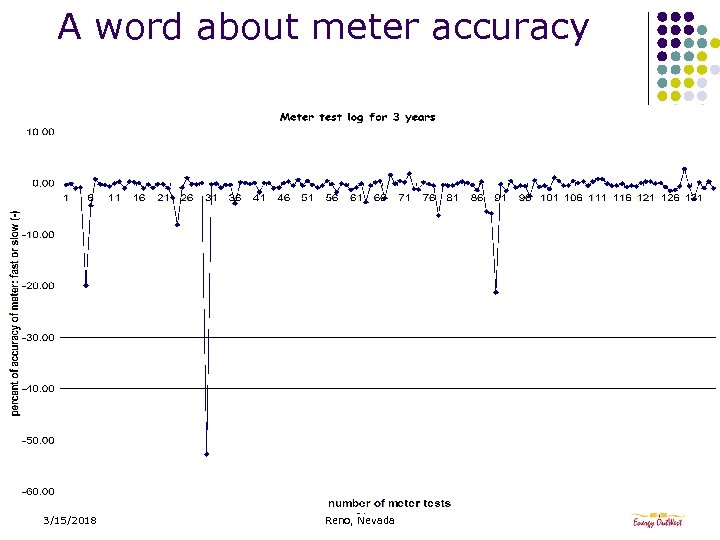
A word about meter accuracy 3/15/2018 2010 Energy Out. West Reno, Nevada
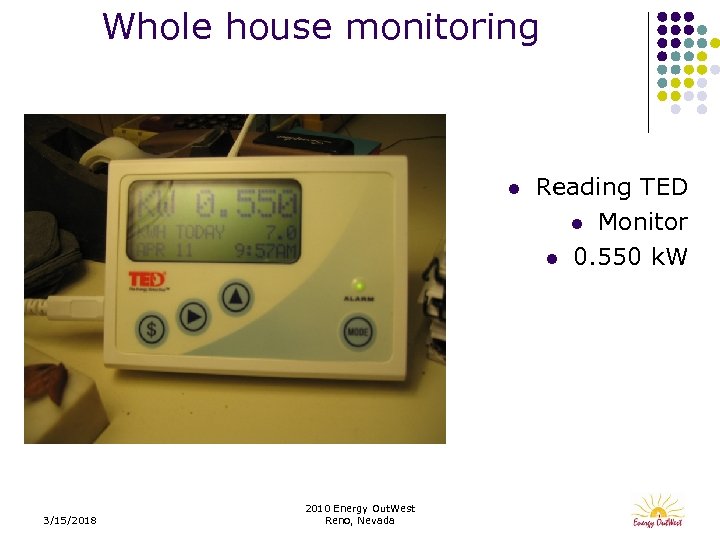
Whole house monitoring l 3/15/2018 2010 Energy Out. West Reno, Nevada Reading TED l Monitor l 0. 550 k. W
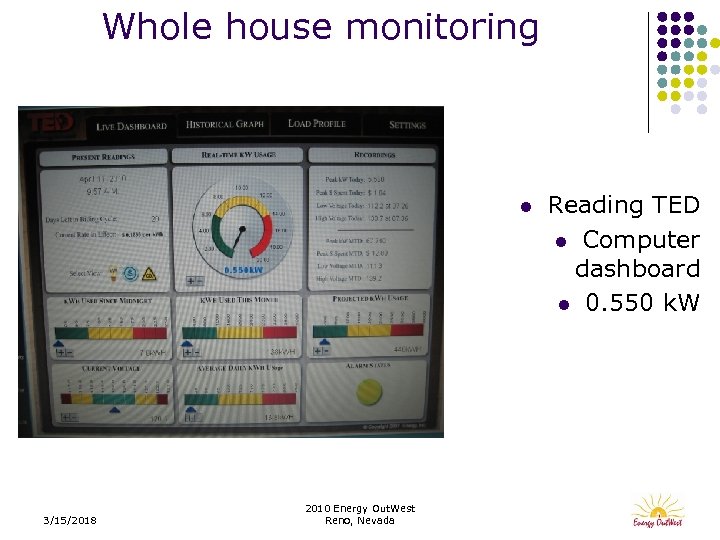
Whole house monitoring l 3/15/2018 2010 Energy Out. West Reno, Nevada Reading TED l Computer dashboard l 0. 550 k. W
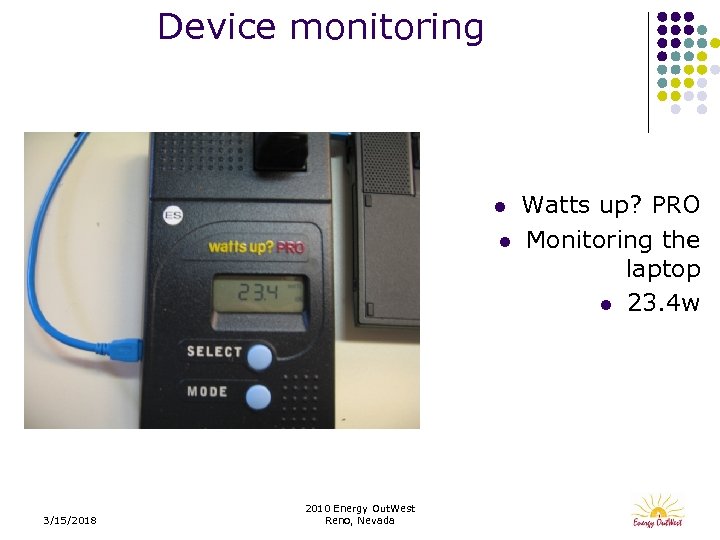
Device monitoring l l 3/15/2018 2010 Energy Out. West Reno, Nevada Watts up? PRO Monitoring the laptop l 23. 4 w
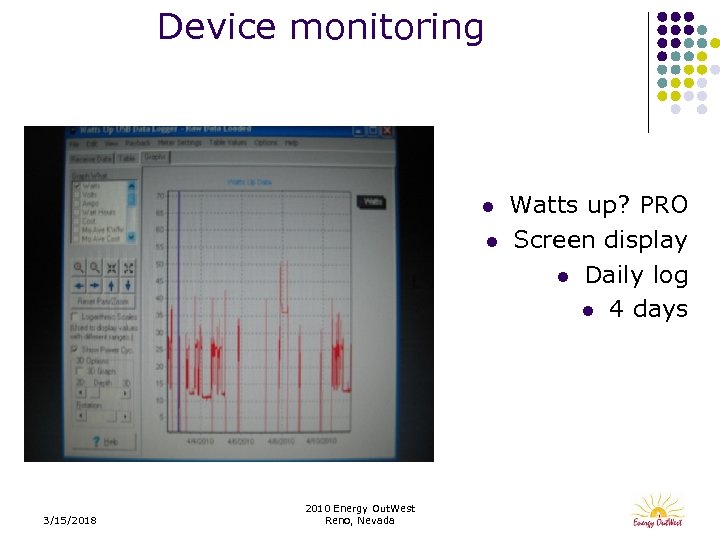
Device monitoring l l 3/15/2018 2010 Energy Out. West Reno, Nevada Watts up? PRO Screen display l Daily log l 4 days
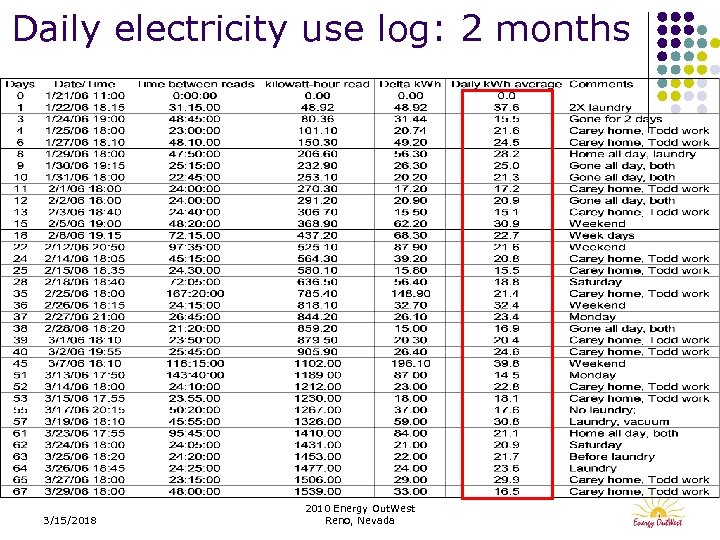
Daily electricity use log: 2 months 3/15/2018 2010 Energy Out. West Reno, Nevada
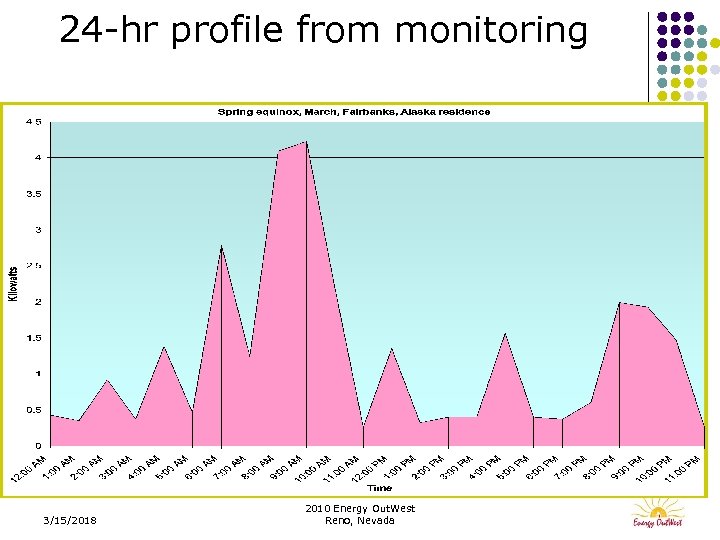
24 -hr profile from monitoring 3/15/2018 2010 Energy Out. West Reno, Nevada
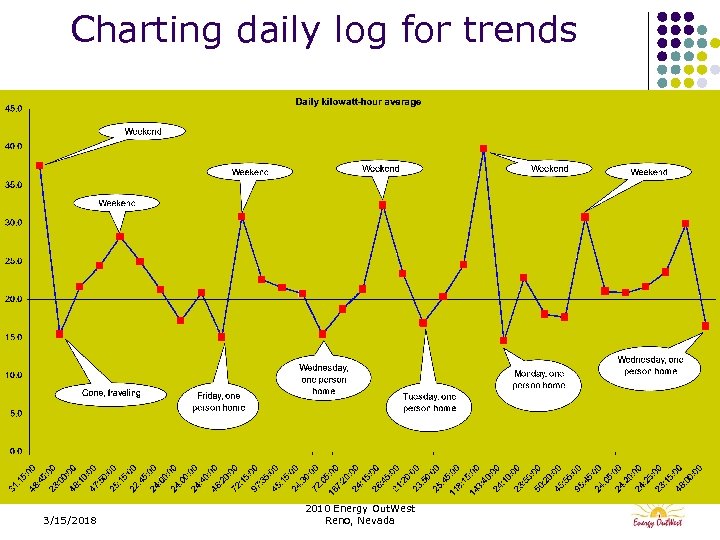
Charting daily log for trends 3/15/2018 2010 Energy Out. West Reno, Nevada
What is “normal” use? Depends. Lots of variables: Home alone? Everybody home? Operate a business in home? Never home? There is no “normal” use, but assessments & comparables may be drawn l Count up appliances & add up nameplates wattages l Monitor usage or control & log actions l Spot trends. Compare daily k. Wh averages & electricity use indexes (annual k. Wh / s. f. ) l Start benchmarking (a dynamic activity that continually fine-tunes itself) 3/15/2018 2010 Energy Out. West Reno, Nevada
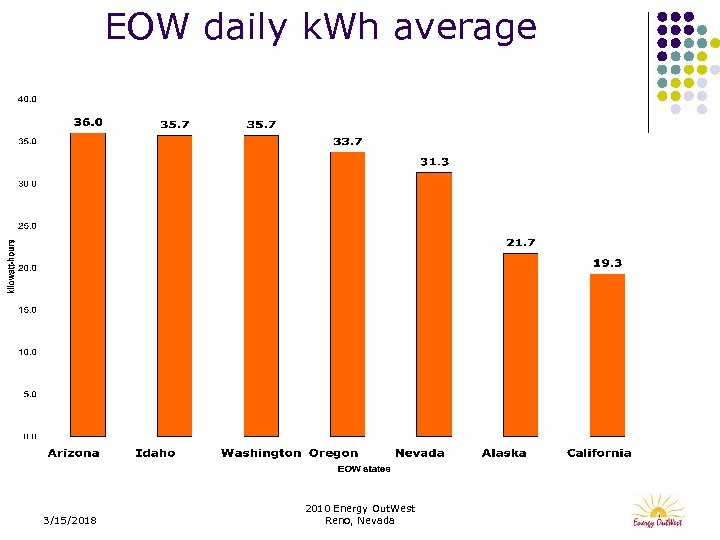
EOW daily k. Wh average 3/15/2018 2010 Energy Out. West Reno, Nevada
Creating a context for comparing l l Focus on baseload use, not total: separate Focus on low-income households (weatherization target) Construct a starting point framework called “benchmarking” using “electricity index” & “daily k. Wh average” to establish “normal”, “high”, or “low” use This framework should be flexible & dynamic as more information is collected 3/15/2018 2010 Energy Out. West Reno, Nevada
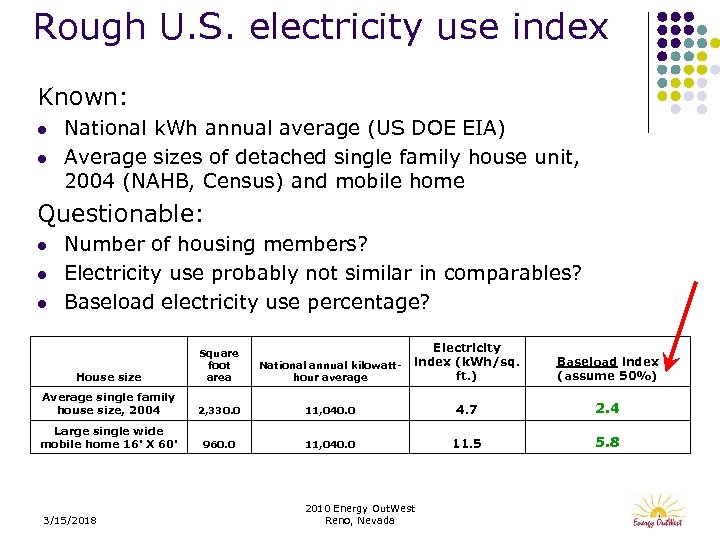
Rough U. S. electricity use index Known: l l National k. Wh annual average (US DOE EIA) Average sizes of detached single family house unit, 2004 (NAHB, Census) and mobile home Questionable: l l l Number of housing members? Electricity use probably not similar in comparables? Baseload electricity use percentage? National annual kilowatthour average Electricity index (k. Wh/sq. ft. ) Baseload index (assume 50%) 2, 330. 0 11, 040. 0 4. 7 2. 4 960. 0 11, 040. 0 11. 5 5. 8 House size Square foot area Average single family house size, 2004 Large single wide mobile home 16' X 60' 3/15/2018 2010 Energy Out. West Reno, Nevada
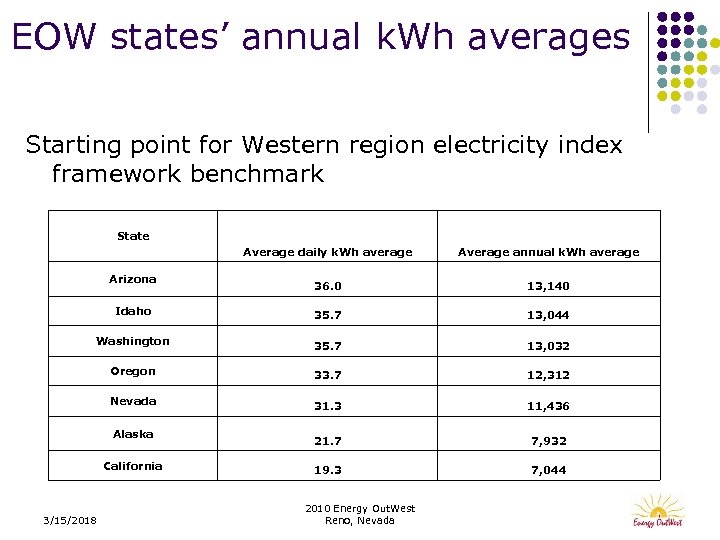
EOW states’ annual k. Wh averages Starting point for Western region electricity index framework benchmark State Average daily k. Wh average Average annual k. Wh average 36. 0 13, 140 Idaho 35. 7 13, 044 Washington 35. 7 13, 032 Oregon 33. 7 12, 312 Nevada 31. 3 11, 436 21. 7 7, 932 19. 3 7, 044 Arizona Alaska California 3/15/2018 2010 Energy Out. West Reno, Nevada
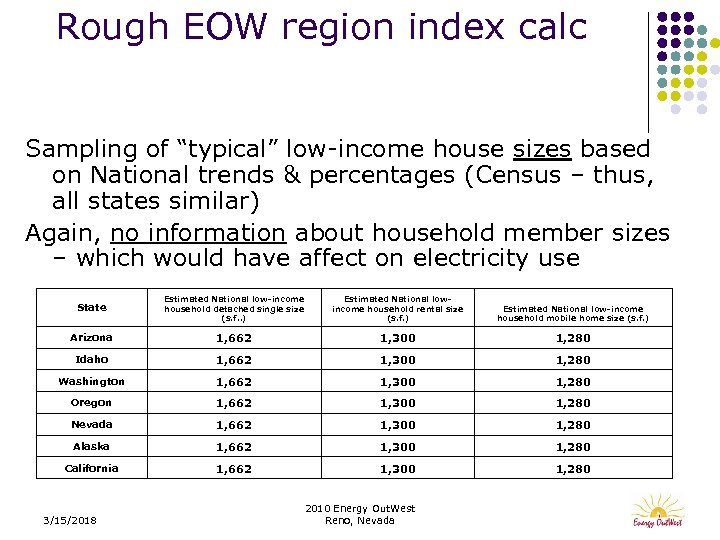
Rough EOW region index calc Sampling of “typical” low-income house sizes based on National trends & percentages (Census – thus, all states similar) Again, no information about household member sizes – which would have affect on electricity use State Estimated National low-income household detached single size (s. f. . ) Estimated National lowincome household rental size (s. f. ) Estimated National low-income household mobile home size (s. f. ) Arizona 1, 662 1, 300 1, 280 Idaho 1, 662 1, 300 1, 280 Washington 1, 662 1, 300 1, 280 Oregon 1, 662 1, 300 1, 280 Nevada 1, 662 1, 300 1, 280 Alaska 1, 662 1, 300 1, 280 California 3/15/2018 2010 Energy Out. West Reno, Nevada
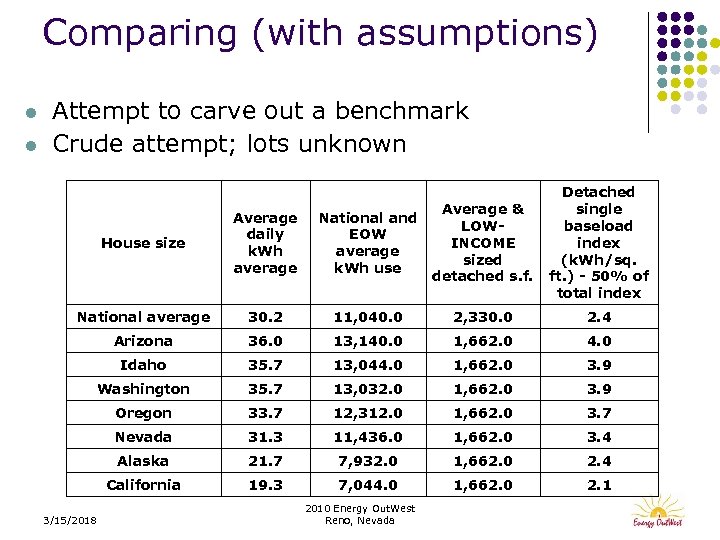
Comparing (with assumptions) l l Attempt to carve out a benchmark Crude attempt; lots unknown Detached single Average & National and LOWbaseload EOW INCOME index average sized (k. Wh/sq. k. Wh use detached s. f. ft. ) - 50% of total index House size Average daily k. Wh average National average 30. 2 11, 040. 0 2, 330. 0 2. 4 Arizona 36. 0 13, 140. 0 1, 662. 0 4. 0 Idaho 35. 7 13, 044. 0 1, 662. 0 3. 9 Washington 35. 7 13, 032. 0 1, 662. 0 3. 9 Oregon 33. 7 12, 312. 0 1, 662. 0 3. 7 Nevada 31. 3 11, 436. 0 1, 662. 0 3. 4 Alaska 21. 7 7, 932. 0 1, 662. 0 2. 4 19. 3 7, 044. 0 1, 662. 0 2. 1 California 3/15/2018 2010 Energy Out. West Reno, Nevada
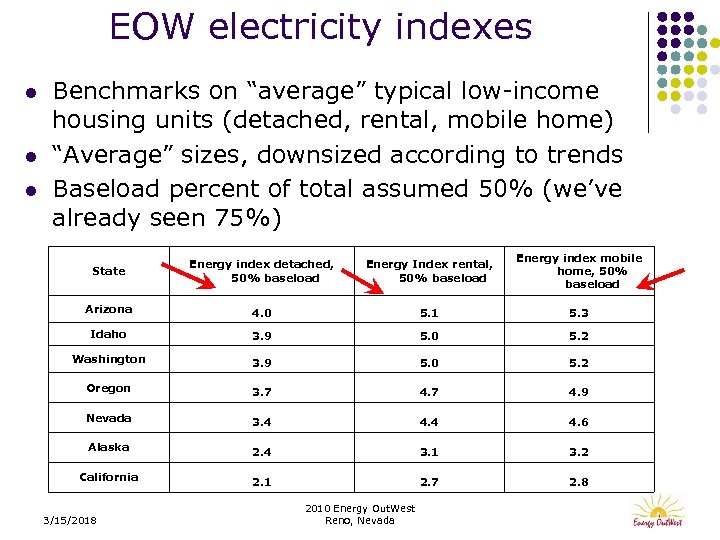
EOW electricity indexes l l l Benchmarks on “average” typical low-income housing units (detached, rental, mobile home) “Average” sizes, downsized according to trends Baseload percent of total assumed 50% (we’ve already seen 75%) State Energy index detached, 50% baseload Energy Index rental, 50% baseload Energy index mobile home, 50% baseload Arizona 4. 0 5. 1 5. 3 Idaho 3. 9 5. 0 5. 2 Washington 3. 9 5. 0 5. 2 Oregon 3. 7 4. 9 Nevada 3. 4 4. 6 Alaska 2. 4 3. 1 3. 2 2. 1 2. 7 2. 8 California 3/15/2018 2010 Energy Out. West Reno, Nevada
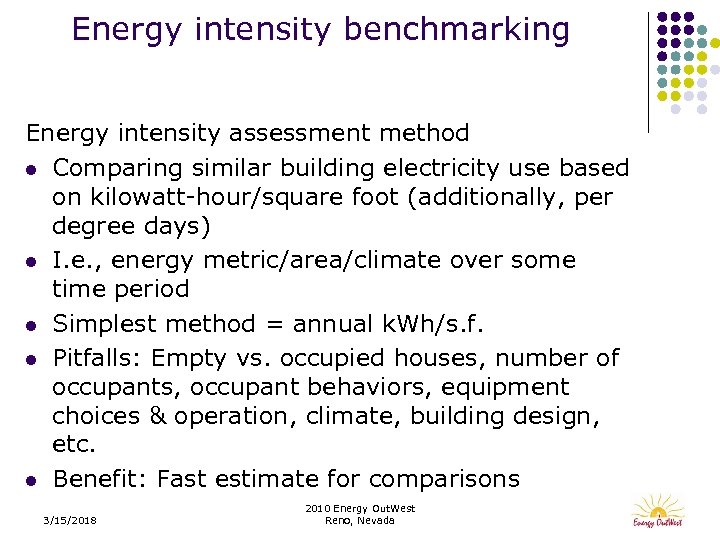
Energy intensity benchmarking Energy intensity assessment method l Comparing similar building electricity use based on kilowatt-hour/square foot (additionally, per degree days) l I. e. , energy metric/area/climate over some time period l Simplest method = annual k. Wh/s. f. l Pitfalls: Empty vs. occupied houses, number of occupants, occupant behaviors, equipment choices & operation, climate, building design, etc. l Benefit: Fast estimate for comparisons 3/15/2018 2010 Energy Out. West Reno, Nevada
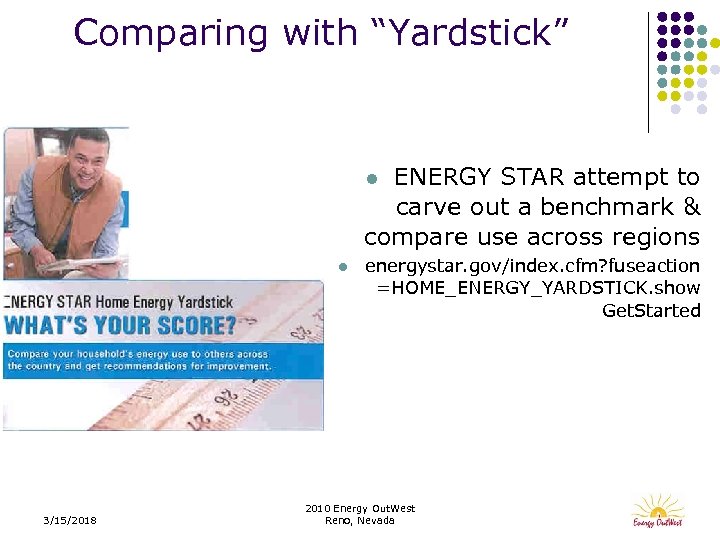
Comparing with “Yardstick” ENERGY STAR attempt to carve out a benchmark & compare use across regions l l 3/15/2018 energystar. gov/index. cfm? fuseaction =HOME_ENERGY_YARDSTICK. show Get. Started 2010 Energy Out. West Reno, Nevada
Welectricity web site Simple, free online web service l Helps track & reduce residential electricity consumption l A network with feedback ability l Compare consumption to others l Set goals, make plans l Calculates average daily consumption for each month l Graphs consumption on a dashboard 3/15/2018 2010 Energy Out. West Reno, Nevada
Welectricity How it works l Sign up for free account l Set up residential profile l Enter bill information l Enter new usage information each month www. welectricity. com 3/15/2018 2010 Energy Out. West Reno, Nevada
Section points l l Use data to compare, track trends, assume some level of “normal”, “high” or “low” use Calculate daily kilowatt-hour average for benchmarking purposes Determine specific annual k. Wh use & housing unit area (square feet) to calculate electricity use index for residence & benchmarking purposes Compare between & across similar & different households for local benchmarking 3/15/2018 2010 Energy Out. West Reno, Nevada
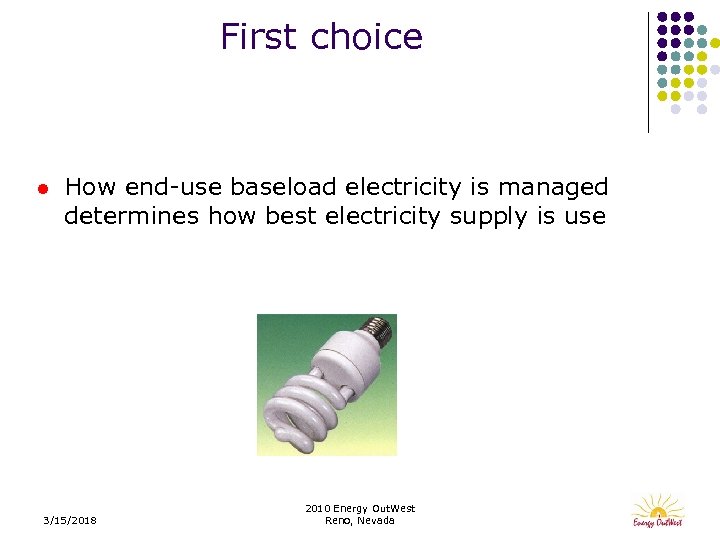
First choice l How end-use baseload electricity is managed determines how best electricity supply is use 3/15/2018 2010 Energy Out. West Reno, Nevada
Again, what is “normal” use? Depends. Lots of variables: Live alone? Stay at home? Run a business from home? Never home? Comparisons & benchmarking are rough attempts to define “normal use” but households – in the end – are collections of independent-minded individuals There are similarities in households but often action plans need specific tailoring 3/15/2018 2010 Energy Out. West Reno, Nevada
How “high usage” often happens • • • 3/15/2018 Inefficient baseload appliances Inattention to behavior, habits Lack of monitoring usage People: dynamics Lack of knowledge & misunderstandings High-usage devices (e. g. , electric heater) 2010 Energy Out. West Reno, Nevada
Investigating usage spikes Possible causes l People home (long weekends, holidays)? l More than 4 people, guests? l Hot water leaks, bad heating elements? l Cold weather? l More billing period days (>30 days)? l Unseen, forgotten devices (crawlspace, water pales, well house, etc. )? l Unheard motors operating (e. g. , well pump)? l New electric device purchase? 3/15/2018 2010 Energy Out. West Reno, Nevada
Investigating habitually high use Possible causes l Dynamics: households > 4 people l Electric water heating l Laundry: electric clothes dryer used often l Old refrigerators, freezers (15 years plus) l Multiple fridges, freezers l Dehumidifiers, fans, pumps l Multiple electronics (TVs, DVD, cable, games, music, etc. ) l Phantom loads (electronics, transformers, etc. ) l Heated water bed, hot tubs (pumps & heaters) 3/15/2018 2010 Energy Out. West Reno, Nevada
Don’t assume • • Inaccurate meter (broken) Misread (wrong) Somebody else’s meter read (confusion) Mysterious, unannounced rate increase (conspire) Leaking electricity (soaked ground) “Not my fault” (pointing fingers) Other people pay less & have and do more “things” (victimized, unlucky) 3/15/2018 2010 Energy Out. West Reno, Nevada
Implement personal energy policy l l l l l Invest in efficiency Efficiency important, but only small part Not just “the lights on” – behavior Understand usage – monitoring tools, meter reads, record keeping, monthly statements; benchmark Develop usage budget plan Stay the course; develop better habits Accountability: it is up to you, not others Commitment contract Partner, or compete, with like-minded households 3/15/2018 2010 Energy Out. West Reno, Nevada
The legs of end-use management To use any energy is to assume management l Efficiency: technologies requiring less energy to do same, or more, functions l Conservation: behavior & habit adjustments or control strategies l Awareness: monitoring, learning l knowing where & why energy is used l passing on information Commitment, accountability, motivation, set goal 3/15/2018 2010 Energy Out. West Reno, Nevada
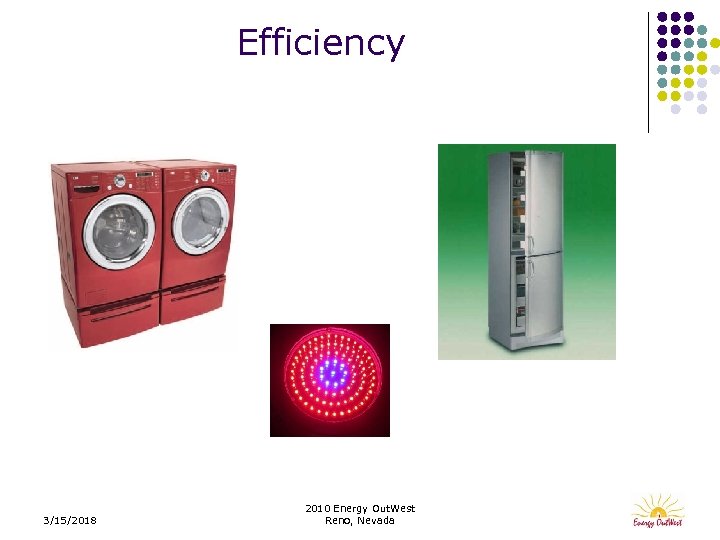
Efficiency 3/15/2018 2010 Energy Out. West Reno, Nevada
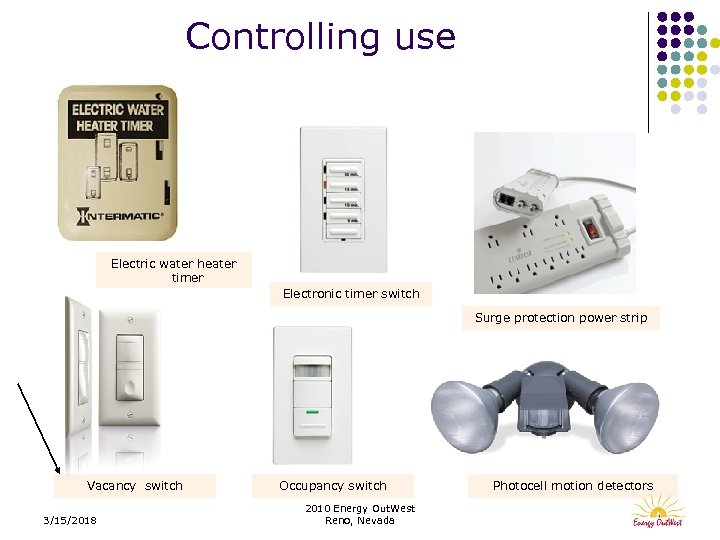
Controlling use Electric water heater timer Electronic timer switch Surge protection power strip Vacancy switch 3/15/2018 Occupancy switch 2010 Energy Out. West Reno, Nevada Photocell motion detectors
Behavior 3/15/2018 2010 Energy Out. West Reno, Nevada
Awareness & knowledge 3/15/2018 2010 Energy Out. West Reno, Nevada
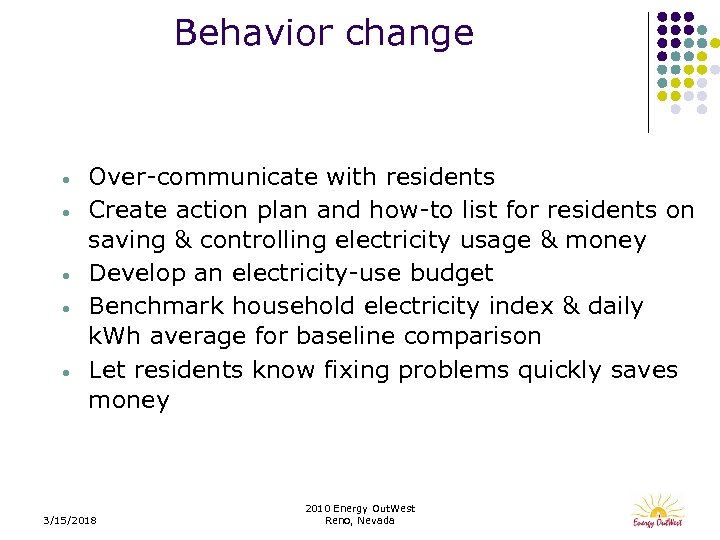
Behavior change • • • Over-communicate with residents Create action plan and how-to list for residents on saving & controlling electricity usage & money Develop an electricity-use budget Benchmark household electricity index & daily k. Wh average for baseline comparison Let residents know fixing problems quickly saves money 3/15/2018 2010 Energy Out. West Reno, Nevada
Behavior change • • • 3/15/2018 Offer seasonal tips to conserve energy (e. g. , a calendar, periodic newsletter, etc. ) Install sub-metering, if necessary (temporary) Launch electrical energy efficiency support campaign Offer some benefit, incentive If possible, follow-up and feedback support 2010 Energy Out. West Reno, Nevada
Affordability budget planning Example: Only afford $100 a month for electricity • • • 3/15/2018 = $0. 11 per k. Wh ÷ $0. 11 into $100 = 909 k. Wh per month ÷ 30 days per month into 909 k. Wh = 30 k. Wh per day to receive a bill of $100 (less customer charge) 2010 Energy Out. West Reno, Nevada
Home energy plan: no cost No cost action – operating cost Monthly energy item Action Estimated savings each MONTH Lighting Off: three 75 -w incandescent lights that operate 2 hrs per night. 2% of monthly energy usage 2 nd refrigerator Unplug & recycle second refrigerator 9% of monthly energy usage Dishwasher Open door & air dry dishes 1% of monthly energy usage Refrigerator Clean coils, provide circulation 1. 7% of energy usage Clothes washer Only full loads (dryers, too), reduce washing 1/3 per mnth . 25% of monthly energy usage Computers Energy savings mode 1% of monthly energy usage 3/15/2018 2010 Energy Out. West Reno, Nevada
Home energy plan: low cost Low cost action – operating costs Monthly energy item Action Estimated savings each MONTH Lighting Replace four 100 -w incandescent four 27 -s CFLs (“over lamp, lumens, with CFLs) 6% of monthly energy usage Thermostat Install ENERGY STAR®-labeled programmable thermostat 3% of monthly energy usage Torchiere Replace any halogen or incandescent torchiere with ENERGY STAR® 2% of monthly energy usage Dimmers Use dimmers, timers, & motion sensors on incandescent 7% of monthly energy usage Water heater Wrap older water heater with insulated blanket 30 k. Whs Faucets Fix defective plumbing, leaks or dripping faucets 25 k. Whs Window shades Install window shades, coverings 5% of monthly energy usage 3/15/2018 2010 Energy Out. West Reno, Nevada
Welectricity web site Simple, free online web service l Helps track & reduce residential electricity consumption l A network with feedback ability l Compare consumption to others l Set goals, make plans l Calculates average daily consumption for each month l Graphs consumption on a dashboard 3/15/2018 2010 Energy Out. West Reno, Nevada
The trick to lowering baseload l l l Avoid & alter traditional or conventional habits & assumptions Become conscious of how you use energy (observation, record keeping) Budget home electric energy use by monitoring & logging activities Invest in proven efficient technologies Make a commitment to yourself & publicize the goal 3/15/2018 2010 Energy Out. West Reno, Nevada
Accountability & commitment l l l l Commit to a plan; make it personal; set goals Don’t wait; benchmark now Challenge family, schools, community; compete Efficiency technology exists; invest Building science & knowledge exits; access Do not expect outside help Challenge leaders to focus on end use first 3/15/2018 2010 Energy Out. West Reno, Nevada
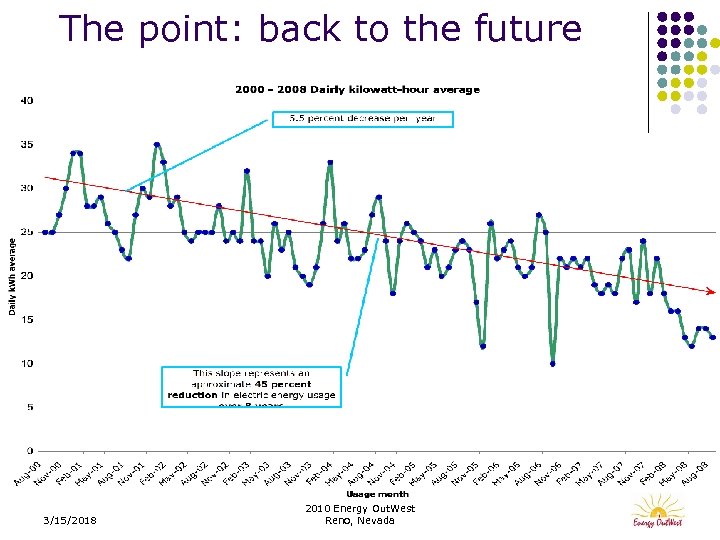
The point: back to the future 3/15/2018 2010 Energy Out. West Reno, Nevada
3/15/2018 2010 Energy Out. West Reno, Nevada
Скачать презентацию Baseload measures quantify address manage Presenter Todd Hoener
3030b56c4ee2d4bbac2b1a1f93bbf03d.ppt