 Скачать презентацию Baseload Electricity quantify address manage 4 Mining patterns
737f28e8423fc68b7cec749da228ed6e.ppt
- Количество слайдов: 18



Baseload Electricity quantify, address, manage 4) Mining patterns for trends, comparisons Presenter Todd Hoener, LEED accredited professional End-use energy specialist Renewable energy program administrator Certified home energy rater & Light commercial energy auditor Golden Valley Electric Association Fairbanks, Alaska 907 451 5607 w tmhoener@gmail. com
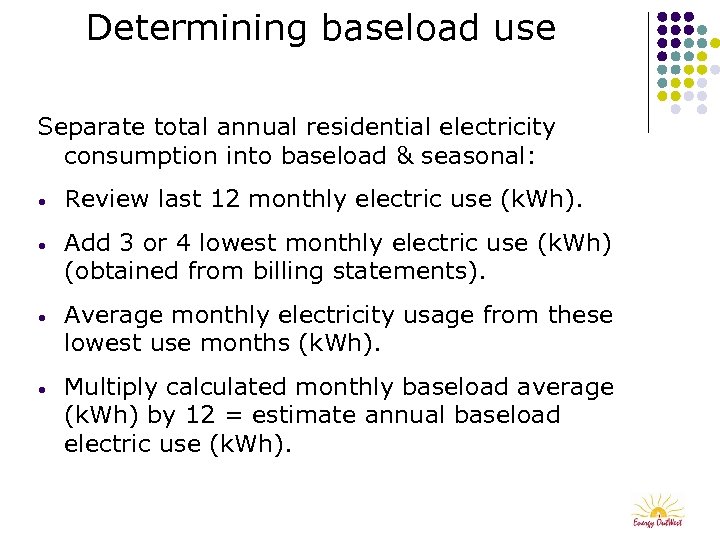
Determining baseload use Separate total annual residential electricity consumption into baseload & seasonal: • Review last 12 monthly electric use (k. Wh). • Add 3 or 4 lowest monthly electric use (k. Wh) (obtained from billing statements). • Average monthly electricity usage from these lowest use months (k. Wh). • Multiply calculated monthly baseload average (k. Wh) by 12 = estimate annual baseload electric use (k. Wh).
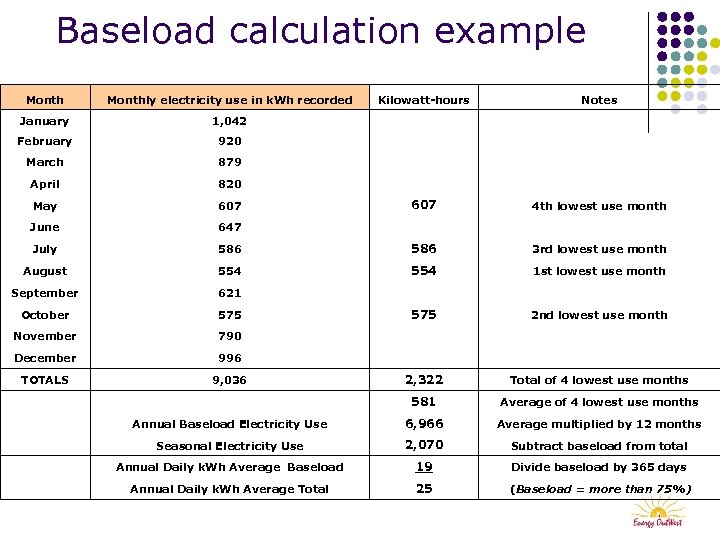
Baseload calculation example Monthly electricity use in k. Wh recorded Kilowatt-hours Notes January 1, 042 February 920 March 879 April 820 May 607 4 th lowest use month June 647 July 586 3 rd lowest use month August 554 1 st lowest use month September 621 October 575 2 nd lowest use month November 790 December 996 TOTALS 9, 036 2, 322 Total of 4 lowest use months 581 Average of 4 lowest use months Annual Baseload Electricity Use 6, 966 Average multiplied by 12 months Seasonal Electricity Use 2, 070 Subtract baseload from total Annual Daily k. Wh Average Baseload 19 Divide baseload by 365 days Annual Daily k. Wh Average Total 25 (Baseload = more than 75%)
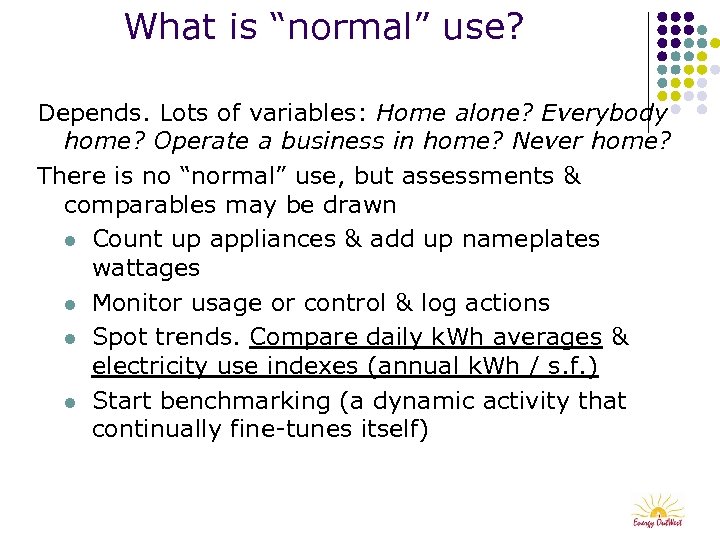
What is “normal” use? Depends. Lots of variables: Home alone? Everybody home? Operate a business in home? Never home? There is no “normal” use, but assessments & comparables may be drawn l Count up appliances & add up nameplates wattages l Monitor usage or control & log actions l Spot trends. Compare daily k. Wh averages & electricity use indexes (annual k. Wh / s. f. ) l Start benchmarking (a dynamic activity that continually fine-tunes itself)
Electricity usage numbers
EOW daily k. Wh average
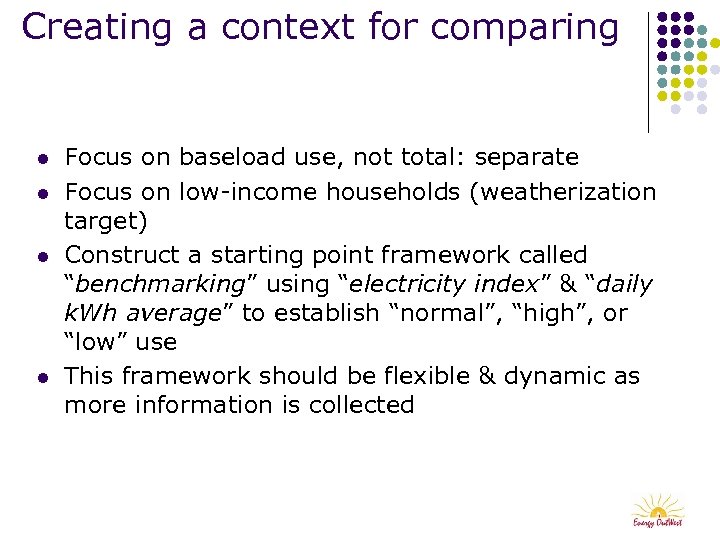
Creating a context for comparing l l Focus on baseload use, not total: separate Focus on low-income households (weatherization target) Construct a starting point framework called “benchmarking” using “electricity index” & “daily k. Wh average” to establish “normal”, “high”, or “low” use This framework should be flexible & dynamic as more information is collected
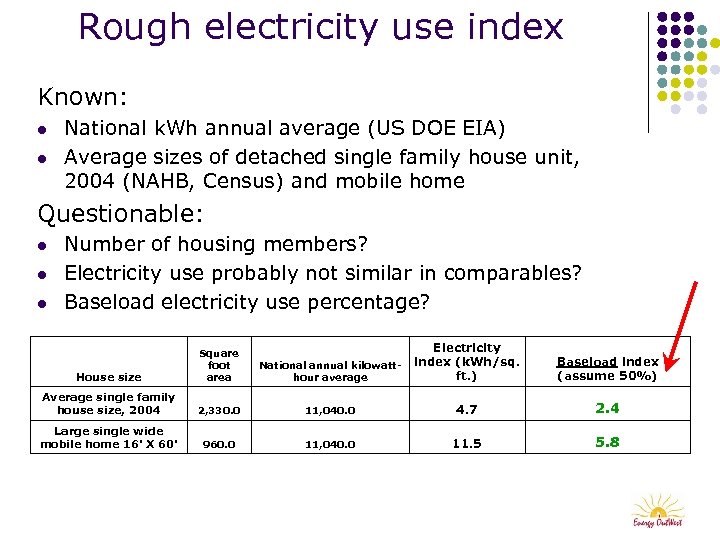
Rough electricity use index Known: l l National k. Wh annual average (US DOE EIA) Average sizes of detached single family house unit, 2004 (NAHB, Census) and mobile home Questionable: l l l Number of housing members? Electricity use probably not similar in comparables? Baseload electricity use percentage? National annual kilowatthour average Electricity index (k. Wh/sq. ft. ) Baseload index (assume 50%) 2, 330. 0 11, 040. 0 4. 7 2. 4 960. 0 11, 040. 0 11. 5 5. 8 House size Square foot area Average single family house size, 2004 Large single wide mobile home 16' X 60'
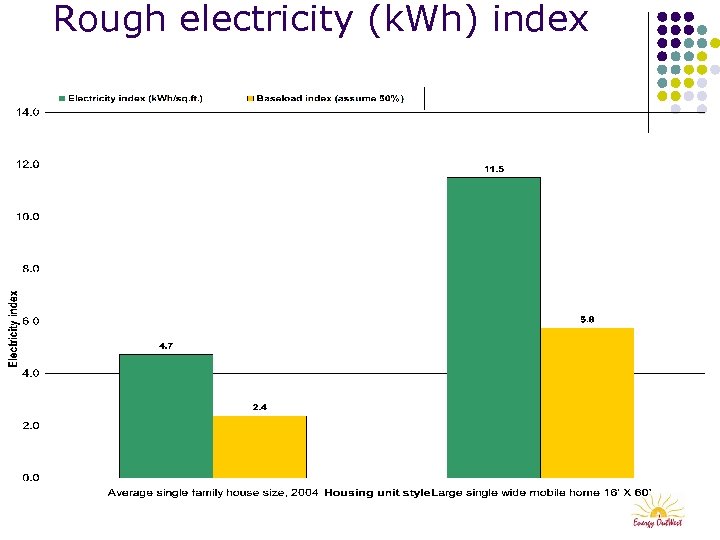
Rough electricity (k. Wh) index
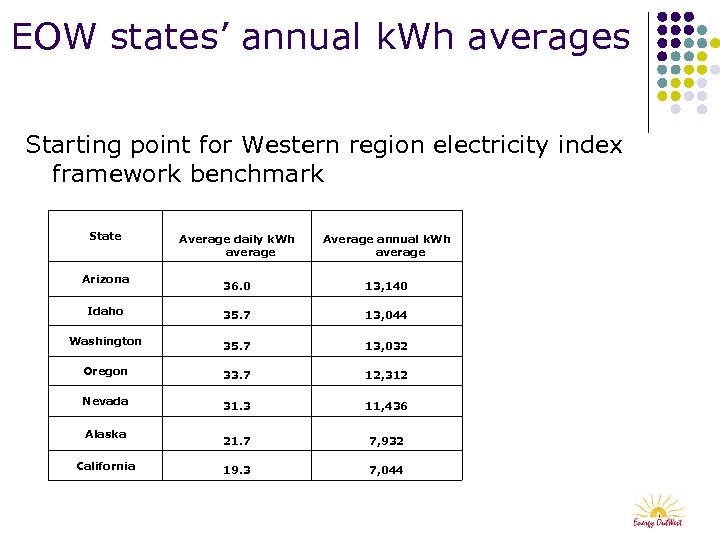
EOW states’ annual k. Wh averages Starting point for Western region electricity index framework benchmark State Average daily k. Wh average Average annual k. Wh average 36. 0 13, 140 Idaho 35. 7 13, 044 Washington 35. 7 13, 032 Oregon 33. 7 12, 312 Nevada 31. 3 11, 436 21. 7 7, 932 19. 3 7, 044 Arizona Alaska California
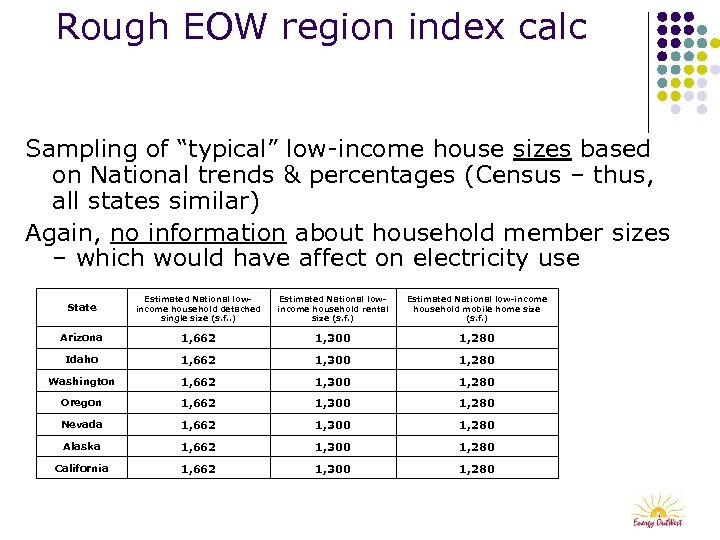
Rough EOW region index calc Sampling of “typical” low-income house sizes based on National trends & percentages (Census – thus, all states similar) Again, no information about household member sizes – which would have affect on electricity use State Estimated National lowincome household detached single size (s. f. . ) Estimated National lowincome household rental size (s. f. ) Estimated National low-income household mobile home size (s. f. ) Arizona 1, 662 1, 300 1, 280 Idaho 1, 662 1, 300 1, 280 Washington 1, 662 1, 300 1, 280 Oregon 1, 662 1, 300 1, 280 Nevada 1, 662 1, 300 1, 280 Alaska 1, 662 1, 300 1, 280 California
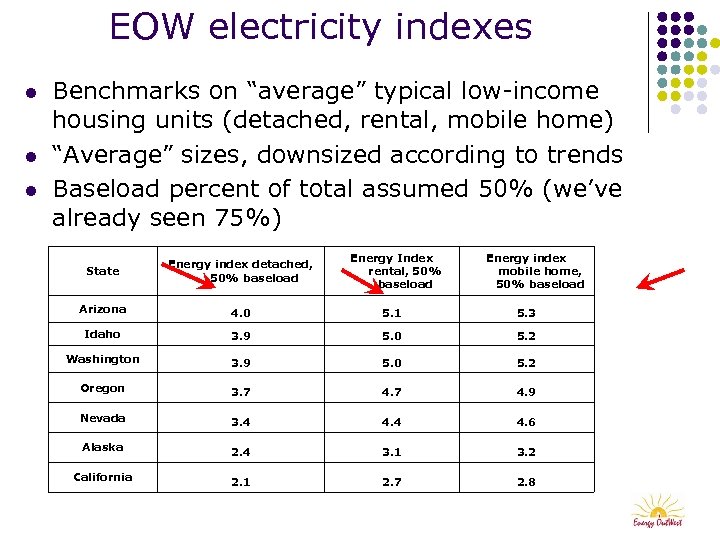
EOW electricity indexes l l l Benchmarks on “average” typical low-income housing units (detached, rental, mobile home) “Average” sizes, downsized according to trends Baseload percent of total assumed 50% (we’ve already seen 75%) Energy Index rental, 50% baseload Energy index mobile home, 50% baseload State Energy index detached, 50% baseload Arizona 4. 0 5. 1 5. 3 Idaho 3. 9 5. 0 5. 2 Washington 3. 9 5. 0 5. 2 Oregon 3. 7 4. 9 Nevada 3. 4 4. 6 Alaska 2. 4 3. 1 3. 2 2. 1 2. 7 2. 8 California
EOW benchmarks graphed l l Assume 50% baseload (we’ve seen higher percent Assume average housing unit sizes
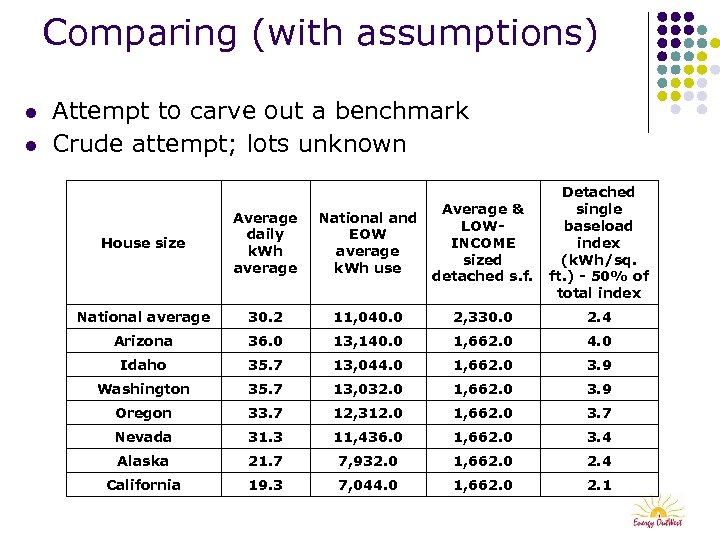
Comparing (with assumptions) l l Attempt to carve out a benchmark Crude attempt; lots unknown Detached single Average & National and LOWbaseload EOW INCOME index average sized (k. Wh/sq. k. Wh use detached s. f. ft. ) - 50% of total index House size Average daily k. Wh average National average 30. 2 11, 040. 0 2, 330. 0 2. 4 Arizona 36. 0 13, 140. 0 1, 662. 0 4. 0 Idaho 35. 7 13, 044. 0 1, 662. 0 3. 9 Washington 35. 7 13, 032. 0 1, 662. 0 3. 9 Oregon 33. 7 12, 312. 0 1, 662. 0 3. 7 Nevada 31. 3 11, 436. 0 1, 662. 0 3. 4 Alaska 21. 7 7, 932. 0 1, 662. 0 2. 4 19. 3 7, 044. 0 1, 662. 0 2. 1 California
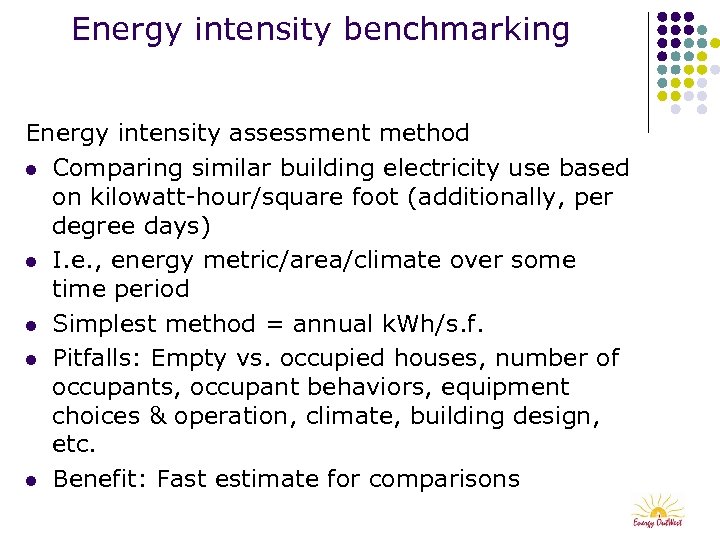
Energy intensity benchmarking Energy intensity assessment method l Comparing similar building electricity use based on kilowatt-hour/square foot (additionally, per degree days) l I. e. , energy metric/area/climate over some time period l Simplest method = annual k. Wh/s. f. l Pitfalls: Empty vs. occupied houses, number of occupants, occupant behaviors, equipment choices & operation, climate, building design, etc. l Benefit: Fast estimate for comparisons
Comparing with “Yardstick” ENERGY STAR attempt to carve out a benchmark & compare use across regions l l energystar. gov/index. cfm? fuseaction =HOME_ENERGY_YARDSTICK. show Get. Started
Section points l l Use data to compare, track trends, assume some level of “normal”, “high” or “low” use Calculate daily kilowatt-hour average for benchmarking purposes Determine specific annual k. Wh use & housing unit area (square feet) to calculate electricity use index for residence & benchmarking purposes Compare between & across similar & different households for local benchmarking
 Скачать презентацию Baseload Electricity quantify address manage 4 Mining patterns
737f28e8423fc68b7cec749da228ed6e.ppt