 Скачать презентацию Barriers to Developing Small Scale Hydropower in the
fc2f90d7854d7e0d24bb3b745fa98d1f.ppt
- Количество слайдов: 30



Barriers to Developing Small Scale Hydropower in the Philippines A Presentation for the Climate Change Information Center Dec. 10, 2002
Barriers to Developing Small-Scale Hydropower in the Philippines Summary • Introduction to HEDCOR • Mini-hydropower development in the Philippines • Barriers to developing mini-hydropower in the Philippines
About Hedcor • • Hydro Electric Development Corporation Is an affiliate of Aboitiz Equity Ventures Owns and/or operates 14 mini-hydro plants Total generating capacity of about 39 MWs Generating about 150 GWhrs annually
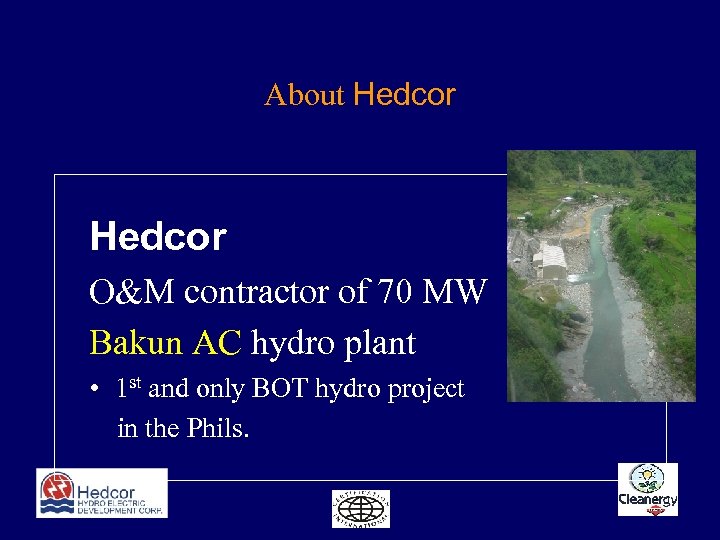
About Hedcor O&M contractor of 70 MW Bakun AC hydro plant • 1 st and only BOT hydro project in the Phils.
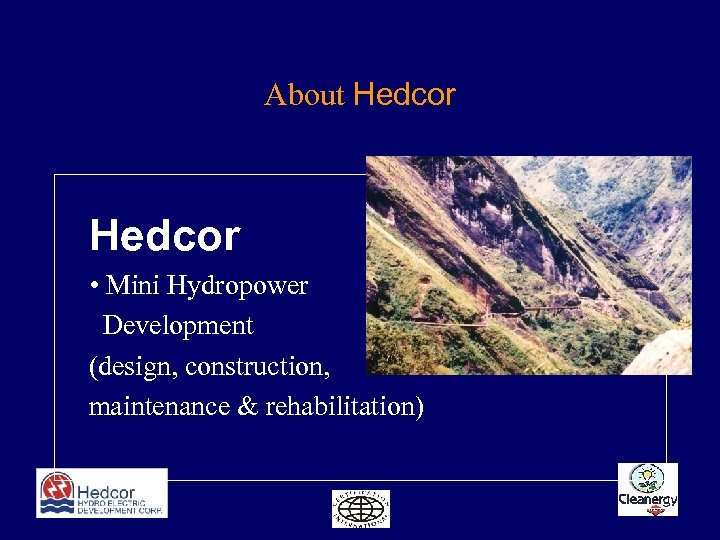
About Hedcor • Mini Hydropower Development (design, construction, maintenance & rehabilitation)
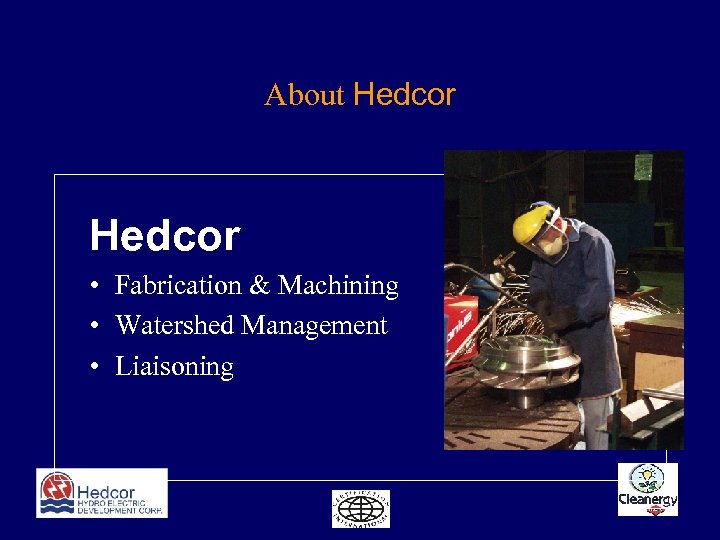
About Hedcor • Fabrication & Machining • Watershed Management • Liaisoning
About Hedcor’s vision: We lead in the promotion and development of clean energy.
Small-Scale Hydropower Development in the Philippines 3 laws & a code that affected the development of mini-hydropower: • R. A. 7156 - Mini-hydroelectric Power Incentives Act • R. A. 9136 – Electric Power Industry Reform Act • R. A. 6957 B. O. T. Law • National Grid Code
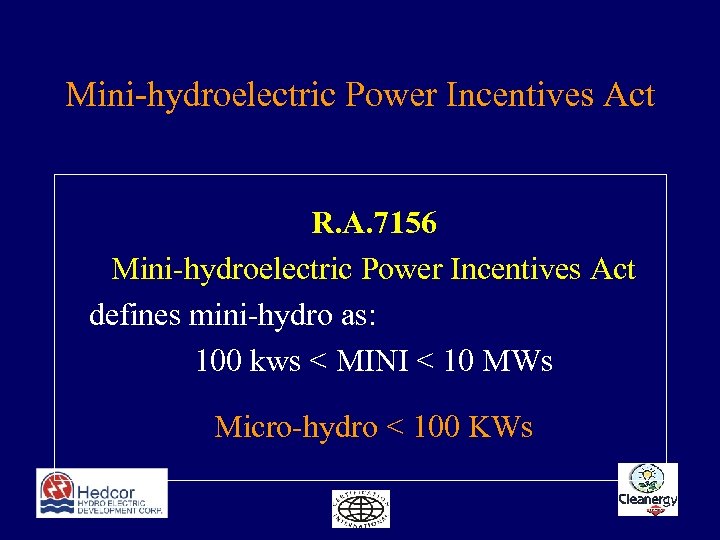
Mini-hydroelectric Power Incentives Act R. A. 7156 Mini-hydroelectric Power Incentives Act defines mini-hydro as: 100 kws < MINI < 10 MWs Micro-hydro < 100 KWs
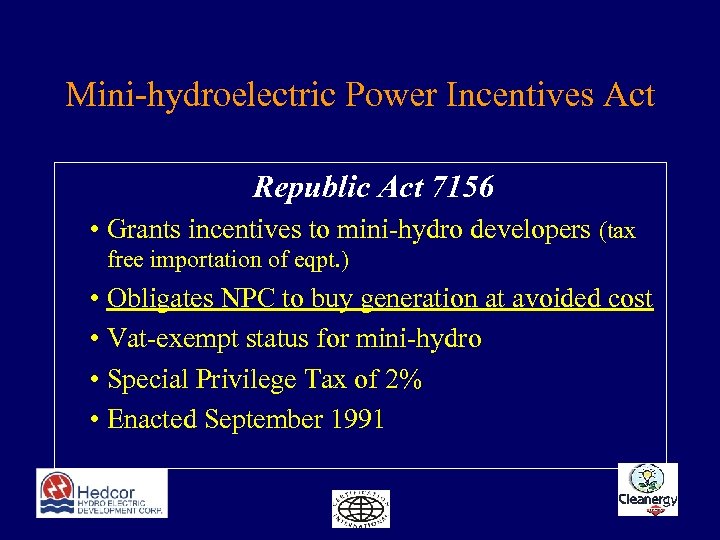
Mini-hydroelectric Power Incentives Act Republic Act 7156 • Grants incentives to mini-hydro developers (tax free importation of eqpt. ) • Obligates NPC to buy generation at avoided cost • Vat-exempt status for mini-hydro • Special Privilege Tax of 2% • Enacted September 1991
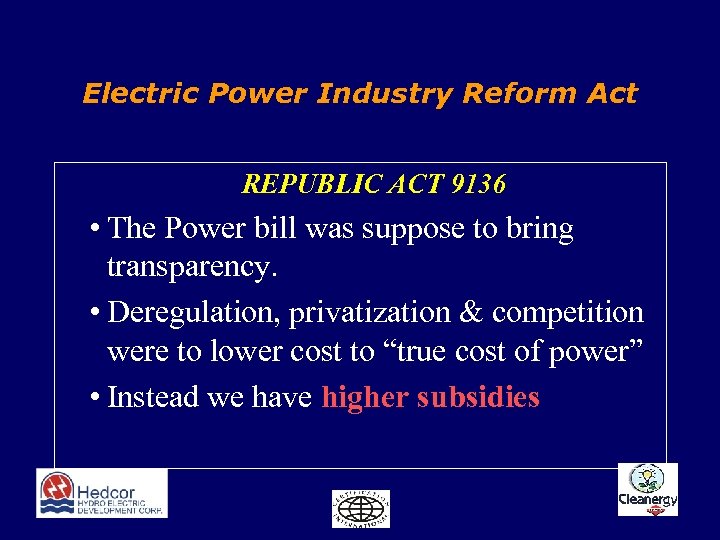
Electric Power Industry Reform Act REPUBLIC ACT 9136 • The Power bill was suppose to bring transparency. • Deregulation, privatization & competition were to lower cost to “true cost of power” • Instead we have higher subsidies
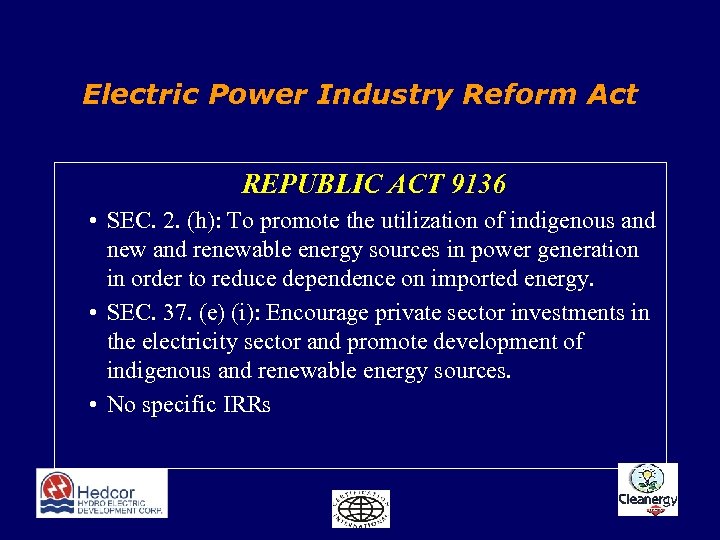
Electric Power Industry Reform Act REPUBLIC ACT 9136 • SEC. 2. (h): To promote the utilization of indigenous and new and renewable energy sources in power generation in order to reduce dependence on imported energy. • SEC. 37. (e) (i): Encourage private sector investments in the electricity sector and promote development of indigenous and renewable energy sources. • No specific IRRs
Build Operate Transfer Act REPUBLIC ACT 6957 & 7718 • Provided a framework of risk sharing between the private developer and GOVERNMENT • Developers could negotiate BOT contracts w/ LGU’s, government agencies and GOCC’s • Typically, a developer bids for a contract, constructs and operates the project for 25 yrs, and then turns the project over
National Grid Code The Code that all power plants comply with: • SCADA requirements • Tele-protection requirements • Communication requirements
Challenges in Developing Hydropower MARKET • Most mini-hydro schemes are in remote areas and therefore usually in coop franchises • Electric coops have small loads and poor load factors • Run-of-river hydro schemes cannot maintain firm capacity whole year round
Challenges in Developing Hydropower MARKET • Most mini-hydro schemes are in remote areas and therefore usually in coop franchises • Only a handful of electric coops are bankable
Challenges in Developing Hydropower WHEELING POWER • High cost of wheeling power: – Transmission rate: P 0. 3076 – Sub-transmission rate: P 0. 0362
Challenges in Developing Hydropower WHEELING POWER • The wheeling fee is based on the monthly peak demand.
Challenges in Developing Hydropower WHEELING POWER • The customer’s demand charges will only be reduced if the generator is able to generate at a firm level for the entire billing period
Challenges in Developing Hydropower Finance Long term loans at developmental rates are not available.
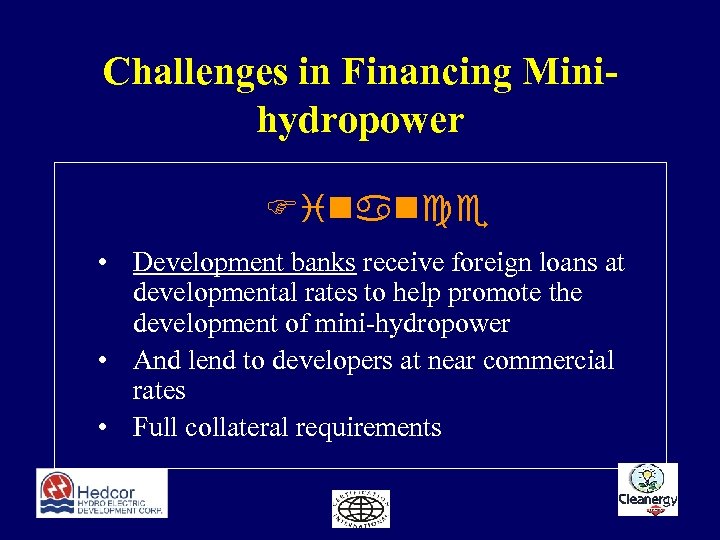
Challenges in Financing Minihydropower Finance • Development banks receive foreign loans at developmental rates to help promote the development of mini-hydropower • And lend to developers at near commercial rates • Full collateral requirements
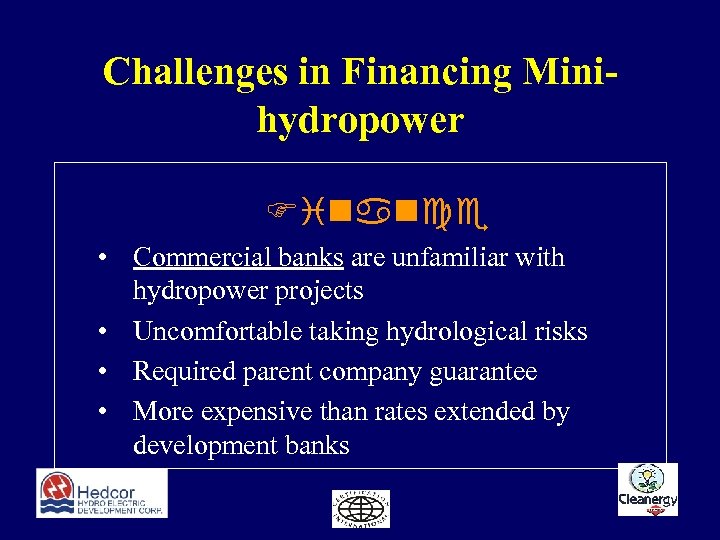
Challenges in Financing Minihydropower Finance • Commercial banks are unfamiliar with hydropower projects • Uncomfortable taking hydrological risks • Required parent company guarantee • More expensive than rates extended by development banks
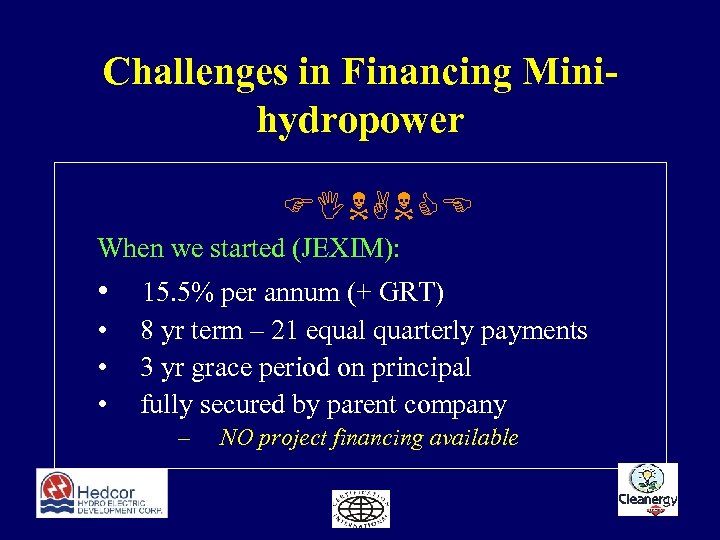
Challenges in Financing Minihydropower FINANCE When we started (JEXIM): • 15. 5% per annum (+ GRT) • • • 8 yr term – 21 equal quarterly payments 3 yr grace period on principal fully secured by parent company – NO project financing available
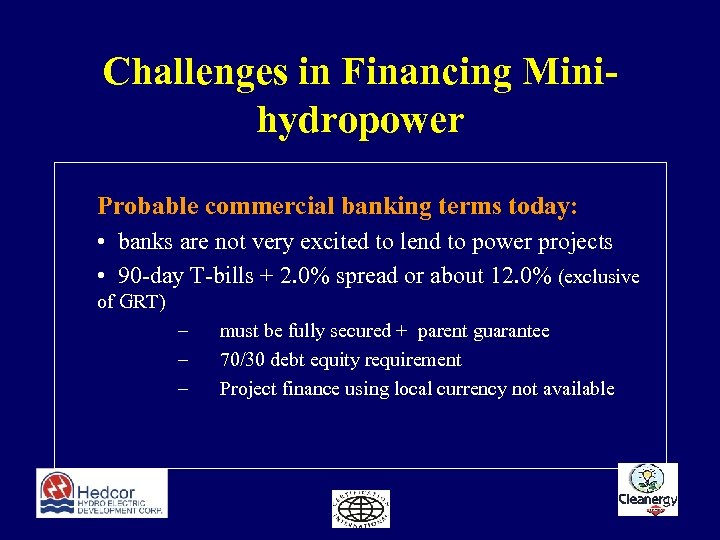
Challenges in Financing Minihydropower Probable commercial banking terms today: • banks are not very excited to lend to power projects • 90 -day T-bills + 2. 0% spread or about 12. 0% (exclusive of GRT) – – – must be fully secured + parent guarantee 70/30 debt equity requirement Project finance using local currency not available
Challenges in Developing Minihydropower Suggested measures to promote the development of mini-hydropower: • Create a market – require utilities to purchase X% of their consumption from NRE’s – public awareness campaign on clean energy

Challenges in Developing Minihydropower Suggested measures to promote the development of mini-hydropower: • eliminate or reduce the wheeling fees for NRE’s • charge wheeling fees based on average monthly use (i. e. kwhrs/hrs x rate)

Challenges in Developing Minihydropower Suggested measures to promote the development of mini-hydropower: • DOE/DENR to initiate steps to augment the revenue of mini-hydropower developers – possibly through CDM
Challenges in Developing Minihydropower Suggested measures to promote the development of mini-hydropower: • exempt mini-hydropower plants from technical requirements imposed on bigger plants (i. e. spinning reserve, back-up reserve, SCADA, reactive power capability, system frequency limits, etc. )
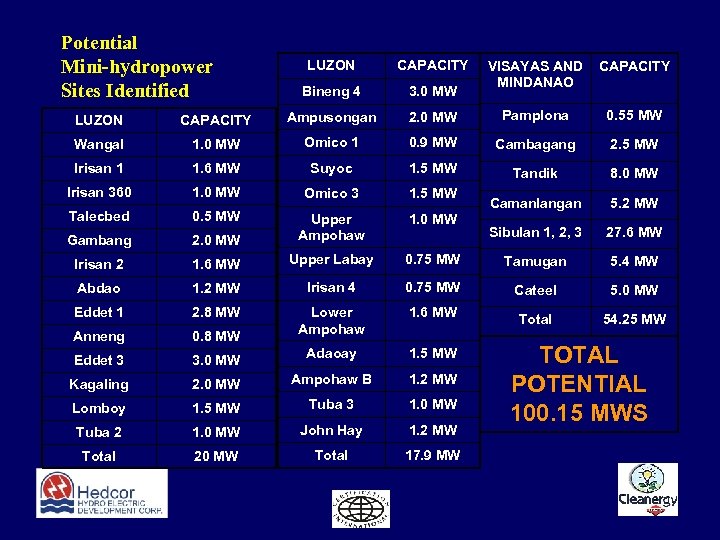
Potential Mini-hydropower Sites Identified LUZON CAPACITY Bineng 4 3. 0 MW VISAYAS AND MINDANAO CAPACITY LUZON CAPACITY Ampusongan 2. 0 MW Pamplona 0. 55 MW Wangal 1. 0 MW Omico 1 0. 9 MW Cambagang 2. 5 MW Irisan 1 1. 6 MW Suyoc 1. 5 MW Tandik 8. 0 MW Irisan 360 1. 0 MW Omico 3 1. 5 MW Talecbed 0. 5 MW Camanlangan 5. 2 MW 1. 0 MW Gambang 2. 0 MW Upper Ampohaw Sibulan 1, 2, 3 27. 6 MW Irisan 2 1. 6 MW Upper Labay 0. 75 MW Tamugan 5. 4 MW Abdao 1. 2 MW Irisan 4 0. 75 MW Cateel 5. 0 MW Eddet 1 2. 8 MW 1. 6 MW Total 54. 25 MW Anneng 0. 8 MW Lower Ampohaw Eddet 3 3. 0 MW Adaoay 1. 5 MW Kagaling 2. 0 MW Ampohaw B 1. 2 MW Lomboy 1. 5 MW Tuba 3 1. 0 MW Tuba 2 1. 0 MW John Hay 1. 2 MW Total 20 MW Total 17. 9 MW TOTAL POTENTIAL 100. 15 MWS

www. hedcor. com
Скачать презентацию Barriers to Developing Small Scale Hydropower in the
fc2f90d7854d7e0d24bb3b745fa98d1f.ppt