 Скачать презентацию Барановичский государственный университет ТЕОРЕТИЧЕСКАЯ ГРАММАТИКА Составитель Бартошевич Ирина
Lecture 4.ppt
- Количество слайдов: 17



Барановичский государственный университет ТЕОРЕТИЧЕСКАЯ ГРАММАТИКА Составитель: Бартошевич Ирина Александровна, заведующий кафедрой, магистр педагогических наук, преподаватель кафедры теории и практики английского языка
Lecture 4 Parts of Speech
Terms n parts of speech
Questions § § What do parts of speech denote? What are the approaches to parts of speech’ classification? What are the difficulties of parts of speech’ classification? What are the criteria of the words’ classification into parts of speech?
Parts of speech - classes of words, all the members of which have certain common characteristics which distinguish them from the members of other classes. The term “parts of speech” was developed in Ancient Greek linguistics. It reflects the fact that at that time there was no distinction between language as a system and speech, the word as a functional element of the sentence and the word as a vocabulary unit.
Classifications may be based either on: *one criterion (homogeneous) or on * a combination of several criteria (heterogeneous).
There are four approaches to the problem of word classification into parts of speech : § classical It is based on Latin grammar; according to its classification of parts of speech all words were divided into : *declinable (nouns, pronouns, verbs and participles); *indeclinable (adverbs, prepositions, conjunctions and interjections). This system was reproduced in the earliest English grammars, but it cannot be applied to English because the principle of declinability/indeclinability is not relevant for analytical languages.
§ functional It was introduced by Henry Sweet who resorted to the functional features of words and singled out: *nominative parts of speech: -noun-words (noun, noun-pronoun, noun-numeral, infinitive, gerund), -adjective-words (adjective, adjective-pronoun, adjective-numeral, participles), -verb (finite verb, verbals – gerund, infinitive, participles); *particles (adverb, preposition, conjunction and interjection).
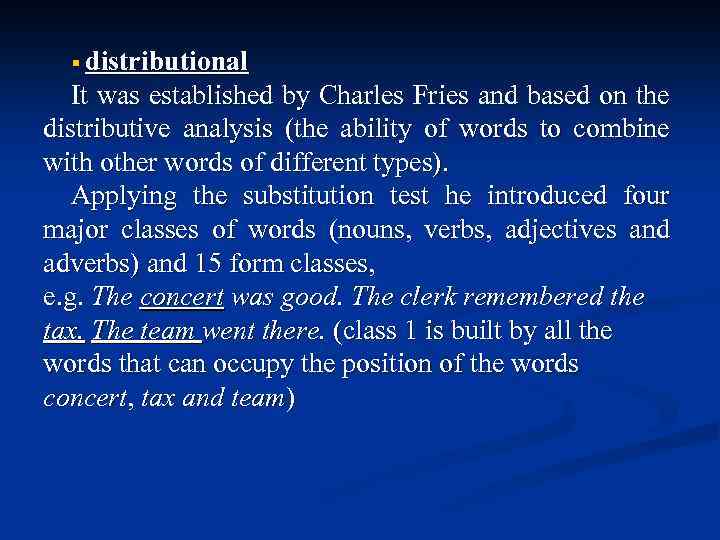
§ distributional It was established by Charles Fries and based on the distributive analysis (the ability of words to combine with other words of different types). Applying the substitution test he introduced four major classes of words (nouns, verbs, adjectives and adverbs) and 15 form classes, e. g. The concert was good. The clerk remembered the tax. The team went there. (class 1 is built by all the words that can occupy the position of the words concert, tax and team)
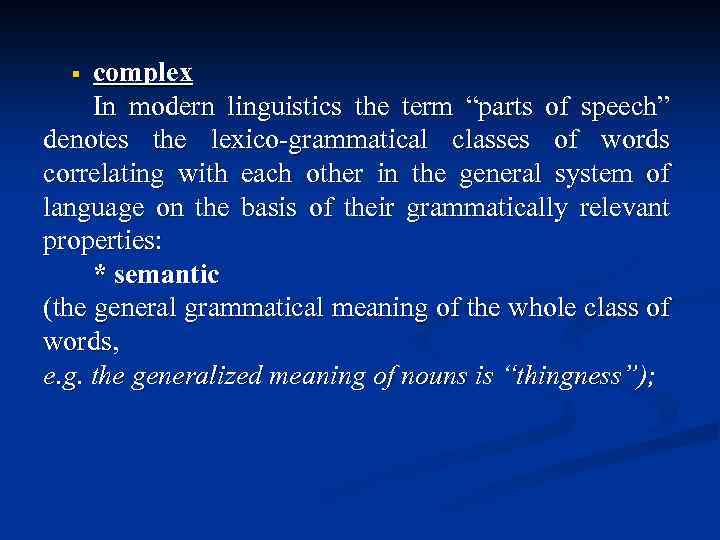
complex In modern linguistics the term “parts of speech” denotes the lexico-grammatical classes of words correlating with each other in the general system of language on the basis of their grammatically relevant properties: * semantic (the general grammatical meaning of the whole class of words, e. g. the generalized meaning of nouns is “thingness”); §
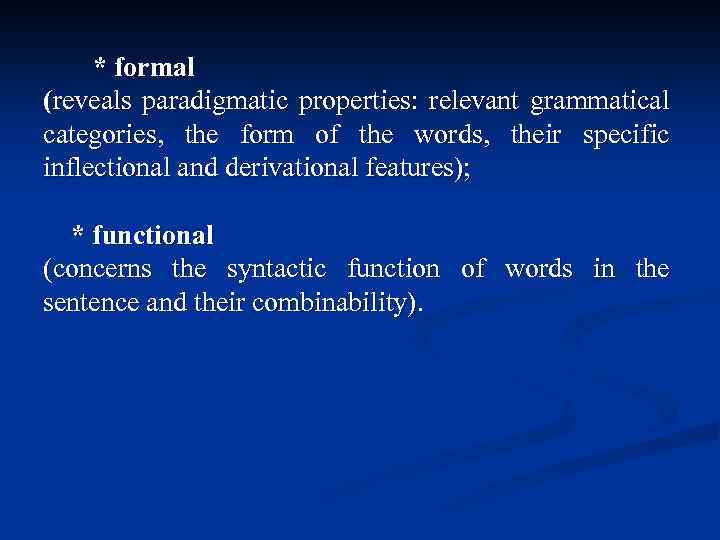
* formal (reveals paradigmatic properties: relevant grammatical categories, the form of the words, their specific inflectional and derivational features); * functional (concerns the syntactic function of words in the sentence and their combinability).
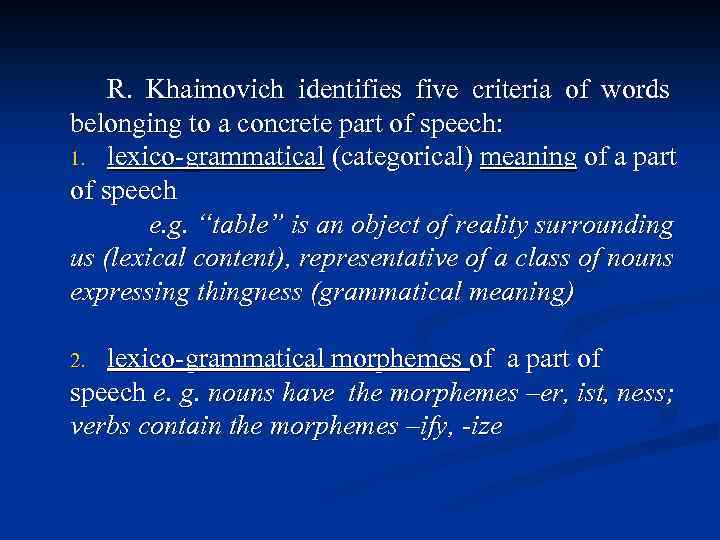
R. Khaimovich identifies five criteria of words belonging to a concrete part of speech: 1. lexico-grammatical (categorical) meaning of a part of speech e. g. “table” is an object of reality surrounding us (lexical content), representative of a class of nouns expressing thingness (grammatical meaning) lexico-grammatical morphemes of a part of speech e. g. nouns have the morphemes –er, ist, ness; verbs contain the morphemes –ify, -ize 2.
3. grammatical categories (paradigm) e. g. nouns have the categories of number and case in English; adjectives – the category of comparison 4. combinability (the ability of the whole lexicogrammatical class of words to form combinations with words of other classes) e. g. adjectives are combined with nouns, adverbs with verbs 5. function in a sentence e. g. a noun usually functions as a subject or an object, adjective as an attribute
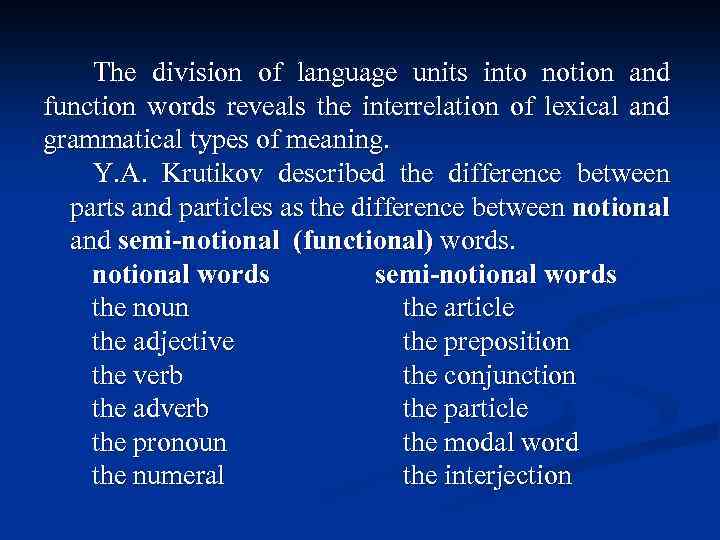
The division of language units into notion and function words reveals the interrelation of lexical and grammatical types of meaning. Y. A. Krutikov described the difference between parts and particles as the difference between notional and semi-notional (functional) words. notional words semi-notional words the noun the article the adjective the preposition the verb the conjunction the adverb the particle the pronoun the modal word the numeral the interjection
B. Ilyish objects to the division of words into notional and functional parts of speech. He says that prepositions and conjunctions are no less notional than nouns and verbs, as they also express some relations and connections existing independently.
There is yet no generally accepted system of English parts of speech. Some words cannot find their proper place, e. g. after all. Some linguists call the class of adverbs a dustbin. It can be explained by the fact that to the class of adverbs belong those words that cannot find their place anywhere else.
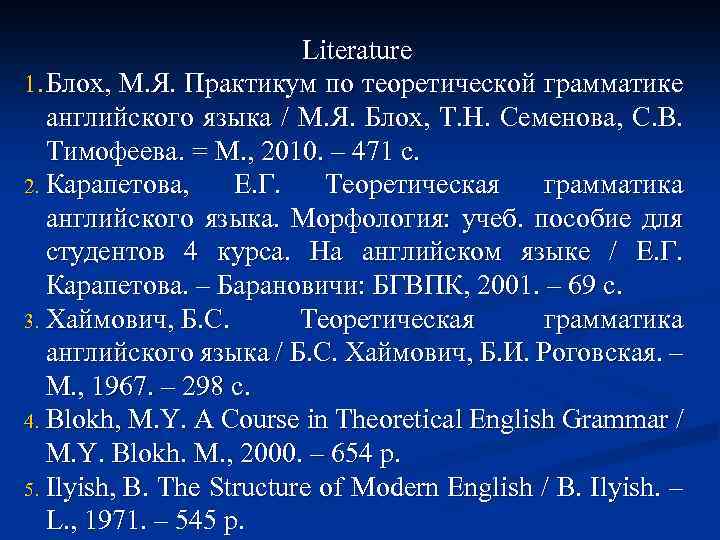
Literature 1. Блох, М. Я. Практикум по теоретической грамматике английского языка / М. Я. Блох, Т. Н. Семенова, С. В. Тимофеева. = М. , 2010. – 471 с. 2. Карапетова, Е. Г. Теоретическая грамматика английского языка. Морфология: учеб. пособие для студентов 4 курса. На английском языке / Е. Г. Карапетова. – Барановичи: БГВПК, 2001. – 69 c. 3. Хаймович, Б. С. Теоретическая грамматика английского языка / Б. С. Хаймович, Б. И. Роговская. – M. , 1967. – 298 с. 4. Blokh, M. Y. A Course in Theoretical English Grammar / M. Y. Blokh. M. , 2000. – 654 p. 5. Ilyish, B. The Structure of Modern English / B. Ilyish. – L. , 1971. – 545 p.
Скачать презентацию Барановичский государственный университет ТЕОРЕТИЧЕСКАЯ ГРАММАТИКА Составитель Бартошевич Ирина
Lecture 4.ppt