 Скачать презентацию Banking Financial Services Securities Investment Management
5e4978ac424702c956901e341b7c8a84.ppt
- Количество слайдов: 48



Banking & Financial Services Securities & Investment Management By Makarand Diwan
Contents n n n n n Business Entity, Equity and Debt Financial Instruments Financial Market Players Investment Management & Security Analysis Securities Transactions Securities related Systems & Components Financial Systems-Design Considerations Securities Systems-Issues/Pain Points An Example of Investment Accounting System
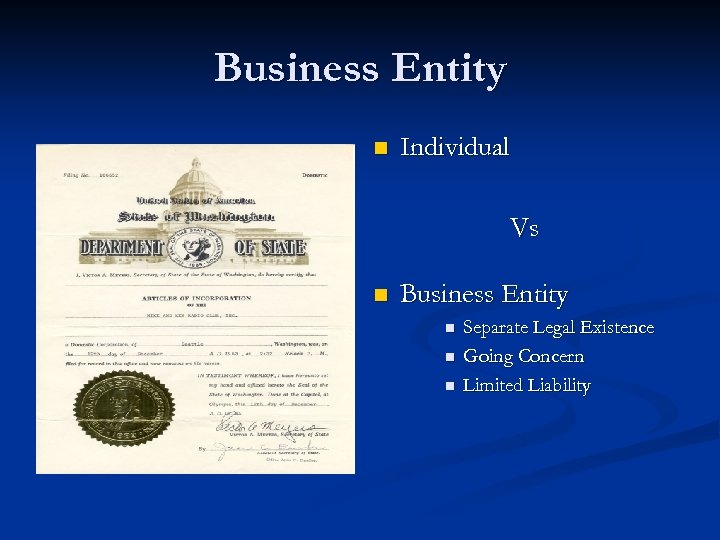
Business Entity n Individual Vs n Business Entity n n n Separate Legal Existence Going Concern Limited Liability
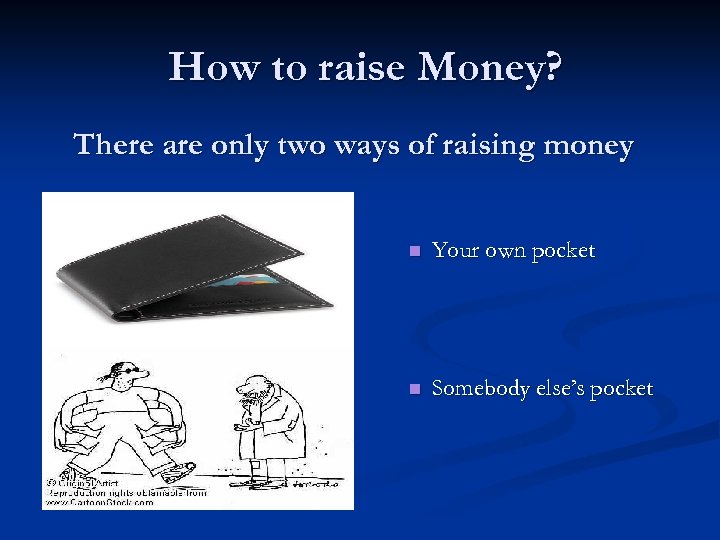
How to raise Money? There are only two ways of raising money n Your own pocket n Somebody else’s pocket
Equity and Debt When business entities want to raise money there are two options: n Equity n Shareholders’ (Owners’) Investment n Debt n Borrowing from Banks & Financial Institutions n Issue of Debt Instruments
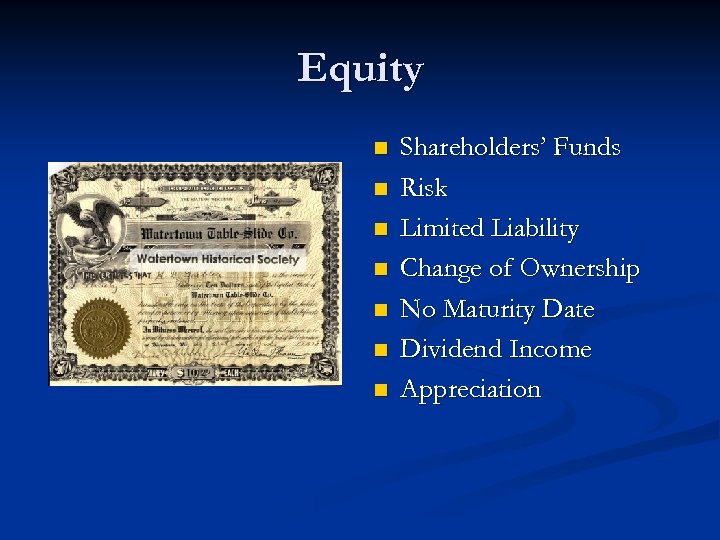
Equity n n n n Shareholders’ Funds Risk Limited Liability Change of Ownership No Maturity Date Dividend Income Appreciation
Debt n n n Bank Loans Issue of Debt Securities Repayment Long/Short Term Secured/Unsecured Interest Cost
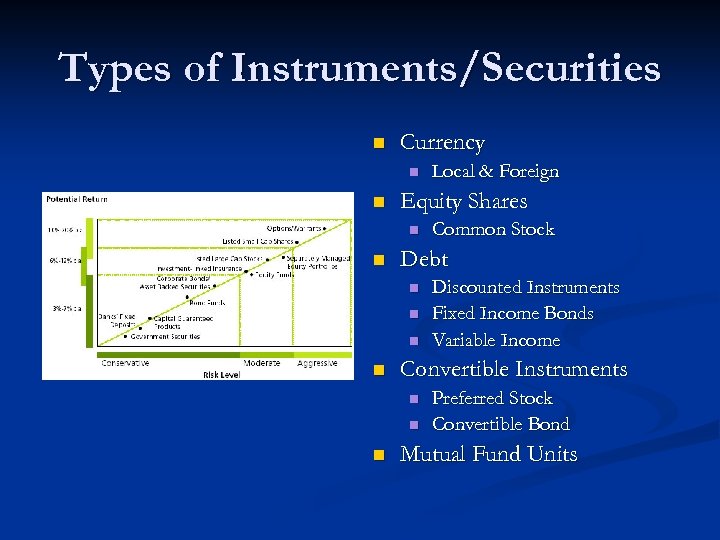
Types of Instruments/Securities n Currency n n Equity Shares n n Discounted Instruments Fixed Income Bonds Variable Income Convertible Instruments n n n Common Stock Debt n n Local & Foreign Preferred Stock Convertible Bond Mutual Fund Units
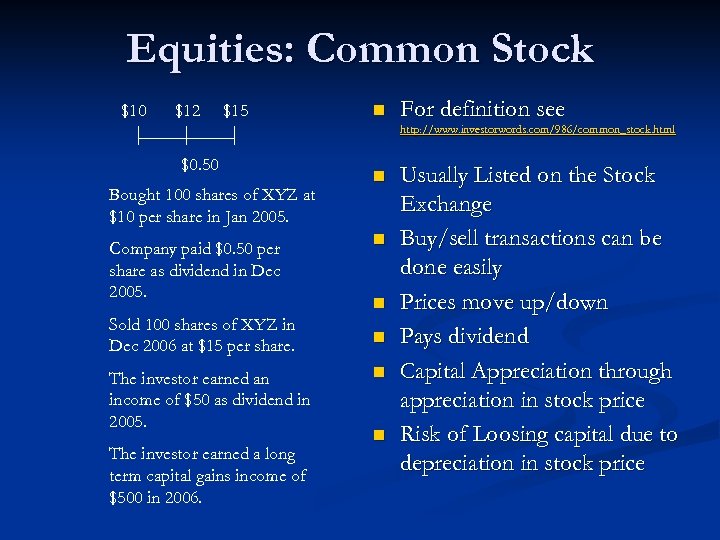
Equities: Common Stock $10 $12 $15 n For definition see http: //www. investorwords. com/986/common_stock. html $0. 50 Bought 100 shares of XYZ at $10 per share in Jan 2005. Company paid $0. 50 per share as dividend in Dec 2005. Sold 100 shares of XYZ in Dec 2006 at $15 per share. The investor earned an income of $50 as dividend in 2005. The investor earned a long term capital gains income of $500 in 2006. n n n Usually Listed on the Stock Exchange Buy/sell transactions can be done easily Prices move up/down Pays dividend Capital Appreciation through appreciation in stock price Risk of Loosing capital due to depreciation in stock price
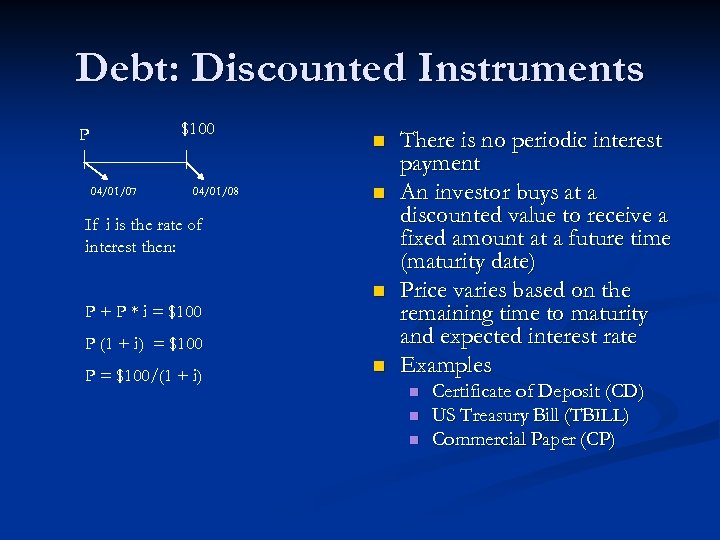
Debt: Discounted Instruments $100 P 04/01/07 04/01/08 n n If i is the rate of interest then: P + P * i = $100 n P (1 + i) = $100 P = $100/(1 + i) n There is no periodic interest payment An investor buys at a discounted value to receive a fixed amount at a future time (maturity date) Price varies based on the remaining time to maturity and expected interest rate Examples n n n Certificate of Deposit (CD) US Treasury Bill (TBILL) Commercial Paper (CP)
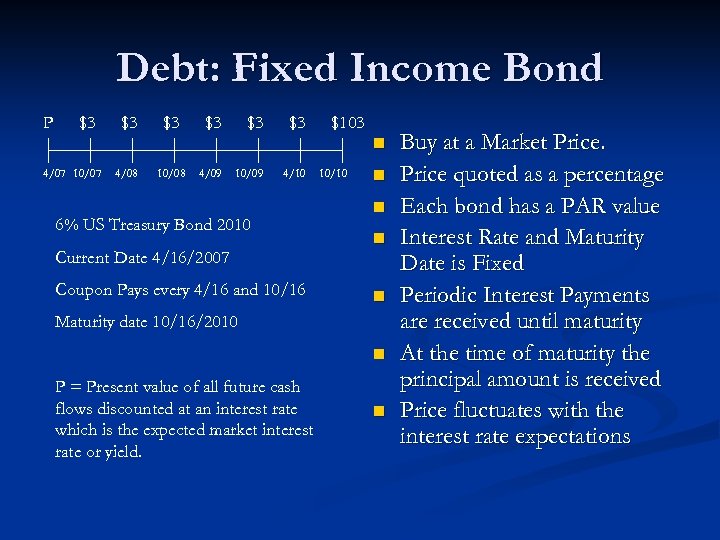
Debt: Fixed Income Bond P $3 $3 $3 $103 n 4/07 10/07 4/08 10/08 4/09 10/09 4/10 6% US Treasury Bond 2010 Current Date 4/16/2007 Coupon Pays every 4/16 and 10/16 10/10 n n Maturity date 10/16/2010 n P = Present value of all future cash flows discounted at an interest rate which is the expected market interest rate or yield. n Buy at a Market Price quoted as a percentage Each bond has a PAR value Interest Rate and Maturity Date is Fixed Periodic Interest Payments are received until maturity At the time of maturity the principal amount is received Price fluctuates with the interest rate expectations
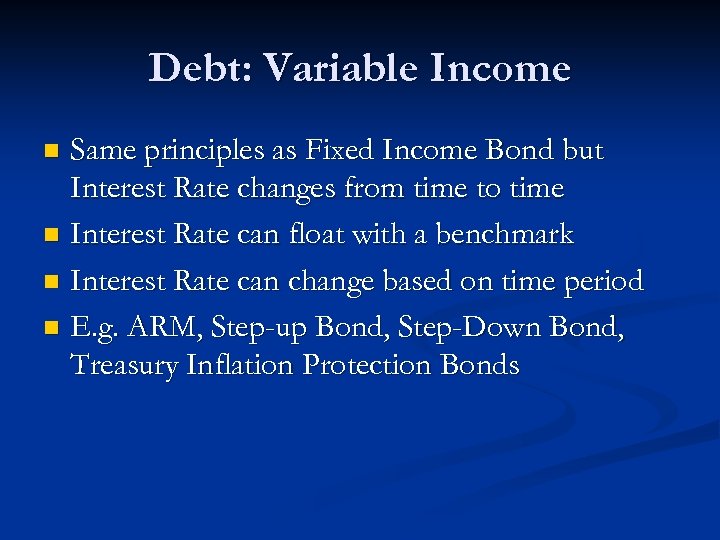
Debt: Variable Income Same principles as Fixed Income Bond but Interest Rate changes from time to time n Interest Rate can float with a benchmark n Interest Rate can change based on time period n E. g. ARM, Step-up Bond, Step-Down Bond, Treasury Inflation Protection Bonds n
Financial Market Participants n n n n Investors Banks Federal Reserve System Automated Clearing House (ACH) Issuers Credit Rating Agencies Registrars & Transfer Agents Depositories Stock Exchanges Brokers Market Makers Portfolio Managers/Mutual Funds Custodians
Investors n Investors are the key players in any market n More the investors and more money available for investment means better depth and efficiency of the market n Individual Investors n Institutional Investors
Banks n n A Bank mobilizes savings of the community through deposits made in checking, savings and CDs Holds money in an electronic form thereby simplifying movement of money Provides loans for personal and business purposes Provides services such as remittance, currency exchange, Commercial Bills Collection and discounting, Issue of Credit Cards
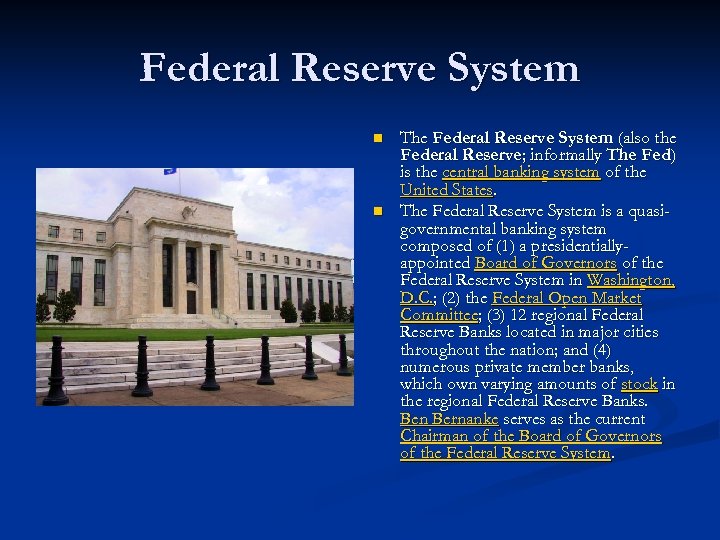
Federal Reserve System n n The Federal Reserve System (also the Federal Reserve; informally The Fed) is the central banking system of the United States. The Federal Reserve System is a quasigovernmental banking system composed of (1) a presidentiallyappointed Board of Governors of the Federal Reserve System in Washington, D. C. ; (2) the Federal Open Market Committee; (3) 12 regional Federal Reserve Banks located in major cities throughout the nation; and (4) numerous private member banks, which own varying amounts of stock in the regional Federal Reserve Banks. Ben Bernanke serves as the current Chairman of the Board of Governors of the Federal Reserve System.
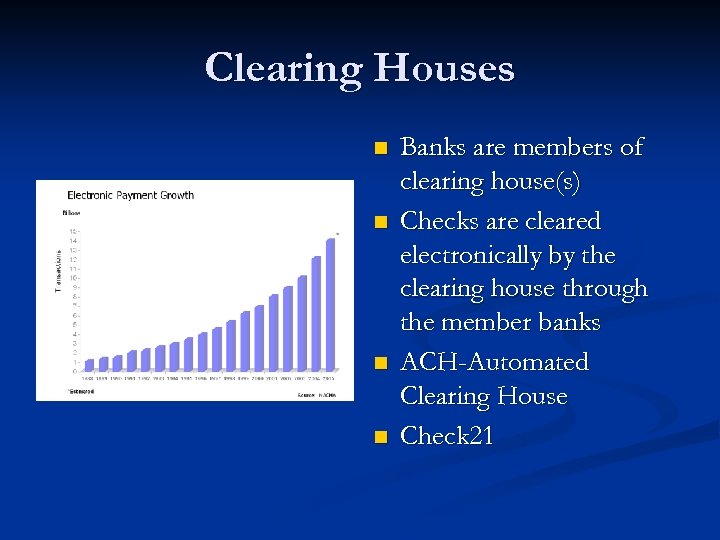
Clearing Houses n n Banks are members of clearing house(s) Checks are cleared electronically by the clearing house through the member banks ACH-Automated Clearing House Check 21
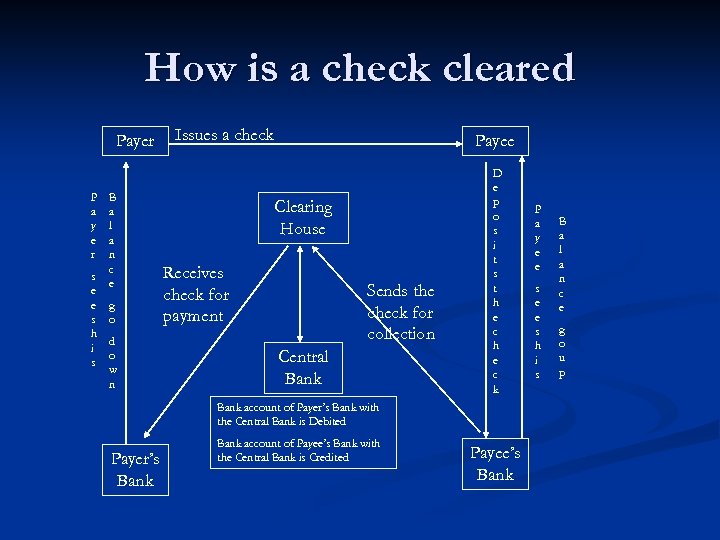
How is a check cleared Payer P a y e r s e e s h i s B a l a n c e g o d o w n Issues a check Payee Clearing House Receives check for payment Sends the check for collection Central Bank D e p o s i t s t h e c k Bank account of Payer’s Bank with the Central Bank is Debited Payer’s Bank account of Payee’s Bank with the Central Bank is Credited Payee’s Bank P a y e e s h i s B a l a n c e g o u p
Issuers n Issuers of Equity or Debt Instruments n Types of Issuers n n n Federal Government State Governments Municipalities Corporate Foreign Issuers SEC-Regulatory Authority n Registered Securities
Credit Rating Agencies n n n Credit Rating Agencies provide ratings to issuers’ and the debt instruments issued by them S&P, Moody’s and Fitch are three prominent Credit Rating Agencies S&P Credit Ratings definitions are available at http: //www 2. standardandpoors. com/portal/site/ sp/en/us/page. article/2, 1, 3, 0, 1148442391999. htm l
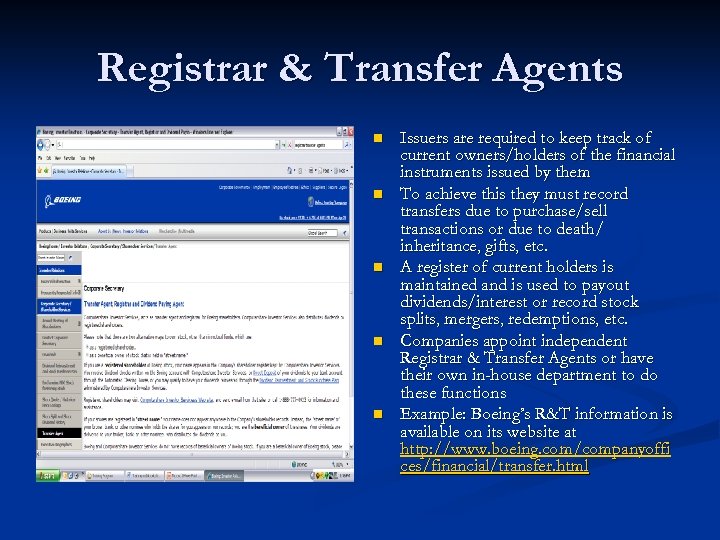
Registrar & Transfer Agents n n n Issuers are required to keep track of current owners/holders of the financial instruments issued by them To achieve this they must record transfers due to purchase/sell transactions or due to death/ inheritance, gifts, etc. A register of current holders is maintained and is used to payout dividends/interest or record stock splits, mergers, redemptions, etc. Companies appoint independent Registrar & Transfer Agents or have their own in-house department to do these functions Example: Boeing’s R&T information is available on its website at http: //www. boeing. com/companyoffi ces/financial/transfer. html
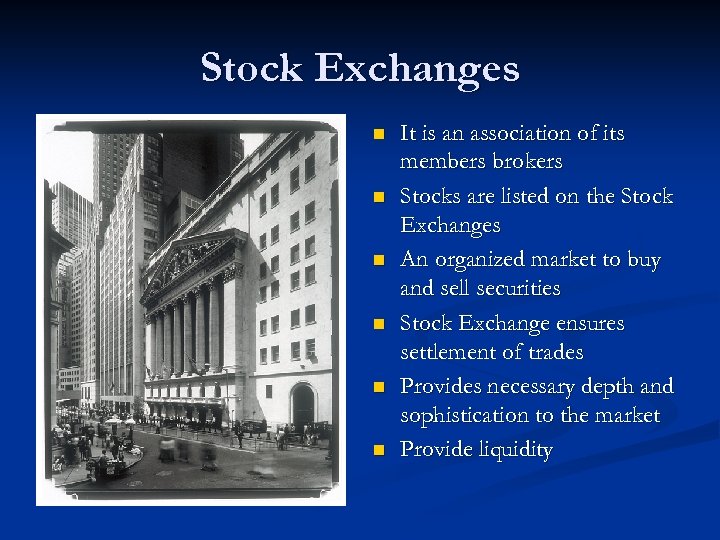
Stock Exchanges n n n It is an association of its members brokers Stocks are listed on the Stock Exchanges An organized market to buy and sell securities Stock Exchange ensures settlement of trades Provides necessary depth and sophistication to the market Provide liquidity
Depositories n n Through depository participants, securities holdings of investors are held with depositories in an electronic form. The Trades are cleared and settled through depositories electronically.
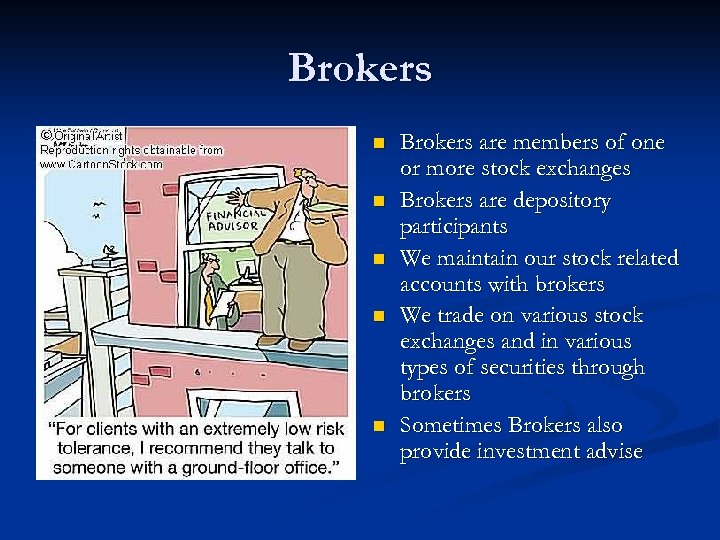
Brokers n n n Brokers are members of one or more stock exchanges Brokers are depository participants We maintain our stock related accounts with brokers We trade on various stock exchanges and in various types of securities through brokers Sometimes Brokers also provide investment advise
Market Maker n n n A market maker makes a market in one or more securities He is always ready to buy or sell a security in which he makes the market A two-way quote is given by the market maker n n Bid – Price at which the buyer is ready to buy Ask – Price at which the seller is ready to sell The difference in the Bid and Ask price is the spread that market maker earns as his profit. If a security is liquid, the spread is usually less and if the security is illiquid the spread is usually high.
Portfolio Managers/Mutual Funds n n n Portfolio Managers provide Investment Management Services to Individual Investors and Institutional Investors Usually Portfolio Managers will provide their services to High Net-worth individuals Mutual Funds also perform investment management functions for a large number of small investors. They pull together financial resources of small investors and then invest those in various financial instruments. They usually offer a better rate of return than the novice investor would have got had he/she invested on his/her own.
Custodians n Custodians offer Custody Services to: n n n Institutional Customers Portfolio Managers Mutual Fund Managers Custodians maintain the safe custody of their clients’ investments Custodians execute clients instructions for settlement of trades Custodians ensure collection of income due on their clients’ investments
Investment Management n Risk vs. Reward n n Diversification n n Higher the expectation of reward higher the risk Not to put all eggs in one basket Asset Allocation n 10% Gold, 40% US Equities, 25% Fixed Income, 20% Real Estate, 5% Foreign Equities, Objective: Growth vs. Income n Liquidity n
Financial Market Performance n n n n n Political Stability Government Policies Economic indicators, GDP, Balance of Payment, Inflation, Unemployment War, Natural Calamities Corporate Performance Inter-linkages of World Markets Future Outlook Consumer Confidence Expectation of Yield Investor Sentiment
Financial Market: Risks Country/Currency Risk n Market Risk n Credit Risk n Counterparty Risks n Settlement Risk n Operational Risk n Proper Setting up of Limits and Monitoring of exposures is necessary n
Corporate Results n Earnings Statement Income n Expense n n Balance Sheet Assets – What business owns n Liabilities – What business owes n Shareholders’ Equity n n Cash Flow Statement
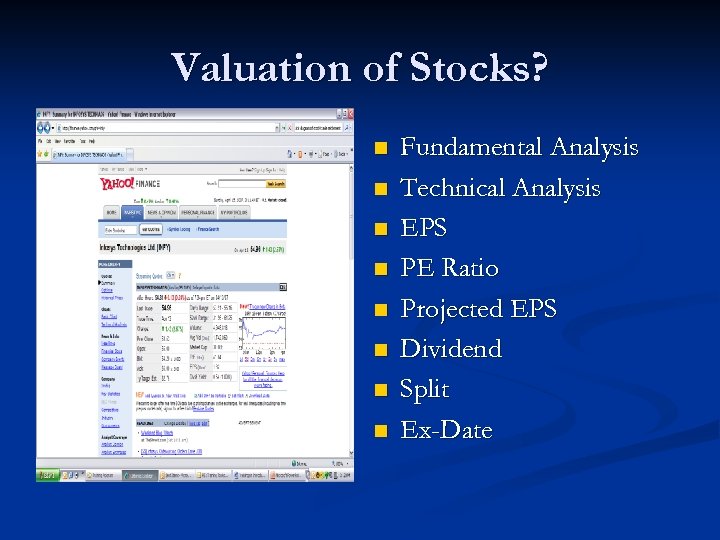
Valuation of Stocks? n n n n Fundamental Analysis Technical Analysis EPS PE Ratio Projected EPS Dividend Split Ex-Date
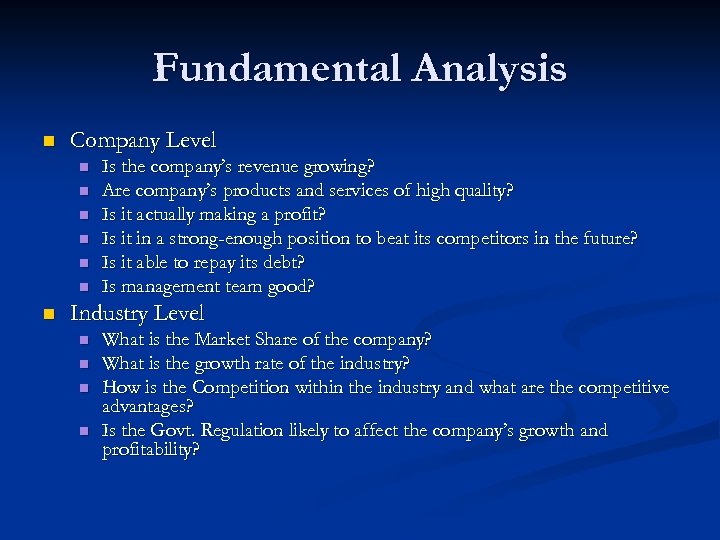
Fundamental Analysis n Company Level n n n n Is the company’s revenue growing? Are company’s products and services of high quality? Is it actually making a profit? Is it in a strong-enough position to beat its competitors in the future? Is it able to repay its debt? Is management team good? Industry Level n n What is the Market Share of the company? What is the growth rate of the industry? How is the Competition within the industry and what are the competitive advantages? Is the Govt. Regulation likely to affect the company’s growth and profitability?
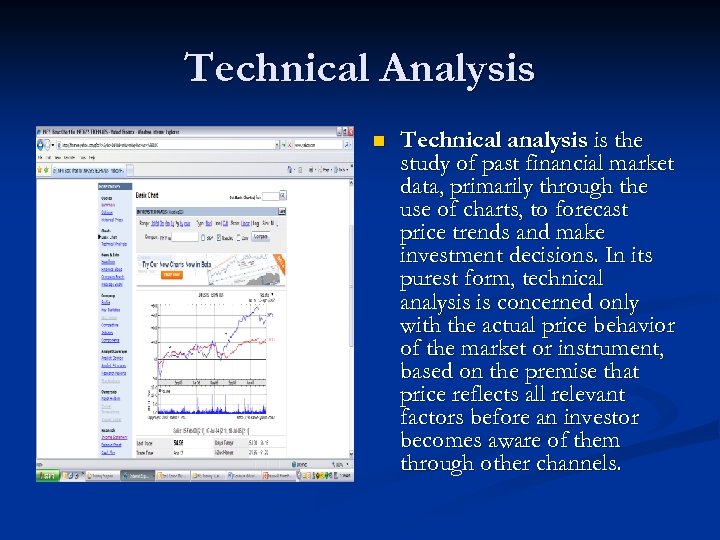
Technical Analysis n Technical analysis is the study of past financial market data, primarily through the use of charts, to forecast price trends and make investment decisions. In its purest form, technical analysis is concerned only with the actual price behavior of the market or instrument, based on the premise that price reflects all relevant factors before an investor becomes aware of them through other channels.
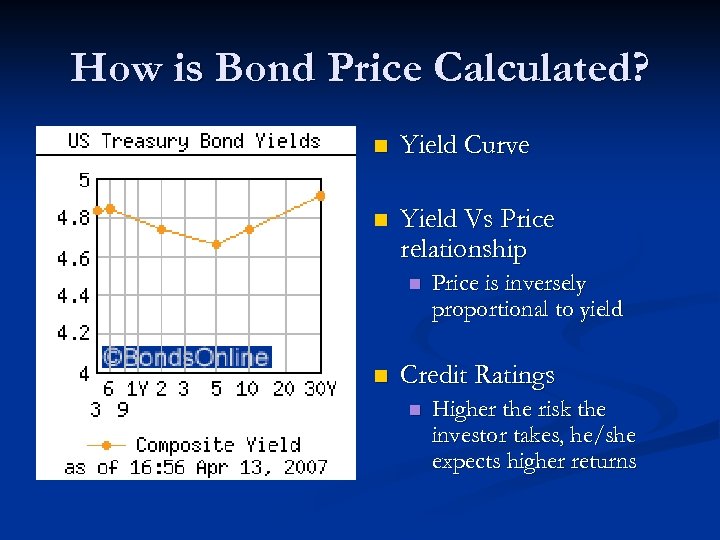
How is Bond Price Calculated? n Yield Curve n Yield Vs Price relationship n n Price is inversely proportional to yield Credit Ratings n Higher the risk the investor takes, he/she expects higher returns
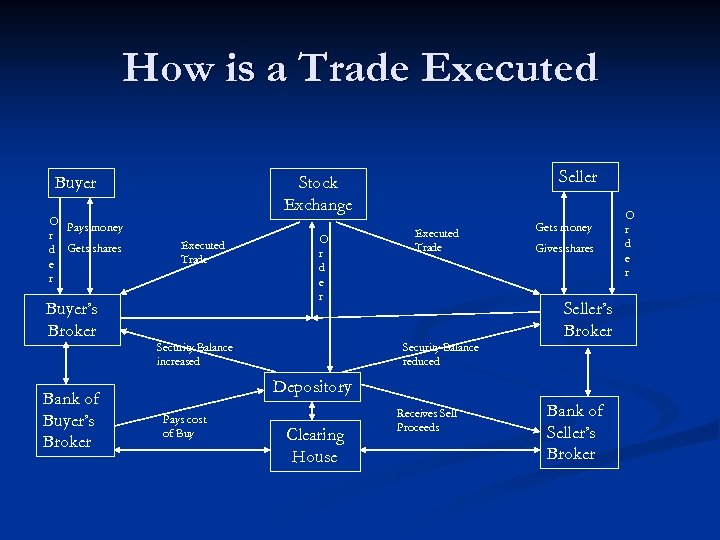
How is a Trade Executed Buyer O Pays money r d Gets shares e r Buyer’s Broker Bank of Buyer’s Broker Seller Stock Exchange Executed Trade O r d e r Security Balance increased Executed Trade Security Balance reduced Gets money Gives shares Seller’s Broker Depository Pays cost of Buy Clearing House Receives Sell Proceeds Bank of Seller’s Broker O r d e r
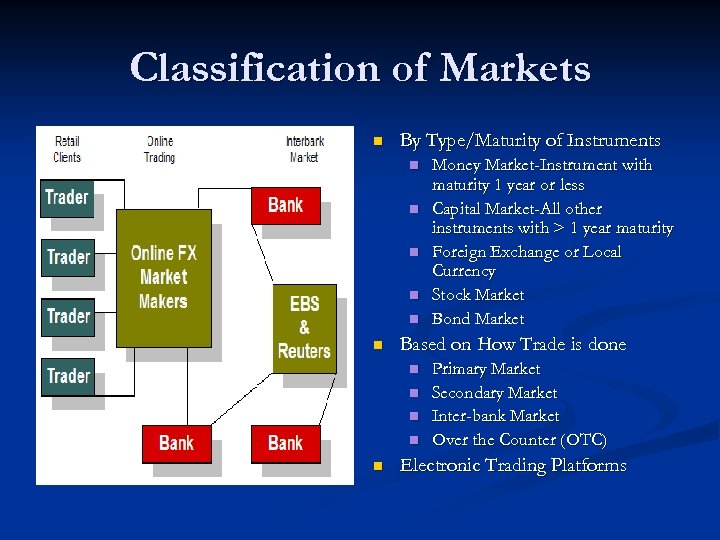
Classification of Markets n By Type/Maturity of Instruments n n n Based on How Trade is done n n n Money Market-Instrument with maturity 1 year or less Capital Market-All other instruments with > 1 year maturity Foreign Exchange or Local Currency Stock Market Bond Market Primary Market Secondary Market Inter-bank Market Over the Counter (OTC) Electronic Trading Platforms
Primary Market n New Issues Initial Public Offering n Private Placements n Issuer sells the new securities for the first time to Investors either directly or through Brokers n Investment Banker n Prospectus n Subscriptions at the Issue Price fixed by the Issuer or Bids are submitted in an Auction n
Secondary Market Subsequent trading of financial instruments among investors n Usually through an organized market, such as stock exchange, inter-bank market, OTC market, etc. n Issuer is not affected in the process. Number of outstanding shares or debt does not change n Issuer must record the change in ownership to payout distributions/effect corporate actions n
Over the Counter (OTC) OTC trading is to trade financial instruments such as stocks, bonds, commodities, derivatives, etc. , directly between two parties. It is the opposite of exchange trading which happens on an organized exchange, such as Stock Exchange or Commodities Exchange. n An OTC Contract is a bilateral contract in which two parties agree on how a particular trade or agreement is to be settled in the future. n
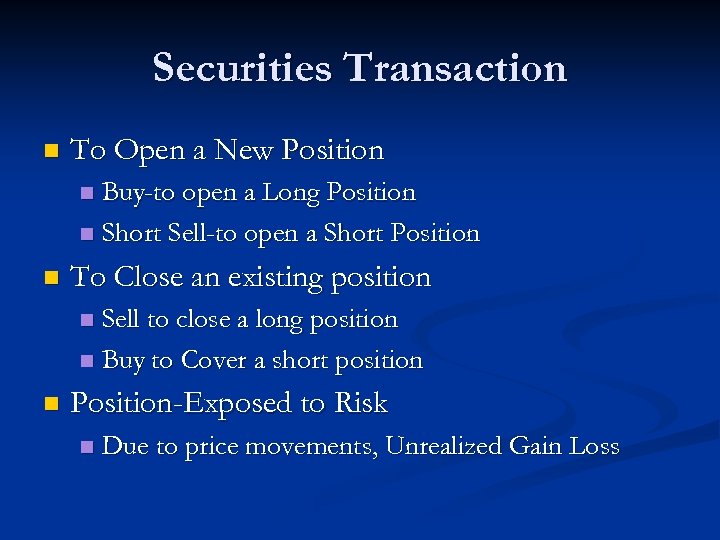
Securities Transaction n To Open a New Position Buy-to open a Long Position n Short Sell-to open a Short Position n n To Close an existing position Sell to close a long position n Buy to Cover a short position n n Position-Exposed to Risk n Due to price movements, Unrealized Gain Loss
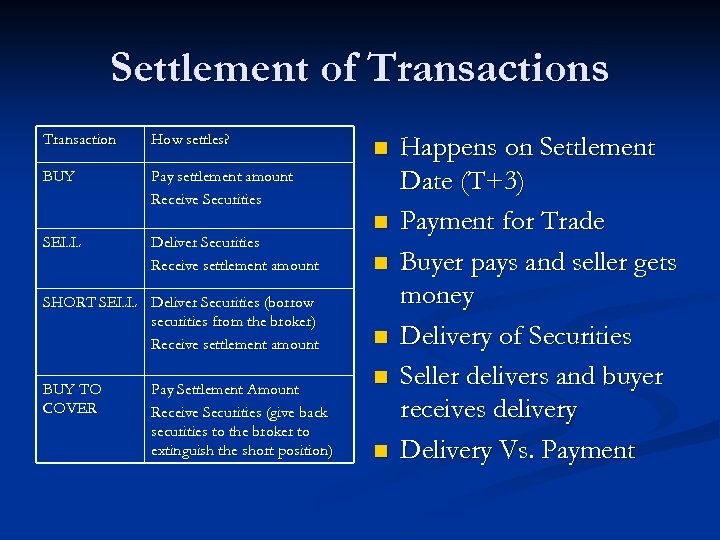
Settlement of Transactions Transaction How settles? BUY Pay settlement amount Receive Securities SELL Deliver Securities Receive settlement amount SHORT SELL Deliver Securities (borrow securities from the broker) Receive settlement amount BUY TO COVER Pay Settlement Amount Receive Securities (give back securities to the broker to extinguish the short position) n n n Happens on Settlement Date (T+3) Payment for Trade Buyer pays and seller gets money Delivery of Securities Seller delivers and buyer receives delivery Delivery Vs. Payment
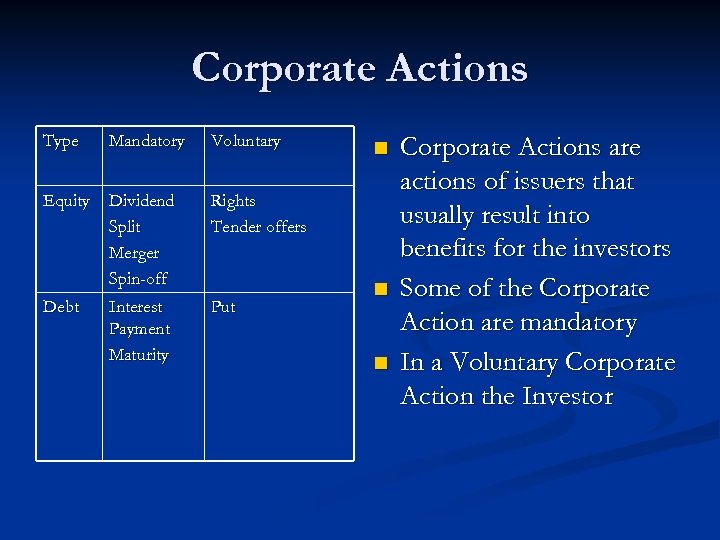
Corporate Actions Type Mandatory Voluntary Equity Dividend Split Merger Spin-off Rights Tender offers Interest Payment Maturity Put Debt n n n Corporate Actions are actions of issuers that usually result into benefits for the investors Some of the Corporate Action are mandatory In a Voluntary Corporate Action the Investor
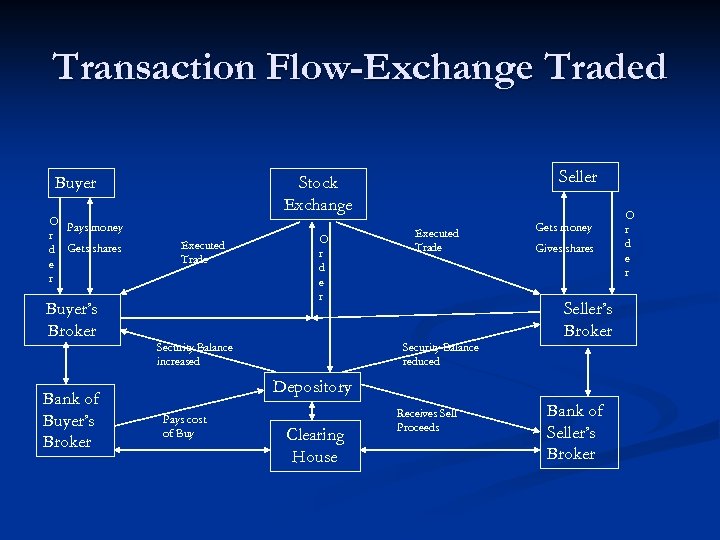
Transaction Flow-Exchange Traded Buyer O Pays money r d Gets shares e r Buyer’s Broker Bank of Buyer’s Broker Seller Stock Exchange Executed Trade O r d e r Security Balance increased Executed Trade Security Balance reduced Gets money Gives shares Seller’s Broker Depository Pays cost of Buy Clearing House Receives Sell Proceeds Bank of Seller’s Broker O r d e r
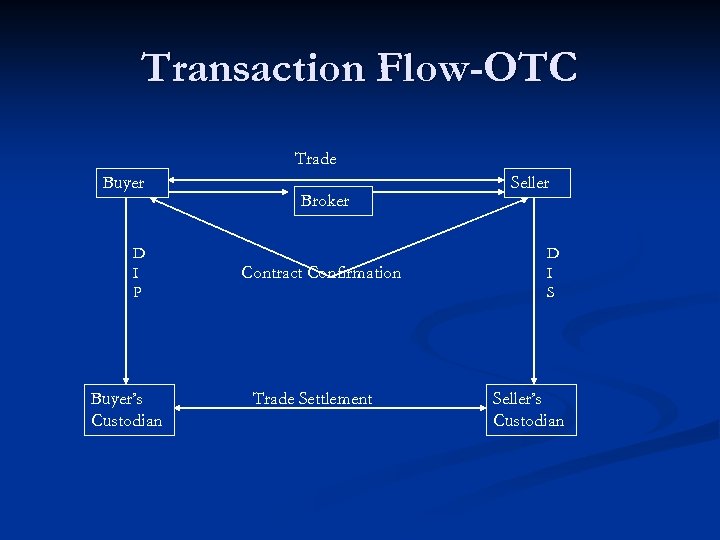
Transaction Flow-OTC Trade Buyer D I P Buyer’s Custodian Broker Contract Confirmation Trade Settlement Seller D I S Seller’s Custodian
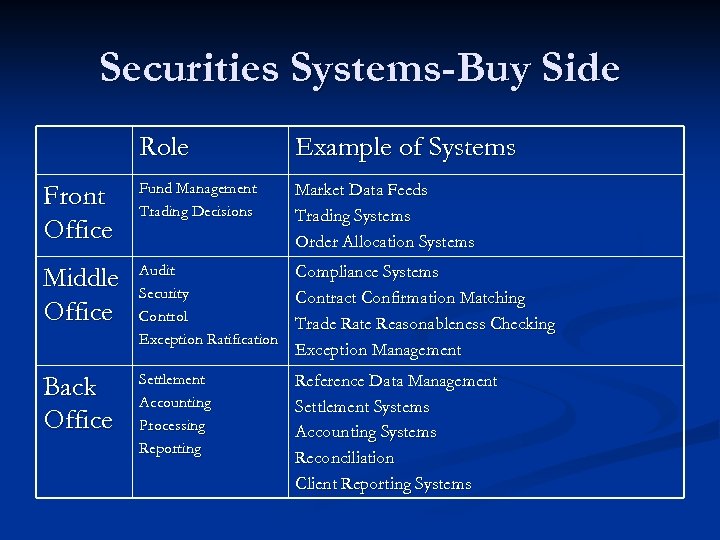
Securities Systems-Buy Side Role Example of Systems Front Office Fund Management Trading Decisions Market Data Feeds Trading Systems Order Allocation Systems Middle Office Audit Security Control Exception Ratification Compliance Systems Contract Confirmation Matching Trade Rate Reasonableness Checking Exception Management Back Office Settlement Accounting Processing Reporting Reference Data Management Settlement Systems Accounting Systems Reconciliation Client Reporting Systems
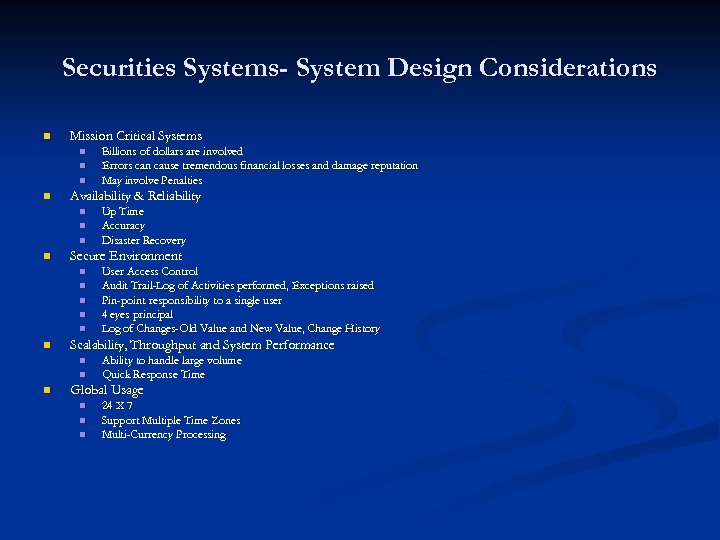
Securities Systems- System Design Considerations n Mission Critical Systems n n Availability & Reliability n n n n User Access Control Audit Trail-Log of Activities performed, Exceptions raised Pin-point responsibility to a single user 4 eyes principal Log of Changes-Old Value and New Value, Change History Scalability, Throughput and System Performance n n n Up Time Accuracy Disaster Recovery Secure Environment n n Billions of dollars are involved Errors can cause tremendous financial losses and damage reputation May involve Penalties Ability to handle large volume Quick Response Time Global Usage n n n 24 X 7 Support Multiple Time Zones Multi-Currency Processing
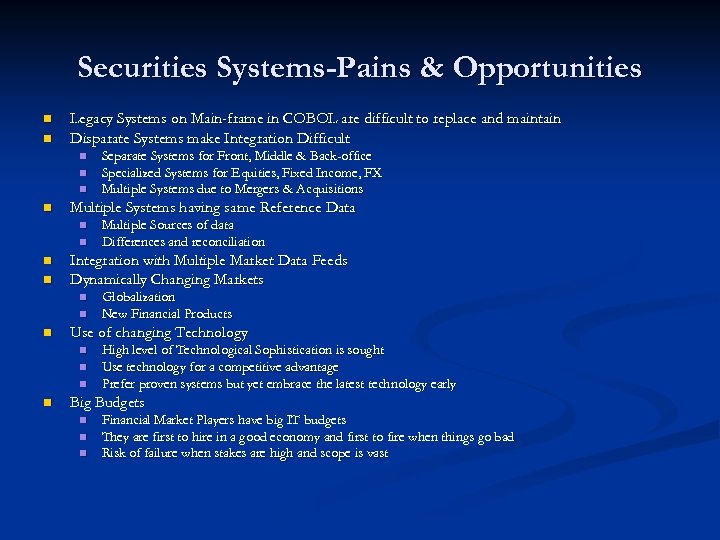
Securities Systems-Pains & Opportunities n n Legacy Systems on Main-frame in COBOL are difficult to replace and maintain Disparate Systems make Integration Difficult n n Multiple Systems having same Reference Data n n n Globalization New Financial Products Use of changing Technology n n Multiple Sources of data Differences and reconciliation Integration with Multiple Market Data Feeds Dynamically Changing Markets n n Separate Systems for Front, Middle & Back-office Specialized Systems for Equities, Fixed Income, FX Multiple Systems due to Mergers & Acquisitions High level of Technological Sophistication is sought Use technology for a competitive advantage Prefer proven systems but yet embrace the latest technology early Big Budgets n n n Financial Market Players have big IT budgets They are first to hire in a good economy and first to fire when things go bad Risk of failure when stakes are high and scope is vast
Скачать презентацию Banking Financial Services Securities Investment Management
5e4978ac424702c956901e341b7c8a84.ppt