 Скачать презентацию Banking Financial Markets Bülent Şenver bs bulentsenver com
29ca41ca57129fd6a30b557e1cf7af88.ppt
- Количество слайдов: 73



Banking & Financial Markets Bülent Şenver bs@bulentsenver. com bsenver@superonline. com bs@bulentsenver. com 1
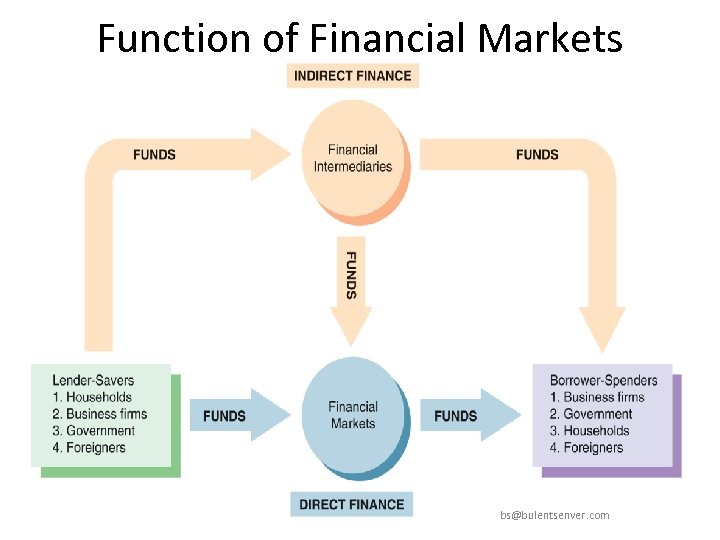
Function of Financial Markets 2 -2 bs@bulentsenver. com
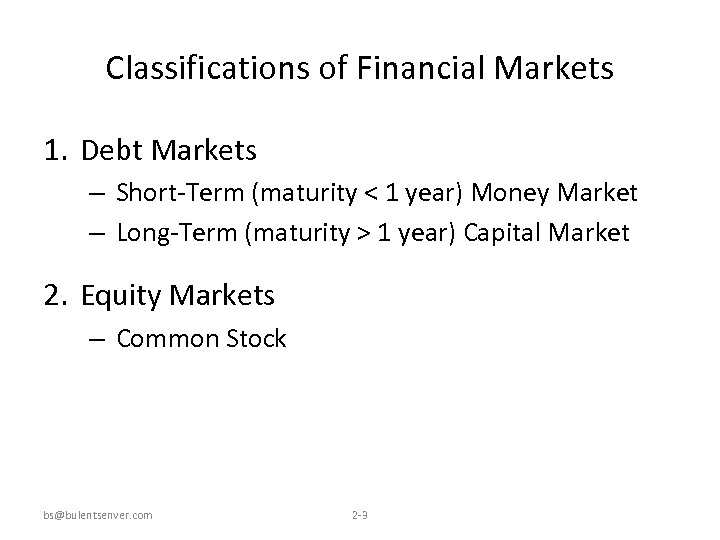
Classifications of Financial Markets 1. Debt Markets – Short-Term (maturity < 1 year) Money Market – Long-Term (maturity > 1 year) Capital Market 2. Equity Markets – Common Stock bs@bulentsenver. com 2 -3
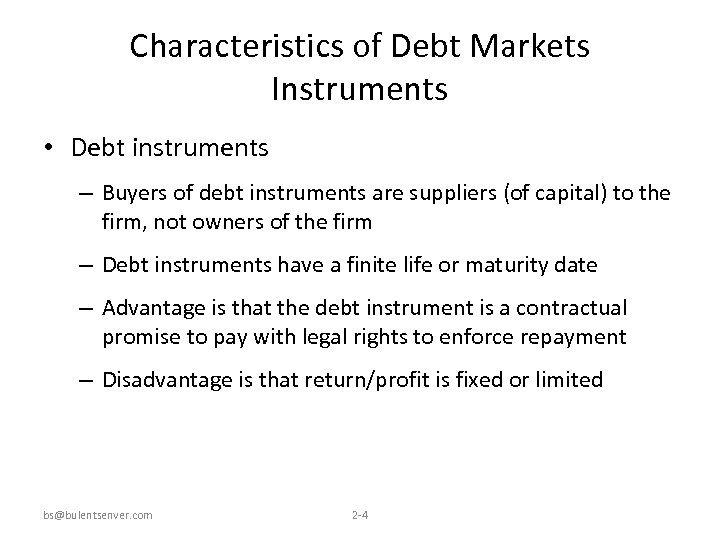
Characteristics of Debt Markets Instruments • Debt instruments – Buyers of debt instruments are suppliers (of capital) to the firm, not owners of the firm – Debt instruments have a finite life or maturity date – Advantage is that the debt instrument is a contractual promise to pay with legal rights to enforce repayment – Disadvantage is that return/profit is fixed or limited bs@bulentsenver. com 2 -4
Characteristics of Equity Markets Instruments • Equity instruments (common stock is most prevalent equity instrument) – Buyers of common stock are owners of the firm – Common stock has no finite life or maturity date – Advantage of common stock is potential high income since return is not fixed or limited – Disadvantage is that debt payments must be made before equity payments can be made bs@bulentsenver. com 2 -5
Characteristics of Financial Markets 1. Debt Markets – Although less well-known by the average person, debt markets in U. S. are much larger in total dollars than equity markets, due to greater number of participant classes (households, businesses, government, and foreigners) and size of individual participants (businesses, and government) bs@bulentsenver. com 2 -6
Characteristics of Financial Markets 2. Equity Markets – Although U. S. markets are highly efficient, the world’s largest, and more familiar to the average person, they are far smaller than the U. S. debt markets largely due to the fact that the only applicable participants are businesses bs@bulentsenver. com 2 -7
Classifications of Financial Markets 1. Primary Market – New security issues sold to initial buyers 2. Secondary Market – Securities previously issued are bought and sold bs@bulentsenver. com 2 -8
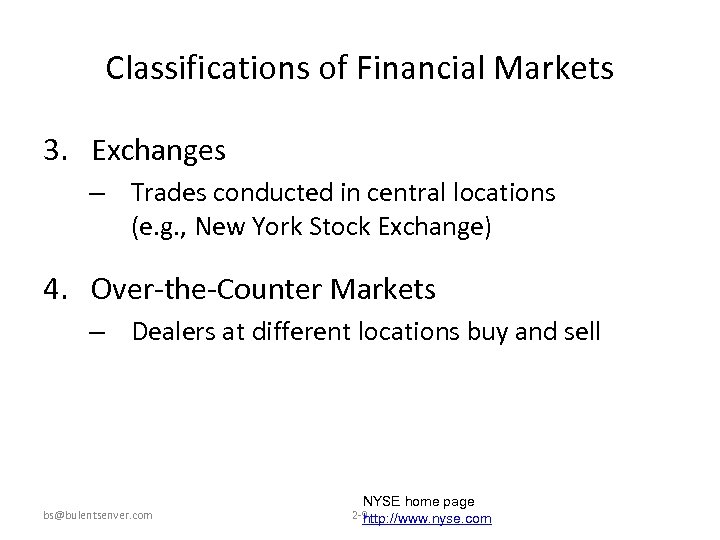
Classifications of Financial Markets 3. Exchanges – Trades conducted in central locations (e. g. , New York Stock Exchange) 4. Over-the-Counter Markets – Dealers at different locations buy and sell bs@bulentsenver. com NYSE home page 2 -9 http: //www. nyse. com
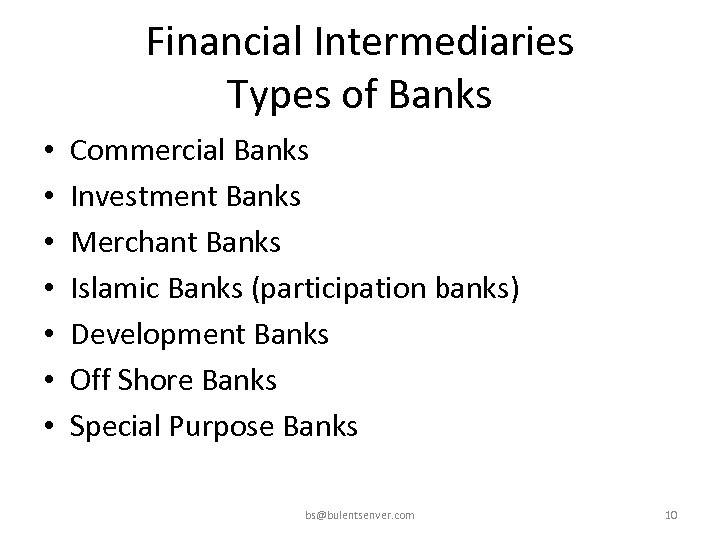
Financial Intermediaries Types of Banks • • Commercial Banks Investment Banks Merchant Banks Islamic Banks (participation banks) Development Banks Off Shore Banks Special Purpose Banks bs@bulentsenver. com 10
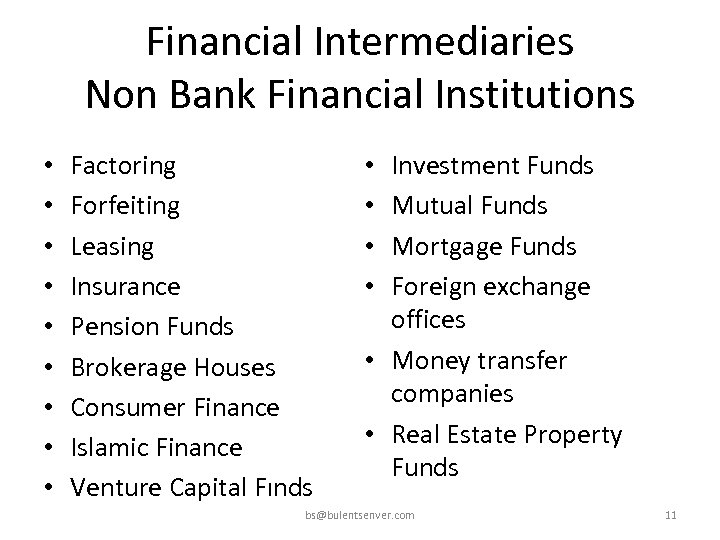
Financial Intermediaries Non Bank Financial Institutions • • • Factoring Forfeiting Leasing Insurance Pension Funds Brokerage Houses Consumer Finance Islamic Finance Venture Capital Fınds Investment Funds Mutual Funds Mortgage Funds Foreign exchange offices • Money transfer companies • Real Estate Property Funds • • bs@bulentsenver. com 11
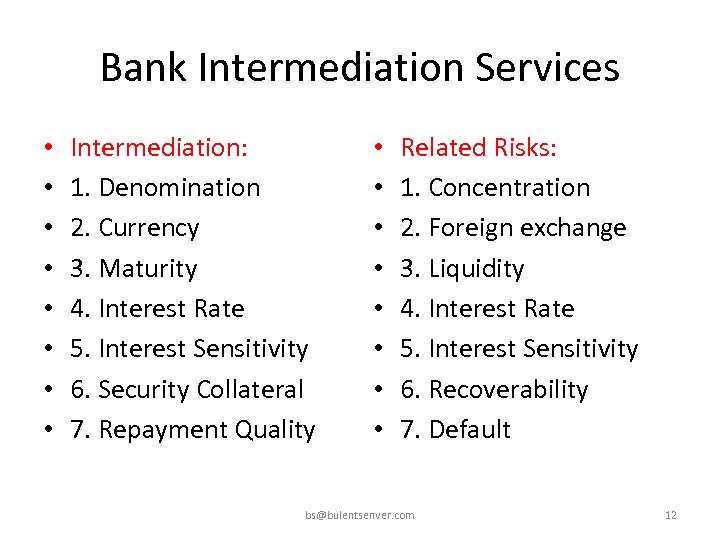
Bank Intermediation Services • • Intermediation: 1. Denomination 2. Currency 3. Maturity 4. Interest Rate 5. Interest Sensitivity 6. Security Collateral 7. Repayment Quality • • Related Risks: 1. Concentration 2. Foreign exchange 3. Liquidity 4. Interest Rate 5. Interest Sensitivity 6. Recoverability 7. Default bs@bulentsenver. com 12
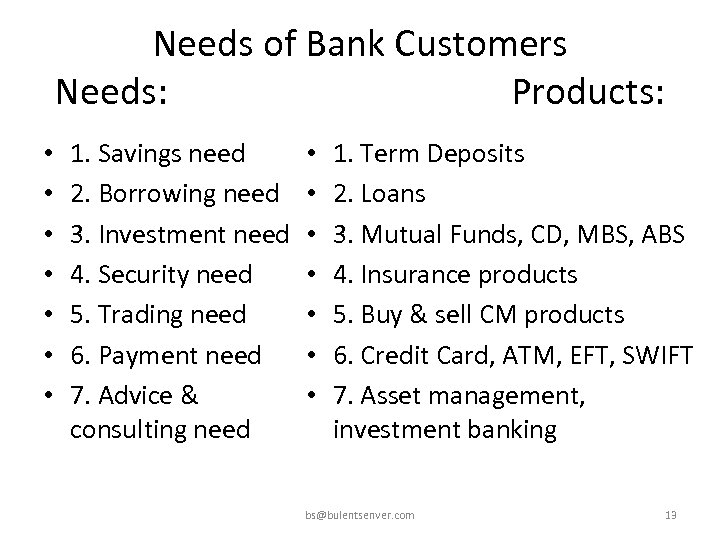
Needs of Bank Customers Needs: Products: • • 1. Savings need 2. Borrowing need 3. Investment need 4. Security need 5. Trading need 6. Payment need 7. Advice & consulting need • • 1. Term Deposits 2. Loans 3. Mutual Funds, CD, MBS, ABS 4. Insurance products 5. Buy & sell CM products 6. Credit Card, ATM, EFT, SWIFT 7. Asset management, investment banking bs@bulentsenver. com 13
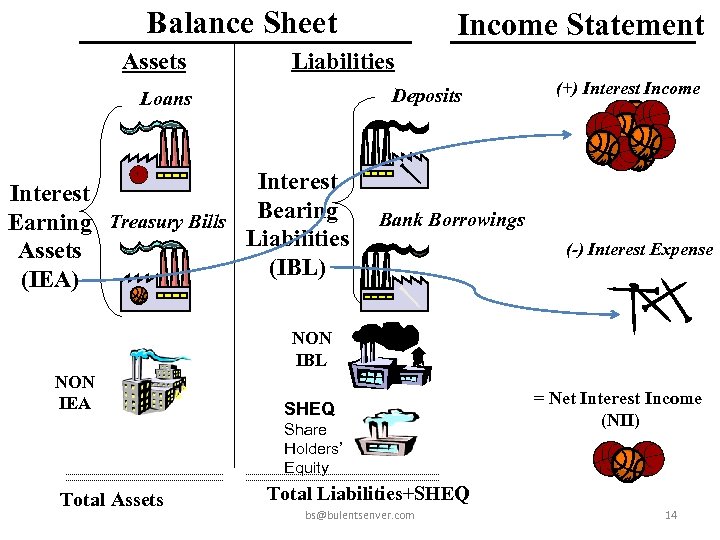
Balance Sheet Income Statement Liabilities Assets Deposits Loans Interest Earning Treasury Bills Bearing Liabilities Assets (IBL) (IEA) (+) Interest Income Bank Borrowings (-) Interest Expense NON IBL NON IEA SHEQ Share Holders’ Equity Holders’ = Net Interest Income (NII) Equity Total Assets = Total Liabilities+SHEQ bs@bulentsenver. com 14
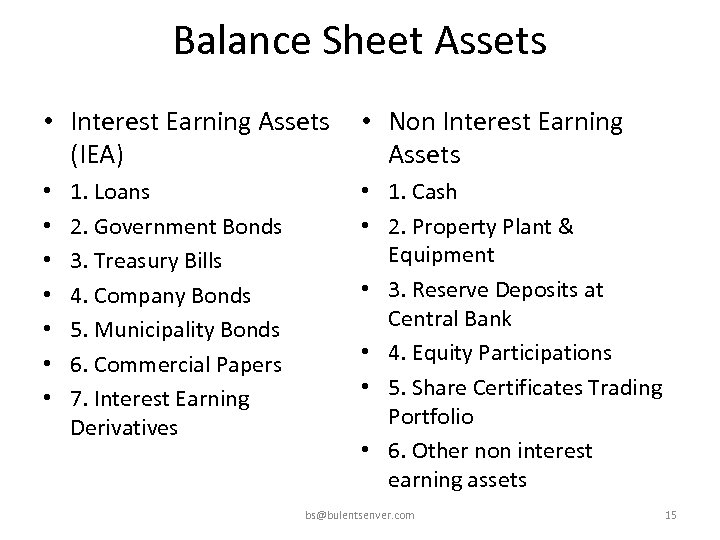
Balance Sheet Assets • Interest Earning Assets (IEA) • • 1. Loans 2. Government Bonds 3. Treasury Bills 4. Company Bonds 5. Municipality Bonds 6. Commercial Papers 7. Interest Earning Derivatives • Non Interest Earning Assets • 1. Cash • 2. Property Plant & Equipment • 3. Reserve Deposits at Central Bank • 4. Equity Participations • 5. Share Certificates Trading Portfolio • 6. Other non interest earning assets bs@bulentsenver. com 15
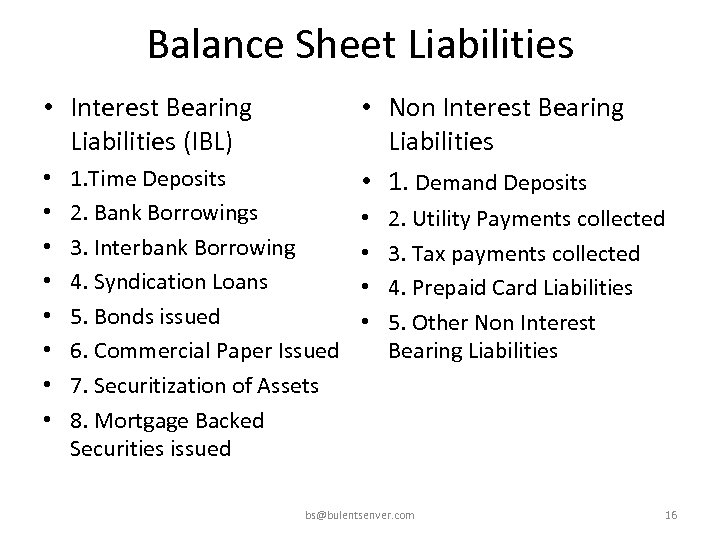
Balance Sheet Liabilities • Interest Bearing Liabilities (IBL) • • 1. Time Deposits 2. Bank Borrowings 3. Interbank Borrowing 4. Syndication Loans 5. Bonds issued 6. Commercial Paper Issued 7. Securitization of Assets 8. Mortgage Backed Securities issued • Non Interest Bearing Liabilities • 1. Demand Deposits • • 2. Utility Payments collected 3. Tax payments collected 4. Prepaid Card Liabilities 5. Other Non Interest Bearing Liabilities bs@bulentsenver. com 16
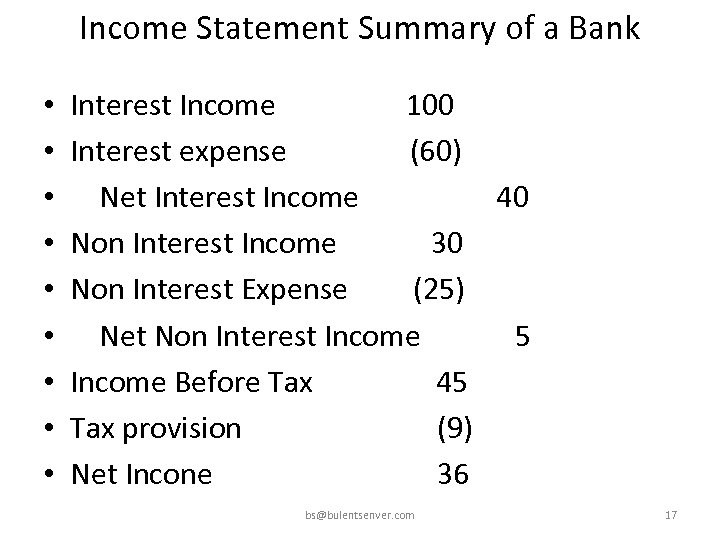
Income Statement Summary of a Bank • • • Interest Income 100 Interest expense (60) Net Interest Income 40 Non Interest Income 30 Non Interest Expense (25) Net Non Interest Income 5 Income Before Tax 45 Tax provision (9) Net Incone 36 bs@bulentsenver. com 17
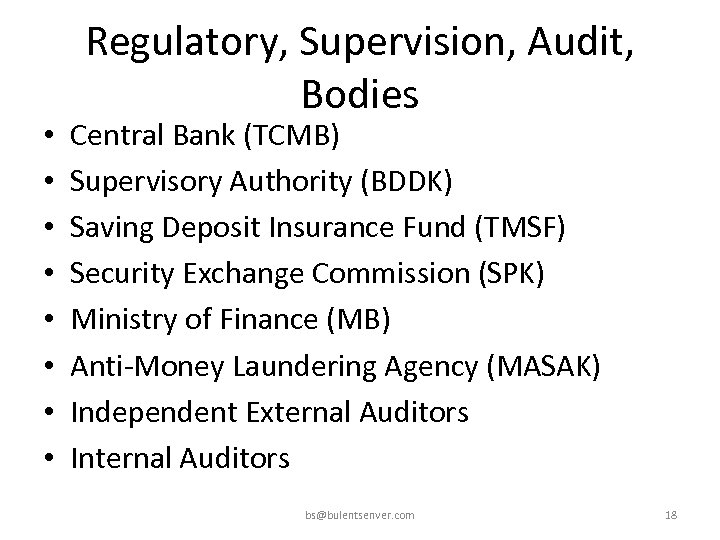
• • Regulatory, Supervision, Audit, Bodies Central Bank (TCMB) Supervisory Authority (BDDK) Saving Deposit Insurance Fund (TMSF) Security Exchange Commission (SPK) Ministry of Finance (MB) Anti-Money Laundering Agency (MASAK) Independent External Auditors Internal Auditors bs@bulentsenver. com 18
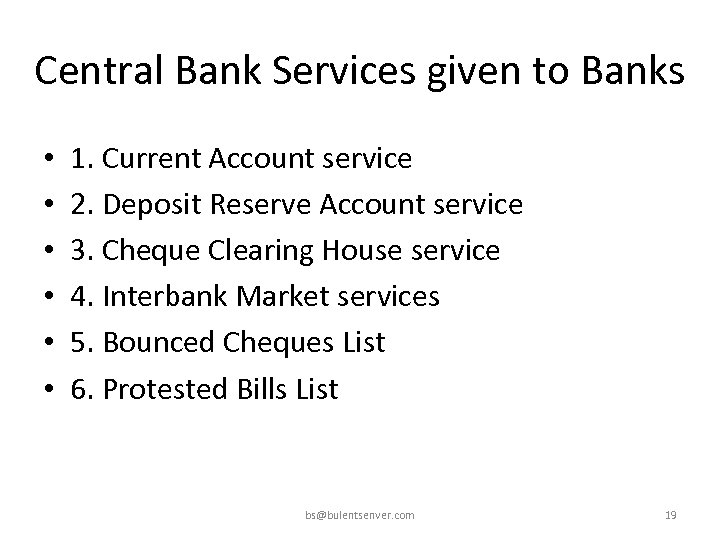
Central Bank Services given to Banks • • • 1. Current Account service 2. Deposit Reserve Account service 3. Cheque Clearing House service 4. Interbank Market services 5. Bounced Cheques List 6. Protested Bills List bs@bulentsenver. com 19
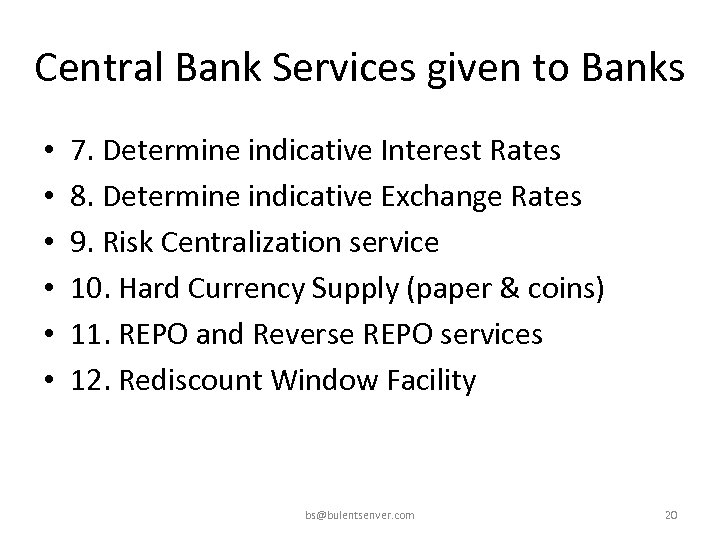
Central Bank Services given to Banks • • • 7. Determine indicative Interest Rates 8. Determine indicative Exchange Rates 9. Risk Centralization service 10. Hard Currency Supply (paper & coins) 11. REPO and Reverse REPO services 12. Rediscount Window Facility bs@bulentsenver. com 20
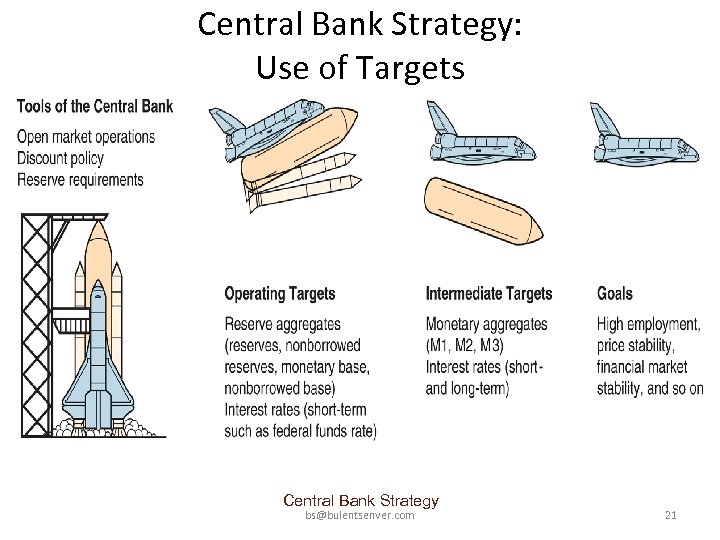
Central Bank Strategy: Use of Targets Central Bank Strategy bs@bulentsenver. com 21
Should the Fed (Central Bank) Be Independent? • Every few years, the question arises in Congress as to whether the independence of the Fed should be reduced in some fashion. This is usually motivated by politicians who disagree with current Fed policy. • Arguments can be made both ways, as we outline next. bs@bulentsenver. com 7 -22
Case for Independence • The strongest argument for independence is the view that political pressure will tend to add an inflationary bias to monetary policy. This stems from short-sighted goals of politicians. For example, in the short-run, high money growth does lead to lower interest rates. In the long-run, however, this also leads to higher inflation. bs@bulentsenver. com 7 -23
Case for Independence • The notion of the political business cycle stems from the previous argument. – Expansionary monetary policy leads to lower unemployment and lower interest rates—a good idea just before elections. – Post-election, this policy leads to higher inflation, and therefore, higher interest rates—effects that hopefully disappear (or are forgotten) by the next election. bs@bulentsenver. com 7 -24
Case for Independence • Other arguments include: – The Treasury may seek to finance the government through bonds purchased by the Fed. This may lead to an inflationary bias. – Politicians have repeatedly shown an inability to make hard choices for the good of the economy that may adversely affect their own well-being. – Its independence allows the Fed to pursue policies that are politically unpopular, yet in the best interest of the public. bs@bulentsenver. com 7 -25
Case Against Independence • Some view Fed independence as “undemocratic”—an elite group controlling an important aspect of the economy but accountable in few ways. • If this argument seems unfounded, then ask why we don’t let the other aspects of the country be controlled by an elite few. Are military issues, for example, any less complex? • Indeed, we hold the President and Congress accountable for the state of the economy, yet they have little control over one of the most important tools to direct the economy. bs@bulentsenver. com 7 -26
Case Against Independence • Further, the Fed has not always been successful in the past. It has made mistakes during the Great Depression and inflationary periods in the 1960 s and 1970 s. • Lastly, the Fed can succumb to political pressure regardless of any state of independence. This pressure may be worse with few checks and balances in place. bs@bulentsenver. com 7 -27
Central Bank Independence and Macroeconomic Performance Throughout the World • Empirical work suggests that countries with the most independent central banks do the best job controlling inflation. • Evidence also shows that this is achieved without negative impacts on the real economy. bs@bulentsenver. com 7 -28
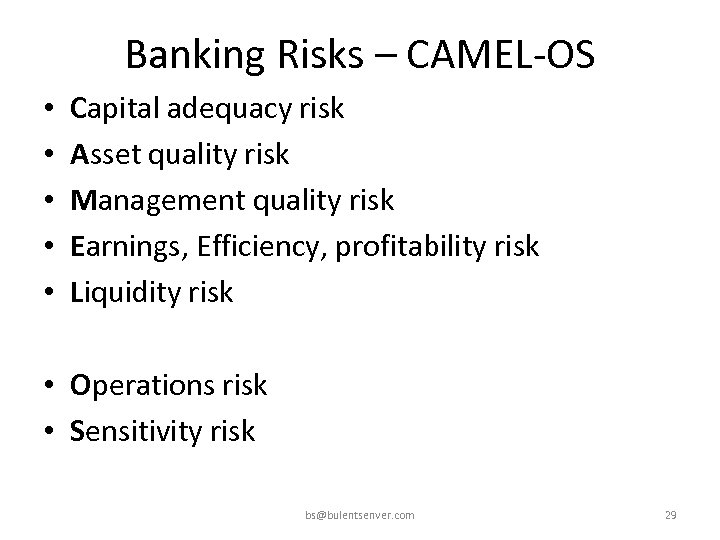
Banking Risks – CAMEL-OS • • • Capital adequacy risk Asset quality risk Management quality risk Earnings, Efficiency, profitability risk Liquidity risk • Operations risk • Sensitivity risk bs@bulentsenver. com 29
Banking Risks – Liquidity Risk • Liquidity Risk: • “The inability of a bank to fulfill its obligations when they became due and/or the inability of a bank to perform its daily banking operations after fulfilling its obligations due to lack of cash or liquid assets” bs@bulentsenver. com 30
Banking Risks - Liquidity Risks • Liquidity Risks: • 1. Funding Risk • 2. Time Risk • 3. Call Risk bs@bulentsenver. com 31
Banking Risks – Interest Risk • Interest Risk: • “The risk of making losses by a bank due to the changes in Interest Income and/or Interest Expense of the bank arising from either changes in market conditions or changes in the interest characteristics of the bank’s Interest Earning assets and/or Interest Bearing Liabilities” bs@bulentsenver. com 32
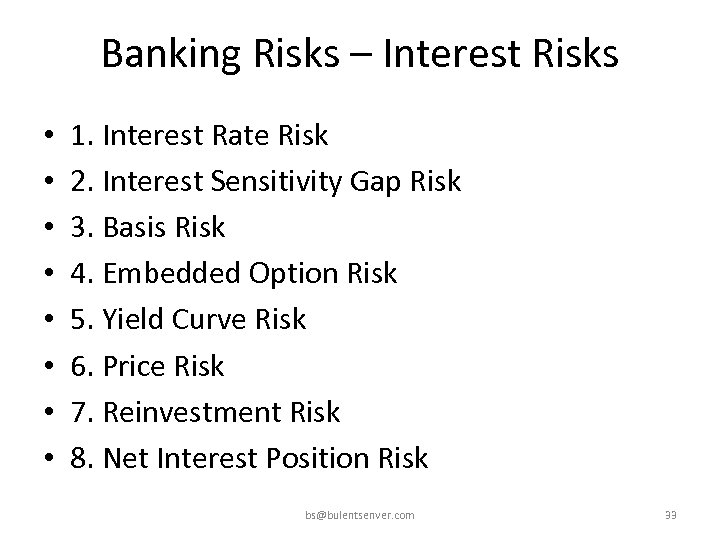
Banking Risks – Interest Risks • • 1. Interest Rate Risk 2. Interest Sensitivity Gap Risk 3. Basis Risk 4. Embedded Option Risk 5. Yield Curve Risk 6. Price Risk 7. Reinvestment Risk 8. Net Interest Position Risk bs@bulentsenver. com 33
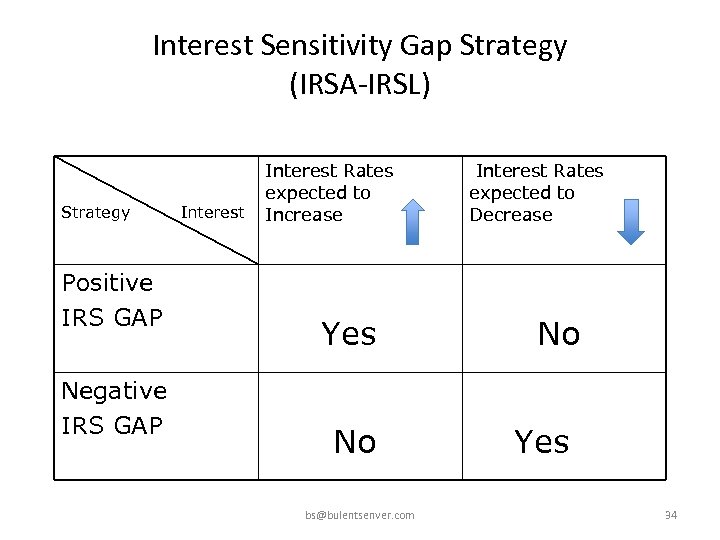
Interest Sensitivity Gap Strategy (IRSA-IRSL) Strategy Positive IRS GAP Negative IRS GAP Interest Rates expected to Increase Yes No bs@bulentsenver. com Interest Rates expected to Decrease No Yes 34
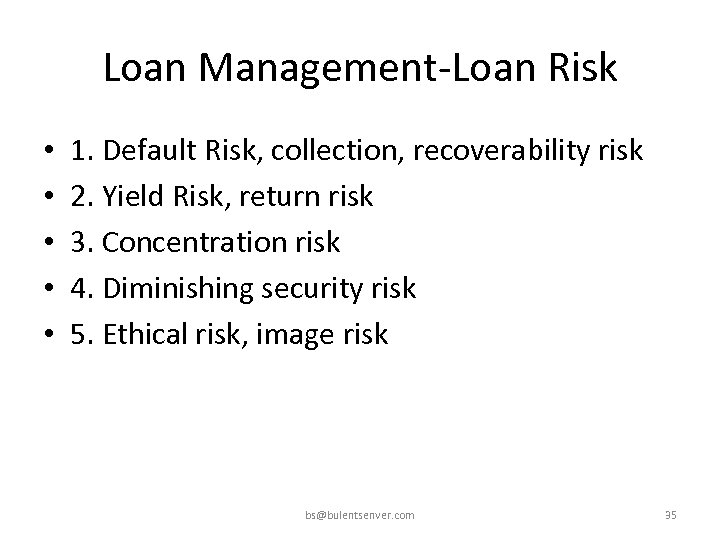
Loan Management-Loan Risk • • • 1. Default Risk, collection, recoverability risk 2. Yield Risk, return risk 3. Concentration risk 4. Diminishing security risk 5. Ethical risk, image risk bs@bulentsenver. com 35
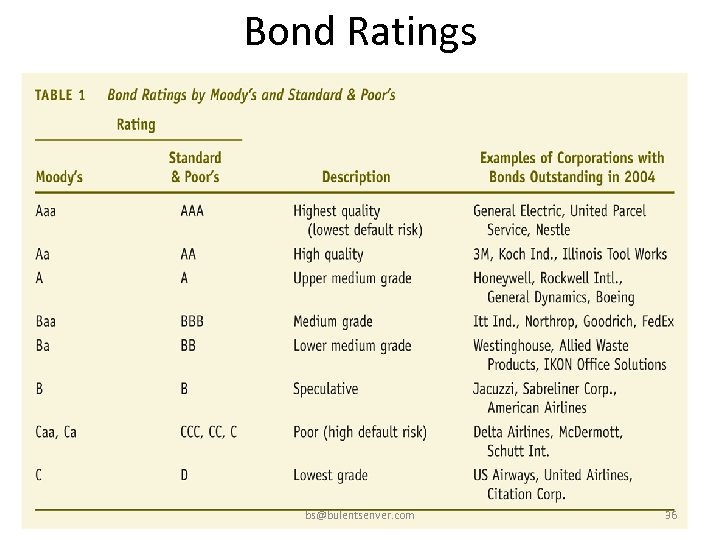
Bond Ratings bs@bulentsenver. com 36
Loan Management-Loan Types • Borrower type: -Retail (individual) Loans -Corporate Loans • Maturity type: -Short-term Loans -Medium-term Loans -Long-term Loans bs@bulentsenver. com 37
Loan Management-Loan Types • Currency type: -Local Currency Loans -Foreign Currency Loans • Where used: -Working capital Loans -Import Loans -Export Loans -Investment Loan bs@bulentsenver. com -Consumer Loan -Mortgage Loan -Auto Loan -Credit Card Loan 38
Loan Management-Loan Types • Security type: -Secured Loans -Unsecured Loans • Risk type: -Cash Loans (shown on balance sheet) -Non-Cash Loans (shown as off balance sheet item) e. g. Contingent Liabilities and Commitments bs@bulentsenver. com 39
6 C’s of Loan Management • • • 1 C Capacity 2 C Character 3 C Capital bs@bulentsenver. com 40
6 C’s of Loan Management • • • 4 C Collateral 5 C Conditions 6 C Compliance bs@bulentsenver. com 41
5 P’s of Non Performing Loans • How to control NPL? • • • 1. Philosophy 2. Policies 3. Procedures 4. Pricing 5. People bs@bulentsenver. com 42
Loan Life Cycle • • 1. Loan Product Development 2. Loan Marketing and Sales 3. Loan Application 4. Loan Quick Review, filtering 5. Loan Investigation 6. Loan Analysis 7. Loan Approval bs@bulentsenver. com 43
Loan Life Cycle • 7. Loan Approval Committees (LAC): – Board of Directors (LAC 4) – Head Office Loan Approval Committee (LAC 3) – Regional Office Loan Approval Committee (LAC 2) – Branch Loan Approval Committee (LAC 1) • 8. Compliance to Loan Conditions • 9. Loan Agreement • 10. Loan Disbursement, Loan Utilization bs@bulentsenver. com 44
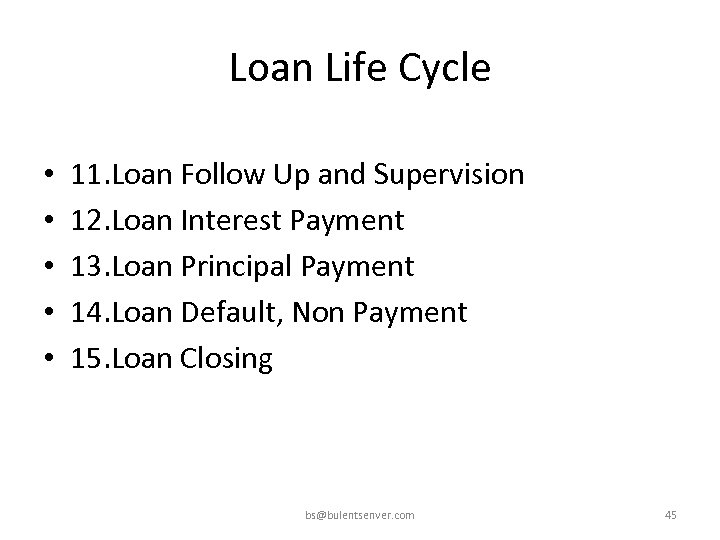
Loan Life Cycle • • • 11. Loan Follow Up and Supervision 12. Loan Interest Payment 13. Loan Principal Payment 14. Loan Default, Non Payment 15. Loan Closing bs@bulentsenver. com 45
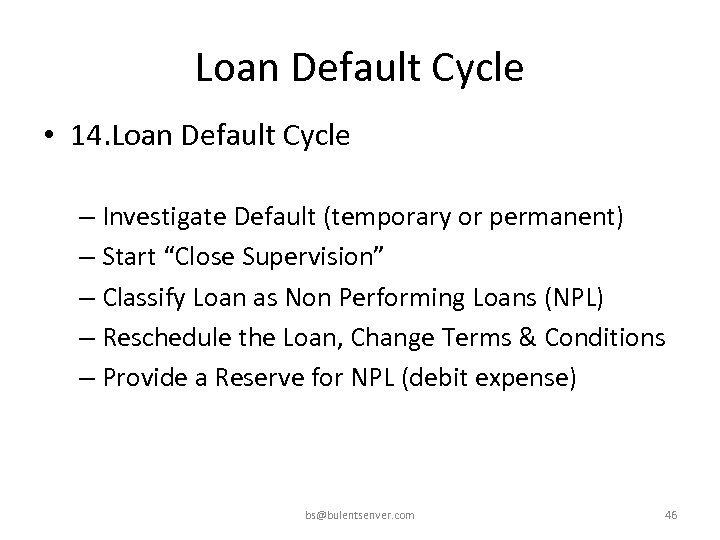
Loan Default Cycle • 14. Loan Default Cycle – Investigate Default (temporary or permanent) – Start “Close Supervision” – Classify Loan as Non Performing Loans (NPL) – Reschedule the Loan, Change Terms & Conditions – Provide a Reserve for NPL (debit expense) bs@bulentsenver. com 46
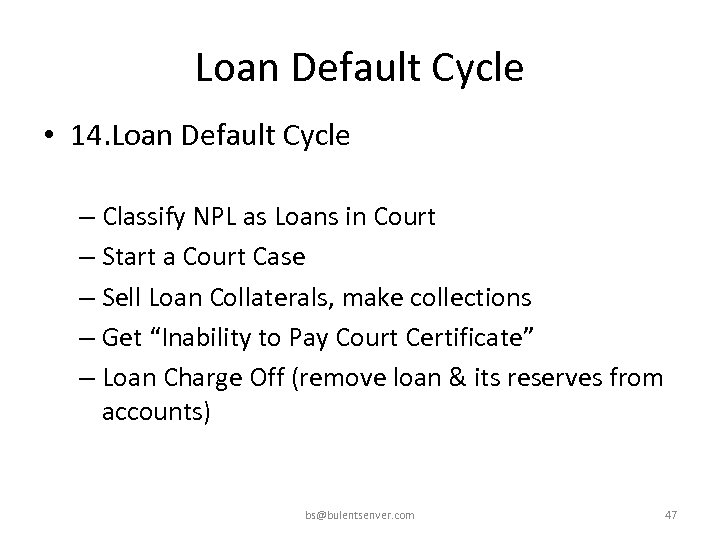
Loan Default Cycle • 14. Loan Default Cycle – Classify NPL as Loans in Court – Start a Court Case – Sell Loan Collaterals, make collections – Get “Inability to Pay Court Certificate” – Loan Charge Off (remove loan & its reserves from accounts) bs@bulentsenver. com 47
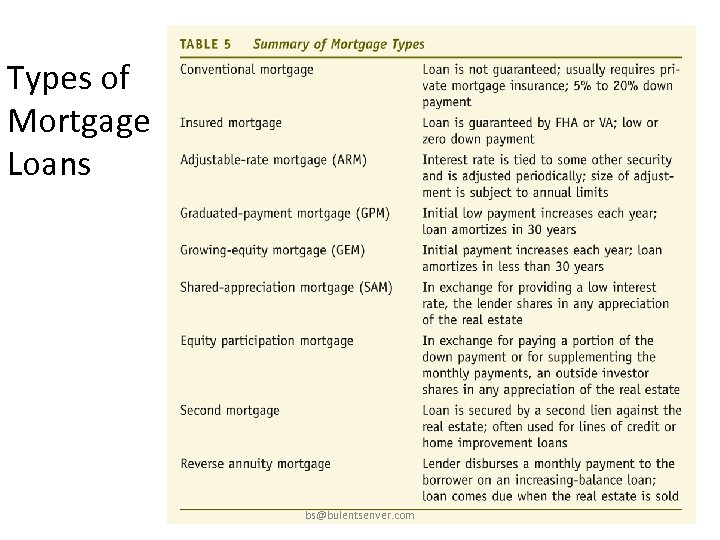
Types of Mortgage Loans bs@bulentsenver. com 12 -48
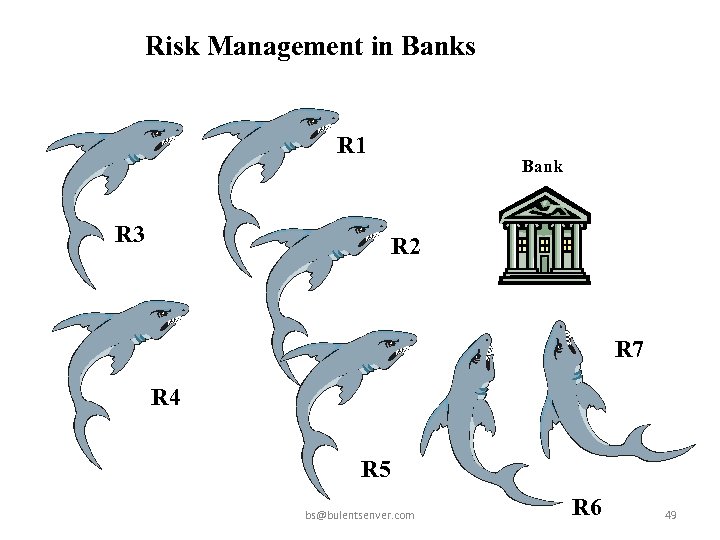
Risk Management in Banks R 1 R 3 Bank R 2 R 7 R 4 R 5 bs@bulentsenver. com R 6 49
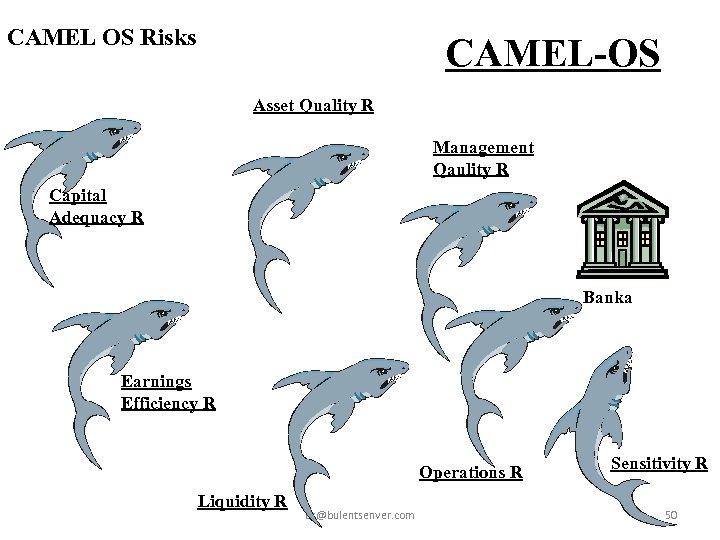
CAMEL OS Risks CAMEL-OS Asset Quality R Management Qaulity R Capital Adequacy R Banka Earnings Efficiency R Operations R Liquidity R bs@bulentsenver. com Sensitivity R 50
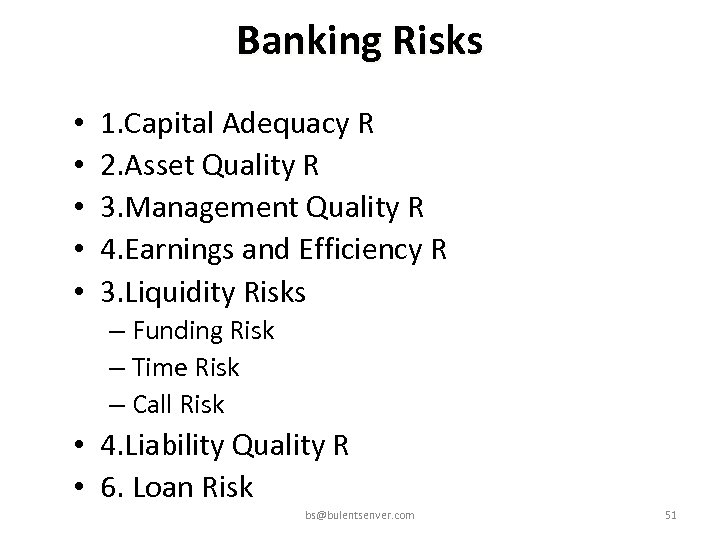
Banking Risks • • • 1. Capital Adequacy R 2. Asset Quality R 3. Management Quality R 4. Earnings and Efficiency R 3. Liquidity Risks – Funding Risk – Time Risk – Call Risk • 4. Liability Quality R • 6. Loan Risk bs@bulentsenver. com 51
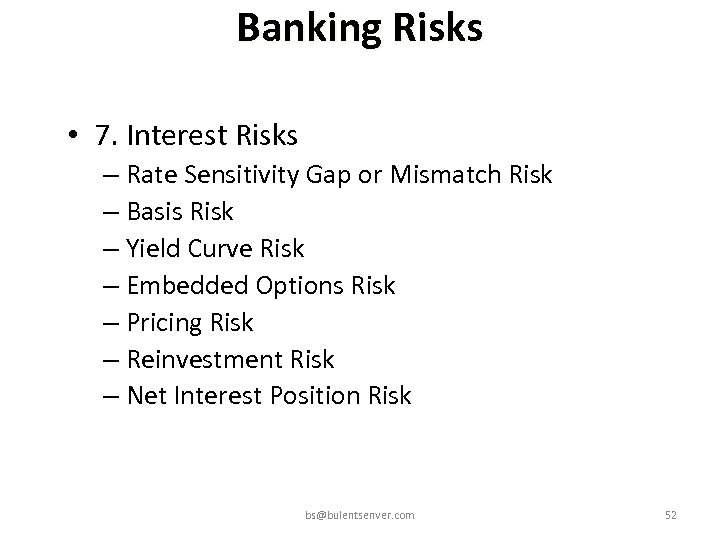
Banking Risks • 7. Interest Risks – Rate Sensitivity Gap or Mismatch Risk – Basis Risk – Yield Curve Risk – Embedded Options Risk – Pricing Risk – Reinvestment Risk – Net Interest Position Risk bs@bulentsenver. com 52
Banking Risks • 8. Foreign Exchange Risks – F/X Pozisition R – F/X Availability R – F/X Transaction R – F/X Translation R bs@bulentsenver. com 53
The Foreign Exchange Market • Definitions 1. Spot exchange rate 2. Forward exchange rate 3. Cross exchange rate 4. Appreciation 5. Depreciation 6. Arbitrage bs@bulentsenver. com 13 -54
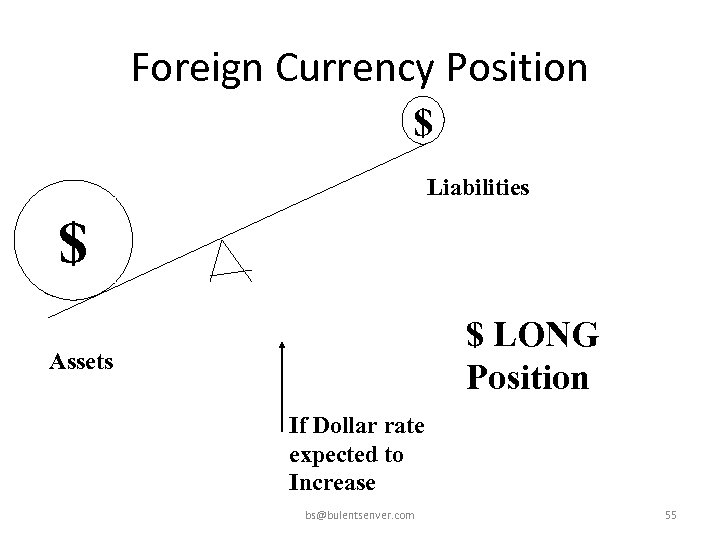
Foreign Currency Position $ Liabilities $ $ $ LONG Position Assets If Dollar rate expected to Increase bs@bulentsenver. com 55
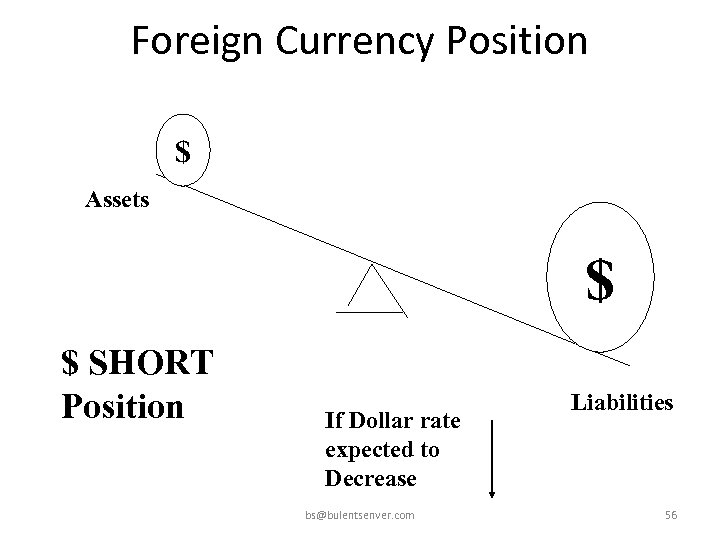
Foreign Currency Position $ Assets $ $ SHORT Position If Dollar rate expected to Decrease bs@bulentsenver. com Liabilities 56
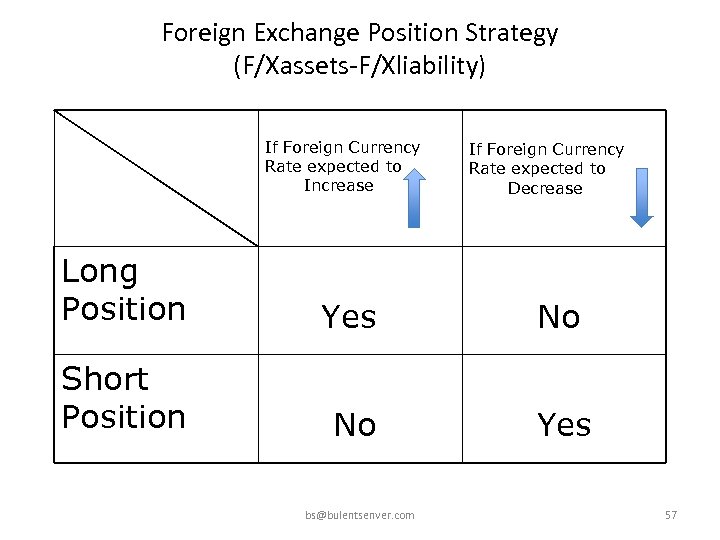
Foreign Exchange Position Strategy (F/Xassets-F/Xliability) If Foreign Currency Rate expected to Increase If Foreign Currency Rate expected to Decrease Long Position Yes No Short Position No Yes bs@bulentsenver. com 57
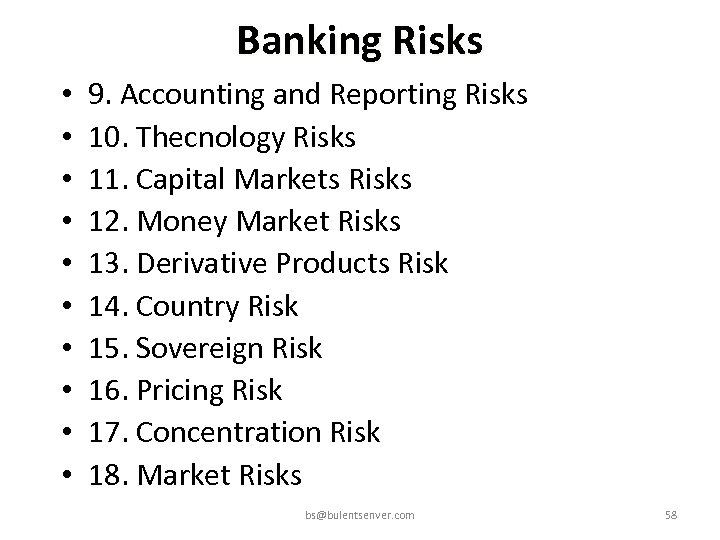
Banking Risks • • • 9. Accounting and Reporting Risks 10. Thecnology Risks 11. Capital Markets Risks 12. Money Market Risks 13. Derivative Products Risk 14. Country Risk 15. Sovereign Risk 16. Pricing Risk 17. Concentration Risk 18. Market Risks bs@bulentsenver. com 58
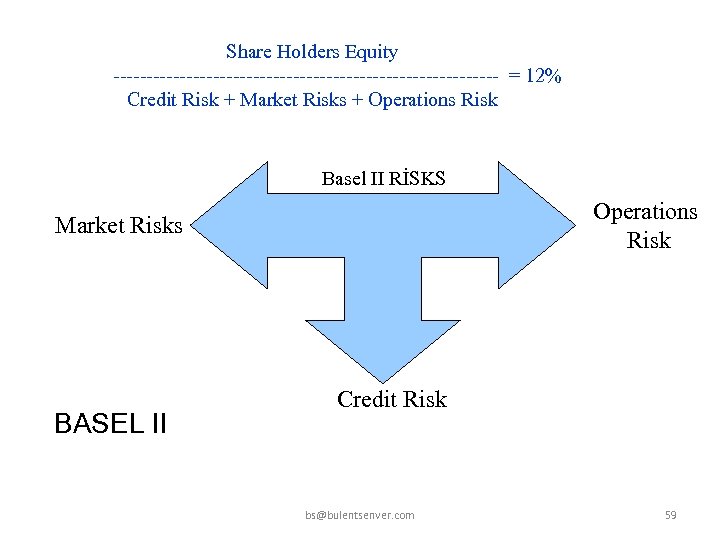
Share Holders Equity ----------------------------- = 12% Credit Risk + Market Risks + Operations Risk Basel II RİSKS Operations Risk Market Risks BASEL II Credit Risk bs@bulentsenver. com 59
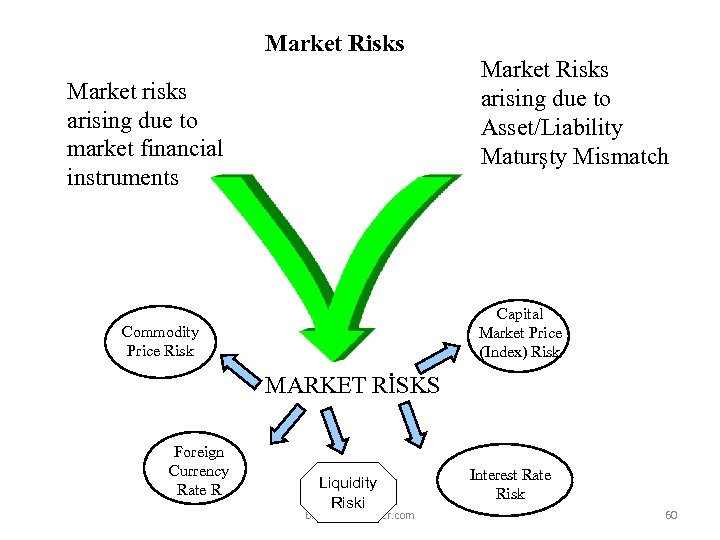
Market Risks Market risks arising due to market financial instruments Market Risks arising due to Asset/Liability Maturşty Mismatch Capital Market Price (Index) Risk Commodity Price Risk MARKET RİSKS Foreign Currency Rate R Liquidity Riski bs@bulentsenver. com Interest Rate Risk 60
Banking Risks • • • 19. Competition Risk 20. Theft Riski 21. Fraud Risk 22. Defalcation Risk 23. Natural Disasters Risks 24. Strategy Risk 25. Fiduciary Business Risks 26. Error Wrong Transactions Risks 27. Laws and Regulations Compliance Risk bs@bulentsenver. com 61
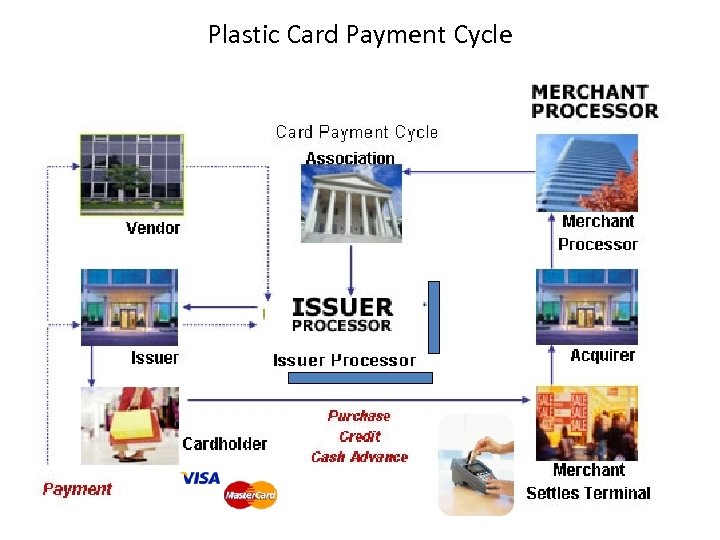
Plastic Card Payment Cycle bs@bulentsenver. com 62
Types of Plastic Cards • • • Debit Card Charge Card Credit Card Prepaid Card Business Card Purchase Card • • Installment Card Co-Branded Card Loyalty Card Special Purpose Card bs@bulentsenver. com 63
Plastic Card Technology • • Magnetic stripe card Chip card Contactless card NFC Near Field Communication card Virtual card Biometrics Mobile bs@bulentsenver. com 64
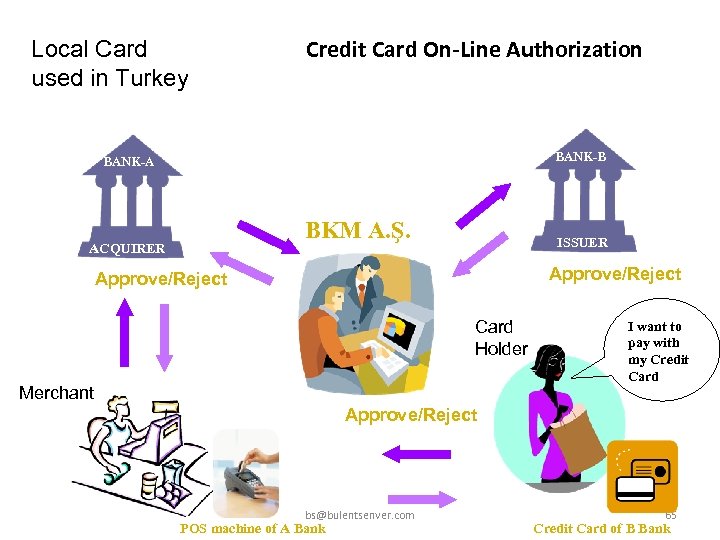
Local Card used in Turkey Credit Card On-Line Authorization BANK-B BANK-A BKM A. Ş. ACQUIRER ISSUER Approve/Reject Card Holder Merchant I want to pay with my Credit Card Approve/Reject bs@bulentsenver. com POS machine of A Bank 65 65 Credit Card of B Bank
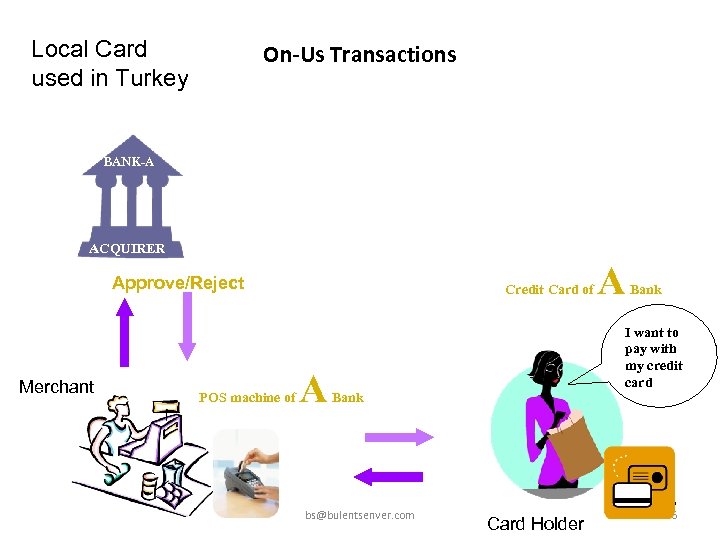
Local Card used in Turkey On-Us Transactions BANK-A ACQUIRER Approve/Reject Merchant POS machine of Credit Card of A Bank I want to pay with my credit card Bank bs@bulentsenver. com A 66 Card Holder 66
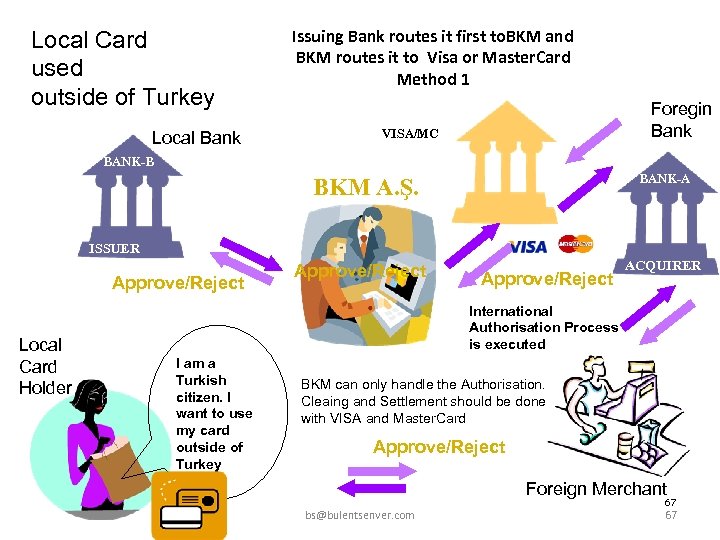
Local Card used outside of Turkey Local Bank Issuing Bank routes it first to. BKM and BKM routes it to Visa or Master. Card Method 1 Foregin Bank VISA/MC BANK-B BANK-A BKM A. Ş. ISSUER Approve/Reject Local Card Holder Approve/Reject ACQUIRER International Authorisation Process is executed I am a Turkish citizen. I want to use my card outside of Turkey BKM can only handle the Authorisation. Cleaing and Settlement should be done with VISA and Master. Card Approve/Reject Foreign Merchant bs@bulentsenver. com 67 67
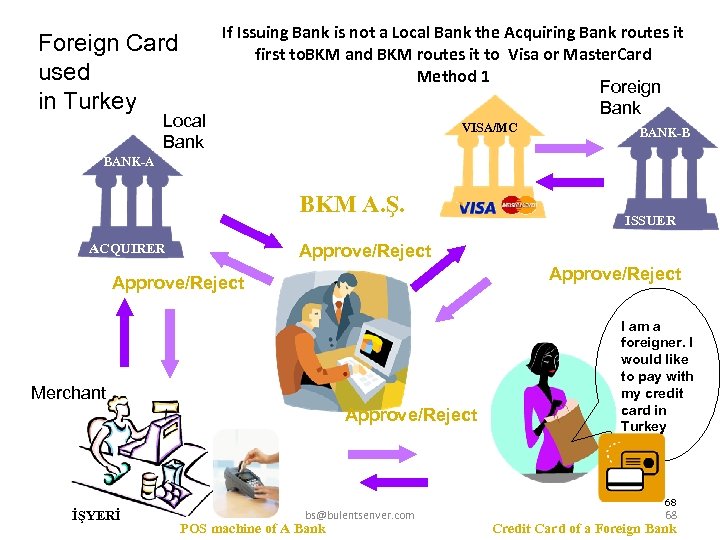
Foreign Card used in Turkey Local Bank If Issuing Bank is not a Local Bank the Acquiring Bank routes it first to. BKM and BKM routes it to Visa or Master. Card Method 1 Foreign Bank VISA/MC BANK-B BANK-A BKM A. Ş. ACQUIRER Approve/Reject Merchant Approve/Reject İŞYERİ ISSUER bs@bulentsenver. com POS machine of A Bank I am a foreigner. I would like to pay with my credit card in Turkey 68 68 Credit Card of a Foreign Bank
Banking Crises • USA Crises: • 1980 Savings Banks crises (S&L) • 2007 sub-prime mortgage loans • Turkey Crises: • 2000 November – Interest risk – Demirbank • 2001 March – Liquidity & Devaluation risk bs@bulentsenver. com 69
Moral Hazard in Banking People will take risks that they should not take if they have an incentive to do so. Risk versus Benefit. (eg. Bearings Bank, Lehman Brothers, İmar Bank) • • Business Ethics Conflict of Interest Non Compliance with Laws & Regulations Violation of Banking Rules & Practices bs@bulentsenver. com 70
Future Trends in Banking • • 1. Disintermediation 2. Globalisation 3. Big emerging markets 4. Centralisation of operations 5. Use of outsourcing services 6. Consolidation 7. Mergers and Acquisitions bs@bulentsenver. com 71
Future Trends in Banking • 8. Decrease in Net Interest Income margins • 9. Growth in Non Interest Income Business • 10. Technology to play an important role in bank success • 11. New business with new partnership agreements • 12. New Distribution Channels bs@bulentsenver. com 72
Future Trends in Banking • 13. New competition non bank financial and non-financial institutions • 14. Franchising of certain bank branch functions • 15. Importance of Supervision and Audit of banks will increase • 16. New Laws and Regulations to limit the risks taken by banks bs@bulentsenver. com 73
Скачать презентацию Banking Financial Markets Bülent Şenver bs bulentsenver com
29ca41ca57129fd6a30b557e1cf7af88.ppt