 Скачать презентацию Bank Regulation Is Changing But for Better or
6ead9556d053cfafa8edc261cf1c476b.ppt
- Количество слайдов: 50



Bank Regulation Is Changing: But for Better or Worse? Gerard Caprio Williams College

If men were angels, no government would be necessary. If angels were to govern men, neither external nor internal controls would be necessary. In framing a government which is to be administered by men over men, the great difficulty lies in this: you must first enable the government to control the governed; and in the next place oblige it to control itself. James Madison, Federalist Papers, Number 51
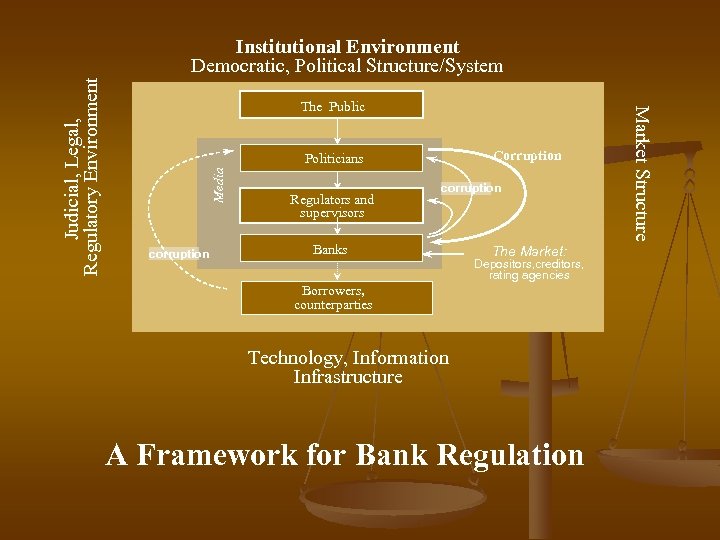
The Public Corruption Media Politicians corruption Regulators and supervisors corruption Banks The Market: Depositors, creditors, rating agencies Borrowers, counterparties Technology, Information Infrastructure A Framework for Bank Regulation Market Structure Judicial, Legal, Regulatory Environment Institutional Environment Democratic, Political Structure/System
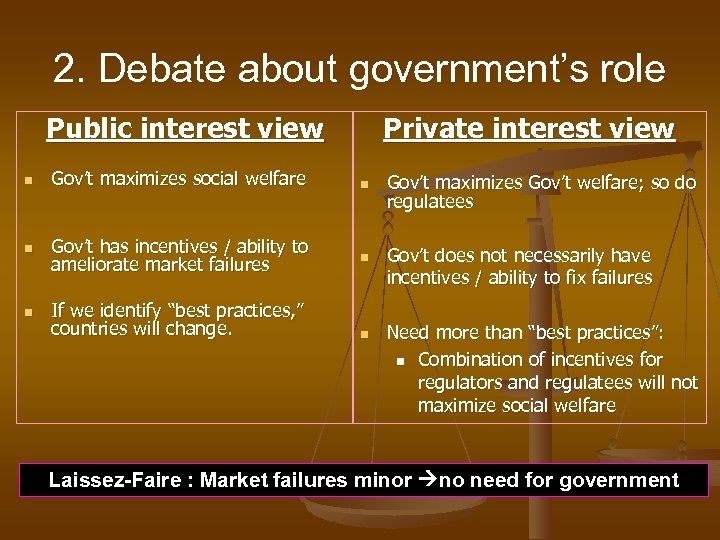
2. Debate about government’s role Public interest view n Gov’t maximizes social welfare n Gov’t has incentives / ability to ameliorate market failures n If we identify “best practices, ” countries will change. Private interest view n n n Gov’t maximizes Gov’t welfare; so do regulatees Gov’t does not necessarily have incentives / ability to fix failures Need more than “best practices”: n Combination of incentives for regulators and regulatees will not maximize social welfare Laissez-Faire : Market failures minor no need for government
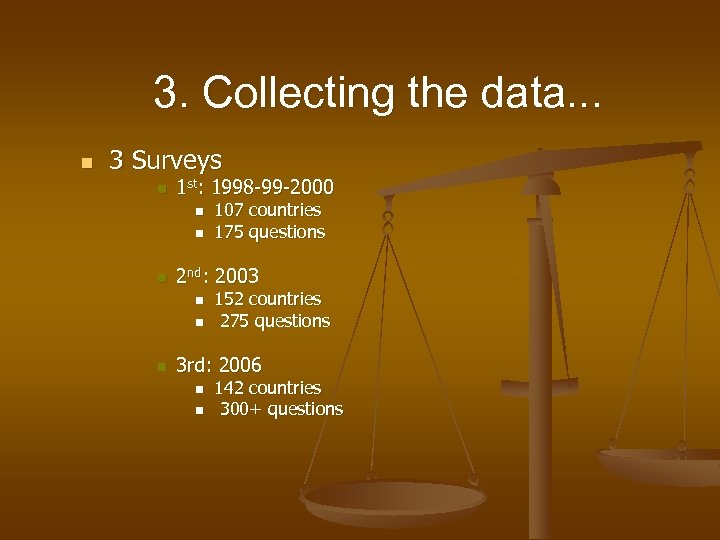
3. Collecting the data. . . n 3 Surveys n 1 st: 1998 -99 -2000 n n n 2 nd: 2003 n n n 107 countries 175 questions 152 countries 275 questions 3 rd: 2006 n n 142 countries 300+ questions
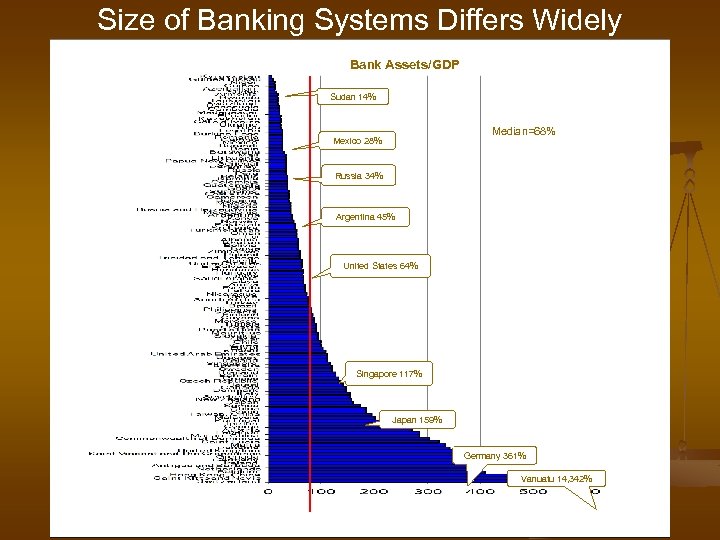
Size of Banking Systems Differs Widely Bank Assets/GDP Sudan 14% Median=68% Mexico 28% Russia 34% Argentina 45% United States 64% Singapore 117% Japan 159% Germany 361% Vanuatu 14, 342%
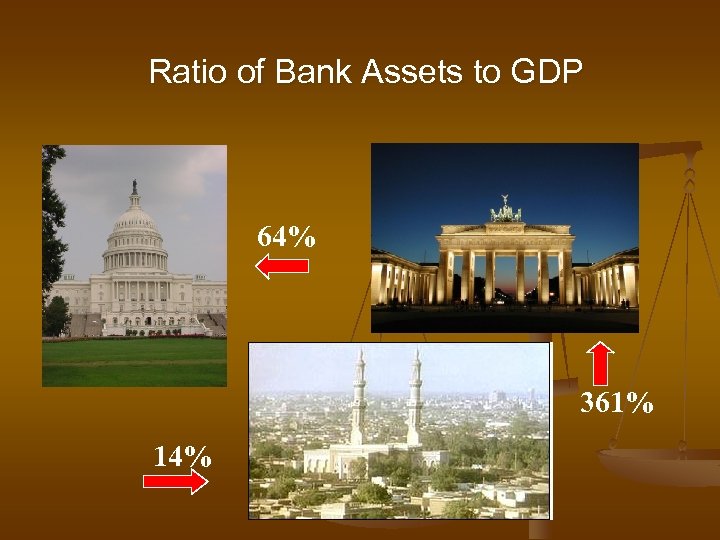
Ratio of Bank Assets to GDP 64% 361% 14%
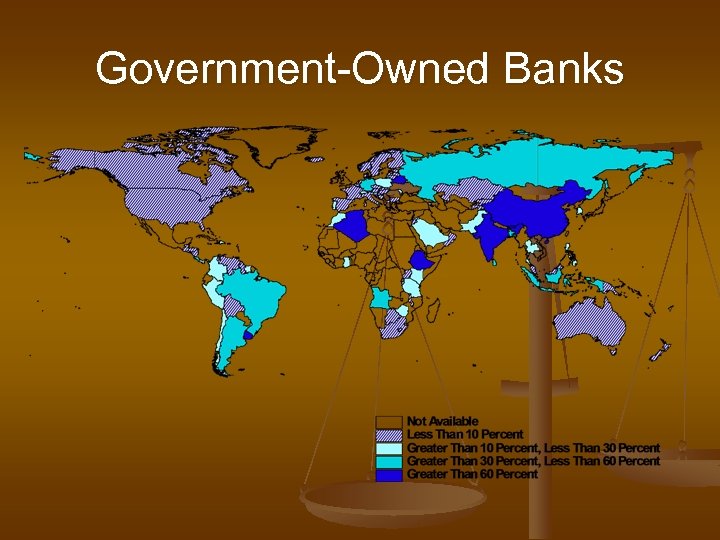
Government-Owned Banks
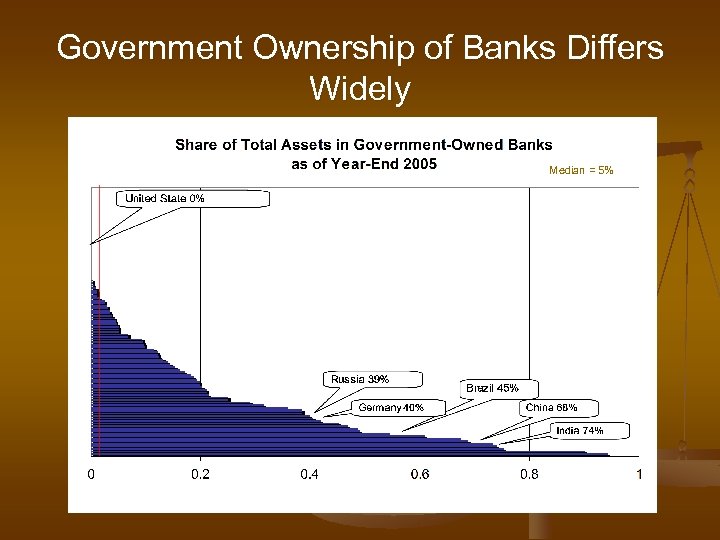
Government Ownership of Banks Differs Widely Median = 5%
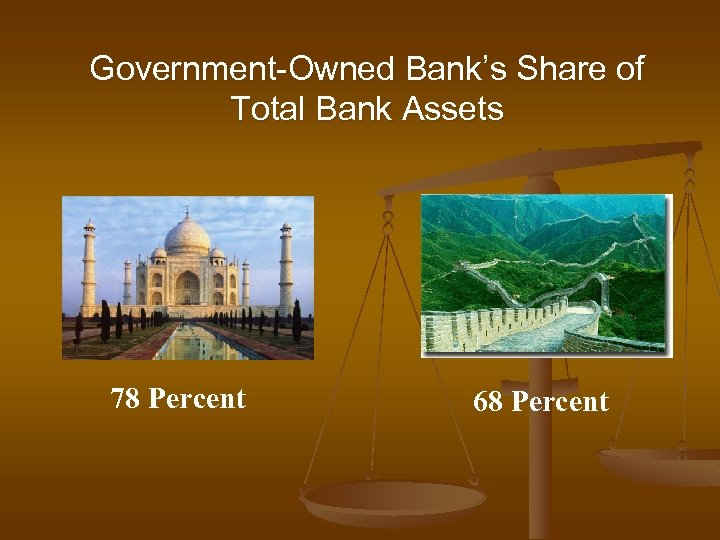
Government-Owned Bank’s Share of Total Bank Assets 78 Percent 68 Percent
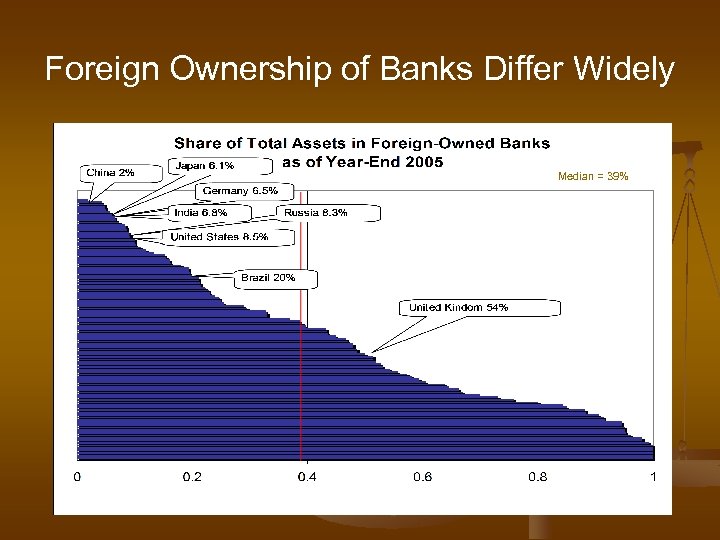
Foreign Ownership of Banks Differ Widely Median = 39%
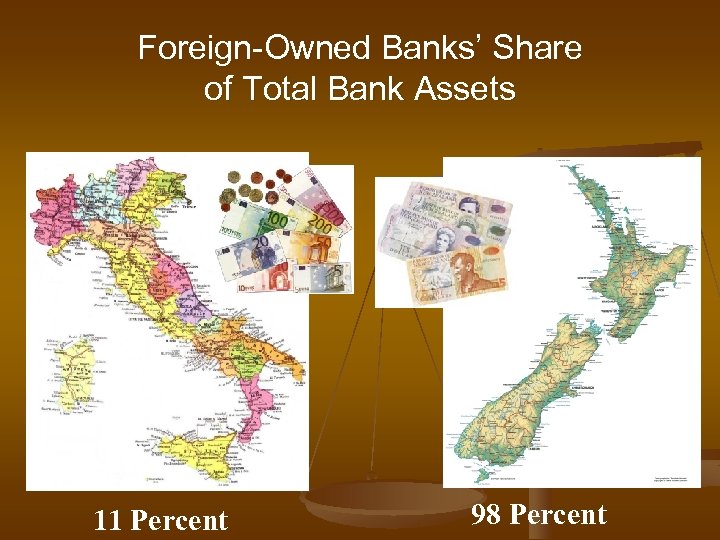
Foreign-Owned Banks’ Share of Total Bank Assets 11 Percent 98 Percent
Grouping and Aggregating Data to Assess What Works Best n n n Structure, scope, independence of regulation and supervision Bank activities Entry requirements Capital requirements Deposit Insurance n n Supervisory powers Private monitoring External governance Ownership characteristics All the data is online in the hopes of lowering the entry barriers to conducting better research.
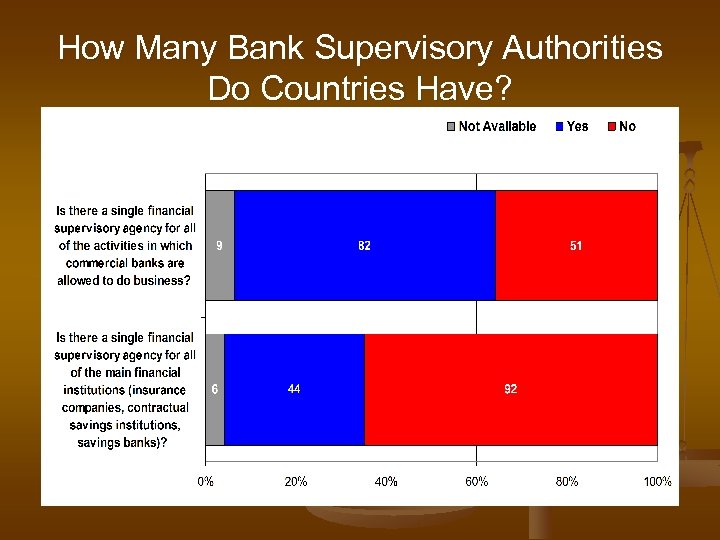
How Many Bank Supervisory Authorities Do Countries Have?
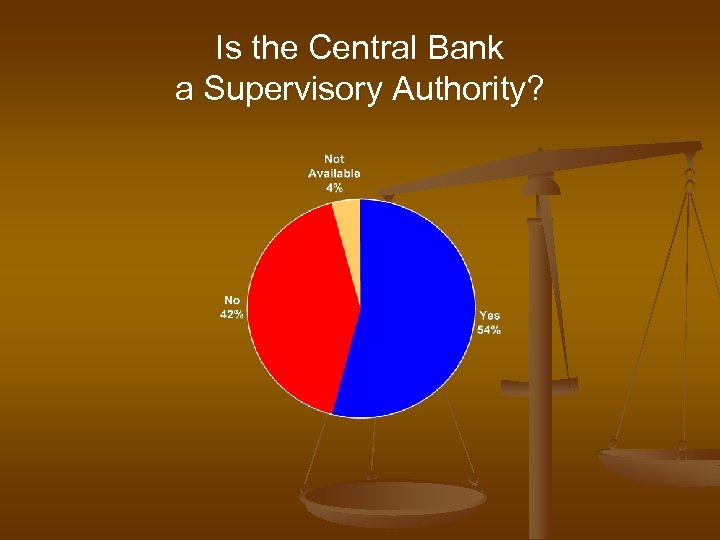
Is the Central Bank a Supervisory Authority?
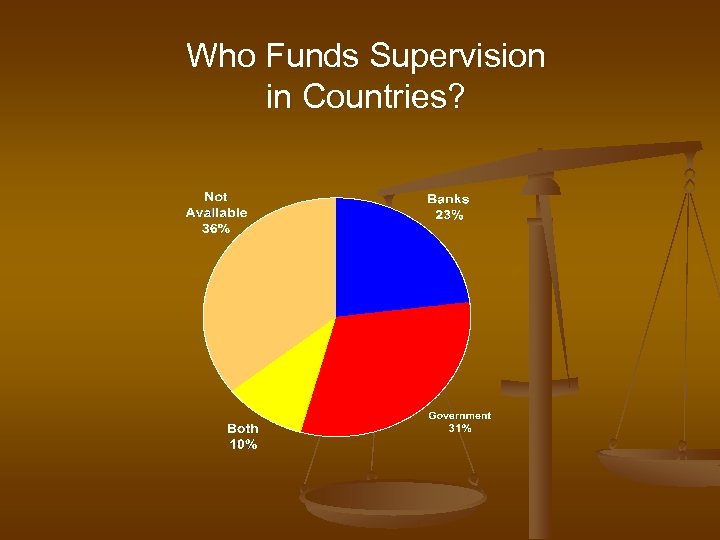
Who Funds Supervision in Countries?
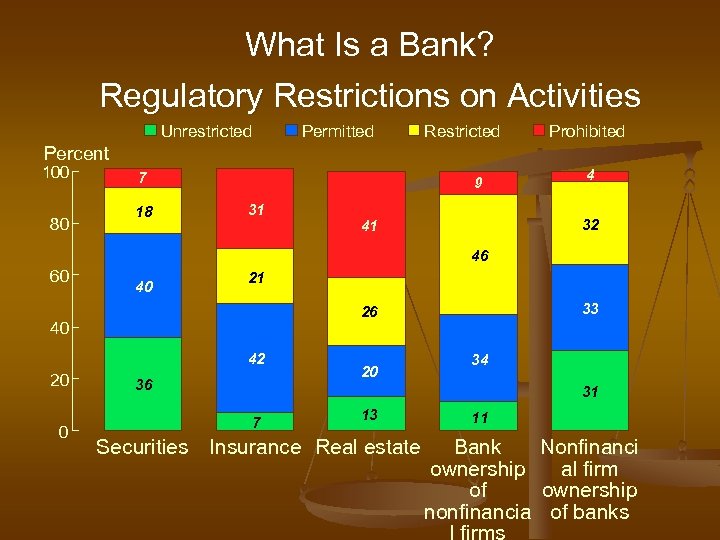
What Is a Bank? Regulatory Restrictions on Activities Unrestricted Permitted Restricted Prohibited Percent 100 80 7 18 9 31 4 32 41 46 60 40 21 40 42 20 0 33 26 36 20 34 31 7 13 Securities Insurance Real estate 11 Bank Nonfinanci ownership al firm of ownership nonfinancia of banks
Entry n Foreign n limitations on foreign entry/ownership % of entry applications denied (foreign & domestic) Domestic n summary indicator of rules to obtain a license n draft by-laws, organizational chart, financial projections, financial background information on major owners, background of directors/managers, sources of capital, etc.
Capital n Summary measure of initial and general capital stringency n n n Basel C/A Capital varies with market risk loan securities, FX losses deducted from capital initial capital only with cash and government securities borrowed funds for initial capital verify capital sources
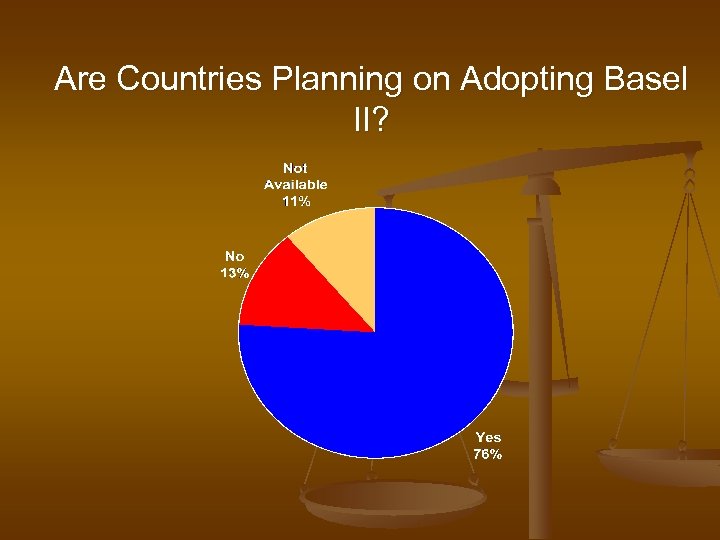
Are Countries Planning on Adopting Basel II?
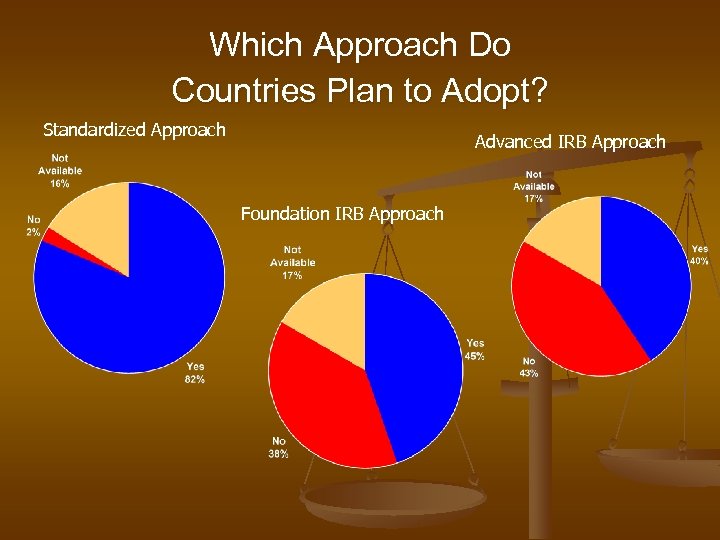
Which Approach Do Countries Plan to Adopt? Standardized Approach Advanced IRB Approach Foundation IRB Approach
Deposit Insurance Generosity n Explicit n Level of coverage n Coinsurance n Coverage (e. g. , FX, interbank deposits) n Funding (source; flat or risk based) n Management n Membership
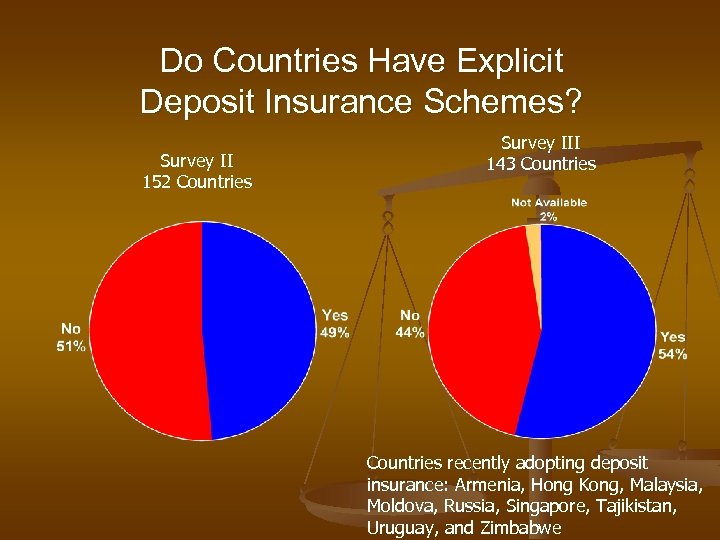
Do Countries Have Explicit Deposit Insurance Schemes? Survey II 152 Countries Survey III 143 Countries recently adopting deposit insurance: Armenia, Hong Kong, Malaysia, Moldova, Russia, Singapore, Tajikistan, Uruguay, and Zimbabwe
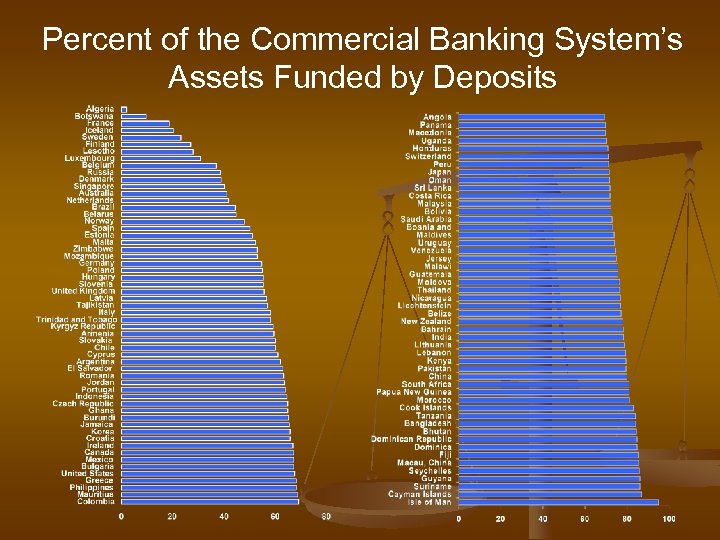
Percent of the Commercial Banking System’s Assets Funded by Deposits
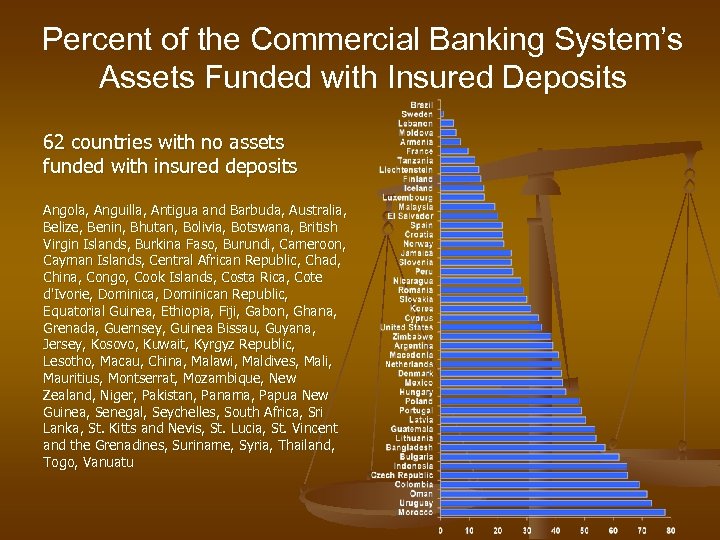
Percent of the Commercial Banking System’s Assets Funded with Insured Deposits 62 countries with no assets funded with insured deposits Angola, Anguilla, Antigua and Barbuda, Australia, Belize, Benin, Bhutan, Bolivia, Botswana, British Virgin Islands, Burkina Faso, Burundi, Cameroon, Cayman Islands, Central African Republic, Chad, China, Congo, Cook Islands, Costa Rica, Cote d'Ivorie, Dominican Republic, Equatorial Guinea, Ethiopia, Fiji, Gabon, Ghana, Grenada, Guernsey, Guinea Bissau, Guyana, Jersey, Kosovo, Kuwait, Kyrgyz Republic, Lesotho, Macau, China, Malawi, Maldives, Mali, Mauritius, Montserrat, Mozambique, New Zealand, Niger, Pakistan, Panama, Papua New Guinea, Senegal, Seychelles, South Africa, Sri Lanka, St. Kitts and Nevis, St. Lucia, St. Vincent and the Grenadines, Suriname, Syria, Thailand, Togo, Vanuatu
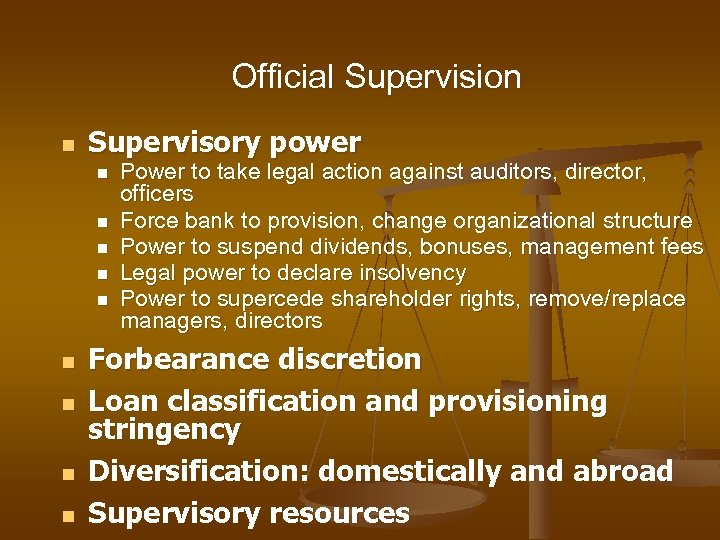
Official Supervision n Supervisory power n n n n n Power to take legal action against auditors, director, officers Force bank to provision, change organizational structure Power to suspend dividends, bonuses, management fees Legal power to declare insolvency Power to supercede shareholder rights, remove/replace managers, directors Forbearance discretion Loan classification and provisioning stringency Diversification: domestically and abroad Supervisory resources
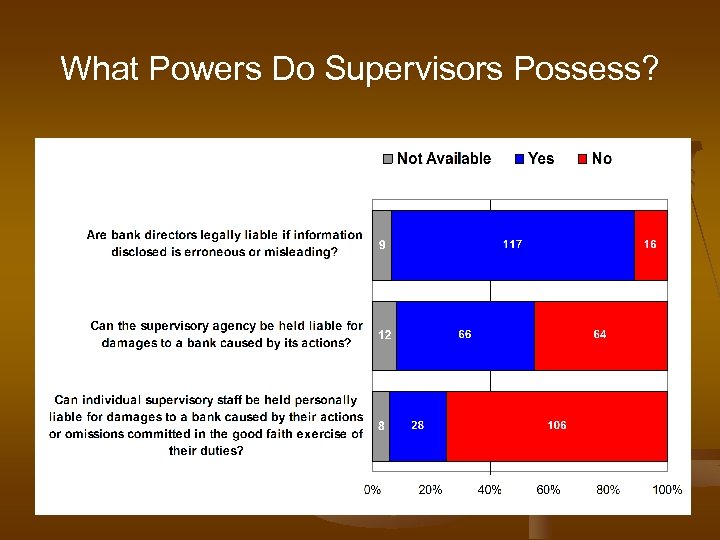
What Powers Do Supervisors Possess?
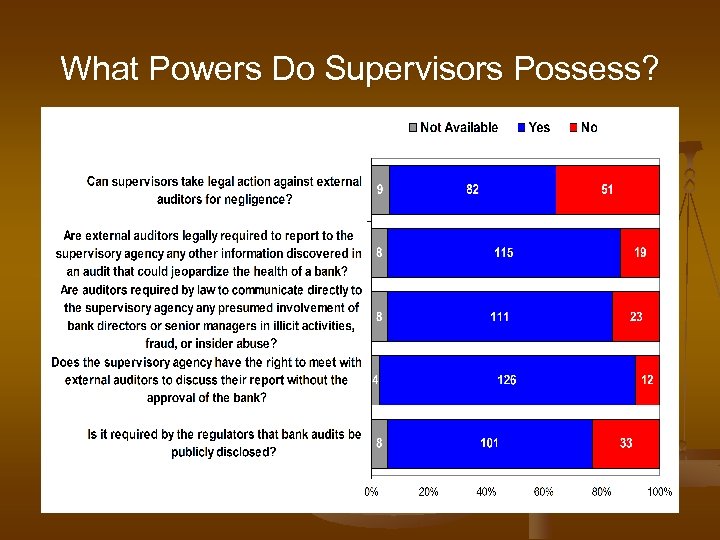
What Powers Do Supervisors Possess?
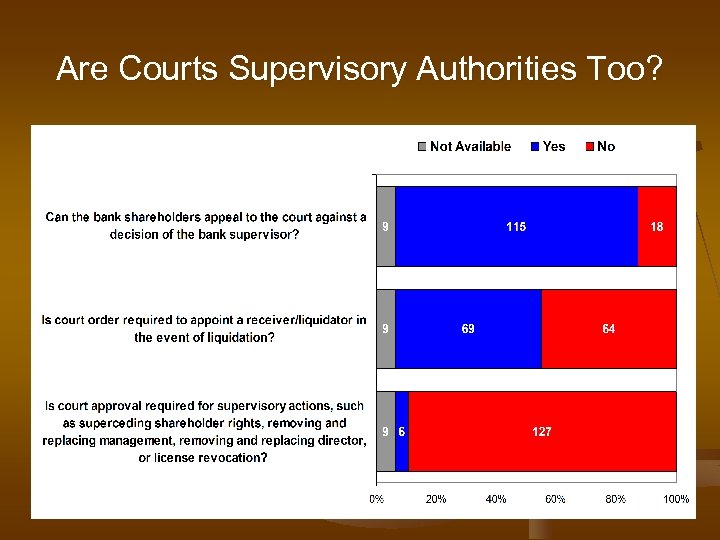
Are Courts Supervisory Authorities Too?
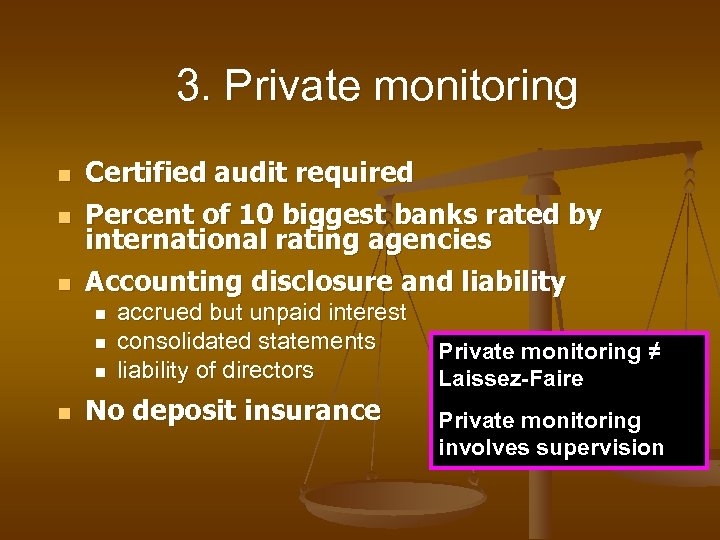
3. Private monitoring n n n Certified audit required Percent of 10 biggest banks rated by international rating agencies Accounting disclosure and liability n n accrued but unpaid interest consolidated statements liability of directors No deposit insurance Private monitoring ≠ Laissez-Faire Private monitoring involves supervision
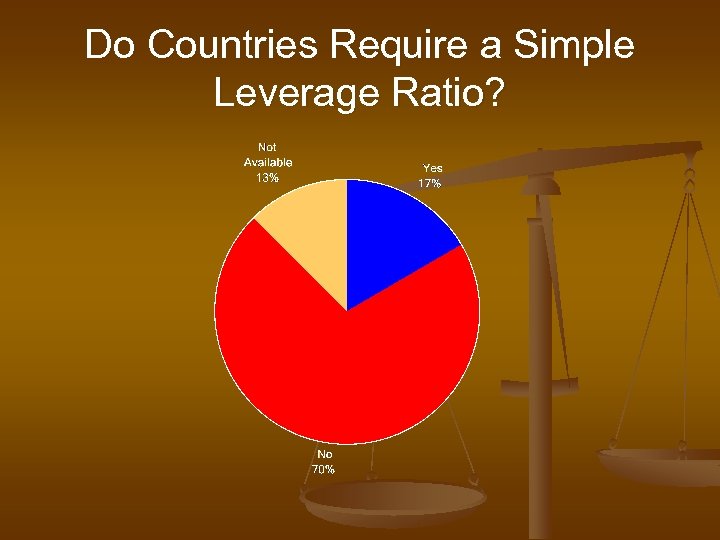
Do Countries Require a Simple Leverage Ratio?

4. What Works Best? What “works” Bank development n Efficiency n Integrity n Stability n Bank governance? n
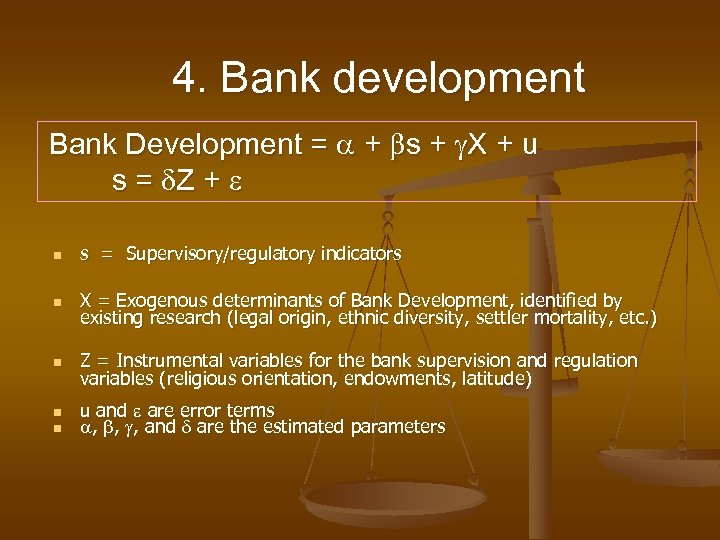
4. Bank development Bank Development = + s + X + u s = Z + n s = Supervisory/regulatory indicators n X = Exogenous determinants of Bank Development, identified by existing research (legal origin, ethnic diversity, settler mortality, etc. ) n Z = Instrumental variables for the bank supervision and regulation variables (religious orientation, endowments, latitude) n n u and are error terms , , , and are the estimated parameters
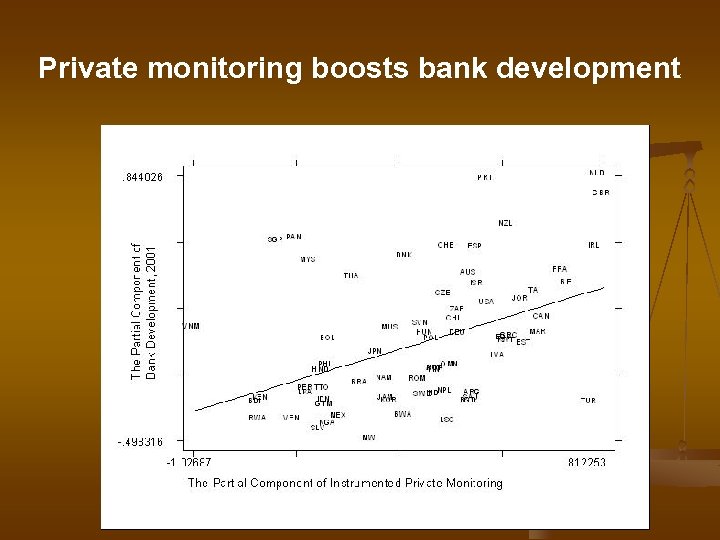
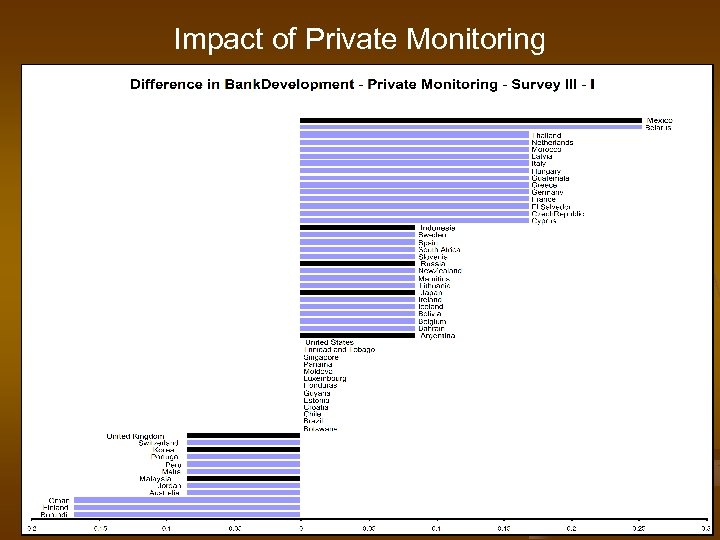
Private monitoring boosts bank development
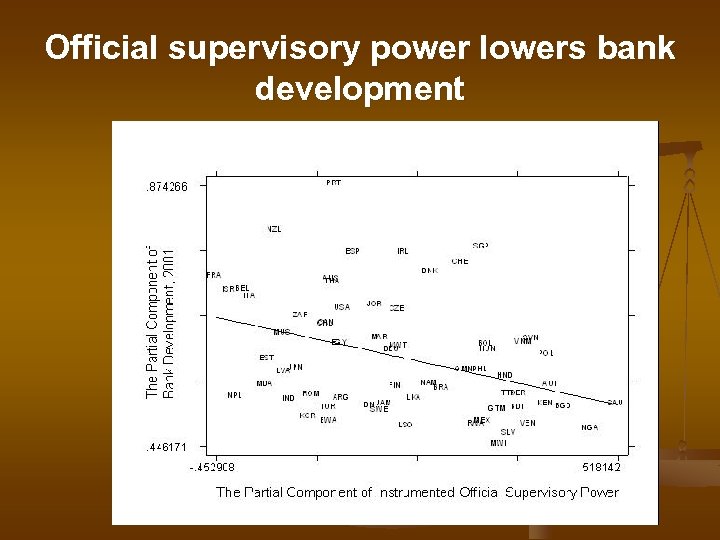
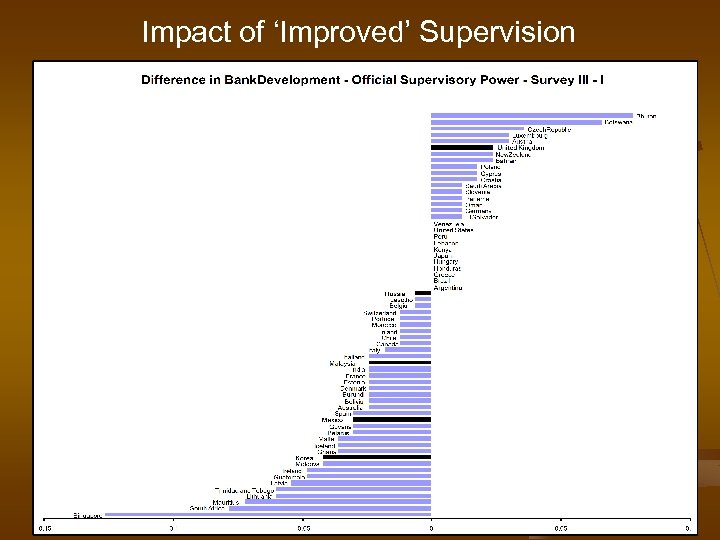
Official supervisory power lowers bank development
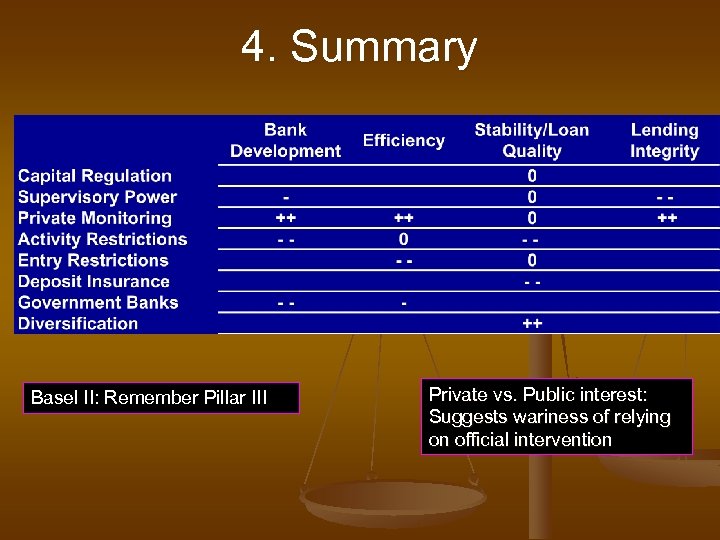
4. Summary Basel II: Remember Pillar III Private vs. Public interest: Suggests wariness of relying on official intervention
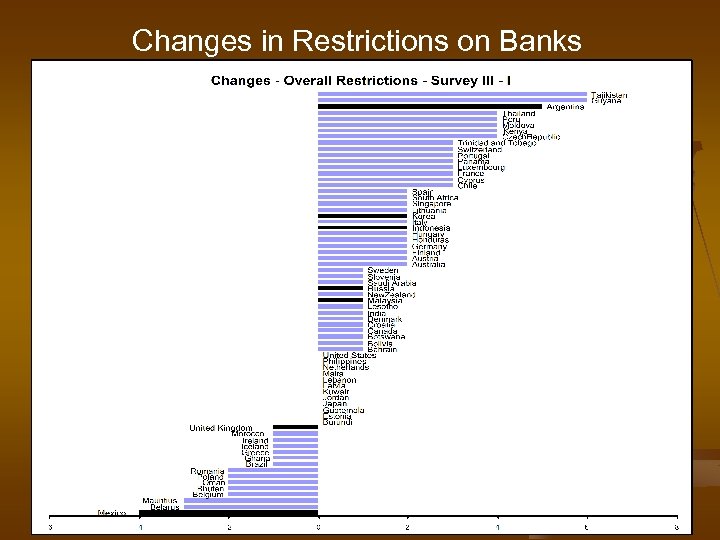
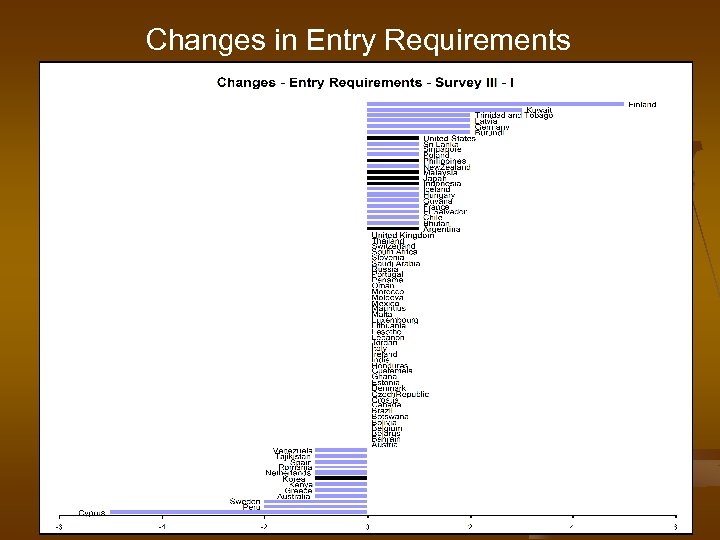
Changes in Restrictions on Banks
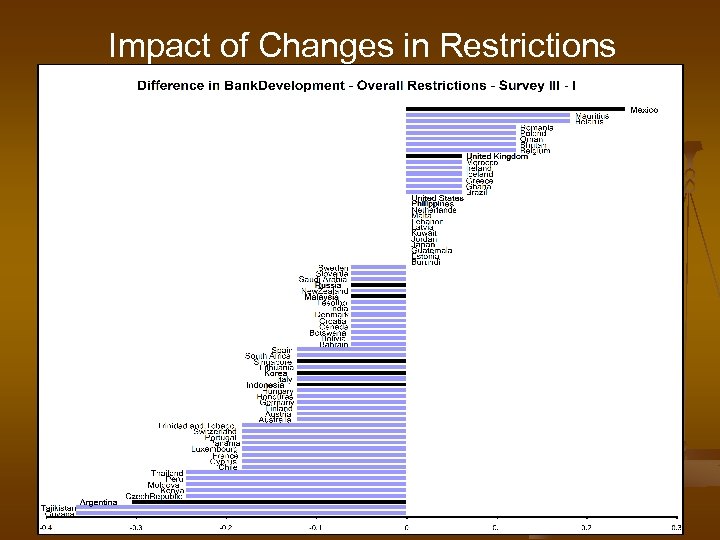
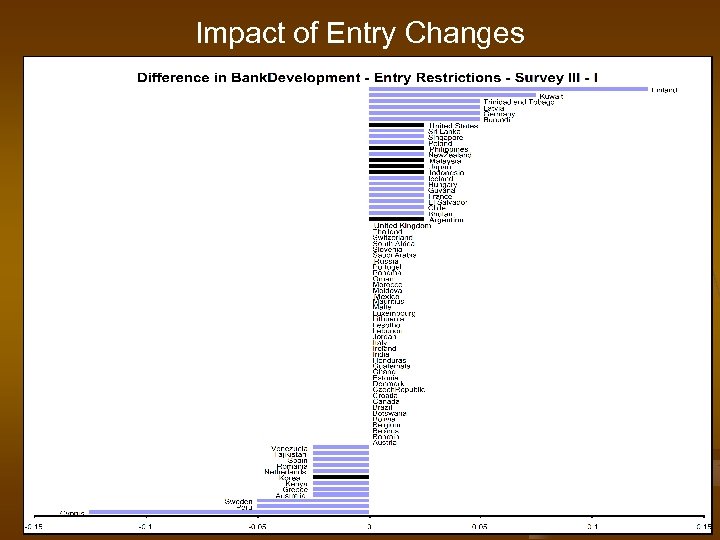
Impact of Changes in Restrictions
Changes in Entry Requirements
Impact of Entry Changes
Impact of ‘Improved’ Supervision
Impact of Private Monitoring
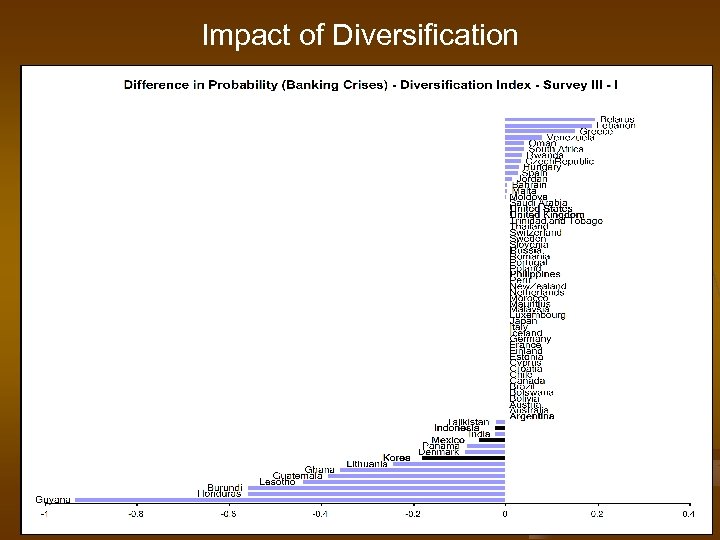
Impact of Diversification
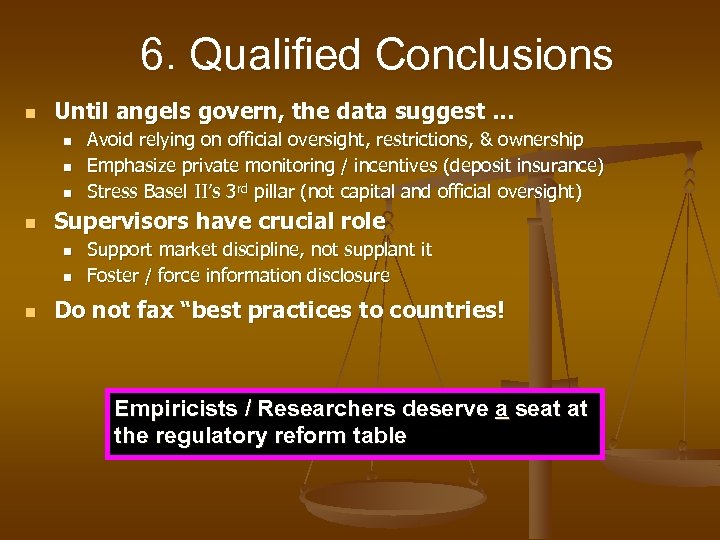
6. Qualified Conclusions n Until angels govern, the data suggest … n n Supervisors have crucial role n n n Avoid relying on official oversight, restrictions, & ownership Emphasize private monitoring / incentives (deposit insurance) Stress Basel II’s 3 rd pillar (not capital and official oversight) Support market discipline, not supplant it Foster / force information disclosure Do not fax “best practices to countries! Empiricists / Researchers deserve a seat at the regulatory reform table
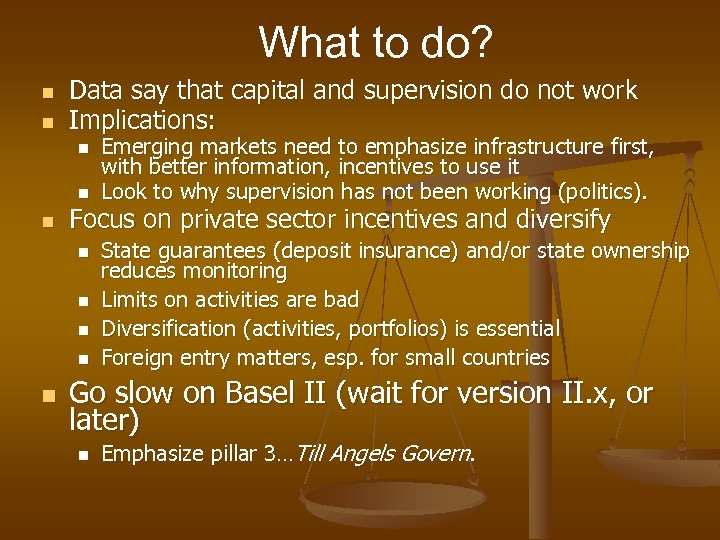
What to do? n n Data say that capital and supervision do not work Implications: n n n Focus on private sector incentives and diversify n n n Emerging markets need to emphasize infrastructure first, with better information, incentives to use it Look to why supervision has not been working (politics). State guarantees (deposit insurance) and/or state ownership reduces monitoring Limits on activities are bad Diversification (activities, portfolios) is essential Foreign entry matters, esp. for small countries Go slow on Basel II (wait for version II. x, or later) n Emphasize pillar 3…Till Angels Govern.
Our Limitations n Measurement n n n Gauging Government Role n n Errors, omissions, time-series in measuring supervision / regulation? Impact of supervision on the ground (only have proxies) Better aggregate indexes of approaches to supervision / regulation? Solution: get better data Policies may work differently in different political / institutional regimes Do we capture these nuances? Solution: add case studies Regulatory choices n n Does X-C evidence add much? Solution: add time series data
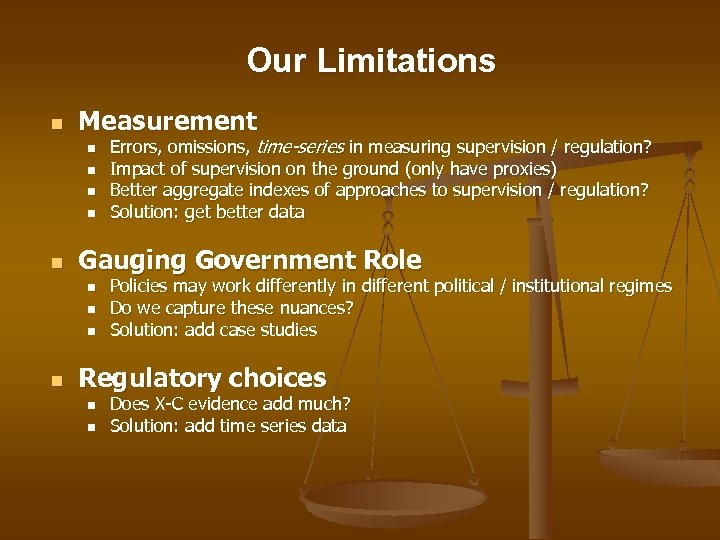
Our Limitations n Measurement n n n Gauging Government Role n n Errors, omissions, time-series in measuring supervision / regulation? Impact of supervision on the ground (only have proxies) Better aggregate indexes of approaches to supervision / regulation? Solution: get better data Policies may work differently in different political / institutional regimes Do we capture these nuances? Solution: add case studies Regulatory choices n n Does X-C evidence add much? Solution: add time series data
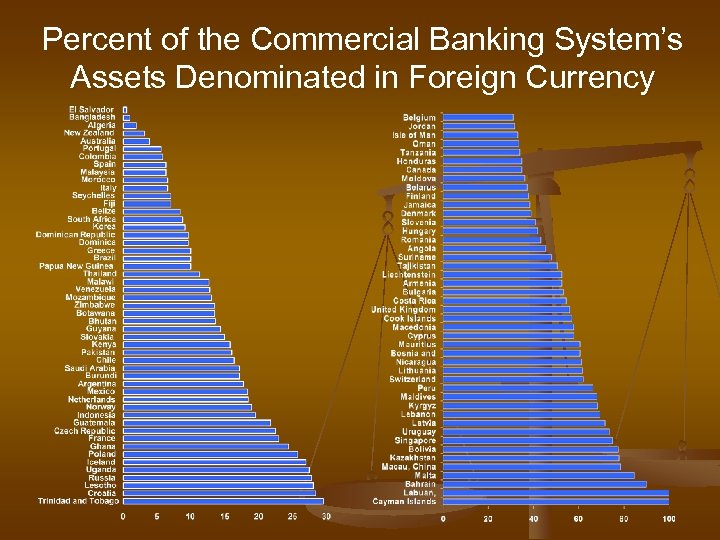
Percent of the Commercial Banking System’s Assets Denominated in Foreign Currency
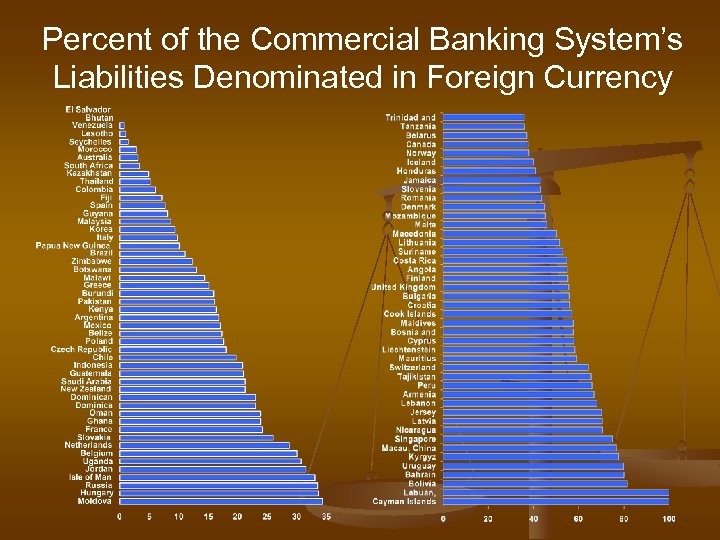
Percent of the Commercial Banking System’s Liabilities Denominated in Foreign Currency
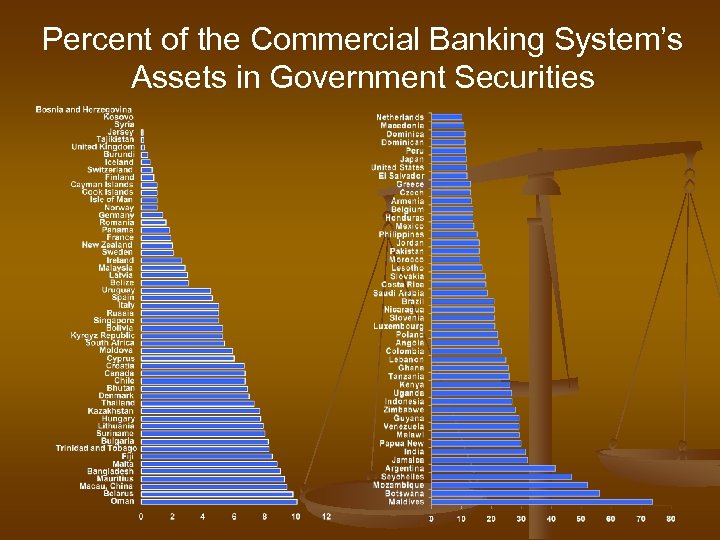
Percent of the Commercial Banking System’s Assets in Government Securities
Скачать презентацию Bank Regulation Is Changing But for Better or
6ead9556d053cfafa8edc261cf1c476b.ppt