 Скачать презентацию Bank of Israel Annual Report 2008 April 19
536c41b3e3b449cdd15274f38cd97002.ppt
- Количество слайдов: 32



Bank of Israel Annual Report 2008 April 19, 2009 1
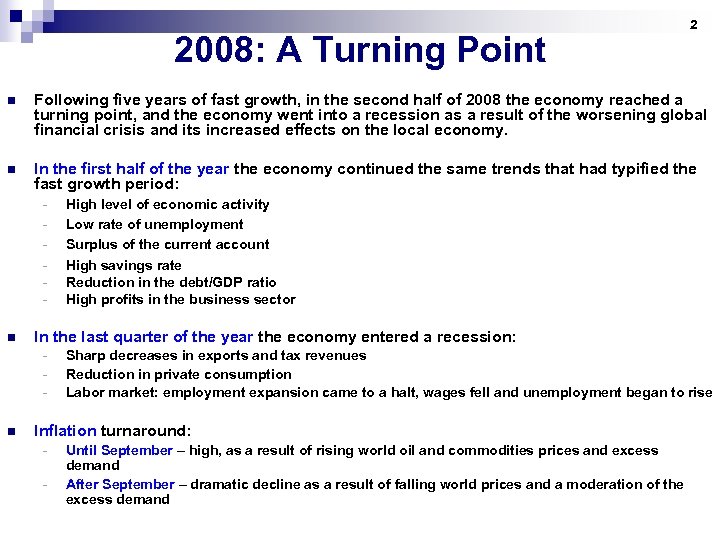
2008: A Turning Point 2 n Following five years of fast growth, in the second half of 2008 the economy reached a turning point, and the economy went into a recession as a result of the worsening global financial crisis and its increased effects on the local economy. n In the first half of the year the economy continued the same trends that had typified the fast growth period: - n In the last quarter of the year the economy entered a recession: - n High level of economic activity Low rate of unemployment Surplus of the current account High savings rate Reduction in the debt/GDP ratio High profits in the business sector Sharp decreases in exports and tax revenues Reduction in private consumption Labor market: employment expansion came to a halt, wages fell and unemployment began to rise Inflation turnaround: - Until September – high, as a result of rising world oil and commodities prices and excess demand After September – dramatic decline as a result of falling world prices and a moderation of the excess demand
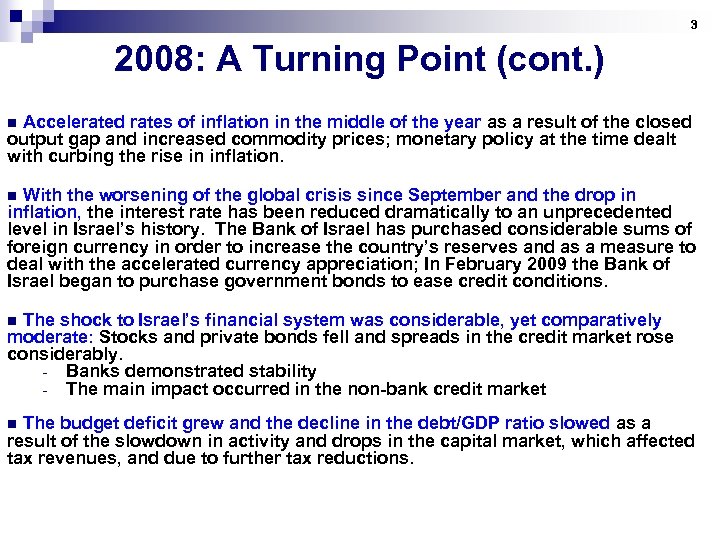
3 2008: A Turning Point (cont. ) Accelerated rates of inflation in the middle of the year as a result of the closed output gap and increased commodity prices; monetary policy at the time dealt with curbing the rise in inflation. n With the worsening of the global crisis since September and the drop in inflation, the interest rate has been reduced dramatically to an unprecedented level in Israel’s history. The Bank of Israel has purchased considerable sums of foreign currency in order to increase the country’s reserves and as a measure to deal with the accelerated currency appreciation; In February 2009 the Bank of Israel began to purchase government bonds to ease credit conditions. n The shock to Israel’s financial system was considerable, yet comparatively moderate: Stocks and private bonds fell and spreads in the credit market rose considerably. - Banks demonstrated stability - The main impact occurred in the non-bank credit market n The budget deficit grew and the decline in the debt/GDP ratio slowed as a result of the slowdown in activity and drops in the capital market, which affected tax revenues, and due to further tax reductions. n
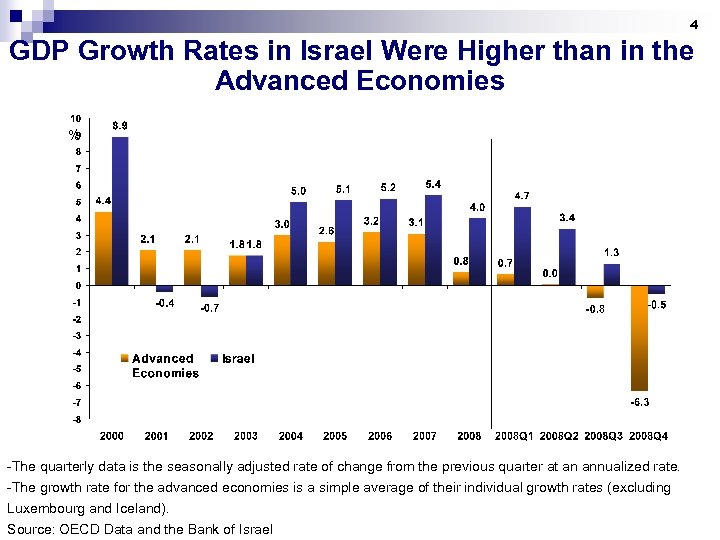
4 GDP Growth Rates in Israel Were Higher than in the Advanced Economies % -The quarterly data is the seasonally adjusted rate of change from the previous quarter at an annualized rate. -The growth rate for the advanced economies is a simple average of their individual growth rates (excluding Luxembourg and Iceland). Source: OECD Data and the Bank of Israel
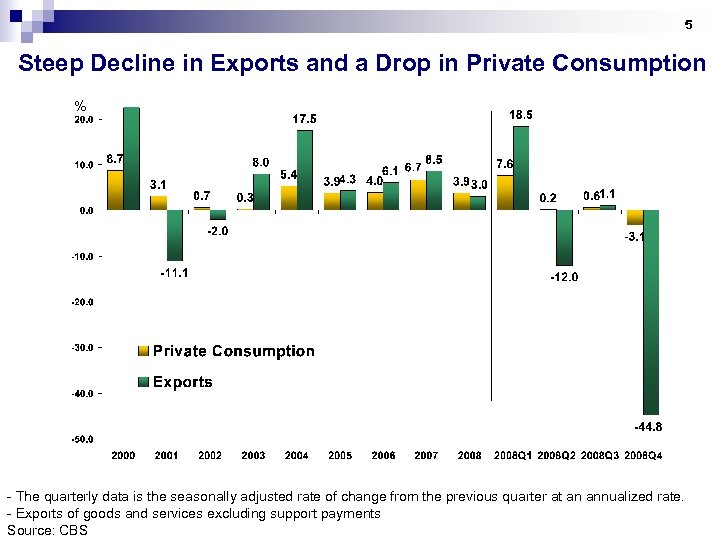
5 Steep Decline in Exports and a Drop in Private Consumption % - The quarterly data is the seasonally adjusted rate of change from the previous quarter at an annualized rate. - Exports of goods and services excluding support payments Source: CBS
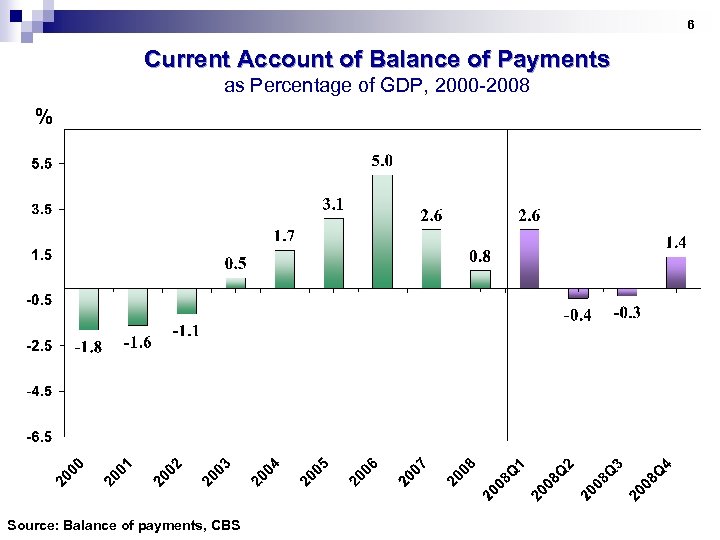
6 Current Account of Balance of Payments as Percentage of GDP, 2000 -2008 % Source: Balance of payments, CBS
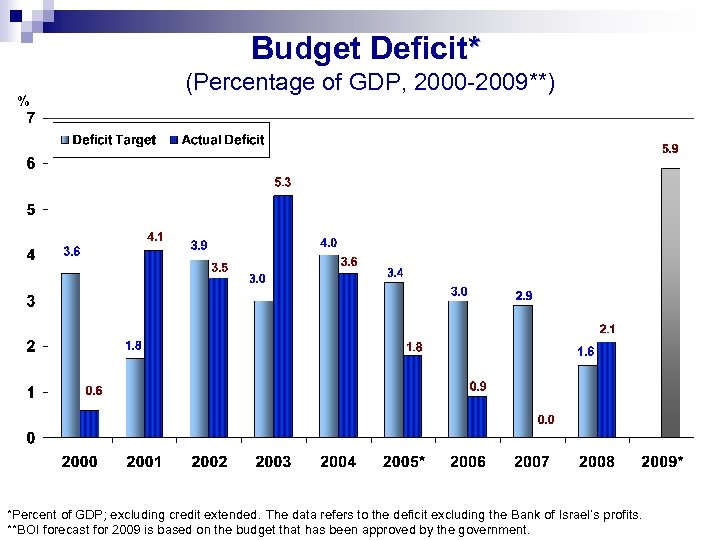
Budget Deficit* % (Percentage of GDP, 2000 -2009**) *Percent of GDP; excluding credit extended. The data refers to the deficit excluding the Bank of Israel’s profits. **BOI forecast for 2009 is based on the budget that has been approved by the government.
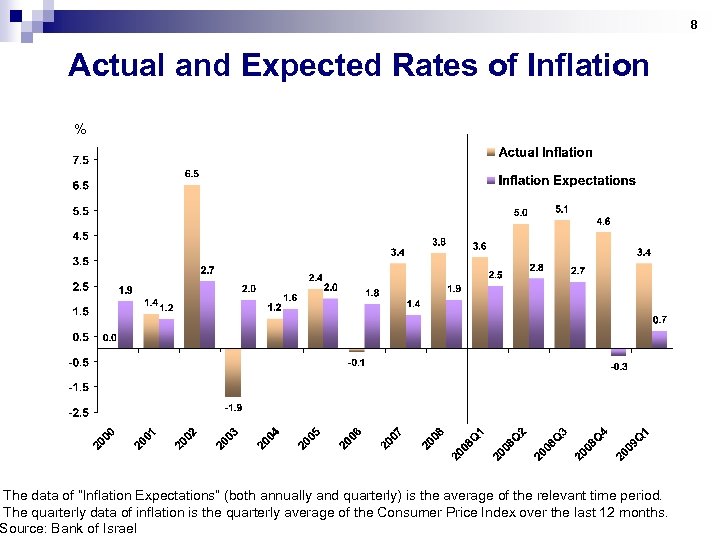
8 Actual and Expected Rates of Inflation % The data of “Inflation Expectations” (both annually and quarterly) is the average of the relevant time period. The quarterly data of inflation is the quarterly average of the Consumer Price Index over the last 12 months. Source: Bank of Israel
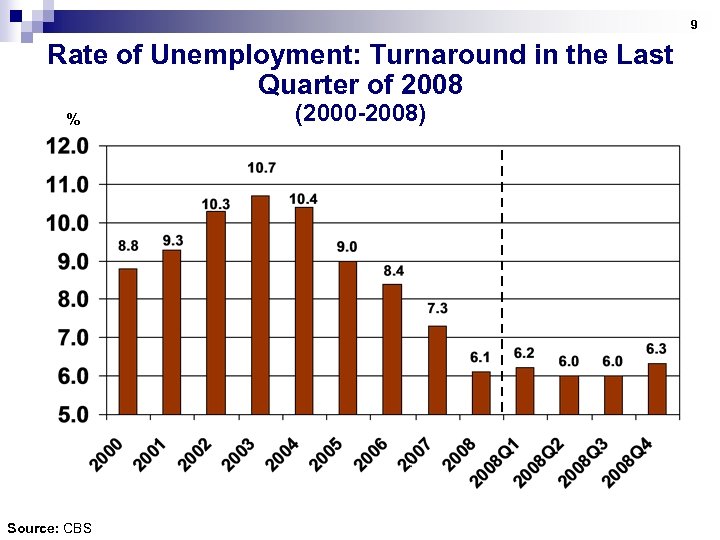
9 Rate of Unemployment: Turnaround in the Last Quarter of 2008 % Source: CBS (2000 -2008)
Five Years of Growth: What Have We Gained? n n n A rise of 10% in real per capita GDP since 2000 and 15% compared with 2001 -02 Sustained surplus in the current account A decline in absolute poverty levels, in almost all population groups Increase in the participation and employment levels and a decrease in unemployment in all population groups Improved fiscal environment: reduction in the budget deficit, public debt and public expenditure as a percentage of GDP accompanied by tax cuts What haven’t we gained? n n n 10 Cyclically adjusted, the declines in deficits have been modest Per capita GDP relative to the U. S. – return to 60% (level preceding the recession) An increase in relative poverty (although it declined in the last two years)
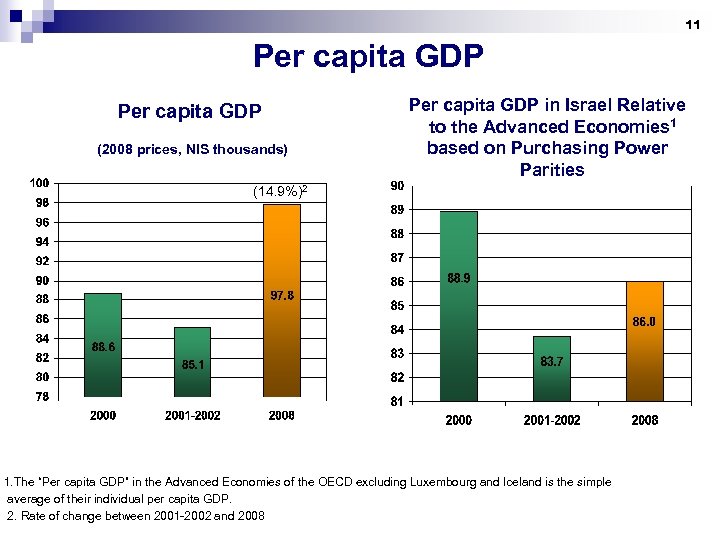
11 Per capita GDP (2008 prices, NIS thousands) Per capita GDP in Israel Relative to the Advanced Economies 1 based on Purchasing Power Parities (14. 9%)2 1. The “Per capita GDP” in the Advanced Economies of the OECD excluding Luxembourg and Iceland is the simple average of their individual per capita GDP. 2. Rate of change between 2001 -2002 and 2008
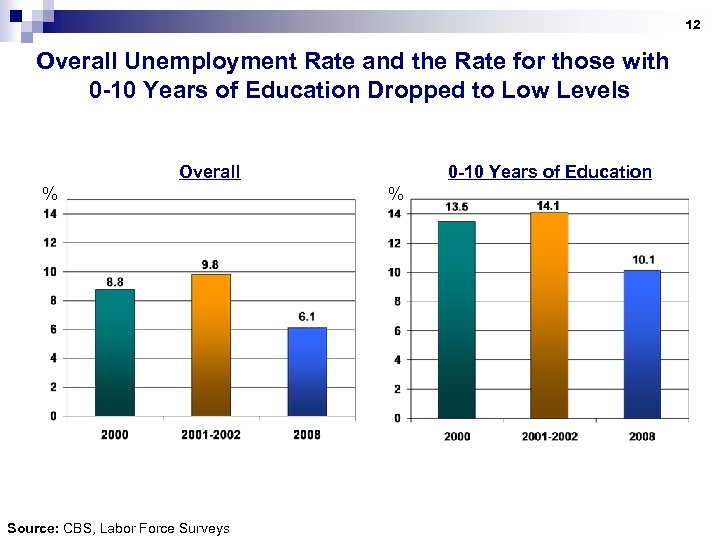
12 Overall Unemployment Rate and the Rate for those with 0 -10 Years of Education Dropped to Low Levels Overall % Source: CBS, Labor Force Surveys 0 -10 Years of Education %
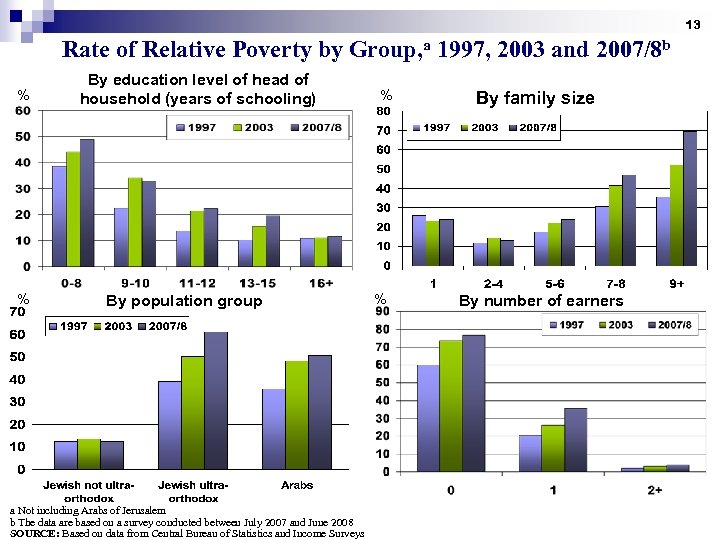
13 Rate of Relative Poverty by Group, a 1997, 2003 and 2007/8 b % % By education level of head of household (years of schooling) By population group a Not including Arabs of Jerusalem b The data are based on a survey conducted between July 2007 and June 2008 SOURCE: Based on data from Central Bureau of Statistics and Income Surveys % % By family size By number of earners
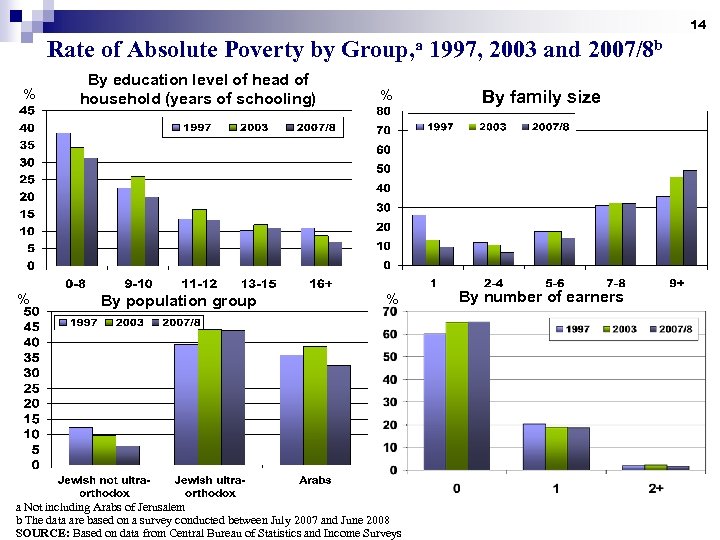
14 Rate of Absolute Poverty by Group, a 1997, 2003 and 2007/8 b % % By education level of head of household (years of schooling) By population group % % a Not including Arabs of Jerusalem b The data are based on a survey conducted between July 2007 and June 2008 SOURCE: Based on data from Central Bureau of Statistics and Income Surveys By family size By number of earners
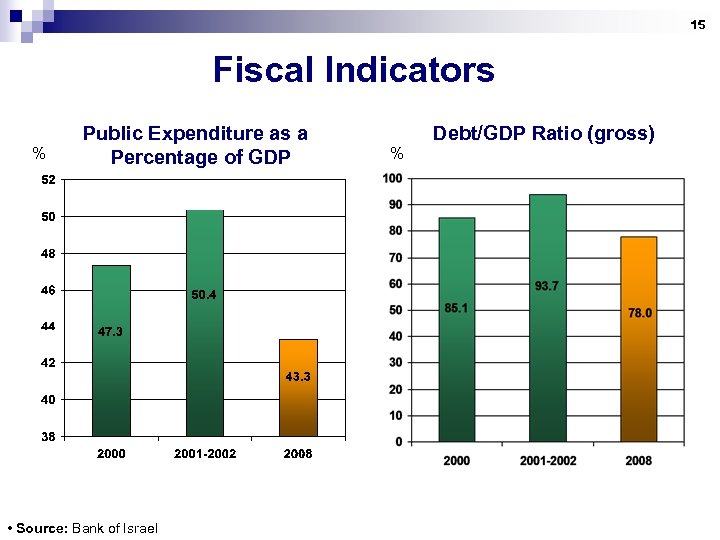
15 Fiscal Indicators % Public Expenditure as a Percentage of GDP • Source: Bank of Israel Debt/GDP Ratio (gross) %
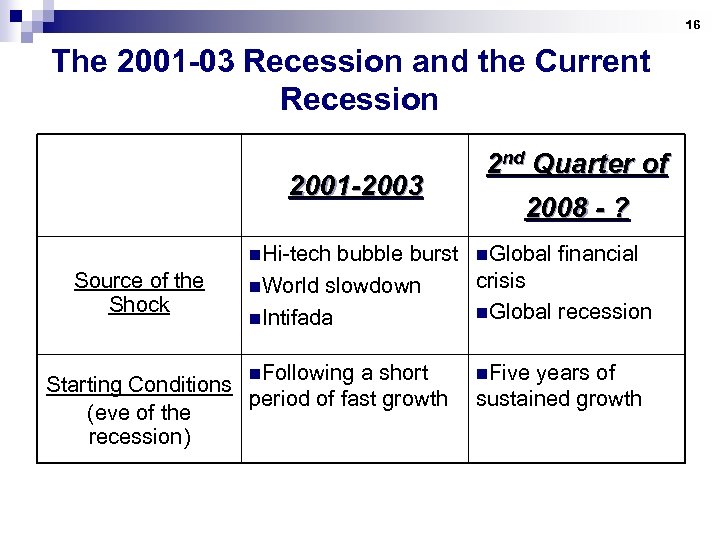
16 The 2001 -03 Recession and the Current Recession 2001 -2003 2 nd Quarter of 2008 - ? n. Hi-tech Source of the Shock bubble burst n. Global financial crisis n. World slowdown n. Global recession n. Intifada n. Following a short Starting Conditions period of fast growth (eve of the recession) n. Five years of sustained growth
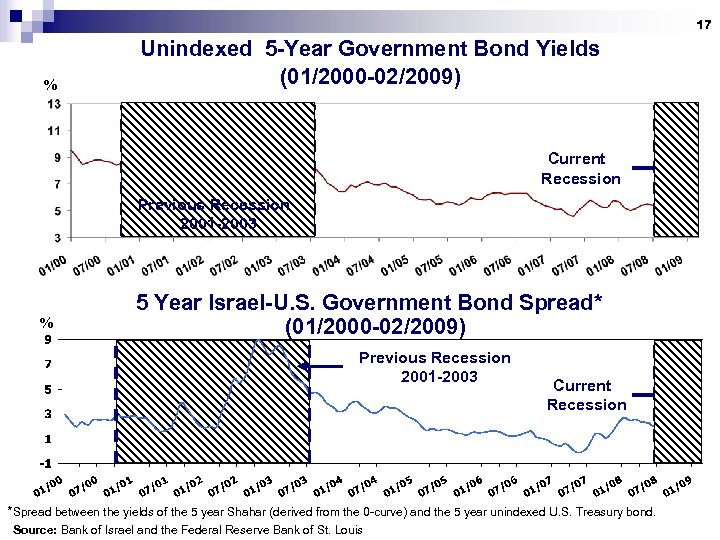
17 % Unindexed 5 -Year Government Bond Yields (01/2000 -02/2009) Current Recession Previous Recession 2001 -2003 % 5 Year Israel-U. S. Government Bond Spread* (01/2000 -02/2009) Previous Recession 2001 -2003 Current Recession *Spread between the yields of the 5 year Shahar (derived from the 0 -curve) and the 5 year unindexed U. S. Treasury bond. Source: Bank of Israel and the Federal Reserve Bank of St. Louis
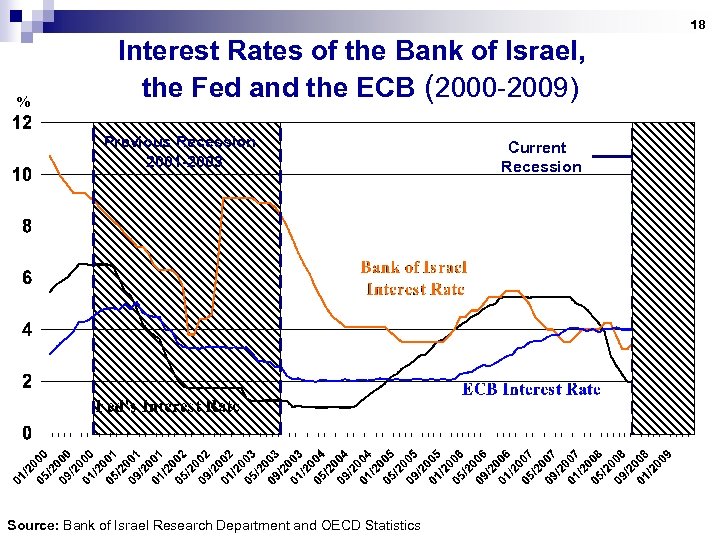
18 % Interest Rates of the Bank of Israel, the Fed and the ECB (2000 -2009) Previous Recession 2001 -2003 Source: Bank of Israel Research Department and OECD Statistics Current Recession
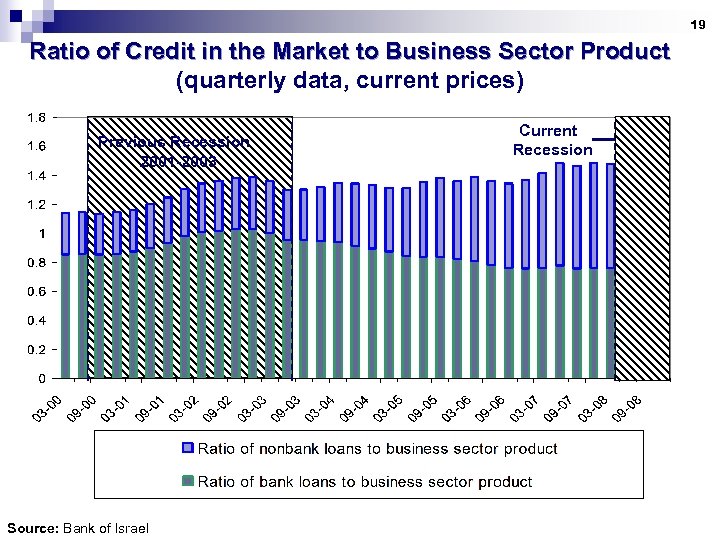
19 Ratio of Credit in the Market to Business Sector Product (quarterly data, current prices) Previous Recession 2001 -2003 Source: Bank of Israel Current Recession
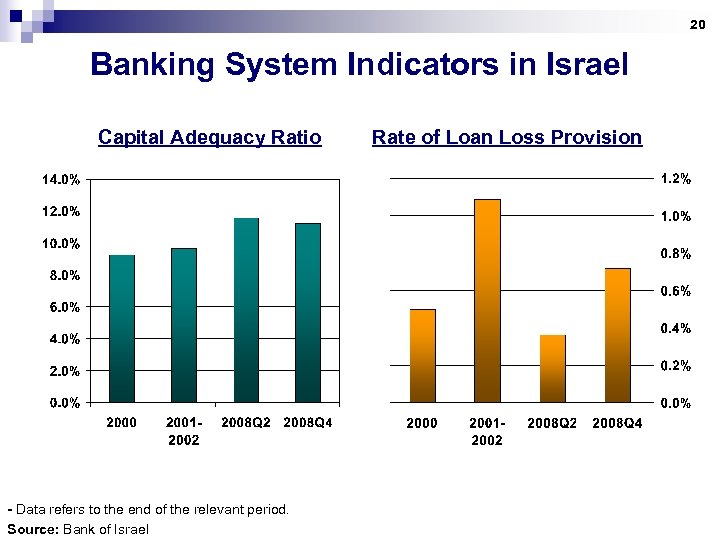
20 Banking System Indicators in Israel Capital Adequacy Ratio - Data refers to the end of the relevant period. Source: Bank of Israel Rate of Loan Loss Provision
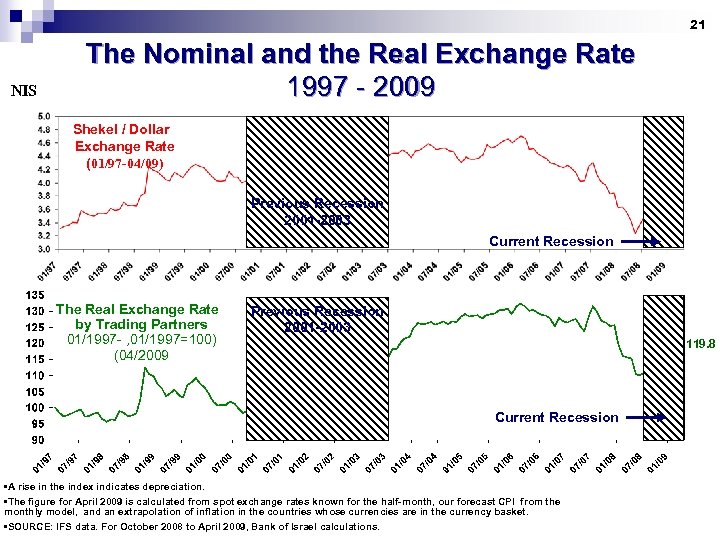
21 NIS The Nominal and the Real Exchange Rate 1997 - 2009 Shekel / Dollar Exchange Rate (01/97 -04/09) Previous Recession 2001 -2003 Current Recession The Real Exchange Rate by Trading Partners 01/1997 - , 01/1997=100) (04/2009 Previous Recession 2001 -2003 119. 8 Current Recession • A rise in the index indicates depreciation. • The figure for April 2009 is calculated from spot exchange rates known for the half-month, our forecast CPI from the monthly model, and an extrapolation of inflation in the countries whose currencies are in the currency basket. • SOURCE: IFS data. For October 2008 to April 2009, Bank of Israel calculations.
22 Forecast
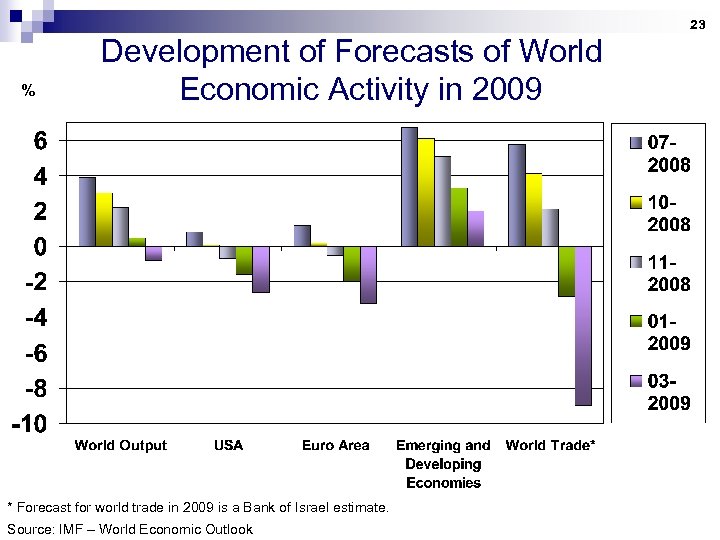
% Development of Forecasts of World Economic Activity in 2009 * Forecast for world trade in 2009 is a Bank of Israel estimate. Source: IMF – World Economic Outlook 23
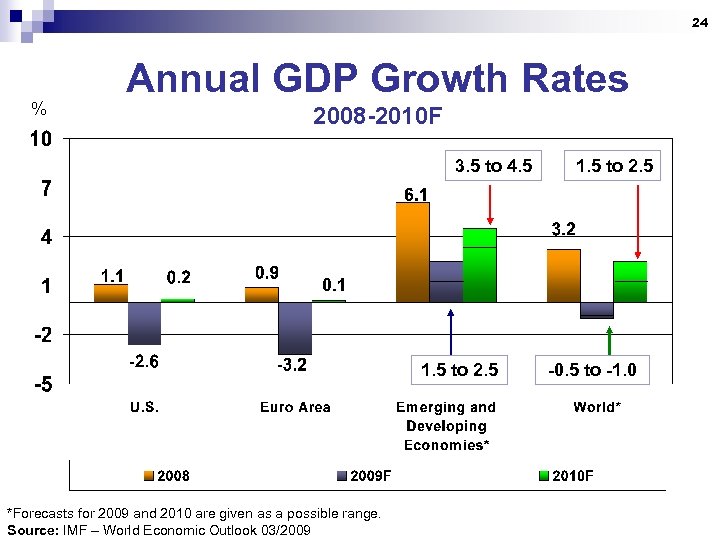
24 % Annual GDP Growth Rates 2008 -2010 F 3. 5 to 4. 5 1. 5 to 2. 5 *Forecasts for 2009 and 2010 are given as a possible range. Source: IMF – World Economic Outlook 03/2009 1. 5 to 2. 5 -0. 5 to -1. 0
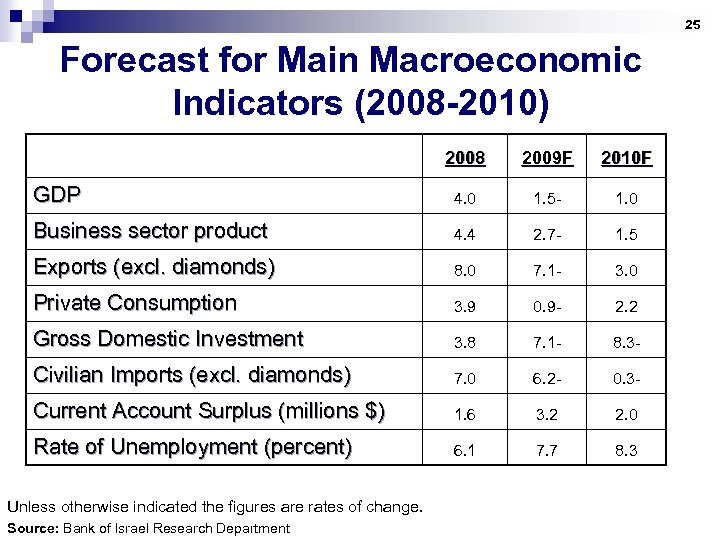
25 Forecast for Main Macroeconomic Indicators (2008 -2010) 2008 2009 F 2010 F GDP 4. 0 1. 5 - 1. 0 Business sector product 4. 4 2. 7 - 1. 5 Exports (excl. diamonds) 8. 0 7. 1 - 3. 0 Private Consumption 3. 9 0. 9 - 2. 2 Gross Domestic Investment 3. 8 7. 1 - 8. 3 - Civilian Imports (excl. diamonds) 7. 0 6. 2 - 0. 3 - Current Account Surplus (millions $) 1. 6 3. 2 2. 0 Rate of Unemployment (percent) 6. 1 7. 7 8. 3 Unless otherwise indicated the figures are rates of change. Source: Bank of Israel Research Department
26 Thank you
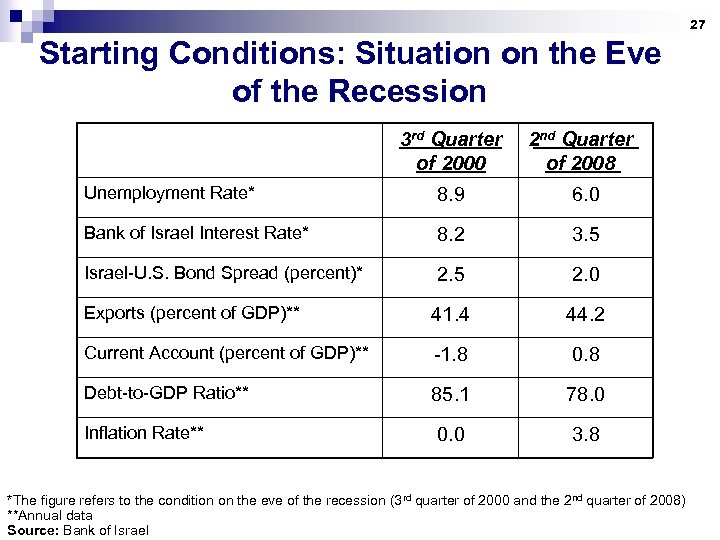
27 Starting Conditions: Situation on the Eve of the Recession 3 rd Quarter of 2000 2 nd Quarter of 2008 Unemployment Rate* 8. 9 6. 0 Bank of Israel Interest Rate* 8. 2 3. 5 Israel-U. S. Bond Spread (percent)* 2. 5 2. 0 Exports (percent of GDP)** 41. 4 44. 2 Current Account (percent of GDP)** -1. 8 0. 8 Debt-to-GDP Ratio** 85. 1 78. 0 0. 0 3. 8 Inflation Rate** *The figure refers to the condition on the eve of the recession (3 rd quarter of 2000 and the 2 nd quarter of 2008) **Annual data Source: Bank of Israel
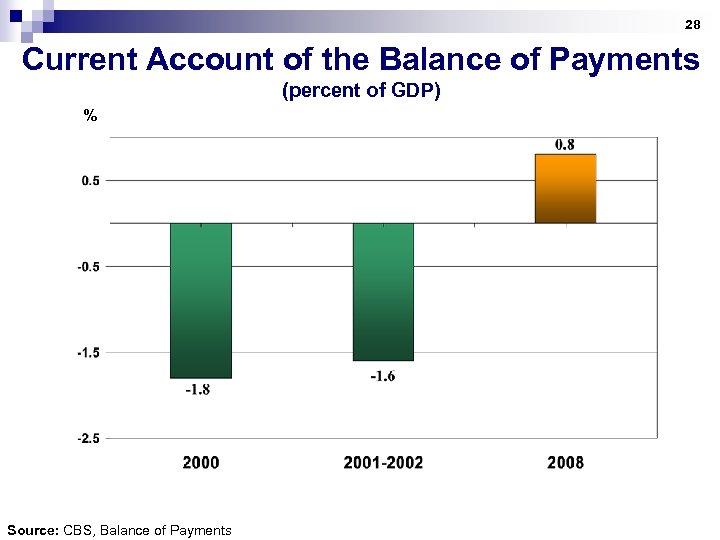
28 Current Account of the Balance of Payments (percent of GDP) % Source: CBS, Balance of Payments
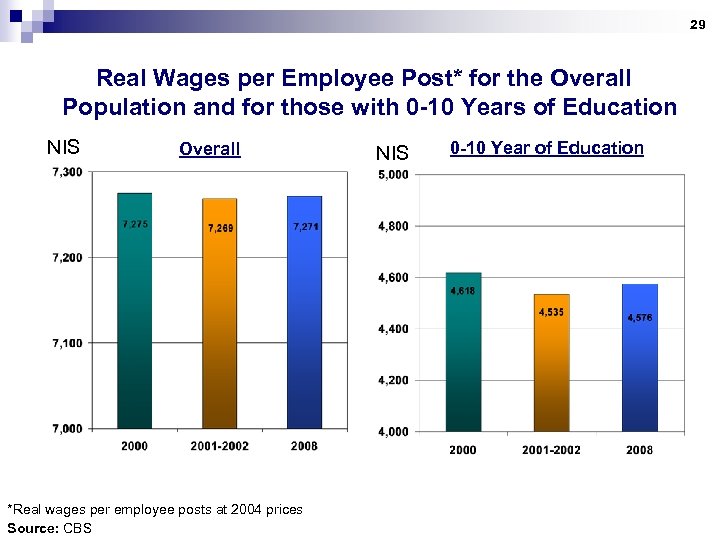
29 Real Wages per Employee Post* for the Overall Population and for those with 0 -10 Years of Education NIS Overall *Real wages per employee posts at 2004 prices Source: CBS NIS 0 -10 Year of Education
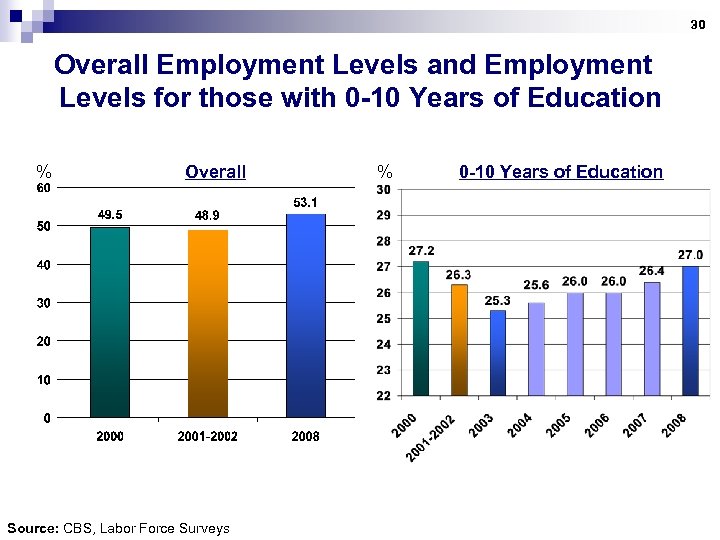
30 Overall Employment Levels and Employment Levels for those with 0 -10 Years of Education % Overall Source: CBS, Labor Force Surveys % 0 -10 Years of Education
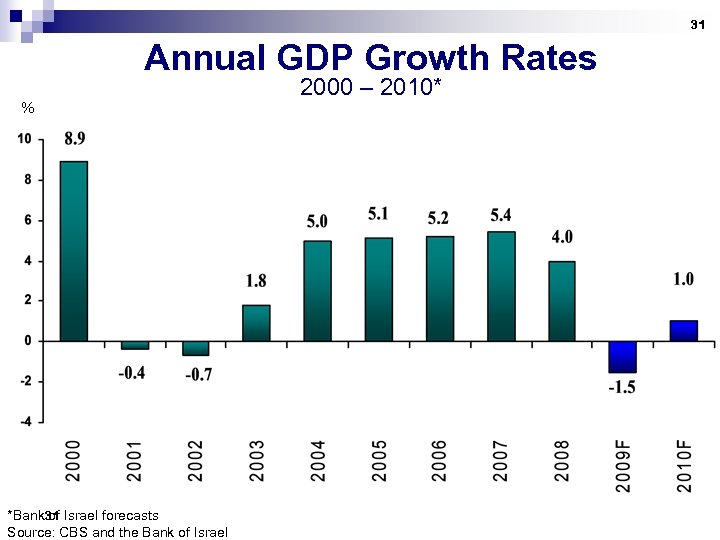
31 Annual GDP Growth Rates % *Bank 31 Israel forecasts of Source: CBS and the Bank of Israel 2000 – 2010*
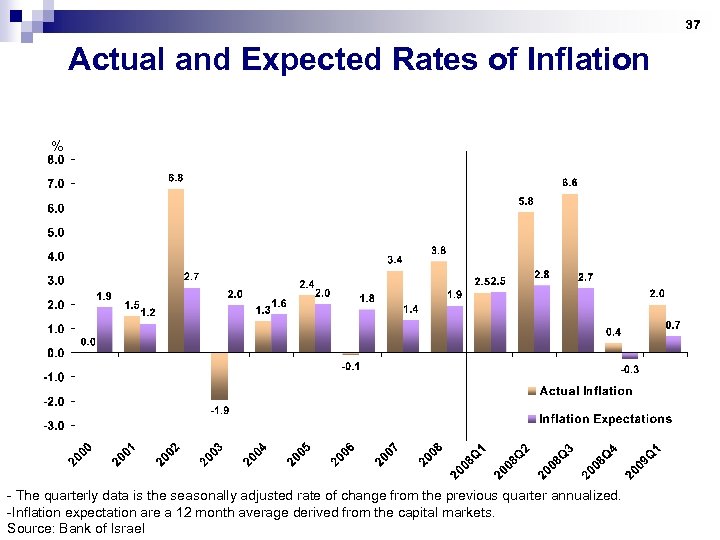
37 Actual and Expected Rates of Inflation % - The quarterly data is the seasonally adjusted rate of change from the previous quarter annualized. -Inflation expectation are a 12 month average derived from the capital markets. Source: Bank of Israel
Скачать презентацию Bank of Israel Annual Report 2008 April 19
536c41b3e3b449cdd15274f38cd97002.ppt