 Скачать презентацию Bank of England Governor and Company of the
ПРЕЗЕНТАЦИЯ БАНК АНГЛИИ. ПОНОМАРЕВ А.О..pptx
- Количество слайдов: 23



Bank of England (Governor and Company of the Bank of England)
Bank of England The Bank of England, formally the Governor and Company of the Bank of England, is the central bank of the United Kingdom and the model on which most modern central banks have been based. Established in 1694, it is the second oldest central bank in the world, after the Sveriges Riksbank, and the world’s 8 th oldest bank. It was established to act as the English Government's banker, and is still the banker for the Government of the United Kingdom. The Bank was privately owned by stockholders from its foundation in 1694 until nationalised in 1946.
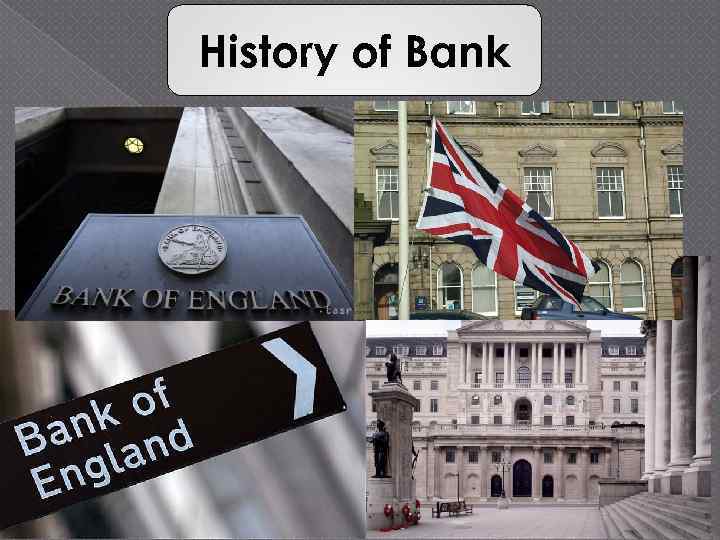
History of Bank
The establishment of the bank was devised by Charles Montagu, 1 st Earl of Halifax, in 1694, to the plan which had been proposed by William Paterson three years before, but not acted upon. He proposed a loan of £ 1. 2 m to the government; in return the subscribers would be incorporated as The Governor and Company of the Bank of England with long-term banking privileges including the issue of notes. The Royal Charter was granted on 27 July through the passage of the Tonnage Act 1694. Public finances were in so dire a condition at the time that the terms of the loan were that it was to be serviced at a rate of 8% per annum, and there was also a service charge of £ 4, 000 per annum for the management of the loan. The first governor was Sir John Houblon, who is depicted in the £ 50 note issued in 1994.

19 Century
The 1844 Bank Charter Act tied the issue of notes to the gold reserves and gave the Bank sole rights with regard to the issue of banknotes. Private banks that had previously had that right retained it, provided that their headquarters were outside London and that they deposited security against the notes that they issued. A few English banks continued to issue their own notes until the last of them was taken over in the 1930 s. Scottish and Northern Irish private banks still have that right. The bank acted as lender of last resort for the first time in the panic of 1866

20 Century
Britain remained on the gold standard until 1931 when the gold and foreign exchange reserves were transferred to the treasury, but their management was still handled by the Bank. During the governorship of Montagu Norman, from 1920 -44, the Bank made deliberate efforts to move away from commercial banking and become a central bank. In 1946, shortly after the end of Norman's tenure, the bank was nationalised by the Labour government. After 1945 the Bank pursued the multiple goals of Keynesian economics, especially "easy money" and low interest rates to support aggregate demand. It tried to keep a fixed exchange rate, and attempted to deal with inflation and sterling weakness by credit and exchange controls
In 1977, the Bank set up a wholly owned subsidiary called Bank of England Nominees Limited (BOEN), a private limited company, with two of its hundred £ 1 shares issued. According to its Memorandum & Articles of Association, its objectives are: - “To act as Nominee or agent or attorney either solely or jointly with others, for any person or persons, partnership, company, corporation, government, state, organization, sovereign, province, authority, or public body, or any group or association of them. . ” Bank of England Nominees Limited was granted an exemption by Edmund Dell, Secretary of State for Trade, from the disclosure requirements under Section 27(9) of the Companies Act 1976, because, “it was considered undesirable that the disclosure requirements should apply to certain categories of shareholders. ” The Bank of England is also protected by its Royal Charter status, and the Official Secrets Act. BOEN is a vehicle for governments and heads of state to invest in UK companies (subject to approval from the Secretary of State), providing they undertake "not to influence the affairs of the company". BOEN is no longer exempt from company law disclosure requirements. Although a dormant company, dormancy does not preclude a company actively operating as a nominee shareholder. [25] BOEN has two shareholders: the Bank of England, and the Secretary of the Bank of England. In 1981 the reserve requirement for banks to hold a minimum fixed proportion of their deposits as reserves at the Bank of England was abolished – see reserve requirement
On 6 May 1997, following the 1997 general election which brought a Labour government to power for the first time since 1979, it was announced by the Chancellor of the Exchequer, Gordon Brown, that the Bank would be granted operational independence over monetary policy. Under the terms of the Bank of England Act 1998 (which came into force on 1 June 1998), the Bank's Monetary Policy Committee was given sole responsibility for setting interest rates to meet the Government's Retail Prices Index (RPI) inflation target of 2. 5%. The target has changed to 2% since the Consumer Price Index (CPI) replaced the Retail Prices Index as the treasury's inflation index. If inflation overshoots or undershoots the target by more than 1%, the Governor has to write a letter to the Chancellor of the Exchequer explaining why, and how he will remedy the situation. The handing over of monetary policy to the Bank had been a key plank of the Liberal Democrats' economic policy since the 1992 general election. Conservative MP Nicholas Budgen had also proposed this as a private member's bill in 1996, but the bill failed as it had the support of neither the government nor the opposition.

Governance structure
The Bank of England is governed by a Board of Directors. The Council consists of the Governor (the Governor), his two deputies (Deputy Governors) and 16 members of the Board (Non-Executive Directors). They are all appointed by Royal decree after approval by the Parliament of great Britain. The Governor and his deputies are appointed for five years, members of the Board of Directors for four years. All of them can be assigned on the following terms. The Board of Directors shall meet at least once a month, and its remit covers all issues of management of the Bank, except for matters of monetary policy, which is the monetary policy Committee The Monetary Policy Committee, MPC). The Chairman of the Bank of England is also the head of the Committee on monetary policy. Other Committee members are selected from wellknown economists, and not employees of the Bank. Currently Governor of the Bank of England mark Carney is (Mark Carney).
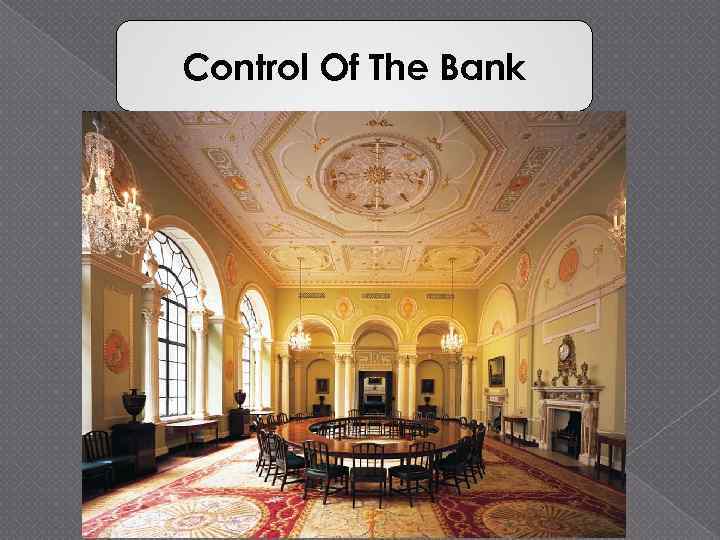
Control Of The Bank
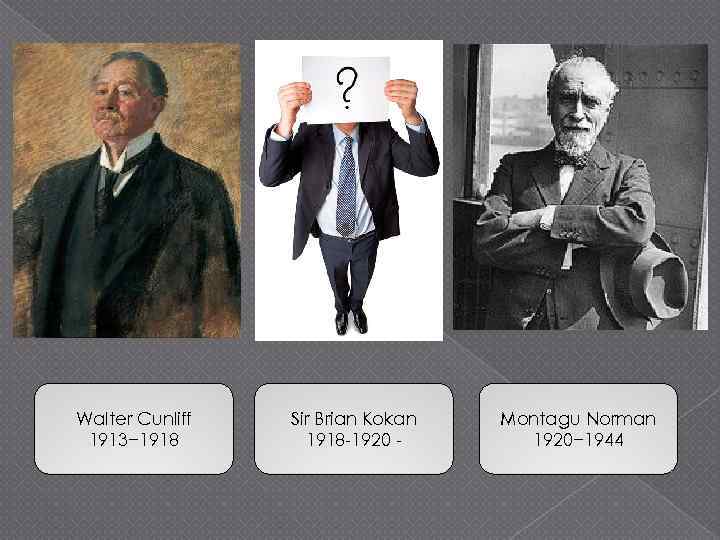
Walter Cunliff 1913− 1918 Sir Brian Kokan 1918 -1920 - Montagu Norman 1920− 1944
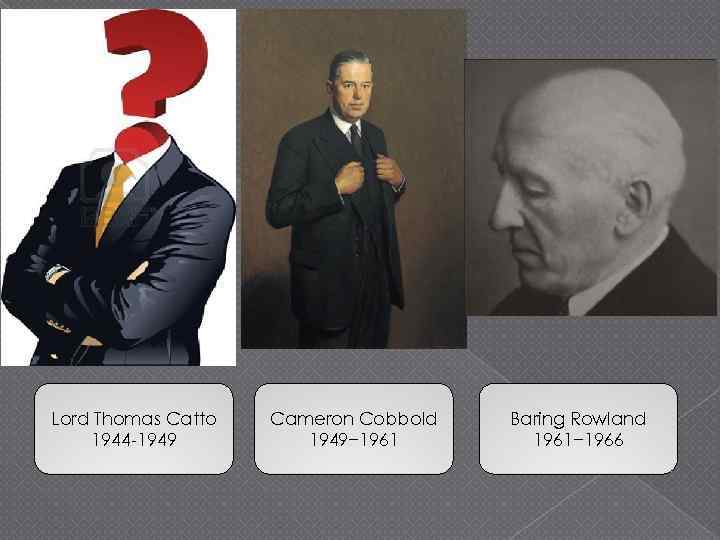
Lord Thomas Catto 1944 -1949 Cameron Cobbold 1949− 1961 Baring Rowland 1961− 1966
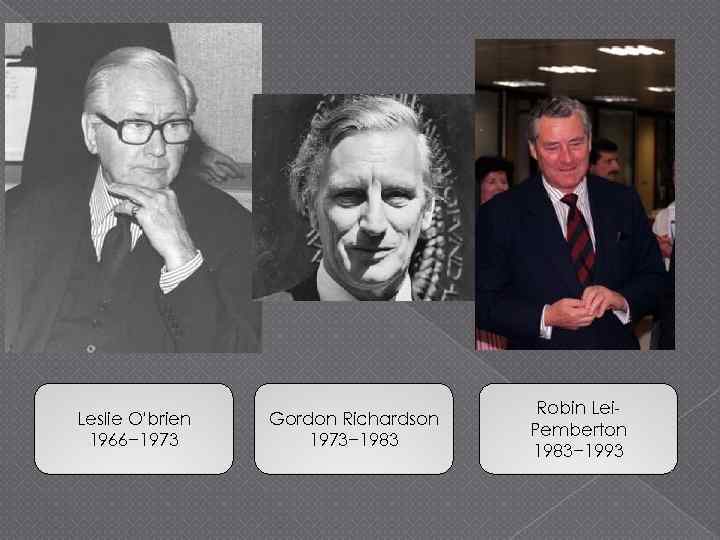
Leslie O'brien 1966− 1973 Gordon Richardson 1973− 1983 Robin Lei. Pemberton 1983− 1993
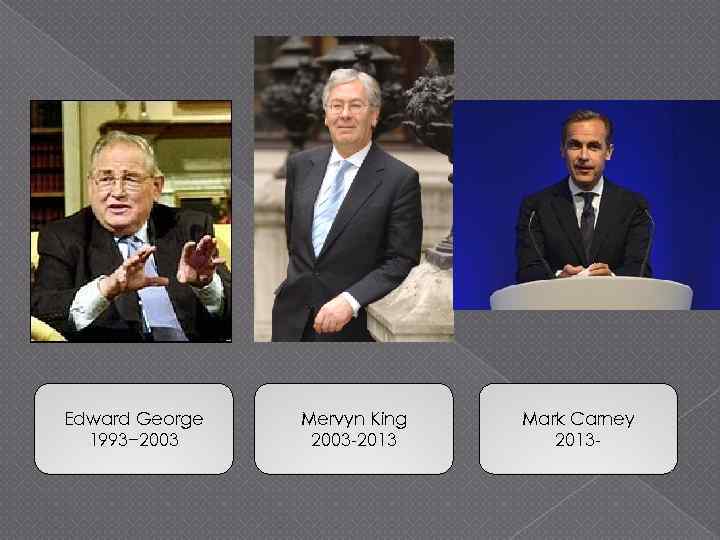
Edward George 1993− 2003 Mervyn King 2003 -2013 Mark Carney 2013 -

Function
The Bank of England performs all the functions of a Central Bank. The most important of them assumes maintaining price stability and supporting the economic policy of the Government to ensure economic growth. To this end, the Bank solves the problem in the following key areas: § Maintaining exchange rate stability and the purchasing power of the national currency (the pound sterling). To ensure this goal is the correct policy interest rates, implying that actual situation inflation target (2012 - 2 % per annum), which is determined by the government. § Maintaining stability of the financial system, both domestic and global. § Ensuring financial stability implies a threat to the entire financial system. Threats are investigated by regulators and analytical services of the Bank. Threats are eliminated by financial and other operations, as in the national market and abroad. In exceptional cases, the Bank may act as a "lender of last resort". § Ensuring the efficiency of the financial sector in the UK.
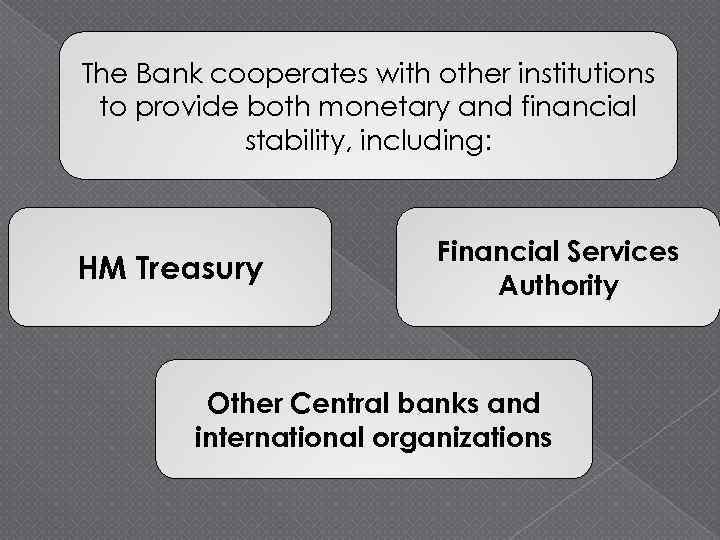
The Bank cooperates with other institutions to provide both monetary and financial stability, including: HM Treasury Financial Services Authority Other Central banks and international organizations
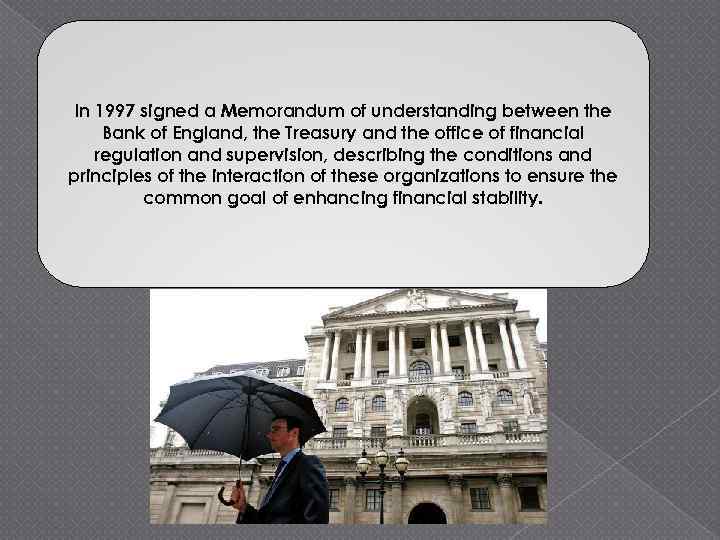
In 1997 signed a Memorandum of understanding between the Bank of England, the Treasury and the office of financial regulation and supervision, describing the conditions and principles of the interaction of these organizations to ensure the common goal of enhancing financial stability.
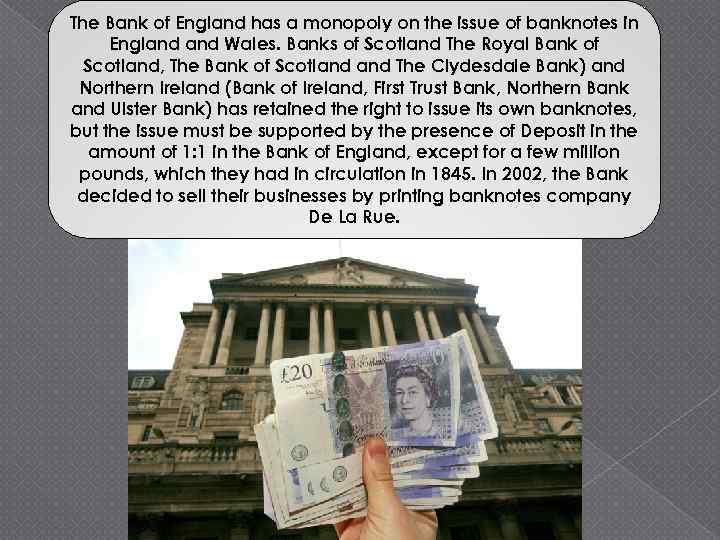
The Bank of England has a monopoly on the issue of banknotes in England Wales. Banks of Scotland The Royal Bank of Scotland, The Bank of Scotland The Clydesdale Bank) and Northern Ireland (Bank of Ireland, First Trust Bank, Northern Bank and Ulster Bank) has retained the right to issue its own banknotes, but the issue must be supported by the presence of Deposit in the amount of 1: 1 in the Bank of England, except for a few million pounds, which they had in circulation in 1845. In 2002, the Bank decided to sell their businesses by printing banknotes company De La Rue.
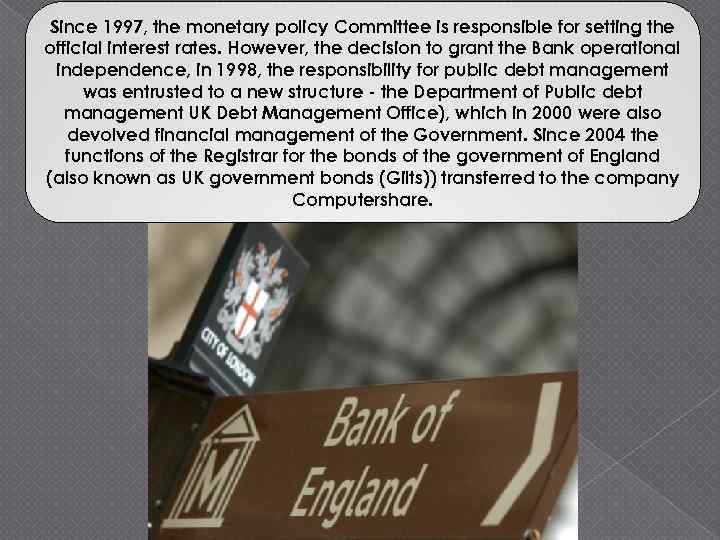
Since 1997, the monetary policy Committee is responsible for setting the official interest rates. However, the decision to grant the Bank operational independence, in 1998, the responsibility for public debt management was entrusted to a new structure - the Department of Public debt management UK Debt Management Office), which in 2000 were also devolved financial management of the Government. Since 2004 the functions of the Registrar for the bonds of the government of England (also known as UK government bonds (Gilts)) transferred to the company Computershare.
Скачать презентацию Bank of England Governor and Company of the
ПРЕЗЕНТАЦИЯ БАНК АНГЛИИ. ПОНОМАРЕВ А.О..pptx