 Скачать презентацию Banff State Dept of Ultrarelativistic Jets GRBs 101
e23bef7d45543eb271baf7962ad7048d.ppt
- Количество слайдов: 40



Banff State Dept of Ultrarelativistic Jets GRBs 101 Practice Final Exam Time 1 hr Collaboration Allowed
Sample Questions • • What have GRB observers done for us lately? Compare and contrast: GRB, AGN, PWN, GSL, SGR, YSO Distinguish temporally short and long bursts Define thoughtfully: jet, pancake? Why are jets thought to be fluid dynamical? How do black holes work? Why has it taken so long to develop GRMHD codes? Describe carefully the chain of events that leads to a magnetar explosion • Discuss prophetically what we will learn in the future about GRB
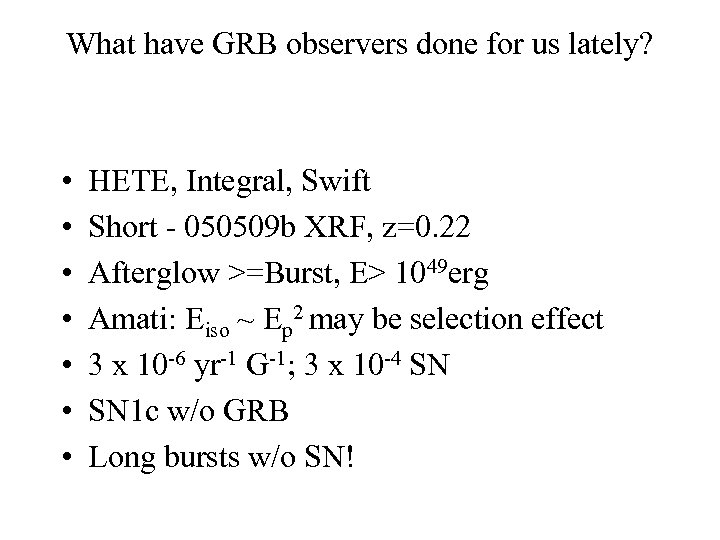
What have GRB observers done for us lately? • • HETE, Integral, Swift Short - 050509 b XRF, z=0. 22 Afterglow >=Burst, E> 1049 erg Amati: Eiso ~ Ep 2 may be selection effect 3 x 10 -6 yr-1 G-1; 3 x 10 -4 SN SN 1 c w/o GRB Long bursts w/o SN!
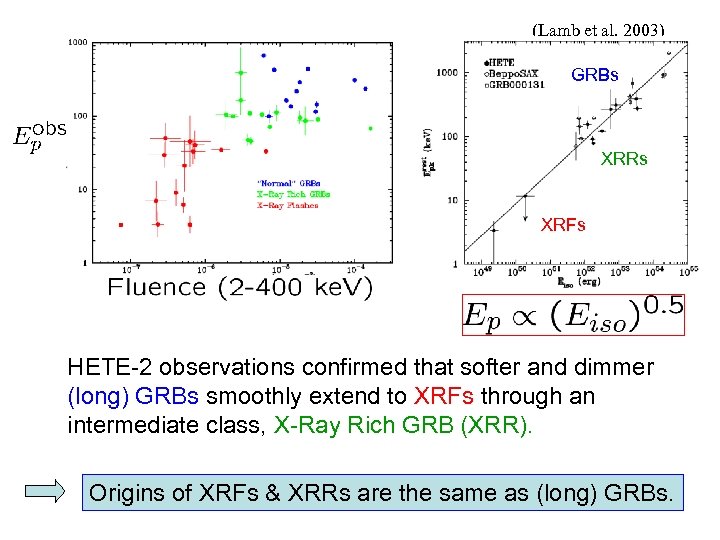
(Lamb et al. 2003) GRBs XRRs XRFs HETE-2 observations confirmed that softer and dimmer (long) GRBs smoothly extend to XRFs through an intermediate class, X-Ray Rich GRB (XRR). Origins of XRFs & XRRs are the same as (long) GRBs.
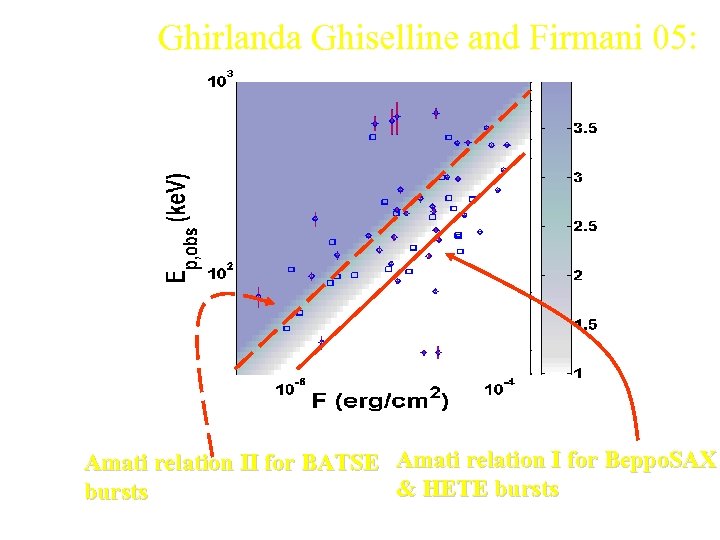
Ghirlanda Ghiselline and Firmani 05: Amati relation II for BATSE Amati relation I for Beppo. SAX & HETE bursts
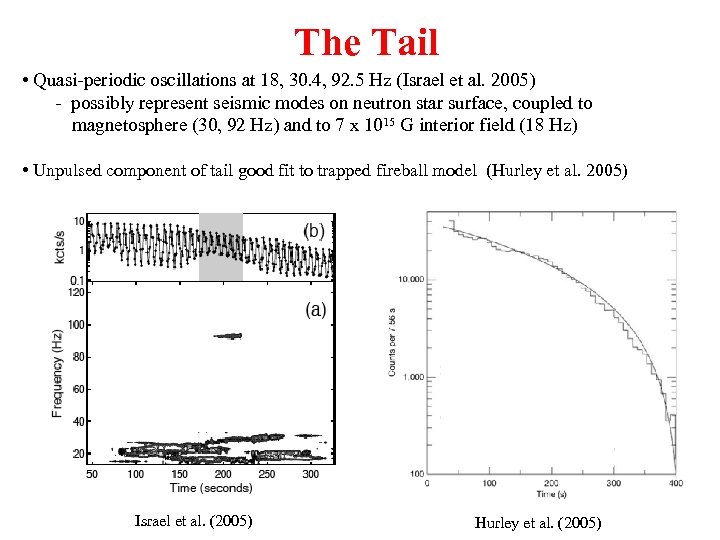
The Tail • Quasi-periodic oscillations at 18, 30. 4, 92. 5 Hz (Israel et al. 2005) - possibly represent seismic modes on neutron star surface, coupled to magnetosphere (30, 92 Hz) and to 7 x 10¹⁵ G interior field (18 Hz) • Unpulsed component of tail good fit to trapped fireball model (Hurley et al. 2005) Israel et al. (2005) Hurley et al. (2005)
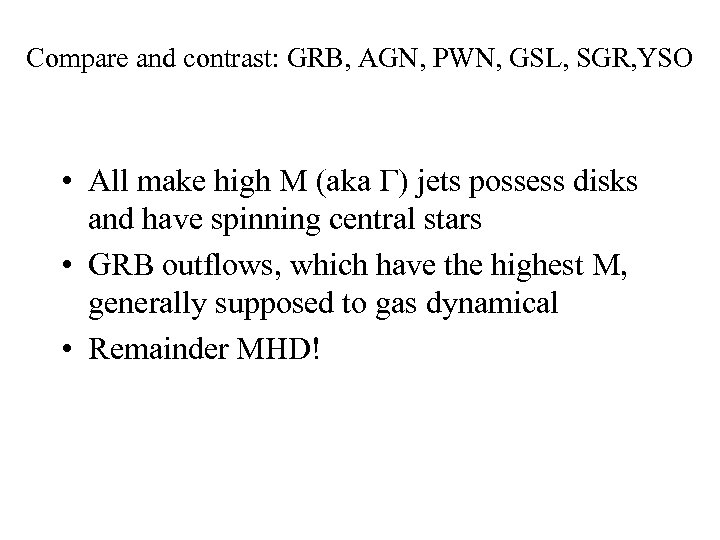
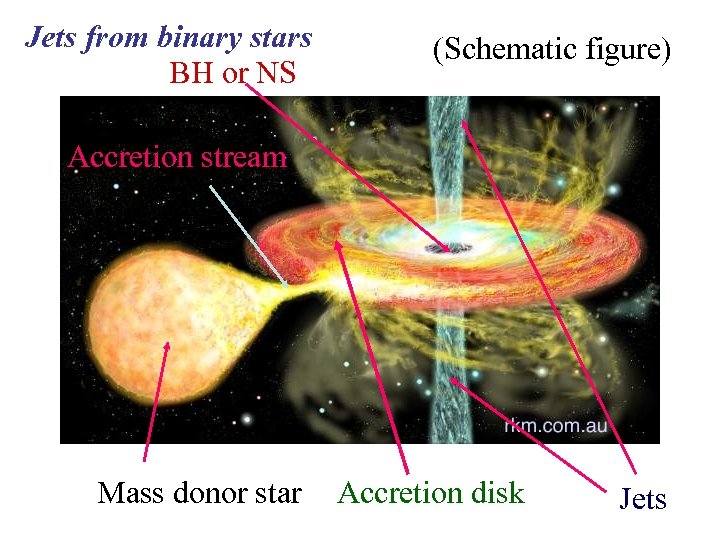
Compare and contrast: GRB, AGN, PWN, GSL, SGR, YSO • All make high M (aka ) jets possess disks and have spinning central stars • GRB outflows, which have the highest M, generally supposed to gas dynamical • Remainder MHD!
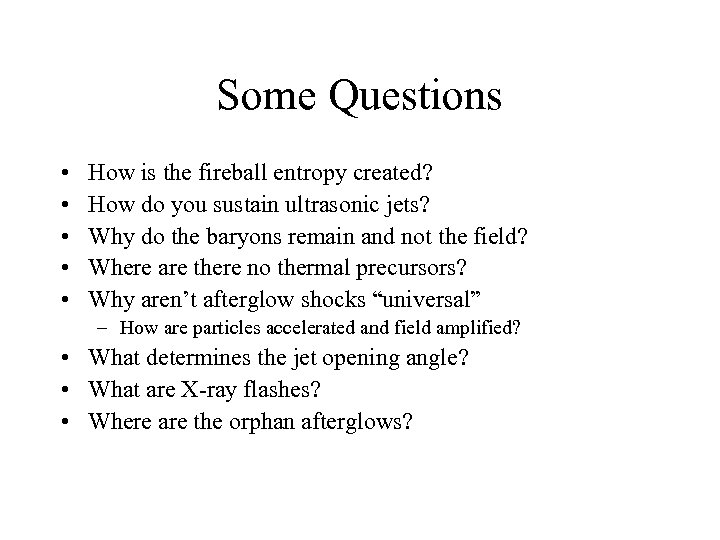
Some Questions • • • How is the fireball entropy created? How do you sustain ultrasonic jets? Why do the baryons remain and not the field? Where are there no thermal precursors? Why aren’t afterglow shocks “universal” – How are particles accelerated and field amplified? • What determines the jet opening angle? • What are X-ray flashes? • Where are the orphan afterglows?
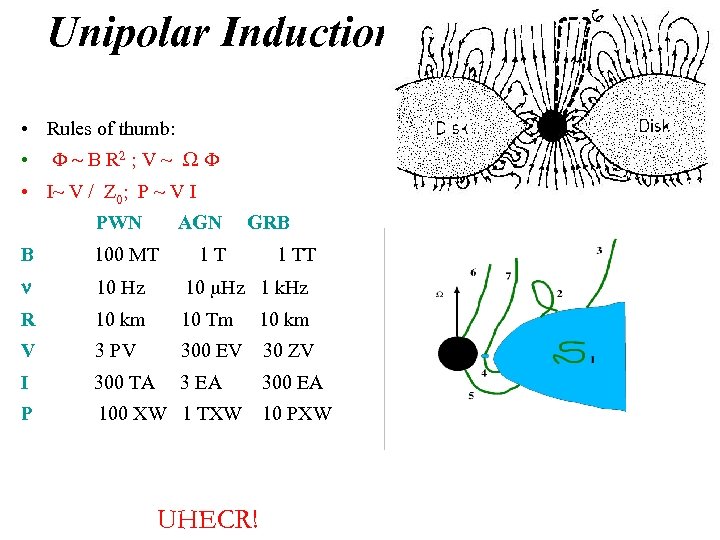
Unipolar Induction • Rules of thumb: • F ~ B R 2 ; V ~ W F • I~ V / Z 0; P ~ V I PWN AGN GRB B 100 MT 1 T n 10 Hz 1 k. Hz R 10 km 10 Tm 10 km V 3 PV 300 EV 30 ZV I 300 TA 3 EA 300 EA P 100 XW 1 TXW UHECR! 1 TT 10 PXW
Distinguish temporally short and long bursts • May be essentially similar – Orientation – Inhomogensity • Short bursts could be – Millisecond magnetars – NS binaries – …. • Swift!
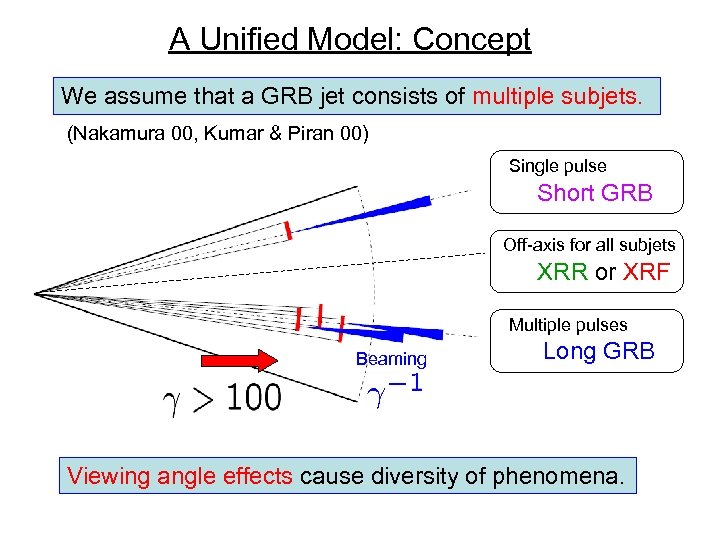
A Unified Model: Concept We assume that a GRB jet consists of multiple subjets. (Nakamura 00, Kumar & Piran 00) Single pulse Short GRB Off-axis for all subjets XRR or XRF Multiple pulses Beaming Long GRB Viewing angle effects cause diversity of phenomena.
Define carefully jet, pancake? • Jets are 4 time longer than they are wide in the rest frame (Bridle)
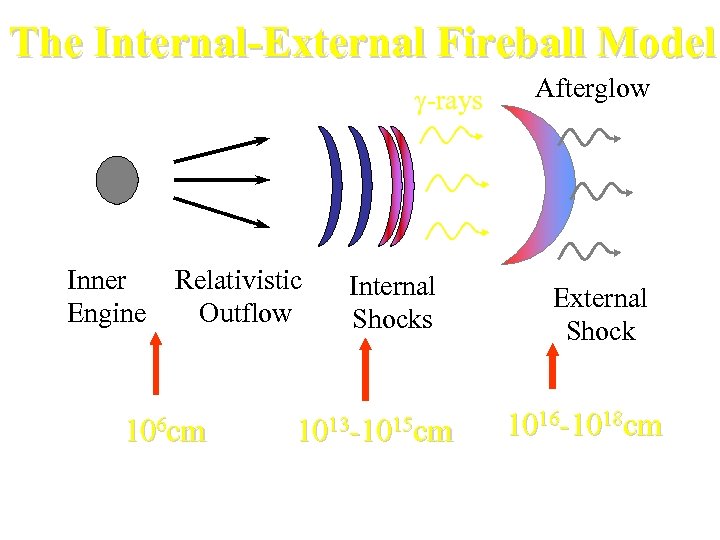
The Internal-External Fireball Model -rays Inner Engine Relativistic Outflow 106 cm Internal Shocks 1013 -1015 cm Afterglow External Shock 1016 -1018 cm
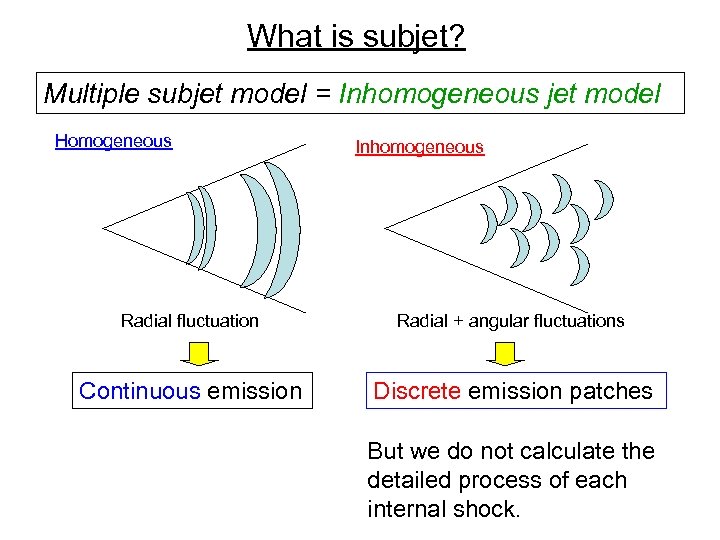
What is subjet? Multiple subjet model = Inhomogeneous jet model Homogeneous Inhomogeneous Radial fluctuation Radial + angular fluctuations Continuous emission Discrete emission patches But we do not calculate the detailed process of each internal shock.
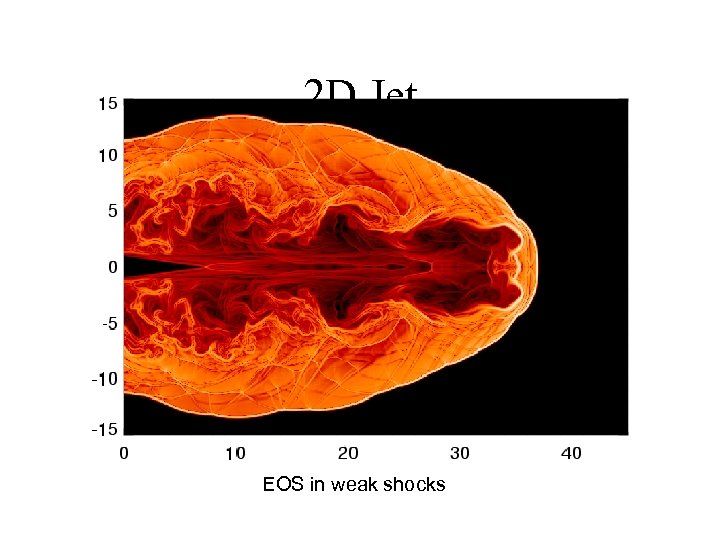
2 D Jet EOS in weak shocks
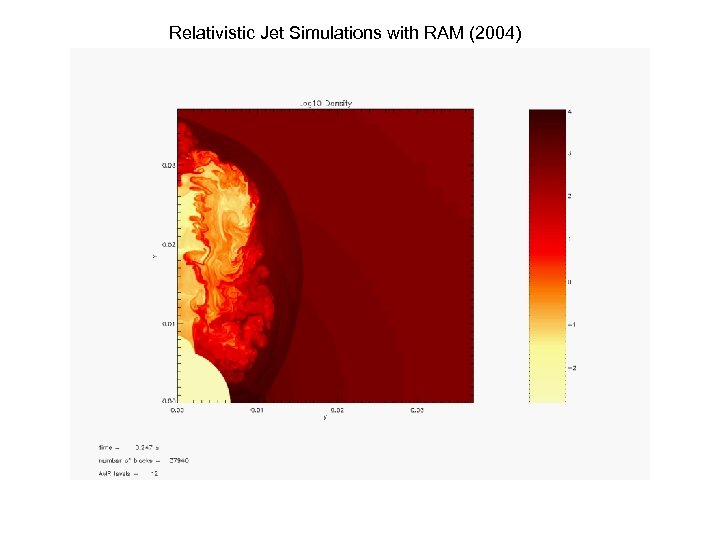
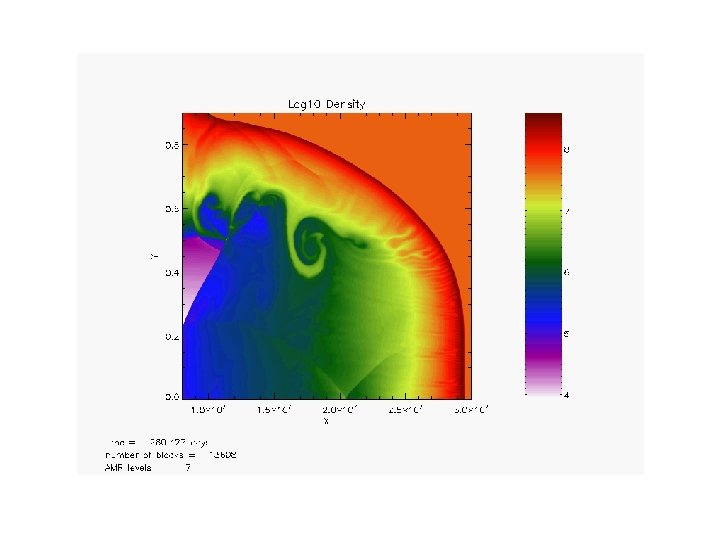
Relativistic Jet Simulations with RAM (2004)
Why are jets thought to be fluid dynamical? • Occam! • FD much easier than MHD/EM – Plenty hard enough - RAM • Ignorance • May be right
Early optical emission ( t-2) + radio flare: • 1 bursts Early optical emission ( t-2) - no radio detection: • 2 bursts Early radio flare - no early optical observations: • 2 bursts Early optical emission that do not decay as t-2 • 4 bursts Tight upper limits (R>17 mag) on any early (t<100 sec) optical emission: • 6 bursts (all are faint; fluence ≤ 10 -6 erg/cm 2)
Electromagnetic GRB Model ØGravitational binding energy=>EM energy flux RB + Lyutikov Organized Poynting flux (disorganized also possible) Ø VEM=E/B ~ c Ø acceleration -> ~100, M < 1 ØPairs combine, gammas escape, E, B dominate ØPoynting flux catches shocked circumstellar medium ~ 1016 cm ØElectromagnetic Form regions with E>B; pairs accelerated Ø Relativistic internal motions Ø GRB Ø ØSweep up ISM at ~ 1017 cm Field incorporated from magnetic piston, shock acceleration Ø Anisotropic afterglow Ø at
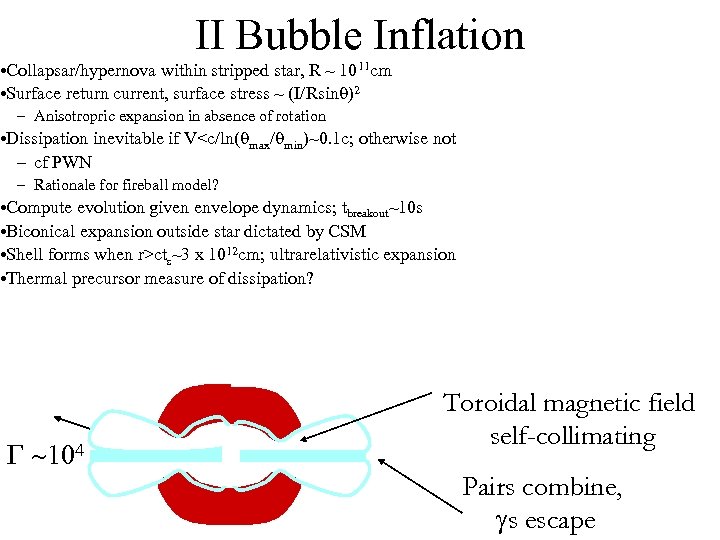
II Bubble Inflation • Collapsar/hypernova within stripped star, R ~ 1011 cm • Surface return current, surface stress ~ (I/Rsinq)2 – Anisotropric expansion in absence of rotation • Dissipation inevitable if V<c/ln(qmax/qmin)~0. 1 c; otherwise not – cf PWN – Rationale for fireball model? • Compute evolution given envelope dynamics; tbreakout~10 s • Biconical expansion outside star dictated by CSM • Shell forms when r>cts~3 x 1012 cm; ultrarelativistic expansion • Thermal precursor measure of dissipation? ~104 Toroidal magnetic field self-collimating Pairs combine, s escape
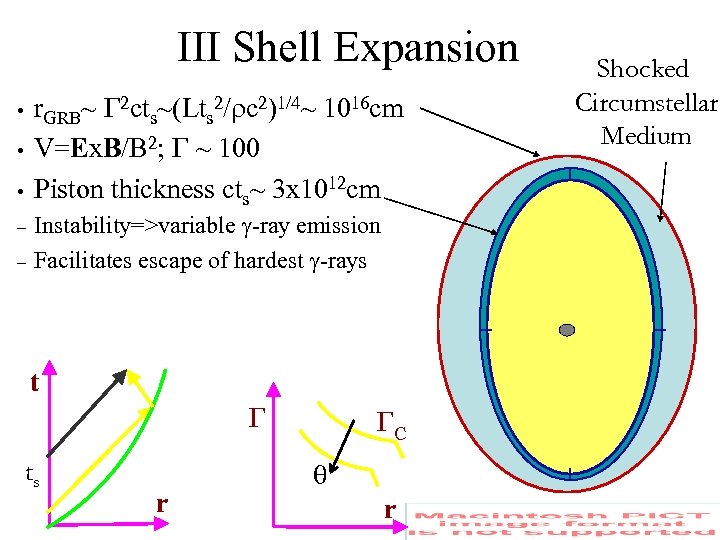
III Shell Expansion 2 cts~(Lts 2/rc 2)1/4~ 1016 cm V=Ex. B/B 2; ~ 100 Piston thickness cts~ 3 x 1012 cm • r. GRB~ • • – – Instability=>variable -ray emission Facilitates escape of hardest -rays t ts r C q r Shocked Circumstellar Medium
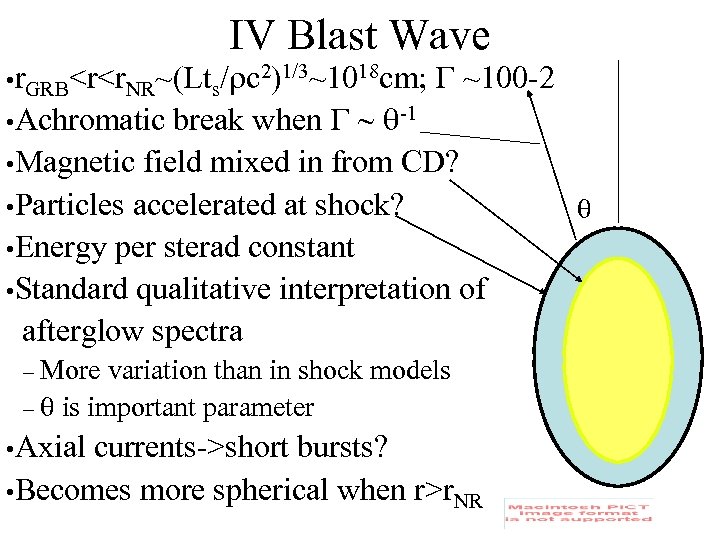
IV Blast Wave • r. GRB<r<r. NR~(Lts/rc 2)1/3~1018 cm; ~100 -2 break when ~ q-1 • Magnetic field mixed in from CD? • Particles accelerated at shock? • Energy per sterad constant • Standard qualitative interpretation of afterglow spectra • Achromatic – More variation than in shock models – q is important parameter • Axial currents->short bursts? • Becomes more spherical when r>r. NR q
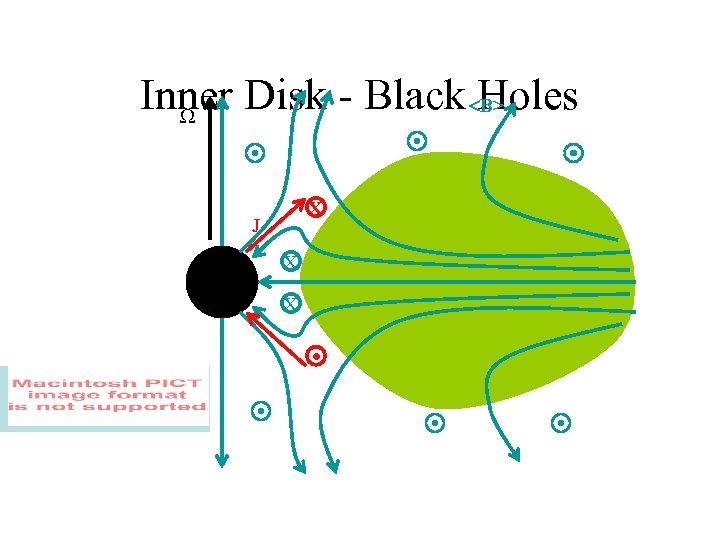
How do black holes work? • Background geometry for disk dynamics • Modify EM => Energy extraction from spacetime as well as gas • Create anisotropic Maxwell tensor
Jets from binary stars BH or NS (Schematic figure) Accretion stream Mass donor star Accretion disk Jets
Archimedean Disks • rout ~ (c/vout)2 rin ~106 rin. Net radial field Conservative disk Ignore irradiation, self-gravitation etc Magnetic pressure dominates and field lines escape
Inner Disk - Black B> Holes W X J X X .
Pictor A Wilson et al Electromagnetic Transport 1018 not 1017 A DC not AC No internal shocks New particle acceleration mechanisms Current Flow Nonthermal emission is ohmic dissipation of current flow? Pinch stabilized by velocity gradient Equipartition in core
Why has it taken so long to develop GRMHD codes? • It’s hard
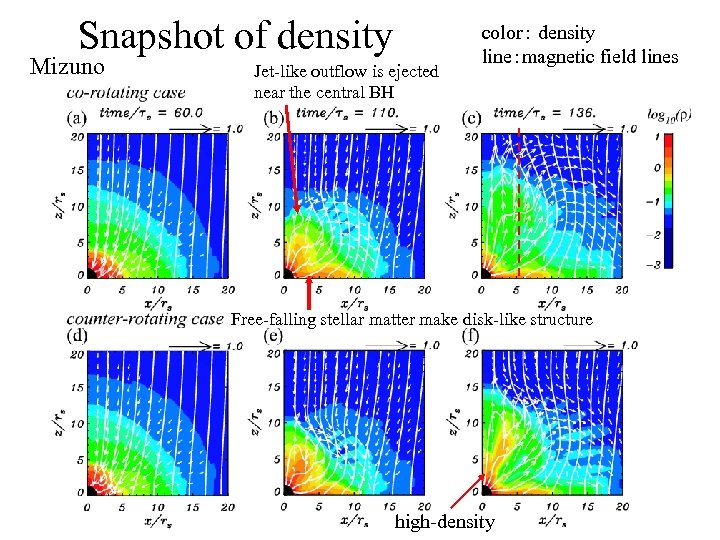
Snapshot of density Mizuno Jet-like outflow is ejected near the central BH color: density line:magnetic field lines Free-falling stellar matter make disk-like structure high-density
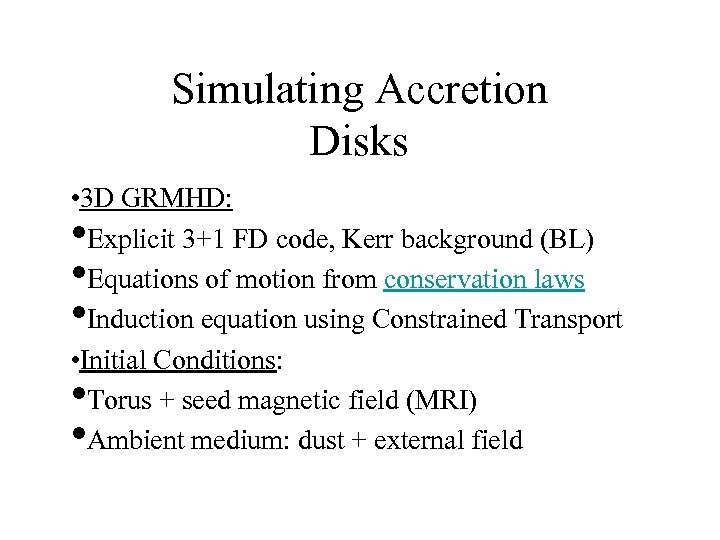
Simulating Accretion Disks • 3 D GRMHD: Explicit 3+1 FD code, Kerr background (BL) Equations of motion from conservation laws Induction equation using Constrained Transport • Initial Conditions: Torus + seed magnetic field (MRI) Ambient medium: dust + external field • • •
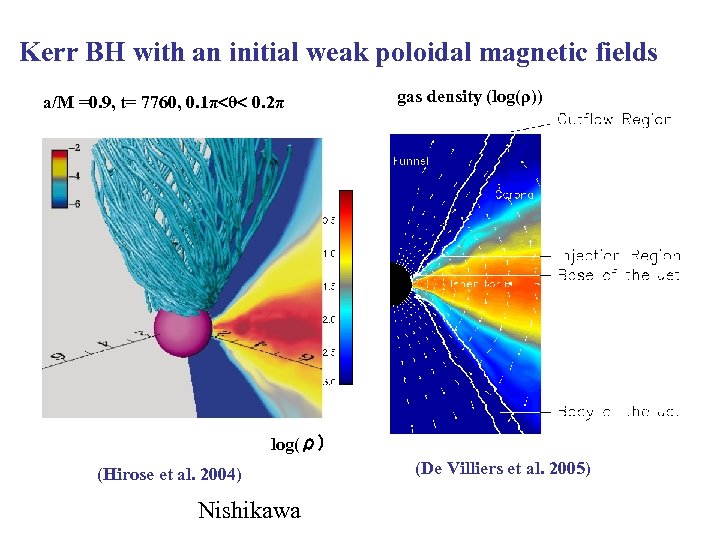
Kerr BH with an initial weak poloidal magnetic fields a/M =0. 9, t= 7760, 0. 1π θ 0. 2π gas density (log(ρ)) log(ρ) (Hirose et al. 2004) Nishikawa (De Villiers et al. 2005)
Describe carefully the chain of events that leads to a magnetar explosion • Release of magnetic energy into magnetosphere • Dissipation • Relativistic Outflow • Blast Wave • Afterglow
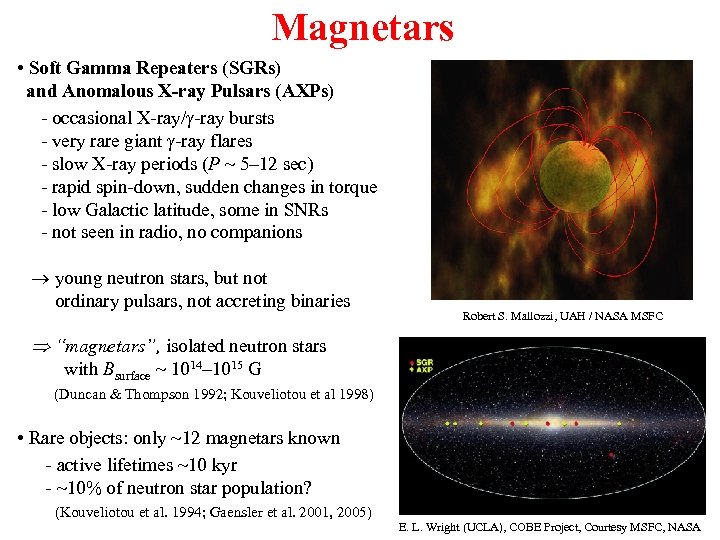
Magnetars • Soft Gamma Repeaters (SGRs) and Anomalous X-ray Pulsars (AXPs) - occasional X-ray/ -ray bursts - very rare giant -ray flares - slow X-ray periods (P ~ 5– 12 sec) - rapid spin-down, sudden changes in torque - low Galactic latitude, some in SNRs - not seen in radio, no companions young neutron stars, but not ordinary pulsars, not accreting binaries Robert S. Mallozzi, UAH / NASA MSFC “magnetars”, isolated neutron stars with Bsurface ~ 1014– 1015 G (Duncan & Thompson 1992; Kouveliotou et al 1998) • Rare objects: only ~12 magnetars known - active lifetimes ~10 kyr - ~10% of neutron star population? (Kouveliotou et al. 1994; Gaensler et al. 2001, 2005) E. L. Wright (UCLA), COBE Project, Courtesy MSFC, NASA
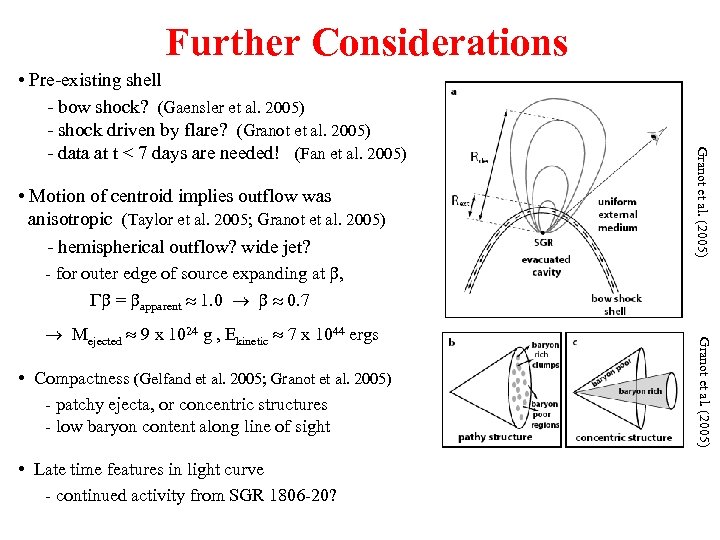
Further Considerations • Motion of centroid implies outflow was anisotropic (Taylor et al. 2005; Granot et al. 2005) - hemispherical outflow? wide jet? - for outer edge of source expanding at , = apparent 1. 0 0. 7 • Compactness (Gelfand et al. 2005; Granot et al. 2005) - patchy ejecta, or concentric structures - low baryon content along line of sight • Late time features in light curve - continued activity from SGR 1806 -20? Granot et al. (2005) Mejected 9 x 1024 g , Ekinetic 7 x 1044 ergs Granot et al. (2005) • Pre-existing shell - bow shock? (Gaensler et al. 2005) - shock driven by flare? (Granot et al. 2005) - data at t < 7 days are needed! (Fan et al. 2005)
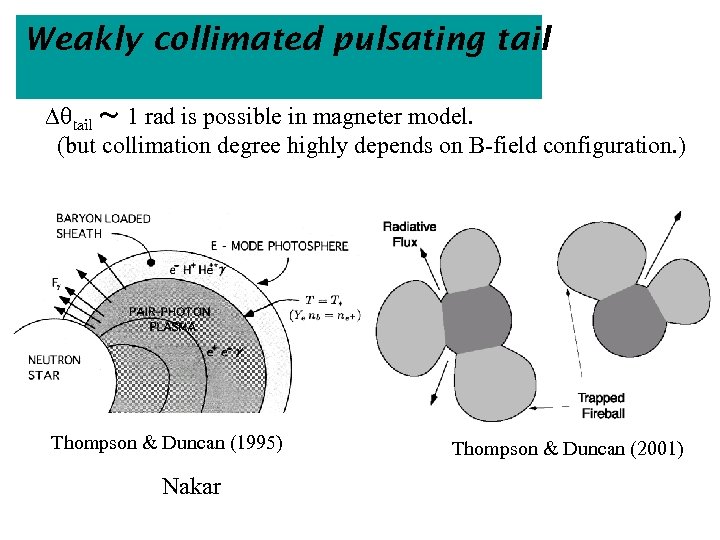
Weakly collimated pulsating tail Dqtail ~ 1 rad is possible in magneter model. (but collimation degree highly depends on B-field configuration. ) Thompson & Duncan (1995) Nakar Thompson & Duncan (2001)
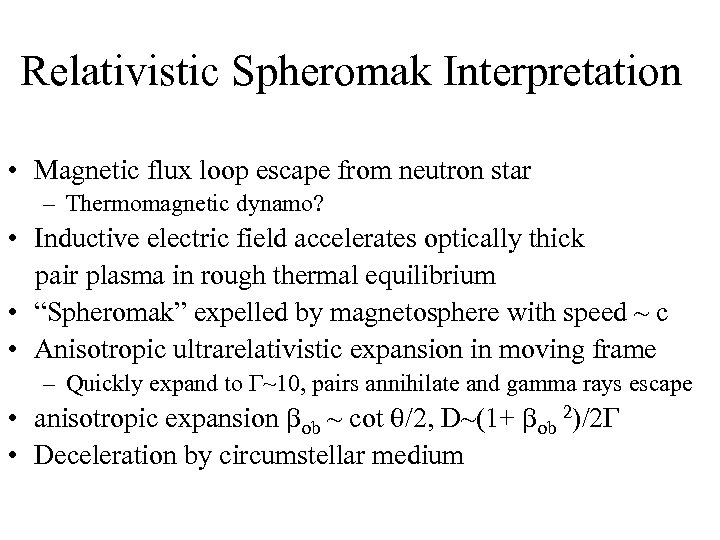
Relativistic Spheromak Interpretation • Magnetic flux loop escape from neutron star – Thermomagnetic dynamo? • Inductive electric field accelerates optically thick pair plasma in rough thermal equilibrium • “Spheromak” expelled by magnetosphere with speed ~ c • Anisotropic ultrarelativistic expansion in moving frame – Quickly expand to ~10, pairs annihilate and gamma rays escape • anisotropic expansion ob ~ cot q/2, D~(1+ ob 2)/2 • Deceleration by circumstellar medium
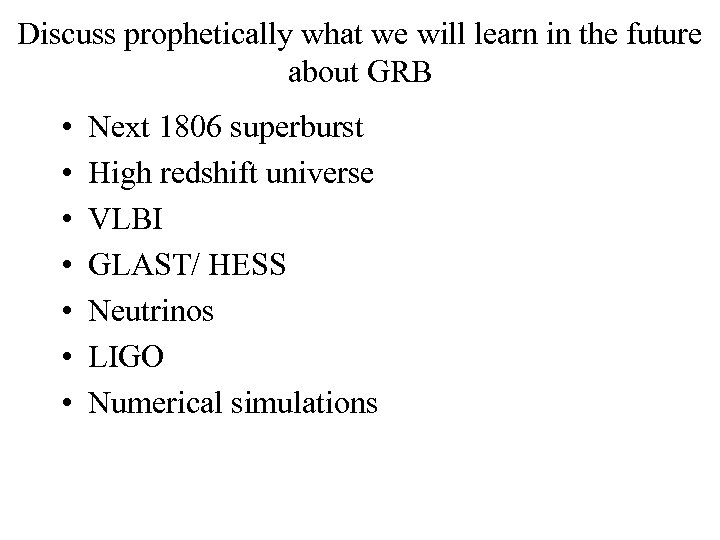
Discuss prophetically what we will learn in the future about GRB • • Next 1806 superburst High redshift universe VLBI GLAST/ HESS Neutrinos LIGO Numerical simulations

 Скачать презентацию Banff State Dept of Ultrarelativistic Jets GRBs 101
e23bef7d45543eb271baf7962ad7048d.ppt